Working Paper Number 48
November 2004
Food Security in Indonesia: Current Challenges and the Long-Run Outlook
By C. Peter Timmer
Abstract
In the long run-- over the past four decades--improvements in food security in Indonesia have generally been driven by pro-poor economic growth and a successful Green Revolution, led by high-yielding rice varieties, massive investments in rural
infrastructure, including irrigation, and ready availability of fertilizer. In the short run, food security in the country has been intimately connected to rice prices. After more than two decades of stabilizing domestic rice prices around the long-run trend of prices in the world market, Indonesia emerged from the devastating financial crisis in 1998 with domestic rice prices much higher than world prices and much higher than long-run trends of real prices in rupiahs. Although the current political rhetoric pushing for even higher prices uses food security as the rationale (i.e., they will cause greater self-sufficiency in rice), in fact few productivity gains are now available to rice farmers, so their gains will be consumers’ loses. High rice prices have a major impact on the number of individuals living below the poverty line and on the quality of their diet.
The paper reviews research on the impact of rice prices on the poor, on real wages in rural and urban areas, and on the broader macroeconomic consequences for
investments in labor-intensive manufacturing. Discussion then focuses on how political and economic circumstances have changed since price stabilization, implemented by the national food agency (Bulog), balanced the needs of producers and consumers as Indonesia’s approach to food security. The most important current challenge for the country’s future food security is re-starting rapid, pro-poor growth. An additional challenge on the horizon is the “supermarket revolution,” which is rapidly changing the basic structure of Indonesia’s food marketing system. Within a decade well over half of Indonesia’s rice is likely to be sold in supermarkets, thus transferring to the private sector a supply-management role that had historically been a public sector activity.
Food Security in Indonesia: Current Challenges and the Long-Run Outlook
C. Peter Timmer
Center for Global Development
Judging the prospects for Indonesia’s food security a decade or more from now requires judgments on three important, and larger, issues: (1) how will Indonesia be governed (i.e. the
quality of governance); (2) how will the economy respond to that governance (i.e. how “pro-poor” will economic growth be); and (3) what will happen to the world rice market? If we had a reasonably clear sense of what the outcomes would be in these three areas, it would be relatively straightforward to understand the likely outcomes for the country’s food security.
That is actually an important conclusion. At the level of development that Indonesia has reached, food security is embedded in a broader set of political, economic and technological forces. As a consequence, food security needs little specific policy attention, beyond a concern for coping with the chronically poor populations that market forces tend to leave behind. Thus, a decade from now, Indonesia’s food security will depend primarily on the rate and distribution of economic growth and targeted programs to alleviate poverty. Of course, some of these programs may well be food-oriented, because the most basic need of the poor is for food.
Will there be a further need to consider the “food” dimensions of this broader concern for social security, whether the food is from the domestic agricultural sector or from the world market? Food security is always an emotional issue, as chronic hunger, local food shortages, and sudden spikes in food prices all mobilize public sentiment to “do something.” “Food security” is the vague but still emotionally powerful concept of what the public wants with respect to these problems. However defined, food security is clearly a public good. So claims that a “time bomb” is ticking for Indonesia’s food security if rice imports are not reduced or banned
altogether have raised concerns among the general population that the country is somehow losing ground in its long-term efforts to keep rice production growing faster than domestic demand.1
Understandably, politicians reacted to these concerns, especially in the context of the parliamentary and presidential elections in 2004. For example, SiswonoYudhohusodo, former Minister of Cooperatives and the vice-presidential candidate who ran with Amien Rais on the PAN ticket in the 2004 Presidential election, has long championed very high import tariffs on rice, or even an outright ban on imports, as a way to return Indonesia to rice self-sufficiency. Rice farmers are perhaps the single largest identifiable voting bloc in Indonesia, so appealing to them is an obvious political strategy. Middle class consumers often acquiesce in these
approaches, and there is no question that rice self-sufficiency has a powerful political resonance throughout Asia. Food security—articulated in the press as self-sufficiency in domestic rice production--remains a potent idea in Indonesia, where it is, as always, a political issue.
1
See the story in the Jakarta Post, May 4, 2002, where the “time bomb” issue was first raised. For a discussion of
Lost in the recent debates has been any clear recognition that food security is primarily an economic issue, one on which a substantial analytical and empirical literature exists, for
Indonesia and in general.2 The universal conclusion from this literature is that only good
economic policies can ensure food security on a sustainable basis for both the country as a whole and the millions of households individually. From this economic perspective, the food security “time bomb” in Indonesia’s future is not potential reliance on rice imports ten years from now. Instead, the time bomb is poverty and the failure to restructure Indonesia’s economy in a way that stimulates rapid growth of productivity in both rural and urban areas, leading to higher incomes.
The Role of Rice Prices
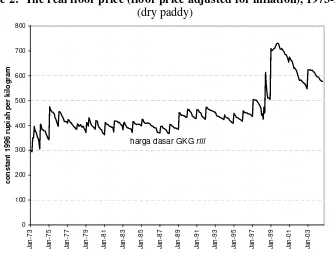
The current political approach to stimulating productivity growth is through higher tariffs on imported rice, or an outright ban on imports. However, the use of price policy to stimulate productivity growth is fraught with difficulties. Indeed, the high level of rice prices in Indonesia makes the necessary economic restructuring quite difficult. There is a great deal of confusion in the country about the level of rice prices. Many government spokesmen, private research organizations, and all representatives of farmers complain about low rice prices. Repeated and highly public efforts are made to keep cheap imported rice out of Indonesia—the Governor of East Java has repeatedly closed the port of Surabaya to ships carrying imported rice—an illegal act, but one which the Central Government has a difficult time overturning. In fact, these efforts have succeeded far beyond their legal intent or mandate. INPRES 9/2001 requires that rice import policies seek a balance between the needs of rice producers and rice consumers.3 Figures 1 and 2 show that despite this Presidential Instruction, rice prices in Indonesia are near historic
high levels when compared with long-run trends in real (deflated) rupiahs (Figure 1).
Figure 1 shows that real rice prices in Indonesia after the financial crisis were at least 30 percent higher than their stable trend from 1975 to 1996, after the country recovered from the world food crisis and before the Asian financial crisis that saw the country lose control of the entire economy, not just rice prices. During that 21-year period, real domestic rice prices were remarkably stable, although they did respond appropriately to local surpluses and deficits. Rice prices almost doubled during the financial crisis, but by mid-2002 were down somewhat from that peak. Since then they have increased again and remain far above the previous level that was regarded as “normal” for more than two decades. As Figure 2 shows, the decline in real prices
2
This general literature is reviewed in C. Peter Timmer, "The Macro Dimensions of Food Security: Economic
Growth, Equitable Distribution, and Food Price Stability," Food Policy, vol. 25, no. 4 (August 2000), pp. 283-295,
and in the Indonesian context in C. Peter Timmer, “The Meaning of Food Self-Sufficiency,” Indonesian Food
Journal, vol. 5, no. 10, 1994, pp. 33-43.
3
An INPRES, or Instruksi Presiden, is a formally issued order from the Indonesian President to all Executive
after the crisis (where rice prices are now measured as the deflated floor price for dry paddy), was reversed in January, 2003. Still, despite modest continuing declines in the real value of the official floor price because of inflation, by late in 2004 the entire structure of rice prices in Indonesia remained more than 30 percent higher in real terms than during the period of rice price stability from the mid-1970s to the mid-1990s.
Figure 1. The real price of rice, January 1969 to May 2002
0
Nominal rice price from Bulog, deflated by the CPI (indeks harga konsumen) from BPS.
Source: The nominal price of rice is reported by Bulog (medium quality rice). The CPI data are from BPS. Figure from Peter Rosner.
Figure 2: The real floor price (floor price adjusted for inflation), 1973-2004
Those “normal and stable” prices sought a balance between the interests of rice producers and consumers. They were adequate to stimulate the increases in rice production in the 1980s that brought Indonesia to self sufficiency at the same time that rice consumption increased dramatically, especially among the poor. This achievement, it should be recognized, was caused by a rice price stabilization policy, not by running up real prices to make rice farming more profitable. Rice profitability came primarily from new technology, massive irrigation
investments, and cheap fertilizer. Stable, not high, rice prices gave farmers confidence to make the necessary investments to raise productivity. Stable rice prices allowed consumers access to the additional rice produced.
The situation at the start of the SBY government is totally different. Even with the incentives provided by very high rice prices in historical terms, farmers cannot raise productivity of rice cultivation very much because they do not have new technology available. Even higher rice prices will not generate that technology or raise productivity. Higher rice prices in this environment produce a zero sum outcome—any increase in rice farmers’ incomes will be lost as rice consumers must pay higher prices.4 There is no “spread effect” or multiplier without productivity gains; real wages will not be pulled up by extra demand from rice farmers—that demand is neutralized by the higher rice prices. Consequently, the desirability of using higher rice prices to improve the incomes of rice farmers, and thus win their political allegiance, must be set against the losses to rice consumers, many of whom are quite poor. The available evidence, reviewed below, suggests that the current political environment in Jakarta, which is pushing vigorously for higher rice prices, is heading Indonesian rice policy toward a disaster for the poor, who always bear the brunt of bad economics.
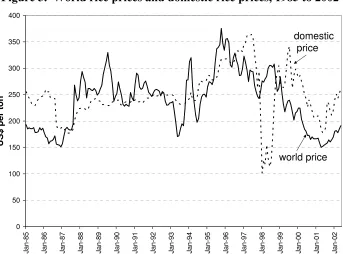
Figures 3 and 4 put the Indonesian rice price in an international perspective. Rice is a tradable commodity and Indonesia has been a substantial importer from world markets for the past half century, except for several years in the mid-1980s when self sufficiency was
temporarily achieved. Especially during the years when Bulog was successful in stabilizing domestic rice prices—from 1975 to 1996—a conscious effort was made to keep domestic rice prices on the long-run trend of world prices. There were two reasons for this policy. First, the world price represents the opportunity cost of rice to the Indonesian economy and economic efficiency requires that domestic and world prices track each other over extended periods of time.5 Second, in the astute words of an early observer of Indonesian economics, “God meant Indonesia for free trade.” Because of the country’s long and porous coastline, close to several major rice exporting ports, it is nearly impossible for Indonesia’s domestic rice price to be kept substantially above or below prices in those ports for extended periods of time.
4
In fact, when Indonesian rice prices are above world prices for extended periods of time, and there are no
productivity gains, this is a negative sum game because of the efficiency losses from forgone gains to trade. The
circumstances when such price deviations create economic losses are discussed at length in C. Peter Timmer,
Getting Prices Right: The Scope and Limits of Agricultural Price Policy, Cornell University Press, Ithaca, NY.
(1986).
5
There are no similar efficiency arguments for following world prices on a day-to-day basis. See C. Peter Timmer,
“Food Price Stabilization: Rationale, Design, and Implementation,” in Perkins and Roemer, eds. Reforming
Figure 3. World rice prices and domestic rice prices, 1985 to 2002
0 50 100 150 200 250 300 350 400
Jan-85 Jan-86 Jan-87 Jan-88 Jan-89 Jan-90 Jan-91 Jan-92 Jan-93 Jan-94 Jan-95 Jan-96 Jan-97 Jan-98 Jan-99 Jan-00 Jan-01 Jan-02
US$
pe
r ton
world price domestic price
Note: The world price is the price of Thai 15 percent broken rice, f.o.b. Bangkok. The domestic price is the price of medium quality rice reported by Bulog. The domestic price is adjusted to the world price using a wholesale-retail markup of 10 percent, a $20 per ton charge for movement from Bangkok to the Jakarta wholesale market, and the average monthly exchange rate for the rupiah as reported by Bank Indonesia.
Source: World price (Thai 15 percent broken f.o.b. Bangkok) from TheRice Trader. Domestic price from
Bulog. Figure from Peter Rosner.
From 2000 until early 2004, Indonesia’s rice prices were at very high levels compared with imports. In the Jakarta market in mid-May, 2002, retail prices were twice as high as for
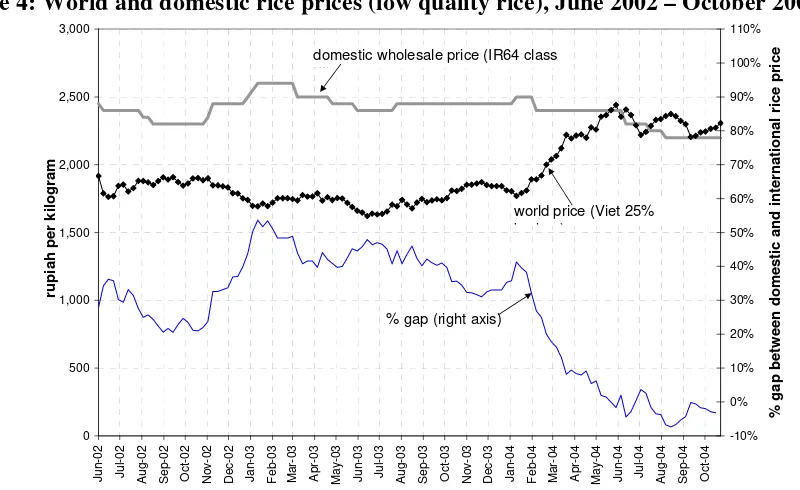
comparable qualities of rice imported from India (when Indian prices were extremely low, as the Food Corporation of India sought to get rid of surplus stocks).6 In March, 2004, the Minister of Trade and Industry placed a complete ban on rice imports “during the main rice harvest,” leaving it to the Minister of Agriculture to signal the end of the harvest. No such signal had arrived by November, although the harvest had ended in May and world rice prices had increased by 25 percent from their low point in 2003. Despite the import ban, because of the run-up in prices in world rice markets in 2004, there is now near-parity between Indonesian rice prices and levels in world markets (Figure 4). This fortuitous parity between domestic and world prices offers a short-run window of opportunity to restructure domestic rice price policy around more reliable interaction with the world market and fewer politically-driven market interventions.
Whether because of import tariffs, seasonal bans on imports, or the risks of fluctuating currency rates and the clear antipathy of local governors to having imported rice in their
provinces, Indonesia’s domestic rice price is high in real terms and, until just recently, was much higher than the world price. As noted, current political rhetoric favors even higher rice prices.
6
Indonesia’s political parties, just as those in the United States, Europe, and Japan, are competing for farmers’ support in the name of food security and higher incomes for family farms. The costs of this competition are horrendous to consumers, taxpayers, or both. The costs in the United States are foregone budget priorities. With considerable blame also attributed to farm policies in Europe and Japan, a further result is badly distorted world markets for staple food commodities. Apart from the budget and consumer costs, Europe and Japan also incur a cost for their high farm prices through macroeconomic distortions and somewhat slower economic growth. However, the farm sector in the United States is not large enough to have much macroeconomic impact, because GDP originating on farms in the U.S. was just 0.8 percent of total GDP in 2001. The costs in Indonesia, unfortunately, are more tragic—more people in poverty, more hunger and malnutrition, and significantly slower economic growth with worse distribution.
Figure 4: World and domestic rice prices (low quality rice), June 2002 – October 2004
0
Note: The spread for medium quality rice is slightly higher but the trend is similar.
The domestic price is the price of IR64 III rice in the Jakarta wholesale market (PIBC). The world price is the price of Vietnamese 25% broken rice. The f.o.b. world price has been adjusted to the Jakarta market by adding $20/ton for freight and insurance, multiplying by the exchange rate, and adding Rp 150/kg for the c.i.f. – wholesale markup. Figure from Peter Rosner.
Three interconnected arguments are made to support higher prices.7 First, subsidies to United States rice growers and exports cause lower world prices and make them “unfair;” second, an historically thin and unstable world rice market makes it risky to rely on imports for domestic food security; and third, a slowdown in the growth of Indonesian rice production has returned the country to importer status. The link among the three arguments is the rice price, and this link is established through the following logic: U.S. farm subsidies drive down the world price (with the U.S. intending to monopolize the world rice market according to some conspiracy theories, despite selling less than 10 percent of the rice traded in world markets), forcing Asian rice producers out of business by reducing profitability of growing rice, thus making the world market even more unreliable. In this view, the response by Indonesia to such a strategy should be higher domestic rice prices, encouraging rice self-sufficiency and food security, to be implemented by isolating Indonesia’s rice market from the world market.
The political appeal of these arguments is obvious, especially because there will be large profits to be made by Bulog in executing the strategy. But the arguments are wrong on three counts. First, they do not take account of the role of higher rice prices on the level of poverty in the country; second, they fail to recognize the full macroeconomic impact of high (and higher) rice prices on both the rate of economic growth and its distribution; and third, ironically, they fail to recognize the crucial role of international trade in rice in Indonesia’s own food security (and the trivial role that U.S. rice exports play in both). These problems are taken up in turn.
A. Rice Prices and Poverty
Rice is the most important commodity in Indonesia, especially for the poorest members of society. It is not surprising that, in the short run, the level of rice prices is the single most important determinant of poverty at the household level. The typical Indonesian household gets over half of its food energy from rice, and expends about ten percent of it income procuring it. Poor households allocate 20-25 percent of their total expenditures to rice.
In the long run, rice prices also exert significant influence on the pace of poverty alleviation by conditioning the rate of economic growth. This growth is the main cause of the structural transformation—the gradual decline of agriculture as a relative share of the economy and the relative growth of industry and modern services. Sectoral contributions to economic growth and to the structural transformation, e.g. the role of agriculture, must be understood in the context of this long-run process of economic restructuring.
In the short run, the effect of rice prices on the poverty of individual households hinges on the household’s status as a net buyer or seller of rice. High prices clearly benefit net sellers of rice, and the larger are net sales the larger are the benefits. Low prices benefit net buyers of rice, especially those who do not produce any rice at all. This is the classic food price policy
dilemma, and it is never a problem that is easily resolved.8
7
The underlying political economy of these arguments is discussed in the final section.
8
This dilemma provided the integrating analytical theme for Food Policy Analysis, by Timmer, Falcon and Pearson
Urban dwellers are net buyers of rice. This group includes the wealthiest members of society, but wealthy households are only a small fraction of urban households. In addition to the urban middle class, there are large numbers of urban poor. Rice accounts for a substantial portion of total expenditures of these poor households. In normal times (pre-crisis), rice
constitutes 20 percent of total expenditures for the poorest quarter of urban households. For the poorest 5 percent, this share rises to 25 percent (and it was even higher at the peak of the crisis).9
The share of the population living in urban areas is also growing over time, another manifestation of the structural transformation. During the 1990s, the level of the rural population was virtually stagnant, but the urban population grew at a rate of about 4.5 percent per year. Because of this differential population growth, the share of the poor that reside in urban areas is growing over time as well.
Although the relative importance of the urban poor is growing, the majority of the poor resides in rural areas and will for a long time to come. In rural areas, the most important
productive asset is land, and land ownership is a key determinant of both wealth and whether any particular household is a net buyer or seller of rice. On Java, 45 percent of all rural households do not own any land other than perhaps a house plot. While not all of these households are poor, the great majority of them are in the lower rungs of the income distribution. Another 20 percent own less than one-quarter hectare of land, which is just enough to provide the average per capita consumption of rice for a family of five (if all the land is planted to rice and not to other crops).
Together, these two groups account for nearly two-thirds of rural households on Java. By and large, they are much poorer than farmers with larger amounts of land, and they are not likely to be net sellers of rice. For these households, lower rice prices mean higher real incomes and less poverty.
Indonesia’s larger landowning rice farmers are not wealthy in absolute terms, but in relative terms most of these households fall in the middle (third) quintile of the overall income distribution. On Java, only one-third of rural households own enough land to produce a surplus of rice for a family of five. These are clearly not the poorest of the poor. In fact, the image of abject poverty is of someone without enough food to eat. Almost by definition, this is not a farmer with enough land to sell a surplus of rice to the market.
It is also important to realize that, on average, land-owning, rice-surplus farmers generate only about half of their family income from growing rice. A decline in rice-based income does not lead to a proportional decline in household welfare even for these households. Indeed, their welfare depends equally on a dynamic non-rice rural economy. In summary, when urban households are included, only about 20-25 percent of Indonesia’s households are even
marginally better off from higher rice prices, and very few of these are among Indonesia’s truly poor. High rice prices hurt the poor.10
9
The 2002 SUSENAS shows that perhaps ten percent of urban households are net producers of foods (not restricted to rice). The data do not indicate whether these are urban-based landlords, or short-distance commuting farmers.
10
There is also evidence that high rice prices during the financial crisis in 1998 caused serious micro-nutrient deficiencies among small children in Central Java. See Steven A. Block, et al., “Macro Shocks and Micro
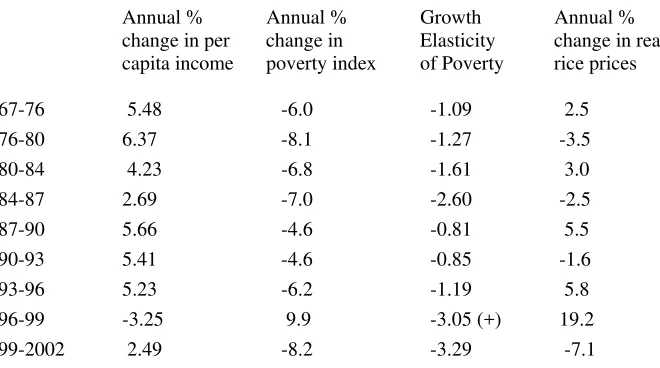
Perhaps the clearest evidence linking rice prices and the poor relates to the distributional impact of economic growth. Table 1 shows the “growth elasticity of poverty (GEP),” i.e. the percentage decline in the headcount index of poverty relative to the percentage change in overall incomes per capita, for various episodes (for which SUSENAS data are available) from 1967 to 2002. This elasticity is always negative—economic growth leads to reductions in poverty (and vice versa)—but it varies widely in magnitude, from -0.81 to -3.29. This variance is largely caused by changes in real rice prices. When rice prices are rising, economic growth has less impact on the poor than otherwise, and when rice prices are falling, the poor benefit.
B. Rice Prices and Economic Growth
Rice prices are important for poverty alleviation not only in terms of their short-term direct effects on the poorest segments of the population. In addition, rice prices play a key role in the structural transformation, both within the agricultural sector and for the economy as a whole. Within the agricultural sector, lower rice prices encourage rice farmers to diversify their cropping pattern by making rice less profitable to grow and by making it cheaper for farmers who diversify into other activities to buy rice from the market.
These ex-rice farmers then begin to produce other crops such as fruits and vegetables, which are more profitable, but also allow consumers to diversify their diets and increase their intake of proteins, vitamins, and minerals, which are crucial for the reduction of malnutrition. This is a slow process under the best of circumstances and must be market driven. Appropriate government support for research, extension, and marketing initiatives can also speed the process. Supporting highly protected prices for rice slows it down.
Crop diversification is occurring to some extent in Indonesia, although not very rapidly. In 1984, when Indonesia temporarily achieved self-sufficiency in rice, 41 percent of all cropped area was planted to rice. The share is still about 35 percent, a relatively small change over a period of 20 years of significant economic growth (despite the financial crisis). By contrast, rice as a share of total cropped area in Malaysia declined from 25 percent in 1972 to 13 percent in 1998. Artificially high (and stable) rice prices have impeded the diversification process unnecessarily in Indonesia. Lower rice prices can speed it along by guaranteeing reliable and affordable supplies of rice in rural markets to farm households who chose to diversify or invest in nonfarm rural activities.
Table 1. Factors Affecting Changes in the Headcount Index of Poverty
Annual % Annual % Growth Annual %
change in per change in Elasticity change in real
capita income poverty index of Poverty rice prices
1967-76 5.48 -6.0 -1.09 2.5
1976-80 6.37 -8.1 -1.27 -3.5
1980-84 4.23 -6.8 -1.61 3.0
1984-87 2.69 -7.0 -2.60 -2.5
1987-90 5.66 -4.6 -0.81 5.5
1990-93 5.41 -4.6 -0.85 -1.6
1993-96 5.23 -6.2 -1.19 5.8
1996-99 -3.25 9.9 -3.05 (+) 19.2
1999-2002 2.49 -8.2 -3.29 -7.1
Note: The Growth Elasticity of Poverty (GEP) is calculated as the ratio of the percentage reduction in the headcount poverty index relative to the percentage change in per capita incomes (in $PPP) from the World Bank Data Base on Pro-Poor Growth. An OLS regression of GEP on the change in the real rice price (DRRP) explains 80 percent of the
variance in GEP, with highly significant coefficients. The results are as follows (t-statistics in parentheses):
GEP = -1.57 + 0.209 DRRP R-squared = 0.8325 Eq. 1
(5.8) (5.9) Adj. R-squared= 0.8086
Alternatively, changes in per capita incomes (DPCI) and in real rice prices can both be used to explain changes in the poverty index (DPI). This specification has the following results:
DPI = -2.42 -0.853 DPCY + 0.445 DRRP R-squared= 0.9108 Eq. 2
(1.68) (2.93) (3.95) Adj. R-squared= 0.8811
Equations 1 and 2 are telling somewhat different stories. In Equation 1, the GEP is constructed by dividing DPI by DPCY, and then the variance in this ratio is related to changes in the rice price (DRRP). The coefficient is 0.209, indicating that for every 1.0 percent movement in real rice prices, the GEP moves 0.2 points. When rice prices are unchanged, the intercept term in Equation 1 says that the PEG is -1.57, a relatively large number in absolute terms.
By contrast, Equation 2 relaxes the restriction that it is the ratio of DPI to DPCY that is the relevant variable to
explain, and focuses instead on changes in the poverty index directly. Statistically, this costs an extra degree of freedom in the estimation, not trivial with only 9 observations, but the results are very illuminating nonetheless. The coefficient on DPCY is only -0.853 (instead of the 1.000 implied in the ratio specification), and the coefficient on changes in the real rice price more than doubles, to 0.445. In the unconstrained model, rice prices are twice as important to conditioning the rate of poverty reduction as they are in the GEP model, and economic growth becomes somewhat less of a driver. However, the intercept term in Equation 2 of -2.42 suggests that even when changes in
per capita incomes and real rice prices are both kept constant (or are even zero), poverty falls by over two
percentage points per year. This is not a statistically robust result, as the intercept is significant at only the 85 percent confidence level.
When the intercept term is constrained to be zero (thus assuming there is no exogenous trend in poverty reduction),
the result is something of a blend between Equations 1 and 2, as Equation 3 indicates:
DPI = -1.285 DPCY + 0.3205 DRRP R-squared= 0.9258 Eq. 3
The lessons for Indonesia from China’s WTO commitments are twofold: first, lower rice prices can stimulate small and medium enterprises (SMEs) in Indonesia as well, and also provide reliable food supplies for farmers who wish to diversify. But second, and far more important for the long run, Indonesia’s very competitiveness in international trade will be challenged by the Chinese strategy unless Indonesia also keeps the cost of its main wage good close to international levels.
This potential impact on the profitability of investments in labor-intensive enterprises means that rice prices play a key role in the structural transformation of the broader economy. Low rice prices allow real wages to be higher for employees without any increase in the nominal wages paid by employers in the high-productivity industrial and service sectors of the economy. In conjunction with other factors, this combination of low nominal wages and high real wages stimulates the job creation and economic growth that are necessary for sustainable poverty alleviation. Excessively high rice prices mean workers need higher wages to keep their real incomes from falling, as has happened in the Philippines, where domestic rice prices have been well above world market prices for the past 15 years. These needs of workers are entirely legitimate, but their higher nominal wages discourage investment, both domestic and foreign. The end result is a slowdown of the productivity growth that is essential for poverty alleviation.
If there are so many benefits to low rice prices, why not drive prices well below market levels to create even more of these positive effects? Artificially low food prices have been tried as a development strategy in many countries, for example in Egypt with highly subsidized bread, China before 1978, with cheap rice and wheat, and the former Soviet Union, also with cheap bread, but they have always failed. Such a strategy reduces farmers’ incentives to produce at the country’s opportunity costs, hindering long-term productivity growth in the agricultural sector. Perhaps as important, a strategy of artificially low food prices requires subsidies and results in substantial fiscal costs to the government. These costs then divert scarce government resources from being used to provide the public goods necessary to create a dynamic rural economy, such as roads, education, and agricultural research. There are also efficiency losses to keeping domestic prices substantially below the trend in world prices because of the misallocation of resources.
What is the optimal level of rice prices? In a world of perfect information and competitive markets, the answer is “the world price.” In the less-than-perfect world that rice importing countries live in, research has shown that keeping domestic rice prices above world prices by perhaps 10 percent may be optimal. This margin ensures that the multiplier effects from increased agricultural incomes are realized, while minimizing the impact on poverty in the short run. However, any large, sustained deviation of domestic prices from world prices in either direction will lead to substantially sub-optimal outcomes and slow the rate of economic growth.
C. Rice Prices and Food Security
on farmer and consumer decision making to allocate resources efficiently. The transition has stalled, however, because of the policy-induced disconnect between the domestic and world rice economies that emerged after the financial crisis in 1997 and which has remained as the main pillar of domestic rice policy since then. This is not a market-oriented rice economy.
The key question at this juncture is how to complete the transition to such a rice economy while recognizing the constraints on policy initiatives that face the government. These
constraints are mostly political, although the lack of new rice technology certainly narrows the degrees of freedom for policy makers. But policy makers seem to think that rice farmers need higher prices to stimulate production, and hence to improve Indonesia’s food security. This perception is based on a faulty understanding of Indonesia’s earlier success in stimulating rice production and improving the country’s food security. Thus it is worth reviewing briefly how rice prices were set during the New Order government, when they were stabilized and
maintained on the long-run trend in world market prices, until the financial crisis. It is also necessary to explain why the policies that achieved these desirable outcomes are no longer appropriate.
In summary, between the late 1960s and the mid-1990s, Bulog defended a floor price and a ceiling price through a combination of the following four policy instruments: first, monopoly control over international trade in rice; second, access to an unlimited line of credit (at heavily subsidized interest rates in the early years and at commercial rates with a Bank Indonesia
guarantee in the later years); third, procurement of as much rice as necessary by Dologs to lift the price in rural markets to the policy-determined floor price; and fourth, extensive logistical
facilities, including a nation-wide complex of warehouses, which permitted seasonal storage of substantial quantities of rice (including the one million tons for the “iron stock” that was considered essential for Indonesia’s food security). These rice stocks, accumulated through domestic procurement in defense of the floor price and, when these supplies were inadequate, through imports, were then used to defend a ceiling price in urban markets. In the early years, the ceiling price was explicit and announced publicly; in the later years, it was informal, providing local Dolog officials more flexibility in maintaining stability of rice prices.11
This was a heavily interventionist approach to formation of rice prices in Indonesia, and thus to the country’s food security. Still, few observers doubted the need for such intervention in the late 1960s and through the period of instability in the world rice market in the 1970s. An econometric assessment of the 25-year period from 1970 to 1995 concluded that Bulog’s
stabilization efforts paid very high dividends in fostering faster economic growth during Repelita I and II [the first two five-year plans, from 1969 to 1979], apart from the additional benefits provided by enhanced political stability. But even this positive assessment concluded that benefits from this market intervention were diminishing as rice became a much smaller
proportion of the value added in the economy and as a share of consumers’ budgets. By the mid-1990s there was clearly a need to design a much more market-oriented price policy.12
11
The details of this story are contained in C. Peter Timmer, “Food Security in an Era of Decentralization: Historical Lessons and Policy Implications for Indonesia.” This paper is part of the output from the Food Policy Support Activity (FPSA) and is available at the project website: www.macrofoodpolicy.com.
12
See C. Peter Timmer, “Does Bulog Stabilize Rice Prices? Should It Try?” Bulletin of Indonesian Economic
This need for reform of the approach to food security was driven by two forces. First, the price stabilization program was very expensive in budgetary terms, because heavy subsidies had to be provided to Bulog to maintain large stocks, subsidize exports when surpluses accumulated, and subsidize imports when domestic supplies were short. The increased corruption in the agency in the mid-1990s further called in question the use of public funds to support the price stabilization role.
Second, successful stabilization of rice prices enhanced the profitability of growing rice and biased farmer decision making toward its cultivation. This bias was desirable at the time as new rice technology and extensive investment in rural infrastructure, especially irrigation, meant farmers had to learn how to manage a radically new way of growing rice. In addition, Indonesia was exposed to a very thin and unstable world rice market in the 1970s and additional domestic rice production enhanced its food security. But as early as the 1980s, the bias toward rice
production was causing serious difficulties in diversifying Indonesia’s agriculture toward higher- value crop and livestock systems.13
A long-run decline in the price of rice in world markets, and significantly greater stability in world prices, have now sharply lowered the opportunity cost of rice to the Indonesian
economy. In 1998, for example, the country was able to import over 6 million metric tons of rice in the wake of the worst drought in recent history—caused by a historically severe el Nino—with very little impact on the world rice market (see Figure 3). With Indonesian rice imports
returning to the “normal” levels of earlier years after 1998, world prices continued their long-term decline.14 Indeed, the decline through 2003 was so severe that even the recent 25 percent run-up of prices from major exporters in Asia only brought them back to their 10-year downward trend. In the face of these long-run opportunity costs of growing rice, farmers will need to
diversify out of rice to have better income-earning prospects in the future. Somewhat paradoxically, the smallest farmers will need to get out of rice growing to ensure their food security.
Alternatives to the high-cost and inefficient approach to rice price policy in the 1980s and early 1990s—and to the country’s food security--were already under discussion in the mid-1990s. Although various analysts had differing priorities for reform, the core ideas were similar. Indonesia should rely much more heavily on rice imports for its food security, including taking the lead in forming a free trade zone for rice in East and Southeast Asia (possibly to include Bangladesh and India as well). Substantial investments in rural infrastructure to improve efficiency of rice marketing would be needed so that traders and farmers would buy and store nearly all of the harvest. Continued development of rural capital markets would also be needed to ensure that the financial liquidity traditionally provided by Bulog procurement in defense of
13
See C. Peter Timmer, "Crop Diversification in Rice-Based Agricultural Economies: Conceptual and Policy
Issues" in Ray A. Goldberg, ed., Research in Domestic and International Agribusiness Management, vol. 8.
(Greenwich, CT: JAI Press, 1988), pp. 95-163.
14
the floor price would be available from the formal banking system at reasonable rates to farmers and traders.15
Greater variability in seasonal prices would be permitted so that these farmers and traders could earn adequate returns on their investments. Such variability would not be a problem for most consumers because rice has declined to a small and manageable share of their budget expenditures. In case of large increases in rice prices in world markets (much less likely with a large Asian free trade zone) or localized shortages, subsidies to poor consumers could be targeted through special logistical efforts (Bulog had already experimented with such a program during the drought in 1991—the pilot activity was called “Special Market Operations,” OPK, which is also the name of a similar program used during (and since) the financial crisis to target cheap rice to poor consumers, still with Bulog as the implementing agency). Variable tariffs on rice imports were also discussed as a mechanism for stabilizing rice prices in Indonesia without the need for a costly logistical agency.
These discussions about improving the efficiency of the rice economy were put on hold during the financial crisis, although both the IMF and the World Bank pushed for liberalization of rice trade and a cutback in Bulog activities as part of their support programs. Indeed, it is these donor efforts that have pushed Indonesia into the transition that is currently underway, and it is clear the donors would prefer to see the process completed as rapidly as possible.
There is substantial merit to the market-oriented rice economy seen at the end of this transition, and it remains a highly desirable goal, both for its effect on efficiency in the agricultural sector and the sustainability of the country’s food security. But there are also substantial political barriers in the way of this outcome. One worrisome element of the current policy debate is that there seems to be little understanding of how the previous rice price policy was designed and implemented as the core component of the country’s approach to food security, what its true costs were, and what the implications might be for price stabilization if Bulog, already converted into a commercially-oriented state enterprise, is given monopoly
control over rice imports. Thus the political discussions are being conducted in a near vacuum of institutional memory and experience with policy design and implementation.
The concern, of course, is that a failure to understand how the country managed its food security successfully under the Suharto government may leave Indonesia’s new political
leadership unprepared to cope with existing challenges, much less new ones. The main existing challenge to food security is not primarily focused on the food dimensions: agricultural
productivity, unreliable import supplies, or local food shortages. Instead, the current challenge, and almost certainly the most pressing challenge for the next decade, will be to re-establish rapid, pro-poor growth in the context of renewed structural transformation.16 Continued or worsening poverty is Indonesia’s main food security concern, but a rapidly changing food system will also be an increasing challenge.
15
See C. Peter Timmer, “Building Efficiency in Agricultural Marketing: The Long-run Role of Bulog in the
Indonesian Food Economy,” Journal of International Development, vol. 9, no. 1 (1997), pp. 133-45.
16
See C. Peter Timmer, “The Road to Pro-Poor Growth: Indonesia in Regional Perspective,” Bulletin of
The Changing Structure of Indonesia’s Food Markets
In particular, a “supermarket revolution” is altering the nature of Indonesia’s food supply chain—from farmers to retail consumers. Although most of the attention so far to this revolution has been about helping small farmers join the supermarket supply chains, a consumer perspective is needed as well. Farmers produce food (to make a living), the marketing chain, ending with supermarkets in some cases, processes food and delivers it to consumers (to make a profit), but the overall welfare of a society is determined by the outcomes for consumers (i.e. by their standards of living, including their sense of food security).
To understand the impact of the supermarket revolution on food security, the key question is, who gains and who loses from the revolution? To answer this question, an
economist will ask, what are the scarce resources, and who controls them, because scarcity has value?17 There are three basic possibilities for what resource is scarcest in the food system: access to farm output; access to marketing technology; or access to consumers.
First, despite concerns that population growth will outstrip growth in food supplies, the
historical evidence is that the capacity to produce basic food commodities is not scarce on a global level. Modern agricultural technology is land-saving, there is abundant rural labor (again, on a global level), rural finance is readily available when there is a profit to be made in lending it, and water is becoming scarce only because it is provided free in most cases. What might be scarce at the farm level is the management ability to meet high quality standards and to deliver reliably a safe product that meets environmental requirements and is fully traceable to its point of production. There are likely to be significant economies of scale to this management ability, even if there are few scale economies in the physical production of most agricultural
commodities, especially those requiring close monitoring such as fresh fruits and vegetables, and many livestock products.
A second possibility for what is scarce is access to marketing and information technology that improves coordination.18 The technology for managing supply chains—in the food system and elsewhere—is changing rapidly, even in the United States. This technology is changing especially rapidly in the modern logistics area that uses information technology to manage inventories. In general, these technologies drive down transactions costs throughout the supply chain. But further, by reducing the need to hold large inventories, these marketing and logistics technologies reduce capital costs and risks. Since inventory is basically a form of “dead capital,”
17
This is a particularly economic view of the world, where something has a “value in exchange” that can be completely different from its “value in use.” Diamonds, for example, are at one end of the spectrum (high value in exchange but limited value in use, and air is at the other (high value in use, but low value in exchange). Food commodities are typically in the middle of this spectrum, but the contradiction between a constantly high “value in use” for food and its sharply fluctuating “value in exchange” have caused some analysts to argue that individual access to food is an “entitlement” or “basic human right” that should be divorced from market access. However, no one has figured out how to do this.
18
improved logistics and inventory management generate real capital savings as well as lower transactions costs. And both contribute to higher productivity and faster economic growth.
The important question is whether access to this technology is sufficiently restricted that it is “scarce,” i.e. can excess profits be earned by controlling it? The evidence suggests that it is easily duplicated as computer power becomes cheaper and local managers learn to imitate the market leaders. Intellectual property rights (IPR) seem not to be a serious impediment to this imitation, despite supermarket chains’ efforts at proprietary control. It is the knowledge that such techniques are feasible and available that is important, not the specific code written for a
particular supermarket’s computers. The parallel to the “technological treadmill” so familiar to American farmers is striking. First adopters of new technology have a temporary cost advantage, but competition leads all market players to adopt it quickly. This seems to be the story for
marketing technology.
The third possibility for what is scarce is access to consumers themselves, and especially to knowledge of how consumers behave—what they want, and therefore, how best to serve them. As concentration in food retailing rises, there seems to be an opportunity for the leading firms— Carrefour, Wal-Mart, Metro, Tesco, etc.—to control this access and thus to earn higher
marketing margins and profits. This has been a longstanding worry in the United States, at least since the 1940s. The evidence so far, both in rich and poor countries alike, is that access to consumers has been very competitive. Market power is used to drive down costs, and these lower costs are then passed along to consumers as lower prices. Why lower prices instead of higher profits? Because supermarkets need to increase market share to achieve the economies of scale that permit their costs to be even lower. So far, this whole process has been highly
contestable. Economists know that contestable markets pass nearly all the benefits of the
marketplace (the sum of producer and consumer surplus, to be technical) through to consumers.19 Thus the main winners in the supermarket revolution are consumers.
This analysis and the conclusions stemming from it have powerful implications for what policy recommendations make sense from a welfare perspective, including a public concern for food security. There are four key areas to consider: (1) consumers and public health; (2) the role of and impact on small farmers; (3) food security per se at the local and national level; and (4) how the supermarket revolution fits into the long-run structural transformation of a society.
As consumers become more urbanized and divorced from the production of their food, the vast array of choices in modern supermarkets can, paradoxically, lead to worsened nutritional status. The “double burden” of malnutrition, with under-nutrition existing side-by-side with obesity and diet-related problems such as heart disease and diabetes, is already facing Indonesia and many other developing countries. The policy options for responding to this problem are limited, but one approach is to use the “focusing power” of supermarkets to provide nutrition education to their shoppers. Nutritional labeling is one component of this education, but
19
supermarkets could also use their sophisticated knowledge of consumer behavior to shape their dietary patterns in healthier directions. This is a “micro” approach to food security
Small farmers are obviously a second focal point of concern, both for their own food security and their contribution to a country’s food supplies. The evidence so far from other countries, especially Latin America, is that small farmers tend to be squeezed out of supermarket supply chains fairly rapidly because of the high transactions costs of dealing with them. This is not likely to be an optimal response in Indonesia, but the question is what policy makers can do to help small farmers without raising costs and hurting consumers. Providing useful technical assistance to farmers, serving as a “catalyst” for the formation of farmer associations, and conducting research, extension and training activities—increasingly as joint ventures with private sector participants—would seem to be promising activities.20
Third, in a large, densely populated society where half the average daily food energy still comes from rice, how will food security be managed when most of this rice is sold in
supermarkets? In the past, as discussed in the historical section on Indonesia’s approach, managing food security at the national level has meant guaranteeing availability of rice in local markets, and keeping the price of rice reasonably stable. Can supermarkets take over these tasks? Price stabilization has traditionally been a public sector role because there is no private market where producers and consumers can “purchase” price stability. But if food sales become sufficiently concentrated in a few dominant supermarket chains, it is entirely possible that consumer demands for price stability of rice could be “internalized” and provided, profitably, by these private sector players.
Finally, as argued above, much of the concern for food security is actually a concern for poverty. There is a serious concern that the rapid spread of supermarkets might actually make rural poverty worse. It is very important to remember, however, that rural poverty cannot be solved by keeping all of Indonesia’s small farmers on their farms, whether or not they are supplying supermarkets. To solve the problem of rural poverty the entire economy must grow rapidly again, jobs must be created off the farm, and Indonesia must continue on its path of structural transformation. Supermarkets are only a small part of this transformation, but by pushing competitive pressures from consumers downward throughout the food system, they can play a surprisingly important role in improving productivity, and consumer welfare, for the economy.
20
Experience with supermarket development in China shows the usefulness of these approaches. See Dinghuan Hu, Thomas Reardon, Scott Rozelle, Peter Timmer and Honglin Wang, “The Emergence of Supermarkets with Chinese
Characteristics: Challenges and Opportunities for China’s Agricultural Development,” Development Policy Review,
The Political Economy of Food Security
The political economy of dealing with poverty and rapid changes in the food system is troublesome as Indonesia’s new democratic institutions try to work out effective mechanisms for economic governance. Again, a historical perspective is helpful. There are three basic strategic approaches to reducing poverty, and over its long history, Indonesia has tried all three. Under Sukarno, most attention was on redistributive measures, including efforts at a land reform in 1955. The focus shifted under Suharto to active implementation of pro-poor growth strategies as, in the famous words of one of the economic technocrats who came to power in the late 1960s, “there is nothing to re-distribute; we have to make the pie bigger.” Under the recent democratic governments (plural), most of the effort to help the poor has been through direct fiscal transfers involving more-or-less targeted distribution of rice, school vouchers, and cards granting access to health facilities.
Only the pro-poor growth strategy has shown any capacity for sustained progress in reducing poverty—and thus enhancing food security--so the immediate issue is to understand the political economy of that strategy, both in the Suharto era and for the future political context of modern Indonesia. Political scientists speculate on the nature of the political coalition assembled by Suharto to maintain and strengthen his hold on power. This coalition was clearly held
together by distribution of economic resources, often in the form of lucrative access to easily marketable commodities such as oil or timber (i.e. to the rents from “point-source” natural resources). Indonesia had the potential to experience the “natural resource curse” in an acute manner, but avoided the worst manifestations until the mid-1990s.
Import licenses for rice, wheat, sugar and soybeans were equally lucrative and were controlled closely by Bulog in the interests of the Suharto regime. Whether the pro-poor policies, and results, of the regime were tied to keeping these interest groups satisfied, even at the expense of faster economic growth in the short run, is the subject of active debate, especially because Bulog, despite being “privatized,” established close ties with the husband of President Megawati and is lobbying aggressively for renewal of its monopoly control over trade in most agricultural commodities. The ability of Bulog to stall the deregulation process in the early 1990s is seen by some observers as an early signal that the entire growth process was running off the rails into corrupt and distortionary cronyism. From this perspective, the collapse of the formal sector during the Asian Financial Crisis was not such a surprise, as it had become increasingly dominated by these interests.
The most debated political economy aspect of the New Order government was the near schizophrenia between macro and sectoral policies. What is so puzzling is why macro economic policy was left largely in the hands of very talented, but highly apolitical, technocrats.
Persuasive arguments are made that they provided access to the donor community, which has been a strong, almost lavish, supporter of Indonesia since the late 1960s. On the other hand, trade policy protected special interests in the Suharto circle and even beyond, sometimes with no more apparent rationale than a nationalist interest to develop a modern industrial capacity. The role of good economic governance and political commitment to poverty reduction is a key lesson from this experience, but the paradox is why the autocratic Suharto regime provided both
There is speculation that part of Suharto’s commitment came from the highly visible politics, and power, of food security. The drive for higher agricultural productivity—a key ingredient in pro-poor growth--was fueled at least in part by the desire for households, and the country, to have more reliable supplies of rice than what was available, at least historically, from world markets. Here too the world has changed, and a drive for rice self-sufficiency that made technical and economic sense in the early 1980s would be folly today, a reality that has not yet registered with the current government.
Despite the apparent perversity of current political economy with respect to pro-poor growth, and the role of the rice economy in generating that growth, there is a rationale that explains it. Behind the Suharto regime’s commitment to pro-poor growth were two important constituencies, one backing economic growth itself, and the other expressing concern for the poor. The growth coalition was made up of the modernizing elements of the military, the
business elite not already comfortably protected by anti-growth protectionist measures, and most of the rural sector, which was near starvation in the mid-1960s.
The voices for the poor included many of this same coalition, but for quite different reasons. The military was concerned about rural unrest and did not have the coercive resources to suppress it by force alone. The Jakarta political elite, led by President Suharto, increasingly staked their credibility on political stability, and both the urban and rural poor could threaten that, as the 1974 Malari riots demonstrated. And increasingly the donor community came to stress the importance of poverty reduction, as was manifested in the major commitment by the World Bank to the analytical work that surfaced in its 1990 report on poverty.
Thus the fortuitous intersection of the growth and poverty coalitions offered the Suharto regime a clear political opportunity to do well by doing good. In the context of powerful opportunities to stimulate rapid growth in rural areas through high-payoff investments in rehabilitating irrigation systems and rural infrastructure and the importation of new rice
technologies, a cumulative process started that built both rapid growth and poverty reduction into the basic dynamics of the Indonesian economy.
This cumulative process seemed to have ended in the early 1980s, as prices for
agricultural commodities collapsed in world markets, oil prices declined, and the whole growth process seemed threatened. Fortuitously, again, but under the determined guidance of the
technocrats, the economy was restructured to make it more open to foreign trade and investment, just as Japan and Korea came looking for opportunities to invest in labor-intensive
manufacturing facilities. Only with the economic and political collapse in 1998 did this source of pro-poor growth disappear.
What next? The political appeal of the new strategy for dealing with poverty—direct fiscal transfers to the poor—is obvious. These transfers have immediate and visible impact on the recipients, and the political “pitch” for the programs makes it sound as though the
it. In the current political rhetoric, poverty reduction is no longer linked to economic growth. In fact, Bulog seems to have built a political coalition similar to the one supporting Food Stamps in the U.S. Congress, where support comes from conservative rural legislators eager to have
additional markets for the food that is produced in surplus by their farm constituents, and from urban liberals who have many poor people who use food stamps as a major source of their income. Similarly, Bulog has assembled support for its rice procurement program (ostensibly to help rice farmers), which supplies the rice for the OPK program that delivers subsidized rice to the poor. As Stephen Mink of the World Bank has observed, no parliamentarians have been willing to take on both dimensions of the rice program simultaneously, and so the huge budget subsidies that accrue to Bulog to run these programs, and the corruption that accompanies them, go unchallenged.
Rebuilding the economic growth coalition is likely to take a long time, as it will depend on the underlying conditions of economic governance—political stability, rule of law, control of corruption, and so on—that are still moving in the wrong direction. Probably the best that can be done in the short run—the next 3 to 5 years—is to minimize policy damage to the interests of the poor while trying to improve the effectiveness of the programs transferring resources directly to the poor. But in the long run, the only way to sustain food security is through pro-poor