AN UNDERGRADUATE THESIS
DEVELOPING STORYTELLING MATERIALS FOR ENGLISH CLUB AT STATE SENIOR HIGH SCHOOL 1
KOTAGAJAH
By:
AFDHILA KHUSNILA WATI Student Number: 1701070159
Tarbiyah and Teacher Training Faculty English Education Department
STATE INSTITUTE FOR ISLAMIC STUDIES OF METRO
1443 H/2022 M
for the Degree of Sarjana Pendidikan (S. Pd) in English Education Department
By:
AFDHILA KHUSNILA WATI Student Number: 1701070159
Tarbiyah and Teacher Training Faculty English Education Department
Sponsor : Eka Yuniasih, M. Pd
STATE INSTITUTE FOR ISLAMIC STUDIES OF METRO 1443 H/2022 M
ii
iii
v
DEVELOPING STORYTELLING MATERIALS FOR ENGLISH CLUB AT STATE SENIOR HIGH SCHOOL 1 KOTAGAJAH
ABSTRACT By:
AFDHILA KHUSNILA WATI
This research is aimed at Developing Storytelling Materials for English Club at State Senior High School 1 Kotagajah. It is due to the lack of appropriate materials for English Club.
By using research and development design, this research has five steps:
collecting data, planning, creating the materials, validating the product and revising the product. Validation of the product involves three validators, which is divided into three assessments. Those are; language use, content, and design graphic. The empirical data shows that the developed materials are proper accordingly. Related to the all aspects of the assessments are proper according to Aiken’s V which is higher than 0.5.
Furthermore, some suggestions are used to revise the product according to the validator assessments. They are, packaging, product addressed, content layout and compatibility of color selection. After revising the product in accordance with the validators’ suggestions, it can be concluded the product in this undergraduate thesis is implicated to be properly used for English club at state senior high school 1 Kotagajah.
Keyword: English club, materials development, storytelling
vii
AFDHILA KHUSNILA WATI
Penelitian ini bertujuan untuk Mengembangkan Materi Storytelling untuk English Club di SMA Negeri 1 Kotagajah. hal ini dikarenakan kurangnya materi yang sesuai untuk English Club.
Dengan menggunakan desain penelitian dan pengembangan, penelitian ini memiliki lima langkah yaitu pengumpulan data, perencanaan, pembuatan materi, validasi produk dan revisi produk. Validasi produk melibatkan tiga validator yang terbagi dalam tiga penilaian. Yaitu; penggunaan bahasa, isi, dan desain grafis.
Data empiris menunjukkan bahwa materi yang dikembangkan sudah sesuai. Terkait dengan semua aspek penilaian sudah layak menurut Aiken's V yang lebih tinggi dari 0,5. Selanjutnya beberapa saran digunakan untuk merevisi produk sesuai dengan penilaian validator. Yaitu, pengemasan, untuk siapa produk tersebut, tata letak konten dan kesesuaian pemilihan warna. Setelah merevisi produk sesuai dengan saran validator, maka dapat disimpulkan produk dalam skripsi ini bermaksud dapat digunakan dengan baik untuk klub bahasa Inggris di SMA Negeri 1 Kotagajah.
Kata Kunci: Klub bahasa Inggris, materi pengembangan, storytelling
viii
ix
MOTTO
“There is always room for a story that can transport people to another place.”
-J.K. Rowling-
xi
My beloved parents, Mr. Supani and Mrs. Siti Masrifah for the endless love, pray and as the supporter and facilitator
My lovely sister and my beloved grandma that always give motivation and hand for every circumstance
My best sponsor Mrs. Eka Yuniasih, M. Pd for her patient and her amazing guidance to keep me walk
My lovely best friends, my marvelous team, my second home (KIL), Bunda and Mr. Andy
You are my best supporter
My beloved Almamater of State Institute for Islamic Studies of Metro
xii
AKNOWLEDGMENTS
All praises and thanks always to Allah SWT the almighty, for his blessings and favors, the researcher can finish the undergraduate thesis. The researcher realizes this research would not be accomplished without any supports and hand from many helpful people. In this special opportunity, the researcher would like to profound acknowledgment the gratitude
First of all, the deepest gratitude would be given to my beloved parents and family who always support their daughter to do her best.
Next, the profound gratitude would be addressed to:
1. Mr. Andiato, M. Pd, the head of English Education Department of IAIN Metro.
2. Mrs. Eka Yuniasih, M. Pd, my sponsor and advisor who always guide me in the process of this undergraduate thesis patiently.
3. Mrs. R. Surya Damayanti, M. Pd as the headmaster who allow this research held in state senior high school 1 Kotagajah
4. Mrs. Dini Fridayanti as the guider of English club who help in collecting the data.
5. All of my lecturers in English Education Department who never give up to enrich my insight.
6. All of my friends in TBI 17, especially for TBI class who telling about the name of family.
xiii
undergraduate thesis can be valuable and useful for all the readers.
Metro, 30 May 2022 The Researcher
Afdhila Khusnila Wati NPM. 1701070159
xiv
TABLE OF CONTENTS
COVER ... i
TITLE PAGE... ii
NOTIFICATION LETTER... iii
NOTA DINAS... iv
APPROVAL PAGE... v
RATIFICATION PAGE... vi
ABSTRACT... vii
ABSTRAK... viii
STATEMENT OF RESEARCH ORIGINALITY... ix
ORISINALITAS PENELITIAN... x
MOTTO... xi
DEDICATION PAGE... xii
AKNOWLEDGMENT... xiii
TABLE OF CONTENT... xv
LIST OF TABLES... xvii
LIST OF PICTURES... xviii
LIST OF APPENDICES... xix
CHAPTER I INTRODUCTION A. Background of Study... 1
B. Problem Identification... 5
C. Problem Limitation... 5
D. Problem Formulation... 5
E. Purpose of Research... 6
F. Benefit of Product... 6
G. Product Specification... 7
CHAPTER II LITERATURE REVIEW A. Theoretical Review... 9
1. Extracurricular Activity... 9
xv
C. Framework... 27
CHAPTER III RESEARCH METHOD A. Type of Research... 29
B. Research Procedure... 29
C. Research Subject... 31
D. Data Collecting Technique and Instrument Research... 31
E. Data Analysis Technique... 32
CHAPTER IV RESEARCH AND DEVELOPMENT RESULT A. Result of the Development Existing Product... 33
B. Product Revision... 41
C. Research Limitations... 42
CHAPTER V CONCLUSION AND SUGGESTION A. Conclusion of the Product... 43
B. Suggestion for Using Product... 43
BIBLIOGRAPHY APPENDICES
DOCUMENTATION CURRICULUM VITAE
xvi
LIST OF TABLES
1. Table of Respondent Identity... 34 2. Table of Questionnaire Result... 36 3. Table of Aiken’s V Result (Product Validation)... 41
xvii
for English Club)... 29 2. Procedure of Materials Development... 31 3. Process of Validation... 41
xviii
LIST OF APPENDICES
1. Surat Izin Pra-Survey... 50
2. Surat Balasan Izin Pra-Survey... 51
3. Surat Bimbingan Skripsi... 52
4. Surat Izin Research... 53
5. Surat Tugas... 54
6. Surat Balasan Izin Research... 55
7. Surat Bebas Pustaka Perpustakaan... 56
8. Surat Bebas Pustaka Jurusan... 57
9. Kartu Konsultasi Bimbingan Skripsi... 58
10. Keterangan Lulus Uji Plagiasi Turnitin... 62
11. Data Diri Dan Hasil Angket Siswa... 66
12. Draft Produk Awal... 79
13. Hasil Validasi... 167
14. Hasil Revisi... 173
15. Dokumentasi... 258
16. Curriculum Vitae... 260
xix
A. Background of the Study
English can be introduced as the international language. It is approved by the use of English almost every country that known as the integrationist language. English is the gate for exploring the world.1 It can be seen by the English vital duty in the world in form of technology and business2. No doubt English is wanted to be learnt by people in mass. Because it is known that English affect the lives. Not about put on airs people want, but emphasize more to the function as a language assist. It shows the demanding of mass in learning English3.
The fact of English is in demand by public in general can be seen also from the enthusiasm of the government’s program in education for English. As in Indonesia, English has long been a subject at school. This is reinforced by the national exam that includes English subject in it. Therefore, some schools are struggling in making students able to master English by holding some activities outside class schedule, one of it is established an English organization for those who want to hold English well.
1 Kim Hua Tan et al., “Implications of English as an International Language for Language Pedagogy Implications of English as an International Language for Language Pedagogy” 9, no. 1 (2020), https://doi.org/10.5430/ijhe.v9n1p22.
2 Niyozova Aziza Ilyosovna, “The Importance of English Language,”
International Journal an Orange Technologies 2, no. 1 (2020): 24.
3 Parupalli Srinivas Rao, “The Role of English as a Global Language,”
Research Journal of English 4, no. 1 (2019): 2.
1
2
In addition, the school which implements an extracurricular of English in the school is State Senior High School 1 Kotagajah. English club is one of the extracurricular of State Senior High School 1 Kotagajah bases in language learning. English club is an educational organization of outside class which focusing on improving students’ skill in English. This extracurricular has a goal to dough a member who has integrity and capability in public speaking.
English club of State Senior High School 1 Kotagajah is built by the students of the school where the X and XI graders are the organizer of the leadership of this organization and the XII is the monitor.
As the organizer, the XI graders have several programs to light up this organization. The programs of English club include sparing and practicing for every branch, also general gathering. Despite, the organizers also give some games to fill up activity. The activity held on Thursday at 2 until 4 p.m. it called by forum.
In the forum, the leader of English club will ask the member to assemble in branch. At this part, the member will focus on mastering public speaking through each branch. The branches include; speech, storytelling, debate, scrabble, and news casting. Every branch is guided by one tutor from the English teacher and one coordinator from the XI graders. The teacher and the coordinator are the personages who hold the sturdy role in guiding the member of English club.
English club is one of the organizations that want to be followed by students of State Senior High School 1 Kotagajah and storytelling is one of the
branches which are proclivities by the students to be joined. In spite of storytelling is one of branch which is hard to be learnt. It can be said as a complex process. The activity starts from constructing an idea to find out a title then write a story until performing the story. It also needs audience mental process for perceiving the message of the story shown. Many factors surround the activity to help expedite the process. The biggest are consist of facilities and media.
Facilities and media really affect the member of storytelling in improving their storytelling skills. Of course facilities are available. The club already has a language laboratory for supporting them in practicing and many other facilities they can utilize. Unfortunately, the researcher finds a fact from the data pra-survey that conducts by the researcher on June 28, 2020. The researcher uses 14 members of English club from each branch for the sample survey and utilizes the questionnaire of online media of Google form to get the data. It is found a problem that the branch of storytelling, speech and newscast are not equipped by the learning media, specifically with learning materials.
Internet and senior’s experience are the learning resources. Senior (XI graders) will teach the junior (X graders) by their experiences they get before.
From the case that has been shown, it explains that the learning resources by the member of storytelling are inadequate. It is because there are a lot of difficulties of the storytelling’s member that is found by the researcher.
These majority difficulties are coming from the students itself. The students who learn by relying on senior’s experience make the students troubled to
4
move forward. The students only mimic what seniors command for. It makes the members of storytelling hard to find their soul in storytelling. The students cannot divisive their ideas in creating their own story. The activity emphasizes more on practice, but the practice is less on theory. It is added by the newbie (the students who just join the English Club and do not have any experience before) that will find difficulties in understanding storytelling well, because it is the first for new member.
This is compounded by the fact that not all member of English Club of all branches except storytelling understand storytelling well even the senior (XI graders). It happen because the lack of knowing of storytelling. The other members just take to accomplish from what they have been seen. The other members just know the storytelling from the first joining English club. The other members just see the storyteller’s performance. It supposes that the other members just become an audience and do not have any power in trying a showing. So that, it is opined that storytelling is not easy to be learnt.
However, other members also have an interest in storytelling. But, the other members do not want to explore storytelling. It is realized by the fact that learning storytelling needs a lot of practice. They still think how hard to show a story is, because the others members do not believe on their talent. But the truth, if they want to learn it, they just can read a lot of information about storytelling. The fact, they do not want it.
Based on the problem stated above, the researcher is conscious about the worthwhile storytelling materials that can be used not only for the member
of storytelling but also for English club. Therefore, the researcher is conducting to design storytelling materials for English Club of State Senior High School 1 Kotagajah, so that they have guidelines. It aims to make them have a balance between practice and theory.
B. Problem Identification
Based on the background which has explained above, the researcher can identify some problem which may be caused by;
1. English Club of State Senior High School 1 Kotagajah does not have any appropriate storytelling materials for activating the learning program for storytelling’s member.
2. The members of English club except storytelling are having less interest in storytelling
3. The lack of understanding of storytelling by the members of English club.
C. Problem Limitation
Based on the problem identification stated above, this research focuses on the problem that English club of State Senior High School 1 Kotagajah does not has any appropriate storytelling materials for the learning process.
Because of that, the researcher proposes this research in tittle “Developing Storytelling Materials for English Club at State Senior High School 1 Kotagajah”.
6
D. Problem Formulation
From the problem limitation explained above, the researcher formulates the problems as follows:
1. What are learning needs of the member of English club of State Senior High School I Kotagajah?
2. What kind of the storytelling materials for the member of English club of State Senior High School 1 Kotagajah?
3. How is the experts’ validity to the developed storytelling materials for English club at State Senior High School 1 Kotagajah?
E. Purpose of Research
Related to the problem formulation above, the objectives of this study are:
1. To analyze the learning needs of the member of English club of State Senior High School I Kotagajah.
2. To develop the appropriate storytelling materials for the member of English club of State Senior High School 1 Kotagajah.
3. To know the experts’ validation to the developed storytelling materials for English club at State Senior High School 1 Kotagajah?
F. Benefit of Product
By this finding research, the researcher is expecting that this product will give a great contribution of benefit for:
1. English Club of State Senior High School 1 Kotagajah
The benefit for the extracurricular includes for;
a. For the Storytelling Member
The product of this research can facilitate the members of storytelling to progress their knowing, skill and ability level in practicing the storytelling properly, fluently and appropriately.
Hence, they will learn easily and more confident to show up their own.
b. For English Club Member
The designing of this product is expected to be additional learning materials for other member except storytelling. The researcher hopes that this product will enrich knowledge and become supporting English learning materials in different way. The researcher wishes, it could aid the member becomes an erudite in applying the product.
c. For the English Club Guiders
The developed materials of this research can be used for new information and reference for the English ‘club’s guiders. It is expected that this materials will be helpful for the English club’s guiders in the reaching the learning target.
2. For the Other Researcher
The result of this research hopefully can be used for the other researcher to arrange further research dealing with storytelling materials in different instructional learning tool.
8
G. Product Specification
The specification of the product consists of:
1. The product consists of five units.
2. Every unit includes of different topic which has several sub chapter.
3. The storytelling materials is supporting by pictures to illustrate and encourage the motivation and interest of the members.
4. The product consists of theoretical material, a related text, and Vocabulary list
5. The product is created related to the relevant book and journal.
Based on the arguments stated above, the researcher strengthen by conveying some principle of some theoretical as a foundation.
1. Extracurricular Activities
Galina, Ivanova, Olga ang Logvinova describes extracurricular activity as an action that has nothing to do with academic scores and targets. It also means all related activities that function to develop the personality and character building of students as a whole. This is intended to create quality of the students in the future. These occupations are related to the social life of the community where students condition the course of it4. Another definition from extracurricular activity is non-academic activities that occurred under school’s auspices but conducted in the outside of class time.
Additionally, it includes of optional participant from the part of the students and do not have academic credit.
According to Annu and Sunita, extracurricular activity refers to the bustle that offered by the school with taking time outside of school compulsory (regular). Annu and Sunita propose that extracurricular is having association with the school where the activities of the
4 Kenneth R Bartkus et al., “Clarifying the Meaning of Extracurricular Activity:
A Literature Review of Definitions,” American Journal of Business Education 5, no. 6 (2012): 698.
9
10
extracurricular is hold.5 In the other hand, extracurricular activity does not take in the formal curriculum. It means that the curriculum activity is not counted as the target achievement (grade). Therefore the school does not count the academic performance from the extracurricular activities.6
In line with the definitions above, extracurricular activities are able to enhance students’ critical thinking in facing some problem inside or outside and increase the social maturity.7 It helps the students to control personal life in daily8. It also improves the individual academics achievement and gives contribution to the guidance of personality.9
According to some experts above, extracurricular activity holds important role as the second educational program for the students to explore knowledge. Extracurricular activity becomes a bridge in propagating ideas. The case is beneficially added by the leadership program that students will get only in the activity of extracurricular.
5 Annu Singh and Mishra Sunita, “Extracurricular Activities and Student’s Performance in Secondary School of Government and Private Schools,” International Journal of Sociology and Anthropology Research 1, no. 1 (2015): 53–54.
6 Anna Han and Kyungbin Kwon, “Students’ Perception of Xtracurricular Activities: A Case Study” 3, no. 3 (2018): 137.
7 Sang-yeob Kim and Wi-young So, “The Relationship between School Performance and the Number of Physical Education Classes Attended by Korean Adolescent Students,” Journal of Sports Science and Medicine, no. November 2011 (2012): 226.
8 Yusuf Suleiman, Zahyah Bt Hanafi, and Muhajir Tanslikhan, “Influence of Extracurricular Services on Students’ Academic Achievement in Secondary Schools in Kwara State: A Qualitative Approach,” Indonesian Journal on Learning and Advanced Education, no. 1 (2019): 1–19, https://doi.org/10.23917/ijolae.v1i2.7766.
9 Singh Annu and Mishra Sunita, “Extracurricular Activities and Student’s Performance in Extracurricular Activities and Student’s Performance in Secondary School,” International Journal of Technical Research and Applications 2, no. 6 (2019):
8–11.
2. Materials Development
a. Definition of Materials Development
To support a learning process, materials are the essential substance for a teacher. According to Wardani, Basthomi and Sumaryo, the learning materials adjust with the field and the actual needs of the students. The students in different background of knowledge will get a struggle in understanding the learning process if the materials are not appropriate to the student’s interest in.10 In addition, Azmy, Purwoko and Hadisaputra say that innovation from the materials will improve the outcomes of the learning process of the students11.
Ampa, Basri, and Andriana state that the contextual materials are the factor establish the learning process. By the contextual materials, the students will be helped by the fact that the learning materials will connect to the content of life context whereas the content is used. However, related materials are the reference that let the students to process the new information in different way based on their basic. It will make the students find the meaning of the context naturally. This is due to the society when the students will seek the relation and its use. 12
10 Dina Ayu et al., “Developing Reading Materials for Physical Education Students,” Jurnal Pendidikan: Teori, Penelitian Dan Pengembangan 2, no. 2 (2017):
273–79.
11 Moh Khaerul Azmy, Agus Abhi Purwoko, and Saprizal Hadisaputra, “The Development of Chemistry Teaching Materials in the Form of Handoutsbased ( PBL ) in Class XI IPA Madrasah Aliyah ( Ma ) Kediri District,” IOSR Journal of Research and Methods in Education (IOSR-JRME) 8, no. 3 (2018): 71–73, https://doi.org/10.9790/7388-0803037173.
12 Andi Tenri Ampa, Basri Muhammad D, and Andi Arie Andriani, “The Development of Contextual Learning Materials for the English Speaking Skills,”
12
Material development or it can be said as teaching material is a set of systematic materials of written or unwritten to produce environment for students’ learning process.13 It delivers a source as a language input that can be utilized by the teacher in way to maximize the intake possibilities and to stimulate deliberate output.14 Beside it, the learning material discussed that close to daily life will help the students to communicate the result.15 Therefore, the learning process becomes authentic, active, meaningful and holistic.16
A derived understanding about materials development is a set of specific materials that arranged as the learning foundation in helping the teacher to convey it. Hence, the learning process will be systematically applied. The composed material will make easy both students or teacher when doing such activity related to the target of the learning.
b. Principles of Materials Development
Before proposing the developing materials, writer needs to develop supple outline in helping the production of effective
International Journal of Education and Research 1, no. 9 (2013): 1–10.
13 Ramona Kurnia, Darnies Arief, and Irdamurni, “Development of Teaching Material for Narrative Writing Using Graphic Organizer Story Map in Elementary School,” International Journal of Research in Conceling and Education 01, no. 01 (2017): 22–26, https://doi.org/10.24036/009za0002.
14 Miftahul Khair Nur Ali Mubar, “Developing English Learning Materials for Younf Learners Based on Needs Analysis at Mtsn Model Makassar,” English Teaching Learning and Research Journal I, no. 02 (2015): 313–30.
15 Asrizal et al., “The Development of Integrated Science Instructional Materials to Improve Students’ Digital Literacy in Scientific Approach,” Jurnal Pendidikan IPA Indonesia 7, no. 4 (2018): 442–50, https://doi.org/10.15294/jpii.v7i4.13613.
16 Wiyanto and Arif Widiyatmoko, “Preparation Model of Student Teacher Candidate in Developing Integrative Science Learning,” Journal of Education and Human Development 5, no. 2 (2016): 169–77, https://doi.org/10.15640/jehd.v5n2a20.
material for learning target to become coherent and principled.
Therefore, there are several points that should be considered for providing the effectiveness of the material according to Tomlinson. Those points consist of 14 principles. But, there are 6 things that should drive in materials development. Those are:
1) The materials should be contextualized.
2) The materials should help students’ to heed the features of authentic input.
3) The materials should provide the students to have opportunity in using target language to achieve communicative purposes.
4) The materials should give impact for students in the sense of arousing curiosity of students.
5) The materials should give feedback to build the output activities.
6) The materials should stimulate students’ mental activity.17 3. Story
As for things that need to be considered in the story includes several aspects. Those are:
a. The Definition of Story
Every journey that made in the day life is called by a story. A story is created from a set of events that have passed.
17 Brian Tomlinson, English Language Learning Materials: A Critical Review (London: Continuum International Publishing Group, 2008).
14
Friday in Rusli and Idrus, explain that story is part of daily experience.18 In other words, story is created from every part of the time, every memory of life and every activities of human.
Story as the account of an occurrence or a series of occurrences united to the way in interesting a listener. Several plots or events are evolved by story which is taken place in space and time. It is seen that story immersing emotional by the feature of the plots or timeline related to people’s character and life’s events.19
A story outlines of a pack of cognitive activity whose union systems the kind of mental portrayal. It comes from the activity of brain that creates a fantasy of sequence of events. It is a form of imagination in crafting an event both fiction and non- fiction. The case involves the character, setting place and time, and the story line as well as the actor depicted to the plot. 20
Story can express feeling and values. It also gives meaning of life. Story can be used for teaching the young and convey such cultures. It is uniting the elements of own self, experience and the self-fantasy. It makes the harmony of sense of wholeness. Therefore, it can be defined that story is a set of
18 Roziana M Rosli and Faizah Idrus, “Cybernated Storytelling: Revitalising Storytelling Activities for Secondary School Students,” Teaching English with Technology 17, no. 3 (2017): 19–34.
19 Artur Lugmayr et al., “Serious Storytelling – a First Definition and Review,”
Multimedia Tools and Applications 76, no. 14 (2017): 15707–33, https://doi.org/10.1007/s11042-016-3865-5.
20 Marie and Marie Ryan, “Toward a Definition of Narrative,” in The Cambridge Companion to Narrative, In D. Herm (Cambridge: Cambridge University Press, 2007), 22–36.
events or the continuity of occasion despite it is related to the real life or it is just a fiction.
b. Elements of Story
Element of a story is the part to make the story life.
Without the elements the story unlived. It is as the core thing that should be put on a story. There are eleven elements of story conducting by Miller. Those are:
1) Character 2) Place 3) Time 4) Storyline
5) Sensory elements 6) Properties
7) Body language, gesture and attitudes 8) Emotions in the story
9) Narrator 10) Narrator Voice
11) Theme (message, moral value. meaning). 21
c. Parts of Story
21 Eric Miller, “Theories of Story and Storytelling,” in Anthropology of Play (chennai: World Storytelling Institute, 2011), 1–7.
16
A good story consists of 4 steps. Every step has different events. The part of a story is like a curve. It is started from the lower to higher and goes down. Some of the steps are namely:
1) Introduction
Introduction is the basic information of a story. It tells about the introduction of characters and the description of setting of time and place.
2) Body
The Body is the majority of the story. It develops plots and conflict of a story. The character will begin to react the problem and conflict that will be faced. Usually it contains twists and turns for gaining interest.
3) Climax
Climax refers to the high point of the story. It is the most vital part. It is about everything becomes exciting. The problem will be confronted by the character. The conflict finds solve.
4) Conclusion
Conclusion is the wrap up of the story. It is to the point and short. The problem has been solved. It is presenting final plans briefly. It also drives home some message related to the story.22
22 Wendy C Collins, Tell Me the Story, ed. G Collins (Fountain Inn: Gary C.
Collins Publishing, 2005).
d. Types of Story
Selecting a story is the first step of storytelling.
According to Spaulding, story can be categorized into several types. Those are:
1) Folk Tales
Folk tales is a story that comes from many generations before. It is unknown who and how creates and changes it. It told by many people over time. It usually brings values of the culture of the story from. Every region always has own folk tales. The story underlying folktales are The Frog King, The Goose and The Goose Girl, Gold Cucumber and so on.
2) Wonder Tales
Wonder tales refer to originally myths in literary version of tales. The examples of these are sleeping beauty, Cinderella, Snow White, and Seven Dwarfs.
3) Hero Tales
Hero tales are called by self-explanatory. It tells about hero and heroines. It includes courage, steadfastness and bravery. The examples of hero tales are Wonder Woman, Superman, and Avengers.
4) Myths
18
Myth is a story related to believe of a religious system. It is a legendary or traditional story. It usually concern about the world and experience. The examples are story of Dewi Sri and The Myth of Aji Saka and Dewata Cengkar.
5) Legends
Legend is a historical story. It takes place in certain place and happened in past. The examples of legend stories are Crying Stone, Roro Jonggrang, Sangkuriang, Toba Lake and so on.
6) Fables
Fables are story that tell about animals. Usually there is lesson inside of it. The examples about fables are Rabbit and Turtle, The Wolf and The Lamb, Ant and Lion and so on. 23
4. Storytelling
The several aspects that need to be considered in the storytelling are:
23 Amy E Spaulding, The Art of Storytelling Telling Stories (Plymuoth:
Scarecrow Press, 2011): 36-38.
a. Definition of Storytelling
Storytelling is an art of expressing thought into actions.
According to Zuhriyah, storytelling talks about retelling stories that have read and heard before by a storyteller based on her words composition in creating and understanding the story she show. The activity includes the straight interaction of storyteller and the listener or the audience in several levels. 24
Every storyteller will light up the story to make livelier.
It can be done by connecting a story to the audience. Storyteller can take a real story from experience which will engage the audience. The case becomes a key for having a clear understanding about the story where performing. A good storyteller will connect to the audience, this causes the audience feel the actions and take part into the story. Friday in Rosli and Idrus also explains storytelling as joint ventures for connecting the cultures of world because every culture has a story in any language in this world.25
The statement above is confirmed by Alimi that defines storytelling as a tool to unite a society. Alimi stated that in local social South Sulawesi, storytelling becomes a connector between the newcomers to the residents. The inhabitant use
24 Mukminatus Zuhriyah, “Storytelling to Improve Students’ Speaking Skill,”
English Education: Jurnal Tadris Bahasa Inggris 10, no. 1 (2017): 119–34.
25 Roziana M Rosli and Faizah Idrus, “Cybernated Storytelling: Revitalising Storytelling Activities for Secondary School Students,” Teaching English with Technology 17, no. 3 (2017): 21.
20
storytelling by expressing the history of the community’s life, feeling and thought and the reaction to the life changes.26
Another explanation also described by Watson and McMohan, the way human make sense of their life experience refers to storytelling. Because of that, storytelling is very essential to the way people live in their lives. Storytelling can be defined as a narrative approaches where as it is the term of entertaining people. 27
From some explanation that reflected above, can be taken the point that storytelling refers to the fiction or nonfiction story that shown by a storyteller in a place that called storyteller’s stage. This is in line to the way people share a story which is for entertaining or giving such information to the audience.
b. Technique in Storytelling
Techniques in storytelling are much needed when it is going performing a story in front of public. The techniques point out the underlying word bellow:
1) Be Composed
26 Moh Yasir Alimi, “Muslims through Storytelling: Islamic Law, Culture and Reasoning in South Sulawesi,” Komunitas: International Journal of Indonesian Society and Culture 10, no. 1 (2018): 131, https://doi.org/10.15294/komunitas.v9i1.16269.
27 Mary McMohan and Mark Watson, “Story Telling: Crafting Identities,” British Journal of Guidance and Conselling 41, no. 3 (2013): 280, https://doi.org/10.1080/03069885.2013.789824.
Every storyteller should be calm when conveying a story whether they are beginning performance or an expert.
It does not allow thinking about poise quality. Storyteller should occupy time constructively. A fear should be abandoned from mind.
2) Establish and Maintain Eye Contact
It is a must for a storyteller to look directly every audience. It is for making confident in purpose and honest.
Eye contact becomes a basic communication when it attracts and gets attention from the audience.
3) Speak Loudly and Clearly
A goal of the performance is distinctly can be heard by all the audience. It is a must for a storyteller to speak loudly because the different room and situation while performing. Clear pronunciation is imperative. It does not allow running the words or sentences.
4) Maintain a High Energy Level
High enthusiasm indicates the important performance. The more energy are radiating, the more interested the audience will be. A vitality of content is given from energy. A gleam eyes, tautness body, lilt voice and facial expression are the program from the energy.
5) Use Good Bodily Response
22
Posture, facial expressions, vocal variety and gesture give unspoken message along with spoken words. A wise storyteller will use response of body properly in enhancing story become effectively.28
c. Performing a Story
There are several important things that have to be known during and before performing a story. Those are:
1) Make a story by own words
Make a story by own words have meaning that a story can be write by using own words even though the reference refers to the intended story. It will make easy the storyteller to understand and relaxed.
2) Use Eye Contact
The use of eye contact also has been mentioned in the element of a story. Eye contact is how the eyes can give conversational manner to the audience. It concern that on making story to be interesting.
3) Energetic
The level of energy will determine the interest level of the audience. Enthusiasm when conveying a story is spreadable. It is important to keep total attention to the listener.
28Wendy C Collins, Tell Me the Story, ed. G Collins (Fountain Inn: Gary C.
Collins Publishing, 2005, page 15-18.
4) Act Out the Characters
Every character should be different. It can be differ by character personality, stance, voice and gesture. It is the strong ways to make the storyteller extra live the story. The listener will not think about the strange but it is more about the good characterization every figure.
5) Apply Story to Life
It is obvious when a story can be understood by the listener. A storyteller should give impact and provide lessons. It also should invite the audience to feel the natural life of the story and bring the message of salvation.
6) Respect the Audience
An approach is used also when performing a story.
The storyteller should give intention to the listener and provide a space for them to follow a story. 29
7) Avoiding Repetition and Unfamiliar Words
Every action or sentence that used in performing a story should be said once. Repetition will make a shown become tedious.30 In the other hand, it is better for a storyteller to use or defines unfamiliar to familiar words. In this case, storyteller should help the audience understand
29 Ibid. Page 10-12.
30 Nancy Lamb, The Art and Craft of Storytelling: A Comprehensive Guide Ti Classic Writing Techniques, ed. Lauren Mosko, 1st ed. (Cincinnati, Ohio: Writer’s Digest Book, 2008).
24
and get the flavor of the story. A performance is not about learning vocabulary although new words will give new tasty.31
d. Audio and Visual Aids for Storytelling
Audio-visual aids refer to tool that support the performance of storytelling. It makes the showing become effective. It provides the performance enjoyable and more real.
The audio aids can be sound effect, song or rhymes. The visual aids are the props that help for showing a story. It can be picture and some goods that can be used which is related to the story.32
B. Relevant Studies
For supporting this research, the researcher conducts to find relevant studies that relate to the storytelling and developing materials. First research is conducted by Agustina in tittle “Improving Students’ Speaking Ability through Storytelling Technique at Second Grade of SMPN 19 Bandar Lampung” (2019). The researcher investigates if storytelling can improve students’ speaking skill and fluently with language for State Junior High School 19 of Bandar Lampung. The conclusion of the research shows that storytelling can be implemented in teaching speaking. It is clear that
31 Amy E Spaulding, The Art of Storytelling Telling Stories (Plymuoth:
Scarecrow Press, 2011): 77-78.
32 Gail Ellis and Jean Brewster, Tell It Again ! The Storytelling Handbook for Primary English Language Teachers, 3rd ed. (British Council, 2014), 48-49.
storytelling can improve students’ speaking skill. It is proven by the score students achieve is terracing.33
Next, it comes from Masyitoh in Title “Developing The Material Of English Educational Video In Supporting Speaking Skill For The First Grade Students Of Mts N Parakan Temanggung In Academic Year 2016/2017”. The researcher conducts to develop a material of English educational video for supporting students of the first grade of Mts N Parakan Temanggung in speaking skill. The researcher finds there is a limited material in helping students to encourage their speaking skill. The researcher explains that, textbook is not giving enough effect for the students. While, to speak well is need a good hearing. Therefore, Masyitoh conducts R&D research to make a video material as a different guideline for the students. The results shows that this designed product give a better impact for the students to understand the materials of easily.34
Third, the research arises from an international journal of research studies in education, volume 4, number 4. This journal is arranged by Hsu and Julia in title “Telling tales: Using storytelling to teach EFL kindergarten students in Taiwan” (2015). Hsu and Julia conduct to use a storytelling as a resource to teach English Foreign Language (EFL) kindergarten in Taiwan. By using an action research method, the researchers say that teaching by using practicing is an important for English learning of kindergarten. From the
33 Falera Agustina, “Improving Students’ Speaking Ability through Storytelling Technique at Second Grade of SMPN 19” (2019).
34 Novia Fajar Masyitoh, “Developing the Material of English Educational Video in Supporting Speaking Skill for the First Grade Students of MTs N Parakan Temanggung in Academic Year 2016/2017” (2017).
26
research that investigated by Hsu and Julia, it is founded there is contribution of storytelling strategy to engage students’ active in learning process, increase the students’ attention based on group activity in learning process and encourage the students to create a story based on students’ thought.35
Then, this research is formulated by Pratiwi in title “Designing English Learning Materials for English Conversation Club in SMA N 1 Kroya”
(2017). The aim of this research are identifying the learning needs and designing an appropriate materials for the students of English conversation of SMA N 1 Kroya. The researcher decides to design the product to support the learning process for the club. The result of this research brings a new way for the students to learn how to make a good conversation based on the example of the product. The researcher confirms that it will facilitate the English conversation club of SMA N 1 Kroya.36
Last, the researcher finds a previous research from a Mediterranean journal of social science. It is conducted by Papadimitriou, Kapaniarisis, Zisiadiz and Kalogirou in title “Digital Storytelling in Kindergarten: An Alternative Tool in Children’s Way of Expression” (2013). The research is directing a digital storytelling as an alternative tool for children of kindergarten to way an expression. It spends three weeks to gain the teaching experiment. From the experiment, the researchers finds the intervention of teaching that use digital storytelling offers new way in children’ expression. It
35 Hsu and Tsu-chia Julia, “Telling Tales: Using Storytelling to Teach EFL Kindergarten Students in Taiwan,” International Journal of Research Studies in Education 4, no. 4 (2015): 13–25.
36 Gandi Nur Pratiwi, “Designing English Learning Materials for English Conversation Club in SMAN 1 Kroya” (2013).
proves that digital storytelling helps the children to be more confident on express their thought and develops the children to encourage a creation of own.37
From the previous researches above, the researcher can take a point that storytelling is well-known as the technique and strategy that used as the insert tool to support the learning process for helping teacher to raise the learning target. The result, storytelling always gives marvelous affect for the students. In the other hand, the research of developing materials are have been arranged by some previous researcher. The focus of the design product is depending on the needs of the schools or the students.
Furthermore, the researcher finds some differences from the research previously. First, there are no materials that arranged storytelling materials.
The researcher just uses the technique and strategy of storytelling. Second, the developing materials previously focus on the students based on educational of school and a club. There is no researcher who conducts a design product for an extracurricular intern school.
The researcher believes this media will help students in understanding the learning target of the organization to achieve some knowledge and bring a better change for the school. Whichever this must help them to fancy their thought of story they made and performed. Furthermore, the researcher is certain that it will build the students’ competitive personality and intensify their self-confidence for able to dispute someday.
37 Eleni Papadimitriou et al., “Digital Storytelling in Kindergarten: An Alternative Tool in Children’s Way of Expression,” Mediterrabeab Journal of Social Sciences 4, no. 11 (2013): 389–96, https://doi.org/10.5901/mjss.2013.v4n11p389.
28
C. Framework
In every research, a framework is needed as a basis or as a new in determining the direction of research, this is necessary in order to focus on the study that will be researched. Development research is a product development and validation process. For the effective development, this research needs a framework.
As for some of steps used in this research and development of this storytelling materials for English Club are
Developing Storytelling Materials for English Club at State Senior High School 1 Kotagajah
The members of storytelling is inactive in the learning process Problems are found:
1. There is no appropriate learning materials for storytelling members
2. The lack of understanding of storytelling by the members of storytelling
Picture 1. Steps In Research and Development of Storytelling Materials for English Club
The storytelling materials for English Club is feasible and ready
to use Storytelling materials for English
Club is revised as suggested
CHAPTER III RESEARCH METHOD
A. Type of Research
The researcher used Research and Development as the research type of this study. According to Gall, Gall and Borg, research and development refers to a model based production which tested in the field systematically, evaluated and polished until it fulfill the effectiveness of criteria, quality and determined standard. Research and development model is promising in improving education because it involves a close relation to systematic program evaluation and development program38. Moreover, Sugiyono proposes research and development as a systematic study of how to design a product, evaluate the performance of the product with the aim of obtaining empirical data used as a basis for making a product, tools and models that can be used in learning39.
Form the explanation above, it can be concluded that Research and Development is a methodology that used for researching, designing, producing and testing the validity of the product that have been produced.
B. Research Procedure
The Research and Development procedure directed by Walter Dick, Lou Carey, and James Carey is used to this research. The researcher adapts
38 Mereduth D. Gall, Joyce P. Gall, and Walter R. Borg, “Educational Research:
An Introduction”. (7. Ed) (New York: Pearson, 2003), 589.
39 Sugiyono. Metode Penelitian Kuantitatif, Kualitatif, dan RnD, Bandung:
Alfabeta, 2019, 394-396.
30
some steps in order to make feasible in the research setting. The steps are follows:
Picture 2. Procedure of Materials Development (Dick and Carey in Gall and Borg, 2003:570)
From the figure above, it can be explained as follows:
1. Collecting data and gather some information for the target and the learning needs.
Collecting Data Gathering some information
Planning
Conducting and organizing content outline and the developing content
Producing the materials Writing first draft of the materials
Evaluating by experts Validating product by experts
Revising the product materials Writing the final draft
32
2. Planning which is conducting and organizing the content grid. It is including the topics, units, materials and the activities.
3. Producing and selecting materials. It is writing preliminary draft of the product.
4. Evaluating by an expert. It is about experts’ judgment to the product material. The evaluation points consist of content, language, and the layout appropriateness of the product.
5. Revising the learning material. It is about writing the final draft based on suggestions and feedback from the experts.40
C. Research Subject
The research will be conducted in State Senior High School 1 Kotagajah, Central Lampung, especially for English Club as the extracurricular at school. Not all member of English Club are involved to this research, the subject of this research is participated only by the storytelling member and few other member of English club from 10 until 12 graders.
D. Data Collecting Technique and Instrument Research
In this study, the researcher collects the data by using questionnaire.
The first questionnaire will be given to the students to find out the learners’
need whether it is relevant with the materials or not. These are entered to googleform because of the new regulation that requires students and coach to have not face to face meeting.
40 Mereduth D. Gall, Joyce P. Gall, and Walter R. Borg, “Educational Research:
An Introduction”. (7. Ed) (New York: Pearson, 2003), 570-573.
The second questionnaires will be given to the expert for judgment which is used to discover the validity of the product. It will accommodate the experts in delivering their suggestion through the materials.
E. Data Analysis Technique
The researcher will analyze the data by quantitative and qualitative.
The data will be interpreting in mathematical procedures and explanation.
Quantitative technique use closed-ended questionnaire in which the researcher identifies set response such categories (i) strongly agree, (ii) agree, (iii) undecided, (iv) disagree and (v) strongly disagree and qualitative technique will use open-ended question. It will be interpreted in explanation. 41
41 John Creswell, Educational Research: Planning, Conducting and Evaluating Quantitative and Qualitative Research, 4th ed. (Boston: MA: Pearson, 2012), 535.
CHAPTER IV
RESEARCH AND DEVELOPMENT RESULT
A. Result of the Development of Existing Product
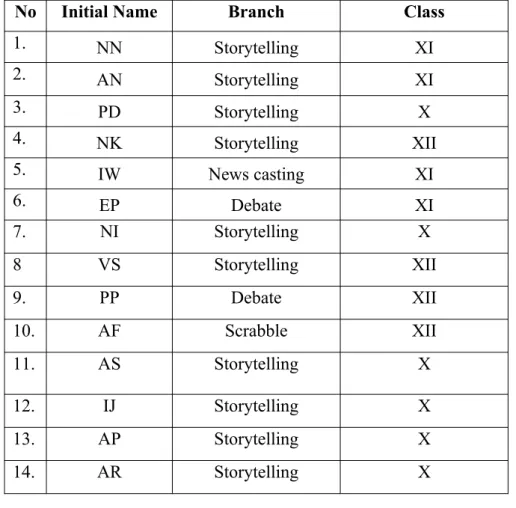
1. The Needs of Storytelling Materials for the Member of English Club The needs for the storytelling learning material for member of storytelling in English club were known by collecting data. The data collection was done in two ways. The demography is shown on the table below.
Table 1. Identity of the Respondent
No Initial Name Branch Class
1. NN Storytelling XI
2. AN Storytelling XI
3. PD Storytelling X
4. NK Storytelling XII
5. IW News casting XI
6. EP Debate XI
7. NI Storytelling X
8 VS Storytelling XII
9. PP Debate XII
10. AF Scrabble XII
11. AS Storytelling X
12. IJ Storytelling X
13. AP Storytelling X
14. AR Storytelling X
.
34
a. Questionnaire (Open-ended)
The questionnaire was given on June, 28 2020 to the members of English club. The interview was done by using Google form. It consists of 11 questions of open-ended question and 5 questions of close-ended question. It is answered by 14 members of English club. The results of questionnaire are;
1) There is no learning material as the guidance for the member.
2) Difficulty in finding and convincing an idea to make a story.
3) The members are unconfident and difficult to memorize a story.
4) The lack of vocabulary mastery.
5) Resource and guidance just focus on internet.
b. Questionnaire (Likert Scale and Close-ended Question)
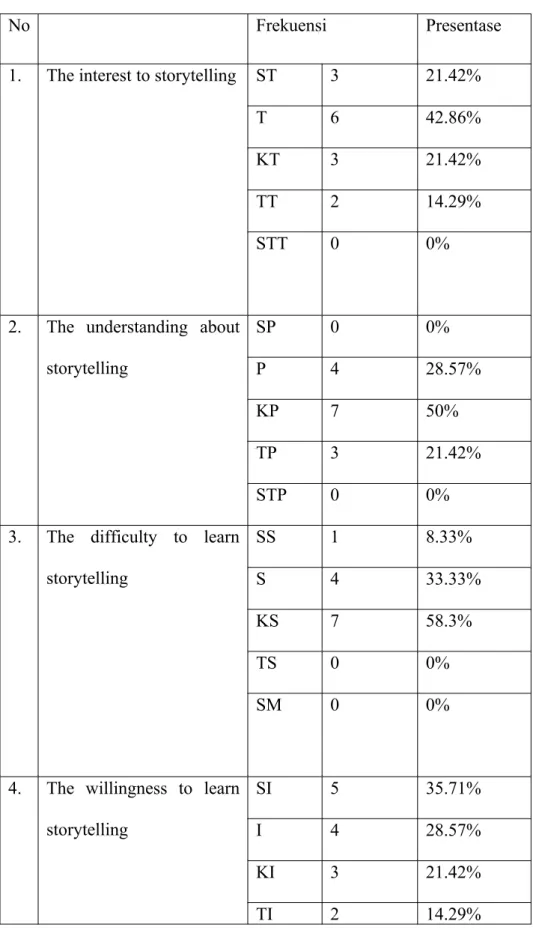
The questionnaires were distributed to the members of storytelling on June 2020, by using google form. The questionnaire was conducted with 14 respondent and 11 questions. The following table below explains the percentage of the questionnaires result by the respondent.
36
Table 2. Questionnaire for Need Analysis
No Frekuensi Presentase
1. The interest to storytelling ST 3 21.42%
T 6 42.86%
KT 3 21.42%
TT 2 14.29%
STT 0 0%
2. The understanding about storytelling
SP 0 0%
P 4 28.57%
KP 7 50%
TP 3 21.42%
STP 0 0%
3. The difficulty to learn storytelling
SS 1 8.33%
S 4 33.33%
KS 7 58.3%
TS 0 0%
SM 0 0%
4. The willingness to learn storytelling
SI 5 35.71%
I 4 28.57%
KI 3 21.42%
TI 2 14.29%
STI 0 0%
5. Every branches introduce other branches
Yes 12 85.71%
No 2 14.29%
6. Every member learn storytelling
Yes 10 71.43%
No 4 28.57%
7. The time in forum is enough to polish the skill
Yes 12 85.71%
No 2 14.29%
8. Polishing skill outside the forum
Yes 10 71.43%
No 4 28.57%
9. The role of senior is important for new member to develop the skill
Yes 14 100%
No - -
The table above shows the data of result from a questionnaire analysis that has been filled by the respondent. Those are,
1) The most 42.86% students are interested to storytelling and 21.42% students were strongly interested. It means that more than a half of the members have strong willing to know about storytelling.
2) 71.42% of the members have less understanding about storytelling. It means that just one-third respondents who knew about storytelling.
38
3) There are no respondents agree that storytelling is not difficult or even very easy.
4) The table shows that 64.28% members have willingness to learn storytelling. Three-four respondents have high enthusiasm to explore their insight to storytelling.
5) There are almost members agree that every branches introducing their branches each other.
6) Three-quarter members are learning storytelling.
7) The data shows that 85.71% member argue that time in forum is not enough to enrich the skill.
8) Three-quarter members increasing their skill outside the learning time.
9) All the members agree that senior has core role in the progress of skill of the members.
2. The Storytelling Materials for the Member of English Club
Pocket Book of “Basic Storytelling for Newbie” consists of five chapters. Chapter one (introduction), chapter two (what is storytelling?), chapter three (get started), chapter four (get to know), and chapter five (how to tell a story).
a. Description of Chapter One (Introduction)
In chapter one, titled “Introduction” explains about the introduction of speaking performance related to storytelling. As the part of the public speaking, storytelling has different treatment in
teaching and learning. Therefore, this chapter gives identification contextually. Then, this chapter also served a picture as the additional source. It presents difficult vocabulary with the meaning.
b. Description Chapter Two (What is storytelling)
This chapter includes of one topic that has several sub topics.
Chapter two explains about the definition of storytelling that complete with the element of storytelling, part of the story and types of story. This chapter also equipped by pictures that enlighten the paragraph. Every sub topics also served vocabulary list as additional source.
c. Description Chapter Three (Get Started)
As like the name of the chapter, chapter three is the beginning before doing storytelling. It includes how to gain idea, select a theme and creating a title, creating the story and convincing the character of the story. To make easy the reader, this chapter also provides pictures that define the description of the materials. Every topic includes some steps that explain the topic. It also gives vocabulary list for make the reader easy to catch the meaning for every material.
d. Description Chapter Four (Get to Know)
This chapter consists of two subtopics; they are technique of storytelling and types and the using aids. In the technique of storytelling explain some steps of how to perform a story in public in
40
a good way. Beside it, it explains also the types and the correct aids that used as supporting materials in storytelling. It also provided by illustration picture and unfamiliar vocabulary list.
e. Description Chapter Five (How to Tell a Story)
In this chapter includes three topics. The first topic explains about the steps how to perform a story well. The second explains about how to grab audiences’ attention. And the last chapter describes about how to build a confidence when showing storytelling. Every chapter is completed by illustration of picture and vocabulary list of difficult words.
The last part of this book is included examples of story with the properties that used. It is also explained the arrangement part of the story in order to make easy the reader to identify it.
3. The Internal Validity of the Developed Storytelling Materials for English Club
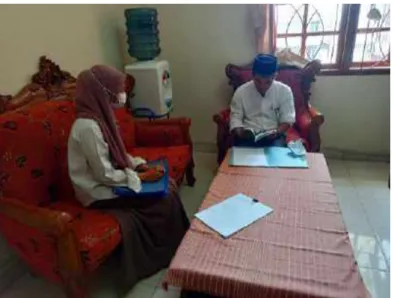
The developed materials of storytelling have been validated and assessed by three English lecturers of IAIN Metro. Every lecturer has different assessment. The assessment consists of three aspects. The first is language use. The second is the assessment of the content materials.
The last is the design graphic. The validation was done by questionnaire that had disseminated to each validator.
Picture 3. The Process of Validating Product
The results of the validation were calculated by using Aiken’s V validity formula to determine the coefficient of the content validity. The value recapitulation of Aiken’s V is presented in Table 2.
Table 3. Validation of Product
No Language Use Assessment Aiken’s V Score Remarks
1. Title Suitability 0.67 Accordingly
2. The accuracy of language and vocabulary selection
0.67 Accordingly
3. The effectiveness of the sentences used
0.67 Accordingly
4. Demand and unity of ideas 0.67 Accordingly
42
No. Content Assessment Aiken’s V Score Remarks
1. Material suitability 0.67 Accordingly
2. Material depth 0.67 Accordingly
3. Material accuracy 0.67 Accordingly
4. Material updates 1.00 High validity
5. Conformity with students’
level of development
0.67 Accordingly
No. Graphic Design Assessment Aiken’s V Score Remarks
1. Content layout 1.00 High validity
2. Content illustration 1.00 High validity
3. Typography materials 1.00 High validity
4. Size conformity 1.00 High validity
5. Compatibility of color selection 0.67 Accordingly The table shows 14 aspects assessed by the expert. From the calculated data, the develop materials are proper according to Aiken’s V which almost the aspects have percentage higher than 0.5 (X>0.5). The result of the data is 9 from 14 aspects are accordingly valid, which has value 0.67. Those are material suitability, material depth, the effectiveness of the sentences used, demand and unity of ideas, title suitability, the accuracy of language and vocabulary selection, the effectiveness of the sentences used, demand and unity of ideas,
compatibility of color selection. Besides, according to the validity from the expert that is shown on the table above, the materials development has high validity. It is proven by 5 aspects which have calculated value more than 0.8<X. those are mostly from graphic design and 1 from content assessment.
B. Product Revision
Product revisions are adjusted based on the suggestions from the practitioners. This is related to the things that should be corrected. Those are, 1. Validator 1 (Dr. Dedi Irwamsyah, M. Hum) gave suggestion in the
selection of paper material for the cover and the content. Especially for the packaging of the product. The next suggestion was the product should be registered to ISBN and book copyright. The book should be known from who the book is addressed. Then, the vocabulary list should be completed by pronunciation and arranging in alphabetical. The last was bolding every words in the vocabulary list.
2. Validator 2 (Dr. Aria Septia Anggaira, M. Pd) stated that the product should be specifically destined. The second suggestion was vocabulary list should not be inputted to the product because it has already used English over all.
3. Validator 3 (Andianto, M. Pd) suggested to notice about the selection of picture color, picture layout and the originality of the picture. It meant that the picture was better drawn by the researcher.
44
The suggestions from the validators are very good. But, not all of the advices can be applied properly in the product in the near time. Those are about graphic design especially for selection of picture color and the originality of the picture. The next is about registration of ISBN and book copyright, also the deleted of the vocabulary list. Furthermore, the other suggested aspects from the practitioners were implemented accordingly that’s about adding pronunciation in vocabulary list, arranging words in vocabulary list to be alphabetic, bolding every words in the paragraph that mentioned in vocabulary list, and the picture layout.
C. Research Limitation
The research limitation especially occurs in the validity section. It is about the assessment aspects. Not all of the suggestions from the validators can be applied in the product nearest time. Furthermore, the product quality has not been met the criteria both in terms of presentation.