THE EFFECTIVENESS OF PRE-READING PLAN (PREP) TECHNIQUE TO IMPROVE STUDENTS’ READING COMPREHENSION IN THE
TENTH GRADE OF MADRASAH ALIYAH DDI CAMBALAGI KABUPATEN MAROS
( Pre-Experimental Research )
A THESIS
Submitted of the Faculty of Teacher Training and Education Muhammadiyah University of Makassar in Partial Fulfillment of the
Requirement for the Degree of Education of English Department
BY
MUTMAINNAH 10535561813
ENGLISH EDUCATION DEPARTMENT
FACULTY OF TEACHER TRAINING AND EDUCATION MUHAMMADIYAH UNIVERSITY OF MAKASSAR
2018
MOTTO
:“DON’T WAIT UNTIL TOMORROW WHAT YOU CAN DO TODAY”
“SUCCESS NEEDS A PROCESS”
ABSTRACT
Mutmainnah. 2017. The Effectiveness of Pre-Reading Plan (PREP) Technique to Improve Students’ Reading Comprehension at the Tenth Grade of MA DDI Cambalagi. Thesis. English Department. Faculty of Teachers Training and Education, Muhammadiyah University of Makassar. Advised by Ummi Khaerati Syam and Hj. Ilmiah.
This research aimed to find out whether the use of Pre-Reading Plan technique can improve students‟ reading comprehension at the tenth grade of MA DDI Cambalagi. This research focused on stating the main idea, supporting idea and the conclusion of the material, the kind of reading is literal reading.The researcher applied pre-experimental design with one group pre-test and post-test.
There were 26 students of X IPS 1 in the school became the sample which decided by using purposive sampling. In collecting the data, theresearcher conducted pre- test and post-test by serving reading test.
The research findings indicated that using Pre Reading Plan as a technique was effective to improve students‟ comprehension.It was proved by the result of mean score of post-test which was classified as fairly good (69.9) higher than the pre-testwhich was claasified as poor (53.8) in reading comprehension. Therefore there was the improvement of the students reading comprehension in terms of main idea, supporting idea and conclussion.
The result of improvement is also proved by the value of t-test (4.36) which was greater than the value of t-table (2.060). Therefore, it can be concluded that applying Pre-Reading Plan technique has significant effect in reading comprehension and can make the students aware about their prior knowledge.
Keywords : Pre Reading Plan, Reading, Reading Comprehension.
ACKNOWLEDGMENT
Allah praises be to Allah, Lord of the world, for the health and the strength that Allah has given to the researcher in writing this „thesis‟. Peace and salutation be upon the prophet Muhammad, his family, his companions as well as his followers.
Firstly, the researcher also would thank to her beloved parents, Abd. Latif and Mariyama who always never stop teaching their precious meaning of life, giving their knowledge, giving their time and who always pray for her every time; her brother and sister, Imran and Musdalifah, who always give support and motivation to her.
Secondly, the researcher would like to address her thank and great gratitude to Ummi Khaerati Syam, S.Pd., M.Pd and Hj. Ilmiah, S. Pd.,M.Pd as the researcher‟s advisors, who give consultation with full of patience, help and guidance as valuable advice during developing this Thesis and completing her work, may Allah SWT respond to their kindness much better.
Thirdly, the researcher thought that she would never finish this thesis fluently without their supports and their helps. Her gratitude also goes to:
1. Erwin Akib, M.Pd., Ph. D asDean of Faculty of Teachers and Training Education.
2. Ummi Khaerati Syam, S.Pd., M. Pd as the Head of English Education Department.
3. Muh. Jamil, S. Ag., M .Pd. I as Headmaster of MA DDI Cambalagi for giving permission to the researcher to do observation and conduct the research.
4. Suriati, S.Pd as the English teacher of MA DDI Cambalagi for all sincere help, time and guidence.
5. All lecturers of English Education Department for teaching precious knowledge and sharing wonderful experiences.
6. Thestudents of MA DDI Cambalagi especially class X IPS 1 for being participant in this research.
7. All my of friend in English Education Department especially G class.
8. All my bestfriend Ade Isra Julianti and Hafsari, S.Pd for all support and wishes that given to me.
Finally, the researcher admits that her writing is still far from being perfect. Therefore she hopes some suggestions and criticism from the reader for this paper. Hopefully this thesis will have some values for her and the reader.
Makassar, 10 September 2017
The Researcher
TABLE OF CONTENTS
Page
COVER ... i
LEMBAR PENNGESAHAN ... ii
APPROVAL SHEET ... iii
COUNSELLING SHEET ... iv
SURAT PERNYATAAN ... vii
SURAT PERJANJIAN ... viii
MOTTO ... ix
ABSTRACT ... x
ACKNOWLEDGMENT ... xi
TABLE OF CONTENTS ... xiii
LIST OF TABLES ... xv
LIST OF FIGURES ... xvi
LIST OF APPENDICES ... xvii
CHAPTER I : INTRODUCTION ... 1
A. Background ... 1
B. Research Question ... 4
C. Objective of the Research ... 5
D. Significance of the Research ... 5
E. Scope of the Research ... 5
CHAPTER II : REVIEW OF RELATED LITERATURE ... 6
A. Previous Related Research Findings ... 6
B. Concept of Reading ... 7
C. Concept of Pre- Reading Plan ... 11
D. Concept Reading Comprehension ... 14
E. Conceptual Framework ... 16
CHAPTER III : RESEARCH METHODOLOGY ... 17
A. Research Design ... 17
B. Population and Sample ... 17
C. Variable of the Research ... 18
D. Research Hypothesis ... 18
E. Research Instruments ... 19
F. Technique of Data Collection ... 21
G. Technique of Data Analysis ... 22
CHAPTER IV : FINDINGS AND DISCUSSION ... 25
A. Findings ... 25
B. Discussion ... 28
CHAPTER V : CONCLUSION AND SUGGESTIONS ... 34
A. Conclusion ... 34
B. Suggestions ... 34 BIBILIOGRAPHY
APPENDIX
CURRICULUM VITAE
LIST OF TABLES
Page
3.1 Rubric of Main Idea ... 19
3.2 Rubric of Supporting Idea ... 20
3.3 Rubric of Conclusion ... 20
3.4 Scoring Classification. ... 22
3.5 Hyphothesis Testing ... 23
4.1 The Effectiveness of the Students‟ Reading Comprehension in Term Main Idea, Supporting Idea, Conclusion ... 25
4.2 The Improvement of the Students Reading Comprehension ... 27
4.3 T-test of the Students‟ Reading Comprehension ... 28
LIST OF FIGURES
Page 2.1 Conceptual Framework ... 16 4.1 Percentage of Students‟ Improvement in Reading Comprehension ... 26
LIST OF APPENDICES
Page A. I The Result of The Student Reading Comprehension in Pre Test .... 36 A. II The Result of the Students Reading Comprehension in Post Test ... 37 A. III The Gain Score (D) of the Students‟ Reading Comprhension ... 39 A.IV The Percentage of Students‟ in Pre-test and Post-Test of
Reading Comprehension ... 41 A.V The Student Mean Score of the Student Test and Calculatig the ...
Student T-Test ... 44 A.V Distribution of T-Table ... 47 A.VI The List Name of the Students‟ Class X IPS 1 MA DDI Cambalagi 49 Research Instrument ... 50 Lesson Plan ... 55 Documentations... 69
CHAPTER I INTRODUCTION A. Background
Pre-Reading Plan technique is one of the technique of teaching reading where the students are trained to free associate on key vocabulary words reflect these associations as a group, and then reformulate their knowledge based on the discussion. According to Langer (1980:4), Pre-Reading Plan is an activity before reading strategy that helps teacher assesses students‟ prior knowledge, how students prior knowledge are organized can be determined as well as the quality and quantity of language that students use to express their knowledge about a particular topic. Therefore Pre-Reading Plan is an activity before the actional reading, Pre Reading Plan give opportunity to the student to generate what they already know about the topic the they are going to read.
The Pre-Reading Plan technique begins with the teacher introducing a key word, concept or picture to stimulate a discussion. By having the students say anything that initially comes to mind and having that information recorded on the whiteboard and participants are able to see the associations. By asking the students some questions that can make the student think more deeply about the material that they will read. The students also have the opportunity to listen to other explanations and interact with other students. This interactive process also provides students with the opportunity to accept, reject or alter their own initial associations and to integrate them into more accurate pictures of the target concept. After that is the reformulation of knowledge, which provides the
opportunity for students to verbalize any changes of modifications of their associations that may have occurred during the discussion (Langer,1980:5). The purpose of helping the student to link his/her background knowledge with concepts in the text is to set up appropriate expectations about the language and content of the passage.
Reading is crucial skill for English language learners in today‟s world; it supports the development of overall proficiency and provides access to crucial information at work and in school. With English being the dominant language of the internet, international business, and academia (including science), beginning and advanced students alike face challenges to develop their second language (L2) reading abilities (Komiyama, 2009:32).
To get a good achievement in reading skills, however, is never easy, and students need consistent practice to become fluent readers (Grabe &
Stoller,2011:11). It is a fact that the student who study English may be fluent in their native language, but they cannot transfer into the skill of reading English.
When they read an English text, they tend to know or focus to the words rather than on the entire text and they are laid to their dictionary, therefore they read slowly, word by word and have lack of understanding the text. Successful readers have to solve many puzzles, such as learning to recognize unfamiliar letters, words, syntax, and discourse patterns. These challenges can be overcome more easily if students are given strategies to read.
Based on the information from the English teacher of tenth grade students MA DDI Cambalagi, the student reading commprehension is still low, it was
proved by the mean score of the students‟ achievement in reading English. It was only about 60 while standart score of curriculum was 70 and the target score is minimally like the standart of curriculum must be achieved. Most of the students in MA DDI Cambalagi also assumed that English is difficult to learn especially learning reading skill. The students seemed uninterested in reading an English text. The students were bored when the teacher gave them a text to read. They only read the text quickly but they do not know to analyze or comprehend the text It happened because they were lack of vocabulary and they had no idea about the content of the material, what the text is about and they are hard to find out the main idea and details from the text. Beside that, the researcher also found that most of the students did not know the purpose of reading that text, they just followed the researcher instruction. The researcher can say that it is impressed that the students are under pressure to read.
By applying this Pre-Reading Plan technique, it is possible to the teacher to make good decisions about how to increase students‟ knowledge. The activating knowledge consists of building students‟ awareness of what they already know and elaborating and refining what they know through group discussions. This activating prior knowledge about the topic will help the students to gain the message or the content of the reading text, and the motivation of the student will also increase, because they have preceding information, what the reading text will talk about.
Most studies seem to agree that the pre-reading can give effect to the student reading comprehension. For example, Alemi and Ebadi (2010:1) have
demonstrated the facilitative effects of activating reader‟s prior knowledge as relevant to understanding of the new text. According to them, pre-reading activities do not only prepare readers for the concepts that follow but also makes the reading task easier and connecting the new concept more meaningful to prior knowledge. While Marinaccio (2012:53) concluded that pre-reading strategies encouraged students to successfully activate their prior knowledge and connect it with new material. Some researchers also interestedused Pre-Reading Plan technique in some kinds of reading text for example, Darmi (2012:43) found that the Pre-Reading Plan technique can improve the student reading comprehension especially in reading descriptive text. Maretnowati (2014:3) had focused on improving student reading recount text by using pre-reading technique.
Meanwhile, the present study will focus on narrative text.
However, even though many studies have investigated the effect of pre- reading strategies but there has been very little research reported on the effectiveness of Pre-Reading Plan. The purpose of the present study is to ascertain the effectiveness of using Pre-Reading Plan.
Based on the explanation above, the researcher will conduct the research under title” The Effectiveness of Pre-Reading Plan (PreP) to Improve Students‟
Reading Comprehension in the tenth grade of MA DDI Cambalagi.”
B. Research Question
Based on the background above, the researcher would like to formulate the research question as follow:
“Is the Pre-Reading Plan effective to improve st udents‟ reading comprehension”?
C. Objective of the Research
Based on the research question above, the objectives of this study is “to find out whether the students‟ reading comprehension improve significantly through Pre-Reading Plan”.
D. Significance of the Research
The result of the research is expected to benefit for reference to know the effectiveness of Pre-Reading Plan technique, for other writers who are interested to analyse the Pre-Reading Plan to improve reading comprehension, this research can be reference.
E. Scope of Research
Based on the research question above, the researcher limited only in improving reading comprehension to the tenth grade of Madrasah Aliyah DDI Cambalagi by using Pre-Reading Plan. The researcher focused on improving students‟ literal reading comprehension on stating the main idea, supporting idea and the conclusion of the material.
CHAPTER II
REVIEW OF RELATED LITTERATURE A. Previous Related Research Findings
There have been many researches done related to pre-reading some of them are presented below:
1. Darmi (2012) from the analysis result, it can be concluded that by using Pre- Reading Plan techniques the student became easy and enjoy reading a reading material. It was proved by the score that student got in pre-test was 5.7 and in post-test was 7.0, it means that there was a progress score after the students got treatment through pre- reading technique. By this technique, the student became easy to read a reading text and students aware about their prior knowledge.
2. Maretnowati (2014) in her research concluded that using pre- reading activity has a great an positive influence in teaching reading. The students who are taught using the pre-reading activity have higher score than the students taught without pre-reading activity. It was known that there is a significance difference between the score of the student who are taught using pre-reading activity. It was proved by the research findings. The result of statistic calculation indicated that the value of t-test = 5.05 and the value of df (degree of freedom) as 38 on degree of significance of 5 % and 1 % is 2.02 and 2.71 comparing the with each values of the degrees of significance, the researcher found that 2.02<5.05>2.71. Therefore, t-test is higher than t-table,it
can be concluded by using pre-reading activities can improve reading comprehension especially in teaching reading recount text.
3. Nurman (2015) found that using Pre-Reading Plan strategy can improve the students‟ literal reading comprehension at the tenth year student and this technique also can make activeness in learning process especially in reading.
4. Nurfitriani(2013) in her research on The Effect of Pre-Questioning on The Reading Comprehension Achievement conclude that the students‟ reading comprehension when they were taught using pre-questioning was classified as very good. It was proved by the mean score of the student post- test (8,55) in experimental group (using pre-questioning).
From the four researches finding above, the researcher concluded that in teaching reading comprehension by using pre-reading technique can improve the students‟ achievement in reading. The difference between the researcher and the other researcher are in the kind of reading text and the instrument. In teaching reading comprehension, the teacher should make the students interested in reading English material. In order that the students easy to understand the content of the material, and easy to answer the question from the teacher.
B. Concept of Reading 1. Definition of Reading
There have been many linguists who have given their definitions about reading. Among the linguists are Richard & Schmidt (2010:483), Burns in Sinambela (2015:14), Grabe and Stoller (2011:11), Alderson (2000:3) as respectively given below:
Richard & Schmidt (2010:483) stated that reading means understanding the meaning of written text to get an over all infomation from the context of the text. The activity of reading can be done silently. Therefore, the students‟ need to have a good interaction with the text in order to get information about what the writer has written inn the text.
Burns in Sinambela (2015:14) stated that reading is a process of thinking by the reader to get massage from the writer through printed or written representation. The reader has to recognize word that requires interpretation of graphic symbols. Reading means understanding the meaning of what is on the printed and written verbal symbols.
Reading is also interactive in the sense that linguistic information from the text interacts with information activated by the reader from long-term memory, as background knowledge. These two knowledge sources (linguistic and background) are essential for building the reader‟s interpretation of the text. Grabe
& Stoller (2011:11). Reading needs the identification and recognition of what is printed or written on the page which can be a stimulus to remember meaning built up through past experience, the reader understand the new meaning through relevant concept of readers manipulation that is already in his possesion. the resulting meaning are organized into a process of thinking in accordance with the golas that oparate on the reader..
According to Alderson (2000:3) argues that there are two aspects in reading: process and product. In the process of reading there happened many things. The reader thinks about what he is reading, what the text means, or what
he expects from the text. This statement proves that in reading, there is cognitive process in reader‟s mind.
Reading is an activity or process in getting information. Reading involves the interaction because it is one of skill which are highly connected with someone‟s language ability. When people read they construct and research for meaning based on their own perception to the text bring to them.
From these definitions above, the researcher can conclude that reading is a process of understanding the meaning of a text. This process involves an interaction between the reader and the author of the text, the reader can understand what the author‟s thought. The reader has to catch the idea which is conveyed by the writer.
2. Aims of Reading
A person may read for many purposes, and purpose helps to understand more what is read by people, if he is reading for pleasure or reading for pure recreation and enjoyment, he may read rather quickly or slowly based on the way he like or feels. But if reading for studying or setting information such as news, science or same line, which are part of his study or assignment, he does it very slowly and carefully.
According to Anderson in Elfitriyani (2013:10), there are seven aims of reading. For example reading for details and fact, reading for main ideas, reading for sequence or organization, reading for inference, reading for classifying, reading for evaluating and reading for comparing of contest. Those seven aims of reading will be explained in detail below:
a. Reading for detail and fact. It is reading to get the information of what have read by subject in a story.
b. Reading for main ideas. It is reading to know primary ideas in a story
c. Reading for sequence or organization. It is reading to know sequence and composition of story organization.
d. Reading for inference. It is reading to conclude and to know the meaning in a story.
e. Reading for classifying. It is reading to agglomerate the same things.
f. Reading for evaluating. It is reading to know the value of the story and also to know appraising the subject in a story.
g. Reading for comparing of contest. It is reading for combining between two stories.
According to that explanation, there are many purposes of reading which can be achieved by people. There are some people who have the purpose in reading more than just one. This case of course will influence their reading result.
But, advisable, people who read just have one purpose; will get a good comprehension since they are more focus.
3. Types of Reading
According to Kozak (2011:7), there are some types of reading and the corresponding types of activities to develop the corresponding reading skill.
a. Skimming
Skimming is the most rudimentary type of reading. Its object is to familiarize you as quickly as possible with the material to be read.
b. Scanning
Scanning is a skill that requires that you read quickly while looking for specific information. To scan a reading text, you should start at the top of the page and then move your eyes quickly toward the bottom. Generally, scanning is a technique that is helpful when you are looking for the answer to a known question.
c. Close reading
Close reading is the most important skill you need for any form of literary studies. It means paying especially close attention to what is printed on the page.
Close reading means not only reading and understanding the meanings of the individual printed words, but also involves making yourself sensitive to all the nuances and connotations of language as it is used by skilled writers.
C. Concept of Pre-Reading Plan (PreP) 1. Definition of Pre-Reading Plan
According to Langer (1980:4), Pre-Reading Plan is an activity before reading strategy that helps teacher assesses students‟ prior knowledge, how students prior knowledge are organized can be determined as well as the quality and quantity of language that students use to express their knowledge about a particular topic.
Pre-Reading Plan is pre-instruction activity that fosters group discussion and an awareness of the material to be covered. Teacher introduces an important concept of the material to be taught and student share what they know about the concept.
The PReP is a 3-step assessment/instructional procedure for teachers to use before assigning textbook reading to their classes. It is a group discussion activity (approximately 5-6 students) which helps both teachers and students gain information about students' text-related prior knowledge. The assessment aspect of the activity helps the teacher to determine the amount of prior information a reader has about a specific topic, as well as how the reader has organized this information and to become more aware of the language a student uses to express knowledge about a given subject and also to make judgments about how much additional background information and vocabulary is needed before students can successfully comprehend the text.
According to Tierney (1990:42), the PreP techniques provide a teacher with a means to prepare students to read a text selection and at the same time analyse their responses so as a tailor subsequent instruction to student needs.
PReP is also become one way in which can be trans lated into useful classroom application.
2. Procedure of Pre-Reading Plan
According to Langer (1980:4), there are three steps to a Pre-Reading Plan
a. Select a reading passage for the class. Identify its central concept and state it in a brief sentence. Share this statement with the class and springboard for their pre-reading activities.
b. Divide the class into small groups. Ask each group to list each words and phrases from their prior knowledge that are associated with the central concept of the reading selection. After that, the students group the ideas into logical categories and share their list of associated terms with the class.
c. The student reflect on the specific relationship of each term they listed to the central theme. Ask the following questions to help students‟ clarify these associations: “what made you think of this association?”,“how is the specific word related to the general concept?” and then is there any new ideas about this particular concept?”.
3. Purpose of Pre-Reading Plan
The Pre-Reading Plan was developed by Langer (1981:43) with the following goals:
a. To give students an opportunity to generate what they know about a topic and to extend these idea and evaluate them.
b. To provide teacher with procedure for assessing the adequacy of the students prior knowledge about a specific topic.
c. Determining the language that students use to express their ideas.
4. Pre-Reading Plan involves three steps phases a. Initial associations with the concept
In the first phase the teacher gives a key word, example (have you ever heard the word “congress”?). As each student tells what ideas initially come to mind, the teacher jots each response on the board. It is during this phase that the students have their first opportunity to find association between the key concept and their prior knowledge.
b. Reflection on initial associations
During the second phase of the Pre-Reading Plan are asked “what makes you think of..?”(the response given by the students ). This phase helps the students develop awareness of their network association. They also have the opportunity to listen to each other‟s explanations, to interact and become aware of the changing ideas. Through this procedure they have an opportunity to listen to each other „s explanations, to interact and become aware of their changing ideas, reject, accept, revise and integrate some of the ideas that come to mind.
c. Reformulation of knowledge
In this phase the teacher says “based on our discussion and before we read the text have you new ideas about?. This phase allow student to verbalize associations that have been elaborated or change through the discussion.
D. Concept of Reading Comprehension 1. Definition of Reading Comprehension
Reading and comprehension are two things that cannot be separated.
Reading means understanding the text and it is the same things as comprehension.
According to Grellet (1981:3), reading is understanding a written text which means extracting the required information from it as efficiently as possible.
Comprehension means understanding the meaning or the point of the topic. Dubin, Eskey and Grabe (1986:6), show more specific explanation, comprehension means relating what we do not know or new information, which is not random collection or facts but a “theory of world” in each of our heads.
Reading comprehension is most likely simple multiplication of word recognition abilities and general language comprehension abilities.
Based on RAND Reading Study Group (2002:11), comprehension entails three elements:
a. The reader who is doing the comprehending b. The text that is to be comprehended
c. The activity in which comprehension is a part
Those elements are related to each other which decide the quality of reading comprehension of the reader.
Reading comprehension is very important in our everyday for example, when we glance at newspaper, magazines, and books, we often need to understand the reading passage more profoundly. Someone cannot get information completely without comprehension. Comprehension includes recognizing and understanding main ideas and related details.
Based on definitions above, it can be synthesized that definition of reading comprehension is the process of interaction between a reader and a text to get
information and interpretation from the text and get the conclusion of the information. Delivery of ideas, opinions, or feeling is some important aspects of the process which a writer‟s become real reader.
E. Conceptual Framework
The conceptual framework of this research could be served as follow:
INPUT PROCESS OUTPUT
Figure: 2.1 Conceptual Framework
The conceptual framework above shows that the researcher taught a reading material by using Pre-Reading Plan technique as a treatment in teaching reading comprehension. The researcher uses Pre-Reading Plan technique in order to know the students improvement in reading comprehension.
Reading material
Applying pre- reading Plan to improve reading
comprehension.
(Treatment)
Improving students' reading
comprehension
CHAPTER III
RESEARCH METHODOLOGY A. Research Design
In this research, the researcher applied a pre-experimental method with one group pre-test and post-test design. It aimed to find out the effectiveness of Pre-Reading Plan technique in improving students‟ reading comprehension at the tenth grade of MA DDI Cambalagi in learning reading comprehension. This research consisted of pre-test, treatment, and post-test. The formula presented as follows:
O1 X O2
Where:
O1 : pre-test X : treatment
O2 : post- test (Gay, 2011:265) B. Population and Sample
1. Population
The population of the research was the tenth grade students of MA DDI Cambalagi academic year 2017-2018 which consisted of 6 classes with total 156 students.
2. Sample
The sample was selected by using purposive sampling technique. The purposive sampling technique also known as judgmental, selective or subjective sampling, it was a type of non-probability sampling technique. non probability focuses on sampling techniques where the units that investigated ware based on the judgment or purpose of the research. The sample was one class with 26 students. The researcher tookX IPS 1in academic year 2017/2018 as the sample of this research.
C. Variable of the Research
There were two variable in this research, namely independent and dependent variables. The independent variable of this research was the Pre- Reading Plan and the dependent variable was students‟ reading comprehension.
D. Research Hypothesis
There were two hypotheses in this research. They were H0 (Null hypothesis) and H1 (Alternative hypothesis)
a. Null Hypothesis
There was no significant difference between the students‟ reading comprehension before and after using Pre-Reading Plan technique in improving students‟ reading comprehension at thetenthgrade MA DDI Cambalagi.
b. Alternative Hypothesis
There was significant difference between the students‟ reading comprehension before and after using Pre-Reading Plan technique in improving their reading comprehension at the tenth grade MA DDI Cambalagi.
E. Research Instruments
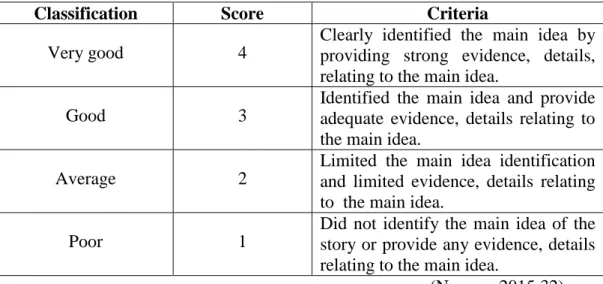
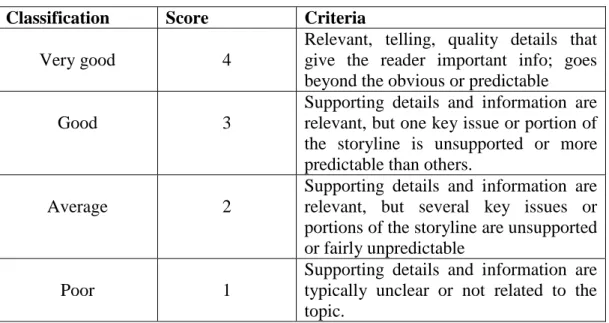
The instrument of this research was reading test. The test about reading a story (narrative text). The test was given in some topics and then the researcher gave the student essay test to evaluate their reading comprehension. After the students were‟ given a test, the researcher assessed the score of the students‟ answer into the following measurement:
Table 3.1: (Rubric of Main idea)
Classification Score Criteria
Very good 4
Clearly identified the main idea by providing strong evidence, details, relating to the main idea.
Good 3
Identified the main idea and provide adequate evidence, details relating to the main idea.
Average 2
Limited the main idea identification and limited evidence, details relating to the main idea.
Poor 1
Did not identify the main idea of the story or provide any evidence, details relating to the main idea.
(Nurman,2015:32)
Table 3.2:(Rubric of Supporting Idea)
Classification Score Criteria
Very good 4
Relevant, telling, quality details that give the reader important info; goes beyond the obvious or predictable
Good 3
Supporting details and information are relevant, but one key issue or portion of the storyline is unsupported or more predictable than others.
Average 2
Supporting details and information are relevant, but several key issues or portions of the storyline are unsupported or fairly unpredictable
Poor 1
Supporting details and information are typically unclear or not related to the topic.
(Nurman,2015:33) Table 3.3: (Rubric of Conclusion)
Classification Score Criteria
Very good 4
The conclusion clearly connects introduction and body of the topic with insightful comments/analysis
Good 3
Ideas in the conclusion adequately connect introduction and body of the topic
Average 2 The conclusion leaves questions and/or is a weak wrap up of the topic.
Poor 1 Conclusions are typically unclear or not
related to the topic.
(Shorten, 2009:1)
F. Technique of Data Collection
In collecting data the researcher used some procedures as follows:
a. Pre-test
Before applying Pre-Reading Plan or before doing the treatment, the students were given pre-test to measure their achievement in reading comprehension.
b. Treatment
After the student given the pre-test, the student was treated by using Pre- Reading Plan technique. The treatment was applied for four meetings and each meeting take 90 minutes.
a) In the first meeting the teacher presented material about (Malin Kundang).
b) In the second meeting the teacher presented material about (Garlic and Union).
c) In the third meeting the teacher presented material about ( Kancil and Crocodile).
d) In the fourth meeting the teacher presented material about (Snow White).
c. Post test
In the post test, the teacher gavethe students a reading material and evaluate them by using reading task to know whether the students reading comprehension are improved by using Pre-Reading Plan technique.
G. Technique of Data Analysis
In analysing the data collected through the pre-test and post-test the researcher used the procedure as follow :
1. Scoring the student answer by using formula
Where :
X : The student final score (Pusat Kurikulum 2006: 40)
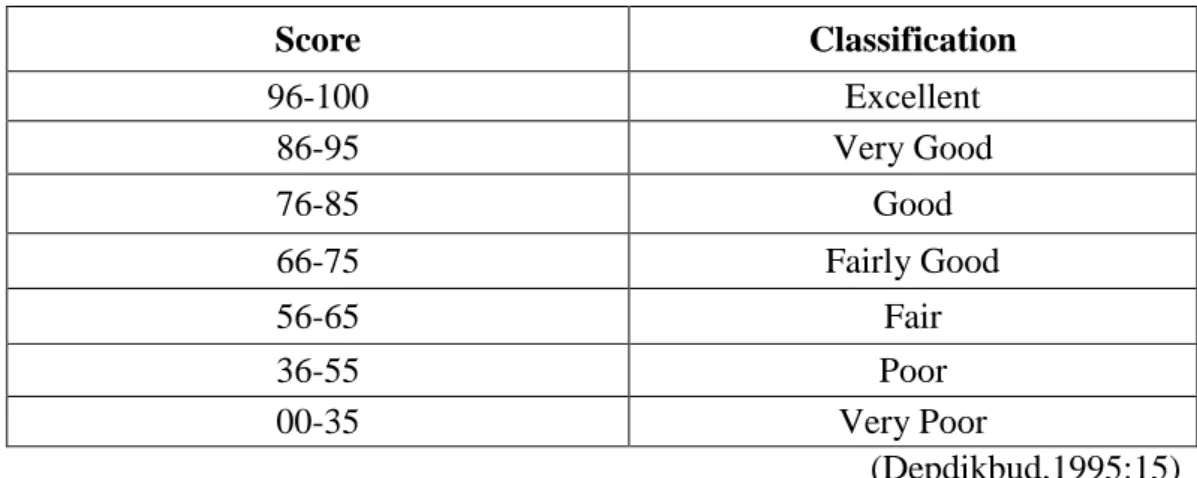
2. After collecting the data of the student the researcher classified the score of the students into the following criteria
Table 3.4 : (Scoring Classification)
Score Classification
96-100 Excellent
86-95 Very Good
76-85 Good
66-75 Fairly Good
56-65 Fair
36-55 Poor
00-35 Very Poor
(Depdikbud,1995:15) 3. Finding out the mean score, standart deviation, frequency and rate percentage
of the students answer by using descriptive statistics.
4. The percentage of increasing achievement used the following formula ̅̅̅̅
̅̅̅̅
̅̅̅̅
Where:
P = The percentage
= Average Score of Post-test
= Average Score of Pre-test (Arikunto,2006:23)
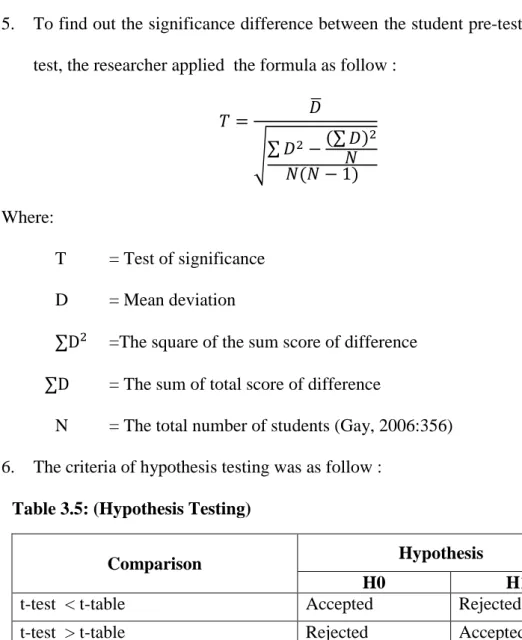
5. To find out the significance difference between the student pre-test and post- test, the researcher applied the formula as follow :
̅
√∑ (∑ ) ( ) Where:
T = Test of significance D = Mean deviation
∑ =The square of the sum score of difference ∑ = The sum of total score of difference
N = The total number of students (Gay, 2006:356) 6. The criteria of hypothesis testing was as follow :
Table 3.5: (Hypothesis Testing)
Comparison Hypothesis
H0 H1
t-test < t-table Accepted Rejected
t-test > t-table Rejected Accepted
The table above meant (1) the t-test value was smaller than t-table value, the null hypothesiswas accepted, while the alternative hypothesiswas rejected
and (2) the t-test value was equal to greater than t-table value, the null hypothesis was rejected while the alternative was accepted.
CHAPTER IV
FINDING AND DISCUSSION A. Finding
The finding of the research contains clear answer to the research question as obtainable objective of the research which it aims to find out the improvement of the students‟ reading comprehension by using Pre-Reading Plan technique at the tenth grade of MA DDI Cambalagi. The result of data analysis can be seen through the result of the pre-test and post-test.
1. The Effectiveness of Pre-Reading Plan Technique in Improving Reading Comprehension
The effectiveness of the students‟ reading comprehension are viewed in main idea, supporting idea and conclussion through the effectiveness of Pre- Reading Plan technique that could be seen clearly at table 4.1:
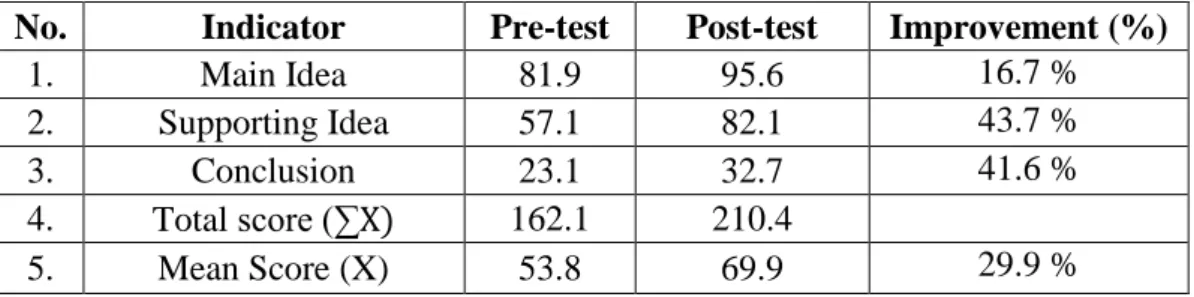
Table 4.1 : The Effectiveness of The Students’ Reading Comprehension in Term Main Idea, Supporting Idea and Conclusion.
No. Indicator Pre-test Post-test Improvement (%)
1. Main Idea 81.9 95.6 16.7 %
2. Supporting Idea 57.1 82.1 43.7 %
3. Conclusion 23.1 32.7 41.6 %
4. Total score (∑X) 162.1 210.4
5. Mean Score (X) 53.8 69.9 29.9 %
The data in table 4.1 shows 3 (three) indicators of the effectiveness in the students‟ reading comprehension. The mean score of the students‟ reading comprehension in pre-test is 53.8. It was classified as a poor category, but after using the effectiveness of pre-reading technique, the mean score of post-test
becomes 69.9. It was greater than pre-test. It was classified as a fairly good category. The improvement of the students‟ reading comprehension from pre-test to post-test is 29.9 %.
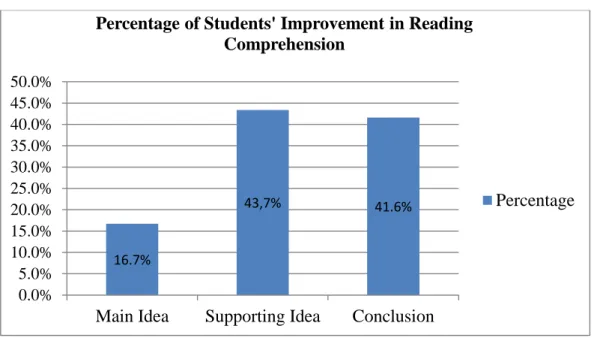
The researcher presented the percentage of improvement in chart. This chart could show the improvement percentage of the three indicators of the effectiveness of Pre-Reading Plan in students‟ reading comprehension. The percentage of students‟ improvement in reading comprehension could be seen in figure 4.1 below:
Figure : 4.1 Percentage of Students’ Improvement in Reading Comprehension
Figure 4.1 above showed that supporting idea had highest percentage in students‟ reading comprehension 43.7%. It was followed by percentage of conclusion with percentage 41.6% and the lowest percentage is the improvement of main idea with percentage 16.7%.
16.7%
43,7% 41.6%
0.0%
5.0%
10.0%
15.0%
20.0%
25.0%
30.0%
35.0%
40.0%
45.0%
50.0%
Main Idea Supporting Idea Conclusion Percentage of Students' Improvement in Reading
Comprehension
Percentage
2. The Mean Score and Improvements of the Students’ Reading Comprehension
To answer the research question in the previous chapter, the researcher administers a test, which is given twice to the student. Firstly pre-test is given before the treatment. Secondly, post-test is given after the treatment. The result of the students‟ reading comprehension through Pre-Reading Plan technique is presented in table 4.2 below :
Table 4.2: The Improvement of the Students’ Reading Comprehension
No. Variable Pre-test Post- test Improvement
1. Reading
Comprehension 53.8 69.9 29.9 %
The table above shows the variable of reading comprehension as the result of calculating of student pre-test and post-test after taught Pre-Reading Planas a technique, the student score in pre-test (53.8) was different from the post-test (69.9). It means that the mean score of the students‟ post-test was higher than the mean score of the students‟ pre-test.
3. The Significance of the Students’ Reading Comprehension
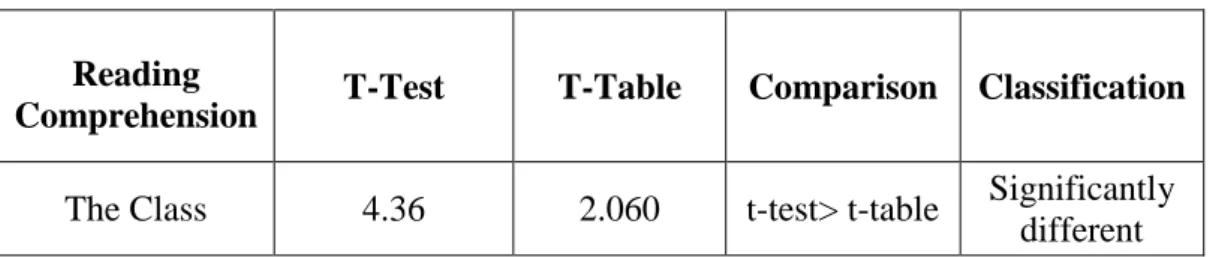
To know the level of significance of the pre-test and post-test the researcher used t-test analysis on the level of significance (p) = 0.05 with the degree of freedom (df) = N-1, where N= number of subject ( 26 students ) then the value of t-table was 2.060. The test statistical, analysis for independent sample was applied. The following table shows the result of t-test calculation.
Table 4.3: T-test of the Students’ Reading Comprehension Reading
Comprehension T-Test T-Table Comparison Classification The Class 4.36 2.060 t-test> t-table Significantly
different Table 4.3 shows the significance difference between t-test and t-table that t-test value was greater than t-table (t-test > t-table ), the final result shows that t-test value for the final score of students‟ reading comprehension was (4.36 >
2.060). it means that there is significant difference between the students‟ reading comprehension before and after using Pre-Reading Plan technique` it is also said that the null hypothesis (H0) was rejected and the alternative hypothesis (H1) was accepted.
B. Discussion
In this part, the discussion covers the interpratation of the research findings derived from the result of student reading comprehension. The previous research Darmi (2012:43) showed that from the analysis result, it can be concluded that by using Pre-Reading Plan techniques the student became easy and enjoy reading a reading material. It was proved by the score that student got in pre-test was 5.7 and in post-test was 7.0, it means that there was a progress score after the students got treatment through pre- reading technique.
Furthermore, Maretnowati (2014:42) stated that using pre- reading activity has a great an positive influence in teaching reading. The students who are taught using the pre-reading activity have higher score than the students taught without
pre-reading activity. It was known that there is a significance difference between the score of the student who are taught using pre-reading activity. It was proved by the research findings. The result of statistic calculation indicated that the value of t-test = 5.05 and the value of df (degree of freedom) as 38 on degree of significance of 5 % and 1 % is 2.02 and 2.71 comparing the with each values of the degrees of significance, the researcher found that 2.02<5.05>2.71.
Therefore, t-test is higher than t-table, it can be concluded by using pre-reading activities can improve reading comprehension especially in teaching reading recount text.
Meanwhie, Nurman (2015:43) found that using Pre-Reading Plan strategy can improve the students‟ literal reading comprehension at the tenth year student and this technique also can make activeness in learning process especially in reading. Nurfitriani (2013:42) in her research on The Effect of Pre-Questioning on The Reading Comprehension Achievement conclude that the students‟ reading comprehension when they were taught using pre-questioning was classified as very good. It was proved by the mean score of the student post- test (8,55) in experimental group (using pre-questioning).
From the four previous researches finding above, the researcher would like to compare the result that the researcher found of the observation in improving reading comprehension by using Pre Reading Plan technique. The description of previous section showed the students‟ reading comprehension has improved.
Based on findings above in applying Pre-Reading Plan as a technique in the class, the data was collected through test as explained in previous finding sections
showed that the students‟ reading comprehension was significantly improve the students‟ score after applying Pre-Reading Plan as a technique,it was proved by the student mean score of post-test (69.9) was higher than student pre-test (53.8) it meant the student reading comprehension after applying Pre-Reading Plan as a technique better than before the treatment was given to the student.Before giving treatment, the students‟ reading comprehension students` was categorized as poor. After giving the treatment, their ability was significantly improved and catgorized as fairly good. By using Pre-Reading Plan technique also can make the student enjoy reading a reading material because the student were trained to activate their prior knowledge of the topic that was given from the researcher.
From the explanation above it can be concluded that in teaching reading comprehension by using pre-reading technique can improve the students‟
achievement in reading. The difference between the researcher and the other researcher are in the kind of reading text and the instrument. In teaching reading comprehension, the teacher should make the students interested in reading English material. In order that the students easy to understand the content of the material, and easy to answer the question from the teacher.
1. The students` Improved in reading comprehension
To know the improvement of student in reading comprehension, the researcher used the formula of Gay (2006:356) to calculate the data and to know the result of the t-test of the student. But before the the researcher calculate the t- test of the student, the researcher found the mean score of the student. After calculating the mean score, the researcher found the students` reading
comprehension had improved 29.9 % from the mean score 53.8 on pre-test to be 69.9 on post-test. It was supported by the mean score post-test of the students`
reading comprehension was higher than pre-test.
The score of the student post-test was higher than the mean score of the students` pre-test. Therefore, the use of Pre-Reading Plan as a technique can enrich the students` reading comprehension.
It was also supported by the result of the data analysis on the table showed that from the level of significance (p) + 0.05 with the degree of the freedom (df) =N-1, where N= number of subject (26) students` reading comprehension was higher than the t-table (4.36> 2.060). Then, students` reading comprehensive could improve by using the Pre-Reading plan as a technique.
2. The Improvement of the Students` in Deciding Main Idea
After calculating the score, the researcher found the students` in deciding main idea had improve 16.7% from the mean score 81.9 on pre-test to be 95.6 on post-test. It was supported by the mean score of post-test was higher than the mean score of pre-test. Therefore, the effectiveness of Pre-Reading Plan could improve the students` deciding main idea in reading comprehension.
3. The Improvement of the Students` in Deciding Supporting Idea
After calculating the score, the research found the students` in deciding supporting idea had improved 43.7 % from the mean score 57.1 on pre-test to be 82.1 on post-test. It was supported by the mean score of post-test was higher than the mean score of pre-test. Therefore, the effectiveness of Pre-Reading Plan as a
technique could improve the students` deciding supporting idea in reading comprehension.
4. The Improvement of the Students` in Conclusion
After calculating the score, the researcher found the students` in deciding conclusion had improved 41.6% from the mean score 23.1 on pre-test to be 32.7 on post-test. It was supported by the mean score of post-test was higher than the mean score of pre-test. Therefore, the effectiveness of Pre-Reading Plan as a technique could improve the students` deciding supporting idea in reading comprehension.
The indicator above, the researcher tries hard to improve the students`
reading comprehension that is asked students` to discussed the material that the researcher gave in every meeting, and with applying (PReP) Pre-Reading Plan technique the researcher finally success to improve the students` reading comprehension it showed from the students` result in pre-test and post-test .
Based on the result above, hypothesis test showed that Null Hypothesis (H0) was rejected and Alternative Hypothesis (H1) was accepted. So, the researcher concluded that there was significant improvement of the students‟
reading comprehension by using Pre-Reading Plan as a technique in teaching reading comprehension in MA DDI Cambalagi.
Although Pre Reading Plan technique was effective to improve students‟
reading comprehension but the researcher still found some weakness of applying Pre Reading Plan in the class. For example, some students may not want to
associate freely because they were shy or have no idea about the particular topic so they decided to silent, while some students may try to interpret. So, the researcher hoped for other researcher who intrested to investigate Pre Reading Plan technique can fix what the present study has been found.
CHAPTER V
CONCLUSION AND SUGGESTION
This chapter consists of two sections. The first section deals with the conclusion and the second one deals with suggestion.
A. Conclusion
Based one the finding on the discussion, the researcher concludes that the teaching reading through Pre-Raeding Plan technique is effective to improve the students‟ reading comprehension. By using this technique, the students became easy and enjoy reading a reading material.It was proved by the score that they got in pre-test was 53.8 and in post test was 69.9. It means that there was a process score after the student got treatment through pre-reading technique.
Learning about reading text through pre-reading is an effective way to improve students‟ reading comprehension. By using this technique, the students became re-remember what they know about the material and it makes the students aware about their prior knowledge.
B. Suggestion
Based on the conclusion above, the researcher proposes the following suggestions.
The English teacher should be more creative to choose method or technique in teaching reading, so that the students will be more interested and
motivated to study english, so with appying Pre Reading Plan (PreP) as a technique to improve the students‟ reading comprehension the English teacher can helps the students‟ in reading.
Finally, the researcher realizes that this thesis still far from perfect, so the researcher really hopes this thesis can be a meaningful contribution for the teacher of english as well as students and further writers.
BIBILIOGRAPHY
Alderson, J.C. 2000. Asessing Reading. United Kingdom. Cambridge University Press.
Alemi, M & Ebadi, S. (2010) The Effects of Pre-Reading Activities on ESP Reading Comprehension. Journal of Language Teaching and Research,
Vol. 1, No. 5, pp. 569-577.(
http://www.academypublication.com/issues/past/jltr/vol01/05/04.pdf.
Downloaded at 02 February 2018 )
Arikunto, Suharsimin. (2006). (Edisi Revisi VI) Dasar-Dasar Evaluasi Pendidikan. Jakarta: Bumi Aksara.
Darmi. 2012. The Effect of Pre Reading Activities to Improve Reading Comprehension. Makassar : Universitas Muhammadiyah Makassar Departemen Pendidikan dan Kebudayaan. 1994. Petunjuk Teknis Pengajaran
Bahasa Inggris. Jakarta: Depdikbud.
Dubin. F , D.E Eskey and W. Grabe. 1986. Teaching Second Language Reading for Academic Purposes (Second Language Professional Library. New York: Addison Wasley
Elfitriyani. 2013. The Correlation between Vocabulary Mastery and Reading Ability on Narrative Text at the Second Year Students of SMPN 3 Kampar. Pekanbaru: UIN Suska Riau
Gay, L. R, Georfey, E. Peter, A. 2006. Eight: Educational Research Competencies for Analysis and Application. Pearson
Gay, L. R. 2011. Educational Research: Competencies for Analysis and Application Tenth Edition. Ohio : Pearson
Grabe . W. & Stoller F. 2011. Teaching and Researching Reading 2nd Edition.
Routledge. London & New York
Grellet,F. 1981. Developing Reading Skills: A Practical Guide to Reading Comprehension Exercises. United Kingdom. Cambridge University Press.
Harmer, J. 2007. The Practice of English Language Teaching Fourth Edition.
United Kingdom. Pearson Longman
Komiyama, R. 2009. CAR: A Means for Motivating Students to Read.United States. English Teaching Forum
Kozak. 2011. The Types of Reading and Exercises for Teaching Reading.
(http://www.e-osnova.ru/PDF/osnova_10_0_696.pdf. Downloaded at 08 February 2017)
Langer, Judith. A. 1980. From Theory to Practice : Pre-Reading Plan.
Educational Resource Information Centre
(http://files.eric.ed.gov./fulltext/ED197283.pdf. Downloaded at 08 February 2017)
Langer, Judith. A. 1981. Prior Knowledge and Its Relationship to Comprehension. Journal of Reading Behavior.
(http://journals.sagepub.com/doi/pdf/10.1080/10862968109547426) Maretnowati, L. 2014. The Effectiveness of Pre Reading Activities ( Questioning
and Viewing Pictures) in Student’ Comprehension in Reading Recount text. Jakarta. UIN Syarif Hidayatullah
Marinaccio, J. 2012. The Most Effective Pre-reading Strategies for
Comprehension.Fisher Digital Publications.
(http://fisherpub.sjfc.edu/cgi/viewcontent.cgi?article=1209&context=educ ation_ETD_masters. Downloaded at 08 February 2017)
Nurfitriani. 2013. The Effect of Pre-Questioning on the Reading Comprehension Achievement. Makassar: Universitas Muhammadiyah Makassar
Nurman. O. 2015. The Effectiveness of Pre-Reading to Improve Reading Comprehension .Makassar: Universitas Muhammadiyah Makassar.
Pusat Kurikulum. 2006. Model Penilaian Kelas.
(http://file.upi.edu/Direktori/FIP/JUR._PEND._LUAR_BIASA/19520215 1983011-M._UMAR_DJANI_MARTASUTA/B_UPI/8_Model-
Model_Kurikulum/Model_Penilaian_Kelas/05_PLB/Penilaian_Pendidika n_Khusus-Januari.pdf. Downloaded at 04 July 2017)
RAND Reading Study Group. 2002. Reading for Understanding : Toward an R&D Program in Reading Comprehension. Santa Monica, CA : Science and Technology Policy Institute. RAND Education.
Richards, Jack C & Schmidt. R. 2010. Longman Dictionary of Language Teaching and AppliedLinguistics 4th Edition. Longman : Malaysia
Shorten G & Carr C. 2009. Middle / High School Instructional Support Materials for Writing: Introductions and Conclusions. Shelton School District.
(https://www.sheltonschools.org/CAL/Shared%20Documents/Writing/Se condaryModules/Intros_ConclModule/IC_DocFolder/Conclscoringguide.
doc. Downloaded at 16 June 2017)
Sinambela E, Manik S, Pangaribuan R. E. 2015. Improving Students’ Reading Comprehension Achievement by Using K-W-L Strategy . English
Linguistics Research Vol. 4, No. 3; 2015.
(http://www.sciedu.ca/journal/index.php/elr/article/viewFile/7547/4747.
Downloaded at 31 May 2017)
Sugiyono. (2014). Metode Penelitian Pendidikan Pendekatan Kuantitatif Kualitatif dan RAD. Bandung:ALFABETA
Tierney, Robbert. J. 1990. Reading Strategies And Practices A CompendiumThird Edition. Allyn and Bacon
APPENDIX I
THE RESULT OF THE STUDENTS READING COMPREHENSION IN PRE-TEST
No Sample
Reading Comprehension
Score Classification Main Idea Supporting
Idea Conclusion
1 S 01 100 55 25 60 Fair
2 S 02 100 37,5 10 49,2 Poor
3 S 03 100 75 50 75 Fairly Good
4 S 04 100 75 50 75 Fairly Good
5 S 05 75 75 5 51,7 Poor
6 S 06 75 87,5 50 70,8 Fairly Good
7 S 07 100 55 0 51,7 Poor
8 S 08 50 25 0 25 Very Poor
9 S 09 10 42,5 10 20,8 Very Poor
10 S 10 10 42,5 5 19,2 Very Poor
11 S 11 10 42,5 5 19,2 Very Poor
12 S 12 100 75 30 68,3 Fairly Good
13 S 13 100 87,5 0 62,5 Fair
14 S 14 100 42,5 10 50,8 Poor
15 S 15 75 75 2,5 50,8 Poor
16 S 16 100 12,5 30 47,5 Poor
17 S 17 100 75 5 60 Fair
18 S 18 100 92,5 27,5 73,3 Fairly Good
19 S 19 75 75 25 58,3 Fair
20 S 20 100 12,5 42,5 51,7 Poor
21 S 21 75 25 25 41,7 Poor
22 S 22 100 62,5 30 64,2 Fair
23 S 23 100 62,5 30 64,2 Fair
24 S 24 75 37,5 25 45,8 Poor
25 S 25 100 87,5 50 79,2 Good
26 S 26 100 57,5 62,5 73,3 Fairly Good
Total Score 2130 1485 603 1399
Poor
Mean Score 81,9 57,1 23,1 53,8
APPENDIX II
THE RESULT OF THE STUDENTS READING COMPREHENSION IN POST-TEST
No Sample
Reading Comprehension
Score Classification Main Idea Supporting
Idea Conclusion
1 S 01 100 62,5 37,5 66,7 Fairly Good
2 S 02 75 37,5 37,5 50 Poor
3 S 03 100 95 50 81,7 Good
4 S 04 100 100 25 75 Fairly Good
5 S 05 100 100 25 75 Fairly Good
6 S 06 100 100 62,5 87,5 Very Good
7 S 07 100 87,5 50 79,2 Good
8 S 08 75 30 12,5 39,2 Poor
9 S 09 35 75 12,5 40,8 Poor
10 S 10 100 50 25 58,3 Fair
11 S 11 100 50 25 58,3 Fair
12 S 12 100 100 25 75 Fairly Good
13 S 13 100 100 25 75 Fairly Good
14 S 14 100 87,5 25 70,8 Fairly Good
15 S 15 100 87,5 37,5 75 Fairly Good
16 S 16 100 100 37,5 79,2 Good
17 S 17 100 75 25 66,7 Fairly Good
18 S 18 100 82,5 37,5 73,3 Fairly Good
19 S 19 100 100 57,5 85,8 Very Good
20 S 20 100 100 25 75 Fairly Good
21 S 21 100 50 37,5 62,5 Fair
22 S 22 100 87,5 25 70,8 Fairly Good
23 S 23 100 95 25 73,3 Fairly Good
24 S 24 100 87,5 25 70,8 Fairly Good
25 S 25 100 100 62,5 87,5 Very Good
26 S 26 100 100 25 75 Fairly Good
Total Score 2485 2136 852,5 1818
Fairly Good
Mean Score 95,6 82,1 32,7 69,9
The Result of the Students’ Reading Comprehension Pre-Test Using SPSS
Pre-Test Descriptive Statistics
N Minimum Maximum Sum Mean
Std.
Deviation Variance Main Idea 26 10.00 100.00 2130.00 81.9231 29.70107 882.154 Supporting Idea 26 12.00 92.00 1485.00 57.1154 23.70540 561.946
Conclusion 26 .00 62.00 603.00 23.1923 18.82131 354.242
Score 26 19.00 79.00 1399.00 53.8077 17.73363 314.482
Valid N
(listwise) 26
The Result of the Students’ Reading Comprehension Post-Test Using SPSS Post-Test Descriptive Statistics
N Minimum Maximum Sum Mean
Std.
Deviation Variance Main Idea 26 35.00 100.00 2485.00 95.5769 14.09446 198.654 Supporting Idea 26 30.00 100.00 2136.00 82.1538 21.91017 480.055 Conclusion 26 12.00 62.00 852.00 32.7692 13.63028 185.785
Score 26 39.00 87.00 1818.00 69.9231 12.52812 156.954
Valid N
(listwise) 26
APPENDIX III
THE GAIN SCORE (D) OF THE STUDENTS’ READING COMPREHENSION
No Code of Sample
Reading Comprehension Pre-test
(X1) (X1)2 Post-test
(X2) (X2)2 Gain/D
(X2-X1) D2
1 S 01 60 3600 66,7 4448,89 6,7 44,89
2 S 02 49,2 2420,64 50 2500 0,8 0,64
3 S 03 75 5625 81,7 6674,89 6,7 44,89
4 S 04 75 5625 75 5625 0 0
5 S 05 51,7 2672,89 75 5625 23,3 542,89
6 S 06 70,8 5012,64 87,5 7656,25 16,7 278,89
7 S 07 51,7 2672,89 79,2 6272,64 27,5 756,25
8 S 08 25 625 39,2 1536,64 14,2 201,64
9 S 09 20,8 432,64 40,8 1664,64 20 400
10 S 10 19,2 368,64 58,3 3398,89 39,1 1528,81
11 S 11 19,2 368,64 58,3 3398,89 39,1 1528,81
12 S 12 68,3 4664,89 75 5625 6,7 44,89
13 S 13 62,5 3906,25 75 5625 12,5 156,25
14 S 14 50,8 2580,64 70,8 5012,64 20 400
15 S 15 50,8 2580,64 75 5625 24,2 585,64
16 S 16 47,5 2256,25 79,2 6272,64 31,7 1004,89
17 S 17 60 3600 66,7 4448,89 6,7 44,89
18 S 18 73,3 5372,89 73,3 5372,89 0 0
19 S 19 58,3 3398,89 85,8 7361,64 27,5 756,25
20 S 20 51,7 2672,89 75 5625 23,3 542,89
21 S 21 41,7 1738,89 62,5 3906,25 20,8 432,64
22 S 22 64,2 4121,64 70,8 5012,64 6,6 43,56
23 S 23 64,2 4121,64 73,3 5372,89 9,1 82,81
24 S 24 45,8 2097,64 70,8 5012,64 25 625
25 S 25 79,2 6272,64 87,5 7656,25 8,3 68,89
26 S 26 73,3 5372,89 75 5625 1,5 2,25
Total 1409 84182,7 1827,5 132356 418 10118,56
Mean Score 53,8 3237,2 69,9 5090,15 16,1 389,17
The Gain Score of The Students’ Reading (D) by using SPSS
Pre-test
(X1) (X1)2
Post-test
(X2) (X2)2
Gain/D
(X2- X1) D2
N Valid 26 26 26 26 26 26
Missing 0 0 0 0 0 0
Mean 53.8077 3237.2308 69.9231 5090.1538 16.0769 389.1754 Median 54.5000 3035.0000 74.0000 5498.5000 15.4500 240.2650
Mode 51.00 2672.00 75.00 5625.00 6.70 44.89
Variance 314.482 3.015E6 156.954 2.594E6 135.936 1.954E5
Range 60.00 5904.00 48.00 6120.00 39.10 1528.81
Sum 1399.00 84168.00 1818.00 132344.00 418.00 10118.56
APPENDIX IV
THE PERCENTAGE OF STUDENTS’ IN PRE TEST AND POST TEST OF READING COMPREHENSION
The Students’ Percentage in Pre-Test Frequency Percent
Valid Percent
Cumulative Percent
Valid 19 2 7.7 7.7 7.7
20 1 3.8 3.8 11.5
25 1 3.8 3.8 15.4
41 1 3.8 3.8 19.2
45 1 3.8 3.8 23.1
47 1 3.8 3.8 26.9
49 1 3.8 3.8 30.8
50 2 7.7 7.7 38.5
51 3 11.5 11.5 50.0
58 1 3.8 3.8 53.8
60 2 7.7 7.7 61.5
62 1 3.8 3.8 65.4
64 2 7.7 7.7 73.1
68 1 3.8 3.8 76.9
70 1 3.8 3.8 80.8
73 2 7.7 7.7 88.5
75 2 7.7 7.7 96.2
79 1 3.8 3.8 100.0
Total 26 100.0 100.0
The Students’ Percentage in Post-Test
Frequency Percent
Valid Percent
Cumulative Percent
Valid 39 1 3.8 3.8 3.8
40 1 3.8 3.8 7.7
50 1 3.8 3.8 11.5
58 2 7.7 7.7 19.2
62 1 3.8 3.8 23.1
66 2 7.7 7.7 30.8
70 3 11.5 11.5 42.3
73 2 7.7 7.7 50.0
75 7 26.9 26.9 76.9
79 2 7.7 7.7 84.6
81 1 3.8 3.8 88.5
85 1 3.8 3.8 92.3
87 2 7.7 7.7 100.0
Total 26 100.0 100.0