BY
ALICE HIJRAH SULHA SIN. 11810420806
FACULTY OF EDUCATION AND TEACHER TRAINING STATE ISLAMIC UNIVERSITY OF SULTAN SYARIF KASIM RIAU
PEKANBARU
1444 H / 2022 M
BY
ALICE HIJRAH SULHA SIN. 11810420806
A Thesis
Submitted as partial fulfilment of the Requirements for Bachelor Degree of English Education (S. Pd)
DEPARTMENT OF ENGLISH EDUCATION
FACULTY OF EDUCATION AND TEACHER TRAINING STATE ISLAMIC UNIVERSITY OF SULTAN SYARIF KASIM RIAU
PEKANBARU
1444 H / 2022 M
i
ii
iii
ACKNOWLEDGEMENT
Praise is due to Allah Almighty, the creator of the universe, who is also the most forgiving and generous. With His help and favor, the researcher has finished the last research paper that must be submitted in order to receive a bachelor's degree from the State Islamic University of Sultan Syarif Kasim Riau's English Education Department, Faculty of Education and Teacher Training. And last, may shalawat and salam always be offered to Allah's final messenger, Prophet Muhammad SAW, who has motivated and enlightened countless people all over the world.
The researcher owes a huge debt of gratitude to researcher‟s parents, Alm.
Mr. Drs. Darmen and Mrs. Osriati, S. Pd, who provided love, support, funding, and encouragement in order to complete this thesis. They stood by the researcher throughout his and her struggles and provided a solid foundation for his and her understanding of Islamic teachings and the value of education. The researcher wishes to express her appreciation to all kind individuals who have supported, inspired, and even assisted the researcher in completing the study. As follows:
1. Prof. Dr. Hairunas, M.Ag., the Rector of State Islamic University of Sultan Syarif Kasim Riau. Prof. Dr. Hj. Helmiati, M.Ag the Vice-Rector I of State Islamic University of Sultan Syarif Kasim Riau. Dr. H. Mas‟ud Zein, M.Pd, the Vice-Rector II of State Islamic University of Sultan Syarif
iv
Kasim Riau. Prof. Edi Erwan, S.Pt., M.Sc., Ph.D., the Vice-Rector III of State Islamic University of Sultan Syarif Kasim Riau.
2. Dr. H. Kadar, M.Ag., the Dean of Education and Teacher Training Faculty of State Islamic University of Sultan Syarif Kasim Riau. Dr. H. Zarkasih, M.Ag., as the Vice of Dean I, Dr. Zubaidah Amir MZ., S.Pd., M.Pd., as the Vice of Dean II, Dr. Amirah Diniaty, M.Pd., Kons., as the Vice of Dean III and all staffs. Thanks for the kindness and encouragement.
3. Dr. Faurina Anastasia, S.S., M.Hum., the Head of the English Education Department who has given the researcher correction, suggestion, support, advice, and guidance in finishing this thesis.
4. The English Education Department's Secretary, Dr. Nur Aisyah Zulkifli, S.Pd., M.Pd., provided this thesis with corrections, suggestions, assistance, advice, and direction.
5. Muhammad Taufik Ihsan, S.Pd, S.Kom, M.Pd., the researcher‟s supervisor who has given guidance, critics, advice, encouragement, and motivation to the researcher from the beginning of writing the thesis until the completion of it. The researcher apologizes for her weaknesses because of bothering his time and asking so many questions.
6. Rizky Gushendra, M. Ed, the Academic Supervisor for his guidance to the researcher.
7. Dr. Dodi Settiawan, M. Pd and Muhammad Fajri Hamdy, M. Pd as the researchers‟ raters who have helped to give the score of the researcher‟s data.
v
8. All lecturers of the English Education Department of State Islamic University of Sultan Syarif Kasim Riau, who has given knowledge and information of this project paper and thanks for their contributions and support during the courses.
9. Azzukhruf Alpinru, the researcher only younger brother, and all of the researcher‟s family members for their love and have given a chance to continue studying, have given motivations, supports, affection, and advices to accomplish this thesis.
10. Drs. Erwin Satriadi, M. Pd., the Head of Senior High School 1 Payakumbuh, Edizon, S. Pd. M. Si., The Vice Head of Senior High School 1 Payakumbuh, Harmita Nova Linda, S. Pd., as an English teacher of Senior High School 1 Payakumbuh that gave the researcher suggestions and encouragements to held the research and all of the staffs who have helped in accomplishing this research.
11. Titi Iklina, S. Pd, the researcher's comrade in arms who has continuously provided unending inspiration and assistance to complete this thesis.
Thank you very much for all of your compassion, encouragement, and unwavering love. May Allah continue to bless her journey through life.
12. The researcher's long time closest friend from elementary school, Fauziah Annisa Rahma, S. Pd, has assisted with data collection and has consistently provided a wealth of conversation, inspiration, and suggestions. My sincere thanks to Allah for blessing her life and trials, and
vi
for keeping researcher entertained while listening to all of researcher‟s stories.
13. Special thanks go out to the researcher's cherished "GURLS" trio of closest friends, Shofi Azhari, Diah Fadillah, and Dinda Aprilia Alamanda, for all of the encouragement, joy, and unfailing love they have ever given the researcher.
14. A massive thank you for all of the collaboration from the third semester onwards, Yoan Zaindanu and Susmitra Muhammad Efendi of the "ALICE AND TWO KNIGHTS" group, who have accompanied the researcher for over three years. May Allah constantly favor them and their difficulties with His blessings and grace.
15. “SMANSA‟S YOUNG TEACHERS”, the researcher‟s partners of teaching practice at Senior High School 1 Payakumbuh; Salsabila Dinda, Yuni Oktavia, Muvidellatul Husni, Nabila Indah Kemara, S. Pd, Aulya Sani, Elsa Suci Ramanda, S. Pd, Hikmil Kumala, S. Pd, Dhini Hariani, S.
Pd, Fauziah Annisa Rahma, S. Pd, Aldalia Shafa Maudiani, Noor Hidayah, Farah Azizah, S. Pd, Dara Cyntia Syafitri, Titi Iklina, S. Pd, and Miftaahul Dhiyo Ulhaq. A heartfelt thanks for the wonderful times we shared, the smiles, the priceless moments, the supports, and the never-ending inspiration throughout the teaching practice period. May Allah constantly favor their tribulations.
16. The fabulous class ever, F Class 2018, gratitude for all of memorable experiences for 3 years and a half.
vii
17. The students of tenth science 5 of Senior High School 1 Payakumbuh, who have participated in the collecting data process. A massive thank you all the dearest students.
18. Researcher‟s Team of KKN Jorong Padang Panjang, thanks for the togetherness and friendship.
19. Last but not least, I wanna thank me, I wanna thank me for believing in me, I wanna thank me for doing all this hard work, I wanna thank me for having no days off, I wanna thank me for never quitting, I wanna thank me for just being me at all times.
Finally, the researcher acknowledges how many flaws there are in this thesis. Therefore, helpful criticism and recommendations are required to enhance it. May Allah, the Most High, the Ruler of the Universe, bless you all. Aamiin.
Pekanbaru, July 18th, 2022 The Researcher,
Alice Hijrah Sulha SIN. 11810420806
viii ABSTRACT
Alice Hijrah Sulha (2022) : The Influence of Vocabulary Learning Strategies towards Students’ Speaking Skill at Senior High School 1 Payakumbuh
Learning vocabulary become one of the important things in learning English especially in speaking skill. In fact, a lot of senior high school students appear to have significant problems in it. Besides, vocabulary learning strategies are the strategies for improving acquisition that has been utilized effectively by many students. The study aimed to determine the influence of vocabulary learning strategies on students‟ speaking skill at Senior High School 1 Payakumbuh. This research used quantitative research. Correlational research design used in this research. This research was held on May 10th – 21st, 2022 at Senior High School 1 Payakumbuh. The data was collected from 40 samples and were selected randomly using simple random sampling. They were tenth grade students of Senior High School 1 Payakumbuh. In addition, questionnaire and oral test were used to gather the data. Simple linear regression also used to analyze both of the data. The findings showed that the vocabulary learning strategies had 4.5%
contribution on students‟ speaking skill. It means that there is no significant influence of vocabulary learning strategies on students‟ speaking skill at senior high school 1 Payakumbuh. Furthermore, according to the relevant research, it was found that the factors are blended learning and restriction-in class time since this research was conducted after Covid-19 pandemic.
ix ABSTRAK
Alice Hijrah Sulha (2022) : Pengaruh Strategi Pembelajaran Kosa Kata Terhadap Kemampuan Berbicara Siswa di SMAN 1 Payakumbuh
Penelitian ini bertujuan untuk mengetahui apakah ada pengaruh yang signifikan antara strategi pembelajaran kosa kata terhadap kemampuan berbicara siswa di SMAN 1 Payakumbuh. Penelitian ini merupakan penelitian korelasi dengan pendekatan kuantitatif. Objek penelitian ini adalah untuk mengetahui pengaruh strategi pembelajaran kosa kata terhadap kemampuan berbicara siswa dan subjek penelitian ini adalah kelas sepuluh SMAN 1 Payakumbuh. Data dikumpulkan melalui kuisioner dan tes lisan. Ada 40 siswa kelas sepuluh sebagai sampel di SMAN 1 Payakumbuh yang mengikuti penelitian ini dan dipilih secara acak. Berdasarkan analisis data menggunakan rumus regresi linear sederhana, temuan menunjukkan bahwa strategi pembelajaran kosa kata memiliki kontribusi 4.5% pada kemampuan berbicara siswa. Itu berarti tidak ada pengaruh yang signifikan dari strategi pembelajaran kosa kata terhadap kemampuan berbicara siswa di SMAN 1 Payakumbuh. Berdasarkan penelitian yang relevan, ditemukan juga bahwa beberapa faktor yang menyebabkan pengaruh yang sangat lemah ini karena adanya blended learning dan keterbatasan jam belajar dikelas karena penelitian ini dilakukan setelah pandemic Covid-19.
x
صخله
( ،تحلص ةزجه سيلأ 2222
) ىذل ملاكلا ةراهه يلع ثادزفولا نيلعت تيجيتازتسإ زيثأت :
تيهوكحلا تيوناثلا تسرذولا يف ذيهلاتلا 1
هوبهوكاياب
شيبك شيحأت كاُْ ٌاك ارإ اي تفشؼي ٗنإ جحبنا ازْ فذٓي ىيهؼت تيجيتاشتسإ شيحأت ٍيب
تييٕكحنا تيَٕاخنا تسسذًنا يف زييلاتنا ٖذن ولاكنا ةسآي ٗهػ ثادشفًنا 1
ازْ .ِٕبيٕكاياب
شيحأت تفشؼي ْٕ جحبنا ازْ عٕضٕي .يًك مخذي غي يطابتسا جحب ٍػ ةسابػ جحبنا
َاخنا تسسذًنا يف زييلاتنا ٖذن ولاكنا ةسآي ٗهػ ثادشفًنا ىيهؼت تيجيتاشتسإ تييٕكحنا تيٕ
1
كاُْ .تيٕفشنا ثاسابتخلاأ ثاَايبتسلاا للاخ ٍي ثاَايبنا غًج ىت .ِٕبيٕكاياب 04
زييلات ٍي
تييٕكحنا تيَٕاخنا تسسذًنا يف تُيؼك ششاؼنا فصنا 1
ازْ يف إكساش ٍيزنا ِٕبيٕكاياب
ا تنداؼي واذختساب ثاَايبنا ميهحت ٗنإ اًداُتسا .اًيئإشػ ىْسايتخا ىتٔ جحبنا يطخنا ساذحَلا
تبسُب تًْاسي آن ثادشفًنا ىيهؼت تيجيتاشتسإ ٌأ جئاتُنا شٓظُت ،ظيسبنا 0.4
ةسآي يف ٪
ةسآي ٗهػ ثادشفًنا ىيهؼت تيجيتاشتسلإ شيبك شيحأت ذجٕي لا َّأ يُؼي ازْ .زييلاتهن ولاكنا تييٕكحنا تيَٕاخنا تسسذًنا يف زييلاتنا ٖذن ولاكنا ا ٗهػ ًءاُب .ِٕبيٕكاياب 1
ثار ثاحبلأ
ىهؼتنا يْ تياغهن فيؼضنا شيحأتنا ازْ يف ببست يتنا ميإؼنا ٍي ذيذؼنا ٌأ اًضيأ ذجٔ ،تهصنا ذيفٕك تحئاج ذؼب ِؤاشجإ ىت جحبنا ازْ ٌلأ مصفنا يف ةدٔذحًنا ىهؼتنا ثاػاسٔ جيذًنا -
11
.
xi
LIST OF CONTENTS
SUPERVISOR APPROVAL ... i
EXAMINERS APPROVAL ... ii
ACKNOWLEDGEMENT ... iii
ABSTRACT ... viii
ABSTRAK ... ix
صخله ... x
LIST OF CONTENTS ... xi
LIST OF TABLES ... xiv
LIST OF CHARTS ... xiv
LIST OF APPENDICES... xviii
CHAPTER I INTRODUCTION A.Background of the Problem ... 1
B.Problem of the Research ... 4
1.Identification of the Problem ... 4
2.Limitation of the Problem ... 5
3.Formulation of the Problem ... 5
C. Objective and Significance of the Research ... 6
1.Objective of the Research ... 6
2.Significance of the Research ... 6
D.Definition of Term... 7
1.Speaking Skill ... 7
2.Vocabulary Learning Strategies... 7
xii
CHAPTER II REVIEW OF RELATED LITERATURE
A.Theoretical Framework ... 8
1.Speaking Skill ... 8
a. Nature of Speaking ... 8
b. The Components of Speaking ... 9
c. Function to Speaking ... 11
d. Basic Types of Speaking ... 12
e. Indicators of Speaking Skills ... 15
f. Teaching Speaking... 16
2. Vocabulary ... 17
a. Definitions of Vocabulary... 17
b. The Importance of Vocabulary ... 18
c. Types of Vocabulary ... 18
d. Teaching Vocabulary... 21
e. Vocabulary Learning ... 23
f. Vocabulary Learning Strategies ... 24
g. Techniques in Teaching Vocabulary ... 29
B. Relevant Research ... 32
C.Operational Concept ... 35
D.Assumption and Hypothesis ... 36
1.Assumption ... 36
2.Hypothesis ... 36
CHAPTER III METHOD OF THE RESEARCH A.Design of the Research ... 37
B.Location and Time of the Research ... 38
xiii
C.Subject and Object of the Research ... 38
D.Population and Sample of the Research ... 38
1.Population ... 38
2.Sample ... 39
E.Technique of Collecting the Data ... 40
1.Oral Test ... 41
2.Questionnaire ... 41
3.Validity ... 43
4.Reliability ... 44
F.Technique of Data Analysis ... 46
1.Normality of the Test ... 46
2.Data Analysis ... 47
CHAPTER IV RESULT AND DISCUSSION A.The Result ... 50
1.Vocabulary Learning Strategies... 50
2.Students‟ Speaking Skill ... 77
3.Students‟ Vocabulary Learning Strategies and Students‟ Speaking Skill. ... 78
B. Discussion ... 83
CHAPTER V CONCLUSION AND SUGGESTION A.Conclusion ... 86
B. Suggestion ... 86 REFERENCES
APPENDICES
CURRICULUM VITAE
xiv
LIST OF TABLES
Table II. 1 VLS Taxonomy by Schmitt ... 27
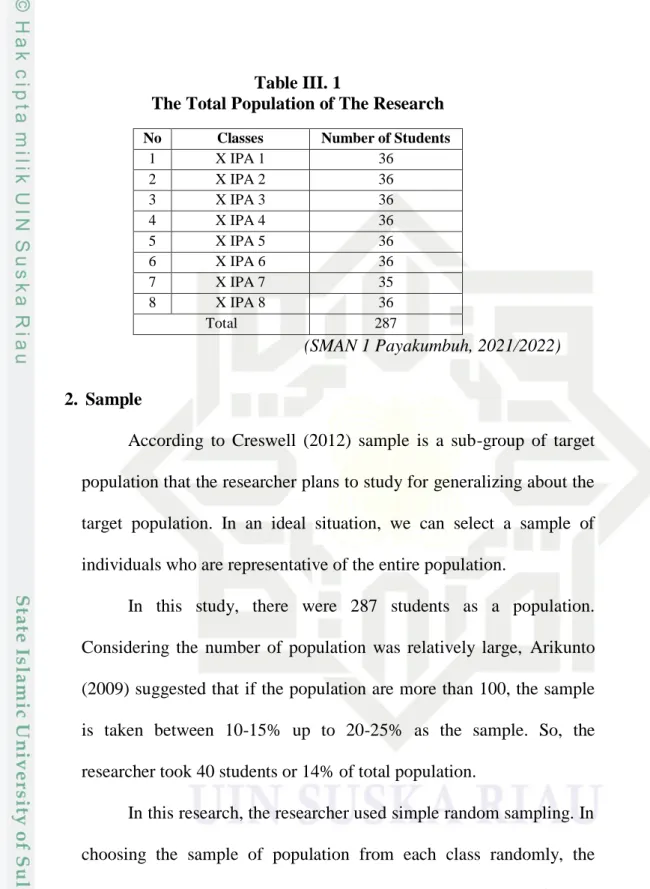
Table III. 1 The Total Population of The Research ... 39
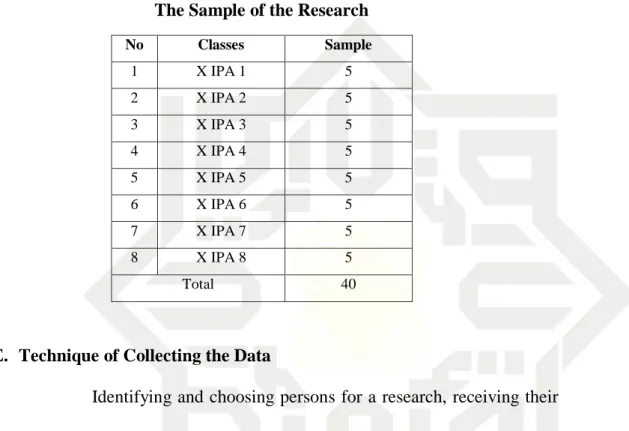
Table III. 2 The Sample of the Research ... 40
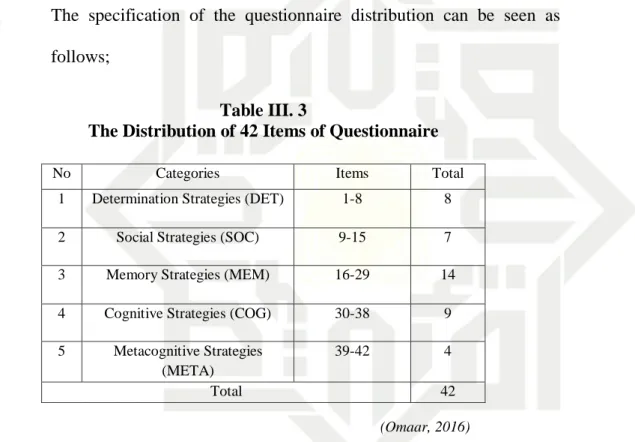
Table III. 3 The Distribution of 42 Items of Questionnaire ... 42
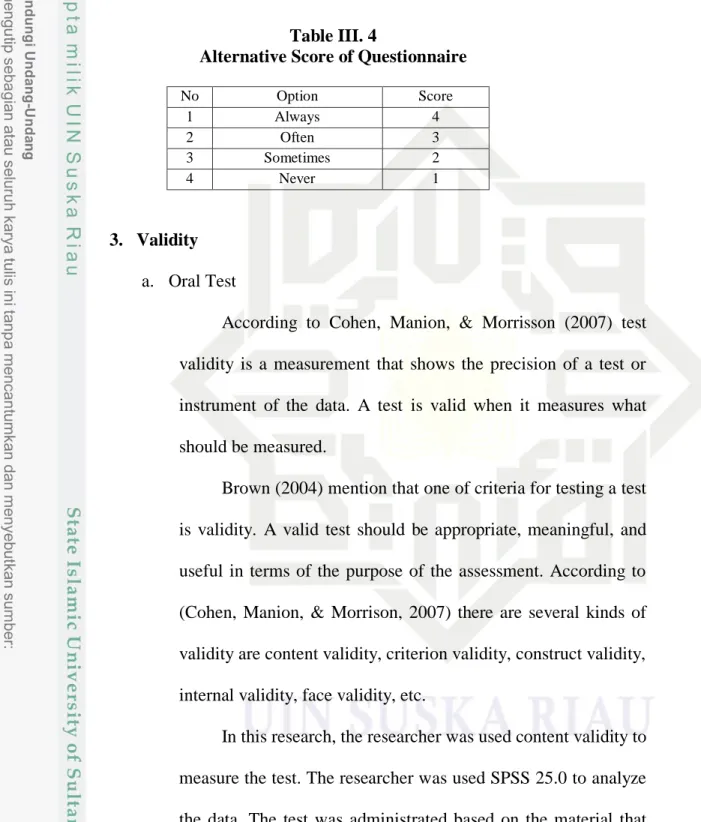
Table III. 4 Alternative Score of Questionnaire ... 43
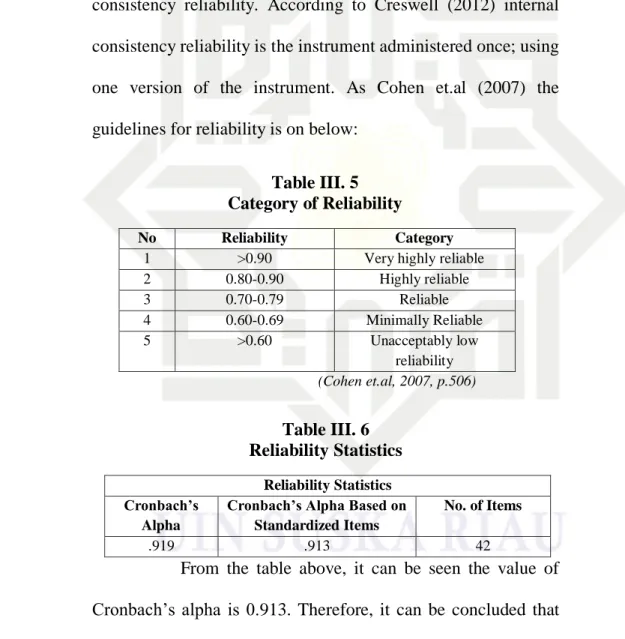
Table III. 5 Category of Reliability ... 45
Table III. 6 Reliability Statistics ... 45
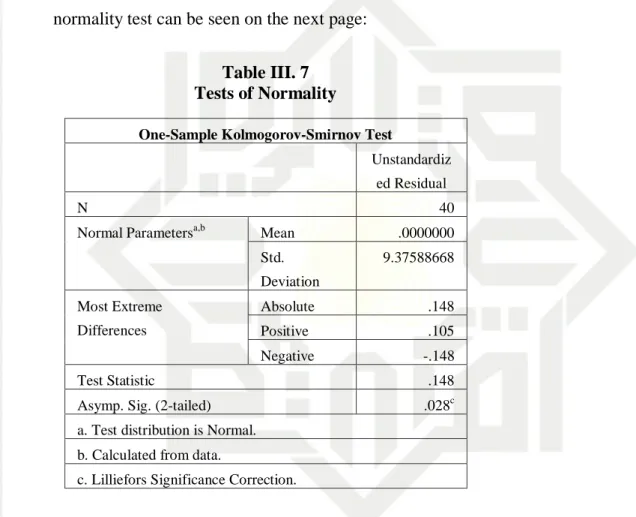
Table III. 7 Tests of Normality ... 46
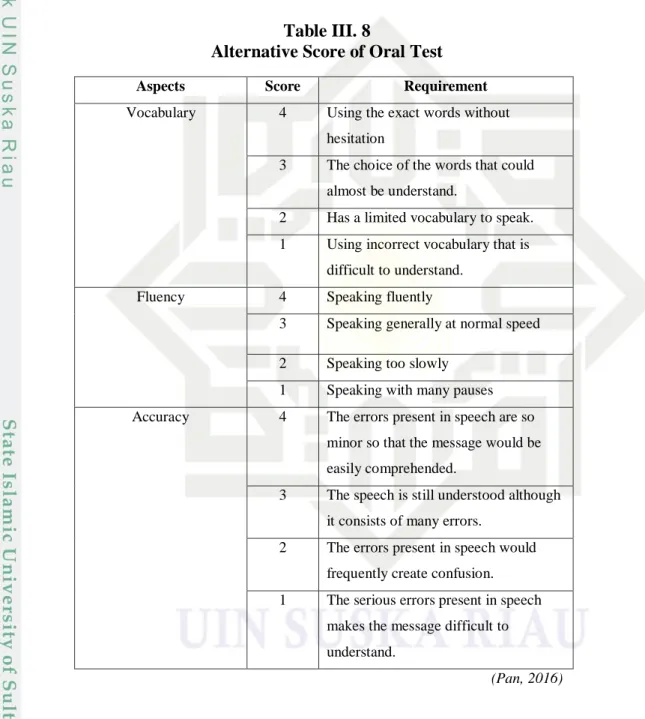
Table III. 8 Alternative Score of Oral Test ... 47
Table IV. 1 Analyze the type of new words; for example, whether it is a noun, verb, pronoun, or adjective ... 51
Table IV. 2 Analyze the affixes and roots of new words... 51
Table IV. 3 Analyze any available picture or gestures accompanying the new word ... 52
Table IV. 4 Guess the meaning of new words from text or context ... 52
Table IV. 5 Use bilingual dictionary, for example, English-Indonesia dictionary to find the meaning of new words ... 53
Table IV. 6 Use monolingual dictionary ... 54
Table IV. 7 Use word lists to find meanings ... 54
Table IV. 8 Use flash cards to find the meanings ... 55
Table IV. 9 Ask the teacher for Indonesia translation of new words ... 55
Table IV. 10 Ask the teacher for paraphrase or synonym of new words... 56
Table IV. 11 Ask the teacher for a sentence including the new word ... 57
Table IV. 12 Ask classmates for the meaning of new word ... 57
Table IV. 13 Discover the meaning through group work activity ... 58
Table IV. 14 Study and practive the meaning of new words in pairs or a group in a class ... 58
Table IV. 15 Teacher checks my word lists for accuracy ... 59
Table IV. 16 Easy to learn new words when have pictorial representation ... 60
xv
Table IV. 17 Image word's meaning ... 60
Table IV. 18 Connect the word to a personal experience ... 61
Table IV. 19 Associate the word with its coordinates ... 61
Table IV. 20 Connect the word to its synonyms ... 62
Table IV. 21 Use the new word in a sentence ... 63
Table IV. 22 Study the spelling of a new word ... 63
Table IV. 23 Study the sound of new word ... 64
Table IV. 24 Say new words aloud when studying ... 64
Table IV. 25 Image word's form to remember it ... 65
Table IV. 26 Remember the affixes and roots of new words ... 65
Table IV. 27 Remember the part of speech of new words... 66
Table IV. 28 Try to use own language to explain and remember the meaning of new words ... 67
Table IV. 29 Use physical actions when learning a new word ... 67
Table IV. 30 Verbally repeat new words several times ... 68
Table IV. 31 Write new words several times ... 69
Table IV. 32 Use wordlists and revise them over time ... 69
Table IV. 33 Use flash cards to remember words ... 70
Table IV. 34 Take notes about new words ... 70
Table IV. 35 Use vocabulary section in textbook ... 71
Table IV. 36 Listen to a CD of word lists ... 72
Table IV. 37 Put English labels on physical objects ... 72
Table IV. 38 Keep a vocabulary notebook ... 73
Table IV. 39 Use English social media (songs, films) ... 73
Table IV. 40 Test themselves with word lists ... 74
Table IV. 41 Skip or pass new words ... 74
Table IV. 42 Continue to study new words over time ... 75
Table IV. 43 Result Score of Vocabulary Learning Strategies ... 76
Table IV. 44 Correlations ... 79
Table IV. 45 Coefficient Correlation ... 80
Table IV. 46 Model Summaryb ... 80
xvi
Table IV. 47 Anovaa ... 81 Table IV. 48 Contribution Level ... 81 Table IV. 49 Coefficientsa ... 82
xvii
LIST OF CHARTS
Chart IV. 1 Result Score of Vocabulary Learning Strategies... 76 Chart IV. 2 Frequency of Students' Speaking Skill Score ... 77
xviii
LIST OF APPENDICES Appendix I Research Instrument
Appendix II Students‟ Responses of Questionnaire Appendix III Raters‟ Score for Speaking Skill Appendix IV Thesis Guidance Letters
Appendix V Research Letters Appendix VI Documentation
1 CHAPTER I INTRODUCTION
a. Background of the Problem
Patel and Jain (2008) states that one of the primary functions of language is communication. It is closely related to the speaking skill.
Speaking skill is one of the prevalent skills in the English Learning context. It is the ability to communicate orally with other people, animals, and even oneself about one‟s beliefs, thoughts, facts, and feelings.
According to Nunan (2003), speaking is a useful oral talent that entails creating a system of vocal utterances to transmit information. In another statement, Brown (2004) states that producing, receiving, and interpreting information are all part of the interactive process of generating meaning that is speaking. Therefore, speaking is one of the language skills that focuses on verbal exchanges, as seen by the sentence above, this can properly and smoothly create, send, and receive data. So that, the speaker must be aware of his or her vocabulary, grammar, and pronunciation.
Based on research guided by English First, an international education institution, Indonesia ranked 74th out of 99 countries in the world with a score of 453 in 2020 according to the English First English Profiency Index (EF EPI). Meanwhile, in 2021, Indonesia ranked 80th out of 112 countries with a score of 466. Therefore, Indonesia has a low-level English mastery that indicates its ability is still at a low grade and not
capable to be negotiated, moderate, or contend with other countries. It also implies that speaking skill in Indonesia is still insufficient. Thus, students ought to encourage and increase their speaking skills.
As it mentioned before, vocabulary became one of the important things in mastering English speaking skill. In fact, a lot of senior high school students appear to have significant problems in speaking skill.
According to Khan, et al (2018), one of main causes is vocabulary deficiency. In particular circumstances, they frequently found that 29%
students can respond the question but they did not know how to express the words. Meanwhile, another 26% also faced the difficulties in finding suitable words in speaking English. Moreover, Slavin (2011) added that this situation reveals that students need additional time to do all of the exercises that permit them to practice their speaking skill.
In line with problems above, the researcher also found the practical problem at Senior High School 1 Payakumbuh that use the 2013 Curriculum as a guideline in teaching and learning process. According to the interview with an English teacher on July 1st 2021, she has provided speaking exercises in teaching and learning process such as retelling monolog, story or practicing dialogue in pairs in front of class. But, the students are still not be able to speak English confidently. Moreover, according to the students‟ speaking score that conducted by the teacher, 65% students got the scores that lower than the minimum criterion
achievement (KKM). Thus, these problems can be seen in the following symptoms;
1. Students are not confident to speak in front of class.
2. Students have lack of vocabulary.
3. Students do not understand how to pronounce the words in front of class.
Learning vocabulary is one of the most essential aspects of learning a foreign language. But, up until the 1960s, scholars still ignored vocabulary study; nevertheless, it has recently attracted the attention of a large number of academics (Muliawati & Ismail 2017). Vocabulary Learning Strategies (VLS) are the strategies that accelerates and promotes vocabulary learning, it has piqued the interest of many academics. Beside these also the strategies for improving vocabulary acquisition that has been utilized effectively by many students to improve their programs (Schmitt, 2000). Also, Schmitt (1997) stated that VLS has 5 strategies; discovery strategy, social strategy, memory strategy, cognitive strategy, and metacognitive strategy. Over the last several years, there has been a boom in interest about these strategies, with many people expressing a strong desire to develop in this aspect (Al-Khresheh, Al-Ruwalli, 2020).
As it mentioned before, vocabulary learning strategies became one of the effective strategies to improve students‟ speaking skill.
However, based on previous studies, the participants are only focused on
university students. (e.g, Noorizah & Zaini (2009), Mustapha (2010), Omaar (2016), Adam (2016), Kamariah (2016), Al-Khresheh, et al (2020), Murdewi (2021). Speaking skill‟s improvement also evolves a matter of English teachers at senior high school 1 Payakumbuh.
According to the phenomena illustrated above, the writer is interested the problems above in research entitled; THE INFLUENCE
OF VOCABULARY LEARNING STRATEGIES TOWARDS
STUDENTS’ SPEAKING SKILL AT SENIOR HIGH SCHOOL 1 PAYAKUMBUH.
b. Problem of the Research
1. Identification of the Problem
Based on the researcher‟s primary consultation with one of the English teacher in State Senior high School 1 Payakumbuh, it is found that there are many students who are not able to speak English confidently. Many of them have a lack of vocabulary, therefore, they do not understand how to pronounce the words.
For English students, mastering speaking skill is challenging since it requires immense great effort. Speaking has been included in the instructional program for English teaching in the earlier times, the portion of the term given to exercises in which students can interact with other in English remains small in the entire class. Hence, the obstacles in speaking in class plays important role in learning English.
It could give a lot of disadvantages to the students., especially lack of vocabulary which is an important element in language learning.
Therefore, vocabulary learning necessitates both theoretical and practical ability on the part of the students. According to Schmitt (2000), studying vocabulary is critical since it is a key indicator of language ability. In the same way that learning any foreign language is intrinsically linked to vocabulary knowledge, a lack of vocabulary items obstructs the process of learning English as foreign language.
Learners in EFL may not get the intended objectives in the language learning process and competency if they lack appropriate vocabulary knowledge (Macis & Schmitt, 2017). According to Adam (2016), a lack of vocabulary knowledge significantly impedes EFL learners‟
ability to communicative effectively.
2. Limitation of the Problem
After identifying the problems stated above, the researcher needs to limit and focus the problem in the significant. The researcher will limit on how the influence of vocabulary learning strategies towards‟ students‟ speaking skill. Besides, the previous research are only focused on college students, therefore the researcher want to reinvestigate this topic but to the senior high students.
3. Formulation of the Problem
The problems of this research can be formulated in this following question;
a. Is there any significant influence of vocabulary learning strategies towards students‟ speaking skill?”
c. Objective and Significance of the Research 1. Objective of the Research
The objective of the research is to know if there are any significant influence of using vocabulary learning strategies towards students‟
speaking skill at Senior High School 1 Payakumbuh.
2. Significance of the Research
This study is expected to give both theoretical and practical contribution.
a. Theoretically, the findings of this study should provide a significant addition to the science of vocabulary teaching and learning, particularly for students in senior high school. because acquiring vocabulary is crucial to mastering English. People who are interested in learning English can better comprehend and be aware of the various learning tactics employed by students who are successful at mastering vocabulary by reading information on vocabulary learning strategies.
b. Practically, the finding of this study can be useful for students and English teacher.
For students, it can help them construct and put into practice their own building technique, particularly for vocabulary development. As a result, students may be simpler, more motivated to acquire language,
and able to study alone. They might also exhibit improved proficiency in speaking exercises.
This research can also help English teachers create materials and activities that are more suitable for their students in order to enhance their vocabulary development. Thus, it can facilitate the teaching and learning process for English teachers, particularly in the vocabulary area, which can encourage students' interest in learning English.
D. Definition of Term
In order to avoid misunderstanding and misinterpreting in writing this research, it is necessary to the researcher to define the following terms:
1. Speaking Skill
In this study, speaking is defined as the capacity of a person to create sound or voice orally and to share or express ideas and thoughts with others as a way of communication in daily life, whether or not any specific technology is used (Burns & Joyce, 1997).
2. Vocabulary Learning Strategies
In this study, vocabulary learning strategies are the strategies fall under language learning strategies, which are defined to include activities that are deliberately preferred by students where they can exploit for obtaining, storing, retrieving, encoding, rehearsing, and using words. (Schmitt, 2000).
8 CHAPTER II
REVIEW OF RELATED LITERATURE
A. Theoretical Framework 1. Speaking Skill
a. Nature of Speaking
Speaking is an important ability in every language, whether it is your first, second, or foreign. According to Nunan (1999), learning to speak a second or foreign language is the most crucial component of the process, and success is determined by the ability to carry on a conversation in the language. Researchers in the field of language learning have proposed a variety of meanings for the term “speaking”. This supported by Chaney (1998) that speaking is the process of creating and communicating meaning through the use of both verbal and nonverbal symbols in a variety of situations. In other opinion, Brown (1994) and Burns and Joyce (1997) characterized speaking as a collaborative process of creating, receiving, and digesting information. Eckard and Kearny (1981), and Howarth (2001) that speaking is defined as a two-way process in which actual exchange of ideas, information, or emotions takes place. This top- down perspective sees spoken words as the result of collaboration between two or more people in a shared time and space.
Therefore, based from the explanation above, speaking is defined as the capacity of a person to create sound or voice orally and to share or express ideas and thoughts with others as a way of communication in daily life, whether or not any specific technology is used.
According to Leong and Ahmadi (2017), speaking helps students improve their vocabulary and grammatical abilities where students may communicate their feelings, thoughts, and requests, as well as converse, discuss, and demonstrate the many functions of language. This indicates that speaking is the most crucial function that is required for efficient communication.
b. The Components of Speaking
Components in speaking must be well-understood in order to accurately know students' speaking skill. According to Brown (2004), there are five components of speaking; pronunciation, grammar, fluency, comprehension, and vocabulary.
1) Pronunciation
Gilakjani (2016) described pronunciation as “the act of making English sounds.” Repeating sounds and correcting them when they are made incorrectly is how pronunciation is learned.
When students begin learning to pronounce new words correctly, they develop new habits and overcome challenges caused by their original language. In other opinion, according to Yates (2002),
pronunciation is the creation of sounds that are employed to convey meaning.
2) Grammar
For students to generate acceptable sentences on spoken interactions, they must learn grammar. The full meaning of a statement can only be understood if the grammar is correct.
According to Harmer (2007), learning grammar entails understanding how distinct grammatical parts may be connected together to form word chain. Grammar is often regarded as one of the most important factors in assisting students in communicating in the language (Emel & Toraman, 2015).
3) Fluency
Harmer (2015, cited by Shahini, Shahamirian, 2017), refers to focusing on the topic of speech in order to communicate as effectively as feasible. Furthermore, Baily (2003 in Shahini, Shahamirian, 2017), fluency is defined as the ability to use language swiftly and confidently, with few hesitations or unnecessary pauses.
4) Comprehension
According Oxford Dictionary, comprehension defined as ability to understand language (written and spoken). It implies that in order to comprehend, both the speaker and the listener must understand the speaker's intended meaning when they say
anything. As a consequence, it can be deduced that comprehension refers to the speakers' grasp of what they are saying to the listeners in order to avoid miscommunication; it also serves to ensure that the listeners simply catch the speaker's information.
5) Vocabulary
The importance of vocabulary in foreign language learning is unavoidable. Hornby (1995, cited by Asyiah, 2017) defined vocabulary as a) the entire quantity of words in a language; b) all terms known to a person or utilized in a certain book, subject, or other context; and c) a list of words and their definitions.
c. Function to Speaking
Richard (2008), stated that speaking has three purposes or functions: it can be used for interaction, transaction, or performance.
1) Speaking as Interaction
Speaking as interaction refers to what we often refer to as "conversation" and describes social interaction. Rather than the message, the attention is on the speakers and how they wish to present themselves to one another.
2) Speaking as Transaction
A scenario in which the focus is on what is said or done is known as speaking as transaction. Participants and how
they socially engage with one another, according to Richard, are less significant than communications and making oneself known clearly and accurately.
3) Speaking as Performance
This relates to public discourse, which includes classroom presentations, public announcements, and speeches performed in front of an audience. Speaking as a performance has a recognized framework (e.g., a welcome speech) and is closer to written language than conversational language.
Discourse as an engagement or transaction, on the other hand, is typically evaluated based on its efficacy or impact on the listener, which is unlikely to occur. Speaking has three tasks, as shown above: interaction to play a primarily social role, transaction to clearly and exactly identify oneself, and performance to communicate knowledge in front of an audience for public speaking.
d. Basic Types of Speaking
Brown (2004) states that there are some basic types of speaking as in the following taxonomy:
1) Imitative
At one end of a continuum of types of speaking performance is the ability to simply parrot back (imitate) a word or phrase or possible a sentence. While this purely
phonetic level of oral production, a number of prosodic, lexical, and grammatical properties of language may be included in the criterion performance
2) Intensive
The production of short stretches of oral language designed to demonstrate competence in a narrow band of grammatical, phrasal, lexical, or phonological relationships.
3) Responsive
Responsive include interaction and test comprehension but at the somewhat limited level of very shorts conversations, standard greetings and small talk, simple requests and comments. This is a kind of short replies to teacher or student- initiated questions or comments, giving instructions and directions. Those replies are usually sufficient and meaningful.
4) Interactive
The difference between responsive and interactive speaking is in the length and complexity of the interaction, which sometimes includes multiple exchanges and/or multiple participants. Interaction can take two forms of transactional language, which has the purpose of exchanging specific information or interpersonal exchanges which have the purpose of maintaining social relationship.
5) Extensive (monologue)
Extensive oral production tasks include speeches, oral representations, and storytelling, during which the opportunity for oral interaction from listeners is either highly limited (perhaps to nonverbal responses) or ruled out together.
In this research, the speaking type is extensive (monologue). According to Brown (2001), monologue are divided into two categories: planned and unplanned (impromptu). When a single speaker uses spoken language, such as in speeches, lectures, readings, news, and broadcasts, the listener must comprehend long stretches of speech without disturbing the flow of information, which will continue whether or not the listener understands it.
Planned monologues are notoriously difficult to comprehend due to their lack of redundancy. Unplanned monologues contain greater redundancy, which aids comprehension, but they also include more performance variables and other hesitations, which can aid or impede comprehension. The example of monologue:
“It was the first day off in a long time, and all of us were trying to get a little rest and relaxation out by the pool at this big, modern hotel that looked something like a prison. If I had to call it anything I would call it a „pleasure prison‟. It was the kind of place you might come to on a package tour out of Bangkok. You would
come down on a chartered bus-and you would probably not wander off the grounds because of the high barbed-wire fence they have to keep you in and the bandits out.”
e. Indicators of Speaking Skills
Pan (2016) indicates that some dimensions for the assessment of speaking skill may, for instance, include fluency, vocabulary, and accuracy.
1) Fluency
According by Richards (2006, quoted by Shahini, Shahamirian, 2017) states that fluency is the use of spontaneously occurring language by a speaker who engages and maintains meaningful dialogue.
2) Vocabulary
According to Horonby (2003) vocabulary is one of remarkable component in part of speech which consist of all of the words that a person knows or uses, all of the words in a certain language, or all of the words that individuals use while discussing a specific subject.
3) Accuracy
Skehan (1996, cited by Namaziandost, Abedi, & Nasri 2019) defines accuracy as referring “to how well the target language is produced in relation to the rule system of the target language.
f. Teaching Speaking
Learning, according to McKay and Brown (1980), is a typically permanent change in abehavioral inclination that occurs as a result of repeated practice. Teaching, which is suggested in the first definitions of learning, may be described as “showing or assisting someone in learning how to do something, offering instruction, directing in the study of anything, supplying information, or causing to know or comprehend.”
Students will learn how to perform something, solve an issue, process information or work, and much more as part of the educational process. Students will build human relationships through communication or involvement in speaking classes, in addition to gaining extra information from a conversation.
Because of the transactional aspect of speaking, the efficacy of the students' performance should be measured by their ability to communicate information effectively (Nation & Newton, 2009). Therefore, one of the purposes of teaching speaking is to help students improve their capacity to communicate and engage in both spoken and written formats. Another goal of teaching speaking, according to Abadi (2015), is to examine students' ability to utilize language in various communication contexts.
Besides, teachers also must know how to make effective teaching speaking in the classroom while teaching speaking. There
are seven standards for creating speaking method, according to Brown (2000), and the following are the guiding principles: (a) use tactics to meet a wide range of student needs, from grammatical accuracy to message-based engagement, meaning, and fluency, (b) use approaches that aren't intrinsically compelling, (c) encourage the use of genuine language in appropriate situations, (d) give appropriate correction and feedback, (e) make use of the inherent connection that exists between speaking and listening, (f) enables students to communicate orally and (g) encourage the development of speaking strategies.
2. Vocabulary
a. Definitions of Vocabulary
Every language has a noteworthy component called vocabulary, which plays a crucial role in language acquisition.
This is not a bad thing because you can't communicate or comprehend people if you don't have a vocabulary (Muliawati, Ismail, 2017). According to Ur (1996), We can define vocabulary as the words we teach in a foreign language. New vocabulary items, on the other hand, may consist of more than one word, such as post office mother in-low, which is made up of two or three words but expresses a single idea. There are additional idioms with many phrases, such as call it a day. Besides, Hornby (2003) also states that all of the words that a person knows or
uses, all of the words in a certain language, or all of the words that individuals use while discussing a specific subject are referred to as vocabulary. Therefore, vocabulary is one of remarkable component which consist of words that a person knows and uses when talking on a certain topic.
b. The Importance of Vocabulary
It is important to understand that a students‟ ability to read, write, listen especially to speak is influenced by their vocabulary. In speaking ability, vocabulary helps and facilitates the students to explain their ideas orally. In addition, Coady and Huckin (1997) argue that vocabulary is important and critical to the normal language learner. It transforms vocabulary into a fundamental component of mastering the four language abilities of listening, reading, writing, and speaking. A language student will not be able to grasp language abilities unless they have a sufficient vocabulary. The meaning demonstrates the importance of language competence in communicating.
c. Types of Vocabulary
According to Hatch & Brown (1995) divides two kinds of vocabulary, namely receptive and productive vocabulary.
1) Receptive Vocabulary
Receptive vocabulary are words that the students recognize and understand when they occur in context, but which cannot produce correctly. It is vocabulary that the students identify when they see it in reading context but do not use it in speaking and writing. Because the student simply learns thoughts from others, the receptive vocabulary is also known as a passive process. The receptive vocabulary is the basic vocabulary in language application. It is substantially broader than productive vocabulary because the student recognizes numerous words when he hears or reads them but does not utilize them while speaking or writing.
2) Productive Vocabulary
The words that students comprehend, can pronounce correctly, and use productively in speaking and writing are referred to as productive vocabulary. It includes receptive vocabulary as well as the capacity to talk or write at the proper moment. As a result, because students can develop the words to convey their thoughts to others, productive vocabulary may be handled as an active activity. Judy (2007) also mentioned four different sorts of vocabulary:
a) Listening Vocabulary
The words we hear and understand begin in the womb; fetuses can detect sound as early as 16 weeks;
additionally, babies listen during all of their waking hours and continue to learn new words in this manner throughout their lives; by the time they reach adulthood, the majority will recognize and understand approximately 50.000 words; children who are completely deaf are not exposed to listen vocabulary. Instead, kids will be exposed to “visual listening vocabulary” if they have singing models at home or at school. The number or words imitated is substantially lower than a hearing child‟s accidental vocabulary listing (Judy, 2007).
b) Speaking Vocabulary
The word that is utilized when speaking. Speaking vocabulary is quite restricted; most adults use about 5000 to 10.000 words for all of their conversations and instructions, a figure that is far lower than listening vocabulary, owing to its ease to use (Judy, 2007).
c) Reading Vocabulary
When reading a book, many words may be read and comprehend; but, they cannot be used in spoken language.
Reading is the second most common way to expand one‟s vocabulary (Judy, 2007).
d) Writing Vocabulary
When writing to communicate a concept, the words can be retrieved. It‟s usually simpler to describe anything verbally, using facial expression and tone to aid convey concepts, than it is to find the perfect words to represent the same thoughts in writing, The words that can be spelled have a big impact on writing vocabulary. When reading, a youngster who is deaf will speak all of the phonemes associated with a word to sound it out, then guess a word they are familiar with. Children would not guess a term they did not know based on their lexicon (mental dictionary). Auditory memory is not used by deaf kids to sound out words. The majority of what they learn are spelling patterns. As a result, deaf students often utilize a smaller number of words in their writing when studying (Judy, 2007).
d. Teaching Vocabulary
There is no “correct” or “optimal” technique to teach vocabulary (Schmitt, 2008). In every circumstance, the optimum technique will be determined by the type of student being taught, the words being targeted, the school system and
curriculum, and a variety of other considerations. When creating a vocabulary component for a language course, however, a few rules should be kept in mind.
Also, Schmitt (2000) states that, any well structured of vocabulary program should have a good balance of explicit teaching and activities that allow for accidental acquisition.
With rank beginners, it is likely that all terms must be explicitly taught until students have a sufficient vocabulary to begin using the unknown words they encounter in context.
According to Nation and Newton (2009), there are some techniques for teaching vocabulary, the following description of techniques and procedures has been arranged according to proficiency level-beginner, intermediate, and advanced.
1) Beginners
For adult beginners, a quick development of vocabulary through direct vocabulary learning is beneficial.
Vocabulary cards, keyword technique, and word part analysis are all good ways to achieve this.
2) Intermediate
At the intermediate level, one of the most essential goals is to extend the number of ways that recognized words may be used. This entails bringing attention to a
word's underlying meaning by seeing it used in a variety of situations. Therefore, some techniques that can be used in this level are „It‟s my word!‟ or word detective.
3) Advanced
At this level, all students must develop their techniques for dealing with the high quantity of low frequency words they will encounter. In order of significance, these tactics include guessing new words from context, utilizing word components to retain word meanings, and applying mnemonic techniques.
e. Vocabulary Learning
In a person's language acquisition process, vocabulary learning plays a significant role. According to Hinkel (2015), teaching is crucial in many aspects of life, including writing, reading, listening, and speaking. The success or failure of a person acquiring a language is determined by their vocabulary. A wider vocabulary allows a person to comprehend more of what they read or hear, which in turn allows them to employ vocabulary learning in written and spoken interactions.
In other opinion, Nation and Newton (2009) state that the most effective language-focused vocabulary learning considers a word as part of a system rather than a message. This entails paying attention to frequent spelling and sound patterns in words,
the underlying idea of word senses (head of the school, head of a bead...), word construction devices, the range and types of collocations in a word, and the range of context-based cues to a word's meaning.
Therefore, Ramos (2015) states that a firm foundation for language learning was laid via a proper vocabulary study program. Many material creators, teachers, and researchers have performed considerable research on the function of vocabulary in predicting language competency. Vocabulary recovered its relevance after being disregarded in early language learning methods, and it is now considered as an essential component of successful language acquisition. As they transitioned from the
"grammar translation technique" to a "communicative teaching strategy," educators began to prioritize fluency above correctness.
Being a result, subsidiary vocabulary acquisition and teaching has become one of the two most essential teaching programs, with the deliberate teaching technique as the other (Xu & Hsu, 2017).
f. Vocabulary Learning Strategies
Nation (2001) states that vocabulary learning strategies are one part of language learning strategies which in turn are part of general learning strategies. Also, McCharty (1990) states students' total self-direction is encouraged by language learning methodologies. Self-directed learners are self-motivated students
who are capable of taking charge of their own education while progressively acquiring confidence, involvement, and competency. The same is true with vocabulary learning strategies.
As a result, children require instruction in vocabulary learning methods. Research has shown that many learners utilize more strategies to acquire vocabulary than they do for other integrated activities like hearing and speaking.
Learning vocabulary is an essential and unavoidable part of language acquisition. As a result, research focusing on vocabulary development have been on the rise over the past 20 years. A vocabulary strategy is a method for improving vocabulary acquisition that has been utilized effectively by many students to improve their program (Schmitt, 2000). These strategies are classified as language learning strategies, which are described as actions that learners choose to improve their language learning processes. They also comprise direct and indirect learning mechanisms that students might use to acquire, store, retrieve, encode, rehearse, and use words.
It is important to know about students‟ strategies, therefore, Hatch & Brown (1995) identify five key processes in vocabulary learning students must follow. The five keys are: 1) Having a variety of resources for learning new words, 2) obtaining a distinct image of the new words‟ forms, whether
visual, auditory, or both, 3) learning the definitions of words, 4) creating a strong memory link between the words‟ shapes and meanings, 5) and using the words.
The entire catalog of vocabulary learning strategies is Schmitt's taxonomy (1997). Schmitt first separated VLS into two groups, and then into some techniques for each category. The two categories are methods for finding new words and methods for making existing words stronger. Since social techniques may be used to both groups, he includes them in both,
1. Strategies for the discovery a new word
It comprises determination and social strategy. Students won't require assistance from others to decide on the methods they will employ to discern the meaning of words. Students instead utilize dictionaries. While in social strategy, students require the assistance of others to clarify word meanings.
2. Strategies for consolidating of a word
Social strategy, memory strategy, cognitive strategy, and metacognitive strategy all fall under this category.
Students will interact with others as part of social strategy to understand what words imply. For students to understand the meaning of words, memory techniques are related to their knowledge backgrounds. It may be done in a variety of methods, including by memorizing words physically,
studying words in groups, linking them to prior knowledge, learning how to spell words, and more. Memory strategy and cognitive strategy are extremely similar, although cognitive strategy is unrelated to mental processes. To acquire vocabulary, you can employ mechanical methods like word lists, flash cards, etc. The last strategy is a metacognitive one that governs and assesses the learning process.
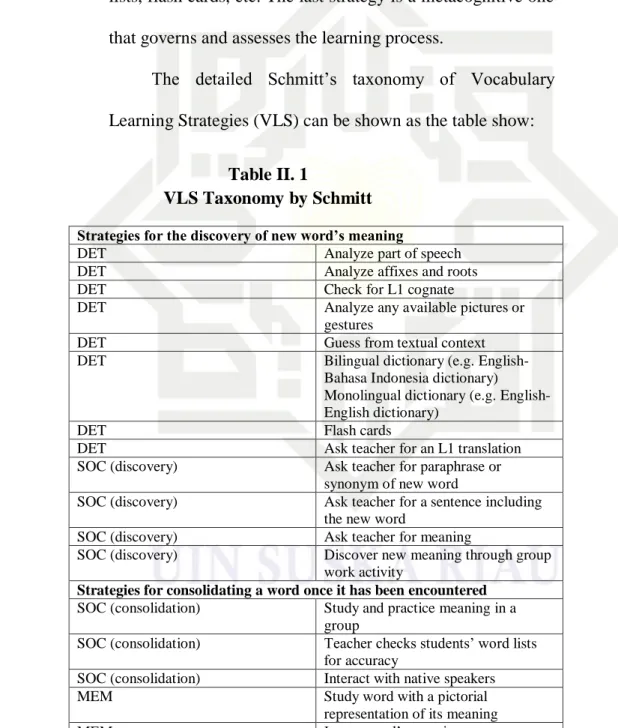
The detailed Schmitt‟s taxonomy of Vocabulary Learning Strategies (VLS) can be shown as the table show:
Table II. 1
VLS Taxonomy by Schmitt
Strategies for the discovery of new word’s meaning
DET Analyze part of speech
DET Analyze affixes and roots
DET Check for L1 cognate
DET Analyze any available pictures or
gestures
DET Guess from textual context
DET Bilingual dictionary (e.g. English-
Bahasa Indonesia dictionary) Monolingual dictionary (e.g. English- English dictionary)
DET Flash cards
DET Ask teacher for an L1 translation
SOC (discovery) Ask teacher for paraphrase or synonym of new word
SOC (discovery) Ask teacher for a sentence including the new word
SOC (discovery) Ask teacher for meaning
SOC (discovery) Discover new meaning through group work activity
Strategies for consolidating a word once it has been encountered SOC (consolidation) Study and practice meaning in a
group
SOC (consolidation) Teacher checks students‟ word lists for accuracy
SOC (consolidation) Interact with native speakers
MEM Study word with a pictorial
representation of its meaning
MEM Image word‟s meaning
MEM Connect word to a personal experience
MEM Associate the word with its
coordinates
MEM Connect the word to its synonyms and
antonyms
MEM Use semantic maps
MEM Use “scales” for gradable adjectives
MEM Peg Method1
MEM Logic Method2
MEM Group words together to study them
MEM Group words together spatially on a
page
MEM Study the spelling of a word
MEM Study the sound of a word
MEM Imagine word form
MEM Underline initial letter of the word
MEM Configuration
MEM Use keyword Method
MEM Affixes and roots (remembering)
MEM Part of speech (remembering)
MEM Paraphrase the word‟s meaning
MEM Use cognates in study
MEM Learn the words of an idiom together
MEM Use physical action when learning a
word
MEM Use semantic feature grids
MEM Verbal repetition
MEM Written repetition
MEM Word lists
MEM Flash cards
COG Take notes in class
COG Use the vocabulary section in your
textbook
COG Listen to tape of word lists
COG Put English labels on physical objects
COG Keep a vocabulary notebook
COG Use English-language media (songs,
movies, newspaper, etc)
COG Testing oneself with word tests
COG Use spaced word practice
MET Skip or pass new word
MET Continue to study word over time
g. Techniques in Teaching Vocabulary
When it comes to teaching vocabulary, there are a variety of strategies that may be used. Allen (1983) lists the following vocabulary teaching techniques that might be planned and chosen:
1) Demonstration
The technique of executing gestures and actions falls under the category of demonstration. Real objects and commands are available to the teacher. The teacher can show the topic by utilizing real-world things in the classroom, such as doors, windows, clocks, and desks. When using a command technique, the teacher may ask students to do something such as touching the pen, pointing the picture and so on.
2) Visual Aids
Visual means something visible. When teaching vocabulary, teachers might utilize visual aids to help students see and recognize items more clearly. Besides that, visualization may interest the students in their learning vocabulary.
3) Verbal Explanation
Definition and translation can be used to provide verbal explanation. According to Allen (1983), teachers can
demonstrate meaning by employing explanations in the students‟ own language, definitions in simple English, and using vocabulary, and using vocabulary that students have already known to show the meaning. For instance, the word
“umbrella” can be introduced by explaining what it looks like and when the people usually use it.
4) Word List
When using the word list technique, teacher should be careful to use appropriate vocabulary. The words taught should be relevant to the students‟ needs and appropriate for their level.
5) Dictionary Use
Dictionaries can be monolingual (all in a foreign language); bilingual (foreign language words have first language meanings and vice versa); or bilingualized (foreign language terms have first language definitions and vice versa) (monolingual with the first language definition also provided). Students have a strong preference for bilingual dictionaries, and studies demonstrate that bilingualized dictionaries can accommodate a wide range of preferences and styles. The dictionary may be utilized in two ways:
receptively to aid reading and listing, and productively to aid writing and speaking. Many students do not utilize
dictionaries as well as they could, according to studies on dictionary usage, therefore training in dictionary use practices could be beneficial (Nation, 2001).
6) Teaching Group of Words Together and Cross-Association Organized knowledge is simpler to learn than unstructured information, according to a well-known psychological concept. This conclusion suggests that when learning, it's a good idea to arrange related words together. This is only true if the words are only partially understood. When comparable terms are taught together for the first time, students may become confused because they learn the word forms and meanings but are unsure which belongs with which (cross- association)
7) Translation
Translation, or translating a term into a student's native language, is one of the most popular strategies. However, some specialists advise against using this method. "If we merely supply a literal translation, the pupils will not see how the term is utilized in an English phrase," writes Doff (1988). When professors present examples and students supply the word translation, translation is straightforward, clear, and rapid for accomplishing the goal. Students may be unfamiliar with the word itself because it has been translated into other variations.
B. Relevant Research
To observe some prior investigations conducted by other researchers that are relevant to our research, relevant research is required.
It is critical to conduct relevant research in order to avoid plagiarizing previous study strategies and conclusions. There are only a few studies relevant to this investigation.
The research was conducted by Murdewi (2021) entitled A Survey on Vocabulary Learning Strategies used by the students at SMP Muhammadiyah Palangka Raya. The purpose of this research is to identify students‟ vocabulary learning strategies to learn English in SMP Muhammadiyah Palangka Raya. For this research, survey research design is applied and it included quantitative approach. The findings of this research showed that students gave positive responses with High category of the students‟ vocabulary learning strategies to learn English. Most of the students in the vocabulary class, have their own strategies. This showed that every learning strategy affect students‟ progress in English vocabulary class. So, learning strategies given effect of students‟ progress in obtaining learning outcomes in their progress in learning to write and speak in English.
Another research was conducted by Ahmed Omar Aghalli Omaar (2016) entitled EFL Vocabulary Learning Strategies among Tuareg People. This study examined the overall use of Vocabulary Learning Strategies (VLS) among EFL Tuareg learners in the Libyan classroom and