Fifth Print - 2018
Published by Educational Publications Department Printed by Mathavi pethum, No. 624, Bulugaha junction
kandy road kelaniya.
Sixth Print - 2019
ISBN 978-955-25-0076-3
wms fjuq tl ujlf. orefjda tl ksjfiys fjfikd
tl mdge;s tl reêrh fõ wm lh ;=< ÿjkd
tneúks wms fjuq fidhqre fidhqßfhda tl f,i tys jefvkd
Ôj;a jk wm fuu ksjfia fid¢k isáh hq;= fõ
ieug u fu;a lreKd .=fKkS fj<S iu.s oñkS
rka ñKs uq;= fkd j th u h iem;d lsis l, fkdu Èrkd
wdkkao iurfldaka J¸ uõ´ ©UPÒ |õ©õ÷Áõ®
Jß÷Ó |õ® ÁõÊ® CÀ»®
|ß÷Ó Eh¼À Kk®
Jß÷Ó |® S¸v {Ó®
AuÚõÀ \÷Põuµº |õ©õ÷Áõ®
JßÓõ´ ÁõÊ® Á͸® |õ®
|ßÓõ´ CÆ CÀ¼Û÷»
|»÷© ÁõÌuÀ ÷Ásk©ß÷Óõ
¯õÁ¸® Aߦ P¸øn²hß JØÖø© ]ÓUP ÁõÌ¢vkuÀ
ö£õßÝ® ©o²® •zx©À» & Ax÷Á
¯õßÖ ©È¯õa ö\ÀÁ©ß÷Óõ.
BÚ¢u \©µU÷Põß PÂøu°ß ö£¯º¨¦.
Being innovative, changing with right knowledge Be a light to the country as well as to the world.
Message from the Hon. Minister of Education
The past two decades have been significant in the world history due to changes that took place in technology. The present students face a lot of new challenges along with the rapid development of Information Technology, communication and other related fields. The manner of career opportunities are liable to change specifically in the near future. In such an environment, with a new technological and intellectual society, thousands of innovative career opportunities would be created. To win those challenges, it is the responsibility of the Sri Lankan government and myself, as the Minister of Education, to empower you all.
This book is a product of free education. Your aim must be to use this book properly and acquire the necessary knowledge out of it. The government in turn is able to provide free textbooks to you, as a result of the commitment and labour of your parents and elders.
Since we have understood that the education is crucial in deciding the future of a country, the government has taken steps to change curriculum to suit the rapid changes of the technological world. Hence, you have to dedicate yourselves to become productive citizens. I believe that the knowledge this book provides will suffice your aim.
It is your duty to give a proper value to the money spent by the government on your education. Also you should understand that education determines your future. Make sure that you reach the optimum social stratum through education.
I congratulate you to enjoy the benefits of free education and bloom as an honoured citizen who takes the name of Sri Lanka to the world.
Akila Viraj Kariyawasam Minister of Education
Foreword
The educational objectives of the contemporary world are becoming more complex along with the economic, social, cultural and technological development. The learning and teaching process too is changing in relation to human experiences, technological differences, research and new indices. Therefore, it is required to produce the textbook by including subject related information according to the objectives in the syllabus in order to maintain the teaching process by organizing learning experiences that suit to the learner needs. The textbook is not merely a learning tool for the learner. It is a blessing that contributes to obtain a higher education along with a development of conduct and attitudes, to develop values and to obtain learning experiences.
The government in its realization of the concept of free education has offered you all the textbooks from grades 1-11. I would like to remind you that you should make the maximum use of these textbooks and protect them well. I sincerely hope that this textbook would assist you to obtain the expertise to become a virtuous citizen with a complete personality who would be a valuable asset to the country.
I would like to bestow my sincere thanks on the members of the editorial and writer boards as well as on the staff of the Educational Publications Department who have strived to offer this textbook to you.
W. M. Jayantha Wickramanayaka,
Commissioner General of Educational Publications, Educational Publications Department,
Isurupaya, Battaramulla.
2019.04.10
W. M. Jayantha Wickramanayaka
T.D.C. Kalhari Gunasekara
t S .
PB 1
1 Circles
By studying this lesson, you will be able to,
● identify items which have the circular shape and
● create circular designs using items which have the circular shape.
1.1 Identifying items which have the circular shape
A figure of a purple circular shaped card is given here.
Pictures of several more items, in which the circular shape can be observed are given below.
Exercise 1.1
(1) From the following items, select and write down the ones in which the circular shape can be observed.
(i) The mathematics text book (ii) Drum
(iii) Cricket bat (iv) Sieve
(v) Winnowing fan (vi) Wheel of a vehicle
(vii) Steering wheel of a car (viii) Tea spoon
(ix) Pot
1.2 Drawing circles using items
The following figures illustrate how the circular shape is drawn using various items that have the circular shape. Carefully observe the figures and then engage in the following activity.
Step 1 - Take a two rupees coin, a cup and a saucer.
Step 2 - Draw the circular shape using each of these items.
Step 3 - Find several other items which have the circular shape, and draw the circular shape using each one of them.
Activity 1
The figure drawn in the above activity using the two rupees coin is shown here. The complete curved line of such a figure is known as a circle.
Observe that the circles drawn in the above manner are different from each other in size.
2 3
Step 1 - Using a cup, draw the circular shape on a piece of paper.
Step 2 - Separate the circular part, cutting along the curved line of the circular shape. Then we obtain a circular lamina.
Step 3 - Fold this circular lamina as shown in the figure, so that it is divided into two equal parts.
Step 4 - With the aid of a ruler, mark the fold line using a pencil.
Step 5 - Fold the circular lamina again as before, into two equal parts along a different fold line.
Step 6 - Mark this second fold line too with a pencil as done previously.
Mark several other such fold lines, in the same manner as above.
Step 7 - Observe that all these fold lines pass through the same point. See whether the distance from this point to several points on the curved edge are equal to each other using a ruler.
Do the above activity using a saucer and a coin too.
Activity 2
Through this activity, the fact that the distance from the point where the fold lines which divide the circular lamina into two equal parts intersect, to any point on the curved edge of the lamina is the same is established.
Step 1 - Draw a circle in your exercise book by using a coin.
Step 2 - Mark an '' '' inside the circle.
Step 3 - Place a dot on the circle.
Step 4 - Draw a '''' outside the circle.
Activity 3
Compare the figure you obtained by doing the above activity, with the figure given here.
In this manner, you will be able to identify the positions inside the circle, on the circle and outside the circle.
Exercise 1.2
(1) From the collection of items given below, select the ones that can be used to draw circles and write down the corresponding numbers.
(i)
(v) (vi)
(vii)
(ii) (iii) (iv)
4 5 (2) From the figures shown below, select those which are circles and
write down the corresponding numbers.
(i) (iv)
(viii) (iii)
(ii)
(vii) (v) (vi)
(3) Select various items which have the circular shape, and using them draw several circles which are different in size to each other.
(4) In this figure, K
E L
B
●
●
●
● ●
●
●
● X
P A
O
(i) which letters indicate positions inside the circle?
(ii) which letters indicate positions on the circle?
(iii) which letters indicate positions outside the circle?
(5) In a competition of throwing darts onto a circular board by standing at a location in front of it, 10 points are awarded if the dart hits the circle and 5 points are awarded if the dart hits the inside of the circle.
But, no points are awarded if the dart hits the outside of the circle.
A group of students participated in the above competition. The figure indicates where the darts thrown by each of the students hit the board.
Sunil
Nafeel
Pradeep
Sanjeeva
Mohan Rajitha
(i) Who are the students who were awarded 10 points?
(ii) Who are the students who were awarded 5 points?
(iii) Who are the students who did not receive any points?
(iv) If each of these student is given two more opportunities to throw darts, what is the maximum number of points that Mohan could receive in total?
1.3 Creating circular designs
Three circular designs created using circles are shown below. Such designs can frequently be seen on clothing materials, festival decorations and in religious places.
Step 1 - Draw a line on a piece of paper
using a ruler.
Step 2 - Using a coin, draw a circle as shown in the figure.
Step 3 - Move the coin a short distance along the line and draw another circle as shown in the figure.
Activity 4
For free distribution
6 For free distribution 7
Step 4 - Move the coin a short distance along the line once more and draw another circle.
Step 5 - In the above manner, by moving the coin a short distance along the line several times more, draw about 20 circles.
Create various designs as in the above activity, by moving the coin along different curved lines as well and drawing circles.
One such design is shown here.
Step 1 - Take coloured pencils, pieces of paper and several items which can be used to draw circles.
Step 2 - Using various colours,
(i) create circular designs using only one of the items.
(ii) create circular designs using two or more items of different sizes.
Step 3 - By drawing circular designs, create a decoration to be displayed in your room to make the room attractive.
Activity 5
● There are many items of different sizes in our environment that have a circular shape.
● Various designs can be created using circles.
Summary
2 Place Value
By studying this lesson, you will be able to,
● know the place value corresponding to the position of each digit in a whole number,
● know the value represented by each digit in a whole number and
● read and write in words numbers up to the billions period.
2.1 Place value
When writing numbers, we most often use the Hindu-Arabic number system. In this system, the ten digits 0, 1, 2, 3, 4, 5, 6, 7, 8 and 9 are used to write numbers.
When writing numbers from zero up to nine, we write one digit in one position. As an example, the number three is written as 3 using a digit. That is, one position is used to write 3. The greatest number which can be written using only one position is 9.
The number which is one greater than nine is ten. Each number from ten up to ninety nine is written using either two distinct digits or one digit twice using two positions.
As an example, the number ten is written as 10 using digits. The number ninety nine is written as 99 using digits. That is, the numbers 10 and 99 are written using two positions.
Now, let us consider a couple of numbers written using the digits 3 and 5 in two positions.
When the digits 3 and 5 are written as 35, the number is “thirty five”.
When the digits 3 and 5 are written as 53, the number is “fifty three”.
That is, the numbers obtained are different to each other according to the positions of the digits 3 and 5.
8 9
Now, let us describe the place value corresponding to the position of each digit in a number and the value represented by each of the digits.
● Using thirty five beads, if chains containing ten beads each are made by threading the beads, there will be three chains of ten beads each, with five beads remaining.
3 tens 5 ones
The thirty five beads can be separated into three sets of ten beads each and five sets of one bead each.
That is,
Thirty five = 3 tens + 5 ones = 35
According to the above explanation, the 5 in 35 represents 5 ones. The position which 5 occupies is the 'ones place'. The place value of the position occupied by the digit 5 is taken as 1.
The 3 in 35 represents 3 tens. The position which 3 occupies is the 'tens place'. The place value of the position that the digit 3 occupies is 10.
In the following figure, each position has been marked using a square, and the position of each digit of 35 has been indicated.
3 5
Tens pl ace Ones place
Digit in the tens place Digit in the ones place
Let us represent 35 on an abacus.
Tens Ones
We learnt that 35 = 3 tens + 5 ones.
In the same manner,
53 = 5 tens + 3 ones = 50 + 3, 65 = 6 tens + 5 ones = 60 + 5 and 99 = 9 tens + 9 ones = 90 + 9
That is, there is a value represented by a digit in a number, according to the position of the digit.
Now, let us find the value represented by each digit of 35.
The value represented by 3 in the number 35 = 3 tens = 30 The value represented by 5 in the number 35 = 5 ones = 5
The maximum value that can be represented by a digit in the ones place is 9.
The maximum value that can be represented by a digit in the tens place is 90.
The maximum number of counters that can be placed on a single rod of an abacus is 9.
Example 1
Number Digit Name of the position of the digit
Value represented by the digit
45 45 30
4 5 0
Tens place '''''''''''''''''''''''''''
Ones place '''''''''''''''''''''''''''
Ones place ''''''''''''''''''''''''''''
''''''''''''40 '''''''''''' 5 ''''''''''''0
10 11
Exercise 2.1
(1) Complete the following table.
Number Digit in the ones place
Digit in the tens place
Value represented by the digit in the
ones place
Value represented by the digit in the
tens place
63 76 40 88
2.2 Place value described further
Tens place Ones place
The greatest number that can be written using two positions is 99. It has 9 tens and 9 ones. The number which is one greater than 99 is hundred.
The tens place and ones place are not sufficient to write the number hundred in digits. Hence the place value corresponding to the position to the left of the tens place is taken as 100 and that position is named as the hundreds place.
Tens place Hundreds
place
Ones place
Therefore hundred is written using three positions as 100.
Number Hundreds Tens Ones
100 1 0 0
Now let us look at numbers which are written by using digits in three positions.
Several numbers which can be formed using the digits 2, 4 and 5 are given below. Consider the ways of using 5 in these numbers.
245 Two hundred forty five 254 Two hundred fifty four 524 Five hundred twenty four In 245, the digit 5 is in the ones place.
The value represented by 5 in 245 = 5 ones = 5 In 254, the digit 5 is in the tens place.
The value represented by 5 in 254 = 5 tens = 50 In 524, the digit 5 is in the hundreds place.
The value represented by 5 in 524 = 5 hundreds = 500
It is clear that the value represented by 5 in the above numbers varies according to the position of 5.
The place value corresponding to the position of each digit in a number from right to left is respectively 1, 10, 100, 1000, 10000 etc.
Accordingly, when two successive digits of a number are considered, the place value corresponding to the position of the digit on the left is ten times the place value corresponding to the position of the digit on the right.
12 13
Now, let us name the positions that each of the digits 2, 4, 5, 6 and 7 occupies in the number 67524 by writing these digits in five positions.
Digit in the ones place Digit in the tens place Digit in the hundreds place Digit in the thousands place
Digit in the ten thousands place
6 7 5 2 4
Ones place Tens place Hundreds place Thousands place Ten Thousands
place
Let us represent 67524 on an abacus.
Ten thousands Thousands Hundreds Tens Ones
67524 = 6 ten thousands + 7 thousands + 5 hundreds + 2 tens + 4 ones Let us now consider the value represented by each digit in the number 67524.
4 is in the ones place of 67524.The value represented by 4 is 4.
2 is in the tens place of 67524. The value represented by 2 is 20.
5 is in the hundreds place of 67524. The value represented by 5 is 500.
7 is in the thousands place of 67524. The value represented by 7 is 7000.
6 is in the ten thousands place of 67524. The value represented by 6 is 60000.
Example 1
Write down the value represented by each digit in the number 5968.
The value represented by 8 in 5968 = 8 ones = 8 The value represented by 6 in 5968 = 6 tens = 60 The value represented by 9 in 5968 = 9 hundreds = 900 The value represented by 5 in 5968 = 5 thousands = 5000
Exercise 2.2
(1) In the number 99601,
(i) what is the value represented by 9, which is positioned fourth from the right?
(ii) what is the place value corresponding to the position of 0?
(iii) what is the value represented by 0 ?
(iv) what is the value represented by 9, which is positioned fifth from the right ?
(2) Complete the following table.
Number Digit Name of the position of the digit
Value represented by the digit
7940 9
8095 9
4568 5
1273 7
34856 5
94512 4
94512 5
19085 1
19085 0
5436 5
(3) Write down all the numbers of three positions, that can be written using each of the digits 4, 5 and 8 exactly once. For each of these numbers, write down the place value corresponding to the position of 8 and the value represented by 8.
For free distribution
14 For free distribution 15
(4) Using each of the digits 2, 4, 5 and 9 exactly once, write down,
(i) the largest possible number of four positions and the value represented by each digit in that number.
(ii) the smallest possible number of four positions and the value represented by each digit in that number.
2.3 Periods of numbers
The total number of students studying in several schools from grade 6 to 11 is 2836696.
See whether you can read the number of students given in the above statement. How numbers such as the above are read and written in words is described below.
Let us consider the number 2836696.
Let us write this number by separating it into groups of three, starting from the ones place, as given below.
2 836 696
A group separated in the above manner is known as a period of numbers or number zone.
In this separation, the number of positions with digits in the last period, that is, the leftmost period, may be less than three. Only the digit 2 is in the last period of the above number.
Let us name the periods of this number as follows.
Units period
696
Millions period
2
Thousands period
836
This number is read as two million eight hundred thirty six thousand six hundred ninety six.
Now, let us consider how the number 967476568 is read.
Let us first separate this number into periods from right to left as follows.
967 476 568
Millions period
Thousands period
Units period
This number is read as nine hundred sixty seven million four hundred seventy six thousand five hundred sixty eight.
Let us also consider how the number 7686975623 is read. Let us first separate it into periods.
7
Billions period
686 975 623
Millions period
Thousands period
Units period
The period which comes after the millions period is named as the billions period.
This number is read as seven billion six hundred eighty six million nine hundred seventy five thousand six hundred twenty three.
To find out how the number 675278285676 is read, let us separate it into periods as follows.
675
Billions period
278 285 676
Millions period
Thousands period
Units period
This number is read as six hundred seventy five billion two hundred seventy eight million two hundred eighty five thousand six hundred seventy six.
Writing a number in this manner by separating it into groups of three positions, starting from the ones place and moving towards the left,is to represent the number in standard form.
16 17
When writing a number in standard form, a small space is left between two periods to separate and identify the periods.
By writing a number in standard form, it can easily be read, and an idea can be obtained about its magnitude.
In some instances, to separate the periods, a comma is written between the periods instead of the small space.
Note
General form Standard form
2854375 2 854 375 43529644 43 529 644 204007800 204 007 800
8430000000 8 430 000 000
The following table provides several examples of how numbers are read.The way of writing them in words is also the same.
Number Period How the number is
read /written in words Millions Thousands Units
63 276 63 276 Sixty three thousand two
hundred seventy six
654 378 654 378
Six hundred fifty four thousand three hundred seventy eight
2 000 375 2 000 375 Two million three
hundred seventy five
43 001 000 43 001 000 Forty three million one
thousand
204 007 800 204 007 800
Two hundred four million seven thousand eight hundred
The way of reading a number or writing a number in words is known as the name of the number.
In most financial documents, the amount is written down in words.
For extra knowledge
Number Name of the number Other names used
100 000 Hundred thousand Lakh
1 000 000 Million Ten lakhs
10 000 000 Ten million Crore
100 000 000 Hundred million Ten crores
(1) Fill in the blanks in the following table.
Number Name of the number
63 465 71 005 125 368 300 300 2 178 525 348 '''''''''''''''''''''''''''''' '''''''''''''''''''''''''''''' ''''''''''''''''''''''''''''''
''''''''''''''''''''''''''''''''''''''''''''' ''''''''''''''''''''''''''''''''''''''''''''' ''''''''''''''''''''''''''''''''''''''''''''' ''''''''''''''''''''''''''''''''''''''''''''' '''''''''''''''''''''''''''''''''''''''''''''
Three million eight hundred thousand two hundred.
Seven billion two hundred fifty million twenty.
Eight billion eight.
Activity 1
Exercise 2.3
(1) Write down each of the following numbers in standard form.
(i) 72350 (ii) 55000 (iii) 27201125
(iv) 300001279 (v) 299000001 (vi) 21345699
18 19
(2) Write down each of the following numbers which have been separated into periods in words.
Period The number
in words Billions Millions Thousands Units
(i) 10 040 500 000
(ii) 4 750 050 000
(iii) 1 010 100 500
(iv) 75 004 350 050
(3) Write down each of the following numbers in standard form and then write them in the table separated into periods.
(i) 76735 (ii) 864657 (iii) 2769812
(iv) 47867619 (v) 763156561 (vi) 6746971256
(vii) 2765231
Number Period The number
in words Billions Millions Thousands Units
(4) Write down each of the following numbers in standard form and write down the name of the number as well.
(i) 50800435000 (ii) 43050800500 (iii) 585000430
(iv) 300001283 (v) 299000003 (vi) 272000023
(vii) 100200030000 (viii) 553000000 (ix) 47000005
(5) Write the following numbers, which have been given in words in standard form.
(i) Four hundred five thousand
(ii) Three hundred twenty five thousand five hundred
(iii) Four million eight hundred thousand
(iv) Six billion sixty million
(v) Eighteen million twenty four thousand fifty (6)
149597870
Earth Sun
The distance between the earth and the sun is 149597870 in kilometers. Write this number in standard form and write it in words too.
(7) A businessman plans to deposit Rs 15006500 in a bank. How does he write this amount in word on a bank slip?
Miscellaneous Exercise
(1) Write down each of the following numbers by expanding in terms of the place value as shown in the example.
Example:
6745 = 6 thousands + 7 hundreds + 4 tens + 5 ones
(i) 24 (ii) 40 (iii) 546 (iv) 7163 (v) 92651 (2) Complete the following table.
Number Digit Place value of
the digit
Value represented by the digit
(i) 80 341 3
(ii) 64 592 9
(iii) 200 450 2
(iv) 185 340 8
(v) 4 500 000 4
20 21
(3) Using each of the digits 8, 6, 5, 3 and 1 exactly once, write down
(i) the largest possible number of four positions and the value represented by 3 in the number.
(ii) the smallest possible number of four positions and the value represented by 3 in the number.
(4) Write the following numbers in standard form and write also how they are read.
(i) 450050 (ii) 37504537 (iii) 212345699
(iv) 8432109640 (v) 2003040050 (vi) 143021000
(5) What is the smallest number that can be written using three different digits, which has the millions period as its last period? Write this number in words too.
(6) What is the greatest number, which has the billions period as its last period? Write this number in words too.
● The place value corresponding to the position of each digit in a number from right to left is respectively 1, 10, 100, 1000, 10000 etc.
● The value represented by each digit in a number is decided according to the position of the digit in the number.
● It is convenient to read and write a number in words, when that number is written in standard form.
Summary
3 Mathematical Operations on Whole Numbers
By studying this lesson, you will be able to,
z add whole numbers,
z subtract a whole number from a larger whole number,
z multiply whole numbers and
z divide a whole number by a whole number.
In this lesson, the operations of addition, subtraction, multiplication and division, which you have learnt earlier will be studied more methodically.
3.1 Adding whole numbers
Numbers such as 0, 1, 2, 3, 4, … are known as whole numbers.
First vendor Second Vendor
The first vendor has 12 balloons and the second vendor has 13 balloons.
By counting the balloons, we can find out that the total number of balloons that the two vendors have is 25.
This answer can also be obtained by separately adding the two digits in the ones (units) place together, and the two digits in the tens place together.
22 23
Let us explain this addition using two methods.
(1) Let us add numbers together using counting frames.
Let us represent the numbers 12 and 13 on two counting frames.
12
Hundreds Tens Ones Hundreds Tens Ones
13
Let us place all the counters in the ones place of these two counting frames in the ones place of another counting frame. Let us also place all the counters in the tens place of both counting frames in the tens place of the new counting frame. This is illustrated below.
Hundreds Tens Ones
The number that is represented on this counting frame is 25.
That is, 12 + 13 = 25
(2) Let us add the two numbers 12 and 13 by considering the value represented by the digit in each place of the numbers.
Number Value represented by the digit in the tens place
Value represented by the digit in the ones place
12 10 2
13 10 3
Sum 20 5
The value represented by the digit in the tens place of the answer is 20.
20 is 2 tens. That is, the digit in the tens place of the answer is 2.
Similarly, the value represented by the digit in the ones place of the answer is 5. 5 is 5 ones. That is, the digit in the ones place of the answer is 5.
Since the digit in the tens place is 2 and the digit in the ones place is 5, the answer is 25. That is, 12+13=25
Next, let us find the sum of the following numbers.
4 7 6 8
+3 9 8 6
Let us explain this addition using the following steps.
Ones 4 7 6 8
+ 3 9 8 6 4
Tens Hundreds Thousands
1
14
Step 1 – Let us add the ones.
8 + 6 = 14
14 ones is 1 tens and 4 ones.
Let us carry over the 1 tens to the tens column.
Let us write the 4 ones in the ones column.
Ones 4 7 6 8
+ 3 9 8 6
5 4
Tens Hundreds Thousands
1 1
15
Step 2 – Let us add the tens.
1 + 6 + 8 = 15 15 tens is 150.
There are 1 hundreds and 5 tens here.
Let us carry over the 1 hundreds to the hundreds column.
Let us write the 5 tens in the tens column.
Ones 4 7 6 8
+ 3 9 8 6
7 5 4
HundredsTens Thousands
1 1
1
17
Step 3 – Let us add the hundreds.
1 + 7 + 9 = 17
17 hundreds is 1700.
There are 1 thousands and 7 hundreds here.
Let us carry over the 1 thousands to the thousands column.
Let us write the 7 hundreds in the hundreds column.
Ones 4 7 6 8
+ 3 9 8 6 8 7 5 4
Tens Hundreds Thousands
1 1
1
Step 4 – Let us add the thousands.
1 + 4 + 3 = 8
Let us write the 8 thousands in the thousands column.
The answer is 8754.
24 25
Example 1 Example 2 Example 3 6 2 7
+ 2 8 3 9 1 0
11 10 1
1
14 13
1 1
1 4 5 8
+2 9 2 6 4 3 8 4
4 5 6
3 7 6 + 1 2 0 8 2 0 4 0
Example 4
Simplify 157 + 26
1
13
1 5 7
+ 2 6 1 8 3
Let us write the numbers one below the other as indicated here, such that the digits in the ones place of the numbers are in one column, the digits in the tens place of the numbers are in one column and the digits in the hundreds place are in one column. Then let us add the numbers together.
1
1 2
20 14 10
Exercise 3.1
(1) Simplify the following.
(2) Simplify the following.
(i) 27 + 31 (ii) 43 + 29 (iii) 176 + 217 (iv) 352 + 189
(v) 2187 + 1854 (vi) 3095 + 1936 (vii) 84 + 258 (viii) 7 + 195 (ix) 139 + 2875 (x) 1987 + 36 + 171 (xi) 657 + 11 389 + 64 721
(3) There are 486 boys and 658 girls in a certain school. How many students are there in total in this school?
(4) In January, 1846 coconuts were plucked from the coconut trees in a certain estate and in March, another 1384 coconuts were plucked.
How many coconuts were plucked in total during the two months?
(5) The number of shoes manufactured by a certain company during the months January, February and March were 1395, 1426 and 1737 respectively. How many shoes were manufactured in total during the three months?
(6) Nimal who is a businessman received an income of Rs 810 on the first day, an income of Rs 985 on the second day and an income of Rs 1130 on the third day. What was his total income during the three days@
(7) If 974 milk bottles were collected at a certain collection centre on Monday, and if 103 more milk bottles were collected on Tuesday than on Monday, then how many bottles of milk were collected in total on the two days?
3.2 Subtracting a smaller whole number from a given whole number
Figure 1 Figure 2
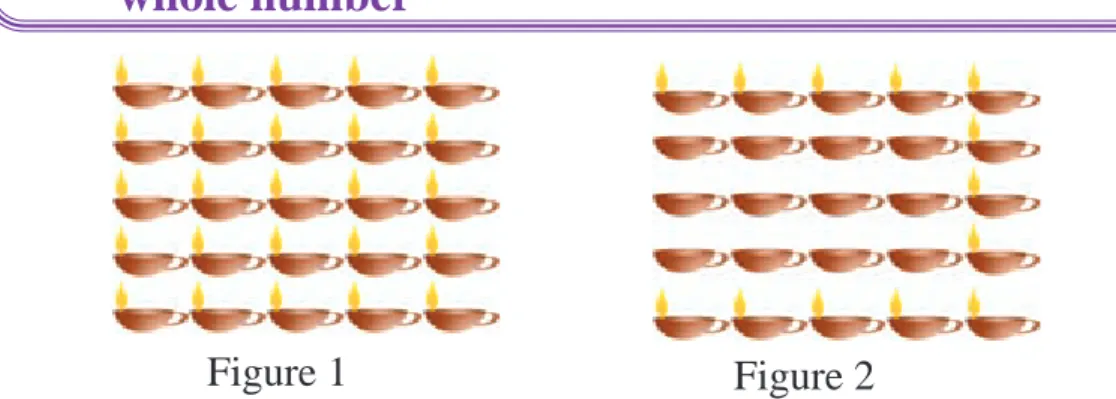
The first figure shows 25 lamps which are lit. The second figure shows the same 25 lamps after 12 lamps had burnt out. By counting them, we can find out that there are 13 lamps which are lit in the second figure.
We can also find the number of lamps which are lit in the second figure by subtracting 12 from 25.
As in the case of addition, in subtraction too, we subtract the digits in the ones place and the digits in the tens place separately.
26 27
When 2 ones are subtracted from 5 ones, we obtain 3 ones.When 1 tens is subtracted from 2 tens, we obtain 1 tens.
Accordingly, there are 1 tens and 3 ones in the answer. That is, the answer is 13.
Example 1
Simplify the following.
(i) (ii) (iii)
Now, let us subtract 1896 from 6753.
Let us write the numbers in the following manner so that the digits in each place are in the relevant columns.
Let us explain this subtraction using the following steps.
6 7 5 3
– 1 8 9 6
7
Ones HundredsTens
Thousands
4 13
5 3
Step 1 – Let us subtract the ones.
•
The 3 in the ones place is less than the 6.•
Therefore, let us carry over 1 tens, that is, 10 ones from the 5 tens in the tens place to the ones place.•
Then, there are 13 ones in the ones place.•
Also, there are 4 tens remaining in the tens place.•
When 6 ones are subtracted from 13 ones, there are 7 ones.6 7 5 3
- 1 8 9 6
5 7
Ones HundredsTens
Thousands
6 144 13
5
7 3
Step 2 – Let us subtract the tens.
•
The 4 remaining in the tens column is less than the 9.•
Therefore, let us carry over 1 hundreds, that is, 10 tens, from the 7 hundreds in the hundreds place to the tens place.•
Then, there are 14 tens in the tens place.•
Also, there are 6 hundreds remaining in the hundreds place.•
When 9 tens are subtracted from 14 tens, there are 5 tens.6 7 5 3
- 1 8 9 6
8 5 7
Ones HundredsTens
Thousands
4
6 14 13
5 16
5 7
6 3
Step 3 - Let us subtract the hundreds.
•
The 6 remaining in the hundreds column is less than the 8.•
Therefore, let us carry over 1 thousands, that is 10 hundreds from the 6 thousands in the thousands place to the hundreds place.•
Then there are 16 hundreds in the hundreds place.•
Also, there are 5 thousands remaining in the thousands place.•
When 8 hundreds are subtracted from the 16 hundreds, there are 8 hundreds.6 7 5 3 -1 8 9 6
4 8 5 7
Tens Ones Hundreds Thousands
4
6 14 13
5 16
5 7
6 3
Step 4 - Let us subtract the thousands.
•
When 1 thousands is subtracted from the remaining 5 thousands in the thousands place, there are 4 t housands r emaining.Hence, when 1896 is subtracted from 6753, the answer is 4857.
Exercise 3.2
(1) Simplify the following.
(i) 35 (ii) 478 (iii) 3975 (iv) 72 (v) 576 -23 -153 - 2341 - 38 -129
(vi) 352 (vii) 814 (viii) 506 (ix) 602 (x) 700 - 175 - 359 - 273 - 435 - 354
(xi) 7481 (xii) 4201 (xiii) 3023 (xiv) 6000 - 2154 - 1758 - 1496 - 2358
(2) Simplify the following.
(i) 782 - 257 (ii) 524 -175 (iii) 631 - 58 (iv) 246 - 89 (v) 3532 - 785 (vi) 4000 - 356
28 29
(3) If Nimal, who took 475 coconuts, was able to sell 297 of them, how many coconuts were remaining?
(4) If there were 192 males in a gathering of 300 people, how many females were there?
(5) In a certain factory, 1450 cars were manufactured in 2013 and 2325 cars were manufactured in 2014. How many more cars were manufactured in 2014 than in 2013?
(6) Heshan received Rs 325 from his father and Rs 430 from his mother. If he bought a pair of slippers for Rs 149, and a book for Rs 225 from this money, how much money was left over?
3.3 Multiplying whole numbers
The figure depicts three groups of 5 guavas each.
There are 15 guavas in total in these three groups.
5 + 5 + 5 = 15
“Three fives” is denoted as a multiplication in the form 5 × 3, That is 5 × 3 = 15
Similarly, 2 + 2 + 2 + 2 + 2 = 2 × 5 = 10 and 10 + 10 + 10 + 10 = 10 × 4 = 40
Let us explain the fact that 5 × 3 = 3 × 5 in the following manner.
Three groups of five is 15.
Let us separate 15 into groups of three each as below.
When the three groups of five are separated into groups of three,we obtain five groups.
That is, 5 × 3 = 3 × 5.
A multiplication table of the whole numbers from 0 up to 9 is given below.
× 0 1 2 3 4 5 6 7 8 9
0 0 0 0 0 0 0 0 0 0 0
1 0 1 2 3 4 5 6 7 8 9
2 0 2 4 6 8 10 12 14 16 18 3 0 3 6 9 12 15 18 21 24 27 4 0 4 8 12 16 20 24 28 32 36 5 0 5 10 15 20 25 30 35 40 45 6 0 6 12 18 24 30 36 42 48 54 7 0 7 14 21 28 35 42 49 56 63 8 0 8 16 24 32 40 48 56 64 72 9 0 9 18 27 36 45 54 63 72 81
The multiplication of two whole numbers, which are less than 10 can be performed using the above table.
Clarify it by the following examples.
5 × 3 = 15 (see the sign ) 7 × 6 = 42 (see the sign ) 9 × 8 = 72 (see the sign )
The product of 34 « 2 cannot be obtained directly from the above table. Let us find the product in cases.
2 thirty fours is 34 + 34. That is, 68.
This answer can also be obtained in the following manner.
For free distribution
30 For free distribution 31
By multiplying the value represented by the digit in the ones place and the value represented by the digit in the tens place separately by 2, the value 68 is obtained.
When 4, which is in the ones place of 34 is multiplied by 2, we obtain 8 ones.
When 3, which is in the tens place of 34 is multiplied by 2, we obtain 6 tens.
Accordingly, 8 ones + 6 tens = 8 + 60 = 68 Exercise 3.3
(1) Obtain the following products using the multiplication table given above.
(i) 3 × 4 (ii) 7 × 3 (iii) 8 × 0 (iv) 9 × 6 (2) Evaluate the following.
(i) 42 × 3 (ii) 122 × 4 (iii) 78 × 7 (iv) 96 × 9
3.4 Multiplying a whole number by 10, by 100 and by 1000
Let us consider the following products.
2 × 10 is 10 twos. That is, 2 tens. Its value is 20.
2 × 100 is 100 twos. That is, 2 hundreds. Its value is 200.
2 × 1 000 is 1000 twos. That is 2 thousands. Its value is 2000.
12 × 10 is 10 twelves. That is 12 tens. That is, 10 tens and 2 tens.
Therefore, its value is 100 + 20 = 120.
Accordingly, let us consider the following products.
2 × 10 = 20 2 × 100 = 200 2 × 1000 = 2000 3 × 10 = 30 3 × 100 = 300 3 × 1000 = 3000 7 × 10 = 70 7 × 100 = 700 7 × 1000 = 7000 12 × 10 = 120 12 × 100 = 1200 12 × 1000 = 12 000 15 × 10 = 150 15 × 100 = 1500 15 × 1000 = 15 000
By examining the above products, the following facts are discovered.
● The number obtained, when a number is multiplied by 10 can be obtained by placing 1 zero at the right end of the initial number.
● The number obtained, when a number is multiplied by 100 can be obtained by placing 2 zeros at the right end of the initial number.
● The number obtained, when a number is multiplied by 1000 can be obtained by placing 3 zeros at the right end of the initial number.
3.5 Multiplication of whole numbers described further
Let us consider 25 × 14.
25 × 14 is 14 twenty fives. This 14 twenty fives can be considered as 10 twenty fives and 4 twenty fives.
10 twenty fives is 250. 4 twenty fives is 100. Therefore, 14 twenty fives is 250 + 100, which is equal to 350.
That is, 25 × 14 = 10 twenty fives + 4 twenty fives = 250 + 100 = 350
What has occurred here is, that 25 has been multiplied by the value represented by each digit in 14 and the resulting values have been added together to obtain the answer.
Accordingly, when multiplying 25 by 14, it can be written in the following way too.
32 33
Example 1 Evaluate 64 « 36.
Example 2
Evaluate 157 × 52.
Usually, when finding the product of two numbers, the larger number is multiplied by the smaller number.
Exercise 3.4
(1) Fill in the blanks.
(i) 13 × 10 = ... (ii) 72 × 100 = ... (iii) 54 × 1000 = ...
(iv) 39 × 100 = ... (v) 43 × ... = 430 (vi) 67 × ... = 6700 (vii) ... × 100 = 2900 (viii) 2450 × 100 = ...
(ix) 1700× ... = 17 000 (x) ... × 1000 = 40 000 (2) Fill in the blanks using suitable values.
(iii) 136 × 32 2
8 4 2 (ii) 78
× 24 1 15 0 1 7 (i) 52
× 13 15 5 0 6 6
(3) Simplify the following.
(i) 64 (ii) 59 (iii) 76 (iv) 82 (v) 125 (vi) 248 × 21 × 63 ×54 × 45 × 32 × 70
(vii) 348 × 25 (viii) 515 × 36 (ix) 47 × 805 (x) 2015 × 36
(xi) 5115 × 29 (xii) 3042 × 42 (xiii) 4004 × 73 (xiv)86 × 6029
(4) In a certain hall, there are 35 rows containing 57 chairs each. How many chairs are there in total in the hall?
(5) The price of a bag of rice is Rs 1225. What is the price of 75 such bags of rice?
(6) The number of students who can travel in a school bus is 55. How many students can travel in 6 such buses?
(7) A school student needs 8 exercise books. The price of an exercise book is Rs 48. The number of students in a certain class is 35. How much money in total is required to buy the exercise books needed for all 35 students?
3.6 Dividing a whole number by another whole number
The figures show the number of olives, two friends named Rasika and Sameera received, when 10 olives were divided equally between the two.
Total number of olives is 10.
The number of olives that Rasika received is five.
The number of olives that Sameera received is five.
Rasika and Sameera each received 5 olives.
We describe how the olives were divided between the two of them as
“10 divided by 2”.
This is written as 10 ÷ 2.
Accordingly, 10 ÷ 2 = 5.
This can be clarified in the following manner too.
There are 2 groups of five in 10. That is, 10 = 5 × 2. Therefore, a group has 5, when 10 is divided into two equal groups.
That is, 10 ÷ 2 = 5.
34 35
Now, let us divide 7 buttons equally between two friends.
In this case, each child would receive three buttons and there will be one button remaining.
That is, 7 ÷ 2 is 3 with 1 remaining.
How we obtain 7 ÷ 2, using the long division method is shown below.
Quotient
Remainder 2
3 7 6 1
7 consists of at most 3 twos and 3 × 2 = 6.
When 7 is divided by 2 we obtain 3, with a remainder of 1.
3.7 Dividing a whole number by 10, by 100 and by 1000
Let us consider the following divisions.
20 ÷ 10 means, “how many tens are there in 20?”.
200 ÷100 means, “how many hundreds are there in 200?”.
2000 ÷ 1000 means “how many thousands are there in 2000?”.
Let us consider the following divisions accordingly.
Let us find the value of 20 ÷10.
Since, 2 ×10 = 20, we obtain 20 ÷10 = 2.
Similarly, we have
30 ÷ 10 = 3 200 ÷ 100 = 2 300 ÷ 100 = 3 400 ÷ 10 = 40 700 ÷ 100 = 7 2000 ÷ 1000 = 2 3000 ÷ 1000 = 3 7000 ÷ 1000= 7 520 ÷ 10 = 52 15000 ÷ 100 = 150
By observing the above divisions, the following facts are discovered.
● When a number, which has a zero at the right end is divided by 10, the answer is obtained by removing that 0.
● When a number, with 2 zeros at the right end is divided by 100, the answer is obtained by removing these 2 zeros.
z When a number, with 3 zeros at the right end is divided by 1000, the answer is obtained by removing these 3 zeros.
² But, no number can be divided by zero.
When any number is multiplied by zero, the answer is zero.
2 × 0 = 0 28 × 0 = 0 412 × 0 = 0
When zero is divided by any number other than zero, the answer is zero.
0 ÷ 2 = 0 0 ÷ 13 = 0 0 ÷ 971 = 0
Note
3.8 The division of whole numbers described further
Let us find the value of 75 ÷ 5 using the long division method.
1 5 7 5
5 1 × 5 = 5 2
Step 1 – The digit in the tens place of 75 is 7.That is, there are 7 tens.
When 7 is divided by 5, we obtain 1 with a remainder of 2.
That is, there is a remainder of 2 tens.
2 7 55
5 5
1
Step 2 – Let us add the remaining 2 tens to the 5 ones. Then there are 25 ones.
2 51
7 55 55 0 2
5
5 « 5 = 25
Step 3 – Let us divide the 25 ones by 5. Then we obtain 5 ones.
That is, the value of 75 ÷ 5 is 15.
Next, Let us find the value of20÷5.
We know that this is denoted by either 5 20 or 5 20.
5 20
4 or 0 204 5 20
36 37
Now, let us divide a number by a number with two digits.
Let us consider the division of 38 by 12.
2 38 3
12 36
There are no twelves in 3. Therefore, let us find how many twelves are there in 38. There are 3 twelves in 38 with 2 remaining.Accordingly, when 38 is divided by 12, we obtain 3 with 2 remaining.
Example 1
Simplify the following.
(i) 470 ÷ 10 (ii) 253 ÷ 11 (iii) 419 ÷ 13
10 « 4 = 40 10 « 7 = 70 47
10 470 40 70 70 0
23 11 253 22 33 33 0
11 « 2 = 22 11 « 3 = 33
13 « 2 = 26 13 « 3 = 39 32
13 419 39 29 26
3
470 ÷ 10 = 47 253 ÷ 11 = 23 419 ÷ 13 = 32 with a remainder of 3
Exercise 3.5
(1) Fill in the blanks.
(i) 40 ÷ 10 = '''''''' (ii) 720 ÷ 10 = '''''''' (iii) 600 ÷ 100 = '''''''' (iv) 1300 ÷ 100 = '''''''''
(v) 5000 ÷ 1000 = '''''''' (vi) 12 800 ÷ 10 = '''''''''' (vii) 19 000 ÷ 1000 = '''''''' (viii) 8300 ÷ ''''''''' = 83
(ix) 24 380 ÷ 10 = '''''''' (x) 31 000 ÷ ''''''''' = 3 100 (2) Simplify using the long division method.
(i)525 ÷ 7 (ii) 240 ÷ 9 (iii) 416 ÷ 13 (iv) 625 ÷ 25 (v) 448 ÷ 14 (vi) 2244 ÷ 17 (vii) 2772 ÷ 21 (viii) 1980 ÷ 15 (ix) 3696 ÷ 24 (x) 2052 ÷ 19
(3) The van fare was Rs 10 800 for a journey made by 16 people. If this cost was met equally by fifteen of them, how much did each pay?
(4) If 6480 chairs are to be distributed equally among 20 schools, how many chairs will each school get?
(5) If the cakes of soap in 12 boxes, each containing 25 cakes of soap, are divided equally among 15 employees, how many cakes of soap will each employee get?
Miscellaneous Exercise
(1) The number of people who visited an art exhibition on the first three days of the exhibition was respectively 1320, 1567 and 1624. How many people in total visited the art exhibition on these three days?
(2) A factory produced 3788 yoghurts during the first week and 4124 yoghurts during the second week. How many more yoghurts were produced in the second week than in the first week?
(3) There are 10 identical book racks in a library. Each book rack contains 5 shelves. 30 books are placed on each of these shelves. How many books are there in total in the library in these 10 book racks?
(4) A man needs to plant 152 coconut plants. However, he is able to plant only 8 per day. How many days will he require to plant all 152 of them?
(5) It is required to bring 740 cement bags to a cement sales centre.
The maximum number of cement bags that can be transported in a vehicle is 24. Find the number of trips the vehicle needs to make to bring all the cement bags to the centre.
● When adding and subtracting whole numbers, the relevant mathematical operation should be performed separately in relation to the different places, namely ones place, tens place etc.,
● The following steps are carried out in multiplying two whole numbers.
- Obtain the value represented by each digit in one number.
- Multiply the other number by each of these values.
- Obtain the final answer by adding all these products.
● The long division method can be used to divide a whole number by another whole number.
Summary
PB 39
4 Time
By studying this lesson, you will be able to,
● identify the units of measuring time,
● identify the relationships between different units of measuring time,
● find the time taken for an activity,
● express the time in terms of the 24 hour clock and
● write the date in standard form.
4.1 Reading the time on a 12 hour clock accurately
Find a clock similar to the one shown in the figure, which shows the correct time and observe it carefully.
² In this clock, the circular edge has been divided into 60 equal parts by short line segments.
² The numbers from 1 up to 12 have been marked on the face of the clock, such that there are five equal parts between any two adjacent numbers.
● From the three hands which are fixed at the centre, the shortest hand is the hour hand. The narrow hand in red is the seconds hand, and the remaining hand is the minute hand.
● The three hands rotate in the direction in which the numbers on the face are increasing.
● The time it takes for the pointed end of the hour hand to move from one number to the next is one hour.
● The time it takes for the pointed end of the minute hand to move from one short line segment to the next is one minute.
● The time it takes for the pointed end of the seconds hand to move from one short line segment to the next is one second.
● During an hour, the minute hand rotates one round.
1 hour = 60 minutes
● During one minute the seconds hand rotates one round.
1 minute = 60 seconds
● When the time is being read, the hour is taken to be the number which the hour hand is pointing towards or has last passed.
● The number of minutes and the number of seconds is taken to be the number of line segments each hand has last passed or is pointing towards.
Let us read the time denoted by the clock in the figure.
Since the hour hand lies between the numbers 10 and 11, the number that the hour hand has last passed is 10.
The minute hand lies between the 25th and 26th line segments. Hence, the line segment that the minute hand has last passed is 25. The seconds hand is pointing towards the 13th line segment.
Therefore, the time is read as 25 minutes and 13 seconds past 10. This is written as 10.25.13. Sometimes, the number of seconds is not indicated.
In such a case, the time is expressed as 10.25.
Exercise 4.1
(1) Write down the time denoted by each of the following clock faces, in terms of hours, minutes and seconds.