SMITHSONIAN INSTITUTION BUREAU OF AMERICAN ETHNOLOGY
BULLETIN
108A DICTIONARY
OF THE ATAKAPA LANGUAGE
ACCOMPANIED BY TEXT MATERIAL
BY
ALBERT
S.GATSCHET
AND
JOHN R. SWANTON
SMITHSONIAN INSTITUTION BUREAU OF AMERICAN ETHNOLOGY
BULLETIN
108A DICTIONARY
OF THE ATAKAPA LANGUAGE
ACCOMPANIED BY TEXT MATERIAL
BY
ALBERT
S.GATSCHET
AND
JOHN R. SWANTON
UNITED STATES GOVERNMENT PRINTING OFFICE
WASHINGTON
:1932ForsalebytheSuperinteudentofDocuments,Washington, D. C.
I
LETTER OF TRANSMITTAL
Smithsonian Institution,
'
Bureau of American Ethnology, Washington, D. C, May
16,1931.
Sir:
Ihave the honor
tosubmit the accompanying manuscript,
entitled"A Dictionary
ofthe Atakapa Language," by Albert
S.Gatschet and John R. Swanton, and
torecommend that
it^^be^'pub- lished asa
bulletin ofthe Bureau
ofAmerican Ethnology.
Very
respectfullyj^ours,M. W. Stirling,
Chief.Dr. C. G. Abbot,
Secretary ofthe
Smithsonian
Institution.in
CONTENTS
Page
Introduction 1
Atakapa
texts:1
.
The
westernAtakapa
92. Cakta'lko 11
3. Children's ears
and
faces 124. Yu'lc Caki'n O'k 12
5. Biographic noticeof
Ponponne
146. Chief Cukuhu'-i
and
Cyprien 167.
Treatment
ofthesick 178.
Himo'c
(burial) 189.
A
fightamong
negroesatLake
Charles 20Atakapa-English dictionary 21
Indexto the
Atakapa
dictionary 161ILLUSTRATION
Plate
1. AlbertSamuel
Gatschet-BUREAU OF AMERICAN ETHNOLOGY BULLETIN
108PLATE
1ALBERT Samuel Gatschet
A DICTIONARY OF THE ATAKAPA LANGUAGE
(ACCOMPANIED BY TEXT MATERIAL) By Albert
S.Gatschet and John R. Swanton
INTRODUCTION By John R. Swanton
Atakapa
dialectswere spoken from Vermilion Bay and the lower course
ofBayou Teche,
La., toGalveston Bay and Trinity River, Tex., and extended westward from the Trinity an uncertain distance between the
territories ofthe Tonkawan and Karankawan
tribes. All ofthe Indians between Vermilion and Galveston Bays were
calledAtakapa by the French, but those on Trinity River and Bay were known
tothe Spaniards
asHorcoquisa, Orcoquisac, or some
similardesignation, which we may simplify
toAkokisa. The termination
isaorisac stands
forthe native word "ishak"
(icak)meaning "people,"
but the
significance ofthe
firsttwo
syllables isuncertain. They may contain the word
for"river," or the word meaning "west."
Hildke ishak would be "western people" and might have been employed
incontradistinction
tothe name given some
ofthe Louisi- ana bands,
i. e.,Hiyekiti
ishak,"eastern people," or "sunrise people." The name "Atakapa
"was an opprobrious epithet bestowed by the Choctaw.
Itsignifies"man-eater" (hatak-apa) and probably was not confined
inapplication
tothe people under consideration but extended
tothe Gulf coast
tribes in thisregion
generally,who
did, it is true,
have the gruesome custom
ofeating portions
ofdead, enemies, though cannibalism was by no means extensively resorted
to.Most that
isknown regarding the history and ethnology
ofthe Atakapa
Ihave already given
inBulletin 43
of this series.Further
interestingnotes have been
collectedby Dr.
J.O. Dyer
intwo small pamphlets
entitled"The Early History
ofGalveston"
(Pt. I,Galveston,
1916),and "The Lake Charles Atakapas (Cannibals) period
of1817-1820" (Galveston,
1917).In Bulletin 68
I instituteda
linguisticcomparison between the
Atakapa, Chitimacha, and Tunica languages, which had been placed
by Powell
inthree
distinct linguistic families,and from
thisconcluded
that they were
genetically related. Isuggested the name Tunican
forthe new
stock, sinceTunica was the oldest
ofthe three
toappear
inthe narratives
ofEuropean
explorers,and,
signifyingsimply "people,"
2 BUREAU OF AMERICAN ETHNOLOGY
[bull, lois
more appropriate than
either ofthe
others.In the International Journal
ofAmerican Linguistics
(vol. 5,Nos.
2-4,pp. 121-149)
willbe found a grammatical sketch
ofthe language prepared by the present
writer.The Atakapa and Akokisa embraced four or
five principalbands
—
on Vermilion Bayou, Mermentau, Calcasieu, the Sabine and Neches, and Trinity Rivers. The two
firstmentioned were those known
especially as
Hiyekiti or Easterners, and spoke a
dialect differing insome measure from the language
ofthe remainder. Judging by the only vocabulary
ofAkokisa which has been preserved
tous,the speech
ofthe Trinity River Atakapa
differed littlefrom that
ofthe Calcasieu and Sabine Indians.
Itisprobable, though not
asyet demonstrated, that the
tribewhich gave Opelousas
itsname spoke the Eastern Atakapa tongue. Plainly
its affinitieswere
eitherwith Atakapa or Chitimacha and not with the Muskhogean family. Westward, the researches
of Prof.Herbert E. Bolton have shown quite
conclusivel}'-that the Atakapan group included the
Bidai, afterwhom Bedias Creek has received
itsname, and
at leasttwo
tribes stillfarther west, the Deadoses and
Patiri.The Han, found by Cabeza de Vaca
inoccu- pancy
ofthe eastern end
ofGalveston Island
in1528, were probably Atakapan. Han may have been derived from an or
a°,the Atakapa word
for"house."
The
firstvocabulary known
tohave been taken do^vn from any
tribe
of
thisgroup was
alsothe
last tobe brought
tothe attention of students.
Itwas
collectedby Jean B^renger, captain
ofthe
vessel Subtile, inwhich an expedition under Bernard de
laHarpe
setout
forthe Bay
ofSaint Bernard
in 1721.Falling short
of their objective,the explorers
visitedGalveston Bay and returned
toLouisiana
in lessthan a month, carrying
offwith them nine
ofthe Indians
ofthat
region,who escaped not long afterwards and undertook
toreturn to
theirnative country. There
isreason
tosuppose that part
ofthem succeeded,
since, in1722, some Indians from the westward
visitedNew Orleans and stated that eight
of thisband had passed through
theircountry and had been supplied by them with bows and arrows
inorder that they might obtain subsistence
forthemselves during the
restof theirjourney. On the passage
toLouisiana with these un- fortunates B^renger, by taking down a vocabulary
of45 words, was
able
tocompensate
tothe learning
ofthe
future,and
insome meas- ure
tothe Indians themselves,
forthe
cruelact
of his superior.This invaluable record
ofAkokisa speech lay hidden among the
colonialdocuments
inthe national archives
ofFrance
until1919 when, along with an equally valuable Karankawa vocabulary,
itwas published by MM. de
Villiersdu Terrage and Paul Rivet
inthe Journal de
laSociete des Americanistes de
Paris.^A copy
ofBeranger's memoir
>LesIndiensduTexaset lesExpeditions fran^aisesde1720et 1721,invol.xi(n.s.),1914-19,pp. 403-442.
GATSCHET
8WANT0NJ
DICTIONARY OF THE ATAKAPA LANGUAGE
had meanwhile found
itsway into a
collection ofmanuscripts
inthe possession
ofa Swiss gentleman and these were purchased by Edward E. Ayer
toadd
to hisAmericana
inthe Newberry Library, Chicago.
I
came upon
this inthe course
ofinvestigations
inthe Ayer
collec- tionand obtained a photostat copy. The two vocabularies, along with explanatory material and
facsimilereproductions
ofthe
copies, Iprepared
forpublication
inthe International Journal
ofAmerican
Linguistics,
but before they could be put
intype the one by Du
Terrage and Rivet made
itsappearance and
Iwithdrew my own.
This would not now require mention except that on one or two points the copy, or my interpretation
ofthe copy,
isnearer the Atakapa
original as
checked by Gatschet's material than the rendering given
inthe French publication. Perhaps, when the copy was made, the
originalwriting was
clearerthan at present, or possibly my greater
familiaritywith Atakapa through the Gatschet vocabularies may
have given me an advantage
intransUterating some
ofthe words.
For our knowledge
ofthe eastern Atakapa
dialectwe
arealmost
entirelydependent on a vocabulary containing 287
entriestaken down
at the Attackapas Post (modern FrankUn) April
23,1802, by Martin Duralde, along with a Chitimacha vocabulary and some scanty ethnological information.
Pillingattributes the
original collectionof the words
toa man named Murray from whom Duralde copied them, and indeed the common use
ofsh with
itsEnglish value instead of the ch which a Frenchman would have used, or x or some other circumlocution a Spaniard would probably have employed, lends color
tothe idea that
itcame through someone familiar with Enghsh.
One copy
of thisvocabulary reached the American Philosophical Society
inPhiladelphia through Dr. John
Sibley. Itwas published
inpart by Albert
Gallatin,along with
hiscomparative vocabularies,
inthe Transactions and Collections
ofthe American Antiquarian Society, Volume
II(Cambridge,
1836),pages 307-367, and
inJohn Severin Vater's Analekten der Sprachenkunde, Leipzig,
1821,pages 63-84. A copy
ofthe Atakapa words
inthe
latterwas made by Oscar
Loew
inMay, 1877, and revised by Doctor Gatschet
inJanuary,
1879.Gatschet's copy
ispreserved among the manuscripts
inthe Bureau
ofAmerican Ethnology and has been one main
reliance ofthe writer
forthe eastern Atakapa forms. Another copy
of thismanuscript, apparently that retained by
itsauthor, was
later dis-covered among some
oldpapers
inthe
loft ofa house
ator near Opelousas,
La.,where they had
lain forsome 40
years,and where unfortunately the mice had destroyed considerable portions
ofthem.
Itstitle,
translated from the
originalFrench, was, "Two vocabularies
ofthe Indian nations, the Chetimaches and Attacapas, being a
letterwritten
to SirWilliam Dunbar, respecting some
ofthe
curi-4 BUREAU OF AMERICAN ETHNOLOGY
[bull, los osities ofthe country,
tobe communicated
tothe Society
ofthe North." This
translationand a translation
ofthe
rest ofthe
original material,except
ofcourse the Indian terms, was made by a Dr. W. M.
Carpenter, the gentleman who furnished the above information.
In
hisintroductory note he gives the date "August 23d, 1848,"
but
itdoes not appear
towhom the manuscript was
sent,though
itwas among some papers
of J.R. Bartlett which came
tothe Bureau
of
American Ethnology through Mr.
J.N. B. Hewitt. Presumably the
originalremained
inDoctor Carpenter's possession and we can hardly hope that
ithas survived. The William Dunbar ennobled by the author
ofthe
originalmanuscript
isofcourse that "William Dunbar
of
Natchez" whose journal
ofexplorations up the Red, the Black, and the Washita Rivers
(inDocuments Relating
tothe Purchase and Exploration
ofLouisiana, Boston, 1904) and paper on The Language
ofSigns Among Certain North American Indians (Trans- actions
ofthe American Philosophical Society
vol.VI
(o. s.),pp.
1-8,
Philadelphia, 1809)
are wellknown. By him
itwas evidently transferred
toDoctor Sibley and thus
tothe PhOosophical Society,
"the Society
ofthe North"
ofthe manuscript.
Although Gatschet took pains
to correctthe printed vocabularies by comparing them with the
original,on the whole the Carpenter manuscript appears
tobe more
reliablethan
hisown copy,
at least ifwe may judge by a comparison
ofboth with the language
ofthe western Atakapa. A few words
inconfirmation
ofthe correctness
ofsome
ofthose
inthe manuscripts were obtained by Gatschet
in1885 from Louison Huntmgton, one
of histwo
principalinformants, who had gotten them from an eastern Atakapa woman named Fanchon-
ette,
wife
ofthe
lastwestern Atakapa head
chief.The western Atakapa
linguistic material,constituting by
farthe greater portion that has been preserved, was
collectedby Doctor Gatschet
inJanuary,
1885, atLake Charles, from Louison Hunt- ington and Delilah Moss, or Delia Moss
asshe was commonly
called.The
latterwas one year younger than Louison, but seems
tohave been the better informant, and she had a much
fullerknowledge
ofEngHsh. Gatschet made
hisearhest records from Louison, using
first
a copy
ofPowell's Introduction
tothe Study
ofIndian Languages.
Later he employed a number
ofsmall school copy books ruled wdth 21
lines tothe page which he afterwards had bound together and
lettered
"Atakapa Language" on the back. The writing begins on page
3and extends
topage
178,but there
aretwo pages
of entries inMobilian, two pages devoted
to"Atdkapa-Shetimasha
affinities"and containing nothing new, and one or two unused or only
partiallyused pages. The
restisfilledquite
solidly.Almost the whole
ofthe
entrieson pages
3 to 115, inclusive,consisted
originally ofmaterial
sw/nton]
dictionary OF THE ATAKAPA LANGUAGE 5 obtained from Louison Huntington and was entered
inblack
ink.Afterwards Gatschet went over
all of thiswith Delilah Moss, making corrections and amplifications
inred
ink,and sometimes
insertingnew words. From
apoint near the bottom
ofpage 115
topage 175 he made new
entriesobtained from
Delilah,sometimes using red
ink,sometimes black, but these
are easilydistinguished from the
restby the absence
of alterations.The material
inboth
sections consistsmainly
ofwords and phrases, but, from Louison, Gatschet took down about 4K pages
of text (pp.97-100 and a
halfpage on
112),corrected
asusual with the help
of Delilah,and about 13 pages from Delilah
herself (pp.154-157, 161-163, 166-167, 170-175).
In reproducing
thismaterial
Ihave endeavored
toinclude
allrenderings given which were not afterwards cut out by Gatschet.
At
first I tried toindicate which forms or parts
offorms were from Louison and which from Delilah, but
itproved impossible
to differ-entiate
clearlybetween them, except
inthe
texts.As
Ihave already
stated,the
entirebody
ofmaterial obtained from Louison was gone over with the help
of Delilah,and therefore the
latterbecame
responsi- ble forby
farthe greater portion
of it.In certain
caseswhere
itseemed best
tonote one or the other
ofthese two
asauthority
Ihave done
soby
insertingthe
letters"L" or "D."
Allforms derived from Powell's Introduction
arefollowed by the
letter"I." Without excep-
tionthese seem
tohave come from Louison. Words from the eastern Atakapa
dialecthave the
letters"E. D."
afterthem, and where forms
inthe two versions
ofthe Murray manuscript
areappreciably
different,the
letter"C" has been employed
forthe Carpenter version and the
letter"P"
forthat
inPhiladelphia. Words taken from the Akokisa vocabulary
ofBerenger
areaccompanied by the abbreviation
"Ak." The eastern Atakapa and Akokisa words have been modified
tosome extent
so as toconform
tothe phonetic system employed
inreproducing Gatschet's material, but where
this variesfrom the
originalthe
latterisplaced immediately
after it inbrackets. A few forms were
collectedby the writer from Armojean Reon
in1908, and those carry the
letters"A. R."; two or three from Teet Verdine, obtained
in1907, have
hisname
spelled out.The phonetic system employed
is farfrom
perfect,and
ofcourse
itcan never become
perfect.In the main
itrepeats the one used by
Gatschet except that
3. isused instead
of a, cinstead
of sh,x
instead
of 'h,x
forx and
1instead
of '1.Though a and a are
ordinarily employed
for distinctsounds, Armojean Reon seemed
topronounce Gatschet's
a's likeEnglish "short"
a. Initial I's(Gat-
schet's '1)appear oftener
as tl,and consequently
Ihave entered them
that way, though placing them by themselves. In
allprobability
they represent the ubiquitous Southeastern surd
1. It isnot
at all clearthat
'hand
x,my x and
x,stand
for distinctsounds, though the
b BUKEAU OF AMERICAN ETHNOLOGY
[bull,imsecond seemed
tobe formed a
littlefarther back
inthe
throat.Fortis sounds
areknown
tohave been present
inCoahuilteco and Chiti- macha, and there
isevery reason
to believethat they occurred
inAtakapa, but
ifso they were not heard
eitherby Gatschet or myself.
Practically no attempt has been made
tostandardize the sounds or the words,
for,unless that
is carefullydone,
it is safer topreserve variant forms from which the
originalmay
insome measure be
inferred.Accents and hyphens have
alsobeen
leftabout
as inthe
original,though accentuation
of single-syllabledwords seems rather unnecessary. Where
severalforms
ofa stem
aregiven, that which
I
regard
asmost
likely tobe
correcthas been placed
first.Accents have been omitted from stems or words used
asheadings except
inpolysyllabic words from the Western
Dialect.In only a few cases do words preserved from the Eastern Dialect contain
accents.The following
list willgive some idea
ofthe
significance ofthe phonetic
signsemployed
:
a,a;continentala,a
where
thelengthofthesound was
particularly noticeable, a;a obscure asin ability.a;ain fat.
a;ainhall.
a; ai in hair,usedoccasionally.
e, e; continental long e, like English long a, e used
where
the length is pronounced.6; e inset.
i; continentallongi, English longe.
i;shortias inpit, oftenverging intoi.
o;longo as inmote.
6;o as in top, butrarely used.
u;continentallong u, Englishoo.
li;like
u
infull.w,y; asinEnglish.
°;indicates nasalizationinthepreceding vowel sound.
n; like
ng
insingand
withthevowel precedingcloselyrelated to thepurenasals.OccasionallyI
seemed
tocatch a nasalsound
intermediatebetween
"and
n,and
thisisgivenas°.
n,
m;
as in English.X, x;spirants alreadyexplained.
h;asinEnglish, oftennot heard
by
the recorder.1, as in English.
1, tl, a surd 1 found in
most
Southeastern languagesand
wanting in English butsomewhat
likethecombination of thl orhi. Sometim.es itseemsto bepro-nounced more
nearlylike Englishtl,butthismay
be duetoEuropean
influence.f; a bilabialf not very
common and
often rendered p. Gatschetsometimes
replacesfand w by
v butthisisprobably erroneous.p, b;t, d; k, g;ts, dz.; the sonantsappear very rarely, but itis probable that
two
series ofsounds are actually involvedas is the case inChitimacha and we
know
through Garcia's catechismtohave
been the case in Coahuilteco,the one probably a fortis series, the other medial sounds, but the distinction, if such existed, hasbeenlost. Gatschet occasionallyhas tc, dc,and
ds, butthese aremere
variants of tsand
dz.sw™n] dictionary of THE ATAKAPA LANGUAGE 7
c; about equivalent to English sh.
There was
probablyno
true s in theWestern
Dialect,though
sappearsinplaceof c insome
instances. Inour only record of the Eastern Dialect s is fairlycommon and may have
existed asan
independent sound, or itmay have
been usedby
therecorder instead of c.j;equivalent toz in English"azure."
kk, kg, gg;a combinationof lettersoccurring frequentlyintheEastern
Atakapa
materialand
probably intendedforx or x, orforoneof theseaccompanied by
k.th;occurringinseveralEastern
Atakapa
forms.Whether
thisisequivalentto tasinFrench, orisintendedfor1orforsome
othersound
it isimpossibleto say.';indicatesapause.
The
authoroftheEasternAtakapa
vocabulary statesthathe has "suppressedall the diphthongs, or double
and
triplevowels" and "employed
onlysimple vowels; pronouncing eachasisthecasein Spanish,even
incaseswhere
there are several in succession, so that each vowel constitutesa syllable or very distinct natural sound." In view of the repeated doubling of vowels in the material, this statement is rather important because thesame
tendency is observed inCaddo,
spokenjusttothe northoftheAtakapa
country. Iftherewas
borrowingit
was
probablyby
the Atakapa, sincethefeature is notsomarkedly
developed inWestern
Atakapa.The
writerofthemanuscriptinsistsalsothat eachofthe phonetics in consonantic clusterswas
sounded, but he himselfis not consistent in usingthem.The arrangement
ofmaterial
in thiswork
is similar tothat
inthe Biloxi Dictionary, Bulletin
47.The Atakapa-English material has been placed under stems or the smallest units into which words may be analyzed. The English- Atakapa
section issimply an index
toenable the student
to findthe nearest English equivalents
inthe Atakapa-English
part.For the convenience
ofthe investigator the
lexicalmaterial has been prefaced by two
tables,one giving the numer-
alsin
the two
dialectsand the other the verbal and nominal
affixes so far asthese have been
identified.The pronominal and imperative
affixes
and a few others have
alsobeen given
aplace
inthe stem catalogue.
The present publication contains
allthe Atakapa
linguisticmaterial
now known
tobe
inexistence and,
sinceno speakers
ofAtakapa remain and there
isslightprospect
ofamplifications from manuscript
sources,our appreciation
ofthe language
itselfand
its relations toother Indian tongues must
restupon
this.As
it is,our knowledge would be
infinitely lesshad
itnot been
forDoctor Gatschet's industrious
month
atLake Charles,
hismaterial constituting
wellover nine-tenths
ofthe
total.While
this isbut one
ofDoctor Gatschet's numerous
services to
the cause
ofAmerican
linguistics,our
relativedependence upon him
in thiscase
isprobably greater than
inany other
single instance. Iam indebted
toMiss Caroline Dormon,
ofChestnut, La.,
forsome notes and corrections
in entriesbearing on fauna and
flora.
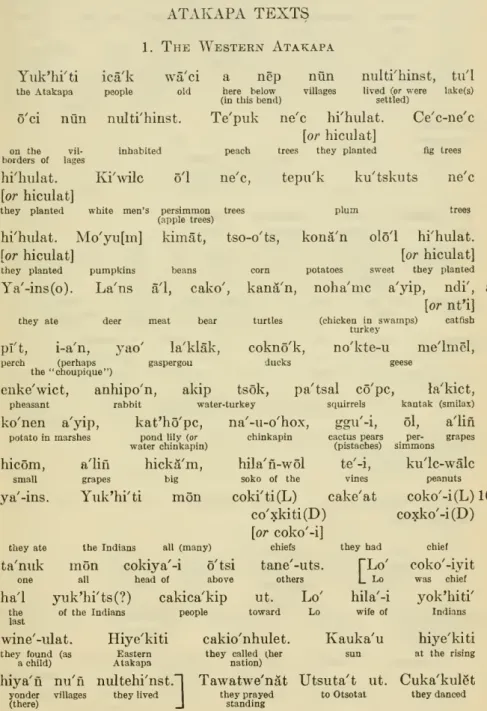
ATAKAPA TEXTS
1.
The Western Atakapa
Yuk'hi'ti
theAtakapa
ica'k
people
\vaci old
a nep
here below (in thisbend)
nun
villages
nulti'hinst,
tul
lakeCs) lived (orwere
settled)
o'ci
nun
nulti'hinst.Te'puk
on the borders of
vil- lages
inhabited
hi'hulat.
[or hiculat]
they planted
Ki'wilc
o'lpeach
ne'e,
ne'e hi'hulat.
[or hiculat]
trees they planted
Ce'c-ne'c
fig trees
white men's persimmon trees (appletrees)
hi'hulat.
Mo'yu[m] kimat,
tso-o'ts, [orhiculat]they planted pumpkins Ya'-ins(o).
La'ns
tepu'k ku'tskuts
ne'eplum trees
kona'n
olo'lthey ate deer
pi't, i-a'n, perch (perhaps
the"choupique")
enke'wict,
pheasant
ko'nen
a'yip,potatoinmarshes
yao
hi'hulat.
[or hiculat]
beans corn potatoes sweet they planted
a'l, cako',
kana'n, noha'mc
a'yip, ndi', [or nt'i]meat bear turtles
la'klak,
eokno'k,
gaspergou ducks
(chicken in swamps) turkey
catfish
no'kte-u me'lmel,
geese
anhipo'n, akip
tsok,rabbit water-turkey
kat'ho'pc, na'-u-o'hox,
pa'tsal co'pe, la'kict, squirrels kantak (smilax)
pondlily{or water chinkapin)
chinkapin
hicom,
a'linhicka'm,
small grapes big
ya'-ins.
Yuk'hi'ti mon
theyate
ta'nuk
one
ha'l yuk'hi'ts(?)
the ofthe Indians last
theIndians all(many) eokiya'-i
head of
mon
all
o'tsi above
eakica'kip
people
hila'fi-wol soko of the
eoki'ti(L)
eo'xkiti(D)
[or eoko'-i]chiefs
tane'-uts.
others
ut.
Lo'
toward
ggu
-1, cactus pears(pistaches) te'-i,
vines
cake'
ata'lin grapes
Lo
theyhad
TLo' L
Lohila'-i wife of
wine'-ulat.
Hiye'kiti cakio'nhulet.
they found (as achild)
Eastern Atakapa
Kauka'u
sun
hiya'n nu'n
nultehi'nst.yonder (there)
villages theylived
]
they called (her nation)
Tawatwe'nat Utsuta't
ut.theyprayed toOtsotat standing
Ol, per- simmons
ku'lc-wale
peanuts
coko'-i(L) 10 eoxko'-i(D)
chief
coko'-iyit was chief
yok'hiti'
Indians
hiye'kiti
at the rising
Cuka'kulet
theydanced
10 BUREAU OF AMERICAN ETHNOLOGY
[bull. 10815Utsuta't
ut,Ce'c pu'm wacwa'ci pu'm
pii'mulat.I'cak
hila'-itoOtsotat ofthe the ofthe old dance theydanced aman wife
young the dance
tanu'k
one
ke'at, hehad
icak
hila'-i wivestslk two
ke'-en
whenhehad
hatse'-ec.
itwasbad
Pa'lnal
(achiefon MiddleLake) hila'-i
wife hila'-i,
wife
tati'hin-tat he lay down
20nta'hentat.
cameout
Hakit
their
wa
CI olderwa'ci
old
ha
his
pam-nimat.
Hila'yi ta'xnikpa'mat, Palna'l
beat and killed wife [hehadthree]other beat Palnal
kic
pa'm-nimat;
yi'l lathimato'1-u
woman beatand killed days three or fourKauka'u a'm'n
ica't
pa'mlikc mon.
head mashed all
hukica'k
relatives
hokia'lulha'-uxc
(L), hokia'lul a'-uc(D)
theycouldnotmarry
he had drunk
hic'ntset
a'nike
his ears
wet
brothers sisters(said
bywoman)
a
this
hina'k
like
kice't okia'liil
sisters (saidbyman).
they married
inak.
asif
Wo'cifia
hina'ket.Ke'c
'n cakio'l te'cmon cakmanma'net,
naked
ca'kiol men
they went almost
katna'-u
beard
women and
cak'a'xc.
had none
hair long was worn by
them
Hatiu'lco
'n'o'hikcakatko'pcen
they pamted themselves
with red paint
they painted them- selves white
25hatme'lco; haki't
ica'kka'-u hatme'lco pu'mudl(L) pu'mul(D)
they painted themselves black
ha'kit
their
their relatives when dead they painted black ica'tip
hatna'-inst? hati'dsom,
headson they put on themselves littleon them-
(when) they danced
na -u
feathers
tilvpu'mudl
(or tikpti'mst)(L)tikpum ne'kin(D)
atthedancingplace
selves
haki't
naxcna'n.
haki't they
ciiicna
m
alittle calabash^rattle)
they sounded
The following version
ofthe bracketed
sectionwas given by Delilah Moss:
Lo'
yuki'ti ha'l Lo Indians thelasthila'-i yuk'hi'ti
wife Indians
coxko'yit
waschiefwine'-ulat.
theyfound
yuk'hit
Indian
Ha'
her
cakica'k
relations
cakicak
relations
30
cakio'nculat.theycalled
them
Kaukau'
ofthe sea
ka'ckin
ina swelling
wine'-ulat.
they found
cakio'nculat,
nu'nkin
to'hulatkakau'
iye'tsnetheycalled
them
in villages they lived ofsun atrise
ut.
Lo'
of Lo's
Hiye'kiti
Easterners
Hiye'kiti
Hiye'kiti
H't {or o't, or
hut)
owardStanton]
DICTIONARY OF THE ATAKAPA LANGUAGE 11
1.
The Western Atakapa
The
oldAtakapa people
lived in villagesbelow
this place,on the borders
ofthe
lakes. The^'-planted peach
trees.They planted
fig trees.They planted apple
treesand plum
trees.They planted pumpkins, beans,
corn,and sweet potatoes. They ate
ofthem. They ate deer meat, bear (meat),
turtles,turkeys,
catfish,perch, the choupique, gaspergou, ducks,
geese,pheasants,
rabbits,water turkeys,
squirrels,muscadines, kantak (China
briar),marsh potatoes, water chinkapins, chinkapins, cactus
pears,persimmons, small grapes, big grapes, the soko, and peanuts. The Indians had many
chiefs,one being head
ofallthe
rest.[Lo was the
lasthead
chief.The wife
ofLo was a foundling. Her nation was
calledEasterners (Eastern Atakapa). They
lived in villagesover yonder toward the
rising sun.]The [Atakapa] prayed standing
toOne-above. They danced the sacred dance
toOne-above. They
alsodanced the young people's dance and the old people's dance. A man had but one
wife,and when
a man had two
itwas a bad
thing.Palnal's older wife beat him
todeath. His other wife beat him. When Palnal's older wife beat him
to
death
hisbody l&y on the ground three or four days with the head mashed
in.The water he had drunk ran out
of hisears.Relatives were not allowed
tomarry,
since itwas
as ifbrothers married
sistersand
sistersmarried
brothers.They went almost naked. Men and women wore
theirhair
long,and the men did not wear beards. They danced painted with red and white paint and, when
relativeshad
died,with black paint and with feathers on
theirheads, sounding a
rattleat the dancing
place.Delilah
AIoss's version ofthe bracketedportion:
Lo was the
last chief ofthe Indians. Lo's
wifewas a foundling.
Her
relativeswere Easterners (Eastern Atakapa). They found her during a high
tide.They
calledthem Easterners
(orSunrise people) because they
lived in villagestoward the
sunrise.2.
Cakta'lko
Yuk'hi'ti
ica'kka'-u ha'talko'at hina'k
cakio'nculet,theAtakapa aman dead hisbody thus theynamedit
turnedinto
Ica'k
ica'tha'n
hu'-ulat; po'-ol tsa't'n hu'-ulat,ha
human head nothaving theysaw loweredinfront afterward theysaw his
to'-unta'v'm (D)
ica'tha u'c mon na'-ucem. Kiwilc hiku'lat to"nta'vm
(L)(to"nta'fm
(L)to'-unta'v'm (D))
covered withhair theCreoles haveseenhim sometimes
yuk'hi'ti tu'lip lo'xkin
iwa't'n hu'nst;35
Indian Lakeon (&)ontheprairie hecame heisseen head
12 bureau of american ethnology
2.
Cakta'lko (Human-skin Desirer)
[bull.108
When an Atakapa was dead he turned
intoa being
desiring skins,and they
calledhim by
thisname. When one
firstencountered him, he appeared
tolack a head but afterwards they saw
hishead bent
for-ward and
hisbody
allcovered with
hair.Creoles have seen him
attimes coming through the bushes on the
prairieby Indian Lake and
in
the daytime.
3.
Children's Ears and Faces
40
Yuki'tic no'mc
ica'tkintheAta kapa
icatlciii thehead
the children
theirhead
pa'ht
ha' (L).pa'ltit ha'
(D).
didnotflatten
TTsa'xta'
Lthe Choctawaihina'k
hke
capa'lcita'-ha.
flattenednot
Huke't
themothers
hald't
their
u'ts
nose
cakito'lcenct putinorder
a n
the ears
cakito'lcenct
arranged, putinorder
ahena'ka
inthesame wayas
u'ts
the noses
cakiwi'lenst.
theyputin order
Itiyi'lc onemonth
tanu'k
one
cakiwi'lenst.
An
cakte'lcensttanu'kip
theyputit inorder
the ears
theyput inorder
haki't
an kima'tip
ne' o'ts o'ta'n
their ears inthe inside (from) up to the
below ear
cakte'lcnt
unfolded
yi'lkit
mon
;duringtheday (or telte'lcnst)
toenlarge
Dehlah Moss substituted the following
forthe sentence
inbrackets
:
38a Tsaxta'
Chootawhakit
their
no mc
children
ica't heads
cakpalpa'licat.
flattened.
3.
.Children's Ears and Faces
The Atakapa did not
flattenthe heads
of theirchildren
likethe Choctaw. Mothers shaped the noses and
ears of their children.They continued
this fora month. They shaped them once every day, unfolding
(orenlarging) the
earsby rubbing them on the
insidefrom bottom
to top.4.
Yu'lc Caki'n O'k
toaperson tocome (invitation)
42
Yi'l dayspa xe
seven
yuki't
a'nkin.our housein
'nya'-uta
Iwillwaitfor {orexpect)you
Yu'lc
word, writing
'no'kne
youtocome
a'n-idso'n room
oto'lco have ready
'nke'tne
youtostayin
10-1 sendme
o'k
'nu'xts a''nta'nat
'na'come whetherwhether or not
you can a'tnaxlva
how
ma n
long
ke't
stay
'nu'xts youcan
a?
?
GATSCHET]
SWANTONJ
DICTIONAEY OF THE ATAKAPA LANGUAGE 13
Yi'l day
mon
all,
even
ta'-i river
ho'ktiwe
together (twoormany)
icwa'nehe
wewillwalk
'nta'n
45
ne'c-pa'l idso°'ldn
inbuggy
nta'n tu'-ke'mc
or boat-row
(=rowboat)
icy
a mcne;
wetogather
icya'mcehe.
weshallgather
a yip
marshto'(h)i-a
getting into
icwa'nehe,
wewillgokuna',
potatoes
lo'xkin ontheprairie
iya'n(D) ya'n(D)
there
kaxlo'pc,
with chinkapins (nuphar)
ti'u-sakio'ns
goandvisit
ti'v go
la and
icwa'nehe,
wewill start(.orgo)
na'-u oxo'x
chinkapins
tsama
ku'ts,crawfish
coxmo n
everything
Kidso'nkckin
inthefire
Nti',
fish
n
and
pit ya'
katpa'
perch and trout fish-hook lineby cakti'ts
ya
cakitsa'-e he'-u,ya
wecarrythem and wefrythem many (we) eat
tansta'lik
icanka'mcne
coxto'l icke'tne withcards wewillplayYuki't nu'nkin
our villagein
cakwakehe
(or
cakwaktikit
(better)) we wUlbakekoko'kic-o'-ik
cakicau'tselyuki't kan50
wecatch(them) our home
e- (h)atpe'netsel. Te'iis enoughwedo on evenings
luck usforhaving
pu'm icha'xc a
wehave this
Ica't-to'kc Head-round
ka'-u ya
and todie
dance, ball
coxko'-i
wa'ci ka'wet. Ha'
chief old died his
ha'net.
Koyi'u
.hiwe'-u
cold strong,bad
failed,
camenear
ipco'k
conjurer
mi'cat
shegave
Nakl't
your
O'k
cameya
and
pe'neat
cured
pVck
blood
to'ts sucking
itiyi'lc.
month hila'-i
wife
ke'at.
had hita'-uc.
itout
Yuki'ti
theIndian
cok'he'c
issick
Yuk'hi'ti55
theIndian
Tsanu'k
a horse
pe nene.
forcuring (her)
tsanu'k
horses
cakwinetem
didyoufind yi'l
hiwe'-u
weeks
tsika't
ago,since, past (only saidofweeks)
lat?
three?
leak
mennak
ye
tsanu'ki
ona horse
caka'xlecat
whichyoulost
ka'
that which
iya'nek mon
'nka'ne,cakwine cokwa'nic
thatis all foryoutodo findthem anddrivethem up
leak cokcaktsanc ko°'
u'xts, theycan yilke ya' yi'lhiwe'-u
was married and weeks
1ni ona search,
lookout
ya
and
cakna'-uc;
letthem
coktu'kulet. 60
fetchthem
cokcaktsanc
ko°'men thieves catch
Kile't-ki'c (nameofDelilah's,
mother)
(no'mc)
tsi'c babyke'ne, havingfor
O'l near (intime),
soon
Wi
my
cakno'mc
children
pu'ckin
outofdoors
ha'c
and he
wa'fi
go
John
John
tsika't ago
Annie
Annie
tsi'k, two
ya
and
a'nka'mctit
playing
yilwai'tikit.
willmarry
co'ktokcik,
withtheball (cokto'kc,ball)
14 BUREAU OF AMERICAN ETHNOLOGY
[bull.lUS65coki6'l no'mc haki't cukiolc-hatke' mon lu'cem
ta'lc6m.theboys their
Tsi's waii-haihai'ckit.
baby goescrying
kuyak'ho'
caka'tsel.sausages we made
O'k,
ichu', pelpantaloons
Hiye'n
a hog
all
te'm
yesterday
fullofdirt fullofholes
nima'-utsel ya'
wekilled and
far (it is)
ha' not
tsanu'ki
ona horse
ite'-u to travel
o'kne. 'Nto'I coming
for
wellwith you a'
'natna'ha?
is howareyou?
howdoyoufeel?
4.
An Invitation to Visit
I will
look
foryou
inseven days and have ready
foryou a room
in
our house. Send me word whether you can come or not and how
long you can
stay.Every day we
willwalk along the
rivertogether
or,getting
intoa buggy, go out
calling,or go out
ina rowboat
togather chinkapins, marsh potatoes, nuphar,
crawfish,and everything
else.We
willbake them
inthe
fire.We
willcatch
catfish,perch, and trout with hooks and
lines,carry them home, and
fryand eat
asmany
aswe want. In the evening we
willtryour luck
at cards.We have a dance
inour
village thismonth. Round-head, the old Indian
chief,died
thismonth. His wife was
sickand came near dying. She had a bad
cold.^The Indian conjurer came and cured her by sucking out blood. She gave him a horse
forcuring
her.Did you
findthe horses you
lostthree weeks ago? Let men on horseback search
forthem,
findthem, drive them along and bring them
here.They can catch the
thieves.Kile't-ki'cis
married and two weeks ago she had a baby, and soon John
willmarry Annie. My children play
ballout
ofdoors every day and get
theirpants covered with
dirtand
fullof holes.The baby goes about
crying.Yesterday we
killeda pig and made sausages.
Come and
see us, for it isnot
faron horseback.
Is itwell with you?
5.
Biographic Notice of Ponponne
'0
Wet Kic Mok, Kic Mok n Ponponne
cousin womanshort Woman-short
&
Ponponne kic yuki'tinu'nkin
ke't'ntat,Yuk'hi'ti
woman Indian village in lived IndianTu'l Te'-u
iye' edso°.Ya'n ke'tntat
LakeEnd(EndLake) being smallerthan there she livedma
ino'-i icitsyu'tskin.Hac
ipa'across whilewegrewup she husband
i-o'iiculat
Ta'kapo
theycalledher Atakapa
Tu'l
to'lpot ino' Lake ontheeast sideyuki'ts tu'l
we lake
ha'xcet
had none (wasawidow)
(h)iu'xts
Iknew(her)
atka'ki,
ever since
ya' and
ne'e palpa'l
(box) split-plank
a'nkin
housein
nu'n-ketntat.
she lived
Ikunyu'ts
young
GATSCHETl
swantonJ
DICTIONARY OF THE ATAKAPA LANGUAGE 15
caktika'-u,
shelooked
coka'-hiwe'-u
citha'n li'l doingmuch(industrious)
gathering (pickingto pieces)
and
cokcukyi'kc
selling
75
ya
and
cukwa'k
bread (food)
'n and
coxkci'ukit.
Yuki'ti
shesewed theIndians (allthe time)
he'-u o'k tanu'ka
many different
ya'
yo'let;kitsak
inebriated
Ciko'm
cattle
a'l meat
o-ina'ka
like (notlike?)
pai-o'k
camebackya
and
(h)atit6'lc
dress oneself
and angry
caka'
shemade
ka'-u
whiskey-dead ya' and
ya'
and
pl'lkin onthebed
ha'hat.
did not
Kic cokcaki'kcat.
she sold woman
w
a'n-cakp
a'mkox
going atthemto beatthem
ti(xt) lying
down
Komo'k
baskets
mo'kat
shortwasshe
ya'
and
cak'he'-uc.
toabusethem
n
and
tsanu'k
horses
cakio'l tslk, kic tanii'k,
boys two female one
Toussaint,
hiol idso°' ha' Toussaint (man) younger hisen Kona'c;
ickici'l name Konac daughter'sn Kic Yu'ts. Cok
and Kic Yuts things
hiol (man)
ha'xcet.
shehad none
wa'cin
oldest
Ursin,
Ursin
No'mc
children
lat
three
ke'atSO
she had i'ti
en
name eiiLouison,
name Louisonhe'-u cakwa'nts
many totellha'
his
Yuk'hi'ti
Indian
u'xtsat
knew(could)ha' e'n
bis name
Yuk'hi'ti
Indian
Yoyo't
Yoyo't
en
name
ica'k
cok
wacwa
cinancientabout
ku'ltan
long ago cakni'l.
grandchil- dren
Cakyo'kat
shesang
ka'-ulat done
yoko'n
songs
ka' done (things)
haki't
themha'
her
O't.
to
cakno'mc
children(to)
ya
and about things
ha 85
her
ha'l
imato'l
four
ilu' years
ya' and
Ilu'
woc-pe
years ten and
("fingersready")
wocpe'
latsi'khina'ka
sixty about
nu'nkin imo'culat
(h)atka'ki
(nothatka'kin) ago(in 1870)
ka'wat,
she died
ha'
her (notkftnkin) homeat
theyburied her
wa
cinold (aged)
Ha' nu'k
byherself alone
icla'uc
yellow-fever
ta'tik
of
ka'wat,
she died
lyan
there
imo'cti(xt)
sheisburied andliesthere
yuk'hi'ti Indian
ha'
ickici'l, her daughteroktanu'k
thesame
cakimoc-ne'kin
graveyardin
ha'hu
itfirst,pre- viously (opposite=ha'l)
ha'.
not
ka'wat
died
Kic Tot,
ha' nil,Yoyo't 90
KicTot her grandchild Yoyo't
nu'nkin, cok'he'c
disease
a
this townat
(i.e.,LakeCharles)
coka'-at.
shehad
Kiwi'lc
French (Catholic)
cakimo'c-ne'nkin
cemeteryin
imo'culat.
theyburied(her)
5.
Biographic Notice of Ponponne
My cousin being a short woman, they
calledher Short-woman, and
also
Ponponne. She was an Atakapa woman and
lived inthe Indian
villageon the
east side ofIndian Lake, which
issmaller than End Lake.
16 BUREAU OF AMERICAN ETHNOLOGY
[bull. 108She
livedthere while we were growing up. During the time when
Iknew her she was a widow and
lived ina spUt-plank house. She looked young and was very
industrious,gathering and
sellingmoss and bringing back bread and meat,
afterwhich she lay down on the bed and sewed. She did not
dress likethe Indians. She made many
different
kinds
ofbaskets and
soldthem. She was a short woman and angry when she got drunk, when she went and beat and abused
(people).She had no
cattleor
horses.She had three
children,two boys and a
girl,the
elderboy being named Toussaint and the younger Ursin,
hisIndian name being Konash, her daughter's name Louison and her Indian names Yoyo't and Kic-yuts. She could
tell toher children and her grandchildren many things about what happened
in
olden
times.She sang songs
tothem.
She died 14 years ago
(i. e., in1870) aged about
60.She died
ofyellow fever and they buried her
athome. She
isburied there by
herself,
not
inthe Indian graveyard.
Kic-tot,her grandchild, daugh-
ter ofYoyo't, died before her
at thistown
(i. e..Lake Charles).
She had the same
disease.They buried her
inthe French cemetery.
6.
Chief Cukuhu'-i and Cyprien Wi
my
Inkili'c English
95Ha'lkin
afterwards
wa'cin
kulca'grandfather (maternal) ta'-i Bayou
Cu'kuhui
Cukuhu-i
yuk'hi'ti Indians
coxko'yat
chiefwas
Ta'kapa
Atakapa o'ts nti'n
village
ke't'ntat helived
tsi'pcat
Yuk'hi'ti
heremoved Indian
hina'ka
ilu'wocpe'
aboutthirty years ago
Tu'l
Lakela't o't
to
Tu'l Te'-u
Lake End
(LakeCharles) lya'ii
there
wa cm
o'tse.
over
o'tse.
above
nak
veryold
atka'ki
ka'wat.
hedied
Hila'-
wife
ta'nuk ke'at ha
one he had her
ha'xcat.
Wi
he hadnone
my
to'hulat,she lived
ya'
ha'c
then she icitsiu'tsicat.
raisedus,madeusgrowup
Hio'l
sons
hoktiwe
together
lOOka'-ukin
afterhedied
and
eh Mary Ann.
name Mary Ann
oke't
itso°' mother youngest tikno'mc
until children yilke', tu'l
married the lake
Yuk'hi't
ite't OurIckici'l daughters o'tkine'at.
next towas lat ke'at.
three shehad nit
five
Ha
her
Wi
my
ke'at.
he had ite't
father
kulca'
grandfather
ma mo
across pe'l
tsi'pcat, migrated,removed
(Cyprien)
ica'kto'lat
yuki't
goodwas us
icpa'ts ha'hat.
whippedus not
Pa-ito'lucat
wi
toogoodhewas me
no'mc
o't children toWic
I
' ot.
to
ya
then stepfather
Icyutsyu'ts
heraisedus
wi
ite'tiyania'n
of
my
father afriadlyu'tskin
whenIwasgrownup
hac
he
Cyprien (an Indian)
tanu'kip
once
ha'xcat.
wasnot
okwa'nc
o'twar to
CO
never
ti'cat ha'
swan?on]
dictionary OF THE ATAKAPA LANGUAGE 17
ya'ka'wat. Wi oke't man
ilan-wa'iitat.Tik'hu' ko'hat 105
and died
my
mother long grieved continually togo shewanted(went on mourning) (toAlexandria)
ka'-u ha'xc
ta'n, ti'c a'-ucat.Tanu'kip
ti'cat.hedied before togo she could not once she started
Tik'pa'yat. Kaukau' ka'cik
ici'x a'-ucat.Yuki't no'mcsem
sheturnedback water high cross she couldnot we children alone
tu'xtsel
yuki't nuk.
Iti'tanu'kip
yi'ltut nen
o'lstayed byourselves night inone day before nearly
(pi.ofketo)
pa'-i
mo'hat. Yuki'ts
icatsi'ckicatyuki't oke't
hu'ne.^home shecame we wewereglad our mother to see
Pa-i a'kc
ti'cko'hat. Yuki'ts
ti'cne ico'ncat.Ke'tne 110
back togo (mother) we togo wedid not toremain
wanted want
na'mtsel
ti'cha'xcne,
webegged togo not(her)
6.
Chief Cukuhu'-i and Cyprien
My maternal grandfather Cukuhu'-i was
chief ofthe Atakapa.
He
lived ata
villageon English Bayou above End Lake (Lake Charles). Afterwards he removed
toIndian Lake. There he died at an advanced
age,about 30 years
ago.He had one wife named Mary Ann. He had
fivedaughters. He had no
sons.My mother was next
tothe youngest. She
livedwith her father
untilshe had three
chil-dren. After my grandfather died she married again and moved across the lake and brought us up
there.Our stepfather Cyprien was good
to
us
children.He
raisedus and never whipped us once.
Iwas not
afraid ofmy
father.He was too good
tome. When
Iwas grown up he went
towar and
died.My mother grieved
forhim a long time.
She wanted
togo
tohim
atAlexandria before he died but could
not.Once she started but turned back. The water was too high
forher
to cross.We children stayed
athome by
ourselves.One night
justbefore day she came home. We were glad
to seeour mother. She wanted
togo back. We did not want her
to go.We begged her
toremain and not
to go.7.