i
By
Ramadhan Aras Reg Num.15.1300.153
ENGLISH PROGRAM TARBIYAH FACULTY
STATE ISLAMIC INSTITUTE (IAIN) PAREPARE
2019
ii
IMPROVING STUDENTS’ SPEAKING SKILL BY USING THREE STEP INTERVIEW AT LINTASAN
IMAJINASI BAHASA MAHASISWA (LIBAM) IAIN PAREPARE
By
RAMADHAN ARAS Reg Num.15.1300.153
Submitted to the English Program of Tarbiyah Faculty of State Islamic Institute of Parepare in Partial Fulfilment of the Requirements for the Degree of
Sarjana Pendidikan (S. Pd)
ENGLISH PROGRAM TARBIYAH FACULTY
STATE ISLAMIC INSTITUTE(STAIN) PAREPARE
2019
iii
IMPROVING STUDENTS’ SPEAKING SKILL BY USING THREE STEP INTERVIEW AT LINTASAN
IMAJINASI BAHASA MAHASISWA (LIBAM) IAIN PAREPARE
Skripsi
As a Part of Fulfilment of the Requirement for the Degree of Sarjana Pendidikan (S.Pd)
English Program
Submitted by
RAMADHAN ARAS Reg Num. 15.1300.153
to
ENGLISH PROGRAM TARBIYAH FACULTY
STATE ISLAMIC INSTITUTE (IAIN) PAREPARE
2019
iv
v
vi
vii
ACKNOWLEDGMENTS
ِمْي ِح َّرلا ِنمْح َّرلا ِالله ِمْسِب
First of all, let us thank our God, praise be on Him the beneficent the merciful Lord of the world, the owner of the Day of Judgment, for He has given us the mercy and blessing. Shalawat and Salaam are due to our Prophet Muhammad SAW (peace be upon Him), the last messenger of Allah SWT. He has already spread the Islamic teaching to all human being in this world.
The writer realizes that this skripsi has never been possible to be finished without the assistance of the other people. Therefore the writer wishes to express a lot of thanks to:
1. The writer’s beloved parent Muh. Aras and Hadaria for their love and sincerely pray for him.
1. Dr. Ahmad Sultra Rustam, M.Si as Rector of IAIN Parepare for his kind and help during his study.
2. Dr. H. Saepudin, S.Ag., M.Pd as Dean of Tarbiyah Faculty of IAIN Parepare, who has given the writer guideline in writing the research.
3. Mujahidah, M.Pd as the Chairman of English Study Program at IAIN Parepare has given him the great motivation during the period of this skripsi.
4. Dr. Magdahalena, M.Hum as the first writer’s consultant, who has given him much motivation, guidance and suggestion to complete the skripsi.
viii
5. Drs. Abd. Rauf Ibrahim, M.Si as the second writer’s consultant, who has given him much motivation, guidance and suggestion to complete the skripsi.
6. The lecturer of English Program of IAIN Parepare for motivation during his study.
7. Aco Budi as the Chief of LIBAM STAIN Parepare who has given him permission to conduct the research.
8. The big family of LIBAM (Lintasan Imajinsi Bahasa Mahasiswa) IAIN Parepare, who always motivates, supports and advises the writer to finish this skripsi.
9. The owner of Smart Portal and Belawa Printing who have given him some facilities to finish skripsi.
10. The writer also would like to express his big thanks to Megawany and all his awesome friends that could not be mentioned one by one who has helped and supported him.
Finally, the writer realized that this skripsi still has any weakness and still far from being perfect. Therefore he hopes criticism, a suggestion for its perfection and he hopes this final project will be useful for the reader
May Almighty Allah SWT. Always be with us.
ix
DECLARATION ON THE AUTHENTICITY OF THE SKRIPSI
The writer who signed the declaration below:
Name : Ramadhan Aras
Student Reg. Number : 15.1300.153
Place and Date of birth : Pinrang 28th Apri 1997 Study Program : English Program
Faculty : Tarbiyah
Tittle of Skripsi : Improving students’ speaking skill by using three step interview at lintasan imajinasi bahasa mahasiswa (LIBAM) IAIN Parepare
Stated this skripsi was his own writing and if it can be proved that it was copied, duplicated or compiled by any other people, this skripsi and the degree that has been gotten would be postponed.
x
ABSTRACT
Ramadhan Aras. 2019. Improving Students’ Speaking Skill by using Three Step Interview at Lintasan Imajinasi Bahasa Mahasiswa (LIBAM) IAIN Parepare (Supervised by Magdahalena and Abd. Rauf Ibrahim).
English as primary and foreign language has become the key to the world.
However, it must be found the way how to be mastered it. One of the skills which are very important is speaking skill because it will help people to communicate and interact each other. This research was carried out at LIBAM IAIN Parepare. In this case, the researcher found that some members of LIBAM IAIN Parepare are still a law in speaking especially in front of their friends or other people. To solve the problem, the researcher used three step interview. This technique is one of student center learning which learners help each other and learn. The objective of the research is to know whether three step interview is able or not to improve the speaking skill of members of LIBAM IAIN Parepare.
The population was the members of LIBAM IAIN Parepare and the sample of this research was 25 members. The researcher used pre-experimental design in one group was given pre-test, treatment and post-test design, as for the effect of treatment was judged by the difference between the pre-test and post-test. The success of the treatment is determined by comparing pre-test and post-test score. To collect the data, the researcher used tests that are pre-test and post-test. The researcher also gave questionnaire to know the responses of students to three step intervew. The data were analyzed as a percentage, mean score analyzes and the value of the test.
The first result of the data analyzed that the students’ achievement on the pre- test was (6,36) and post-test was (7,26) This showed that by using three step interview was a good technique in English learning process at Lintasan Imajinasi Bahasa Mahasiswa (LIBAM) IAIN Parepare. After analyzing the data by using the t- test formula, the result of the t-test value (9,64) is bigger than the t-table value (1,7108).It means that there is a different improvement before and after using three step interview as technique of teaching. The second result of analyzed data that 72%
of the students were interested in using three-ste interview, in the other word most of them interested to apply three step interview.
Keywords: Speaking Skill, Three Step Interview.
xi
LIST OF CONTENTS
COVER OF TITLE...ii
SUBMISSION PAGE...iii
ENDORSEMENT OF CONSULTANT COMMISSIONS...iv
APPROVAL PAGE……….…...v
ENDORSEMENT OF EXAMINER COMMISSIONS…...vi
ACKNOWLEDGEMENT...vii
DECLARATION OF THE AUTHENTICITY OF THE SKRIPSI...ix
ABSTRACT...x
LIST OF CONTENTS...xi
LIST OF TABLES...xiv
LIST OF APPENDICES ... xv
CHAPTER I INTRODUCTION 1.1 Background...1
1.2 Problem Statement...3
1.3 Objective of the Research...3
1.4 Significance of the Research...4
CHAPTER II REVIEW OF RELATED LITERATURE 2.1 Some Pertinent Ideas....5
2.1.1 The Concept of Speaking...5
2.1.2 The Nature of Speaking...6
2.1.3 Component of Speaking...8
2.1.4 Kinds of Speaking Activities...11
xii
2.1.5 Technique of teaching speaking...13
2.1.6 Types of speaking test...14
2.1.7 The concept of interview...17
2.1.8 General concept of three step interview...18
2.2 Previous research findings...23
2.3 Conceptual framework...25
2.4 Hypothesis...27
2.5 Operational defenition variable...27
CHAPTER III METHOD OF RESEARCH 3.1 Research Design...29
3.2 Population and Sample...29
3.2.1 Population...30
3.2.2 Sample...31
3.3 The Instrument of Research...31
3.4 Procedure of Collecting Data...31
3.4.1 Pre-test...31
3.4.2 Treatment...31
3.4.3 Post-test...38
3.4.4 Questionnaire...38
3.5 Technique of Data Analysis...38
CHAPTER IV FINDINGS AND DISCUSSIONS 4.1 Finding...42
xiii
4.1.1 Description of the research...42
4.1.2 Finding Through The Test...45
4.1.3 The overall Result of pre-test and post-test...50
4.1.4 T-Test Value...52
4.1.5 Test of Significant...55
4.1.6 Analysis of Questionnaire...56
4.2 Discussion...58
4.2.1 The Result of The Test...58
4.2.2 The Tesult of The Quetionnaire...62
CHAPTER V CONCLUSION AND SUGGESTION 5.1 Conclusion...64
5.2 Suggestion...65
BIBLIOGRAPHY...67
APPENDICES...69
CURRICULUM VITAE……….………92
xiv
LIST OF TABLES
Number The Title of Tables Pages
3.1 Members of LIBAM on 2018 30
3.2 Scoring Formulation 39
3.3 Classification the students’ communicating score 40
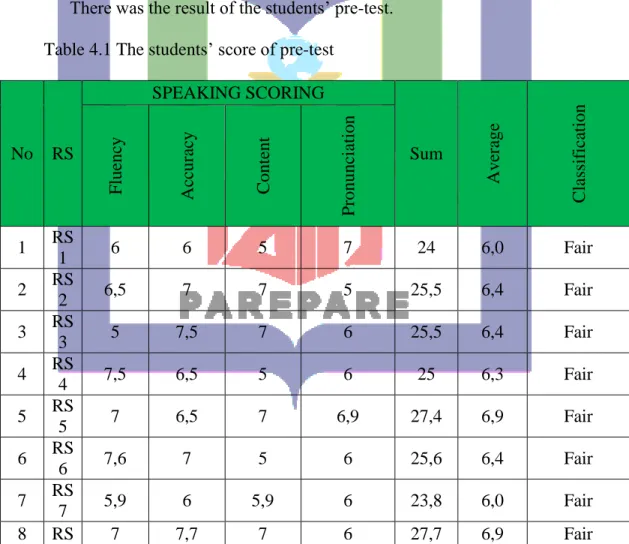
4.1 The students’ score of pre-test 45
4.2 The students’ score of post-test 47
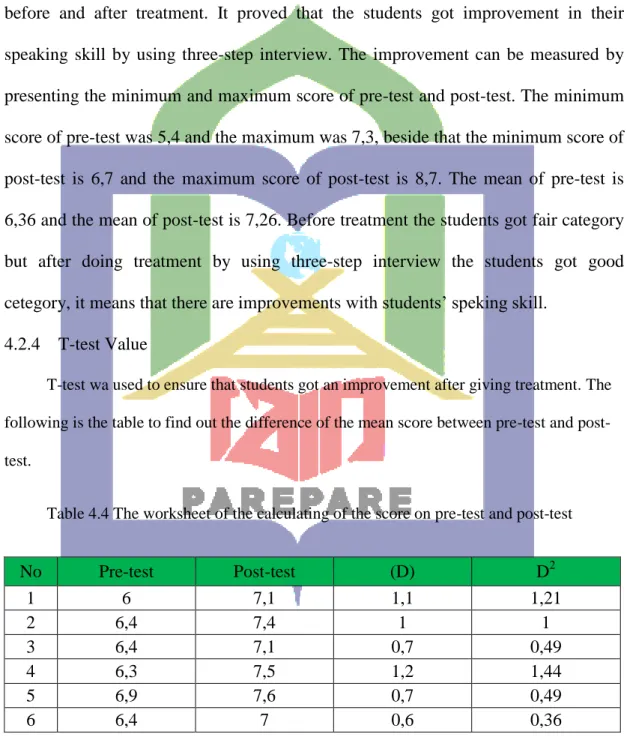
4.3 The comparison between pre-test and post-test result 50 4.4 The worksheet of the calculating of the score on pre-test and
post-test 51
4.5 The result of the questionnaire. 53
xv
LIST OF APPENDICES
Number The Title of Appendices Page
Appendix 1 Research Instrument 69
Appendix 2 Lesson Plan 73
Appendix 3 The result of questionnaaire 85
Appendix 4 Documentation 86
Appendix 5 Research Allowance 89
Appendix 5 Curriculum Vitae 92
1 1.1 Background
Speaking is one of the four skills in English that have to be mastered by the students. It can be a tool for the students to communicate. The students can get the other information from other students through speaking. Speaking is a verbal communication of language use to communicate with others. The students can tell or convey of their information or problems from their mind ideas through speaking.
Speaking helps students to make them be talk-active so that they can share what they know or what they do not know are about the case they are faced. In addition, speaking is the way to express ideas and opinion, to send expression or desire to do something, to solve some a particular problem, to increase the proficiency in speaking and to maintain the relationship or friendship. So, speaking is an important skill of language which should have improves for the students. From the definition above it can be conducted that speaking is one skill must be mastered by students to send or to receive the information or message, to communicate and so on.
In reality, there are still many students difficult to speak in English especially for members of LIBAM. Most of them could not speak English well because of
several reasons. Firstly, they fell difficult to convey their words to other because they confuse to convey or to say what. Secondly, they are shy to speak because of mispronounce words and thirdly not confidence. Finally, the students are lack of vocabularies. There are many also ways to improve speaking skill or deduct the problem in learning speaking.
Base on those problems and the class condition above, the researcher intends to help the English teacher by introducing one of Collaborative Teaching Learning model namely, Three-Step Interview to improve students’ speaking skill. Barkley, et al stated that, practice of Collaborative learning technique has come to mean students working pairs or small groups to achieve shared learning goals. It is learning through group work rather than learning by working alone. Supported by Kayi, agreed that working in groups could create a classroom environment where students have real- life communication, authentic activities, and meaningful tasks that promote oral language. Based on the statement, the researcher chooses one of Collaborative learning technique namely Three-Step Interview.1
In State Islamic Institute (IAIN) Parepare there is an organization named Lintasan Imajinasi Bahasa Mahasiswa (LIBAM) which supports and improves the English skills and Arabic skills of its member. The researcher done preliminary
1 Barkley, et al, “Collaborative Learning Techniques” on Ullin Nukhaq Kurniawati .
“Improving Student’s speaking ability by using three step interview of the tenth grade students at SMK PGRI 1 TULUNGANGUNG in academic year 2015/2016” (Unpublished Skiripsi IAIN Tulungangung, 2016), p. 2
obervation on LIBAM’s member activities especially in English learning process especially in teaching speaking and found that some members of LIBAM were unmotivated and difficult to learn . Their mindsets say English is difficult to learn because most of them don’t know how to express what they want to say and some their instructors don’t use variation technique. In teaching and learning English, it needs to apply many techniques to improve the learners’ skill. One of the techniques which have not been applied is three step interview. Hence, the researcher chooses three step interview, because the students will be easier to express their ideas to others.
Based on the explanation above, the researcher is interested to conduct a research about “Improving students’speaking skill by using three step interview at Lintasan Imajinasi Bahasa Mahasiswa (Libam) IAIN Pareapre”.
1.2 Problem Statement
Based on the background of the study stated above. The research problems are : 1.2.1 Is Three-Step Interview able to improve speaking skill of LIBAM’s member?.
1.2.2 How do the students respond three step interview?
1.3 Objectives of the research
Based on the problem statement of the research above, the objective of this research are to find out the improve students’ speaking skill by using three-step interview and also to find the students’ responses to three step interview tecnique.
1.4 Significance of the research
The researcher hopes that the results of this study can be used by the researcher, teacher, students, educational institution, and next researcher for the following purposes:
1.4.1 For the researcher, to add more knowledge about discourse study especially about this research.
1.4.2 For students, it helped students to increase speaking ability and their interest to be more active in teaching learning process.
1.4.3 For the teacher, the result of the study can be used as an alternative teaching technique to improve students’ speaking ability.
1.4.4 For the next researcher, the result of this research can be used as previous research in his/her research.
1.4.5 English department, the result of this research study will be an input of English materials.
5
CHAPTER II
REVIEW OF RELATED LITERATURE
This chapter deals with the review of related literature. It is important to elaborate some theories, which are used in this research in order to have an underestanding of certain concepts. There were many related theories as the basis of the research.
2.1 Some Pertinent Ideas 2.1.1 The Concept of Speaking 2.1.1.1 Definition of Speaking
Speaking is an interactive process of constructing meaning that involves producing and receiving and processing information. Its form and meaning are dependent on the context in which it occurs, including the participants themselves, their collective experiences, the physical environment, and the purposes for speaking.
It is often spontaneous, open-ended, and evolving.2 speaking is the action of conveying information or expressing one's thoughts and feelings in spoken language.3. Speaking is a skill which is chosen as an object to be improved in this research. Carter and Nunan stated that, speaking in a second language involves the development of a particular type of communication skill.4
2Brown, 1994; Burns &Joyce, 1997 (Online)
(area.dge.mec.pt/gramatica/whatspeakingis.htm, assessed on 22 January 2019)
3Webster’s Comprehensive Dictionary. 2003. The new International Webster’s comprehensive of the English language. (Trident press International), p. 330.
4Ullin Nukhaq Kurniawati, “Improving Student’s speaking ability by using three step interview ” (Unpublished Thesis IAIN Tulungangung, 2016), p. 1
Clark and Clark define that communication deals with two basic activities:
listening and speaking. In speaking, people express their thoughts through words and talk about perceptions, feelings and intentions they want other people to grasp and understand. Meanwhile, Spratt points out that using speech to convey meaning to others is involved in speaking.5
From the definitions above, it is concluded that speaking is an activity which is used by the people to communicate with others to express their ideas, mind, and feeling by words.
2.1.2 The Nature of Speaking
There are many definitions of speaking in language learning proposed by some experts. Clark and Clark define that communication deals with two basic activities: listening and speaking. In speaking, people express their thoughts through words and talk about perceptions, feelings and intentions they want other people to grasp and understand. Meanwhile, Spratt points out that using speech to convey meaning to others is involved in speaking. Unlike writing or reading, speaking also involves interaction which carries out a two-way communication using language and nonverbal codes to keep the listener pays attention to what the speaker is saying and to check that the listener understand the speaker’s meanings. While Brown and Yule in Nunan suggest that spoken language consists of short and often incomplete utterances in a level of pronunciation. Repetitions, the use of fillers such as ‘well’,
5 Clark and clark, “ psychology and Language” on Prucesia Kumara Silva, Improving Student’s speaking skill through the use of video clips (Unpublished Thesis State university of Yogyakarta, 2013), p. 11
‘oh-uh’ and ‘oh’ and overlap between one speaker and another can be often found in speaking.6
Richards and Renandya stated that effective oral communication requires the ability to use the language appropriately in social interactions that involves not only verbal communication but also paralinguistic elements of speech such as pitch, stress, and intonation. Moreover, nonlinguistic elements such as gestures, body language, and expressions are needed in conveying messages directly without any accompanying speech. Brown stated that social contact in interactive language functions is a key importance and in which it is not what you say that counts but how you say it what you convey with body language, gestures, eye contact, physical distance and other nonverbal messages.7
There are many researchers said in their books, they are: Speaking is a form of communication. The speaker must consider the Person they are talking to as listeners.
The activity that the person does primary based on the particular goal. So, it is important that everything person wants to say is conveyed in an effective way, because speaking is not only producing sounds but also a process of achieving goals that involve transferring messages across.
6Prucesia Kumara Silva, “Improving Student’s speaking skill through the use of video clips”
(Unpublished Thesis State university of Yogyakarta, 2013), p. 26
7Setyadi, 2014 (Online)
(https://pdf2doc.com/id/download/5vn6ew7xnthbu2s7/o_1d1q49gonu1pg5p8qb4614751d/BAB%202- 07202244045.doc?rnd=0.4494032012898045, assessed on 22 January 2019).
In other words, the nature of speaking is how to say something can be important as what person say in getting a meaning across. Therefore, speaking process should pay attention to want and how to say as well as to whom appropriately. Despite it is importan, for many years, teaching speaking has been undervalued and English language teachers have continued to teach speaking just as a repetition of drills or memorization of dialogues.8
The more think of the nature of speaking is to express the needs-request, information, service, etc. The speakers say words to the listener not only to express what in his mind but also to Express what he needs whether information service.
Most people might spend of their everyday life in communicating with other.
Therefore, communication involves at least two people where both sender and receiver need to communicate to exchange information, ideas, opinions, views, or feelings9
2.1.3 Components of speaking
There are some components of teaching spoken language such as conversational discourse, pronunciation, accuracy, fluency, affective factors and the interaction effect.
8 Rhodi Jones, Speaking and Listening (London: The Bath Press, 1989), p.14.
9Gillian Brown and George Yule, Teaching The Spoken Language : Approach Based on the Analysis of conversational English (Australia: Cambridge University Press, 1989), p.14.
2.1.3.1 Conversational Discourse
When somebody asks "Do you communicate in English?" they normally mean: Can you carry on a discussion sensibly skillfully? The benchmark of fruitful dialect obtaining is quite often the exhibit of a capacity to achieve down to earth objectives through intuitive talk with different speakers of the dialect. Richards in Dangles expressed that the discussion class is something of a puzzle in dialect educating. The objectives and the systems for instructing discussion are amazingly differing, contingent upon the understudies, educator, and in general setting of the class.
2.1.3.2 Pronunciation
Pronunciation is one of the important components in speaking skill therefore many learners of foreign languages feel that their ultimate goal in pronunciation should be “accent-free” speech that is indistinguishable from that of a native speaker.
2.1.3.3 Accuracy and Fluency
Two clearly important goals of speaking are accuracy and fluency. Accuracy is clear, articulate, grammatically and phonologically correct language. Fluency is flowing and natural language. Accuracy is achieved to some extent by allowing students focus on the elements of phonology, grammar, and discourse in their spoken language, whereas fluency is probably best achieved by allowing the “stream” of speech to “flow”.
2.1.3.4 Affective Factors
One of the major obstacles learners have to overcome in learning to speak is the anxiety generated over the risks of blurting things out that are wrong, stupid, or incomprehensible. Language learners can put a new twist on Mark Twain’s quip that
“It’s better to keep your mouth closed and have others think you are ignorant than to open it and remove all doubt. Our jobs as teachers is to provide the kind of warm, embracing climate that encourages students to speak however halting or broken those attempts may be.
2.1.3.5 The Interaction Effect
The greatest difficulty that learners encounter in attempts to speak is the interactive nature of most communication. Conversations are collaborative as participants engage in a process of negotiation of meaning.10
Based on the theory above, the researcher conclude that someone is said to be capable of speaking English if he can carry on a conversation reasonably. If he has good pronunciation, or produce words correctly and clearly (accuracy and fluency) he is said to have good English. Other components in speaking are effective factors and interaction effect. In teaching speaking, teachers should encourage the students to speak, because when learning to speak, the learners are afraid of being wrong and making mistakes.
10H. Doughlas Brown, Teaching by Prinsiple; an Iinteractive Approach to Language Pedagogy (U.S.A: A Paramount Communications Company, 1994), p.259.
2.1.4 Kinds of Speaking Activities
There are six broad types of oral communication activities that might be incorporated into curricula in many fields of study. Most are conducive to either formal or informal assignments. Some are realistically possible only in smaller classes or recitation sections, while others are appropriate for large lectures as well.
On their own, any of them can help students learn course materials or ways of thinking (speaking to learn). Incorporated more systematically into a broader curriculum or major, they can together help move students to become more proficient in learning to speak. The kinds of speaking activities as follows:
2.1.4.1 One-on-One Speaking (Student-Student or Student-Teacher)
This is can range from moments punctuating a lecture, where students are asked to discuss or explain some question or problem with the person next to them, to formal student conferences with their instructor.
2.1.4.2 Small-Group or Team-Based Oral Work
In smaller scale settings for discussion, deliberation, and problem solving.
Appropriate for both large lectures and smaller classes and allows levels of participation not possible in larger groups.
2.1.4.3 Full-Class Discussions (Teacher- or Student-Led)
In this activity usually less agonistic, argument-based, and competitive than debate and deliberation but still dialogic in character. Often times has the quality of creating an atmosphere of collective, out-loud thinking about some question, idea,
problem, text, event, or artifact. Like deliberation and debate, a good way to encourage active learning.
2.1.4.4 Class Debates and Deliberations
A structured consideration of some issue from two or more points of view.
Debates typically involve participants who argue one side throughout, while deliberation allows for movement by individuals within the process. Both feature reason-giving argument can be applied to issues of many kinds, from disputed scientific facts to theories, policy questions, the meaning of a text, or the quality of an artistic production can range from two participants to a lecture hall.
2.1.4.5 Speeches and Presentations
Usually, a speech delivered by an individual from an outline or script. Also includes group presentations or impromptu speaking. A strong element of monologue, but dialogue can be built in with question and answer or discussion with the audience afterward.
2.1.4.6 Oral Examinations
This activity can take place in the instructor’s office, in small groups, or before a whole class. Range from one oral question on an otherwise written exam to an oral defense of a written answer or paper to an entirely oral quiz or examination.
Difficulty if it used in large groups, but an excellent way to determine the depth and range of student knowledge and to stimulate high levels of preparation.11
11Six Types of Oral Communication Activities, 2007, (online) (http://www.speaking.pitt.edu/about/oral-comm.html assessed on January 22th 2019).
2.1.5 Technique of teaching speaking
Technique is implementation of strategies done by the teacher and students in classroom which is suitable with the method that is used. In teaching speaking, teacher should use technique to make the lesson more exciting, and can easy to be understood.12 Underhill explained that there are some technique which can be used to teaching speaking, namely :
2.1.5.1 Oral Report
Oral report consists of an introduction ("tell the audience what you are going to tell them"), a main body ("tell them"), and a conclusion ("tell them what you have told them").
2.1.5.2 Learner-learner joint discussion/decision making
Learner-learner join discussion/decision-making is the process of identifying and choosing alternatives based on the values, preferences and beliefs of the decision- maker.13
2.1.5.3 Role play
Role play is the act of imitating the character and behaviour of someone who is different from yourself, for example as a training exercise.
2.1.5.4 Learner-learner description and re-creation 2.1.5.5 Using a picture or picture story
12 Ullin Nukhaq Kurniawati . “Improving Student’s speaking ability by using three step interview ” (Unpublished Thesis IAIN Tulungangung, 2016), p. 4
13Wilkipedeia,The free encyclopedia 2019, (online) (https://en.wikipedia.org/wiki/Decision- making, assessed on January 22th 2019).
2.1.5.6 Reading aloud
2.1.6 Types of speaking test
Test is used to measure the students’ speaking ability. Harmer (2005:124) stated that, testing both informally and formally, takes place at the beginning and the end of most language courses, as well as at various times during the course itself.14 Harmer explained that there are some types of speaking test :
2.1.6.1 Interviews
These are generally simple to set up, particularly if there is a room separated from the classroom where students can be met. Such meetings are not without their issues, however. The somewhat formal nature interviews (regardless of whether the questioner is the student's instructor or an outside analyst) implies that the circumstance is not really helpful for testing increasingly casual, conversational talking styles. As anyone might expect, understudies frequently fail to meet expectations in meeting type conditions. It is likewise hard to wipe out the impacts of the questioner, his or her doubting style, for instance on the interviewee's execution.
At long last, if the questioner is additionally the assessor, it might be hard to keep up the stream of the discussion while in the meantime making target decisions about the interviewee's talking capacity. By the by, there are methods for dodging a portion of these issues. An easygoing visit toward the starting can help put competitors at their simplicity.
14Ullin Nukhaq Kurniawati . “Improving Student’s speaking ability by using three step interview ” (Unpublished Thesis IAIN Tulungangung, 2016), p. 5
The utilization of pictures or a pre-chosen subject as a concentration for the meeting can help particularly if applicants are given a couple of minutes to set themselves up ahead of time. In the event that the inquiries are the equivalent for each meeting, the questioner impact is in any event the equivalent for all hopefuls. What's more, hosting a third get-together present to co-get to the applicant can help guarantee a level of objectivity.
2.1.6.2 Live Monologues
Live Monologues is a speech presented by a single character, most often to express their mental thoughts aloud, though sometimes also to directly address another character or the audience.15
The candidates prepare and present a short talk on a pre-selected topic. This eliminates the interviewer effect and provides evidence of the candidates’ ability to handle an extended turn, which is not always possible in interviews. If other students take the role of the audience, a question and answer stage can be included, which will provide some evidence of the speaker’s ability to speak interactively and spontaneously. But giving a talk or presentation is only really a valid test if these are skills that learners are likely to need.
15Wilkipedeia,The free encyclopedia 2019, (online) https://en.wikipedia.org/wiki/Monologue, assessed on January 22th 2019).
2.1.6.3 Recorded Monologues
These are perhaps less stressful than a more public performance and for informal testing, they are also more practicable in a way that live monologues are not.
Learners can take turns to record themselves talking about a favourite sport or past time, for example, in a room adjacent to the classroom, with minimal disruption to the lesson. The advantage of recorded test is that the assessment can be done after the event, and results can be triangulated, that is, other examiners can rate the recording and their ratings can be compared to ensure standardization.
2.1.6.4 Role-Plays
Most students will be used to doing at least simple role-plays in class, so the same format can be used for testing, the other role can be played either by the tester or another student, but again, the influence of the interlocutor is hard to control. The role-play should not require sophisticated performance skills or a lot of imagination.
Situations grounded in everyday reality are best. They might involve using data that has been provided in advance. For example, students could use the information in a travel brochure to make a booking at a travel agency. This kind of test is particularly valid if it closely matches the learners’ needs.
2.1.6.5 Collaborative tasks and discussion
These are similar to role-plays except that learners are not required to assume a role but simply to be themselves. For example, two candidates might be set the task of choosing between a selection of job applicants on the basis of their CV. Or the learners simply respond with their own opinions to a set of statements relevant to a
theme. Of course, as with role-plays, the performance of one candidate is likely to affect that of the others, but at least the learner’s interactive skills can be observed in circumstances that closely approximate real-life language use.
2.1.7 General concept of interview 2.1.7.1 Definition of interview
Interview is a technique which used in this research. Underhill said that, the interview is the common of all oral tests, for many people, it is the only kind of oral test. It is a direct, face to face exchange between learner and interviewer. It means that, through interview students can exchange their ideas and though. Underhill also said that, the interviewer sets out to find out certain things about the learner and to get the answers to certain questions. It means that, the interviewer gains information from the interviewee through questions.16
2.1.7.2 Types of interview
Interview has some types, Arikunto explained that there are two types of interview, namely:
2.1.7.2.1 Unstructured Interview, it is a kind of interview which the interviewer only makes the outline of questions. It needs the interviewers’ creativity;
even the result of interview is based on the interviewer.
16 Ullin Nukhaq Kurniawati . “Improving Student’s speaking ability by using three step interview ” (Unpublished Thesis IAIN Tulungangung, 2016), p. 9
2.1.7.2.2 Structured Interview, it is a kind of interview which arranged before, so it seems like check list. The interviewer only gives check for the suitable points.
This technique uses structured interview, which the interviewer makes the questions before. But it modified, the interviewer not uses check list, but uses questions list.
2.1.7.3 Stages of interview
Generally, interview session has some stages. Based on Underhill interview has three steps17, namely :
2.1.7.3.1 Introduction (polite social questions to put learner at ease).
2.1.7.3.2 Find level (series of questions and topics to establish level against a specific scale).
2.1.7.3.3 Check questions (above and below the established level, to confirm that is right).
It means that the interviewer must prepare the material which will used in every stages during the interview session. The good preparation will brings the good information gained from the interviewee.
2.1.8 General concept of three-step interview 2.1.8.1 Definition of thre-step interview
17 Ullin Nukhaq Kurniawati . “Improving Student’s speaking ability by using three step interview ” (Unpublished Thesis IAIN Tulungangung, 2016), p. 10
Kagan stated that three-step interview is another simple information sharing structure. It consists of three steps and works best in groups of four but can be adapted for larger or smaller groups. Lipton. L stated that The Three- Step Interview is a cooperative structure that helps students personalizes their learning and listen to and appreciate the ideas and thinking of others. Active listening and paraphrasing by the interviewer develops understanding and empathy for the thinking of the interviewee. They can be used as an introduction to an activity or a way to explore ideas and concepts more deeply. Students also have an opportunity to develop active listening skills and understand others’ viewpoints.18
Lipton and Wellman suggested Three Step Interview Technique is a cooperative structure that helps students personalize their learning. It also teach them to listen to and appreciate others’ thinking and idea. Being active in listening and paraphrasing will develop the students’ understanding and empathy to other person.19 2.1.8.2 Procedure of three-step interview
Three-Step interview promotes a simple method to ensure individual accountability. The procedure drives students to be active in the learning process.
Consequently, they will get experience in the teching and learning process. The
18Muhammad Astrianto Setiadi. “Improving Student’s speaking ability through three step interview method ” (Unpublished Thesis Muhammadiyah Makassar Univercsity, 2015), p.3
19Rani Candrakirana Permanasari . “Improving Student’s speaking skill through three step interview technique ” (Unpublished skipsi Semarang state university, 2014), p. 37
following is the procedure of Three-Step interview implementation in the classroom based on Barkley, Cross, and Major20, as follow :
2.1.8.2.1 Students divide into groups of four, and quads subdivide into pairs A-B and C-D.
2.1.8.2.2 Student A interviews B and student C interviews D for a predetermined time. The interviewer asks questions, listens, and probes for further information but does not evaluate or respond.
2.1.8.2.3 Partners reverse roles and interview each other for the same amount of time.
2.1.8.2.4 Students A and B introduce each other with synthesized summaries of their partner’s interview responses to Students C and D. Student C and D do the same for Students A and B.
Three-Step Interview has detail steps. If the teacher did not guide the action, the class will be uncontrolled. And the students will not get the advantages after implemented it.
2.1.8.3 Benifits of three-step interview
Barkley, Cross, and Major stated the benefits of Three-Step Interview, Three- Step Interview is an effective strategy for drawing out students’ experience knowledge from outside of class. Used this way, it can help motivate students
20Ullin Nukhaq Kurniawati . “Improving Student’s speaking ability by using three step interview ” (Unpublished Thesis IAIN Tulungangung, 2016), p. 11
because it bridges the gap between the academic and the real world. This statement made the researcher curious to implement it in the class to improve the students’
speaking ability.21
Three Steps Interview technique will give benefits to the students as follows:22
2.1.8.3.1 Three-Step Interview creates simultaneous accountability 2.1.8.3.2 Students share and apply different questioning strategies, and
2.1.8.3.3 Over time, students can be introduced to different taxonomies of thinking to extend their ability to use different levels of questioning and thinking.
2.1.8.4 The Aims of Three Step Interview
The aims of Three Steps Interview technique is to engage students in conversation for the purpose of analyzing and synthesizing new information. Three- Step Interview is a strategy that is effective when students are solving problems that have no specific right answers. Three problem-solving steps are involved in this process.
2.1.8.5 Teaching Speaking by using three step interview
Teaching speaking is prominently for the students’ oral functions. In teaching speaking, teacher needs to assess some aspects, namely grammar, pronunciation, vocabulary, fluency, and also comprehension. So, the students must speak in the
21 Ullin Nukhaq Kurniawati . “Improving Student’s speaking ability by using three step interview ” (Unpublished Thesis IAIN Tulungangung, 2016), p. 12
22 Rani Candrakirana Permanasari . “Improving Student’s speaking skill through three step interview technique ” (Unpublished skipsi Semarang state university, 2014), p. 38
teaching and learning process. This research uses Three-Step Interview technique to improve the students speaking ability. As Barkley, Cross, and Major said that, Three- Step Interview creates the opportunity for the students to network and to improve specific communication skills. It means that, Three-Step Interview provides the students to speak actively, in order to gain the information from the interviewee.
This research uses topic to be develop in the interview session. As Underhill said that, interviewers usually have a prepared list of written or memorised questions to ask, or topic to bring up. Citravelu, Sithamparam, and Choon also said that, when person speaks, he cannot just speak about nothing. He needs to speak about something. It means that Three-Step Interview needs a problem or topic which will be discussed in the interview session. nothing. He needs to speak about something. It means that Three-Step Interview needs a problem or topic which will be discussed in the interview session.
2.1.8.6 The Reason of Using Three Step Interview in Teaching Speaking
The researcher provides to apply Three-Step Interview in teaching speaking because of some considerations. As Bennett, Barrie, and Carol Rolheiser explained that, first, Three-Step Interview creates simultaneous accountability, second, students share and apply different questioning strategies, and third, over time, students can be introduced to different taxonomies of thinking to extend their ability to use different levels of questioning and thinking. Underhill also explained that, interview allows both people a degree of freedom to say what they genuine think. Kagan in Jacobs et all suggested Three-Steps Interview is used as a technique in teaching speaking
because it includes interaction activities that appropriate in supporting teaching speaking. By applying Three-Steps Interview, students will have an interaction in pairs as an interviewer and an interviewee. They automatically learn what to say and how to speak in English. Based on the statement above, the researcher decides to apply this technique in teaching speaking.
Three Steps Interview technique is one of Cooperative Learning in which students works in a group consisting of 4 persons. Students will be accuctomed to have a conversation for the purpose of analyzing and synthesizing new information by listening to and appreciating the others’ idea and thinking. Three Steps Interview technique will also help students speak in English, because they have to make an interaction with their partner in order to share the ideas orally. So, Three Steps Interview Technique is very useful to be used by the teacher to improve students’
speaking skill.
2.2 Previous Research Findings
Many researchers have reported to exposing the identification of the student’s speaking ability to make the teaching and learning process more effective, especially in the teaching of speaking. Some of the researcher findings are cited concisely below.
Alim Akkas in his result research “Improving Speaking Skills Through Peer Tutoring Strategy at Member of YMPI English Meeting Club (YEMC) At Mts Ympi Rappang Kabupaten Sidrap” showed that there is a significant difference between the members’ speaking skill before and after being taught through “peer tutoring”
strategy, it was proved by the development of mean score from 7,4 on pre-test to 10,35 on post-test, while the t-test value 11,513. therefore, “peer tutoring” strategy was able to improve speaking skill of the members of YMPI English meeting club (YEMC).23
Eva Shinta Dewi in her result research “Improving speaking skill through numbered headstogether of the seventh grade students of smp pgri 4 denpasar in academic year 2014/2015” Showed that numbered headtogether could make students active in learning and significanly improve their speaking ability.24
Rindawati Noviasari in her result research “Teaching speaking through talking stick method” showed that talking stick method method can be effective in helping the students to master speaking skill and maked them understood the English material well.25
Rani Candrakirana permanasari in her result research “Improving students’
speaking skill through three step interview technique”. The collected data showed that Three Steps Interview Technique can be an alternative strategy to improve students’ speaking skill.
23 Alim Akkas, “Improving Speaking Skills Through Peer Tutoring Strategy at Member of YMPI English Meeting Club (YEMC) At Mts Ympi Rappang Kabupaten Sidrap” (Unpublished Skripsi STAIN Parepare, 2015), p.70.
24 Eva Shinta Dewi, “Improving speaking skill through numbered headstogether of the seventh grade students of smp pgri 4 denpasar in academic year 2014/2015 (Unpublished journal Denpasar university, 2015), P.6
25Rindawati Noviasari, “Teaching speaking through talking stick method” (Unpublished Journal Bung Hatta unviversity,2014), P.10
Based on researcher findings above, showed that by using techniques in teaching English in the classroom can influence and improve students speaking skill.
The researcher also concludes that studies above just effective in the general learning process. So the researcher assumes that by using three step interview also can improve the speaking skill of the students in the classroom and able used in teaching English for business
2.3 Conceptual Framework
The conceptual framework underlying in this research was given in the following diagram.
Member of Lintasan Imajinasi Bahasa Mahasiswa (LIBAM) IAIN Pare pare
Input:
Speaking
Process
Three Step Interview 1. Pairs
2. The Revers
3. Shares Output
Student’s Speaking Skill
There are three components are explained in the following:
2.4 Hypothesis
Input : Introducing Three step interview to the students then teaching them how to do it
Process : Practicing speaking using Three step Interview (Pairs, the reverse,Shares)
Output : The achievement of students’ speaking skill after being taught by using three step interview
2.5 Operational Definition of Variable 2.5.1 Research Variable
Variables can be defined as any aspect of a theory that can vary or change as part of the interaction within the theory. In other words, variables are anything can affect or change the results of a study. Every study has variables as these are needed in order to understand differences.26This study has two variables; they are independent variable and dependent variable. These variables involved in this research are going to discuss below:
2.5.1.1 Independent variable is three step interview
Independent variable (X) is a variable which influences or chaises and effect to the dependent variable. Independent variable of the research is teaching by using three step interview which consist of six meetings where the first and second meeting
26Christopher L. Heffner, Defining Variable
”allpsych.com/researchmethods/definingvariables/” (acessed on 22th, January 2019).
is giving material about three step interview and then the third until the sixth meeting is practices of three step interview
2.5.1.2 dependent variable is Students’ speaking skill of LBAM’s member
Dependent variable is variable that is influenced by the independent variable.
The dependent variable of this research is the improvement of speaking skill of LIBAM’s member.
2.5.2 Operational defenition
2.5.2.1 Speaking skill is Speaking is a skill which is chosen as an object to be improved in this research. Carter and Nunan stated that, speaking in a second language involves the development of a particular type of communication skill. In this research there are four aspects of speaking namely; fluency, accuracy, content, pronunciation.
2.5.2.2 Three step interview is a cooperative structure that helps students personalize their learning. It also teach them to listen to and appreciate others’ thinking and idea.
29
CHAPTER III RESEARCH METHOD
3.1 Research Design
In this research, the method applied is a pre-experimental method with one group pre-test and post-test design, this is presented as follow:
E= O1 X O2 Where: E= Experimental
O1= pre-test X= treatment O2= post-test27
In this experimental design, the effect selected teaching materials implementation was found out by comparing the result of the students’ achievement in pre-test and post-test.
3.2 Population and sample
Population is the whole of the object research which can be either humans, animals, plants, air, symptoms, values, events, attitudes and forth. So that these objects can be varied source of research data.28
27Sugiono, Metode Penelitian Pendidikan (Pendekatan Kuantitatif, kualitatif, dan R&D) (Bandung: Alfabeta, 2010), p. 110-111.
28 Syofian Siregar, Metode Penelitian Kuantitatif Dilengkapi Perhitungan Manual & SPSS (Penerbit: Kencana Prenamedia Group, 2013), p. 30.
30 3.2.1 Population
The population of this research were the members of LIBAM IAIN Parepare in 2018. It has consisted 142 members. The researcher’s reason took this organization to be population and sample because it has some students which have different majors, the researcher is also one of LIBAM IAIN’s Member. Therefore, the researcher knew all situations there.
Tabel. 3.1 Members of Libam in 2018
No. Prodi Jenis kelamin
PR LK
1 Ahkwatul Syahsiah 7 3
2 Ekonomi Syariah 9 3
3 Akuntansi Syariah 16 2
4 Pendidikan Bahasa Inggris 31 5
5 Pendidikan Agama Islam 9 1
6 Bimbingan dan konseling
Islam 0 1
7 Manajemen Zakat Wakaf 4 0
8 Tadris IPA 6 3
9 Manajemen Keuangan Syariah 2 0
10 Komunikasi Penyiaran Islam 3 2
11 Hukum Ekonomi Islam 5 0
12 Perbankan Syariah 14 2
13 hukum Pidana Islam 1 1
14 Jurnalistik Islam 1 0
15 Sejarah Peradaban Islam 1 0
16 Pendidikan bahasa Arab 3 1
17 TMT 2 0
18 Hukum Tatanegara 1 0
19 Bahasa dan Sastra Arab 2 0
20 Pariwisata 1 0
Jumlah 118 24 142
3.2.2 Sample
The researcher used sample random in this research. The sample of this research has consisted 25 samples form 142 members.
3.3 The instrument of the research
This test is speaking test that used to measure the students’ speaking skill. This test will apply in pre-test and post-test. The researcher used recorder in getting data from the students’ voice.
3.4 The procedure of collecting data
In collecting data, the researcher gave the students some steps as follows:
3.4.1 Pre test
The pre-test is an oral speaking test where the students are interviewed by other students. Student A became interviewer and studen B became interviewee. Then exchanged interviewer became interviewee and interviewee became interviewer. The pre-test is used to check the students’ speaking ability before giving treatment. Before giving the treatment and this test is given to find out the initial skill or ability before implementing three step interview.
3.4.2 Treatment
The treatment conduct after pre-test has given in the classroom. The materials gave based on the syllabus. The researcher applied the procedure of each activity. The treatment is based on procedures for each activity in each meeting as follows:
3.4.2.1 First meeting
3.4.2.1.1 The researcher greets the students.
3.4.2.1.2 The researcher explained how to introduce ourselves.
3.4.2.1.3 The researcher gave some examples.
3.4.2.1.4 The researcher explained all the difficult words and the important information.
3.4.2.1.5 Students did the three interview techniques as the previous session.
3.4.2.1.6 The students made a group consists of 4 persons.
3.4.2.1.7 Each person be labelled as A, B, C, and D.
3.4.2.1.8 Teacher gave the topic to the students;
3.4.2.1.9 Students were in pairs, one was the interviewer and the other was the interviewee.
3.4.2.1.10 Student A interviewed student B. Student C interviewed student D.
3.4.2.1.11 Students reversed roles.
3.4.2.1.12 Each student shared with team members the information they have got during the interviews.
3.4.2.1.13 Each student performed in front of the class to share their interview’s result
3.4.2.1.14 The researcher concluded the given material.
3.4.2.1.15 The researcherr gave the students motivation to practice their English.
3.4.2.1.16 The researcher closed the class
3.4.2.2 Second meeting
3.4.2.2.1 The researcher greeted the students.
3.4.2.2.2 The researcher explained how to mention things, characteristic.
3.4.2.2.3 The researcher gave some examples.
3.4.2.2.4 Teacher explained all the difficult words and the important information.
3.4.2.2.5 Students did the three interview techniques as the previous session.
3.4.2.2.6 The students made a group consists of 4 persons.
3.4.2.2.7 Each person be labelled as A, B, C, and D.
3.4.2.2.8 Teacher gave the topic to the students;
3.4.2.2.9 Students were in pairs, one was the interviewer and the other was the interviewee.
3.4.2.2.10 Student A interviewed student B. Student C interviewed student D.
3.4.2.2.11 Students reversed roles.
3.4.2.2.12 Each student shared with team members the information they have got during the interviews.
3.4.2.2.13 Each student performed in front of the class to share their interview’s result.
3.4.2.2.14 The researcher concluded the given material.
3.4.2.2.15 The researcher gave the students motivation to practice their English.
3.4.2.2.16 The researcher closesd the class.
3.4.2.3 Third meeting
3.4.2.3.1 The researcher greeted the students.
3.4.2.3.2 The researcher explained how to mention time, days, month, years 3.4.2.3.3 The researcher gave some examples
3.4.2.3.4 Teacher explained all the difficult words and the important information.
3.4.2.3.5 Students did the three interview techniques as the previous session.
3.4.2.3.6 The students made a group consists of 4 persons.
3.4.2.3.7 Each person be labelled as A, B, C, and D.
3.4.2.3.8 Teacher gave the topic to the students;
3.4.2.3.9 Students were in pairs, one was the interviewer and the other was the interviewee.
3.4.2.3.10 Student A interviewed student B. Student C interviewed student D.
3.4.2.3.11 Students reversed roles.
3.4.2.3.12 Each student shared with team members the information they have got during the interviews.
3.4.2.3.13 Each student performed in front of the class to share their interview’s result.
3.4.2.3.14 The researcher concluded the given material.
3.4.2.3.15 The researcherr gave the students motivation to practice their English.
3.4.2.3.16 The researcher closed the class.
3.4.2.4 Fourth meeting
3.4.2.4.1 The researcher greeted the students.
3.4.2.4.2 The researcher explained how to describe someone or things.
3.4.2.4.3 The researcher gave some examples.
3.4.2.4.4 Teacher explained all the difficult words and the important information.
3.4.2.4.5 Students did the three interview techniques as the previous session.
3.4.2.4.6 The students made a group consists of 4 persons.
3.4.2.4.7 Each person be labelled as A, B, C, and D.
3.4.2.4.8 Teacher gave the topic to the students;
3.4.2.4.9 Students were in pairs, one was the interviewer and the other was the interviewee.
3.4.2.4.10 Student A interviewed student B. Student C interviewed student D.
3.4.2.4.11 Students reversed roles.
3.4.2.4.12 Each student shared with team members the information they have got during the interviews.
3.4.2.4.13 Each student performed in front of the class to share their interview’s result.
3.4.2.4.14 The researcher concluded the given material.
3.4.2.4.15 The researcherr gave the students motivation to practice their English.
3.4.2.4.16 The researcher closed the class
3.4.2.5 Fifth meeting
3.4.2.5.1 The researcher greeted the students.
3.4.2.5.2 The researcher explained how to describe someone or things and how to introduce ourselves and others
3.4.2.5.3 The researcher gave some examples.
3.4.2.5.4 Teacher explained all the difficult words and the important information.
3.4.2.5.5 Students did the three interview techniques as the previous session.
3.4.2.5.6 The students made a group consists of 4 persons.
3.4.2.5.7 Each person be labelled as A, B, C, and D.
3.4.2.5.8 Teacher gave the topic to the students;
3.4.2.5.9 Students were in pairs, one was the interviewer and the other was the interviewee.
3.4.2.5.10 Student A interviewed student B. Student C interviewed student D.
3.4.2.5.11 Students reversed roles.
3.4.2.5.12 Each student shared with team members the information they have got during the interviews.
3.4.2.5.13 Each student performed in front of the class to share their interview’s result.
3.4.2.5.14 The researcher concluded the given material.
3.4.2.5.15 The researcherr gave the students motivation to practice their English.
3.4.2.5.16 The researcher closed the class.
3.4.2.6 Sixth meeting
3.4.2.6.1 The researcher greeted the students.
3.4.2.6.2 The researcher explained how to describe someone or things and how to introduce ourselves and others (practicing)
3.4.2.6.3 The researcher gave some examples.
3.4.2.6.4 Teacher explained all the difficult words and the important information.
3.4.2.6.5 Students did the three interview techniques as the previous session.
3.4.2.6.6 The students made a group consists of 4 persons.
3.4.2.6.7 Each person be labelled as A, B, C, and D.
3.4.2.6.8 Teacher gave the topic to the students;
3.4.2.6.9 Students were in pairs, one was the interviewer and the other was the interviewee.
3.4.2.6.10 Student A interviewed student B. Student C interviewed student D.
3.4.2.6.11 Students reversed roles.
3.4.2.6.12 Each student shared with team members the information they have got during the interviews.
3.4.2.6.13 Each student performed in front of the class to share their interview’s result.
3.4.2.6.14 The researcher concluded the given material.
3.4.2.6.15 The researcherr gave the students motivation to practice their English.
3.4.2.6.16 The researcher closed the class.
3.4.3 Post test
After doing the treatment, the researcher gave the post-test to the student. It is aimed to identify the influence of three step interview in achievement speaking skill of member’s of LIBAM IAIN Parepare.
3.4.4 Questionnaire
Questionnaire, based on Airasian is a checklist to get responses or information from some people about factual or demographic, behavioural, and also attitudinal.
From the questionnaire, the researcher will collect the information from the students related to the implementation Three Steps Interview Technique to improve their speaking skill
3.5 The Technique of Data Analysis 3.5.1 Speaking test
The data collected through the test analyzed quantitatively in percentage to measure the students’ achievement. This quantitative analysis employed statically calculation to test the hypothesis. The steps are:
3.5.1.1 To find out the students’ speaking ability, it viewed from the four components, and they are: fluency, accuracy, content, pronunciation.
Table 3.2 Scoring formulation for students’ communicating ability
Classification Score Criteria
Fluency 9-10 - Directly explain completely 7-8 - Explain completely while thinking 5-6 - Explain but not complete
3-4 - Explain while thinking but not complete Accuracy 9-10 - No mistake
7-8 - One inaccurate 5-6 - Two inaccurate word 3-4 - Three inaccurate word 1-2 - More than three inaccurate
Content 9-10 - Message required is dealt with effectively 7-8
- Message required is dealt with effectively but a little unsystematic
5-6
- Message required is adequately conveyed and organized but some loss of detail
3-4
- Message is broadly conveyed but with little subtlety and some loss of detail
1-2
- Inadequate or irrelevant attempts at conveying the message
Pronunciation 9-10 - Very good pronunciation 7-8 - Good pronunciation 5-6 - Fair pronunciation 3-4 - Poor pronunciation 1-2 - Very poor pronunciation
(Brown, H. Daughlas. Language Assessment and Classroom Practice29)
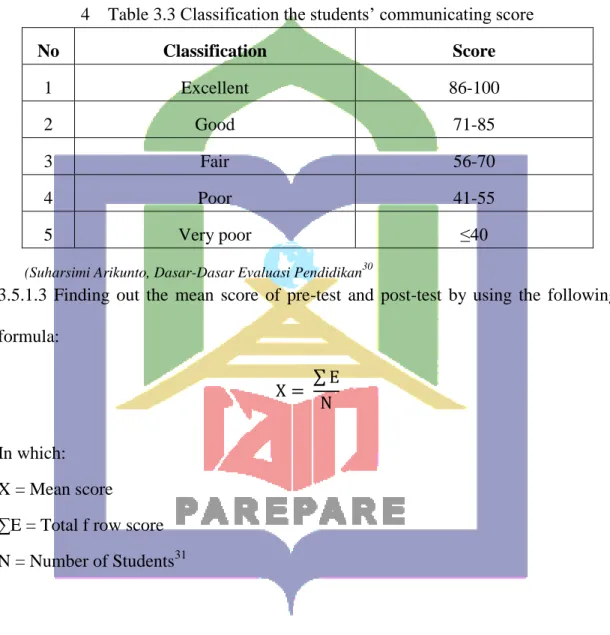
3.5.1.2 The data will classify into the following ways of classification as the table below:
4 Table 3.3 Classification the students’ communicating score
No Classification Score
1 Excellent 86-100
2 Good 71-85
3 Fair 56-70
4 Poor 41-55
5 Very poor ≤40
(Suharsimi Arikunto, Dasar-Dasar Evaluasi Pendidikan30
3.5.1.3 Finding out the mean score of pre-test and post-test by using the following formula:
X = ∑ E N In which:
X = Mean score
∑E = Total f row score N = Number of Students31
29 Daughlas H Brown. Language Assessment and Classroom Practice, (San Francisco: State University, 2004), p. 406-407.
30Suharsimi Arikunto, Dasar-Dasar Evaluasi Pendidikan (edisi revisi) (Jakarta: PT. Bumi Aksara, 2005), p. 245.
31L.R. Gay, Educational Research (New York: Charles Merril Publishing Company, 1987), p. 298.
3.5.1.4 Calculating the mean score of difference between pre-test and post-test by using the following formula:
D = ∑ D N In which:
D = the mean score of difference
∑D = the total scores of difference between pre-test and post-test (X1 – X2)
N = Total sample
3.5.1.5 Finding out the difference by calculating the T-test value by using the following formula;
Notation:
t = D
√∑ D 2−(∑ D) 2 N(N − 1)N T : the test of significance
D : the mean score of difference (X1-X2)
∑D : the sum of the total score
∑D2 : the square of the sum score of difference N : the total sample.32
32L.R. Gay, Educational Research, p. 331.