THE EFFECTIVENESS OF THINK ALOUD STRATEGY TO IMPROVE STUDENTS’ READING COMPREHENSION IN NARRATIVE TEXT
STUDY AT THE EIGHTH GRADE OF SMP MUHAMMADIYAH LIMBUNG
(A Pre-Experimental Research)
A THESIS
Submitted to the Faculty of Teacher Training and Education Muhammadiyah University of Makassar in partial fulfillment of the requirement for
the degree of English Education Department
JUNIATI 10535 5602 13
ENGLISH EDUCATION DEPARTMENT
FACULTY OF TEACHER TRAINING AND EDUCATION MUHAMMADIYAH UNIVERSITY OF MAKASSAR
2018
FAKULTAS KEGURUAN DAN ILMU PENDIDIKAN UNIVERSITAS MUHAMMADIYAH MAKASSAR
SURAT PERNYATAAN
Nama : Juniati
NIM : 10535 5602 13
Program : English Education
TITLE : The Effectiveness of Think Aloud Strategy to Improve Students’ Reading Comprehension in Narrative Text Study at the Eighth Grade of SMP Muhammadiyah Limbung
Skripsi yang saya ajukan di depan tim penguji adalah hasil karya saya sendiri bukan hasil ciplakan dan tidak dibuatkan oleh siapapun.
Demikian pernyataan ini saya buat dengan sebenar-benarnya dan bersedia menerima sanksi apabila pernyataan saya tidak benar.
Makassar, 17Februari 2018
Yang membuat perjanjian
Juniati
FAKULTAS KEGURUAN DAN ILMU PENDIDIKAN UNIVERSITAS MUHAMMADIYAH MAKASSAR
SURAT PERJANJIAN
Nama : Juniati
NIM : 10535 5602 13
Program : English Education
TITLE : The Effectiveness of Think Aloud Strategy to Improve Students’ Reading Comprehension in Narrative Text Study at the Eighth Grade of SMP Muhammadiyah Limbung
Dengan ini menyatakan perjanjian sebagai berikut:
1. Mulai dari penyusunan proposal sampai dengan selesai skripsi saya, saya akan menyusun sendiri skripsi saya.
2. Dalam menyusun skripsi, saya akan selalu konsultasi dengan pembimbing.
3. Saya tidak akan melakukan penjiplakan (plagiat) dalam menyusun skripsi saya.
4. Apabila saya melanggar perjanjian saya seperti yang tertera pada butir 1,2 dan 3 maka saya bersedia menerima sanksi sesuai dengan aturan yang berlaku.
Demikian perjanjian ini saya buat dengan penuh kesadaran.
Makassar, 17 Februari 2018 Yang membuat perjanjian
Juniati
ABSTRACT
MOTTO
“Real Success is determined by Two Factors. First is Faith, and Second
is Action”
JUNIATI. 2018. “The Effectiveness of Think Aloud Strategy to Improve Students‟ Reading Comprehension in Narrative Text Study at the Eighth Grade of SMP Muhammadiyah Limbung (A Pre-Experimental Research)”, Thesis. Under the supervisors of H.M. Basri Dalle and Awalia Azis. The English Education Department, Faculty of Teacher Training and Education, Muhammadiyah University of Makassar.
This research aimed to find out the improvement of the students‟
literal comprehension and interpretative comprehension. The research is limited to improve the students‟ comprehension in narrative text through Think Aloud Strategy on literal reading comprehension (the specific information and sequence events) and interpretative comprehension (conclusion and implication).
To find out the improvement, the researcher used pre-experimental design with one group pre-test and post-test design. The population was the eighth grade students of SMP Muhammadiyah Limbung. The sample was taken by purposive sampling technique and the total number of sample was 36 students. It employed of six meetings (one meeting for pre- test, four meetings for treatment, and one meeting for post-test). It employed reading test as instrument.
The research findings indicated that the application of Think Aloud Strategy was effective in improving the students‟ literal and interpretative reading comprehension. It was proved by the value of the t-test 19.91, which was higher than the value of t-table (2.030). This indicated that H1 wasaccepted, and H0 was rejected and there was a significant difference of the students‟ reading comprehension before and after using Think Aloud Strategy. It was concluded that Think Aloud Strategy improved the students‟ reading comprehension.
ACKNOWLEDGEMENTS
In the name of Allah, Most Gracious, Most Merciful
Alhamdullilah Robbil „Alamin, the Research is grateful for all the bounties that Allah SWT. has showed on one which enabled me to complete this thesis.
Shalawat and salam are addressed to the final chosen religious messenger, the Prophet Muhammad SAW who has changed the human life.
The researcher would like to convey her high appreciation and sincere thanks to her consultants Prof. Dr. H. M. Basri Dalle, M.S. and Awalia Azis, S,Pd.,M.Pd. for their valuable clear perspective, professional expertise, and motivation along for finishing this thesis.
The Researcher realized that many hands had given their helps and useful suggestion for the completion of this thesis. Without the assistance of these people, this thesis would never have existed. Therefore, the Research would like to express his appreciation and sincere thanks to all of them particularly:
1. The deepest gratitude goes to my beloved parents (Muh Nur Dg Bantang and Rawiyah Dg Kenna), my beloved brothers and sister (Kaharuddin, Awaluddin, Aslan and Irmawati). Thanks for your pray, love, support, guidance and time for me. I am nothing without all of you.
2. Dr. H. Rahman Rahim, SE., MM, the Rector of the Muhammadiyah University of Makassar
3. Erwin Akib, M.Pd., Ph.D., the Dean of Teacher Training and Education Faculty.
4. Ummi Khaerati Syam, S.Pd., M.Pd, the Head of English Education Department of FKIP UNISMUH Makassar.
5. My heartful thank to all lecturers of the FKIP UNISMUH especially to the lecturers of English Education Department and all staff of Muhammadiyah University of Makassar for their guidance during the years of the Research‟s Research.
6. Sincere gratitude to Muh, Rizal, S.Pd.,M.Pd.I, as the headmaster of SMP Muhammadiyah Limbung, Kartini Indasari, S.Pd, as the English teacher of SMP Muhammadiyah Limbung, all teachers, staffs and the eighth graders of SMP Muhammadiyah Limbung for the permission and cooperation during the research.
7. Thanks to all my friends in Fire class or F class of English Education Department 2013.
8. Last but not the least, for my best friends (Heprima, Hasdiyanti, Wati Mila, Mira and, Nasrul) thanks for the most exciting and craziest memory of friendship we have been ever through and thanks for your encouragement and support in whatever condition during the togetherness.
Makassar, 2018
Juniati TABLE OF CONTENTS
Page COVER
TITLE PAGE
LEMBAR PENGESAHAN
APPROVAL SHEET COUNSELLING SHEET SURAT PERNYATAAN SURAT PERJANJIAN MOTTO
ABSTRACT
ACKNOWLEDGEMENT TABLE OF CONTENTS LIST OF TABLES LIST OF FIGURES LIST OF APPENDICES
CHAPTER I INTRODUCTION
A. Background 1
B. Research Question 3
C. Objective of the Research 3
D. Significance of the Research 4
E. Scope of the Research 4
CHAPTER II REVIEW OF RELATED LITERATURE
A. The Concept of Think Aloud Strategy 5
1. The Definition of Think Aloud Strategy 5
2. The Strengths of Think Aloud Strategy 7
3. The Procedures of Think Aloud Strategy 9
B. The Concept of Reading Comprehension 12
1. The Definition of Reading Comprehension 12
2. Strategies For Reading Comprehension 13
3. Types of Reading Comprehension 14
4. Reading Comprehension Levels 15
C. The Concept of Teaching Reading 17
1. The Definition of Teaching Reading 17
2. Techniques in Teaching Reading 18
D. The Concept of Narrative Text 20
1. The Definition of Narrative Text 20
2. The Characteristics of Narrative Text 21
3. The Language Features of Narrative Text 21
4. The Generic Structure of Narrative Text 22
5. Types of Narrative Text ... 24 E. Conceptual Framework ... 24 CHAPTER III RESEARCH METHOD
A. Research Design 26
B. Variables and Indicators 28
C. Hypothesis 29
D. Population And Sample 29
E. Research Instrument 30
F. Data Collection 31
G. Data Analysis 32
CHAPTER IV FINDINGS AND DISCUSSION
A. Findings 36
B. Discussion 43
CHAPTER V CONCLUSION AND SUGGESTION
A. Conclusion 49
B. Suggestion 50
BIBLIOGRAPHY APPENDICES
CURRICULUM VITAE
LIST OF TABLES
Table 3.1 Pattern of One Group Pre-test Post-test Design 26 Table 3.2 The Total Population of the eighth Grade Students at SMP
Muhammadiyah Limbung 30
Table 3.3 Criteria of Literal Comprehension 32 Table 3.4 Criteria of Interpretative Comprehension 33 Table 3.5 Classfying the Students‟ Score ... 34
Table 1 The Improvement of the Students‟ Reading in Literal
Comprehension ... 36 Table 2 The Improvement of the Students‟ Reading in Interpretative
Comprehension ... 38 Table 3 T-test of Value of the Students‟ Reading Comprehension ... 40
LIST OF FIGURES
Figure 2.1 The Generic Structure of Narrative Text ... 22 Figure 2.2 Conceptual Framework ... 24 Figure 1 The Improvement of the Students‟ Literal Comprehension ... ... 37 Figure 2 The Improvement of the Students‟ Interpretative
Comprehension... 39
Figure 3 The Comparison Between the Students‟ T-Test and T-Table ... ... 40
LIST OF APPENDICES
APPENDIX 1 : Lesson Plan
APPENDIX 2 : Teaching Materials
APPENDIX 3 : Instruments Pre-test and Post-test
APPENDIX 4 : The Students‟ Score and Classification of the Students Score APPENDIX 5 : Data Analysis
APPENDIX 6: Attendances List of the Eighth Grade of SMP Muhammadiyah Limbung
APPENDIX 7 : Documentation
CHAPTER I INTRODUCTION A. Background
Language is a tool of communication, and it is one of the very important roles in social relationship among human beings. Relationship occurs through
communication and communication occurs through language. Language is applied while interacting among people. Language should be understood between speaker and listener. To create a good communication, language should be spoken fluently and comprehensible. That is why a speaker and a listener should use the same language in order to have a good communication. However, there are so many countries with different languages in this world. Different languages of people from around the world made problems in communication. For solving this problem, there should be a language which can be understood by all people all over the world. Therefore, international community has already dealt with English as the first international language.
English is one of the interactional languages which has an important role in the world. In some countries the power language is the official language which is used for government education commerce and international communication. In Indonesia English is a foreign language that was taught from elementary school to university. English is a foreign language used a medium of instruction at school, many students think that English is the most difficult subject.
The goal of teaching and learning English is to produce and comprehend language that are spoken and written. Some people think that a successful English learner is a person who can speak English fluently. They do not know that a person who is said a success English learner is a person who is master in all of English skills.
There are four skills in English, they are speaking, writing, reading, and listening. It is better for English learners to master in all those skill, but the fact is different. Many English learners do not master in all of those skills. For example, some of English learners are good in writing, but not for speaking or vice versa.
The other example, some English learners are good in reading, but not well in listening or vice versa. It means that these English learners have different ability in acquiring language.
According to Anderson (1999:15) reading as an active process of building meaning from the reading materials where the meaning does not reside on the printed page, nor is it only in the reader. To sum up reading is a complex process that requires the active participation the reader toward the texts and context in order to convey and interpreting the meaning.
Reading is very important for English learners because reading can enlarge their knowledge, vocabulary, and information. From reading is able to get complete understanding of the text. This might be cause by the fact that many of those students do not know the essential information needed to understand a word,
1
including how a word combines with other words difficultget information from the passage and difficult to make a conclusion of the passage. All of those problems will affect the learner in comprehending the passage and reading achievement. Therefore those students need strategies or technique in order to overcome the problem.
Based on the observation and interview conducted at the eighth grade of SMP Muhammadiyah Limbung the researcher found that most of students had low level of reading skill especially in comprehension mostly it is caused by their low vocabulary mastery and teacher‟s misconception about reading activities and the teacher did not implement any teaching strategy in conducting the class. The teacher only delivered the materials from the course book and the white board.
With regard to the condition, the researcher decides to use think aloud strategy to solve the problem and help both the teacher and the students to get new knowledge and experience in their teaching learning process and of course to improve the English class, in this case the students‟ reading comprehension. That is why the researcher delivers this study entitled “The Effectiveness of Think Aloud Strategy to Improve Students‟ Reading Comprehension in Narrative Text at the Eighth Grade of SMP Muhammadiyah Limbung.
B. Research Question
The research problems are formulated as follows:
1. How is the improvement at the students‟ literal reading comprehension through think aloud strategy at the eighth grade of SMP Muhammadiyah Limbung?
2. How is the improvement at the students‟ interpretative reading comprehension through think aloud strategy at the eighth grade of SMP Muhammadiyah Limbung?
C. Objective of the Research
Related to statement above, the objectives of the research are:
1. To find the improvement students‟ literal reading skill at the eighth grade of SMP Muhammadiyah Limbung?
2. To find the improvement students‟ interpretative reading skill at the eighth grade of SMP Muhammadiyah Limbung?
D. Significance of the Research
1. The result of this study is expected to give contribution for the teacher as feedback to improve their strategy in teaching English especially in reading achievement of narrative text.
2. The researcher hopes that the result of this study is expected to give feedback to motivate the students themselves to get a good result especially in reading narrative text.
3. This research is expected to be used as a reference in conducting further research in the same field.
E. Scope of the Research
This research is limited to improve the students‟ reading skill through think aloud strategy focus on literal skill are identifying specific information, sequencing events or ideas and following instruction while interpretative comprehension are, implication and conclusion including the implementation of think aloud strategy are identifying problem solving situation where the learner draws on the own experience and prior knowledge to discover the truths that are to be learned at the eighth grade of SMP Muhammadiyah Limbung.
CHAPTER II
REVIEW OF RELATED LITERATURE A. The Concept of Think Aloud Strategy
1. The Definition of Think Aloud Strategy
Haris & Hodges, 2004. The think aloud is a strategy that allows a teacher to verbalize thoughts while reading orally, modelling for students how the prcess of comprehension works. The goal of the think aloud strategy is that eventually students will develop a similiar thinking process when they are reading independently, thereby improving their comprehension. The think aloud strategy asks students to say out oud what they are thinking when they are reading, solving math problem, or simply responding to questions posed by teacher or other students. Effective teacher think out loud on a regular basis to model this process for students. In this way they demonstrate practical ways of approaching difficult problem while bringing to the surface the complex thinking process that underlie reading comprehension, mathematical problem solving, and other cognitively demanding tasks.
Oster, 2001. Defines think aloud strategty as a reading method where students can verbalize their thought as they read, and thus bring into the open strategies they are using to understand the text. Within the think aloud method we can mention some reading comprehension strategies like predicting and visualizing. Focus on important information; to make predictions, to ask questions, to evoke background knowledge with the text and to express their personal reaction. Likewise we are talking about modeling reading strategies to help students to be aware of strategies they use in their native language (L1) to facilitate transfer into the target laguage (L2).
Afflerbach and Johnston cited by McKeown (2007), claim that think- aloud serves firstly as a method of measuring the cognitive reading process, then as meta cognitive tool to monitor comprehension. In that sense, the think aloud is appropriate for this study because through this strategy the students can monitor their comprehension process. In this research, it was decided to implement the think-aloud strategy because it was used as an instructional approach, and also because this strategy helped readers to comprehend more easily what was being read by them.
Another definition of this strategy is provided by Pressley et al. in McKeown (2007:1) work: “think-aloud is one of the transactional strategies because it is a joint process of teachers and students working together to construct understandings of text as they interact with it”. Through the interactions that think aloud promotes, a better understanding of the texts may emerge in the classroom. Think aloud is also a process in which readers report their thoughts while reading (Wade 1990). It helps students to reflect upon their own reading process.
5
The think-aloud is a technique in which students verbalize their thoughts as they read and thus bring into the open the strategies they are using to understand a text (Baumann, Jones, &Davey, 1983; Wade, 1990). Readers' thoughts might include commenting on or questioning the text, bringing their prior knowledge to bear, or making inferences or predictions.
Think aloud also used to model comprehension processes such as making prediction, creating images, linking information in text with prior knowledge, monitoring comprehension, and overcoming problems with word recognition or comprehension (Gunning, 1996 in teacher vision).
2. The Strengths of Think Aloud Strategy
When teachers model of think aloud for English language learners (ELLs) on a regular basis, ELLs will have a well-rehearsed strategy to use when they are trying to comprehend text on their own. According to Lems., et al (2010), thinking alouds are useful in three important ways:
a. They build metacognitive awareness.
b. They give the teacher a window into the thinking processes of the learner.
c. They give ELLs opportunities to practice using academic language orally.
With the think aloud procedure the student is asked to voice his or her thoughts while reading. Asking students to “think aloud” can provide useful insights into their metacognitive and cognitive processing strategies, as well as their word learning strategies and working memory.
It also provides information about the text features students find interesting or important. These are all processes that have been difficult to evaluate with other assessment procedures. (Irwin, 1991; Kucan &
Beck,1997; Ward & Traweek,1993; Harmon, 2000; Whitney & Budd, 1996; Wade, Buxton, & Kelly, 1999 as cited in Klingner.,et al, 2007).
Meanwhile, Baumann (1992) states that think aloud is one of technique through which readers will be teach to monitor and repair their comprehension during reading. Think aloud is the effective procedure to promote awareness of what students are doing while they are reading.
When readers aware of their reading and thinking as they are reading, their comprehension skill improves. The think aloud process gets
“readers to pay attention to what they are reading by connecting what they are reading to their own background and experiences”.
Think-aloud, or verbal reports (Anderson, 1999) are always a great way to help students become metacognitive learners. This metacognitive awareness (being able to think about one's own thinking) is a crucial component of learning, because it enables learners to assess their level of comprehension and adjust their strategies for greater success (Oster, 2001). According to Oster, an additional advantage to the think-aloud procedure is that students become more aware of the mental processes they use while reading and can thereby improve their reading comprehension.
Additionally, Davey (1983) proposed three advantages of using think aloud in reading class, as follows:
1) It helps students learn to monitor their thinking as they read and improves their comprehension.
2) It teaches students to re-read a sentence, read ahead to clarify, and/or look for context clues to make sense of what they read.
3) It slows down the reading process and allows students to monitor their understanding of a text.
3. The Procedures of Think-Aloud Strategy
Originally, think alouds must be administered individually (Klingner,.etal, 2007). As with other approaches to comprehension assessment, begin by selecting a passage that is at a student‟s
instructional level. The passage should be readable but not too easy for the students, because some cognitive and meatcognitive processes are only activated when a text includes challenging components. Then ask the student questions that help him or her think aloud before, during, and after reading, such as the following (Gunning, 2002):
a. Before reading: what do you think of this passage might be about?
Why do you think this?
b. During reading (after reading each marked-off segment or chunk of text): what were you thinking while you read this section? Were there any parts that were hard to understand? Were there any words that were hard to understand? What did you do when you came across hard words?
c. After reading: tell me what the passage was about.
While the student think aloud, the teacher records his or her responses word for word as closely as possible. She should keep in mind that thinking aloud is initially difficult for many students.
Therefore, it is important for teachers model this process first and allow students time to practice. After the student has finished the think aloud process, the teacher analyzes his or her responses and not which types of responses he or she used.
Based on the discussion above, the researcher simplifies the procedure of think aloud strategy by adapting the theory of collaborative strategic reading by Klingner, et al (2007) because both strategies have similar plot in the process of reading. There are five stages in conducting think aloud strategy in a reading classroom, as follows:
1) Modeling of the Text
The first thing to do by the teacher is to model the think aloud.
He or she chooses the first sentence or paragraph of the text then practice thinking aloud by previewing to find any unfamiliar
vocabulary or parts in the story that can confuse students. He or she then gives background knowledge on the topic at hand. While reading, the teacher needs to pause and make comments about what he/she is thinking in order to clarify for students how comprehension is taking place. The teacher verbalizes predictions, confusing parts, or connections with prior knowledge to help show comprehension of the text. (Vacca&Vacca, 2010)
2) Pre reading
In this phase, students are expected to preview the text they are going to read. In previewing, the students are activating their prior knowledge or brainstorming, predicting and visualizing clues in the text. The purposes of previewing are to a) help students identify what the text is about, b) tap into their prior knowledge about the topic.
The teacher helps the students with previewing by reminding them to use all the visual clues in the text, such as pictures, charts, or graphs, and to look at the headings and subheadings used throughout the passage. He or she might help them connect the topic to their own experiences. This process is done orally by letting the students to express what comes on their mind freely. In this stage, the students practice the think aloud by the teacher‟s guidance.
3) Fix-up Strategy (click and clunk)
Students use the process of click and clunk to monitor their comprehension of the text. When students understand the information, it “click”. When it does not make sense, it “clunks”. In this case, the students state their confusing verbally. They share the questions they have in their mind and then work together to identify clunks by using
fix-up strategy (reread the sentence with the clunk and the sentence before or after the clunk, looking the clues)
4) Whilst reading
In this phase, students have to get the gist of the text by themselves. They get the gist by practicing think aloud independently.
Getting the gist means that students are able to state the main idea of a paragraph or cluster of paragraph in their own words. In this way students learn how to synthesize information, taking a larger chunk of text and distilling it into a key concept or idea.
5) After reading
Students learn to “wrap-up” by formulating questions and answers about what they have learned and read by reviewing key ideas. The goals are to improve students‟ knowledge, understanding, and memory of what they have read. Teachers may give questions about important information in the passage with: who, what, when, where, why and how or related to the whole idea of the text. The students have to share their opinion verbally.
B. The Concept of Reading Comprehension 1. The Definition of Reading Comprehension
It is very important to talk about reading comprehension.
Based on McNeil (1992:16) comprehension is making sense out of the text. From an interaction perspective, reading comprehension is acquiring information from context and combining disparate elements into a new whole. According to Cahyono et al. (2011:55) reading is a means of transferring information between the write and the reader.
Therefore reading comprehension understands a written text means extracting the required information from it as efficiently as possible (Grellet,1981:3).
Reading comprehension is very importance for everyone who to enlarge their knowledge and information. Sometimes some learners feel difficult to comprehend the text that they have read, so they get nothing from the text. So the teachers have to be more concern about the problem.
Reading perceives a written text in order to understand its contents or silent reading. The understanding that result is called reading comprehension. A formal definition of reading comprehension may see unnecessary because the term is use to widely and is meaning is assumed to be generally understood. Teachers think of reading comprehension as what students are thought to do in reading interaction during the early school years and as reading capacities they are expected to display throughout the middle and high school years.
According to Tarigan (1990:8), reading is bringing meaning and getting meaning from printed or written material. Reading is foreign language consist of grasping meaning in that language through its written representation. Reading comprehension that also called reading for comprehension is an activity means to extract certain kinds of information from English text.
One of the most important aspect of teaching reading is to enables students understand what they have to read. To read well, students have to master four skill in comprehending reading text.
Tarigan (1990:12) states, that comprehension skill can be divided into activities.
a. Extensive reading, it consists of survey reading skimming, superficial reading.
b. Intensive reading, it consist of close reading, comprehension reading, critical reading, reading ideas, foreign language reading, and literary reading.
2. Strategies for Reading Comprehension
Reading comprehension is a primary atter of developing appropriate, efficient comprehension strategies. Some strategies are realted to bottom up and top down strategies, Brown (2001:306) states that there are several strategies for reading comprehension, such as:
a. Identifying the purpose in reading b. Using efficient silent reading technique c. Skimming the text for main idea
d. Scanning the text for specific information e. Analyzing vocabulary
f. Guessing when you are not certain 3. Types of Reading comprehension
Reading is bringing meaning and getting meaning from printed or written material. Reading is foreign language comsist of grasping meaning in that language through is written representation. Reading comprehension that is also called reading for comprehension is an
antivity mean to extract certain kinds of information from English text.
Reading is foreign language may face some difficulties, such as:
difficult words, difficult to get information from the pssages and difficult to make a conclusion of the passages. To minimize all those problems, the according to Brown (2001: 352) type of reading used;
the following are commonly referred to:
a. Literal Comprehension
Readig in order to understand, remember or recall the information explicit in a passage
b. Inferential Comprehension
Reading in order to find information which is not explicitly states in a passages using the reader‟s experience intuition by inferring.
c. Critical and Evaluative Comprehension
Reading in order to get information in a passagee with the reader‟s own knowledge in values.
d. Appreciative Comprehension
Reading in order to gain other kind of valued response from a passages.
4. Reading Comprehension levels
The term “level” does not mean simply different degrees of difficulty. It refers to the attitude and reaction to what is read. There are several levels of comprehension. Higher level of comprehension
would obviously include higher level thinking Burns (1984:177) classifies four levels of comprehension. They are:
a. Literal Comprehension
Literal comprehension represents the ability of understanding with information that is explicitly stated in the print and illustration. The students can recall, identify, classify, and sequence detail, fact and stated main ideas form a variety of written materials, and can interpret directions this level of comprehension involves surface meaning.
Literal reading refers to the acquisition of meaning of ideas or information that is explicitly stated in the text. Some specific reading skill at the literal level of comprehension are: identifying specific information or nothing details, sequencing ideas when explicitly signal are given, and following instructions. These skills specially the first two are scanning skill
1) Identifying Specific Information
This reading requires only one or some particular information or detail which the reader needs form a text; the rest of the text may not be read anymore. That information may be a name, a date, a scientific term, or a place or just anything, the search for which motivates the person to read. In looking for a detail, the reader must look for signals in the
environment of the needed information or in the information itself.
2) Sequencing Events or Ideas
Meaningful reading results from the reader‟s ability to follow the flow of thought of the writer. This is happened because any discourse is made up of words and sentences which are not only grammatically linked to one another, but are also logically related and sequence of ideas as presented by the writer enables him to summarize, outline and infer correctly following instructions. Students can take the lesson and knowledge from the reading.
b. Interpretive or Inferential Comprehension
Smith (1980:218) states that demands higher level of comprehension involves reading beyond or between the lines. The reader brings knowledge and experience to the act of reading and draws the differences. The reader also needs to see relationship among ideas, for example, how ideas go together and also implied meaning of the ideas. Interpretive or referential comprehension includes thinking process such as drawing conclusion, making generalization, prediction outcomes. At this level, teacher can asks more challenging question such as asking students to do the following task:
1) Rearrange the ideas or topic discussed in the text
2) Explain the author‟s purpose of reading in the text
3) Summarize the main idea when this is not explicitly stated in the text
4) Select conclusion which can be deduced from the text they have read
c. Critical Reading
Critical reading means evaluating written material, compering the ideas discovered in the material with known standards and drawing conclusions about their appropriateness, accuracy, and timelines.
d. Creative Reading
Creative reading that is ideas from the text to the new situation and to recombine author ideas with other ideas, to form new concept or to expand it.
C. The Concept of Teaching Reading 1. The Definition of Teaching Reading
In teaching reading, the teachers have to concern about the material that is used. The topic and type of reading texts are worth considering too. This topic and reading texts should depend on who students are. If the students are science students, reading scientific text many be a priority. If the students are junior high school students, reading narrative text may be a priority.
According to Mukhroji (2011), teaching reading is more influence by interactive strategies. Teachers teach skill directly, especially in the beginning and provide plenty opportunities for the students to experience by having them read whole books. In regard, the teaching of reading indicates process interactive models of reading.
In reading class, the teachers have to decide what the purpose in reading will be done. It is reading for pleasure or reading for getting understands the passage. If the purpose of reading that will be done is for pleasure, the topic of reading text can be free, such as narrative. If the purpose of reading text that will be done is for getting understands the passage, the topic of reading text should be prepared before.
2. Techniques in Teaching Reading
Psycho linguistically, reading is viewed as an interactive process between language and thought. There are three kinds of activities involved in relation to the reading class activities: pre-reading activities, during/whilst reading activities, and post-reading activities.
a. Pre-reading Activities
Pre-reading activities are instructional activities carried out before students conduct the real reading activities. In pre-reading activities, activation is concerned with the students‟ background knowledge, objectives of reading class, learning activities, and motivating the students. In this stage, teachers try to activate the students‟ schemata related to the topic or explaining briefly the contents of the text.
Pre-reading is to tell students the purpose of reading and learning. Pre-reading is also to motivate the students. Motivation in reading attracts students‟ attention to the text. The activities of pre- reading are activities aiming at facilitating the students‟ understanding about the reading text.
b. During/whilst Reading Activities
During reading activities are the activities that reader does while reading takes place. Mukhroji (2011) mentions that while reading includes: (a) identify the main idea, (b) finding detail the text, (c) following a sequence, (d) inferring from the text, and (e) recognizing the discourse patterns.
During whilst reading activities are instructional activities that are going on while reading activities are happening. According to Mukhroji (2011), five activities to do while reading. First, readers identify main idea of the text and identifying topic sentence through skimming. Second, readers find the details in the text and finding
specific information. Third, readers follow a sequence by relating items in particular order or process. Fourth, readers infer from the text by trying to understand the using their schemata and experience. Fifth, readers recognize the discourse patterns to understand the text holistically.
c. Post-reading Activities
Post-reading activities are the activities conducted by a reader after reading. In post reading activities, students do post-questions, feedback. The post-questions are more effective in incidental comprehension and the objective, since information of both greater and lesser importance is learned.
Post-reading activities are instructional activities that the students and teacher do after reading take place. According to Mukhroji (2011) point out that post-question, feedback, and group and whole class discussions are activities that can be done in the phase of reading activities. The activities function to check students‟ comprehension.
The post questions after reading class activity are very important since information of both greater and lesser important learned. Besides asking question, summarizing the contents of the text is also applicable to the students.
The activity of post-reading can also be in the form class discussion. The discussion may depend on the class size. If the is big, it will be better to have group discussion. If the class is small, it will be better to have whole class discussion.
D. The Concept of Narrative Text 1. The Definition of Narrative Text
Meyers (2005:52) states that narrative is one of the most powerful ways of communicating with others. A good written story let your reader response to some event in your life as if it were own. They not only understand the event, but they can almost feel it. The action, details, and dialogue put the readers in these seem and make it happen for them.
Moreover, Anderson (1997:8) states that narrative is a piece of text tells a story and, in doing, entertains or informs the reader or listener.
From the definition above, narrative story is a story that tells us about something interesting has purpose to amuse, entertain or the readers.
You are using narrative when you tell a friend about something interesting that happen to you at work or at school, when you tell someone a joke.
Anderson (1997:14) states that the good narrative uses words to paint a picture in our mind of:
a. What characters look like (their experience), b. Where the action is taking place (the setting), c. How things are happening (the action) 2. The Characteristics of Narrative Text
The characteristics of narrative texts among others:
a. It tells us about a story of event or events.
b. The events are usually arranged in chronological order- that is, in the order in which they occurred in time.
c. The narrator has a purpose in mind in telling the story. There are some points the narrator wishes to make, or some impression he or she wishes to convey to the reader. Therefore, the details of the narrative are carrefully selected for purpose.
3. The Language Features of Narrative Text
The language features usually found in narrative texts are:
a. Specific characters
b. Time words that connect to tell when they occur c. Verbs to show the action that occur in the story.
d. Descriptive words to portray tha chracter and setting.
(Anderson, 1997: 15)
4. The Generic Structure of Narrative Text
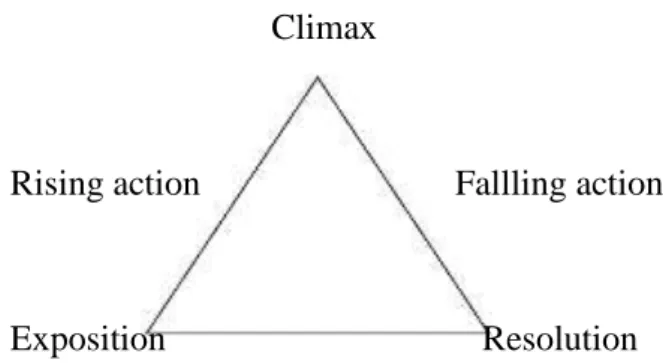
Neo (2005:2) states that a narrative has a structure, a shape or a pattern. It can be represented graphically in this way.
Climax
Rising action Fallling action
Exposition Resolution
Figure 2.1: The generic structure of narrative text
The idea of the Freitag triangle is to serve as a kind of blue print or map which can be used to guide us systematically in our writing. The Freitag triangle consists of:
a. The composition, it establishes the characters and situation.
b. Rising action, it refers to a series of complication leads to the climax.
c. The climax is the critical moment when problem/conflics demand something to be done about them.
d. Felling action is the moment away from the highest peak of excitemen.
e. The reolution consists of the result or outcome.
On the other hand, Anderson (1997:8) states that the steps for constructing narrative are:
a) Orientation/ exposition
The readers are introduced minor characters and possibly some is minor character. Some indication generally given of where the action is located and when it is taking place.
b) Complication/ rising action
The complication is pushed along by a serious of events, during which we usually expect some sort of complication or problems to arise. It just would not be so interesting if something is unexpected did not happen. This complication will involve of main character and oven serves to (temporally toward them from reaching their goal.
c) Sequence of event/Climax
This is where the narrator tells how the character reacts to the complication. It includes their feeling and what they do. The event can be told in chronological order (the order in which they happen) or with flashback. The audience is given the narrator‟s point of view.
d) Resolution/ falling action
In this part, the implication may be resolved for better or worse, but it is rarely left completely unresolved (although this is of course possible in certain types of narrative which leaves us wondering „How did it end”?)
e) Reorientation
It is an optional closure of event.
5. Types of Narrative Texts
Neo (2005:58) there many different types of narrative texts, among others: Humor, romance, crime, real life fiction, theoritical fiction, mystery, fantasy, science fiction, diary novels, and adventure.
E. Conceptual Framework
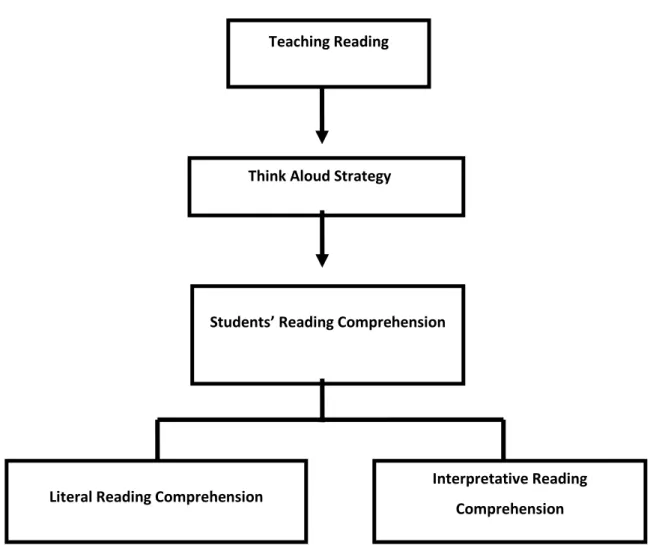
Figure 2.2: conceptual framework
The conceptual framework above describes that in teaching reading material, the researcher focus on narrative text by using think aloud strategy as a teaching approach, which will be used in pre experimental research consists of pre-test, treatment, and post-test.
The aim of this research is to improve the students reading comprehension that focus on the students‟ improvement in literal reading comprehension and interpretative reading comprehension.
Teaching Reading
Think Aloud Strategy
Students’ Reading Comprehension
Literal Reading Comprehension
Interpretative Reading Comprehension
CHAPTER III RESEARCH METHOD A. Research Design
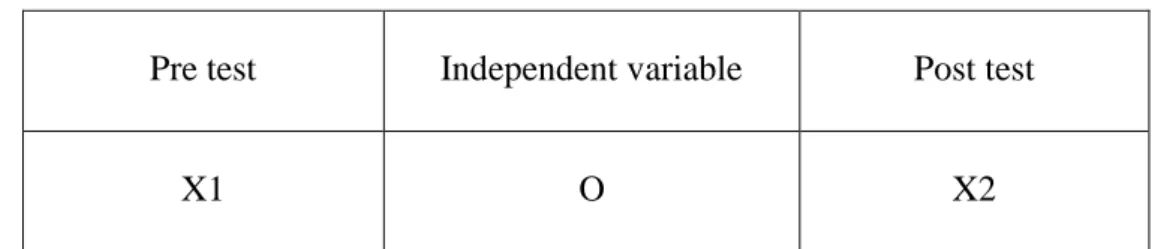
This experimental design used pre- experimental research design (one group pretest-posttest design) that consist of pre-test, treatment and post-test. The
success of the treatment is determined by comparing the pre-test and the post-test scores
Pre test Independent variable Post test
X1 O X2
Table 3. 1 Pattern of on group Pre-test Post-test design (Ary cited in Nikmah 2014:30) Where:
X1 = pre-test O = Treatment X2 = post-test 1. Pre-test
Before giving treatment, the researcher gave pre-test to the students. It was conducted to know how far the students‟ scores in reading. This test aimed to know how far the students ability in reading of narrative text. The pre-test comprised 4 items, in the form of essay test items.
2. Treatment
After having conducted the pre-test, the researcher gave treatment to the students. The researcher applied the technique or treatment using think aloud strategy. The action of the treatment as follows:
a. The teacher introduced the material and gave explanation about narrative text
b. The teacher gave the text to students and chosen the students to read the first sentence or paragraph to found any unfamiliar vocabulary or parts in the story that can confused the students.
c. The teacher needed to pause and make comments about what the students are thinking to explain for students about the material.
d. The teacher helped the students used all the visual clues in the text such as pictures.
e. The teacher asked students to use fix-up strategy (click and clunk) to monitor their comprehension of the text. When students understand the information, it “click”. When it does not make sense, it “clunks”
f. The teacher helped students to explain their confusion verbally, and the students can share the question they have in their mind
g. The teacher and students then worked together to identify clunks by using fix-up strategy (reread the sentence with the clunk and the sentences before or after the clunk, looking for clues)
h. Whilst reading, the teacher asked students to express the gist of the text and to know how the students learn about synthesize information and distilling it into a key concept or idea
i. After reading, the teacher gave questions about the main information (who, what, when, where, why and how) or related to the whole idea of the text.
j. The teacher asked students to share their opinion verbally.
3. Post-test
After treatment process, the researcher gave post-test to find out the score of the students‟ improvement in reading comprehension. In this part, the students were given the test with form of essay test comprises 4 items.
B. Variable and Indicator 1. Variable
This research consisted of the following variables:
a. The independent variable was the use of Think Aloud Strategy (X) b. The dependent variable was the Students‟ Reading Comprehension in
Narrative Text (Y) 2. Indicator
The indicators of the research were used to measure the variable were:
a. The improvement students‟ literal reading comprehension in narrative text to identifying the specific information and to identify sequencing events.
b. The improvement students‟ interpretative reading comprehension in narrative text to identify the conclusion and the implication.
C. Hypothesis
Hypothesis consists of words hypo and thesis. Hypo is under or less or weak. Thesis is theory or proposition that showed as a proof. “Hypothesis is a temporary answer of problems in research until proved from the data which
collected. Thus, hypothesis can define a weak truth statement toward problems on research and need to prove the truth after collecting data. To find the answer of the problem, the researcher should propose alternative hypothesis (H1) and null hypothesis (Ho) as below:
1. Alternative Hypothesis (H1): There was significant difference of the students‟ reading comprehension in narrative text before and after using think aloud strategy.
2. Null Hypothesis (Ho): There was no significant difference of the students‟
reading comprehension in narrative text before and after using think aloud strategy.
D. Population and Sample 1. Population
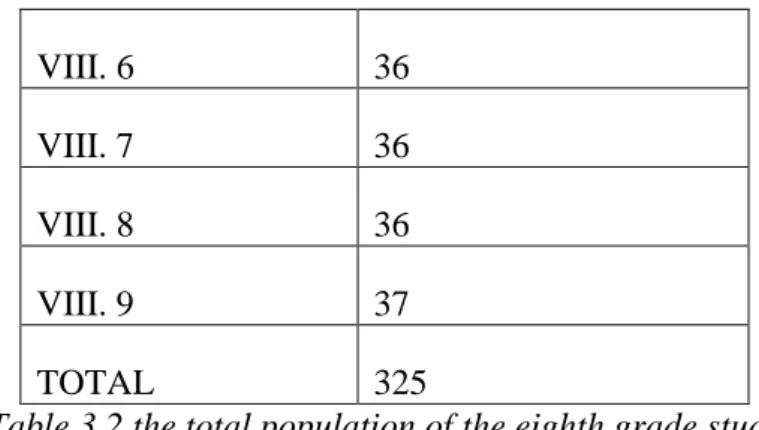
The population of this research was the eighth grade students of SMP Muhammadiyah Limbung in academic year 2017/2018. It consisted of nine classes and the number of population is 325 students.
Classes Number of Students
VIII. 1 36
VIII. 2 36
VIII. 3 36
VIII. 4 36
VIII. 5 36
VIII. 6 36
VIII. 7 36
VIII. 8 36
VIII. 9 37
TOTAL 325
Table 3.2 the total population of the eighth grade students at Smp Muhammadiyah Limbung
2. Sample
The sample technique of this research was purposive sample. The researcher selected this technique based on the statement of the teacher that the students‟ achievement in eighth grade students is getting low in English, especially in reading. The class selected as a sample was grade VIII.7 that consist of 36 students at SMP Muhammadiyah Limbung in academic year 2017/2018.
E. Research Instruments
The instrument used in the research was reading test with essay form. This instrument aimed to find out the result of students‟ improvement in reading especially in reading narrative text. To know students‟ ability in reading narrative text, the researcher gave essay form about 4 items. The test consisted pre-test and post-test. The researcher gave pre-test before apply the treatment which consist of several questions. It aimed to know students‟ prior knowledge in reading. While, the post-test used to finding out students‟ improvement in reading after giving treatment.
F. Data Collection
Data collection was the procedure used by the researcher to collecting the data. In conducting the test in the classroom, the researcher follows the procedure.
1. Pre-test
Before doing the treatment, the research gave pre-test to the students.
It was conducted to know how far the student scores in reading. This test aimed to know how far the students ability in reading of narrative text. The pre-test comprised 4 items in the form of essay test about narrative text, after that the students read and answer the question. The result of pre-test compared with result of post-test after doing treatment.
2. Post-test
After the treatment, the researcher gave post-test to the students (the procedure was same with pre-test). The researcher distributed the instrument to the students, and the researcher asked the students to answer the questions based on the narrative text.
G. Data Analysis
The data collected through quantitative analysis. The researcher used a procedure as follow:
1. Scoring the result of the students‟ test classified as follows:
The researcher was giving correct the students reading comprehension based on the analogies scale for reading
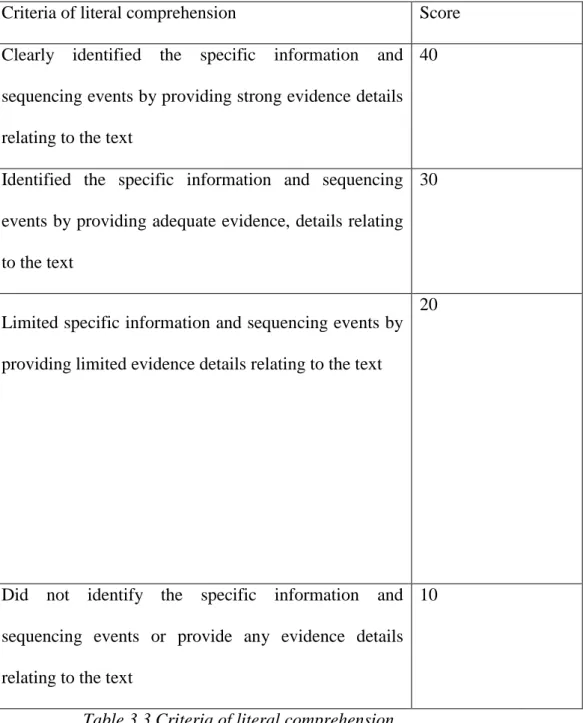
a. Literal comprehension
Criteria of literal comprehension Score Clearly identified the specific information and
sequencing events by providing strong evidence details relating to the text
40
Identified the specific information and sequencing events by providing adequate evidence, details relating to the text
30
Limited specific information and sequencing events by providing limited evidence details relating to the text
20
Did not identify the specific information and sequencing events or provide any evidence details relating to the text
10
Table 3.3 Criteria of literal comprehension (Layman cited in Rusdi 2013:42)
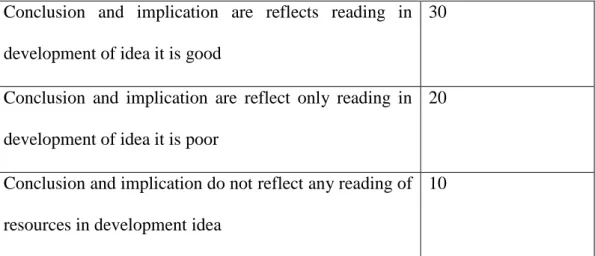
b. Interpretative comprehension
Criteria of interpretative comprehension Score Conclusion and implication are reflects resource reading
in development of idea it is excellent
40
Conclusion and implication are reflects reading in development of idea it is good
30
Conclusion and implication are reflect only reading in development of idea it is poor
20
Conclusion and implication do not reflect any reading of resources in development idea
10
Table 3.4 criteria of interpretative comprehension
(Clarke cited in Rahmawati, 2014:27)
2. Scoring the students correct answer at pre-test and post-test by using this formula:
(Sudjana cited in Harfiah, 2015:31)
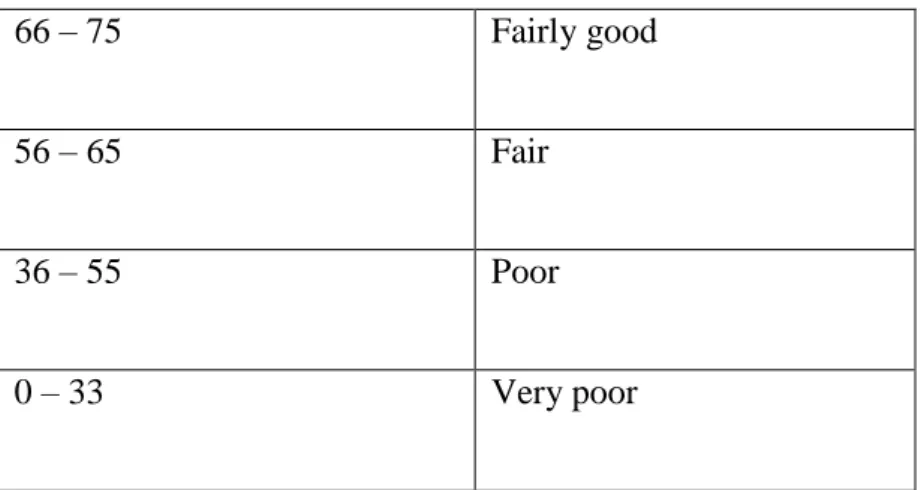
3. Classifying the students‟ score answer into the following criteria:
Score Categories
96 – 100 Excellent
86 – 95 Very Good
76 – 85 Good
66 – 75 Fairly good
56 – 65 Fair
36 – 55 Poor
0 – 33 Very poor
Table 3.5 classifying the students’ score
(Layman cited in Supardi, 2014:34) 4. Finding out the mean score of the students‟ answer by using formula:
X= N
Where: X = Mean score = The total scores
N = The number of students
(Gay cited in Harfiah, 2015:31) 5. The percentage of the students‟ reading comprehension is identify by using
the formula as follow:
Where: P = The percentage of the students‟ improvement X1 = The mean score of pre-test
X2 = The mean score of post-test
(Arikunto cited in Supardi, 2012:43)
6. Finding out the significant differences between pretest and posttest by calculating the value of the test
D
t = ∑D2 (∑ D)2
N N (N-1) Where:
t = Test of significance D = The mean Score
∑D = The sum of differences
∑D2 = The square of ∑D
N = the total Number of students
(Gay cited in Harfiah 2015:31) CHAPTER IV
FINDINGS AND DISCUSSION A. Findings
1. The Improvement of The Students’ Literal Comprehension and Interpretative Comprehension in Reading
The result of the data findings find that teaching reading comprehension in narrative text through think aloud strategy can improve the students‟ achievement in reading of literal comprehension and also can
improve the students‟ achievement in reading of interpretative comprehension. In the further interpretation of the data analysis were given below
a. The Improvement of The Students’ Literal Comprehension Table 1: The Improvement of the Students’ Reading in Literal
Comprehension
No Indicators Pre-Test Post-Test Improvement (%)
1. Specific Information
46.52 69.44 49.26
2. Sequential Events
36.80 65.97 79.26
∑X 83.32 135.41 128.52
X
41.66 67.70 64.26
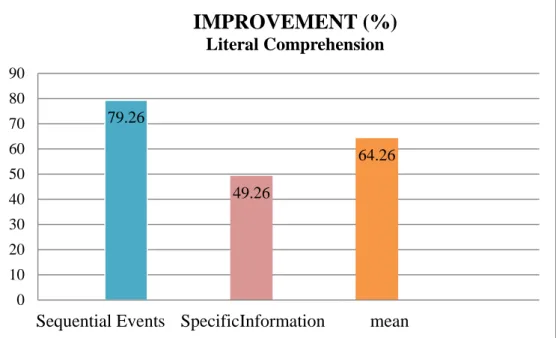
The data on Table 1 shows that the score of sequential events has improved (79.26%) from the mean score of 36.80 of pre-test to post-test of 65.97, than the score of specific information has improved (49.26%) from the mean score in pre-test of 46.52 to post-test 69.44
The comparison of each indicator from Table 1 indicates that improvement in sequential events (79.26%) is greater than specific information (49.26%). It means that the results of the students‟
improvement in indicator of literal comprehension show the greatest improvement than sequential events. But in this case, the entire indicators equally increase in a post-test. After calculating the score, it has been
36
found that the students‟ reading comprehension has improved (64.26%) from the mean score 41.66 on pre-test to be 67.70 on post-test, it is more clearly shown in the figure below:
Figure 1: The Improvement of the Students’ Literal Comprehension Figure 1 explains the improvement of the sequential events (79.26%), and specific information (49.26%), the mean score is (64.26%).
It proves that there is significant improvement in students‟ Literal Reading Comprehension at the Eighth Grade of SMP Muhammadiyah Limbung
b. The Improvement of the Students’ Interpretative Comprehension in Reading
The improvement of the students‟ reading achievement in interpretative comprehension, which focused on conclusion and implication as indicator in Eighth Grade of SMP Muhammadiyah Limbung as result of the students‟ assessment of pre-test and post-tests can be seen clearly in the table below:
79.26
49.26
64.26
0 10 20 30 40 50 60 70 80 90
Sequential Events SpecificInformation mean
IMPROVEMENT (%)
Literal Comprehension
Table 2: The Improvement of the Student’s Reading in Interpretative Comprehension
Indicators Pre - Test Post-Test Improvement (%) Conclusion
42.36 62.5 32.22
Implication
35.41 55.55 57.63
∑X 77.77 118.05 89.85
X
38.88 59.02 44.92
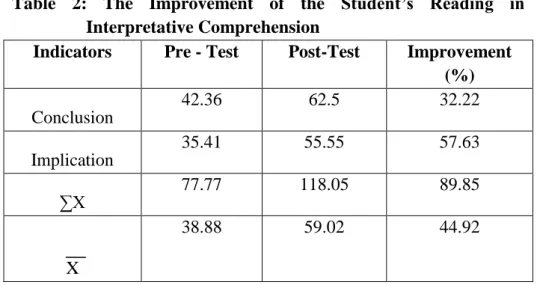
The data on Table 2 shows that the students‟ improvement in the interpretative reading conclusion score has improved (32.22%) from the mean score of 42.36 of pre-test to post-test of 62.5, and then the score of implication has improved (57.63%) from the mean score in pre-test of 35.41 to post-test 55.55. Based on the result above, it can be concluded that the Think Aloud Strategy is effective to apply in teaching and learning process especially in teaching interpretative reading skill (44.92%)
After calculating the score, the writer found the students improvement in the interpretative reading has improved (44.92%) from 38.88 of pre-test to post-test 59.02, it is more clearly shown in the figure below:
Figure 2: The Improvement of the Students’ Interpretative Comprehension
Based on the data above, it can be conclude that the Think Aloud Strategy is effective to apply in teaching and learning process in teaching reading. It can be proved by the improvement of the students‟
interpretative reading as implication (57.63%), and conclusion (32.22%), the mean score is (44.92%).
Table 3: The Frequency and Percentage of Students’ Reading in Literal Comprehension
Classification score
Specific information Sequential events
Pre-test Post-test Pre-test Post-test
F % F % F % F %
Excellent 96 - 100 0 0 6 17 0 0 0 0
Very good 86 - 95 0 0 0 0 0 0 0 0
Good 76 - 85 0 0 0 0 0 0 1 3
Fairly good 66 - 75 5 14 18 50 0 0 22 61
Fair 56 - 65 0 0 0 0 0 0 0 0
Poor 36 - 55 21 58 10 28 17 47 13 36
Very poor 0 - 35 10 28 2 5 19 53 0 0
Total 36 100 36 100 36 100 36 100
57.63
32.22
44.92
0 10 20 30 40 50 60 70
Implication Conlusion mean
IMPROVEMENT (%)
Interpretative Comprehension
The data on Table 3 shows that specific information in pre-test none of students get excellent, very good, good and fair. There are 5 (14%) students get fairly good, 21 (58%) students get poor scores. There are 10 (28%) students get very poor. Students score has improve in post-test there are 6 (17%) students get excellent, 18 (50%) students get fairly good scores and 2 (5%) students get very poor score.
Sequential events in pre-test none of the students get excellent, very good. Good, fairly good and fair scores and there are 17 (47%) students get poor after post-test 13 (36%) students get poor scores. There are 19 (53%) students got very poor scores. In post there is 1 (3%) students get good scores and 22 (61%) students get fairly good scores. It can be conclude that Think Aloud Strategy can improve students reading in Literal Comprehension.
Table 4: The Frequency and Percentage of Students’ Reading in Interpretative Comprehension
Classification Score
Conclusion Implication
Pre-test Post-test Pre-test Post-test
F % F % F % F %
Excellent 96 - 100 0 0 0 0 0 0 0 0
Very good 86 - 95 0 0 0 0 0 0 0 0
Good 76 - 85 0 0 0 0 0 0 0 0
Fairly good 66 - 75 1 3 21 58 0 0 10 28
Fair 56 - 65 0 0 0 0 0 0 0 0
Poor 36 - 55 23 64 15 42 15 42 24 67
Very poor 0 – 35 12 33 0 0 21 33 2 5
Total 36 100 36 100 36 100 36 100
Based on the data above conclusion in pre-test and post-test none of the students who get excellent, very good, good and fair scores. There is 1 (3%) student get fairly good, 23 (64%) students get poor scores and 12 (33%) students who get very poor scores. In post-test students get fairly good has improved there are 21 (58%). Students who get poor scores are 15 (42%) and none of the students who get excellent, very good, good, fair and very poor scores.
Implication in pre-test and post-test also shows none of the students who get excellent, very good, good and fair scores then none of the students get fairly good score in pre-test and then there are 10 (28%) students get fairly good scores in post-test. There are 15 (42%) students get poor scores in pre-test and 24 (67%) students get poor scores in post- test. And the students who get very poor scores in pre-test there are 21 (33%) an in post-test there are 2 (5%) student get very poor scores. It can be conclude that Think Aloud Strategy can improve students reading in interpretative comprehension.
2. T-test Value
Analyzing t-test is used to find out the significant difference of the students‟ result of pre-test and post-test. In order to know the level of significance 5% (0.05), degree of freedom df=N-1 (df is N – 1 = 36 – 1 = 35) it is found that the t-table value is 2.030 the result of the calculation is shown as follows:
Table 3: T-test of Value of the Students’ Reading Comprehension
Variables
t-test t-table
Reading Comprehension
19.91 2.030
The Table 3 shows about the comparison between the students‟ T- test and T-table to improve literal comprehension and interpretative comprehension after using Think Aloud Strategy. The value of the T-test is greater than T-table. The score in variable of Reading Comprehension (19.91> 2.030)
Figure 3: The Comparison between the Students’ T-Test and T- Table
It can be concluded that there is significant difference between the results of the students‟ reading comprehension before and after using Think Aloud Strategy. This also means that the alternative hypothesis (H1) is accepted where the use of Think Aloud Strategy does effective in improved the students‟ literal and interpretative reading comprehension at the Eighth Grade of SMP Muhammadiyah Limbung.
B. Discussion
In this part, the discussion dealing with the interpretation of findings derived from the result of findings about the students‟ literal comprehension dealing with the specific information and sequential events, also the students‟
interpretative comprehension dealing with conclusion and implication. The result of the data analysis through the reading test shows that the students‟
reading comprehension improves significantly. It is indicated by the students‟
achievement in pre-test and post-test.
1. The improvement of the Students’ Literal Comprehension in Reading 0
2 4 6 8 10 12 14 16 18 20
T-test T-table
19.91
2.030
a. Specific Information of Student’s Literal Reading Comprehension The description of data analysis through the test as explained in previous finding section shows that the improvement of students‟
Literal reading comprehension by using Think Aloud Strategy is improve significantly. It is supported by result of the test value in post- tests is greater than test value pre-test. The result of data analysis relevant with the theory of Haris & Hodges (2004:10) stated that the Think Aloud is a strategy that allows a teacher to verbalize thoughts while reading orally, modelling for students how the prcess of comprehension works.
In applying Think Aloud Strategy in learning process in improvement the class has been classified as a fairly good classification because this strategy is essay for students to learn because the students already know the meaning of the text and already know where is the position of the specific information in the text especially in narrative text. It made the students understanding specific information and the students‟ result in post – test higher than the pre – test. It can be seen after testing the students where the mean score of the students‟ specific information in pre-test (X) = 46,52 and post-test (X) =69,44. The improvement is 49.26%. It indicates that the mean score of post-test greater than mean score of pre-test.