10
chapter ten
Selecting market targets
Attacking a fortified area is an act of last resort.
Sun Tzu (c. 500 BC)
Introduction
One of the most fundamental decisions a company faces is its choice of market or markets to serve. Unfortunately, many firms enter markets with little thought as to their suitability for the firm. They are entered simply because they may appear superficially an attractive market for the firm’s products or services. As we shall see in this chapter, a strong case can be made for choosing markets and industries where the prospects are attractive, and also where we can take a strong position.
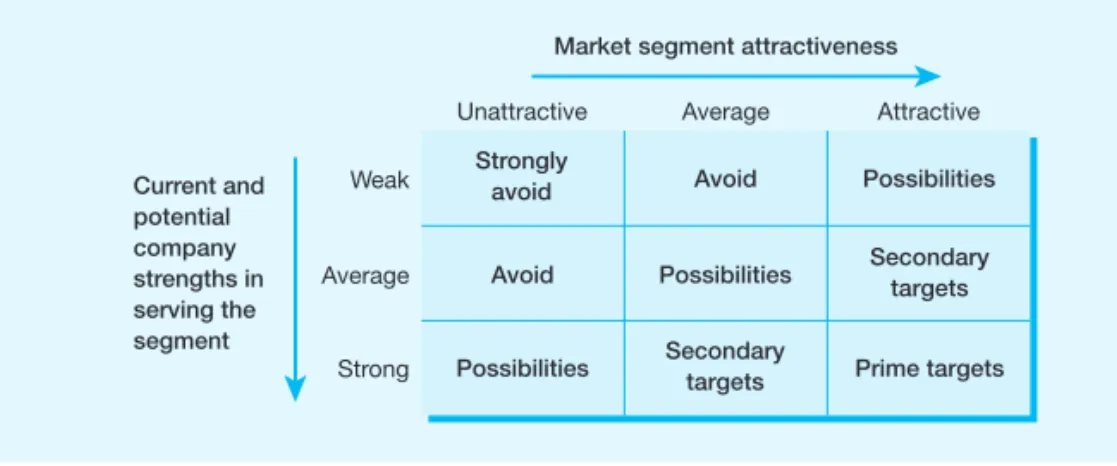
Figure 10.1 suggests that if we compare, in general terms, the attractiveness of markets and the strength of the competitive position we can take, then there are several traps to be avoided:
l Peripheral business: areas where we can take a strong and secure competitive position, but where the market simply does not deliver the benefits that the com- pany needs. It is easy for those with great enthusiasm for a product or service in
which they specialise to drive us into these areas, but they will never deliver the margin and growth that we need and will absorb resources and management time.
l Illusion business: areas where the market appears very attractive to us, because it is large, dynamic, expanding, and so on. However, these are areas where we can only ever hold a weak position – perhaps because these are typically the markets defended most fiercely by entrenched competitors. It is easy for man- agers to be seduced into entering these markets because of the potential they offer, without acknowledging that we can never reach that potential.
l Dead-end business: markets that are not attractive and where we can only take an ‘also-ran’ position. Few managers will deliberately take us into these markets, but this may describe markets from which we should exit – they may have been attractive in the past, but have declined, or our competitive position may have been undermined by new competitors and technologies.
l Core business: markets offering the benefits we want, where we should take a strong position. Clearly these are the highest priority for investment of time and resources. The major issue here is how well we understand what makes a mar- ket attractive for a particular company, and what makes a competitive market strong (Piercy, 1997).
While these strategic traps are easily described, the importance of the issue is under- lined by the fact that market choices are just that – choice may mean that we turn our back on some markets and some customers and some ways of business, to focus on the areas where we can achieve superior performance and results. Making such choices may be difficult. Michael Porter has suggested the heart of the problem:
To put it simply, managers don’t like to choose. There are tremendous organisa- tional pressures toward imitation and matching what the competitor does. Over time this slowly but surely undermines the uniqueness of the competitive position.
(Porter, quoted in Jackson, 1997) Figure 10.1 Market attractiveness and competitive position
Source: Adapted from Piercy (1997).
10.1
Porter’s argument is that a key challenge is to make clear trade-offs and strategic choices. The alternative is that a company risks destroying its own strategy:
They start off with a clear position, and over time they’re drawn into a competitive convergence where they and their rivals are all basically doing the same thing.
Those kinds of competitions become stalemates.
(Porter, quoted in Jackson, 1997) However, the importance of market and segment choices must be put in the context of the potential complexity of markets and the consequent uncertainty sur- rounding the ideal choices to make. Indeed, as we shall see, defining markets and segments is not simply an exercise in statistical analysis, it is also a subjective and highly creative process (e.g. see Aaker, 1995). Considering alternative perspectives on markets and segments is a way to enrich our understanding of the customer, and to establish competitive differentiation in the way we go to market.
The role of this chapter can be described as follows. Chapter 8 was concerned with the different ways in which markets could be segmented. Alternative bases for segmentation were examined and the benefits of adopting a segmentation approach discussed. Chapter 9 then looked at the research techniques available to help seg- ment markets. In this chapter market definition and market targeting is discussed in more detail. In particular, the process of identifying the market segments where the company’s capabilities can be used to the best advantage is considered, together with the selection of the appropriate marketing strategy.
In deciding on the markets and segment(s) to target, four basic questions need to be asked:
1 How do we define the market – what is its scope and constitution?
2 How is the market segmented into different customer groups?
3 How attractive are the alternative market segments?
4 How strong a competitive position could we take – where do our current or potential strengths lie?
The process of market definition
The definition of the markets a company serves, or those it is evaluating as possible targets, is partly a question of measurement and conventional competitive com- parisons. It is also in part a creative process concerned with customer needs. Stanley Marcus of Neimann Marcus is frequently cited on this point: ‘Consumers are stat- istics. Customers are people.’
A number of points are worth bearing in mind in approaching market definition:
l Markets change: The development of marketing strategy takes place in the con- text of a constant process of change. From this perspective it is unreasonable to assume that a company’s definition of markets should remain static.
l Markets and industries: We have made the point before, that markets are not the same as industries or products. Industries are groups of companies that share technologies and produce similar products. Markets are groups of customers with similar needs and problems to solve. Defining markets around industries and products exposes a company to its competitive position being overturned by competition from outside the conventional industry. Developing robust market- ing strategies and strong competitive positions requires not only understanding the existing industry (see Chapter 3), but also the market from the customer’s perspective (see Chapter 4).
l Different definitions for different purposes: Day (1992) makes the point that we may need different market definitions for different types of marketing decision:
tactical decisions such as budgeting and salesforce allocation are likely to require narrow and easily understood market definitions (existing customers, similar products, existing channels), while strategic decisions require broader market definitions (including new market opportunities, changes in technology and substitute products, and potentially new types of competitive entrant).
Different ways of defining markets
Day (1992) suggests that markets can be defined in two ways: on the basis of customers, or on the basis of competitors.
l Customer-defined markets: This approach takes us beyond products that are
‘substitutes in kind’, i.e. the same technology as our own, to ‘substitutes in use’, i.e. all the products and services which may meet the same customer needs and problems.
l Competitor-defined markets: This approach focuses on all the competitors that could possibly serve the needs of a group of customers, and reflects technological similarity, relative production costs and distribution methods.
In general, competitor-based definition will be important for allocating marketing resources and managing the marketing programme – responding to price cuts, salesforce coverage, and so on. On the other hand, customer-defined approaches are likely to be more insightful in understanding the dynamics of the market, the attrac- tiveness of alternative markets, and in developing strong competitive position.
One practical approach to evaluating the characteristics of markets is the product–
customer matrix.
Product– customer matrix
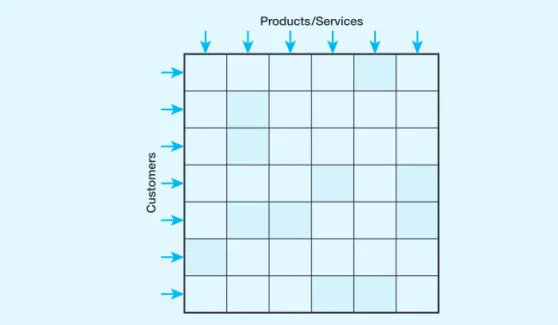
Figure 10.2 suggests that the underlying structure of a market can be understood as a simple grouping of customers and products/services. The challenge is to examine a market using this matrix to identify no more than five or six groups of products and services and five or six groups of customers, who constitute the market. If this is impossible then this is probably not a single market but several, and the exercise should be subdivided.
The important perspective that can be built using this approach is one which recognises:
10.1.2
10.1.1
l products/services– in terms of what they do for customers, not in terms of how they are produced or by whom;
l customers– in terms of important differences between groups in needs, prefer- ences, priorities or ways of buying.
For example, vast arrays of retail financial services products provided by banks and their competitors can be reduced to six categories of products by considering what customer benefits they provide. Rather than hundreds of products, the market con- sists of only six groups of products and services to: provide access to cash; provide security of savings; buy-now pay-later; make cashless payments; get a return on assets such as savings; and acquire a range of specialist services. The same process of reduction can be applied to products/services. For example, do not describe the market as ‘computers’, but as what different mixes of computer hardware, software and services actually deliver to customers in a particular market, such as accounting systems, internal communications, management information, and so on.
This approach provides a start in defining markets in such a way that we move past the core market of similar products, to find the extended market:
to encompass all competitive possibilities for satisfying customer needs, including sub- stitutes and potential entrants. [ because] this latter perspective is especially needed to help understand why some markets are attractive and others are not.
(Day, 1990) This analysis can be used for a variety of purposes, but one advantage of this type of initial approach is that it starts to identify the way a market divides into distinctly different segments.
Figure 10.2 The product–customer matrix
10.2 Defining how the market is segmented
As discussed in Chapter 8, there are many ways in which markets can be segmented.
Often a useful starting point is to ask how management views the market, on the basis of their experience in the marketplace. Management definition of market seg- ments may typically be on the basis of products/services offered or markets served.
Products or services offered
Describing segments on the basis of products or services offered can lead to broad- based segmentation of the market. John Deere, for example, competing against the much larger Caterpillar company in the US crawler tractor (bulldozer) market initially segmented the market into ‘large’ and ‘small’ bulldozers. On the basis of its marketing assets (defined in terms of better service support through local dealer networks and lower system price) Deere decided to concentrate its efforts in the small bulldozer market, thus avoiding head-on competition with Caterpillar, which was stronger in the large bulldozer market (where market requirements centred around spare parts availability).
Many market research companies operating in the service sector define their market segments in terms of the services they offer, e.g. the market for retail audits, the market for telephone surveys, the market for qualitative group discussions, the market for professional (industrial) interviewing.
Underlying this product- or service-based approach to identifying markets is a belief that segments defined in this way will exhibit the differences in behaviour essential to an effective segmentation scheme. The strategy adopted by Deere made sense, for example, only because the requirements of purchasers and users of large and small bulldozers were different. Where the requirements of customers are essen- tially the same, but satisfied by different products or services, this segmentation approach can lead to a myopic view of the market.
Market or markets served
Many companies now adopt a customer-based or markets-served approach to seg- menting their markets. Segments are defined in terms of the customers themselves rather than the particular products they buy. In consumer markets, management may talk in terms of demographic and socio-economic segments while in industrial markets definitions may be based on SIC or order quantity. A particularly useful approach in many markets is to segment on the basis of the benefits the customer is seeking in consuming the product or service and/or the uses to which the product or service is put.
Van den Berghs (a subsidiary of Unilever) has been particularly successful in seg- menting the market for yellow fats on the basis of the benefits sought by consumers (see Broadbent, 1983). The market, which comprises butter, margarine and low-fat spreads, stood at £600 million at retail selling price in 1979. It was a static market with no overall growth. Within the market, however, there were some important changes taking place. There had been a marked trend away from butter to margarine,
10.2.1
10.2.2
primarily because of the increasing price differential (butter and margarine were roughly equivalent prices in the mid-1970s but since then butter prices had in- creased more rapidly, widening the gap). Coupled with this came increased price sensitivity as the UK economy entered the recession of the late 1970s/early 1980s.
Van den Berghs was quick to spot a market opportunity as it segmented the market.
There were at least five benefit segments identified:
l Segment 1 consisted of customers who wanted a ‘real butter taste’ and were not prepared to forego that taste at almost any price. This segment chose butter, the top-selling brands being Anchor, Lurpak and Country Life.
l Segment 2were customers who wanted the taste, feel and texture of butter but were concerned about the price. They were typically not prepared to sacrifice on taste, etc., and not convinced that existing margarines could satisfy them. These customers would typically choose the cheapest butter available, such as super- market own label.
l Segment 3were ex-butter users who were prepared to accept existing margarines as a substitute and even found they offered additional benefits over butter, such as softness and ease of spreading. Also attractive to this segment was tub packag- ing and larger packs. They were more price sensitive than Segment 2. The leading brand in this segment was Stork margarine.
l Segment 4was a growing minority segment concerned with diet and weight con- trol. In particular they were concerned with calories and with fat content. Outline was a leading brand. More recently St Ivel Gold has been particularly successful in appealing to this segment.
l Segment 5were concerned with health in general and particularly the effects of cholesterol. Of special appeal to this segment were spreads low in cholesterol and high in polyunsaturated fats. The market leader in this segment was Flora.
Van den Berghs had achieved around 60 per cent of the total market in 1980 through recognising the segmentation described above and positioning its brands such that they attracted specific individual segments. Segment 1 was deliberately not targeted specifically. Krona, a block margarine with (in blind tests) a very similar taste to butter, was launched at a premium price and high margins to attract Segment 2 customers as they traded down from butter. Segment 3 was secured by Van den Berghs’ leading brand, Stork, while Segments 4 and 5 were served by Outline and Flora respectively. During the 1980s and 1990s competition to serve Segment 2 intensified. Following the initial success of Krona, Dairy Crest launched Clover in 1983 as a dairy spread. In 1991 Van den Berghs launched the amazingly named ‘I Can’t Believe It’s Not Butter’ as a brand that gave a butter taste but with much lower fat intake levels. Within just nine months of its launch, ICBINB (as it became to be known in the trade), took 2.3 per cent of the margarine low-fat spreads market. In 1995 it was followed by St Ivel’s new brand, positioned directly in opposition,
‘Utterly Butterly’. More recently the emergence of ‘cholesterol buster’ spreads such as Benecol presented a new challenge to Van den Berghs’ domination of the market.
The launch of Flora Pro-Activ into this part of the market ensured continued over- all leadership. Since its launch in 2000 the brand has gone from strength to strength,
10.3
outselling its nearest competitor 3 to 1. In 2004 the Pro-Activ range was enlarged to include a spread with olive oil, a milk drink and low-fat yoghurts.
Central to the success of Van den Berghs and other creative marketers has been an unwillingness merely to accept the segmentation of the market adopted by others. In many fast-moving consumer products markets, and in grocery marketing in particular, there has been a tendency to over-segment on the basis of background customer characteristics or volume usage. By looking beyond these factors to the underlying motivations and reasons to buy, companies can often create an edge over their competitors.
Once the segments have been identified the alternatives need to be evaluated on the basis of market attractiveness and company strength, or potential strength, in that particular market segment. This evaluation is carried out across a number of factors.
Determining market segment attractiveness
It is clear that many factors may be considered in evaluating market, or specific segment, attractiveness. In Chapter 2 we discussed multi-factor approaches to evaluation in the context of assessing the portfolio of product offerings, while here they are discussed as strategic tools for deciding which markets to enter in the first place. There have been many checklists of such factors, but one way of grouping the issues is as follows:
l market factors;
l economic and technological factors;
l competitive factors;
l environmental factors.
However, it should be noted at the outset that a general checklist of this kind is only a starting point – the factors important to making a market attractive or unattractive to a specific company are likely to reflect the specific characteristics of that company and the priorities of its management. For example, one company may see a market segment that is growing as highly attractive, while in the same industry another company may look for slower rates of growth to avoid stretching its financial and other capacities. Similarly, a company that has cost advantages over its rivals may see a price-sensitive segment as highly attractive, while its competitors do not. In fact, there is a group of factors that impact on judgements of market attractiveness which are wholly subjective.
Market factors
Among the market characteristics that influence the assessment of market attractive- ness are the following (Figure 10.3).
Size of the segment
Clearly, one of the factors that make a potential target attractive is its size. High- volume markets offer greater potential for sales expansion (a major strategic goal of
10.3.1
many companies). They also offer potential for achieving economies of scale in production and marketing and hence a route to more efficient operations.
Segment growth rate
In addition to seeking scale of operation many companies are actively pursuing growth objectives. Often it is believed that company sales growth is more easily achieved in growing markets.
The market for colas within the carbonated drinks market is declining in many Western markets, making it a less attractive market than it has been. In the US, for example, the cola share of the market has declined from 72 per cent in 1990 to 60 per cent in 2000. Meanwhile sales of bottled water, juices and sports drinks have doubled. This is worrying for Coca-Cola which generates 65 per cent of its sales volume from colas and accounts for one-third of the soft drinks sold in the world (Financial Times, 19 September 2001).
Stage of industry evolution
We looked earlier (see Chapter 3) at the characteristics of markets at different stages of evolution. Depending on the company’s objectives (cash generation or growth) different stages may be more attractive. For initial targeting, markets in the early stages of evolution are generally more attractive as they offer more future potential and are less likely to be crowded by current competitors (see competitive intensity below). Typically, however, growth requires marketing investment (promotion, dis- tribution, etc.) to fuel it so that the short-term returns may be modest. Where more immediate cash and profit contribution is sought a mature market may be a more attractive proposition, requiring as it does a lower level of investment.
Figure 10.3 Factors affecting market segment attractiveness
Predictability
Earlier we stressed the predictability of markets as a factor influencing their attract- iveness to marketers. Clearly the more predictable the market, the less prone it is to discontinuity and turbulence, the easier it is to predict accurately the poten- tial value of the segment. The more certain, too, is the longer-term viability of the target.
Price elasticity and sensitivity
Unless the company has a major cost advantage over its main rivals, markets which are less price sensitive, where the price elasticity of demand is low, are more attractive than those that are more sensitive. In the more price-sensitive markets there are greater chances of price wars (especially in the mature stage of industry evolution) and the shake-out of the less efficient suppliers.
Bargaining power of customers
Those markets where buyers (ultimate customers or distribution chain intermedi- aries) have the strongest negotiating hand are often less attractive than those where the supplier can dominate and dictate to the market.
In the UK grocery market the buying power of the major supermarket chains is considerable. Together the top five chains supply around 70 per cent of the nation’s food shopping needs. Food manufacturers and processors compete vigorously for shelf space to make their products available to their ultimate consumers. Indeed, some supermarket chains are now moving towards charging food manufacturers for the shelf space they occupy.
Similarly, in the market for military apparel a concentration of buying power (by the governments) dictates to potential entrants on what basis they will compete.
Seasonality and cyclicality of demand
The extent to which demand fluctuates by season or cycle also affects the attractive- ness of a potential segment. For a company already serving a highly seasonal market a new opportunity in a counter-seasonal market might be particularly attractive, enabling the company to utilise capacity all year round.
The Thompson publishing group found the package tour market highly attract- ive, primarily for cash flow reasons. The company needed to bulk purchase paper for printing during the winter months and found this a severe drain on cash resources.
Package holidays, typically booked and paid for during the winter months, pro- vided a good opportunity to raise much needed cash at the crucial time. Thomson Holidays, founded originally as a cash flow generator, has gone on to become a highly successful package tour operator.
Economic and technological factors
Issues reflecting the broader economic characteristics of the market and the tech- nology used include the following.
10.3.2
Barriers to entry
Markets where there are substantial barriers to entry (e.g. protected technology or high switching costs for customers) are attractive markets for incumbents but unattractive markets for aspirants. While few markets have absolute barriers to entry in the long term, for many companies the costs of overcoming those barriers may make the venture prohibitively expensive and uneconomic.
Barriers to exit
Conversely, markets with high exit barriers, where companies can become locked into untenable or uneconomic positions, are intrinsically unattractive. Some new target opportunities, for example, may have substantial investment hurdles (barriers to entry) that, once undertaken, lock the company into continuing to use the facilities created. In other markets powerful customers may demand a full range of products/services as the cost of maintaining their business in more lucrative sectors.
When moving into high-risk new target markets a major consideration should be exit strategy in the event that the position becomes untenable.
Bargaining power of suppliers
The supply of raw materials and other factor inputs to enable the creation of suit- able products and services must also be considered. Markets where the suppliers have monopoly or near-monopoly power are less attractive than those served by many competing suppliers (see Porter, 1980).
Level of technology utilisation
Use and level of technology affects attractiveness of targets differently for different competitors. The more technologically advanced will be attracted to markets which utilise their expertise more fully and where that can be used as a barrier to other company entry. For the less technologically advanced, with skills and strengths in other areas such as people, markets with a lower use of technology may be more appropriate.
Investment required
Size of investment required, financial and other commitment will also affect attract- iveness of market and could dictate that many market targets are practically unattainable for some companies. Investment requirements can form a barrier to entry that protects incumbents while deterring entrants.
Margins available
Finally, margins will vary from market to market, partly as a result of price sensitiv- ity and partly as a result of competitive rivalry. In grocery retailing margins are notoriously low (around 2–4 per cent) whereas in other markets they can be nearer 50 per cent or even higher.
Competitive factors
The third set of factors in assessing the attractiveness of potential market targets relates to the competition to be faced in those markets.
Competitive intensity
The number of serious competitors in the market is important. Markets may be dominated by one (monopoly), two (duopoly), a few (oligopoly) or none (‘perfect competition’) of the players in that market. Entry into markets dominated by one or a few key players requires some form of competitive edge over them that can be used to secure a beachhead. In some circumstances it may be that the existing players in the market have failed to move with changes in their markets and hence create opportunities for more innovative rivals.
Under conditions of perfect, or near-perfect, competition price competitiveness is particularly rife. The many small players in the market offer competitively similar products so that differentiation is rarely achieved (the stalemate environment – see Chapter 3), and it is usually on the basis of price rather than performance or quality. To compete here requires either a cost advantage (created through superior technology, sourcing or scale of operations) or the ability to create a valued unique- ness in the market. In segments where there are few, or weak, competitors there may again be better opportunities to exploit.
In the early 1980s Barratt Developments made a major impact on the house- building market. Its segmentation of the market identified the need for specialist housing at various consumer life cycle phases. The first venture was Studio Solos, designed for young, single people. In the first year of sales Barratt sold over 2,000 (2 per cent of total new home sales). In the United States the same strategy was adopted to spearhead the company’s international expansion (70 per cent of Barratt’s US sales coming from solos). At the same time in the United Kingdom the company successfully developed retirement housing for pensioners, one- and two- bedroom apartments in blocks featuring communal facilities and wardens. In both retirement homes and solos housing Barratt was among the first to pursue aggres- sively the markets it had identified. Indeed, it would argue it was among the first to recognise that the housing market was segmented beyond the traditional product- based segmentation of terraces, semis and detacheds.
Quality of competition
Chapter 5 discussed what constitutes ‘good’ competitors – those that can stabilise their markets, do not have over-ambitious goals and who are committed to the market. Good competitors are also characterised by their desire to serve the market better and hence will keep the company on its toes competitively rather than allow it to lag behind changes in the environment. Markets that are dominated by less predictable, volatile competitors are intrinsically more difficult to operate in and control and hence less attractive as potential targets.
10.3.3
Threat of substitution
In all markets there is a threat that new solutions to the customers’ original problems will be found that will make the company’s offerings obsolete. The often quoted example is substitution of the pocket calculator for the slide rule, though other less dramatic examples abound. With the increasing rate of technological change experi- enced in the 1990s and 2000s it is probable that more products will become substituted at an accelerating rate.
In such situations two strategies make sense. First, for the less technologically innovative, seek market targets where substitution is less likely (but beware being lulled into believing substitution will never occur!). Second, identify those targets where your own company can achieve the next level of substitution. Under this strategy companies actively seek market targets that are using an inferior level of technology and are hence vulnerable to attack by a substitute product. Hewlett- Packard’s success with laser printers followed by ink jet printers in the PC peripherals market (attacking dot matrix printers) is a classic example.
Degree of differentiation
Markets where there is little differentiation between product offerings offer signi- ficant opportunities to companies that can achieve differentiation. Where differen- tiation is not possible often a stalemate will exist and competition will degenerate into price conflicts, which are generally to be avoided.
The general business environment
Lastly, there is the issue of more general factors surrounding the market or segment in question.
Exposure to economic fluctuations
Some markets are more vulnerable to economic fluctuations than others. Commod- ity markets in particular are often subject to wider economic change, meaning less direct control of the market by the players in it. For example, the New Zealand wool export industry was badly affected in mid-1990 by an Australian decision, in the face of declining world demand and increasing domestic stockpiles, to lower the floor price on wool by 20 per cent. Australia is such a dominant player in the essentially commodity world market that New Zealand exporters were forced to follow suit.
Exposure to political and legal factors
As with exposure to economic uncertainty, markets that are vulnerable to political or legal factors are generally less attractive than those which are not. The exception, of course, is where these factors can be used positively as a means of entering the markets against entrenched but less aware competitors (e.g. when protection is removed from once government-owned monopolies).
10.3.4
Degree of regulation
The extent of regulation of the markets under consideration will affect the degrees of freedom of action the company has in its operations. Typically a less regulated market offers more opportunities for the innovative operator than one that is closely controlled.
Again there is an exception, however. Regulated markets might afford more pro- tection once the company has entered. This might be protection from international competition (e.g. protection of European car manufacturers from Japanese car imports by quotas), which effectively creates a barrier to (or a ceiling on) entry. The warning should be sounded, however, that experience around the world has gen- erally shown that protection breeds inefficiencies and when that protection is removed, as is the current trend in world trade, the industries thrown into the cold realities of international competition face major difficulties in adjusting.
Social acceptability and physical environment impact
Increasingly, with concern for the environment and the advent of ‘green’ politics, companies are looking at the broader social implications of the market targets they choose to go after. Especially when the company is widely diversified the impact of entering one market on the other activities of the company must be considered.
With increasing concern for the natural world, its fauna and flora, some cosmetics companies are now looking to non-animal ingredients as bases for their products and manufacturers of aerosols are increasingly using non-ozone-depleting propellants in place of CFCs. The Body Shop, a cosmetics and toiletries manufacturer and retailer, has built its highly successful position in the market through a clear commitment to the use of non-animal ingredients, just as Innocent trades on ‘natural’ values with fruit (and nothing but fruit) drinks.
The Body Shop
Alamy/UK Retail Alan King
Summary
The quality of a market is dependent on a number of factors. Other factors being equal, segments that are big and growing offer the best prospects for the future.
Other factors rarely are equal, however, and size and growth are not the only criteria that should be taken into consideration. Of prime importance is the scope for build- ing a valuable and defensible position for the company in that segment. This will also require a clear identification of the company’s strengths with regard to the proposed segment.
Making the criteria clear and explicit
We made the point earlier that the factors making a market or segment attractive to a particular company are likely to be unique to that company, rather than simply reflecting a general checklist of the type discussed above. We also made the point that it is likely that the direction of a decision criterion will also vary – high-growth mar- kets are attractive to some companies and unattractive to others in the same industry.
It is also the case that some of the real criteria for evaluating market/segment attractiveness may be highly subjective and qualitative. For example, a brewery evaluating alternative markets for its by-products identified the criteria of market attractiveness as:
l Market size: It defined a minimum market value to be of interest.
l Market growth rate: Moderate growth was preferred (it did not want to invest large amounts in keeping up with a by-products market).
l Low competitive intensity: It wanted to avoid head-on competition with others.
l Stability: It wanted a stable income flow.
l Low profile: It did not want to invest in any area that would attract media criti- cism, or regulatory activity by the government.
What we see is a mix of the qualitative and the quantitative, and the objective and subjective. None the less, these are the issues that matter to that management group. There is much advantage in making the real criteria as explicit as possible, notwithstanding that some reflect corporate culture and management preferences rather than economic market analysis.
Indeed, a recent development at the Virgin Group has been making explicit the criteria that make further markets attractive to Virgin. The head of corporate develop- ment, Brad Rosser, states that Virgin will invest in a market only if it meets at least four out of the following criteria (Piercy, 1997):
1 The products must be innovative.
2 They must challenge established authority.
3 They must offer customers good value for money.
4 The products must be high quality.
5 The market must be growing.
This describes Virgin’s original mission of offering ‘first-class at business-class prices’
and applying the brand to new market opportunities.
10.3.5
The impact of change
It should also be remembered that nothing is static – things change, and sometimes they change rapidly in a number of ways:
l Company change: As companies evolve, their views about market attractiveness may develop. In the Virgin example given above these criteria may describe the company’s view of how it is developing; they do not describe how it has invested in markets in the past.
l Markets change: The attractiveness of a market can alter dramatically. Matthew Clark, the UK drinks group, reported at the end of 1996 that sales of Diamond White and K Ciders had dropped 40 per cent, with declining profits following.
The reason was a switch by young drinkers to alcopops like Bass’s ‘Hooch’ brand of alcoholic lemonade. Disparaged by the industry experts, a year after launch alcopops were selling 100 million litres a year. Nevertheless, 10 years later and the cider market was experiencing a boom with a 23 per cent increase in sales in 2006 alone (a trend predicted to last into the late 2000s). Dubbed the ‘Magners Effect’
(the brand grew by 225 per cent in 2006), this is attributed to a ‘step change in consumer attitudes’ (National Association of Cider Makers).
l Competitors change: The UK market for household vacuum cleaners had been dominated by Hoover and Electrolux since the 1950s, with very conventional technology. James Dyson offered his new product, ‘the world’s first bagless vacuum cleaner’, to the existing players and was laughed at. After many difficulties he launched his own product – with unknown technology and a high price. He sold
£3 million worth of vacuum cleaners in the first year and has tripled sales every 12 months. Hoover’s share of the upright vacuum cleaner market has halved, and in the high-margin market for cleaners priced over £180 Dyson in 1995 took 58 per cent of the market compared with Hoover’s 14 per cent. The attractiveness of markets and segments within them can change dramatically.
l Reinventing the market: Market attractiveness can also change dramatically as a result of those who ‘reinvent the business’, by establishing new ways of doing business. At the time of writing, Eagle Star has attacked the car insurance market by offering the cheapest products in the United Kingdom from its Internet site.
Daewoo took 1 per cent of the British car market (and a much higher share of its segment) in the fastest time ever, by establishing a new direct distribution channel and a brand proposition of high value and ‘hassle-free’ car buying. Amazon.com made significant inroads into book retailing through offering sales over the Internet, where additional services (such as online searches, book reviews, etc.) could be offered quickly and cheaply, and Apple iTunes took 80 per cent of the UK digital music market in 2006.
l Market boundaries change: The issue of market definition we considered earlier cannot be separated from the question of market attractiveness – attractiveness always means in a specific market. As we saw earlier, a characteristic of many markets is that traditional boundaries and definitions are in flux. Avoiding the investment traps we described at the outset may involve constant awareness of how boundaries are changing as a result of new technologies and new types of customer demand.
10.3.6
10.4 Determining current and potential strengths
The importance of the resource-based theory of the firm, and the practicalities of assessing a company’s strengths (and weaknesses) were considered in Chapter 6. The issue to consider now is how those resources, capabilities and competencies can be deployed in a specific market or segment (see Figure 10.4). One approach to this evaluation divides the issue as follows:
l the firm’s current market position;
l the firm’s economic and technological position;
l the firm’s capability profile.
Current market position
A start in evaluating strengths in a particular market or segment can be made with consideration of the following issues.
Relative market share
In markets that the company already targets, market share serves two main func- tions. First, it acts as a barometer of how well the company is currently serving the target: a higher share will indicate better performance in serving the needs of the customers. Second, market share can, of itself, confer an advantage in further pene- trating the market: high share brands, for example, typically have high levels of cus- tomer awareness and wide distribution. Share of market is a prime marketing asset that can be used to further develop the company’s position.
Rate of change of market share
Absolute market share in itself can confer a strength to the company; so too can rapidly increasing share. Growing share demonstrates an ability to serve the market
Figure 10.4 Factors affecting business strength
10.4.1
better than those competitors currently losing share. A company with a low but increasing share of the market can demonstrate to distributors the need for increased shelf space and availability.
Exploitable marketing resources (assets and capabilities)
Central to this book has been the identification and exploitation of the company’s marketing resources. In target markets where marketing assets and capabilities have potential for further exploitation (e.g. a favourable image, brand name, distribution network, customer relationships, etc.) the company has potential strength from which to build. Identifying marketing assets and capabilities was discussed at length in Chapter 6. Of interest here is how these affect the strength of the company in serving particular market segments. What may, for example, be a strength with one target segment may be a weakness with another.
Unique and valued products and services
In potential markets where the company has superior products and services, which are different in a way valued by the customers, there is potential for creating a stronger competitive position. Similarly, a competitive advantage based on low price relative to the competition is likely to be attractive to price-sensitive segments, but may actually deter segments more motivated by quality.
Economic and technological position
The evaluation should also address the company’s relative economic and techno- logical characteristics and resources.
Relative cost position
The company’s cost structure relative to competitors was listed as a potential mar- keting asset in Chapter 6. Low relative production and marketing costs – through technological leadership, exploitation of linkages or experience and scale effects – give a financial edge to the company in the particular market.
Capacity utilisation
For most companies the level of capacity utilisation is a critical factor in its cost structure. Indeed, the PIMS study has shown that capacity utilisation is most crucial to small and medium-sized companies (see Buzzell and Gale, 1987). Few companies can hope to achieve 100 per cent utilisation (there will inevitably be downtime in manufacturing and slack periods for service companies), and indeed running at ‘full’
capacity may produce strains on both systems and structures. What is clearly import- ant in any operation is to identify the optimum level of utilisation and seek to achieve that.
Technological position
Having an exploitable edge in technology again creates a greater strength for the company in serving a market. That may or may not be leading-edge technology. In
10.4.2
10.4.3
10.5
some markets a lower technology solution to customer requirements may be more suitable than state-of-the-art applications. Again, the key is matching the technology to the customers’ problems or requirements.
Capability profile
The third set of factors affecting competitive strength centres on the resources that can be brought to bear in the market.
Management strength and depth
A major asset, and hence potential strength, of any company is its human resources and particularly its management strength and depth. The skills and competencies of the staff working in an organisation are the tacit strengths on which it can exploit opportunities in the marketplace. In service organisations (such as consult- ancy companies, health services, etc.) in particular, the strength of the supplier often comes down to the individual skills of the managers who deal directly with the customers.
Marketing strength
Marketing strength stems from experience and synergy with other product areas.
Companies operating primarily in consumer markets often believe they have superior marketing skills to those operating in slower moving industrial markets. They then see these markets as areas where they can use the fast moving consumer goods skills they have learned elsewhere to good effect. Experience of transferring skills from one business sector to another, however, has not been universally successful.
Forward and backward integration
The extent of control of the supply of raw materials (backward integration) and distribution channels (forward integration) can also affect the strength or potential strength of a company in serving a specific target. Where integration is high, especi- ally in markets where supplier and buyer power is high (see above), the firm could be in a much stronger position than its rivals.
Summary
The important point to consider when assessing company or business strength is that strength is relative to competitors also serving the segment and to the require- ments of customers in the segment.
Making market and segment choices
Conventional approaches suggest the use of portfolio matrices as a useful way of summarising the alternative business investment opportunities open to a multi- product company, and for making explicit choices between markets and segments.
While such matrices have been used to assess the balance of the portfolio of
businesses the company operates (see Chapter 3), the same techniques can be use- fully adapted to help with the selection of market targets.
Classic portfolio techniques include the Directional Policy Matrix developed by the UK Chemical Division of Royal Dutch Shell (Robinson et al., 1978) or the McKinsey/GE Business Screen (Wind and Mahajan, 1981). These are generally con- sidered as methods for modelling existing portfolios; they are actually, in many instances, better suited to deciding which markets to target in the first place. An adapted model is presented in Figure 10.5; this is the operational version of the con- ceptual model we saw in Figure 10.1 at the start of our evaluation of market targets.
Using this approach the factors deemed relevant in a particular market are identified (typically from the factors listed above) and are each assigned weights depending on their perceived importance. The subjective choice and weighting of the factors to be used in the analysis ensure that the model is customised to the needs of the specific company. The process of selecting and weighting the factors can, in itself, prove a valuable experience in familiarising managers with the realit- ies of the company’s markets. Where appropriate, factors can be more objectively assessed through the use of marketing research or economic analysis.
Once the factors have been determined and weighted, each potential market seg- ment is evaluated on a scale from ‘excellent = 5’ to ‘poor = 1’ and a summary score on the two main dimensions of ‘market segment attractiveness’ and ‘company busi- ness strength in serving that segment’ computed using the weightings. Sensitivity analyses can then be conducted to gauge the impact of different assumptions on the weight to attach to individual factors and the assessments of targets on each scale.
The resulting model, such as that shown in Figure 10.6 for a hypothetical com- pany, enables the alternatives to be assessed and discussed objectively.
Ideally, companies are looking for market targets in the bottom right-hand corner of Figure 10.6. These opportunities rarely exist and the trade-off then becomes between going into segments where the company is, or can become, strong, but that are less attractive (e.g. target opportunity 1), or alternatively tackling more attractive markets but where the company is only average in strength (target 2).
To develop defensible positions in the marketplace the former (sticking to areas of current or potential strength) often makes the most sense. Indeed, many would
Figure 10.5 Target market selection
argue (see Ohmae, 1982) that most companies are better advised to consolidate in apparently less attractive markets where they have considerable exploitable strengths than to ‘chase the rainbows’ of seemingly attractive markets where they are only average or weak players.
Where business strength is weak, investment should be avoided in average or unattractive markets (target 7), unless in very attractive market segments where some strengths could be built or bought in through merger/acquisition (e.g. target 3).
Similarly, investment in unattractive segments should be avoided unless particular company strengths can lead to a profitable exploitation of the market (target 4).
Market segments of medium attractiveness where the company has medium strength should be invested in selectively (targets 5 and 6).
A further factor in selecting target markets for the overall business is how those individual targets add up – i.e. the overall portfolio of businesses or markets the company is operating in (see Chapter 3). Companies are typically seeking to build a balanced portfolio of activities – balanced in terms of cash use and generation, risk and return, and focus on the future as well as on the present.
A prime example of a company using the above approach to selecting new mar- ket targets on a world scale is Fletcher Challenge Ltd. With assets in 1990 valued at over £6 billion, turnover of £4.11 billion and pre-tax profit of £345 million, it was New Zealand’s largest and most successful company. Fletcher Challenge examines opportunities for acquisition or further investment on the basis of two sets of factors – industry attractiveness and potential business strength in serving that market.
Industry or target market attractivenessis determined by the following key factors:
Fletcher Challenge looks for markets with a steady demand growth (growing mar- kets are easier to exit if difficulties arise); which are low in customer concentration (are not dominated by a handful of large customers); where there are substantial barriers to entry (in scale of operations, level of technology employed and control of the inputs and supporting industries); where participants are few and com- petitors are ‘good’ (up to two or three major players, in the market for the long haul);
where prices are stable (absence of price wars or wild fluctuations); and where there is a steep cost (experience) curve where Fletcher Challenge’s scale of operations will yield lower costs. Company strength in serving the targets is examined in the
Figure 10.6 Evaluating market targets for a hypothetical company
Figure 10.7 Alternative marketing strategies
10.6
following main areas: Fletcher Challenge looks for markets where it is, or believes it can become, the market leader; it seeks to utilise its technological expertise to the full; looks for markets where it can achieve a cost leadership position; seeks markets where it can manage intergroup (competitor) understandings; and markets where it can keep control of the market (especially in pricing). The acquisitions and expan- sion strategies of Fletcher Challenge from the mid-1980s have consistently met the above criteria.
Alternative targeting strategies
The classic approach to segmentation or targeting strategies is provided by Kotler, most recently in Kotler (1997). Kotler’s model suggests that there are three broad approaches a company can take to a market, having identified and evaluated the various segments that make up the total (Figure 10.7). The company can pursue:
l undifferentiated marketing, essentially producing a single product designed to appeal across the board to all segments;
l differentiated marketing, offering a different product to each of the different segments; or
l concentrated marketing, focusing attention on one, or a few, segments.
Undifferentiated marketing
An undifferentiated marketing approach entails treating the market as one whole, rather than as segmented, and supplying one standard product or service to satisfy all customers. It is the approach carried out in Porter’s (1980) cost leadership strategy.
This approach was particularly prevalent in the mass marketing era in the days before the emergence (or recognition!) of strongly identified market segments. More recently, however, as the existence of market segments has become more widely
10.6.1
accepted, the wisdom of such an approach in all but markets where preferences are strongly concentrated has been called into doubt.
Differentiated marketing
Differentiated marketing is adopted by companies seeking to offer a distinct product or service to each chosen segment of the market. Thus a shampoo manufacturer will offer different types of shampoo depending on the condition of the hair of the customer. The major danger of differentiated marketing is that it can lead to high costs, both in manufacturing and marketing a wide product line.
Depending on the company’s resources, however, differentiated marketing can help in achieving overall market domination (this is the strategy pursued in the yellow fats market by Van den Berghs – see above).
Focused marketing
For the organisation with limited resources, however, attacking all or even most of the potential segments in a market may not be a viable proposition. In this instance concentrated or focused marketing may make more sense. Under this strategy the organisation focuses attention on one, or a few, market segments and leaves the wider market to its competitors. In this way it builds a strong position in a few selected markets, rather than attempting to compete across the board (either with undifferentiated or differentiated products).
The success of this approach depends on clear, in-depth knowledge of the customers served. The major danger of this strategy, however, is that over time the segment focused on may become less attractive and limiting on the organisation.
The Lucozade brand of soft drink was first marketed in the 1920s. It was originally developed by a Newcastle chemist as an energy drink for his son, who was recover- ing from jaundice. The brand was bought by Beechams in 1938 and marketed in a distinctive yellow cellophane wrapper, with the slogan ‘Lucozade Aids Recovery’.
During the 1950s and 1960s it was Beechams’ biggest selling brand. By the 1970s, however, lower levels of sickness, less frequent flu epidemics and price increases had contributed to a decline in sales. From 1974 to 1978 sales fell by 30 per cent. The company decided that the brand needed to be repositioned.
The first repositioning was as an in-house ‘pick-me-up’ for housewives in the late 1970s. Sales initially increased by 11 per cent, but growth was not maintained, and by the end of 1979 sales had levelled out. In 1980 a new 250 ml bottle was launched and the new slogan ‘Lucozade Replaces Lost Energy’ was developed. But by 1982 a usage and attitude survey showed that the brand character had not changed significantly – it was still used primarily for illness recovery.
More radical repositioning was considered. In the carbonated soft drinks market Lucozade was competing head-on with well-established brands such as Coca-Cola and Pepsi. Lucozade also suffered from a poor image at the younger end of the market – it had been given to them by their mums when they were ill! A new posi- tioning was developed around the theme: ‘Lucozade is not only delicious and refreshing but can quickly replace lost energy’. The potential of the sports market became apparent and in July 1982 the advertising started to use Daley Thompson,
10.6.2
10.6.3
an Olympic decathlete. Initially, however, the target customers liked Daley, but did not connect him with the brand.
The next phase of repositioning was the ‘traffic lights’ TV commercial, using Daley and the heavy metal music of Iron Maiden to ‘portray’ rather than ‘explain’
the message. The advertisements graphically conveyed the energy replacement message in a way younger users immediately identified with. In the first year of the new campaign, sales volume increased by 40 per cent. Qualitative research showed the message getting across to existing users and, crucially, to the younger target market.
Since then Lucozade has enjoyed continued success, and new flavour variants have been launched. The years 1988 saw the launch of the Lucozade Sport isotonic drink and 1995 the launch of the NRG teen drink. The same positioning strategy has been pursued successfully in Ireland, Asia and Australasia. From 1985 to 1995 worldwide sales had grown from £12 million to £125 million (Salmon, 1997). In 2002, the brand was promoted through the Lara Croft/ Tomb Raider association.
The most effective strategy to adopt with regard to target market selection will vary from market to market. Certain characteristics of both the market and the company, however, will serve to suggest the type of strategy that makes most sense in a given situation.
The classic statement on how to approach the segmentation strategy choice comes from Frank et al. (1972). They propose that the choice of strategy should be based on:
l segment size – to determine its value and prospects;
l the incremental costs faced in differentiating between segments – which may be small, or may be high enough to undermine a full segmentation strategy;
l the extent and durability of segment differences – if segments are only margin- ally differentiated they may not be worth taking as separate targets, and if the differences are transitory then the viability of a segmentation strategy may be questionable;
l the stability and mutual compatibility of segment targets;
l the ‘fit’ between segment characteristics and company strengths (see Chapter 8);
and
l the level and type of competition in the prospective segment targets.
The selection of which potential market segment or segments to serve is the crucial step in developing a robust and comprehensive marketing strategy. Until the targets have been clearly identified, their requirements and motivations fully explored, it is not possible to develop a robust competitive positioning.
Summary
B&O Case study
The sound of which Torben Ballegaard Sørensen is most proud at the moment is silence. The chief executive of Bang & Olufsen, the Danish consumer electronics company, says that when B&O’s new sound system for the Audi A8 is turned up to its maximum 1,000 watts, nothing can be heard from outside the car.
The system, which will be launched at the Detroit Motor Show in January, will cost about
$7,000 and includes 14 speakers, mounted in shells that prevent vibrations spreading into the car frame: the loudest thumping bass inside will not penetrate outside.
Passers-by can thus experience vicariously what Mr Sørensen regards as the emotional appeal of B&O products: tranquillity.
In the approach to Christmas, B&O is one of many groups hoping to capitalise on the seasonal demand for consumer electronics. The company exemplifies the growing importance of design and aesthetics – rather than technology or low prices – in buying decisions. It trades on ambience as much as sound.
‘Our brand is about feeling good at home, or where you feel at home – in a car or a hotel. When daily life is cluttered, you can come home to a system that works and is tranquil. It cocoons you,’ says Mr Sørensen.
In the US, still a developing market for a brand that has expanded from Europe, 60 per cent of B&O revenues come from home-theatre installa- tions that can cost up to $250,000. The most expensive of these include flat-screen televisions,
audio systems and speakers, and curtains and lighting adjusted from a remote control.
So it is not the cheap option. Nor is B&O, in spite of the quality of its speakers, the most innovative audio company. Its silver pebble- shaped MP3 player, which sells for $460 in the US, was launched well after Apple’s iPod, and the Serene mobile phone that it has developed jointly with Samsung is not a third-generation device.
Others strive for first-mover advantage but B&O follows sedately.
The company has some unique technology:
its speaker systems use a proprietary ‘lens’ sys- tem to balance sound in rooms. Yet Bose, the privately owned US company that is its most obvious competitor, has a stronger reputation for innovation. Bose has invented devices such as noise-cancelling headphones that block back- ground hubbub.
Despite this, B&O, which celebrates its 80th anniversary this year, is doing well. After a lull in the late 1990s, it has recovered since Mr Sørensen arrived from Lego, another iconic Danish com- pany, in 2001. Revenues increased by 10 per cent in the six months to August 31, and its shares have risen strongly this year.
That is partly because more people can afford its goods. Mr Sørensen says that it concentrates on the most affluent 2 per cent of consumers but that is still a lot. B&O has a well-established pres- ence in Europe – particularly in the UK, Switzerland and Germany – and is pushing into emerging markets. It has six stores in China and plans to open 14 more across the country.
B&O is also gaining from changes in techno- logy. People are buying flat-screen televisions – and home-theatre systems – to replace their cathode-ray tube screens. They are upgrading audio equipment, prompted by the switch from music compact discs to digital downloading.
That gives electronics companies such as B&O a chance to offer systems that play MP3 files as well as discs.
Above all, B&O’s growth reflects renewed appetite for audio and video devices that look as
FT
Getty Images Publicity
well as sound good. As consumers are faced with an array of new formats and devices, and tech- nology becomes ever harder to master, they find simplicity appealing. Apple’s iPod portable music player and its iTunes software have been so suc- cessful because they are well designed.
B&O has one thing in common with Apple.
David Lewis, its chief designer, is British, as is Jonathan Ive, his counterpart at Apple. But while the iPod is a recent invention, B&O’s distinctive style goes back several decades. From the first radios produced by Peter Bang and Sven Olufsen in the 1920s, its product design was rooted in the Bauhaus modernist school.
The sleek good looks of B&O products brought it success in Britain in the 1960s, where the brand remains well known. Mr Sørensen says that design is an enduring – and growing – advantage: ‘As the world gets more crowded and things all look the same, aesthetics mean something.’
The company still tries to make its products simple, whether at home, in cars or in hotels, where it does custom installations. ‘If you are faced with four remote controls in your hotel room when you just want to watch CNN for 15 minutes, you give up and go to the bar,’ says Mr Sørensen.
‘If there is something that does not make you feel like a fool, you are happy to spend more money on it.’
Because of B&O’s prices, its typical customer tends to be older and wealthier than the aver- age buyer of consumer electronics devices. Mr Sørensen says customers often choose between having a new kitchen or car, or a B&O home theatre. ‘They are typically more than 25 years old and they want the best things in life. They would rather have fewer things of higher quality.’
The facts that B&O’s products are so expensive and its big systems require custom installation, present a marketing challenge. The company cannot simply send out products to retailers to compete for attention on their shelves. Hence the increasing emphasis on opening its own stores and working with intermediaries, such as architects, who are building and converting homes.
Despite its growth, B&O faces challenges. One is to convince its customers that it offers not only
good design but superior technology. Mr Sørensen says customers in Switzerland and Germany are attracted to B&O by the idea of buying long- lasting systems. But the resilience of cheap elec- tronics devices has risen: it is no longer unusual for audio systems to work for 10 years.
By the end of the 1990s, B&O seemed to be falling behind Asian companies, one factor that led to Mr Sørensen’s arrival. ‘Some people thought B&O was more style than content. I felt the need to accelerate our product development to show that we were vital and alive.’ Yet he admits that B&O delivers its own twist on ‘mature, reliable technology’ rather than being in the vanguard of change.
B&O also faces a danger of pushing too far upmarket and losing touch with the young people who could be its future customers. For that reason, it has released new products that are – by its standards – cheap. These include a portable radio that retails for $850, a $2,750 home audio system and a $1,200 pair of speakers.
These are still not prices to attract the mass market but B&O wants to widen its appeal with- out an abrupt change of course. ‘It is an invitation to young people,’ says Mr Sørensen. ‘Our core customer remains the same but we want to invite in some new ones. Price-wise, it is approachable.’
Bang & Olufsen’s attractive business model
l B&O’s revenues have risen this year, even though it is less technologically innovative than some of its competitors.
l Growth in business occurs as customers are upgrading to flat-screen televisions and home- theatre systems.
l B&O places strong emphasis on distinctive design, superior quality and making its prod- ucts simple to use.
l The high prices mean B&O’s typical customer is older and wealthier than the average for con- sumer electronics.
Source: John Gapper, ‘When high fidelity becomes high fashion’, The Financial Times, 19 December 2005.
Discussion questions
1 How do you explain that B&O has remained successful in the face of tougher competition?
What is their competitive advantage?
2 How would you define the market B&O are competing in and which segment are they serving?
3 What targeting strategy is B&O currently pur- suing? Is this sustainable?