INCREASING THE STUDENTS` READING COMPREHENSION ABILITY THROUGH TWO STAY TWO STRAY (TSTS) TECHNIQUE AT
TENTH GRADE OF MA-PESANTREN SATU ATAP (PSA) ISTIQOMAH ISLAMIYAH PANARAGAN JAYA TULANG BAWANG BARAT
By:
DIAH ALFIATUN NI`MAH St. Number 13106937
ENGLISH EDUCATION DEPARTMENT
STATE INSTITUTE FOR ISLAMIC STUDIES OF METRO 1439 H / 2018 M
ii
INCREASING THE STUDENTS` READING COMPREHENSION ABILITY THROUGH TWO STAY TWO STRAY (TSTS) TECHNIQUE AT
TENTH GRADE OF MA-PESANTREN SATU ATAP (PSA) ISTIQOMAH ISLAMIYAH PANARAGAN JAYA TULANG BAWANG BARAT
Presented as a Partial Fulfillment of the Requirements for the Degree of Sarjana Pendidikan (S.Pd.)
In English Department
By:
DIAH ALFIATUN NI`MAH Student Number 13106937
Tarbiyah Faculty
English Education Department
Sponsor : Drs. Kuryani Utih, M.Pd Co. Sponsor : Syahreni Siregar, M.Hum
STATE INSTITUTE OF ISLAMIC STUDIES OF METRO 1439 H / 2018 M
iii
iv
v
vi
vii
INCREASING THE STUDENTS’ READING COMPREHENSION ABILITY THROUGH TWO STAY TWO STRAY (TSTS) TECHNIQUE AT
TENTH GRADE OF MA-PESANTREN SATU ATAP (PSA) ISTIQOMAH ISLAMIYAH PANARAGAN JAYA TULANG BAWANG BARAT
ABSTRACT BY:
DIAH ALFIATUN NI`MAH
The main purpose of this research was to investigate the students’ reading ability at MA-PSA Istiqomah Islamiyah Panaragan Jaya in comprehending the information from reading text and to know that Two Stay Two Stray (TSTS) Technique could help the students’ learning process. The researcher tried to prove that that Two Stay Two Stray (TSTS) can be one of the techniques to increase the students’ reading comprehension ability.
In this research, the researcher conducted classroom action research (CAR) which was done in two cycles. Each cycle consist of planning, acting, observing and reflecting. The subject of research was 21 students in tenth grade of MA-PSA Istiqomah Islamiyah Panaragan Jaya. In collecting data, the researcher used test including pre-test, post-test I and pos-test II, observation and documentation. The researcher was conducted collaboration with the English teacher of MA-PSA Istiqomah Islamiyah Panaragan Jaya.
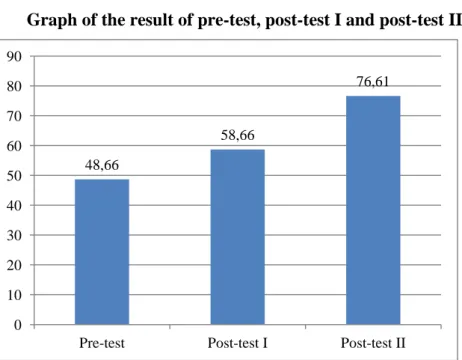
And then, the result of this research showed that Two Stay Two Stray (TSTS) Technique had positive result in increasing the students’ reading comprehension ability at the tenth grade of MA-PSA Istiqomah Islamiyah Panaragan Jaya. It could be proven by the students’ average score that reached in pre-test was 48,66, post-test I was 58,66 and become 76,61 in post-test II. It can be concluded that through Two Stay Two Stray (TSTS) Technique can increase the students’ reading comprehension ability.
Keyword : Reading Comprehension Ability, Two Stay Two Stray (TSTS) Technique, Classroom Action Research
viii
MENINGKATKAN KEMAMPUAN PEMAHAMAN MEMBACA SISWA MELALUI DUA TINGGAL DUA BERTAMU (TSTS) TEHNIK DI KELAS
SEPULUH DI MA-PESANTREN SATU ATAP (PSA) ISTIQOMAH ISLAMIYAH PANARAGAN JAYA TULANG BAWANG BARAT
ABSTRAK OLEH:
DIAH ALFIATUN NI`MAH
Tujuan utama dari penelitian ini adalah untuk mengkaji kemampuan membaca siswa MA-PSA Istiqomah Islamiyah Panaragan Jaya dalam memahami informasi yang terdapat dalam teks bacaan dan untuk mengetahui bahwa Dua Tinggal Dua Bertamu tehnik (TSTS) dapat membantu proses belajar siswa.
Peneliti mencoba membuktikan bahwa Dua Tinggal Dua Bertamu tehnik (TSTS) dapat menjadi salah satu tehnik untuk meningkatkan kemampuan pemahaman membaca siswa.
Dalam penelitian ini, peneliti melaksanakan penelitian tindakan kelas yang dilakukan dalam dua siklus. Setiap siklus terdiri dari perencanaan, pelaksanaan, observasi, dan refleksi. Subjek penelitian ini adalah 21 siswa dari kelas sepuluh MA-PSA Istiqomah Islamiyah Panaragan Jaya. Dalam pengumpulan data, peneliti menggunakan tes (pre-test, post-test I dan post-test II), observasi dan dokumentasi. Penelitian ini bekerjasama dengan guru Bahasa Inggris MA-PSA Istiqomah Islamiyah Panaragan Jaya.
Hasil dari penelitian ini menunjukkan bahwa Dua Tinggal Dua Bertamu tehnik (TSTS) memiliki hasil positif dalam meningkatkan kemampuan pemahaman membaca siswa kelas sepuluh MA-PSA Istiqomah Islamiyah Panaragan Jaya. Hal ini dibuktikan berdasarkan rata-rata yang dicapai siswa pada nilai pre-test adalah 48,66, post-test I adalah 58,66 dan nilai post-test II menjadi 76,61. Dapat disimpulkan bahwa melalui Dua Tinggal Dua Bertamu tehnik (TSTS) dapat meningkatkan kemampuan pemahaman membaca siswa.
Keyword : Kemampuan Pemahaman Membaca, Dua Tinggal Dua Bertamu, Penelitian Tindakan Kelas
ix
x
xi MOTTO
(Al-Isro’,17:7) ……اأَهأَلأَف نْ تُ نْ أَ أَ نْ إِ أَ نْ تُ إِ تُ نْ أَ إِ نْ تُ نْ أَ نْ أَ نْ تُ نْ أَ نْ أَ نْ إِ
If you do good, you do good for your own souls, and if you do evil, it is for them (in like manner)
“Life is not about finding yourself. Life is about creating yourself”
Lolly Daskal
xii
DEDICATION PAGE
I highly dedicate this undergraduate thesis to:
My Beloved Parents (Mr. Suwandi and Mrs. Mardiah)
My Beloved Sister and Brother
(Diah Nur Azizah and Muhammad Yusuf Al-Bastomi) My Beloved Friends
(Zahratul Lathiifah, Pancaning Utami, Sefvirda Arniatika, Rudianto, Imas Sukma Negara, Azzahra Aprillia, Desy Indriani, Zuharoh Ivosari and soon), Absolute (TBI B) Class of TBI 2013 and my Beloved Campus IAIN Metro
xiii
xiv
TABLE OF CONTENT
COVER ……….…………... i
TITLE PAGE ……….……. ii
NOTIFICATION PAGE ……… iii
NOTA DINAS ………. iv
APPROVAL PAGE ………... v
RATIFICATION PAGE ……… vi
ABSTRACT ………. vii
ABSTRAK ……….. viii
STATEMENT OF RESEARCH ORIGINALY ……….. ix
ORISINALITAS PENELITIAN ………... x
MOTTO ………... xi
DEDICATION PAGE ………. xii
ACKNOWLEDGEMENT ………. xiii
TABLE OF CONTENTS ………... xiv
LIST OF TABLES ……….. xvii
LIST OF FIGURES ……….………….. xviii
LIST OF APPENDICES ……… xix
CHAPTER I INTRODUCTION A. Background of Study ………... 1
B. Problem Identification ………...…... 5
C. Problem Limitation ……….…... 6
D. Problem Formulation ………... 6
E. Objective and Benefit of Study ………. 6
CHAPTER II THEORITICAL REVIEW A. The Concept of Reading Comprehension Ability ………. 8
1. The Concept of Reading ……….. 8
a. The Definition of Reading ………..…... 8
xv
b. The Importance of Reading …………..………..…… 10
c. The Models of Reading ……….. 12
d. The Principles for Teaching Reading ………. 13
2. The Concept of Reading Comprehension ……… 13
a. The Definition of Reading Comprehension .………….………. 14
b. The Strategies for Reading Comprehension ……….. 15
c. The Type of Classroom Reading Comprehension ………....….. 16
d. The Teacher’s Role in Teaching Reading ………... 18
3. The Concept of Reading Comprehension Ability ……… 18
a. The Definition of Reading Comprehension Ability …………... 18
b. The Measurement of Reading Comprehension Ability ……….. 20
B. The Concept of Two Stay Two Stray ………. 22
1. The Definition of Two Stay Two Stray ………..…….… 22
2. The Procedure of Two Stay Two Stray ………..……….. 24
3. The Advantage and Disadvantage of Two Stay Two Stray ………. 25
C. Action Hypothesis ……….. 26
CHAPTER III RESEARCH METHOD A. The Variable and The Operational Definition of Variable ……… 27
B. Setting of Study ……….…… 29
C. Subject of Study ……… 30
D. Research Procedure ………... 30
E. Data Collection Technique ………. 36
xvi
F. Research Instrument ………... 39
G. Data Analysis Technique ……… 42
H. Indicator of Success ……… 43
CHAPTER IV RESULT OF THE RESEARCH AND INTERPRETATION A. Result of the Research ……… 44
1. Description of Research Location ……… 44
2. Description of the Research ……….. 51
a. Cycle I ………. 51
b. Cycle II ……… 61
B. Interpretation ………... 69
1. Cycle I ………... 69
2. Cycle II ……….. 70
3. The Students’ Score in Pre-test, Post-test I and Post-test II ………. 71
4. The result of Students’ Learning Activities in Cycle I and II …….. 74
C. Discussion ……… 76
CHAPTER V CONCLUSION AND SUGGESTION A. Conclusion ………... . 78
B. Suggestion ……… . 79 BIBLIOGRAPHY
APPENDICES
CURRICULUM VITAE
xvii
LIST OF TABLES
Table 1 Data Pre-Survey ... 3
Table 2 The KKM of Reading Comprehension Test ... 4
Table 3 The Measurement Rubrics of Reading Comprehension Ability.. 21
Table 4 The Formation of official staffs in MA-PSA Panaragan Jaya …. 47 Table 5 The Condition of Teacher in MA-PSA Panaragan Jaya ……….. 47
Table 6 The Quantity of Students at MA-PSA Panaragan Jaya ………… 48
Table 7 The Building of MA-PSA Panaragan Jaya ………... 49
Table 8 The Students Pre-test Score ………... 51
Table 9 Students’ Mark of Pre-test ………. 52
Table 10 The Students Post-test I Score ………. 56
Table 11 Students’ Mark of Post-test I ………... 57
Table 12 Students’ Activity in Cycle I ………... 58
Table 13 Students’ score at Pre-test and Post-test I ……… 60
Table 14 Students’ Post-test II Score ……….. 63
Table 15 Students’ Mark of Post-test II ……….. 64
Table 16 Students’ Activities in Cycle II ……… 66
Table 17 Students’ Score at Post-test I and Post-test II ………. 67
Table 18 Students’ Activities in Cycle I and Cycle II ……… 68
Table 19 The Comparison of Students’ Score of Pre-test, Post-test I, II .. 71
Table 20 Recapitulation of Students’ Complete Score ………... 73
Table 21 Students’ Activity in Cycle I and Cycle II ………... 74
xviii LIST FIGURES
Figure 1 Spiral Classroom Action Research ... 31
Figure 2 The Organization Structure of MA-PSA Panaragan Jaya ……. 46
Figure 3 The Sketch of Location MA-PSA Panaragan Jaya ……… 50
Figure 4 Graph of the Pre-test Result ……… 53
Figure 5 Graph of the Post-test I Result ……… 58
Figure 6 Graph of the Result of Post-test II ……….. 65
Figure 7 Graph of the result of pre-test, post-test I and post-test II ……. 72
Figure 8 Graph of Students’ Complete of pre-test, post-test I, post-test II 73 Figure 9 Graph of Students’ Result Activity in Cycle I and Cycle II …… 75
xix
LIST OF APPENDICES APPENDICES I
1. Syllabus ... 81
2. Lesson Plan ... 88
3. Students Score of Pre-Survey ... 96
4. The Observation Sheet of Teacher’s Performance I ... 97
5. The Observation Sheet of Teacher’s Performance II ... 99
6. The Observation Sheet of Students’ Activity I ……... 101
7. The Observation Sheet of Students’ Activity II ……... 103
8. The Observation of Reading Comprehension Ability Pre-test 105 9. The Observation of Reading Comprehension Ability Post-test I 107 10. The Observation of Reading Comprehension Ability Post-test II 110 11. The Result of Pre-test, Post-test I, Post-test II ... 113
12. The Measurement of Reading Comprehension Ability … 114
13. Field Note ………. 115
14. Documentation ... 117
APPENDICES II 1. Sk Bimbingan Skripsi ... 122
2. Surat Tugas ... 123
3. Surat Izin Research ... 124
4. Surat Balasan Research ... 125
5. Surat Keterangan Bebas Kaprodi ... 127
6. Surat Keterangan Bebas Pustaka ... 128
7. Kartu Konsultasi Bimbingan Skripsi ... 129
8. Curriculum Vitae ... 131
A. Background of Study
In Indonesia, English is foreign language that much learned in level of school. English is usually a required subject for some years during compulsory education. English was be requirement subject that should be taken to require the curriculum of school. So that, English is foreign language subject which is already familiar among levels of school especially for Senior High School.
English is as foreign language which is has four basic skills, there are listening, speaking, reading and writing. We use all of them to understand our world through mastering those skills in order to communicate our felling with each other. When we meet other people directly, it uses speaking. If anyone is speaking to us, we should be listening what they said. Writing can use when we cannot communicate orally so sending message by written text is good ways. In other time, we receive message (written text), reading is the only ways to know what they mean. From the statements above, four skills is very importance to build our communication world to each other.
In education, reading has the important roles where it used to develop students’ knowledge about lesson or material. Reading is the activity that related between reader and texts. It is the first way to people
known about information from text that processed by their own knowledge for getting the meaning. Reading activities are very common we have done in daily life. Although the activity was commonly done, students still have many problems to master it in English learning. Since English is as language which is not used in daily life, most students in any levels of education get problems in reading English text. It can be indicated that the ability of Indonesian students to read and to comprehend English texts was very low.
Moreover, this condition makes English so difficult to learn Indonesian students. Most students especially in Senior High School, they have limited time to practice and got difficulty when comprehending process in reading English text. The writer finds some problems in reading class but the more specific is students has low understanding about how to identify text. They are often confused about meaning, low in vocabulary, hard to identify and understanding the text. As well as we know that these aspecs are very needed to increase the students ability in reading comprehension. So that is why, we are as the teacher should have new ways to motivate students in order to up their ability.
When we talk about ways or motivation, so many strategies, methods and techniques that can use for teaching language based on age or level. Teacher can choose one or a lot of them to teach and to increase students language ability. Beside this, teacher should be analyzed first students by pre-test in the classroom. After that, teacher will get enough
information about how far the students ability is, what the students problem in learning so that she will be provided what will do next to increase the students reading comprehension ability.
The writer chose a technique for teaching language in reading comprehension ability, it is two stay two stray technique. This is one kinds of cooperative learning method. In this study the writer not use TSTS as method, because cooperative learning is a group of various technique that included in a method. It is adepted from Spencer Kagan (1992). Two stay two stray is technique which provides an opportunity to share the results and other information to the group.
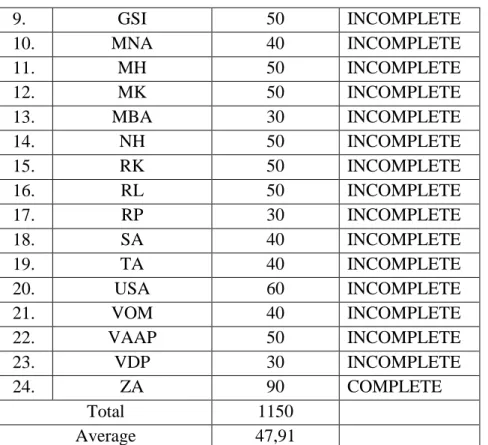
Based on the result of pre-test that was conducted in Senior High School MA-PSA Istiqomah Islamiyah Panaragan Jaya on January, 12th 2017, thw writer founds some problem of reading comprehension like explanation above. Based on the result from pre-test, the table of data as below:
Table I
The Data of Reading Comprehension Result of Pre-test at Tenth Grades of MA-PSA Istiqomah Islamiyah Panaragan Jaya
No. Students’ Initial Score Interpretation
1. AT 50 INCOMPLETE
2. ASY 70 INCOMPLETE
3. ASW 50 INCOMPLETE
4. AS 50 INCOMPLETE
5. AW 50 INCOMPLETE
6. CED 60 INCOMPLETE
7. FNH 40 INCOMPLETE
8. GP 30 INCOMPLETE
9. GSI 50 INCOMPLETE
10. MNA 40 INCOMPLETE
11. MH 50 INCOMPLETE
12. MK 50 INCOMPLETE
13. MBA 30 INCOMPLETE
14. NH 50 INCOMPLETE
15. RK 50 INCOMPLETE
16. RL 50 INCOMPLETE
17. RP 30 INCOMPLETE
18. SA 40 INCOMPLETE
19. TA 40 INCOMPLETE
20. USA 60 INCOMPLETE
21. VOM 40 INCOMPLETE
22. VAAP 50 INCOMPLETE
23. VDP 30 INCOMPLETE
24. ZA 90 COMPLETE
Total 1150
Average 47,91
Source: English Reading Score at the Tenth graders of MA-PSA Panaragan, on January 12th, 2017
Table II
Students’ English Reading Score at the Class X B of MA-PSA Istiqomah Islamiyah Panaragan Jaya
No. Score Explanation Frequency Percentage
1. ≥ 73 Complete 1 4,17%
2. < 73 Incomplete 23 95,83%
Total 24 100%
Source: English Reading Score at the Tenth graders of MA-PSA Panaragan, on January 12th, 2017
The standard minimum criteria (MMC) of MA-PSA Istiqomah Islamiyah Panaragan Jaya for English lesson is 73. It means that students who get the score under 73 can not pass the examination. Based on the table above, there is a student who get complete score (4,17%) and 23 students (95,83%) who uncomplete the pre-test. The writer concludes that
students’ reading comprehension at the tenth graders of MA-PSA Istiqomah Islamiyah Panaragan Jaya is very low.
The writer would used TSTS technique to increase students’
reading comprehension ability because based on the result of pre-test there is possibility increasing their score better than this. TSTS technique can give opportunity students to share his idea or opinion with others and to increase language achivement. So that is why the writer choose this technique, she thought it is suitable to be applied in all of levels and ages.
In this study, the writer would used the classroom action research and it would hoped to increase of teaching and learning English be better especially for students’ reading comprehension ability. In the classroom action research itself, there are 2 or more cycles that can use in implementating the technique. In one cycle, it involves planning, action, observation and reflection that appropriate with necessary of writer and students in the class.
Based on the description above, the writer would conducted the research by the title: Increasing The Students’ Reading Comprehension Ability through TSTS Technique at Tenth Grade of MA-Pesantren Satu Atap (PSA) Istiqomah Islamiyah Panaragan Jaya Tulang Bawang Barat.
B. Problem Identification
According to background of the study above that the writer can identify some problems:
1. The students have a little vocabulary.
2. The students have difficulty to identify the information in reading comprehension text.
3. The students have low ability in comprehending the meaning of the text.
C. Problem Limitation
According to the problems mentioned above, the writer limits the problem only focused on the students are having low ability in comprehending the meaning of the Reading Comprehension text at tenth grade of MA-PSA Istiqomah Islamiyah Panaragan Jaya Tulang Bawang Barat.
D. Problem Formulation
According to background of study and problem identification above, the writer formulates problems formulation in this study as follows:
“Can the use of TSTS technique increase the students’ reading comprehension ability at tenth grade of MA-PSA Istiqomah Islamiyah Panaragan Jaya Tulang Bawang Barat?”
E. Objective and Benefit of Study 1. Objective of the Study
Objective from doing this study is to know matters as;
a. To increase students reading comprehension ability by using TSTS techique.
b. To increase students’ learning activity by using TSTS technique at the tenth grade of MA-PSA Istiqomah Islamiyah Panaragan Jaya.
2. Benefit of the Study
The result of study is expecting obtained benefit in two aspects as;
a. Theorities Aspect
The result of study is expecting to increase knowledge in teaching technology, especially related by technique of English learning.
b. Practices Aspect
The result of study is expecting gave benefit for;
1. Headmaster, as a consideration in guiding English teacher, taking a decision and coaching in English learning process.
2. Teacher, as information to teacher about procedure of TSTS technique can be realized in English language to increase students learning achievement.
3. Student, as a motivation to learn English especially in reading comprehension ability and encouragement to creat learning group for increasing students achivement.
4. Other resercher, hopefuly this study can be prior research of the same subject or type of research.
A. The Concept of Reading Comprehension Ability 1. The Concept of Reading
It described the definition of reading, the importance of reading, the models of reading, strategies of reading, the principles for teaching reading, and the techniques in teaching reading.
a. The Definition of Reading
As we know that the reading is one of the important skill between four skills; listening, speaking, reading and writing, and many experts explaine it based on their mind and knowledge.
According to Neil Anderson, reading is a fluent process of readers combining information from a text and their own background knowledge to built meaning.1 It is relate to reading as the first way to people known about information from texts that processed by their knowledge for getting the meaning.
From reading, we can be guessing what text means and getting information in it. This is supported by state,”Reading is a constant process of guessing, and what one brings to the text is often more important than one finds in it”.2 So we can understand what the
1 Nunan David, Practical English Language Teaching, (New York: McGraw-Hill, 2003), 1st ed, Page 68
2 Grellet Francois, Developing Reading Skills, (Cambridge: Cambridge University Press, 1999), Page 7
writter means by reading and guessing based on our ideas after processe in our mine to get the meaning.
Based on statement above reading is understanding about texts, but it is not quite up there. The readers read texts for knowing and comprehending some information, so they can reach their knowledge or ability. With reading, the readers will be got much knowledge and can be processed by speaking about it with others or writing the main ideas for his self. It related to Hittleman states that “reading is a verbal process interrelated with thinking and with all other communication abilities: listening, speaking, and writing”.3
Another expert, Dechant et al, “reading is a language process and communication that is a process which gives opportunity to readers to interact and communicate with different ideas”.4 Anderson gives his definition of reading that reading is a process of readers combining of information from text and their own background knowledge to build meaning.5 It has connection with statement before, after people read a text, then he combines his informantion and his own ideas to create meaning.
3 Hamra A, Syatriana Eny, “Developing a Model of Teaching Reading Comprehension for EFL Sstudents”, TEFLIN Journal, Universitas Negeri Makasar, Vol. 21, No.1, February 2010, Page 31
4 Ibid,
5 Satria Agust, et al., “The Effectiveness of One Stay/Three Stray Method to Teach Reading Viewed from Students’ Self-Actualization”, English Teaching Journal, Vol. I, Issue 1, 2012, Page 70
Grabe points out he complexity of even defining reading by stating that a description of reading has to account for the notions that fluent reading is rapid, purposeful, interactive, comprehending, flexible, and gradually developing.6 Thus, the writer concludes that reading is a process of understanding a text by readers comprehending and combining information to get the meaning that we are necessity and this activities have relation with our life in daily activities.
b. The Importance of Reading
In English subject has four skill that has studied, they are listening, reading, speaking and writing. Reading is an essential skill for learners of English as a second language.7 Not only listening anymore for teaching second language, but also reading is good way for it. Reading is useful for other purposes too; any exposure to English (provided students understand it more or less) is a good thing for language students.8
Reading is the meaningful interpretation of printed or written verbal symbols. Hedge states that any reading component of an English language course may include a set of learning goals for:9
6 David Nunan, Practical English, Page 68
7 Ibid, Page 69
8 Jeremy Harmer, How to Teach English, (England: Longman, 1998), Page 68
9 Alyousef Hesham S, “Teaching Reading Comprehension to ESL/EFL Learners”, The Reading Matrix,Vol. 5, No. 2, September 2005, Page 147
1. The ability to read a wide range of texts in English. This is the long-range goal most teachers seek to develop through independent readers outside EFL/ESL classroom.
2. Building knowledge of language which will facilitate reading ability.
3. Building schematic knowledge.
4. The ability to adapt the reading style according to reading purpose (i.e. skimming, scanning).
5. Developing an awareness of the structure of written texts in English.
6. Taking a critical stance to the contents of the texts.
It is the process by which people gain information and ideas from books, newspapers, manuals, letters, contracts, advertisements and a host of other materials.10 In the other hand, reading is involving in our daily activities and including the importance process to get information that we need.
Realizing the importance of reading for students’ needs, it is then very crucial for the students to have good reading proficiency.
Reading has the important position in English lesson, because of it students must have good achievement in reading subject.
10 Blachowicz Camile, Ogle Donna, Reading Comprehension: Strategies for Independent Learners, (New York: The Guilford Press, 2008), 2nd ed, Page 15
c. The Models of Reading
Nunan suggests the models can be divided into three categories as follow:11
a. Bottom-up models
It models typically consist of lower-level reading processes. Students start with the fundamental basics of letter and sound recognition, which in turn allows for morpheme recognition followed by word recognition, building up to the identification of grammatical structures, sentences, and longer texts. Letters, letter clusters, words, phrases, sentences, longer text, and finally meaning is the order in achieving comprehension.
b. Top-down models
The reader uses background knowledge, makes predictions, and searches the text to confirm or reject the predictions that are made. A passage can thus be understood even if all of the individual words are not understood. Within a top-down approach to reading the teacher should focus on meaning generating activities rather than on mastery of word recognition.
11 Nunan David., Practical English., Page 70-72
c. Interactive models
The third models combines elements both bottom up and top-down models, it assumes from Stanovich, “that a pattern is synthesized based on information provided simultaneously from several knowledge sources”.
d. The Principles for Teaching Reading
According to Nunan, there are some principles for teaching reading, those are:12
1. Exploit the reader’s background knowledge 2. Build a strong vocabulary base
3. Teach for comprehension 4. Work on increasing reading rate 5. Teach reading strategies
6. Encourage readers’ to transform strategies into skill 7. Build assessment and evaluation into your teaching 8. Strive for continuous improvement as a reading teacher 2. The Concept of Reading Comprehension
It described the definition of reading comprehension, the strategies for reading comprehension, the types of classroom reading comprehension.
12 David Nunan, Practical English., Page 74-77
a. The Definition of Reading Comprehension
The goal of reading is comprehension. Reading comprehension is one of reading goal that would be getting since teaching English.
This is supported by states, “Comprehension is the essence of reading because the goal of written language is communication of messages”.13
Some experts explain their ideas about comprehension within their statement. Likes Duffy states, comprehension is a continuous process of using text clues-mainly word meanings but also syntactic clues-to access relevant categories of prior knowledge and, on the basis of our own experience with those categories of knowledge, making predictions about what meaning is to come.14 The next state is according to Dorn as follows:
Comprehension is a complex process regulated by cognitive, emotional, perceptual, and social experiences. When individuals read, they apply a range of comprehending strategies to monitor and sustain their meaning.
Comprehending involves interpreting and synthesizing ideas in ways that influence the reader’s mind.15
Reading comprehension is understanding a written text means extracting the required information from it as efficiently as possible.16 Building the meaning based on understanding the written text and improving information in it. According to
13 Duffy Gerald G, Explaining Reading: a Resource for Teaching Concepts, Skills, and Strategies, (New York: The Guilford Press, 2009), 2nd ed, Page 14
14 Ibid, Page 17
15 Dorn, Soffos, Teaching for Deep Comprehension: a Reading Workshop Approach, (United States of America: Stenhouse Publishers, 2005), Page 14
16 Grellet F., Developing Reading, Page 3
Anderson et,al states, reading comprehension is the process of constructing meaning by coordinating a number of complex processes that include word reading, word and world knowledge, and fluency.17
Reading comprehension involves much more than readers’
responses to the text.18 Reading comprehension is a complex process. It involves many interactions between readers, what they bring to the text (previous knowledge and strategies used) and variables related to the text (interest in text, understanding of text types).
From the statements above, we can conclude that reading comprehension is a complex process of understanding print or written text to construc the meaning with collaboration between readers ideas and knowledge to get what the authors means.
b. The Strategies for Reading Comprehension
From Brown states that several strategies can be applied to increase students’ reading comprehension, as follow:
a. Identify your purpose in reading a text
b. Apply spelling rules and conventions for bottom-up decoding c. Use lexical analysis (prefixes, roots, suffixes, etc) to determine
meaning.
17 Janette k. klingner, et al, Teaching Reading Comprehension to Students with Learning Difficulties, (New York: The Guilford Press, 2007), Page 2
18 Ibid, Page 8
d. Guess at meaning (of words, idioms, etc.) when you aren’t certain.
e. Skim the text for the gist and for main ideas.
f. Scan the text for specific information (names, dates, key words).
g. Use silent reading techniques for rapid processing.
h. Use marginal notes, outlines, charts, or semantic maps for understanding and retaining information.
i. Distinguish between literal and implied meanings
j. Capitalize on discourse markers to process relationships 19 c. The Type of Classroom Reading Comprehension
According to Brown, several types of classroom reading comprehension as follow:20
a. Perceptive
It involves attending to the components of larger stretches of discourse: letters, words, punctuation, and other graphemic symbols. Bottom-up processingis implied.
b. Selective
It involves to ascertain one’s reading recognition of lexical, grammatical, or discourse features of language within a very short stretch of language, certain typical tasks are used: picture- cued tasks, matching, true/false, multiple-choice, and extract.
19 Brown Douglas, Language Assessment: Principle and Classroom Practices, (California: Longman Press, 2003), Page 188-189
20Ibid, Page 189
Its also included sentences, brief paragraphs, and simple charts and graphs.
c. Interactive
It is included among interactive reading types are stretches of language of several paragraphs to one page or more in which the reader must. Typical genres in interactive reading are anecdotes, short narratives and descriptions, excerpts for longer texts, questionnaires, memos, announcements, directions, recipes and the like. The focus of an interactive task is to identify relecant features (lexical, symbolic, grammatical, and discourse) within texts of moderately short length with the objective of retaining the information that is processe.
d. Extensive
Extensive reading applies to texts of more than a page, up to and including professional articles, essays, technical reports, short stories and books. In extensive reading gives opportunity to the reader to understandreading without reading every language feature of the text, but it is more focus to the meaning of the text and to get fluency in reading.
By the explanation above, the writer will conduct the reading comprehension in the classroom with interactive types. It is suitable with the research subject among the tenth grade of senior high school.
d. Teacher’s Role in Teaching Reading
Teaching reading usually has at least two aspects. First, it can refer to teaching learners who are learning to read for the very first time. A second aspect of teaching reading refers to teaching learners who already have reading skills in their first language.21
Durkin says, conducted an observational study of reading comprehension instruction. She revealed that typical comprehension instruction wasn’t very engaging or likely to improve reading comprehension. She summarized reading comprehension instruction as following a three-step procedure:
mentioning, practicing, and assessing. That is, teachers would mention the skill that they wanted students to use, then they would give them opportunities to practice that skill through workbooks or skill sheets, and finally assess whether or not they used the skill successfully.22
3. The Concept of Reading Comprehension Ability
It described the definition of reading comprehension ability and the measurement of reading comprehension ability.
a. The Definition of Reading Comprehension Ability
According to Danielle states, Comprehension refers to the ability to go beyond the words, to understand the ideas and the
21 Nunan David, Practical English., Page 68
22 Klingerner, Janette K, et al, Teaching Reading Comprehension, Page 2
relationships between ideas conveyed in a text.23 Reading comprehension ability is a way for understanding the words that have the own meaning presented in the text. This ability was very important to readers in comprehending various text met in their live.
Comprehension is not always effortless and fast, of course.
When beginning readers struggle over individual words, reading is slowed to a near halt and deeper levels of comprehension are seriously compromised.24 Reading comprehension ability is interactive process that takes place between a reader and a text. It means that the main point of reading comprehension ability is at the interaction between readers and writters. How readers’
understanding can be constructed to catch the meaning of the writter want to explain on the text.
The ability to read is crucial in contemporary society people find many texts written in English, from holiday brochures to academic books, newspaper, pamphlets, magazines, traffic directions, advertisement, etc. In another hand, reading is nearby relation with human life in society because they always meet text in wherever they are. The other purposes of reading comprehension ability is the reader can catch the writter means or have a good interaction with the meaning of the text.
23 Danielle S.McNamara, Reading Comprehension Strategies: Theories, Interventions, and Technologies, (New York: Lawrence Erlbaum Associates, 2007), Page xi
24 Ibid, Page 4
For students, it is useful to build the understanding about how to catch the meaning of the text that they read. To build good interaction between students and text, it is influend by many factors, one of them is the background knowledge of students about the text that will be read, students who has known the background knowledge about the text will be easier to understand the text means. Well, giving information and background knowledge about the text to the students is needed, so students can understand the meaning of what they read and can comprehend the text well.
Based on the explanation above, it can be concluded that reading comprehension ability is a process of deep interaction between reader and writter to communicate successfully in getting information the text. The students as the readers can comprehend the text based on their ability to recognize the text.
b. The Measurement of Reading Comprehension Ability
Reading comprehension measures should help teachers monitor the comprehension of their students over time and provide information that is useful in designing reading comprehension intervention program.25 There are some criteria commonly use in measuring students’ reading comprehension ability, these are:26
1) Main idea (topic)
25 Klingerner, Janette K, et al, Teaching Reading Comprehension, Page 18
26 Brown Douglas, Language Assessment: Principle, Page 206
2) Expression/idioms/phrases in context 3) Inference (implied detail)
4) Grammatical features
5) Detail (scanning for a specifically stated detail) 6) Excluding facts not written (unstated detail) 7) Supporting ideas
8) Vocabulary in context.
In all cases, the measurement takes the form of standardized assessments aligned to state standards.27
Table 3
Scoring Rubric of Reading Comprehension Ability
Band Indicators
0 No response
1 An inaccurate and incomplete response
2 Some information is accurate and some is inaccurate; the response is sketchy.
3 Information is generally accurate and complete, but not well developed.
4 Response is accurate and complete.
5
Response is accurate and complete, plus the student points out interrelationships between elements or makes connections to personal knowledge.
Holistic reading comprehension rubric28
27 JoAnne Schudt Caldwell, Reading Assessment: A Primer for Teachers and Coaches, (New York: The Guilford Press, 2008), 2nd ed, Page 234
28 Klingner Janette K, et al, Teaching Reading Comprehenison, Page 35-36
B. The Concept of Two Stay Two Stray
It described the definition of two stay stwo stray, the procedure of two stay two stray, and the advantages and disadvantages of two stay two stray.
1. The Definition of Two Stay Two Stray
Two stay two stray is a technique for teaching one of cooperative learning method or grouping learning. It is a cooperative learning activity for shearing ideas within a classroom.29 This technique was developed by Spencer Kagan and was used together with Head Number technique. It was used in all of lesson subject and all age of student level.30
Two stay two stray is a teaching technique adopted from One stay three stray by Spencer Kagan.31 Before TSTS turn up, the first technique that intoduced by Spencer Kagan is One Stay Three Stray (OS-TS). After several years, he is developed become Two Stay Two Stray technique that chosen by the writer. Those are having difference just in quantity when distribution the member of group.
TSTS technique is designed into small groups of students consisting of four students. The students work in small (four-member) groups of mixed ability, including one high achiever, two average
29 Crawford Alan, et al, Teaching and Learning Strategies for The Thinking Classroom, (New York: The International Debate Education Association, 2005), Page 63
30 Huda Miftahul, Cooperative Learning, (Yogyakarta: Pustaka Pelajar, 2015), Page 140
31 Maharani O. P.,“The Effectiveness of Using Two Stay Two Stray as a Technique in Improving Students Speaking Ability”, Journal of English Language Teaching, Universitas Negeri Semarang, Vol 5, No 1, April 2016, Page 2
achievers, and one low achiever or divided by condition and result of pre-test. The groups discuss the topic that is given by the teacher. In TSTS technique, students are responsible for helping other members to learn, achieve the group goal and share information with other groups.
It will bring students to active in learning process, because students will learn more though process constructing and creating working in group and sharing knowledge.
In learning process, this technique can give the students experience in gathering information. During activity, the students are encouraged to contribute their ideas and opinion to another student. In this activity, teacher has an important role. The teacher controls the process of this activity and helps the students who have difficulties in role. Then, the teacher should pay attention to the allocation of time during the activity.
Alan Crawford et.al, also has argued,
This is very useful strategy for quickly sharing ideas within a large class. It has the advantage, shared by many cooperative learning techniques, of putting students in reponsible roles in which they function as expert providers of information to others.32
The structure of TSTS gives a chance to the group to share the resut and information to the other groups. It is done because a lot of learning activities are individual orientated activities. Many teaching and learning activities are combined with individual activities.
32 Crawford Alan, et al, Teaching and Learning, Page 63
Students learned by self and did not see task from other student.
Besides in the real life out of school, life and human working are depends one and others.
2. The Procedure of Two Stay Two Stray
In this technique, each group that consist of 4 members is given an opportunity to share the results of their group discussion with others (another group) by sending two representatives from their member to other groups. Two member others will stay within their group and become presenter for their guests who will come from one of another groups to search information.
Lie suggests the TSTS consists of some steps as follow:33 a. The students are set in group of four students.
b. Then two students of each group will leave the group, each of the two students will stray to other groups.
c. The two staying students have task to share information and work result to their guests.
d. The guests excuse themselves and back to their group and report their findings from other groups.
e. The group matches and discusses the information.
33 Lie Anita, Cooperative Learning: mempraktikkan Cooperative Learning di Ruang- Ruang Kelas, (Jakarta: PT. GRASINDO, 2002), Page 62
3. The Advantages and Disadvantages of Two Stay Two Stray a. The Advantages of Two Stay Two Stray
According to Lie, this technique can be used in all subject and to all levels of students age.34 The first, Two Stay Two Stray is easier technique that can be used variety lessons and age level of students in the classroom. Perhaps other technique have limited subject and level to apply in the certain condition, but this can be able adaptation in both.
Beside this, its given opportunity for group to share the result and information with others.35 When this technique applied, the second advantages that will get is the opportunity for students sharing his information to another group and getting new things that he needs to complete his result.
This technique try the students to socialize well and to practice communication in solving the problem together. Thus, the TSTS technique can make the students more active in group discussion, question-answer to find the answer for explaining another group and attention to explain the materials given by the other students in group discussions.
b. The Disadvantages of Two Stay Two Stray
While the disadvantages of this technique are: first, this is taken a long time. If the teacher will apply this technique, it
34 Ibid, Page 61
35 Ibid,
will success when at beginning semester. Second, students tend to not want to learn in a group. Students not all of them want to learn together in group, any perhaps learned by themselve.
Then, the teacher should prepare something to support this technique, such as materials, money and effort. In addition, teachers tend to difficulties in classroom management. It is occurred because a lot of steps and procedures which must be fulfilled or done before applying this technique in the classroom.
C. Action Hypothesis
Based on arranging theories and the writer formulates the hypothesis as follow: by using Two Stay Two Stray technique students’
reading comprehension ability and their learning activity can be increased at the tenth grade of MA-PSA Istiqomah Islamiyah Panaragan Jaya.
A. The Variable and Operational Definition of Variable 1. The Variable of Research
A variable is a characteristic or attribute of an individual or an organization that (a) researchers can measure or observe and (b) varies among individuals or organizations studied. They are key ideas that researchers seek to collect information on to address the purpose of their study.36
Research often concerns relationships between two variables; there are an independent variable and a dependent variable. An independent variable is an attribute or characteristic that influences or affects an outcome or dependent variable.37 Researchers studied independent variables to see what effect or influence they have on the outcome.
Then, The dependent variable is the response or the criterion variable that is presumed to be caused by or influenced by the independent treatment conditions and any other independent variables.38 On the other hand, a dependent variable is the outcome variable which is caused in total or part by the independent variable.
36 John W. Creswell, Educational Research: Planning, Conducting, and Evaluating Quantitative and Qualitative Research, (USA: Pearson Education, 2012), 4th ed, Page 112
37 Ibid, Page 116
38 John W. Creswell, Research Design: Qualitative, Quantitative, and Mixed Methods Approaches, (USA: SAGE Publication, 2009), 3rd ed, Page 157
2. The Operational Definition of Variable
At this stage operational definitions of terms are usually given in research proposal so that statement of the problem must convey the specific meaning. The variables of the study should be defined clearly and unambiguously in operational terms.39 Based on the statement above, the operational defines as follows:
a. Independent Variable
Independent variable in this research is Two Stay Two Stray technique. To measure the independent variable, the researcher collected the data by observation list. Therefore, there are some of indicators that indicated the students be able to achieve the objectives of this technique as follow:
a. The student be able to work grouply and be active to build teamwork.
b. The student would be able to share the information to others.
c. The student could understand TSTS technique based on the rules to increase the reading comprehension ability.
d. The teacher could use this technique as the variation in learning process.
Moreover, the purpose of using TSTS technique in this research is to practice students’ understanding by sharing the result
39 Yogesh Kumar Singh, The Fundamental of Research Methodology and Statistics, (New Delhi: New Age International Publishers, 2006), Page 33
or information to the others and to add the varian technique in learning process for making it fun.
b. Dependent Variable
Dependent variable of this research is reading comprehension ability. To measure the students’ reading comprehension ability, the researcher took the students achivement by giving written test as pre test and post test.
The measurement of reading comprehension ability is based on the table of holistic for reading comprehension ability.
Beside the explanation above, the indicator of dependent variable are:
1) The students could find the main idea of the text,
2) The students could answer the following question of text, 3) The students could note the important details of the text, 4) The students could understand what the writer means.
Therefore, the goal in this research is the students could identify the information of the reading English text by comprehending ability.
B. Setting of Study
The researcher conducted the research place the tenth grade at MA- PSA Istiqomah Islamiyah Panaragan Jaya in academic year 2017/2018 which is located on Pahlawan street no. 47 Panaragan Jaya, Tulang Bawang Tengah, Tulang Bawang Barat.
C. Subject of Study
The subject of this research is X B students of MA-PSA Panaragan Jaya. Actually in the tenth of MA-PSA there are two classes, there are X B and X C. But the writer choose X B class, because their class have heterogen level of English. That is based on pre-survey and information with teacher of tenth graders. This class has 21 students consist of 8 male and 13 female.
D. Research Procedure
The researcher focused the research by using classroom action research. According to Mills, action research designs are systematic procedures done by teacher (or other individuals in an educational setting) to gather information about, and subsequently improve, the ways their particular educational setting operates, their teaching and their student learning.40
Nunan also gave his state, Action research as an integral part of teachers’ professional practice has been argued from most recently and forcefully by Kemmis and McTaggart who provide a four stage cycle for carrying out such research.41 It supported that action research is the importance part to complete the teacher teaching practice professionally by providing the four stage of cycle.
From Lewin, he said that developed a theory of action research as a spiral of steps involving planning, fact-finding (or reconnaissance) and
40 Creswell John W., Educational Research: Planning, Page 577
41 Nunan David, Language Teaching Methodology: a textbook for teachers, (New York:
Prentice Hall, 1991), Page 13
execution, and which later came generally to be understood as an action–
reflection cycle of planning, acting, observing and reflecting.42
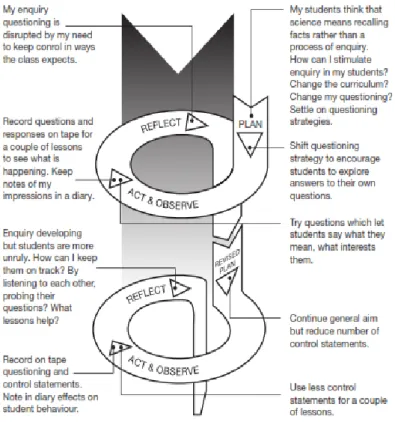
Based from the statement above, action research consists of 4 stage cycle; there are planning, action, observation and reflection, as follows:
Figure 1. The individual aspect in action research by Kemmis Based on the figure above, it could be inferred that the classroom action research is a dynamic process that has four aspects (planning, acting, observing, and reflecting) in every cycles, it was done in the class to increase the quality of learning practice.
42 McNiff Jean, Whitehead Jack, Action Research: Principle and Practice, (New York:
Routledge Falmer, 2002), 2nd ed, Page 41
The following is the Classroom action research cycles:
1. Cycle I
a. Planning
In the classroom action research, the first step to take is planning, for example making lesson plan, observation sheet, and others.43 The researcher would be made lesson plan and another thing to support the action learning in it. Without planning the activity that the researcher has done would not be focused. Here was step that researcher had made in planning:
1) The researcher and collabolator prepared the lesson plan.
2) The researcher and collabolator prepared the material.
3) The researcher and collabolator prepared source learning.
4) The researcher and collabolator prepared observation sheet.
The researcher was done the action research in tenth grade students of MA-PSA Istiqomah Islamiyah Panaragan Jaya in a lot of cycles. The researcher discussed with the English teacher to determine the actions to solve the existing problems. Before doing the actions, the researcher gave the students pre-test. And then in the next meetings, there was done the actions. At the last action, there would be giving the post-test.
43 Muslich Masnur, Melaksanakan PTK itu Mudah (Classrom Action Research), (Jakarta:
Bumi Aksara, 2012), Page 44
b. Action
The next step is doing an action. It would be realization of the planning the researcher was made. In this step the researcher acted as follows:
1) Pre Teaching Activity
a) Prayed and greeted the students.
b) Checked the attendance list.
c) Asked the students condition.
2) While Teaching Process
a) The teacher applied the lesson plan.
b) The teacher explained about reading comprehension and TSTS technique in increasing students’ reading comprehension ability.
c) The teacher began to apply the procedur of TSTS technique.
d) The teacher instructed the students to read and to identify the text in groups.
e) The teacher gave evaluation.
3) Post Teaching Activities
a) The teacher asked to the students to answer some questions related to the topic.
b) The teacher greeted for the students.
c. Observation
This step, the researcher observed the process of teaching learning during in the classroom by using observation sheet and the outline of observation such students able to do the task and understand the material. Observation activities included recording the event and action in the class. The important points in teaching learning process has noted by observer.
d. Reflection
The last step in action research is reflection. The researcher analyzed the data and discussed the observation result during teaching process, like the indication success or not, the weakness and strength from the actions that was doing. The researcher used the evaluation data to make improvement for the second cycle. The researcher decided that the next cycle focused on the weakness in preview cycle.
If the result of the actions was not showed the increasing of students’ in reading comprehension like what in the indicator of success, so the researcher acted the next cycle.
2. Cycle II a. Planning
Planning was the first steps in each activity. Here was step that researcher made in planning:
1) The researcher and collabolator prepared the lesson plan.
2) The researcher and collabolator prepared the material.
3) The researcher and collabolator prepared source learning.
4) The researcher and collabolator prepared observation sheet.
b. Acting
The second steps is acting. It was the implementation about the planning. The researcher actes as follows:
1) Pre Teaching Activity
a) Prayed and greeted the students.
b) Checked the attendance list.
c) Asked the students condition.
2) While Teaching Process
a) The teacher applied the lesson plan.
b) The teacher gave the explanation to the student how to comprehend the reading text.
c) The teacher began to apply the procedur of TSTS technique with gave a text followed by questions.
d) The teacher asked the students to read the text and to identify in groups.
e) The teacher gave evaluation.
3) Post Teaching Activities
a) The teacher asked to the students to answer some questions related to the topic.
b) The teacher greeted for the students.
c. Observing
This step, the researcher observed the process of teaching learning during in the classroom by using observation sheet and the outline of observation. Observation activities included recording the event and action in the class. The important points in teaching learning process has noted by observer.
d. Reflecting
The researcher corrected and analyzed the result of the action. By reflecting, the researcher knew the strenght and weakness of the action. In this step the researcher compared the score distribution of pre test and post test, the researcher reviewed and reflected on the students’ attitude is it was positive or negative, enough in the second cycle or need for next cycle.
E. Data Collection Technique
Collecting data means identifying and selecting individuals for a study, obtaining their permission to study them, and gethering information by asking people questions or observing their behaviors.44 This is needed to obtain accurate data from individuals and places. For completing the data collection, the researcher used qualitative and quantitative data. To acquire the qualitative data, the researcher chose observation, documentation and
44 Creswell John W., Educational Research, Page 9
field note. Meanwhile in acquiring the quantitative data, the researcher used test that consist of pre-test and post-test.
1. Test
According to Arikunto, a test is a procedure or an instrument used to know or to measure something (ability, attitude, achievement and/or intelligence) with some particular role.45The researcher used both pre- test and post-test. The result of test analyzed to know students’ reading comprehension control. There are pre-test and post-test.
a. Pre-test
The researcher would be gave pre-test to students before implementing the primary learning. This step uses to know how far students’ reading comprehension ability.
b. Post-test
This test would be done after the final of learning to know the effect of TSTS technique whether is able to increase the students’
reading comprehension ability. The increasment can be seen if the average score of the post-test is higher than pre-test.
2. Observation
The researcher would be done an observation dealing the real situation related to the teaching and learning process. The term observation is being used in the sense of taking regular and conscius notice of
45 Saputra Ahadi, Use of Two Stay Two Stray Strategy in Teaching Reading, English Education Journal (EEJ), Banda Aceh: University of Syiah Kuala. Vol.7, No.2, April 2016, P. 226
classroom actions and occurrences which are particularly relevant to the issues or topics being investigated.46
3. Documentation
Documentation is technique that would be used to get information from the written source or documents like book, magazines, reguation, notes of meeting and daily report. The researcher used it to get data about the condition of students, school, teacher, official employed and the others at MA-PSA Istiqomah Islamiyah Panaragan Jaya.
Furthermore, the documentation used to know the data of the elements at the school.
4. Field notes
Field notes are the most common data collection strategy used in action research to provide a record of what is going on during an observation. Field notes included descriptions of places (locations, physical layouts, etc.), people (individuals, types, positions, etc.), objects (buildings, furniture, equipment, materials, etc.), acts (single actions that people take), activities (sets of related acts), events (sets of related activities), purposes (what people are trying to accomplish), time (times, frequency, duration, sequencing, etc.), and feelings (emotional orientations and responses).47
46 Burn Anne, Collaborative Action Research for English Language Teachers, (Cambridge: Cambridge University Press, 1999), Page 80
47 Ary Donald, et.al, Introduction to Research in Education, (Wadsworth: Cengage Learning, 2010), 8th ed, Page 526