THE USE OF VISIBLE THINKING TECHNIQUE TO IMPROVE SPEAKING ABILITY OF THE SECOND YEAR
STUDENTS OF SMK NEGERI PAKU
By RUGAIYA
Reg. Number: 18.0213.009
ENGLISH EDUCATION POSTGRADUATE PROGRAM STATE ISLAMIC INSTITUTE (IAIN) PAREPARE
2021
THE USE OF VISIBLE THINKING TECHNIQUE TO IMPROVE SPEAKING ABILITY THE SECOND YEAR
STUDENTS OF SMK NEGERI PAKU
A Thesis Submitted in Partial Fulfillment of Requirements for the Degree of Master of Education (M.Pd) at IAIN Parepare Postgraduate Program
By RUGAIYA
Reg. Number: 18.0213.009
ENGLISH EDUCATION POSTGRADUATE PROGRAM STATE ISLAMIC INSTITUTE (IAIN) PAREPARE
2021
iv
Tap Sca
v
DECLARATION OF THE AUTHENTICITY OF THE THESIS
The Writer signed declaration below:
Nama of student : Rugaiya Student Reg. Number : 18.0213.009 Study Program : English Education
Title of Thesis : The Use of Visible Thinking Technique to Improve Speaking Ability the Second Year Students of SMK Negeri Paku
Stated that this thesis is her own writing. The things out of her masterpiece in this thesis are signed by citation and refered in the bibliography. If it can be proven that thesis has discrepancies, copied or duplicated by any other people, this thesis and the degree that has been gotten would be postponed.
Parepare, February 2021 Writer,
RUGAIYA
NIM: 18.0213.009
vi
ACKNOWLEDGEMENT
Bismillᾱhir Rahmᾱnir Rahῑm
First of all, the writer would like to extend her sincere gratitude to Allah SWT, the Lord of the universe who has given her opportunity and courage to accomplish this thesis as partial fulfillment of the requirements to finish her study and achieve the degree of Magister Pendidikan from English Education of Postgraduate Program of State Islamic Institute (IAIN) of Parepare.
Secondly, the writer is grateful to he parents for their everlasting affection to encourage her and prayer to lead her in writing this thesis. Also thank for lovely her husband Abd. Azis Hatta, S.Sos (Alm.) for always support until he gone. And her little angel Khaira Fayola Azizah who always accompany in study.
Thirdly, the writer also owes thanks to her consultant Dr. Zulfah, M.Pd.
and co-consultant Dr. Abdul Haris Sunubi, M.Pd. for their guidance and suggestions in assisting her doing the research, composing her draft and finally writing her thesis.
Next, the writer would like to express her thanks to:
1. Dr. Ahmad S. Rustan, M.Si. as the Rector of IAIN Parepare who works hard together with the staff to manage education system in IAIN Parepare.
2. Dr. Mahsyar as the Director of Postgraduate Program of IAIN Parepare and also Dr. Abdul Haris Sunubi, M.Pd. as the chairman of English Education Study Program as well as all the staffs for their dedication in creating comfortable situation of education for the students.
3. The lecturers of English Education Study Program for their guidance during the years of the writers study.
vii
4. Drs. Zainuddin as the Headmasters of SMKN Paku for the permission in conducting this research, also for the novice students as the respondents for their participation during this research.
5. Her fellow students of English Education Study Program 2018 for their support and assistance in finishing the last semester of her study.
Finally, the writer expresses her gratitude to the many people who saw her through this thesis for their support and constibution to accomplish it. May Allah SWT, count our effort as kindness in this world and hereafter.
At last, it is undeniable that this thesis is still far from perfection although many efforts have been made to make it complete. Therefore, any constructive criticism and suggestions for the improvement of this thesis are highly appreciated. Hopefully, that this thesis is able to give constribution to the readers and useful for the teaching and learning process.
Alhamdu lillᾱhi rabbil ’alamῑn
Parepare, February 2021 Writer,
RUGAIYA
NIM: 18.0213.009
viii
RUGAIYA. The Use of Visible Thinking Technique to Improve Speaking Ability of the Second Year Students of SMK Negeri Paku.
(Supervised by Zulfah and Abdul Haris Sunubi)
The objective of this research is to to describe the used Visible Thinking Technique improve students speaking ability of the second year students of SMK Negeri Paku. It attempted to answer the question of how does Visible Thinking Technique improve students speaking ability of the second year students of SMK Negeri Paku Polewali Mandar in academic year 2020/2021.
This research was designed in action research. The actions were implemented in two cycles each of which consisted of five stages: reconnaissance, planning, acting, reflecting dan revising plan. This research involved 21 students of the second year students of SMKN Paku in academic year of 2020/2021 and the English teacher as the researcher collaborator. The data of the study were in the form of qualitative and quantitative data. The qualitative data were collected by observing the teaching and learning process and interviewing the students of the second class and the English teacher. The quantitative data were collected through the pre-test, the progress test, and the post test. In analyzing the data, the following steps were applied assembling data, coding the data, comparing the data, building meaning and interpretation, and reporting the outcomes. The validity of the data was obtained by applying democratic, dialogic, catalytic, and outcome validity.
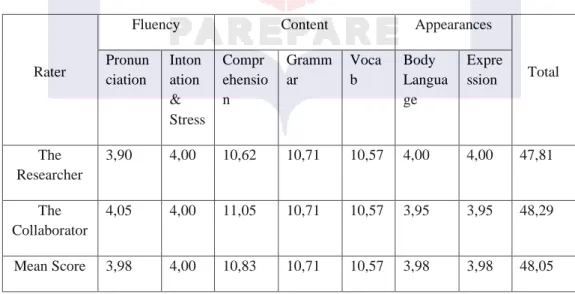
The Results of this research show that the use of the Visible Thinking Technique was able to improve the students’ speaking ability. Based on the qualitative data, applying Visible Thinking Technique gave the students more chance to speak in English. The students become more confident to speak up English. They actively preparticipated during the teaching and learning process. The use of classroom English helped the students to be familiar with English. The vocabulary practice and pronunciation drill also helped them to enrich their vocabulary knowledge and build their accuracy. These findings were also supported by the result of the students’ speaking scores. The mean score improved from 48,05 in Cycle I to 84,71 in Cycle II. It indicated that they made a considerable improvement in some aspect of speaking skills such as pronunciation, intonation and stress, comprehension, grammar, and vocabulary.
Keywords: Visible Thinking Technique, speaking ability
ix ABSTRAK Nama : Rugaiya
NIM : 18.0213.009
Judul Tesis : Penggunaan Teknik Visible Thinking untuk Meningkatkan Kemampuan Berbicara Siswa Kelas II SMK Negeri Paku.
(Dibimbing oleh Zulfah dan Abdul Haris Sunubi)
Tujuan dari penelitian ini adalah untuk mendeskripsikan penggunaan Teknik Berpikir Terlihat yang digunakan dalam meningkatkan kemampuan berbicara siswa kelas dua SMK Negeri Paku. Ini mencoba menjawab pertanyaan bagaimana Teknik Berpikir Terlihat meningkatkan kemampuan berbicara siswa kelas dua SMK Negeri Paku Polewali Mandar tahun ajaran 2020/2021.
Penelitian ini merupakan penelitian tindakan kelas. Tindakan dilaksanakan dalam dua siklus yang masing-masing terdiri dari lima tahap: pengamatan, perencanaan, tindakan, refleksi dan revisi rencana. Penelitian ini melibatkan 21 siswa kelas dua SMKN Paku tahun ajaran 2020/2021 dan guru bahasa Inggris sebagai kolaborator peneliti. Data penelitian berupa data kualitatif dan kuantitatif.
Data kualitatif dikumpulkan dengan mengamati proses belajar mengajar dan wawancara dengan siswa kelas dua dan guru bahasa Inggris. Data kuantitatif dikumpulkan melalui tes awal, tes kemajuan, dan tes akhir. Dalam menganalisis data, langkah-langkah berikut adalah mengolah data, mengkodekan data, membandingkan data, membangun makna dan interpretasi, serta melaporkan hasilnya. Validitas data diperoleh dengan menerapkan validitas demokratis, dialogis, katalitik, dan hasil.
Hasil penelitian menunjukkan bahwa penggunaan Teknik Berpikir Terlihat mampu meningkatkan kemampuan berbicara siswa. Berdasarkan data kualitatif, penerapan Teknik Berpikir Terlihat memberikan siswa lebih banyak kesempatan untuk berbicara dalam bahasa Inggris. Siswa menjadi lebih percaya diri untuk berbicara bahasa Inggris. Mereka secara aktif berpartisipasi selama proses belajar mengajar. Penggunaan bahasa Inggris di kelas membantu siswa untuk mengenal bahasa Inggris. Latihan kosakata dan latihan pengucapan juga membantu mereka untuk memperkaya pengetahuan kosakata dan membangun akurasi mereka.
Penemuan ini juga didukung oleh hasil nilai berbicara siswa. Nilai rata-rata meningkat dari 48,05 pada Siklus I menjadi 84,71 pada Siklus II. Ini menunjukkan bahwa mereka membuat peningkatan yang cukup besar dalam beberapa aspek seperti keterampilan berbicara seperti pengucapan, intonasi dan tekanan, pemahaman, tata bahasa, dan kosa kata.
Kata kunci: Teknik Berpikir Visible, Kemampuan Berbicara.
x
ثحبلا ديرتج
مسلإا يغر :
ليجستلا مقر :
18.0213.009
ةلاسرلا عوضوم :
روظنلما يركفتلا بولسا لامعتسا
ةدياز فى
بلاطا ملكلا ةرمح
ةفلزلا فارشبإ( وكاف ةيموكلحا ةصوصخلما ةيلاعلا ةسردبم ةيناثلا ةحقبط نم .)سرالحادبعو
فدته هذه ةساردلا لىإ فصو تلا بولسا لامعتسا
روظنلما يركف
مدختسلما فى
ةدياز وكاف ةيموكلحا ةصوصخلما ةيلاعلا ةسردبم ةيناثلا ةحقبط نم بلاطا ملكلا ةرمح .
فيك .لاؤس بيج نأ بريج اذه بولسا
يركفتلا روظنلما فى ةدياز ةرمح ملكلا بلاطا نم
ةحقبط ةيناثلا ةسردبم ةيلاعلا ةصوصخلما
ةيموكلحا
وكاف لياويلوب رادنام
يسنيجر ماعلا
يساردلا ٢٠٢٠
/ ٢٠٢١ .
ه اذ ثحبلا وه ثبح ّيّفص ّيئارجإ .
في ةلجاعم ءارجإ
ىلع ينيرود يق
يدارفلاا يذلا
نوكتي نم سخم لحارم يهو : نم تاظحلالما ,
طيطختلا ,
ةلجاعم ,
ساكعنإ ,
ةحقنم ةطخو .
ةيناثلا ةحقبط نم بلاط نورشعو دحو ثحبلا اذه نمضتي
ةصوصخلما ةيلاعلا ةسردبم كلحا
وكاف ةيمو ...
يساردلا ماعلا
٢٠٢٠ / ٢٠٢١
يملعمو
ةغللا ةيزيلنجلإا
ثحبلا نواعتلما لىا .
تناايب ثحبلا
و ةيفيك تناايب تناايب
ةيّمك . تم
و نياثلا فصلا بلاط عم تلاباقلماو ملعتلاو سيردتلا ةيلمع ةبقارم للاخ نم اهعجم ةيزيلنجلإا ةغللا يملعم .
تنا ايبلا عجم تم .
اوطلخا لثمتت ةلجاعم يق ةيلاتلا ت
ايبلا
تنا
.
xi
زيمرتو ايبلا تنا ةنراقمو . ايبلا
تنا تم .جئاتنلا نع غلابلإاو .يرسفتلاو نىعلماءانبو .
.جئاتنلا ةحصو .ةيزيفتح .ةيراوح .ةيطارقيمد لوصلحا نأ جئاتنلا ترهظأ
روظنلما يركفتلا بولسا لامعتسا
ةدياز ىلع ةرداق ةرمح
ملكلا بلاطا ءانب .
ناايب ةيفيك ت قيبطت
روظنلما يركفتلا بولسا
رثكأ بلاطا ىطعي
ب ثّدحتل ةصرفلا
ةيزيلنجلإا ةغللا ةقثرثكأ بلاطلا حبصي .
ثّدحتل
ب ةغللا
ةيزيلنجلإا .
سيردتلا ةيلمع للاخ طاشنب نوكراشي لامعتسا
ةيزيلنجلإا ةغللا
لصفلا فى
فرعتلا ىلع بلاطلا ةدعاسم ةيزيلنجلإا ةغللا
لما ةسرامم . مهدعاست قطنلا نيراتمو تادارف
اهتقد في ةدعاسلماو تادرفلمب مهتفرعم ءارثإ ىلع .
ةاجرد جئاتنب اضيأ ةموعدم ةجيتنلا ذه
بلاطلا ثدحتلا طّسوتلما ةميف .
نم عافترلإ ٤٨٫٠٥
ّيرودلا فى ١
لىإ ٨٤٫٨١
فى
ّيرودلا ٢
ت لي ام لىإ ةساردلا هذه جئاتن يرش
ضعب في ةايربك ةدياز نولعيج مه
بناوج
ك ثدحتلا تاراهم دعاوقلاو مهفلاو رتوتلاو ديوجتلاو قطنلا لثم ثدحتلا تاراهم لثم
.تادرفلماو ا تاملكلا ةيسيئرل
: روظنلما يركفتلا بولسا ،
ثدحتلا تاراهم
: اهيلع قفتإ
ةغللا زكرم سيئر
xii
TITLE ... i
APPROVAL OF CONSULTANT COMMISSIONS ... ii
DECLARATION OF THE THESIS AUTHENTICITY ... iii
ACKNOWLEDGEMENTS ... iv
ABSTRACT ... vi
TABLE OF CONTENTS ... ix
LIST OF TABLE ... xi
LIST OF APPENDICES ... xii
CHAPTER I INTRODUCTION 1.1. Background of the Research ... 1
1.2. Identification of the Problems ... 4
1.3. Limitation of the Problem ... 6
1.4. Research Questions ... 7
1.5. Objective of Research... 7
1.6. Significance of Research ... 7
CHAPTER II REVIEW OF RELATED LITERATURE 2.1. Some Related Research Findings. ... 8
2.2. Some Pertinent Ideas ... 9
2.3. Conceptual Framework ... 34
CHAPTER III METHODOLOGY OF THE RESEARCH 3.1. The Research Design ... 36
3.2. Location and Duration of The Research ... 39
3.3. Subject of The Research ... 39
3.4. Data Collection ... 39
3.5. Data Analisys Technique ... 44
CHAPTER IV RESEARCH FINDING AND DISCUSSION 4.1. Findings or Research ... 49
4.2. Summary of the Finding ... 91
4.3. Discussion... 93 CHAPTER V CONCLUSIONS, IMPLICATION AND SUGGESTIONS
xiii
5.1. Conclusions ... 95
5.2. Suggestion ... 98
BIBLIOGRAPHY ... 99
APPENDIX ... 102
CURRICULUM VITAE ... 102
xiv
No Title Page
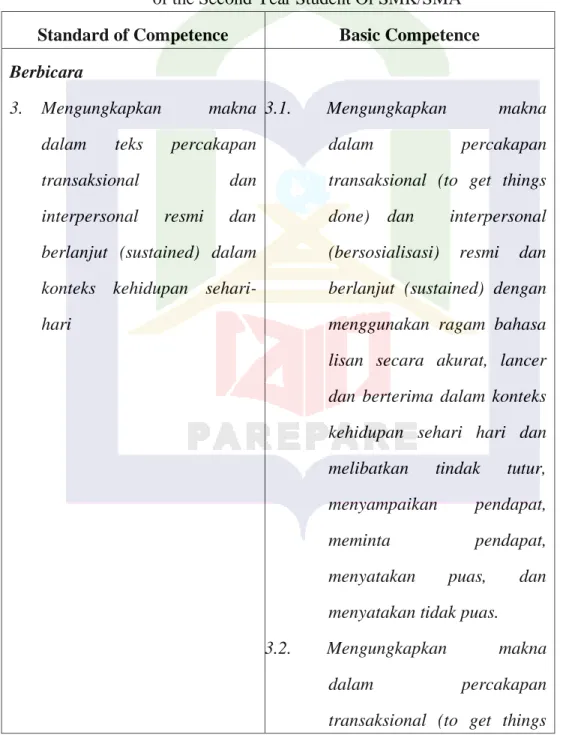
2.1 The Standard of Competence and Basic Competence of the Second Year Student Of SMK/SMA
29
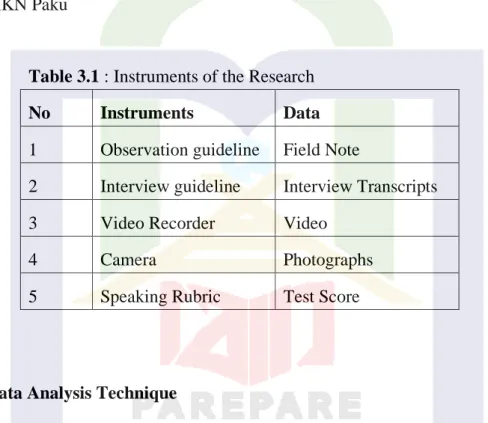
3.1 Instruments of the Research 44
4.1 The Feasible Problems to Solve in the English Teaching and Learning Process at XI Multimedia Class of SMK Negeri Paku
52 4.2 The Determined Actions to solve the Problems of the English-Speaking
Teaching and Learning Process in XI Multimedia SMKN Paku
52
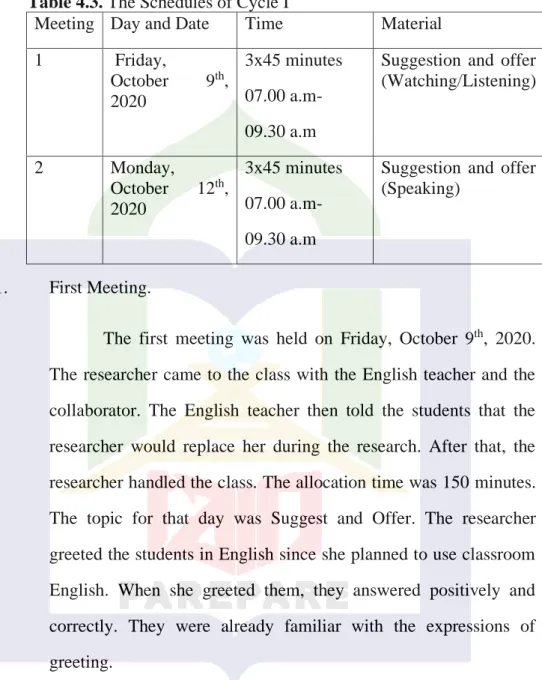
4.3 The Schedules of Cycle I 57
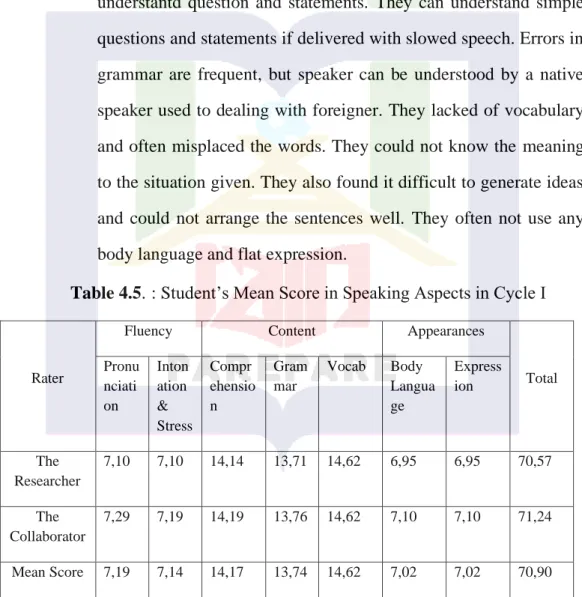
4.4 Student’s Mean Score in Speaking Aspects in the Pre-Test 70 4.5 Student’s Mean Score in Speaking Aspects in Cycle I 71
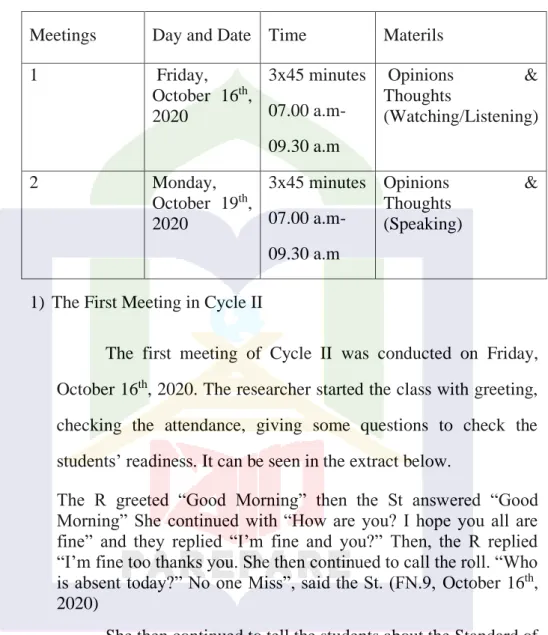
4.6 The schedules of Cycle II 78
4.7 Student’s Mean Score in Speaking Aspects in Cycle II 90 4.8 Student’s Mean Scores in Speaking Aspects in the Post-Test 90
4.9 Cycle I and Cycle II 91
xv
LIST OF APPENDICES
No Title Page
1 Field Note 102
2 Interview Guidelines And Transcriptions 114
3 Course Grids 129
4 Lesson Plans 137
5 Observation Sheets 169
6 Scoring Rubric 182
7 Students’ Score 185
8 Attendent List 193
9 Letter of Permission 195
10 Documentation 196
This first chapter contains the background of study, the identification of the problem, the limitation of the problem, the formulation of the problems, the objective of the study and the significance of the problems.
1.1. Background of the Research
Vocational high school aims to prepare students to work in field soon after they graduate. Mayor in Vocational High schools based on the Government rule Number 17 year 20131are :Technology and Engineer, Technology Information and Communication, Health, Agribusiness and Agrotechnology, Fishery and Marine, Business and Management, Tourism, Arts and Skill, and Arts Performance. Teaching English in vocational high school aims to make students proficient in both spoken and written language to support their competence in a certain study program.
Speaking is a process of conveying, sharing ideas and feeling orally.
Therefore, if students do not learn how to speak or do not get only opportunity to speak in the language, they not be motivated and loose interest in learning.
Moreover, students who do not develop strong oral skill during this time will find it difficult to communicate with their peers in English class. Based on Standard- content of BNSP (National Standard of Education), curriculum development should be relevant with student’ need. To commucate orally in English, the students should be able to used several speaking skills based on Vocational High School syllabus and express meaning verbally in interpersonal and transactional
1Peraturan Pemerintah No. 17 Tahun 2013 tentang Pengelolaan dan Penyelenggaraan Pendidikan, Bab III, Pasal 80.
2
discourse, both formally and informally in the form of conveying requests and orders related to everyday life. But speaking is considered a skill difficult in learning english. Many students have studied English for years but they still have difficulty practice speaking to communicate.
Teaching speaking in in Indonesia is considered to be most difficult. It needs the mastery of vocabulary, pronunciation, structure, discourse, and the social context of culture and situation. In short, it needs the mastery of linguistic and the culture competence. Besides, as speaking is difficult more effort is required on the part of the students and the teachers. It is not enough for the students to listen or to speak only. The teachers need to give the student activities to practice the new speech habits. This means that practice speaking needs much time to fulfill the requirements of the mastery of spoken English, either from school or the environment.
Teachers have different roles in English language classrooms, but one of the most important roles is to teach students how to become skilled thinkers to promote their understanding their intelectual development as these are the major goals of education in this fast moving competitive world. Ritchart & Perkins in Dajani states that thinking usually happens in students’ head, but unfortunately it is not visible either to teachers or to students themselves2. This means that teachers continously need to provide stimulating and supporting activities that engage learners in thinking. Teachers need to work hard on externalizing students’
thoughts throught speaking, writing, drawing, questioning, and documenting, and all this should be consistent with modeling and encouragement by teachers and parents.
2Dajani, M. M. (2016). Using Thinking Routines as a Pedagogy for Teaching English as a Second Language in Palestine. Journal of Educational Research and Practice, 6(1), 1-18
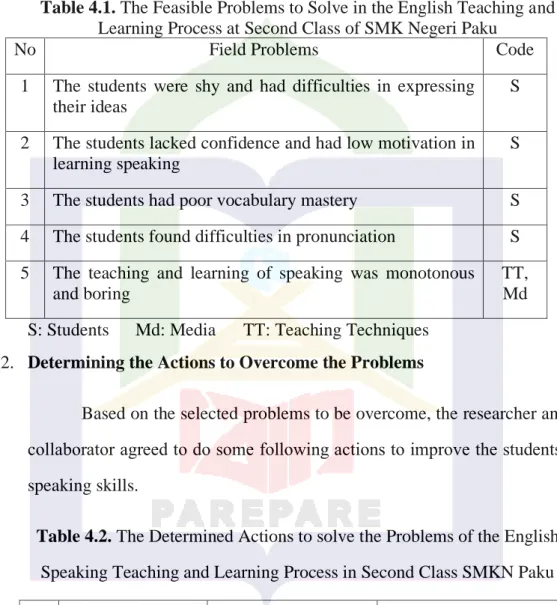
when they give it try to speak in English. The first is that they difficulty to express their ideas. The second is that their pronunciation and grammar are wear. Then, the other problem deal with the vocabulary items. Those kinds of condition also happened among in the second year students of SMK Negeri Paku.
Based on the result of a class observation that was conducting in SMK Negeri Paku, the speaking skill the students had least interest in. As a result, their speaking was quite low. They need opportunities to convey their minds. By observation, it was seen that the teacher used less various techniques. She simply asked her students to read aload. She only pointed some students. Thus, the students did not have the same opportunities to speak. It made the students bored and unmotivated in the teaching and learning process. It can be showed that some of them were busy with their friends. They did not pay attention to their friends in front of the class. So that, they were not encouraged to practice speaking during the teaching and learning process.
This explanation brings the researcher to conduct classroom action research at the second year students of SMK Negeri Paku in academic year of 2020/2021. To be able to overcome the problem, there must be a suitable technique to be used to increase the students’ speaking ability. They need a lot of practice to be able to master the speaking skill. Their motivation to speak in the speaking class low. Meanwhile, the most important element in the speaking class is to give them opportunitues to speak in English. So, the teschnique must be interesting and motivating them to speak more in the speaking class.
In this research, the researcher proposes applying the strategies to help students learn to think and probe beyond the facts in their learning, and it helps teachers find out how students attact problems and use that knowledge to develop
4
new methods to help students succeed called visible thinking. By using Visible Thinking, teachers often realized their previous class discussions had often been one-way street, with the teacher leading their students to get certain answers a process that limited their students’ thinking. The students have time to think and then share their idea with their friends in pairs. Visible Thinking Technique give a students opportunities to speak in the target language for an extended period of time and students naturally produce more speech. In addition, speaking with peers is less intimidating than presenting in front of the class and being evaluated.
Based on the problem, the researcher assumed that it is necessary to find a good technique in learning speaking to make the students feel enjoyable to learn English and to help the students in having the ability to use English to communicate. Therefore, visible thinking technique is considered able to solve students problem in speaking.
To pay attention to the description above, the researcer is interested to apply visible thinking technique under the title ‘The Use of Visible Thinking Technique to improve speaking ability the second year students of SMK Negeri Paku’.
1.2. Identification of the Problems
In identifying the problem, two activities were carried out, namely observing the English teaching and learning process at the classroom and interviewing the English teaching and students. The observations and interviews were conducted on 2 September 2nd, 2020. There are some factors affecting the teaching and learning especially in speaking, such as students, the teacher, activities and the technique.
were afraid of making mistakes. It can be seen when they were asked to practice speaking in front of the class, no one become volunteer students. As a result, the teacher called on them to practice their speaking ability. Besides, lack of interest also becomes one of the reasons. They thought that English was a difficult subject to be learned, especially speaking. They found difficulty to express their ideas. In addition, the students lacked they did not know many English words.
The second problem come from their pronunciation and grammar were still weak. The students found it difficult to pronounce the English words because they were not familiar with the words and the way to pronounce them.
Based on the interviews, students got error in pronunciation on is frequent but can be understood by a native speaker used to dealing with foreigners attempting to speak his language. Students thought that English was very different from Bahasa Indonesia. There were some English sounds that could not be found in Bahasa Indonesia. The evidence of their grammar was weak was when students spoke some sentence the students got error in grammar are frequent, but speaker can understood by a native speaker. For example, one student spoke “they go to supermarket” instead of “they goes to supermarket”.
The third problem deals with the technique used by the teacher. Based on the observation, the teacher always asked the students to work individually and she did not give them enough time to think before they had to produce some words. It seemed they found it hard to work individually. The students rarely worked in pairs or in groups. They needed time to think and share their thinking to her/his friends in pair. By working in pairs, the students could share and discuss the lessons.
6
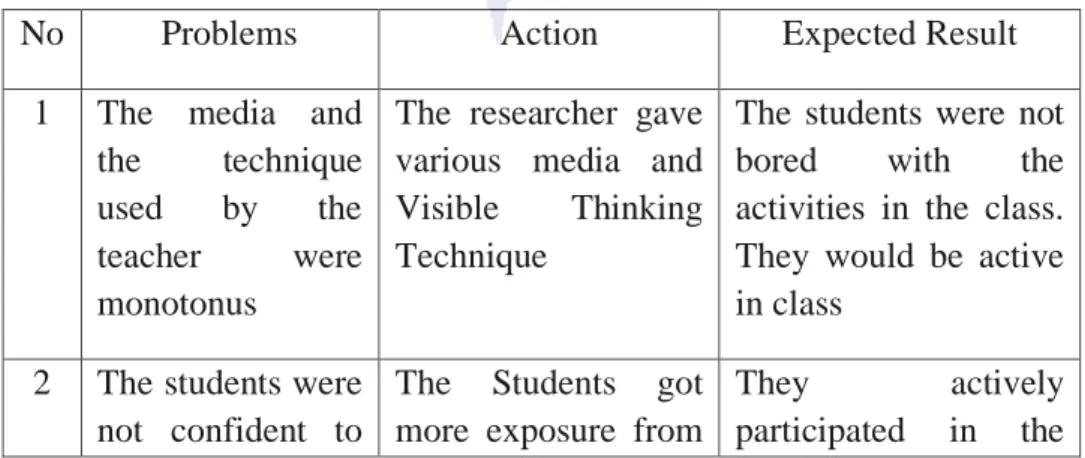
Based on the problems above, the researcher believes that Visible Thinking Technique can improve students speaking ability. Visible Thinking Technique could help to promote the students’ motivation. This technique is learned center in which students put working together in pair. This technique could give benefit both for students and teacher. From the teacher aspect, it can help the teacher to use and apply various and interesting technique during the teaching and learning process. As for the students, this technique allows them to think before they speak and share ideas before sharing in front of class.
1.3. Limitation of the Problem
Based on the identification of the problems above, there are many problems that can be found during the teaching and learning process. This research focuses on how Visible Thinking Technique improves students speaking ability of the second year students of SMK Negeri Paku Polewali Mandar in the academic 2020/2021.
The researcher decided to implement Visible Thinking Technique to improve students speaking ability after considering some reasons. Visible Thinking Technique can help students to work together in pair so that they can learn maximally. By working together in pairs, the can share and discuss the lesson. It means that silent work at the students’ desk can be minimized. The feeling of insecurity to share their opinions can be minimized by working in a pair. Visible Thinking Technique allows the students an opportunity to speak up and to be brave of making mistakes. Than good and appropriate expressions in all over the dialogue.
Because they are in pairs. They will support one another. They can discuss to solve the problem together, correct their mistakes, and give their friends
to speak up in a group. They have good appropriate body language in all over the dialogue. There are opportunities for the students to receive individual assistance from their mates. They can work together to improve their vocabulary. They able to speak the language with sufficient vocabulary and control of grammar are good. The students can speak errors in pronunciation are quite rare. The researcher hope, the students have good intonation and stress in almost 70% of the words pronounced. Their comprehension is quite complete at a normal rate of speech.
1.4. Research Questions
How does Visible Thinking Technique improve students speaking ability of the second year students of SMK Negeri Paku Polewali Mandar.
1.5. Objective of Research
To describe the used Visible Thinking Technique improve students speaking ability of the second years students of SMK Negeri Paku Polewali Mandar.
1.6. Significance of Research
The findings of this research are expected to provide information to:
1. Improve the teaching and learning process of the teachers, particularly the teaching of speaking by using Visible Thinking Technique.
2. This research provide useful information for the teacher and students of SMK Negeri Paku. Thus, it can help the students to improve their speaking ability to use English their future
3. The result of this research can be used as a description for the other students of English Education Department to conduct another research to the topic
8 CHAPTER II
REVIEW OF RELATED LITERATURE
This part consists explanation about the theory of study to build conceptual framework of this research. Some theories about speaking and related studies about Visible Thinking Technique in this chapter will lead the reader to an understanding of the concepts.
2.1. Some Related Research Findings.
Some researcher and conducted the research on visible thinking. Ssome of the findings are citied briefly below:
Gholam conducted a mixed method design was implemented to gather and analyze data to find out visual thinking routines inspired learning in the classroom and made time for students questions, constributions, and thinking. Result revealed that the implementation of visual thinking routines in the classroom strongly inspired learning in the classroom and made time for students’ questions, contributions, and thinking.3
Salmon conducted research to find out language development of young ELLs they engaged in thinking routines. This research used action research. The findings showed that Visible Thinking ideas serve as evidence to discuss the benefits of creating a culture of thinking in the classroom to promote additive in young children4.
Ritchart, Tumer, &Hadar in their research examine a method for uncovering students’ thinking about thinking. The result showed that students
3Gholam, A. (2017). Visual Thinking Routines. Journal of Inquiry & Action in Education, 9(1), 12-27.
4Salmon, A. K. (2008). Young English language learners making thinking and language visible. Colomb. Appl. Linguist. Journal, 10, 126-141.
conception of thinking do improve with age but also can be substantially develoved through a classroom culture where thinking is modeled and rich opportunities for thinking are present5.
Fuad, Zubaidah, Mahanal, &Suarsini conducted a quasi-experimental research to find out the difference in critical thinking skills among students and among male and female students. The results of research relevated that there are different skills in critical thinking in different models6.
Dajani to explore the using of thinking routines as pedagogy of teaching English as a second language. This study is a qualitative method. The finding showed that thinking routines can be seen as one the method or pedagogy that can classroom and thus cultivates culture of critical and creative thinking7.
Based on the studies proved that the topics of the use of visible thinking are important to support speaking skill, especially at Vocational high school.
Besides, the major problems of this study were how to develop the students speaking skill dealing with accuracy, fluency and comprehensibility, and how to motivate the students to speak English, so this research will be conducted to find out the use of visible thinking technique can improve speaking skill of the second year students of SMK Negeri Paku.
2.2. Some Pertinent Ideas
2.2.1. Visible Thinking Technigue
5Ritchhart, R., Turner, T., & Hadar, L. (2009). Uncovering Students' Thinking About Thinking Using Concept Maps. Metacognition and Learnin Journal, 1-27.
6Fuad, N. M., Zubaidah, S., Mahanal, S., & Suarsini, E. (2017, January ). Improving Junior High Schools’ Critical Thinking Skills Based on Test Three Different Models of Learning.
International Journal of Instruction, 10(1), 101-116.
7Dajani, M. M. (2016). Using Thinking Routines as a Pedagogy for Teaching English as a Second Language in Palestine. Journal of Educational Research and Practice, 6(1), 1-18.
10
In addition to placing students thinking at the center of what they do, teachers must also have a window into that thinking: what do students understand and how do they understand it? This is what is meant by ‘making thinking visible.’ It is only they have this information that teachers can help students move to the next level in their thinking. Currently, by plowing through material, teachers don’t fully know what students understand. Attending to student understanding is time consuming and messy so instead, teachers rapidly cover what is need for the test and largely keep students thinking invisible. By making students what means to engage with ideas and think, and show them that learning is about much more than memorizing for a test.
In order the create opportunities for student thinking, teachers must first be able to name and notice when thinking occurs in their classrooms. Teachers must be able to identify when it is that students are putting forth a new point of view, proposing a new theory or conjecture, providing an explanation, making a connection, seeing a pattern, etc. once teachers become aware of and can name examples of thinking in their classroom, then they can highlight these examples and make thinking visible for their students.
1) How we can make thinking visible technique
Ritchart explaines what might it look like to “make thinking visible”. She explaines one teacher designed a series of lessons to reveal students misconceptions about scientific concepts. She came to class one day and demonstrated what happens when she dropped a large and small candle into two jars of liquid. The shorter candle floated while the large one sank. Students were asked to record their observation and to put forth their own theories to explain
why this might have accrued. Next, the teacher retrieved the candles but this time she dropped them into the other jar. This time the larger candle floated while the smaller one sank. This surprised most students as they again had to record their observations and a new theory of explanation. This led to a deeper discussion about floating and the connection between the object and the liquid. Rather than providing students with these explanations, the teacher enquired students to develop their own understanding and she exposed their thinking through speaking8.
After teachers become clear about what thinking is and are able to notice and name it when it occurs, and they create opportunities for students to think in their classroom, how can they make the largely invisible and internal process of thinking visible?
There are three primery ways to make thinking visible:
1. Questioning
Teachers have always used questioning, but inan attempt to use Bloom’s taxonimy, sometimes teachers feel that questions are stilted or they simply can’t come up with good questions in the moment. Perhaps teachers can approach questioning differently. Below are three ways teachers can think about questions.
They can ask questions that: (a) model our interest in the ideas being explored, (b) help students construct understanding , or (c) help studens to clarify their own thinking.
(a) Model our interest in the ideas being explored – These questions include authentic for which the teacher does not already have a set
8Ritchhart, R., Church, M., & Morrison, K. (2011). Making Thinking Visible. In J. Bass, Making Thinking Visible (A Summary of the Summary) (p. 12). 2013.
12
answer. For example , “ I was wondering if that pattem we looked at yesterday might be present in any of the other situations we have looket at in this unit?” or, “Amy found an interesting way of approaching the problem, and I was wondering if that would always work?” The larger “essential questions” that get at the hert of a discipline would fit into this category.
(b) Help students construct understanding – These questions move away from asking review or knowledge – based questions and instead serve to move student understanding forward. In one first grade lesson about the five senses, a teacher had students feel an object in a box. Then she asked, “ what do you know just by feeling it?” what do you not know by feeling it?” and “what does it make you wonder?” without questions that develod understanding, the exercise just becomes a fun game unlikely to develod thinking.
(c) Help students to claryfy their own thinking – rather than transmit what is already in their own heads, teachers shold try to get out what is in their students’ heads. Examples of this type of questioning include,
“what makes you say that?” what do you think you were basing that on?” and “I’am not quite following, can you are thinking in a different way?”
2. Listening
Through listening, we can learn about student thinking, but only if we truly know how to listen. In one example in the book, after a master teacher taught a successful lesson, another teacher used the same lesson in his class, but failed.
The difference when students responded with short answers, or seemed to be
guessing, the teacher was stumped and just moved the lesson forward. Instead, teachers need to listen for student confusion. As the master teacher said, “It’s one thing to ask good questions, but one also has to listen for the answers,” by not listening, it is difficult for teachers to follow up with an appropriate response.
Furthermore, listening conveys respect and interest in student thinking which encourage students to share their thinking in the future.
3. Documenting
This is another tool to make student thinking visible. Whether through notes on a whiteboard, photographs of student work, audiotapes of class discussions, or written notes of student’s contributions, there are many ways to capture student thinking. However, it is important to note that in order to advance student learning, documentation must include more than simply capturing the learning. Students must be also to use the decomentation to reflect on and monitor their progress. Sharing this documentation with collegues can help facilitate a rich discussion about learning and student thinking.
2) Why make visible thinking
Silvanameneg explains that the central idea of Visible Thinking is very simple: making thinking visible. We learn best what we can see and hear (“visible thinking” means generally available to the sense, perceptually accessible so to speak, not just what you can see with your eyes). We watch, we listen, we imitate, we adapt what we find to our own styles and interest, and we build from there.
Now imagine learning to dance when the dancers around you are all invisible.
Imagine learning a sport when the players who already know the game can’t be seen. Strange as it seems, some close to it happens all the time in on very important area of learning: learning to think, wich includes learning to learn.
14
Thinking is pretty much invisible. To be sure, sometimes people explain the thoughts behind a particular conclusion, but often they do not. Mostly, thinking happens under the hood, within the marvelous engine of our mind-brain9.
Visible Thinking includes a number of ways of making students’ thinking visible to themselves, to their peers, and to the teacher, so they get more engaged by it and come to manage it better for learning and other purposes.
Vergara in his book (Making Visible Thinking) state that when thinking visible in classrooms, students are in a position to be more metacognitive, to think about their thinking. When thinking is visible, it become clear that school is not about memorizing content but exploring ideas. Teachers benefit when they can see students’ thinking because misconceptions, prior knowledge, reasoning ability, and degrees of understanding are more likely to be uncovered. Teachers can then address these challenges and extend students’ thinking by starting from where they are10.
So in teaching speaking, teacher should find interesting method so the students enjoy learning, one of interesting method is how to think when asked so we can what we are going to say to respond the question.
2.2.2. Visible Thinking Technique for Speaking Teaching 1. How does visible thinking work?
Visible thinking has several goals. First, it aims to give learners the chance to develop thinking skill such as creativity, curiosity and concern for truth and
9silvanameneg. (2019, May 17). Make Student Thinking Visible To Support The Research Process. Dipetik May 11, 2020, dari Critical thinkers, Professional Development, Reflective.:
https://gradedtl.wordpress.com/2019/05/17/make-student-thinking-visible-to-support-research
10Vergara, P. (2014, Agustus 4). Making thinking visible how to ron ritchhart. Retrieved Juni 1, 2020, from Making Thinking visible Web site
understanding. Second, it also aims to deepen understanding. This makes learners alert to opportunities for thinking and learning. The routines help to document the thinking process of the learner. It shows how every learner contributes to classroom learning and opens up possibilities to talk, share and discuss.
Every committed educator wants better learning and more thoughtful students. Visible Thinking is a way of helping to achieve that without a separate thinking skill course or fixed lessons.
Visible Thinking is based seven core routines that target different types of thinking:
1. Think pair share (active reasoning and explanation)
How well do your students communicate in the class? If they tend to be shy participants, there’s learning tool you can use to help them think independently, pair up and discuss with a classmate or in small groups, and share their knowledge with the class. Developed by Frank Lyman, a professor at the University of Maryland, in 1981 in Cowling11 , it’s simply called Think-Pair- Share.
The teacher asks an open-ended question and students think quietly about it for a minute or two. Then every student pair up partner and they discuss the question for the question for two to five minutes. Finally, the whole class engages in a discussion where students raise their hands and share all thoughts and ideas they’ve gathered.
With young children, it’s best if the teacher models the technique with a volunteer so the class knows what to do. Just make sure to emphasize the rules of
11Cowling, T. K. (2020). How to Use the Think-Pair-Share Activity in Your Classroom.
Retrieved September 14, 2020, from How to Use the Think-Pair-Share Activity in Your Classroom web site: https://www.wgu.edu/heyteach/article/how-think-pair-share-activity-can-improve-your- classroom-discussions1704.html
16
this exercise with your students. They must use their inside voice, take turns, and avoid interrupting their partner. Some teachers even pass out work sheets so students can ask the questions and their thoughts.
Some students feel safer and more relaxed when talking in small groups, rather than having to speak in front of the entire class. The Think-Pair-Share activity gives them the opportunity to feel more comfortable sharing their thoughts. In addition to fostering social skill. This strategy also improves students speaking skills. When pairs brainstorm together, each students’ learns from their partner. This can help students expand their vocabulary as they learn new words from their peers and build on their prior knowledge.
The researcher found this activity to be particularly useful. Use visible thinking technique to spark conversations about the social studies curriculum.
Because many areas of this subject connect to real life, this activity can also help the student to get to know their class. Try asking questions like ‘Why is it important for families to work together?” or “How does your family celebrate holidays?” Teacher can connect these inquiries to the class curriculum, learn about the students, and give the students opportunity to born and learn about each other. As a teacher, the Think-Pair-Share technique can be effective tool for fostering discussions in the classroom. This cooperative can be used with kids of all ages, even vocational high school students.
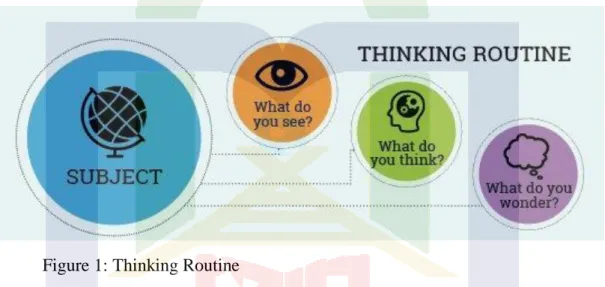
2. See think wonder (exploring works of art and other interesting things)
Maley proposes a routine which this routine ask students to observe carefully, then think and ask questions12. It emphasises how important it is to observe closely as the basic for the thinking and wondering steps that follow.
12Maley, A., & Peachey, N. (2010). Creativity in the English language classroom.
Nagoya: British Council.
Each routine has specific questions associated with it. For example, the See Think Wonder routine (a favorite among teachers in the Cultures of Thinking Project) has three basic questions: What do you see? What do you think about?
And what does it make you wonder? At the beginning of a unit, these questions can be used with an object that connects to the topic to motivate interest. At the end of a unit, the routine encourages students to apply their new knowledge.
Figure 1: Thinking Routine
Another important step is to document the students’ thinking. This serves several purposes: it gives teachers insight into the students’ development, can provide the basic for a rubric on what make a good interpretation or what constitutes good reasoning, and can be a springboard for further discussion about students’ explanations and ideas.
Teacher who have used Visible Thinking find it has numerous benefits. As mentioned above, the strategies help students learn to think and probe beyond the fact in their learning, and it helps teachers find out how students attack problems and use that knowledge to develop new methods to help students succeed. Visible Thinking also changes the character of class discussions, and it change the way teachers teach.
18
After using Visible Thinking, teachers often realized their previous class discussions had often been one-way street, with the teacher leading the students to get certain answers-a process that limited their students thinking. When those limitations were removed, class discussions-and learning-take on new and exciting directions.
1. Think Puzzle explore (sets the stage for further inquiry)
In her second grade class. Kiran Bansal used Thin Puzzle Explore when teaching how to tell time. By asking students what puzzled them or what they wondered about time, the students took encompassing history and philosophy, asking questions such as who invented time? And what would happen if time didn’t exist. The teacher followed the students lead, bringing in guest speakers and exploring these ideas. As a result, students become more invested in the subject and learned not only the mechanics of telling time but also about the concept time.
As there is often no longer one correct answer to a question, teacher should be wanted that teaching can become a little messy. You can have two uses the strategy. As a teacher, one most get used to having a “very vague product” at the end of lesson.
Ritchhart states that by working to making thinking visible teachers in the Culture of Thinking Project in Bialik Collage, a K-12 inclusive school in Melbourne, Australia, say Visible Thinking’s open discussion help students appreciate each other’s ideas and input. Furthermore, the students now have a sense of excitement about learning and share a bond that didn’t exist before. One of the substantial indications of Visible Thinking’s success is that it doesn’t stop at the classroom door. Teachers report that they hear their students talking about
the ideas discussed outside the classroom, and they see their students adapting the strategies for their own use. The students ask the questions among themselves, give evidence for their ideas, and ferret out other students thoughts. Julie Hiraga, a second grade teacher at the Dalton School in New York, even noticed students spontaneously using a routine she introduced in a math lesson earlier that day during reading to help them comperend a story13.
While teachers see many benefits to visible thinking, some warned that teachers still had to make sure that students learned the basic skills. Other teachers said the visible thinking strategie take time to learn and implement. Also, it may be difficult to determine which strategy to use with a particular lesson. Some teachers addressed that issue by planning the tasks and objectives for the content learning and then deciding the best routine the use. In addition, teachers say sometimes students need additional practice in basic skills, and in those instances the thinking routines are less applicable.
2. Element of Speaking
• Fluency
Fluency is a highly notion related mainly to smoothness of continuity Indi scours. It thus includes a consideration of how sentences are connected, how sentence pattern very in word-order and admit elements of structure, and also certain of prosody of discourse.
Richards, Platt, and Weber in Firman states that fluency is the features which give speech the qualities of being natural and normal, including native like use of pausing, rhythm, intonation, stress, rate of speaking, and use of
13Ritchhart, R., & Perkins, D. (2008, February). Making Thinking Visible. Educatinal Leadership Journal, 65(5), 57-61
20
interjections and interruptions14. In the second and foreign language teaching, they further explain that fluency describes a level of proficiency in communication, which include:
a. The ability to produce written and or spoken language with ease;
b. The ability to speak with a good but not necessarily perfect command of intonation, vocabulary, and grammar;
c. The ability to communicate ideas effectively; and
d. The ability to produce continuous speech without causing difficulties or a breakdown of communication.
• Accuracy
Accuracy in speaking means someone can produce correct sentences in pronunciation, grammar and word choose so can understood. They are three components accuracy (1) pronunciation, (2) vocabulary, (3) grammar.
According to Webster Dictionary15 pronounced is the spelling of words in accordance with their usual pronunciation. Pronunciation teaching deals with recognition or understanding the flow of speech and production of words. The aim of pronunciation teaching must be that the students can produce English speech which is intelligible in the areas where they use it. When a teacher English, the teacher needs to be sure that the students can be able say what they want to say.
This means that students’ pronunciation should be at least adequate for that purpose.
14Firman, & Zia ul Haq, M. (2012, November 1). Improving The Students Speaking Accuracy Through LSE 9.0 Software Version. Exposure Journal, 20, 20-38. P. 32 (Softcopy pdf adobe reader)
15Merriam. (1989). Webster's Dictionary of English Usage. Philippines: Merriam-Webster Inc.(dalam Softcopy pdf adobe reader).
• Comprehensibility
Comprehensibility is the process of understanding of the utterance sent by the speaker done by the listener. Comprehensibility in speaking means that the people can understand what they say. Harmer says that if there are two people want to mask communication to each other, they have to be speaking because they have different information. If there is a ‘gap’ between them, it is good communication if the people still confuse with what we say16.
Clark and Eva state that comprehensibility has two command senses. In its narrow sense, it denotes the building of mearning from sounds. Comprehensibility in broader sense denotes the interpretation the meaning and utilizes the speech act conveyed. For example, a question, listener extracts the information then tries to search the answer for it17.
3. Teaching speaking in developing adult EFL students’ speaking abilities.
Learning to speak a foreign language requires more than knowing its grammatical and semantic rules. Learners must also acquire the knowledge of how speakers use the language in the content in the structured interpersonal exchange. In which many factors interact. Therefore, it is difficult to EFL learners, especially adults, to speak the target language fluently and appropriately.
In order to provide effective guidance in developing competent speakers of English. It is necessary to examine the factor effecting adult learners’ oral communication. Components underlying speaking proficiency and specific skills or strategies used in communication.
16Harmer, J. (1988). How to Teach English. England: 1998, p. 87 (dalam Softcopy pdf adobe reader).
17Clark, E., & Clark, H. (1977). Psychology and language : an introduction to psycholinguistics. New York: New York : Harcourt Brace Jovanovich, Publishers (Softcopy pdf adobe reader).
22
a. Communicative Competence
Communication/speaking skills are the exchange and negotiation of information between at last two individuals through the use of verbal and nonverbal symbols, oral, and written form, production and comprehension processes. In oral communication, the vocabulary, and socio-cultural rules for language use are the basic possibility to communicate. In other words, one should- have communicative competence and performance of language he uses. Rivers in Das and those who work with foreign language teaching in the United States tend to define communicative competence as simply linguistic interaction in the target language18. As Savignon said in Das the ability to function in a truly communicative setting; that is, in a spontaneous transaction involving one or more other persons. On the other hand, as Hymes stated that actual communication communicative performance is social rules, the knowledge of when, how, and to whom it is appropriate to use (depend on social-cultural)19.
From the explanation above, we have a clear description that communicative competence is different from communicative performance or actual communication. Competence means what one knows since it is defined as an underlying ability, whereas performance means what one does based on his ability or the manifestation of the ability in concreate situation. However, the communication view considers performance as a part of competence not as a separated concept.
18 Das, B. (1984, April 23-27). Communicative language teaching, Singapore. Retrieved Juni 16, 2020, from Communicative language teaching: p. 15 https://files.eric.ed.gov/fulltext/ED266661.pdf
19 Das, B. (1984, April 23-27). Communicative language teaching, Singapore. Retrieved
Juni 16, 2020, from Communicative language teaching: p.
15https://files.eric.ed.gov/fulltext/ED266661.pdf
b. Speaking Skill
Speaking is like singing. It means that our voice goes up and down at different levels. A student of mucus has to learn the theory of combining sounds into harmonic sequences. He will be considered as a successful learner if he is able to make the movement of his voice in melodic shape. In music, it has its stress in the regular repetition of beats; it has own rhythm; and melody is its intonation.
Speech is said to be essentially movement. However, we have to learn to pronounce the isolated sound correctly and set them in motion in the right manner if we want to make ourselves easily understood. In short, a reasonably correct speech-flow is important for intelligibility than correct sound. It is possible to carry on an intelligible English conversation in a series of mumbles, provided that the voice movement is correct.
Speaking is many ways an undervalued skill. It is due to the fact that we can almost all speak, and so, take this skill too much for granted. Speaking is a skill which deserved attention everybody as much as literally skill, in both first and second language. We often need to be able to speak with confidence in order to carry out many of their most and through which they make or loose friends.
Speaking is one of the four basic skills which students have to acquire in learning a foreign language besides writing, reading, and listening. Yet, it is not easy work for the students to communicate in English. It is due to the fact that the rules of the language are different from those of their own language, and they have not been familiar to the new rules.
24
According to Oxford Advanced Learner’s Dictionary20, speaking is making use of words in an ordinary voice: ultering words: knowing and being able to use a language; expressing oneself in words; making a speech. While, skill is ability to do something well21. In conclusion, the definitioan of speaking skill lexically is the ability to utter words or sounds with the ordinary voice or the ability to communicate vocally or to have conversation through practice, training or talent. In addition to that Lado points out that speaking ability/skills is described as the ability to report acts or situations, or the ability to report acts or situations in Pricese words or the ability to converse or to express a sequence of idea fluently22. The writer can conclude the someone who wants to speak a foreign language has to know the rules of that language, like grammar, vocabulary pronunciation, and word-formation, and to apply them properly communication.
c. Teaching Speaking
1. Principles for Designing Speaking Technique
Brown proposes seven principles for designing speaking techniques.
These principles will help teachers to conduct the speaking class. They are:23
a. Use technique that cover the spectrum of learner needs, from language based focus on accuracy to message-based on interaction,
20Hornby, A. S., Cowie, A. P., & Gimson, A. (1987). Oxford advanced learner's dictionary of current English. New York: Oxford University Press p.827 (Softcopy pdf adobe reader).
21Hornby, A. S., Cowie, A. P., & Gimson, A. (1987). Oxford advanced learner's dictionary of current English. New York: Oxford University Press p.805 (Softcopy pdf adobe reader).
22Lado, R. (1961). Language Testing. London: Longmans. p. 240 (Softcopy pdf adobe reader)
23 Brown, H. D. (2001). Teaching by Principles: an Interactive Approach to Language Pedagogy (2nd ed.). New York: Addison Longman Inc
meaning, and fluency. Make sure that the tasks include techniques designed to help student perceive and use the buildings block of language. At the same time, the teacher should not make the students feel bored with the repetitious drills. The teacher should make the meaningful drilling.
b. Provide intrinsically motivating techniques. Try to appeal to students’ ultimate goals and interests in their need for knowledge, for status, for achieving competence and autonomy, and for being all that they can be. Help them to see how the activity will benefit them.
c. Encourage the use of authentic language in meaningful contexts. It takes energy and creativity to devise authentic context and meaningful interaction, but with the help of the storehouse of teacher resource material it can be done. Even drills can be structured to provide a sense of authenticity.
d. Provide appropriate feedback and correction. In most EFL situations, students are totally dependent on the teacher for the useful linguistic feedback. Feedback can be gotten outside of the classroom but it is important for teachers to inject the kinds of corrective feedback.
e. Capitalize on the natural link between speaking and listening. Many interactive techniques involving speaking will include listening. The two skills can reinforce each other. Skills in producing language are often done through comprehension.
f. Give students opportunities to initiate oral communication. Part of oral communication competence is the ability to initiate conversations to nominate topics, to ask questions, to control
26
conversation and to change the subject. The teacher can design speaking techniques allowing students to initiate language.
g. Encourage the development of speaking strategies. Teachers should help their students develop strategic competence to accomplish oral communicative purposes because not all students are aware of strategic competence. The strategies are asking for clarification (what?), asking someone to repeat something (excuse me?), using fillers (uh, I mean, well), using conversation maintenance cues (Huh, right, yeah), getting someone’s attention (hey, so), using mime and nonverbal expressions to convey meaning and so forth.
The goal of teaching skill is to communicate efficiency. Learners should be able to make themselves understand, they should try to avoid confusion in the massage due to faulty pronunciation, grammar, or vocabulary, and to observe the social and culture rules that apply each communication situation.
Hammer conclude that there are three basic reasons why it is a good idea to give students speaking tasks which provoke them to use all and any language at their command24:
a. Rehearsal : getting student to have a free discussion give them a chance to rehearse having discussion outside the classroom. Having them take part in role play at an airport chek-in desk allow them to rehearse such as a real life event in the safety of the classroom. This is not the same practice in which more detailed study take place; instead it is a way for students to get the feel of what communicating in the foreign language really feels like.
24Harmer, J. (1988). How to Teach English. England: 1998, dalam Softcopy pdf adobe reader p.87 (Softcopy pdf adobe reader)
b. Feedback: speaking task where students are trying to use all and any language they know provides feedback for both teacher and students.
Teacher can see how well their class is doing and what language problems they are having (that is a good reason for ‘boomerang’ lessons); students can also see how easy they find particular kind of speaking and what they need to do to improve. Speaking activities can give them enormous confidence and satisfaction, and with sensitive teacher guidance can encourage them into further study.
c. Engagement: good speaking activities can and should be highly motivating. If the entire student are practicing fully-and if the teacher has set up activity properly and can then give sympathetic and useful feedback-they will get tremendous satisfaction from it. Many speaking task (role-play, discussion, problem-solving etc.) are intrinsically in themselves.
2. Teaching Speaking for SMA/SMK
The discussions of the teaching speaking in vocational high school will include some aspects as provide below:
a. English Learning and Teaching in Vocational High Schools
Teaching English in Indonesia is considered as teaching English as foreign Language EFL. This is because the students commonly learn English in their place of origin, Indonesia and they have Indonesian as their first language.
Furthermore, Holmes mention that teach is something the teacher does to the students, while learn is something the student