THE ADAPTATION OF IBAN ORAL FOLK TALE “KELING”
IN A NARRATIVE ANIMATION
Keith Voon Lip Khiong
Bachelor of Applied Arts with Honours (Department of Design Technology)
2010
Fakulti Seni Gunaan dan Kreatif
THE ADAPTATION OF IBAN ORAL FOLK TALE
“KELING” IN A NARRATIVE ANIMATION
KEITH VOON LIP KHIONG
This project is submitted in partial fullfillment of
the requirments for the Degree of Bachelor of Applied Arts with Honours (Department of Design Technology)
Faculty of Applied & Creative Arts UNIVERSITI MALAYSIA SARAWAK
2010
DECLARATION
The project entitled ‘The Adaptation of Iban Oral Folk Tale “Keling” in a Narrative Animation’ is prepared by Keith Voon Lip Khiong and submitted to the Faculty of Applied and Creative Arts in partial fulfilment of the requirements for a Bachelor of Applied Arts with Honours (Department of Design Technology)
To be examined by : ...
(Ahmad Azaini Bin Abdul Manaf) Supervisor Department of Design Technology Date: ...
ACKNOWLEDGEMENT
I would like to express my gratitude to a great number of people who has been assiting me in completing my research on ‘The Adaptation of Iban Oral Folk Tale “Keling” in a Narrative Animation’.
I would begin by thanking the Almighty one, for blessing me with supportive lecturers who had endlessly giving me tremendous support and guidance. They are Mr. Ahmad Azaini bin Abdul Manaf and Ms. Salmiah binti Abdul Hamid who has shared their wisdom, talents and time.
Not forgeting my parents Mr Voon Chee Foh and Mdm Frances Nigelina for your support. A special note of thanks to my dearest siblings for their support, encouragement, care and motivation which I truly appreciate.
Last but not least, this research could not have been completed without the help of everyone here in Faculty of Applied and Creative Arts. Much appreciation also goes to all my friends who had contributed towards the success of this dissertation.
i CONTENT
List of content Page
Content i – ii
Abstract iii
Abstrak iv
CHAPTER 1: 1 – 10
1.0 Research Title
1.1 Introduction
1.2 Background of Research
1.3 Definition of Terms
1.4 Problem Statement
1.5 Research Objectives
1.6 Research Hypothesis
1.7 Research Scope
1.8 Research Limitation 1.9 Conclusion
ii
CHAPTER 2: 11 – 15
2.0 Introduction
2.1 Literature Review
CHAPTER 3: 16 – 18
Research Methodology
CHAPTER 4: 19 – 52
Research Findings
CHAPTER 5: 53 – 65
Recommendation
CHAPTER 6: 66 – 67
Claim
CHAPTER 7: 68
Conclusion
REFERENCES 69 – 70
APPENDIX 71 – 76
iii ABSTRACT
The Iban is oral folk tale closely related to the Iban spiritual and conception of the mythological world. The objectives of this research are to identify the folk tales among Iban society, to analyze the Iban folk tales, to produce a narrative animation based on Iban folk tale, and lastly to validate the outcome of the animation. Based on the research, a short animation will be produced and adapted from one of the most ancient Iban tale in the oral tradition,
‘Keling the Great Warrior of Panggau Libau’. The animation captures both the richness of the Iban folklore as well as the idiom of the Iban language.
iv ABSTRAK
Cerita rakyat Iban adalah berkait rapat dengan dunia ‘spiritual’ dan mitologi masyarakat Iban. Antara objektif penyelidikan ini adalah untuk mengenalpasti cerita rakyat Kaum Iban, mengkaji dan menganalisis cerita rakyat Iban, menghasilkan satu animasi berbentuk naratif dan akhir sekali, membuat validasi terhadap penghasilan animasi tersebut. Animasi pendek ini akan diadaptasikan daripada salah satu cerita rakyat Iban lama iaitu Jerita Keling, seorang hulubalang terhandal Panggau Libau. Animasi ini menunjukkan kekayaan budaya kaum Iban dari aspek penceritaan lisan dan juga amalan tradisi.
1 CHAPTER 1
1.0 RESEARCH TITLE
The Adaptation of Iban Oral Folk Tale “Keling” in a Narrative Animation.
1.1 INTRODUCTION
This is a research study on the Iban oral folk tale in Sarawak. The study focuses on indentifying the categories of the folk tale group among Iban society. Based on this research, a short animation will be produced and adapted from the oral folk tale which captures both the richness of the Iban folklore as well as the idiom of the Iban language.
This chapter will also focus on the background of the research, problem statement, research objectives, limitations, definition of key terms and conclusion.
1.2 BACKGROUND OF RESEARCH
Iban is the largest race population in Malaysia after the Malays.
The Iban is also one of the local native group in Sarawak which is known as the Dayaks (largest Dayak population, about 459,700 or 29.6%
estimated in the 1987 statistic). In 1838, under the rulings of the White Rajahs, the Iban were then referred as Sea Dayaks. However today, the term Iban is officially used and referred to as a name to acknowledge its race. The Iban language is uniform throughout Sarawak, although its
2 pronunciation varies. These variations help to indentify the speaker’s region.
From the Iban social organization aspect, the smallest unit in the Iban organizational structure is the ‘bilik’. One ‘bilik’ in the ‘rumah panjai’ consist of one family which includes a couple of married husband and wife and their children. Every ‘rumah panjai’ has a chief called ‘tuai rumah’. A ‘tuai rumah’ acts as a spokes person and a representative for his ‘rumah panjai’ society. Other then that, a ‘tuai rumah’ is also believed to ensure a good relationship between longhouse members and the spirit known as ‘roh’ or ‘semangat’.
From the Iban cultural aspects and belief, they were traditionally animist believers. Traditional Ibans believes in ‘roh’ and ‘semangat’. The
‘tuai burung’, ‘tuai rumah’, ‘lemambang’ and ‘manang’ plays a vital role in the Iban ancient beliefs. Today, the majority of Iban are Christian and some of them are Muslim. Both Christian and traditional practises is continued and is observe in ceremonies such as marriage, funeral and festivals. It is also customary for Iban young man to set on a journey or
‘be ja lai’ during their young ages. ‘Be ja lai’ means set on a long journey to prove that one is independent and to bring back trophies which is normally the human skull.
In the arts and heritage aspects, Iban were warriors and head- hunters. Much of their traditional art is connected with these activities.
Ibans are also famous for their beads making and most well-known for
3 their ‘Pua Kumbu’ weaving. During Gawai festival, the Iban traditional dance, the ‘ngajat’ is performed as an entertainment and will be accompanied by musical instruments such as ‘engkerumungs’ and ‘sapek’.
Apart from that, tattooing is done extensively by men only to cover and to glorify ones body. Iban folklore on the other hand covers folk tales, music, dance, and jokes. These folklore helps to preserve the Iban cultural heritage.
The Iban folk tale comes under the oral tradition, it is closely related to Iban mythology and conception of the spirit world. ‘Jerita Tuai’
and ‘Ensera’ are the tales usually told. Both of these tales are handed from generation to generation. These tales were usually recited or chanted for entertainment in the longhouses back then where the men, women and children will sit and listen.
There is no rigid difference between “jerita” and “ensera”, folk tales are almost exclusively for entertainment. On the other hand, folk tales are being told with ethical purposes of explaining Iban behaviour and the potential consequences of wrong behaviour. However, tales which has major mythical attributes culminate in a description of one or more aspects of Iban social, religious and cult practice.
Folk tale has a well-built link with the mythological and spiritual world. Folk tale may have possible facts of certain legends or history of the past. It is also a possible act for a tale to comprehend the origins of Iban religious belief, ritual and social code. For example, “Keling” the
4 legendary Iban hero, is believed to represent human-liked behaviour of the Iban. He owned both spirit properties and human qualities. Therefore, Iban folk tale indirectly do convey the lifestyle of Iban people.
5 1.3 DEFINITION OF TERMS
1.3.1 DEFINITION OF FOLK TALE
Folk tale (noun) a very old traditional story from a particular place that was originally passed on to people in spoken form.
Hornby, A.S et al. (2007). Oxford Advanced Learner's Dictionary,7th Edition. Oxford University Press.
“Folk tale is a narrative fiction prose of a story which has or never happened…profiling time and space…free from space and time
limits…involve mythical creatures and magical transformations.”
(W.R Boscom 1965)
1.3.2 DEFINITION OF NARRATIVE
Narrative - 1. A description of events, especially in a novel.
2. The act process or skill of telling a story.
Narrative (noun) a story or account of events, experiences, or the like, whether true or fictitious, a book, literary work, etc., containing such a story, the art, technique, or process of narrating.
Hornby, A.S et al. (2007). Oxford Advanced Learner's Dictionary,7th Edition. Oxford University Press.
Narrative is generally accepted as possessing two components: the story presented and the process of its telling, or narration, often referred to
6 as narrative discourse. Story is a series of represented events, characters (or agents for some), and actions out of which the audience constructs a fictional time, place, and cause–effect world, or diegesis. In the Lumière short, the material elements include the arrival of the train, the scurrying of rushed passengers, the gestures of the railway workers, the steam emitted from the engine, even the moving shadows beneath people's feet.
(www.filmreference.com/encyclopedia/Independent-Film-Road- Movies/Narrative-DEFINING-FILM-NARRATIVE.html , 2009)
7
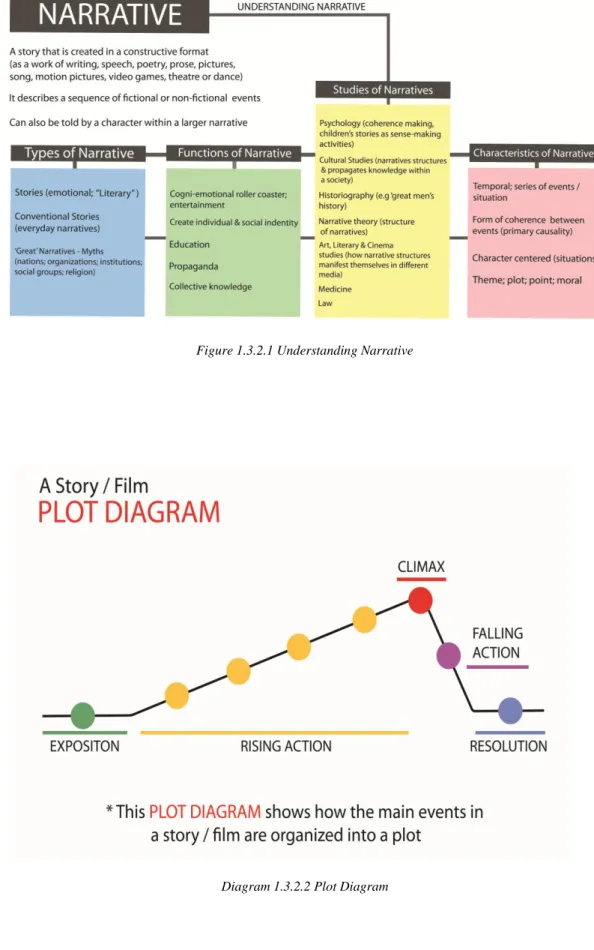
Figure 1.3.2.1 Understanding Narrative
Diagram 1.3.2.2 Plot Diagram
8 1.4 PROBLEM STATEMENT
Today, due to rapid modernization, the Iban oral tradition especially its folk tale faces problem in surviving today’s world. With the coming of education, technology and growing economy, the modern society find it difficult to learn and to know more about the Iban folk tale.
Besides that, Iban folk tales are mostly found in both verbal and written form. Therefore, this precious art of folk tale telling is significantly becoming extinct among today’s generation.
1.5 RESEARCH OBJECTIVES
1. To identify the folk tales that is prominent among Iban society.
2. To analyze the Iban folk tales comprising of narrative component and storytelling.
3. To produce a narrative animation based on Iban folk tale.
4. To validate the outcome of the animation based on narrative component.
9 1.6 RESEARCH HYPOTHESIS
The Iban cultural heritage is very important and is slowly dying due to the rapid globalization. Efforts must be made in order to preserve the Iban’s cultural heritage. With this research, the Iban cultural heritage especially its oral folk tales can be preserved, revitalized and promoted to our modern generation. Through the adaptation of Iban folk tale in this narrative animation, it can easily generate interest among modern generation. Effort such as this can also help in global expansion of the Iban community. This will indirectly help the Ibans to attract foreign audience to know more about their culture. With the coming of technology, modern generation especially young people, they prefer technology related form of entertainment. Therefore, animation is a form best to illustrate the concept and idea of the Iban oral folk tale. Other than that, animation with such local content enables modern generation to appreciate and to learn about the Iban culture.
1.7 RESEARCH SCOPE
The research focuses on the Iban society located in Sibu, the third division of Sarawak. The research area consist of Rumah Panjang Philip Kayak , Rumah Panjang Aup and Rumah Panjang Rantau Panjang. It was selected because of demography factor. Sibu is the third division of Sarawak. It has one of the largest Iban population in Sarawak. An open
10 interview on Iban folk tale will be carried out on influential individuals which are the heads of the longhouse. They are Tuai Rumah Philip Kayak and Tuai Rumah Jonathan Juna. The reason for this interview is to indentify the categories of Iban oral folk tale.
1.8 RESEARCH LIMITATION
The Iban folk tales are familiar among the older generation.
Therefore, some difficulties to gather information may occur. Besides that, there are a large number of oral folk tale which differs in different area.
Since it was oral based, it is difficult for the researcher to preserve the story telling in its original form.
1.9 CONCLUSION
As an early conclusion, this is a research on the Iban folk tale, emphasizing on the Iban oral folk tales. Based on this research a short animation will be produced. The short animation will be adapted from one of the selected tale of the Iban ethnic. The animation in translation captures both the richness of the Iban folklore as well as the idiom of the Iban language.
Animation can be the best form to illustrate the concept and idea of the Iban oral folk tale. Other than that, animation with such local content enables modern generation to appreciate and to learn about the Iban culture.
11 CHAPTER 2
LITERATURE REVIEW
2.0 INTRODUCTION
This chapter consist of earlier researches done by other researchers.
The information gathered through this chapter are references for the researcher to gain more knowledge throughout the research period.
2.1 Zaini Ozea (1997)
According to Zaini Ozea, the exact number of Sarawak’s folk tale is yet to be known. Until now the exact number of the local tales remains unknown. Folk tales are only collected from certain ethnic groups. This proves that there are still a large number of Sarawak’s folk tale which are yet to be collected and documented. Most folk tales are published in English, Bahasa Melayu, Bahasa Iban, Bahasa Bidayuh and Kenyah through journals such as The Sarawak Museum Journal, The Sarawak Gazette & Biro Kesusasteraan Borneo . In this article, it is also stated that there are a list of folk tale categories which are made as perusal material.
The categories are Cerita Penglipur Lara, Cerita Binatang , Cerita Jenaka and Cerita Asal Usul .
Ozea Z. (1983). Analisis Isi Cerita- Cerita Rakyat di Sarawak.
12 2.2 Folk literature
Folk tale has its specialty where it can travel with great ease from one storyteller to another. Folk tale is characterized by its basic pattern and by narrative motifs, it passes language boundaries without difficulty. Folk tale presupposes a background of belief about tribal origins and the relation of men and gods.
(http://www.britannica.com/EBchecked/topic/212142/folk-literature, 2009)
Figure 2.2.1 Samples of folk tales
13 2.3 Defining Film Adaptation
“Adaptation introduces complications in audience perception and aesthetics. The most obvious and common form of film adaptation is the use of a novel as the basis of a film, but film adaptation includes the use of non-fiction (including journalism), autobiography, comic book, scripture, plays, and even other films. From the earliest days of cinema, adaptation has been nearly as common as the development of original screenplays.”
Film adaptation. (2009, August 8). Retrieved from http://www.artandpopularculture.com/Film_adaptation.
Based on the article, adaptation in film gives the audience the sense of aesthetics. Most adaptation are being adapted from non fiction materials, comic books, novel, scriptures and also from other film. It shows that adaptation can help generate new ideas, improving ones story telling and also to be a guideline of reference in making a story.
2.4 Comics and Film: A Narrative Perspective
“The narrator may also be a character in the story…A non- character narrator is the anonymous “voice of God.” This type is a matter of fact commentator who may be objective or subjective…Sometimes the narrator is not revealed until the end.”
14 Comics and Film: A Narrative Perspective. (2009, August 8). Retrieved from http://www.emaki.net/blog/2009/06/comics-and-film-narrative- perspective.html
Based on the description, a narrator can be a character in a story.
For example: in a story he/she can be child, but in the actual life he or she is actually a grown up person. A non-character narrator is refer to as the a narrator which is not seen throughout the entire film.
2.5 The Narratives
“ The Narratives are of different kinds, recognisable by the dramatics personae that they feature, the function that they play in the life of the society, the meanings attached to them and the stylistic features in them. Six type of narratives can be identified: the folk tale or the marchen, the myth, the epic, the legend, the ballad and the memorate.”
(1982). The Narratives. In M. T. Osman, Manual For Collecting Oral Tradition With Special Reference To Southeast Asia (p. 31). Kuala Lumpur: Dewan Bahasa dan Pustaka.
According to statement, there are six type of narratives which has there own dramatic value, role of play in today’s society and also stylistic features.
2.6 Narration by Catherine Levison
“...Narration is assimilating information and retelling it. Anyone would listen closely if they knew they were going to retell what they had
15 heard. Just like when you've seen a documentary and tell your friend all about it the next day, you will remember it better...”
Narration, Narrating For a Better Communication. 25/3(65).
According to Catherine Levison, narration can help in audience’s understanding. Good narrating skills enable listeners to remember the information better. Therefore, animation with a narrator and narrative plot will give a huge impact in audience understanding. This will help them to understand, remember and to retell the tale later on.
2.7 Walt Disney Quoted
“Animation offers a medium of story telling and visual entertainment which can bring pleasure and information to people of all ages everywhere in the world.”
(Walt Disney)
According to Walt Disney, animation can be a medium for effective story telling, not only for entertainment purposes only.
Animation brings information to the audience of all ages.
Hence, the researcher find it rational in a way that animation can be used as a medium to tell a tale with the adaptation of the local Iban content.