Medical Experts Locator
by
Zulakram bin Abd Rahman (15396)
Dissertation submitted in partial fulfilment of the requirements for the
Bachelor of Technology (Hons) (Business Information Systems)
JANUARY 2014
Universiti Teknologi PETRONAS Bandar Seri Iskandar
31750 Tronoh Perak Darul Ridzuan
1 ABSTRACT
This project aims to help patients in efficiently finding and locating specific medical experts. Patients may sometimes find the medical specialist they are seeking for at a certain location (hospital) not to be of their liking. Past research has found that these user preferences can influence in users not seeking medical treatment altogether.
Therefore, travelling from hospital to hospital without the ability to check on whom users are trying to find in advance is essentially time-consuming; where in some cases, the waste of time can lead to a much worse condition of their illness. The goal of this project is to minimize effort and time consumption in physically searching for medical experts at their respective hospital. The scope of this project is in the Kuala Lumpur vicinity, with specific focus on government hospitals. Using a quantitative-research method, a survey is developed for the purpose of data collection of the following; to study on the preferences of patients. The mobile application incorporates the application with a GPS-based application program such as Google Maps to ease users in locating medical experts. Results of the findings have an overall influence on the mobile application design itself, where future works will aim to further give improvement on the design and development of the mobile application.
2
ACKNOWLEDGEMENT
I would like to thank the countless number of people who have helped me in the process of completing my final year project.
Deepest gratitude is given to my supervisor; Dr. Noreen Izza binti Arshad, who has always been there when I needed advice and guidance during the development of this project.
Thank you to everyone who has lent me their cooperation and professional advice during the process of this project, as well to all those who were kind enough to give a small portion of their personal time to participate in the data collection and user testing of this mobile application.
Last but not least, special thanks to my family and friends for their non-stop encouragement and motivation not only during the course of final year project, but also throughout my three years here in UTP. Thank you Nadrah binti Isa for always believing in me.
Thank you again for all the love, support and guidance.
3
TABLE OF CONTENT
Abstract 1
Acknowledgement 2
1. INTRODUCTION 8
1.1 Background of Study 8
1.2 Problem Statement 9
1.3 Objective 9
1.4 Scope of Study 10
1.5 Relevancy of the Project 11
1.6 Feasibility of the project within scope and time frame 11
2. LITERATURE REVIEW 12
2.1 Both sides of medical care; differences between public and private health sector
12
2.2 Patients’ personal preferences of medical personnel 14 2.3 Past studies on the relationship of delay of treatment and possible
health hazard risks
14
2.4 Similar mobile applications currently existing in the market 16
2.5 Demand of mobile applications in Malaysia 17
3. METHODOLOGY 19
3.1 Research Methodology 19
4
3.2 Project Development 21
3.2.1 Project Activities 21
3.3 Systems Architecture 23
3.3.1 Activity Diagram 23
3.3.2 Process Flow 23
3.4 Key Milestones 24
3.5 Gantt Chart 25
3.6 Collection of Data 25
4. RESULTS AND DISCUSSION 26
4.1 Survey Findings 26
4.2 Graphical User Interface (GUI) 29
4.2.1 Mobile application navigation process 32
4.3 User testing results 33
5. COMMERCIALIZATION 35
5.1 Marketing/commercialization strategy 35
5.2 Online advertising 35
5.3 Pricing 36
5.4 Stages of Invention 37
6. CONCLUSION 38
6.1 Relevancy to the Objectives 38
6.2 Suggested Future Works for Continuation 39
5
7. REFERENCES 40
8. APPENDICES 43
Appendix A 43
Appendix B 44
Appendix C 45
6
List of Figures
Figure 1 myHealth mobile application, by Ministry of Health 16 Figure 2 Example of similar mobile applications in the western market 17
Figure 3 Prototyping Model 19
Figure 4 Project Activities 21
Figure 5 Overview of Project Methodology (with Project Activities) 22 Figure 6 Systems architecture to show project flow and functions 23
Figure 7 System flow chart for users 24
Figure 8 Survey questions with respondent’s preference 27 Figure 9 Average user preference on medical experts’ criteria 28 Figure 10 Graphical User Interface (GUI) for the prototype 29
Figure 11 Display of results 30
Figure 13 GPS to aid user to location of the medical specialist 31
Figure 14 Average app prices as of April, 2013 31
Figure 15 Step by step navigation process of Medical Experts Locator 32 Figure 16 Overview of testing result of user acceptance test 33
Figure 17 Results of respondent’s satisfaction level 34
Figure 18 Integrating Medical Experts Locator with GPS function 35 Figure 19 Stages for invention of the mobile application 37 Figure 20 Stages for invention of the mobile application 38
7 List of Tables
Table 1 Key Milestones 24
Table 2 Results of the survey with percentage of user’s preferences 26
8 CHAPTER 1 INTRODUCTION
1.1 Background of Study
In the early sixteenth-century, English scholar and Vicar Robert Burton of Oxford University stated, “Restore a man to his health, and his purse lies open to thee.” What this points to is the fact that health has no price, and almost everyone would pay anything to get well. True today as it was four hundred years ago, medical services do not come cheap as long as doctors’ power to demand exists. The reality of healthcare services in Malaysia is coherent with that notion. Although far from perfection, substantial government subsidization ensures public healthcare is almost as free of charge. A common impression amongst society is that wealthy patients would go to private hospitals; consequently help reduce the workload of the public sector, ensuring poorer patients getting better and faster services at government hospitals. This conception includes both the services of regular doctors and medical specialist in either medical sector.
Choosing a doctor is one of the most important things that a person will do in their lifetime. Regardless of it being a physician, surgeon or any other medical specialist, one must be satisfied for both medical and personal treatment received. The motivation behind this project is the importance behind the process of choosing a doctor or a medical expert. After the selection, patients fully entrust the doctor for his or her medical expertise, wise advice and ability to administer treatment in a timely manner that may potentially save their lives. Furthermore, there may be other factors involved behind the patient’s decision to seek for a specific doctor they desire. For example, study shows women are more likely to receive mammography only if they see a female doctor, rather than a male (Lurie et al., 1993). This can also count for screening tests for breast, cervical, and colon cancer.
9 1.2 Problem Statement
Having prior knowledge of who to look for and the whereabouts of medical experts based on their criteria (e.g. cost, location, gender, expertise) can save time and people’s lives; as well as where technology can lead to a less expensive healthcare. Therefore, the problem statement of this project is as follows:
1. Travelling from hospital to hospital without the ability to check on whom users are trying to find in advance is essentially time-consuming; where in some cases, the waste of time can lead to a much worse condition of their health.
2. Existing similar mobile applications in the market does not possess a ‘specific- based’ search function for locating medical experts (function to search based on certain criteria e.g. age, gender etc.). An example of this is myHealth, a similar mobile application developed by the Ministry of Health, Malaysia (MOH).
1.3 Objectives
Based on the problems identified in the literature above (see Section 1.2); the objectives of this project are:
1. To gather medical experts’ profile and integrate them into a centralized database to be available in mobile applications,
2. To incorporate the mobile application with a GPS-based application program (e.g. Google Maps, Waze) to ease users in locating medical experts,
3. To design and develop a mobile application that could assist users in locating medical experts,
4. To test the usability of the application with the target audience.
10 1.4 Scope of Study
This project covers a certain scope of study, which are the following;
1. Public health sector
A study on the pros and cons of both the public and private health sector will be carried out, and the factors to show why this project is focused on public healthcare alone will be presented.
2. Target location of Government Hospitals in Kuala Lumpur vicinity
This project chooses to focus on the Kuala Lumpur vicinity as studies have shown that is where the most medical specialists are located in the country.
3. Programming and development of the mobile application on Android platform
Since Android is written primarily in a customized version of the Java programming language, the developer must have sufficient knowledge on how to create and program the mobile application using the specified language, tools, and what platform and/or software to use to develop the mobile application.
4. Research on similar applications in the market
Similar products will no doubt be available in the market. Before proceeding with this project, a comparison and analysis of those similar applications will be made to differentiate with one another, and see which aspect of the mobile application that can be further be improved.
11 1.5 Relevancy of the project
The relevancy of this project is that it will lessen the problem of where patients waste resources (e.g. energy, time etc.) of going to certain hospitals, but finding out that the medical personnel in-charge is not of their liking. This may influence patients to not getting any medical treatment at all. What this mobile application aims to accomplish is giving patients the opportunity to check beforehand specifically which medical specialist will be available at the users’ preferred hospital; so that users are able to plan ahead of the journey. Availability can range from doctor’s schedule, or whether a doctor they seek meets the users’ specific preference; in terms of gender, age etc.
1.6 Feasibility of the project within scope and time frame 1. Technical Feasibility
The means that is used to develop this mobile application is App Inventor for Android. It is an open-source web application by Google used to create software applications, and is technically feasible. This is because it fits with the Android operating system (OS) that is required in the project scope (see Section 1.4).
2. Economic Feasibility
The cost of developing this mobile application is free, since open-source software such as ‘App Inventor for Android is free to download and use from the internet. Furthermore, all the development specification is already in the inventory.
3. Time Feasibility
With just under eight months to complete the mobile application, this project can be completed at least to the minimum of its requirements. Another factor to consider is scope creep. If due to the scope creep and testing difficulties, it may be difficult to measure how perfect the system can be within the time frame.
12 CHAPTER 2
LITERATURE REVIEW AND/OR THEORY
The literature review will be divided into several sections. Section 1 will explain the major differences and gaps between the public and private health sector in Malaysia.
Section 2 will describe on patients’ personal preferences with regards to their choice of medical personnel. Section 3 shows numerous previous researches in where delay of treatment may cause to a patient’s health condition deteriorating. Section 4 will describe the current research gap; existing similar applications in the market and the pros and cons in comparison with this project. Lastly, Section 5 will highlight on the current demand of mobile applications in Malaysia.
2.1 Both sides of medical care; differences between public and private health sector Medical costs have augmented globally, and it is no different in Malaysia.
Expected to rise even more in the near future, medical inflation in Malaysia is at an average of roughly ten to fifteen percent yearly. According to former Ministry of Health Director General Tan Sri Dr. Abdul Khalid Sahan, healthcare has been universally accepted as a basic right of all citizens, where everyone has a right to receive it irrespective of his or her ability to pay. The choice of choosing between hospitals ultimately depends on three main factors: cost, quality of service and urgency/complexity of the medical situation (Chia, 2007). Patients however, are likely ti still face high amounts of medical bills. Greatly intensified during the last decade, the cost of welfare in the next five to ten years is something to ponder on. Based on The Future of Retirement: Malaysia Report, published in 2013 by HSBC Insurance Holdings Limited, London – one of the biggest worries of Malaysians are medical costs, with 64 percent of survey respondents citing fears of not having enough money for good healthcare provision as they enter retirement.
13
The number of Malaysians who are insured medically is an estimated 10.8 million people, roughly forty percent of the country’s total population. Without even reaching the half mark, this leaves roughly 16.2 million people without health insurance policies.
According to “Liow: Malaysians benefit from affordable healthcare” (2011), lack of sufficient financial resources may sway citizens towards public hospitals, which provides more affordable healthcare because of the subsidization by the government.
The substantial subsidy particularly reduces the financial load on patients. An examination of the out and in-patient charges of government-operated hospitals and clinics reveals the high level of subsidy for health care costs. Because of this, it would approximately cost RM 1.00 and RM 5.00 for outpatient clinic and specialist clinic visits respectively; and a maximum cost of RM 50.00 to RM 80.00 for a third-class ward hospitalization at a public hospital. This is the cost of outpatient treatment in hospitals under the Ministry of Health; under the Fees (Medical) Order 1982 of the Fees Act 1951. Nonetheless, the question is whether the current scenario seems sustainable with the rising costs of today.
According to Kok (2009), public healthcare offers favourable medical treatment, but longer waiting time and a less personalized attention from doctors may be subjected to patients – due to the large volume of incoming patients the doctors are required to manage. Nevertheless, the government is still accountable for ensuring that healthcare is made accessible to all citizens. According to Dr. Pawel Suwinski, senior consultant of Frost & Sullivan Malaysia Sdn. Bhd., healthcare practices for Asia-Pacific; private healthcare services have become increasingly unaffordable to many. This is due to the fact that people evidently make choices based on affordability, and the current economic conditions have an impact consumers’ income. Over the span of 50 years, the healthcare system in Malaysia has been transformed from one dominated by the public sector in both provision and financing, to one in which the private sector has an increasing presence in hospital and specialist care, as well as in financing (Leng, 2008).
Therefore, this research is inclined to focus only on the public hospitals because those who can afford a higher cost for medical services tend to go to private hospitals. This reasoning is in correlation with this project’s scope of study.
14
2.2 Patients’ personal preferences of medical personnel
According to several studies conducted in the past, it was shown that women were more likely to undergo screening with pap smears and mammograms if they see female rather than male physicians (Lurie et al., 1993). This is includes tests for breast, cervical, and colon cancer. In Malaysia, the constitution protects freedom of religion, but Islam is declared the state religion of the country. Muslim women particularly, prefer only to be examined by female doctors. Those who obey strictly to Islamic teachings may find pregnancy, childbirth and postpartum-period care by the opposite gender uncomfortable and especially difficult. Muslim women in general, as well as their husbands, also place high importance on maintaining modesty and will prefer female practitioners. For example, during the childbirth process, women may like to be protected by curtains or screens, with only female medical staffs present (“Cultural Dimensions of Pregnancy”, 2010). A study carried out by Fennema et. al (1990) showed that out of 185 patients with a mean age of 34 years, 40 percent of patients prefer male doctors, and 55 percent prefer female doctors. Out of the 40 percent of patients preferring male doctors, 31 percent of them were men. 43 percent out of the 55 percent who favoured female doctors were in fact women. The remaining 5 percent of the total number of patients did not have a specific preference.
This previous study has shown that different people may have their own special preference. Since it was found that a pattern existed where female and male genders were most probably going to favour their respective genders, this project will look at the gender aspect as one of the factors of patient preference in selecting the medical specialists.
2.3 Past studies on the relationship of delay of treatment and possible health hazard risks
According to the American Heart Association, chest pain or an unstable angina are recognized commonly as conditions of acute coronary syndrome (ACS), where the blood supplied to the heart muscle is suddenly blocked. A major contributor to heavier injury of cardiovascular disease for ACS and stroke is delay of treatment. Significant
15
numbers of individual who delay to seek care develop potentially preventable complications. Regrettably, many individuals who experience symptoms delay significantly before seeking treatment (Moser et al, 2006).
Cerebrovascular accident (CVA), or commonly known as a stroke, is the rapid loss of brain function due to any disturbance in the blood supply to the brain. Past studies have been conducted in the past where it is revealed pre-hospital delays were very similar to those of ACS patients. In most of the research that were reviewed, the median delay time was in a range of three to six hours. Despite this, the crucial focus of healthcare professionals and researchers to date has been on reducing in-hospital treatment delays is cases where the patients themselves take far too long to get treatment or just a basic check up on their personal health.
Previous studies regarding myocardial infarction; or commonly known as heart attacks by De Luca et al (2004), have also shown that every minute of delay in treatment of patients with ST Elevation Myocardial Infarction (STEMI) affect 1-year of mortality.
The risk of 1-year mortality is increased by 7.5% for each 30-minute delay of treatment for myocardial infarction. Furthermore, delaying treatment by 30 minutes reduced the average life expectancy by 1 year for ACS. Those who received the first balloon inflation within 60 minutes of arrival at the hospital had a 30-day mortality rate of 1.0%, but for every 15 minutes longer than 1 hour the odds of death increased 1.6 times (Moser et al 2006).
These studies show real life examples where time can play a role in the deterioration of a person’s health condition. These reports show that it is still important to seek medical treatment, even at moments when time plays such a minor role and the health condition is not fatal. Therefore, this mobile application will offer a ‘search and locate’ purpose to the user, in order to not waste time and resources in finding the right medical specialist.
16
2.4 Similar mobile applications currently existing in the market
A similar mobile application that is already in the market is myHealth. It is the official mobile application from the Ministry of Health Malaysia, and is initiated by MAMPU (Malaysian Administrative Modernization and Management Planning Unit) to actuate government services through mobile platforms. The benefit of this existing mobile application is that is very convenient to find out on health facilities, health risks and assessments. It is also free to download from the Android Google play store. However, the disadvantages of myHealth is that it provides a search function of doctors only by known name or location, and a National Skills Registry (NSR) number; something the known public may not be aware of. Furthermore, myHealth primarily focuses on non- specialist.
Figure 1: myHealth mobile application; developed by the Ministry of Health, Malaysia.
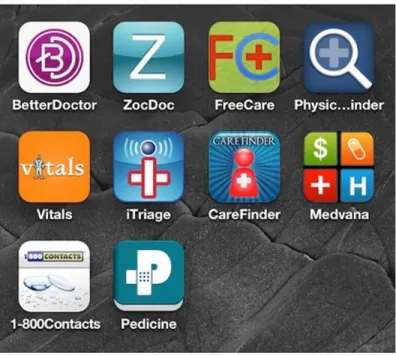
Quite a number of these similar mobile applications exist in the Android Google Store, but only catering to the western market and hospitals in the United States. Such examples of these are shown in the picture below.
17
Figure 2: Example of similar mobile applications in the western market.
Therefore, it is not usable for the Malaysian community in comparison with the Medical Experts Locator; where it focuses on government hospitals located in Malaysia.
2.5 Demand of mobile applications in Malaysia
In 2011, a study on consumer behaviours towards usage of smartphone in Malaysia was conducted by a team of people from School of Computer Sciences and Centre of Excellence NAv6; from Universiti Sains Malaysia, Pulau Pinang, Malaysia. From the number of respondents that took part in the study, roughly 90% of respondents were of below the age 36 years old. From those statistics, it was discovered that application software is the most popular in regards to mobile contents, generating an amount of interest of 41.8 percent out of a hundred. Furthermore, GPS-based application software established modest attention in utilization amongst the respondents, coming in fifth overall in respondent’s preferences of mobile applications (Osman, Sabudin, Osman &
Shiang-Yen, 2011).
18
From this study, we can conclude that the demand for mobile applications is present, with a moderate interest in those applications that integrate GPS features. This ties in with the motivation and interest for why this project in conducted.
From this chapter, it is established on why the project focuses on public healthcare as its main scope; and the demand for this type of mobile application from the Malaysian public. Moreover, previous research have found that certain illness may have an effect on patients if delayed of treatment were to happen. The literatures have also proved on different preferences depending on different patients in their preference of doctors, which varies across different genders or so.
19 CHAPTER 3 METHODOLOGY
3.1 Research Methodology
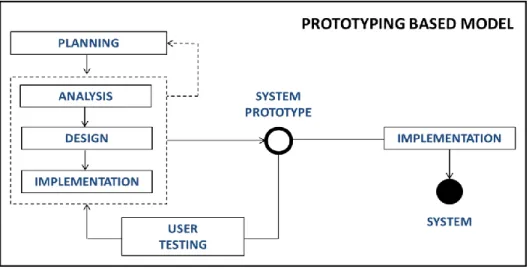
Figure 3: Prototyping Model
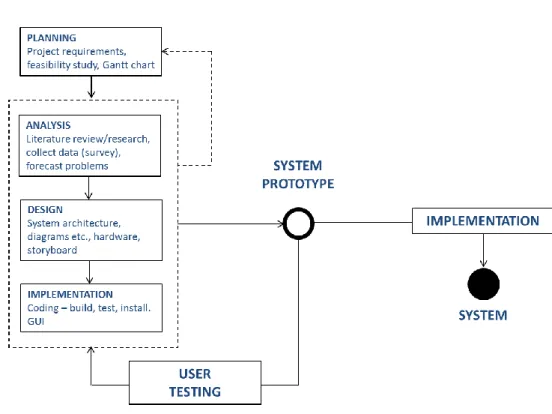
Using the prototyping methodology, the Analysis, Design, and Implementation phases are performed concurrently; on each cycle resulting in a system prototype that will be reviewed by the project sponsor. Based on comments from the sponsor, this particular cycle is done repetitively up until the prototype has successfully met the needed requirements. The final prototype is the system. Only the primary basic analysis and design is required for prototyping development, as the result important system functions may not be recognized until somewhere in the middle of project timeline. As a result, it is possible to redo again from the beginning since there is a possibility to alter the initial design decision. Although not precisely meeting the requirements, it can deliver the system rapidly to the users.
SDLC (System Development Life Cycle) is a process of developing a software or system, with the objective to meet certain requirements. The process covers various activities. Example of these are to why should the system be built, feasibility analysis of
20
the project, forecasting and analysing current problems, ensuring the correct system design and architecture are chosen, implementation and user testing, all the way up to delivering the system as a product to the end user. SDLC is performed through a few development phases whereby each phase continues and enhances the previous phases.
The development phases in System Development Life Cycle that are used are:
1. Planning
During the initial planning phase, the project requirements are defined and the process of why the system should be built is understood thoroughly. Moreover, a feasibility study is carried out from several different perspectives, and well as a Gantt chart was developed to forecast progress and milestones for both FYP 1 and FYP 2.
2. Analysis
The analysis phase includes activities such as problems identifying and analysis, and even include forecasting possible difficulties and problems that may arise in the future regarding the system. The deliverable of the analysis phase will assist developing work, and enable on how the system will be built. In this stage, the literature review and research is carried out, a survey is distributed for the collection of data (regarding user preferences on medical experts).
3. Design
System analysis induces the design decision, which determines how the overall system operates. This includes data processing, network infrastructure, hardware, graphical user interface (GUI) as well as other vital issues in the whole system environment. This phase is where the project process flow is identified, as well as the development of the ‘story-board’ for the application itself.
4. Implementation
Out of all the phases, the implementation phase is where the most resource, cost and time is utilized the most. This is the process where the system is essentially
21
built, test and eventually installed. Activities such as system maintenance and user-training are also included. During this phase, the java codes are implemented, as well as development of the interface. Coding includes building, testing and installing. After the prototype is completed, user acceptance and usability testing is carried out on the mobile application.
3.2 Project Development 3.2.1 Project Activities
Figure 4: Project Activities for FYP 1 1. Initiation
The project starts from the discussion of ideas for the Final Year Project (FYP) with project supervisor. The project initiation begins when the needs or opportunities for the project are identified. The idea of the project will then be written properly for the project proposal.
2. Concept Development
Scope of the concepts is well-defined and literature review is carried out comprehensively to gain sufficient knowledge on the project problem statement.
3. Planning
In this phase, Gantt chart is prepared to ensure that all project activities are cleared and can be done by the time allocated. The planning phase also includes the analysing of the system concept, conducting feasibility studies as well as conducting preliminary investigation of system requirement.
22 4. Requirement Analysis
In this phase, the result from the preliminary investigation is translated into a process flow diagram to ease the system developer’s understanding regarding the system requirement.
5. Concept Design
This phase involves the design of model diagram; where the application development ideas are translated into a visual concept diagrams or proposed system interfaces.
Figure 5: Overview of the Project Methodology (with Project Activities)
23 3.3 Systems Architecture
3.3.1 Activity Diagram of Medical Experts Locator
Figure 6: Systems architecture to show project flow and functions
3.3.2 Process Flow
Figure 7 displays a system flow chart of Medical Expert Locator. It shows the system flow chart of mobile application for the users. Users are required to choose the medical specialty or category they seek, and then to determine which hospital do they intend on looking at. Once the results of the medical specialists are shown, if users feel they do not like the choices that are available at that particular hospital, they are required to choose a different location. The process ends when users have selected where to go and will be navigated with the aide of the GPS function.
24
Figure 7: System flow chart for users 3.4 Key Milestones
Each activities listed are considered a milestone. At the start of this project, a Gantt chart is created. Changes in the Gantt chart is made to ensure that any unpredictable roadblocks and/or difficulties arise in the latter phases of development.
No. Activities Week
1 Project Proposal 2
2 Previous research/study findings 5 3 Data collection through survey 6
4 Extended Proposal 6
5 GUI Storyboard/mock-up prototype 10
6 Proposal Defense 11
7 Interim Report submission 13
Table 1: Key Milestones for FYP 1
25 3.5 Gantt Chart
For the Gantt charts please refer to Appendix A.
3.6 Collection of Data
The method of data collection of this project consists of survey. The target number of audience is 60 people, with the scope of those working in the public sector. As explained in the scope of study, this project chooses to focus on the public healthcare sector;
therefore those working in the private sector will be disqualified as they are covered with private health insurance.
Meanwhile, data of medical personnel will be gathered and collected to be integrated in a centralized database. Communication and direct contact will be made with the public hospitals, as well as the National Specialist Register of Malaysia.
26 CHAPTER 4
RESULTS AND DISCUSSION
4.1 Survey Findings
Overview of Data Collection and Findings
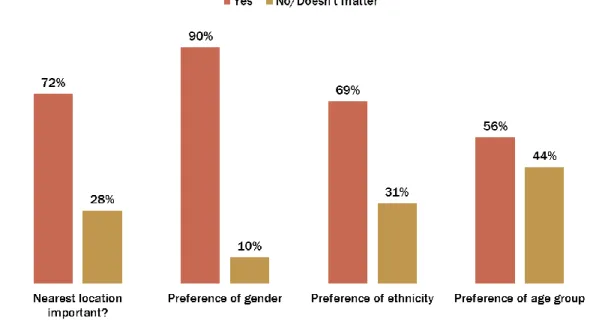
The survey was conducted with 36 respondents, with the objective of analysing their personal preferences when choosing medical experts. The questions given in the survey were closed-ended with the choice of ‘Yes’, ‘No/doesn’t matter’. This survey was conducted with the target audience of those who were working in the public sector.
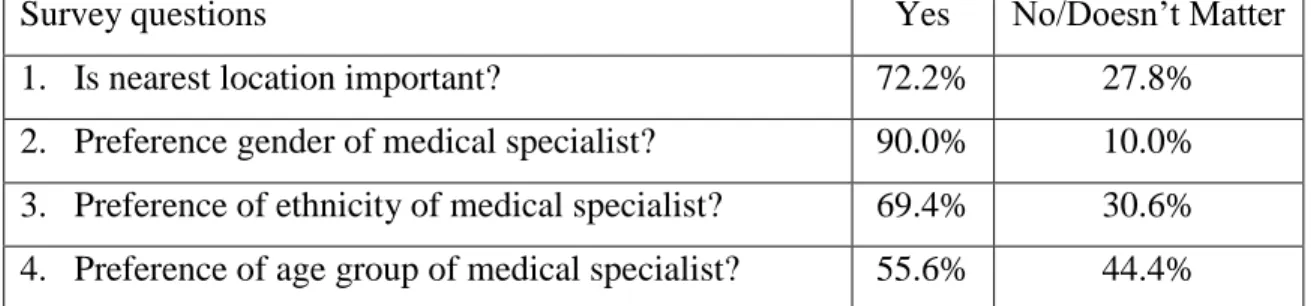
Based on the result of the survey, the percentage of respondent who had a specific preference (those who answered ‘Yes’) to the different categories of medical expert’s profile were as follows:
Survey questions Yes No/Doesn’t Matter
1. Is nearest location important? 72.2% 27.8%
2. Preference gender of medical specialist? 90.0% 10.0%
3. Preference of ethnicity of medical specialist? 69.4% 30.6%
4. Preference of age group of medical specialist? 55.6% 44.4%
Table 2: Result of the survey with percentage of user’s preferences
Therefore, Table 2 shows that participants of the survey have their own preference in the aspects of location, age, ethnicity and age group. Therefore, these factors will be prioritized in the mobile application.
27
Figure 10: Survey questions with respondent’s preference
From the results, for questions 2, 3 and 4 respectively; all respondents who answered
‘Yes’ had a specific preference of their own. For example, for preference of gender, 90 percent of the 36 respondents chose either ‘Male’ or ‘Female’ as their preference, with 10 percent of respondents having an opinion of it didn’t matter what gender the medical specialist were. Therefore, this chart shows that each of the respondents had a personal preference with regards to the respective categories.
28
Figure 11: Average user preference on medical experts’ criteria
From Figure 6, out of the 36 people who took part in the survey, 31 percent of participants picked gender as a top important factor in their decision to search for medical specialists, while 26 percent chose location, 24 percent ethnicity and 19 percent chose age-group as the important factor. It can be concluded that most users feel important towards going to seek medical help from experts who they know fit their gender preference, as shown in Figure 7. Therefore, during the initial design of the mobile application, age and location are the criteria on a high priority. These factors will influence on how the mobile application interface will be developed, based on the emphasis of each factors according to the most important, to the least important. Due to location being one of the highest priority; a global positioning system (GPS) will be integrated to the mobile application. The reason for including this is to aide users to locate, and help navigate to the location of the medical specialist after they have specifically made the choice of whom they seek and where to go to.
There was also a short, open-ended sub section of the survey where respondents are required to fill in brief experiences regarding the subject. Example of the questions were on known contacts (medical specialist in the family, friends etc.), years of experience of the medical specialist and history with any medical specialist. All open-ended questions
29
did not have much response due to the group of respondent’s never having personal experience in seeking specialist’s medical treatment. Therefore, this aspect of the research was nullified.
4.2 Graphical User Interface
Figure 12: Graphical user interface for the prototype (From left: homepage, medical specialty/category, location)
In one of the researches conducted in the project scope, some examples of the most common medical expertise are of the following:
1. Anaesthesiology 2. Cardiology 3. Dermatology
4. Emergency medicine 5. Family medicine 6. Gynaecology
7. Neurosociology 8. Orthopaedic 9. Paediatrics 10. Radiology 11. Urology
30
Figure 11 displays the prototype homepage, a list of the medical categories and the location available according to the project scope. From Figure 8, it was identified that the top factors in users’ preference of medical specialist are the following;
1. Gender 2. Location
Therefore, the results page will include these criteria. Additional factors (e.g. medical background) were also included, based on comments given in the post-survey research process. An example of the prototype interface with these factors can be seen in Figure 12. .
Figure 13: Display of results based on what input user has selected.
Figure 13 shows the results from what the users have selected from the medical category and hospital location. The result from that particular selection displays a total of six results. Results display the name of the medical experts, gender, medical profile (which can also be seen to determine experience and education background) as well as the NSR number. The next step in the process will connect the user to the GPS function and navigate them to the desired hospital location.
31
Figure 14: GPS feature to aid user to location of the medical specialist.
Figure 14 displays the page once the mobile application has connected with the GPS function of the smartphone (in this case it’s Google Maps). Users can then easily locate and navigate themselves to the desired hospital.
32 4.2.1 Mobile application navigation process
Figure 15: Step by step navigation process of Medical Experts Locator
Figure 15 shows the step by step process of how the users will navigate through the mobile application. At (1), the users will open the application and start. At (2), the users are then required to select a medical category, and choose which location (3). Once chosen, users are given the list of results (4). If users are dissatisfied with the current results, they are required to go back to step (3) and choose a different location. Once satisfied, users are directed through the GPS function and navigated to their desired location.
33 4.3 User Testing Results
User testing was conducted with 30 respondents; consisting of those who are in the public work sector. After the testing, feedback towards the project is evaluated. User testing was divided into three categories; prototype interface, prototype usability and the interest of the overall project. The results are as follows;
Figure 16: Overview of testing result of user acceptance test
From the result above, it can be clearly seen that 70.4% of respondents gave a positive result towards Medical Experts Locator prototype. A breakdown of the 70.4% shows only 52.3% of the respondents gave positive reviews regarding the prototype interface.
This may be due to the fact that the prototype is not fully developed; therefore the interface is not fully completed in terms of visual and aesthetic value. 76.6% of respondents showed positive response in terms of the mobile application’s usability;
where respondents found it quick and simple to navigate between pages, and work out the basic functions, all through to the end. Last but not least, 86.6% of respondents showed major interest in the prototype itself, with many claiming the intention and objective of the application interesting and worth taking a further look at.
34
Figure 17: Results of respondent’s satisfaction level
From the result above, the average respondents satisfaction level from their experience with the prototype was satisfied; which came in at 50%. This meant that half of the number of respondents who answered tested the prototype reacted positively. 43% of the respondents were at average level of satisfaction, with a mere 7% having feeling very satisfied from the prototype.
The results from this survey may be due to a couple of reasons. The user prototype was fully functional, but it was not 100% complete in terms of data availability. This may be a possible cause in why few respondents felt mostly satisfied with the mobile application. Feedback shows that respondents were interested in the idea, but recommendations included that the prototype to take account of more features and include more upgrades to increase user satisfaction.
7%
50%
43%
0% 0%
Satisfaction Level
Mostly satisfied Satisfied Average Less Satisfied Not Satisfied
35 4.4 Contribution to the mobile application
For the development of this project, one of the major features of the mobile application is that it incorporates the application with a GPS-based application program (pre-installed on any smartphone running on an Android OS).
Below is the setup for the coding of the integration process of the mobile application with a GPS-based application program, on App Inventor for Android.
Figure 18: Integrating Medical Experts Locator with GPS function
Figure 18 displays the coding blocks used in App Inventor to integrate the mobile application with the GPS on an Android smartphone, as well as connecting it to a specific GPS-based application program. Examples of this are Google Maps and Waze.
Future developers interested in the modification and enhancement to the mobile application can utilize this feature, by simply using the following specific coding blocks.
36 CHAPTER 5
COMMERCIALIZATION
5.1 Marketing/Commercialization Strategy
For this project, it was decided that the commercialization strategy to opt for was a freemium revenue model.
Primarily used to describe a business model that offers both free and premium services, freemium is a derived from the combination of "free" and "premium". It works by offering limited functionality at free of charge; whereby for a premium charge, additional features and support can be added on.
Using the freemium business model, end users will eventually buy the product. But the percentage of users in that category can range from less than five to just ten percent. When viewed financially, this does not make much sense. Due to the innovations of today’s modern world advances in digital production and distribution via the internet, the possibility to copy and distribute free products to a larger group at very minimal costs can now be achieved. Because of this, selling to only a small percentage of end users makes it easy to create a viable model from (Niculescu &
Wu, 2011)
5.2 Online Advertising
In online advertising, the Internet is fully utilized to convey promotional marketing messages to consumers. Once a mobile application marketable, online advertising can be a good method to generate revenue. One way of doing it is through floating ads. Floating ads, or sometimes referred to as overlay-ads, is a type of rich media advertisement, and with the request of application's content, appears superimposed over them.
37 5.3 Pricing
As of April 2013, the average price paid for Android apps (including those where the price was free) was significantly less than for those on iOS. This meant that the average user on Android want a mobile application at a lower cost, even more so that those users on iOS. What this implies is that Android users are more tolerant of in- app advertising to subsidize the cost of developing apps.
Figure 19: The average mobile app price as of April, 2013
Past studies have shown that iPad users tend to be bigger spenders than owners of other devices, including iPhone. (Flurry Analytics, Google Play, April 2013). On average, the price of iPad apps were as much as 2.5 times compared to those on iPhone, and 8 times more than the average price of those on Android. This is likely to be at least partly attributable to the fact that on average iPad owners have higher incomes than owners of other devices.
Osman et al (2011) conducted a study on the consumer behaviours toward usage of smartphone in Malaysia, where a total 1814 respondents took part (see Section 2.5).
On a segment where respondents were asked on the price they were willing to pay for a useful application, results proved that an approximately of 40 percent (the majority of the respondents) were willing to pay RM 5.00 or less for the mobile
38
application, with 31 percent of respondents not wanting to pay anything at all. This implies that the application selling price should be controlled within the price limit in order to get a higher number of demands
It is estimated that the Medical Experts Locator mobile application is to be released for free, but users are to be charged an additional $0.99 for an upgrade to premium version. Although the specifics are yet to be finalized, premium version will offer more choice of specifications and functions, such as a more broad of locations covered, and more detailed specifics of the medical experts.
5.4 Stages of Invention of Medical Experts Locator
Figure 20: Stages for invention of the mobile application
As of date, Medical Experts Locator is a running prototype, with the user testing phase completed. The current progress is to fix certain technical issues to increase user acceptance and satisfaction, based on the user testing results.
39 CHAPTER 6 CONCLUSION
6.1 Relevancy to the Objectives
As a conclusion, the mobile application has been designed based in accordance to the result findings from respondents. As mentioned previously in Chapter 1, the objectives were to gather medical experts’ profile and integrate them into a centralized database to be available in mobile applications and to incorporate the mobile application with a GPS-based application program, in order to ease users in locating medical experts. This project aims try to solve the problem of where patients waste energy and time of going to certain hospitals, but only to find out that the medical personnel in-charge is not of their liking. This mobile application will also aim to give patients the opportunity to check beforehand specifically which medical specialist will be available at the users’
preferred hospital; so that users are able to plan ahead of the journey.
It was found that the profiles of medical experts could be integrated into a database for the purpose of designing similar types of mobile applications in healthcare; as well as utilizing a ‘web mapping service application’ by integrating with Medical Experts Locator mobile application to help users navigate and locate medical experts.
Medical Experts Locator is an alternative for users to locate medical experts through smartphones, besides using internet-based systems and other offline mediums (e.g.
Yellow pages, hospitals directory).
40 6.2 Suggested Future Works for Continuation
Initial result from user testing of the mobile application prototype shows positive response in terms of its usability. The scope of this project primarily focuses on public hospitals with the Kuala Lumpur vicinity, where future works can include a bigger scope in terms of the number of hospitals involved and the area covered.
Furthermore, the mobile application may be developed on a different platform to give the application further room for improvement, and fix the limitedness of features and functions currently found on App Inventor for Android.
41
REFERENCES
1. Are rising medical costs getting you down? (2013). Retrieved October 12, 2013, from
http://www.hsbc.com.my/1/PA_ES_Content_Mgmt/content/website/personal/invest ments/liquid/4282.html
2. Chia, S. (2007, October 10). Transforming Malaysian healthcare. PWC. Retrieved October 13, 2013, from www.pwc.com/my/en/press/101007-transforming-msian- healthcare.jhtml
3. Cultural Dimensions of Pregnancy. 2010. Retrieved November 1, 2013 from http://www.health.qld.gov.au/multicultural/support_tools/14mcsr-pregnancy.pdf 4. De Luca, G., Suryapranata, H., Ottervanger J. P., Antman, E. M., (2004). Time
Delay to Treatment and Mortality in Primary Angioplasty for Acute Myocardial Infarction Every Minute of Delay Counts. American Heart Association. 109, 1223- 1225. doi: 10.1161/01.CIR.0000121424.76486.20
5. Fennema, K., Meyer, D. L., Owen, N. (1990). Sex of physician: Patients' preferences and stereotypes. The Journal of Family Practice, Vol. 30(4), 441-446.
6. “Hospital Canggih Tetapi.” Malaysian Insider May 2013.
http://www.themalaysianinsider.com/sideviews/hospital-canggih-tetapi...-harris- nasril/
7. Karen, F., Meyer, D. L., Owen, N. (1990, April) Sex of physician: Patients' preferences and stereotypes. The Journal of Family Practice, 30(4), 441-446.
Retrieved from http://psycnet.apa.org/psycinfo/1992-14082-001
42
8. Kok, C. (2009, March 14). Rising pressure of healthcare cost. The Star Online.
Retrieved October 12, 2013 from
http://www.thestar.com.my/story.aspx?file=%2f2009%2f3%2f14%2fbusiness%2f34 56038
9. Leng, C. H. (2008). Ownership, control, and contention: Challenges for the future of healthcare in Malaysia. Social Science & Medicine, 66, 2145-2156. Retrieved from http://www.sciencedirect.com/science/article/pii/S0277953608000610
10. Liow: Malaysians benefit from affordable healthcare. (2001). The Star Online.
Retrieved October 29, 2013, from
http://www.thestar.com.my/story.aspx?file=%2F2011%2F9%2F2%2Fnation%2F201 10902114556
11. Lurie, N., Ekstrum, J. (1993, August 12). Preventive Care for Women. Does the Sex of the Physician Matter? The New England Journal of Medicine, 329(7), 478-482.
Retrieved from http://www.nejm.org/doi/pdf/10.1056/NEJM199308123290707 12. Moser, D. K., Kimble, L. P., Alberts, M. J., Alonzo, A. … Zerwic, J. J. (2006).
Reducing Delay in Seeking Treatment by Patients With Acute Coronary Syndrome and Stroke. A Scientific Statement from the American Heart Association Council on Cardiovascular Nursing and Stroke Council, 114, 168-182. doi:
10.1161/CIRCULATIONAHA.106.176040
13. Niculescu, M. F., Wu, D.J. (2011) When Should Software Firms Commercialize New Products via Freemium Business Models? College of Management, Georgia Institute of Technology. pp. 1-13.
14. Osman, M. A., Sabudin, M., Osman, A. & Shiang-Yen, T. (2011). Consumer Behaviors toward Usage of Smartphone in Malaysia. International Conference on Software and Computer Applications, Vol. 9(Issue), pp. 158-164.
43
15. Wester, P., Rådberg, J., Lundgren, B., Peltonen, M. (1999). Factors Associated With Delayed Admission to Hospital and In-Hospital Delays in Acute Stroke and TIA. A Prospective, Multicenter Study. 30, 40-48 doi: 10.1161/01.STR.30.1.40
44
APPENDICES Appendix A: Gantt chart
Figure 8: Gantt chart for FYP 1
Figure 9: Gantt chart for FYP 2
45 APPENDIX B: Medical Experts Locator
MEDICAL EXPERTS LOCATOR QUESTIONNAIRE Nationality:
Medical Insurance (if any):
Age:
Gender:
History with Medical Experts:
1. Have you ever sought for any specialist medical treatment in the past?
Yes No
If so, what was it for? _________________________________________
2. Do you have any family members who are doctors/medical personnel?
Yes No
3. Do you prefer to seek medical treatment from public or private institutions?
Public Private
4. When deciding on where to seek specialist medical treatment, is nearest location important to you?
Yes No
5. Preferred age group of medical specialist?
<30
31 – 40
41 – 50
>50 6. Preferred gender of medical specialist?
Male Female
7. Preferred ethnicity of medical specialist?
Malay
Chinese
Indian
Other
Does not matter
45 APPENDIX C
MEDICAL EXPERTS LOCATOR: USER TESTING FEEDBACK FORM
The objective of this feedback form is to record the feedback from respondents in order to improve the function and effectiveness of this mobile application.
Please rate 1- 4 for the questions below. Strongly
Agree Agree Disagree Strongly Disagree INTERFACE
This application has user-friendly
Graphical User Interface (GUI).
4 3 2 1
The layout of the mobile application is neat
and structured.
4 3 2 1
USABILITY It is easy to understand how this
application works.
4 3 2 1
It is easy to navigate through the
application pages.
4 3 2 1
My overall experience with this mobile
application is positive.
4 3 2 1
INTEREST
You are interested to use this application.
4 3 2 1
I will recommend this application to be
used by friends and family.
4 3 2 1
OVERALL USER SATISFACTION Please rate your level of
satisfaction towards Medical Experts Locator