Mobile Bookstore (m-Bookstore)
by
Aman Zenni Bin Roslan 3610
Final report submitted in partial fulfillment of the requirements for the
Bachelor of Technology (Hons) (Information Communication Technology)
JANUARY 2006
Universiti Teknologi PETRONAS
Bandar Seri Iskandar 31750 Tronoh Perak Darul Ridzuan
Approve
CERTIFICATION OF APPROVAL
Mobile Bookstore
by
Aman Zenni Bin Roslan
A project dissertation submitted to the Information Technology Programme
Universiti Teknologi PETRONAS in partial fulfillment of the requirement for the
BACHELOR OF TECHNOLOGY (Hons) (Information Communication & Technology)
(Mr. Anang Hudaya)
UNIVERSITI TEKNOLOGI PETRONAS
TRONOH, PERAK May 2006
CERTIFICATION OF ORIGINALITY
This is to certify that I am responsible for the work submitted in this project/assignment, that the original work is my own except as specified in the references and acknowledgements, and that the original work contained herein have not been undertaken or done by unspecified sources or persons.
XT
AMAN ZENNI BIN ROSLAN
ABSTRACT
Mobile technologies and computing are evolving and expanding each day, demanding and creating a much more ubiquitous computing environment. This research project proposes the development and implementation of the Mobile Bookstore - a mobile solution for bookstore businesses. This report presents the final research and study of the development of the Mobile Bookstore as a solution to the problem statements stated in the project proposal as well as in this report, which is considered as the main objective of the study. The Mobile Bookstore will address to the four problem statements, which are the geographical problems, the advancing mobile technologies, ubiquitous demands in computing and large bookstore information requests. These objectives help in answering the question to why this research is done and why would we need a mobile bookstore? With the mobile bookstore, companies can reach out to more customers, anywhere and everywhere using mobile devices. This concept allows for a more ubiquitous business and computing. Major bookstores need to compete and to be on top, implementing the latest technologies to serve its customers, and the mobile technology is one that should be taken advantage of. Browsing the large database of a bookstore can be time-consuming and difficult using expensive kiosks
that come in limited numbers. A wireless environment can create wireless networks
allowing those with mobile devices to browse through the bookstore database with ease. With this report, the basis for the research of this project will be underlined in detail, including the technologies, means, methods and study of recent researches related to the study. The result of this research project will be the software solution, a system (the Mobile Bookstore), which consists of two modules: the outdoor WAP-
based module and the indoor Wireless Network module.
ACKNOWLEDGEMENTS
First and foremost, I would like to thank Allah S.W.T for granting me the strength and will to complete this project. I would like to thank Universiti Teknologi PETRONAS and my supervisor, Mr. Anang Hudaya, for providing me with the proper guidance to complete this project. My deepest appreciation goes to all the lecturers and evaluators that have helped me in improving this project, recognizing both strengths and weaknesses. Many thanks and appreciations go to Mr. Nordin for conducting the Final
Year Project in UTP.
I would also like to thank my colleagues for providing all theirhelp and support in this project. I would like to thank Ms. Nur Farihah Bt. Sajali for constantly supporting and helping me in developing this project. Last but not least, I would like to thank my parents for their guidance and support, and for having faith in their son in
studying abroad, far from home.
ABBREVIATIONS
WWW
World Wide Web
W3C
World Wide Web Consortium
HTML
Hypertext Markup Language
XML
Extended Markup Language
WAP
Wireless Application Protocol
SOAP
Simple Object Access Protocol
WPAN
Wireless Personal Area Network
PDA
Personal Digital Assistance
WSE
Web Service Enhancements
J2ME
Java 2 Micro Edition
TABLE OF CONTENTS
CERTIFICATION OF APPROVAL ii
CERTIFICATION OF ORIGINALITY iii
ABSTRACT iv
ACKNOWLEDGEMENTS v
ABBREVIATIONS vi
LIST OF FIGURES x
LIST OF TABLES xi
CHAPTER 1: INTRODUCTION 1
1.1 Background of Study 1
1.2 Problem Statements 13
1.3 Objectives and Scope of Study 16
CHAPTER 2: LITERATURE REVIEW 20
CHAPTER 3: METHODOLOGY 23
3.1 Introduction to Project Methodologies 23
3.2 Development Process Model - Waterfall Model 23
3.3 Process Iteration - Incremental Development 24
3.4 Prototyping - Evolutionary Prototyping 25
CHAPTER 4: DISCUSSION 26
4.1 Scope of Discussion 26
4.2 Target Users 27
4.3 Outdoor Module: Mobile Web Bookstore Application 29 4.4 Indoor Module: Wireless Bookstore Application 34
4.5 Administrative Users 38
4.6 Current System Discussion 38
CHAPTER 5: CONCLUSION AND RECOMMENDATION 73
5.1 Conclusion 73
5.2 Recommendations 74
REFERENCES 75
APPENDICES 79
LIST OF FIGURES
Figure 1: An Example of Mobile Web Services 6
Figure 2: Capability Sharing 7
Figure 3: Waterfall Model 24
Figure 4: Incremental Development Model 24
Figure 5: Mobile Bookstore Outdoor Module Use Case Diagram 31 Figure 6; Mobile Bookstore Indoor Module Use Case Diagram 36
Figure 7: Login Screenshot 39
Figure 8: Guest (Non-Members) Main Menu 41
Figure 9: Members Main Menu 42
Figure 10: Search Function Flowchart 44
Figure 11: Screenshots of the Search Function 45
Figure 12: Branch Indicators 49
Figure 13: User Cart Information Link 50
Figure 14: Simple Maximum CartValue Table Diagram 51
Figure 15: Add Book to and Remove Book from Cart Functions 52
Figure 16: Manage Cart Page Screenshot 53
Figure 17: Cart Information in Book Information Page 53
Figure 18: Book Owner Records Table Diagram 54
Figure 19: Book Rating Information 55
Figure 20: Rate This Book Function 56
Figure 21: Remove Rating Function 56
Figure 22: Manage Book Ratings Page Screenshot 57
Figure 23: Used Books List Screenshot 58
Figure 24: Adding Used Books to Cart 59
Figure 25: Removing Used Books from Cart 59
Figure 26: Purchase Disclaimer 60
Figure 27: Purchase Method Options 61
Figure 28: My Transactions Page 62
Figure 29: Batch Status Details 63
Figure 30: StaffLogin Page 64
Figure 31: Transaction Management 65
Figure 32: Request/Transaction Details 66
Figure 33: Book Ownership Management 67
Figure 34: Administrator Login 68
Figure 35: Setting up Printer Connection 69
Figure 36: Automated Request Listening and Printing 70
Figure 37: Receipt Printout Format 71
Figure 38: Mobile Bookstore Database Relationship Diagram 72
LIST OF TABLES
Table 1: Statistics of Mobile (Cellular) Phone Users in Malaysia 12
Table 2: Statistics of Broadband Internet Users in Malaysia 12Table 3: Statistics of Dial-Up Internet Users in Malaysia 13
worldwide and it is the single medium of which we agree on to be the main source of education and knowledge.
1.1.2 The World Wide Web (WWW)
According to [19]
The World Wide Web ("WWW", "W3", or simply "Web") is an information
space in which the items of interest, referred to as resources, are identified by global identifiers called Uniform Resource Identifiers (URIs). The term is often mistakenly used as a synonym for the Internet, but the Web is actually a service
that operates over the Internet.The vast growth and evolution of the Internet has affected our lives in many ways we would have never imagined 20 years ago. The Internet, as we know it, is a
collection of interconnected networks that link and connect people from all over the
world under a common standard and protocol. The World Wide Web provides vast resources of information in web pages sent to the users' computers, almost instantly.
The advancements in technology have provided us with better network managements
and hardware, resulting in better and faster network performance. This increases the speed of information transfer within the Internet to allow a much faster use of the
World Wide Web.
The World Wide Web has spawned many new features and applications for our daily lives. As we can see today, businesses are competing to provide its products and services online or through the World Wide Web. E-commerce and e-business are emerging in today's advanced and modern environment. Online sales of products and services are increasing and are becoming crucial to most businesses. As the Internet and the World Wide Web provides new opportunities for businesses, it also provides new opportunities for the dissemination of knowledge and education to a wider audience,
worldwide. The Internet and the World Wide Web have also made it possible for online
collaborations and work to be done among parties from different regions of the globe without them having to travel far.
1.1.3 Mobile Technologies
Mobile devices are very popular in today's world. Mobile phones allow us to communicate with others almost everywhere. Before, telephones were only to be used at homes and offices, but not on the go. Now, mobile phones can be used almost anywhere, providing us with mobility in our daily communications with others. Mobile devices are advancing each day, providing more and more features to its users, besides communication. Mobile phones nowadays allow users to perform more functions than ever, such as running applications, games and many other useful features.
According to [13]
Mobile personal devices such as Palm Pilot devices, web-enabled cellular phones, and Personal Data Assistants (PDAs) have been the darlings of consumers from businessmen to students alike. The decrease in price of the mobile devices due to market competitiveness and the established open standard for wireless application development is fueling this hyper growth of m- commerce. According to a recent market study, it is estimated that there will be 500 million wireless subscribers by the end of year 2001, and this number is expected to grow to more than a billion by 2004. (p. 199)
Today, we talk about mobile phones with capabilities to run powerful applications and also to join networks as well as the Internet. Web services are extended to mobile devices, making way for the existence and advancements of mobile web technologies. Nowadays, the mobile device market is growing rapidly and this can be seen even in Malaysia alone. Mobile device companies such as Nokia, Panasonic, LG, Samsung, Sony Ericsson and Motorola are competing in the mobile device industry, providing us with all the latest mobile gadgets especially mobile phones. The
growth of the mobile device industry itself acts as a catalyst to the growth of mobile applications and also mobile commerce.
1.1.4 Web Services
The W3C definition of Web Service [18] is:
'... a Web Service is a software system designed to support interoperable
machine-to-machine interaction over a network. It has an interface described in
a machine-processable format (specifically WSDL1). Other systems interact with the Web Service in a manner prescribed by its description using SOAP2 messages, typically conveyed using HTTP with an XML3 serialization in conjunction with other Web-related standards.'
According to [4]
Web Services provide a technology for expressing the interactions between customer and business partners, as part of their business processes. Over the last ten years, Internet growth has been phenomenal, fuelled by consumer browsing and shopping. Businesses have been creating trading partnerships electronically, and in recent years more of these have been created using Web Services to enable interoperability between partners. Web Services have seen early adoption and rapid growth, and many businesses are now offering Web Services access to their business systems for their trading partners, (p. 202)
The principal goal of Web Services is to provide interoperability between typically distributed application components [4]. When we talk of Web Services, we are referencing to the use of the World Wide Web on the normal desktop or personal computer systems. But of course, Web Services extend to more features besides the plain HTML. However, Web Services are more concerned with web applications that are meant for the everyday normal computers, whether used at home, work or for special-purpose computer systems.
1.1.5 Mobile Web Services
According to [4]
Mobile Web Services apply Web Services technology to the mobile environment, enabling exciting new services to be offered to consumers on their mobile telephones, wireless-LAN-enabled PDAs and laptop computers. Mobile Web Services are the application of Web Services technology to the mobile environment. Standard Web Services technology could be directly applied to applications on mobile devices, for instance a shopping application on a mobile telephone could invoke an operation on a Web Service using SOAP, to purchase a music CD, and provide payment information. However, this application of Web Services technology is unlikely to meet the full requirements of the mobile application and its user. A mobile Web Service application will typically differ from a more traditional Web Service application because of the following factors: (a) the portability of the device; (b) the association of the device with a particular user; (c) the personalization of the application to the user; (d) the constraints imposed by the limitations of the device, in terms of limited user interface, small form factor, low processing power and often poor bandwidth, (p. 203)
According to [9]
WAP is an enabling technology that bridges the gap between the mobile world and the Internet. The integration of WAP and Web components allows end-to end services between information providers and mobile clients. With the coming 3G systems and mobile IP, WAP and similar technologies will continue to play an important role in the development of information services, (p. 329)
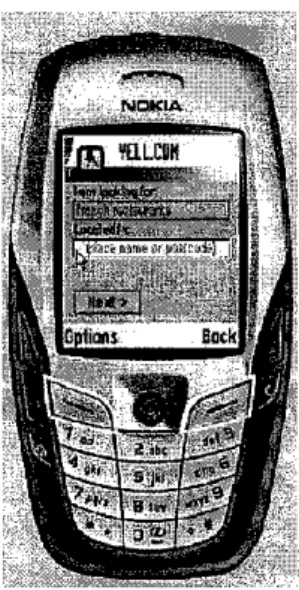
As seen from Figure 1 [4], with mobile web services, people can view web pages and applications (hosted using Web Services) on their mobile devices, especially their mobile phones. A common question in today's world is "why do we need mobile web services?" and "what are the benefits of building a framework that will support the
convergence of mobile communications and PC networks, and why are Web Services a good solution for this?" [4]. It is important that we understand the rationale behind implementing mobile web services as solutions to many online problems and as a step forward to the future. Farley and Capp (2005) [4] states that there are two major criteria that explains the rationale of implementing mobile web services as a solution: (a) the ability of mobile networks to allocate a single and specific identity to a single user with the use of their current SIM cards, improving security on networks and allowing better implementation of mobile web services through the mobile network; and (b) the high availability of mobile devices to consumers that lends itself to the integration in a larger, more complex and multi-device system (p. 204).
Figure 1: An Example of Mobile Web Services
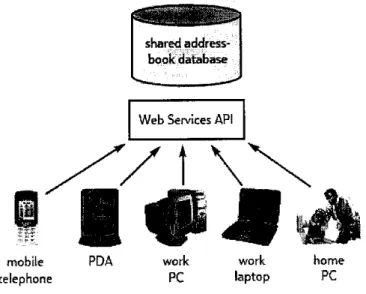
Figure 2 shows a simple diagram of the process of capability sharing [4].
Through capability sharing, a multi-device environment is created, and the implementation of Mobile Web Services will be a catalyst for such a process to run and operate smoothly. With the Mobile Web Services implemented and integrated with the current Web Services, a centralized system is created connecting everyone, everywhere. The World Wide Web can be said to be accessible to all users no matter where they are, just as long as they have their mobile devices with them.
mobile
telephone
shared address- book database
Figure 2: Capability Sharing
1.1.6 Mobile Web Developments from Microsoft Corporation
Many software companies today are competing to produce the best Software Development Kits or SDKs to its customers (programmers). Companies such as Sun Microsystems and Microsoft Corporation are in the leads developing the best Mobile
Web Service SDKs to allow for a much better and reliable development environment
for all mobile web programmers worldwide. As the computing world knows, Microsoft Corporation is one of the largest software and development toolkit providers in the world today. Complementing the Microsoft Windows Operating System family,
Microsoft has released the .NET Framework, a framework to allow for better
compatibility amongst many programming platforms (to be developed and run on
Microsoft Windows platforms).
In the areas of Web Services, Microsoft is famous for its ASP and ASP.NET
web programming platforms running under the Microsoft Internet Information Services (IIS). Microsoft has actively integrated its .NET Framework, ASP.NET and IIS to with Mobile Web Services enhancements, through the introduction of its latest installment,
the Web Service Enhancements. Web Services Enhancements for Microsoft .NET(WSE) is a supported add-on to Microsoft Visual Studio .NET and the Microsoft .NET
Framework providing developers the latest advanced Web services capabilities to keep pace with the evolving Web services protocol specifications [11]. The WSE is known to support for Mobile Web Services development.
The Mobile Internet Toolkit is also another add-n installment introduced by Microsoft Corporation to further increase its support for Mobile Web Services development.
1.1.7 Simple Object Access Protocol (SOAP)
There are many definitions of the Simple Object Access Protocol or SOAP found on the Internet. But no matter what, these definitions are all based on a single idea and are similar in defining what SOAP is. SOAP provides a simple and lightweight mechanism for exchanging structured and typed information between peers in a decentralized, distributed environment using XML [3]. SOAP does not itself define any application semantics such as a programming model or implementation specific semantics; rather it defines a simple mechanism for expressing application semantics by providing a modular packaging model and encoding mechanisms for encoding data within modules [3]. The Simple Object Access Protocol (SOAP) is a novel protocol which supports information exchange in a decentralized, distributed environment, which brings flexibility and extensibility to the communication and invocations among remote hosts [10]. The SOAP framework can be used and integrated with mobile web applications to act as a middleware for all clients accessing the mobile web services. The implementation of the SOAP framework can also be considered as a proxy for mobile web services. However, SOAP requires a high performance for collaboration such as delivery and invocation [10].
1.1.8 Bluetooth Technology on Mobile Devices
Bluetooth is a wireless, small, cheap and power efficient communication technology [20]. Bluetooth is an open industry standard that can provide short-range radio communication among small form factor mobile devices [23]. Bluetooth has been designed to provide a cable replacement technology with emphasis on robustness and low cost [23]. Bluetooth is becoming more commonly used in many mobile devices produced in the world today. Companies like Nokia and Sony Ericsson are focusing on integrating Bluetooth technology in their mobile products especially their mobile phones. Bluetooth provides better connectivity with many other devices and is slowly becoming a standard for many mobile devices. With the use and integration of Bluetooth, many more features can be added to the mobile devices such as the ability to connect to personal computers, other mobile devices and also join wireless networks using the Bluetooth network.
1.1.9 Wireless PANs and Bluetooth Networks
Wireless personal area networks (WPANs) are short to very short-range (from a couple centimeters to a couple of meters) wireless networks that can be used to exchange information between devices in the reach of a person [22]. WPANs may be deployed to replace cables between computers and their peripherals to establish temporary or permanent short-reach connections as an enabler of pervasive computing as well as to institute ad hoc networks [22].
The best technology example representing WPANs is the recent industry standard Bluetooth [22]. Bluetooth appears to be a candidate for building ad hoc networks [20] and also Personal Area Networks. In the ad hoc Bluetooth networking area, some problems still have to be investigated, especially with respect to the ad hoc routing scheme to be used in these networks [20]. The Bluetooth networks are frequently being used as extensions to the Internet and end-users are exploiting them to
access wireless Internet services from different types of handheld devices [23]. One of
the key features of Bluetooth that makes it a preference in the mobile industry is its
cheap price.
According to [22]
Companies developing Bluetooth chips claim, that in the near future complex one-chip solutions of the Bluetooth specification will be available in the $5 price range. With this target price it is predicted that not only will most PDAs, phones, laptops include such technology but that the number of small WPAN enabled devices (e.g., pens, cameras, headsets, and various sensors) will soon
outnumber the computers on the Internet, (p. 7)1.1.10 Ubiquitous Mobile Computing
Modern technological .changes have allowed the computing environment to become increasingly pervasive, ubiquitous, and mobile [10]. The availability and adoption of a wide range of mobile computing devices (e.g., laptops, Personal Digital Assistants (PDAs), wearable computers) of varying sizes and processing capabilities, along with the emergence of Wireless Local Area Networks (WLANs) such as IEEE 802.11 and Personal Area Networks (PANs) such as Bluetooth and HomeRF, are catalysts enabling the ubiquitous access of information anywhere, anytime [23].
Realizing truly ubiquitous mobile computing requires innovative theories, paradigms and applications in various research areas including algorithms, networking,
and software architectures and data management [12]. Ubiquitous and mobile webapplications are typically very autonomous in nature, because they rely on additional
information about the user's context [1]. The credo of ubiquitous computing is that
hardware and software in everyday life should "disappear", and be as autonomous as
possible [1].1.1.11 Online Bookstores to Mobile Bookstores
Bookstores play a major role as a source of information provider, as it provides the service of selling books and other educational materials. There are many major bookstores in the world today selling huge amounts of books and educational materials.
Examples of some of the large bookstore chains available in Malaysia are MPH and Kinokuniya. These two bookstore giants provide us with huge collections of books, magazines and many otherformats of information for sale.
To improve the selling ofbooks to a wider range of customers, many companies have expanded their bookstore business to the online method, which is through the World Wide Web. Companies like Amazon has opened sites (such as www.amazon.com'), providing e-commerce and e-business functions to those who wish to purchase books and other products online. However, we have yet to come across major companies investing in mobile bookstores, where customers can browse and actually buy books and other educational materials through their mobile phones.
1.1.12 Internet and Mobile Phone Users in Malaysia
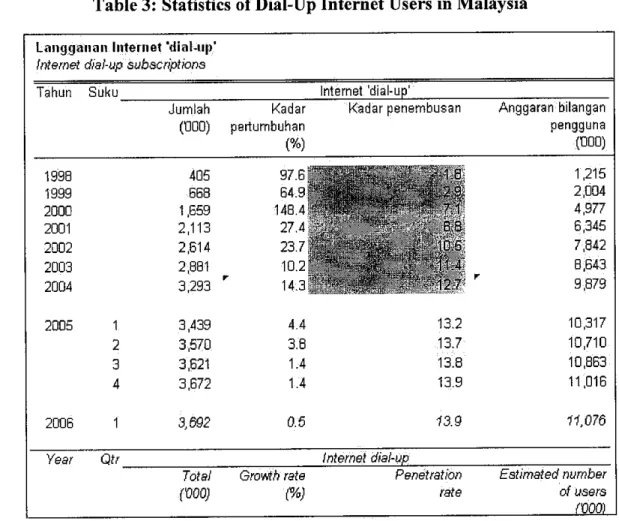
Internet and mobile phone users in Malaysia are increasing each year. Statistics from the Malaysian Communications and Multimedia Commission (MCMC) website clearly shows this growth of usage and this can be directly related to the society's
awareness towards the advancing technology. The tables below show the current
statistics of mobile phone users, broadband Internet users and dial-up Internet users in
Malaysia, as taken from the MCMC site
("http://www.cmc.gov.mv/facts figures/stats/index.asrj).
Table 1: Statistics of Mobile (Cellular) Phone Users in Malaysia
Telefon selular
Cellular phones
Tahun Suku Telefon. selular Perkhidmatan pesanan
pendek Pasca
bayar Pra
Dayar
Jumlah
(000)
Kadar fDertumbuhan.
Kadar penembusan
% digital
Jumlah Per
(%) pa) langganart
Nota 1 2
1993 2,150 -12.6 9.7 74.5
1999 2,717 26.4 12.0 83.7
2000 2,599 2,523 5,122 88.5 21.6 91.8
2001 3,069 4,316 7,385 44.2 30.8 95.6
2002 2,961 6,092 9,053 22.6 36.9 97.9 3,605.9 398
2003 2,566 8,558 11,124 22:9 43.9 98.9 6,163.5 554
2004 2,555 12,057 14,611 31.3 56.5 99.8 9.532.1 .652
2005 1 2,628 13,201 ' 15,829 8.3 60.9 99.9 3,406.9 215
2 2,787 13,764 r 16,551 4.6 63.3 99.9 4,953.0 299
3 2,896 14,655 r 17,551 6.0 66.8 99.9 6,085.5 347
4 2,925 16,620r 19,545 11.4 74.1 99.9 7,553.6 386
2006 1 2,983 17,607 r 20,590 5.3 77.7 99.9 7,458.5 362
Short message services
Year Qtr Cellular,phones. (SMS)
Total Growth rate Penetration % digital Total Per
Postpaid Prepaid (W0) m rate (million} subscription
Table 2: Statistics of Broadband Internet Users in Malaysia
Bilangan langgaimi jalur leltar mencjikut tekiiologi
Estimated number of broadbandsubscriptions by technology
Tahun Suku Bilanq an langganan
Penembusan
ADSL SDSL Wireless Lain-lain Jumlah
2002 18,511 542 249 19,302 0.08
2003 108,173 1,931 302 110.406 0.45
2004 247,802 2,834 1,865 252.501 0.98
2005 477,685 3,712 5,914 14,391 490,630 1.86
2006 1" 'L 539 317- 3,942 : ;.';-Wmr:M
r^fesT
575,816 2.17Year Qtr Number of subscriptions
etrationRate
ADSL SDSL Wireless Others Total'
Table 3: Statistics of Dial-Up Internet Users in Malaysia
Langganan Internet "dial-up' internet dial-upsubscriptions
Tahun Suku Internet 'dial-up'
Jumlah Kadar Kadar penembusan Anggaran bilangan
(DOO) pertumbuhan (%)
pengguna
(DOO)
1998 405 97." '"-.••>"'•':•.' .•' J Mi 1,215
1999 668 64.J ''1w^7l''"%<-1& 2,004
2000 1,659 148.4 • ••••&$•: ' "• .**/f-• •y|' 7"i 4,977
2001 2,113 27.4 S3 6,345
2002 2,614 23.7 ••'•••'••-->!• •*' "C.G 7,342
2003 2,881 10.2'••^•... „# .f-;-f'..4i 8,643
2004 3,293 14.3 •••••** 127 r 9,879
2005 1 3,439 4.4 13.2 10,317
2 3,570 3.8 13.7 10,710
3 3,621 1.4 13.8 10,863
4 3,672 1.4 13.9 11,016
2006 1 3,592 0.5 13.3 11,075
Year Qtr Internet dial-up
Total Growth rate Penetration Estimated number
(WO) {%) rate of users
fOOO)
As can be seen from these tables, mobile phone and Internet users are increasing
each year, up to 2006. Broadband Internet users are also increasing, and this covers
other Internet access methods such as WAP and Wireless.
1.2 Problem Statements
1.2.1 Geographic Problems
Bookstores (take for instance MPH and Kinokuniya in Malaysia) have vast amount of
books to be sold to millions of readers. One of the main problem statements is that
these very large bookstores sell a wide range of books, but are located only at urban
areas (too far for some). Some of these readers might be out of reach or as we are, some
are just lazy and prefer everything to be done at home. Small bookstores near their living areas will never match up to the range of books sold at these bookstore giants.
We have heard of online bookstores (Internet) but what about those that travel a lot?
What about those that do not prefer to hook up to the Internet using their personal computer? Or even, what about those that prefer to perform these functions easily and
remotely using nothing but their mobile devices?1.2.2 Competition Due to Technology Enhancements
We have heard of online bookstores, but today the world is hyped with the advancements in mobile technology. WAP or mobile Internet (on hand phones, PDA's)
is becoming more popular amongst consumers nowadays. Companies nowadays compete with each other by providing the latest form of service and products, making use of the latest technologies available in the world. Those companies that fail to meet with the latesttechnological requirements will face hard times in their businesses.
Today, mobile technologies are advancing and the need to make use of the technologies is important to both businesses and consumers. The question now is what if you can choose books, read the summaries, read reviews and purchase these books by
only using hand phones or PDA's?
1.2.3 Meeting with Ubiquitous Demands in Computing
Another problem statement related to the one mention above would be if there exists
such a system (mobile bookstore), how can we make it such an easy process for the
users (customers/readers)? How can the users easily browse through the huge bookstore
database by only using their hand phones? How can we reduce the amount of data
transfer to allow the users to perform all their book shopping needs faster and more
reliable? Most of today's mobile communications company charge customers for
connecting to Internet through their hand phones or PDA's (GPRS) according to the
amount of data they download (usually at a certain charge per kilobyte downloaded).The more data downloaded, the more customers pay.
These issues are concerned with the ubiquitous demands in today's
computing world. Applications, especially web and mobile web applications require a lot of ubiquitous functions adapted in order to provide better navigation and also better network bandwidth usage. One of the limitations or drawbacks in the ubiquitous mobile computing especially in the areas of Mobile Web Services, however, is the need to limit
the information retrieved and shown on the screen of the mobile device due to certain factors such as the small size of the mobile device and the limited bandwidth of the
mobile device.
One of the most critical technologies in a variety of application services of
ubiquitous computing is to supply adequate information or services depending on each context through context-awareness [8]. An increase in the information transferred can lead to information overload and proper solutions need to be developed in order to solve this problem when facing with ubiquitous forms of computing.
According to [8]
Applications of ubiquitous computing are increasingly leveraging contextual
information from several sources to provide users with behavior appropriate to their environment. The method of information retrieval is one of the most fundamental research issues in ubiquitous computing. Applications where user's
contexts change continuously over time require prompt retrieval of relevant
information, (p. 167)As seen in Table 1 and Table 2 on page 12, mobile phone and broadband
Internet users in Malaysia are increasing by each year. This indicates a high probability
of the increase in the use of mobile Internet access through WAP. WAP can be accessed by either GPRS or 3G, so costs are becoming lesser each year.
1.2.4 Large Bookstore Information Requests
The final problem statement would be on browsing the bookstore itself. One may not complain of the large number of books sold at these large bookstores, but admire them.
However, searching manually through thousands of books can be a hassle. In Kinokuniya (located at KLCC), the bookstore provides its customers with at least one kiosk, allowing them to browse through the bookstore's large database. However, this can be problematic considering that the bookstore receives hundreds of customers per
day. Will customers eventually have to put up with lining up just to use the kiosk?
Imagine a bookstore where those who own mobile devices can search through the
bookstore's database, read summaries and reviews, check for prices and availability,and also locate books in the bookstore.
1.3 Objectives and Scope of Study
1.3.1 Objectives of the Study
The objective of the study is mainly to perform the necessary research on issues related to the problem statements identified in the above section, in order to formulate a suitable solution to solve the problems stated - the Mobile Bookstore, a mobile web application. This solution is usually a combination of a few methods and techniques in fields related to the study, often compiled in a system. Since this research will be performed according to the nature of the programme taken (Information Technology), the solution will be compiled in a system - an application that is usable, testable and
verifiable.
The functional objective deriving from the base objectives is to develop or produce a software system in order to meet all the base objectives. This software system is a requirement of the research project. The system proposed is the Mobile Bookstore. The scope of the system will be covered under Scope ofStudy.
The objectives of this study can be summarized (briefly but concisely) in the
following phrases:
• The first objective of this study is to perform a thorough research on matters related to the problems statement discuss, which in detail will cover two
wide areas of IT - the study of developing a mobile web application systemto cater for a mobile bookstore system and the study of the implementation
of a wireless Bluetooth network in a bookstore to provide users with better book browsing and shopping capabilities.• The second objective will be to make use of the analyses done on the research subjects to fully implement all studies and to develop the appropriate systems in order to provide a solution to the problem statements.
1.3.2 Scope of Study
The scopes of study will mainly be concerned with all the problem statements stated as the main objective of the research is to come up with solutions to the problem statements. These objectives will be integrated and used as the main requirements in developing or producing the software system as a solution. The software system proposed for this research project is of course the Mobile Bookstore. Therefore, the
scopes of studycan be summarized into four areas.
The first scope would be to satisfy the objective of solving the first problem
statement - geographical problems. Studies will be done to research on methods,
techniques and issues in developing a mobile web application. Research will also be done to decide on a suitable platform to develop the mobile web application. This project will produce a product that will allow readers and bookstore customers to browse the bookstore through their mobile devices, using WAP - a mobile bookstore.
This allows customers to search for books, locate stores where these books are available, and even order these books through their mobile devices. This product will be a micro site for a large bookstore.
The second scope would be to satisfy the objective of solving the second
problem statement - competition problems due to technological advancements. This scope can be combined with the first as it involves the same contents and research processes as the first scope, which is to produce a mobile web application for the
bookstore.
The third scope is to satisfy the third objective of solving the second problem statement - problems in meeting with the ubiquitous demands in today's computing.
Research will be done on how to apply techniques and methods to allow for a better
mobile application environment meeting with the ubiquitous needs in today's mobile web surfing environment. The mobile bookstore will be smart in a sense that it will remember users' book preferences to allow it to show results of related books. The
mobile bookstores can recommend similar books instead of showing everything. The mobile bookstore will ensure ubiquitous data processing whereby if users were tobrowse away from their search queries and then go back, the results will still remain.
The system will also try to reduce the amount of data transfer to ease the browsing
process, allowing faster transactions.Last but not least, the fourth scope will satisfy the objective of solving the
fourth problem statement - problems in spreading and handling large bookstore
information requests from customers. Studies and researches will be done in developing
methods to implement a wireless network in an indoor bookstore environment to allow
users to use their mobile devices to browse through the bookstore database. The mobilebookstore will contain another module used in the bookstore itself. This module will
make use of Bluetooth technology to allow users to search for books and locate these books in the bookstore itself. Multiple Bluetooth signal readers or ports will be placed at strategic locations in the bookstore to allow users to locate their present location in the bookstores as well as books. This is an alternative to WAP, for those who are physically in the bookstore. This will eliminate the problem of customers having to line up and use the kiosk (usually provided in very little numbers) to search for books in the bookstore - marking the birth of a wireless bookstore browsing environment.
1.3.3 Scope of Practical Work of Study
The system proposed for this project will hold the title 'Mobile Bookstore' or 'm- Bookstore'. The system consists of two major or main modules, which are the Mobile Web Application module and the Indoor Wireless Bookstore module. As agreed with the supervisor for this project, Mr. Anang Hudaya, the practical work (the implementations) of the project will focus more on the first module, which is the Mobile Web Application Module. This module will focus on the development of a mobile web application for the bookstore, allowing anyone with WAP-enabled mobile phones to access the system.
If time permits, work on the second module will be done. This will also depend on the approval and suggestion of the supervisor, Mr. Anang Hudaya.
CHAPTER 2: LITERATURE REVIEW
The proposed solution for this research project is the development of a Mobile Bookstore system, to cater both the mobile commerce and wireless bookstore environment modules. Before explaining the basis of this proposed system, a thorough literature review must first be done. Information Systems are becoming a standard in many organizations and businesses all over the world. Many web applications are based on Information Systems, and this has led to the growth of e-commerce and e-business.
Online shopping and online banking are examples of the applications of such advancements in Information Systems. The growth and evolution of Mobile Web Services has made it possible to implement WAP-Based Information Systems [9]. What is meant by this term is that Information Systems as what we see and use on the World Wide Web can now be used and accessed on mobile devices especially mobile phones.
This implementation has given birth to new mobile web technologies and services, such as mobile commerce and mobile management systems, extending the use of mobile devices themselves. Mobile commerce (m-commerce) refers to an ability to conduct wireless commerce transactions using mobile applications in mobile devices [13]. M- commerce applications can range from as simple as an address book synchronization to as complicated as credit card transactions [13].
An assumption is made that there are probably too little to none mobile bookstore or library systems exists, although there are many other implementations of mobile commerce available in the world today. There are two specific current applications and implementations that will be discussed as a relevance to the study, which are the SmartLibrary [1] and the m-Mall [5]. Related information on the study is limited as the technology is still new and not much companies and businesses have ventured into the m-Shopping or m-Commerce area.
The SmartLibrary [1] is a location-aware mobile library service that provides map-based guidance to books and collections on a PDA [1]. The SmartLibrary is a completely software-based solution, which can be provisioned atop a WLAN installed for wireless Internet access, without any additional hardware [1]. Using the SmartLibrary, users can search for books in the library using their PDAs and locate the location of the book in the library on a user-friendly map, as well as providing the shortest path possible to that location. The m-Mall [5] is a system where its users are walking individuals that shop in stores nearby, or interact with the stands in an exhibition [5]. The m-Mall servers will know user location in real time, by means of an auxiliary Bluetooth network, and push information into user handhelds, regardless of their technology. A simpler explanation of this system is where users with Bluetooth- enabled mobile devices will accept offers, advertisements and other shopping information on their mobile devices once they have entered the mall implementing the m-Mall system.
The Mobile Bookstore will be implemented both using the WAP and mobile web service technologies as well as on a Bluetooth network. The focus for the implementation of the project is more on the first module, which is the mobile commerce for the bookstore focusing on ubiquitous features and site navigation. From my research, I could not find anything solid on any current research or implementation of mobile bookstores or even mobile commerce applications. I will assume that my research is a process of developing or creating a new solution that can be used by major bookstore companies, as their mobile business solution. The development, however, will make use as many e-commerce and online business applications as reference, never to reinvent them. The first module will be a mobile Internet solution, employed using mobile web services. The indoor wireless bookstore module will be developed after the completion of the first module. The SmartLibrary and the m-Mall are perfect references for pursuing the research and development of the second module, but however it is important to note that my research is different and not an update, modification or mere reinvention of any researches done. The Mobile Bookstore Indoor
Module will use some concept and ideas from the two researches (SmartLibrary and m- Mall) but only minor and basic ones. The Mobile Bookstore will be unique in its own
way. Current kiosk systems (in bookstores) may be used as a good reference and major
enhancements will be made to deploy a similar application to the mobile.CHAPTER 3: METHODOLOGY
3.1 Introduction to Project Methodologies
As stated earlier in this report, one of the main objectives of this research project is to come up with a software solution for the problem statements and to develop the software system to meet the requirements of the project. In dealing with the design of
the software solution, the design methodologies play an important role in determiningthe success of the project. Proper design methodologies need to be implemented in order to produce the best quality product with less defects and meets all the objectives and scopes of the study. The design methodologies of the project can be classified
according to three classifications, which are:
• Development Process Model - Waterfall Model
• Process Iteration - Incremental Development
• Prototyping - Evolutionary Prototyping
3.2 Development Process Model - Waterfall Model
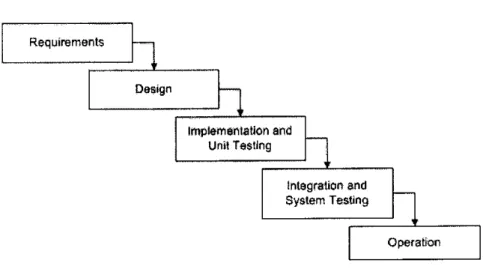
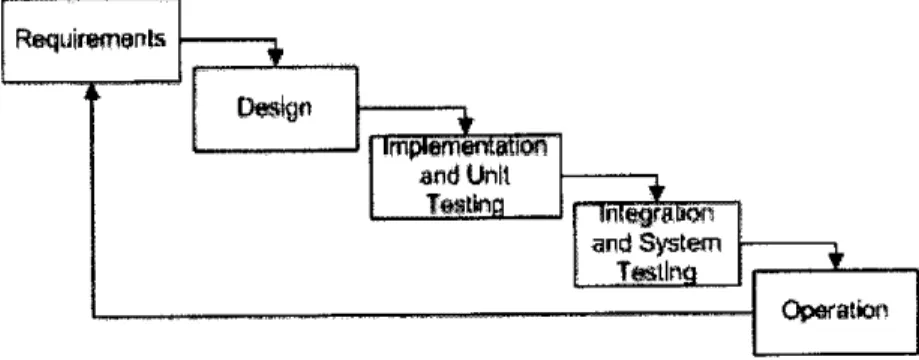
Figure 3 below illustrates the processes involved in the waterfall model of software
development. The design methodology for the software solution in this project will
follow the common waterfall model approach in its development. The requirements for
the software system will first be defined from its problem statements, scope and
objectives. The next process would be to design the Mobile Bookstore software system
(database and software design). The following process would be the implementation
and testing of the software. Process iteration models will be used to allow the iteration
of the waterfall model to further refine the software accordingly to changes in the requirements.Requirements
•>
Design
> >
implementation and Unit Testing
>•
integration and System Testing
*•
Operation
Figure 3: Waterfall Model
3.3 Process Iteration - Incremental Development
+
Design
<.
* implementation
and Unit
Twt&nn ' +
Integration and System
T«tlnq +
Operation
Figure 4: Incremental Development Model
To allow iteration of the waterfall model, the design methodology will implement the
incremental development model of process iteration. A diagram of the common
processes in the incremental development is illustrated in Figure 4 above. The
waterfall model is a simple management model and it separates the design and
implementation phases, leading to more robust systems which are amendable to
change. To allow the robust development, the incremental development is used with the
waterfall model. This allows of an iterated development environment, whereby once
testing shows of defects or need for enhancements, the waterfall model can be restarted or reiterated to perform the changes. This is crucial in the development of the Mobile Bookstore as the early requirements that can be gathered may be too small to allow for
a good software design.3.4 Prototyping - Evolutionary Prototyping
In developing the software solution (Mobile Bookstore), the main concern is producing prototypes that can be assessed, tested, evaluated and verified. The best way to do so is to implement the evolutionary prototyping approach to development. With this approach, prototypes are created beginning with a basic set of requirements. The prototypes will be tested and verified of its functionalities. The prototypes can be enhanced and modified according to newer requirements added or modified, creating a new prototype. All prototypes will evolve into bigger and better prototypes, until finally becoming the last version of prototype for the system. This final prototype can be
further tested, verified and enhanced to be used as the final system itself.
CHAPTER 4: DISCUSSION
4.1 Scope of Discussion
This section of the report will discuss on how to implement and develop the software solution for the research project. This section will mainly discuss on how the technologies discussed in the Lntroduction: Background of Study section can be used and integrated in order to develop and implement the software solution for this research project. The discussion will be done according to the two modules proposed for the
software solution. This section will be divided according to the following sections:
• Target Users
o Outdoor (WAP) Module
o Indoor Module
• Outdoor Module: Mobile Web Bookstore Application o Technologies Used
o Preferred Development Platform o How the First Module Works o Overall System Flow
o Module Features
• Indoor Module: Wireless Bookstore Application o Technologies Used
o Preferred Development Technologies and Methods
o How the Second Module Works o Overall System Flow
o Module Features
• Administrative Users
• Current Progress
o User Login and Sessions o Main Menu for Browsing
o Enhanced Mobile Search Functions
o Book Information Page o Book Availability Tracking
o User Carts Function
o Book Ownership Tracking Function o User Rating Function
o Database Design
4.2 Target Users
4.2.1 Outdoor (WAP) Module
The main target users for this solution (first module) can be anyone - it can be you and
it can be me. But to summarize the users to specific groups, then the target groups of users are book readers, students, educational institutions or universities, schools and libraries. Those who wish to the solution to browse and shop for books through theirmobile phone will be the main targeted users for this solution. These users will require mobile phones equipped with GPRS and WAP access in order to use the Mobile Bookstore System. Besides these users who are considered customers, another question raised is who will be hosting the solution or who will sell these books? The solution is proposed to be implemented by book companies who want to sell their books through
the mobile medium hence reaching more customers.
To ease in the explanation of the system the two groups will be classified as
common User and Administrator terms in the system. The target users are considered asthe Normal User of the system while the bookstore companies or solution implementers
are known as the Administrators of the system.The requirements for the users in this system consist of three basic and necessary ones, which are:
• Mobile phones (preferably any latest models or WAP-enabled models).
• GPRS access provided by telecommunications network.
• WAP access (comes with GPRS).
• Broadbandaccess (optional).
4.2.2 Indoor Module
Basically, the target users for the indoor module are similar to the outdoor (WAP) module. The target users are the customers of the solution implementer (bookstore), who owns a mobile phone, but in this case requiring Java or any other mobile application platform enabled applications to be run on the mobile phone. The users will use their mobile phones to access to the Mobile Bookstore system under a local wireless network (preferably Bluetooth networks) implemented throughout the bookstore. This replaces the needs for a kiosk and users can use their mobile phones to browse the Mobile Bookstore system, ftee-of-charge.
To summarize, the requirements for the users are listed below:
• Mobile phones supporting Java or any application platforms (preferably Smart phones).
Bluetooth (integrated to mobile phones).
4.3 Outdoor Module: Mobile Web Bookstore Application
4.3.1 Technologies Used
Basically, the technologies used in developing and implementing the first module of the software solution (the outdoor mobile web application module) will be based around a single development framework, which is the Microsoft .NET Framework (version 1.1, to be exact). To develop a web application, Microsoft has released an extension to its .NET framework to integrate the web development ability into the framework, which is the Web Service Enhancement or the WSE. To further include the ability to author and
develop mobile web pages, Microsoft has released the Mobile Internet Toolkit to allow
for mobile web authoring.To develop the first module (outdoor module) of the Mobile Bookstore, I will
implement the use of the .NET framework, equipped with the WSE and Mobile Internet
Toolkit. The .NET framework provides high compatibility in mobile webprogramming. The programming language used in developing the first module will be
the mobile ASP.NET programming platform. ASP.NET is a well known web
programming platform, supporting languages such as VB, C# and C++. The mobile
ASP.NET allows the use of ASP.NET platform to develop mobile web applications formobile devices. The SOAP approach will be used in the implementation of the first
module, acting as a proxy for the mobile bookstore web system. The .NET framework
allows the SOAP framework to be implemented with high compatibility. The .NET framework also allows easy connection and integration with database systems such as the Microsoft SQL Server, allowing a better web application development environment.4.3.2 Preferred Development Platform
The preferred programming platform will of course be the ASP.NET Mobile programming platform used on the .NET Framework 1.1, by Microsoft. The ASP.NET Mobile will support most of the functions supported in a normal ASP.NET platform for web programming and it will ease the programming functions as well as increase the functionalities of the system. The ASP.NET Mobile will allow integrations and connections to many SQL servers or databases, and the preferred database platform will be the Microsoft SQL Server 2000 database platform, supporting stored procedures that will be implemented in the system. Stored procedures allow for a more robust database programming and scripting, allowing for a more robust system to be developed.
4.3.3 How the First Module Works
Users will use their WAP-enabled mobile device to open the mobile bookstore mobile web application. The address opened will link to the SOAP server that will retrieve the required methods from the proper mobile web server. Surfing the mobile web application is similar to any other WAP site, but the mobile bookstore is equipped with features such as the ubiquitous features and the mobile commerce features. This will ensure that surfing the mobile web application will be easy and efficient.
""' '" ", ?-\: .-M^"^'^^"'"^"^-
'•S-;
i-C- •-.
Target Use
•*•:•+. .^zffi^--'•*'*•''•"*'
Administrator
\
^:^.«= ,•••••;. •
Vi-Xfsv^Efss/ y- •! jr..
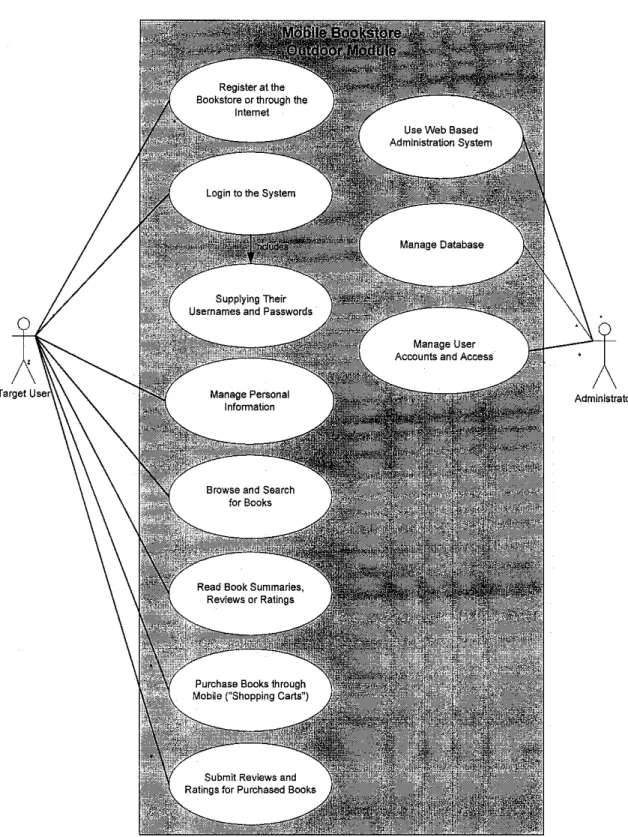
Figure 5: Mobile Bookstore Outdoor Module Use Case Diagram
4.3.4 Overall System Flow
The overall flow or depiction of the system can be seen in Figure 5 above. The use case diagram depicts the two user types of the system, which are the Target User and the Administrator. The functions that the target user can be performed are explained in the following:
4.3.4.1 Target Users (Normal Users)
The target users or the normal users will first have to register with the bookstore to open up a mobile account in order for them to access the Mobile Bookstore system.
This can be achieved through a manual cum computerized account registration system.
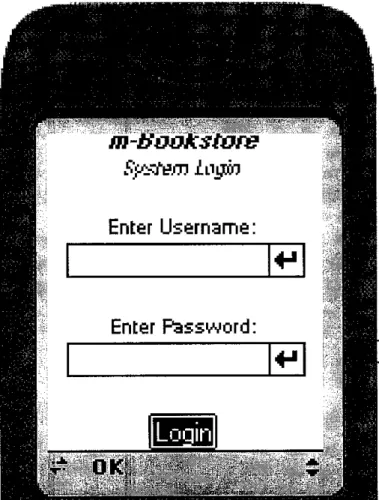
The user must first visit the bookstore itself to fill up a form at the bookstore in order to register their particulars and start up an account. The bookstore employee (considered an Administrator in this case) will register the users' information and start up accounts for the users through the web based administration system. Another alternative for registering would be to include a "Register for Mobile Bookstore" section in the company's own web site. Through this method, users can register themselves for an account (to access the Mobile Bookstore) through the Internet. Users will be given a username with a default password (or chosen password) and then the user is able to log on to the Mobile Bookstore application on their mobile phones.
Once users have access they can log on to the Mobile Bookstore system. Users are able to manage their personal information including their passwords, meaning users can change their password through mobile. Users can also use the system to browse and search for books. The system will be equipped with a preference-based search functions or engines, meeting the needs for a ubiquitous mobile surfing environment (more to be explained in later sections). Once found a suitable and desired title, users can read summaries, reviews or even ratings for the book (if any is available). Users can place to-be purchased books in their own "shopping carts". This shopping cart will be stored
in the database according to each login and if a disconnection happens, the cart is still saved and users can resume shopping when logging in the next time. As an addition, users can submit reviews and ratings for already purchased books (this function is optional).
These are basically all of the functions that the target users can perform using the Mobile Bookstore system.
4.3.4.2 Administrators
In the outdoor module, the administrators will use the web based administration module
(that will be designed for the system) to perform administrative functions such as managing the system database and also managing the user accounts and access to the
Mobile Bookstore system.
4.3.5 Module Features
The module features can be summarized in the points below:
• Normal Users
o Login sessions are provided for each unique user.
o Search function designed to cater for mobile accessibility and ubiquitous environment. When users search for a book, a list of results will normally appear. But the system will detect user's preferences and display the results based on the user's preferences.
o Personal information management.
o Read and submit summaries, reviews or ratings.
o Place books in a shopping cart and continue shopping at a later time, meaning the cart is saved for each user. The system will provide a Cart Management sub-module to manage shopping
carts.
o Purchase books through mobile.
Administrator
o Web based administration system.
4.4 Indoor Module: Wireless Bookstore Application
4.4.1 Technologies Used
To develop and implement the second module of the mobile bookstore (indoor module
wireless bookstore module), Bluetooth technology will be used. A wireless Bluetooth network will be developed and used in order to create a wireless bookstore environment for Bluetooth-enabled mobile devices. To develop this module, the possibleprogramming platform for development and implementation would be the Java programming platform for mobile devices, suchas the J2ME. Other alternatives are still
under consideration for this module. This module is considered optional as the mainfocus for the software solution is on the first module.
4.4.2 Preferred Development Technologies and Methods
The preferred technologies and platform will be a localized web based system. This means that when the users are connected to the local wireless Bluetooth network, they can access a local mobile web application (the indoor Mobile Bookstore module) without the needs for a WAP connection. The Java J2ME can be used to achieve this,
but a simpler approach will be researched as this outdoor module will not be the main
focus of the project solution. This module will be developed if time permits. A simpler approach will allow Bluetooth-enabled mobile phones to connect to the servers located
in the bookstore and connect to an intranet Mobile Bookstore site.
4.4.3 How the Second Module Works
This module will make use of Bluetooth technology to allow users to search for books and locate these books in the bookstore itself. Multiple Bluetooth signal readers or ports will be placed at strategic locations in the bookstore to allow users to locate their present location in the bookstores as well as books. The Bluetooth readers can be setup to represent a wireless Bluetooth network inside the bookstore, giving access to the indoor bookstore system to those with Bluetooth-enabled mobile devices. This is an alternative to WAP, for those who are physically in the bookstore. This will eliminate the problem of customers having to line up and use the kiosk (usually provided in very little numbers) to search for books in the bookstore - marking the birth of a wireless bookstore browsing environment.
Target User
- Mobile Bookstore
• • Indoor Modulo
iwse and Search for Books
,e Web Based
•" :•• listration System
• " • '" '\'" I"*"** «Vfi/.v'.. 'jt.'i:- .
Book Summarie -views or Rptinns
Reserve Bo - (Optional
'<• i--
5
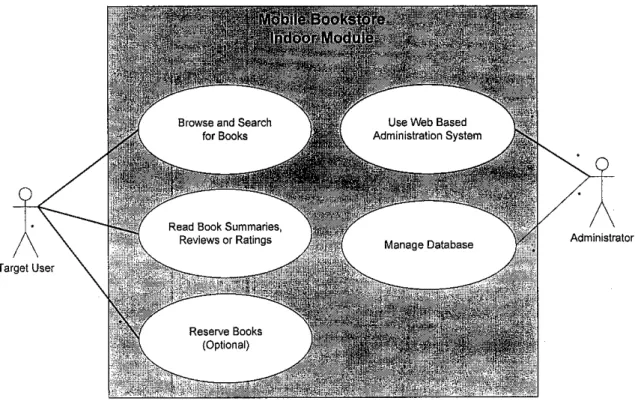
Figure 6: Mobile Bookstore Indoor Module Use Case Diagram
Administrator
4.4.4 Overall System Flow
The overall system flow can is depicted by the use case diagram shown in Figure 6 above. The system flow is similar to that of the Outdoor Module, except for some differences whereby the indoor module has fewer functions as it focuses more on
browsing and searching features. The normal users can browse and search for books
within the bookstore using the system and retrieve information such as where the book is located in the bookstore. Users can read book summaries, reviews and ratings. Anoptional feature would be to allow users to reserve books that they want to buy. The
administrators will be able to perform administrative functions such as managing thesystem databases through the web based administration module.
4.4.5 Module Features
The module features can be summarized in the points below;
• Normal User
o Search function designed to cater for mobile accessibility and ubiquitous environment. When users search for a book, a list of results will normally appear. But the system will detect user's preferences and display the results based on the user's preferences.
o Read summaries, reviews or ratings.
o Reserve books.
• Administrator
o Web based administration module.