I M (0)
Faculty of Cognitive Sciences and Human Development
THE EFFECT OF NON-MONETARY REWARDS TOWARDS JOB SATISFACTION
Syahizan (a' Syahrizan bin Abang Monir
HF 5549.5 J63
LAYSý
E3ORANG PENGESAHAN STATUS TESIS
JIDI`L: ýh¢ v
SFSI PI: NG: \JI; aN : _2orQ
Sa\a iYaqýýzAN ý SYAµR-12. RAt 4Qý'ir-M4! 5
ciiURl. r
BESAR>Gred: A
mcn! -, aku mcmbcnarkan tcsis * im disimpan di Pusat hbldmat NIaklUlllat Akadcnllk_
l'niýcrsiti Mala\sia Sara\\ak dcngan s9rat-sNarat kegunaan scpcrti bcrikut:
Tcsis adalah hal: milik UniNcrsiti Malmsia Sara\ýak.
ý' Pusat Khidmat Maklumat Akadcmik. Uniýcrsiti Ný1alaýsia SaraN\ak dibcnarkan nmmbuat salman untuk ttijuan pcnguijian sah aja.
ý. Pusat Khidmat Maklumat . 'lkadcmik. Uniyersiti Malaysia SaraNcak dibenarkan membuat pendigitan untuk membangunkan Pangkalan Data Kandungan Tcmpatan.
4 Pusat Khidniat Maklumat Akadcmik. Uniycrsiti Malaysia Sara\yak dibenarkan membuat salinan tesis im sebagai bahan pcrtukaran antara inslitusi pcngajian tinggi.
sila tandahan ( ý ) St! L. I. I.
, r. r: RI 1A1)
v I
TI DAK TERI IA D
(Mcn!; andungi maklumat ýýaný; bcrdarjah kcsclamatan atau kcpcntingan scpcrti tcrmaktub di dalam AKTA RAHSIA RASMI
I1)7Z)
(19cngandungl nlaklumat Terhad %ang tclah ditcntukan olch organisasi! badan di niana pcnýclidikan dijalankan)
(F: 1NUATANGAN PCNI! LIS) : ýlanr. ýt
4-o/
Srrns. nJýln - { Sc. Fsdz)
ý'qýw 4k " __ ---
NDATANGAN PENYELIA)
Calalatt
I I, Jinr. ( l. u, il.: n 'ch: uvi c, i, ha; i Iý. vah 1)Ltr I al at; th `; nj; ma d: ut S: ujana \Inlla
L. i tc, i' fill hI I I I atau l I: II \I). 'ila Luul, irl.: ut stillt dLuil,: ula I, ilctl, hctI. ua.; t ra; ani a i hcrLcn: t: ut Jcu an mcnc: ual: ut L. tl . chah , Ian tcng,,, h ic. t"" ni I, ctlu . tiF. xLt'Lan . ch: r", ai ý l'. RI IA D.
P, KHIDMAT MAKLUMAT AKADEMIK UNIMAS
muumiiiiuuiuuii 1000209708
Statement of Originalith
I hc vvurk dcscrihcd in t1lis I- nlal Ycar 1'1k )jcct. cntitlcd
"`'Fhe Effect of'tion-Alonetari Reiºards toiý ards Job Satisfaction"
Ihc hcst uI IIIC alllhur , kllhAV lcdýc that týl thi atlthcýr C\Ccht yv hrrc duc rcicrcncc Is madc.
/_ýý]Q, - /20/0 ý
ý\; ihVan (! '\ aluiian : '1br_ Munir
U NI VEKJI i 1 MALA Y SIA SA. QAWAK
THE EFFECT OF NON-MONETARY REWARDS TOWARDS JOB SATISFACTION
SYA141ZAN 0) SYA14RIZAN B. ABG. MONIR
This project is submitted in partial fulfilment of the requirements for a Bachelor of Science with I-Ionours
(Human Resource Development)
Faculty of Cognitive Sciences and Human Development UNIVERSITI MALAYSIA SARAWAK
(2010)
The project entitled `The Effect of Non-Monetary Rewards Towards Job Satisfaction' was prepared by Syahizan (7) Syahrizan Abg. Monir and submitted to the Faculty of Cognitive Sciences and Hunan Development in partial fulfillment of the requirements for a Bachelor of Science with Honours (Human Resource Development).
Received for examination by:
Date:
---
If-pezu
Grade ý
ý
ACKNOWLEDGEMENT
Alhamdulillah. Thanks to Allah SWT, whom willing giving me the opportunity to complete this Final Year Project. This final year project report was prepared for University Malaysia Sarawak (UNIMAS), basically for student in final year to complete the undergraduate program that leads to the degree of Bachelor of Sciences with Honours (human Resource Development). This report is based on the methods given by the university.
Firstly, I would like to express my deepest thanks to my supervisor; Mr. Abang Ekhsan bin Abang Othman, for his guidance during two semester's session 2009/2010. 1 also want to thanks the faculties' supporting staff of UNIMAS for their cooperation during completion of this final year project that had given valuable information, suggestions and guidance in the compilation and preparation this final year project report.
Deepest thanks and appreciation to my parents, family, friends, and others for their cooperation, encouragement, constructive suggestion and full of support for the report completion, from the beginning till the end.
Last but not least, my thanks to all members of Faculty of Cognitive Sciences and Human Development, Lecturers, and Human Resource department, for the great commitment and cooperation during any Final Year Project.
III
Pusat Khidmat Maklumat Akademik UNIVERSITI MALAYSIA SARAWAJ(
TABLE OF CONTENTS
Acknowledtiement Table of Contents
List of Tables List of Figures Abstract Ahstrak
CHAPTER 1 - INTRODUCTION 1.0 Introduction
1.1 Research Background 1.2 Problem Statement 1.3 Objectives of the Study
1.3.1 General Objective 1.3.2 Specific Objectives I . 4 Conceptual Framework 1.5 Reseach Hypotheses 1.6 Definition of Terms
1.6.1 Job Satisfaction
1.6.2 Non-Monetary Rewards 1.6.3 Autonomy
1.6.4 Recognition 1.6.5 Job Itself
1.6.6 Working Environment 1.6.7 Skill Varieties
1.7 Significance of Study 1.8 Conclusion
CIIAPTER 2 - LITERATURE REVIEW 2.0 Introduction
2. 1 Job Satisfaction
2.2 Related Theories of Job Satisfaction 2.3 Non-Monetary Rewards
2.3.1 Autonomy 2.32 Recognition 2.3.3 Job Itself
2.3.4 Working Environment 2.3.5 Skill Varieties
2.4 Conclusion
CHAPTER 3- METHODOLOGY
3.0 Introduction 3. I Research Design
3.2 Location of the Research 3.3 Population and Sample
3.3.1 Sampling Technique 3.4 Research Instruments
3.4.1 Questionnaire 3.4.2 Interview 3.5 Pilot Study 3.6 Data Collection
3.6.1 Primary Data 3.6.2 Secondary Data 3.7 Data Analysis
3.7. 1 Descriptive Statistics 3.7.2 Inferential Statistics
3.7.2.1 Pearson Correlation Coefficient 3.7.2.2 Multiple Regressions
3.8 Conclusion
('IIAPTFR 4 - FINDINGS AND DISCUSSION 4.0 Introduction
4. 1 Demographic Characteristics of Respondents 4. I. 1 Age Group
4.1 .2 Gender 4.1.3 Race 4.1.4 Faculty
33
34 35 35 35 36 37 37 39 40 41 41 41 41 42 44 44 45 45
46 47 47 48 48 49
4.1.5 Job Position 50
4.2 Level of Job Satisfaction 51
4 3 Result of Hypotheses Testing 52
4.3.1 Relationship between autonomy and job satisfaction 52 4.3.2 Relationship between recognition and job satisfaction 54 4.3.3 Relationship between jobs itself and job satisfaction 55 4 3.4 Relationship between working environment 57
and job satisfaction
4.33 5 Relationship between skill varieties and job satisfaction 58 4.3.6 Dominant factor associated with job satisfaction 59
4.4 Sununarv of Analysis 62
4.5 Conclusion 62
V
CHANTER 5 - RECOMMENDATION AND CONCLUSION
5.0 Introduction 63
5.1 Summary 64
5.2 Recommendation 66
5.2.1 Recommendation to Organization 66
5. 2.2 Recommendation to Human Resource Practitioner 67
ý?. Recommendation to Future Research 68
5. Limitation of Study 69
5.4 Conclusion 70
REFERENCES APPENDICES
vi
LIST OF TA BLE: s
Table3.1:
I: ctiuItti 0l, 0r0nbach s Alpha 40
I'ahie 3.2:
cores and Interpretation 43
I : i ble 3.3:
Interpretation of the Pearson Coefficient \'alue_ r 44 Fable 4.1:
I)i, trihutiR)n ot'Responilents by AOe Group 47
'I able 4.2:
I)i, tnbut ion ol'Re, pondents by Gender 48
I'ablc 4.3:
I )i, lr ihtititn ul'Respondcnts b\ Race Fa ble 4.4:
Ui, trihution oi'llrshondcnt. ti býý Faculty Fable -t. 5:
I)utrihutlon of, Reýhondents I. eý el of Job Satisiaction hased on Percentage Iable4.6:
( '(Jrrelation bCtvýrcn : Autonomy and Job Satisfaction Table 4.?:
( orrclation hckcccll Reco. -nition and Job Satisfaction Table 4. S:
Correlation between
. lob Itself and . lob Sat isliet ion I'able 4.1):
('orrclation hcmcen \1'orl. inº2 Fm ironment and Jot) Satistäction Fablc 4. I(1:
Corrrlation hct\\rcn Skill ýarictios and Joh Sat isfartloll
48
49
ýI
54
SS
57
58
\ II
Table 4.11:
Significance of the Model (Stepwise Method) 59
Table 4.12:
Beta Coefficients of Predictor Variables 60
Table 4.13:
Result of Hypotheses 61
LIST
OF FIGURES
Figure l. l:
Schematic Diagram of the Conceptual Framework 9
Figure 4.1:
Distribution of Respondents by Job Position 50
Figure 4.2:
Distribution of Respondents' Level of Job Satisfaction based on Frequency 51
ix
ABSTRACT
THE EFFECT OF NON-MONETARY REWARDS TOWARDS JOB SATISFACTION
Syahizan qq S_yahrizan Abg. Monir
This study aims to determine the level of job satisfaction among faculties' supporting staff in UN IMAS. The main objective is to determine the level of job satisfaction and the relationship of non-monetary rewards associated with job satisfaction among faculties' supporting staff. The sample for this study was 100 respondents which taken out from 303 population through stratified sampling technique. Questionnaire was used as main research instrument in this study which distributed to 100 respondents represented all the faculties in UNIMAS. Findings of this study were analyzed by using Statistical Package for the Social Science (SPSS) 17.0 window version. The statistical techniques that utilized in analyzing data are Pearson Correlation Coefficient and Multiple Regression. Pearson Correlation Coefficient was applied in order to determine the significant relationship between independent variables (Autonomy, Recognition, Job Itself, Working Environment, and Skill Varieties) and dependent variable (Job Satisfaction) while Multiple Regression are employed to identified possible dominant factor among independent variables that effects most towards job satisfaction. The findings, found that all the five factors have significant relationship with the job satisfaction among faculties' supporting staff.
Besides, result showed that Job Itself found as the dominant factor. Through the findings of this study, recommendations were suggested to organization, HR practitioners, as well as future researchers in purpose to study on the matter of job satisfaction.
ARSTRAK
KI,, 'S. =1 N-KI ,, '. ti, aN (; AN, I, g Il a N 1311KAN KF_ H'ANGAN " 1'
F, RH. ADAP . KL7'1LA. 5AN KL'IZIA
ýýaurhiýan ýi Svnhri.: an Ahg. Monir
Kujian ini hertrtjuan unink mengkaji tcr/rap keprrasan kerja di kalangan stafsokongan hrkulti di IINIA9A. 1'. Objektif rrtanra prrla unink mengetalnri talrap kepuasan keija dan huhrurgan ganjcºrzrºr hukan keºrcrngan dengan kepuasan kerja staf sokongan. rakulti.
. ti'anrpel unink kajicnr ini adalcrh 100 re. sponden daripada 303 populasinya melahri teknik pen. saurplelan berstrata. 13ornn, g soal seliclik nrer7rpakan in. strunren kajian utanra di mana 1011 sei horcrng kaji selidik telah diedarkan kepada re. sponden yang nreIrukili semucr
. lakulti di 1! NIA. 1AS. Keputusan kajian ini dianalisasi dengan nrengrgrrncrkcrn perisian Statistical Package, for . S'osial Sciences (SPSS) itersi 17.0.
1 eknik-tckrrik ancrlisis data yang digunakan dalam kajian ini adalah Pekali Korelasi Pearson dan Rc, resi Bergandc: r. Dalanr kajian ini, Pekali Korelasi Pearson drgrrncrkcm unink mengkaji hubungan signifikan antara pembolehuhah tidak hersandar (nu, nonri, pcn,; hargaan, pekerjaan, persekitaran ker ja, dan kepelbagaian kenurlriran) elan pembolehubah her. sandar (Kepuasan Ker ja). Regresi Rerganda pula di, iýrnrakcar hagi mengenalpasti fäktor dominan di antara penrholehubah tidak hersundar yangr memheri kesan yang ketara terhadap kepuasan kerja. 13erdasarkan dupatmr kajian, kesenrua lima. firktor didapati nrempunyai perkaitan yang signifikan derngan ke puasan kerja di antaºn sva f 'sokongan, f'akulti di UNIMAS. Melalui dapatan kajiun ini juga. heherapcr cadangran tela/r dikennrkakan kepada organisasi, pelak_sana . surºrher manrrsia, than jrrga per>>>elidikan masa hadapan sehagai kegunaan dalam kcrjicur nrengenai kepuasan kerja.
Xi
CHAPTER 1
INTRODUCTION
1.0 Introduction
This chapter provided a brief introduction of current literature regarding why this study is conducted. Information on the background of the study, statement of the problem, objectives of the research, conceptual framework, hypothesis of the research, significance of the study, and definition of term are provided to define the scope and focus of the study.
1.1 Research Background
For the previous decades, only the organizations that are able to provide varieties of reward systems and best administer can carry on. As referred to Chiu et at. (2002), different types of reward systems have been used to enhance the level of
job satisfaction in striving towards organization goals.
Compensation practitioners have focused primarily on financial compensation and benefits. However, the new model in this age includes the characteristics of non- financial compensation (Mondy, 2002). As suggested by previous research, non- financial factors can have a beneficial impact on organization such as reduced turnover, lower absenteeism and increased productivity as well to achieve job satisfaction (Milkovich, 1999). It represented a very desirable but somewhat it is vague in many organizational settings.
Many say that cash is king, but in today's economy employees know that there is more to the story than cash alone (Carroll, 2009). As a managers, the questions begin to fill their head of how will they recognize people by giving them money when already over budget on payroll. Managers might think that if to tell someone that they are doing a good job, they might expect a promotion, or at least a raise (Richardson, 2003). Employees perform on work because they want organization paying them; a rewards. Money is just paid but not for everything that employees wanted to. While money is certainly an important factor for employees, they often are looking for more non-monetary types of rewards.
According to Carroll (2009); today's job seekers and the employees become concern about non-monetary compensation, and there is a good reason they are paying attention to it. Non-monetary compensation can equal 20 percent to 60 percent of the value of the cash compensation that an employee receives. For the current job
2
seeker, starting salaries have barely increased, frozen or actually dropped. So, finding non-monetary benefits in an offer can be essential when an employee evaluates it.
Therefore, these added perks can be a good ingredient, act as a seal on a deal.
Organizations nowadays aware that employees are the vital assets to enable the organization run their business or operation and it is crucial to retain the workers in the orgganization especially talented and skillful employees. Thus, job satisfaction is taking seriously in this matter. Organization must first know facets of job satisfaction.
Berry (1977) indicated that an organization must go straight to the employees when they think about job satisfaction. Where there are dissatisfaction arise, employees are the one that can be seek for the answer about factor causes dissatisfaction. Otherwise, there might worsen the situation if the real factors are neglected.
For managers, the top three issues on job satisfaction were wages, job security and promotion opportunities. However, for employees; full appreciation for work done, feeling "in" on things and help with personal problems topped their list, and these are the same three items managers ranked beneath. A clear difference in thinking between managers and employees emerges when look at the survey's results (Richardson, 2003). Therefore, Seta, Paulus and Baron (2000) pointed out that by knowing the factors contributing to the employee's job satisfaction; the organization can properly plan and take appropriate steps to increase positive behavior among employees. It is also indicated that different types of compensation or reward system being concern by employees.
Traditionally, compensation systems have been designed to retain and to motivate employees to increase their effort toward the achievement of organizational goals and strategy. According to Mondy (2002); compensation is the total of all re,, N-ards provided to employees in return for their services. It acts as one of the most
important Human Resource tools that can make or influence employees' job satisfaction in their workplace.
Compensation system consists of two main components, which are financial and non-financial compensation. Financial compensation consists of two categories which are direct and indirect compensation. Direct financial compensation consist of the pay that a person receives in the form of wages, salary, bonuses and commissions while indirect financial compensation includes all financial rewards that are not included in direct compensation (Mondy, 2002). Furthermore, Mondy (2002) added that non-financial compensation consists of the satisfaction that a person receives from the job itself or from psychological and/or physical environment in which the person works. This type of non-financial compensation consists of the satisfaction received from performing meaningful tasks. This aspect of non financial compensation involves both psychological and physical factors within the firm's working environment.
I-lowever, the applications of non-financial methods of motivation toward employees' job satisfaction are attempts by employers to apply in the workplace.
Examination of such theories, like what Herzberg (1964) had researched on, shown that motivation of employees, which leads to improved quality of output, is best achieved through satisfaction of higher needs, awareness of the role of groups in the workplace and the need to provide motivators. Job satisfaction is an important criterion for the success of an organization. It is closely associated with job turn over and life satisfaction.
Nonetheless, factors related to job satisfaction are relevant in the prevention of employee frustration and low job satisfaction because employee would work harder and perform better if they are satisfied with their jobs. A sizeable amount of work in the job satisfaction literature has been devoted to develop conceptual and
4
Pusat Khidmzt Maklumat Akaiemik UNIVERSITI MALAYSIA SAjtAWAK
operational definitions of the job satisfaction construct, including overall or general job satisfaction and satisfaction with facets of jobs such as the autonomy, recognition, job itself, working environment and skill varieties. Job autonomy is expected to be associated with greater job satisfaction because workers have more freedom to determine their own effort and work schedule. It is expected that a higher degree of job autonomy will lead to greater satisfaction (Nguyen, Taylor & Bradley, 2003).
Porter et al. (as cited in Oshagbemi, 2003) characterized satisfaction as a feeling towards a job that is determined by the difference between the amount of some valued outcome that a person receives and the amount of outcome he feels he should receive" which known as a recognition to them. When individuals find satisfaction in the work itself, they appreciate all types of feedback because it helps them do a better job and guides them to do their job in the best way possible (Richardson, 2003). Thus, these important factors will result as an enjoyable job in employees interest that influence much on job satisfaction. As revealed by Vos and Voordt (2001 ), office workers seem to be seeking, specifically, an interesting, exciting and creative existence, where work and private life fit in well with each other. Environmental factor and skill varieties also considered as an outstanding factor and have major impact on job satisfaction than other job factors (Dawal &
"Naha, 2006).
People are now seen as the primary source of a company's competitive advantage (Lawler, 1994). Therefore, the way people are treated increasingly determines whether an organization will prosper or even survive. It is believed that people need to be respected and treated as precious human capital, more essential to an organization's effectiveness than its financial capital (Ali & Ahmed, 2008). The most important evidence that indicated the worsening conditions of an organization is the low rate of job satisfaction. Thus job satisfaction is the key to establish a healthy organizational environment in an organization.
1.2 Problem Statement
There has been a great deal of focus on compensation, non-financial elements in jobs, job satisfaction and similar topics since the last decades. It is evident that it has been a major concern to create jobs and working conditions that satisfy employees. Previous research suggest that non-financial factors can have a beneficial impact on organization such as reduced turnover, lower absenteeism and increased productivity (Milkovich, 1999). Job satisfaction among employees has a great impact on the organization.
Although, there have been numerous publications on job satisfaction, there has been relatively little empirical data gathered on the job satisfaction, there is very little research on the non-financial elements and some even are not consistent. For example, in Chou, Boldy and Lee (2002) revealed that non-financial benefit has significant effect on employees' satisfaction, while Castel, Navarro and Torres (2005) found that benefit does not have any effects on employees' job satisfaction.
Furthermore, most of the organizations neglected the cause of job dissatisfaction and the way they compensating their employees. This is because these organizations have limited knowledge on factors of non-financial compensation and how it affects on employees' job satisfaction. Crow et at. (1995) stated that organization always neglected the cause of job satisfaction whenever they come across the effect of dissatisfaction when organization faced with the problem of dissatisfaction.
'These problems might occur due to different thinking between managers and employees. For managers, the top three issues on job satisfaction were wages, job security and promotion opportunities. However, for employees, full appreciation for work done, feeling "in" on things and help with personal problems topped their list,
6
and these are the same three items managers ranked beneath. A clear difference in thinking between managers and employees emerges when looking at the survey's results regarding factors influences satisfaction that they preferred (Richardson, 2003). Richardson (2003) found surprising result that the survey has been repeated over years with the same results, indicated similar trends and gaps in management's understanding of what workers looking for in job satisfaction.
Previous studies attempted to explain a worker's job satisfaction and variables such as age, length of service and pay are among the most related with job satisfaction. A non-monetary rewards that associated with or influence job satisfaction has been overlooked. In addition, most of the studies are either general or specific to one country and are not applicable to the Malaysian context. It may lead to a practice that is different in local circumstances, such as organizational culture. In view of that, this research aims to investigate whether the non-monetary rewards can influence job satisfaction of employees.
1.3 Objectives of the Study
There are two main parts in research objectives, which are the general objective and the specific objectives.
1.3.1 General Objective
The main objective of this study is to determine the level of job satisfaction among faculties" supporting staff in UNIMAS and the non-monetary rewards associated with job satisfaction.
1.3.2 Specific Objective
Specifically, the objectives of this study are:
1. To determine the relationship between autonomy and job satisfaction
among faculties' supporting staff.ii. To determine the relationship between recognition and job satisfaction among faculties' supporting staff.
iii. To determine the relationship between job itself and job satisfaction among faculties' supporting staff.
iv. To determine the relationship between working environment and job satisfaction among faculties' supporting staff.
v. To determine the relationship between skill varieties and job satisfaction among faculties' supporting staff.
vi. To determine the most dominant factor of non-monetary rewards that influence their job satisfaction.
8
I . 4 Conceptual Framework
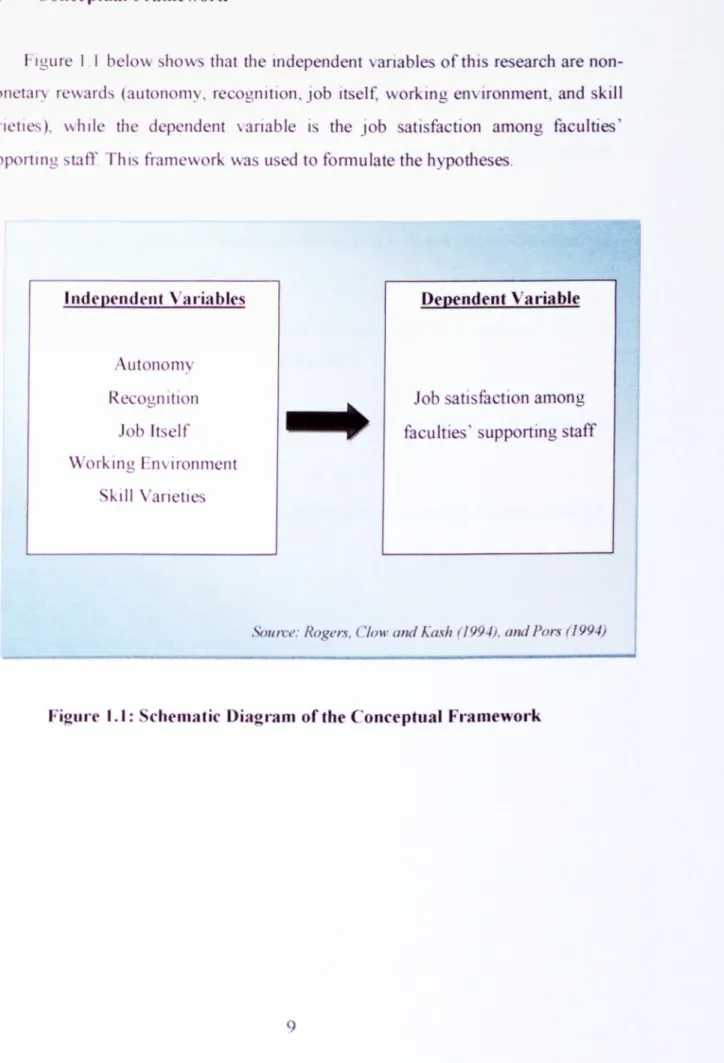
t ýý, ure I I heloýý shows that the independent variables of this research are non- nmonetary rewards (autonomy. recoOnition, job itself, working; em ironment. and skill 'ar, eties). vOhile the dependent variable is the job satisfaction among faculties' supporting staff This framework was used to formulate the hypotheses.
Independent Variables
Autononly
Reco, -, nition Joh Itself' Working I'mironnient
Skill Varieties
MN*
Dependent Variable
Job satisfaction among faculties' supporting staff
Source: Rogers, Clow anu1 ka. ch i1994i, and Pors (1994i
Figure I. I : Schematic Diagram of the Conceptual Framework
1.5 Research Hypotheses
Hol: There is no significant relationship between autonomy and job satisfaction among faculties' supporting stafff.
Ho?: There is no significant relationship beween recognition and job satisfaction among faculties' supporting staff.
Ho3: There is no significant relationship between jobs itself and job satisfaction among faculties' supporting stall.
Ho-1: There is no significant relationship between working environment and job satisfaction among faculties* supporting staff.
Hoy: There is no significant relationship between skill varieties and job satisfaction among faculties supporting staff.
Ho6: There is no dominant factor of non-monetary rewards that influence their job satisfaction.