Datu Haji Len Talif Salleh
STIDC General Manager from
31st. March 2003 to 31st. December 2009
PERKASA Editorial Committe takes this opportunity to thank its former Advisor, Datu Haji Len Talif Salleh for his guidance and wishes him all the best in his future undertaking.
Datu Haji Sarudu Haji Hoklai
STIDC General Manager effective 1st. January 2010
PERKASA Editorial Committe has the pleasure to welocme its new Advisor, Datu Haji Sarudu Haji Hoklai and looks forward to serving under his able leadership.
THANK YOU
WELCOME
Editorial
04 What’s In For 2010
Current Issue
05 Global Economic Recovery Leveraging Timber Trade
Improvement in global economy boost export of Sarawak’s timber and timber products.
Feature
06 Datu Haji Sarudu – New General Manager Of STIDC
Facing new challenges with wide experience.
08 World Wetland Day
Enhancing awareness among the local communities on the importance of wetland conservation amid the global climate change.
Highlight
10 Tribute To Datu Haji Len Talif Sallh
Market Report
08 January-February 2010 Market Performance
Trade Statistics, Sarawak 09 January-February 2010 /
January-February 2009 Trade Statistics
PERKASA bi-monthly newsletter is published by Sarawak Timber Industry Development Corporation (STIDC). All rights reserved. No part of this publication may be reproduced in any form without prior consent of the Publisher.
The title “PERKASA”, its logo and contents remain the property of the Publisher. Opinions expressed by advertisers are not necessarily of the Publisher or Editor.
SARAWAK TIMBER INDUSTRY DEVELOPMENT CORPORATION (STIDC) Wisma Sumber Alam, Jalan Stadium, Petra Jaya, 93050 Kuching,
P.O.Box 194, 93702 Kuching, Sarawak, Malaysia.
Tel: 6082-443477 Fax: 6082-442691 E-mail: [email protected]
C O N T E N T S
ADVISOR
Datu Haji Sarudu Haji Hoklai General Manager
CHIEF EDITOR
Tuan Haji Hashim Haji Bojet Deputy General Manager MEMBERS
Dayang Nena Abang Bruce Senior Assistant General Manager (Trade Development)
Haluyah Awi
Senior Assistant General Manager (Administration)
Catherine Sng Bee Seio Assistant General Manager (Finance & Investment) Edmund Daging Mangku Assistant General Manager (Resource Development)
Tagat Jimbat
Assistant General Manager (Domestic Trade) Mohd. Hinri Abdullah Assistant General Manager (Preventive & Enforcement) Suraya Mohamad Ali Senior Manager (Registration & Licensing)
Editorial Committee
Nicholas Andrew Lissem Manager
(Industrial Planning) Hajjah Eda Haji Edan Manager
(Publications) WRITER
Norman Botes Noma TRADE STATISTICS Ermi Fariza Rambli
Editorial
A s we welcome year 2010 we would like to share what are in the pipeline both locally and internationally in playing our role as the leader and catalyst of Sarawak’s timber industry and in helping this industry to gain new height.
Locally, we will continue to promote Sustainable Forest Management and monitor the implementation of Log Quota Policy so as to ensure sustainable supply of raw materials for local processing. This augurs well with our efforts to encourage the utilisation of timber species from planted forests. In ensuring that the timber activities are carried out orderly, we will continue to monitor the industry and intensify our enforcement activities with the synergy of the related enforcement agencies. This is in addition to our routine activities such as company registration and timber grading. In keeping abreast with the latest trends we also plan to organise visits to potential markets.
Internationally, consistent efforts will be made in addressing issues related to the overall development of the timber industry.
This is to ensure that this sector remain buoyant. Concerns raised by NGOs on environment, social, timber certification, Chain-of-Custody and legality status will also be addressed through meetings and dialogues with our international counterparts. In line with this, we will continue to support the Malaysian Timber Council’s annual event and familiarisation visit to Sarawak in order to give first hand information on the State’s timber industry.
The improved demands from the global market and global economic recovery is a sign that there is light at the end of the tunnel. In January-February 2010, the export value of plywood grew by 25% to RM584 million from RM465 million during the same period last year while the value of logs rose by 90% to RM339 million from RM178 million during the corresponding period in the previous year. It is hoped that this industry would continue to forge ahead so as to remain resilient.
What’s In For 2010
TIMBER TRADE
■ Positive trend in the timber sector following the global economic recovery.
■ Industry players must always be ready to face the challenges and market uncertainties.
■ STIDC continues to synergise with the related authorities in tackling trade issues.
SUMMARY
Improvement in global economy boost export of Sarawak’s timber and timber products.
Meanwhile, STA reported that although the demands for Sarawak’s timber were overwhelming in 2009, demands for timber products such as plywood, sawn-timber, moulding and laminated truck flooring were weak due to global economic downturn.
On 2010 market outlook, STA reported that improvement in demand for the said products does not bring significant positive impact to the industry due to sharp increase in prices of logs and perceived that this could aggravate market situation.
Report from Sarawak Bumiputera Furniture Entrepreneurial Association also showed that the 2009 market performance among the Association members was not encouraging owing to negligible purchases from both the government and private sectors. Stiff competition in the open market as well as slow development in housing projects had led to the decline of sales by 30% among the members.
Grouse was also heard from a plywood exporter saying that 2009 was one of the most challenging years with the company’s plywood segment affected by the slowdown in demand from its key markets, notably Japan which accounted for 50% of its plywood exports.
To mitigate the situation Datu Haji Len said the State Government had imposed a flat royalty rate of RM50 per cubic metre on all types of timber and timber products in Sarawak compared with RM65 per cubic metre previously. Royalty payment was also extended from 14 days to three months presently.
Due to improvement in global economy he was optimistic that the volume of logs as well as export earnings will grow this year to at least the same amount of that in 2008.
Hoping for new development projects in the government and private sectors, Sarawak Bumiputera Furniture Entrepreneurial Association urged its members to be innovative and creative in all business aspects so as to remain competitive.
Likewise, the plywood exporter aimed to continue to operate its plywood and veneer mills efficiently while focusing on cash cost containment and making progress with its productivity and efficiency initiatives.
The export growth momentum which would continue at least in the first half of 2010 and global economic recovery translates into promising future for timber trade.
T
imber sector being the mainstay of Sarawak’s economy contributed RM6.7 billion to the State’s revenue in 2009 compared with RM8 billion in the previous year.This sector also provided 45,000 employment opportunities to both local and foreign workers.
The first two months of 2010 saw a growth of 31% to RM1.1 billion in export value of timber and timber products from Sarawak compared with RM.84 billion during the corresponding period last year. This reflected a positive trend in the timber sector following the global economic recovery.
Datu Haji Sarudu Haji Hoklai, General Manager of STIDC said despite the fact that the global economy is picking up, industry players must always be ready to face the challenges and market uncertainties. The current market scenario warrants the industry to go extra mile particularly in terms of product quality and marketing strategies. Market diversification is also becoming imperative.
In helping the industry going through the present market situation STIDC continues to work closely with Forest Department of Sarawak, Sarawak Forestry Corporation Sendirian Berhad and Sarawak Timber Association (STA) in tackling trade issues. The Corporation is also committed to realizing the State Government’s aspiration to establish one million hectares of planted forest by 2020 and to ensure sustainable and alternative supply of raw materials for local processing.
Datu Haji Len Talif Salleh, Director of Forest Department of Sarawak revealed that the State registered a decline in terms of log production in 2009 which accounted for 10.7 million cubic metres compared with 11.3 million cubic metres in 2008.
Export Value of Logs, Sawntimber and Plywood - Jan-Feb 2010 / Jan-Feb 2009
DATU HAJI SARUDU – NEW GENERAL MANAGER OF STIDC
Facing new challenges with wide experience.
S
TIDC ushered the New Year with the coming of Datu Haji Sarudu Haji Hoklai as the new General Manager effective 1st January 2010.With his 30 years experience in the civil service, Datu Haji Sarudu took the new challenge courageously in realizing the State Government’s aspiration to sustain a resilient timber industry in Sarawak.
In line with the Corporation’s vision to be the leader and catalyst of Sarawak’s timber industry, he pledged to fulfill the State Government’s mandate to render quality services professionally to STIDC and the timber industry.
With commendable team spirit and dedication among STIDC workforce he is optimistic that such values would help him in delivering his service effectively.
He viewed the Tanjung Manis Halal Hub project as one of the uphill tasks that warrants serious attention. This is parallel with the State Government’s objective to make Tanjung Manis the halal hub of choice as well as an
“
”
The future is becoming more challenging. To remain competitive, we must have strategic planning as well as
innovative action plans.
Datu Haji Sarudu Haji Hoklai General Manager of STIDC
Datu Haji Sarudu Haji Hoklai.
important economic zone under Sarawak Corridor of Renewable Energy (SCORE) project. This is also in support of Malaysia’s Industrial Master Plan III (IMP3) which aims to make Malaysia the global halal hub by 2020.
He urged his staff as well as STIDC subsidiaries to continue to give their undivided support and total
Datu Haji Sarudu (2nd right) mingling around with members of the industry in conjunction with the timber industry dinner in Bintulu.
Handing over of duty by Datu Haji Len Talif Salleh (middle), former General Manager of STIDC to his successor, Datu Haji Sarudu (left).
Datu Haji Sarudu (4th right) launching the 5S implementation in conjunction with his visit to STIDC Central Regional Office in Tanjung Manis New Township.
Datu Haji Sarudu (left) visiting a timber company in Miri, Sarawak.
Datu Haji Sarudu (2dn right) being briefed by an investor during his visit to Tanjung Manis New Township.
commitment to ensure the success of this project. This is also to sustain the Corporation’s reputation as one of the excellent government agencies in Sarawak.
Ever since he took over the helm, the new General Manager has attended the meetings with the Forest Department of Sarawak, Sarawak Timber Association and Sarawak Forestry Corporation Sendirian Berhad. He was also on familiarisation visits to STIDC regional offices, subsidiaries and timber companies besides attending industry dinner.
Datu Haji Sarudu graduated from Ohio University, USA with Corporate Master of Business Administration after obtaining his Bachelor of Arts from Universiti Kebangsaan Malaysia.
He served under various capacities statewide since he first joined the civil service in 1980. Among the key posts held by him were the Director of Human Resource Management in the Chief Minister’s Department, Permanent Secretary of the Ministry of Tourism and Urban Development, Resident of Mukah and Kota Samarahan Divisions, and District Officer of Mukah, Bintulu and Belaga.
In recognition of his outstanding contributions he was conferred with several awards such as Darjah Jasa Bakti Sarawak (DJBS) which carries the title “Datu”, Kesatria Mangku Negara (KMN), Johan Bintang Kenyalang (JBK), Pingat Pegawai Bintang Kenyalang (PBK), and Pingat Perkhidmatan Bakti (Perak).
WORLD WETLA
W etland is part of the
natural resources which contributes to rich ecosystem and generates socio- economic spin-off benefits. It also plays important roles such as providing natural habitat for flora and fauna as well as mitigating erosion and flooding. More importantly, it provides clean water for our daily consumption.
World Wetland Day is held on 2nd February every year in recognition of the significance of wetland. In Sarawak, the World Wetland Day 2010 was organized by the Forest Department at Pulau Salak near Kuching Wetland National Park – RAMSAR Site. The Honourable Tuan Haji Mohamad Naroden bin Majais, Assistant Minister in the Chief Minister’s Department (Bumiputera Entrepreneurial Development) and Assistant Minister of Planning and Resource Management of Sarawak officiated the event on behalf of The Honourable Datuk Amar Haji Awang Tengah Ali Hassan, Second Minister of Planning and Resource Management/Minister of Public Utilities of Sarawak and STIDC Chairman.
This year’s event carried a theme “Caring for Wetlands:
an answer to Climate Change”. The theme reflected the urgent need to address the global climate change.
Convention of the United Nation Framework for Climate Change held in Copenhagen in December 2009 recognised that wetland conservation helps to stabilize the adverse impact of climate change as well
Enhancing awareness among the local
communities on the importance of wetland conservation amid the global climate
change.
as enhancing the fertility and productivity of wetland areas.
The event was aimed at enhancing awareness among the local communities on the importance of wetland conservation amid the global climate change. Besides the local community, it was participated by the teachers, students as well as officials of the related government agencies.
Kuching Wetland National Park was gazetted on 10th October 2002. The 6,610-hectare national park manifests the Sarawak State Government’s continuous effort in ensuring a balance between conservation, development and sustainable natural resources.
The national park is dominated by Mangrove forest with major species like Avicennia spp. (api-api), Rhizophora spp. (bakau), Sonneratia spp. (pedada/
perepat) and Bruguiera spp. (berus). It is also home for endangered wildlife species such as Proboscis Monkey (Nasalis larvatus), Silver leaf Monkey (Trachypithecus villosus) and migratory birds. In
“
”
Forest Department of Sarawak is committed to sustainable management of wetland resources for the benefit of the present and future generations. It is therefore vital to create awareness on the importance of wetland at grass root level including the schools and local communities.
The Honourable Datuk Amar Haji Awang Tengah Ali Hassan Second Minister of Planning and Resource Management and
Minister of Public Utilities of Sarawak.
SUMMARY
■ Wetland is part of the natural resources which contributes to rich eco-system and generates socio-economic spin-off benefits.
■ World Wetland Day 2010 was aimed at enhancing awareness among the local communities on the importance of wetland forest conservation amiss the global climate change.
■ The theme“Caring for Wetlands: an answer to Climate Change” reflected the urgent need to address the global climate change.
AND DAY
addition, the national park is a breeding and nursery site for 43 fish families and 11 prawn species.
Kuching Wetland National Park was declared the first RAMSAR Site in Sarawak on 2nd April 2005 and was gazetted on 8th November the same year.
Subsequently, Sarawak received an allocation of RM1 million from the Federal Government to undertake the Multidisciplinary Assessment (MDA) Project on this national park. MoU was also signed between Forest Department and UNIMAS on 7th August 2008 giving the green light for UNIMAS to carry out the MDA.
The MDA led to the development of Kuching Wetland National Park (RAMSAR Site) – Management Plan 2010-2019. The management plan was presented to the related government departments and agencies as
Tree planting by the Honourable Tuan Haji Mohamad Naroden bin Majais (centre) marking the climax of this year’s World Wetland Day.
well as NGOs on 27th January 2010. Similar presentation will be conducted for the community leaders in the near future to ensure effective implementation of the plan.
This year’s World Wetland Day culminated in tree planting by the Honourable Tuan Haji Mohamad Naroden, local communities, teachers and students.
S
TIDC bid farewell to its former General Manager, Datu Haji Len Talif Salleh on 31st December 2009. As one of the pioneers of STIDC, he joined the Corporation on 8th October 1979 as Forestry Executive Officer. He was promoted as Senior Executive Officer in 1984 and Deputy General Manager on 1st July 2001. Subsequently on 31st May 2003, he was promoted as the General Manager.The Honourable Datuk Amar Haji Awang Tengah Ali Hassan, Minister of Planning and Resource Management II and Minister of Public Utilities cum STIDC Chairman mentioned that when Sarawak State Government appointed him as STIDC Chairman he was actually reluctant in view of heavy tasks ahead. However, the Minister said he accepted the challenge due to the fact that STIDC has a leader of exeptional calibre to bring the organisation and the timber sector into greater height. “The person is none other than Datu Haji Len” he said.
Meanwhile, Dr. Lee Hua Seng, Sarawak Timber Association Chief Executive Officer described Datu Haji Len as knowledgable on the timber industry besides being approachable and always ready to listen to the voice of the industry.
Likewise, Tuan Haji Hashim Haji Bojet, Deputy General Manager of STIDC commented that Datu Haji Len was knowledgable on timber and forestry sectors. “He is like a mobile library and one can refer to him on these sectors. Besides, he was bold in his arguements on issues
Datu Haji Len (5th right) receiving souvenir from Ms. Haluyah Awi, Senior Assistant General Manager (Administration) at the farewell dinner while the Honourable Datuk Amar Haji Awang Tengah Ali Hassan (centre) looks on.
Tribute To Datu Ha
related to these sectors. As a CEO, he emphasised on empowerment, delegation of authorities and mutual trust among the staff, thus he was always easy to work with. Datu Haji Len was also supportive and took good care of the staff welfare” said Haji Hashim.
Also commended Datu Haji Len was Tuan Haji Abdul Hadi Bin Datuk Abdul Kadir, Harwood Timber Sendirian Berhad General Manager and former STIDC employee who said that he acquainted with Datu Haji Len since 1980’s. “Looking back at those days, it is no wonder that
Datu Haji Len (5th right) cutting his birthday cake in conjunction with his farewell dinner.
aji Len Talif Salleh
Datu Haji Len (4th left) launching the STIDC Family Day 2009.
Datu Haji Len (2nd left) together with Sarawak’s delegation during the visit to Guangzhou, China on 20th-25th March 2009.
Datu Haji Len (front - 4th right) launching the Tanjung Manis Fishing Safari 2009.
Datu Haji Len is what he is today because he was a person with high esteem, confident and more importantly, having high level of management skill” he said.
Tuan Haji Maliki Mahli, Tanjung Manis Development Sendirian Berhad General Manager on the other hand described Datu haji Len as friendly, hardworking and has the perseverance for success.
While at the helm, Datu Haji Len brought tremendous transformation particularly in terms of office administration which emphasized on productivity and quality. This was evident when he devised a formula to encourage the establishment of new downstream industries. This had benefited the State in terms of revenue earnings, foreign exchange, new employments, product diversification and technology transfer.
Through STIDC Vendorship Development Programme, he also helped the Bumiputera furniture entrepreneurs to gain new height. Furniture complexes were developed to provide conducive workplaces to the vendors and to help them in their business.
His direct involvement in the Rajang Master Plan as well as in the overall development of Tanjung manis New Township had also brought tremendous transformation to the township. From a humble beginning, the township is now equipped with modern communication and transportation network as well as basic amenities. The economic activities of Tanjung Manis had also diversified into many fields like the timber industry, fishery, aquaculture, agriculture, manufacturing, shipbuilding, Central Oil Distribution Terminal, palm oil industrial cluster, integrated port, fishmeal industry and halal product industry.
With forestry educational background, Datu Haji Len shared his expertise by joining several technical committees and participating in their R&D projects such as “Counterpart Consultant for Forestry Safety, FAO”,
“Member of Technical Committee for the Hydroelectric Power Study with SAMA Consultant”, “Technical Consultation on Development of Intermediate Technology for Forestry, New Delhi”, “Counterpart Consultant for Rejang Master-plan Study – HA Simon”, Counterpart Consultant for Woodchip, Pulp and Paper CSIRO”, FAO Panel Product Consultant, Rome” and “Forest Industry and Marketing Study, Stockholm, Sweden”.
Datu Haji Len’s important contributions to Sarawak’s timber sector were also marked in his tireless efforts in the implementation of Log Quota Policy and the establishment of pulp and paper industry
He also played pivotal roles in leading the trade missions abroad to promote timber products and new investment opportunities. This helped to entice foreign investors into the State either through foreign direct investment or joint ventures.
His active involvement in overseas dialogues and meetings with international counterparts manifested his commitment in addressing pertinent issues for common good. This was reflected in his meeting with international organizations such as International Timber Trade Organisation (ITTO), United Nation Food and Agriculture Organisation (FAO), Timber Trade Federation (TTF), Commonwealth Scientific Industrial Research Organisation (CSIRO), Swedish International Development Agency (SIDA) and the European Union (EU).
Sarawak’s timber sector stands to gain from Datu Haji Len’s present office as the Deputy Permanent Secretary of the Ministry of Planning and Resource Management and Director of Forest Department of Sarawak particularly in policy matters.
STIDC would like to take this opportunity to thank him for his guidance and wish him success in future undertakings.
MARKET PERFORMANCE (January-February 2010)
Export Value of Logs & Timber Products.
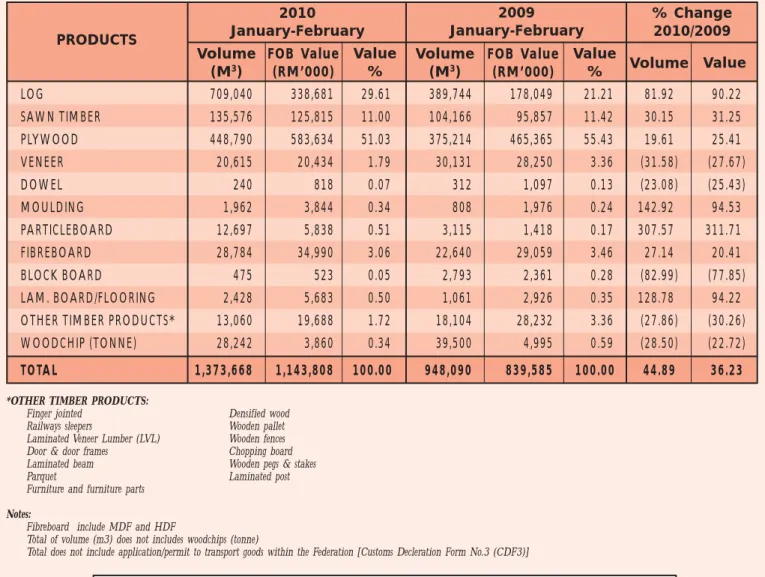
Cumulative export for the period of January to February 2010 showed continues improvement of 36% in value to RM 1.1 billion against the previous corresponding period of 2009. In line with the global economic recovery, there were increased in the overall values of logs and timber products exported in 2010. Respective increased in export values were that of logs (90%), sawn timber (31%), plywood (25%), moulding (95%), particleboard (312%), fibreboard (20%) and laminated board (94%). In spite of the overall increase in export value, there was a decrease in values of veneer (28%), dowels (25%), blockboard (78%), woodchips (23%) and other timber products (30%).
The demand from major market is picking up steadily such as plywood, logs and sawn timber were RM 584 million, RM 339 million, and RM 126 million respectively and contributed 51%, 30% and 11% to the total exported value of logs and timber products from the State since for the first two month 2010.
Logs
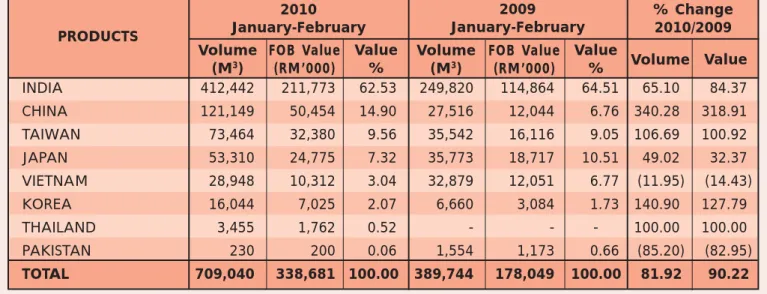
Sarawak’s exports of logs for January to February 2010 registered a positive growth of 82% in volume (709,040 m3) and 90% in value (RM339 million) compared to the corresponding period last year (389,744 m3 with value RM178 million). Improved intake from major markets contributed to the positive growth for the month.
India remained the number one importer of the State’s logs which comprises 58% @ 211,773 m3 of the total export. This followed by China, Taiwan, Japan and Vietnam (4%).
Export of logs to India in January to February 2010 increased by 65%
to 211,773 cubic meter from 114,864 m3 in comparison to the corresponding period of 2009, followed by China (340%), Taiwan (107%) and Japan (49%). However export of logs to Vietnam decreased by 12% compared to the previous year.
The top five importers were India, China, Taiwan, Japan and Vietnam had contributed 97% of the overall exported volume and value from January to February 2010.
Sawn timber
Volume of sawn timber export in January to February 2010 jumped by 30% to 135,576 m3 from 104,166 m3 and the value also increased by 31% to RM 126 million from RM 96 million compared to that of similar period in 2009.
Thailand remained the number one importer of the State’s sawn timber, by purchasing 45,111 m3 of the overall volume exported valued at RM 44 million followed by Middle East, Philippines and Taiwan.
Export of sawn timber to Thailand in 2010 increased by 40% to 45,111 m3 from 32,327 m3 in comparison to the corresponding period of 2009, followed by Middle East (82%), Philippines (10%) and Taiwan (84%).
The major buyer of sawn timber like Thailand, Middle East, Philippines and Taiwan constituted 83% of the total export volume and contributed 81% to the total export value of logs for the first two month 2010.
(Table 3) Plywood
Plywood exported for the first two month of 2010 at 448,790
million m3 was 20% higher than that of 375,214 m3 exported for the corresponding period in 2009. Plywood sales at RM 584 million contributed 50% to the overall timber products revenue obtained from the export of logs and timber products for the period.
Japan remains the number one importer of the State’s plywood with purchase of 188,533 m3 or 42% of the volume exported valued at RM 257 million for the first two month of 2010. It had bought 178,960 m3 in the same period last year which is increased by 5% for January to February this year. Other major plywood importers also increased their purchase like Korea (30%), Middle East (20%) and Taiwan (116%).
Export of plywood to Japan, Korea, Middle East and Taiwan constituted 90% of the overall exported volumes and contributed 88% to the overall revenue from the product for the first two month of 2010. (Table 4) Other timber product
Other timber products includes veneer, dowels, moulding, particleboard, fibreboard, block board, laminated board, woodchips and other timber products (mention in Table 1). Value of these exports of products was at RM 96 million accounted for 7% of the overall value of logs and timber products exported during the first two month of 2010.
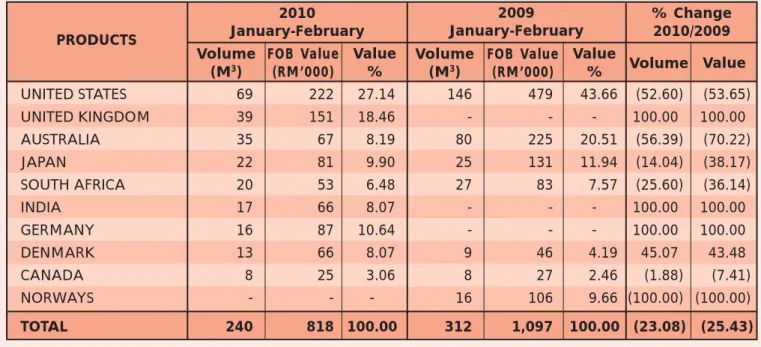
There were respective increase in export volumes of moulding (143%), particleboard (308%), fibreboard (27%) and laminated board (129%) from January to February 2010 compared to corresponding period in 2009. However, there was a marked decrease for veneer (32%), dowels (23%), blockboard (83%) and woodchips (29%) for the first two month 0f 2010 compared to the previous year. (Table 5,6,7,8,9)
Future Outlook
By the end of February 2009, the average unit price of timber product such as sawn timber and particleboard remain stable whereas logs, plywood, veneer, blockboard and woodchips were quite encouraging.
There were respectively higher in the unit price of logs (5%), sawn timber (1%), plywood (5%), veneer (6%), particleboard (1%), blockboard (30%) and woodchips (8%) for January to February 2010 compared to the previous year 2009. However unit price of moulding was lower by 20% for the first two month of 2010 compared to that similar period in 2009. This is followed by laminated board (15%), fibreboard (5%) and dowels (3%).
The timber industry experienced its most challenging period in 2009 following the global economic and financial crisis. Sarawak timber products export recovered slightly by 19% in the 4th quarter 2009 to RM 1.9 billion compared to RM 1.6 billion in the same period in 2008.
However, overall export for 2009 deteriorated by 18% to RM 6.6 billion from RM 8.0 billion in the earlier year.
Despite this, it is predicted the export trend to sustain and recover slightly towards the end of this year and this years ahead. This is in anticipation of recovery in economic growth in Malaysia and regionally, in particular the Asia-Pacific region which is also the major market for Sarawak timber products besides India and Middle East.
Additionally, traditional trading partners like Japan, Thailand, Middle East, India and European United have shown a good start in the earlier year 2010 by increasing their purchasing of logs and timber products in Sarawak.
T RADE S TATISTICS S ARAWAK
T RADE S TATISTICS S ARAWAK
TABLE 1. EXPORT SUMMARY OF TIMBER AND TIMBER PRODUCTS FROM SARAWAK
*OTHER TIMBER PRODUCTS:
➢ Finger jointed ➢ Densified wood
➢ Railways sleepers ➢ Wooden pallet
➢ Laminated Veneer Lumber (LVL) ➢ Wooden fences
➢ Door & door frames ➢ Chopping board
➢ Laminated beam ➢ Wooden pegs & stakes
➢ Parquet ➢ Laminated post
➢ Furniture and furniture parts Notes:
➢ Fibreboard include MDF and HDF
➢ Total of volume (m3) does not includes woodchips (tonne)
➢ Total does not include application/permit to transport goods within the Federation [Customs Decleration Form No.3 (CDF3)]
2010 January-February Volume
(M3)
FOB Value (RM’000)
Volume (M3)
FOB Value (RM’000) PRODUCTS
2009 January-February
% Change 2010/2009 Volume Value Value
% Value
%
LOG 709,040 338,681 29.61 389,744 178,049 21.21 81.92 90.22
SAWN TIMBER 135,576 125,815 11.00 104,166 95,857 11.42 30.15 31.25 PLYWOOD 448,790 583,634 51.03 375,214 465,365 55.43 19.61 25.41
VENEER 20,615 20,434 1.79 30,131 28,250 3.36 (31.58) (27.67)
DOWEL 240 818 0.07 312 1,097 0.13 (23.08) (25.43)
MOULDING 1,962 3,844 0.34 808 1,976 0.24 142.92 94.53
PARTICLEBOARD 12,697 5,838 0.51 3,115 1,418 0.17 307.57 311.71
FIBREBOARD 28,784 34,990 3.06 22,640 29,059 3.46 27.14 20.41
BLOCK BOARD 475 523 0.05 2,793 2,361 0.28 (82.99) (77.85)
LAM. BOARD/FLOORING 2,428 5,683 0.50 1,061 2,926 0.35 128.78 94.22 OTHER TIMBER PRODUCTS* 13,060 19,688 1.72 18,104 28,232 3.36 (27.86) (30.26) WOODCHIP (TONNE) 28,242 3,860 0.34 39,500 4,995 0.59 (28.50) (22.72) TOTAL 1,373,668 1,143,808 100.00 948,090 839,585 100.00 44.89 36.23
EXPORT VALUE OF MAJOR TIMBER & TIMBER PRODUCTS FROM SARAWAK (RM’000) : 2010 / 2009
TABLE 2. EXPORT OF LOGS BY COUNTRY OF DESTINATIONS 2010
January-February Volume
(M3)
FOB Value (RM’000)
Volume (M3)
FOB Value (RM’000) PRODUCTS
2009 January-February
% Change 2010/2009 Volume Value Value
% Value
%
INDIA 412,442 211,773 62.53 249,820 114,864 64.51 65.10 84.37
CHINA 121,149 50,454 14.90 27,516 12,044 6.76 340.28 318.91
TAIWAN 73,464 32,380 9.56 35,542 16,116 9.05 106.69 100.92
JAPAN 53,310 24,775 7.32 35,773 18,717 10.51 49.02 32.37
VIETNAM 28,948 10,312 3.04 32,879 12,051 6.77 (11.95) (14.43)
KOREA 16,044 7,025 2.07 6,660 3,084 1.73 140.90 127.79
THAILAND 3,455 1,762 0.52 - - - 100.00 100.00
PAKISTAN 230 200 0.06 1,554 1,173 0.66 (85.20) (82.95)
TOTAL 709,040 338,681 100.00 389,744 178,049 100.00 81.92 90.22
EXPORT VALUE OF LOG TO MAJOR DESTINATIONS (RM’000) : 2010 / 2009
2010 January-February Volume
(M3)
FOB Value (RM’000)
Volume (M3)
FOB Value (RM’000) PRODUCTS
2009 January-February
% Change 2010/2009 Volume Value Value
% Value
%
THAILAND 45,111 43,634 34.68 32,327 27,597 28.79 39.55 58.11 MIDDLE EAST 35,986 37,788 30.03 19,757 21,049 21.96 82.15 79.52
PHILIPPINES 17,256 11,556 9.18 15,758 11,626 12.13 9.50 (0.60)
TAIWAN 13,493 8,662 6.88 7,331 4,759 4.96 84.07 82.01
SINGAPORE 5,348 5,013 3.98 7,401 5,667 5.91 (27.74) (11.54)
SOUTH AFRICA 3,614 3,897 3.10 2,722 3,159 3.30 32.77 23.36
KOREA 3,076 3,327 2.64 4,737 4,874 5.08 (35.06) (31.74)
CHINA 2,823 2,390 1.90 4,029 2,768 2.89 (29.94) (13.66)
JAPAN 2,447 3,316 2.64 4,565 6,987 7.29 (46.41) (52.54)
HONG KONG 2,255 1,805 1.43 1,074 1,204 1.26 109.99 49.92
OTHERS* 4,168 4,427 3.52 4,466 6,167 6.43 (6.68) (28.21)
TOTAL 135,576 125,815 100.00 104,166 95,857 100.00 30.15 31.25
*OTHER DESTINATION:
➢ AUSTRALIA ➢ REUNION
➢ BELGIUM ➢ SEYCHELLES
➢ BRUNEI DARUSSALAM ➢ SRI LANKA
➢ FRANCE ➢ UNITED KINGDOM
➢ GERMANY ➢ UNITED STATES
➢ MALDIVES ➢ VIETNAM
➢ MAURITIUS ➢ Within Malaysia (Peninsular or Sabah)
➢ NETHERLANDS
EXPORT VALUE OF SAWN TIMBER TO MAJOR DESTINATIONS (RM’000) : 2010 / 2009
TABLE 4. EXPORT OF PLYWOOD BY COUNTRY OF DESTINATIONS
*OTHER DESTINATION:
➢ BRUNEI DARUSSALAM ➢ MAURITIUS
➢ CANADA ➢ NEW ZEALAND
➢ INDIA ➢ SINGAPORE
➢ INDONESIA ➢ SOUTH AFRICA
➢ MALDIVES ➢ THAILAND
➢ MALTA ➢ VIETNAM
2010 January-February Volume
(M3)
FOB Value (RM’000)
Volume (M3)
FOB Value (RM’000) PRODUCTS
2009 January-February
% Change 2010/2009 Volume Value Value
% Value
%
JAPAN 188,533 256,571 43.96 178,960 238,531 51.26 5.35 7.56
KOREA 100,282 114,560 19.63 76,943 72,037 15.48 30.33 59.03
MIDDLE EAST 65,761 85,569 14.66 54,779 66,856 14.37 20.05 27.99
TAIWAN 48,132 59,222 10.15 22,250 24,511 5.27 116.32 141.61
EU 8,540 12,717 2.18 4,447 7,217 1.55 92.06 76.21
HONG KONG 7,471 9,896 1.70 6,202 7,625 1.64 20.45 29.78
CHINA 7,233 11,330 1.94 2,486 4,470 0.96 190.96 153.47
UNITED STATES 6,342 10,296 1.76 9,545 17,116 3.68 (33.55) (39.85) PHILIPPINES 4,641 6,100 1.05 10,024 12,843 2.76 (53.70) (52.50)
AUSTRALIA 4,191 7,101 1.22 3,032 5,498 1.18 38.22 29.16
OTHERS* 7,664 10,272 1.76 6,546 8,661 1.86 17.09 18.60
TOTAL 448,790 583,634 100.00 375,214 465,365 100.00 19.61 25.41
EXPORT VALUE OF PLYWOOD TO MAJOR DESTINATIONS (RM’000) : 2010 / 2009
2010 January-February Volume
(M3)
FOB Value (RM’000)
Volume (M3)
FOB Value (RM’000) PRODUCTS
2009 January-February
% Change 2010/2009 Volume Value Value
% Value
%
TAIWAN 8,945 8,511 41.65 9,584 9,100 32.21 (6.67) (6.47)
KOREA 7,196 5,776 28.27 12,097 9,850 34.87 (40.52) (41.36)
PHILIPPINES 1,820 2,163 10.59 2,186 2,907 10.29 (16.73) (25.59)
CHINA 1,418 1,077 5.27 3,810 2,405 8.51 (62.78) (55.22)
JAPAN 954 1,419 6.94 1,224 2,170 7.68 (22.05) (34.61)
THAILAND 166 243 1.19 157 135 0.48 5.52 80.00
AUSTRALIA 103 1,235 6.04 61 789 2.79 69.13 56.53
SINGAPORE 14 10 0.05 - - - 100.00 100.00
VIETNAM - - - 933 729 2.58 (100.00) (100.00)
CHILE - - - 80 165 0.58 (100.00) (100.00)
TOTAL 20,615 20,434 100.00 30,131 28,250 100.00 (174) (127)
EXPORT VALUE OF VENEER TO MAJOR DESTINATIONS (RM’000) : 2010 / 2009
TABLE 6. EXPORT OF DOWEL BY COUNTRY OF DESTINATIONS 2010
January-February Volume
(M3)
FOB Value (RM’000)
Volume (M3)
FOB Value (RM’000) PRODUCTS
2009 January-February
% Change 2010/2009 Volume Value Value
% Value
%
UNITED STATES 69 222 27.14 146 479 43.66 (52.60) (53.65)
UNITED KINGDOM 39 151 18.46 - - - 100.00 100.00
AUSTRALIA 35 67 8.19 80 225 20.51 (56.39) (70.22)
JAPAN 22 81 9.90 25 131 11.94 (14.04) (38.17)
SOUTH AFRICA 20 53 6.48 27 83 7.57 (25.60) (36.14)
INDIA 17 66 8.07 - - - 100.00 100.00
GERMANY 16 87 10.64 - - - 100.00 100.00
DENMARK 13 66 8.07 9 46 4.19 45.07 43.48
CANADA 8 25 3.06 8 27 2.46 (1.88) (7.41)
NORWAYS - - - 16 106 9.66 (100.00) (100.00)
TOTAL 240 818 100.00 312 1,097 100.00 (23.08) (25.43)
EXPORT VALUE OF DOWEL TO MAJOR DESTINATIONS (RM’000) : 2010 / 2009
2010 January-February Volume
(M3)
FOB Value (RM’000)
Volume (M3)
FOB Value (RM’000) PRODUCTS
2009 January-February
% Change 2010/2009 Volume Value Value
% Value
%
AUSTRALIA 854 1,979 51.48 467 1,032 52.23 83.02 91.76
KOREA 605 977 25.42 - - - 100.00 100.00
JAPAN 247 390 10.15 60 135 6.83 312.10 188.89
UNITED KINGDOM 41 133 3.46 - - - 100.00 100.00
MAURITIUS 35 70 1.82 - - - 100.00 100.00
CHINA 33 59 1.53 - - - 100.00 100.00
SOUTH AFRICA 32 65 1.69 - - - 100.00 100.00
SEYCHELLES 31 28 0.73 - - - 100.00 100.00
BELGIUM 29 48 1.25 - - - 100.00 100.00
GERMANY 26 41 1.07 - - - 100.00 100.00
OTHERS* 30 54 1.40 281 809 40.94 (89.43) (93.33)
TOTAL 1,962 3,844 100.00 808 1,976 100.00 142.92 94.53
*OTHER DESTINATION:
➢ CANADA
➢ DENMARK
➢ NETHERLANDS
➢ SINGAPORE
➢ TAIWAN
➢ UNITED STATES
EXPORT VALUE OF MOULDING TO MAJOR DESTINATIONS (RM’000) : 2010 / 2009
TABLE 8. EXPORT OF FIBREBOARD BY COUNTRY OF DESTINATIONS 2010
January-February Volume
(M3)
FOB Value (RM’000)
Volume (M3)
FOB Value (RM’000) PRODUCTS
2009 January-February
% Change 2010/2009 Volume Value Value
% Value
%
JAPAN 19,974 26,852 76.74 18,085 24,657 84.85 10.44 8.90
INDONESIA 3,852 3,533 10.10 1,689 1,730 5.95 128.13 104.22
PHILIPPINES 1,102 957 2.74 282 382 1.31 291.42 150.52
CHINA 685 698 1.99 181 194 0.67 277.73 259.79
VIETNAM 552 528 1.51 570 533 1.83 (3.26) (0.94)
INDIA 513 271 0.77 344 209 0.72 49.17 29.67
THAILAND 412 452 1.29 565 649 2.23 (27.10) (30.35)
BRUNEI DARUSSALAM 406 344 0.98 234 188 0.65 73.48 82.98
NETHERLANDS 384 588 1.68 - - - 100.00 100.00
TAIWAN 324 311 0.89 219 229 0.79 47.71 35.81
OTHERS* 579 456 1.30 470 288 0.99 23.12 58.33
TOTAL 28,784 34,990 100.00 22,640 29,059 100.00 27.14 20.41
*OTHER DESTINATION:
➢ KOREA
➢ SINGAPORE
➢ SOUTH AFRICA Notes:
➢ Fibreboard include MDF and HDF
EXPORT VALUE OF FIBREBOARD TO MAJOR DESTINATIONS (RM’000) : 2010 / 2009
2010 January-February Volume
(M3)
FOB Value (RM’000)
Volume (M3)
FOB Value (RM’000) PRODUCTS
2009 January-February
% Change 2010/2009 Volume Value Value
% Value
%
INDONESIA 6,931 3,171 54.32 - - - 100.00 100.00
KOREA 2,202 912 15.62 1,448 590 41.61 52.11 54.58
PHILIPPINES 2,186 1,025 17.56 194 88 6.21 1028.87 1064.77
VIETNAM 798 426 7.30 263 114 8.04 203.76 273.68
JAPAN 243 135 2.31 545 372 26.23 (55.41) (63.71)
INDIA 223 96 1.64 151 62 4.37 47.92 54.84
CHINA 70 51 0.87 - - - 100.00 100.00
KENYA 45 22 0.38 - - - 100.00 100.00
OTHERS* - - - 515 192 13.54 (100.00) (100.00)
TOTAL 12,697 5,838 100.00 3,115 1,418 100.00 307.57 311.71
*OTHER DESTINATION:
➢ HONG KONG
➢ PAKISTAN
➢ SINGAPORE
EXPORT VALUE OF PARTICLE BOARD TO MAJOR DESTINATIONS (RM’000) : 2010 / 2009
The Malaysian Grading Rules For Sawn The Malaysian Grading Rules For Sawn The Malaysian Grading Rules For Sawn The Malaysian Grading Rules For Sawn The Malaysian Grading Rules For Sawn Hardwood Timber (English)
Hardwood Timber (English) Hardwood Timber (English) Hardwood Timber (English) Hardwood Timber (English)
Commercial Timber Species Of Sarawak Commercial Timber Species Of Sarawak Commercial Timber Species Of Sarawak Commercial Timber Species Of Sarawak Commercial Timber Species Of Sarawak (1 set of 3) (English)
(1 set of 3) (English) (1 set of 3) (English) (1 set of 3) (English) (1 set of 3) (English)
Guide To Timber Trade Sarawak Guide To Timber Trade Sarawak Guide To Timber Trade Sarawak Guide To Timber Trade Sarawak Guide To Timber Trade Sarawak (2010 / 2011)
(2010 / 2011) (2010 / 2011) (2010 / 2011) (2010 / 2011)
Manual Of Sarawak Timber Species Manual Of Sarawak Timber Species Manual Of Sarawak Timber Species Manual Of Sarawak Timber Species Manual Of Sarawak Timber Species Sarawak Log Grading Rules (English) Sarawak Log Grading Rules (English) Sarawak Log Grading Rules (English) Sarawak Log Grading Rules (English) Sarawak Log Grading Rules (English) Timber Sample Box (English Description) Timber Sample Box (English Description) Timber Sample Box (English Description) Timber Sample Box (English Description) Timber Sample Box (English Description)
ORDER FORM
✁
***** Fax toFax toFax toFax toFax to ::::: 6082-441169 / 4426916082-441169 / 4426916082-441169 / 4426916082-441169 / 4426916082-441169 / 442691 E-mail
E-mailE-mail
E-mailE-mail ::::: [email protected] /[email protected] /[email protected] /[email protected] /[email protected] /
MODE OF PAYMENT MODE OF PAYMENTMODE OF PAYMENT MODE OF PAYMENTMODE OF PAYMENT
All quotation will be inclusive of airmail postage and bank commission (for overseas payment only)
Payment should be made in the form of Telegraphic Transfer to our Maybank Current Account No. 51111 3408 936Maybank Current Account No. 51111 3408 936Maybank Current Account No. 51111 3408 936Maybank Current Account No. 51111 3408 936Maybank Current Account No. 51111 3408 936
Name: Designation:
Company:
Address:
Country: E-mail:
Tel: Fax:
Date:
Signature:
Publication Catalogue : Publication Catalogue :Publication Catalogue : Publication Catalogue : Publication Catalogue :
copy/copies/set/sets copy/copies/set/sets copy/copies/set/sets copy/copies/set/sets copy/copies/set/sets
Company Stamp:
To :
Sarawak Timber Industry Development Corporation (STIDC) Sarawak Timber Industry Development Corporation (STIDC) Sarawak Timber Industry Development Corporation (STIDC) Sarawak Timber Industry Development Corporation (STIDC) Sarawak Timber Industry Development Corporation (STIDC)
We wish to purchase the items indicated.
Please quote us on the total cost inclusive of postage and bank commission. (if any).
The Malaysian Grading Rules For Sawn Hardwood Timber The Malaysian Grading Rules For Sawn Hardwood Timber The Malaysian Grading Rules For Sawn Hardwood Timber The Malaysian Grading Rules For Sawn Hardwood Timber
The Malaysian Grading Rules For Sawn Hardwood Timber
(2009 Edition)(2009 Edition)(2009 Edition)(2009 Edition)(2009 Edition)RM RM RM RM RM 25 25 25 25 25
RM RM RM
RM RM 25 25 25 25 25 Commercial Timber Species Of Sarawak Commercial Timber Species Of Sarawak Commercial Timber Species Of Sarawak Commercial Timber Species Of Sarawak Commercial Timber Species Of Sarawak
(a set of 3)(a set of 3)(a set of 3)(a set of 3)(a set of 3)Guide To Timber Trade Sarawak Guide To Timber Trade Sarawak Guide To Timber Trade Sarawak Guide To Timber Trade Sarawak
Guide To Timber Trade Sarawak
(2010 / 2011)(2010 / 2011)(2010 / 2011)(2010 / 2011)(2010 / 2011)RM RM RM RM RM 20 20 20 20 20
RM RM RM
RM RM 10 10 10 10 10 Manual Of Sarawak Timber Species Manual Of Sarawak Timber Species Manual Of Sarawak Timber Species Manual Of Sarawak Timber Species Manual Of Sarawak Timber Species
(Revised Edition)(Revised Edition)(Revised Edition)(Revised Edition)(Revised Edition)Sarawak Log Grading Rules (SLGR) Sarawak Log Grading Rules (SLGR) Sarawak Log Grading Rules (SLGR) Sarawak Log Grading Rules (SLGR)
Sarawak Log Grading Rules (SLGR)
(1996 Edition)(1996 Edition)(1996 Edition)(1996 Edition)(1996 Edition)RM RM RM RM RM 55555
RM RM RM