WATER QUALITY STUDY ON UNIMAS LAKE
Muhammad Shaiful Bin Nordin
Bachelor of Engineering (Civil Engineering)
2009
UNIVERSITI MALAYSIA SARAWAK
BORANG PENGESAHAN STATUS TESIS
Judul: WATER QUALITY STUDY ON UNIMAS LAKE
SESI PENGAJIAN: 2004 – 2009
Saya MUHAMMAD SHAIFUL BIN NORDIN
(HURUF BESAR)
mengaku membenarkan tesis * ini disimpan di Pusat Khidmat Maklumat Akademik, Universiti Malaysia Sarawak dengan syarat-syarat kegunaan seperti berikut:
1. Tesis adalah hakmilik Universiti Malaysia Sarawak.
2. Pusat Khidmat Maklumat Akademik, Universiti Malaysia Sarawak dibenarkan membuat salinan untuk tujuan pengajian sahaja.
3. Membuat pendigitan untuk membangunkan Pangkalan Data Kandungan Tempatan.
4. Pusat Khidmat Maklumat Akademik, Universiti Malaysia Sarawak dibenarkan membuat salinan tesis ini sebagai bahan pertukaran antara institusi pengajian tinggi.
5. ** Sila tandakan ( ) di kotak yang berkenaan
SULIT (Mengandungi maklumat yang berdarjah keselamatan atau kepentingan Malaysia seperti yang termaktub di dalam AKTA RAHSIA RASMI 1972).
TERHAD (Mengandungi maklumat TERHAD yang telah ditentukan oleh organisasi/
badan di mana penyelidikan dijalankan).
TIDAK TERHAD
Disahkan oleh
(TANDATANGAN PENULIS) (TANDATANGAN PENYELIA)
Alamat tetap: NO 79, JALAN KOSAS 3/3, TAMAN KOSAS, 68000
AMPANG, SELANGOR. EN. JETHRO HENRY ADAM
(Nama Penyelia)
Tarikh: 20 May 2009 Tarikh:
CATATAN * Tesis dimaksudkan sebagai tesis bagi Ijazah Doktor Falsafah, Sarjana dan Sarjana Muda.
** Jika tesis ini SULIT atau TERHAD, sila lampirkan surat daripada pihak berkuasa/organisasi berkenaan dengan menyatakan sekali sebab dan tempoh tesis ini perlu dikelaskan sebagai SULIT dan TERHAD.
Final Year Project Report below:
Title : Water Quality Study on UNIMAS Lake Author : Muhammad Shaiful Bin Nordin
Metric Number : 13424
Has been read and certified by:
__________________________ ________________________
En. Jethro Henry Adam Date Supervisor
WATER QUALITY STUDY ON UNIMAS LAKE
MUHAMMAD SHAIFUL BIN NORDIN
This thesis is submitted in partial fulfillment of the requirement for the degree of Bachelor of Engineering with Honours
(Civil Engineering) 2009
Faculty of Engineering
UNIVERSITI MALAYSIA SARAWAK 2009
ii
Special dedication to my mother and family.
iii
ACKNOWLEDGEMENT
I would like to wish a special thanks to my supervisor Mr. Jethro Henry Adam for his guidance and continuous support during the period of study and the completion of this thesis. His kindness is invaluable.
I would also like to show my appreciation to the Department of Development and Asset Management and Sport Units of Universiti Malaysia Sarawak (UNIMAS) for providing invaluable information and facilities required during the period of study.
Last but not least, I would also like to dedicate my gratitude to those who were involved either formally or informally especially the Head Department of Aquatic Science; Dr Samsur Mohamad, Science Officer, Faculty of Resource Science and Technology; Miss Zeti Akhtar, Technician of Vertebrata Aquatic Laboratory; Mr. Mustafa Kamal, Technician of Environmental Laboratory; Mr.
Sapian and my friends; Mr. Muhd Fadzil Noor, Miss Domira and Mr. Amirul.
vi
CONTENTS
Page number
Acknowledgement iii
Abstrak iv
Abstract v
List of Table x
List of Figure xii
List of Photo xiii
List of Abbreviation xv
CHAPTER 1 INTRODUCTION
1.1 Project Background 5
1.2 Problem of Statement 8
1.3 The Aim and Objectives 9
1.4 Scope of Study 10
1.5 Hypothesis 10
vii
CHAPTER 2 LITERATURE REVIEW
2.1 Background of Water Quality 11
2.2 Water Quality Index 12
2.3 Importance of Water Quality 15
2.4 Malaysia Standards 16
2.4.1 Department of Environment
Standards 16
2.4.2 Interim National Water Quality
Standards 19
2.4.3 Formula to Determine the Water 21 Quality Index
2.5 Water Quality Index for
Others Countries 22
2.5.1 Bhargava’s Water
Quality Index 23
2.5.2 The British Colombia
Water Quality Index 24 2.5.3 National Sanitation Foundation
Water Quality Index (NSF WQI) 26
2.6 Physical Parameters 27
2.6.1 Colour 27
2.6.2 Electrical Conductivity 28
2.6.3 Taster and Odour 28
2.6.4 Temperature 29
2.6.5 Turbidity 30
2.7 Chemical Parameters 30
2.7.1 pH 31
2.7.2 Ammonia Nitrogen 31
viii
2.7.3 Total Dissolved Solids (TDS) 32 2.7.4 Total Suspended Solids (TSS) 33 2.7.5 Biochemical Oxygen Demand
(BOD) 34
2.7.6 Chemical Oxygen Demand
(COD) 35
2.7.7 Dissolved Oxygen (DO) 36 2.8 Issues Related with the Water Quality 36
2.8.1 Water Quality Criteria and Guidelines for Developing
Countries 37
2.8.2 Objectives of the Setting of Water Quality for
Developed Countries 38 2.8.3 Water Quality Issues in
Malaysia 39
CHAPTER 3 METHODOLOGY
3.1 Dissolved Oxygen Test (DO) 47 3.2 Biochemical Oxygen Demand
Test (BOD) 48
3.3 Chemical Oxygen Demand
Test (COD) 49
3.4 Ammonia Nitrogen Test 51
3.5 Total Suspended Solid Test (TSS) 52
3.6 pH Test 52
ix
CHAPTER 4 RESULTS, ANALYSIS AND DISCUSSION
4.1 Dissolved Oxygen Results 59 4.2 Biochemical Oxygen Demand Results 61 4.3 Chemical Oxygen Demand Results 63 4.4 Ammonia Nitrogen Results 64
4.5 Suspended Solids Results 65
4.6 pH Results 66
4.7 Measuring of Water Quality Index 69
CHAPTER 5 CONCLUSIONS AND
RECOMMENDATIONS 74
REFERENCE 78
APPENDIX 83
x
LIST OF TABLE
Table 1.1: Estimated Earth’s Water Inventory Table 2.1: DOE Water Quality Index Classification
Table 2.2: DOE Water Classification Based on Water Quality Index
Table 2.3: Class of Water Based on Interim National Water Quality Standards for Malaysia
Table 2.4: Parameters Used to Determined the Water Quality Standards Table 2.5: Sub Index Formula to Determine WQI
Table 2.6: The Categories of WQI
Table 2.7: The Rankings of Water Quality Index Table 2.8: The NSF WQI Description
Table 4.1: The Depth of UNIMAS Lake for Each Location
Table 4.2: Average DO and Temperature Result for Each Location Table 4.3: Average BOD Results for Each Location
Table 4.4: Average COD Results for Each Location Table 4.5: Average NH3-N Results for Each Location
Table 4.6: Average Suspended Solids Results for Each Location
xi
Table 4.7: Average pH Results for Each Location Table 4.8: Classes for Each Parameter
Table 4.9: BOD, NH3-N, and SS Index Range
xii
LIST OF FIGURE
Figure 1.1: Location of UNIMAS Figure 2.1: Process of Index Calculation
Figure 3.1: View of UNIMAS Lake and the Location for Each Sample Collected Figure 4.1: Percent Saturation of DO
Figure 4.2: pH of Common Substance and Lethal pH Limits for Aquatic Organism
xiii
LIST OF PHOTO
Photo 1.1: View of UNIMAS Lake Photo 1.2: Kayaking Activities Photo 1.3: Bridge Facilities Photo 1.4: Grandstand Facilities Photo 2.1: Pollution at Sungai Juru
Photo 2.2: Rubbish and Other Suspended Solid Material at UNIMAS Lake Photo 2.3: Different Colour of Lake Water and the Liquid Material
Photo 3.1: Apparatus for DO Test Photo 3.2: BOD Bottle
Photo 3.3: COD Reactor Photo 3.4: Cooling Process Photo 3.5: Spectrophotometer Photo 3.6: pH Meter
Photo 4.1: Rubbish and Others Suspended Solid Photo 4.2: Drainage Locates at the Location 2 Photo 4.3: Location 3
xiv Photo 4.4: Location 4
Photo 4.5: Location 5 Photo 4.6: Location 6 Photo 4.7: Location 7
xv
LIST OF ABBREVIATION
BOD - Biochemical Oxygen Demand COD - Chemical Oxygen Demand
cm - Centimetres
DO - Dissolved Oxygen
DOE - Department of Environmental
FEPA - Federal Environmental Protection Agency
H+ - Ion Hydrogen
L - Litre
mg/L - Milligram/Litre
ml - Millilitre
N2 - Nitrogen Gas
NH3-N - Ammonia Nitrogen
NO2 - Nitrite
NO3 - Nitrate
NSF WQI - National Sanitation Foundation Water Quality Index
xvi
NTU - Nephelomertic Turbidity Units
OH- - Hydroxyl
pH - Hydrogen Ion Concentration
RM - Ringgit Malaysia
TDS - Total Dissolved Solids TSS - Total Suspended Solids UNIMAS - Universiti Malaysia Sarawak
U.S - United States
USEPA - U.S Environtmental Protection Agency WHO - World Health Organisations
WQI - Water Quality Index
Y.B - Yang Berhormat
iv
ABSTRAK
Kajian kejuruteraan persekitaran merupakan bidang kajian khusus yang memberi fokus kepada bidang rawatan air dan air sisa, dan kawalan kualiti air. Bidang lain yang berkait rapat dengan kejuruteraan persekitaran ini ialah Indeks Kualiti Air yang merupakan kaedah terbaik bagi mengkaji perubahan sifat fizikal, kimia, dan biologi dalam sistem akuatik. Tujuan utama kajian ini ialah untuk menentukan Indeks Kualiti Air bagi tasik UNIMAS dan mengklasifikasikan tasik tersebut berdasarkan piawai Bahagian Persekitaran, dan piawai Kualiti Air Kebangsaan. Kajian ini memfokuskan kepada sifat fizikal dan kimia seperti Oksigen Terlarut (DO), Keperluan Oksigen Biokimia (BOD), Keperluan Oksigen Kimia (COD), Ammonia Nitrogen (NH3-N), Jumlah Pepejal Terampai (TSS), dan kosentrasi ion Hydrogen (pH). Enam kerja amali terlibat dalam mengkaji sifat-sifat fizikal dan kimia air sebelum Indeks Kualiti Air bagi tasik UNIMAS dapat ditentukan. Daripada kajian ini, Indeks Kualiti Air bagi tasik UNIMAS ialah 91.44 dan dapat diklasifikasikan sebagai “Bersih” dan
“Kelas II”. Kelas II bermaksud, air tersebut sesuai digunakan untuk tujuan bekalan air beserta rawatan yang konvensional diperlukan, sesuai bagi spesies akuatik yang sensitif, selain sesuai untuk kegunaan rekreasi.
v
ABSTRACT
Environmental engineering studies include a special area of study, which focuses about water and wastewater treatment and water quality control.
Another important thing related to environmental engineering is the study about the Water Quality Index (WQI). WQI is the best approach for simulating the physical, chemicals, and biological changes in the aquatic systems. The aim of this study is to determine the WQI for UNIMAS lake and to classify the water based on the Department of Environmental standards and the Interim National Water Quality standards for Malaysia. This study focuses on the physical and chemical parameters such as Dissolved Oxygen (DO), Biochemical Oxygen Demand (BOD), Chemical Oxygen Demand (COD), Ammonia Nitrogen (NH3- N), Total Suspended Solids (TSS) and Hydrogen Ion Concentration (pH). Six experimental works involved in physical and chemical parameter was carried out to finalize all the parameter value before determining the WQI for UNIMAS lake.
From this study, the value of WQI for UNIMAS lake is 91.44 and the lake can be classified as “Clean”. The lake also can be classified as “Class II” which is suitable for water supply with a conventional treatment required, suitable for sensitive aquatic species and also suitable for recreational use with body contact.
1
CHAPTER 1
INTRODUCTION
Water is mainly used for water supply, industrial and agricultural water supply, hydro-electrical power supply, recreational purposes, navigational and transportation. It shows that, water is the most important elements in our lives, and waters are the soul of life.
Water covers 70% of the world and 97% of it are saline and the remaining 3% is insipid water. Three percent of the insipid water are formed in ice and glaciers or located in the ground surface, which is too difficult and not economical to take out (Miller, 1995). Only 0.003% from the insipid water can be use and it is in the form of soil moisture, groundwater, steams, lakes and rivers.
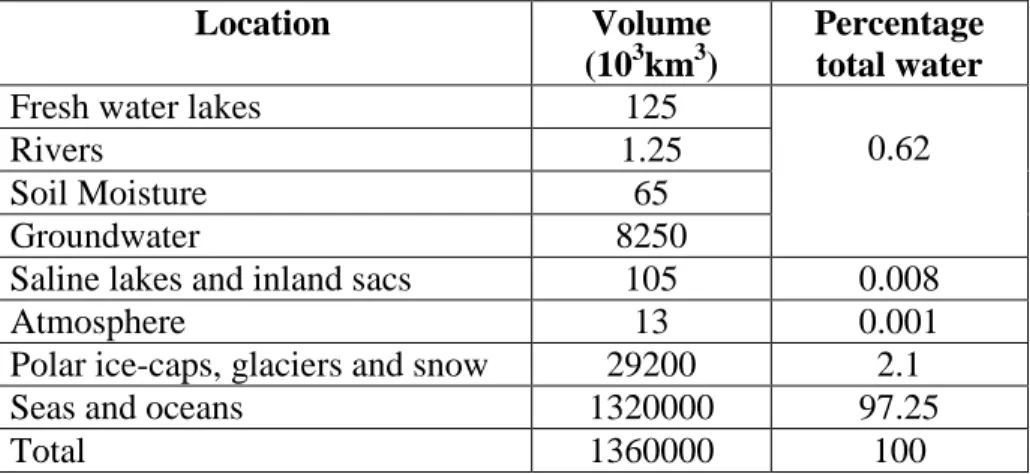
Table 1.1 shows the types of water, volume covered, and percentage of the total water on earth.
2
Table 1.1: Estimated Earth’s Water Inventory
Location Volume
(103km3)
Percentage total water
Fresh water lakes 125
0.62
Rivers 1.25
Soil Moisture 65
Groundwater 8250
Saline lakes and inland sacs 105 0.008
Atmosphere 13 0.001
Polar ice-caps, glaciers and snow 29200 2.1
Seas and oceans 1320000 97.25
Total 1360000 100
There are two sources of water; surface water and ground water. In Malaysia, surface water is the main source for water supply (Abdllah, 1990).
Rivers are the main source for the water supply in Malaysia thus, it is very important to prevent water pollution especially cases which involves the river system.
Water studies may involve fields such as water quality engineering, hydraulic, hydrology, water resource engineering, wastewaters engineering and fluid mechanic. These studies are about water cycle, water in physical, chemical and biological parameters, water quality index, water treatment, the purpose of water and others.
3
Nowadays the water quality study is very important. In developed and developing countries, supplying water with good qualities is very important because it can contribute in ensuring the health of people.
The function of water quality study is very important. It is used to determine the Water Quality Index (WQI) for water and to classify it from very bad to excellent water condition based on the physical and chemical parameters.
From the Interim National Water Quality Standards for Malaysia, water can also be classified into six classes from very bad to excellent classes. The objective of this study closely related to water quality and the determination of WQI of the selected water system. The water system that has been chosen for this study is Universiti Malaysia Sarawak (UNIMAS), which is shown in Figure 1.1.
4
(UNIMAS website)
Figure 1.1: Location of UNIMAS
5 1.1 Project Background
Universiti Malaysia Sarawak (UNIMAS) was established on 24th December 1992 as the first public university in the state of Sarawak. UNIMAS is located at Kota Samarahan, about 25 kilometres from the city of Kuching.
UNIMAS offers undergraduate degree, postgraduate, and PhD programmes.
The location site for this study is at the UNIMAS lake, which is located at the west campus. Photo 1.1 shows the UNIMAS lake. UNIMAS lake is among the beautiful landscapes of the west campus. It also surrounds part of the new campus landscape. The most popular activity at UNIMAS lake is kayaking.
Photo 1.2 shows the kayaking activities. The grandstand and the bridge are the facilities provided for UNIMAS lake surrounding. Photo 1.3 and photo 1.4 shows the facilities provided at UNIMAS Lake. The lake has a maximum depth of 7.62 m and the major source of the lake water is rainfall (Department of Development and Asset Management UNIMAS).