The Philippine Review of Economics
Editor-in-Chief EMMANUEL F. ESGUERRA
Editorial Advisory Board EMMANUEL DE DIOS
RAUL V. FABELLA HAL CHRISTOPHER HILL
CHARLES Y. HORIOKA KIAN GUAN LIM ROBERTO S. MARIANO JOHN VINCENT C. NYE GERARDO P. SICAT JEFFREY G. WILLIAMSON
Associate Editors LAWRENCE B. DACUYCUY FRANCISCO G. DAKILA JR.
JONNA P. ESTUDILLO MARIA S. FLORO GILBERTO M. LLANTO
Managing Editor HONLANI RUTH R. RUFO
A joint publication of the University of the Philippines
School of Economics and the Philippine Economic Society
ARTICLES IN THIS ISSUE Unemployment and monetary policy:
a revisit and new job strategies Dante B. Canlas
A SYMPOSIUM ON THE CARE ECONOMY Introduction to the symposium on
the care economy Maria S. Floro
Elizabeth M. King Child and elderly care in South Korea:
policy analysis with a gendered, care-focused computable general equilibrium model
Martín Cicowiez Hans Lofgren
Women’s market work and childcare policies in Colombia: policy simulations using a computable general equilibrium model
Martín Cicowiez Hans Lofgren Ana Tribin Tatiana Mojica The enduring impact of the
pandemic on gender patterns of paid and unpaid work: evidence from time-use data in Turkey
Ipek Ilkkaracan Emel Memiş
Unpaid eldercare and its impact on
the US labor supply Tanima Ahmed
Maria S. Floro Care work and the demographic
composition of households: two Asian cases
Elizabeth M. King Hannah L. Randolph Jooyeoun Suh Care workers’ sense of responsibility,
working conditions, and the quality of care in South Korea
Shirin Arslan Arnob Alam Maria S. Floro Seung-Eun Cha Eunhye Kang
Aims and Scope: The Philippine Review of Economics (pre) invites theoretical and empirical articles on economics and economic development. Papers on the Philippines, Asian and other developing economies are especially welcome. Book reviews will also be considered.
The pre is published jointly by the up School of Economics and the Philippine Economic Society. Its contents are indexed in the Journal of Economic Literature, EconLit, and RePEc.
pre’s readership includes economists and other social scientists in academe, business, government, and development research institutions.
Publication Information: The pre (issn 1655-1516) is a peer-reviewed journal published every June and December of each year. A searchable database of published articles and their abstracts is available at the pre website (http://pre.econ.upd.edu.
ph).
Subscription Information:
Subscription correspondence may be sent to the following addresses:
• pssc Central Subscription Service,
psscenter, Commonwealth Avenue, 1101, Diliman, Quezon City, Philippines.
P.O. Box 205, up Post Office, Diliman, Quezon City, Philippines 1101
PHONE: 922-9627, FAX: 924-4178/926-5179
Submissions: Authors may submit their manuscripts to addresses below:
• [email protected] or [email protected]
• The Editor, The Philippine Review of Economics, Rm 237, School of Economics, University of the Philippines, Diliman, Quezon City, 1101.
Manuscripts must be written in English and in ms Word format.
All graphs and tables must be in Excel format. Submission of a manuscript shall be understood by the pre as indicating that the manuscript is not under consideration for publication in other journals. All submissions must include the title of the paper, author information, an abstract of no more than 150 words, and a list of 3–4 keywords. Complete guidelines can be viewed in pre’s website.
Copyright: The Philippine Review of Economics is protected by Philippine copyright laws. Articles appearing herein may be reproduced for personal use but not for mass circulation. To reprint an article from pre, permission from the editor must be sought.
EDITOR-IN-CHIEF Emmanuel S. de Dios UP SCHOOL OF ECONOMICS EDITORIAL ADVISORY BOARD Raul V. Fabella
UP SCHOOL OF ECONOMICS Hal C. Hill
AUSTRALIAN NATIONAL UNIVERSITY Charles Y. Horioka
ASIAN GROWTH RESEARCH INSTITUTE (KITAKYUSHU)
Kian Guan Lim
SINGAPORE MANAGEMENT UNIVERSITY Roberto S. Mariano UNIVERSITY OF PENNSYLVANIA John Vincent C. Nye GEORGE MASON UNIVERSITY Gerardo P. Sicat UP SCHOOL OF ECONOMICS Jeffrey G. Williamson HARVARD UNIVERSITY ASSOCIATE EDITORS Dante B. Canlas UP SCHOOL OF ECONOMICS Ramon L. Clarete UP SCHOOL OF ECONOMICS Lawrence B. Dacuycuy DE LA SALLE UNIVERSITY Francisco G. Dakila Jr.
BANGKO SENTRAL NG PILIPINAS Cristina C. David PHILIPPINE INSTITUTE
FOR DEVELOPMENT STUDIES Jonna P. Estudillo NATIONAL GRADUATE INSTITUTE
FOR POLICY STUDIES (TOKYO) Maria S. Floro
AMERICAN UNIVERSITY (WASHINGTON D.C.) Gilberto M. Llanto
PHILIPPINE INSTITUTE FOR DEVELOPMENT STUDIES Aniceto C. Orbeta PHILIPPINE INSTITUTE
FOR DEVELOPMENT STUDIES Ernesto M. Pernia UP SCHOOL OF ECONOMICS Stella Luz A. Quimbo UP SCHOOL OF ECONOMICS MANAGING EDITOR Honlani Ruth J. Rabe UP SCHOOL OF ECONOMICS COPY EDITOR Dinna Dayao
and the Philippine Economic Society (PES)
EDITOR IN CHIEF Emmanuel F. Esguerra UP SCHOOL OF ECONOMICS EDITORIAL ADVISORY BOARD Emmanuel de Dios
UP SCHOOL OF ECONOMICS Raul V. Fabella UP SCHOOL OF ECONOMICS Hal Christopher Hill AUSTRALIAN NATIONAL UNIVERSITY Charles Y. Horioka KOBE UNIVERSITY Kian Guan Lim
SINGAPORE MANAGEMENT UNIVERSITY Roberto S. Mariano UNIVERSITY OF PENNSYLVANIA John Vincent C. Nye GEORGE MASON UNIVERSITY Gerardo P. Sicat UP SCHOOL OF ECONOMICS Jeffrey G. Williamson HARVARD UNIVERSITY ASSOCIATE EDITORS Lawrence B. Dacuycuy DE LA SALLE UNIVERSITY Francisco G. Dakila Jr.
BANGKO SENTRAL NG PILIPINAS Jonna P. Estudillo UNIVERSITY OF THE PHILIPPINES Maria S. Floro
AMERICAN UNIVERSITY (WASHINGTON D.C.) Gilberto M. Llanto
PHILIPPINE INSTITUTE FOR DEVELOPMENT STUDIES
MANAGING EDITOR Honlani Ruth R. Rufo UP SCHOOL OF ECONOMICS
Aims and Scope: The Philippine Review of Economics (PRE) invites theoretical and empirical articles on economics and economic development. Papers on the Philippines, Asian and other developing economies are especially welcome. Book reviews will also be considered.
The PRE is published jointly by the UP School of Economics and the Philippine Economic Society. Its contents are indexed in the Journal of Economic Literature, EconLit, and RePec. PRE’s readership includes economists and other social scientists in academe, business, government, and development research institutions.
Publication Information: The PRE (ISSN 1655-1516) is a peer- reviewed journal published every June and December of each year.
A searchable database of published articles and their abstracts is available at the PRE website (http://pre.econ.upd.edu.ph).
Subscription Information:
Subscription correspondence may be sent to the following addresses:
• PSSC Central Subscription Service,
PSSCenter, Commonwealth Avenue, 1101, Diliman, Quezon City, Philippines.
P.O. Box 205, UP Post Office, Diliman, Quezon City, Philippines 1101
PHONE: 922-9627, FAX: 924-4178/926-5179
Submissions: Authors may submit their manuscripts to the addresses below:
• The Editor, The Philippine Review of Economics, Rm 237, School of Economics, University of the Philippines, Diliman, Quezon City, 1101.
Manuscripts must be written in English and in MS Word format.
All graphs and tables must be in Excel format. Submission of a manuscript shall be understood by the PRE as indicating that the manuscript is not under consideration for publication in other journals. All submissions must include the title of the paper, author information, an abstract of no more than 150 words, and a list of 3–4 keywords. Complete guidelines can be viewed in the PRE’s website.
Copyright: The Philippine Review of Economics is protected by Philippine copyright laws. Articles appearing herein may be reproduced for personal use but not for mass circulation. To reprint an article from PRE, permission from the editor must be sought.
Acknowledgements: The PRE gratefully acknowledges the financial support towards its publication provided by the Philippine Center for Economic Development (PCED). The Review nonetheless follows an independent editorial policy. The articles published reflect solely the editorial judgement of the editors and the views of their respective authors.
2017 OFFICERS AND BOARD OF DIRECTORS
PRESIDENT Jose Camacho Jr.
UNIVERSITY OF THE PHILIPPINES LOS BAÑOS VICE PRESIDENT
Majah-Leah Ravago
UNIVERSITY OF THE PHILIPPINES DILIMAN SECRETARY
Ronald Mendoza ATENEO SCHOOL OF GOVERNMENT TREASURER
Emilio Neri Jr.
BANK OF THE PHILIPPINE ISLANDS MEMBERS
Victor Abola
UNIVERSITY OF ASIA AND THE PACIFIC Cristina Bautista
ATENEO DE MANILA UNIVERSITY Kevin Chua
WORLD BANK
Lawrence Dacuycuy DE LA SALLE UNIVERSITY Lawrence Fernandez MERALCO
George Manzano
UNIVERSITY OF ASIA AND THE PACIFIC Stella Quimbo
PHILIPPINE COMPETITION COMMISSION IMMEDIATE PAST PRESIDENT Rosemarie Edillon
NATIONAL ECONOMIC AND DEVELOPMENT AUTHORITY
PHILIPPINE REVIEW OF ECONOMICS Emmanuel de Dios
EDITOR
COUNCIL OF ADVISERS Romeo Bernardo
LAZARO, BERNARDO, TIU AND ASSOCIATES Raul Fabella
UNIVERSITY OF THE PHILIPPINES DILIMAN Cielito Habito
ATENEO DE MANILA UNIVERSITY Ernest Leung
Solita Collas-Monsod
UNIVERSITY OF THE PHILIPPINES DILIMAN Cesar Virata
C. VIRATA AND ASSOCIATES
Founded 1961
The Philippine Economic Society (PES) was established in August 1962 as a nonstock, nonprofit professional organization of economists.
Over the years, the PES has served as one of the strongest networks of economists in the academe, government, and business sector.
Recognized in the international community of professional economic associations and a founding member of the Federation of ASEAN Economic Associations (FAEA), the PES continuously provides a venue for open and free discussions of a wide range of policy issues through its conferences and symposia.
Through its journal, the Philippine Review of Economics (PRE), which is jointly published with the UP School of Economics, the Society performs a major role in improving the standard of economic research in the country and in disseminating new research findings.
At present the society enjoys the membership of some 800 economists and professionals from the academe, government, and private sector.
• Lifetime Membership – Any regular member who pays the lifetime membership dues shall be granted lifetime membership and shall have the rights, privileges, and responsibilities of a regular member, except for the payment of the annual dues.
• Regular Membership – Limited to individuals 21 years of age or older who have obtained at least a bachelor’s degree in economics, or who, in the opinion of the Board of Directors, have shown sufficient familiarity and understanding of the science of economics to warrant admission to the Society. Candidates who have been accepted shall become members of the Society only upon payment of annual dues for the current year.
• Junior Membership – This is reserved for full- time college or graduate students majoring in economics. Affiliation for junior membership is coursed through the Junior Philippine Economic Society (JPES).
For more information, visit: www.phileconsociety.org.
BOARD OF TRUSTEES 2023 PRESIDENT
Philip Arnold P. Tuaño ATENEO DE MANILA UNIVERSITY
VICE PRESIDENT Agham C. Cuevas
UNIVERSITY OF THE PHILIPPINES-LOS BAÑOS
SECRETARY Alice Joan G. Ferrer
UNIVERSITY OF THE PHILIPPINES-VISAYAS
TREASURER Marites M. Tiongco DE LA SALLE UNIVERSITY
BOARD MEMBERS Faith Christian Q. Cacnio BANGKO SENTRAL NG PILIPINAS Jovi C. Dacanay
UNIVERSITY OF ASIA AND THE PACIFIC Sarah Lynne S. Daway-Ducanes NATIONAL ECONOMIC AND DEVELOPMENT
AUTHORITY Ricardo L. Dizon
POLYTECHNIC UNIVERSITY OF THE PHILIPPINES Adoracion M. Navarro
PHILIPPINE INSTITUTE FOR DEVELOPMENT STUDIES
Emilio S. Neri, Jr.
BANK OF THE PHILIPPINE ISLANDS Ser Percival K. Peña-Reyes ATENEO DE MANILA UNIVERSITY
EX-OFFICIO BOARD MEMBERS Charlotte Justine Diokno-Sicat ASIAN DEVELOPMENT BANK
IMMEDIATE PAST PRESIDENT Emmanuel F. Esguerra UNIVERSITY OF THE PHILIPPINES DILIMAN
EDITOR-IN-CHIEF, THE PHILIPPINE REVIEW OF ECONOMICS
The Philippine Review of Economics
Vol. LX No. 1 June 2023
ISSN 1655-1516
DOI: 10.37907/ERP3202J
1 Unemployment and monetary policy: a revisit and new job strategies
Dante B. Canlas
A Symposium on the Care Economy 10 Introduction to the symposium on the care economy
Maria S. Floro Elizabeth M. King
19 Child and elderly care in South Korea: policy analysis with a gendered, care-focused computable general equilibrium model Martín Cicowiez
Hans Lofgren
65 Women’s market work and childcare policies in Colombia:
policy simulations using a computable general equilibrium model Martín Cicowiez
Hans Lofgren Ana Tribin Tatiana Mojica
99 The enduring impact of the pandemic on gender patterns of paid and unpaid work: evidence from time-use data in Turkey Ipek Ilkkaracan
Emel MemiŞ
Maria S. Floro
158 Care work and the demographic composition of households:
two Asian cases Elizabeth M. King Hannah L. Randolph Jooyeoun Suh
191 Care workers’ sense of responsibility, working conditions, and the quality of care in South Korea
Shirin Arslan
Arnob Alam
Maria S. Floro
Seung-Eun Cha
Eunhye Kang
The enduring impact of the pandemic on gender patterns of paid and unpaid work:
evidence from time-use data in Turkey
Ipek Ilkkaracan
Istanbul Technical University
Emel Memiş*
Ankara University
This paper examines changes in the gender patterns of paid and unpaid work in Turkey from the pre-pandemic period to the early pandemic phase under lockdown conditions and the late pandemic phase under relative normalization. We analyze data from three surveys fielded during these periods. We first adjust for demographic shifts during the pandemic to isolate the changes in paid and unpaid work. We then examine the impact of new work arrangements during the pandemic. Pooled regression analysis shows that paid work time has largely returned to pre-pandemic levels under partial normalization. Unpaid work time has decreased relative to the lockdown period, but it remains higher than pre-pandemic, particularly for women but also for men. The more enduring effects of the pandemic pertain to paid work, attitudes toward teleworking, and the provisioning of social care services. The share of teleworking has increased for women and men.
JEL classification: J16, J22, O52
Keywords: COVID-19, work, gender gaps, care
* Address all correspondence to [email protected].
1. Introduction
An important gender economic impact of the COVID-19 pandemic has manifested itself in unpaid and paid work patterns among women and men. There was a substantial increase in demand for household production under lockdown conditions due to school closures, limited or no access to paid domestic and care services, and greater care needs due to COVID-related health problems. Time-use data collected in different countries during the early phase of the pandemic show that, while in many cases women took on a higher share of the increase in demand for unpaid domestic and care work, there was also a relatively substantial increase in men’s unpaid work time (see, for example, Aloe et al. [2021] and Meraviglia
and Dudka [2021] for Italy; Andrew et al. [2020] for the UK; Biroli et al. [2021]
for the UK, Italy and the US; Deshpande [2020] for India; Farré et al. [2020]
for Spain; Ilkkaracan and Memiş [2021] for Turkey). Shorter paid work hours and teleworking emerged as increasingly accessible options during the major disruptions in employment, and they increased time available for unpaid work at home, particularly for men. Parents of young children spent longer hours at home, and in some instances, fathers’ share of care and domestic work increased from the pre-pandemic phase (Carlson et. al. [2021]; Deshpande [2022]). Such changes encouraged expectations of a more egalitarian division of care and domestic work at home persisting into the post-pandemic era.
Emerging evidence, however, suggests that the patterns in unpaid and paid work time are reversing in the second phase of the pandemic after lockdown conditions were lifted. These shifts signal a possible return to the pre-pandemic norms, but whether or not this happens depends on power relations within families, on whether or not the partner with less bargaining power will still carry more of the work burden [Croda and Grossbard 2021]. More flexible work and a higher prevalence of teleworking, however, seem to be a more enduring outcome of the pandemic. The flexible work arrangements adopted by businesses are expected to persist, which may lead to real changes in the gender division of housework and childcare [Alon et al. 2020]. This new trend could have significant implications for the landscape and experiences of paid and unpaid work in Turkey.
This paper uses a unique database collected by three field surveys. These surveys were conducted during the pre-pandemic period, early pandemic period with lockdowns, and late pandemic period with relative normalization. All three surveys included a standard recall time-use question. Using the first two surveys, Ilkkaracan and Memiş [2021] assessed the changes in the gender gaps in unpaid and paid work time due to COVID-19 from the pre-pandemic period to the early pandemic period with lockdown. Here, we analyze the third survey to explore whether the transformations in gendered unpaid and paid work patterns that we observed under lockdown persist in the post-lockdown pandemic period. Of particular interest in this paper is the impact of increased adoption of teleworking and shorter work hours on women’s and men’s allocation of time.
Summarizing the main findings of our earlier study [Ilkkaracan and Memiş 2021], foremost we observed a significant increase in unpaid domestic work by both women and men, but more by women, thus increasing the gender gap in unpaid care by about an hour a day. Within-group differences among women and men are noteworthy: among women, the differences in unpaid work time by their education level, employment status, or household income narrowed or even disappeared under lockdown. As purchasing power for paid care services ceased to matter, the unpaid work time of women with higher education, who were employed or living in high-income households, converged towards time similarly spent by women with lower education, not employed or living in low-
income households. Among men, the location of work had a significant influence on their unpaid work time. The increase in the unpaid work hours of men who switched to working from home was double that of men who continued to work in the workplace. Based on this finding, our earlier study proposed that flexible work practices, such as teleworking and shorter work weeks, could increase men’s participation in household production and promote more equal sharing of unpaid work at home.
Ilkkaracan and Memiş [2021] also found that paid work time decreased, on average, for both women and men (whether employed or non-employed during the pandemic), but it decreased less for women than for men. Almost a third (31 percent) of women and a fifth (18 percent) of men who were employed before the pandemic reported that they suffered job and income losses due to dismissal or unpaid leave. For those who remained employed during the pandemic, however, paid work time increased slightly among women (by 0.3 hours/day) but decreased among men (by 0.8 hours/day). Having no data on occupation, we attributed this disparity to the higher concentration of women’s employment in “essential” sectors such as health, education, and food retail, and to more women being able to work remotely. Forty-nine percent of employed women were working from home fully or partially, while 39 percent for employed men did so during the pandemic.
In sum, women on average worked more total hours (paid and unpaid) compared to the pre-pandemic period, while men worked fewer hours. The increase in total work hours was more pronounced for women who remained employed during the lockdown; they worked 1.4 hours more daily, that is, 1.1 hours more in unpaid work and 0.3 hours more in paid work. By contrast, the total work hours of men who remained employed remained the same or decreased slightly as the increase in their unpaid work time was offset by the decrease in their paid work hours.
In this paper, we examine the third field survey, conducted in October 2021 under partial normalization, after some lockdown measures were lifted.
We explore whether the above findings about the early pandemic phase have persisted. For example, to what extent did the shifts in the allocation of time to paid and unpaid work by women and men continue after stay-at-home measures had been lifted? Did work patterns return to their pre-pandemic levels? For what share of women and men in employment has teleworking become permanent, and to what extent does it still influence the allocation of time of women and men?
Finally, because the third survey fielded additional questions about the views and preferences of women and men concerning policies on the care economy and work-life balance, we are able to explore whether the pandemic experience changed views about gender equality.
2. Data and methodology
As mentioned above, this paper analyzes data collected by three consecutive field surveys in Turkey conducted in the pre-pandemic period (April 2018), early pandemic under lockdown conditions (May 2020), and late pandemic under relative normalization (October 2021). All three surveys used a standard recall time-use question. Rather than panel surveys, each is a cross-section survey with a different sample. The first two surveys were the Life Styles Survey (LSS), conducted on a monthly basis with a national sample defined by the private survey company KONDA in 2010. These surveys included two parts: one part which was a series of repeated questions each month on political voting preferences and attitudes defining lifestyles, and another part which was a set of rotational questions that pertain to participants’ opinions on selected topics [KONDA 2008].
For example, in March and April 2020, the rotational questions focused on the COVID-19 pandemic. The LSS conducted in May 2018 included for the first time a time-use question using a recall method: the respondents were asked to recount their activities over 24 hours on a typical weekday in the previous week. This time-use question was repeated in KONDA’s survey in May 2020 which focused on how the pandemic had changed time use. At the time, Turkey was under a partial lockdown during the week and total lockdown on weekends, and schools were closed at all levels including pre-primary schools. In October 2021, the third household survey was fielded; it was not an LSS, but a special survey entitled
“Home Care and Time Use during the Pandemic,” and was sponsored by the Turkish office of the Heinrich Boell Foundation. The recall time-use question of the May 2020 survey was repeated. At this time, schools were open again and the stay-at-home measures had been lifted with a return to partial normalization except for regulations on wearing masks. All abovementioned surveys were conducted through face-to-face interviews.
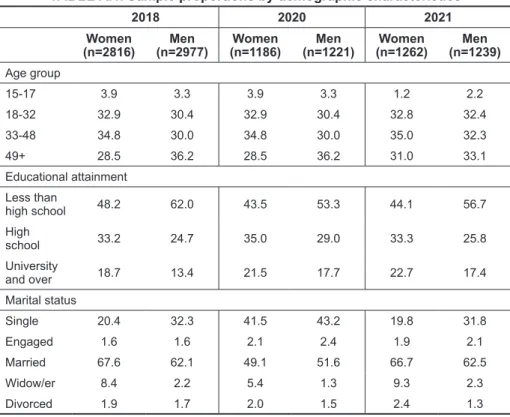
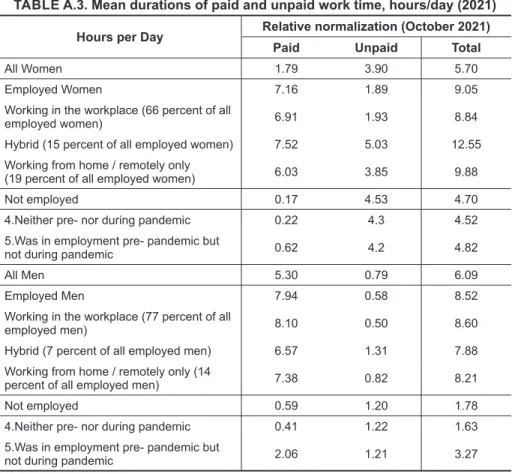
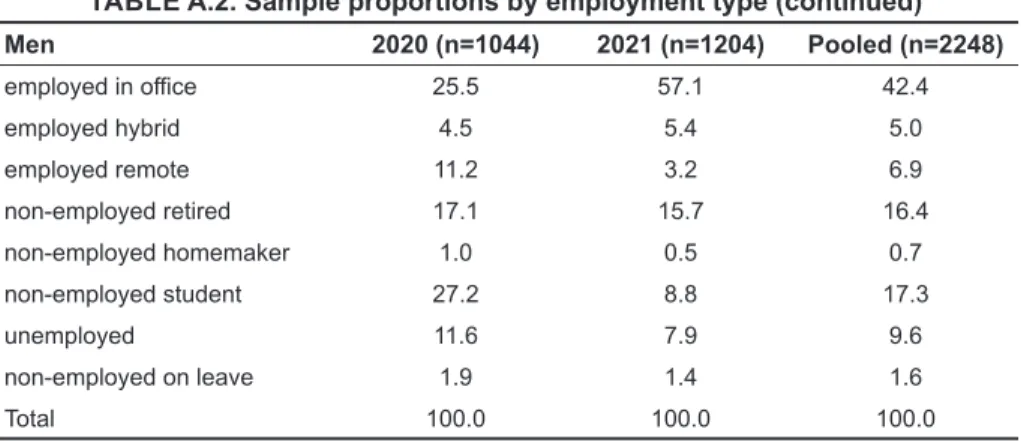
The survey samples included 2,523 randomly selected individuals in October 2021, 2,407 individuals in May 2020, and 5,793 individuals in April 2018. The Annex presents the summary statistics for all three samples based on age groups, education, and household types (Table A1 and A2 in Annex). The respondents were predominantly individuals over 18 years old and living in couple households with children, with three to five co-residents, as is typical in the modal household structure in Turkey.
The rest of the paper is organized as follows: we first explore the changes in average paid, unpaid, and total work time by gender and employment status from the pre-pandemic phase (2018) to the two different phases of the pandemic (the lockdown in 2020 and relative normalization in 2021). We then conduct multivariate regression analysis using pooled and single cross-section data to assess the impact of the pandemic on the time allocation to work by women and men. Because the occurrence of the pandemic and the duration of its different phases are exogenous to individuals and households, the results of our regression analysis can be interpreted as causal.
2.1. Changes in the mean duration of work time of women and men
For our first analysis, to be confident that the observed changes in time use over time are due to behavioral changes in response to the pandemic and not to differences in sample compositions across the three surveys, we adjust for demographic changes. We use two decomposition methods proposed by Aguiar and Hurst [2006] to do so. The first decomposition method estimates the change over time in the mean duration of work time of women and men between two components, using constant weights that are derived from pooling the three rounds of time-use data and computing the percentage of the population that belongs to each demographic cell constructed along three categorical variables, namely, sex (two categories), age group (four categories), and education (three categories).
The result is a 24x1 demographic vector, 𝑊, that contains fixed weights which we use to calculate the weighted means for each activity in each year. The four age categories represent ages 15-17 years, 18-32 years, 33-48 years, and 49 years and over. The three education categories correspond to less than high school education, high school, and more than high school. Specifically, if Tij
t is the 24x1 vector of cell means for activity j in year t, then the demographically-adjusted average time spent in activity j in year t for individual i is 𝑊'Tij
t.
The second decomposition method proposed by Aguiar and Hurst [2006]
involves an econometric estimation which conditions on demographic factors to observe how time spent in a given category changed from 2018 to 2020 and then to 2021, adjusted for demographic changes. Formally, we estimate:
Tij
t = α + β2020 D2020 + β2021 D2021 + γage Ageit + γeduc Educit + εit (1) where Tij
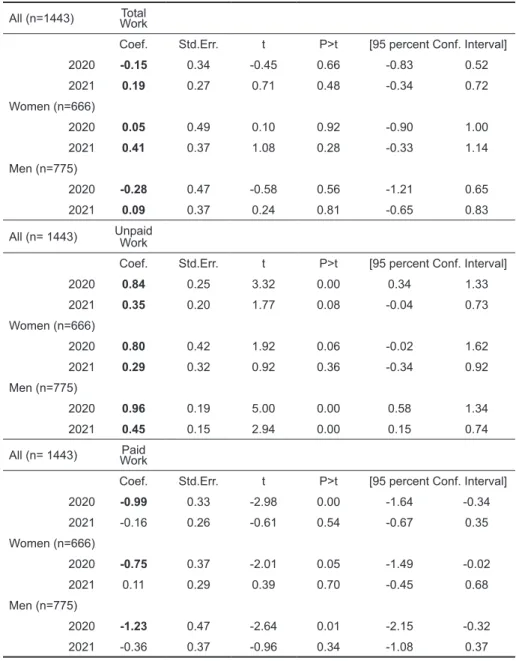
t is the time spent in activity j for individual i in survey t and D2020 and D2021 are year dummies equal to one if individual i participated in a time use survey conducted in year 2020 or 2021. As in the first method, the disaggregation by age groups and education levels yields demographic cells with four age categories and three education categories. The coefficients of the year dummies represent changes over time, isolated from changes in demographic factors. The results from both methods show consistent findings; in the next section, we focus our discussion on the findings from this second method.1
2.2. Impact of the phases of the pandemic on work time
The second part of our analysis assesses the impact of the pandemic at its different phases on paid and unpaid work time of men and women. Because the pandemic might affect individuals and households in different ways, we add control variables such as education, household income, marital status,
1 Consistent findings based on the first method adjusting for demographic weights are presented in the Annex (Figure A1 and Table A5). We mainly focus on the findings of the October 2021 survey, reflecting on whether the effects observed in the early pandemic persisted under the late pandemic period and to what extent.
employment status, and location of employment. We estimate a regression model using two samples of pooled data. First, we pooled all three rounds of survey data from 2018, 2020, and 2021, using year dummies for 2020 and 2021 to obtain pooled estimators for the impact of the lockdown (2020) and partial normalization (2021). Data on location of employment (i.e., remotely, in the workplace, or in hybrid form), a variable of focus for this study, were collected by the pandemic surveys (2020 and 2021) but not in the pre-pandemic survey (2018). Hence, we also conduct a pooled estimation for data from 2020 and 2021 to explore the impact of emerging forms of employment on unpaid work time. Since time data can only be greater than or equal to zero, we use Tobit estimation to analyze changes in time use patterns. Formally, we estimate:
Tij
t = α + β2020 D2020 + β2021 D2021 + γage Ageit + γ'x Xit + εit (2) where Tij
t is the time spent in activity j by individual i in survey t. D2020 and D2021
are year dummies equal to one if the individual i participated in the 2020 or 2021 time-use survey. Ageit is a vector of age group dummies, and Educit is a vector of educational attainment dummies. Xit stands for the demographic, household, and employment status variables, including marital status, whether the household has co-habiting children, the age of children and household income. The equation for estimation is,
yi*
t = β'x Xi + ∈ji (3) where yi*
t is the latent variable representing time allocated to activity j by individual i. Xi is a vector of explanatory variables demographic, household, employment status variables. The Tobit model assumes that there is a latent continuous variable that cannot be observed over its entire range as in time-use data. A large fraction of paid work time for women is zero due to the gender-based division of labor in Turkey which means that the labor force participation rates of married women with small children is quite low. For the same reason, a significant proportion of observations on unpaid work time for men is zero. ꞵj is a vector of parameters and
∈ji is the error term. The observed time allocation (yji) variables are related to the corresponding latent time allocation variables by
yji = yi* t if yi*
t > 0 (4)
Because employment status, which we include as one of the control variables in the time-use equations, is endogenous and thus not independent of the other control variables, its coefficient is likely to be biased.2 In order to address this
2 We first employed an instrumental variable approach to address this endogeneity issue by using regional unemployment rates as instruments for employment status. Disaggregated by sex and age groups, we obtain 194 different regional unemployment rates using data from Turkey’s Household Labour Force Surveys.
The Household Labor Force Survey data is compiled by Turkish Statistics Agency TURKSTAT, the most comprehensive information source on the Turkish labor market. The Wald test showed that the null hypothesis of no endogeneity is rejected.
endogeneity problem, we use Heckman’s two-step model [Heckman 1979] and the double-hurdle model [Cragg 1971] to address both the endogeneity issue and the potential issue that a factor might have different effects on the decision to be employed and on the decision about work hours. The double-hurdle model allows this potential difference and assumes that positive hours of work time are observed only if the individual’s decision passes the two hurdles. To correct for sample selection bias, again we use the regional unemployment rates as instruments for the employment status that varies by age group and gender. In particular, this estimation technique allows us to explore any changes in the impact of demographic variables on unpaid work time, such as education, marital or employment status under lockdown and partial normalization with cross- sectional data, separately for each year (2018, 2020, and 2021).
Empirical studies using pre-pandemic data have found that, under normal circumstances, having higher education and being employed reduces unpaid work time for women, while being married increases it (Ilkkaracan [2012]; Dayioglu [2000]; Ozar and Gunluk-Senesen [1998]). Ilkkaracan and Memiş [2021] find that these within-group differences were eliminated under lockdown with statistically insignificant coefficients for these control variables. We add the cross-section estimation for 2021 to explore whether within-group differences re-emerge under partial normalization, and add controls that signify when remote and hybrid employment arrangements were allowed.
3. Findings
3.1. Gender patterns in time-use during the pandemic
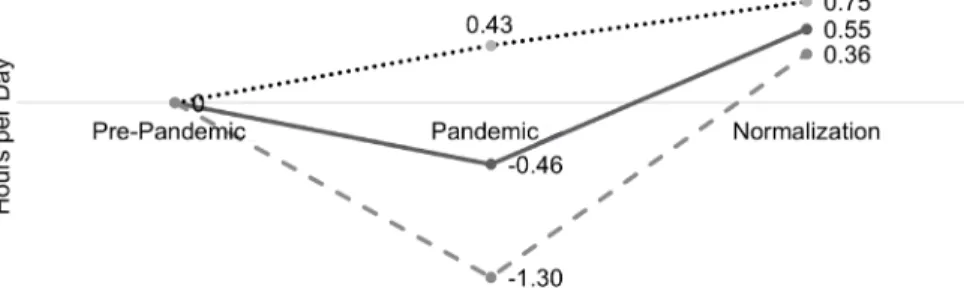
The findings from the two decomposition approaches based on Aguiar and Hurst [2006] show behavioral changes, i.e., how average paid, unpaid, and total work time would change, if the demographic weights were fixed as in 2018. Figures 1-3 show the changes in total, unpaid, and paid work time from the pre-pandemic phase to the early phase of the pandemic with lockdown measures and then to the late pandemic phase with partial normalization. We find that both women and men spend more time in paid and unpaid work combined (Figure 1), (0.75 and 0.36 hours/day, respectively) in the late pandemic phase (October 2021), as compared to the pre-pandemic period of April 2018. For the overall population, the increase in total work time was 0.55 hours/day. Under lockdown (May 2020), by contrast, total work time decreased for men by 1.30 hours/day, and it decreased an average of 0.46 hours/day for the total population. In contrast, at that time there was an increase in total work for employed women of 0.43 hours/day compared to the later phase of near-normalization. This difference was because under the lockdown, the relative decrease in women’s paid work (-0.81 hours/day) was more than offset by a dramatic increase in their unpaid work hours (1.23 hours/day).
The increase in total work reflects the increase in unpaid work to a large extent.
During the late pandemic period, unpaid work remained higher for both men and women compared to the pre-pandemic period, although not to the same extent as under lockdown (Figure 2). In October 2021, women’s and men’s average unpaid work time were longer than during the pre-pandemic period by 0.69 and 0.28 hours per day, respectively. For the total population, an average of 0.53 hours per day more was spent on unpaid work as compared to the pre-pandemic era. These numbers indicate a persistent increase in unpaid work time under partial normalization, though not to the same extent as under lockdown. Under lockdown in May 2020, the increase in unpaid work time was 1.23 hours per day for women and 0.60 hours for men, or almost one more hour per day, on average, for the total population. At that time, paid work time decreased by as much as 1.90 hours per day for employed men and by 0.81 hours per day for employed women, or a decrease of 1.43 hours per day, on average, for the population. After some normalization, however, we observe a recovery toward pre-pandemic levels in paid work time (Figure 3).
FIGURE 2. Change in unpaid work time, conditional on age and education, hours/day FIGURE 1. Change in total work time conditional on age and education, hours/day
3.2. Impact of the pandemic on work
Tables 1-3 show the results for work hours, using the pooled sample from the three surveys, on the impact of the two phases of the pandemic and of the location of work after controlling for a range of individual and household characteristics (age, education, marital and employment status, presence of children and age of children, household income) (Equation 2). The significant and positive coefficients of year dummies on unpaid work time reflect the gender impact of the lockdown period on unpaid work time relative to the pre-pandemic period (Table 1a). Under lockdown, men’s unpaid work time increased by 0.49 hours per day (see the marginal effects), but women’s unpaid work time rose by 0.9 hours per day. With normalization in late pandemic, we again observe a persistently longer duration of unpaid work for both men and women than the pre-pandemic. However, the absolute effect and the gender gap are lower as compared to the lockdown with an increase of 0.14 hours/day for men and 0.52 hours/day for women. The magnitudes of the changes in unpaid work, controlling for the range of variables in Equation 2, are lower than the changes we obtain using the method based on Aguilar and Hurst [2006] as presented in Figure 1 controlling for endogeneity.
We reject the null hypothesis for the correlation between selection and outcome equations for the paid work time (atrho) and total work time estimations, which supports the selection model to be used. However, the test results do not support the unpaid work time selection model.
The negative effect of the lockdown on employment hours of men was stronger (at -0.688) when compared to women (-0.568). Women in employment spent longer hours at work (1.55 hr./day) while no significant change is observed in men’s paid work time. The selection equation presents a negative and significant change in employment of the lockdown at a higher degree for men compared to women. Paid work time, on the other hand, presents a positive change for employed women (0.50 hours/day), unlike its impact on men’s paid work time (-0.57 hours/day). Under partial normalization, we observe that paid work time FIGURE 3. Change in paid work time, conditional on age and education, hours/day
rises for men by 0.87 hours/day relative to its pre-pandemic level while for women, the change is higher at 1.26 hours/day. The selection equation results support a better recovery in men’s jobs; year dummies coefficients in selection equations present a higher positive coefficient for men (by 0.25) when compared to women (by 0.21). Table 1b presents the estimation results using a double- hurdle model.
Table 2 presents estimation results for unpaid, paid, and total work time for women and men, respectively, in the smaller pooled sample (2020 and 2021), this time including also the location of paid work as a control variable. We use remote and hybrid employment as two separate controls against the base of being employed in the workplace. We also have a year dummy for 2021, which shows the change in work time from lockdown to normalization. Women’s remote and/
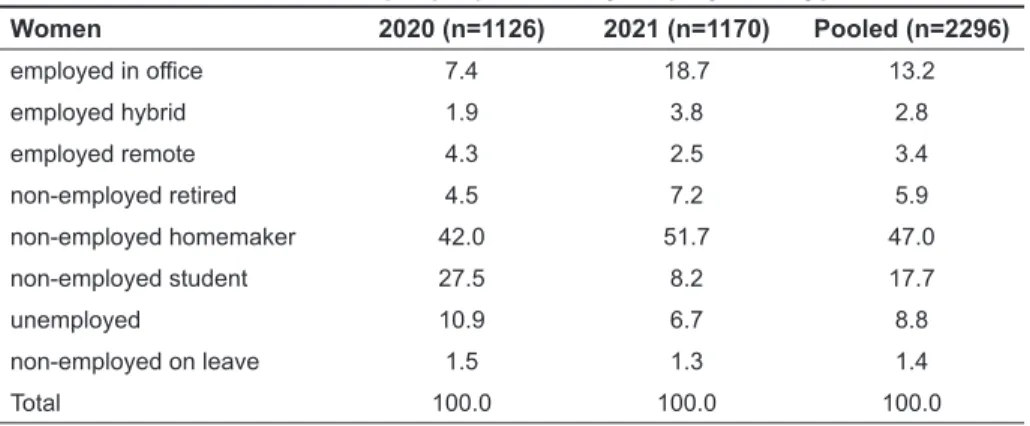
or hybrid paid work decreased from 45 percent in 2020 to 25 percent in 2021, while men’s remote and/or hybrid paid work decreased from 42 percent of employed men in 2020 to 13 percent in 2021 [Ilkkaracan 2022]. When questioned about their preferences, 42 percent of women stated they prefer teleworking, 30 percent stated they prefer hybrid forms (partly teleworking and partly working at the workplace), and 28 percent stated a preference for working at the workplace.
The distribution of preferences for men is 21 percent, 29 percent, and 50 percent, respectively. As expected, women’s preferences for teleworking are higher than men. Yet at the same time, it is striking that almost one in every two men prefers some form of teleworking [Ilkkaracan 2022].
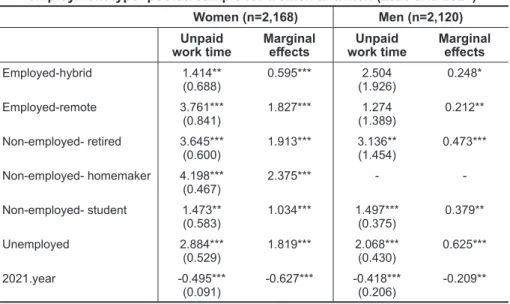
This time we only use the double-hurdle estimation technique as our focus is mainly on unpaid work time. The results in Table 2 indicate that women working from home or remotely spend 1.83 hours/day more on unpaid work than the base group who employed in the workplace. The coefficient for hybrid employment is positive, but we find a lower effect with 0.59 hours/day compared to remote work.
Among the non-employed groups, homemakers spend the most unpaid work time at 2.4 hours/day longer than women working in the workplace. Women’s unpaid work time decreased by 0.63 hours/day under normalization (year dummy 2021) as compared to the lockdown.
109
Coefficients Marginal
effects Selection
equation Coefficients Marginal
effects Selection
equation Coefficients Marginal
effects Selection equation Women (n=5,154)
2020 2.316***
(0.475) 1.21*** -0.572***
(0.0632) 1.555***
(0.482) 0.50 -0.568***
(0.0632) 0.969***
(0.247) 0.900*** -0.577***
(0.0633)
2021 1.406***
(0.333) 1.97*** 0.215***
(0.0599) 0.905***
(0.321) 1.26*** 0.207***
(0.0599) 0.503***
(0.177) 0.526** 0.205***
(0.0601)
athrho -0.468***
(0.120) -0.560***
(0.141) -0.0627
(0.102)
lnsigma 1.527***
(0.0402) 1.509***
(0.0494) 0.855***
(0.0225)
Constant 8.228**
(3.343) -2.755***
(0.336) 8.181**
(3.282) -2.723***
(0.335) 1.184
(1.798) -2.746***
(0.338) Men (n=5,265)
2020 0.357
(0.284) -016 -0.692***
(0.0504) -0.0165
(0.298) -0.57*** -0.688***
(0.0504) 0.494***
(0.0782) 0.488*** -0.690***
(0.0505)
2021 0.853***
(0.202) 1.21*** 0.248***
(0.0561) 0.708***
(0.200) 0.87*** 0.249***
(0.0560) 0.139**
(0.0604) 0.141** 0.251***
(0.0561)
athrho -0.235***
(0.0909) -0.309***
(0.110) -0.0109
(0.0552)
lnsigma 1.502***
(0.0159) 1.500***
(0.0191) 0.293***
(0.0130)
Constant 7.801***
(1.079) -2.322***
(0.200) 7.418***
(1.157) -2.328***
(0.200) 0.940***
(0.283) -2.346***
(0.201) Note: Standard errors in parentheses. ***, **, * denote statistical significance at the one, five, and ten percent levels, respectively. Control variables are age, education, marital status, household size, and household composition variables, categorical variable for income group, existence of children in the household disaggregated by age group region, and the regional unemployment rates by gender and age group as the instrumental variable. The significance of artrho suggests that the null hypothesis of no correlation between error terms of time duration and selection equation is rejected for total work time and paid work time, but not for unpaid work time. Any estimation of work time without controlling for sample selection bias would turn biased results in the case of total work time and paid work time but not for unpaid work time. Lnsigma provides information on the correlation between residuals, suggesting dependence between the time duration and selection equations.
Ilkkaracan & Memiş: Impact of the pandemic on gender patterns of paid and unpaid work TABLE 1b. Estimation results for daily work time, by gender, using a double-hurdle model: samples for 2018, 2020 and 2021
Total work time Paid work Time Unpaid work time
Coefficients Marginal
effects Selection
equation Coefficients Marginal
effects Selection
equation Coefficients Marginal
effects Selection equation Women (n=5,154)
2020 1.286***
(0.208) 0.969*** 0.257***
(0.065) 0.835**
(0.397) -0.500*** -0.663***
(0.062) 1.173***
(0.195) 1.325*** 0.623***
(0.062)
2021 1.097***
(0.218) 0.757*** 0.138*
(0.074) 0.166
(0.298) -0.059 -0.097*
(0.057) 1.075***
(0.226) 0.642*** 0.164**
(0.188) Men (n=5,265)
2020 -0.889***
(0.206) -0.347** -0.113**
(0.051) -0.087
(0.246) -1.02*** -0.615***
(0.051) 1.888**
(0.873) 0.536** 0.519***
(0.047)
2021 0.372**
(0.194) 0.571*** 0.246***
(0.064) 0.361
(0.200) 0.240* 0.024
(0.059) 0.051*
(0.846) 0.229* 0.318***
(0.052) Note: Standard errors in parentheses. ***, **, * denote statistical significance at the one, five, and ten percent levels, respectively. Control variables are age, education, marital status, household size, and household composition variables, categorical variable for income group, existence of children in the household disaggregated by age groups region and the regional unemployment rates by gender and age groups as the instrumental variable.
TABLE 2. Double-hurdle estimation results of work time by gender and employment type: pooled sample for women and men (2020 and 2021)
Women (n=2,168) Men (n=2,120) Unpaid
work time Marginal
effects Unpaid
work time Marginal effects
Employed-hybrid 1.414**
(0.688) 0.595*** 2.504
(1.926) 0.248*
Employed-remote 3.761***
(0.841) 1.827*** 1.274
(1.389) 0.212**
Non-employed- retired 3.645***
(0.600) 1.913*** 3.136**
(1.454) 0.473***
Non-employed- homemaker 4.198***
(0.467) 2.375*** - -
Non-employed- student 1.473**
(0.583) 1.034*** 1.497***
(0.375) 0.379**
Unemployed 2.884***
(0.529) 1.819*** 2.068***
(0.430) 0.625***
2021.year -0.495***
(0.091) -0.627*** -0.418***
(0.206) -0.209**
Note: Standard errors in parentheses. ***, **, * denote statistical significance at the one, five, and ten percent levels, respectively. Control variables are age, education, marital status, household size, and household composition variables, categorical variable for income group, existence of children in the household disaggregated by age group, region, and the regional unemployment rates by gender and age group as the instrumental variable.
Table 2 also presents the estimation results for men in the smaller pooled sample (2020 and 2021). Compared to the base group of those employed at the workplace, men working from home or remotely spend an additional 0.21 hours/day on unpaid work, and men working in hybrid jobs, an additional 0.25 hours/day. The positive impact of remote/hybrid work on men’s unpaid work time is smaller than that observed for women, but this is still substantial in relative terms to men’s average unpaid work time. On a weekly basis (five days a week), men working remotely or hybrid spend one hour to 1.2 hours per week more time on unpaid work than men working in the workplace. Among the non-employed groups, unemployed men spend around three hours longer per week than those employed in their workplace, while students spend almost two hours more and the retired spend 2.5 hours more per week. We also find a statistically significant decline in men’s unpaid work time under normalization (year dummy 2021) as compared to the lockdown period even though it is low at around one hour per week; this is more evidence that men’s increased participation in unpaid work during the lockdown does not persist into the late pandemic period of partial normalization.
Table 3 shows cross-sectional estimation results separately for each year (2018, 2020, and 2021). Confirming our previous results in Ilkkaracan and Memiş [2021], the coefficients on education continue to remain statistically insignificant under partial normalization (2021) as they did for the lockdown period.
The cross-section for the pre-pandemic (2018), however, reveals that women with higher education spend less time on unpaid work (consistent with other studies using pre-pandemic time-use data) than their counterparts with lower education. Married women consistently spend more time on unpaid work than non-married women in all three time periods. The association between being employed and unpaid work time for women changed from being negative pre- pandemic to positive and statistically insignificant under lockdown. Under partial normalization in 2021, being employed at the workplace or in hybrid form is once again negatively associated with women’s unpaid work time, while the coefficient on remote employment is positive and insignificant. Even with the lockdown measures lifted, the within-group differences among women by education and employment status in unpaid work time seem to be less pronounced than in the pre-pandemic period (see Tables A4 and A3 and Figure A1 in Annex).
The cross-section estimation results for men show the positive influence of higher education on unpaid work time during the pre-pandemic period, with university graduates doing more unpaid work than their less educated counterparts. This relationship faded under lockdown, and persists under partial normalization. In the pre-pandemic period, employed men also spent substantially less time on unpaid work, but this effect also dissipated under lockdown. Under partial normalization, the pre-pandemic pattern has reappeared for men employed in the workplace, but not for men who are working remotely or hybrid; we see no relative negative influence on unpaid work time as compared to their non- employed counterparts.
Finally, the survey data on attitudes towards policies on care provision and work-life balance show an overwhelmingly positive support.3 The policy questions were posed under five headings: provisioning of daycare centers for children by local and central governments; measures to keep these services intact under extraordinary circumstances such as the pandemic; legal regulations for employed parents to take childcare leave when necessary; such legal provisions for childcare leave should be equally accessible for fathers and mothers; provisioning of home- based care services and also daycare services (through active living centers) for elderly and disabled by local and central governments.
About four-fifths (83 percent) of the respondents supported the statement that “Quality nurseries and kindergartens should be provided to all families with children,” whereas 17 percent did not. A lower percent of respondents (59 percent) agreed with the statement, “Nurseries and kindergartens should remain open by taking necessary precautions in extraordinary situations such as the pandemic.”
The relatively lower support for the latter statement can be ascribed to concerns about contagion risk [Ilkkaracan 2022].
3 See Ilkkaracan [2022] for detailed results.
113 TABLE 3. Double-hurdle estimation results of work time by gender and employment type: cross-sectional samples
(2018, 2020, and 2021)
Dependent variable:
Daily unpaid work time
2021 2020 2018
Women Men Women Men Women Men
Amount Selection Amount Selection Amount Selection Amount Selection Amount Selection Amount Selection Educational attainment (Base: Less than high school)
High School 0.224
(0.393) -0.006
(0.125) -2.479
(1.541) 0.054
(0.097) 0.00460
(0.346) 0.210
(0.180) 0.010
(0.830) 0.210*
(0.108) -0.611*
(0.312) -0.111
(0.0730) -2.094
(2.816) -0.026 (0.067) University -0.506
(0.694) -0.054
(0.148) -3.357
(2.376) 0.017
(0.112) -0.0456
(0.436) 0.533**
(0.218) 1.428
(1.041) 0.287**
(0.123) -0.961**
(0.482) -0.0369
(0.0971) -0.708
(1.547) 0.240***
(0.079) Marital Status (Base: Single)
Married 1.349
(0.838) 0.924***
(0.150) 1.503
(2.088) 0.086
(0.143) 3.159***
(0.545) 1.240***
(0.221) 0.658
(1.298) 0.301*
(0.175) 2.425***
(0.516) 0.853***
(0.0969) 0.707
(1.718) 0.114 (0.103) Separated/
Widow(er) 0.232
(0.986) 0.163
(0.202) 2.385
(2.559) 0.248
(0.243) 1.517***
(0.565) 0.037
(0.220) 3.028
(1.900) 0.019
(0.222) 1.683***
(0.580) 0.554***
(0.111) -1.802
(2.576) 0.094 (0.128) Employment Status (Base: Non-employed)
Employed in
workplace 0.137***
(0.020) 0.086***
(0.019) -2.370***
(0.496) -0.869***
(0.159) -2.015***
(0.704) -0.377***
(0.103) -2.782***
(0.372) -0.551***
(0.070) -0.208
(1.155) -0.266***
(0.064) Employed
hybrid 0.827
(1.017) 5.474*
(3.233) Employed
remote 5.935***
(1.260) -0.694
(2.313)
A majority (87 percent) of survey respondents supported the statement that “It should be made legal for employed parents to take leave for childcare, when necessary,”
and 80 percent supported the egalitarian approach of “Facilitating childcare practices of employed parents should include not only mothers but also fathers.”
There was overwhelming support (94 percent) for the statement that “Public institutions and municipalities should provide home care services for the elderly, disabled and sick.” Similarly, the statement “Public institutions and municipalities should provide care services for the elderly and disabled through day centers (such as active living centers, community centers)” was supported by 91 percent of the respondents.
We analyze the scores on these six propositions on a scale from one to five (with five being very true, and one very false), and find that the average scores of men and women are largely similar. Of these six propositions, men and women differ most on, “Facilitating childcare practices of employed parents should include not only mothers but also fathers.” However, even on this issue, support is very high with 4.22 out of five for women and 4.12 for men, a negligible difference [KONDA 2022].
There is no comparable pre-pandemic data on public attitudes towards similar policies. Hence, it is not possible to determine the extent to which support for the care economy and work-life balance policies was impacted by the pandemic conditions. However, it is possible that the overwhelming support for these policies, from all segments of men and women, can be partially attributed to an enhanced awareness of the importance of access to care which was triggered by the pandemic.
4. Conclusions
Summarizing our main findings, under partial normalization in the late pandemic period, the unpaid work time for women and men remains higher than during the pre-pandemic period, but less than under the lockdown period. The persistent increase is more than double for women than for men (at 0.63 hours/
day for women versus 0.30 hours/day for men). Paid work time, however, returned to pre-pandemic levels and even at slightly higher levels for employed men than before the pandemic. The combined paid and unpaid work time for women and men are higher (0.77 hours/day and 0.65 hours/day, respectively) under some normalization. However, the increase for women is due more to a change in unpaid work, while for men the increase is due to equal increases in unpaid and paid work time.
Overall, in the post-lockdown phase, there has been a return to the workplace as the location of employment, but some teleworking and hybrid work have remained. A substantial share of employed women (25 percent) and a non- negligible share of employed men (13 percent) are still working under these flexible arrangements. Many more, however, would prefer fully remote or hybrid forms of employment—72 percent of women and 49 percent of men.