A Publication of
Central Philippine University
Iloilo City, Philippines
S o u th e a s t A sia J o u rn a l
CONTENTS Vol. 8, No. 2 1974-1975
Faculty Research
1 CPU College Freshmen’s Reasons for Taking the Course They Are Pursuing
Elma S. Herradura
8 Social Conscience Orientation of C.P.U. Students Macario B. Ruiz
Abstracts
16 A Study of Filipino Adolescent’s Reactions to Their Readings Norma P. Jayme
18 A Study of Certain Common Errors in English Sentence Structure as Influenced by the Hiligaynon
Bianca S. Sobrejuanite
23 Case Studies on Fifteen High School Underachievers Sr. Therese Immaculate Koottiyaniyil, R.A.
28 A Study of the Status of Science Teaching in the Intermediate Grades in the District of Roxas City
Lilia Barbasa
35 A Survey of Types of Organization and Decision-Making in Business Establishments in Iloilo City
Rodolfo Gumabong Special Contribution
37 Revolution Since 1776: Is the American Experience a Model for Developing Areas?
Chester L. Hunt Index to Volumes 1—8
Cover design by Genaro Diesto, Jr.
Reasons for Taking the Course They Are Pursuing
Elma S. Herradura *
What factors influence Filipino young men and women’s choice of their college courses? In order to shed some light on this question, a survey was made of the reasons of the college freshmen o f Central Philippine University of the school year 1973—1974. The reasons for the choice of one’s college course were elicited as part of a question
naire survey that was conducted among the freshmen of six colleges of the University; namely College of Arts and Sciences, Agriculture, Commerce, Education, Engineering, and Nursing. The freshmen were asked to complete the completion-
type item, “ I decided to take the course I am taking now because . . .”
Out of a total of 1,5.29 enrolled as
“freshmen,” 1,197 participated in the survey. Only 1,192 fully ac
complished questionnaires could be included in the analysis o f the data.
Each o f the college groups was divided into the younger and older sub-groups. The younger students consisted of those who were born in 1955 and later; the older res
pondents included those born in 1954 and earlier. Each age sub
group was sub-divided into two—
those who belong to the low socio- economic group (from now on to be
*Dr. Elma S. Herradura is Dean, School of Graduate Studies, Central Philippine University.
2
referred to as the low SES sub
group) and those who belong to the high socio-economic group (from now on to be called the high SES sub-group.) The low SES sub-group was composed o f students who got scores of 10.5 and less; the high SES sub-group made up of stu
dents who got scores o f 11.0 and higher, in the Socio-Economic Scale.
Thirty questionnaires were randomly chosen for the purpose of establishing the categories that were used in the content analysis of the freshmen’s responses. At first, twelve categories we re established.
The mutual exclusiveness and ex
haustiveness o f the twelve categories were further tested as the researcher content-analyzed more papers. One -category “ the course is in demand”
was eliminated because it soon be
came evident that the respondents emphasized different things when they described a course as being “in demand,” depending on what was emphasized by the respondent, his response was classified under either o f two other categories. Two other categories were eliminated for a similar reason. A fourth was ex
cluded when it became evident that there were not enough responses to warrant its being treated a separate category.
Each o f the remaining eight categories was defined in terms of an anchor statement or phrase and in terms o f typical statements tal
lied under the category. In order to check on the reliability o f the cate
gorization of the responses, the two members o f the Social Science Re
search Unit o f CPU were asked to make an independent content ana
lysis o f the responses of the Nursing and Agriculture students. A clerk then checked on the correspond
ence between the researcher’s cate
gorization and that o f the inde
pendent content analysis. It was found that there was one hundred per cent correspondence between the two content analyses. This was probably because the two Social Science Unit researchers were using the detailed definitions o f the cate
gories that had been set up. A one- hundred per cent correspondence might not have been obtained on all the questionnaires. However, a very high percentage of correspond
ence could be safely presumed.
In the analysis o f data, it was found necessary to obtain scores for various categories of responses, rather than frequencies o f mention, for the various reasons:
Most respondents gave more than one reason for their choice of
a college course. Below the stimu
lus-phrase “ I decided to take the course I am taking now because was written “ You may write your other reasons below, if you had more than one reason.”
This was done because the try-out studies showed that even when the students were asked only for one reason, the majority of them gave more than one, a fact clearly in
dicated that in most cases the stu
dent or his parent had more than one reason for their decision. If additional reasons had not been solicited, there would have been no way of knowing, which respondents had really only one reason and which ones gave only one reason simply because they were the type who follow instructions carefully.
Since it was not easy to ignore the additional responses, it was decided to give all the respondents equal opportunity to give more than one reason, if they wanted to. In the final survey, the desire to give more than one answer was shown by the student’s writing more than one answer on the space provided for the first reason. This indicated that even if their reasons had not been solicited, they would have given multiple reasons, anyway.
Since it was cumbersome to deal with three frequencies for each
category, it was decided to score each by giving a weight of 2 to the first-mentioned response and 1 to each additional reasons. Reasons after the third one were arbitrarily ignored.
FINDINGS
The three high ranking reasons for choosing a college course were the same for boys and girls, both when they were taken as whole groups and as age or SES sub
groups. However, only the first- ranking of these three reasons (suit
ability to the respondents abilities, personality, e tc .) was given first by all sub-groups, except the high SES sub-group of boys who ranked this only second. This finding shows that even when students and/
or their elders considered other important factors in choosing a college course, the primary con
sideration was the student’s interest in the work, his aptitude and in
clination for it and the feeling that he can intellectually cope with the course work. This interest or in
clination was commonly expressed in phrases like “ I enjoy working with people” (given by social work students), “ It has always been my ambition to be a ”, “I
4
want to know more ab o u t_______
(a particular kind of work is men
tioned) and I am sure I will succeed as a _ _ _ _ _ Under “ suitability to the respondent’s abilities, apti
tudes, personality” are included only those responses that clearly indicate the respondent’s own in
clination, interest, or desire. Res
ponses like “My parents (or other elders) and I chose this course” and
“I like this course. My parents like it too,” were tallied under influence or urging of elders.” The arbitrary deci
sion to so classify such responses was made with cognizance o f the fact that the choice could have been primarily been made by the student in view o f his own inclina
tion, abilities, and personality and was only endorsed by the elders for the same reason. Despite this, it was decided to categorize such re
plies under “elders’ influence” be
cause the mention of the parents’
concurrence with the choice in
dicated that the child considered important his parents’ opinion on the matter.
The next two most popular reasons o f boys and girls were given different ranks by the two groups.
The girls ranked economic consider
ations only third; this was the boys’
second choice. Altruism, the third
choice of the boys, was the girls’
second choice.
Among the boys, only the high SES sub-group did not rank second “ economic consideration.”
Respondents whose replies were tal
lied under this category generally looked upon the college education on the whole, not necessarily the particular course they had chosen, as an avenue to economic security or at least to the improvement of the economic lot of the respondent and his family.
The sub-groups o f girls un
animously chose altruism second.
Responses talked under altruism emphasized human welfare, service to God, fellowmen, community and country.
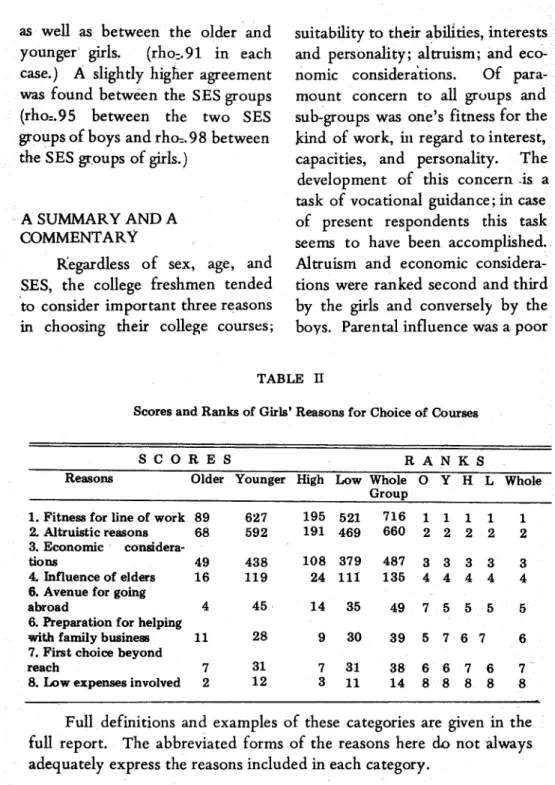
The reason that ranked fourth in importance as a determinant of the boys’ and girls’ choice of a career is the influence of elders. However, the figures in Tables I and II show that among both the boys and girls, it was a poor fourth. All the sub
groups of girls ranked this fourth, but the older and low SES sub
groups of boys ranked this sixth and fifth. Taken as a whole group, the boys gave this category fourth rank.
Among the girls, the first four reasons were given the same ranks
by the various age and SES sub
groups.
The other four reasons in
cluded in the analysis obtained low score's. It may be worth noting that
“ the course chosen being in line with the family’s business” was a close fifth to “elders’ influence” in the case of the boys’ “ Family business” was also ranked fifth by the girls. The last three reasons, viz., “ the course is second only to the first choice which could not be
pursued for reasons,” “desire to go abroad,” and “it is an inexpensive course” got negligible scores among the boys as well as among the girls.
Each of these last four reasons got about the same ranks among the various sub-groups o f boys and girls.
A rho of .91 was found between the boys’ and girls’ reasons, signify
ing substantial agreement between the two sex groups. The same extent o f agreement was found bet
ween the older and younger boys
TABLE I
Scores and Ranks of Boys’ Reasons for Choice o f Courses S c o r e s
Reasons Older Younger High Low Whole Group
Ranks Whole O Y H L
1. Fitness for line of w ork (as to interest, inclination, intellectual abilities, per
sonality) 75 212 64 223 287 1 1 2 1 1
2. Economic considera
tions (security, improve
ment of one’s lot) 74 153 74 153 227 2 2 1 2 2
3. Altruistic reasons 34 107 40 101 141 3 3 3 3 3
4. Influence o f elders 6 59 20 45 65 6 4 4 5 4
5. Preparation for helping
with family business 10 51 14 47 61 5 5 5 4 5
6. First choice beyond
reach 11 10 4 17 21 4 6 6 6 6
7. Avenue for going
abroad 3 5 2 6 8 7 7 7 7 7
8. Low expenses involved 0 3 0 3 3 8 8 8 8 8
Full definitions and examples of these categories are given in the full report. The concise forms of the responses given above do not al
ways adequately express the reasons included in each category.
6
as well as between the older and younger girls. (rho=.91 in each case.) A slightly higher agreement was found between the SES groups (rho=.95 between the two SES groups of boys and rho=.98 between the SES groups of girls.)
A SUMMARY AND A COMMENTARY
Regardless o f sex, age, and SES, the college freshmen tended to consider important three reasons in choosing their college courses;
suitability to their abilities, interests and personality; altruism; and eco
nomic considerations. Of para
mount concern to all groups and sub-groups was one’s fitness for the kind of work, in regard to interest, capacities, and personality. The development of this concern is a task of vocational guidance; in case of present respondents this task seems to have been accomplished.
Altruism and economic considera
tions were ranked second and third by the girls and conversely by the boys. Parental influence was a poor
TABLE II
Scores and Ranks of Girls’ Reasons for Choice o f Courses
S C O R E S R A N K S
Reasons Older Younger High Low Whole Group
O Y H L Whole 1. Fitness for line of work 89 627 195 521 716 1 1 1 1 1
2. Altruistic reasons 68 592 191 469 660 2 2 2 2 2
3. Economic considera
tions 49 438 108 379 487 3 3 3 3 3
4. Influence of elders 16 119 24 111 135 4 4 4 4 4
6. Avenue for going
abroad 4 45 14 35 49 7 5 5 5 5
6. Preparation for helping
with family business 11 28 9 30 39 5 7 6 7 6
7. First choice beyond
reach 7 31 7 31 38 6 6 7 6 7
8. Low expenses involved 2 12 3 11 14 8 8 8 8 8
Full definitions and examples of these categories are given in the full report. The abbreviated forms of the reasons here do not always adequately express the reasons included in each category.
fourth choice; this influence was reported by a greater proportion of the boys than of the girls. The latter fact seems contrary to the common belief that girls heed their parents’ wishes more than the boys do.
That the girls gave slightly more importance to altruism than economic considerations, and that the boys did conversely, are not surprising. These findings seem to indicate the boys’ anticipation of their role as bread winners. Heads- to-be o f families naturally would be concerned with completing a col
lege course which promises greater capacity for securing economic ade
quacy and stability. In a content analysis o f adolescent high school boys and girls’ compositions (in General Santos, Cotabato), de la Cru z 1 found that the boys had significantly more frequently made mention o f materialistic or economic concerns than did girls.
The greater concern of the girls with humanitarian and altruistic considerations gives further support for the belief championed by Ashley Montagu, that the female is the more humane of the sexes. “Wom
en are the carriers of the true spirit of humanity — the love of
the mother for her child.” 2 Frank3 society, the family can still serve as the primary source of goals and standards while the adolescent shifts from a dependent to an independent role. If Frank’s statement is valid, this finding implies that the Philip
pines, the Western Visayas (where most o f CPU freshmen come from) to be more accurate, is not exactly tradition-bound but is a society in which traditions still play some part. “Parental influence” would probably have scored higher if this were a tradition-bound society. □
1 Juanita de la Cruz, “ Likes and Dislikes (about Adults of Filipino Adolescents” (un
published Master’s Thesis, Central Philippine University, Iloilo City, 1972)
2Ashley Montagu, The Natural Superiority o f Women (New York: MacMillan Company, 1953).
3K. Frank, “ The Adolescent and the Fam ily,” “Adolescence Forty-Third Yearbook, NSEE, (Chicago: University of Chicago Press, 1944), p.240.
Social Conscience Orientation of C.P.U. Students *
Macario B. Ruiz
This study is one o f a series o f investigations on the attitudes o f Central Philippine University stu
dents in pursuance o f one o f the objectives of the University Research Center to undertake institutional research. 1 This study aimed to investigate the moral concern o f students about perceived social ills or what might be termed insti
tutional wrongdoings. What, for instance, would their reaction or feeling be if they knew that one o f their classmates is a “drug addict”
or is “spending money for cigarettes but won’t even buy their notebooks for school work? ”
It is to be noted that commit
ment to an enlightened social con
science is one o f the objectives o f the general education program o f the University. 2 It is therefore planned to use the findings in these investigations as benchmark inform
ation against which to compare value changes in the students after
a two-year period.
PROCEDURE
The procedure followed in this investigation is similar to the one in a previous report. 3 In fact, the data for this study were gathered from the same sample and the same questionnaire.
*
This is the nin th of a series of Institutional Studies being conducted by the Research Center under Dr. Ruiz’s direction.
1 See Research Bulletins No. 6, 1974, No. 1, 1975, No. 2, 1975, fo r studies on students’ attitudes and environmental perceptions.
2 See “ Objectives of Central Philippine University,” Section 1.6.
3
See Research Bulletin No. 1, s. 1975, ibid.
The instrument. Part II o f the research instrument consists of thirty statements of the Likert type, with four foils from which the res
pondent was asked to select one.
These thirty items attempt to assess the student’s religious orientation, social concern, and social con
science. Only the findings on social conscience are presented in this report.
One item is given below for purposes o f explanation o f the design o f the foils:
“If you knew a classmate here who is a drug addict, what would you most likely do? ”
(a) Nothing; I wouldn’t be disturbed. None o f my busi
ness.
(b) I would be disturbed but do nothing.
(c) I would be disturbed but whether I took action would depend on who the student was.
(d) I would express my con
cern only to the student, maybe advise him to stop it or see a doctor.
Attention is invited to the way the foils are worded. Foil a des
cribes an attitude o f indifference
or apathy; Foil b describes a dis
turbed feeling, concern, but no action is taken; Foil c and Foil d also show the same orientation as the first two in that there is a
“scaling” pattern to assess the degree of disturbance or concern and a possible course of action. This design has been followed in all the ten items which make up the inven
tory wherever it was possible. In all cases, though, the scaling pattern was maintained.
Reliability and validity of the inventory. Based on the item responses o f 175 or more students chosen by systematic sampling de
sign from the seven college groups (except Theology where all the 18 respondents were included), the reliability coefficient4 was .93.
A combination o f different methods o f validation was used.
(a) It was hypothesized that if the inventory discriminated cer
tain groups o f known social con
science orientation he and those with somewhat lower social con
science, the inventory, for one thing, should be valid. The Theo
logy group, whom we assumed to belong to the first, did better in the inventory in a “ try-out” compu
tation than a random sample from
4The coefficient alpha as developed by Cronback, L.J., “ Coefficient Alpha and Internal Consistency of Tests,” in Psychometrika, 1951. was used.
10
all the other six groups. The difference between the means of these two trial groups was 3.62 in favor o f the former. The critical ratio was 6.2, which indicated that the difference was significant at the one per cent level. The weakness of this method is that the assump
tion about the superiority o f the Theology group is open to question.
(b) It was assumed that this inventory would correlate rather highly with the social concern in
ventory on the theory that both had a fairly good similarity of orientation and content. The ob
tained coefficient o f correlation was .69. This, o f course, was an ad hoc method, since the research versions o f the two inventories were used.
(c) It was assumed that the inventory had validity if there was agreement in the rankings o f the items based on weighted group scores o f the seven colleges repre
sented, it would be assumed that the inventory had validity as a group measure. The Kendall “W” 5 was .74, which is very high and signifi
cant at the 1 per cent level.
(d) Finally, the item/scale correlations o f the items were com
puted. The findings were:
Item 2 ...93
Item 5 ...79
Item 8 ...83
Item 11 . ...42
Item 14 . . . .46
Item 1 7 ...39
Item 20 . . . .0 (?)
Item 2 3 ...64
Item 26 . . . .54
Item 2 9 ...67 W The coefficient alpha as developed by Cronback, L.J., “ Co
efficient Alpha and Internal Con
sistency o f Tests,” in Psychometrika, 1951, was used.
Item 20, obviously is a poor item. It should be replaced or revised in a future version o f this instrument. We included this item in the scoring o f figures in the paper. On the whole, however, it can be said that for purposes o f this study, the inventory was suffi
ciently valid and reliable.
Description of the inventory.
As mentioned in Section 2.1, the inventory is o f the Likert type.
Some o f the “ themes” tapped are about cheating, gambling by juve
niles, exploitation o f labor, poverty, irresponsible use o f leisure time, etc. High scores in the inventory
5
John J. Peatman, Introduction to Applied Statistics, Over seas edition. New York:
Harper and Row, 1964, pp. 382 — 385.
indicate that the respondents ex
press concern about these themes, while low scores imply that the respondents are apathetic, undis
turbed, or detached about the matter.
Scoring. The foils in each of the ten items were given arbitrary weights, as follows:
Foil a . . . 1 Foil b . . . 2 Foil c . . . 3 Foil d . . . 4 If a respondent marked Foil d, his score for that item was 4; if he marked Foil a, his item score was 1.
His total scale score was the sum of all the item scores. Thus, if he marked all Foils d in every one o f the ten items, his scale score would be 40, which is the highest possible
score. If he marked Foils a in every one o f the ten items, his scale score was 10, which is the lowest possible score.
Determination of “high” or
“low” scores. Since the means and standard deviations o f the instru
ment in social concern (6) and this one are particularly the same (M = 31.2 and 31.1, SDs = 4.36 and 4.25 respectively) and th e SEm of both were the same, the model for categorizing the scores used in the former was adopted here.
The reader is referred to Research Bulletin No. 2, s. 1975 for an explanation o f the rationale of the model.
Class Interval Description o f Categories
3 7 - 4 0 Very, very high
33 - 36 Very high
2 9 - 3 2 High
27 - 28 Uncertain
23 - 26 Low
19 - 22 Very low
15 - 18 Very, very low
14 — below Extremely low
6 See Research Bulletin No. 2, s. 1975.
12
FINDINGS
The findings are presented in two sub-sections.
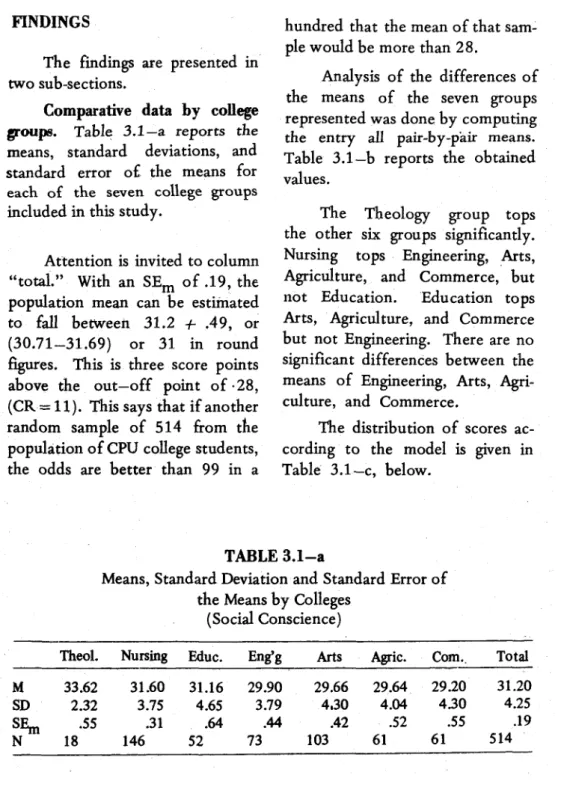
Comparative data by college groups. Table 3.1—a reports the means, standard deviations, and standard error o£ the means for each o f the seven college groups included in this study.
Attention is invited to column
“ total.” With an SEm o f .19, the population mean can be estimated to fall between 31.2 + .49, or (30.71—31.69) or 31 in round figures. This is three score points above the out—off point o f 28, (CR = 11). This says that if another random sample o f 514 from the population o f CPU college students, the odds are better than 99 in a
hundred that the mean o f that sam
ple would be more than 28.
Analysis o f the differences o f the means o f the seven groups represented was done by computing the entry all pair-by-pair means.
Table 3.1—b reports the obtained values.
The Theology group tops the other six groups significantly.
Nursing tops Engineering, Arts, Agriculture, and Commerce, but not Education. Education tops Arts, Agriculture, and Commerce but not Engineering. There are no significant differences between the means o f Engineering, Arts, Agri
culture, and Commerce.
The distribution o f scores ac
cording to the model is given in Table 3.1—c, below.
TABLE 3.1—a
Means, Standard Deviation and Standard Error o f the Means by Colleges
(Social Conscience)
Theol. Nursing Educ. Eng’g Arts Agric. Com. Total
M 33.62 31.60 31.16 29.90 29.66 29.64 29.20 31.20
SD 2.32 3.75 4.65 3.79 4.30 4.04 4.30 4.25
SEm .55 .31 .64 .44 .42 .52 .55 .19
N 18 146 52 73 103 61 61 514
TABLE 3 .1 -b
Matrix o f Critical Ratios of Differences o f Means
(Social Conscience)
Theol. Nursing Educ. Eng’g Arts Agric. Com.
Theol. X 3.2 2.92 5.7 5.2 5.2 5.7
Nursing X .61 3.2 3.7 3.3 4.0
Educ. X 1.8 2.0 2.82 3.28
Eng’g X .8 .4 1.0
Arts X .03 .7
Agric. X .6
Com. X
Note: Critical ratio of at least 1.96 and 2.58 are necessary for the difference to be significant at the 5 per cent and 1 per cent level of significance respectively. Differences between means can be abstracted from Table 3.1—a.
TABLE 3.1—c
Distribution of Scores According to the Model N = 514
Scores Categories No. % Sub-tot.
No. Sub-tot.
%
37-40 Very, very high 53 10.28
33-36 Very high 166 32.20
29-32 High 158 30.65
Sub-Total 380 73.15
27-28 Uncertain 65 12.61 65 12.61
23-26 Low 55 10.67
19-22 Very Low 17 3.30
15-18 Very, very Low 0 -
14-below Extremely Low 0 -
Sub—total 72 13.97
Total 514 99.71 514 99.71
14
Seventy-three per cent o f the sample come within the “high to very, very high” categories, whereas only 14 per cent come within the
“low to very, very low” categories.
These facts should confirm the observation made earlier in this sub
section that the obtained mean is significantly higher than the cut- off point o f 28.
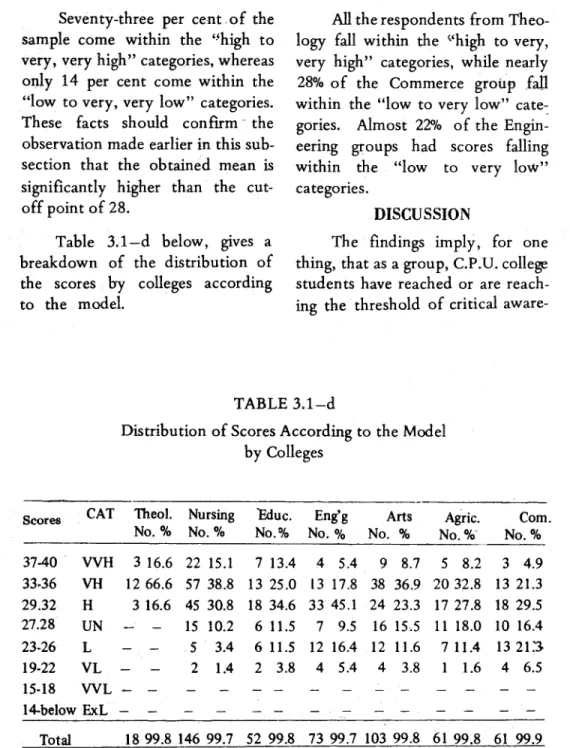
Table 3.1—d below, gives a breakdown of the distribution of the scores by colleges according to the model.
All the respondents from Theo
logy fall within the "high to very, very high" categories, while nearly 28% o f the Commerce group fall within the “low to very low” cate
gories. Almost 22% o f the Engin
eering groups had scores falling within the “low to very low”
categories.
DISCUSSION
The findings imply, for one thing, that as a group, C.P.U. college students have reached or are reach
ing the threshold o f critical aware-
TABLE 3.1—d
Distribution of Scores According to the Model by Colleges
Scores CAT Theol. Nursing Educ. Eng’g Arts Agric. Com No. % No. % No.% No. % No. % No. %: No . % 37-40 VVH 3 16.6 22 15.1 7 13.4 4 5.4 9 8.7 5 8.2 3 4.9 33-36 VH 12 66.6 57 38.8 13 25.0 13 17.8 38 36.9 20 32.8 13 21.3 29.32 H 3 16.6 45 30.8 18 34.6 33 45.1 24 23.3 17 27.8 18 29.5 27.28 UN — — 15 10.2 6 11.5 7 9.5 16 15.5 11 18.0 10 16.4 23-26 L — — 5 3.4 6 11.5 12 16.4 12 11.6 7 11.4 13 21.3
19-22 VL — - 2 1.4 2 3.8 4 5.4 4 3.8 1 1.6 4 6.5
15-18 VVL -
14-below ExL -
Total 18 99.8 146 99.7 52 99.8 73 99.7 103 99.8 61 99.8 61 99.9
ness - awareness o f the ills o f the social order, as well as its virtues.
This is another way o f saying that they are developing an enlightened conscience, which, by the way, is one o f the objectives o f our general education program. They are, in a manner o f speaking, ready for change. The potentialities for posi
tive social and individual action are there. What remains for us to do is to externalize that enlightened conscience from the level o f “ pure thought” to that o f positive action.
Just how?
The problem, we like to think, is not really change itself, for whether we do anything about it or not, change is most certainly going on. The problem is the management o f change. And change management, in turn, requires a good deal o f understanding o f insti
tutions and how people behave in them.
Then we might add that sud
den imposed change may be more harmful than beneficial. We are not referring to sudden change in the area o f quantitative measurable change like the physical environ
ment, buildings, facilities, and the like. We are speaking o f imposed
sudden change in the realm o f the moral, spiritual, or attitudinal.
We might select one concern perceived to be a hindrance to individual or social development, say the maximization o f the use o f personal resources. The selection o f this concern is, o f course, the outcome o f a dialogue between the teacher and the students. The less we talk about our positions in the philosophy o f change the better — whether society should first be changed and society will change the individual, or whether we should change the individual first and society will change accordingly.
This might result in the polarization o f people into opposing camps, and will, eventually have nothing to do with each other.
Both positions are necessary.
They complement each other. The strategy, maybe, is to focus on inner-directed change, acceptance o f the need for change at the grass
roots level. The next phase o f this suggested strategy is to create and/
or provide the supporting structures by means o f which the individual student is given the opportunities to externalize the needed change over time. □
A Study of Filipino Adolescent’s Reactions to Their Readings *
Norma P. Jayme
This study is concerned with the fourth level o f reading. It was the purpose of this study to find the influence of reading on the concepts, attitudes, and behaviour of Filipino adolescents.
A modified critical-incident technique was used as the basis for collecting the data. The aim of the technique was to obtain self-observa
tion of internal behavior of students.
Students were asked specifically how books, stories, poems, and articles had affected their atti
tudes, ideas and behavior. The ma
jor instrument used was the question
naire, and the information gathered was supplemented and validated by interviews and further validated by case studies.
The subjects were 396 junior and senior students in both public
and private schools in the city of Iloilo. In this study, three schools were chosen; namely, a private Ro
man Catholic school, a private Prot
estant school, and a public seconda
ry school.
The data gathered from the questionnaires were transmuted to percentages to make values parallel and hence meaningful. Types of literature considered influential, the types of influence, the general types of readings, and the situation in which reading was done were each correlated with sex and age, res
pectively. The chi-square and the significance o f the difference bet
ween two percentages were used in determining the degree of related
ness between any two o f the factors cited above.
*
Abstract of a Master’s Thesis done at Central Philippine University, Iloilo City, Philippines.
A random sampling of thirty students from the original 396 were interviewed. Students whose inter
view responses showed extreme pat
terns of high and low influence were selected for case studies. There were twelve students selected for case studies: six from the high influence group and six from the low influence group according to the criteria set up by the investigator.
Other kinds of information to round out the case studies were taken from the guidance counselor’s records, teachers’ ratings and records, and cumulative records.
The findings from the question
naire, interviews and case studies revealed the following;
1. That adolescent in general were most influenced by short stories.
2. That the event of the story, the personality of the characters and the usefulness of the ideas in per
sonal life were the parts of the stories that influenced the students the most.
3. That there were changes in concepts, attitudes and behavior of the adolescents as a result of their readings.
4. That the adolescents as read
ers tend to be observers, participa
tors, and synthesizers in that order.
5. That the adolescents were most influenced in the following areas: philosophy o f life and self- image.
6. That these adolescents were influenced more by voluntary read
ing than specifically assigned read
ing.
7. That the adolescents were influenced more by works of ima
gination than works o f fact.
8. T h a t adolescents were highly influenced by their readings, but such influence was not related to sex.
9. That adolescents were in
fluenced more on the positive side than on the negative side.
On the basis o f the findings, the following recommendations were offered:
1. Teachers put more emphasis on the use of the reading program for the development of character values.
2. Introspective reports might be used by teachers to ascertain the kind of reading materials that in
fluence their students.
3. Teachers and librarians in
form their students that there are other materials in the libraries that are as interesting as novels and short stories.
(Continued on page 22)
A Study of Certain Common Errors in English Sentence Structure as Influenced by the Hiligaynon *
Blanca S. Sobrejuanite
A number o f studies have been done to determine the influence of the native language o f a student on his study o f a foreign language. The data yielded from those investiga
tions have been o f much help to the teachers, the supervisors, the textbook writers, and other re
searchers.
The grammatical structures of the native language have indeed been found to have influence, either to interfere with the learning of categories in the target language or to facilitate it. The second-language learner’s first language is, therefore, of. interest to his language teacher.
Structures of the foreign language which are similar in mean
ing and distribution and formation to some structure in the native
language will be easy to learn be
cause old learning can be trans
ferred. Some structures are dif
ficult because they require the second-language learner to change his old habits, or to reorganize his old habits under a new system.
The results o f the investiga
tions have given rise to more fruit
ful methods o f teaching English as a second language. If the English teacher is aware of the trouble spots the students will have in their oral and written work, he will be guided well in the preparation o f his lessons and in his choice of devices or techniques to be em
ployed. Conversant with the “ do’s”
and “ don’t ’s” o f effective language teaching, the English teacher will have more success in his teaching.
*
An abstract of a Master’s Thesis done a t Central Philippine University, Iloilo City, Philippines.
This study was an attem pt to pinpoint the trouble spots in English noun-head modifications which were due to the interference o f the native language, to classify them, to obtain some indication of the mag
nitude and persistence of these errors, and to establish the hierarchy of difficulty of these structures.
METHODOLOGY
Since the student’s original written work is a good indicator of how much learning has taken place, the written compositions of 800 students from five grade levels, Grade VI to the Fourth Year in high school, served as the corpus of this study. The compositions were selected at random (one out of three) from 2,402 compositions col
lected from six schools.
Then these compositions were grouped and analyzed by grade levels. During the running tally of the errors, emerging patterns of types o f errors in noun-head modifi
cations were noted. Then the errors were classified into cate
gories. Later, some types were reclassified into sub-types. With the errors properly listed and grouped, a frequency count o f the occurrence in each year was taken.
The percentage equivalent of each
error in relation to the total number of errors was taken for each grade level to derive some measure o f the magnitude of the difficulty for each grade and its persistence through the years.
As the third step, a count o f both the correct and the incorrect usages under each category found in the compositions o f the fourth year cases was done to determine the success of teaching at the end o f the period of study. Then the per
centage equivalent o f the wrong usages in relation to the correct usages was solved for each category.
The rank of difficulty of the errors was then determined in terms of the relative mastery o f each struc
ture as revealed by these percent
ages. Another frequency count was taken, this time in terms of the students committing the error, in order to nullify the effect of length in composition work. The error had to be committed twice by a student before he was considered as one who had not mastered that structure and be tallied as a “ case in error.”
The percentage equivalent in rela
tion to the total number of cases was computed to show the ranking difficulty o f the errors with this new perspective. All the tables were then studied and interpreted.
20
The fourth procedure was a contrastive study o f comparable English and Hiligaynon sentences.
The correct English versions o f the sentences used as “ key” for each error type under study was given to a native informant to translate into Hiligaynon. An analysis of the structuring o f the correct English sentence, the incorrect English sentence, and their Hiligaynon gloss was undertaken. Comparison re
vealed which types of errors were caused by the interference of the native language.
FINDINGS
The gross count of the fre
quency o f errors and the count of the number o f cases committing each error pointed out the relative difficulty o f each type of error in five grade levels. The types of errors in the first half of the rank
ing lists were the same for both.
Of special interest is the consistency of the ranking o f the difficulty in the use of articles, the observance of number agreement between noun
phrase markers and the noun head, and the construction of modifying clauses, which were first, second, and sixth, respectively, in both.
The types o f errors which were committed more frequently by the fourth year students are those more
advanced students should be ex
pected to commit when they are trying to express themselves more freely, but the great persistence of the error in the use of the genitive should be a cause for much concern because it is a basic structure. The two other basic structures which have not been mastered even after ten years, as shown by a percentage equivalent that is still high, are the use of articles and number agree
ment. These types of errors are due to the influence of the Hiligaynon.
Error in the use o f pronominal modifiers, which is another basic structure, is also due to the inter
ference o f the native language. The word-for-word translations o f the dialect result in the use of irrelevant expressions, error in position of modifiers, error in word order, error in clause constructions, and error in expression of comparison. When one concept in Hiligaynon equals several concepts in English, errors in choice o f vocabulary and word building occur. It has been shown that the eleven types of errors were caused by the interference of Hili
gaynon.
CONCLUSIONS
Much o f the difficulty in learn
ing a second language is due to
interference from the native lan
guage o f the learners. The interfer
ence found by this study arises from the following differences in the sig
nalling systems involved:
1. One concept in one language is split into several concepts in another;
2. A relatively free word order is translated into a relatively fixed word order;
3. Obligatory word orders which are similar in meaning are opposite in arrangement;
4. The same concept is sig
nalled by different morphological processes.
RECOMMENDATIONS
Here are a few recommenda
tions based on the findings o f this study;
1. Language teachers can im
prove their teaching by always try
ing to spot errors that often occur and making even just an informal contrastive analysis o f the native way o f expressing the communica
tion situation involved and the foreign language way, to see whether any interference in the new learning is due to former speech habits.
2. Since non-mastery o f the basic structures in the early years will compound difficulty later (this
study shows that such errors also tend to be persistent), it is recom
mended that the basic structures be given much emphasis during the early years o f study so that correct use o f such structures as the articles, items with special distribution like
“little” and “few” and the common
“ one o f . . . ” becomes automatic.
3. The child’s loyalty to his native language is a strong impedi
ment in learning; therefore, strong motivations must go with foreign language learning, no matter a t what age.
4. More studies o f the distinc
tive features of Hiligaynon be con
ducted. Researches on the follow
ing are recommended:
a. The System o f Particles — Particles like “sang,” “sa,” “nga,”
etc. interfere with- the learning o f English especially. Although, some indication of how they function is given here, a more definitive description of their distribution and function is need
ed before the full extent o f their influence on the learning o f a second language by a Hiligaynon speaker can be determined.
b. Word Order — Word order in Hiligaynon is optional and it is obligatory in English. These conflicting features provide a reason for an interesting study in
22
this area. Some such questions as these seek answers: How free is Hiligaynon word order?
Among the possibilities, are some preferred to others so as to be considered “ characteristic” of dialect?
c. The Function Words in Hili
gaynon — What are the function words in Hiligaynon? What is their distribution? What structural meanings do they sig
nal? How do they compare with English function words?
5. This study is limited t o errors in the use o f noun-head modifiers. Further studies o f the same nature may be on the modi
fication structure o f the verb and that o f the modifiers themselves.
6. School personnel, including classroom teachers, should study the literature on bilingualism in order to avail themselves o f findings of studies on the effect on the child of the study o f more than one lan
guage. This background should help curriculum makers decide what realistic objectives to set and what accomplishment to expect.
Teachers should be helped by their study in (1) providing the appro
priate background for language study, (2) providing proper motiva
tions for learning, (3) choosing effective aids, (4) knowing what
achievements a language learner can be capable of, (5) deciding on the nature and sequence o f the learning activities.
7. Teachers, English teachers in particular, should know about the basic structures of Hiligaynon.
A teacher’s adequate knowledge of how the native language words is essential to his comparative study of the two languages. □
Filipino Adolescent’s . . . (Continued from page 17)
In addition, the study has pointed the need for further in
vestigation such as:
1. The case study method be used for the study of individual patterns of response.
2. The relationship between reading and other variables, such as socio-economic class and other per
sonality characteristics, if any, be Studied.
3. Negative influence from reading might be further in
vestigated.
4. The relationship o f sex to situation in which reading was done be further studied especially in schools where the males are seg
regated from the females.
5. The relationship between reading and intelligence and reading comprehension be studied. □
School Underachievers *
Sr. Therese Immaculate K oottiyaniyil, R.A.
th is study was undertaken with the purpose of discovering the problems that are related to under- achievement. Through the analysis of many measures and data about each case, the researcher aimed to discover the following:
1. The characteristic patterns of personality traits o f under
achievers.
2. a. The problem areas through the administration of the Mooney Problem Check List, and the speci
fic problems in these areas that are mentioned by the majority o f the underachievers.
2.b. The seriousness o f under
achievers’ problems regarding home and family.
3. The acceptance o f the un
derachievers by their peers.
4. The adequacy of their self- concept.
5. The level o f their academic motivation.
6. Their study habits and at
titudes, and the specific problems, in the SSHA, that are common to the majority o f underachievers.
More specifically, the follow
ing research hypotheses were tested:
Hypothesis 1. There are nega
tive personality traits that are com
mon to the majority of under
achievers.
Hypothesis 2.a. There are problems identified by the use o f Mooney Problem Check List that are common to the majority o f underachievers.
Hypothesis 2.b. The area of home and family is a serious prob
lem area for the majority of the underachievers.
*An abstract o f a Master’s Thesis done a t Central Philippine University, Iloilo City, Philippines.
24
Hypothesis 3. The majority of underachievers is not well-accepted by their peers.
Hypothesis 4. The majority of underachievers does not have ade
quate self-concept.
Hypothesis 5. The majority of underachievers does not have high academic motivation.
Hypothesis 6. The majority o f underachievers does not have good study habits and attitudes. There are problems in this area that are common to the majority of cases.
The subjects of this study were fifteen (nine third year and six fourth year high school) male students o f Central Philippine Uni
versity, in Iloilo City, of the school year 1974-1975. These were stu
dents whose IQ’s were 110 or higher according to Leila Padilla Philippine Self-Administering Test o f Mental Ability. None had a general average o f 86 or above.
The general average o f each student for the previous school year was made the index o f academic achieve
ment. All belonged to the lowest twenty per cent o f their respective sections in academic achievement.
The Sixteen Personality Factor Test, Mooney Problem Checklist, Sociometric Test, Self-Concept in
ventory, Motivation Inventory, Sur
vey o f Study Habits and Attitudes,
Personal Data Form, and Interviews with parents, teachers, and the un
derachievers were the sources of data.
METHODOLOGY
The method used in this study was the case study method o f re
search. Arbitrary qualitative terms were assigned to values or ranks in order to facilitate the interpretation o f different test results. One set of.
qualitative term used in connection with Motivation, Self-Concept, Social Standing, and Study Habits and Attitudes were also translated into “ degree of seriousness” in order to facilitate the presentation of facts expressed in different catego
ries in only one graphic presenta
tion. The results o f the diagnosis of the problems o f each case were presented in the form of an indi
vidual graphic profile and a descrip
tive case study report. Finally, a color-chart was prepared to enable the researcher to see at a glance the problem areas of all fifteen cases, thus enabling her to draw up a profile of underachievers as a group.
FINDINGS
The following were the signi
ficant findings o f this study:
1. The Personality Character
istics of the Underachievers. Ten or more of the fifteen cases had the following personality character
istics: they were somber; had high scholastic mental capacity; had aver
age superego strength; were neither submissive nor dominant; neither relaxed nor tense; they tended to be shy, and self-sufficient. Eight to nine cases were emotionally less stable (affected by feelings), appre
hensive or prone to worry, suspi
cious, and controlled. Among the fifteen cases only one -- a different case at each instance - was trusting, emotionally stable, reserved and casual None was happy-go-lucky, socially bold or venturesome, and none with high ergic tension.
2. Problems Areas. The use of the Mooney Problem Check List showed that the four most common problem areas o f the underachievers were the personal psychological re
lations, the social recreational activi
ties, adjustment to school work, and the social psychological rela
tions. The problems, in these areas, that are common to the majority of cases were: losing their temper;
worrying; daydreaming; being care
less; feeling awkward in meeting people; having trouble in keeping a
conversation going; not spending enough time in study; getting low grades; not being interested in some subjects; and having trouble with Mathematics.
As far as the area home and family was concerned, it was among the least serious problem areas for the majority o f the cases. The single problem in this area that was com
mon to two-thirds o f the cases was
“wanting more freedom at home”.
Six underachievers were identified as having serious problems related
to home and family. The most common problems of these six cases were: “wanting more freedom at home”; “ being treated like a child” ; and “worried about a mem
ber o f the family”.
The Acceptance o f the Un
derachievers by Their Peers. The Sociometric test results showed that the majority o f the cases was not very popular among Their Peers, More specifically, out o f fifteen cases, four were well accepted; six were average; and five were not well accepted. O f these five, two were ignored or rejected by their peers.
4. The Adequacy of Their Self- Concept. The use of the Self-Con
cept Inventory indicated that out of
26
fifteen cases only three had ade
quate self-concepts; six had aver
age self-concepts; and six had in
adequate self-concepts. The majori
ty o f the cases was found to be easily discouraged by failure. The most common problems of the six underachievers who were identified as having inadequate self-concepts were: being easily discouraged by failure; being afraid to recite in class; having to tell lies to impress people; and finding themselves trembling and sweating before they take a test.
5. The Level of Their Academic Motivation. The findings on the Motivation Inventory showed that out of fifteen cases, none had high academic motivation; two had aver
age motivation; three had low moti
vation; and ten had very low moti
vation. The majority of the cases agreed with the statement, in the Motivation Inventory, “Most young people do not want to go to school.” The Education Accept
ance Scale in the SSHA, which also measured the academic motivation, showed that all, except two, had one or more of the following prob
lems: “lack interest in some sub
jects” ; “ lack interest in school work” ; “ made to take subjects I do not like” ; and “ if I do not like a
subject, I believe in doing only enough to get a passing grade.”
6. Their Study Habits and Attitudes. It was found out through the Survey of Study Habits and Attitudes, that although none of the fifteen cases had shown a very poor work method, only three had good study habits and atti
tudes.
The problems, with regard to study habits, that were common to two-thirds or more cases were: not keeping their work for each subject together and carefully arranged in some planned order; not talking it over with the teacher when in trou
ble with their school work; not doing their assignments at school so as to reduce their home work; not completing their home work assign
ments on time; and not studying an hour or more each day outside of school
The majority of underachievers did not make up their missed les
sons without a reminder from the teacher. If the assignments were dull, they did not complete them.
Their place o f study at home was not kept neat and business-like.
They did not keep their assignments up to date by doing them regularly.
The poor study attitudes com
mon to eight or more cases were
the following: “I feel that the tea
chers expect students to do too much studying outside of class” ;
“I believe that the main job of the schools is to teach students the things that will help them earn a living” ; “ My teachers do not make their subjects interesting and mean
ingful to me” ; “I feel that the teachers do not try to give the same amount of attention and help to all their students” ; and “ I feel that I would have studied harder if I were given more freedom to choose sub
jects that I like.”
CONCLUSIONS
Based on the findings of this study, the following hypotheses were sustained: (1) there are nega
tive personality traits that are com
mon to the majority o f cases; (2) there are problems, identified by the use of Mooney Problem Check List, that are common to the major
ity of cases; (3) the majority of cases does not have adequate self- concept; (4) the majority of cases does not have high academic motiv
ation; and (5) the majority of cases does not have good study habits and attitudes.
The hypotheses which were not strongly supported by the find
ings of this study were: (1) the
area home and family is a serious problem area to the majority of the cases, and (2) the majority o f the cases is not well accepted by their peers.
RECOMMENDATIONS
In view of the findings of this study, the following recommenda
tions were made:
1. It is recommended that similar studies should be conducted on the third and fourth year high school students, of the same school, having IQ’s o f 110 or higher on the Leila Padilla Philippine Self- Administering Test of Mental Ability but belong to the highest twenty per cent of their sections in academic achievement. The com
parison of the results of the present study with those of the one proposed will help identify problems characteristic of underachievers and thus help identify factors causing underachievement.
Similar studies should be con
ducted in other schools to find out whether their underachievers have similar problems.
3. More studies should be con
ducted on the relationships bet
ween: (a) interest in the subjects and achievement; (b) attitudes to
ward teachers, and interest in the (Continued on page 43)
A Study of the Status of Science Teaching in the Intermediate Grades in the District of Roxas City *
Lilia Barbasa
For sometime now the Philip
pines has been beset by the prob
lems o f insufficiency and o f econom
ic dependence on other countries.
We need scientific manpower to make us self-sufficient in our staple food, rice, and to make full use of our rich natural resources in order to become economically stable. The school, being the agency that can give us the much needed scientific manpower, must have a good science program. To improve the science program there is a need to reassess the science teaching in order to know its strengths and weaknesses.
The researcher, in her desire to help solve the problem, conducted a study to ascertain the effectiveness of the science teaching in the inter
mediate grades in the District of Roxas City for the school year
1968-1969. The study was con
ducted in the twenty-one out of the twenty-seven elementary schools in the said district with 745 Grade V pupils and 595 Grade VI pupils under forty-five science teachers.
The methods used in the study were questionnaire, checklist, ocular survey, and interv i ew. The mean, the S.D., SEM percentage of error, chi square and coefficient o f reliabi
lity were the statistical tools used.
The Health and Science Test for both grades was made up of one hundred items: twenty-five items of the attitude test, twenty-five items of scientific skills test, and fifty items of understanding and factual test.
The curricular validity of the Grade V and the Grade VI Health and Science Test was evaluated.
*An abstract of a Master’s Thesis done at Central Philippine University, Iloilo City, Philippines.
Each o f the two tests was evaluated by ten persons considered to be knowledgeable in science. The standard set for rating each item of the test is as follows: 5-Very very important; 4-very important; 3-im- portant; 2-fairly important; 1-not important; 0-useless.
Any of the items that was rated not important or useless, was either improved or changed. Not one of the test items of the two tests was rated not important or useless, so not one of the test items was improved or changed. The general average curricular validity of the Grade V and the Grade VI Health and Science Test was 3.875 which falls within the category
“ Important.”
The reliability of the test used in this research was also computed.
The investigator used the split-half method of the Spearman-Brown prophecy formula. Through sys
tematic sampling, two hundred samples were used for each of the Grade V and the Grade VI. As computed, the coefficient o f relia
bility of the Grade V Health and Science Test was + .74 while that of the Grade VI was +.79. T.L. Kelly proposed a minimum r-value of .50 for evaluating group accomplish
ment. Based on this standard, the
reliability of the two tests used in this research was high.
The outcomes of this study are summarized under five topics:
1. Instructional outcomes in the understanding of scientific concepts and the application of scientific processes and attitudes.
2. The science teachers’ special training in science teaching
3. Preparation time of science teachers
4. Instructional materials, aids and guides, library facilities and laboratory provisions
5. Supervisory assistance of science teachers.
Instructional Outcomes in the Un
derstanding of Scientific Concepts and th e Application of Scientific Processes and Attitudes
The sample pupils’ achieve
ments in Science as revealed by the test results were as follows: The population mean of all the Grade V pupils in the schools in the District o f Roxas City was estimated with 99% confidence to fall between 35-36 while that o f the Grade VI pupils with also 99% confidence falls between 40-42. The Grade V pupils had developed properly only two scientific attitudes out of the seven included in the test. Not one of the skills was properly developed