The Thinker The Thinker The Thinker Quarter 1 – 2020 / VOLUME 83
A P A N - A F R I C A N Q U A R T E R L Y F O R T H O U G H T L E A D E R S
SPECIAL EDITION:
African futures and the
Fourth Industrial Revolution
PART 2
EMILE ORMOND ON
THE ETHICAL RISkS OF AI
DU PREEz AND SINHA ON
HIGHER EDUCATION
LEADERSHIP
IN THE ERA OF THE FOURTH
INDUSTRIAL REVOLUTION
Submissions due on 4 May 2020
For further enquiries, please contact the editor, Ronit Frenkel at [email protected]
AFRicA
Open submissions on any aspect
In This Issue
4
The Ghost in the Machine: The Ethical Risks of AI Emile Ormond12
Higher Education Leadership in the Era of the Fourth Industrial Revolution Jaco Du Preez and Saurabh Sinha19
The Impact of the Fourth Industrial Revolution on Education in South Africa M.R. Pather24
The Fourth Industrial Revolution: Another Industrial Revolution Leaving Black Women Behind?Malaika Mahlatsi
29
Political Organising and Mobilising in the Age of the Fourth Industrial Revolution:A Reflection on the Gauteng Young Communist League of South Africa Kgabo Morifi
34
The Fourth Industrial Revolution and Nigeria: A Policy Conundrum and High Stakes for the Future of the African ContinentO.A. Ladimeji
42
Assessing a Common Currency in Africa Anton M. Pillay48
The Fourth Industrial Revolution and the Importance of Disagreement Alex Broadbent53
Googling the US Electoral Cycle, 2004-2016: South African Insights Bhaso Ndzendze58
The Russia-Africa Summit and Economic Forum: An Unprecedented Event in the History of African-Russian RelationsAlexander Mezyaev
65
Mohamed Enver Surty’s In Pursuit of Dignity Hussain SavantT
he University of Johannesburg acquired The Thinker in April 2019 from Dr Essop Pahad. Over the last decade, The Thinker has gained a reputation as a journal that explores Pan-African issues across fields and times. Ronit Frenkel, as the incoming editor, plans on maintaining the pan- African scope of the journal while increasing its coverage into fields such as books, art, literature and popular cultures.The Thinker is a ‘hybrid’ journal, publishing both journalistic pieces with more academic articles and contributors can now opt to have their submissions peer reviewed. We welcome Africa-centred articles from diverse perspectives, in order to enrich both knowledge of the continent and of issues impacting the continent.
Prof Ronit Frenkel
CONTRIBUTORS TO THIS EDITION –
All contributing analysts write in their personal capacityProfessor Alex Broadbent is the Director of the institute for the Future of Knowledge at the University of Johannesburg. Alex holds a B1 rating from the National Research Foundation of South Africa (2019-2025) and is an alumnus of the South African Young Academy of Sciences.
Alex is a philosopher of science, medicine and epidemiology, with particular interests in causal inference, explanation, and prediction, including the evolution of these abilities in humans and their implementation in machines. Alex was a founding figure in establishing philosophy of epidemiology, and is a leading philosopher of medicine globally.
Alex has published three monographs, the most recent being Philosophy of Medicine (2019, Oxford University Press) and around 25 journal articles.
Leila Hall is a Lesotho-born writer, editor and teacher currently studying towards a PhD in the Department of English at UJ. She has had journalism and fiction published on a range of websites, including cNN international, The Huffington Post, True Africa and The Kalahari Review. Her current writing and research interests focus on expressions of LGBTQi+ identity and experience in contemporary African fiction. She is currently the assistant editor of The Thinker.
Jaco du Preez received his BEng. (Electronic Engineering) and BEng. Hons. (Electronic Engineering) from the University of Pretoria in 2014 and 2015, respectively. He has authored two textbook-style manuscripts on Millimeter-Wave
Antennas (2016) and Power Amplifiers (2017) in addition to various other articles and op-eds in collaboration with the University of Johannesburg.
He currently works as a Design Engineer at Etion Create (Pty) Ltd., where he has been since 2017 designing and validating hardware and software for a variety of processing cards targeted at industrial and defence applications.
Malaika Mahlatsi is a Masters candidate in the Department of Geography at Rhodes University and the bestselling author of the critically acclaimed Memoirs of a Born Free: Reflections on the Rainbow Nation (Jacana, 2014).
Professor Alexander Mezyaev is Head of the Department of international Law, Law Faculty, University of Management TiSBi, Russia. He is also a Visiting Professor at the University of Johannesburg (SARcHi African Diplomacy and Foreign Policy South Africa), as well as Editor-in- chief of the Kazan Journal of international Law and international Relations.
Kgabo Morifi is a PhD candidate in the Department of Public Administration at the Tshwane University of Technology and the Gauteng Provincial Secretary of the Young communist League of South Africa (YcLSA).
Bhaso Ndzendze is a Lecturer in Political Dynamics in international Relations in the Department of Politics and international Relations
at the University of Johannesburg, as well as Research Director for the centre for Africa-china Studies at the University of Johannesburg.
Emile Ormond is an analyst and risk specialist with more than 14 years experience in the international relations environment. He holds an MBA from Unisa’s Graduate School of Business Leadership and is a doctoral candidate focusing on business ethics’ risks of artificial intelligence in developing markets.
Dr Magas R. Pather is a Senior Lecturer in the Department of Languages cultural Studies and Applied Linguistics (LancSAL) Faculty of Humanities - University of Johannesburg. He teaches Business communication and English skills and was the HOD of the Department of Applied communicative Skills on all four campuses.
Prior to this he held the post of Deputy Director in the Department of Basic Education –South Africa after being a school principal in various schools with diverse population groups. He has published book chapters with Learning in Higher Education (LiHE) - Denmark, presented papers at local and international fora and recently at Yunnan University - Kunming in china. in March 2019, he successfully led a group of students from Humanities to participate in a collaborative research symposium at Shandong Normal University – china. He was awarded the Erasmus Grant and has established strong academic ties with Babes Bolyai University in cluj Romania.
Anton M. Pillay is a student of Prof chris Landsberg; South African Research chair in African Diplomacy and Foreign Policy (SARChl).
Anton’s research interests include African politics, Decolonial thought, and War & Peace. Anton is based at the center for Academic Development (CAD) at the Vaal University of Technology (VUT).
Hussain Savant is a full-time writer who lives in Johannesburg. He has spent most of his life in the corporate world in the financial and transport sectors respectively. He holds an Honours degree in Philosophy from the University of Johannesburg.
Prof Saurabh Sinha obtained his B.Eng, M.Eng, and Ph.D. degrees in Electronic Engineering from the University of Pretoria. As an established
researcher, rated by the National Research Foundation, he has authored or co-authored over 120 publications in peer-reviewed journals, books and at international conferences. On 1 October 2013, Prof Sinha was appointed as Executive Dean of the Faculty of Engineering and the Built Environment at the University of Johannesburg (UJ). As of 1 Dec.
2017, Prof Sinha is the UJ Deputy Vice-Chancellor:
Research and internationalisation. Prof Sinha served the 2014-2015 iEEE Board of Director and as iEEE Vice-President: Educational Activities.
The Journal for Progressive Thought
www.thethinker.co.za Publisher English Department
University of Johannesburg Kingsway campus,
Auckland Park, Johannesburg Tel:+27 11 559 2553
Editor Prof Ronit Frenkel [email protected]
Design & Art Direction Liesel van der Schyf [email protected]
Tel:+27 82 336 7537
Advisory Council Dr Ademola Araoye (Nigeria), Professor Puleng
Lenka Bula (South Africa), Dr Faisal Devji (Tanzania), Professor chris Landsberg (South Africa), Professor Tshilidzi Marwala (South Africa), Professor Sabelo
J Ndlovu-Gatsheni (Zimbabwe), Dr Morley Nkosi (South Africa), Dr Francis Onditi (Kenya)
Professor Eghosa E Osaghae (Nigeria), Dr Mzulcisi Qobo (South Africa), Dr Garth le Pere (South Africa), Professor Alioune Sall (Senegal), Addai Sebo (Ghana), Dr Mongane Serote (South Africa), Professor Mammo
Muchie (Ethiopia).
Material in this publication may not be reproduced in any form without proper citation. Views and opinions expressed in
The Thinker are not necessarily those of University of Johannesburg. They can accept no liability of whatsoever
nature arising out of or in connection with the contents of the publication.
© 2020 University of Johannesburg www.thethinker.co.za
The Thinker
The Thinker
The Thinker
A P A N A F R I C A N Q U A R T E R L Y F O R T H O U G H T L E A D E R SA
group of eminent scientists, including the late physicist Stephen Hawking, notoriously claimed that: “Success in creating artificial intelligence (Ai) would be the biggest event in human history. Unfortunately, it might also be the last" (Hawkings et al., 2014). Remarks such as these often conjure up dystopian visions of killer robots enslaving humanity, or the redundancy of flesh-and-bone beings in a digitally sentient world.Either way, such notions distort Ai’s contemporary and subtle threats. Artificial intelligence may pose substantial long-term risks, but an existential threat is preceded by an ethical one – risk resides not only in the future but also in the present. Like their global peers, African policymakers need to consider the ethical challenges of Ai. if they fail to do so, the continent is more likely to be a victim than a victor of the technologies underlying the so-called Fourth industrial Revolution (4iR).
in this article, i will provide an introduction to Ai and its impact, with a brief exploration of Ai’s
major ethical themes, along with a more detailed discussion of machine bias. i will then outline some of the measures that governments and other stakeholders are taking towards Ai-ethics. Finally, i will conclude with some suggestions for how African stakeholders can strengthen Ai's ethical governance.
A Brave New Digital World
Artificial intelligence is a key component of the 4IR – the latter defined as a merging of technologies that blur the lines between the physical, digital and biological spheres – building on the digitally-driven Third industrial Revolution (Schwab, 2016). Until recently, the digital revolution has relied on human beings to create software and analyse data, but recent advances in Ai have recast this process (Kissinger, Schmidt and Huttenlocher, 2019). Experts argue that Ai is best understood as a ubiquitous, general purpose technology – similar to electricity – that stretches over multiple By Emile Ormond
THE GHOST IN THE MACHINE
©Shutterstock.com
The Ethical Risks of AI
domains (Burgess, 2018). That is, AI (and its most popular subset, machine learning) is potentially applicable to any area that currently requires human cognition.
The reach of the 4iR, and Ai in particular, is foreseen to stretch across the globe and eventually affect all sectors and professions (Schwab, 2016).
current notable examples of Ai include Apple and Amazon's voice-operated personal assistants, Facebook and Twitter’s personalised news feeds, and Google and Tesla's autonomous-driving vehicles (Marr, 2018). Outside of the technology sector, AI is used by firms for recruitment and performance management, by insurance companies to set rates, by banks to adjudicate loans and by health practitioners for diagnoses (Ananny, 2017; Easen, 2018). The use of AI is not limited to the tertiary sector; it can also be used in the primary sector – for instance, in the management of cattle herds in South Africa (Gavaza, 2019).
Studies have claimed that Ai could serve as a catalyst for wide-spread economic growth due to, inter alia, productivity gains and spin-off industries.
Globally, Ai technology could stimulate a doubling of growth rates (Schoeman et al., 2017). Pundits predict that Ai will see a strong uptake within Africa in coming years (Hao, 2019; Snow, 2019).
in South Africa, the use of Ai technologies could result in a two-fold increase in economic growth and boost company profitability by an average of 38% by 2035 (Schoeman et al., 2017).
For now, however, Ai’s use remains relatively nascent in Africa. A 2019 study in South Africa found that only 13% of corporates currently use AI technology; of the rest, 21% plan to do so within the next 12-24 months (Goldstuck, 2019). Furthermore, 99% indicated that they understand the benefit of Ai and will need to use it at some point in the future (Smith, 2019).
Clear and Present Danger
“The real problem is not whether machines think but whether men do.” – B.F. Skinner (psychologist, philosopher)
While Ai has tremendous potential, it also presents significant challenges for organisations
and authorities, particularly in the realm of ethics.
Many African states are still grappling with the moral, social and economic consequences of the Second and Third industrial Revolutions (Knott- Craig, 2018; Oosthuizen, 2019), and the gravity of this situation is exacerbated by policymakers who lack an understanding of Ai technology and its vast potential impact (Stone et al., 2016; Royakkers et al., 2018).
Artificial intelligence has already played a central role in many prominent cases of ethical failure.
A widely-known example is that of cambridge Analytica, a data analytics firm that used machine learning, fuelled by illicitly gathered social media data, to influence US voters in the 2016 presidential election (Cadwalladr and Graham-Harrison, 2018).
Another example is the cOMPAS system, which is used by US courts to help assess the likelihood of a defendant becoming a recidivist. The system was found to systematically discriminate against non-white racial groups (Angwin et al., 2016).
There are multiple less-publicised and more subtle examples that illustrate how ethical shortcomings in Ai can be harmful to individuals and organisations, including infringements on laws and legal rights (Campolo et al., 2017; Fagella, 2018; Whittake et al., 2018; Larsson et al., 2019;
Tufecki, 2019).
After an extensive review of relevant literature , I identified six key areas related to AI’s near-term potential ethical impacts on the social world.
These six areas can be divided into three non- mutually exclusive tranches. The first is related to risk inherent to the nature of Ai (accountability, bias and transparency), the second links to the
I reviewed major academic databases, such as Ebscohost, using the following search string, adapted from Larsson et al. (2019): ‘("artificial intelligence" OR
"machine learning" OR "deep learning" OR "autonomous systems" OR "pattern recognition" OR "image recognition" OR "natural language processing" OR
"robotics" OR "image analytics" OR "big data" OR "data mining" OR "computer vision" OR "predictive analytics") AND ("ethic*" OR "moral*" OR "normative"
OR "legal*" OR "machine bias" OR "algorithmic governance" OR "social norm*" OR "accountability" OR "social bias")’. The date range was 1 January 2015 to 30 July 2019.
Experts argue that AI is best understood as a ubiquitous, general
purpose technology – similar to electricity – that stretches over multiple
domains (Burgess, 2018). That is, AI (and its most popular subset, machine
learning) is potentially applicable to any area that currently requires
human cognition.
real or perceived consequences of Ai (autonomy and socio-economic risk), and the final tranche is related to the potential maleficent use of AI. These risks are not limited to Ai, as they are also present to a lesser or greater degree in ancillary fields such as data science (Marivate and Moorosi, 2018).
i have not included the ethical aspects of data management – ownership, consent and privacy – as these may be exacerbated by Ai, but would be present even without it (Taddeo and Floridi, 2018).
Firstly, accountability relates to the intrinsic purpose of Ai, which is to recreate aspects of human intelligence. consequently, Ai challenges the traditional moral and jurisprudence paradigms that assign agency exclusively to human beings (Davey, 2017; Tegmark, 2018). Secondly, AI – especially if fuelled through machine learning
¬– has also been accused of perpetuating socio- economic bias through outputs (e.g. through recommendations and decisions) that are based on biased data (Anderson, 2018; Larsson et al., 2019). Thirdly, due to Ai’s complex algorithm, transparency is compromised by the so-called
“black box” phenomena – where the output of the system is unknown to even the system’s designers or administrators (Etzioni and Etzioni, 2016;
Pavaloiu and Klose, 2017).
Fourthly, human self-determination is threatened by increasingly ubiquitous Ai systems that openly, but often inconspicuously, shape people’s choices and actions (Taddeo and Floridi, 2018). This includes, for instance, the search engine algorithm that determines what results one sees.
Fifthly, there have been predictions that the wide- scale adoption of Ai will disrupt the global labour market and result in large-scale job losses and the entrenchment of inequality (Bossman, 2016;
Miailhe and Hodes, 2017; Green, 2018). Lastly, like most other technology, Ai can be abused by a range of legitimate and illegitimate actors. For instance, in the recent past, Ai has been used to distort information for political ends (Jurkiewicz, 2018).
While each of the aforementioned issues is fertile ground for much deeper discussion, i will now focus on discussing the issue of bias, which is especially concerning within the African context.
Discriminating Machines
Bias in computer systems can be described as systematic and unfair discrimination against certain individuals or groups (Donovan et al., 2018;
Smith and Neupane, 2018). In other words, bias deepens and entrenches existing social inequality and results in AI’s benefits being unequally spread amongst different groups across and within countries (Stone et al., 2016; Kaye, 2018).
it is important to understand that data is the food that Ai algorithms feast upon. The availability of large data sets is a key prerequisite of most forms of Ai. The problem, however, is that data collection mostly occurs in the West and in china, while there is a data shortage in Africa (Microsoft, 2018; Marwala, 2019). The result is that the bulk of collected data does not accurately reflect the African experience, which means that many algorithms may not be properly tailored to the characteristics of local populations (Mahomed, 2018). An example of this Table 1. Near-Term Ethical Challenges of AI
Tranche 1 – Intrinsic
1. Accountability it is unclear who is
accountable for the outputs of Ai.
2. Bias Shortcomings of algorithms and/or data entrench and exacerbate bias.
3. Transparency Ai systems operate as a
“black box”, with little ability to understand or verify outputs.
Tranche 2 – Consequence
4. Autonomy Loss of autonomy in human decision-making, deference and acceptance of Ai systems to make decisions affecting humans.
5. Socio-Economic Risks
Ai will result in job losses, and will entrench/
exacerbate income and resource inequality.
Tranche 3 – Utilisation
6. Maleficence Ai can be used by illicit actors for nefarious purposes, including by criminals, terrorists and repressive state machinery.
Source: Author’s own
problem can be seen in image recognition software that struggles to identify human faces with dark tones or erroneously labels black people as gorillas (Ananny and Crawford, 2018).
Bias in Ai systems can take multiple forms but can be divided into system- and data-level bias (Anderson, 2018; Kaye, 2018; Larsson et al., 2019).
System-level bias is present in several conditions.
Firstly, it occurs when developers allow Ai systems to confuse correlation with causation (Anderson, 2018) – for example, if a system determines a low- income earner’s credit score by using the scores of his or her friends. The individual, who may otherwise be in a good financial position, would receive an undesirable score simply because his associates have credit issues. Secondly, system- level bias can occur if the system includes parameters for known proxies (Anderson, 2018;
Pasquale, 2018) – for instance, education, income and area of residence are common proxies for race, especially in South Africa, a country with a socio-economic legacy of segregation. Lastly, at a structural level, the creators select which applications get developed and what features these applications will have (Smith and Neupane, 2018; Larsson et al., 2019). In other words, AI systems are not neutral or impartial systems, but rather are inadvertently value-laden products of those who created them (Campolo et al., 2017).
As data scientist cathy O’Neil pointedly put it:
“Algorithms are opinions embedded in code”
(2017).
Data-level bias also presents itself in several related ways. Firstly, any bias present in historical data, which is used to identify patterns, is merely reproduced in the output (Kirkpatrick, 2016;
Microsoft, 2018). For instance, a system advising on university admissions, which is trained on historical data, will make recommendations related to the university’s alumni (Anderson, 2018). Secondly, bias
can occur when the input data is not representative of the target population (Anderson, 2018). For instance, when facial recognition software, which was trained primarily with a data set of caucasians, is used to recognise faces of various races (Pasquale, 2018). Thirdly, bias often presents itself when data is poorly selected (Anderson, 2018) – for instance, if a navigation application only provides directions for a motor vehicle and fails to include other options such as public transport and walking, which are options likely to be used by lower-income groups.
Lastly, there is the danger of bias when data is outdated, incomplete or incorrect. it follows that the output of a system will be inaccurate if input data is not current, comprehensive and accurate (IBE, 2018; Smith and Neupane, 2018).
The impact of bias in Ai systems is exacerbated by the fact that they are often used with the goal of balancing or correcting bias in the decisions made by humans (Donovan et al., 2018). Moreover, people generally have a misplaced confidence that digital systems operate fairly and in an unbiased manner (Smith and Neupane, 2018; Larsson et al., 2019).
Often people are not even aware that bias has taken place, given that Ai systems run as a silent background process (Noble, 2018). The reality, however, is that many systems codify existing biases or inadvertently introduce new ones (Donovan et al., 2018).
it is worth pointing out that bias is not always problematic; in fact, there are situations were one may want to encourage “legitimate bias”
in a system’s output. An example of this would be an Ai hiring recommendation system that is calibrated to promote affirmative action. It could be argued that such bias is fair and socially desirable. However, these are normative concepts that need to be clearly defined by the parameters of the system and require consensus for what this practically entails, as programming social values is problematic due to their abstract nature (coeckelbergh, 2019; Roff, 2019). The salient point is that Ai is a product of human design and data, and therefore is not immune to the underlying – and often biased – values, beliefs and practices of the social world.
Where Angels Fear to Tread
“The danger is not that computers will begin to think like men, but that men will begin to think like
It is important to understand that data is the food that AI algorithms feast upon.
The availability of large data sets is a key prerequisite of most forms of AI. The problem, however, is that data collection
mostly occurs in the West and in China, while there is a data shortage in Africa
(Microsoft, 2018; Marwala, 2019).
computers.” – Sydney J. Harris (journalist, author) Encouragingly, there appears to be a growing awareness of the ethical challenges presented by Ai. Measures to address these include calls for adopting a multidisciplinary approach to Ai, establishing an international legal regime and governments crafting strategic plans that address ethical issues.
There is an appeal at an overarching level for the AI fraternity to broaden its influence and considerations beyond its computer science and statistics origins in order to understand the technology’s ethical facets (Agrafioti, 2018). The appeal is that Ai needs to be approached and researched in a multidisciplinary manner, which will allow for a better holistic understanding and perspective on Ai (crawford and calo, 2016;
Cath, 2018; Dignum, 2018; Whittake et al., 2018;
coeckelbergh, 2019; Larsson et al., 2019). The social facets and impact of Ai need to be better understood, as it touches on many different aspects of societal existence, including commerce, economics, law, philosophy, psychology, sociology and politics (Cummings et al., 2018). This approach is exemplified by the Fairness, Accountability and Transparency (FAT) focus in the development and utilisation of socio-technical systems.
There are multiple calls for an international, legally-sanctioned approach to the governance of AI (Underwood, 2017; Anderson, 2018; Groth, Nitzberg and Esposito, 2018; Jurkiewicz, 2018; Kaye, 2018; Medhora, 2018; Raso et al., 2018; Royakkers et al., 2018; Pielemeier, 2019). The implicit assumption in this view is that the boundary-less nature, broad scope and impact of Ai means that a global approach is necessary to adequately address its ethical and legal dimensions. This would provide a range of rights, responsibilities and sanctions for Ai’s stakeholders, including consumers, companies, governments and international organisations.
This internationalist approach broadly consists of two views: firstly, the use or extension of current instruments and, secondly, the creation of new ones. The first and most popular view is to utilise existing international legal frameworks.
The current human rights legal frameworks – exemplified by the UN Universal Declaration of Human Rights – provide agreed norms to assess and address Ai’s impact, as well as a shared language and architecture for convening, deliberating and
enforcing an international legal regime (Anderson, 2018; Kaye, 2018; Medhora, 2018; Raso et al., 2018;
Pielemeier, 2019). The benefit of this is that the statutes are already in existence and have broad consensus. However, the impact, implementation and respect of human rights regimes have long been questioned (Langford, 2018). The second view is that exemplar legislation on digital technologies should be expanded. For instance, it has been suggested that the EU’s widely-praised General Data Protec¬tion Regulation (GDPR) legislation, governing the use of big data, should be extended to account for Ai and should be adopted in other legal territories (Jurkiewicz, 2018; Coeckelbergh, 2019).
Several Western governments have in recent years released Ai white papers or strategic plans that also focus on ethical challenges (coeckelbergh, 2019). This includes canada, the EU, France, the UK and the US. However, developing countries – with the notable exceptions of china and india – have overwhelmingly not produced similar plans.
There have, however, been green shoots. For instance, in early 2019, South African President cyril Ramaphosa appointed a 4iR Presidential commission to devise a national action plan.
While positive, the commission’s mandate does not explicitly include the consideration of ethical issues (Ndabeni-Abrahams, 2019).
Codes Necessary But Insufficient
A range of organisations, stretching across the private and public sphere, have drafted a plethora of ethical values and principles to guide the development and use of Ai (Algorithm Watch, 2019; Winfield, 2019a), with claims that there are more than 70 publicly available sets of ethical principles and frameworks (Morley et al., 2019). The ethical codes vary in tone, language and style, but in terms of substance are mostly in agreement,
Encouragingly, there appears to be a growing awareness of the ethical challenges presented by AI. Measures to address these include calls for adopting
a multidisciplinary approach to AI, establishing an international legal regime and governments crafting strategic plans
that address ethical issues.
with a sizeable overlap. The documents broadly envision a human-centred view of Ai, which sees the technology as having great potential that needs to be managed closely to limit its drawbacks and risks. Similarly, the underlying principles and values are largely aligned. For instance, Floridi et al. (2018) provide a synthesis of six Ai-ethics documents and identify the following core underlying principles:
beneficence, non-maleficence, autonomy, justice and explicability.
Scholars have praised the ethical codes as a necessary but insufficient step towards ethical AI.
Moreover, there is little evidence to suggest that these codes have gained much traction in practice (Campolo et al., 2017; Winfield and Jirotka, 2018;
Morley et al., 2019; Winfield, 2019b). Companies, in particular, are accused of (intentionally or not) using these codes for “ethics washing” – where the Ai industry’s ethics codes and practices are used to rebut the need for external regulation (Wagner, 2018). This has raised concerns that these ethics codes are little more than virtue signalling, which provides the appearance of ethical vigilance but lacks institutional frameworks or structures to
promote, monitor and manage ethics (Vincent, 2019). Relatedly, Greene, Hoffmann and Stark (2019) noted, in a study analysing the content of the codes, that Ai ethical codes are “technologically deterministic”. in other words, these codes presuppose the desirability and utility of the technology and consequently limit the ethical dialogue on Ai from the outset.
Quo Vadis?
Where does this leave African governments and other stakeholders who want to harness the economic power of Ai while also mitigating its risks?
There are no simple solutions to the complex and dynamic ethical challenges raised by Ai and other facets of the 4iR. There are, however, a handful of measures that stakeholders should consider:
• Educate societal shapers – i.e. state and corporate policymakers – to be au fait with Ai. While an in-depth technical grasp is not necessary, there needs to be an understanding of the technological drivers and the risks these entail.
• Formulate policy that accounts for unique
African conditions, as opposed to merely importing policy from elsewhere. This means that the focus should not just be on making Ai more ethical but, more fundamentally, on questioning whether Ai is appropriate or desirable in certain social domains.
• Create a consolidated African Union policy position on Ai – a prerequisite being national policies among the majority of member states.
African countries will be better able to influence and set requirements for AI firms if they are unified and have standardised requirements.
• Institute standing, cross-governmental Ai-working groups to integrate the technology throughout state machinery and policy. Artificial intelligence cannot only be the purview of a cohort of officials in one or two departments.
• Introduce legislation and industry incentives to encourage the protection and fair collection, storage and use of data in Ai. This could build on existing laws, such as South Africa’s existing Protection of Personal information (POPi) Act.
• Appoint a digital ambassador to engage directly with technology companies. Several countries, most notably Denmark, have diplomatic staff who focus exclusively on technological actors.
in conclusion, there is a pressing need for the continent to formulate policy, build formal structures and create policymaker capacity to understand, monitor and shape the evolving ethical risks associated with Ai in a pro-active and dynamic manner. While Hawking and his peers were rightly concerned with Ai’s long-term impact, Africans should not overlook its more immediate challenges. ■
References
Agrafioti, F. (2018). How to Set Up an AI R&D Lab. Harvard Business Review [online]. Available at: https://hbr.org/2018/11/how-to-set-up-an-ai-rd-lab.
Algorithm Watch, (2019). AI Ethics Guidelines Global Inventory. Algorithm Watch [online]. Available at: https://algorithmwatch.org/en/project/ai-ethics- guidelines-global-inventory/ [Accessed 20 Jun. 2019]
Ananny, M. (2017). Boards Need to Keep an Eye on the Ethics of AI. Directors and Boards [online]. Available at: https://www.directorsandboards.com/
articles/singleboards-need-keep-eye-ethics-ai.
Ananny, M. and Crawford, K. (2018). Seeing without knowing:
Limitations of the transparency ideal and its application to algorithmic accountability. New Media and Society, 20(3), pp. 973–989 [online], doi:
10.1177/1461444816676645.
Anderson, L. (2018). Human Rights in the Age of Artificial Intelligence.
Access Now [online]. Available at: https://www.accessnow.org/cms/assets/
uploads/2018/11/AI-and-Human-Rights.pdf.
Angwin, J. et al. (2016). Machine Bias. Pro Publica [online]. Available at:
https://www.propublica.org/article/machine-bias-risk-assessments-in- criminal-sentencing [Accessed 6 Aug. 2019]
Bossman, J. (2016). Top 9 Ethical Issues in Artificial Intelligence. World Economic Forum [online]. Available at: https://www.weforum.org/
agenda/2016/10/top-10-ethical-issues-in-artificial-intelligence/ [Accessed 16 Mar. 2019]
Burgess, M. (2018). Is AI the New Electricity? The Guardian [online]. Available at: https://www.theguardian.com/future-focused-it/2018/nov/12/is-ai-the- new-electricity [Accessed 15 Mar. 2019]
Cadwalladr, C. and Graham-Harrison, E. (2018). Revealed: 50 million Facebook profiles harvested for Cambridge Analytica in major data breach. The Guardian [online]. Available at: https://www.theguardian.com/
news/2018/mar/17/cambridge-analytica-facebook-influence-us-election [Accessed 6 Aug. 2019]
campolo, A. et al. (2017). AI Now 2017 Report. Ai Now institute [online].
Available at: https://ainowinstitute.org/AI_Now_2017_Report.pdf.
Cath, C. (2018). Governing artificial intelligence: ethical, legal and technical opportunities and challenges. Philosophical Transactions A: Mathematical, Physical and Engineering Sciences, 376(2133) [online], doi: http://dx.doi.
org/10.1098/rsta.2018.0080.
Coeckelbergh, M. (2019). Artificial intelligence: some ethical issues and regulatory challenges. Technology and Regulation, pp. 31–34 [online], doi:
10.26116/techreg.2019.003.
crawford, K. and calo, R. (2016). There is A Blind Spot in Ai Research. Nature, 538, pp. 311–313 [online], doi: 10.2139/ssrn.2208240.
Cummings, M. L. et al. (2018). Artificial Intelligence and International Affairs: Disruption Anticipated. chatham House [online]. Available at: https://www.chathamhouse.org/sites/default/files/publications/
research/2018-06-14-artificial-intelligence-international-affairs-cummings- roff-cukier-parakilas-bryce.pdf
Davey, T. (2017). Towards a Code of Ethics in Artificial Intelligence with Paula Boddington, Future of Life institute [online]. Available at:
https://futureoflife.org/2017/07/31/towards-a-code-of-ethics-in-artificial- intelligence/?cn-reloaded=1 [Accessed 16 Mar. 2019]
Dignum, V. (2018). Ethics in artificial intelligence: introduction to the special issue. Ethics and Information Technology, Springer Netherlands, 20(1), pp.
1–3 [online], doi: 10.1007/s10676-018-9450-z.
Donovan, J. et al. (2018). Algorithmic accountability: A primer. Data &
Society, 501(c) [online]. Available at: https://datasociety.net/wp-content/
uploads/2018/04/Data_Society_Algorithmic_Accountability_Primer_FINAL.
pdf.
Easen, N. (2018). The Ethics of AI: How to Hold Machines Accountable.
Raconteur [online]. Available at: https://www.raconteur.net/technology/the- ethics-of-ai-how-to-hold-machines-accountable [Accessed 15 Mar. 2019]
Etzioni, A. and Etzioni, O. (2016). Ai Assisted Ethics. Ethics and Information Technology, Springer Netherlands, 18(2), pp. 149–156 [online], doi: 10.1007/
s10676-016-9400-6.
Fagella, D. (2018). What is Artificial Intelligence? An Informed Definition.
EmerJ [online]. Available at: https://emerj.com/ai-glossary-terms/what-is- artificial-intelligence-an-informed-definition/ [Accessed 19 Jun. 2019]
Floridi, L. et al. (2018). AI4People—An Ethical Framework for a Good AI Society: Opportunities, Risks, Principles, and Recommendations. Minds and Machines, Springer Netherlands, 28(4), pp. 689–707 [online], doi: 10.1007/
s11023-018-9482-5.
Gavaza, M. (2019). Connected cattle: how technology is benefitting rural SA. Financial Mail [online]. Available at: https://www.businesslive.co.za/fm/
features/2019-01-31-connected-cattle-how-technology-is-benefitting-rural- sa/ [Accessed 25 Jun. 2016]
Goldstuck, A. (2019). Corporate SA not in love with 4IR. World Wide Worx [online]. Available at: http://www.worldwideworx.com/wp-content/
uploads/2019/07/Exec-Summary-4IR-in-SA-2019.pdf [Accessed 9 Jul. 2019]
Green, B. P. (2018). Ethical Reflections on Artificial Intelligence. Scientia et Fides, 6(2), p.9 [online], doi: 10.12775/setf.2018.015.
Greene, D., Hoffmann, A.L. and Stark, L. (2019). Better, Nicer, clearer, Fairer:
A Critical Assessment of the Movement for Ethical Artificial Intelligence and Machine Learning. Proceedings of the 52nd Hawaii International Conference on System Sciences, p.10 [online]. Available at: http://dmgreene.
net/wp-content/uploads/2018/11/Greene-Hoffmann-Stark-Better-Nicer- clearer-Fairer-HicSS-Final-Submission.pdf.
Groth, O., Nitzberg, M. and Esposito, M. (2018). AI & Global Governance:
A New Charter of Rights for the Global AI Revolution. United Nations University center for Policy Research [online]. Available at: https://cpr.
unu.edu/ai-global-governance-a-new-charter-of-rights-for-the-global-ai- revolution.html.
Hao, K. (2019). The future of AI research is in Africa. MiT Technology Review [online]. Available at: https://www.technologyreview.com/s/613848/ai-africa- machine-learning-ibm-google/ [Accessed 29 Aug. 2019]
Hawkings, S. et al. (2014). Stephen Hawking: ‘Success in creating Artificial Intelligence would be the biggest event in human history’. The independent [online]. Available at: https://www.independent.ie/business/
technology/stephen-hawking-success-in-creating-artificial-intelligence- would-be-the-biggest-event-in-human-history-30238573.html [Accessed 29 Aug. 2019]
IBE, (2018). Business Ethics & Artificial Intelligence. Business Ethics Briefing [online]. Available at: file:///C:/Users/Waardo/Desktop/ibe_briefing_58_
business_ethics_and_artificial_intelligence.pdf.
Jurkiewicz, C. L. (2018). Big Data, Big Concerns: Ethics in the Digital Age.
Public Integrity, 20, pp. S46-59 [online], doi: 10.1080/10999922.2018.1448218.
Kaye, D. (2018). Report of the Special Rapporteur on the promotion and protection of the right to freedom of opinion and expression, United Nations Human Rights Office of the High Commissioner [online]. Available at: https://www.ohchr.org/EN/Issues/FreedomOpinion/Pages/ReportGA73.
aspx.
Kirkpatrick, K. (2016). Battling algorithmic bias. Communications of the ACM, 59(10), pp. 16–17 [online], doi: 10.1145/2983270.
Kissinger, H., Schmidt, E. and Huttenlocher, D. (2019). The Metamorphosis.
The Atlantic [online]. Available at: https://www.theatlantic.com/magazine/
archive/2019/08/henry-kissinger-the-metamorphosis-ai/592771/ [Accessed 10 Aug. 2019]
Knott-Craig, A. (2018). How 4IR will benefit South Africa. Bizcommunity [online]. Available at: https://www.bizcommunity.com/Article/196/706/183281.
html [Accessed 9 Jul. 2019]
Langford, M. (2018). Critiques of Human Rights. Annual Review of Law and Social Science, 14(1), pp. 69–89 [online], doi: 10.1146/annurev- lawsocsci-110316-113807.
Larsson, S. et al. (2019). Sustainable AI: An inventory of the state of knowledge of ethical, social, and legal challenges related to artificial intelligence. Lund University Publications [online]. Available at: https://lup.
lub.lu.se/search/publication/e2fa1b6a-860e-44b0-a359-fbd842c363db Mahomed, S. (2018). Healthcare, artificial intelligence and the Fourth industrial Revolution: Ethical, social and legal considerations. South African Journal of Bioethics and Law, 11(2), p. 93 [online], doi: 10.7196/sajbl.2018.
v11i2.00664.
Marivate, V. and Moorosi, N. (2018). Exploring data science for public good in South Africa: evaluating factors that lead to success. 19th Annual International Conference on Digital Government Research: Governance in the Data Age, Delft, The Netherlands, AcM Digital Library [online]. Available at: https://dl.acm.org/citation.cfm?id=3209366.
Marr, B. (2018). The Key Definitions Of Artificial Intelligence (AI) That Explain Its Importance. Forbes [online]. Available at: https://www.forbes.com/sites/
bernardmarr/2018/02/14/the-key-definitions-of-artificial-intelligence-ai- that-explain-its-importance/#1a7535104f5d [Accessed 15 Mar. 2019]
Marwala, T. (2019). Artificial intelligence, at Africa’s door. UNEScO [online].
Available at: https://en.unesco.org/courier/2019-2/artificial-intelligence- africas-door [Accessed 25 Jun. 2019).
Medhora, R. (2018). AI & Global Governance: Three Paths Towards a Global Governance of Artificial Intelligence. United Nations University center for Policy Research [online]. Available at: https://cpr.unu.edu/ai-global- governance-three-paths-towards-a-global-governance-of-artificial- intelligence.html.
Miailhe, N. and Hodes, C. (2017). Making the AI Revolution Work for Everyone, The Future Society. The Ai initiative [online]. Available at: http://ai- initiative.org/wp-content/uploads/2017/08/Making-the-AI-Revolution-work- for-everyone.-Report-to-OECD.-MARCH-2017.pdf.
Microsoft, (2018). Artificial Intelligence for Africa: An Opportunity for Growth, Development, and Democratisation. The University of Pretoria [online]. Available at: https://www.up.ac.za/media/shared/7/ZP_Files/ai-for- africa.zp165664.pdf.
Morley, J. et al. (2019). From What to How: An Overview of AI Ethics Tools, Methods and Research to Translate Principles into Practices.
Research Gate [online]. Available at: https://www.researchgate.net/
publication/333103986_From_What_to_How_An_Overview_of_AI_Ethics_
Tools_Methods_and_Research_to_Translate_Principles_into_Practices Ndabeni-Abrahams, S. (2019). Terms of Refernce for the Presidential Commission on the Fourth Industrial Revolution. South African Government [online]. Available at: https://www.gov.za/sites/default/files/
gcis_document/201904/42388gen209.pdf.
Noble, S. U. (2018). Algorithms of Oppression: How Search Engines Reinforce Racism. New York: NY Press.
O’Neil, C. (2017). The era of blind faith in big data must end. TED [online].
Available at: https://en.tiny.ted.com/talks/cathy_o_neil_the_era_of_blind_
faith_in_big_data_must_end.
Oosthuizen, M. (2019). Africa’s 4th industrial revolution - endless opportunities. institute for Security Studies [online]. Available at: https://
issafrica.org/media-resources/videos-and-infographics/iss-live-africas-4th- industrial-revolution-endless-opportunities.
Pasquale, F. (2018). When machine learning is facially invalid.
Communications of the ACM, 61(9), pp. 25–27 [online], doi: 10.1145/3241367.
Pavaloiu, A. and Klose, U. (2017). Ethical Artificial Intelligence - An Open Question. Journal of Multidisciplinary Developments, 2(2), pp. 15–27.
Pielemeier, J. (2019). AI & Global Governance: The Advantages of Applying the International Human Rights Framework to Artificial Intelligence.
United Nations University center for Policy Research [online]. Available at:
https://cpr.unu.edu/ai-global-governance-the-advantages-of-applying-the- international-human-rights-framework-to-artificial-intelligence.html.
Raso, F. A. et al. (2018). Artificial Intelligence & Human Rights: Opportunities
& Risks. Berkman Klein center for internet and Society at Harvard University, Boston [online]. Available at: https://cyber.harvard.edu/
publication/2018/artificial-intelligence-human-rights.
Roff, H. M. (2019). Artificial Intelligence: Power to the People. Ethics
& International Affairs, 33(02), pp. 127–140 [online], doi: 10.1017/
S0892679419000121.
Royakkers, L. et al. (2018). Societal and ethical issues of digitization. Ethics and Information Technology, Springer Netherlands, 20(2), pp. 127–142 [online], doi: 10.1007/s10676-018-9452-x.
Schoeman, W. et al. (2017). Artificial Intelligence: Is South Africa Ready?.
Gordon institute of Business Science, University of Pretoria. Accenture [online]. Available at: https://www.accenture.com/t20170810T154838Z__w__ / za-en/_acnmedia/Accenture/conversion-Assets/Dotcom/Documents/Local/
za-en/Accenture-Ai-South-Africa-Ready.pdf.
Schwab, K. (2016). The Fourth Industrial Revolution: What it Means and How to Respond. World Economic Forum [online]. Available at: https://
www.weforum.org/agenda/2016/01/the-fourth-industrial-revolution-what-it- means-and-how-to-respond/ [Accessed 15 Mar. 2019]
Smith, c. (2019). SA businesses still in their comfort zone when it comes to AI - expert. Fin24 [online]. Available at: https://www.fin24.com/Companies/
icT/sa-businesses-still-in-their-comfort-zones-when-it-comes-to-ai- expert-20190814 [Accessed 17 Aug. 2019]
Smith, M. and Neupane, S. (2018). Toward a Research Agenda: Artificial Intelligence and Human Development. international Development Research Centre [online]. Available at: https://www.idrc.ca/sites/default/files/
ai_en.pdf [Accessed 22 Mar. 2019]
Snow, J. (2019). How Africa is seizing an AI opportunity. Fast company [online]. Available at: https://www.fastcompany.com/90308114/how-africa-is- seizing-an-ai-opportunity [Accessed 29 Aug. 2019]
Stone, P. et al. (2016). Artificial Intelligence and Life in 2030, One Hundred Year Study on Artificial Intelligence: Report of the 2015-2016 Study Panel.
Stanford University [online], doi: https://ai100.stanford.edu.
Taddeo, M. and Floridi, L. (2018). How AI Can Be A Force For Good. Science, 361(6404), pp. 751–752 [online], doi: 10.1126/science.aat5991.
Tegmark, M. (2018). Benefits & Risks of Artificial Intelligence. Future of Life Institute [online]. Available at: https://futureoflife.org/background/benefits- risks-of-artificial-intelligence/?cn-reloaded=1 [Accessed 16 Mar. 2019]
Tufecki, Z. (2019). Machine intelligence makes human morals more important. TED [online]. Available at: https://www.ted.com/talks/zeynep_
tufekci_machine_intelligence_makes_human_morals_more_important [Accessed 24 Aug. 2019]
Underwood, S. (2017). Potential and peril. Communications of the ACM, 60(6), pp. 17–19 [online], doi: 10.2345/0899-8205-45.1.4.
Vincent, J. (2019). The Problem with AI Ethics. The Verge [online]. Available at: https://www.theverge.com/2019/4/3/18293410/ai-artificial-intelligence- ethics-boards-charters-problem-big-tech [Accessed 20 Jun. 2019]
Wagner, B. (2018). Ethics as an Escape from Regulation: From “ethics- washing” to ethics-shopping?, in Hilebrand, M. (ed.) Being Profiled, Cogitas Ergo Sum, Amsterdam University Press, pp. 84–90 [online]. Available at:
https://www.privacylab.at/wp-content/uploads/2018/07/Ben_Wagner_
Ethics-as-an-Escape-from-Regulation_2018_BW9.pdf.
Whittake, M. et al. (2018). AI Now Report 2018. Ai Now institute at New York University [online]. Available at: https://ainowinstitute.org/AI_Now_2018_
Report.pdf.
Winfield, A. (2019a). An Updated Round Up of Ethical Principles of Robotics and AI. Alan Winfield’s Web Log [online]. Available at: http://alanwinfield.
blogspot.com/2019/04/an-updated-round-up-of-ethical.html [Accessed 20 Jun. 2019]
Winfield, A. (2019b). My top three policy and governance issues in AI/ML.
Alan Winfield’s Web Log [online]. Available at: http://alanwinfield.blogspot.
com/2019/05/my-top-three-policy-and-governance.html [Accessed 20 Jun.
2019]
Winfield, A. and Jirotka, M. (2018). Ethical governance is essential to building trust in robotics and Ai systems. Philosophical Transactions A:
Mathematical, Physical and Engineering Sciences, 376(2133), p. 19 [online].
Available at: http://dx.doi.org/10.1098/rsta.2018.0085.
Higher Education
Leadership
By Jaco Du Preez and Saurabh Sinha
in the Era of the Fourth Industrial Revolution
Introduction
A
number of universities in South Africa have taken up the quest for the Fourth industrial Revolution (4iR). Universities like the University of Johannesburg (UJ) aspire to “dynamically shape the future”, and the 4iR provides a perfect segue for this – the university’s approach towards the 4iR catalyses us to shape graduates who are able to think differently and to distinguish themselves in this way. in particular, our focus has been on learning. Learning encompasses a blend of teaching, research and innovation in an era where even the fundamentals are shifting.Through a considered process that took almost a year, UJ decided to contextualise its 2025
strategy for Global Excellence and Stature (GES) for the 4iR. This strategic or catalytic initiative has wide implications for the university’s business, and in particular for the research-innovation nexus. The quest is to graduate students who are able to access and define new economic zones. South Africa’s current focus is not only on the physical and urban economies, but also on the digital economy and the oceans economy, through Operation Phakisa (“hurry up”). The South African government has more recently extended these initiatives to the basic education sector. The digital economy brings about opportunities for creating jobs in a virtual environment, as well as new ways of combatting poverty. While it may be tempting to point out that one of the main culprits
Higher Education
Leadership
behind the rise in income inequality worldwide is technology, this conclusion does not do the complexity of the problem any justice. Technology improves efficiency and creates avenues for wealth creation. The methods by which we utilise the benefits of these improvements can play a vital role in income disparity, as reported in an in-depth analysis of countries throughout Western and Eastern Europe with respect to technological change (Kharlamova et al., 2018).
The digital economy has, however, been around for some time. One could visualise the oceans and digital/data economy in an analogous way. in the ocean, for instance, there is much water, but most of this is not accessible for (say) drinking.
The digital economy similarly has much data, but there are limitations that prevent making use of all this data in a meaningful way – as computing and communication technologies (wired and wireless) have yet to converge in a sophisticated way.
Sophistication refers to the inclusion of advanced artificial intelligence (AI) systems utilising machine and, in particular, deep learning. The latter includes data fusion from various man-machine sources, and this will have privacy, security and other secondary implications. Advanced systems, such as traffic networks, may face the complication of a hijack and individual data breaches would routinely occur. Using technologies such as Ai in a multipronged way refers to the 4iR and would allow for accessing and utilising data beyond offerings of the “traditional” digital economy (the Third industrial Revolution). in the analogy of the oceans, it would be like accessing water (data) or aspects of the ocean (digital economy) that are yet to be harvested in a sustainable way. With that said, the importance of curbing the hype behind the alleged powers of big data and seriously taking into account its real world implications, such as privacy and information security, should not be
brushed aside.
it is important to note that the digital economy has the potential of deepening inequality, unless a consideration of digital equity and equality is included as an “initial specification” in education and economic scenarios related to the 4iR. in the education scenario, inclusiveness must be a central focus in project and programme initiatives.
Fortunately, younger generations (millennials and beyond) are a majority in the “Global South” and their energy, combined with the 4iR, could bring about a new kind of global renewal for equality. in the economic scenario, government must play a role in encouraging entrepreneurship by assisting start-up companies, supporting Small, Medium
& Micro Enterprises (SMMEs), encouraging and driving investment in digital infrastructure, and guiding the adaptation of primary and secondary education to the new digital landscape. An example of such initiatives would be to incentivise the 4iR as an economic stimulus, with productivity gains gradually being taxed. The nature of start-up companies operating in highly competitive markets requires government to lower the barrier to entry and loosen the regulatory burden for small businesses. The situation is worsened in the case of the digital economy. The World Bank notes that it takes an average of 40 days to start a business in South Africa, compared to four days in the U.S. and five days in the U.K. As initiatives progress in parallel, education-economic thinking for inclusiveness would need to be central to the graduate’s paradigm of thinking, as it would encourage economic participation and would enable previously unexplored horizons.
University students therefore have to be trained to reach a new level of digital astuteness, to access multiple thought domains through interdisciplinary activity, and to develop a mindset that aspires beyond the ordinary. The 4iR provides a perfect platform for this new model of education. A distinguishing characteristic of the 4iR is the effort expended to ensure sustainability, and an acute awareness of the social change that accompanies technological revolution. it can be argued that these changes occurred rather organically in the past, and were in part also a product of the rapidly varying geopolitical situation across the world (prime examples are the two World Wars, which accelerated technological and
It is important to note that the digital economy has the potential
of deepening inequality, unless a consideration of digital equity and
equality is included as an “initial specification” in education and
economic scenarios related
to the 4IR.
scientific development in addition to drastically altering global economic activity). in today’s world, broadly speaking, things are more stable, and new technologies need time to be fully adapted and to produce their full effect.
it is by no means far-fetched to consider the higher education system as an industry in itself, given that it records about $380 billion worth of economic activity in the U.S. (Penprase, 2018). To this extent, the analysis of the education system in the context of the 4iR can be performed. This article first analyses the education paradigm in a historical context, given that there is much to learn from the joint advancement and interaction of technology and higher education, as evidenced in the previous three industrial revolutions. With the background established, we zero in on the unique situation in South Africa and discuss various opportunities where 4iR technology could be adopted in the process of propelling higher education into the next age.
The Effect of the First Three Industrial Revolutions on the Education Paradigm
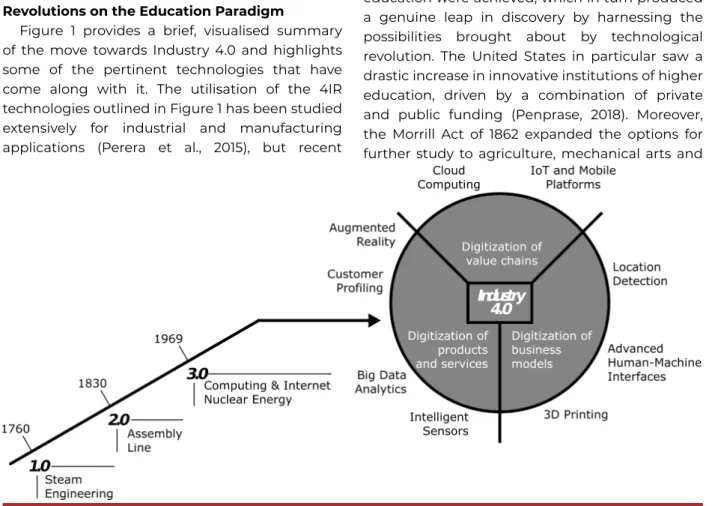
Figure 1 provides a brief, visualised summary of the move towards industry 4.0 and highlights some of the pertinent technologies that have come along with it. The utilisation of the 4iR technologies outlined in Figure 1 has been studied extensively for industrial and manufacturing applications (Perera et al., 2015), but recent
efforts in the education industry have also been promising.
The First industrial Revolution abruptly highlighted the limitations of the educational system at the time, and it opened up a diverse array of new disciplines that could be pursued in educational programs. The New Education, as described by charles Eliot (President of Harvard at the time), details a dramatic shift in the education paradigm, and universities across the world adopted the German model of postgraduate research (Hawkins, 1964). As a result, dozens of research-focused universities started to appear in the United States, and this model is still influential to how universities are operated today (Watson, 2010). The second half of the 19th century, a time period commonly associated with the Second industrial Revolution, saw the emergence of electrically driven manufacturing technologies, leading to what was known at the time as a “new economy”.
Significant improvements in access to higher education were achieved, which in turn produced a genuine leap in discovery by harnessing the possibilities brought about by technological revolution. The United States in particular saw a drastic increase in innovative institutions of higher education, driven by a combination of private and public funding (Penprase, 2018). Moreover, the Morrill Act of 1862 expanded the options for further study to agriculture, mechanical arts and
Figure 1. Pathway to the Fourth Industrial Revolution across time.
science and engineering, with the intention of opening up educational opportunities to the industrial class (Jolly, 2009). As a result of this and the previously-unseen profitability of new industries brought about by the revolution, institutions such as Stanford University and the University of Chicago were founded (in 1885 and 1890, respectively). Smaller colleges such as the Throop college (caltech as it is known today) were also established during this time. The societal and economic changes were both a product of the revolution and a response to it. A role for women as an integral part of the academy and industry was cultivated by the prominence of co-educational institutions.
Given the recent emergence of the Third industrial Revolution (which will loosely be described as the computer revolution of the later decades of the 20th century), the effect that it has had on higher education has arguably only been truly felt in the past couple of years. countries across the world have been exhibiting increasing participation rates to higher education programs, and the globalisation of research efforts has further added to this effect. Moreover, the prominence of remote learning has increased substantially due to the availability of online courses – many of which are available from highly reputable institutions, such as the Open courseWare (OcW) initiative from the Massachusetts institute of Technology (MiT).
Education in South Africa
The problems facing our education system in South Africa are multi-faceted and should be approached as such. Among age groups from 15 to 64 years, the youth (15-24 years) bracket boasts the highest unemployment for all educational
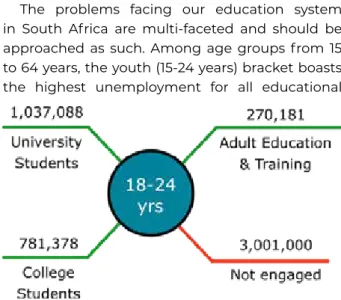
levels (Stats SA, 2019). More than 30% of graduates of some or other form of tertiary education are not employed, while close to 60% of young people that did not graduate from high school are in the same boat. A breakdown of educational engagement for 18 to 24 year olds as measured in 2014 is shown in Figure 2 (Stats SA, 2019).
Figure 2 shows that 58.9% of our youth are neither employed nor engaged in any form of tertiary training, educational or otherwise. There are plenty of factors that contribute to these alarmingly high rates – resource availability and utilisation in primary and secondary schools, access to mother-tongue education, administrative and policy issues, and school infrastructure problems, to name but a few, and limiting the discussion to but a few paragraphs is nowhere near enough to do the issue justice (Legotlo and Wilfred, 2014). About half of individuals between 18 to 24 state that a lack of funding is the reason behind their inability to attend further education, compared to about 18%
that indicated insufficient academic performance.
The solutions that the 4iR could bring to problems such as accessibility to education could be significant, but they would rely on harnessing the many aspects of current and future generations of intelligent systems. A handful of initiatives are discussed in the succeeding section.
One of the primary challenges of the 4iR is the scarcity of qualified, trained personnel to spearhead the movement, especially in higher education (Baygin et al., 2016). As such, the importance of improving access to online resources, training material, courses and remote instruction cannot be overstated, as it will facilitate greater enrolment. Online universities, for example, are not burdened by the need for physical proximity and the maintenance of campus Figure 2. Summary of individual engagement in higher
education for persons between 18 and 24.
Significant improvements in access to higher education were achieved, which in turn produced a
genuine leap in discovery by harnessing the possibilities brought about by technological
revolution.
infrastructure, although they do come with their own challenges with regards to infrastructure upkeep. The upcoming section will highlight some aspects of the 4IR that could greatly benefit young people who are eager to learn.
Applications and Educational Improvements Inspired by the 4IR
The subtle entry of machine learning techniques into our daily lives in recent years has truly enabled connected devices to operate as extensions of people, augmenting many ways in which they operate at home and at work. A new era of augmented intelligence is bound to drastically change current educational systems, and the success of the transition relies on efficiently manoeuvring technological changes. The trend of augmentation (as opposed to automation) will most likely continue in the education industry, considering the importance of human interaction and relationships during development. Higher Education (HE) forms an integral part of the 4iR, and HE4.0 (as it is occasionally referred to) will no doubt transform the education system for the better (Xing and Marwala, 2017).
An effective educational plan to cope with the 4iR must follow the example of the Third industrial Revolution, which took a more hybrid approach to instruction and made a vast array of resources available on demand, even outside of scheduled hours.
Massive Open Online Courses
Massive Open Online courses (MOOc) are a departure from the classical lecturing paradigm, where students are gathered in a classroom run by one or more lecturers. Removing the need for physical proximity to a lecturer and significantly expanding the reach of lectures presented are two primary positives offered by MOOc. The success of
online training services such as Udemy, coursera, Udacity and Skillshare (to name but a fraction of the selection available) clearly highlights the efficacy of these platforms. courses are rated by users, but are generally not presented and evaluated according to any particular standard – an issue that should be addressed if such platforms are to be expanded to university- and graduate-level training. The Open University is an example of a successful online educational platform that offers degrees accredited by both the Middle States commission on Higher Education and the Mid- Atlantic Region commission on Higher Education.
Perhaps one of the greatest advantages of the online university, and for selected academic programmes, is the sizeable reduction in infrastructure and upkeep costs. With South Africa’s higher education institutions reporting a reduction in capital expenditure of about 6%
between 2015 and 2017, reducing the cost of providing tertiary education is crucial (Stats SA, 2018).
Remote Learning, Tutoring and Support
An integral part of MOOc, remote tutoring and support can also be leveraged in traditional teaching environments. Moreover, access to online discussion boards and remote support from tutors is, for the most part, significantly more efficient compared to traditional teaching environments.
The online interface between students and facilitators opens up additional possibilities, such as translating written material into different languages. Natural language processing (NLP) can greatly assist in this regard, especially considering the amount of algorithm training material available. An extension of this is the translation of speech material into a suitable language. The usefulness of such an approach is of course subject to the characteristics of each particular language, but in many cases portions of the material that have considerable overlap between languages could be translated, whereas more technical aspects may not be translatable to begin with.
With that said, NLP as a field is not mature enough to handle such complex tasks, seeing that lexical, syntactic, referential and pragmatic ambiguities – fundamental characteristics of language – are not yet properly defined within the framework in which NLP interprets language.