DNS Traffic Based Classifiers for the Automatic Classification of Botnet
Domains
Submitted in fullment
of the requirements of the degree of Master of Science
of Rhodes University
Etienne Raymond Stalmans
Grahamstown, South Africa June 2013
Abstract
Networks of maliciously compromised computers, known as botnets, consisting of thou- sands of hosts have emerged as a serious threat to Internet security in recent years.
These compromised systems, under the control of an operator are used to steal data, dis- tribute malware and spam, launch phishing attacks and in Distributed Denial-of-Service (DDoS) attacks. The operators of these botnets use Command and Control (C2) servers to communicate with the members of the botnet and send commands. The communica- tions channels between the C2 nodes and endpoints have employed numerous detection avoidance mechanisms to prevent the shutdown of the C2 servers. Two prevalent detec- tion avoidance techniques used by current botnets are algorithmically generated domain names and DNS Fast-Flux. The use of these mechanisms can however be observed and used to create distinct signatures that in turn can be used to detect DNS domains being used for C2 operation. This report details research conducted into the implementation of three classes of classication techniques that exploit these signatures in order to accurately detect botnet trac. The techniques described make use of the trac from DNS query responses created when members of a botnet try to contact the C2 servers. Trac ob- servation and categorisation is passive from the perspective of the communicating nodes.
The rst set of classiers explored employ frequency analysis to detect the algorithmi- cally generated domain names used by botnets. These were found to have a high degree of accuracy with a low false positive rate. The characteristics of Fast-Flux domains are used in the second set of classiers. It is shown that using these characteristics Fast-Flux domains can be accurately identied and dierentiated from legitimate domains (such as Content Distribution Networks exhibit similar behaviour). The nal set of classiers use spatial autocorrelation to detect Fast-Flux domains based on the geographic distribution of the botnet C2 servers to which the detected domains resolve. It is shown that botnet C2 servers can be detected solely based on their geographic location. This technique is shown to clearly distinguish between malicious and legitimate domains. The implemented classiers are lightweight and use existing network trac to detect botnets and thus do not require major architectural changes to the network. The performance impact of im- plementing classication of DNS trac is examined and it is shown that the performance impact is at an acceptable level.
Acknowledgements
I would like to thank my family for all their support and constant encouragement through- out the writing of this thesis. I also want to thank my supervisor Dr. Barry Irwin for all his support and guidance. And nally I would like to thank John Richter for the hours he put into proof reading and correcting my mistakes, any remaining errors are mine alone.
This work was performed in and funded by the Centre of Excellence in Distributed Mul- timedia at Rhodes University, with nancial support from Telkom SA, Comverse, Verso Technologies, Tellabs, StorTech, EastTel and THRIP. Financial assistance towards the completion of my MSc was provided by Telkom SA and I would like to thank them for the support without which this research would not have been possible.
ACM Computing Classication System Classication
Thesis classication under the ACM Computing Classication System (1998 version, valid through 2012)
C.2.0 [General] Security and protection
C.2.3 [Network Operations] Network monitoring C.2.3 [Network Operations] Public networks I.2.7 [Natural Language Processing] Text analysis
i
Contents
1 Introduction 1
1.1 Problem Statement . . . 2
1.2 Research Objectives . . . 3
1.3 Research Method . . . 4
1.4 Document Structure . . . 5
2 Background 7 2.1 Domain Name System . . . 7
2.2 Botnets . . . 11
2.2.1 Structure of Botnets . . . 11
2.2.2 DNS Fast-Flux . . . 14
2.2.3 Algorithmically Generated Domain Names . . . 15
2.3 Related Work . . . 17
2.3.1 URL Analysis . . . 17
2.3.2 DNS Fast-Flux Detection . . . 19
2.4 Summary . . . 20
ii
3 Techniques for Botnet Identication 22
3.1 Data Description . . . 22
3.1.1 Domain Name Data Sources . . . 23
3.1.2 Fast-Flux Data Sources . . . 24
3.1.3 Live Test Data . . . 25
3.2 Lexical Features . . . 25
3.2.1 Frequency Analysis . . . 26
3.3 Lexical Classiers . . . 27
3.3.1 Probability Distribution . . . 29
3.3.2 Total Variation Distance . . . 29
3.3.3 Bayesian . . . 30
3.3.4 Naïve Bayesian Classier . . . 31
3.4 Domain Name Query Features Classiers . . . 32
3.4.1 Modied Holz Classier . . . 33
3.4.2 Rule-based Classier . . . 34
3.4.3 Naïve Bayesian Classier . . . 34
3.5 Geographic Features Classiers . . . 35
3.5.1 GeoIP Database . . . 37
3.5.2 Geographic Value . . . 40
3.6 Spatial Autocorrelation . . . 42
3.6.1 Moran's Index . . . 43
3.6.2 Geary's Coecient . . . 44
3.7 Summary . . . 44
iii
4 Results 46
4.1 Data Metrics . . . 46
4.1.1 Labelling Data . . . 46
4.1.2 Results Evaluation . . . 47
4.2 Algorithmically Generated Domain Name Detection . . . 48
4.2.1 Unigram Classiers . . . 49
4.2.2 Bigram Classiers . . . 56
4.2.3 Results Summary . . . 59
4.3 DNS Fast-Flux Detection . . . 59
4.3.1 Modied Holz Classier . . . 61
4.3.2 Rule-Based Classier . . . 61
4.3.3 NaïveBayesian Classier . . . 63
4.3.4 Combined Classier . . . 63
4.3.5 Summary . . . 65
4.4 Spatial Autocorrelation . . . 65
4.4.1 Moran's Index . . . 66
4.4.2 Geary's Coecient . . . 70
4.4.3 Spatial Autocorrelation Summary . . . 71
4.5 Performance Analysis . . . 72
4.5.1 Test Platform . . . 73
4.5.2 Lexical Classiers Performance Analysis . . . 73
4.5.3 Fast-Flux Classiers Performance Analysis . . . 74
4.6 Summary . . . 77
iv
5 Discussion 79
5.1 Algorithmically Generated Domain Names . . . 79
5.1.1 Observed Character Distribution . . . 80
5.1.2 Unigram Versus Bigram Classier Accuracy . . . 83
5.1.3 Summary . . . 84
5.2 DNS Fast-Flux . . . 85
5.2.1 Classier Results . . . 85
5.2.2 Legitimate Fast-Flux Domains . . . 87
5.3 Spatial Autocorrelation . . . 89
5.3.1 Observed Distribution Patterns . . . 90
5.3.2 Moran's Index and Geary's Coecient . . . 91
5.3.3 Open Source Intelligence . . . 93
5.4 Performance Analysis . . . 94
5.4.1 Lexical Classiers Performance . . . 94
5.4.2 Fast-Flux Classiers Performance . . . 95
5.5 Real-World Application . . . 95
5.5.1 Log Analysis . . . 96
5.5.2 DNS Trac Monitoring . . . 97
5.6 Summary . . . 97
6 Conclusion 99 6.1 Future Work . . . 101
6.1.1 Anti-Malware Protection . . . 101
6.1.2 DDoS Detection . . . 102
v
References 103
A Fast-Flux Domain Query Responses 113
B Algorithmically Generated Domain Names 116
C Geographic Distribution of C2 Servers 118
D Published Works 120
LIST OF TABLES vi
List of Tables
2.1 Fast-Flux Domain Query Result . . . 14
2.2 Content Distribution Network DNS Query Result (fbcdn.com) . . . 14
2.3 Sample Algorithmically Generated Domain Names . . . 16
3.1 Domain Name Data Sources . . . 23
3.2 Fast-Flux Data Sources . . . 25
3.3 Live Test Data . . . 25
3.4 Geographic Data for a Fast-Flux Domain (cjjasjjikooppfkja.ru) . . . 37
3.5 Input Values for the IP Address 59.146.177.153 . . . 40
4.1 Results of the Unigram Classiers . . . 49
4.2 Results of the Bigram Classiers . . . 56
4.3 Accuracy Rates of Lexical Analysing Classiers . . . 59
4.4 Results For Fast-Flux Classiers . . . 60
4.5 Mean values of DNS features for Fast-ux and legitimate domains . . . 60
4.6 Fast-Flux Classier Outputs . . . 62
LIST OF TABLES vii 4.7 Naive Bayesian Classier Results for Fast-Flux and CDN Domain Queries . 64
4.8 Summary of Fast-Flux Classier Accuracy Rates . . . 65
4.9 Moran's Index Classier Performance . . . 67
4.10 Geary's Coecient Classier Performance . . . 70
4.11 Summary of Spatial Autocorrelation Classier Accuracy . . . 71
4.12 Real-World Performance of Lexical Classiers . . . 74
4.13 Processing Time Per DNS Response Packet . . . 75
4.14 Projected Performance Impact of DNS Query Response Classication . . . 77
5.1 Observed Domains . . . 88
5.2 Observed Mean Values for Moran's Index . . . 92
5.3 Observed Mean Values for Geary's Coecient . . . 92
B.1 Concker-C Domains . . . 116
B.2 Kraken Domains . . . 117
B.3 Bobax Domains . . . 117
C.1 Geographic Distribution of C2 Servers . . . 118
LIST OF FIGURES viii
List of Figures
2.1 DNS Hierarchical Tree Structure . . . 8
2.2 DNS Resolution Process . . . 9
2.3 Output for the DNS Resolution Process Using the dig Command . . . 10
2.4 Botnet Structure . . . 12
3.1 Frequency Distribution of Unigrams. . . 27
3.2 Frequency Distribution of Bigrams. . . 28
3.3 Histograms of Mean Nearest Neighbour Distances for Legitimate Domains and Fast-Flux . . . 38
3.4 Geographic Distribution of Hosts for a Botnet and a Legitimate Domain . 39 4.1 Total Variation Classier Output for Unigrams . . . 51
4.2 Density Distribution of Unigram Naive Bayesian Classier Output. . . 52
4.3 Naive Bayes Classier Output for Legitimate Domains . . . 54
4.4 Naive Bayes Classier Output for Algorithmically Generated Domain Names . . . 55
LIST OF FIGURES ix
4.5 Density Distribution of Bigram Naive Bayesian Classier Output. . . 58
4.6 ROC of Fast-Flux Classiers Accuracy . . . 66
4.7 Kernel Density Comparison of Moran's Index Using UTM. . . 68
4.8 Kernel Density Comparison of Moran's Index Using MGRS. . . 69
4.9 ROC for Moran's I Classiers . . . 69
4.10 Kernel Density Distribution for Geary's Coecient. . . 71
4.11 ROC for Geary's Coecient Classiers . . . 72
4.12 Processing Time for Lexical Classiers . . . 73
4.13 Processing Time of the Various Fast-Flux Classiers . . . 75
4.14 Projected Performance Impact of DNS Query Response Classication . . . 76
5.1 Comparison of Vowel to Consonant Ratios . . . 81
5.2 Geographic Distribution of Botnet C2 Server IP Addresses . . . 91
x
List of Algorithms
3.1 Total Probability . . . 29
3.2 Total Variation Distance . . . 30
3.3 Bayesian Classier . . . 31
3.4 Naïve Bayesian Classier . . . 32
3.5 Modied Holz Heuristic Classier . . . 33
3.6 Rule-based Fast-Flux Classier . . . 35
3.7 Naïve Bayes Probability of Continuous Attributes. . . 36
3.8 Naïve Bayesian Fast-Flux Classier . . . 36
3.9 Timezone Value Calculation . . . 40
3.10 The Military Grid Reference System Numeric Value . . . 41
3.11 Moran's Index . . . 43
3.12 Geary's Coecient . . . 44
4.1 Classier Performance Calculations . . . 47
1
Introduction 1
Botnets have emerged as a serious threat to Internet security and are commonly used to conduct malicious and illegal activities. These botnets may consist of thousands of infected corporate and household hosts spread around the world. Botnet operators use Command and Control (C2) servers to distribute commands to and manage the hosts of the botnet and thus need to ensure that these servers are resistant to being shutdown.
The distributed nature of these botnets makes mitigation and remediation dicult. This distributed nature of the host belonging to the botnet means a central call home point is required for the hosts to receive instructions. Therefore the hosts require a means of determining the C2 server's addresses and call home for instructions. To add to the di- culties posed by the homogeneous nature of botnets, botnet operators employ numerous detection and shut-down evasion techniques. These techniques predominantly rely on the Domain Name System (DNS) to provide a means for infected hosts to contact the C2 servers, while also providing eective anti-detection and shutdown protection.
This report describes a number of techniques for detecting botnet trac from DNS query responses. These detection techniques exploit the signatures created by the detection avoidance mechanisms employed by botnets. The rst set of classiers described employ frequency analysis to detect algorithmically generated domain names with a high degree of accuracy with a low number of false positives. The characteristics of Fast-Flux domains are used in the second set of classiers. The nal set of classiers use spatial autocorrelation to detect Fast-Flux domains from the geographic distribution the botnet C2 servers. It is shown that Fast-Flux domains can be accurately identied and dierentiated from legitimate domains such as Content Distribution Networks. The proposed classiers are lightweight and use existing network trac to detect botnets and thus do not require major architectural changes to the network.
1.1. PROBLEM STATEMENT 2
1.1 Problem Statement
The growth in the number of Internet connected devices has seen a related rapid growth in the number of hosts infected by malicious software. This software is known as mal- ware (Vanier, 2011; Arbor Networks, 2012a). Internet connected devices expose multiple vectors by which malware can infect the system. Current malware protection schemes are largely failing as systems are becoming more exposed to external threats (Wilson, 2008). Once a system has been infected, the malware can be used to steal data, sending spam, phishing, distributing malware and Distributed Denial-of-Service (DDoS) attacks.
Current malware detection methods predominantly rely on host-based malware detection mechanisms that are based on pattern matching and heuristics. These traditional detec- tion techniques are easily bypassed by zero-day attacks and polymorphic code (Ollmann, 2008). Current network-based solutions often focus on preventing malware from entering the system through the use of rewalls, Intrusion Detection Systems and blacklists. These systems are blind to malware that enters the system through other attack vectors, such as mobile Internet connections or removable devices, thus highlighting the need for detection systems that also focus on trac leaving the network.
The current generation of malware is largely focused on the creation of large networks of infected hosts known as botnets. Botnets consist of thousands of infected hosts, referred to as bots, that receive instructions from C2 servers operated by an individual. Traditionally Internet Relay Chat (IRC) servers have been used as C2 servers and have communicated with the botnet through IRC channels (Lee, Jeong, Park, Kim, and Noh, 2008). This has led to network administrators often blocking IRC trac on the network. Recent trends in botnet development have seen the use of alternative communication channels, such as DNS-tunnelling and HTTP requests, between the C2 servers and infected hosts (Pereira, Fucs, and de Barros, 2007; Lee et al., 2008).
The use of alternative communication channels has allowed botnet trac to bypass com- mon network lters (Gu, Zhang, and Lee, 2008). These channels cannot simply be blocked as IRC trac has been due to many of the underlying protocols being essential for normal network activity. An example of this is DNS, where almost all network communication is reliant on DNS for address translation to aid the establishing of communication between hosts. While most web trac relies on HTTP or HTTPs for reliable communication between servers and hosts.
An emergent trend shown by recent botnets such as ZeuS, Kehlios and Citadal is the use of new detection avoidance techniques. One of these avoidance techniques, known as DNS
1.2. RESEARCH OBJECTIVES 3 Fast-Flux, allow botnets to avoid detection and to reduce the ability of researchers to nd and shut-down the C2 servers. Fast-Flux relies on rapidly changing domain name records to mask the location of C2 servers and to ensure domains are defended against common shutdown techniques such as IP address blacklisting.
A further detection avoidance technique is algorithmically generated domain names. In this method each infected host employs a Domain Generation Algorithm (DGA) to gen- erate a large set of domain names to query (Yadav, Reddy, Reddy, and Ranjan, 2010).
These generated domain names are queried until a live C2 server is found. Botnets such as Concker, Kraken and Torpig have successfully employed algorithmically generated domain names to ensure the longevity of the botnet C2 servers. Trends in algorithmic name generation have seen bots, such as those infected with Concker-C, generating up- wards of 50000 domain names an hour (Porras, Saidi, and Yegneswaran, 2009). This large volume of generated domain names makes it nearly impossible for researchers to block or pre-register all domains associated with these botnets, as was done with earlier Con- cker variants (Leder and Werner, 2009; Porras et al., 2009). Furthermore, the massive amount of generated names makes the maintenance and use of domain blacklists slow, cumbersome and ultimately largely ineective.
1.2 Research Objectives
This research has been conducted with the the aim of detecting botnet domains and communication using features contained in DNS query responses. The research objectives can be formally dened as the following:
The detection of algorithmically generated domain names such as those used by the Torpig, Kraken and Concker botnets. These botnets employ DGAs to create a large pool of domain names which are queried by infected hosts to query when at- tempting to contact the C2 servers. These generated domain names tend to display a dierent frequency distribution of characters than those observed in legitimate domain names. The aim of this research is to identify these algorithmically gen- erated domain names using statistical classiers, providing a lightweight, learning system capable of accurately dierentiating between algorithmically generated and semantically correct domain names.
1.3. RESEARCH METHOD 4
The detection and identication of Fast-Flux domains used to host the C2 servers by using the information contained in the DNS query response. The distinct charac- teristics of Fast-Flux domains were examined and used to create a signature, which could be used to identify and dierentiate between Fast-Flux domains and legitimate domains such as Content Distribution Networks (CDNs).
The geographic location of servers were used with the aim of detecting Fast-Flux domains. The characteristic displayed by Fast-Flux domains where the C2 infras- tructure usually consists of geographically widely dispersed hosts was employed as an identifying feature that could be used statistical classiers. The research aims to formally dene this geographic dispersion and hence classify domains as either Fast-Flux or legitimate.
Finally the possible performance impact the proposed classiers would have on existing network trac was considered. The classiers are all passive and thus the research aim was to keep classication time as close to zero as possible to match the zero interaction required with the botnet hosts.
1.3 Research Method
The research was conducted to identify techniques that could be used to identify domains from DNS query response network trac that could be linked to potential botnet activity.
The proposed detection techniques were used to construct prototype classiers capable of detecting known botnet domains. These classiers were then evaluated to determine their accuracy as well as the rate at which false positives and false negatives occur. Finally the performance of the classiers was evaluated to determine the feasibility of deploying the classiers on a real world network.
The proposed classiers were derived by examining current detection evasion techniques employed by botnets: namely algorithmically generated domain names and DNS Fast- Flux. This led to the identication of features which could be used in the construction of classiers. Once these features were known, statistical techniques were researched to iden- tify techniques which could be used to produce classiers. The proposed classiers were trained using known, legitimate botnet domains. The trained classiers were then tested against real world samples to determine their accuracy when exposed to data gathered from botnets operating at the time. Real world performance testing was conducted to
1.4. DOCUMENT STRUCTURE 5 evaluate the performance impact the proposed classiers would have on existing network trac.
1.4 Document Structure
The remainder of the document consists of ve chapters as follows:
Chapter 2 provides background information about the Domain Name System, bot- nets and the evasion techniques used by botnets. Related work is outlined and it is explained how this research aims to extend and improve on previous work, as well as introducing novel classication techniques.
Chapter 3 describes the datasources used and how data was divided into train- ing and test sets. Lexical analysis is explained and the lexical features of English words, domain names and algorithmically generated domain names are examined.
Following this, the techniques used to construct the classiers for the classication of domain names are outlined. The techniques for detecting Fast-Flux domains are described along with the spatial autocorrelation and how this can be applied to Fast-Flux domain detection.
Chapter 4 presents the results for the classiers described in Chapter 3. First the means of measuring classier performance are outlined, followed by the results for the lexical analysis classiers. The results for classiers using DNS query features to detect Fast-Flux domains are presented. Finally the results obtained through spatial autocorrelation are presented.
Chapter 5 discusses the results obtained in testing. The performance in terms of accuracy of the classiers are compared to related works and the implications of the research results are discussed. The weaknesses of the classiers are discussed along with possible bypass techniques and how these could be countered.
Chapter 6 provides a conclusion to the research and suggests possible future research based on the ndings and work presented in this document.
The appendices provide additional information that may be useful in understanding the data used in this document. Sample Fast-Flux botnet DNS queries are provided in Ap- pendix A. Algorithmically generated domain names for the Concker-C, Kraken and
1.4. DOCUMENT STRUCTURE 6 Bobax botnets are provided in Appendix B. Appendix C provides a sample of the ge- ographic distributions of Fast-Flux C2 servers.
Elements of this document have been published in short format and links to these are provided in Appendix D.
7
Background 2
This chapter provides background information relevant to the research presented in the remainder of this document. The domain name system (DNS) and how it is used ubiq- uitously in modern Internet communication is described in section 2.1. Botnets are de- scribed in detail in section 2.2 along with two of the evasion techniques employed by these.
These techniques are discussed separately as DNS Fast-Flux (subsection 2.2.2) and algo- rithmically generated domain names (subsection 2.2.3). Furthermore, the relationship these evasion mechanisms have with DNS are discussed in detail. Related work in bot- net detection and the use of DNS in the detection of botnets is outlined in section 2.3.
This includes work in the identication of algorithmically generated domain names and Fast-Flux detection. The chapter concludes with section 2.4 providing a summary of the information presented.
2.1 Domain Name System
All devices connected to the internet have a globally unique address used to identify the device. This unique address is known as the device's Internet Protocol (IP) address and consists of 32-bits in IP version 4 (IPv4). In IPv4 this is typically written as a series of four binary octets (A.B.C.D) known as dotted notation (example 192.168.0.1). IP version 6 (IPv6) consists of 8 octets and thus allows for a larger set of address to be represented than in IPv4. IPv6 is the ocial replacement for IPv4 and has slowly been integrated into existing networks (Colitti, Gunderson, Kline, and Rece, 2010). For the purpose of this research IPv6 is out of scope, though all the methods described should be portable to IPv6. These numerical IP addresses are easy for computing devices to
2.1. DOMAIN NAME SYSTEM 8
.
com org
asite bsite example
www mail
eu au
Figure 2.1: DNS Hierarchical Tree Structure
use but harder for humans to remember. The Domain Name System (DNS) was created to provide a mapping between the user-friendly domain names and machine friendly IP addresses. DNS is a distributed, hierarchical naming system that ensures the names used to identify resources on the Internet can remain constant despite changes to the underlying IP address or physical location. A domain name may consist of up to 253 characters, with an individual domain label not allowed to exceed 63 characters (Mockapetris, 1987).
Characters which are allowed to be present in domain labels are alphanumerical ([a- z][A-Z][0-9]) as well as the hyphen. All other characters are invalid in domain names (Mockapetris, 1987). International domain name servers (iDNS) allow domain names to fall outside these limits, allowing for characters from languages such as Chinese to be used (Tan, Seng, Tan, Leong, De Silva, Lim, Tay, Subbiah, et al., 2002).
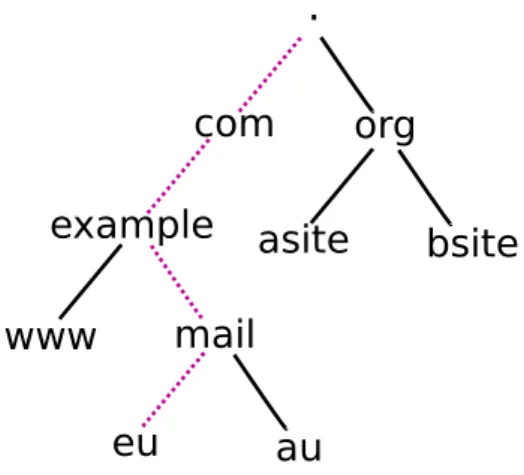
Domain names are constructed using a hierarchical tree structure, where a domain name may consist of multiple domain labels separated by a dot (`.') such that eu.mail.example.com.
constitutes a fully qualied domain name. A fully qualied domain name ends in a `.' which is known as the root node. The root node is taken as implied and is commonly left o. Each domain name identies a path from the root node, identied by the rightmost `.', to the node representing the Internet endpoint resource. This hierarchical structure can be represented as shown in Figure 2.1. The domain eu.mail.example.com. can be mapped by following the branches of the tree structure as shown. The path starts at the root node progressing downwards through each child node, known as a resource record (RR), along the path until eventually terminating at the nal node, which would typically resolve the domain address and other records. The progression down the tree is shown as purple dashes, starting at the root node `.' and progressing down to the lowest level domain
`eu'. The depth of a node in the tree is known as the domain level, with each domain name consisting of at least two domain levels, such that for the domain example.com,
2.1. DOMAIN NAME SYSTEM 9
Figure 2.2: DNS Resolution Process
the Top-Level Domain (TLD) is `com' and the Second-Level Domain (SLD) is `example'.
All the child nodes of `example' indicate sub-domains controlled by the `example.com' domain. Available TLDs are controlled by Internet Corporation for Assigned Names and Numbers (ICANN) and can be divided into two subgroups, Generic TLDs (gTLD) and Country Code TLD (ccTLD). Generic TLDs represent domains such as .com, .edu, .gov and .net, while ccTLDs consist of a two-character country code such as .uk, .ru and .za (Aitchison, 2011).
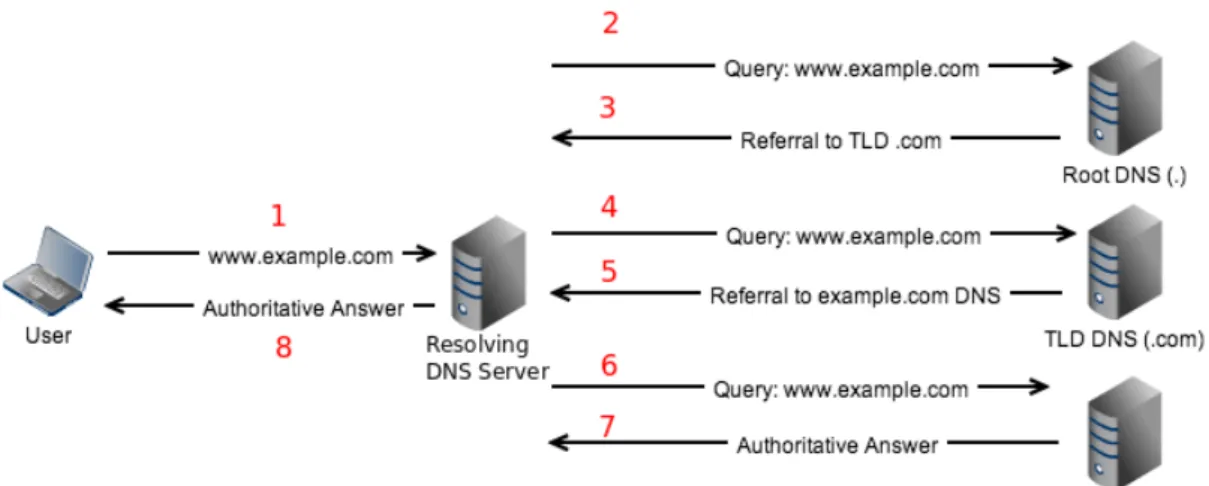
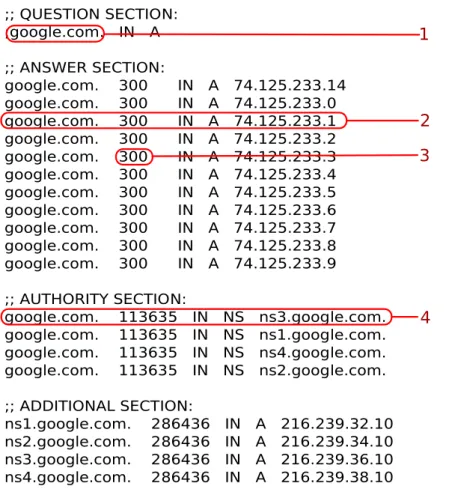
When a user wishes to contact a host on the Internet the domain name rst needs to be mapped to the IP address of that host. This is done through the DNS resolution process, as can be seen in the simplied process depicted by Figure 2.2, where a query for the domain name www.example.com returns an authoritative answer from the DNS server for example.com. A DNS query is done to the host's local DNS resolver (1), usually internal to the organisation or the host's Internet Service Provider. This DNS server performs a lookup of the domain name in it's local cache and if the address record is available returns an answer to the host (8). When the address record is not available the DNS server performs either an iterative or recursive DNS lookup. This referral process shown by steps 2 through 7 consists of a series of lookups to the DNS servers for each node in the DNS hierarchy until a valid DNS record is located. If no DNS record is found a MX record is returned to indicate that the domain name could not be resolved. This process is however outside the scope of this research. Additional information on iterative or recursive DNS lookup can be found in the literature Aitchison (2011). The result of this resolution process is a DNS query response consisting of numerous elds containing values pertinent to the domain in question. A typical DNS query response can be seen in
2.1. DOMAIN NAME SYSTEM 10
;; QUESTION SECTION:
;google.com. IN A
;; ANSWER SECTION:
google.com. 300 IN A 74.125.233.14 google.com. 300 IN A 74.125.233.0 google.com. 300 IN A 74.125.233.1 google.com. 300 IN A 74.125.233.2 google.com. 300 IN A 74.125.233.3 google.com. 300 IN A 74.125.233.4 google.com. 300 IN A 74.125.233.5 google.com. 300 IN A 74.125.233.6 google.com. 300 IN A 74.125.233.7 google.com. 300 IN A 74.125.233.8 google.com. 300 IN A 74.125.233.9
;; AUTHORITY SECTION:
google.com. 113635 IN NS ns3.google.com.
google.com. 113635 IN NS ns1.google.com.
google.com. 113635 IN NS ns4.google.com.
google.com. 113635 IN NS ns2.google.com.
;; ADDITIONAL SECTION:
ns1.google.com. 286436 IN A 216.239.32.10 ns2.google.com. 286436 IN A 216.239.34.10 ns3.google.com. 286436 IN A 216.239.36.10 ns4.google.com. 286436 IN A 216.239.38.10
1
2 3
4
Figure 2.3: Output for the DNS Resolution Process Using the dig Command Figure 2.3, where the resolution of the domain google.com has been done using the dig1 command.
Examining the query response in Figure 2.3, the value at 1 represents the ORIGIN di- rective, which is the name of the domain that has been queried. This will be extracted from DNS query responses and used in the lexical analysis of domain names as outlined later in section 3.2. The next value of concern is the A Resource Record, as identied by 2. This value denes the IPv4 address of a particular host in the domain. A related eld to this is the AAAA Resource Record, which has an identical structure to a standard A Resource Record. It is used to identify a host using it's IPv6 address. Each IP address associated with an A record has an Autonomous System Number (ASN), which is used in the routing of trac on the Internet (Dragon Research Group, 2011). Each ASN is usually associated with a single organisation and is thus a good indicator of the owner of an IP address block. The value at 3 is the Time-to-Live (TTL) directive for the domain.
1dig (domain information groper) is a network administration command-line tool for querying DNS name servers. Dig is a built-in tool in many Linux distributions.
2.2. BOTNETS 11 This value species the amount of time, in seconds, that a domain name should be cached by another name server. Once the TTL expires the DNS record should be renewed by performing a new DNS query. RFC 1912 recommends minimum TTL values of 1-5 days, allowing clients to benet from the eects of DNS caching (Barr, 1996). The nal value of interest is labelled as 4. This is the NS Resource Record and is used to identify the authoritative name servers for the domain. The authoritative name server is used to host the DNS records for a domain and answer queries for resolution.
2.2 Botnets
The term `botnet' is used to describe a collection of compromised hosts that are networked together and are under the control of a third party, known as a botmaster (Pereira et al., 2007; Shadowserver Organisation, 2012). These compromised hosts may consist of any computing device capable of accessing the Internet, including private home computer systems, corporate computer systems and even mobile devices (Xiang, Binxing, Lihua, Xiaoyi, and Tianning, 2011). Botnets are used by botmasters to commit multiple cy- bercrimes such as spam distribution, Distributed-Denial-of-Service (DDoS) attacks and malicious software distribution. Furthermore, the compromised hosts may report back to the botmaster with user details such as online banking passwords and credit card informa- tion. Once a botnet has been created, the botmasters require a means of communicating instructions to all the hosts in the botnet. A common strategy for this is the use of Com- mand and Control (C2) servers. These C2 servers provide a central location for botnet members to receive instructions as well as a location to report back with stolen informa- tion. As C2 servers provide a central location for hosts to call-back to, they also create a central weak-point which security researchers can use to shutdown the entire botnet.
For this reason botmasters have employed many detection and shutdown techniques. The structure of botnets and the evasion techniques employed by botmasters are discussed in greater detail in the subsequent sections.
2.2.1 Structure of Botnets
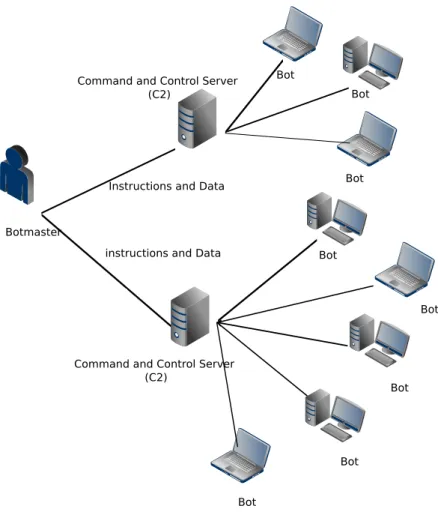
The structure of a typical botnet is presented in Figure 2.4, where the botnet consists of all the components outlined above. The botmaster is able to submit commands to the bots through the C2 servers, while using the C2 servers as relays for data being returned by the bots. The use of C2 servers as proxies makes locating the botmasters location
2.2. BOTNETS 12
Botmaster
Instructions and Data
IData
Command and Control Server (C2)
Bot Bot
Bot Bot Bot
Bot Bot Command and Control Server Bot
(C2)
instructions and Data
Figure 2.4: Botnet Structure
nearly impossible and provides anonymity to the botmasters. As the botmaster relies on C2 servers for communicating with the bots of the botnet, C2 servers are the weak point of any botnet as taking down a C2 server denies a botmaster access to the bots of the botnet (Silva, Silva, Pinto, and Salles, 2012). To slow down locating and shutting down of C2 servers, botmasters have employed multiple strategies. Two of these strategies, DNS Fast-Flux and algorithmically generated domain names, are discussed in the next sections.
Botnets consist of multiple parts, independent of the botnet's size or the architecture employed. These parts each play dierent roles in the operation of the botnet and provide a dierent target for managing and taking down botnets. This structure can be broken down into four main components as follows:
Botmaster: An individual or group that controls the operation of the botnet.
The botmaster may not be the creator of a botnet and may have purchased the botnet from another botmaster or rent the botnet temporarily. The botmaster
2.2. BOTNETS 13 issues commands to the bots belonging to the botnet through the C2 servers using the C2 channel.
Bot: A bots in the botnet may consists of any computing device that has been compromised and is under the control of the botmaster. The bots in a botnet receive instructions from the botmaster through the C2 channel and will perform periodic checks with the C2 servers for new instructions. The botmaster may also directly control the bot through a remote access trojan (RAT). Bots may be instructed to harvest user information on compromised hosts. This information may include keystrokes, credit card information and online banking logins. Botmasters may compromise hosts in multiple ways including malicious software, drive-by-downloads and hacking. Bots will typically perform DNS queries, just as legitimate hosts would, to nd the IP addresses of C2 servers to contact (Morales, Al-Bataineh, and Sandhu, 2009).
C2 Server: C2 servers are used to relay instructions and data between the bot- master and the bots of the botnet. In many cases the botmaster will never have direct access to individual bots but rather uses the C2 servers as proxies for con- trolling these hosts (Silva et al., 2012). The C2 servers may be bots on the botnet, server infrastructure such as web-servers which have been compromised, or so called bullet-proof hosting. Bullet-proof hosting consists of networks that are known to tolerate hostile network activity and ignore take-down notices for malicious hosts.
C2 Channel: The C2 channel employed denes how communication is performed between bots and the C2 servers. Early botnets employed Internet Relay Chat (IRC) as a communication channel but in recent years there has been a shift towards the use of standard HTTP communication channels. This has largely been due to stricter rewall policies, limiting the types of trac which may egress from a network. With HTTP being ubiquitous in the functioning of the web trac, it is nearly always allowed on a network (Lee et al., 2008). Furthermore, botnet HTTP trac is not as noticeable with legitimate HTTP trac already present on most networks. Botnets have steadily been shifting towards the use of encrypted communication channels, preventing Man-in-The-Middle (MiTM) attacks by security researchers. This shift towards encrypted C2 channels has made botnet take down more dicult and has made it near impossible to submit rogue commands to bots belonging to a botnet.
2.2. BOTNETS 14 Table 2.1: Fast-Flux Domain Query Result
IP Address AS Number Organisation Country
222.106.31.123 AS4766 Korea Telecom KR
95.139.78.214 AS48400 CJSC Comstar-Regions RU
110.133.1.126 AS9824 Technology Networks Inc JP 80.54.192.197 AS5617 Telekomunikacja Polska S.A. PL 211.125.152.16 AS10019 Matsusaka Cable-TV Station Inc JP Table 2.2: Content Distribution Network DNS Query Result (fbcdn.com)
IP Address AS Number Organisation Country 66.220.149.88 AS32934 Facebook, Inc. US 66.220.152.16 AS32934 Facebook, Inc. US 66.220.158.70 AS32934 Facebook, Inc. US 69.171.234.21 AS32934 Facebook, Inc. US 69.171.237.16 AS32934 Facebook, Inc. US 69.171.247.21 AS32934 Facebook, Inc. US
2.2.2 DNS Fast-Flux
DNS Fast-Flux is another method used by botmasters to build resilient and robust botnet control infrastructure. Fast-Flux uses rapidly, repeatedly changing DNS records to provide constantly changing IP addresses to which a domain name resolves. The use of rapidly changing DNS records is not in itself malicious and has been used by legitimate services to provide load balancing for high availability and high volume web sites (Holz, Gorecki, Rieck, and Freiling, 2008). Fast-Flux domains rely on a short TTL for the resource records, ensuring that each subsequent DNS query will request a new resource record and not use the cached version. With each new DNS query, a new set of resources records is returned with new resources records mapping to dierent IP addresses from the previous query. This rapid ux in DNS records provides a means of concealing the C2 servers as no two DNS queries map back to the same hosts, with many of the resource records returned linking to proxy hosts which relay instructions back to the C2 servers. A further benet of DNS Fast-Flux is that as long as a single address returned is available, the whole service remains online.
As has been stated, Fast-Flux can be used as a legitimate means of providing load balanc- ing for web sites such as those hosted on CDNs. There is, however, a noticeable dierence between legitimate CDNs and Fast-Flux domains (Holz et al., 2008). Botmasters are not free to choose the hardware and network location of individual nodes, resulting in diverse IP ranges being returned with each DNS query response. This can be seen in Table 2.1,
2.2. BOTNETS 15 where ve widely dispersed IP ranges are returned for a single DNS query. Furthermore, each of these IP ranges were registered to a dierent organisation and belong to dierent ASNs. The geographic locations of the hosts also appear randomly distributed globally, with four dierent countries represented. This can be compared to the results for CDNs' DNS query result in Table 2.2, where - despite two IP ranges being returned - they are from the same ASN and both ranges belong to Facebook Inc. Furthermore, all the hosts mapped to these IP addresses are located in the United States and are not widely dis- persed geographically, as is the case with the Fast-Flux domain presented in Table 2.1.
It has been noted that employing Fast-Flux as a defensive measure to mitigate DDoS attacks has a high success rate (Lua and Yow, 2011). For this reason Fast-Flux presents a double-edge sword, as it provides an eective means for both legitimate and malicious domains to maintain availability and throughput (Lua and Yow, 2011).
2.2.3 Algorithmically Generated Domain Names
Algorithmically generating domain names is a technique employed by various botnet fam- ilies to increase the lifespan of botnet C2 domains. These domain names are generated using a Domain Generation Algorithm (DGA), ensuring that the botmaster knows in ad- vance which domain names will be generated and thus knowing which domain names to register. By using a DGA botmasters are able to have clients generate a large number of domain names that could possibly be used by C2 servers (Damballa, 2012). Due to the large number of domains being generated, security researchers are unable to determine which domain names will actually be used. Furthermore, the sheer volume of domain names makes it near impossible to preregister all the domain names that have been gen- erated. The technique of preregistering domain names had been eective in preventing communication between bots and the C2 servers for early variants of botnets such as Concker-A and Concker-B, where only 250 domain names were generated in a day.
The release of the Concker-C variant saw the generation of 50000 domain names a day.
This was an extremely dicult number of domains to preregister, in both monetary and logistic terms (Leder and Werner, 2009). As the botmasters require only one domain to be reachable, researchers have to ensure a one hundred percent success rate in preregistering all domains if they wish to eectively prevent communication between the botmaster and the botnet. The botmasters are able to pre-generate a list of domain names that will be generated by the botnet hosts in the future and register a selection of these domains in advance.
The success of the Concker-C botnet has led to the use of DGAs by multiple botnets,
2.2. BOTNETS 16 Table 2.3: Sample Algorithmically Generated Domain Names
Torpig Kraken Concker-C
wghfqlmwtwe.com aafsyt.dyndns.org nzfpt.ir oderkayotwe.com aetqzvfzub.dyndns.org gxigcsiv.sh ghplzwgtwe.com aifuunhoomc.dyndns.org motied.sk wdecfjiwtwe.com gmqaeoeudhd.dyndns.org zuwomto.com.fj bcplcwytwe.com kpjobheecz.dyndns.org dtofeqdih.in aefjchpatwe.com likkhxbl.dyndns.org bgwmdt.hu mhjqxaxmtwe.com bnbnpqkagr.dyndns.org hdwcgwvr.co.za sfgtilbstwe.com danssxjpgqh.dyndns.org udjgefanm.com.ag aefnmvuatwe.com ggdcnsp.dyndns.org slkvruja.am jbcfqmmjtwe.com baqydcdnusq.dyndns.org rozikf.com.gt ocdvjxdotwe.com uresesbfsb.dyndns.org mcptvhezs.com.hn ajicfjiatwe.com gbsszmdkuq.dynserv.com jkoo.com.do qefswxaqtwe.com zpuxycznd.dynserv.com hfhvue.vn
with the ve largest DGA based botnets being Concker, Murofet, BankPatch, Bonnana and Bobax (Damballa, 2012). The DGAs use a seed value that is consistent across all the bots of the botnet, such as the system time. The Torpig botnet used the Twitter API2 to generate domain names from the most popular terms being discussed on the platform. The pseudo random nature of these domain names mean that characters in the generated domain names will appear to have a uniformly random distribution. Closer investigation reveals that certain characters tend to appear more frequently than others.
The frequency distribution of characters is discussed in greater detail in section 3.2. Sam- ples of algorithmically generated domain names for the Torpig, Kraken and Concker-C botnets are shown in Table 2.3. It can clearly be seen that the domain names generated do not look the same as legitimate domain names such as facebook.com, youtube.com and myspace.com, which all consist of a combination of English words. Furthermore, it can be noted that all the Torpig domain names end in `twe', indicating they were generated in December Unmask Parasites (2009). This is due to the DGA used to generated these domains, where a sux relating the current month is appended to each generated domain name (Unmask Parasites, 2009).
2https://www.twitter.com/api
2.3. RELATED WORK 17
2.3 Related Work
The emergence of botnets as a serious threat in the modern Internet landscape has led to numerous researchers to examine ways of detecting botnets and the trac associated with botnets. Two areas of botnet research related to this work were examined. Work in the analysis of URLs is discussed in subsection 2.3.1, where previous attempts to de- tect algorithmically generated domains are examined. Research in spam ltering is also discussed as this relates to the Bayesian techniques used in this research. The second subset of botnet research examined was DNS Fast-Flux detection and this is discussed in subsection 2.3.2. Multiple techniques of botnet detection based on DNS query analysis are outlined.
2.3.1 URL Analysis
Signal theory and signal processing methods have been proposed as an approach for de- tecting algorithmically generated domain names (Yadav et al., 2010). Analysis of the distribution of alphanumeric characters as well as the distribution of bigrams within do- main names was conducted in Yadav et al. (2010). The frequency distribution of char- acters were found for legitimate and algorithmically generated domain names. The K-L divergence3 was used as a statistical measure of how closely the frequency distributions for the test domain relate to the known distributions for legitimate and algorithmically generated domain names. A domain was classied based on which distribution it diverged from the most. They extended their analysis to examine the distribution of bigrams (also known as character pairs) in an attempt to identify domain names that had been gener- ated using algorithms that attempt to match the frequency distribution of characters in natural language. The techniques employed required domain grouping to increase accu- racy, with observed domains being primarily grouped according to domain and secondly according to IP address. Domain name grouping was done on sets of 50, 100, 200 and 500 test words, with at least 50 domain names in a group required to positively identify malicious domains, while the researchers noted the best results were achieved once 500 domain names had been analysed. The results achieved showed a 100% detection rate when 500 domain labels were used, with only 5-7% false positives, with a true positive rate (TPR) of 93%. Bigram analysis resulted in more domains being detected with a lower false positive rate of 2%. When only 50 domain names were present in a grouping, the detection rate dropped to 80% with a 20% false positive rate (FPR).
3KullbackLeibler divergence: A measure of the dierence between two probability distributions
2.3. RELATED WORK 18 The analysis of domain names based on the character distribution oer the benet of not having to do costly lookups of known `safe words', such as suggested in other works such as Alienvault Labs (2012). The work by Alienvault Labs (2012) used syntax heuristics, where domains were classied according to the number of consonants contained in the domain name after common English words such as `or', `and', `page', `free' had been removed. The results from the AlienVault research showed a 61% TPR and a low FPR of 10%. These results were obtained using only Concker-C domains as the malicious dataset. While the low FPR and relatively high TPR are commendable, the system is easily bypassed by simply reducing the number of consonants in the domain name. This can be achieved by altering the DGA and thus it is hypothesised that the AlienVault solution would not be as eective in detecting algorithmically generated domain names for previously unseen malware.
The move towards social services such as Twitter, where users are limited in the number of characters which they can post, 140 character limit, has seen the emergence of URL shortening services (Lee and Kim, 2012). These shortening services provide an interme- diary service between the user and the shortened domain, where a mapping between a unique short domain and a fully qualied domain is created. The popularity and sheer number of URL shortening services available has seen a move by botnet creators towards using these services as a means of uxing between botnet C2 servers (Lee and Kim, 2012).
The URLs used for phishing and advertising spam were analysed by Ma, Saul, Savage, and Voelker (2009). They identied that malicious URLs exhibit dierent alphanumeric distributions than legitimate URLs. Statistical learning techniques were employed to identify malicious URLs from lexical features such as domain name length, number of dots in the URL and host names. The proposed system aimed to identify single URLs as malicious, whereas Yadav et al. (2010) looked at the grouping of domain names (Ma et al., 2009). Work performed by Xie, Yu, Achan, Panigrahy, Hulten, and Osipkov (2008) led to the development of regular expression based signatures for detection of spam URLs.
The solution proposed in this research is intended to surpass the accuracy of the regular expression based solution. Furthermore, the solution should be harder to bypass and will avoid the need to constantly update signatures to match new attacks as they develop.
Classiers based on Bayesian statistics have been used successfully in the classication of binary problems. One area of information security where this has been particularly successful is in the detection of spam emails (Seewald, 2007; Sahami, Dumais, Hecker- man, and Horvitz, 1998). Bayesian statistics allow for the creation of classiers that are content-based as well as self-learning, allowing for probabilistic problem solving (Androut-
2.3. RELATED WORK 19 sopoulos, Koutsias, Chandrinos, Ch, Paliouras, and Spyropoulos, 2000). The two main types of classiers that have been used in the detection of spam emails are Bayesian classi- ers and Naive Bayesian classiers. The Bayesian classiers assume dependence between the attributes being examined, while the Naive Bayesian classiers assume independence between attributes. Assuming independence allows for smaller, less complicated training sets to be used. Furthermore, the probabilities of attributes in the Naive Bayesian classi- er are easier to calculate as the dependence on other attributes do not have to be taken into account. It has been shown that both Naive and standard Bayesian classiers allow for highly accurate classication of spam mail (Androutsopoulos et al., 2000; Seewald, 2007; Zhang, Zhu, and Yao, 2004), leading to the notion that they may easily be adapted to create accurate classiers for URL classication.
2.3.2 DNS Fast-Flux Detection
A number of approaches for detecting malicious network activity through DNS trac monitoring were studied. The system implemented by Perdisci, Corona, Dagon, and Lee (2009) for the detection of malicious Fast-Flux service networks through the passive analysis of recursive DNS trac traces identied common features in Fast-Flux DNS query results (Perdisci et al., 2009). Common features identied were a short time-to- live (TTL), multiple Address (A) records and multiple ASNs. It was shown that the IP addresses resolved to the domain name were often from dissociated networks and changed rapidly, matching the operation of Fast-Flux as described in subsection 2.2.2.
The denitive work in Fast-Flux detection was done by Holz et al. (2008), who identied the same key DNS features. These DNS features were used in the creation of heuristic classication models for the detection of Fast-Flux botnets. Their primary observation was that Fast-Flux botnets could be detected using the number of distinct A records returned and the number of dierent ASNs associated with the domain. Results showed botnet creators attempt to mimic the structure of CDNs. This behaviour masks botnet activity and hinders the automatic classication of domains (Holz et al., 2008). It was, however, identied that the inherent distributed structure of botnets could be used as a distinguishing factor. The authors Holz et al. (2008) noted that botmasters have limited control over the hardware and network location of individual nodes, where CDNs have full control over the locations of nodes. Furthermore, botmasters could not easily obfuscate these features. These features were used in a Fast-Flux detection system. The proposed system required secondary DNS queries once the original queries TTL expired, increasing the time required to classify domains.
2.4. SUMMARY 20 The distributed nature of botnet C2's is a well established fact and researchers have at- tempted detection and classication of botnets using the geographic locations of botnet nodes (Caglayan, Toothaker, Drapaeau, Burke, and Eaton, 2009; Hu, Knysz, and Shin, 2011; Huang, Mao, and Lee, 2010). The research conducted by Huang et al. (2010) pro- posed a method for delay-free detection of Fast-Flux service networks. The solution relied on spatial distribution estimation and spatial service relationship evaluation. Timezones were used to distinguish between dierent geographic system spaces and were combined with information entropy to measure how uniformly nodes were distributed. The authors noted that benign domains tend to be distributed in the same timezone, while Fast-Flux nodes are widely distributed across multiple timezones. The authors further noted that if all the hosts of a botnet were to be located in the same timezone, timezone based en- tropy would not be an eective measure for detecting if the hosts belonged to a benign or Fast-Flux domain. The work performed by Caglayan et al. (2009) aimed to model the behavioural patterns of Fast-Flux botnets. Using DNS records, they showed Fast-Flux botnets exhibit common characteristics: that botnets form clusters based on botnet size, growth and operation. It was further shown that the majority of Fast-Flux botnets oper- ate in more than ve countries at a time, averaging between 20 and 40 countries. In Hu et al. (2011) the global IP usage patterns of Fast-Flux botnets were studied. Their re- search beneted from a global perspective, with 240 nodes on four continents monitoring DNS trac. Hu et al. (2011) found that Fast-Flux botnets advertise IP addresses from multiple countries, irrespective of where the DNS query came from, where as CDNs ad- vertise IPs in a geographically aware manner. This observation provides valuable insight into the operation of Fast-Flux botnets, and further helps determine how a classier that is capable of dierentiating between Fast-Flux botnets and CDNs may be constructed.
2.4 Summary
This chapter presented background information pertinent to the research presented in the rest of this document. The Domain Name System was described in section 2.1, where the DNS hierarchy was explained along with the mapping between easy to remember domain names and the numerical addresses used by hosts on the Internet. The structure of DNS query responses were outlined along with explanation of the records relevant to this research.
section 2.2 provided background information on botnets and their structure. The re- lationship between C2 servers and the hosts of a botnet was described as well as the
2.4. SUMMARY 21 communication channels used by botnets. Two detection evasion techniques employed by modern botnets were described. subsection 2.2.3 described the use of DGAs by hosts on a botnet to generate a list of domain names to query when attempting to contact the C2 servers. A brief description of the Torpig domain name generation algorithm was provided to represent common techniques used by botnet creators in setting up DGAs. The second detection avoidance technique described was DNS Fast-Flux. subsection 2.2.2 described the operation of Fast-Flux botnets and how DNS records are used to mask the addresses of the C2 servers and to increase the botnets resilience against shutdown.
Finally related works in the detection of algorithmically generated domain names were presented in subsection 2.3.1, along with works focusing on the detection of malicious domain names. Bayesian spam ltering techniques were discussed, leading to the premise that these techniques may be applied to the detection of algorithmically generated domain names. Research into Fast-Flux domains and the detection there-of was described in subsection 2.3.2. Research into the use of geographic dispersion in the detection of botnets was presented and briey discussed.It was shown that methods for detecting Fast-Flux botnets have been successful and that there is, however, room for improvement.
The techniques used in related works are expanded upon and improved in the chapter 3.
New and novel means of detecting algorithmically generated domain names are pre- sented, along with the adaption of Bayesian spam ltering techniques to detect algorith- mically generated domain names. Three techniques expanding on the research discussed in subsection 2.2.2 are described. These aim to detect Fast-Flux domains from DNS query responses. Spatial autocorrelation is presented as a new, novel technique for detecting Fast-Flux based on the geographic distribution of C2 servers.
22
Techniques for Botnet Identication 3
This research aims to identify botnet trac on a network before actual communication is established between the infected host and the Command and Control (C2) servers. Botnet creators have developed a variety of means of allowing the infected hosts to contact the correct C2 server. These techniques, like most connections on the Internet, rely on the Domain Name System (DNS). This chapter describes multiple techniques used in the identication of DNS queries used by infected hosts attempting to communicate with C2 servers. By detecting queries for C2 servers, it is possible to block trac to these host preemptively ensuring hosts are unable to establish a communication channel with the botnet controller and thus prevent infected hosts from receiving instructions. Infected hosts are identied in the process allowing network administrators to clean infected hosts.
The data used in the training and testing of the classiers is described in section 3.1. Tech- niques for identifying algorithmically generated domain names are described in section 3.2.
The DNS query responses are examined in more depth in section 3.4, where multiple tech- niques for detection based on these features are detailed. In section 3.5 the geographic features extracted from the DNS query are detailed as another means of accurately iden- tifying Fast-Flux domain queries.
3.1 Data Description
Due to the nature of botnets and the multiple detection techniques examined, the data used in this study was collected from various sources. Furthermore the data was stan- dardised and divided into two distinct datasets: training data and test data. This was done to allow classiers to be trained using one set of data while the testing of classier
3.1. DATA DESCRIPTION 23 accuracy was performed on a separate set of data. The use of two datasets ensured an accurate representation of classier accuracy as the classier results were not inuenced by testing known data.
3.1.1 Domain Name Data Sources
The data used for the lexical analysis of domain names was taken from sources known to contain accurate and clean data. These sources are outlined below and a summary of the datasets are presented in Table 3.1.
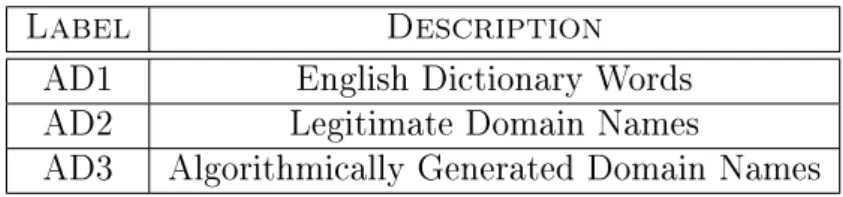
Dictionary words: 10 000 words taken from the Oxford English Dictionary (Oxford University Press, 2011), based on words longer than 6 characters. The dataset is labelled as AD1,
Legitimate domain names: 10 000 domain names from a combination of the Google Doubleclick Ad Planner Top-1000 Most Visited Sites (Google, 2012) and the Alexa Top 10 000 Global Sites list (Alexa, 2012). The combined dataset is labelled as AD2,
Algorithmically generated domain names: 10 000 sample domain names generated by Kraken (Royal, 2008), Torpig (Unmask Parasites, 2009) and Concker-C (Leder and Werner, 2009; Porras et al., 2009). The combined dataset is labelled as AD3.
The training and test data were extracted from these datasets at random with a random selection of 3000 dictionary words, legitimate domain names and algorithmically generated domain names being selected from each dataset. The remaining 7000 samples from each dataset were then used as the test data for measuring classier accuracy.
Table 3.1: Domain Name Data Sources
Label Description
AD1 English Dictionary Words AD2 Legitimate Domain Names
AD3 Algorithmically Generated Domain Names
3.1. DATA DESCRIPTION 24
3.1.2 Fast-Flux Data Sources
Acquiring the data used in the construction and testing of Fast-Flux classiers was par- ticularly dicult. This was due to the nature of Fast-Flux botnets, which dictates rapidly changing variables within the datasets as well as domains frequently being taken oine.
Due to this constant ux the values for each domain feature were captured over the pe- riod that the domains were active and stored for further examination at a later stage.
Classier construction was done using this historical data while testing was performed on live domains when possible and historical data for reference. The collection of data was further hampered by the take-down of multiple botnets during the research period. The re-emergence of the Hlux2 (Garnaeva, 2012) botnet for a limited period of time allowed for the capture of valuable data, however the rapid take-down of this botnet made live testing impossible. The take-down of the ZeuS botnet by Microsoft (Microsoft Corpora- tion, 2012) hampered live testing of the classiers during the later stages of the research, while the emergence of the Citidale variant of ZeuS has led to a recent increase in the number of Fast-Flux botnet domains. A set of 500 domains were randomly selected as training domains, while the remaining 1500 domains were used for testing the classiers accuracy.
The sources of Fast-Flux botnet data were as follows:
ZeuS Tracker (abuse.ch, 2012) produced a set of 238 Fast-Flux domains for the period March 2011 - October 2012. Labelled as FD1.
Spyeye Tracker (abuse.ch, 2011) produced a set of 28 Fast-Flux domains for the period March 2011 - September 2011. Labelled as FD2.
The Hlux2/Kelihos botnet domains acquired from a private source at a large Euro- pean Internet Service Provider consisted of 507 Fast-Flux domains that had been manually classied for the period 23 January 2012 - 1 March 2012. Labelled as FD3.
Arbor ATLAS summary report (Arbor Networks, 2012b) consisted of 674 Fast-Flux domains for the period January 2012 - March 2012. Labelled as FD4.
The total number of Fast-Flux botnet domains in the dataset was 1447, with the combined dataset being divided at random into a set of 400 training domains and 1047 test domains.
The dataset of legitimate domains consisted of the top 2000 domains taken from a merged dataset of the Google Doubleclick Ad Planner Top-1000 Most Visited Sites (Google, 2012)
3.2. LEXICAL FEATURES 25 and the Alexa Top 10000 Global Sites list (Alexa, 2012). The datsets used were labelled with the prex FD with each datasource labelled as FD1, FD2, FD3 and FD4 respectively.
This can be seen in Table 3.2.
Table 3.2: Fast-Flux Data Sources
Label Sample Size (domains) Botnet Family
FD1 238 ZeuS
FD2 28 Spyeye
FD3 507 Hlux2/Kelihos
FD4 674 Unknown
FD5 2000 Legitimate
3.1.3 Live Test Data
Testing of the classiers was performed using DNS trac logged at a large South African university and a local schools network to determine if the classiers were capable of iden- tifying malicious domains not seen anywhere else. The datasets consisted of a pcap dump containing 40 910 498 raw DNS packets. This dataset was labelled as LD1. Accompa- nying this raw pcap dump, a secondary dump of 33 261 575 visited URLs along with timestamps as seen by the web proxy. This dataset was labelled as LD2. To simulate blacklist testing, a set of test data was obtained from MalwareURL (MalwareURL, 2011), containing a listing 254 214 malicious URLs. This dataset has been labelled as LD3. A summary of the datasets used is shown in Table 3.3.
Table 3.3: Live Test Data
LABEL SIZE
LD1 40 910 493 packets LD2 33 261 575 domains LD3 254 214 domains
3.2 Lexical Features
The Domain Name System relies on the mapping of alphanumeric, human-understandable and -memorable addresses to numeric IP addresses. These domain names usually consist of dictionary words or a combination of dictionary words in a memorable sequence. Ran- domly generated domain names are a technique used by botnet creators for ensuring C2
3.2. LEXICAL FEATURES 26 longevity and to protect against the shutdown of C2 domains. These randomly generated domain names need be consistent across the botnet to ensure that all infected hosts con- tact the correct C2 servers. To this end, botnet operators use a class algorithm, known as a Domain Generation Algorithm (DGA), to determine how these domain names are generated. These algorithmically generated domain names tend to exhibit a bias toward certain character distributions depending on how the algorithm was constructed. These character distributions vary greatly from the character distributions found in legitimate dictionary words and thus legitimate domain names (Crawford and Aycock, 2008). Using the lexical features of a domain name, frequency analysis can be performed to determine the distribution patterns for letters in dictionary words, domain names and algorithmi- cally generated domain names. The DGAs have been reverse engineered for numerous botnet families including Torpig (Unmask Parasites, 2009), Concker (Concker Working Group, 2010) and Kraken (Royal, 2008). This process of reverse engineering the DGA is, however, time consuming and tedious (Thomas Barabosch, 2012), hence the need to de- tect this algorithmically. Frequency analysis can be based on single character distribution or on the distribution of character combinations such as ie, ch and qu, known as bigrams.
3.2.1 Frequency Analysis
Establishing a baseline for all comparison is essential in creating eective classiers. Fre- quency analysis was performed on datasets of dictionary words, known legitimate domain names and known algorithmically generated domain names. Frequency analysis was done on single character distributions (unigrams), character combinations (bigrams) and on the distribution of vowels and consonants. The frequency distribution for unigrams for dictionary words, legitimate domain names and algorithmically domain names are shown in Figure 3.1.
As seen in the gure, there is a clear distinction between unigram distribution from legitimate and algorithmically generated domain names. Legitimate domain names tend to follow the same distribution pattern for unigrams as English words. This can be attributed to the fact that the domain names examined are largely taken from the `English Web'. Algorithmically generated domain names follow a similar distribution pattern as a random distribution of unigrams. There is, however, a bias towards certain unigrams, which can be attributed to the pseudorandom nature of DGAs.
Bigram analysis focused on all possible two character groupings for alphanumeric char- acters allowed in domain names. The frequency distribution of these bigrams can be
3.3. LEXICAL CLASSIFIERS 27
Character
Frequency (%)
− 0 1 2 3 4 5 6 7 8 9 a b c d e f g h i j k l m n o p q r s t u v w x y z English
Legitimate
Algorithmically Generated
121086420
Figure 3.1: Frequency Distribution of Unigrams.
seen in Figure 3.2. The gure clearly shows that the bigram frequency for algorithmically generated domain names never exceed 0.3%, while common bigrams from the English language display the same frequency distribution in legitimate domain names. The inset shows the bigram distributions for all combinations of the regular expression [0-9][a-z].
The frequency distributions of the combinations ah, aj, al and others have the identical frequency distributions for legitimate domain names and English words.
3.3 Lexical Classiers
The clear distinction between the frequency distribution of both unigram and bigram characters in algorithmically generated domain names and legitimate domain names lends itself to the idea that highly accurate classiers can be constructed based on the known frequency of character distributions. The problem of identifying a domain name as le- gitimate or algorithmically generated can be seen as a binary problem and thus binary classiers and likelihood ratios were investigated. For the remainder of this section uni- grams and bigrams are collectively referred to as tokens.
28
0 .0 0 .5
1 .0 1 .5
2 .0
Character Combination
Frequ nc y (%
)
0.0 0.5
1.0 1.5
a9 ab ad af ah aj al an ap ar at av ax az aa
Algorithmically Generated
English LegitimateAlgorithmically Generated
English Legitimate aabacadaeafagahaiajaka9a7a8a