1
Impact Evaluation Report of the Women’s Skill Development for Freelancing Marketplaces (WSDFM) Program
Md. Raied Arman Anindita Bhattacharjee
Narayan Das Dipanwita Ghosh
Mohima Gomes Lopita Huq Md. Kamruzzaman
Sakib Mahmood
BRAC Institute of Governance and Development (BIGD) BRAC University
May 2022
2
Acknowledgement
We would like to thank the organizations that provided financial, operational, and other necessary support for this study.
Specifically, we thank Mr Ataul Osmani and Ms Mahzabin Akter from CodersTrust Bangladesh (CTBD) for providing continuous support with program implementation-related information and other support whenever required.
We are grateful to colleagues from the BRAC Institute of Governance and Development (BIGD), particularly Dr Imran Matin and Mrs Nusrat Jahan, for their valuable suggestions. We also thank Mr Mehid Hasan Munna for copyediting this report meticulously.
3
Table of Contents
Executive Summary……….……….5
List of Tables ... 5
List of Figures ... 6
List of Boxes ... 7
List of Acronyms ... 8
1. Introduction ... 15
1.1. Theory of Change ... 17
2. WSDFM Project Overview ... 17
3. Methodology ... 18
3.1. Quantitative Methodology ... 19
3.1.1. Evaluation Design ... 19
3.1.2. Data Collection ... 20
3.2. Qualitative Methodology ... 21
4. Descriptive Statistics (Quantitative) ... 23
4.1. Baseline Characteristics ... 23
4.2. Baseline Equivalence ... 25
4.3. Attrition ... 26
4.4. Targeting Criteria ... 27
4.5. Training Uptake ... 28
4.6. Income and Employment ... 31
5. Findings... 39
5.1. Quantitative Findings ... 39
5.1.1. Impact on Employment and Income ... 40
5.1.2. Impact on Communication and Software Application Skills ... 41
5.1.3. Impact on Food and Non-food Expenditure ... 43
5.1.4. Impact on Financial Assets ... 43
5.1.5. Impact on Women Empowerment ... 44
5.1.6. Impact on Confidence and Aspiration... 45
5.1.7. Impact on Lifestyle and Psychological Well-Being ... 47
5.1.8. Impact on Perception and Knowledge of Freelancing ... 49
5.1.9. Some Additional Impact Analyses ... 50
4
5.1.10. Quantitative Findings: Summary ... 50
5.2. Qualitative Findings ... 52
5.2.1. Process Documentation ... 52
5.2.2. Brief Description of Study Participants ... 59
5.2.3. Comparative Analysis of Skills and Capabilities ... 61
5.2.4. A Comparative Analysis between Participants ... 65
5.2.5. Overall Challenges and Overcoming Them ... 68
5.2.6. On the Issue of Sustainability ... 73
5.2.7. Qualitative Findings: Summary ... 78
6. Conclusion ... 78
7. Recommendations ... 80
References ... 84
Appendix A ... 86
Appendix B ... 91
5
List of Tables
Table 1: Baseline Characteristics ... 24
Table 2: Equivalence of Treatment and Control Groups (Baseline Observations) ... 25
Table 3: Equivalence of Treatment and Control Groups (Follow-Up Observations) ... 26
Table 4: Employment and Income (Aggregate) ... 40
Table 5: Employment and Income (Segregated) ... 40
Table 6: Skills in Software Applications ... 42
Table 7: Skills in English ... 43
Table 8: Household Expenditure... 43
Table 9: Loan Statistics ... 44
Table 10: Savings Statistics ... 44
Table 11: Women Empowerment ... 45
Table 12: Self-Confidence ... 46
Table 13: Aspiration ... 46
Table 14: Lifestyle and Psychological Well-Being ... 48
Table 15: Perception and Knowledge of Online Freelancing ... 49
Table 16: Segments, Class Counts, and Total Hours of Graphic Design Course ... 59
Table 17: Segments, Class Counts, and Total Hours of Digital Marketing Course ... 59
6
List of Figures
Figure 1: Sample Selection Flow Diagram ... 20
Figure 2: Age Distribution of Respondents ... 27
Figure 3: Education Level of Respondents ... 28
Figure 4: Percentage of Respondents Attending Class ... 29
Figure 5: Percentage of Respondents Attending Advising Sessions... 29
Figure 6: Training Uptake of Respondents Based on Marital Status ... 30
Figure 7: Training Uptake of Respondents Based on Schooling Status ... 31
Figure 8: Employment Status of Respondents ... 32
Figure 9: Hours Worked per Day by Respondents ... 32
Figure 10: Average Monthly Earnings (BDT) of Respondents ... 33
Figure 11: Employment in Freelancing Among Respondents ... 33
Figure 12: Hours Spent per Day in Freelancing by Respondents ... 34
Figure 13: Respondents’ Average Monthly Earnings (BDT) From Freelancing ... 35
Figure 14: Hours Spent per Day on Other Income-Generating Activities by Respondents ... 36
Figure 15: Respondents’ Average Monthly Earnings (BDT) From Other Income-Generating Activities . 37 Figure 16: Hours Spent per Day by Respondents in Freelancing and Non-Freelancing Activities (Uptake and Advising Comparison) ... 38
Figure 17: Average Monthly Earnings (BDT) of Respondents (Uptake and Advising Comparison) ... 38
Figure 18: Recruitment Process ... 52
Figure 19: Training Process ... 57
7
List of Boxes
Box 1: Qualitative Insights: Spillover Effects on Income and Employment ... 41
Box 2: Qualitative Insights: English and Communication Skills ... 42
Box 3: Qualitative Insights: Decision-Making Capabilities ... 45
Box 4: Qualitative Insights: Time Allocation ... 48
8
List of Acronyms
2SLS two-stage least squares
BIGD BRAC Institute of Governance and Development
CPI consumer price index
CSE Computer Science Engineering
CTBD CodersTrust Bangladesh
DM Digital Marketing
FGD focus group discussion
GD Graphic Design
HIES Household Income and Expenditure Survey ICT information and communications technology
IDI in-depth interview
IT information technology
ITT intention to treat
IV instrumental variable
NEET not in education, employment, or training
NGO non-governmental organization
PWD person with disability
RCT randomized controlled trial
ROI returns on investment
SD standard deviation
SDG Sustainable Development Goal
SEO search engine optimization
SSC Secondary School Certificate
TOT treatment on the treated
WRS Web Research and Support
WSDFM Women’s Skills Development for Freelancing Marketplaces
9
Executive Summary
Introduction
The world of work is going through a sea-change. Technology is consuming an ever-growing share of jobs traditionally done by humans and simultaneously churning out tech-focused new occupations. Of them, online freelancing—selling skills online, in the simplest terms—has quite literally opened a new world of opportunities for young people today. Online freelancing is particularly promising for the youth in developing countries as it does not need academic credentials, contacts, or a substantial investment. It allows anyone with little more than basic English and average cognitive capabilities to learn necessary skills and just with hard work, a working computer, and reliable internet potentially establish a sustainable income source in the global online marketplace. Moreover, because online freelancing can be done from home and at flexible hours, it could be a viable income source for educated, underprivileged young women, who face additional constraints in working outside, like restricted mobility and the extra burden of household work.
Bangladesh has a large population of unemployed, educated, underprivileged young women.
Realizing the potential of online freelancing in women’s economic empowerment, to provide decent online employment opportunities for underprivileged women, CodersTrust Bangladesh (CTBD), with funding from a private philanthropy based in the Netherlands, implemented the project titled “Women’s Skills Development for Freelancing Marketplaces (WSDFM).” In this project, participants received information and communications technology (ICT)-related training and post-training mentorship with financial support from a donor. The intervention was implemented in four branches of CTBD across Dhaka, and the support package was provided to 1,000 individuals meeting the targeting criteria. Among the two targeting criteria, the first criterion was a minimum educational qualification of the Secondary School Certificate (SSC) and the second criterion was an age range of 18–35 years.
The BRAC Institute of Governance and Development (BIGD), BRAC University, conducted this research to measure the impact of the program on the income, employment, confidence, aspiration, empowerment, skills, and lifestyle of the participants. It also explores the project implementation process and the underlying factors behind the success and failure of the participating women.
Methodology
To evaluate the impact of the program, BIGD conducted a mixed-method study, a combination of quantitative and qualitative methods. A randomized controlled trial (RCT) was conducted for the quantitative analysis . The RCT focused on evaluating the impact on specific outcomes of interest. There was a baseline and a follow-up survey. The baseline survey was conducted on 833 respondents from October 2019 to December 2020. Of these 833 respondents, 425 were from the treatment group and 408 from the control group. In the follow-up survey, conducted from November 2021 to December 2021, 599 individuals could be surveyed; of them, 298 were from the treatment group, while 301 were from the control group.
For qualitative analysis, one in-depth interview (IDI) with the participants at the very beginning of the training and another one at the end of their career placement period were conducted, with a focus group discussion (FGD) conducted between the end of the training and the beginning of the career advising period.
It should be noted that brief follow-up interviews were also conducted because some of the participants mentioned facing challenges in adapting to online classes in the first IDI and some of them also showed
10 indications of dropping out. Qualitative research was carried out with a total number of 29 participants: 15 trainees of the Graphic Design (GD) course and 14 trainees of the Digital Marketing (DM) course.
Both the methods were used with specific objectives and were not conducted to fully complement each other. The quantitative method was used solely for impact evaluation, whereas the qualitative method was used for process documentation and to understand the in-depth mechanisms of the project. In this report, the findings from the study are revealed and discussed separately for each method.
Quantitative Findings
The objective of the quantitative analyses was to check the targeting accuracy and to estimate the impact of the intervention on various outcomes of interest. The baseline survey data showed that the targeting was quite successful. For the educational qualification criterion, a 100% targeting success and for the age criterion, a 95% success have been found among the surveyed observations at baseline.
In the impact evaluation based on follow-up survey data, a large impact could be found on labour market outcomes such as employment (26% increase), hours worked (42% increase), and income (54% increase).
This shows that more females from the treatment group were employed and had higher productivity. As a result, they are earning more as well. These changes are largely due to increased participation in freelancing which could be observed in the 184%, 168%, and 169% increases in employment, hours worked, and income, respectively, from freelancing. Since this was a freelancing training, the treatment group was seen to be more actively involved in freelancing and earning more from it as well. The impact was much stronger on those taking more classes. For those who took at least 25 of the total 48 classes, the rate of freelancing employment was 42%, while the rate was 21% for those taking 11–24 classes and just 16% for those taking even fewer classes (the rate in the control group was 12%). Similarly, their income from freelancing was much higher, BDT 2,500 per month, which was BDT 2,083 and BDT 643, respectively, for the other two groups (BDT 778 in the control group).
As for other indicators, since the intervention is training on freelancing based on computer software applications, as expected, skills in computer applications of different categories have all had positive impacts. These enhanced skills have had some positive spillover effects on income—a 38% increase—from non-freelancing activities. With the higher income, consumption expenditures of the respondents also got higher: food and non-food expenditures have increased by 48% and 41%, respectively, which can be interpreted as a lasting impact of the intervention since these increased expenditures potentially have positive implications on human capital. Financial market participation has had some positive impacts too—
the percentage of participants having loans has decreased, while that of having savings has increased. Even though no significant impact could be observed in confidence and aspiration, the evaluation shows a significant impact on some women empowerment indicators with mixed outcomes. The psychological well- being of the participants also increased, and finally, expectedly, knowledge about freelancing increased by 12% due to the intervention.
The uptake, i.e., participation rate of the program was not very high: 55% of the participants took at least half of the classes, while just a quarter of them took all the classes. The uptake of the advising sessions was extremely low. From this, we can state that with higher uptake of the training and mentoring sessions, the magnitude of the impact would be even higher.
11 The idea that mentorship is essential to earning potential was one of the main assumptions underlying the project design. Therefore, under the topic of effectiveness, a key question was to single out which element (i.e., training or mentoring) of the intervention was more effective. On this, a direct comparison between the two was not possible as there was a lack of samples due to low uptake of the mentorship element.
However, both the qualitative and quantitative findings indicate that when classroom training is complemented with mentoring, the outcomes further improve.
To sum up, all these findings indicate towards a successful intervention that has managed to meet the primary objective of impacting the labour market outcomes. Had there been no disruption due to COVID- 19 and had there been a higher uptake, the magnitude, at least on the labour market outcomes (and closely correlated outcomes such as consumption and financial market participation), would have been higher. The ambiguous effect on empowerment or the muted effect on confidence and aspiration has occurred due to the socioeconomic context of the participants than the intervention design; but even then, further fine-tuning of the intervention model can be thought of to address such issues by being inclusive. Some of the quantitative findings are complemented by insights from the qualitative analyses.
Qualitative Findings
The qualitative analyses focused primarily on process documentation of the intervention which led to looking into the positives and negatives of the intervention based on the experience of the participants and observation of each step of the intervention procedures. Through a comparative analysis, an attempt was made to analyze any patterns amongst those who succeeded and those who did not. One of the main reasons singled out by the training participants for not engaging in or not continuing in freelancing is the amount of time that needs to be invested in order to be successful. Most of the trainees had to manage their household chores and caregiving responsibilities and find time around them to attend the training classes.
Trainees shared about attention deficiency or distractions in online classes due to household issues, responsibilities, and events. A second reason was the need for sustained communication with the buyers in English. Some of the participants felt that their English was not adequate to maintain communication with buyers, represent themselves, or negotiate appropriately to compete effectively. Thirdly, some trainees did not receive moral support from their parents and had to go against their will to attend the training. They stated that if they had received their parents’ support, they could have learned better from the training. For some trainees, the challenge to convince their families was to show earnings from freelancing. Fourth, running the necessary software smoothly required computers with considerably high configurations which were not affordable and available for many trainees.
On the other hand, participants able to do and continue freelancing could invest the requisite time and effort for this work. This was evident among those who could manage household chores and responsibilities as well as time for work. It is not just time that is the enabling factor, but also the family support that is key for women to do freelancing from home. A second reason why some could successfully engage in freelancing was the referrals and linkages of their friends and family members to find jobs in the national freelancing market. A third reason given by the participants was their academic background or English language skills that gave them an edge over others to negotiate and sell their skills. Finally, a number of participants also acknowledged the support they received from their mentors and their peers to improve and persevere. Graduates actively working in the field were expecting to earn more from their work. Part of the reason they fail to do so is their inability to crack the international marketplace. The demand for jobs in the
12 freelance marketplaces is very high, but so is the competition. Both technical and soft skills are necessary to gain a good assessment of the buyer. A trainee may have to wait months before landing her first job.
Disruption due to COVID-19
COVID-19 shock was one of the challenges faced by the participants. Many of the participants and the households they belong to suffered a loss or reduction in incomes, which affected participants’ health, their ability to participate in the training, training performance, and their eventual gain from the training. Due to financial constraints, buying mobile data to attend online classes, repairing their existing computer/laptop to continue attending classes, or buying a new computer/laptop with sufficient technical configurations for the classes were added burdens for many trainees.
Keeping the income shock and connectivity issues aside, one could expect online classes to be more practical for the women because they would not have to travel, saving time and money and avoiding the stresses that come with travelling as women. But it turned out that many failed to take classes uninterruptedly from home. They complained that their family members did not take their classes seriously and came up with frequent demands to do something else during the classes. It is easy to imagine that they probably did not manage to practice much beyond the classes.
Given the small sample size of the quantitative study, we cannot determine the exact impact of COVID-19 on the beneficiaries, but from the observations and qualitative insights, we can infer that the magnitude of the program’s impact would certainly have been higher had there been no disruption due to COVID-19.
Conclusion and Recommendations
In this evaluation, we find that regular participation in a freelancing training program can have a strong impact on the economic empowerment of educated, underprivileged women. These findings have given us insights into various aspects of the intervention.
First, one of the main binding constraints for the females is time. It is clear that many family members expect monetary returns too early and are not willing to allow aspiring freelancers enough time to invest in building their skills and portfolios. Before enrolling, many participants themselves believed that they would be able to earn regularly from freelancing without compromising their daily routine; in other words, freelancing would not require too much time. As we can see, the reality turned out to be very different. In fact, those who were successful were found to be spending significantly longer hours in productive work without reducing their engagement with childcare, chores, etc. So, it is important to give this reality check to applicants so that they can make an informed decision.
An insight related to programmatic implementation that came out of our study is that underprivileged women may need a more compassionate attitude, intensive care, and handholding from the instructors because of the nature of their struggle—limited English and computer skills and low confidence. Perhaps the programs can be spread out over a longer period to accommodate their busy schedule and hold physical classes to give them the mental space to learn better.
As for harmful effects of the intervention, there has not been any such findings significant enough to be labelled as harmful. Some findings which can potentially appear as harmful effects found in the qualitative exploration are: drop in confidence, and lack of support faced from family members. However, quantitatively, we did not see any significant negative impact on participants’ confidence or
13 psychological wellbeing. Rather, we found significant positive impact on psychological wellbeing indicators of the respondents. So, we cannot claim there to be any harmful effects of the training within the scope of this research.
Despite all the constraints, many participants of the program became successful, particularly in the local freelancing market, as evidenced in the RCT. Freelancing trainings can surely be a path towards the economic empowerment of educated underprivileged women in Bangladeshi and elsewhere. To be most successful, any program must be designed with an appreciation of the struggles and limitations that these women face.
From a broader labour market perspective, to address the gender wage and employment gap in the labour market of Bangladesh, freelancing can be considered as a potential channel, and such interventions as the one offered in WSDFM can provide a big boost in this aspect, as can be observed from our findings. We think this model can be scaled up in both size and scope to effectively employ not only women but also unemployed educated youth and those who have fallen behind in the labour market, such as the disabled, the transgender etc., in the field of online freelancing.
For the effective scaling-up of this program, three major areas need to be focused on: the creation of inclusive demand, sustained marketplace participation, and financial inclusion. The study findings show strong labour market implications through increased employment, productivity, and income. Therefore, the inclusion of the groups that lag behind in the labour market, such as disabled people, females, transgender, and those not in education, employment, or training (NEET), have high potential returns on investment (ROI). In that light, demand creation among these groups can be very fruitful.
The Second component is ensuring sustained marketplace participation from the supply side. Bangladesh has the second highest number of registered freelancers, but a very small percentage of active participants.
In order to ensure sustainable take-up of freelancing training, the reasons for fallout from freelancing need to be identified. Training institutes need to incorporate modifications in the targeting process, selection process, and training courses.
Lastly, a feasible financing model or scheme is required to ensure a compact supply-demand eco-system, which can play a significant role and be a win-win for both the financial institutions and the participants.
Here, we have listed a few key recommmendations that can support effective scaling-up of this program according to three groups: implementers, participants, and policymakers.
Recommendations for Implementers
• Sharpen the targeting process to evaluate each applicant based on their innate abilities and skills.
• Customize courses to serve different groups of people and according to the trainee’s needs and skill set.
• Emphasize providing additional skills and knowledge necessary for the effective applicability of the skills earned through the training.
• Teach the good and bad practices in the online marketplace.
• Provide sufficient support to weaker students and ensure a hospitable environment.
• Adopt efficient marketing strategies.
14 Recommendations for Participants
• Make informed decisions about the training institute and work opportunities before joining the training program.
• Actively participate in the freelancing platforms and follow good practices.
• Improve bargaining skills and aim for higher payments.
• Explore the diverse opportunities and facilities that are available for freelancing.
Recommendations for Policymakers
• Support inclusive demand creation for online freelancing among those who are lagging behind in the labour market.
• Ensure that online freelancing gets the necessary social validation.
• Ensure the quality of the training centres through strong regulation policies and licensing system.
• Reduce the tariff barriers on necessary devices for online freelancing.
• Support more research on skill development programs in freelancing.
• Build evidence-based models to efficiently scale up the programs and increase their effectiveness.
• Introduce a feasible financing model or scheme to ensure a stable supply-demand ecosystem.
• Smoothen international monetary transaction to reduce friction in receipt of payments.
15
1. Introduction
The world is constantly achieving new milestones and breaking records in technology and advancement, yet gender disparity and inequality persist on a disproportionately large scale relative to the advances.
Among the multiple areas, one of the most prominent areas where gender disparity persists in is the labour market. Globally, less than one of every two women participate in the labour market, whereas, for men, the ratio is three out of four (World Bank, 2020). Although engaging in the labour market does not necessarily imply greater well-being (Jayachandran, 2020), for women, paid employment often leads to increased autonomy and influence within a household and society (Sen & Tinker, 1990). This can lead to improved and more equal outcomes in the other domains of life and help with empowerment in the process.
Bangladesh has ranked 50th out of 153 countries in the Global Gender Gap Report 2020, and has consolidated its position as a top performer among the South Asian economies (World Economic Forum, 2020). However, women in Bangladesh still face discriminatory behaviour; among them, the underprivileged women suffer even more in dimensions such as domestic violence (Ashrafun, 2018).
Moreover, in terms of economic participation and opportunity, Bangladesh ranks 141st out of 153 countries (World Economic Forum, 2020). Many of those women who are already part of the labour force work under poor conditions in the informal sector and face gender discrimination and workplace harassment. An increased labour market participation of women can play a pivotal role in mitigating this gap. And a potential pathway through which women can be introduced into the labour market is online freelancing.
In the field of freelancing, Bangladesh has already claimed a place. Oxford Internet Institute declared Bangladesh as second in the world after India in supplying online labour (“Oxford: Bangladesh Second Largest Source of Online Workers,” 2017). As of 2017, Bangladesh accounts for 16.8% of the global market share, with around 650,000 registered freelancers (Ovi, 2017). This platform and reputation have already created an adequate acceptance for Bangladeshi online workers worldwide. This can be capitalized on to introduce well-trained underprivileged women into the freelancing marketplace.
In the context of Bangladesh and other similar economies, women face various barriers to physically attending the office, such as commuting issues, security concerns, household responsibilities, and workplace harassment, to name a few. The nature of online freelancing provides women with the opportunity to work from home, enabling them to get around all these potential drawbacks of in-person office-related jobs.
Freelancing can contribute to the country’s economic growth through various routes. It is a potential source of significant volumes of foreign exchange for Bangladesh, a country that runs a current account deficit and meets the deficit primarily through remittance earnings. It is also an excellent way to introduce the large young population to the high-skilled service sector without considerable investment. But unfortunately, like many other technical jobs, women’s participation in online freelancing in Bangladesh is relatively low, where they only represent 9% of all registered freelancers (Raysa, 2021).
In this context, a private philanthropy based in the Netherlands has come forward with a project in collaboration with CodersTrust Bangladesh (CTBD)—an international company that specializes in providing information and communications technology (ICT)-related training—as the implementation partner. Titled “Women’s Skills Development for Freelancing Marketplaces (WSDFM),” the project’s main objective is to create decent job opportunities for underprivileged young women through online
16 employment. The support package offered to the target participants provides free ICT-related training and post-training mentorship. The organization has aligned the goal of the project with the Bangladesh Government’s vision for equal employment of women in ICT by 2030, which is in line with the Sustainable Development Goal (SDG) Target 8.5 which aims to “Achieve full and productive employment and decent work for all women and men.” It is also intended to play a role in attaining the government’s goal of translating the vision of “Digital Bangladesh” into reality.
The project aimed to develop 1,000 young underprivileged women into freelancers by providing them free training on different ICT-related skills and build their confidence through post-training technical mentorship and career advising support. CTBD conducted the training and post-training mentorship. There were particular targeting criteria for the participants to be eligible, and only the eligible participants were given the training and post-training mentorship. Then the selected eligible candidates were provided with the support package. Further details about the program are discussed in Section 2.
To evaluate the impact of the program, the BRAC Institute of Governance and Development (BIGD), BRAC University, conducted a mixed-method study, a combination of quantitative and qualitative methods. BIGD conducted a randomized controlled trial (RCT) for quantitative analyses at the individual level. Process documentation, in-depth interviews (IDIs), focus group discussions (FGDs), and class observations have been carried out for the qualitative analyses. The key objective of the evaluation was to generate key learnings about the effectiveness and sustainability of the intervention. Under the two overarching objectives, the following questions have been looked into in this evaluation report:
- Is the intervention able to reach, select, and include women from the target group (i.e., young women from underprivileged backgrounds)? That is, to what extent do the participants represent members of the target group?
- Is the intervention (i.e., training and mentoring) able to generate the projected outcomes (i.e., increased knowledge, skills, professional portfolios on freelancing marketplaces, income, job security, etc.) among the participants?
- What confidence do we have that the intervention generated the observed (positive) changes in outcomes among the participants? Are there any externalities of the intervention?
- Which elements from the intervention (i.e., training and mentoring) are generating most of the change in outcomes? That is, are some elements of the intervention more effective than others?
- To what extent is the intervention able to generate lasting change in the outcomes among the participants? Again, are there any externalities in attitude, such as changes in self-belief, confidence in employability (even in more traditional jobs), etc.?
- What barriers, opportunities, and challenges are faced by the participants in generating lasting change in the outcomes (e.g., in getting stable employment)? What needs to improve or what further support is required in case desired changes were not achieved?
The purpose of this report is to discuss the impact through answering the above questions. The main findings show a significant increase in employment and income, contributed by increased employment and income in freelancing. There is a significant impact on freelancing-related skills as well. As for externalities, a potential increase in human capital through increased communication skills and increased food and non-
17 food expenditure was observed, while no significant impact was noted on lifestyle, confidence, and empowerment aspects. The training classes seem to be the more effective of the two intervention elements.
Some of the key challenges faced by the participants include COVID-19 shock, hardware and software accessibility struggles, challenges in bidding and negotiation in the marketplace, societal and family barriers, etc. Findings also show that the targeting criteria have been closely met.
The next section briefly discusses the theory of change. Section 2 provides an overview of the program and describes the project intervention. Going forward, Section 3 elaborates on the evaluation design and methodology; the first half of Section 3 explains the quantitative methodology and the second half explains the qualitative methodology. Descriptive statistics are given in Section 4, where subsections on baseline characteristics of the respondents, baseline and follow-up equivalence, attrition, target criteria, training uptake, and key outcome indicators (income and employment) can be found. Finally, Section 5 lays out the findings in two key subparts: quantitative and qualitative findings. The report ends with concluding remarks from the research team in Section 6.
1.1. Theory of Change
There are a number of ways in which education and training might influence labour market outcomes (employment, earnings, and labour productivity). The first is that education and training impart human capital in the form of observable and unobservable skills which raise employability, productivity, and wage (Card, 1999). Since training imparts practical skills, it may increase trainees’ human capital and productivity. Krueger and Lindahl (2001) further assert that investment in human capital can be the key to macroeconomic growth. Sufficient credit is not available for disadvantaged youth to obtain the appropriate training on their own despite their need for this training (Jensen, 2010). It is thus expected that subsidized training, such as the WSDFM program, will increase human capital, thereby increasing earnings.
The second channel is linked to inefficient information flows and significant labour market frictions. Youth may encounter difficulties in employment if they do not receive training, as employers may be unsure of their abilities (Altonji & Pierret, 2001; Farber & Gibbons, 1996; Pallais, 2014). As a result, even if there are open positions in businesses, unemployment may occur. Evidence of the difficulty for small firms to fill vacant positions, despite unemployment, has, for example, been shown for Ghana by Hardy and McCasland (2015). The fact that the WSDFM program participants will have certificates of completion means that the program will help mitigate the information gap to an extent for the participants.
Theoretically, well-connected workers are likely to fare better than those that are poorly connected (Montgomery, 1991). The career advising sessions conducted by CTBD under the project may potentially offer some networking possibilities; hence, this is a third channel through which the labour market outcomes can be affected by the project.
In short, based on the discussion above, we can conclude that these are the routes we expect the program to impact the labour market outcomes of the program participants.
2. WSDFM Project Overview
CTBD is an international company specializing in providing a combined online “Learn and Earn” platform for freelancers. They offer both training on skillsets necessary for online freelancing and post-training
18 mentorship. The training and mentorship enable the trainees to learn and upgrade their skills to earn more money on freelance portals, hence the term “Learn and Earn.” The company charges a fee for its services.
Under the WSDFM project, CTBD developed 1,000 underprivileged women into freelancers by training them on ICT courses and building their confidence through post-training technical mentorship and career advising support. The tuition and mentorship fees for all the 1,000 participants have been provided by a donor organization. So, in practice, the 1,000 participants got their services for free.
The target group consists of Bangladeshi females who are underprivileged and are aged between 18 and 35, with a minimum qualification of a Secondary School Certificate (SSC). Getting to know about the program through online or in-campus advertisement, a good number of applicants who met the criteria and were eligible applied for the program. The applicants meeting the criteria were then evaluated through a selection process and the best performers in the selection tests were selected. Their selection process consisted of three phases: (i) a written test, (ii) a computer literacy/efficiency test, and (iii) an interview.
The training spanned over four months. Every week, there were three classes, with each class having a duration of four hours. A total of 50 lectures were covered in four months for a combined total of 200 hours (192 hours of class sessions and 8 hours of examination) of training provided to a participant. The classroom sessions provided both theoretical and practical training. There were three different courses offered to the participants: Graphic Design (GD), Digital Marketing (DM), and Web Research and Support (WRS). The training was conducted in four branches of CTBD across Dhaka, the capital of Bangladesh.
After the training was over, the monitoring portion of the project began. The trainees were mentored and monitored for three months after the classroom training. In this phase, participants were given tips and support on developing their professional profiles in at least two of the top four freelancing platforms. Then, they were given on-the-job guidance in their first few assignments. The participants were also provided career advice on freelancing in this phase. The purpose of this mentoring phase was to properly induce trained participants into the freelancing marketplace and make them self-sufficient in the market.
Besides the capacity-building of participants, the project partnered with 20 educational institutions to build a culture of freelancing among women. This has been done to raise awareness among the target population about young women’s economic empowerment through freelancing.
The project aimed to achieve the following outcomes:
1) women trained in freelancing jobs have established their profiles on online platforms as experts, 2) women have secured regular jobs online and are earning more due to better skills matching, 3) young women are more career-focused and understand the market opportunities in freelancing, 4) change in perceptions that online freelancing jobs are suitable career options for women as opposed
to prevailing perceptions that they are not, and
5) increase the number and visibility of women in the ICT sector to potentially trigger a multiplier effect over the medium to long run.
3. Methodology
This was a mixed-method study that used both quantitative and qualitative methods with different objectives. Quantitative method was used solely for impact evaluation of the labour market outcomes and indicators on women empowerment, confidence, aspiration, lifestyle, and psychological well-being. On the
19 other hand, qualitative method was used mainly for process documentation and to understand the in-depth mechanisms and features of the project. In mixed-method studies, sometimes qualitative findings can be used to support or explain some of the quantitative findings. Yet, since in this study, both methods were used with completely different objectives and were not conducted to fully comprehend each other, the methods and findings must be separately discussed and identified.
3.1. Quantitative Methodology
For a quantitative assessment of the program, we conducted an RCT. Data were collected using a questionnaire-based survey.
3.1.1. Evaluation Design
The power calculation showed that assuming an effect size of 0.20 standard deviation (SD), a sample of 900 individuals would be enough to detect the effect with a power of 0.85. Hence, we requested CTBD to provide us with a list of 900 eligible individuals they shortlisted based on a series of tests. Then, 450 randomly selected individuals were assigned to the treatment group and provided with the program benefits (i.e., free training and mentorship). The remaining 450 did not receive the program benefits and served as the control or comparison group. This design allows us to compare the outcomes between the treatment and control groups.
However, under the WSDFM program, CTBD was required to provide training to a total of 1,000 candidates, meaning an additional 550 individuals were also trained alongside the samples of the treatment group from the RCT. These 550 individuals were part of the program but were not part of the impact evaluation. So, in practice, from all the primarily selected candidates, CTBD initially randomly selected a portion and sent the list to BIGD for randomization. The remaining eligible candidates, who were thus randomly not selected for the experiment, were directly enrolled into the program. The flow diagram (Figure 1) below visualizes the randomization process.
20 Figure 1: Sample Selection Flow Diagram
Of the candidates who applied and passed the three evaluation tests to prove themselves eligible to receive training, BIGD randomly assigned half to the treatment group and the other half to control. Training on freelancing was given only to those who were part of the treatment group. This method made sure that the participants of the two groups were homogenous, as all of them were selected by CTBD and eligible for receiving the training.
This whole process was repeated several times till the desired number of participants was achieved. It took one year to reach the target of 900 individuals. This was done in a sequential phase-by-phase method due to operational and logistical issues, since enrolling such a big number of participants all at once and training them together was not operationally feasible for the implementing organization.
3.1.2. Data Collection
A detailed questionnaire-based data collection was conducted for this study. The baseline survey was conducted from October 2019 to December 2020. The survey covered 833 individuals; of these individuals, 425 were from the treatment group and 408 from the control group. A point worth mentioning is that during the baseline survey in March 2020, the COVID-19 pandemic hit Bangladesh and due to COVID-19 safety protocols, the remaining participants were surveyed through phone calls. At baseline, a total of 376 participants were surveyed in person and 457 were surveyed over the phone. The treatment participants started receiving their training after their respective baseline surveys were complete.
The follow-up survey was conducted from November 2021 to December 2021. This survey covered 599 individuals, 301 of whom were from the control group and 298 were from the treatment group. During the baseline, with the intervention not yet rolled out, there was relatively more enthusiasm and excitement about it among the participants. As a result, the response rate was higher at baseline compared to follow-up.
Randomly selected candidates for RCT
[n = 900]
Treatment group [n = 450] Control group [n = 450]
Shortlisted candidates [n> = 1,450]
Randomly selected candidates for direct enrollment [n = 550]
Randomization
21 Again, due to COVID-19, some of the respondents refused to participate in in-person surveys and preferred to be surveyed over the phone. In total, out of these 599 individuals, 226 were surveyed over the phone.
We checked for any difference in household characteristics between the participants of the phone survey and the in-person survey, and no significant difference was found. Based on information from the follow- up survey, the impact of the program is evaluated in this report.
The project and its quantitative impact evaluation were both designed before the COVID-19 outbreak. The first confirmed case of COVID-19 was detected in Bangladesh on 8 March 2020, and government-imposed lockdowns followed after a few days of it. Unquestionably, the economy of Bangladesh faced huge difficulties due to the pandemic. As a result, the livelihoods of people were affected on a massive scale.
This COVID-19 shock hit amid the project rollout. Since this unpredictable and unaccounted problem occurred amid the project rollout, this brings into question if the pandemic shock affected the impact evaluation results. In this context, since the quantitative impact evaluation was performed using an RCT, the study had two comparison groups (treatment and control). Based on our RCT assumptions, both groups were randomly selected and hence comparably similar. If either one group is affected due to the COVID- 19 shock, the other group will be affected similarly. Hence, the impact that is drawn by comparing both groups was not affected by the COVID-19 shock. As a result, the quantitative findings have strong internal validity. On the contrary, the magnitude of the impact could have been different (higher or lower) in a non- pandemic context. This weakens the external validity of the study. But again, these are only our inferences, and they are not backed by strong evidence.
3.2. Qualitative Methodology
The qualitative research has two main foci:
1) the training process—in order to understand how the training facilitates or obstructs the participation and utilization of the training by the young women, and
2) the training participants—to understand income-earning opportunities, particular constraints, and household dynamics experienced by underprivileged young women who take the training.
In order to address these points, the methodology adopted was:
1) Process documentation through observation, participation, and interviews: This activity involved documenting the entire training process, beginning with (a) outreach to potential participants (activities/campaigns held by CTBD for recruitment; (b) method and criteria for selection; (c) process of recruitment; (d) actual training period, including group dynamics and participation of trainees; and (d) post-training and mentorship period.
2) IDIs with selected participants: The research targeted 30 training participants for in-depth study over the course of training and apprenticeship. The research plan was to select 10 respondents in three phases over the research period based on their marital status and educational background and hold three interviews with them during the pre-training, post-training, and post-apprenticeship phases. It was expected that we would be able to explore cases of those who successfully complete training and gain mentorship and those who struggle with the training and/or with their apprenticeship, and analyze the cases of those who are able to attract income-earning opportunities
22 and those who cannot. The plan was also to try and understand which types of participants are likely to drop out and why.
3) FGDs: The research expected to conduct FGDs with the training participants. The FGDs were to be held with 8–10 “good” performing trainees and 8–10 “struggling” trainees based on variables for their performance assessment included in the survey, their portfolio ratings, as well as our classroom observations during the process documentation, in order to explore the research questions. A further round of FGDs was planned to be conducted at the end of their mentorship separately with those who successfully get stable employment and those who fail to do so.
4) Class observations: Class observations are part of the process documentation, but are highlighted as a specific tool to study the training sessions, performance of the mentors, participation of the trainees, and the group dynamics between mentors and participants.
Modifications to the Methodology and Challenges Posed by COVID-19 Change from three batches studying three courses to two batches studying two courses:
We aimed to select 10 training participants in three phases over the research period based on their marital status and educational background. Each phase was to study the batch taking a specific training: GD, DM, and WRS. However, discussions with CTBD revealed that students were mainly interested in two courses:
GD and DM. They did not find a sufficient number of candidates to start the WRS course. As a result, the research concentrated on two batches of 15 training participants each.
Delays due to COVID-19:
Due to the onset of the COVID-19 pandemic, all kinds of activities of CTBD were put on hold along with the qualitative research. CTBD took the prompt decision to continue with the ready batches by providing online training. This transition from offline to online training took a little over a month to operationalize.
The first online batch of GD (which this research followed) commenced on 15 April 2020.
Change in research plan due to online training:
There were two major changes in the methodology as an impact of COVID-19 and the response of CTBD to it. The initial plan was to perform face-to-face interviews with participants and observe training sessions by attending classes physically. However, since all training sessions were changed to online training sessions, the research team was no longer able to attend physical classes to observe the classes or interact and build rapport with participants or have any face-to-face interactions with them, especially during IDIs.
Instead, training sessions were observed via online platforms, such as Zoom and Google meet, IDIs were conducted over the telephone, and FGDs were held over Google Meet.
These changes were discussed with the donor and agreed upon. At first, it was decided that we would study the online training process for the first batch (GD) and study the offline or face-to-face training once such classes resumed for the second batch (DM). This comparison would add a further dimension to our assessment of the process by examining the advantages and disadvantages of online and offline training.
However, during the last quarter of 2020 when the COVID-19 situation did not change, CTBD decided to continue with online training. Discussions were held with the donor, and the implications of the delays were analyzed. It was then decided on 15 September 2020 that the other batch would also be studied online.
However, the research team had to wait for a while before CTBD had sufficient participants to start a batch on DM. Consequently, research on the DM batch did not start before 7 December 2020.
23 Adjustments to methodology to adapt to online training:
Because of the COVID-19 situation, a change in methodology was required. First, classes were observed online instead of face-to-face. This meant obtaining a schedule for the classes, contacting the mentor ahead of time to be admitted to the class, and introducing ourselves online to the training participants as researchers who were there to observe.
Second, instead of watching group dynamics in the classroom, the research team followed the conversation between the trainer and the participants and also followed the chat boxes to assess interaction.
Third, as all the interviews were conducted via an online process, a detailed explanation was provided to the participants regarding the purpose of the interviews and why they were chosen for the interview before every interview so that they do not feel unsafe or confused. It was ensured that the researcher who has been in contact with a participant from the beginning remains in contact with that participant till the very end so that there is no disruption to the rapport building. Consent was taken from the participants before conducting the interviews and for recording the interviews.
Finally, the FGDs were supposed to be held with two groups—“good” performing trainees and “struggling”
trainees—divided based on variables for their performance assessment included in the survey, their portfolio ratings, as well as classroom observations. However, as the trainees were already facing various challenges due to the online process, we decided to focus on the research issues and the challenges encountered by them during the COVID-19 period.
4. Descriptive Statistics (Quantitative)
Before going into the impact evaluation, in this segment, we elaborate on descriptive statistics to get a glimpse of the overall scenario.
4.1. Baseline Characteristics
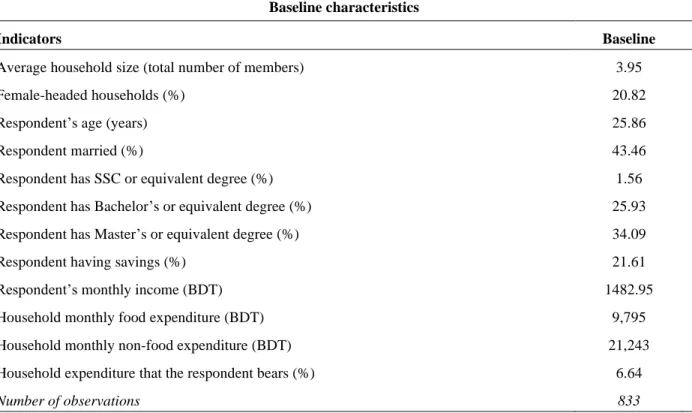
We begin our discussion of descriptive statistics by focusing on some key baseline characteristics of the full sample (Table 1). The average size of our study sample households is 3.95, almost similar to the national (urban) average of 3.93, as found in the data from the Household Income and Expenditure Survey 2016 (BBS, 2017). About 21% of households are female-headed, which is higher than the national average of about 13%. Due to the social structure and gender divide in our country, it can be assumed that female- headed households are more vulnerable than male-headed ones; therefore, in terms of meeting the program targeting criterion of “underprivileged” women, this finding indicates some degree of success. The mean age of the respondents is just above 26 years; the majority of the respondents fall within the targeting criterion of above 18 to below 35 years. Marital status is a crucial factor in terms of labour force participation and a major obstacle to the employment of young women (Lee et al., 2008). As shown in Table 1, a large portion, about 43%, of the respondents are married. There is a common notion that women generally tend to drop out of education after marriage. However, evidence from this survey does not reflect that notion. Almost 31% of the married respondents are still continuing with their education. The remaining 69% who have stopped schooling, on average, are more than five years older (29 years as opposed to 24 years) than those who are currently continuing their education. The minimum age of married respondents currently continuing education is 20 years, while it is 23 years for the married respondents who have stopped schooling. So, it is possible that married women have stopped schooling because they have already gone past that stage in life where they are supposed to be in school and not because they have gotten married.
24 Unlike other skill development programs, this training heavily focuses on human capital development.
Hence, the educational status and attainment of the sample are very important. Since one of the key targeting criteria required the completion of SSC or equivalent degree, the minimum educational attainment is an SSC or equivalent degree for all the participants. The majority of the respondents, about 34% of them, completed up to a Master’s or equivalent degree, and 25% completed up to a Bachelor’s or equivalent degree. Out of the 833 respondents, 55% are active students and 45% have finished their education. The reason behind this large share of active students can be attributed to the nature of the intervention.
Since this project focuses on labour market outcomes, indicators such as income and savings are crucial characteristics. The average per capita monthly income of the respondents is BDT 1,482; around 21% of them save some portion of their earnings. Even though the food expenditure of the sample households is almost equal to the national average, the non-food expenditure of BDT 21,243 is higher than the national urban average of BDT 13,898 (BBS, 2017). Given that the educational status of the participants is a minimum of SSC or its equivalent, the households from the sample are expected to be better off than the national average since they had the ability to continue schooling at least up to SSC or its equivalent.
Moreover, the national average is an urban average that contains urban areas from across the country, while all the samples of this survey are from Dhaka city. Dhaka is one of the most expensive cities to live in (Mercer, 2020). Hence, the average non-food expenditure is higher among the sample of our survey. The monetary units of the national statistics have been adjusted for inflation using the latest consumer price index (CPI) data from the Bangladesh Bank (2021), and hence can be considered as relatively reliable reference points.
Table 1: Baseline Characteristics
Baseline characteristics
Indicators Baseline
Average household size (total number of members) 3.95
Female-headed households (%) 20.82
Respondent’s age (years) 25.86
Respondent married (%) 43.46
Respondent has SSC or equivalent degree (%) 1.56
Respondent has Bachelor’s or equivalent degree (%) 25.93
Respondent has Master’s or equivalent degree (%) 34.09
Respondent having savings (%) 21.61
Respondent’s monthly income (BDT) 1482.95
Household monthly food expenditure (BDT) 9,795
Household monthly non-food expenditure (BDT) 21,243
Household expenditure that the respondent bears (%) 6.64
Number of observations 833
25
4.2. Baseline Equivalence
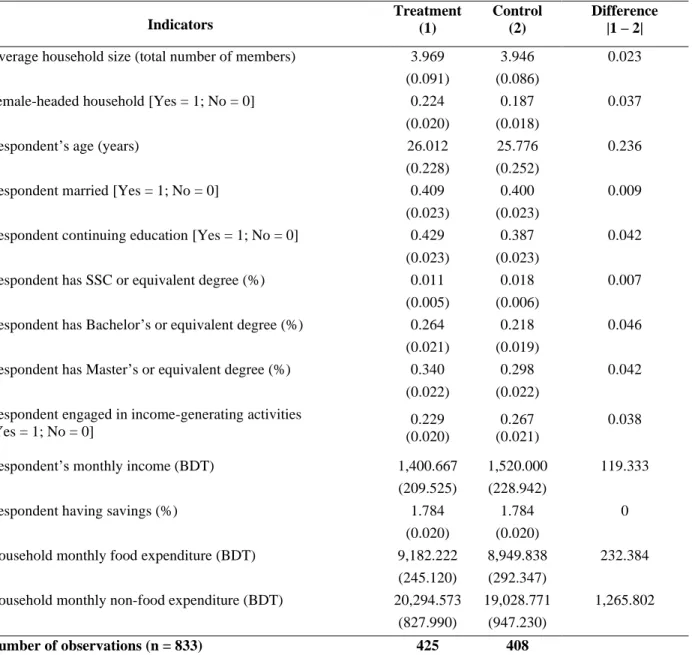
Since this was an RCT, respondents were randomly allocated to treatment and control groups. It is important to check for any heterogeneity between the treatment and control groups before delving deeper into the analyses of specific characteristics. Table 2 below documents the baseline equivalence of the two groups among the baseline observations. It can be observed from the table that no statistically significant difference exists between the two groups in terms of key baseline household characteristics such as household size, household head, and expenditure and individual characteristics such as respondents’ age, education, marital status, employment, income, and savings.
Table 2: Equivalence of Treatment and Control Groups (Baseline Observations) Indicators
Treatment (1)
Control (2)
Difference
|1 – 2|
Average household size (total number of members) 3.969 3.946 0.023
(0.091) (0.086)
Female-headed household [Yes = 1; No = 0] 0.224 0.187 0.037
(0.020) (0.018)
Respondent’s age (years) 26.012 25.776 0.236
(0.228) (0.252)
Respondent married [Yes = 1; No = 0] 0.409 0.400 0.009
(0.023) (0.023)
Respondent continuing education [Yes = 1; No = 0] 0.429 0.387 0.042 (0.023) (0.023)
Respondent has SSC or equivalent degree (%) 0.011 0.018 0.007
(0.005) (0.006)
Respondent has Bachelor’s or equivalent degree (%) 0.264 0.218 0.046 (0.021) (0.019)
Respondent has Master’s or equivalent degree (%) 0.340 0.298 0.042
(0.022) (0.022) Respondent engaged in income-generating activities
[Yes = 1; No = 0] 0.229 0.267 0.038
(0.020) (0.021)
Respondent’s monthly income (BDT) 1,400.667 1,520.000 119.333
(209.525) (228.942)
Respondent having savings (%) 1.784 1.784 0
(0.020) (0.020)
Household monthly food expenditure (BDT) 9,182.222 8,949.838 232.384 (245.120) (292.347)
Household monthly non-food expenditure (BDT) 20,294.573 19,028.771 1,265.802 (827.990) (947.230)
Number of observations (n = 833) 425 408
Note: Figures in the parentheses are standard errors. ***, **, and * denote statistical significance at 1%, 5%, and 10% levels, respectively.
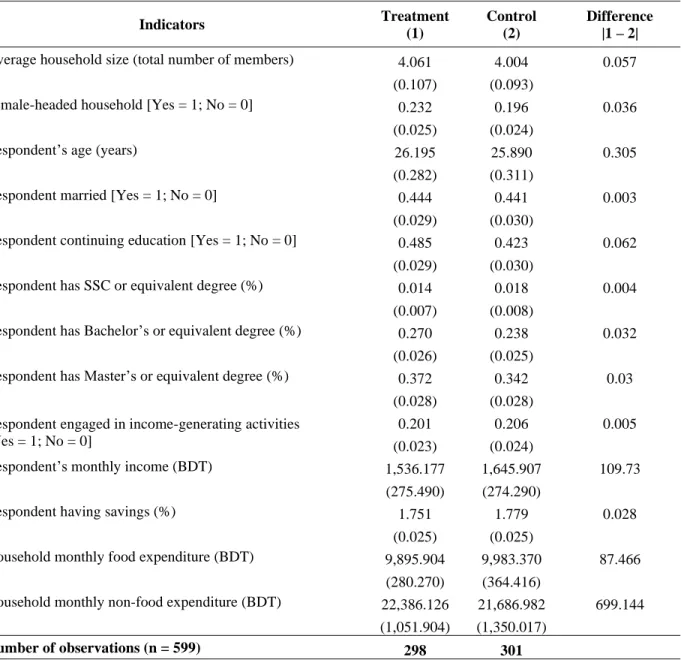
26 The follow-up sample is a subset of the baseline sample, where 599 of the initial 833 respondents could be reached. Therefore, it is essential to ensure that heterogeneity does not exist among the follow-up observations as well. Table 3 documents the follow-up equivalence of the treatment and control groups.
The differences in the two groups are not statistically significant, indicating that both groups have similar characteristics, hence successful randomization.
Table 3: Equivalence of Treatment and Control Groups (Follow-Up Observations)
Indicators Treatment
(1)
Control (2)
Difference
|1 – 2|
Average household size (total number of members) 4.061 4.004 0.057
(0.107) (0.093)
Female-headed household [Yes = 1; No = 0] 0.232 0.196 0.036
(0.025) (0.024)
Respondent’s age (years) 26.195 25.890 0.305
(0.282) (0.311)
Respondent married [Yes = 1; No = 0] 0.444 0.441 0.003
(0.029) (0.030)
Respondent continuing education [Yes = 1; No = 0] 0.485 0.423 0.062 (0.029) (0.030)
Respondent has SSC or equivalent degree (%) 0.014 0.018 0.004
(0.007) (0.008)
Respondent has Bachelor’s or equivalent degree (%) 0.270 0.238 0.032 (0.026) (0.025)
Respondent has Master’s or equivalent degree (%) 0.372 0.342 0.03
(0.028) (0.028) Respondent engaged in income-generating activities
[Yes = 1; No = 0]
0.201 0.206 0.005
(0.023) (0.024)
Respondent’s monthly income (BDT) 1,536.177 1,645.907 109.73
(275.490) (274.290)
Respondent having savings (%) 1.751 1.779 0.028
(0.025) (0.025)
Household monthly food expenditure (BDT) 9,895.904 9,983.370 87.466 (280.270) (364.416)
Household monthly non-food expenditure (BDT) 22,386.126 21,686.982 699.144 (1,051.904) (1,350.017)
Number of observations (n = 599) 298 301
Note: Figures in the parentheses are standard errors. ***, **, and * denote statistical significance at 1%, 5%, and 10% levels, respectively.
4.3. Attrition
In this study, all the respondents from the baseline survey could not be reached in the follow-up survey due to the socio-economic context of the respondents, the prevalent COVID-19 context, etc. About 70% of the treatment group and about 73% of the control group from the baseline sample could be surveyed in follow-
27 up. The overall attrition rate is about 28%. Detailed figures on attrition rates and variables have been provided in Table A6, which shows that the attrition rate is 29% in the treatment group and 26% in the control. In order to ensure that the attrition is not affecting the randomization and the homogeneity across the groups, we test if the attrition is random. As shown in Table A6, it can be observed from the results of the three regressions that the attrition is random as none of the variables is significant. This strengthens the internal validity of the survey, and in tandem with the baseline equivalence discussed in Section 4.2, we can now confidently state that the randomization has been successful.
4.4. Targeting Criteria
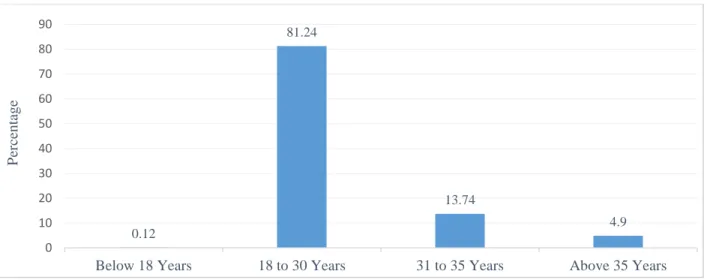
Age was one of the targeting criteria for the program, and the eligible age range was initially set to 18–30 years. In our surveyed sample, around 81% of the respondents were from this range. Figure 2 shows the distribution of respondents according to age. During the program’s implementation, CTBD found a good number of applicants aged more than 30 years. So, there was a readjustment in the criterion and the eligibility age range was reset to 18–35 years, with some conditional flexibility for applicants aged more than 35 years. Hence, we find almost 14% of the respondents aged between 31 and 35 years. All in all, the targeting criterion of 18–35 years is met by 95% of the candidates. The maximum age recorded for a respondent in the survey is 45 years. Only one respondent, who is 17 years old, is aged under 18 years.
Figure 2: Age Distribution of Respondents
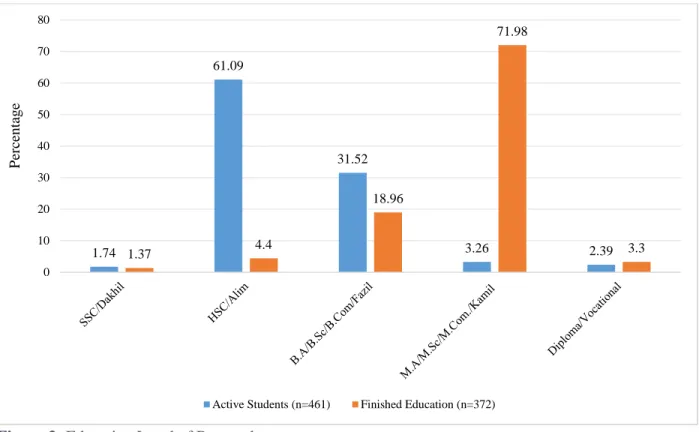
Another key targeting criterion of the project is a minimum educational qualification of SSC or its equivalent. The survey collected data on educational attainment levels and found that all the participants met the targeting criterion. During the baseline survey, out of the 833 respondents, 55% were active students and 45% had finished their education.
Figure 3 shows the education level (last class passed) of the respondents. It can be observed from the figure that most of the respondents who have finished schooling have a Master’s or equivalent degree. The majority of those who are still continuing with their education are currently pursuing their Bachelor’s (or equivalent) or Master’s (or equivalent) degree. It can be concluded that most of the participants are quite qualified in terms of educational attainment, as the majority of them have a Master’s or equivalent degree.
With this level of educational qualification, a question might arise if these candidates can be considered underprivileged, and would it have been better to provide the support packages to less qualified candidates
0.12
81.24
13.74
4.9 0
10 20 30 40 50 60 70 80 90
Below 18 Years 18 to 30 Years 31 to 35 Years Above 35 Years
Percentage