THE EFFECTIVITY OF INTERACTIVE MULTIMEDIA AS LEARNING MEDIA TO REDUCE STUDENT’S MISCONCEPTION ON
HUMAN CIRCULATORY SYSTEM AT SMA NEGERI 1 BERASTAGI A.Y. 2016/2017
By:
Letti Nainggolan ID. 4123342008
Bilingual Biology Education
THESIS
Submitted to Fulfill the Requirement for The Degree of Sarjana Pendidikan
BIOLOGY EDUCATION
FACULTY OF MATHEMATICS AND NATURAL SCIENCE STATE UNIVERSITY OF MEDAN
ii
BIOGRAPHY
Letti Nainggolan was born in Sidikalang on May 31st 1994. Her father name is Indo
Nainggolan and her mother name is Siti Aminah Sitorus. She is the second child in her family
and she has three brothers. In 2000, the author started her education in SDN No.200503
Padangsidempuan and graduated in 2006. In 2006, the author continued her education in SMP
Kesuma Indah Padangsidempuan and graduated in 2009. Then, in 2009 the author continued in
SMA Kesuma Indah Padangsidempuan and graduated in 2012. In 2012, the author was accepted
iii
THE EFFECTIVITY OF INTERACTIVE MULTIMEDIA AS LEARNING MEDIA TO REDUCE STUDENT’S MISCONCEPTION ON
HUMAN CIRCULATORY SYSTEM AT SMA NEGERI 1 BERASTAGI ACADEMIC
YEAR 2016/2017
(Letti Nainggolan, 4123342008) ABSTRACT
This study aimed to analyze the student’s misconception on human circulatory system topic and also to determine the effectivity of interactive multimedia to reduce students misconception that experienced by students of XII IPA in SMA Negeri 1 Berastagi. The method used in research is descriptive and quasi experimental where the descriptive method is to investigate students understanding of concept and students misconception based on human circulatory system topic. Second, quasi experimental research used after learning process. Quasi experimental research used to determine the effectivity of interactive multimedia in reducing student’s misconception and increasing students understanding. The design of quasi experimental research used one group pretest and posttest design. Instrument that used for detecting students misconception were two dimensional diagnostic test and essay test, for reducing students misconception by using interactive multimedia as learning media. Student’s misconception reduce 42.46 % in group that using interactive multimedia as learning media and reduce 14.8 % in group without interactive multimedia. Based on the calculation, it was got 0.57 as gain index value in group that using interactive multimedia and 0.30 as gain index value in group without interactive multimedia. The t-test result was tcount (6.598) and ttable (1.699), so tcount (6.598) > ttable (1.699). It was conclude that interactive multimedia is effective to reduce student’s misconception on human circulatory system in SMA Negeri 1 Berastagi Class XII IPA academic year 2016/2017.
iv
ACKNOWLEDGEMENT
Thanks to Almighty God for his bless and love in everyday and every time.
Because of his love and grace, give me strength to complete this thesis with title “The
Effectivity of Interactive Multimedia as Learning Media to Reduce Student’s
Misconception on Human Circulatory System at SMA Negeri 1 Berastagi Academic
Year 2016/2017”.
First, thanks for the Dean of FMIPA UNIMED Dr. Asrin Lubis, M.Pd, the
Head of Biology Department Dr. Hasruddin, M.Pd, the Coordinator of Bilingual
Program Dr. Iis Siti Jahro, M.Si, and my thesis supervisor Prof. Dr. Herbert
Sipahutar, M.S., M.Sc, M.Si for his guidance and support during write this thesis.
Also thank you so much to Syarifuddin, M.Sc, Ph.D, Drs. Yusuf Nasution, M.Si, Drs.
Puji Prastowo, M.Si as examiner lecturer for reviewing thesis by give input and great
comments for this thesis perfection. Many thanks for Dr. Melva Silitonga, MS and
Dr. Hasruddin, M.Pd because their help in validation my instrument for research.
Thank you so much to Dra. Martina A.Napitupulu, M.Sc as academic supervisor.
Thank you so much to principle of SMA Negeri 1 Berastagi Alberto Colia,
M.Pd for the kindness to give me chance to do research and all students that
participate in my research, thanks for cooperation in process and procedure of
research.
My greatest thanks for my family especially my beloved parents I.
Nainggolan and S.A Br Sitorus that always give me the strength. Also thanks for all
friends in Bilingual Biology Education 2012, for the information and the support.
Medan, Januari 2017
Author
viii
LIST OF TABLE
Page
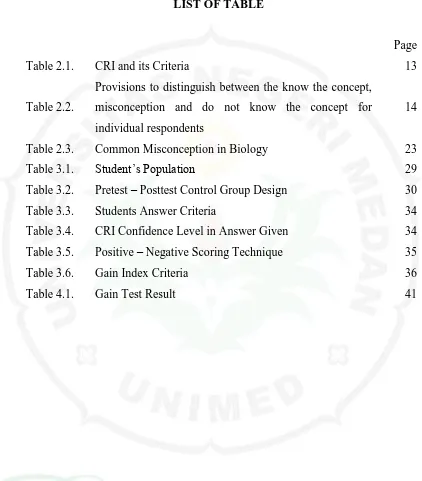
Table 2.1. CRI and its Criteria 13
Table 2.2.
Provisions to distinguish between the know the concept,
misconception and do not know the concept for
individual respondents
14
Table 2.3. Common Misconception in Biology 23
Table 3.1. Student’s Population 29
Table 3.2. Pretest – Posttest Control Group Design 30
Table 3.3. Students Answer Criteria 34
Table 3.4. CRI Confidence Level in Answer Given 34
Table 3.5. Positive – Negative Scoring Technique 35
Table 3.6. Gain Index Criteria 36
ix
LIST OF FIGURE
Page
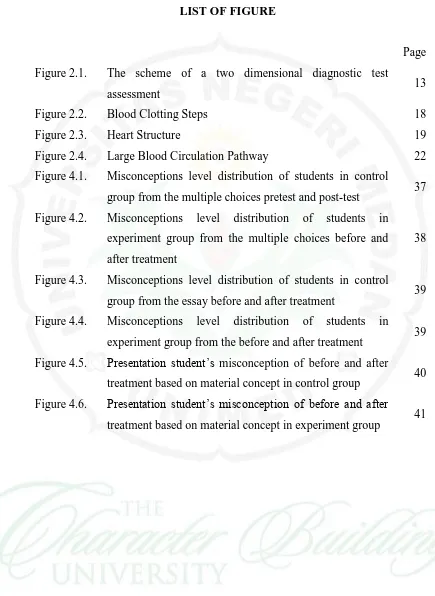
Figure 2.1. The scheme of a two dimensional diagnostic test
assessment 13
Figure 2.2. Blood Clotting Steps 18
Figure 2.3. Heart Structure 19
Figure 2.4. Large Blood Circulation Pathway 22
Figure 4.1. Misconceptions level distribution of students in control
group from the multiple choices pretest and post-test 37
Figure 4.2. Misconceptions level distribution of students in
experiment group from the multiple choices before and
after treatment
38
Figure 4.3. Misconceptions level distribution of students in control
group from the essay before and after treatment 39
Figure 4.4. Misconceptions level distribution of students in
experiment group from the before and after treatment 39
Figure 4.5. Presentation student’s misconception of before and after
treatment based on material concept in control group 40
Figure 4.6. Presentation student’s misconception of before and after
x
LIST OF APPENDIX
Page
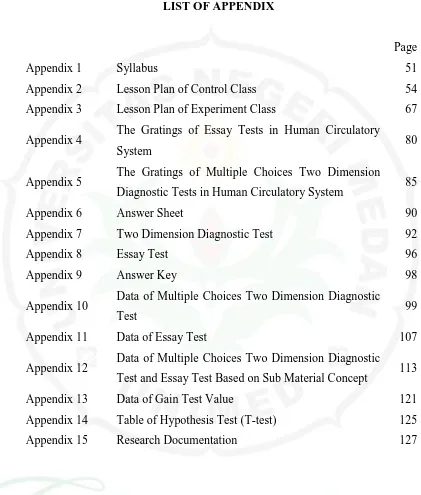
Appendix 1 Syllabus 51
Appendix 2 Lesson Plan of Control Class 54
Appendix 3 Lesson Plan of Experiment Class 67
Appendix 4 The Gratings of Essay Tests in Human Circulatory
System 80
Appendix 5 The Gratings of Multiple Choices Two Dimension
Diagnostic Tests in Human Circulatory System 85
Appendix 6 Answer Sheet 90
Appendix 7 Two Dimension Diagnostic Test 92
Appendix 8 Essay Test 96
Appendix 9 Answer Key 98
Appendix 10 Data of Multiple Choices Two Dimension Diagnostic
Test 99
Appendix 11 Data of Essay Test 107
Appendix 12 Data of Multiple Choices Two Dimension Diagnostic
Test and Essay Test Based on Sub Material Concept 113
Appendix 13 Data of Gain Test Value 121
Appendix 14 Table of Hypothesis Test (T-test) 125
46
CHAPTER V
CONCLUSION AND SUGGESTION
5.1. Conclusion
For the research result that have done, take the conclusion as follow:
1. There was misconception in students in SMA N 1 Berastagi. The misconception reduced on
multiple choice tests in student class experiment class as much 22.05%, while in class control
class as much 4.34%. The misconception reduced on essay test in student class experiment
class as much 62.87%, while in control class as much 25.26%. The highest misconception
occurred in blood clotting and disorders that able occur in human circulatory system sub
material concept for control class. In experiment class, the highest misconception occurred in
blood vessel and disorders that able occur in human circulatory system sub material concept.
2. Interactive multimedia as learning media is effective to reduce misconception level on human
circulatory system. The effectivity of interactive multimedia obtained from gain index value
in experiment class 0.41 that which higher than control class 0.27. Same with essay test gain
value in experiment class 0.73 higher than control class 0.34.
5.2. Suggestion
Based on research result, there are some suggestions which need to convey as follow:
1. Need the guidance or counseling to the teacher in get the right concept as learning concept
which done till avoid misconception also can to use interactive multimedia as learning media
in reducing misconception if occur misconception in students.
47
REFERENCE
Ainur. and Fida. (2015). Identifikasi Miskonsepsi Siswa Pada Subtopik Struktur Dan Fungsi Organel Sel Menggunakan Instrumen CRI Dan Wawancara Diagnostik. Jurnal Pendidikan Biologi. 4 : 908 – 912.
Ariani, N. and Haryanto, D. (2010). Pembelajaran Multimedia di Sekolah. Jakarta: Prestasi Pustaka.
Arnaudin, M. W. and Mintzes, J. J. (1985). Students’ alternative conception of the human circulatory system: Across age study. Science Education, 69 : 721 – 733.
Arsyad, Azhar. (2003).Media Pembelajaran. Jakarta : Raja Grafindo Persada.
Berg, E.V.D. (1991). Miskonsepsi Fisika dan Remidiasi, Pengantar Lokakarya di Universitas Kristen Satya Wacana 7-10 Oktober 1990. Salatiga: Universitas Kristen Satya Wacana.
Campbell. (2000). Biologi Edisi 3. Erlangga Publisher. Jakarta.
Campbell, N. A., Jane, B. R., & Lawrence, G. M. (2004). Biologi Edisi Kelima Jilid 3. Jakarta: Erlangga.
Colbourne, H., Constantin, B., Dobell, D., Fehres, C., MacFadyen, D., Mason, A., Thomson, G. and Venter, A. (2007). Inquiry into Biology: Respiration System. McGraw-Hill Ryerson.
Committee on Undergraduate Science Education., (1996), Science Teaching Reconsidered: a Handbook by the National Academy Press (online). Available: http://nap.edu/readingroom/books/str/4.html (Accessed on March 12th, 2016).
Dahar, R.W. (1989). Teori-Teori Belajar. Jakarta: Rineka Cipta.
Farida, Yusuf. (2008). Evaluasi Program dan Instrumen Evaluasi untuk Program Pendidikan dan Penelitian. Jakarta: Rineka Cipta.
Fariza. (2011). Pembelajaran Remidiasi dengan Menggunaka Media Animasi Komputer Terhadap Penurunan Miskonsepsi. Surakarta.
48
Hasan, Saleem., Bagayoko D. and Kelley E. L. (1999). Misconceptions and the Certainty of Response Index (CRI). Journal of Physics Education, 34 : 294-299.
Hewindati, Y. and Suryanto, A. (2004). Pemahaman Murid Sekolah Dasar terhadap Konsep IPA Berbasis Biologi: Suatu Diagnosis adanya Miskonsepsi. Education Journal, 5: 61-72.
Irianto, E.S. 2008. Penerapan Pembelajaran Multimedia untuk Meningkatkan Hasil Belajar IPA bagi Siswa Kelas VIII SMP N 1 Rembang Tahun Pelajaran 2007/2008. Widyatama, 6(1): 31-42.
Kaur,G.,(2013), A Review on selected literature on causative agents and identifications strategies of sudents misconception, Educatania Confab 2(11):79-94.
Klymkowsky, M., Taylor, R., Splinder, S. and Doxas, R. (2006). Two-dimensional, Implicit Confidence Tests as a Tool for Recognizing Student Misconception. Journal of College Science Teaching, 44-48.
Liliawati, Winny. and Ramalis, Taufik R. (2008). Identifikasi Miskonsepsi Materi IPBA di SMA dengan Menggunakan CRI (Certaintly of Response Index) dalam Upaya Perbaikan Urutan Pemberian Materi IPBA Pada KTSP. Jurnal Pendidikan Teknologi dan Kejuruan, 4 : 3 – 4.
Lydiawati. (2014). Penggunaan Peta Konsep untuk Menganalisis Miskonsepsi Siswa. Skripsi. FITK. Jakarta, Indonesia: UIN Press.
Mader, Sylvia. S. (2004). Understanding Human Anatomy & Physiology: Respiration System. Fifth Edition. The Mc Graw−Hill Companies.
Meltzer, D. E. (2002). The Relationship Between Mathematics Preparation an Conceptual Learning Gain in Physics: A Possible “Hidden Variable in Diagnostic Pretest Scores”. American Journal Physics, 70(12): 1259– 1268. (Accessed on April 10th, 2016).
Muntiani. (2015). Analisis Miskonsepsi Biologi Materi Struktur dan Fungsi Jaringan pada Hewan Menggunakan Certainty of Response Index (CRI) pada Siswa Kelas XI IPA. Skripsi. FMIPA. Yogyakarta, Indonesia: UNINSK Press.
Nasution, L. O. (2012) Analisis Miskonsepsi Siswa, Guru, dan Buku Biologi Kelas XI Pada Materi Sistem Respirasi dan Sistem Eksresi di SMA se-Mandailinggodang Kabupaten Mandailing Natal. Found in http://digilib.unimed.ac.
49
Peleaz, N. J., Denise, B., Rojas, J.B. and Hoover, M. (2005). Prevalence of blood circulation misconception among prospective elementary teachers. Adv Physical Educ. 29:172-181
Putri, Rahmadiyah, K. (2015). Misconception Analysis and Peer Tutoring Method By Using Interactive Multimedia in Decreasing Students’ Misconception Class XII on Topic Photosynthesis in SMA Swasta Nrul Iman Tanjung Morawa Academic Year 2014/2015. Skripsi. FMIPA. Medan, Indonesia: UNIMED Press. Pendidikan : Pengertian, Pengembangan dan Pemanfaatannya. Seri Pustaka Teknologi Pendidikan No.6. Jakarta: Rajawali.
Sanders, M. (1993). Erroneous ideas about respiration: The teacher factor. Journal of Respiration Science Teaching, 30 : 919-934.
Suparno, Paul. (1997). Filsafat Konstruktivisme dalam Pendidikan. Yogyakarta: Kanisius.
Suparno, Paul. (2005). Miskonsepsi dan Perubahan Konsep Pendidikan Fisika. Jakarta: Grasindo.
Suparno, Paul. 2013. Miskonsepsi & Perubahan Konsep dalam Pendidikan Fisika. Jakarta: Grasindo
Tate, Philip. (2009). Seeley’s Principles of Anatomy and Physiology. Second Edition. The McGraw−Hill Companies.
Tayubi, Y. R. (2002). Identifikasi miskonsepsi pada konsep-konsep fisika dengan menggunakan CRI (certainty of response indeks). Laporan akhir penelitian hibah Due-Like UPI tahun 2002, UPI, Bandung.
Tayubi, Y. R. (2005). Identifikasi Miskonsepsi pada Konsep-Konsep Fisika Menggunakan Certainly of Response Index (CRI). Journal of Mimbar Pendidikan, 24 : 4 – 9.
50
Teoh, B.S.P and Neo, T.K. (2007). Interactive Multimedia Learning: Students’ Attitudes and Learning Impact in an Animation Course. The Turkish Online Journal of Educational Technology – TOJET, 6(4): 1303-6521. Found in: http://www.tojet.net/articles/v6i4/643.pdf (Accessed on April 10th, 2016).
Tobias, Sheila. (1987). In class Methods for Getting at Student Misconceptions. Proceedings of the Second International Seminar Misconceptions and Educational strategies in Science and Mathematics. Cornell University. 3 : 514- 516.