1
UNIVERSITI TEKNIKAL MALAYSIA MELAKA
FACULTY OF ELECTRICAL ENGINEERING
FINAL YEAR PROJECT II (FYP II)
BEKU 4973
SOLAR FARM POWER DISTRIBUTION MONITORING SYSTEM
Rosmarni Binti Tajol Asnan
2
I hereby declared that I have read through this report entitled “Solar Farm Power
Distribution Monitoring System” and found that it has comply the partial fulfillment for
awarding the degree of Bachelor of Electrical Engineering (Power Electronics & Drives)
Signature : ………
Supervisior’s Name : Dr. Abdul Rahim Bin Abdullah
3
SOLAR FARM POWER DISTRIBUTION MONITORING SYSTEM
ROSMARNI BINTI TAJOL ASNAN
This report is submitted in partial fulfillment of requirements for the degree of
Bachelor in electrical engineering (Power Electronics and Drives)
Faculty of Electrical Engineering
UNIVERSITI TEKNIKAL MALAYSIA MELAKA
iii
I declare that this report entitle “Solar Farm Power Distribution Monitoring System” is the
result of my own research except as cited in the references. The report has not been accepted for any degree and is not concurrently submitted in candidature of any other degree.
Signature : ...
Name : ...
iv
v
ACKNOWLEDGEMENT
First and foremost, I am very grateful to ALLAH S.W.T for giving me life and chance to finish this project without much difficulty. Special thank goes to my helpful supervisor Dr. Abdul Rahim bin Abdullah. The supervision and support that he gave truly helps the progression and smoothness of completing this project. The cooperation is much indeed appreciated.
My grateful thanks also goes to my family for their endless support and encouragement. My deepest gratitude also extend to all lecturers of Universiti Teknikal Malaysia Melaka (UTeM), for their guidance, ideas, and support in completing this final year project. This project had opened my eyes on solving real problems and I was able to relate them with what I’ve been studied in UTeM during the past 3 years.
vi
ABSTRACT
vii
ABSTRAK
x
REFERENCES 49
xi
LIST OF TABLES
TABLE TITLE PAGE
4.1 Comparison of measured values between Red Phase Monitoring System and PQA
41
4.2 Comparison of measured values between Yellow Phase Monitoring system and PQA
43
4.3 Comparison of measured values between Blue Phase Monitoring system and PQA
xiii
xiv
LIST OF ABBREVIATIONS
AC - Alternating current DC - Direct current
GUI - Graphical User Interface DAQ - Data Acquisition
RMS - Root Mean Square VB - Visual Basic
xv
LIST OF APPENDICES
APPENDIX TITLE PAGE
1
CHAPTER 1
INTRODUCTION
1.1 Introduction
2
1.2 Problem Statements
Nowadays, the use of solar energy is expanded day by day which can be one of the alternative power that people choose to use. The benefits of using solar monitoring system are environmental friendly, cost effective and sustainable product to enhance the quality of life. Besides that, the solar energy also can help user to save the electricity which is usually use a main power supply.
Before this, the user only use the electricity but unknown of voltage and current that insert to the loads. The measurements are taken by multimeter to know what value of voltage and current is suitable to appliances consumer. In previously, the readings taken by employee on manual. In this way will cause an error when taking the readings. So, this project is made because can make the user easy to check the performance of measurement parameters on computer.
Other than that, fuel is a highly used as a material to generate electrical energy. The price of fuel was increase in global market from time to time and the stocks for this material rapidly decrease. As an engineering student, the projects of development of solar monitoring system are provided.
1.3 Project Objectives
The main objectives of the implementation of the solar farm power distribution monitoring system are:
i. To develop solar farm power distribution monitoring system that can measure and display voltage (rms), current (rms), frequency, real power, apparent power and power factor on the computer in real time.
ii. To design monitoring system which provide accurate value data of measurement parameter.
3
1.4 Project Scopes
The scopes of this project are listed as follows:
i. This system utilize the Visual Basic 2010 software and NI USB-6009 DAQ device. ii. This project only can measure voltage (rms), current (rms), frequency, real power,
apparent power and power factor.
4
CHAPTER 2
LITERATURE REVIEW
2.1 Introduction
Chapter 2 will discuss about the literature review. Literature review is a body of text that aims to review the critical points of the solar farm power distribution monitoring system. In this chapter, the research for the explanation from people who are master in solar monitoring system is done. The references of the explanation are done by referring to the books and internet.
2.2 Previous Project
2.2.1 On-line monitoring of the efficiency of Photo-Voltaic panels for optimizing maintenance scheduling
5
overall generation efficiency at an acceptable level. This method proposes a remote monitoring system for on-line tracking of the energy performance of a photovoltaic generation plant. The main goal of this system is to monitor the generated energy and relate the measured value to the climatic conditions. In this way, it is possible to keep the generating stations at a pre-defined minimum level of efficiency, also by optimally scheduling maintenance operations [1].
2.2.2 Performance Monitoring of Solar Stand Alone Power
The performance monitoring of solar photovoltaic (PV) power system is very essential for initial system evaluation, and continuous output optimization. Currently, PV system monitoring is complicated and expensive and limited to large scale grid connected solar PV plants. A simple and economic method that can be used by stand alone PV power systems. The method uses reference cells to collect real time data and an electronic subsystem for processing. This method is to integrate reference cells and processing electronics with the PV module to provide an economical solution to small PV system performance monitoring and optimization. Using small reference cells to estimate module or array output power have at least three advantages. First, the voltage and current to be measured is very small compared to the total module or array values. Second, the load does not have to be disconnected temporarily to measure array or module current. Third, the electronic circuits used to acquire and process data will be simpler [2].
2.2.3 GPRS based Power Quality Monitoring System
6
in remote wild farms or on mountains. The communication method can also be used in applications where the data flow is not so heavy and there is difficult in wire communication. There are two typical network topology using GPRS for data transmission where the data centre accesses the data through digital data network and through internet [3].
2.3 Present Project
From the previous project like above, the different method to monitor solar system have found. As a conclusion, from this literature review the proposed solar farm monitoring system by interface visual basic using NI DAQ card 6009 because is better compared to other method. For my project Solar Farm Power Distribution Monitoring
System use Visual Basic 2010 software to display voltage(rms), current(rms), frequency,
real power, apparent power and also power factor in real time. This are make a different with my project. For the On-line monitoring of the efficiency of Photo-Voltaic panels for
optimizing maintenance scheduling use LabVIEW Software. So from that the hardware
7
2.3.1 Solar Energy
As solar energy is a part of widely recognized renewable energy sources, the solar energy source is free of cost and clean energy whereby environmental impacts are negligible. In tropical countries like Malaysia, solar energy potential has been utilized in wide range of applications of remote and urban areas and has been growing rapidly. Since solar energy depends on solar presence in a particular zone, correct and accurate information from the sun, seasonal changes of the solar energy and the amount of solar energy received from the sun are necessary to be evaluated and the basic parameters of solar energy system are needed to be as accurate as possible [4].
Solar energy is one of the renewable energies on which nowadays scientists interested in energy sources are focused. A problem that appears is their output which is intermittent and therefore storage, careful control and parameter monitoring are required. The solar energy availability depends on season, weather conditions, pollution or geographical position. Autonomous renewable systems, such as solar energy powered networks, experience real-time variations of input energy [5].
8
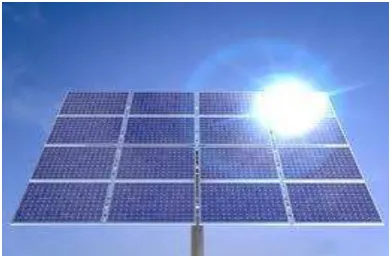
Figure 2.1: Photovoltaic array system
2.3.2 Visual Basic
It's a computer programming system developed and owned by Microsoft. Visual Basic was originally created to make it easier to write programs for the Windows computer operating system. The basis of Visual Basic is an earlier programming language called BASIC that was invented by Dartmouth College professors John Kemeny and Thomas Kurtz. Visual Basic is often referred to using just the initials VB. Visual Basic is easily the most widely used computer programming system in the history of software [7].