NEWSPAPER
By
NUR IZMA RACHMIATI 107026001265
ENGLISH LETTERS DEPARTMENT
LETTERS AND HUMANITIES FACULTY
STATE ISLAMIC UNIVERSITY
“
SYARIF HIDAYATULLAH
”
ABSTRACT
Nur Izma Rachmiati, A Phonemic and Graphemic Change of English Loanwords
in Teropong Articles of Kompas’ Newspaper. Thesis: Letters and Humanities
Faculty. UIN Syarif Hidayatullah Jakarta, 2011.
In this research, the writer discussed the change process of phonemic and graphemic of English loanwords in Teropong articles of Kompas’ newspaper.
Teropong articles contains of science and technology development.
Due to some reasons, the first is that most of the Indonesian words used are loanwords, second is that Kompas’ is a great leading newspaper in Indonesia, and third that science and technology issues has been an interesting issue to discuss.
In this research, the writer uses a descriptive qualitative method. The data were taken from the articles of Teropong in Kompas’ on August 16 2011 edition. From the findings, the writer found that there are 50 loanwords in the articles of Teropong in Kompas’ newspaper. The thesis examines the change process of loanwords from the source language into the recipient language at phonemic and graphemic. At phoneme level, the writer discusses the conditioning of the English loans that are subjected to as a result of the phonetic asymmetry between Bahasa Indonesia and English both of consonants, vowels, and diphthongs that made appropriate with recipient language system because the phonemes in English and Bahasa Indonesia basically are different. At grapheme level, the writer discusses that the change of spelling system in Bahasa Indonesia which is adapted from foreign language both grapheme, double consonants, and consonant clusters.
A PHONEMIC AND GRAPHEMIC CHANGE OF ENGLISH
LOANWORDS IN
TEROPONG
ARTICLES OF
KOMPAS’
NEWSPAPER
A Thesis
Submitted to Letters and Humanities Faculty in Partial Fulfillment of the Requirements for the Degree of Strata One (S1)
NUR IZMA RACHMIATI
107026001265
Approved by:
Dr. Frans Sayogie, M. Pd
Advisor
ENGLISH LETTERS DEPARTMENT
LETTERS AND HUMANITIES FACULTY
STATE ISLAMIC UNIVERSITY “SYARIF HIDAYATULLAH”
JAKARTA
LEGALIZATION
Name : Nur Izma Rachmiati NIM : 107026001265
Title : A Phonemic and Graphemic Change of English Loanwords in Teropong Articles of Kompas’Newspaper
The thesis entitled has been defended before the Letter and Humanities Faculty’s Examination Committee on August 16, 2011. It has already been accepted as a partial fulfillment of the requirements for the degree of strata one.
Jakarta, August 16, 2011
Examination Committee
Signature Date
1. Drs. Asep Saefuddin, M.Pd (Chair Person) 19640710 199303 1 006
2. Elve Oktafiyani, M.Hum (Secretary) 19781003 200112 2 002
3. Dr. Frans Sayogie, M.Pd (Advisor) 19700310 200003 1 002
4. Drs. H. Abdul Hamid, M.Ed (Examiner I) 150 181 922
I hereby declare that this submission is my own work and that, to the best of my knowledge and belief, it contains no material previously published or written by another person nor material which to a substantial extent has been accepted for award of any other degree or diploma of the university or other institute of higher learning, except where due to acknowledgement has been made in the text.
Jakarta, August , 2011
ACKNOWLEDGEMENT
In the name of Allah the Most Gracious, the Most Merciful
Alhamdulillahi robbil alamin, all praise and thanks are given to Allah
SWT, for guiding the writer amazingly and mysteriously during the process of
this research. Greeting and invocation are presented to Prophet Muhammad SAW,
who has guided humanity to the right path blessed by the Lord.
The writer would like to give her sincerest gratitude to her beloved
parents, her brothers and her sisters for their endless, silent prayer and who always
accompany her with love and attention. It makes the writer realize that she would
have never finished her study without their support.
This work could not be completed without a great deal of help from
many people, especially Dr. Frans Sayogie, M. Pd, the writer’s thesis advisor on
writing this thesis. The deepest gratitude for his guidance, helpful correction,
patient, cooperation, time, and kindness until this thesis completed.
The writer also would like to express her deepest gratitude to the
individuals for helping her in finishing this thesis and for their contribution in the
process of writing until it had become a complete work. They are as follows:
1. Dr. Abd. Wahid Hasyim, M.Ag, the Dean of Adab and Humanities
Faculty.
2. Drs. A. Saefuddin, M.Pd, the Head of English Letters Department and
Mrs. Elve Oktafiyani, M.Hum, the Secretary of English Letters.
3. All of the lecturers in English Letters Department for teaching her many
5. The writer’s dearest ‘Muhammad Lazuardi Ramadhan’ for giving
support, motivation, and accompanies her in bad and good times.
6. The writer’s friends: Dewi Permata Sari, Esa Yolanda Putri, Putri
Martanti, Yasir Mubarok, Sangkawentar, Nurul Laily. M., Astriadi, and
Cici Puput Lestari for the wonderful friendship and for the help in the
process of writing; Egi Imam, Aslam, Piscessius and Darwis for
laughing and every funny things they brought.
7. The writer’s friends in English Letters Department, especially in
Linguistics class. Thanks for giving her unforgettable friendship.
8. All the people who have helped the writer during the process of
conducting this research whose names are not mentioned here.
May Allah SWT, The Almighty and The Merciful, bless them all. The writer
realizes that this thesis is still far from being perfect. Therefore, suggestions and
criticisms will be accepted for the improvement of this thesis.
Jakarta, August 20, 2011
TABLE OF CONTENTS
ABSTRACT ... i
APPROVEMENT ... ii
LEGALIZATION ... iii
DECLARATION ... iv
ACKNOWLEDGEMENT ... v
TABLE OF CONTENTS ... vii
CHAPTER I. INTRODUCTION ... 1
A. Background of the Research ... 1
B. Focus of the Research ... 6
C. Research Questions ... 6
D. Significance of the Research ... 7
E. Research Methodology... 7
1. Objective of the Research ... 7
2. Method of the Research ... 7
3. Unit of Analysis ... 8
4. Instrument of the Research... 8
CHAPTER II. THEORETICAL FRAMEWORK ... 9
A. Loanwords ... 9
1. The Definition of Loanwords ... 9
2. Kinds of Borrowings ... 10
3. The Limits of Loanwords ... 10
2. Phonotactics ... 33
C. Types of Phonological Change ... 34
1. Assimilation ... 34
2. Sound Change ... 36
D. Graphemes... 37
CHAPTER III. RESEARCH FINDINGS ... 39
A. Data Description... 39
B. Data Analysis ... 47
CHAPTER IV. CONCLUSION AND SUGGESTION ... 62
A. Conclusion ... 62
B. Suggestion ... 63
BIBLIOGRAPHY ... 64
CHAPTER I
INTRODUCTION
A. Background of the Research
Language is a system of communication that plays an important role in all
aspects of human life. It is the most effective tool of communication for people.
Language makes people understandable of what other people mean. Without
language, the world cannot develop normally. People also use language to express
their thought, feeling, and everything in their mind. In society, a language that
people use in speaking is really affected by the situation around. Wardhaugh has
defined language itself as “a system of arbitrary vocal symbols used for human
communication”.1
Language is also a meaning of communication in our social order. The
application of Bahasa Indonesia, whether as a way of communication use in
radio, broadcasting, television, or newspaper, may put in the place that is used
widely in our country. In addition, Badudu states that language has its own
characteristic in the community, so the language of newspaper which is short,
simple, understandable, solid, and interesting.2 He proposes that press as a
meaning of mass communication has a big responsibility in the establishment of
language.
1
Ronald Wardhaugh, Introduction to Linguistics (New York: McGraw-Hill Book Company, 1972), p. 3
2
The use of language in magazines, newspaper, and other mass media is called
press.3 In an Indonesian newspaper as one of mass media, there are many words
either initially from Indonesian language or other language. They often emerge in
every issue such as economics, politics, social, science and technology, opinion,
and cultural issues. The use of language in mass media such as press, radio,
television, has greater influence toward people’s speaking habit in society. The
newspaper is reader„s digest. The society read newspaper to follow up the issues
that happened surrounding. Newspaper can be found in every type of our society
which has different social classes, whether it is upper class, middle class, or lower
class.
Marcelino (1993) in his article quotes the statement from Alisjahbana who
stated that more than 321.000 of modern terms of foreign language have been
drafted into Indonesian terminology and used in the school, parliament, and the
mass media.4 Thus the words borrowed from another language are loanwords. A
language may borrow some words from other language to fulfill the needs in
extending the vocabularies in one field or to enrich the vocabulary to be able to
get along with development of technology, information and the rapid
communication in the Globalization Era.
Actually, there are lots of other reasons or motivations in borrowing English
terms such as needs, prestige and so on. Frans van Coestsem says about
motivation in accommodate borrowing terms as follows:
3
Haris Sumadiria, Jurnalistik Indonesia (Bandung: Simbiosa Rekatama Media, 2006), p. 53
4
3
“Meanwhile a speaker’s accommodation in his speech maybe is motivated by either prestige or need, or combination of two. So, prestige is as a motivation and not a result. A speaker using borrowed words maybe is motivated to do so by need, but nonetheless derive prestige from this situation. On the other hand, a speaker using borrowed words maybe motivated to do so by prestige, while such a
usage is rejected as pretentious by another speaker”.5
A strong influence about the introduction of western language, especially
English, in modern sectors has caused the uses of vocabulary from foreign
language into Bahasa Indonesia. Therefore, having these foreign loanwords is a
very common thing to do in Indonesian mass media.
Kompas is the most widely read newspaper in Indonesia. Published by
Kompas-Gramedia Group Publishing since June 28, 1965, it has a reputation in
Indonesia for high-quality writing and investigative journalism. It is written in
Indonesian.6 Kompas newspaper has been the great leading newspaper that
published nationally and read nationwide by many people in Indonesia.
In this newspaper, there are a lot of rubrics such as Business, Opinions,
many of the words that are written are commonly loanwords from English, such
as teknologi, telekomunikasi, internet, etc. To conclude, due to some reasons, first
is that most of Indonesian words used are loanword, second is that Kompas is the
5
Frans van Coetsem, Loan Phonology and the Two Transfer Types in Language Contact (Netherlands: Foris Publications, 1988), p. 14
6
great leading newspaper in Indonesia, and third that science and technology has
also grapheme in the spelling of Bahasa Indonesia.
In phonology, there are phonemes, phones, and allophones as a phonological
unit. Moreover, the rules of phonology either in English or Bahasa Indonesia are
different, so when some language borrows the words from the other, they adapt it
in phonological or morphological modification. The loanword will be changed
based on the rule and habit in the recipient language, for example: teknologi, it is
derived from English “technology”7. The word “technology”
/tek'nɒləʤi/8
becomes teknologi /téknologi/ in Bahasa Indonesia, there is a replacement of
phonemes /ʤ/ to phoneme /g/.
In its development, Bahasa Indonesia has been influenced by some
languages. Based on the standard of its integration, the absorption of foreign terms
in Bahasa Indonesia can be categorized into three major categories.9 First, the
element that is absorbed into Bahasa Indonesia is no longer needed to change the
spelling, such as trailer, audiogram, unit, etc.
7
J.S. Badudu, Kamus Kata-Kata Serapan Asing Dalam Bahasa Indonesia. Third Edition.(Jakarta: Kompas, 2007), p. 344
8
A.S. Hornby, Oxford Advance Learner’s Dictionary, Sixth Edition. Ed. Sally Wehmeir (Oxford: Oxford University Press, 2003), p. 1388
9
5
Second, the foreign elements that have not been fully absorbed into the
Bahasa Indonesia, such as reshuffle, shuttle cock, and long march. These
elements are used in Bahasa Indonesia context, but the pronunciation still follows
foreign ways. Third, the foreign elements both of the pronunciation and writing
rules were adapted into Bahasa Indonesia, so the form can still be compared with
its Indonesian original form.
In addition, Tata Bahasa Baku Bahasa Indonesia as the standard in Bahasa
Indonesia organizes spelling rules that occurs to loanwords from foreign language
based on its graphemes. There are differences between phonemes and graphemes.
If people talk about phonemes, they were talking about the sound; when they talk
about the letter, it was graphemes. Grapheme is the overall of letters or
combination of letter that represent phonemes. Basically, Bahasa Indonesia has
different spelling system with English language, both phonemically and
graphemically. Some of the rules that are grapheme c, before vowels a, u, or o, is
changed into grapheme k, grapheme f does not change, ph is changed into
grapheme f.10
In Kompas’ Teropong articles, there are many of graphemes from English
loanwords is changed into Bahasa Indonesia based on the adjustment of spelling
and pronunciation in Bahasa Indonesia system, such as the word kabin from
English word cabin. Grapheme c is changed into k in Bahasa Indonesia when it is
put before vowel aand it’s pronounced as /k/.
10
Marcellino (1993) mentioned that there are four linguistic factors that
influence the use of loanwords in Bahasa Indonesia vocabulary.11 First is filling
the non-existence lexicons in Bahasa Indonesia. Second is giving the accurate
meanings in the semantic field, this means that it replaces the Indonesian word
itself. Third is filling the specific needs of a register. The last is having the
adaptability with system of Bahasa Indonesia.
The fourth factor, which has been mentioned above, related to the
phonological and morphological system of English loanwords in Bahasa
Indonesia. Therefore, the writer as a student of English Letters is interested in
analyzing phonemic and graphemic change from English into Bahasa Indonesia
and process of change of those loanwords that are used in Teropong articles of Kompas’ newspaper. In this research the writer uses phonological phonemes and
graphemes theory.
B. Focus of the Research
As mentioned above, the writer will focus the research on the change process
phonemes and graphemes of the loanwords from English into Bahasa Indonesia.
Here the writer tries to analyze it in Teropong articles of Kompas’ newspaper.
C. Research Question
According to the focus of the study, there is a question will be discussed,
how is the change process of phonemic and graphemic of English loanwords in
Teropong articles of Kompas’ newspaper?
11
7
D. Significance of the Study
Through the research, the writer hopes that this thesis will be a good reference for other students, especially students of English Letters Department of
State Islamic University Syarif Hidayatullah, who are interested in doing a further research on the same topic. In addition, from the analysis of phonemic and graphemic change of English loanwords in this research, the writer hopes that it
would give Indonesians as the owners of Bahasa Indonesia and the users of English in general, a better understanding about the spelling of loanwords especially that come from English, in Bahasa Indonesia vocabulary. The last but
not least, the writer hopes this study will give contribution in the scientific development of the study of borrowing words in Bahasa Indonesia.
E. Research Methodology 1. Objective of the Research
The objective of the research is to know the change process of phonemic and
graphemic of English loanwords in Teropong articles of Kompas’ newspaper.
2. Method of the Research
In this research, the writer uses descriptive qualitative method that explains
the change process of phonemic and graphemic of English loanwords in Teropong
articles of Kompas’ newspaper.
3. Unit of Analysis
The unit of this research is the word chosen in two articles of Teropong in Kompas’ newspaper, 16 August 2011 edition. They are;
a. Telekomunikasi; Sebuah Dunia yang Bergerak Cepat
4. Instrument of the Research
The writer uses herself as a main instrument by reading and marking the
loanwords from English that are changed in Teropong articles of Kompas’
newspaper. The writer also uses some references as a reference for research
support.
The books that the writer uses as the references are:
a. Dictionary of Kamus Besar Bahasa Indonesia (fourth edition) by
Departemen Pendidikan Nasional (2008) in order to see the phonetic
transcription of Bahasa Indonesia.
b. Dictionary of Kamus Kata-Kata Serapan Asing Dalam Bahasa Indonesia
(third edition) by J.S. Badudu (2007) to check the loanwords in the source
language.
c. Oxford Advanced Learner’s Dictionary by A S Hornby (2000) to find out
the phonetic transcription in source language.
d. Tata Bahasa Baku Bahasa Indonesia (second edition) by Hasan Alwi , et
al to find out the rules of Indonesian spelling system.
Then, the writer divided the data into two parts, they are phonemic and
CHAPTER II
technologies, or wars. Robins (1980) has pointed out that:
“Wherever there are culture contacts of any sort between the speakers
different languages, this means virtually everywhere, speakers will make use of words from other languages to refer to things, processes, and ways of behavior, organization, or thinking, for which words or phrases were not available or convenient in their own language hitherto. Some of the foreign words so used by individual speakers pass into general currency in the language, being altered in pronunciation in the process in the direction of the sounds and phonological
patterns of the language acquiring them. These are known as loan words.”12
Loan words also called as borrowings. In one of his early works Haugen
(1950) defined borrowing as the attempted reproduction in one language of
patterns previously found in another language.13 Winfred says, “The study of
variations in languages as speakers of one language adopt elements of another or
as speakers of one dialect take on forms of another. The process of introducing
such elements is known as borrowing”.14
12
R. H Robins, General Linguistics: An Introductory Survey (New York: Longman Group Ltd, 1980) p. 235
13
Kombe Sure, Grammatical and Phonological Integration of English Loanwords into Dholu, In Journal of Multilinguial and Multicultural Development 1993. Edited by Professor John Edwards (Frankfurt: Multilingual Matters Ltd, 1993), p. 330
14
2. Kinds of Borrowings
According to Bloomfield the adoption of the features that differ from those of
the main tradition, is linguistic borrowing. Within the sphere of borrowing, he
distinguishes into cultural borrowing, and intimate borrowing.15
a. Cultural Borrowing
Cultural borrowing is where the borrowed features come from the different
language. Cultural borrowing comes from trade activity, science and technology,
and religion. English and Arabic are the languages that have cultural borrowing in
Bahasa Indonesia. Itborrows the English are in terms of science and technology,
and Arabic in terms of religion. The words internet, plaza, and artikel come from
English loanwords. The words sholat, saum, wudhu come from Arabic loanwords.
b. Intimate Borrowing
Intimate borrowing occurs when two languages are spoken in what is
topographically and politically a single community.16 Conquest and migration are
the cause of intimate borrowing. Dutch and Chinese are the example of languages
in intimate borrowing. Dutch loanwords are borrowed because of conquest. Much
of the words are used in government terms, such as bursa, pensiun, and Parlemen.
Chinese loanwords are borrowed because of migration. Much of the words are
found in culinary terms, such as capcay, bakso, and somay.
3. The Limits of Loanwords
In language development, Bahasa Indonesia got some influences from other
languages such as Dutch, Spain, Arabic, French, and especially English.
15
Leonard Bloomfield, Language. (New York: Holt, Rinehart and Winston, Inc., 1933), p. 444
16
11
Jespersen defines that:
“When in two languages we find no trace of exchange of loan-words, one way or another, we are safe to infer that two nations have had nothing to do with each other. But if they have been in contact, the number of loan-words and still more the quality of the loan-words, if rightly interpreted will inform us of their reciprocal relations, they will show us which of them has been the more fertile in ideas and in what domains of human activity each has been superior to the
other.”17
Hence, the borrowing that has occurred between Bahasa Indonesia and
English reflects the cultural and social interactions between Bahasa Indonesia and
English.
Any prolonged cultural contact, especially with speakers of a language who
enjoy political power or prestige in any sphere, leads to a considerable amount of
borrowing of vocabulary from that language in spheres concerned.18 Normally,
loan words are assimilated to the phonetic sound classes and the phonological
patterns of the borrowing language, the original consonants and vowels being
replaced by consonants and vowels as close to them as are available. Thereafter,
synchronically as opposed to historically, they are no longer recognizable by their
form as loans.
However, in certain cases words continue to be recognized and treated as
foreign in origin, and attempts are made to pronounce them as such, English
coupon and restaurant, when pronounced with a final nasalized vowel, and rouge
and garage, when pronounced with final /ʒ/, which does not occur finally except
assimilated and unassimilated, depending on the attitude or background of the
speaker.19
Historically, loan words occurred by audio, it means by sense of hearing: a
stranger said these loan words and then Indonesian people imitate it, according to
what they heard. Because of English phonological system is different with Bahasa
Indonesia system, so the imitations of their speech sounds based on the ability of
tongue to pronounce it. Thus Dutch domme krach when pronounced as dongkrak,
Sanskrit utpatti pronounced as upeti, Arabic mudharat pronounced as melarat,
Portuguese almari as lemari, and English real estate pronounced as realestat.
The use of real estate is caused by Indonesian people thought that there are no
equivalent words in Bahasa Indonesia for its word. It is some common case if
there are no equivalent words in Bahasa Indonesia for some foreign words, so that
Indonesian people refer to pronounce real estate into realestat. The word realestat
is commonly used by Indonesian people who work on the field of
entrepreneurship or industrial sector. Basically, the changing form caused by the
lenition of phonemes /e/ in the end of words, such as accurate, chocolate, and
dictates which is pronounced with akurat, coklat and diktat.
In such case, word realestat when it is used in a living environment,
Indonesian people must transform it into a word which is fulfilled the rules of
Indonesian form. For example:
Realestat Sukamenak not Sukamenak Realestat20
19
Ibid, pp. 236-237
20
13
Based on the restrictions above, it can be seen that the loanwords is the
process of borrowing from another language and more less adapted to loan the
rules of language.
4. The Form of Loanwords
Based on the level of its integration in the absorption of Bahasa Indonesia, it
can be divides into three major categories.21First, the element that is no longer is
needed to change the spelling, such as trailer, audiogram, unit, etc. Second, the
foreign elements that have not been fully absorbed into Bahasa Indonesia, as like
shuttle cock, real estate. These elements are used in Bahasa Indonesia context,
but the pronunciation still follows foreign ways. Third, the foreign elements both
of the pronunciation and writing rules were adapted into Bahasa Indonesia, so the
form can still be compared with its Indonesian original form. It can be divided
into three groups, they are:
a. Adjustment of Spelling
In this case, sought for foreign language spelling is changed as needed, so
Indonesian form can be compared to its original form. For example, synonym
becomes sinonim, ecology becomes ekologi, and syllabus becomes silabus.
The rules of foreign terms absorption in Bahasa Indonesia as follows:22
If ae unvaried with e, does not change
aerobe aerob
aerolit aerolit
aerosol aerosol
21
Ibid, p. 61
22
15
e does not change when it appears before consonants
atmosphere atmosfer
system sistem
synthesis sintesis
e which is not pronounced is released
pleistocene pleistosen
gh is changed into phoneme /g/ when it appears before vowels
sorghum sorgum
i does not change when appears at the beginning of a word before a vowel
17
oo (double vowels) does not change coordination koordinasi
oolite oolit
zoology zoologi
uo is changed into u, when its pronunciation is /u/.
q is changed into k sch before vowels, is changed into sk
19
x does not change when it appearsat the beginning of word
xanthate xantat
xenon xenon
xylophone xilofon
x at the other position, is changed into ks
executive eksekutif
latex lateks
xc before vowels e or i, is changed into ks
consonants which can make difference in meaning.
accu aki
effect efek
commission komisi
solfeggio solfegio
b.Adjustment of Consonant Clusters
The adjustment of consonant clusters are not translated and accepted into
21
bl- blastula becomes bl- blastula
cl- clinic kl- klinik
-ck block -k blok
c. Adjustment Affixes
The adjustment of Affixes can be classified in two groups; adjustment of
suffix, and adjustment of prefix. The adjustment of suffix is absorbed into
Bahasa Indonesia as a part of full words. The words such as standardisasi,
implementasi and objektif are full absorbed, instead of standar, implemen, and
objek. The adjustment of prefix is derived from Indo-European languages that can
be considered in the terminology if Bahasa Indonesia after adjustment of spelling,
as follows: aberration become aberasi, anemia become anemia.
B. Phonological Change
Phonological change is taught in historical linguistics, the histories of specific
languages, phonetics and phonology. Phonological change can be called sound
change. Sound change is any appearance of a new phenomenon in the phonetics
or phonological structure of a language.23 The phonological change of English
loanwords into Bahasa Indonesia because English and Bahasa Indonesia have the
different language system. Before the writer discusses a much deeper about the
language system in English and Bahasa Indonesia, here is the definition about
phonology broadly and narrowly according to Roger Lass, as follow:
“Phonology, broadly speaking, is that sub-discipline within linguistics concerned with the sounds of language. More narrowly, phonology proper is concerned with the function, behavior, and organization of sounds as linguistic
23
item; as opposed to phonetics which is a rather more „neutral‟ study of the sounds themselves as phenomena in the physical world, and the physiological, anatomical, neurological, and psychological properties of the human beings that
make them”.24
“Phonology … is used in two ways-as the mental representation of linguistic
knowledge and the description of this knowledge… refers either to the
representation of the sounds and sound patterns in a speaker‟s grammar or the
study of the sound pattern in a language or in a human language in general”.25 In
phonological studies, they are called phone, phoneme and morpheme. The phone
is any sound produced by the human vocal apparatus and audible to the ear.26
Sapir says in the physical world the native speaker and hearer actualize
and are sensitive to sounds, but what they feel themselves to be pronouncing and
hearing is “phonemes”.27 Worth: Harcourt Brace College Publishers, 1998), p. 253
26
Nelson Brooks, Language and Language Learning Theory and Practice (USA: Harcourt, Brace & World Inc., 1964), p. 26
27
Victoria Fromklin and Robert Rodman (1998), op.cit. p. 254
28
Nelson Brooks (1964), loc.cit.
29
23
1. Phonemic
Phonemic is that part of linguistics analysis which concerns itself with the
isolation, description, and analysis of the distribution of these minimum units of
sound feature.30
a) Consonant
Consonants are produced by stopping or obstructing this flow of air.31 They
are classified according to voicing, aspiration, nasal or oral sounds, places of
articulation and manner of articulation. Voicing is whether the vocal cords vibrate
or not. It can be classified as either voiceless (vl) or voiced (vd). Voiceless is if
the vocal cords are apart when the airstream is pushed from the lungs, the air is
not obstructed at the glottis and it passes freely into the supra-glottal cavities. If
the vocal cords are together, the airstream forces its way through and causes them
to vibrate, this sounds is called voiced sounds.32
1) Place of Articulation
Place of articulation is the part that touched or approached by articulators.33
Bilabial: articulated by two lips (e.g. /p/, /m/, /b/).
Labio-dental: articulated by the lower lip and upper front teeth (e.g. /f/, /v/).
Dental: articulated by the tip of the tongue on the back of the upper front teeth
(e.g. /θ/, /ð/).
Alveolar: articulated by the tongue blade on the alveolar ridge (e.g. /n/, /s/).
30
Ernst Pulgram, Applied Linguistics in Language Teaching (Washington DC: Georgetown University Press, 1954), p.19
31
Norman C. Stageberg, An Introductory English Grammar. Third Ed (New York: Holt, Reinhart and Winston, 1977), p. 23
32
Victoria Fromklin and Robert Rodman (1998), op. cit, p. 225
33
Post-alveolar (or palato-alveolar): the tongue blade articulates with the alveolar
ridge, while the front of the tongue is raised towards the hard palate (e.g. /ʃ/, /ʒ/,
/tʃ/, and /ʤ/).
Retroflex: the tongue tip articulates with the back of the alveolar ridge (e.g. /ɽ/)
Palatal: articulated by the front of the tongue against the hard palate (e.g. /j/).
Velar: articulated by the back of the tongue against the central and forward part of the soft palate (e.g. /g/, /k/).
Glottal or laryngeal: articulated by the glottis (e.g. /h/).
2) Manner of Articulation
Manner of Articulation is the way the airstream is affected as it travels from
the lungs up and out of the mouth and nose.34
Aspirated sounds are produced because of an extra puff of air is produced.
Un-aspirated sounds are produced when the vocal cords vibrating as soon as the lips are opened.
Stops are produced when the sounds are stopped completely in the oral cavity.
Fricative sounds are produced by an obstruction of the air stream causing audible friction.
Affricative sounds are produced by a stop closure followed immediately by a slow release of the closure characteristic of fricative.
Oral sounds are produced with the velum up, blocking the air from escaping through the nose.
Nasal sounds are produced with the velum is lowered, air escape through the nose as well as the mouth.
34
25
Liquid sounds are produced with some obstruction of the air stream in the mouth, but not enough to cause any real constriction or friction.
Glides / Semi-vowels are produced with little or no obstruction of the airstreams in the mouth.
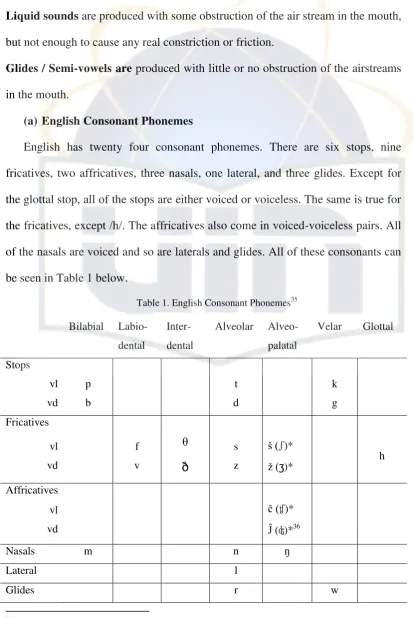
(a) English Consonant Phonemes
English has twenty four consonant phonemes. There are six stops, nine
fricatives, two affricatives, three nasals, one lateral, and three glides. Except for the glottal stop, all of the stops are either voiced or voiceless. The same is true for the fricatives, except /h/. The affricatives also come in voiced-voiceless pairs. All
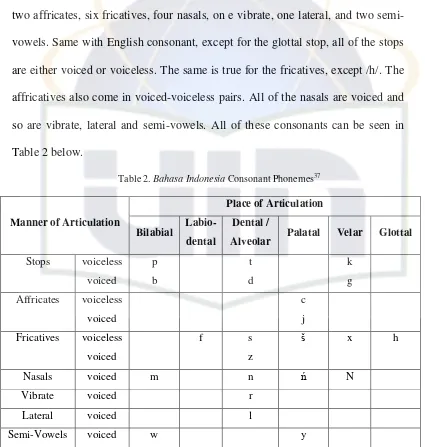
(b)Bahasa Indonesia Consonant Phonemes
Bahasa Indonesia has twenty two consonant phonemes. There are six stops,
two affricates, six fricatives, four nasals, on e vibrate, one lateral, and two
semi-vowels. Same with English consonant, except for the glottal stop, all of the stops
are either voiced or voiceless. The same is true for the fricatives, except /h/. The
affricatives also come in voiced-voiceless pairs. All of the nasals are voiced and
so are vibrate, lateral and semi-vowels. All of these consonants can be seen in
Table 2 below.
Table 2. Bahasa Indonesia Consonant Phonemes37
Manner of Articulation
Place of Articulation
Bilabial Labio-dental
Dental /
Alveolar Palatal Velar Glottal
Stops voiceless
Those Bahasa Indonesia consonants are similar with English consonants,
but there are some English consonants that do not exist in Bahasa Indonesia: /θ/,
/ð/, /ʃ/, /v/, and /ʒ/.
37
27
b) Vowels
Vowels are produced by a continuous air stream and all are voiced.38 Norman
C. Stageberg makes four statements about vowel as follow:
1. Vowels are oral sounds. In some dialects and its certain contexts vowels may
become partially nasal, but normally they are orals, not nasals.
2. Vowels are voiced.
3. Vowels are characterized by a free flow of air through the oral cavity.
4. The distinguishing features of the different vowels are determined largely by
tongue position.39
(a) English Vowel Phonemes
English has twelve vowels. They are four high vowels, five middle vowels
and three low vowels. All of these vowels are represented in Chart 1 below.
Front Central Back
Muhammad Farkhan, An Introduction to Linguistics. (Jakarta: Lembaga Penelitian UIN Jakarta, 2006), p. 37
39
Norman. C. Stageberg (1977), op.cit. p.12
40
(b)Bahasa Indonesia Vowel Phonemes
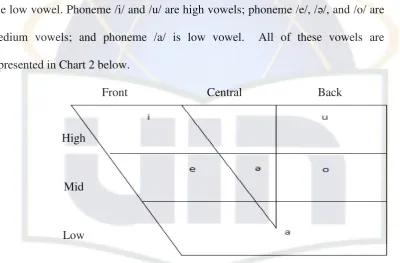
Bahasa Indonesia has six vowel phonemes; they are /i/, /e/, /ə/, /a/, /u/, /o/. It
explained that Bahasa Indonesia has two high vowels, three medium vowels, and
one low vowel. Phoneme /i/ and /u/ are high vowels; phoneme /e/, /ə/, and /o/ are
medium vowels; and phoneme /a/ is low vowel. All of these vowels are
represented in Chart 2 below.
Front Central Back
High
Mid
Low
Chart 2. Bahasa Indonesia Vowel Phonemes
Those Bahasa Indonesia vowels can placed in initial, middle, and final
position.
Table. 3
Phoneme Initial Middle Final
/i/ ikan pintu api
/e/ ekor bebek sore
/ə/ emas geger tante
/a/ anak rames kota
/u/ unggas gunting batu
29
Phoneme /ə/ in final word only exist from the loanwords such as in tante,
orde, kode, mode, and brigade, because all vowels can placed in any position of
syllable, such as phoneme /a/, which can placed in initial, middle, or final. 41
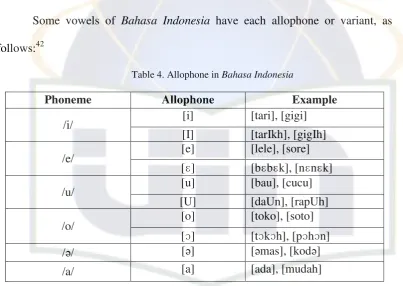
Some vowels of Bahasa Indonesia have each allophone or variant, as
follows:42
Table 4. Allophone in Bahasa Indonesia
Those Bahasa Indonesia vowels are similar with English vowels but there is
any English vowel that does not exist in Bahasa Indonesia: /æ/.
c) Clusters and Diphthongs
A basic understanding of clusters and diphthongs are the same. The difference
is that the clusters associated with consonants, whereas the diphthongs with
vowel. Consonant cluster is a combination of two or more consonants included in
the same of syllable.43 Richard and Schmidt explained that consonant cluster is a
sequence of two or more consonants at the beginning of a syllable (e.g. /splæʃ/ in
splash) or the end of a syllable (e.g. /sts/ in tests).44 If the combined consonants
were in two syllables, the combined it's not called clusters.
Bahasa Indonesia has no consonants cluster in the end of a word, except in
loaned word form. As many other words, Bahasa Indonesia use the loan-form in
daily communication with some vowel addition or delete some consonant, such as
mars and lift in which pronounced with mares and lif.
In the word korps, this word ends with a consonant group: /rps/. This
consonant group is called consonant cluster.
Two consonant clusters are common in Bahasa Indonesia as follows:
44
Jack C. Richard, et al, Longman: Dictionary of Language Teaching and Applied Linguistics, (London: Pearson Education Limited, 2002), p. 110
/mp/ empat, pimpin, tampuk /rn/ warna, purnama, ternak
/mb/ ambil, gambar, ambang /rl/ perlu, kerling, kerlip
/nt/ untuk, ganti, pintu /rt/ arti, serta, harta
/nd/ indah, pendek, pandang /rk/ terka, perkara, murka
/ňc/ lancar, kunci, kencang /rs/ bersih, kursi, gersang
/ňj/ janji, banjir, panjang /rc/ percaya, karcis, percik
/ŋk/ engkau, mungkin, bungkuk /st/ pasti, kusta, dusta
/ŋg/ angguk, tinggi,tanggung /sl/ asli, tuslah, beslit, beslah
/ŋs/ bangsa, angsa, mangsa /kt/ waktu, dokter, bukti
/ns/ insan, insang, lensa /ks/ paksa, laksana, saksama
/rb/ kerbau, korban, terbang /kb/ akbar, makbul
31
From the pattern of syllables and consonant cluster above, it can be concluded
that consonant clusters which is not include of these groups will be strange to our
ears. Words such as rafka and atdun, that is strange to hear for us, because the
/ňš/ munsyi /kn/ laknat, makna, yakni
/rg/ harga, pergi, sorga /kl/ takluk, maklum, taklimat
/rj/ kerja, terjang, sarjana /kr/ makruf, takrif
/rm/ permata, cermin, derma /ky/ rakyat
/kw/ dakwa, dakwah, takwa /mr/ jamrut
/pt/ sapta, optik, baptis /ml/ jumlah, imla
/ht/ sejahtera, tahta, bahtera /lm/ ilmu, gulma, palma
/hk/ bahkan /gn/ signal, kognitif
/hš/ dahsyat /np/ tanpa
/hb/ sahbandar, tahbis /rh/ gerhana, durhaka
/hl/ ahli, mahligai, tahlil /sb/ asbak, asbes, tasbih
/hy/ sembahyang /sp/ puspa, puspita, aspirasi, aspal
/hw/ bahwa, syahwat /sm/ basmi, asmara, resmi
/sh/ mashur /km/ sukma, nikmat
/ls/ palsu, pulsa, filsafat, balsam /bd/ sabda, abdi
/lj/ salju, aljabar /gm/ magma, dogma
consonant cluster /fk/ and /td/ do not exist in our consonant cluster although the
consonant /f/, /k/, /t/, and /d/ are phonemes in Bahasa Indonesia.45
Victoria Fromkin and Robert Rodman define diphthongs are as a sequence of
two sounds, vowel, and glides.46 Further, it consists of a vowel plus a glide that
occurs in the same syllable, the tongue moving smoothly from one position to the
other without hiatus47 as in clown [klaʊn], bear [beər], and toy [tɔɪ]. English has
several diphthongs, there are [aɪ],[ɛɪ], [əƱ], [ɔə], [ɪə], [aƱ], [ɔɪ], [ɛə], [Ʊə]. On
the other hand, Bahasa Indonesia has several diphthongs, such as /ay/, /aw/, and
/oy/.48 Those diphthongs are phonemic and not similar with vowel. Both vowels in
diphthongs symbolized that a vowel cannot separate each other, that‟s different
with two vowels which stand together. For example, /ai/ in /gulai/ “diberi gula”
that consist of two vowels, /a/ and /i/, but in diphthong /ay/ in sungai consist of
one vowel.
Meanwhile, diphthong /ey/ which written in /ei/ appeared when some foreign
come to Bahasa Indonesia. This diphthong often mixed with /ay/ in certain words.
For example:
Victoria Fromkin and Robert Rodman (1998), op.cit. p. 236
47
Norman C. Stageberg (1977), op.cit. p. 21
48
33
2. Phonotactics
In every language there are restrictions on the kinds of sounds and sound
sequences possible in different positions in words (particularly at the beginning
and end), restrictions on possible combinations of sounds are known as
phonotactics constraints.49 Languages generally prefer Consonant (C) first, Vowel
(V) second type syllable structure, but not all languages allow a syllable more
than one consonant. For instance, English allows up to three consonants at the
beginning – CCCV(C) and the first consonant is always /s/ as in strike, scream,
spray, split, squadron, and skewer50and has a wide variety of types: 51
1. V „oh‟
preceding consonant. There are syllables in Bahasa Indonesia as follows:52
1. V a-mal, su-a-tu, tu-a
Kushartanti, et al. Pesona Bahasa: Langkah Awal Memahami Linguistik. (Jakarta: PT Gramedia Pustaka Utama, 2005), p. 165
51
Carol Jean Godby (1982), loc.cit.
52
3. CV pa-sar, sar-ja-na, war-ga
and prangko each of them has changed into selogan, setrika, and perangko.
C. Types of Phonological Change 1. Assimilation
Assimilation defined as the phonetic process by one speech sound comes to
resemble or become identical with a neighboring sound between words or within a
word.53 In assimilation process, there are some consonants assimilates with vowel
features, vowel assimilates with consonant features, consonant assimilates with
consonant features, and vowel assimilates with vowel features.
a) Consonant assimilates with vowel features
35
b) Vowel assimilates with consonant features
see /si:/ to be seen /si:n/
capacity /kə′pæsəti/ to be kapasitas
Vowel is used to nasalize phonetically when it juxtaposes with nasal
consonant, this process as in the form see /si:/, with its final /i:/, and nasal
consonant /n/ is added. Then it becomes seen /si:n/.
c) Consonant assimilates with consonant features
news /nuz/ to be newspaper /nuspepər/
chronic /krɑ:nӀk/ to be kronis
The citation from of news is /nuz/ or /nӀuz/. Let us take news, with its final
/z/, and add paper to it. Now the voiced /z/ is juxtaposed to the voiceless /p/ of
paper. So the voiced /z/ changes to a voiceless /s/ in newspaper /nuspepər/.
d) Vowel assimilates with vowel features
foot /fʊt/ to be feet /fi:t/
The vowel of one syllable may become more like the vowel of some other
syllable. So, we can distinguish vowel harmony and umlauting. According to
Sanford A. Schane, vowel harmony is a case in which vowels agree in certain
features. (Harmoni vokal ialah keadaan vokal-vokal yang bersesuaian dalam
ciri-ciri tertentu) this process as in the example above and it often occurs in irregular
plurals. Besides that, umlaut is back vowels are fronted before certain suffixes
containing a high front vowel. (Umlaut ialah vokal belakang didepankan sebelum
sufiks tertentu yang berisi vokal tinggi depan).54
54
2. Sound Change
Campbell has defined several types of sound changes of loanwords, among
which are following. Deletions that consist of Syncope, and Apocope; Insertions
that consist of Prosthesis, Epenthesis, and Paragoge; and Metathesis.55
a) Deletions
Syncope is the loss (deletion) of a vowel from the interior of a word (not
initially or finally). E.g. rocket becomes roket.
Apocope refers to the loss (apocopation, deletion) of a sound, usually a
vowel, at the end of a word. E.g. artist becomes artis.
b) Insertions
Prothesis is a kind of epenthesis in which a sound is inserted at the
beginning of a word. E.g. phone becomes telepon.
Epenthesis is the insertion of an extra consonant within a word. E.g.
apartment becomes apartemen.
Paragogue is adds a sound (usually a vowel) to the end of a word. E.g.
fact becomes fakta.
c) Metathesis is the transposition of sounds; it is a change in which sounds
exchange positions with one another within a word. E.g. variable becomes
variabel.
D. Graphemes
Grapheme is the overall of letters or combination of letter that represent
phonemes. Grapheme f represent fan, ph represent photo, and gh represent cough,
55
37
is a grapheme with three variants or allograph. Soenjono Djarwowidjojo states
that an ideal writing system is that the relationship between graphemes and
phonemes that one-on-one.56 It means each phoneme is represented by one
grapheme with one variant.
There are differences between phonemes and graphemes. If we talk about
phonemes, we were talking about the sound; when we talk about the letter, it was
graphemes. Grapheme is written between the two brackets <...>.57 It is true that
often the written representations of these two concepts together. For example, to
represent objects that used to sit, we write kursi and said it was /kursi/ - in the
terms of grapheme there are five units, in the terms of phonemes there are also
five units. However, in one-on-one like that does not always be found. Grapheme
<e>, for example, can represent the phoneme /e/ as in sore and phoneme /ə/ as in
besar. Conversely, the phoneme /f/ can also represent by two different graphemes:
fajar, visa. Phoneme /ŋ/ is expressed by two letters, i.e., n and g, two letters that
form one grapheme <ng>.
Before the enactment of EYD, Bahasa Indonesia has some of each phoneme
that represent by more than one grapheme. People used to write the word baca
and baju with tj and dj - batja and badju, moreover, t, d and i are three graphemes
that stand alone. Now, phoneme /c/ and /j/ respectively have been represented by
one grapheme, <c> and <j>. People still have <ng> that represents one phoneme
/N/.
56
Soenjono Djarwowidjojo, Psikolinguistik: Pengantar Pemahaman Bahasa Manusia,(Jakarta: Yayasan Obor Indonesia, 2005), p. 298
57
This is different with English. It could be argued that English is a language
that disorganized in spelling and pronunciation. In this language, a grapheme can
be represented by several kinds of allograph or variant. For example, phoneme /k/,
can be represented by eleven allograph: c-cash, cc- account, cch- bacchanal, ck-
back, ch- character, cq- acquaint, cque- sacque, cu- biscuit, k- keep, q- barbeque,
and qu- liquor. Conversely, one grapheme can represent some phonemes.
Grapheme <gh> can represent phoneme /f/, as in rough, /p/ as in hiccough, and /g/
CHAPTER III
RESEARCH FINDINGS
A. Data Description
In this description of the data, the writer discusses about the change process
of phonemes and graphemes of English loanwords in Teropong articles of Kompas’ newspaper.
From that newspaper, the writer found the English loanwords of Teropong
articles up to 50 words. To make easier to analyze, the writer tabulated the data of
English loanwords in Bahasa Indonesia which is taken from Teropong articles of Kompas’ newspaper, August 2011 edition.
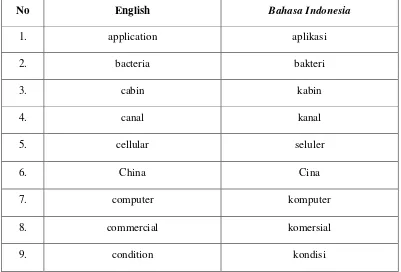
The tabulated data are described in table. 5 below:
Table. 5 Data of English Loanwords in Teropong articles of Kompas’ newspaper.
No English Bahasa Indonesia
1. application aplikasi
2. bacteria bakteri
3. cabin kabin
4. canal kanal
5. cellular seluler
6. China Cina
7. computer komputer
8. commercial komersial
10. consumer konsumen
11. contact kontak
12. design desain
13. director direktur
14. doctor dokter
15. effect efek
16. evolution evolusi
17. faculty fakultas
18. film film
19. frequency frekuensi
20. general jendral
21. information informasi
22. institute institut
23. interactive interaktif
24. lens lensa
25. local lokal
26. manager manajer
27. maximal maksimal
28. modem modem
29. multimedia multimedia
30. operator operator
31. oxygen oksigen
41
33. potency potensi
34. producer produsen
35. public publik
36. quality kualitas
37. relative relatif
38. reporter reporter
39. satellite satelit
40. senior senior
41. specialist spesialis
42. spectrum spektrum
43. station stasiun
44. strategy strategi
45. team tim
46. technology teknologi
47. telecommunication telekomunikasi
48. telephone telepon
49. television televisi
50. video video
The writer divided her analysis into two parts; they are the changes processes
of English loanwords in Teropong articles of Kompas’ newspaper both of
1. Phonemic
The corpus for phonemic change is derived from Teropong articles in Kompas’ newspaper, 16 August 2011 edition. As comparison, the writer also uses
an Oxford Advanced Learner’s Dictionary by Hornby, to find the phonetic
transcription of English word.
Table 6.Data of Phonemic Change of English Loanwords in Teropong articles of Kompas’ newspaper.58
No English Sound Change Bahasa Indonesia
39. modem /'məʊdəm/
Bahasa Indonesia, the writer uses Tata Bahasa Baku Bahasa Indonesia by Hasan
Alwi to see the rules of Indonesian spelling systems. The writer divided
graphemic analysis into two parts; they are pure phonological adaptation and
syllabic adaptation.
a) Pure Phonological Adaptation
Table 7. Data of Graphemic Change of English Loanwords in Teropong articles of Kompas’ newspaper
No English Graphemic Change Bahasa Indonesia
1. cabin
<c> → <k>
kabin
2. canal kanal
27. film film
46. telecommunication telekomunikasi
47
48. lens a syllabic become
disyllabic lensa
49. permanent consonant inhibitory
at the end of
languages. So in this research, the writer writes the same meaning in English and
Bahasa Indonesia has those phonemes.
In this section, the writer uses phonemic analysis that divided it into consonant
and vowel analysis.
a) The Process of Phonological Change Phonemically for Consonant 1) Consonant Replacement
English Loanwords Consonant Change
a) /di'zain/ /désain/ /z/ → /s/
b) /lenz/ /lénsa/ /z/ → /s/
In those words above, the voiced alveolar sibilant /z/ changes to the voiceless
alveolar /s/ because in Bahasa Indonesia system, the phoneme /z/ has an
allophone which is only are in the first syllable.60 In (a) and (b) examples, /di'zain/,
and /lenz/, the phoneme /z/ is in the second syllable so that it must be changed to
59
Sudarno, Kata Serapan dari Bahasa Arab, (Jakarta: Arikha Medika Cipta, 1992), p. 61
60
be /s/. In Bahasa Indonesia system, the phoneme /s/ has an allophone which can
be put in the first or the second of syllable.
[z] → [s]
Phoneme /z/ changes to be phoneme /s/ when it is put in the middle and in the last
syllable, except in the first syllable.
English Loanwords Consonant Change
a) /tek'nɒləʤi/ /téknologi/ /ʤ/ → /g/
b) /'strætəʤɪ/ /stratégi/ /ʤ/ → /g/
In the data above, voiced affricative consonant /ʤ/ is replaced with voiced stop
consonant /g/ and is added by vowel /i/. This matter occurs because in Bahasa
Indonesia system phoneme /g/ only has an allophone which can be put in the first
syllable. At the end of syllable or word, the pronunciation of grapheme <g> is
[k>]. However, if that word ends with the grapheme <g> followed by suffix that
begin with a vowel, the grapheme <g> will pronounced as [g].61
[ʤ] → [g]
Phoneme /ʤ/ in English or /j/ in Bahasa Indonesia changes to be phoneme /g/
when it is put in the last syllable and followed by suffix that begin with a vowel.
2) Consonant Addition
English Loanwords Consonant Change
/'ʤenrəl/ /jenderal/ adding /d/
61
49
From the data above, there is an addition of voiced consonant on those
loanwords. It usually occurs in changes from other language likes Dutch, emmer
becomes ember. It is clear that the situation correlated with two consonants in
Bahasa Indonesia which does not allow the glides to occur in nasal compound,
and sequence of two consonants that divided from /nr/ is not a group of consonant
cluster in Bahasa Indonesia system.
3) Consonant Omission
English Loanwords Consonant Change
a) /prə'dju:sə(r) /produsér/ /dju/ → du/
b) /kəm'pju:tə(r)/ /komputər/ /pju/ → /pu/
c) /͵telɪkə'mju:nɪkeɪʃn/ /télékomunikasi/ /mju/ → /mu/
d) /kən'sju:mə(r)/ /konsumén/ /sju/ → /su/
e) /ɪnstɪtju:t/ /institut/ /tju/ → /tu/
From the data above, it can be seen that a consonant system has the
consonant clusters.62 Bahasa Indonesia and English language systems has the
differences of consonant sequence, in (a), (b), (c), (d), and (e) /dju/, /pju/, /mju/,
/sju/, /tju/. Phoneme /j/ is deleted because there is a rule in Bahasa Indonesia that
the phoneme /j/ palatal affricative cannot appear after phoneme dental stop /d/,
bilabial stop /p/, bilabial nasal /m/, dental fricative /s/, and dental stop /t/ because
all language have constraints on the permitted sequences of two phonemes. 63
[dju, pju, mju, sju, tju] → [du, pu, mu, su, tu]
62
Ibid. p. 78
63
The consonant sequences /dju, pju, mju, sju, tju/ changes to be /du, pu, mu, su,
tu/ because those consonant sequences cannot be accepted in Bahasa Indonesia
system.
a) The Process of Phonological Change Phonemically for Vowel. 1) Vowel Replacement.
seen that Bahasa Indonesia does not have low-front and low-back vowels. So, the replacement of English vowels into Bahasa Indonesia vowels is a common phenomenon. Like the data (a) above, low-front vowel /æ/ and diphthong that is not in Bahasa Indonesia such as (c), /ei/ is usually replaced by low-central vowel
51
low-central vowel /a/. Moreover, (d) and (i), the replacement of mid-central /ə/
and low-back rounded /ɔ/ are replaced often by mid-back vowel /o/, then the
diphthong which is not in Bahasa Indonesia, such as data (g) and (i), /əʊ/ and /oʊ/
are replaced also by mid-back /o/.
The other case, (e), is the replacement of mid-central vowel /ə/ to be mid-front
vowel /é/ in Bahasa Indonesia, (h), is replacement of high-front vowel /ɪ/ to be
mid-front vowel /e/ and then (i), is replacement of lower mid-central // is changed
by high-back vowel /u/ in Bahasa Indonesia.
The vowel replacement occurs because English has no more phonemes than
Bahasa Indonesia. So, when there is no Bahasa Indonesia phoneme which exactly
same with English, Bahasa Indonesia system will replace the phoneme with other
phoneme which is similar.
/æ/
/a/ /ə/
/ei/
/əʊ/
/o/ /ə/
/ɔ:/
[æ, ə, ei] → [a]
The vowel /æ, ə/ and diphthong /ei/ become vowel /a/ because Bahasa
Indoneia does not have those phonemes or Bahasa Indonesia system does not
accept those phonemes occur in that vowel sequence.
The vowels /ə/, /ɔ:/ and diphthong /əʊ/ become vowel /o/ because Bahasa
Indonesia does not have those phonemes or Bahasa Indonesia system does not
accept those phonemes occur in that vowel sequences.
2) Vowel Addition
English Loanwords Vowel Change
a) /mæksɪml/ /maksimal/ adding /a/
It can be seen that /mæksɪml/ changed to be /maksimal/, there is a process of
adding a new phoneme /a/ because Bahasa Indonesia does not have the phonetic
cluster in the last syllable so the loanwords which have that feature usually will be
adapted by inserting vowel in pronunciation or deleting one of the consonants.64
Bahasa Indonesia system often adds a vowel in a process of adaptation the
loanwords in order to solve the syllable pattern or following consonant which
Bahasa Indonesia system does not have. Such as the examples above, there is
adding vowel /a/.
2. Graphemic Analysis
Before a word or term is received in a language, shall first be adjusted are
rules and regulations. English phoneme does not have characteristics in common
with Bahasa Indonesia phoneme; need some adjustments to get the nearest sound
form in accordance with phonological system of Bahasa Indonesia. Adjustment of
foreign sounds with changes based on phonological system of a language is called
pure phonological adaptation.
64
53
In principle, graphemes can represent a phoneme or more.65 The same thing
happened in English language. English grapheme is not only that represents a
sound, but also some sounds. Not a few grapheme also which became the basis of
how an element adapted, especially if the sound or the element not have
characteristics in common with Bahasa Indonesia phonemes.
a. Pure Phonological Adaptation
Pure phonological adaptation occurs only in English phonemes contained in the
phonological system of Bahasa Indonesia. This adjustment is generally carried
out based on pronunciation, while writing adjusted to the rules of spelling in
Bahasa Indonesia. If the adjustment occurs by its spelling rule often this is due to
avoid a homonym, perhaps also because the structure of morphology is less
and third allophone at the end of syllable.
English Bahasa Indonesia