THE RELATIONSHIP BETWEEN SALIVA pH AND DENTAL CARIES STATUS AMONG PRESCHOOL CHILDREN IN SLEMAN DISTRICT
2015
Sri Utami
School of Dentistry, Faculty of Medicine and Health Sciences, Universitas Muhammadiyah Yogyakarta
ABSTRACT
Background: Dental caries is a major dental and oral health problem worldwide with a very high prevalence of morbidity. Dental caries in preschool children is a disease which is extremely destructive; thus, this impacts on the growth and development of the permanent teeth. The prevalence in children aged 2-4 years in countries has reached 18%, while the prevalence of caries in children aged 3-6 years in the city of Yogyakarta has reached 84.1%. Dental caries is a multifactorial disease, among others, influenced by host factors, agent, oral environment, socioeconomic status, environment, culture, demographics and behavior. The objective of this study was to determine the association between saliva pH and dental caries status in preschool children in Sleman District.
Methods: This was an observational using a case-control design. Subjects were 120 children, 60 cases and 60 controls, aged 4-6 years, who attended kindergarten (TK) in Sleman, and selected using simple random sampling. The variables studied were saliva pH and dental caries status. The saliva pH was measured using pH digital meter (Hanna), and dental caries status measured using the dmf-s index. Data analysis used simple logistic regression.
Table 1. The Characteristic of Respondents
Characteristic Case Control Total P
value
n % n % n %
Sex
Male 33 54,17 39 53,11 72 58,75
0,075 Female 27 45,83 21 46,89 48 46,25
Total 60 100 60 100 120 100
Age
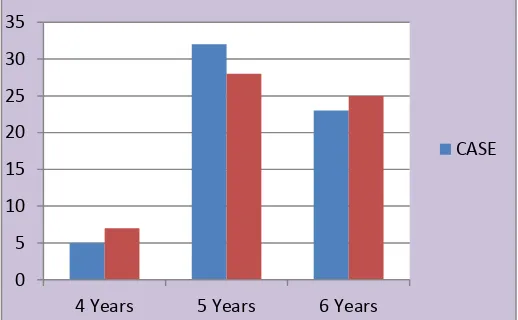
4 years 5 8,11 7 11,63 12 10,00
0,465 5 years 32 54,05 28 46,51 60 50,00
6 years 23 37,84 25 41,86 48 40,00
[image:2.612.183.433.276.447.2]Total 60 100 60 100 120 100
[image:2.612.177.436.493.653.2]Fig.1. The Proportion of Sex by Case
Fig.2. The Proportion of Age by Case 0 5 10 15 20 25 30 35 40 45 MALE FEMALE CASE CONTROL 0 5 10 15 20 25 30 35
4 Years 5 Years 6 Years
Table 2. Results of Bivariate Analysis
Variable Case Control Total OR 95 % CI P
N % n % n %
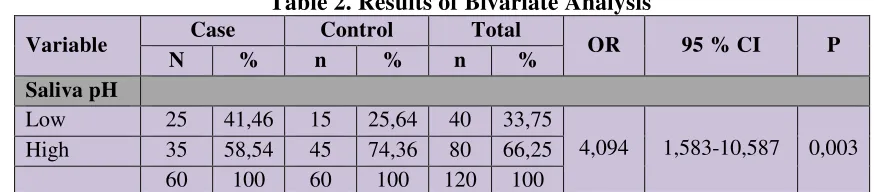
Saliva pH
Low 25 41,46 15 25,64 40 33,75
4,094 1,583-10,587 0,003
High 35 58,54 45 74,36 80 66,25
60 100 60 100 120 100
Conclusions: The pH of saliva was associated with dental caries status in preschool children, children with lower saliva pH have 4 times greater risk of suffering dental caries than children with higher saliva pH. Fourty percent of dental caries in preschool children could be prevented by keep the salivary pH in normal condition.
Keywords: Dental caries in preschool children, risk factor and pH saliva
REFERENCES
1. Borutta, A., Wagner, M. dan Kneist, S., 2010, Early Childhood Caries: A Multi-Factorial Disease, OHDMBSC, 9 (1): 32-38
2. Kuswandari, S., 2006, Profil Kesehatan Gigi Anak Prasekolah di Kota Yogyakarta, Majalah
KedokteranGigi, XIII, 2
3. Brodeur, J.M. dan Galarneau, C., 2006, The High Incidence of Early Childhood Caries in Kindergarten-age Children, JODQSupplement
4. Shimizu, K., Igarashi, K., dan Takahashi, N., 2008, Chairside Evaluation of pH Lowering Activity and Lactic Acid Production of Dental Plaque: Correlation with Caries Experience and Incidence in Preschool Children, QuintessenceInternational, 30 (2): 151-158
5. Marsh, P.D., 2009, Dental Plaque as A Biofilm: The Significance of pH in Health and Caries,
ContinuingEducation, 30 (2): 76-87