
Surat Keterangan
Pengalihan Ijin Publikasi Mandiri
Kami, panitia pelaksana kegiatan International Symposium on Medicinal Plant and Traditional Medicine “Indonesia Traditional Medicine for Human Welfare”, memberikan ijin Pengalihan Publikasi Mandiri secara online artikel dari:
Nama Penulis : Desy Nurmalitasari, Agni Hikmawati, Laily Hidayati, Broto Santoso Asal Institusi : Fakultas Farmasi Universitas Muhammadiyah Surakarta
Judul Artikel : Molecular Docking of Antioxidant Compounds: Groups of Flavonoid and Phenolic from Eight Indonesian Medicinal Plants.
untuk dipublikasi secara Mandiri oleh yang bersangkutan. Artikel tersebut telah dipresentasikan secara oral dalam International Symposium on Medicinal Plant and Traditional Medicine “Indonesia Traditional Medicine for Human Welfare” yang diselenggarakan oleh Medicinal Plant and Traditional Medicine Research and Development Centre (MPTMRDC/B2P2TOOT) - NiHRD, Ministry of Health Republic of Indonesia in colaboration with National Working Group of Indonesian Medicinal Plant (POKJANASTOI)pada tanggal 4-6 Juni 2014 di Auditorium of Medicinal Plant and Traditional Medicine Research and Development Center (MPTMRDC/B2P2TOOT) Tawangmangu. Demikian surat ini dibuat agar dapat dipergunakan sebagaimananya mestinya.
Tawangmangu, 27 Februari 2015 Panitia Pelaksana
Molecular Docking of Antioxidant Compounds: Groups of Flavonoid and
Phenolic from Eight Indonesian Medicinal Plants
Desy Nurmalitasari1, Agni Hikmawati1, Laily Hidayati1, Broto Santoso1*
1Faculty of Pharmacy, Universitas Muhammadiyah Surakarta *Corresponding author, email: [email protected]
Abstract
Indonesia is a well-known country with a variety of resources vegetables and fruits. Most of them are used as a prospectus cure for cancer within antioxidant mechanisms. Some parts of these plants are eucalyptus leaves, bay leaves, guava leaves, mangosteen skin, Kepel leaves, peanut shell, yellow leaves and seeds of rambutan known to have antioxidant activity. This recent study aimed to gain information about the chemical interaction studies of the ligand-protein by molecular docking of flavonoid and phenolic compounds with a ligand-protein target that is responsible for antioxidant activity. The eight extracts obtained by maceration using 96% ethanol were tested their antioxidant activity with DPPH method to obtain their IC50 values.
Flavonoids and phenolic compounds of each plants were obtained from the database of Universal Natural Product (http://pkuxxj.pku.edu.cn/UNPD) and other literature. The 99-selected compounds were performed molecular docking against the 6-protein target using Dock6. The results were obtained in the form of colour pasta extracts with IC50 values (and
yield) for eucalyptus leaves, bay leaves, guava leaves, mangosteen skin, kepel leaves, peanut shell, yellow leaves and seeds of rambutan was 29.4 (33.36); 43.9 (25.71); 82.6 (30.0); 170 (38.44); 190 (22.71); 240 (6.09); 790 (26.39) and 970 (8.55) µg/mL (% w/w) respectively. Eucalyptus leaf extract has the greatest antioxidant activity by DPPH method. This result correlates with its binding activity of molecular docking. A compound, namely (5R)-6,7,8-trihydroxy-1,3-dioxo-1H,2H,3H,5H-cyclopenta[c]isochromene-5-carboxylic acid (eucalyptus) is highly active against all protein targets followed by murrapanine (yellow) compared to the native ligand of the protein target. All other molecules of the six remaining extract did not contain molecule that has a dominant binding affinity of ligand-protein. This could be happened because the antioxidant activity of each extract was admitted as resultant of several molecules or there are other molecules that are not incorporated in the flavonoid and phenolic groups that have antioxidant activity. However, further research is needed to prove that antioxidant activity is the resultant of several compounds.
Keywords: Indonesian Medicinal Plants, Antioxidant, DPPH, Molecular Docking, Dock6
INTRODUCTION
Antioxidants are compounds that mainly have low molecular mass and they can
reduce the damaging effects of radical compounds in general (Langseth, 1995). These
compounds stabilize radicals by completing the lack of electrons with the result that
stop their chain reaction (Windono et al., 2001). Small number of antioxidants could
inhibit or delay the oxidation process.
Based on its mechanism of action, antioxidants can be classified into three
groups. Primary antioxidants donate a hydrogen atom rapidly to a lipid radical, for
example flavonoids, tocopherol, thiol compound that can break the chain propagation
antioxidant, which able to eliminate the process of initiation of oxygen and nitrogen
radicals or to react with molecules or enzymes that initiate radical reactions such as,
oxidase and reductase causing non reactive radical species. The examples of this
category are sulphite antioxidants, vitamin C, beta-carotene, uric acid, bilirubin, and
albumin. Tertiary antioxidant is a type of antioxidants that could repair the damaged
cells and tissues caused by radicals. Sulphoxide methionin reductase could be as an
example (Aviram and Vaya, 2001).
The compounds that have antioxidant activity in plants are phenolic and
flavonoid groups. They work by donating redox capability which play an important role
in captivating and deactivating radicals, quenching singlet and triplet oxygen, or
decomposing peroxides (Osawa, 1994). Other compounds that can be found in plants
belonging to the group of antioxidants, among other polyphenols group, bio-flavanoid,
vitamin C, vitamin E, β-carotene, catechin and resveratrol (Hernani and Raharjo, 2006).
Indonesia is a well-known country with a variety vegetables and fruits. They
could be used as a source of natural medicine. Some plants such as eucalyptus leaves
(Melaleuca leucadendron L), bay leaves (Syzygium polyanthum), guava leaves
(Psidium guajava Linn), mangosteen skin (Garcinia mangostana), kepel leaves
(Stelechocarpus burahol), peanut shell (Arachis hypogaea), yellow leaves (Murraya
paniculata) and seeds of rambutan (Nephelium lappaceum) are known to have
antioxidant activity. Guava has phenolic compounds such as mirisetin, epigenin, ellagic
acid and anthocyanins (Miean and Mohamed, 2001). Saponins, flavonoids, tannins and
essential oils have been found in eucalyptus (Thomas, 1992). Ethanol extract of its
leaves has antioxidant activity (Indrayana, 2008). Belami et al., (1997) indicated that
bay leaves contain mainly flavonoids, quercetrin, which are known to have very strong
activity as an antioxidant and anti-cancer (Ding et al., 2010). Some studies showed that
flavonoids and phenolic in plants and its extract have antioxidant activity but there is no
correlation between the concentration of flavonoids and phenolic and their antioxidant
activity (Zheng and Wang, 2001).
Gupta et al. (2013) stated that there were six-protein targets, which have been
used to predict antioxidant activity of molecules. These proteins are enzyme that
responsible for antioxidant mechanism in human body. They were ordered in
transferase (18GS, 1TDI, 3LJR, 1JNK), oxidoreductase (4NOS) and signalling protein
(1YVL) class. Molecular docking could be able to bind and emphasise the evidence of
chemistry. Molecular docking uses the three-dimensional structure of the receptor to
screen and acquire conformation of molecules as ligands that have the highest binding
affinity to protein. The method could gain the information about relations between the
conformations of ligands with the active site of protein (McGovern and Shoichet, 2003).
This research has the following objectives: measuring the ability of antioxidant
activity by molecular docking, knowing the types of medicinal plants that contain the
best antioxidants and their molecular docking profile. This recent study has been
performed to gain information about the chemical interaction studies of the
ligand-protein by molecular docking. The flavonoid and phenolic compounds in eight
medicinal plants have been docked to proteins target that are responsible for
antioxidant activity.
MATERIAL AND METHODS
Materials for molecular docking were MacBook Pro with Intel-i7 processor, 8GB
RAM, Intel HD Graphics 4000 and Mac OS X Mavericks 10.9 (64bits). Computational
system has been built using MacPorts 2.2.1, XCode 5.1, Chimera 1.8, MarvinSuite 6.2,
Dock6.6, iBabel 3.3 or OpenBabel 2.3.2, PyMOL opensource version 1.7.1.1 and
LigPlot+ 1.4.5 for education. Materials for antioxidant assay were DPPH
(2,2-diphenyl-1-picrylhydrazyl), ethanol, aquadest, spectrometer, glassware and analytical balance.
Chemical materials were pro analysis grade.
Molecular docking has been performed using Dock6 to calculate docking score
of ligands. They have been gained from UNPD database (Universal Natural Product
Database at http://pkuxxj.pku.edu.cn/UNPD/) and some articles (Kato et al., 2013;
Sunarni et al., 2007). Chimera has been used to prepare protein, ligands and other
components as explained at http://www.bioinformatics.iastate.edu/. Molecules of bay
leaves and kepel leaves have been generated utilizing MarvinSuite. Two-dimensional
structures of them were drawn with MarvinSketch. Their 3D-structure was produced by
MarvinSpace. Docking results was obtained as Grid Score (kcal/mol) using Dock6.6
with four types calculation based on the center of binding-site gridbox and flexibility of
ligand during process. They are flexible ligands with default Dock6 calculation or ligand
centre for gridbox and rigid ligand using default Dock6 calculation or ligand centre for
gridbox. Protein residue and ligand contact were generated using LigPlot+. PyMOL
was applied to capture the conformation of docked ligands inside protein.
Ethanol extract of plants were obtained using maceration method and
preparing of the requirement reagent in ethanol (0.4 mM DPPH, concentration series of
each plant extract). After 45 minutes incubation, fixed solutions were measured for their
absorption intensity at 517 nm. Radical scavenging activity against DPPH was
expressed as IC50 value.
RESULTS AND DISCUSSION
Ligands gained from database must be appropriate to phenolic or flavonoid
groups. The result revealed that there were 99 molecules in total for the molecular
docking studies. The number for molecules from eucalyptus leaves, bay leaves, guava
leaves, mangosteen skin, kepel leaves, peanut shell, yellow leaves and seeds of
rambutan are 7, 3, 11, 43, 1, 14, 18 and 6, respectively.
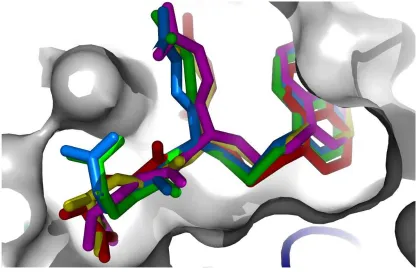
Figure 1. Docked position of native ligands inside 3LJR protein resulted from molecular docking compared to its crystallography data. Red colour represents crystallography ligand, green for flexible ligand that obtained based on default Dock6 calculation for gridbox (RMSD = 0.646), blue for flexible ligand that obtained based on ligand centre for gridbox (RMSD = 0.602), yellow for rigid ligand using ligand centre for gridbox (RMSD = 0.925) and magenta for rigid ligand using default Dock6 calculation for gridbox (RMSD = 0.497).
Scientific evidence regarding chemical compounds in the bay leaves and kepel
leaves has not been found to date. This causes the number of molecules of both plants
is less representative to be profile of molecular docking. Fortunately, they are included
the group of phenolic and flavonoid. They are hydroxychavicol,
4-allyl-2-hydro-xy-1-(20-allyl-40-hydroxy-50-methoxyphenoxy)benzene for bay leaves and
3,7,3',4'-tetrahydroxy-5-methylflavon for kepel leaves (Kato et al., 2013; Sunarni et al., 2007).
Validation of molecular docking should be done to the native ligand from each
protein. The results of molecular docking validation of six proteins with their native
ligands indicated that the 3D conformation between native ligand of crystallography
with native ligand of docking results was found to be similar position from one to
another. Figure 1 is an example of the 3D conformation of docked ligand of the protein
3LJR, a transferase enzyme, namely Glutathione S-transferase theta-2.
Figure 2. Result of the best three of docked ligands for protein 1JNK represent as –Log (Grid Score) value and compare to dock result of native ligand (blue solid line) for each type of gridbox centre. Result of rigid ligands (DCR) and flexible ligands (DCF) that obtained based on default Dock6 calculation for gridbox and result of rigid ligands (LCR) and flexible ligands (LCF) using ligand centre for gridbox.
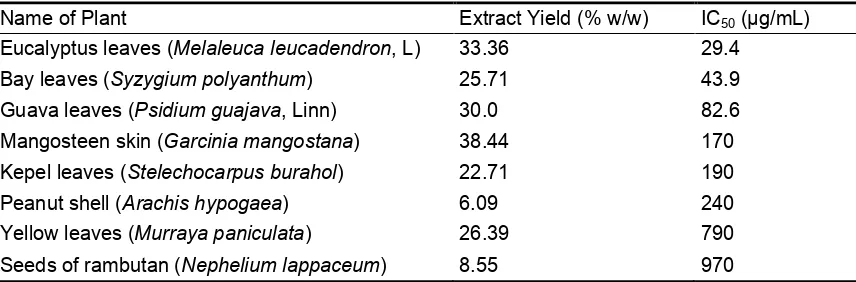
Table 1. Result of extraction and radical scavenging activity against DPPH
Name of Plant Extract Yield (% w/w) IC50 (µg/mL)
Eucalyptus leaves (Melaleuca leucadendron, L) 33.36 29.4
Bay leaves (Syzygium polyanthum) 25.71 43.9
Guava leaves (Psidium guajava, Linn) 30.0 82.6
Mangosteen skin (Garcinia mangostana) 38.44 170
Kepel leaves (Stelechocarpus burahol) 22.71 190
Peanut shell (Arachis hypogaea) 6.09 240
Yellow leaves (Murraya paniculata) 26.39 790
Seeds of rambutan (Nephelium lappaceum) 8.55 970
Compound KP01 or
(5R)-6,7,8-trihydroxy-1,3-dioxo-1H,2H,3H,5H-cyclopen-ta[c]isochromene-5-carboxylic acid has the best result of molecular docking even
compared to native ligand of 1JNK for all type of gridbox centre (Figure 2). They have
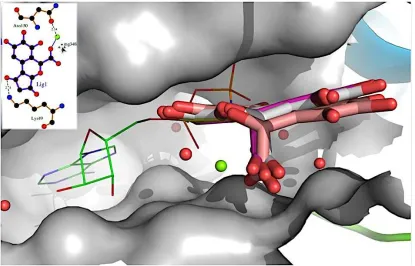
similar 3D-conformation when docked with protein (Figure 3). This happened because
They have two hydrogen bonds with Lys49 and Mg348-Asn150. Furthermore, the
same results have been revealed for 1TDI, 1YVL, 3LJR and 18GS protein (Figure 8).
Murrapanine or KG01 (yellow leaves) as the second of rigid ligand compared to native
for dock screening using default Dock6 calculation for gridbox.
Figure 3. The best of docked ligand conformation with the lowest of Grid Score, namely (5R)-6,7,8-trihydroxy-1,3-dioxo-1H,2H,3H,5H-cyclopenta[c]isochromene-5-carboxylic acid (drawn in sticks) from eucalyptus compared to native ligand (drawn in lines). One of them has hydrogen bond with Lys49 and Mg348-Asn150 (white box).
Figure 5. The lowest three of docked ligands for 1YVL as –Log (Grid Score) compare to dock result of native ligand (blue solid line) for each type of gridbox centre. DCR= dock centre rigid, DCF= dock centre flexible, LCR= ligand centre rigid and LCF= ligand centre flexible.
Figure 6. The lowest three of docked ligands for 3LJR as –Log (Grid Score) compare to dock result of native ligand (blue solid line) for each type of gridbox centre. DCR= dock centre rigid, DCF= dock centre flexible, LCR= ligand centre rigid and LCF= ligand centre flexible.
Figure 8. Docked ligands with the lowest of Grid Score, namely (5R)-6,7,8-trihydroxy-1,3-dioxo-1H,2H,3H,5H-cyclopenta[c]isochromene-5-carboxylic acid (drawn in sticks) from eucalyptus compared to native ligand (drawn in lines). White box represent chemical interaction ligand-protein, such as hydrogen bond with Arg12 (A: 1TDI), Lys556 and Arg 574 (B: 1YVL), Lys53 (C: 3LJR) and Tyr6-HOH216 (D: 18GS).
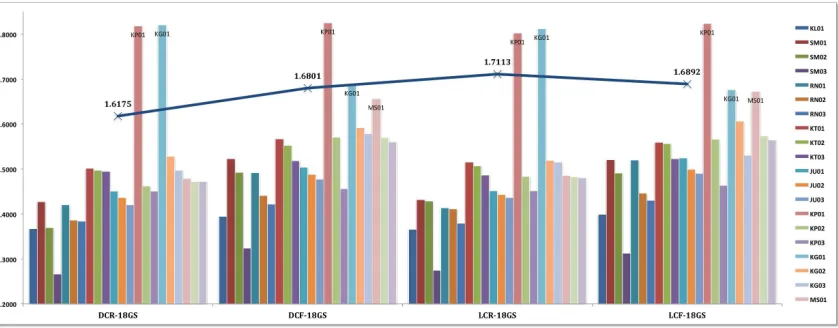
Figure 9. The result of best three of docked ligands in 4NOS (–Log [Grid Score]) compare to dock result of native ligand (blue solid line) for each type of gridbox centre. DCR= dock centre rigid, DCF= dock centre flexible, LCR= ligand centre rigid and LCF= ligand centre flexible.
KP01 also had the lowest Grid Score of molecular docking with 1TDI, 1YVL,
3LJR and 18GS protein and the second place is KG01 (Figure 4-7). These only
illustrate as a single molecule profile of molecular docking. Different result has been
found in assay of the antioxidant using DPPH (Table 1). As an example, yellow
result. This is the reason why molecular docking result of molecules in other plants did
not exceed the result of native ligand. They worked as a group of compounds instead
of a single molecule. Mangosteen skin has the biggest yield of extract and the highest
number of molecules than other plants. This is the reason why the mangosteen has the
large variety of biological activity. Some of them are antioxidant and anti-cancer.
Figure 9 explains that tested ligands had potent binding activity with protein
compared to original ligand. Binding site pocket of 4NOS has a small volume space
because its ligand only has fifteen atoms. Other non standard molecules beside ligand
have been removed from protein when preparation has been completed. Gridbox size
of 4NOS determined using default Dock calculation and ligand centre point resulted in
a big molecular volume of binding site ligand-protein interaction site. Molecular docking
of ligand fulfilled other binding site pocket instead where native ligand
three-dimensional position was, due to ligands could replaced the position of these non
standard molecules.
Peanut shell and seeds of rambutan extract had yield less than 10% and the
others had more than 20% yield of extract (Table 1). Phenolic and flavonoid content in
both extracts may be less than that of other plant extracts. This is a cause that their
antioxidant activity was low. Mangosteen skin extract had the contradictive result. It
had high yield of extract but it did not contribute to its IC50 value. It can be occurred
when extracted molecules were not including in groups of phenolic or flavonoid and did
not have the antioxidant pharmacopore. IC50 value of bay leaves and guava leaves did
not have correlation with their molecular docking result because their antioxidant
molecules were not phenolic or flavonoid.
CONCLUSION
A single compound, namely
(5R)-6,7,8-trihydroxy-1,3-dioxo-1H,2H,3H,5H-cyclopenta[c]isochromene-5-carboxylic acid (eucalyptus) is highly active against all
protein targets followed by murrapanine (yellow leaves) compared to the native ligand
of the protein target. All other molecules of the six remaining extract did not contain
molecule that has a dominant binding affinity of ligand-protein. This could be happened
because the antioxidant activity of each extract was admitted as resultant of several
molecules or there are other molecules that are not incorporated in the flavonoid and
phenolic groups that have antioxidant activity. However, further research is needed to
ACKNOWLEDGMENT
Thanks to Directorate General of Higher Education of Ministry of Education and
Culture has funded this research through field research of student creativity program
2013.
REFERENCES
Aviram M. and Vaya J. 2001. Markers for Low-density Lipoprotein Oxidant, Methods in
Enzymol., 335: 244-56.
Belami D., Gana A. and Kusaardiyani S. 1997. Flavonoid Utama dan Asam Fenolat
Daun Salam. Eugenia Polyantha Wight, Myrtaceae. Skripsi. Fakultas Farmasi. Institut Teknologi Bandung.
Berman HM., Westbrook J., Feng Z., Gilliland G., Bhat TN., Weissig H., Ilya N.
Shindyalov IN. and Bourne PE. 2000. The Protein Data Bank. Nucl. Acids Res., 28
(1): 235-242.
Ding M., Zhao J., Bowman L., Lu Y. and Shi X. 2010. Inhibition of AP-1 and MAPK
signaling and activation of Nrf2/ARE pathway by quercitrin. Int. J. Oncol., 36(1):
59-67.
DOCK6.6 (2013). University of California at San Francisco; San Francisco, CA.
Gupta SK., Pandey R., Karmakar M., Smita S., Pant A., Shukla V., Yadav AK., Negi H. and Gupta MM. (2013). Computational Prediction of Molecular Targets responsible
for Antioxidant Activity of D-pinitol in Caenorhabditis elegans. IJCA Proceedings
on National Seminar on Application of Artificial Intelligence in Life Sciences 2013, NSAAILS, 1: 19-23.
Hernani and Raharjo M. 2006. Tanaman Berkhasiat Antioksidan. Penebar Swadaya.
Jakarta.
Indrayana R. 2008. Efek Antioksidan Ekstrak Etanol Daun Salam (Syzygium
polyanthum) Pada Serum Darah Tikus Jantan Galur Wistar Yang Diinduksi Karbon Tetraklorida. Skripsi. Universitas Muhammadiyah Surakarta.
Kato E., Nakagomi R., Gunawan-Puteri MDPT. and Kawabata J. 2013. Identification of hydroxychavicol and its dimers, the lipase inhibitors contained in the Indonesian
spice, Eugenia polyantha. Food Chemistry, 136(3-4): 1239–1242.
Langseth L. 1995. Oxidants, Antioxidants, and Disease Prevention. Internasional life
Sciences Institutes (ILSI) Europ. Belgium.
Laskowski RA. and Swindells MB. (2011). LigPlot+: multiple ligand-protein interaction
diagrams for drug discovery. J. Chem. Inf. Model., 51, 2778-2786.
Marvin was used for drawing, displaying and characterizing chemical structures,
substructures and reactions, Marvin 6.2.0, January 30th, 2014, ChemAxon
McGovern SL. and Shoichet BK. 2003. Information Decay in Molecular Docking
Screens against Holo, Apo, and Modeled Conformations of Enzymes. J. Med.
Chem., 46(14): 2895-907.
Miean KH. and Mohamed S. 2001. Flavonoid (Myricetin, Quarcetin, Kaemfenol,
Luteolin, and Apegenin) Content of Edible Tropical Plant. Journal of Agricultural
and Food Chemistry. 49: 3106-311.
O'Boyle N., Banck M., James C., Morley C., Vandermeersch T. and Hutchison G. 2011.
Open Babel: An Open Chemical Toolbox. Journal of Cheminformatics, 3(1): 33.
Osawa T. 1994. Novel Natural Antioxidants for Utilization in Food and Biological
systems. In: Uritani I., Garcia VV. and Mendoza EM. (Eds.). Postharvest
Biochemistry of Plant Food-Materials in Tropics (pp. 241-251).
Pettersen EF., Goddard TD., Huang CC., Couch GS., Greenblatt DM., Meng EC. and Ferrin TE. 2004. UCSF Chimera--a Visualization System for Exploratory Research
and Analysis. J. Comput. Chem., 25(13): 1605-12.
PyMOL (2014). Molecular Graphics System, Version 1.7.1.1 Schrödinger, LLC.
Sunarni T., Pramono S. and Susidarti RA. 2007. Flavonoid antioksidan penangkap
radikal dari daun kepel (Stelechocarpus burahol (Bl.) Hook f. & Th.). Majalah
Farmasi Indonesia, 18(3), 111 – 116.
Thomas ANS. 1992. Tanaman Obat Tradisional Indonesia. Kanisus.
Windono T., Soediman S., Yudawati U., Ermawati E., Srielita and Erowati TI. 2001. Uji Peredaman radikal Bebas terhadap 1,1 Diphenyl-2-Picrylhydrazyl (DPPH) dari Ekstrak Kulit Buah dan Biji Anggur (Vitis Vinifera L.). Probolinggo Biru dan Bali.
Artocarpus. Media Pharmaceutical Indonesian. Fakultas Farmasi Universitas Surabaya.
Zheng W., and Wang SY. 2001. Antioxidant Activity and Phenolic Compounds in
![Figure 9. The result of best three of docked ligands in 4NOS (–Log [Grid Score]) compare to dock result of native ligand (blue solid line) for each type of gridbox centre](https://thumb-ap.123doks.com/thumbv2/123dok/822592.587910/13.595.87.509.85.353/figure-result-ligands-compare-result-native-ligand-gridbox.webp)
