i
DUAL MODE SIW BANDPASS FILTER
NOOR AZAH BT AB HALIM
This Report Is Submitted In Partial Fulfillment Of The Requirement For The Award Of Bachelor Of Electronic Engineering (wireless communication)
With Honours
Faculty of Electronic and Computer Engineering Universiti Teknikal Malaysia Melaka
ii
UNIVERSTI TEKNIKAL MALAYSIA MELAKA
FAKULTI KEJURUTERAAN ELEKTRONIK DAN KEJURUTERAAN KOMPUTER
BORANG PENGESAHAN STATUS LAPORAN PROJEK SARJANA MUDA II
Tajuk Projek : DUAL MODE SIW BANDPASS FILTER Sesi
Pengajian : 2010/2011
Saya NOOR AZAH BT AB HALIM
mengaku membenarkan Laporan Projek Sarjana Muda ini disimpan di Perpustakaan dengan syarat-syarat kegunaan seperti berikut:
1. Laporan adalah hakmilik Universiti Teknikal Malaysia Melaka.
2. Perpustakaan dibenarkan membuat salinan untuk tujuan pengajian sahaja.
3. Perpustakaan dibenarkan membuat salinan laporan ini sebagai bahan pertukaran antara institusi pengajian tinggi.
4. Sila tandakan ( √ ) :
SULIT*
(Mengandungi maklumat yang berdarjah keselamatan atau kepentingan Malaysia seperti yang termaktub di dalam AKTA RAHSIA RASMI 1972)
TERHAD* (Mengandungi maklumat terhad yang telah ditentukan oleh
organisasi/badan di mana penyelidikan dijalankan)
TIDAK TERHAD
Disahkan oleh:
__________________________ ___________________________________
(TANDATANGAN PENULIS) (COP DAN TANDATANGAN PENYELIA)
Alamat Tetap: NO. 16, KG PAYA KECIL
BT.4, JLN MENTAKAB 28000 TEMERLOH
PAHANG DARUL MAKMUR
Tarikh : 3th MEI 2011 Tarikh: 3th MEI 2011
iii
“I hereby declare that this report is the result of my own work except for quotes as cited in the references.”
Singnature :………..
Author :NOOR AZAH BT AB HALIM
iv
“I hereby declare that I have read this report and in my opinion this report is sufficient in terms of the scope and quality for the award of Bachelor of Electronic
Engineering (Wireless Communication) with Honours.”
Signature :………..
Supervisor’s Name :DR. BADRUL HISHAM BIN AHMAD
v
Specially dedicated to my beloved parents Mr Ab Halimb Kudin and Mrs Zainoriah Bt Mohamed,
brothers, sisters and all my fellow friends
vi
ACKNOWLEDGEMENT
In the name of Allah S.W.T, the most Merciful and the most Gracious
Alhamdulillah, a lot of thanks to Allah S.W.T for His blessing for me to complete my Final Year Project and this thesis is symbolic of the support and guidance that I get from all my family and friends.
I am grateful to many individuals who helped in various ways in the completion of this report. First and foremost, I offer special thanks to my supervisor Dr. Badrul Hisham bin Ahmad. Beverly not only provided invaluable assistance in my finale year project, but also for the guidance and enthusiasm given throughout the progress of this project.
Ventures such as this exact a heavy toll from the families. I thank them for their tolerance of our obscene, physically and emotionally. I am blessed and strengthen by their unconditional support and love, and for their sharing with me the belief that my efforts are worthwhile and useful.
vii
ABSTRACT
viii
ABSTRAK
ix
TABLE OF CONTENT
CHAPTER PAGE
DECLARATION iii
DEDICATION vi
ACKNOWLEDGEMENTS vii
ABSTRACT vii
ABSTRAK viii
TABLE OF CONTENT ix
LIST OF TABLES xi
LIST OF FIGURES xii
LIST OF ABBREVIATIONS xiv
LIST OF APPENDICES xvi
I INTRODUCTION
1.1 Introduction 1
1.2 Problem Statement 3
1.3 Objective Project 4
1.4 Scope Project 4
II LITERATURE REVIEW
Fundamentals Substrate Integrated Waveguide 7
2.1.1 Introduction 7
2.2 Rectangular Waveguide 8
2.3 Degenerate Mode 8
x
2.4 Substrate Integrated Waveguide 14
2.5 Via Holes 18
2.6 Transition between planar circuit and SIW 19
2.7 Band pass filter 20
2.7.1 Filter technologies 23
2.7.2 Dual mode SIW Band pass filter 25
2.8 Conclusion 27
III METODOLOGY
3.1 Flowchart 29
3.2 Fabrication 30
3.2.1 Expose to UV 30
3.2.2 Developing 31
3.2.3 Etching 32
3.2.4 Drilling 33
3.2.5 Soldering 36
IV RESULT AND ANALYSIS
4.1 Dual Mode SIW Bandpass Filter 37
4.1.1 Project design 37
4.2 Specification Dual mode Band pass filter Design 41 4.2.1 Transition between SIW and microstrip 44
4.3 Simulation 47
4.3.1 Simulation dual mode SIW bandpass filter 47 4.4 Manufactured and measured dual mode SIW
bandpass filter 48
V CONCLUSION AND FUTURE WORK
5.1 Future Works 51
5.2 Conclusion 52
xi
xii
LIST OF TABLES
TABLE NO. TITLE PAGE
1.1 Differentiate between conventional single 3 mode filter and dual mode filter.
1.2 Operating Frequency all band 5
4.1 Specification design 42
xiii
LIST OF FIGURES
FIGURE NO. TITLE PAGE
2.1 Rectangular waveguide 8
2.2 TE Mode 8
2.3 Cut off wavelength 9
2.4 Current on the wall of the rectangular 10
Waveguide
2.5 Rectangular waveguide 11
2.6 Characteristics curves 12
2.7 Electrical analysis of dual mode cavity 13
2.8 (a) Air filled waveguide, 15
(b) Dielectric filled waveguide, (c) Substrate integrated waveguide
2.9 Dimension definition of rectangular 15
Waveguide
2.10 Dimensions for DFW and SIW 16
2.11 Diameter and pitch 17
2.12 SIW 17
2.13 The substrate integrated waveguide 18
(SIW) structure
2.14 Electric field distribution 18
2.15 Transition between a microstrip line 19
and SIW
xiv
2.17 Band pass filter 21
2.18 Band stop filter 21
2.19 Low pass filter 21
2.20 High pass filter 22
2.21 SIW Band pass filter 25
2.22 Shunt inductive discontinuity in a 26
rectangular waveguide
2.23 Shunt inductive iris embedded in a 27
section of waveguide
3.1 Exposure UV machine 33
3.2 Etching machine 35
3.3 Process of manual drilling 35
3.4 Process of soldering 36
4.1 Rectangular waveguide 38
4.2 Diameter and Pitch 39
4.3 Diameter and Pitch 40
4.4 Via Holes 40
4.5 SIW dual mode band pass filter layout 42
4.6 Line Calculation for Z2 44
4.7 Line Calculation for Zo 45
4.8 Line Calculation for Z1 46
4.9 S parameter result 47
4.10 Dual mode SIW bandpass filter 48
xv
LIST OF ABBREVIATIONS
LPF - Lowpass filter
BPF - Bandpass filter
BSF - Bandstop filter
IL - Insertion loss
RT - Return loss
BW - Bandwidth
PCB - Printed circuit board
I/O - Input/output
Zo - High impedence
ADS - Advance design system
dB - Decibel
εr - Dielectric constant
h - Dielectric substrate
SIW - Substrate integrated waveguide TEM - Transverse electromagnetic
NEMA - National Electrical Manufacturers Association
FR - Fire resistant
HFSS - High Frequency Structure Simulator
N - Number of element
TE - Transverse Electric
TM - Transverse Magnetic
SIW - Substrate Integrated Waveguide
xvi
LIST OF APPENDICES
APPENDIX TITLE PAGE
A Poster during seminar PSM 2 54
CHAPTER 1
INTRODUCTION
This project is involved researching and analysis about dual mode band pass filter using SIW characteristics. In microwave engineering, microstrip is widely used in the design of all kinds of passive circuits due to its compact size, easy integration and readiness. But with frequency increasing, as an open structure, a microstrip circuit shows undesirable radiation. Such radiation not only introduces additional losses in the circuit but it also has negative impact on the surrounding components.
Alternatively, the traditional waveguide circuit has minimum radiation loss as it is closed structure and all the electromagnetic energy is bounded inside the waveguide, but it is cumbersome compared to its microstrip counterpart. With frequency increasing, the physical dimensions of the waveguide decreases, but the integration of many waveguide circuits is still not as easy as that for the microstrip circuits.
2
a circuit, metallic post are embedded into a printed circuit board, which is covered with conducting sheets on both side, to emulate the vertical walls of a traditional waveguide. It has the advantage of the traditional waveguide circuit, such as low radiation loss, high Q factor and high power capacity while can be readily fabricated with the existing technologies like printed circuit board and low temperature co-fired ceramic (LTCC) technologies. [1]
For the metal post that emulates a vertical wall, the post radius and separation should be carefully designed in order to reduce the wave leakage and to get a desired propagation constant. Specially, for two rows of periodic metal post, the wave propagation characteristics have been studied, and the design equations for the post walls been studied. [3]
Miniaturized high performance narrowband microwave band pass filters are highly desirable for the next generation of satellite and mobile communications systems. To meet this demand, it seems that the dual-mode microstrip filter is one of the prospective candidates. The dual-mode microstrip filter is composed of one or more dual-mode microstrip resonators which are usually in the form of a ring, a disk or a square patch [1].
For most single layer substrate integrated waveguide circuits, the top and bottom copper sheets are intact without slots and they are excited by a TE-like mode electromagnetic waves. These micro strip resonators can be treated as waveguide cavities with magnetic walls on the sides. The fields within the cavities can be expanded by the
TEmn modes. Assuming no field variation normal to the substrate, thus the resonators may
also be referred to as 2-D resonators since a resonance can occur in either of two orthogonal co-ordinates with only vertical electric and horizontal magnetic fields if the circuit is placed in the horizontal plane.
3
present for the research of a dual-mode SIW for the design of compact microwave band pass filers. The characteristics of mode splitting are described. A novel dual-mode band pass filter composed of a proposed dual-mode microstrip resonator was designed and fabricated. The measured filter performance is also presented.
Radio frequency (RF) and microwave filters represent a class of electronic filter, designed to operate on signals in the megahertz to gigahertz frequency ranges (medium frequency to extremely high frequency). This frequency range is the range used by most broadcast radio, television, wireless communication (cell phones, Wi-Fi, etc...), and thus most RF and microwave devices will include some kind of filtering on the signals transmitted or received. Such filters are commonly used as building blocks for duplexers and diplexers to combine or separate multiple frequency bands.[2]
1.1 PROBLEM STATEMENT
[image:19.612.111.529.565.717.2]High performance microwave band pass filters with low insertion loss, high selectivity, compact size and multiple bands are widely used for wireless and satellite communication systems. During the years, band pass waveguide filters have used all kinds of metallic and non-metallic insertions in order to improve performance and reduce size.
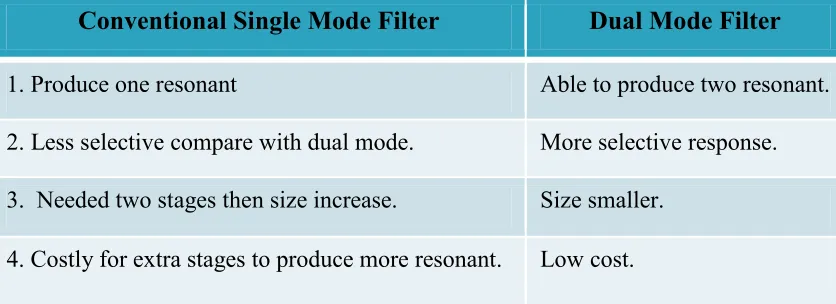
Table 1.1: Difference between single mode filter and dual mode filter.
Conventional Single Mode Filter Dual Mode Filter
1. Produce one resonant Able to produce two resonant.
2. Less selective compare with dual mode. More selective response.
3. Needed two stages then size increase. Size smaller.
4
1.2 OBJECTIVE PROJECT
The objectives of this project are to produce a filter design that utilize substrate integrated waveguide band pass filter. The SIW cavity has higher Q factor than conventional microstrip resonator, and as result it will produce high performance filters. It also has the advantage of easy connection to other MIC or MMIC devices via a simple transition.
A summary of the objectives of this project follows:
a) To design, develop and test a dual mode band pass filter.
b) Study will be focus on the measurement site including the fabricated filter.
1.3 SCOPE OF THE PROJECT
The scope of this project is only involved the operating frequency at X band between 9 GHz until 14 GHz. The X-band is a segment of the microwave radio region of the electromagnetic spectrum. The term "X-band" is also used informally and inaccurately to refer to the extended AM broadcast band, where the "X" stands for "extended".
5
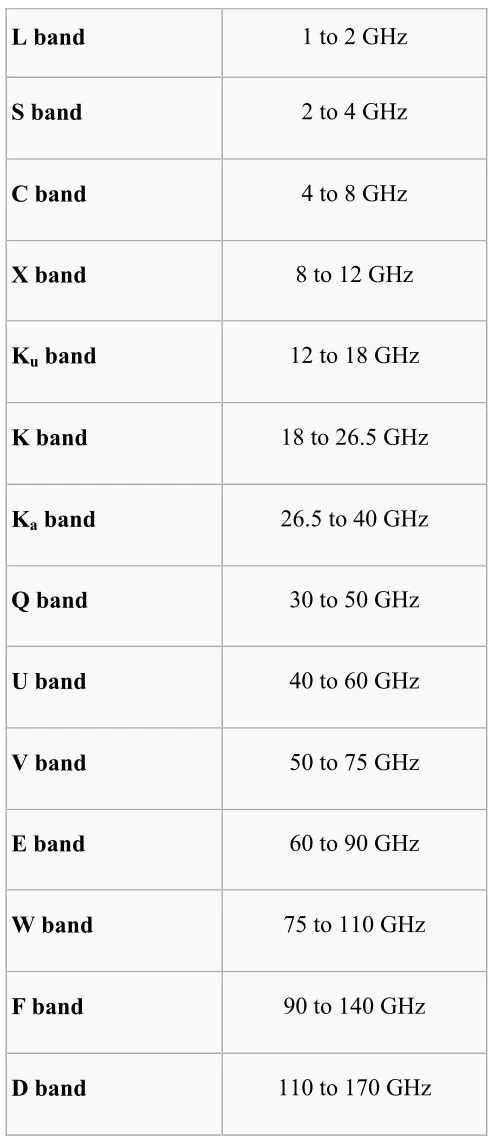
Table 1.2: Operating Frequency all band
L band 1 to 2 GHz
S band 2 to 4 GHz
C band 4 to 8 GHz
X band 8 to 12 GHz
Ku band 12 to 18 GHz
K band 18 to 26.5 GHz
Ka band 26.5 to 40 GHz
Q band 30 to 50 GHz
U band 40 to 60 GHz
V band 50 to 75 GHz
E band 60 to 90 GHz
W band 75 to 110 GHz
F band 90 to 140 GHz
6
TE301 and TE102 were chosen as the two degraded modes in order to reduce the dimensions of the filter. A key factor of the dual-mode operation is to generate two orthogonal modes that resonate at the same frequency. Such two modes are typically regarded as a pair of degenerate modes. Suppose the index sets of these two degenerate modes are (m, 0, l) and (p, 0, q). The only additional constraint for the dual-mode operation is that m ≠ p and l ≠ q [4]. An obvious example is a square cavity (the case of a = c) since its TE301 and TE102 mode substantially resonate at the same frequency.
7
CHAPTER 2
LITERATURE STUDY
2.1 FUNDAMMENTAL SUBSTRATE INTEGRATED WAVEGUIDE
A substrate integrated waveguide circuit with metallic posts only is the simplest and most popular configuration because it can be easily fabricated using the existing printed circuit board technique.[5]
2.1.1 Introduction
A waveguide is a structure which guides waves, such as electromagnetic waves or sound waves. There are different types of waveguide for each type of signal. The original and most common [5] meaning is a hollow conductive metal pipe used to carry high frequency radio waves, particularly microwaves.
8
addition, different waveguides are needed to guide different frequencies: an optical fiber guiding light (high frequency) will not guide microwaves (which have a much lower frequency). As a rule of thumb, the width of a waveguide needs to be of the same order of magnitude as the wavelength of the guided wave. [6]
2.2 RECTANGULAR WAVEGUIDE
Waveguide as specifically refers to long metallic structures with only one piece of conductor between the source and load end. These metallic structures are usually hollow, so that EM fields are confined within the hollow and be guided along the axial direction. Applying Maxwell’s Equations with the proper boundary conditions shows that propagating EM waves can be supported by the waveguide. Due to the absence of center conductor, only TE and TM mode exist.