Humanomics
The ef f ect iveness of Bait ul Maal wat Tamwil in reducing povert y: The case of Indonesian Isl amic Microf inance Inst it ut ion
Muhammad Akhyar Adnan Shochrul Rohmatul Ajija
Article information:
To cite this document:
Muhammad Akhyar Adnan Shochrul Rohmatul Ajija , (2015),"The effectiveness of Baitul Maal wat Tamwil in reducing poverty", Humanomics, Vol. 31 Iss 2 pp. 160 - 182
Permanent l ink t o t his document : http://dx.doi.org/10.1108/H-03-2012-0003
Downl oaded on: 14 April 2016, At : 21: 23 (PT)
Ref erences: t his document cont ains ref erences t o 59 ot her document s. To copy t his document : permissions@emeral dinsight . com
The f ul l t ext of t his document has been downl oaded 511 t imes since 2015*
Users who downloaded this article also downloaded:
(2015),"The key players’ perception on the role of Islamic microfinance in poverty alleviation: The case of Pakistan", Journal of Islamic Accounting and Business Research, Vol. 6 Iss 2 pp. 244-267 http://dx.doi.org/10.1108/JIABR-06-2013-0017
(2010),"Improving the effectiveness of Islamic micro-financing: Learning from BMT experience", Humanomics, Vol. 26 Iss 1 pp. 65-75 http://dx.doi.org/10.1108/08288661011025002
(2008),"Banking for the poor: the role of Islamic banking in microfinance initiatives", Humanomics, Vol. 24 Iss 1 pp. 49-66 http://dx.doi.org/10.1108/08288660810851469
Access t o t his document was grant ed t hrough an Emeral d subscript ion provided by emeral d-srm: 602733 [ ]
For Authors
If you woul d l ike t o writ e f or t his, or any ot her Emeral d publ icat ion, t hen pl ease use our Emeral d f or Aut hors service inf ormat ion about how t o choose which publ icat ion t o writ e f or and submission guidel ines are avail abl e f or al l . Pl ease visit www. emeral dinsight . com/ aut hors f or more inf ormat ion.
About Emerald www.emeraldinsight.com
Emeral d is a gl obal publ isher l inking research and pract ice t o t he benef it of societ y. The company manages a port f ol io of more t han 290 j ournal s and over 2, 350 books and book series vol umes, as wel l as providing an ext ensive range of onl ine product s and addit ional cust omer resources and services.
Emerald is both COUNTER 4 and TRANSFER compliant. The organization is a partner of the Committee on Publication Ethics (COPE) and also works with Portico and the LOCKSS initiative for digital archive preservation.
*Rel at ed cont ent and downl oad inf ormat ion correct at t ime of downl oad.
The effectiveness of Baitul Maal
wat Tamwil in reducing poverty
The case of Indonesian Islamic
Microinance Institution
Muhammad Akhyar Adnan
Department of Islamic Economics,Universitas Muhammadiyah Yogyakarta, Yogyakarta, Indonesia, and
Shochrul Rohmatul Ajija
Department of Economics, Airlangga University, Surabaya, Indonesia
Abstract
Purpose– This paper aims to investigate the effectiveness of Baitul Maal wat Tamwil (BMT) in reducing poverty.
Design/methodology/approach– The case study approach on BMT MMU Sidogiri (located at East
Java Province) is taken. Two important and dominating products of BMT MMU Sidogiri (i.e. ba’i bithaman ‘ajil (BBA) and mudarabah) are examined carefully on how much they have helped the customers in reducing their poverty. The paper goes beyond data measurement using descriptive statistics, pairedt-test and some poverty measurement indexes such as headcount index; poverty gap; Sen index; and Foster, Greer and Thorbecke Index to investigate the effectiveness of the BMT in reducing poverty.
Findings– This paper reveals that BMT inancing is effective in reducing poverty. Most of
respondents can increase their income after receiving BMT inancing. Products of BMT, especially BBA and mudarabah, to empower the poor in various productive businesses have been able to reduce the extent and severity of poverty. This paper also discloses some interesting and important indings related with how BMT’s work, so that it can contribute more to the knowledge enrichment, as well as the development of BMTs, in general, in realising their mission.
Originality/value– The establishment of the so-called BMT in the form of an Islamic microinance is intended initially to effectively help the poor. At present, there are around 3,874 BMTs operating around the country. Although the BMTs have been existing since more than ten years, no research has been conducted to examine their effectiveness in alleviating the poverty. This study in aimed at fulilling this important gap.
Keywords Poverty, Baitul Maal wat Tamwil (BMTs), Pairedt-test, Poverty measurement indexes
Paper typeResearch paper
Introduction
According to theCentral Bureau of Statistics (2010), the Indonesian population living with per capita income below the poverty line is still high, that is, around 13.3-19.1 per cent during 2000-2010. These percentages are quite small compared with the justiication of the World Bank report (2007, cited inBeik, 2010) saying that almost half of the Indonesian population is living with per capita income below USD 2 per day.
Because this issue has always prompted government concern, various programs have been introduced to combat poverty. In Indonesia,Amalia (2009)said that one of the The current issue and full text archive of this journal is available on Emerald Insight at:
www.emeraldinsight.com/0828-8666.htm
HUM
31,2
160
Humanomics Vol. 31 No. 2, 2015 pp. 160-182
© Emerald Group Publishing Limited 0828-8666
DOI10.1108/H-03-2012-0003
most effective tools to cut the vicious circle of poverty is through empowering microcredit program via microinance institutions (MFIs). The main reason is that MFIs are concentrating on microenterprises (MEs) which are handled by the poor (Asian Development Bank, 2000; Bakhtiari, 2006; United Nations Development Programme (UNDP), 1999;Widiyanto and Abdul Ghafar, 2006). By increasing income of the poor, MFIs contribute to improving the poor’s basic capabilities such as good health, education, social networks and command over economic resources (Kholis, 2009).
In the context of Indonesia, the poor people are dominated by Muslims employed in informal MEs (Amalia, 2009). Therefore, Islamic microinance such as Islamic Micro Financial Cooperatives (Baitul Mal wat Tamwil, BMTs) have a big opportunity to contribute in reducing poverty. It is because, by its very nature, BMT is focussed on the development of Muslims’ MEs in Indonesia (Ali, 2009).
BMT has been well developed by the establishment of the two pioneers, namely, BMT Salman in the 1980s and BMT Ridho Gusti, in Bandung, West Java, in the 1990s (Ali, 2009;Seibel, 2005). AfterPusat Inkubasi Bisnis Usaha Kecil(Center for Incubating Small Business [PINBUK]) started promoting Islamic cooperatives under the new label of BMT in 1995, the number of BMT increased tremendously until the end of 2010. This rapid growth of BMT started in 1995 with large jumps in numbers during the Asian inancial crisis of 1997 and 1998. According to the database of the Center for Incubating Small Business [PINBUK], currently, there are already 3,874 BMTs in the country (Yusri, 2011).
Lesmana (2008),Kholis (2009),Nazirwan (2010)andWidiyanto and Abdul Ghafar (2010)argue that BMTs are able to perform multiple roles in the local community as agents of socio-economic change, charitable centre or Bazis and have become independent from government or donor subsidies. In other words:
BMT is an idealistic microinance system which in its framework embeds noble doctrines and morality of divine religion, local cultures and values as well as a distinct inancial methodology that aims to alleviate socio-economic constraints and multi faceted problems of poverty (Nazirwan, 2010).
Despite the great attention on the role of BMTs in reducing poverty, there are still very few empirical studies on them. By utilizing some BMTs in Central Java, one study (Widiyanto and Abdul Ghafar, 2010) generally concludes that BMTs are the effective tools to combat poverty. Studies on other regions such as East Java, however, have not been analyzed yet, whereas one of the successful BMTs in Indonesia has been established there, namely, BMT Sidogiri (Amalia, 2009).
Accordingly, this research is intended to examine the effectiveness of BMT in reducing poverty by using BMT MMU Sidogiri, Indonesia, as a case study. This BMT offers some types of inancing products, namely,bai’ bitsamanil ajil(BBA),mudarabah, qard hasan,murabahahandmusharakah.However, according to the annual report of BMT MMU Sidogiri, there are only two most popular products used by the BMT, i.e. BBA (61.76 per cent) andmudarabah(23.82 per cent) in 2009.
Therefore, this study will examine the impact of the two productive inancing products of BMT MMU Sidogiri on poverty reduction. The indicator of impact used is monthly household income of the poor before and after receiving BBA ormudarabah inancing schemes. In addition, this research will also investigate the institutional framework of BMT MMU Sidogiri as one of the successful BMTs in Indonesia
161
Indonesian
Islamic
Microinance
Institution
(Amalia, 2009). Given the objective of the study, hence, this paper raises a question that will be addressed: how far have BMTs made a signiicant impact in reducing poverty? In the second section, this paper quotes some literature reviews about the concept of BMT and poverty, as well as some prior studies related with the topic. Section 3 presents research methods for assessing the effectiveness of BMT in reducing poverty. Then Section 4 describes research inding and analysis. Lastly, Section 5 summarises the main indings and their implications.
Literature review Baitul Maal Wat Tamwil
BMT as a variant of the Islamic MFI and has been deined as a community-based MFI that operates under the cooperative system and non-governmental organisation domain (Nazirwan, 2010). Moreover, Mu’alim and Abidin (2005) also state that BMT is an economic organisation which is focussed on developing cooperation and investment to evolve MEs and alleviate poverty through a proit–loss sharing system. It is loated by a wide variety of organisations including Islamic banks, Islamic rural banks (BPRS) and is, at times, backed by Islamic organisations such as Nahdatul Ulama and Muhammadiyah that currently have over a hundred million members (Obaidullah, 2008).
According toSolehudin (2010), as there is no speciic legal rule which regulates BMT, the BMT can follow the regulation of cooperative or self-help group (SHG) (Kelompok Swadaya Masyarkat/KSM). If the BMT is regarded as a cooperative, it is regulated under the Cooperative Law which is Cooperative Act No.25/1992 (Fadilla, 2007). Meanwhile, if the BMT is established as an SHG, it will be only a group of people and there is no legal rule to regulate it.
Therefore, not all BMTs operate as a legal entity because some of them are in the form of peoples’ SHG. If the BMTs are in the form of cooperatives, they will be registered with the Ministry of Cooperative and Small/Medium Enterprise (Widiyanto and Abdul Ghafar, 2006). In addition, according to Aziz (2006), most BMTs also have been associated with Induk Koperasi Syariah BMT (Inkopsyah BMT). Meanwhile, other BMTs are associated with other organisations (such as the foundation of Dompet Dhuafaand some religious organisations) or are independent.
Ideally, the establishment of a BMT has to be attested by a notary (Widiyanto and Abdul Ghafar, 2006). If they are not yet registered as a legal entity, they will receive a business certiicate from the regional Center for Incubating Small Business (PINBUK). This is because BMT statutes are standardised and include subjects such as identify area, objectives and business activities based onshariahprinciples. For example, the source of funds is determined as a share of the founding members, compulsory and voluntary savings, donations, loans and retained proits. The mobilisation of voluntary savings, borrowing from the other sources of funds and lending must be based on shariahprinciples. Besides that, 2.5 per cent of annual proits have to be donated (zakah) and a minimum 10 per cent (afterzakahand tax) must be allocated in reserves and compensation funds which are utilised for management and commissioners.
In practice, a BMT offers some products which are quite similar with Islamic banks (Sakai and Marijan, 2008). However, these two institutions have a clear difference, especially regarding their clients. Islamic bank clients are in the middle- and
upper-HUM
31,2
162
income groups; in contrast, BMT is dedicated only to Muslim MEs who have a low income level.
Speciically, Wafa and Nasrodin (2008) inAli (2009)divided BMT activities into three areas, namely, the real sector, inancial intermediation and social intermediation. In terms of the real sector, BMT basically can invest its funds in long-term business activities such as building a new factory or buying stocks from an established irm. As a inancial intermediary, Nazirwan (2010) states that BMT is designed to conduct inancial intermediations through mobilizing deposits from member clients and inancing commercial ventures. In addition, as a social intermediary, BMT is dedicated to performing socio-religious roles by collecting charity donations from Muslims and helping the needy along with their spiritual lives.
Many types of the inancing are offered by BMTs. Generally, they are promoting some inancing products such as proit–loss sharing (mudarabahandmusharakah), murabahah,bai’bitsamanil Ajilandqard hasan.As a social intermediary, BMTs tackle the management, i.e. collecting and distributing of zakah, infaq, sadaqah andwaqf (ZISWAF). The integration between ZISWAF institutions and BMTs is necessary to enable the poor to get inancing assistance (Chapra, 1998). Therefore, the basic objective of ZISWAF to solve tricky social problems such as poverty, unemployment, natural catastrophes, indebtedness and inequitable income distribution could be attained (Al Qardawi, 2002).
Poverty
There is still no universally accepted deinition of poverty (Tambunan, 2003). Because poverty is multi-dimensional in nature, as it has both income and non-income dimension usually intertwined, there is always dificulty in deciding where to draw the line between the poor and the “non-poor”. Nevertheless, many experts have tried to deine poverty. For instance, United Nations (2001) as quoted byBarber (2008)deined poverty as:
[…] a human condition characterised by the sustained or chronic deprivation of the resources, capabilities, choices, security and power necessary for the enjoyment of an adequate standard of living and other civil, cultural, economic, political and social rights.
In Indonesia, poverty is measured by comparing household consumption per capita with the poverty line as devised by the Central Board of Statistics (Alisjahbana and Yusuf, 2003). If a household’s consumption expenditure per capita lies below the respective poverty line, then the household is considered as poor. The poverty line has been increasing 5.72 per cent during March 2009-2010, i.e. from Rp200,262 per capita per month in March 2009 and Rp211,726 in March 2010 (Central Bureau of Statistics, 2010). Accordingly, the number of poor people in 2010 is decreasing compared with 2009, i.e. 31.02338 million from 32.52997 million.
BMT and poverty alleviation
Widiyanto and Abdul Ghafar (2010)measure the effectiveness of BMTs in reducing poverty by evaluating the effectiveness of BMT inancing to develop MEs. ME development is potential for poverty alleviation in several ways:
• providing credit (inancing) and/or providing classes to poor people to help them to start or to strengthen their businesses (Schreiner and Woller, 2003);
163
Indonesian
Islamic
Microinance
Institution
• building self-esteem and self reliance; • encouraging autonomy; and
• creating community atmosphere (Geroyet al., 1997).
Goldmark (2001) reveals that:
[…] the future of ME development contemplates a wider range of available service, both inancial and non-inancial, through which small business owners can build linkages to larger business and more proitable markets.
It means that to use ME development as a means of poverty alleviation, the availability of a wider range of non-inancial services to improve the effectiveness of inancing is necessary. The improving of inancing effectiveness is not only useful for ME development and poverty alleviation but also gives beneit to Islamic microinance institutions by reducing the risk of business and enhancing sustainability of the program (Widiyanto and Abdul Ghafar, 2010).
The study ofWidiyanto and Abdul Ghafar (2010)in BMT inancing utilises 60 BMTs and 204 MEs as samples which are located in Central Java, Indonesia. The effectiveness of BMT inancing (as measured by paired samplet-test) in developing MEs has been evaluated by pointing out the change of household income of MEs and business performance, i.e. business income and proit by comparing the mean of these indicators the irst time the MEs joint BMTs (irst condition) and when the research was conducted (second condition). In addition, the effectiveness of inancing also has been analyzed from the rate of non-performing inancing (NPF) or the rate of repayment of BMT in 2002-2005.
The indings indicate that BMT inancing is able to improve business performance of MEs effectively and enhance the household income of MEs. In addition, the rate of NPF also constitutes an important indicator of the effectiveness of inancing. The low rate of NPF or the high rate of repayment indicates that BMT inancing is effective in developing MEs. MEs that are able to develop their business will obtain proit and, furthermore, they are able to repay the capital as well as the share of proit or mark-up to BMTs.
The study of Widiyanto and Abdul Ghafar (2010) is important in building the hypothesis of the current research, i.e. there is signiicant difference in income of the poor before and after receiving BMT inancing. The expected difference is that the poor income will be increasing after accepting the BMT’s inancing. In other words, BMT is effective in reducing poverty.
Research method
Population and sampling method
Population of the study is deined as the total number of BMT inancing customers, i.e. 17,372 (BMT MMU Sidogiri Annual Report, 2010). Because the study has been speciied on the role of BBA and mudarabah inancing products in alleviating poverty, the respondents must be customers who are receiving BBA ormudarabahproducts. Due to the dificulties of collecting the exact number of recipients of BBA or mudarabah products, the researcher will interview the respondents irst to make sure whether they are BBA ormudarabahcustomers.
HUM
31,2
164
The effectiveness of the BMT in assisting the poor will be evaluated by comparing the income of the poor before and after receiving the inancing scheme. The poor people are deined as for those who have per capita income around Rp211,726 per month (Central Bureau of Statistics, 2010). Because the average family size in Indonesia is around 4.7 persons per family in the year 2007 (Central Bureau of Statistics, 2007), it is assumed that poverty line income for household in East Java is Rp995,112.2 per month.
According to D. Noor (personal communication, February 10, 2011), the number of the poor that have been assisted by the BMT in the end of 2010 is quite large, i.e. around 12,160 households or 70 per cent from total number of inancing customers (17,372). They are separated in the province of East Java, Indonesia. They become participants in various inancing products of BMT MMU Sidogiri which have been focussed on productive programs.
Further, the researcher will use purposive sampling procedure in getting the sample based on the sampling frame consisting of the poor people accepting the BBA or mudarabahinancing scheme. The main reason is that BBA andmudarabahare the two most requested products received by the poor. In addition, equity-based inancing such asmudarabahplaces greater social welfare responsibilities and religious commitments upon Islamic banks to achieve the Islamic economic objectives, including social justice, equitable distribution of income and wealth and promotion of economic development (Lewis and Algaoud, 2001, inDusuki, 2007).
The study was done in ten branches which are eficient in BMT MMU Sidogiri. The top ten eficient branches are Sidogiri, Lekok, Beji and Paserapan which have been eficient overall; Prigen, Sukorejo, Purwosari and Pandaan which have been eficient in technical; and Gondangwetan, as well as Grati, which has been allocatively eficient. Due to the equal sample size desired from each branch, the researcher will select a sample size of 20 respondents from each selected branch. Therefore, the sample is 200 clients which exceed the sample size requirement.
Research method
This study will utilise the survey method to gather the data. Webster, as cited byRoss
et al.(2002), deines a survey as “the action of ascertaining facts regarding conditions or the condition of something to provide exact information especially to persons responsible or interested” and as “a systematic collection and analysis of data on some aspect of an area or group”. Consequently, the survey is a process and goes much beyond the mere compiling of data. To yield relevant information, the data must be analyzed, interpreted and evaluated.
The study will use both descriptive and inferential statistics.Gravetter and Wallnau (2008) deine descriptive statistics as “statistical procedures used to summarise, organise and simplify data”. Meanwhile, inferential statistics “consist of techniques that allow us to study samples and then make generalisations about the populations from which they were selected”. Being involved in a descriptive study, the researcher will utilise a survey to examine the characteristics of respondents. As an inferential research work, the current study will use pairedt-test to investigate the effectiveness of BMT in reducing poverty in Indonesia.
The pairedt-test compares “two population means where you have two samples in which observations in one sample can be paired with observations in the other sample”
165
Indonesian
Islamic
Microinance
Institution
(Shier, 2004). A typical example is outcome measurements of pre- and post-treatment (Park, 2009). Suppose that a sample ofnclients is given a diagnostic test before getting a particular BBA ormudarabahinancing and then again after completing the BBA or mudarabahinancing. We want to ind out whether, in general, the BBA ormudarabah inancing led to improvements in household income.
This research will also utilise some well-known poverty measures as studied byBeik (2010)to examine the effectiveness of the BMT in reducing poverty. The researcher will compare the index before and after the clients have been receiving the BBA or mudarabahinancing scheme. The several poverty measures that would be used are:
• poverty incidence: headcount ratio (HC);
• the extent of poverty which uses poverty gap and income gap estimates; • Sen index to measure the severity of poverty; and
• Foster, Greer and Thorbecke (FGT) Index.
The irst index to measure the poverty is HC. It is the simplest and best known poverty measure [United Nations Statistics Division (UNSD), 2005]. It describes the percentage of the population whose per capita incomes or expenditures are below the poverty line (Asian Development Bank, 2005). The formula of the HC is:
H⫽ q
n (1)
where q is number of people below the poverty line; and n is total number of population.
The second index is depth of poverty (poverty gap). According to Shea (1997), Poverty Gap (PG) index is another measure that captures the magnitude of poverty, considering both the number of poor people and how they are. It provides information regarding how far off households are from the poverty line. In addition, this measure captures the mean aggregate income or consumption shortfall relative to the poverty line across the whole population (World Bank, 2011). It is the combined measurement of incidence of poverty and depth of poverty. It is given by:
PG ⫽
兺
i⫽1G
(z⫺ y
i)/z
n (2)
wherezis the poverty line andyidenotes income individuali.
The last two indexes are Sen Index (S) and FGT Index. These two indices measure poverty severity or squared poverty gap. According to theWorld Bank (1993), it takes into account not only the distance separating the poor from the poverty line (the poverty gap) but also the inequality among the poor.
Sen Index (S) is a poverty measurement which integrates two simple poverty
indices, namely, the HC and the PG, to build a new poverty indexS(Bellu and Liberati,
2005a). It can be expressed as follows:
HUM
31,2
166
S⫽HC关PG ⫹ (1⫺ PG)Gp兴
⫽HC
关
1⫺ˉ yp
z ⫹
共
1⫺ 1⫹ ˉ ypz
兲
Gp兴
⫽
HC
关
1⫺ ˉ ypz(1 ⫺Gp)
兴
(3)
where HC is headcount; PG is poverty gap; and Gpis Gini Index. The Gini Index must be measured, taking into consideration only the distribution of income among the poor.
Gini index is a statistical property for measuring income inequality (Berrebi and Silber, 1987;Lerman and Yitzhaki, 1984;Zhenget al., 2008). It is deined as the mean of absolute differences between all pairs of individuals for some measure. The minimum value is 0 when all measurements are equal, and the theoretical maximum is 1 for an ininitely large set of observations where all measurements but one has a value of 0, which is the ultimate inequality (Buchan, 2002).
The classical deinition of Gini Index appears in the notation of the theory of relative mean difference (Bellu and Liberati, 2005b;Milanovic, 1997):
G⫽Cov(y,F(y))2 ˉ
y (4)
whereCovis the covariance between income levelsyand the cumulative distribution of the same incomeF(y) and ˉyis average income. In turn, it is worth recalling that the covariance is the expected valueEof the products of the deviations from the mean of each variable. In the speciic case:
Cov关y,F(y)兴⫽ E关y⫺yˉ兴·关F(y)⫺ ˉFy兴 (5)
The last poverty measurement index is the FGT Index. It is most commonly deined as the square of the poverty gap divided by the population. By using the square of the poverty gap, the FGT Index gives heavier weight than PG Index to the poverty of the very poor because all poverty gaps are squared.Jolliffe and Semykina (1999)as well as
Bellu and Liberati (2005a) also explain the FGT Index as one of the most important poverty indices. Its appeal is mainly due to its simplicity. The formula of FGT is as follows:
FGT⫽ 1
N
兺
i⫽1p
共
z⫺ yi
z
兲
␣
(6)
where z – yi, is the income short-fall of the i th poor; z⫽poverty line;p⫽number of
people whose income is below the poverty line;␣⫽a parameter which takes on a value greater than or equal to zero (␣ ⱖ0). Basically, FGT is based on normalised poverty gaps (the term in the round brackets). Poverty gaps are then raised to the␣power. For ␣ ⫽0, the FGT Index collapses to theHC. For␣ ⫽1, instead,FGT⫽HC·PG. In this sense, FGT embodies the two simplest poverty measures.
167
Indonesian
Islamic
Microinance
Institution
By increasing␣, more weight is given to poorer individuals, as their wider gaps weigh more than smaller gaps of relatively less poor people. For␣¡⬁, theFGTIndex, indeed, takes into account only very small incomes, i.e. it approaches theRawlsian Criterion.For this reason, the parameter␣ ⱖ0 plays the role of poverty aversion. The greatest␣, the greatest the poverty aversion, i.e. the greatest the weight attached to very poor individuals.
Research inding and analysis Overview of BMT MMU Sidogiri
According to annual cooperative member meeting of BMT MMU Sidogiri (2010), this Islamic MFI had been initiated in 1997 by someAsatidzs (local Muslim teachers) and boards of Madrasah Miftahul Ulum (MMU) and its branches at Sidogiri Islamic Boarding Schools. The most important reason for establishing this organisation was that many Muslims did not pay too much attention to practicing shariah in their socio-economic activities. Moreover, they tended to be involved in the interest-based economy which is clearly prohibited in Islam.
Therefore, after a meeting on 25thMuharram1418 H or 1st June 1997, BMT MMU had been established successfully on 12th Rabi’ul Awal 1418 H or 17th July 1997 in the small rent house (around 16.5 m2) with three oficial employees and 348 members coming fromAsatidzs, leaders and boards of Sidogiri Islamic Boarding School. People who contributed to the establishment of BMT MMU Sidogiri were: Hadlori Abd. Karim as the Chairman ofMiftahul UlumIslamic elementary school; Dumairi Noor as the Vice Chairman of Miftahul Ulum Islamic elementary school; Baihaqi Ustman as an Administrator Purser ofMiftahul UlumIslamic elementary school; Mahmud Ali Zain as a Chairman of cooperative of Sidogiri Islamic boarding school; and Muna’i Achmad as the Vice Chairman ofMiftahul UlumIslamic elementary school (Bakdiah, 2008).
BMT MMU Sidogiri became a cooperative legal entity (i.e. 608/BH/KWK.13/IX/97) on 4 September 1997. The serial number of company registration certiicate is 132526000999, whereas the serial number of trade business registration certiicate is 133/13.25/UP/IX/98. In addition, tax identiication number of the BMT is 1-718-668.5-624.
Visions, missions and objectives
To pursue its visions i.e. building and developing the ummah economic activities according to shariah and promotingta’awun(help each other) in goodness, especially in socio-economic activities, the BMT MMU Sidogiri has been arranging its missions. Those are irst, implementing and socializing shariah in economic activities; second, engrafting the understanding that shariah in economy is justice, easy andmaslahah; third, increasing the welfare ofummahand members; and fourth, implementing the concept of STAF (Shiddiq/Honesty, Tabligh/Communicative, Amanah/Trusty, Fatonah/Professional) in the economic activities.
Furthermore, according to its visions and missions, the BMT MMU Sidogiri, consequently, has some speciic objectives. Those are irst, building cooperation to help the economic interests of members and societies; second, helping to advance the welfare of members and societies and developing the national economy to create the prosperous societies who regard the ive basic principles of the Republic of Indonesia as well as the constitution and get the blessing from Allah SWT.
HUM
31,2
168
Products and services
Literally, BMT is a combination ofBaitul MalandBaitul Tamwil. Baitul Malis focussed on social purposes, whereasBaitul Tamwilis proit-oriented. As a consequence, BMT MMU Sidogiri has divided its products into three kinds:
(1) deposits products (MudarabahandWadiah Yad Addhomanahsaving account); (2) inancing schemes; and
(3) ZIS (Zakah, InfaqandShodaqoh).
Mobilisation of funds from saving-surplus units in the economy actually is a necessary task of a inancial intermediary like BMT MMU Sidogiri (Kholis, 2009). As an Islamic MFI which has many constraints in nature, BMT, in general, attempts to achieve this goal by creating and selling a variety of inancial products that match the needs of the saving-surplus units.
BMT MMU Sidogiri therefore is engaged in mobilizing savings from members of society. This role is conducted by offering shariah-compliant products such as general shariah savings account, time deposits account, Qurban/Aqiqah saving account, Hajj saving account, pilgrimage/tourism saving account and wedding party saving account. Hajjsaving account is under themudarabahmode of investment. Under this scheme, a customer wishing to performhajjdeposits money by instalments to this fund over a speciic period to be able to bearhajjrelated expenses when the fund is matured. The accrued dividend is distributed among the participating members for the whole period of investment.
The BMT deposit products have some strength such as the duration of deposits which can be extended as the customers want; the customers will get an adequate proit sharing calculated on daily mechanism;mudarabahdeposits that have been blocked cannot be released but still get proit sharing; investment is channelled to halal enterprises only; and the deposits can be used as a collateral of inancing.
Furthermore, to avoid the overlapping of job description between BMT and Islamic banks, BMT MMU Sidogiri only offers inancing around Rp. 1 until 10 million. Meanwhile the inancing of BMT MMU Sidogiri include some products. Those are:
• proit–loss sharing [Mudarabah(MDA) andMusharakahinancing (MSA)]; • Murabahah(cost plus sale) inancing (MRB);
• Bai’Bitsamanil Ajil(deferred payment sale) inancing (BBA); and
• Qard Hasan(benevolence) inancing (QH) by offering Rp. 1 million per client.
BMT MMU Sidogiri also introducedrahn(pawning contract) inancing andhajjbailout services in 2010.Rahnis deined as possessions offered as security for a debt so that the debt will be taken from it in case the debtor failed to pay back the due money (Abdelhaleem, 2003). Meanwhile,hajjbailout service is used to bailout the pilgrims who do not yet have enough money to register their name with the Indonesian Religious Department. However, these two products are still new and not speciically reported yet. This following Table I illustrates inancing product distributed by BMT MMU Sidogiri in 2009-2010.
BBA dominates the inancing scheme distributed to the customers. In 2009, BMT MMU Sidogiri allocated 62.96 per cent of its inancing through BBA contract, and the percentage decreased to 62.06 per cent in 2010. The second product presiding over the
169
Indonesian
Islamic
Microinance
Institution
inancing schemes ismudarabah.In 2009, the percentage ofmudarabahwas 22.71 per cent of the total inancing distributed. However, the amount ofmudarabahinancing declined in 2010, i.e. from Rp. 12,106.93 to 7,556.18 million. In other words, it fell 12.44 per cent from the percentage of the previous year. Qard hasan, murabahah and musharakahare in the third, fourth and ifth positions, respectively, in 2009.Qard hasan rose up in 2010 and became the second position of inancing distributed, whereas murabahahandmusharakahare still in the last two positions.
Procedure to propose the inancing
The initiative of inancing can be come out from the two sides, i.e. the BMT and customers. If the intention is coming from the BMT side, the BMT will arrange and invite entrepreneurs to do a prospective business which has not been developed yet. On the other hand, if the idea arises from the customers, they could propose a inancing proposal to the BMT accompanied by all requirements regulated.
BMT MMU Sidogiri determines general requirements for inancing schemes. According to the interview with the BMT MMU Sidogiri manager, the requirements embrace:
• the customer must be a member of the BMT oficially;
• illing application form provided by the BMT management completely and honestly;
• have a good personality, be responsible and trustworthy; • productive age (18-60 years);
• giving a copy of identity card (KTP) or family card (KK);
• all inancing products except murabahah and BBA are used for business purposes only. If the inancing is used for other purposes, it must obtain legal approval from the BMT;
• readiness to be surveyed and interviewed;
• readiness to follow supervision mechanism by BMT; and • priority given to those who have a collateral.
After completing the requirements, the BMT will analyze strength, opportunity and weakness, as well as threat of the enterprise proposed. If the plan is approved, the BMT
Table I.
Financing product distributed by BMT MMU Sidogiri 2009-2010
Financing products
Total amount (million Rp.) (%)
2010 2009 2010 2009
BBA 45,659.33 33,568.69 62.06 62.96
Mudarabah 7,556.18 12,106.93 10.27 22.71
Qard Hasan 15,338.38 4,359.37 20.85 8.18
Murabahah 4,892.18 3,239.00 6.65 6.07
Musharakah 127.45 46.70 0.17 0.09
Total 73,573.53 53,320.68 100.00 100.00
Note: MT MMU Sidogiri Annual Report (2009-2010)
HUM
31,2
170
will conduct an agreement with the customer including proit margin negotiation or proit distribution (nisbah), mode of instalment payment and collateral.
The proit margin of inancing products based on trade transaction (i.e.murabahah and BBA) and proit–loss sharing (i.e.mudarabahandmusharakah) is determined by negotiation between BMT and clients. In addition, the proit margin and proit loss sharing also will be decided based on analysis of productivity and proitability, as well as market segment of the business.
Real sector
As a cooperative, BMT MMU Sidogiri also opens businesses on real sectors. Those are bakery, rice mill, mineral water and natural organic fertilizer factory. However, from four real sectors operated, there are only two businesses which have been run well, i.e. bakery and rice mill.
Income received from the two sectors is quite high, i.e. more than Rp. 1.9 billion a year. The net proits reached in 2009 and 2010 are Rp. 39.65 and 49.34 million, respectively. This evidence shows that although the contribution is still quite small, i.e. 1.18 per cent in 2010, the existence of real business in BMT also takes place in increasing the total proit of BMT.
Running business in real sectors is important for BMT, as its role as a cooperative which prioritises its objective to increase welfare of the members. Because most BMT members are employees and students of Sidogiri Islamic boarding school, the real sectors are focussed on the businesses which can fulil the needs of the employees and students. For instance, rice mill is necessary to supply the needs of rice as a primary food, whereas the bakery provides cake, bread and other kinds of snack and beverages.
Development of BMT MMU Sidogiri
BMT MMU Sidogiri has developed enormously since its establishment in 1997. The speed of growth of this BMT from 1997 until 2005 had been indicated by the opening of nine new branch ofices in the end of 2005. Although BMT MMU Sidogiri had only been launching ive branches in 2006, six branches during 2007 until 2008 and two branches in 2009, it succeeded in opening ten new branches in the end of 2010.
The rapid development of BMT MMU Sidogiri also can be indicated from the quick growth of its revenue, asset, proit and zakah which have quite identical trend. In the following igure, it can be seen that the revenue of BMT MMU Sidogiri had been increasing gradually from Rp. 6,216 million in 2000 to Rp. 129,465 million in 2008. This revenue then escalated drastically, i.e. to be Rp. 235,357 million in 2009 or increased 81.79 per cent compared with the previous period. Furthermore, in the end of 2010, the turnover of BMT MMU Sidogiri tackled its peak position, i.e. Rp. 342,418 million or a rise of 45.49 per cent than in 2009.
The number of assets of BMT MMU Sidogiri also tends to increase steadily from 2000 to 2010, i.e. from Rp. 1,346 to 74,730 million. The most striking feature in this trend is that the percentage of the increasing of BMT’s assets in 2001 was remarkably the highest in number which was just around 345 per cent. On the other hand, 2006 had dramatically smaller number in the percentage of the raising of BMT’s assets, i.e. only 5.01 per cent.
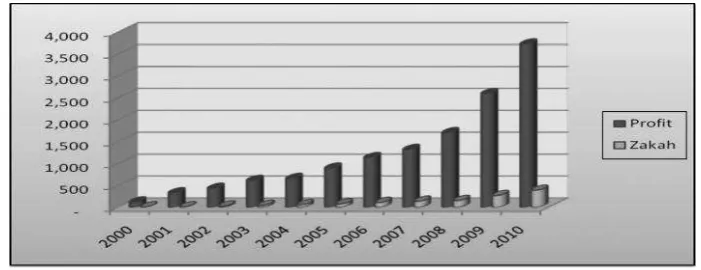
An overview of the proit and zakah of BMT MMU Sidogiri during 2000-2010 is shown inFigure 1. It is most evident that the proit of BMT MMU Sidogiri tends to be
171
Indonesian
Islamic
Microinance
Institution
always increasing. In addition, that is also apparent from the graph that, in 2010, the proit of BMT MMU Sidogiri was at the highest position which was nearly Rp. 3,725 million compared to other periods. Consequently, the ability of paying zakah in 2010 was also in the best attainment, i.e. Rp. 386 million. Of course, this condition is bringing credit to BMT MMU Sidogiri. This is because, by giving Rp. 386 million of zakah, BMT MMU Sidogiri directly can help many poor people to escape from poverty.
According to the interview with the manager of BMT MMU Sidogiri, it can be known that the calculation ofzakahis basically based on the proit and asset attained. Because BMT MMU Sidogiri has always increased its proit and assets, the amount ofzakah tends to rise accordingly.Zakahthat has been collected, moreover, is distributed to the poor people who have average income less than Rp. 20,000 or USD 2.33 a day[1]. The zakahis distributed into three proportions, i.e. 20 per cent for productive sector, 60 per cent for consumptive sectors and 20 per cent for giving scholarships to the poor students.
From that evidence, it can be asserted that BMT MMU Sidogiri gives its priority in paying zakah. The main reason is thatzakahis one of the ive pillars of Islam on which stands the structure of Islam and it is destined wholly to eight classes of needy Muslims designated by the Quran (Densumite, 2010). So, because one of its missions is improving the welfare ofummahand members, BMT MMU Sidogiri has also maximised itszakah contribution.
Effectiveness of inancing in reducing poverty Pairedt-test
The effectiveness of BMT inancing as measured by paired samplet-test in reducing poverty has been evaluated by pointing out the change of household income of the customers. Using the Statistical Package for the Social Science (SPSS) 18th version, mean of the household income of the customers at time of joining BMT (Condition 1) and when the research was conducted (Condition 2) will be compared. Results of paired sample statistics is tabulated inTable II.
FromTable III, it can be seen that the mean of household income before receiving BMT’s inancing is Rp. 1,098,700, whereas standard deviation of mean is 5.301. Household income after accepting BMT’s inancing is Rp. 1,669,100 and standard
Figure 1.
Proit and Zakah of BMT MMU Sidogiri in 2000-2010 (million Rp)
HUM
31,2
172
deviation of its mean is 4.696. The difference between the means is Rp. 570,400. It means that the household income of customers at the irst time they joined BMT is signiicantly different with the last condition when the survey was conducted, i.e. increases around 50 per cent.
Paired samples t-test compares the means of household income before and after receiving BMT’s inancing. The results of paired samplest-test are shown as follows.
In the pairedt-test framework, the null hypothesis would be:
H0. There is no signiicant difference in income between before and after receiving BMT inancing, which essentially states that the BMT inancing is not effective. The alternative hypothesis is:
H1. There is difference between before and after receiving BMT inancing which shows that the BMT inancing is effective.
So, this study is intended to reject the null hypothesis which means that BMT inancing is effective in reducing poverty through increasing the household income of the customers.
The inding of paired sample t-test shows that t-value is ⫺8.959. With 0.05 signiicance level and 155 degree of freedom, thet-statistic will be 1.960. Becauset-value is greater than t-statistic, the null hypothesis will be rejected. Therefore, from this evidence, it can be concluded that BMT is effective in reducing the poverty.
Poverty measures
Analyzing the effectiveness of BMT in reducing poverty also can be done through application of various well-known poverty indexes that have been discussed in the methodology chapter. Summaries of the results of using those measurements are tabulated inTable IV.
The irst index to measure the poverty is headcount index (HC). The calculation of HC is as follows:
HCbefore receiving BMT financing⫽
q n ⫽
82
156 ⫽0.526 (7)
Table II.
Summary of the paired sample statistics
Indicator Mean (Rp.) SD
Household income 1 1,098,700 5.301
Household income 2 1,669,100 4.696
Note: 1 and 2 represent the irst and last condition of the customers respectively
Table III.
Summary of the paired samplest-test
Indicator t-value Signiicance oft-value
Household income 1 and 2 ⫺8.959 0.000**
Notes: 1 and 2 represent the irst and last condition of the customers, respectively; ** represents 0.05 signiicance level
173
Indonesian
Islamic
Microinance
Institution
HCafter receiving BMT financing ⫽
q n ⫽
47
156 ⫽ 0.301 (8)
whereqis number of people below the poverty line; andnis total number of population. Ratio of the poor people showed by HC before receiving BMT inancing is 0.526. After receiving BMT inancing, the HC is reduced to be 0.301. This condition indicates that BMT inancing is able to reduce poverty incidence from 52.6 to 30.1 per cent. It means that the BMT inancing is able to reduce the number of respondents living below poverty line by 22.5 per cent from the initial position. In the other words, it could be saying that BMT inancing is quite successful in reducing poverty, although the number of respondents living below poverty line is still high.
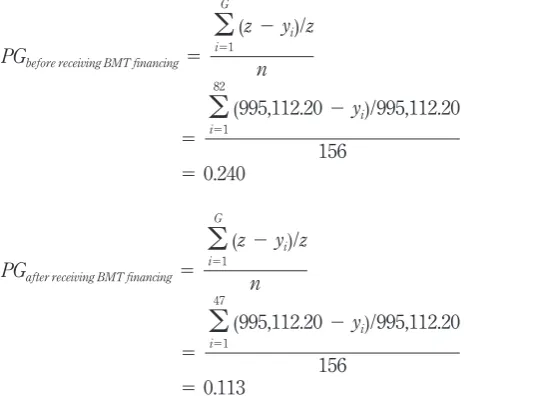
The second index is PG which is used to measure the extent of poverty. The calculation of PG is shown as follows:
PGbefore receiving BMT financing⫽
兺
i⫽1G
(z⫺ y
i)/z
n
⫽
兺
i⫽1 82(995,112.20⫺ yi)/995,112.20
156 ⫽ 0.240
(9)
PGafter receiving BMT financing⫽
兺
i⫽1G
(z⫺ y
i)/z
n
⫽
兺
i⫽1 47(995,112.20⫺ y
i)/995,112.20
156 ⫽ 0.113
(10)
wherezis the poverty line, G is number of individuals who are under poverty line andyi denotes income of individuali.From the calculation above, it can be known that PG also shows diminishing results. The ratio of poverty gap can be reduced from 24 to 11.3 per cent. It means that gap due to difference in income earned by the poor can be decreased through BMT inancing.
Table IV.
Summary of poverty measures: before and after receiving BMT
Poverty measurements Before receiving BMT inancing After receiving BMT inancing
HC 0.526 0.301
PG 0.240 0.113
S 0.187 0.079
FGT 0.129 0.051
HUM
31,2
174
The next two poverty measurements, the Sen Index (S) and FGT Index are utilised to compute the severity of poverty. To compute the Sen Index, it is necessary to measure the Gini index (G) irst. The calculation of Gini index is as follows:
Gbefore receiving BMT financing⫽ Cov(y,F(y))
2 ˉ y
⫽ (E关y ⫺yˉ兴·关F(y)⫺ ˉFy兴)2 ˉ y
⫽ 83,010.77 ⫻ 2 1,098,718
⫽ 0.15
(11)
Gafter receiving BMT financing ⫽ 141,928.93 ⫻
2 1,669,135
⫽ 0.17
(12)
The symbolydenotes income of individual, whereas ˉyis average of individual income. The result of Gini index is used to measure the Sen index as in the following equation:
Sbefore receiving BMT financing⫽ HC关PG⫹ (1⫺ PG)Gp兴
⫽ 0.526关0.240⫹ (1⫺ 0.240) ⫻ 0.15兴
⫽ 0.187
(13)
Safter receiving BMT financing ⫽ HC关PG ⫹(1⫺PG)Gp兴
⫽ 0.301关0.113⫹ (1⫺ 0.113) ⫻ 10.17兴
⫽ 0.079
(14)
The empirical analysis shows that the value of Sen Index after receiving BMT inancing is smaller than before receiving BMT inancing, i.e. 0.187 and 0.079, respectively. It means that the severity of poverty is reduced after the BMT inancing is distributed to the poor people.
The last poverty index is FGT which relates to the reduction in severity of poverty. The computation of FGT is as follows:
FGTbefore receiving BMT financing⫽ 1
N
兺
i⫽1p
共
z⫺yi
z
兲
␣
⫽ 1
156
兺
i⫽1 82共
995,112.20⫺ yi 995,112.20兲
2
⫽ 0.129
(15)
FGTafter receiving BMT financing ⫽
1 N
兺
i⫽1p
共
z⫺ yiz
兲
␣
⫽ 1
156
兺
i⫽1 47共
995,112.20⫺ yi
995,112.20
兲
2
⫽ 0.051
(16)
175
Indonesian
Islamic
Microinance
Institution
The symbolpshows the number of respondents who are under the poverty line,zis the poverty line,yiis income of individualIand the value of␣is 2. Similar results also can
be seen from the value of the FGT Index which shows a decreasing movement from 0.129 to 0.051. The evidence indicates that the condition of the poor is better off when they receive BMT inancing. The distance separating the poor from the poverty line is decreased and the inequality among the poor is reduced after they receive BMT inancing.
What can be learned from the BMT MMU Sidogiri experience?
Several lessons can be noted from BMT MMU Sidogiri on how to reduce poverty and play a role as a good Islamic microinance institution. BMT MMU Sidogiri can help many poor people because around 70 per cent of its inancing customers are MEs which are handled by the poor. Because the BMT can keep the high proportion for the poor clients, the role of BMT in alleviating poverty can be attained.
Another lesson that can be learned from the BMT MMU Sidogiri experience is how it performs the inancing. Prior study conducted byWidiyanto and Abdul Ghafar (2010)
has tried to take advantage from some BMTs in Central Java based on their selection process, business control and building a good relationship with customers. The similar evidence is seen in BMT MMU Sidogiri as well.
Selection process of customers
In terms of selection process, BMT MMU Sidogiri has prioritised customers who have fulilled some basic criteria. Those are membership, credibility (honesty/akhlaq), capability in running business (skill), business experience, collateral and business worthiness. The BMT prioritises the distribution of its inancing to the members. The BMT also tries to catch the new applicants who are willing to join the BMT’s membership. However, the BMT will not inance applicants who do not want to be members. The main reason is that when the BMT is doing business with non-members, the case for prudential regulation and supervision is most compelling (Basel Committee, 2010).
By paying Rp. 75.000 as compulsory savings, the clients will be allowed to get inancing from BMT. The compulsory savings usually typify funds that are often required in place of collateral and must be contributed by the membership (Ledgerwood, 1999). It gives some beneits such as demonstrating the value of savings practices to borrowers, serving as an additional guarantee mechanism to ensure loan repayment, demonstrating the ability of clients to manage cash low and make periodic contributions, and helping to build up the asset base of clients.
The next necessary criterion of customers is credibility. According to Khalilet al. (2002), the characteristics of entrepreneurs are vital criteria in relation to the decision by the provider of funds to accept or reject a project. The personal qualities of the businessman could be detected from their worship including their involvement in religious activities. If they are active in their society, it will be easier to identify their personality by interviewing the other members of the community.
Other basic criteria on studying the feasibility of customers can be done by selecting MEs which have real business value and avoiding the ictitious enterprises. MEs that have existed for some time will get the prioritisation from the BMT rather than the
HUM
31,2
176
infant ones. A business run by entrepreneurs who already have the experience will be more credible than enterprises handled by inexperienced businessmen.
Business control
In terms of evaluation and supervision, BMT employer will start to oversee the customer at least three days after delivering the inancing, especially formusharakahandqard hasan. These two inancing schemes are prone to default. The calculation of musharakahis much complicated for the customers who are commonly less educated and not implementing a good accounting system (Adnanet al., 2003). In addition,qard hasanis prioritised to high-risk customers who are really poor. Therefore, the BMT has to ensure that everything is under control. If there is any intended or unintended default, the deliberation will be made in advance before legal action.
BMT will assess the level of business’s proitability and applicant’s integrity including honesty, discipline, responsibility and commitment. Speciic information on applicants who have high integrity will be obtained by visiting them regularly (silaturahmi). In addition, BMT also gives them priority funding in the future.
Meanwhile, for those clients who are in default or close to being in default, they will get more attention and supervision from the BMT. In this regard, BMT never prosecutes the customers. Every problem encountered must be solved through deliberation and kinship. BMT will take three steps when facing a non-performing inancing: re-scheduling, re-conditioning and re-structuring. In the irst step, i.e. re-scheduling, customers are given a speciic period to restore their business and start to make payment. Under re-conditioning, the customers are allowed to operate their business as well as in normal condition. In the last step, i.e. re-structuring, the BMT will evaluate and ameliorate the possibility of re-default. The customers who have less integrity, as a consequence, will not be given priority when they apply for inancing in future.
Many chances given to the unsuccessful customers indicate that the BMT really cares for the poor. The BMT understands the consequence of doing business with clients who have less creditworthiness (Dusuki, 2008). However, BMT still prioritise the poor as their customers because the BMT’s main mission is to enhance the welfare of the ummah.
Building a good relationship with customers
According toWidiyanto and Abdul Ghafar (2010), most BMTs including BMT MMU Sidogiri also establish good relationship with customers to reduce the NPF. It can be done through attending (silaturahmi) wedding parties, visiting during a wake, taking a personal approach, being a personal advisor, conducting religious activities and building up the character (akhlaq).
Building a good relationship with the customers is essential in increasing business performance of MEs as well as reducing the NPF of the BMT. As a concept, relationships are beneicial for organisations, as they enhance customer satisfaction (Brookeset al., 2006). Reichheld and Sarrer (1990) also state that a relationship with customers substantially boosts company proits, claiming that most companies can increase proits through retaining an additional customer. Therefore, by having a good relationship, the BMT is able to easily and accurately access business information from the customers. The ease and accuracy of the business information facilitate the BMT in
177
Indonesian
Islamic
Microinance
Institution
controlling the progress of business to reduce principal agent problem, as well as in solving the business problem of the participants (Widiyanto and Abdul Ghafar, 2010).
Conclusion and recommendation
Based on ield observation in BMT MMU Sidogiri, it can be concluded that BMT is effective in reducing poverty. Most of respondents can increase their income after receiving BMT inancing. Products of the BMT, especially BBA andmudarabah, to empower the poor in various productive businesses have been able to reduce the extent and severity of poverty. Therefore, integrated programs for the poor designed by BMT, i.e. the provision of inancial and non-inancial services including spiritual development via internalizing Islamic moral value become essential tools in alleviating poverty.
BMTs not only have a crucial role in reducing poverty and fostering local economic development but also in alleviating the scope and prevalence of illegal moneylenders trapping the poor. Usingqard hasanscheme, BMTs succeed in eliminating the number of moneylenders as well as educating people regarding the jeopardy ofriba.
Poverty alleviation will be successful if Islamic inancing institutions such as BMTs are massively conducted in many areas (Widiyanto and Abdul Ghafar, 2010). So, given the important role of BMTs in combating poverty, it is expected that the Indonesian Government, local as well as international Islamic organisations have intensiied support for BMTs. The government can channel a proportion of public budget through BMTs which will then administer and manage funds for the appropriate clients. The two largest Islamic communities in Indonesia such as Nahdhatul Ulama and Muhammadiah also can maximise the role of BMTs to help theummah, as the majority are still poor. The role of BMTs could be maximised when governments and Muslim communities are collaborating well.
Limitation of the study and suggestion for future research
Some limitations of this study that need to be highlighted. This study has been addressed to analyze the performance of BMT in assisting MEs and reducing poverty. In fact, there are around 3,874 BMTs in Indonesia (Yusri, 2011). Therefore, by taking only one BMT (i.e. BMT MMU Sidogiri) as a case study, it could not signiicantly represent the actual situation of BMTs in Indonesia. As a consequence, the research indings could not be generalised for the whole BMTs in Indonesia as well.
In addition, there are actually many indicators for measuring poverty. Maxwell (1999)has mentioned some terms that can be used to describe poverty, for instance, income or consumption poverty, human (under) development, social exclusion, ill-being, (lack of) capability and functioning, vulnerability, livelihood un-sustainability, lack of basic needs and relative deprivation. This study only focusses on the easiest and simplest indicator, namely, income of the poor people (Chowdhury, 2009). Consequently, there are still many indicators that are not utilised by this study. Thus, the research also might not be producing comprehensive results on poverty analysis.
This study can be extended and modiied in a number of ways. The number of BMTs analyzed should be added until it is representative of the total BMTs in Indonesia. For instance, Adnanet al.(2003)carried out their study on the best 47 BMTs in ive different provinces in Indonesia, i.e. West Java, Jakarta Special Territory of Capital, Central Java, Special Region of Yogyakarta and East Java.
HUM
31,2
178
Lesmana (2008)used some best BMTs in three provinces of Indonesia, namely, West Java, Central Java and South Sulawesi. Future research could examine a larger number of BMTs which not only speciied the successful BMTs but also the unsuccessful BMTs. There are still many BMTs in Indonesia which are not successful (Sabili, 2009). If the future study is focussed only on the successful BMTs, it might show the same results. But if it also includes the unsuccessful BMTs, the results might be different.
Future research may also be extended by analyzing other indicators of poverty measurement. Garson (2015) in Morduch (2002) investigated the role of micro-inancing based on household needs for better access to speciic basic services, especially in the areas of low-cost housing, water supply and sanitation and health services. Zelleret al.(n.d.) analysed the impact of a few rural institutions in improving income, food security and educational and nutritional status of the poor. The more indicators investigated in future research, the more comprehensive the results.
Note
1. According to the “coinMill” currency converter per 25 May 2011, 1 million rupiah equals with USD 116.71
References
Abdelhaleem, T. (2003),Financial Law II, Dar al-Arqam Islamic Center, Mississauga.
Adnan, M.A., Widarjono, A. and Anto, M.B.H. (2003), “Study on factors inluencing performance of the best baitul maal wat tamwils (BMTs) in Indonesia”,IQTISAD Journal of Islamic Economics, Vol. 4 No. 1, pp. 13-35.
Al Qardawi, Y. (2002),Zakat Role in Curing Social and Economic Malaises: Economics of Zakat, IRTI – IDB, Jeddah.
Ali, M.M. (2009), “Analisis eisiensi baitul maal wat tamwil dengan pendekatan two stage data envelopment analysis: Studi kasus kantor cabang BMT MMU dan BMT UGT Sidogiri [Eficiency analysis of baitul maal wat tamwil using two stage data envelopment analysis: case study of BMT MMU and BMT UGT Sidogiri]”, Unpublished undergraduate research paper, STEI Tazkia, Bogor.
Alisjahbana, A. and Yusuf, A.A. (2003), “Poverty dynamics in Indonesia: panel data evidence”, Working Paper in Economics and Development Studies 200303.
Amalia, E. (2009),Keadilan distributif dalam ekonomi Islam. [A Distributive Justice in Islamic Economics], Raja Graindo Persada, Jakarta.
Asian Development Bank (2000), “Finance for the poor: microinance development strategy”, available at: www.adb.org/documents/policies/microinance/inancepolicy.pdf (accessed 5 June 2011).
Asian Development Bank (2005), Social Protection Index for Committed Poverty Reduction, Halcrow Group, London.
Aziz, M.A. (2006),Pedoman Pendirian BMT [BMT’s Handbook], Pinbuk Press, Jakarta. Bakdiah, K. (2008), “Penerapan pembiayaan dengan akad mudharabah dan musharakah: studi
kasus pada BMT MMU Sidogiri Pasuruan [The application of mudharabah and musharakah inancing: a case study of BMT MMU Sidogiri Pasuruan]”, Unpublished undergraduate research paper, Universitas Islam Negeri Malang, Jawa Tim.
179
Indonesian
Islamic
Microinance
Institution
Bakhtiari, S. (2006), “Microinance and poverty reduction: some international evidence”, International Business and Economics Research Journal, Vol. 5 No. 12.
Barber, C. (2008), “Notes on poverty and inequality”, available at:www.oxfam.org.uk/resources/ downloads/FP2P/FP2P_Notes_Poverty_Inequality_BP_ENGLISH.pdf(accessed 2 March 2010).
Basel Committee (2010), “Microinance activities and the core principles for effective banking supervision”, available at:www.bis.org(accessed 29 May 2010).
Beik, I.S. (2010), “The use of zakat as inancing source for micro and small scale enterprises and its role in reducing poverty: a case study in Jakarta, Indonesia”, Unpublished doctoral dissertation, International Islamic University Malaysia, Kuala Lumpur.
Bellu, L.G. and Liberati, P. (2005a), “Impacts of policies on poverty”, available at:www.fao.org/ docs/up/easypol/324/gnrlsed_pvty_gap_msrs_010EN.pdf(accessed 11 April 2010). Bellu, L.G. and Liberati, P. (2005b), “Inequality analysis: the Gini index”, available at:
www.fao.org/docs/up/easypol/329/gini_index_040en.pdf(accessed 20 May 2011). Berrebi, Z.M. and Silber, J. (1987), “Regional differences and the components of growth and
inequality change”,Economics Letter, Vol. 25 No. 3, pp. 295-298.
Brookes, A., Hemingway, F.A., Lee, E. and Towers, D. (2006), “Services and relationship marketing”, available at:www.towers.fr(accessed 31 May 2011).
Buchan, I. (2002), “Calculating the Gini coeficient of inequality”, available at:www.nibhi.org.uk (accessed 19 May 2011).
Central Bureau of Statistics (2007), “Jumlah penduduk miskin di Indonesia pada maret 2010 mencapai 31.02 juta orang [The number of poor people in Indonesia on March 2010 is around 31.02 millions]”, available at:www.bps.go.id/index.php?news⫽776(accessed 12 June 2011).
Central Bureau of Statistics (2010), “Jumlah penduduk miskin di Indonesia pada maret 2010 mencapai 31.02 juta orang [The number of poor people in Indonesia on March 2010 is around 31.02 millions]”, available at:www.bps.go.id/index.php?news⫽776(accessed 12 June 2011).
Chapra, M.U. (1998), “The global inancial crisis: can Islamic inance help?”,IIUM Journal of Economics and Management, Vol. 16 No. 2, pp. 118-124.
Chowdhury, A. (2009), “Microinance as a poverty reduction tool: a critical assessment”, DESA Working Paper 89, The United Nation.
Densumite, S. (2010), “The interrelationship between zakat and economy: microeconomic analysis”, Unpublished Master’s thesis, International Islamic University Malaysia, Kuala Lumpur.
Dusuki, A.W. (2007), “The ideal of Islamic banking: a survey of stakeholders’ perception”,Review of Islamic Economics, Vol. 11 No. 3.
Dusuki, A.W. (2008), “Banking for the poor: the role of Islamic banking in microinance initiatives”,Humanomics, Vol. 24 No. 1, pp. 49-66.
Fadilla, M. (2007), “The history of Baitul Maal Wat Tamwilin (BMT) in Indonesia”, available at: www.carlosani.com/home2/main/news-articles/sp803.php(accessed 13 June 2011). Geroy, G.D., Jankovich, J., Hyden, T.J. and Wright, P.C. (1997), “HRD and microenterprise:
socio-economic capacity building in LDCs”,Empowerment in Organizations, Vol. 5 No. 2, pp. 65-71.
Gravetter, F.J. and Wallnau, L.B. (2008),Essentials of Statistics for the Behavioral Sciences, 6th ed., Thomson Wadsworth.
HUM
31,2
180
Jolliffe, D. and Semykina, A. (1999), “Robust standard errors for the Foster-Greer-Thorbecke class of poverty indices: SEPOV”, available at:http://users.starpower.net/djolliffe/stb/sepov.pdf (accessed 20 May 2011).
Kholis, N. (2009), “The contribution of Islamic microinance institution in increasing social welfare in Indonesia (A case study of BMT’s role at Pakem market micro traders in Yogyakarta)”, available at:http://dualmode.depag.go.id/(accessed 16 December 2010).
Ledgerwood, J. (1999), Microinance Handbook: An Institutional and Financial Perspective (Sustainability Banking with the Poor), The World Bank, Washington, DC.
Lerman, R.I. and Yitzhaki, S. (1984), “A note on the calculation and interpretation of the Gini index”,Economics Letters, Vol. 15 Nos 3/4, pp. 363-368.
Lesmana, T. (2008), “The role of Islamic micro inancial cooperatives (baitul maal wat tamwil) in local economic development: case study of three provinces in Indonesia”,Journal of Islamic Business and Economics, Vol. 2 No. 1, pp. 49-62.
Maxwell, S. (1999), “The meaning and measurement of poverty”, available at:www.odi.org.uk/ resources/download/2277.pdf(accessed 17 May 2011).
Milanovic, B. (1997), “A simple way to calculate the Gini coeficient and some implications”, Economics Letter, Vol. 56 No. 1, pp. 45-49.
Morduch, J. (2002), “Analysis of the effects microinance on poverty reduction”, New York University (NYU) Wagner Working Paper Series, Vol. 10 No. 4.
Mu’alim, A. and Abidin, Z. (2005), “Profesionalisme praktisi BMT di kota Yogyakarta dan kabupaten Sleman [The professionalism of BMT practitioners in Yogyakarta city and Sleman regency]”,Millah, Vol. 4 No. 2.
Nazirwan, M. (2010), “Embracing the Islamic community-based microinance for poverty alleviation”, available at:www.mikrobanker.com/ile_article/1291215156Islamic%20 Community%20Based%20Microinance.pdf(accessed 17 February 2011).
Obaidullah, M. (2008),Introduction to Islamic Microinance. IBF Net (P), New Delhi.
Park, H.M. (2009), “Comparing group means: T-tests and one-way ANOVA using stata, SAS, R and SPSS”, available at:www.indiana.edu/~statmath/stat/all/ttest/ttest.pdf(accessed 29 March 2011).
Reichheld, F. and Sarrer, E. (1990), “Zero defections: quality comes to service”,Harvard Business Review, Vol. 68, pp. 105-111.
Ross, K.C., Clark, L.D., Padgett, T.C. and Renckly, T.R. (2002), Air University Sampling and Surveying Handbook: Guidelines for Planning, Organizing, and Conducting Surveys, Department of the Air Force.
Sabili (2009), “BMT harus berbenah diri [BMTs must reconstruct themselves]”, available at: www.sabili.co.id/niaga-update/bmt-harus-berbenah-diri(accessed 18 May 2011).
Sakai, M. and Marijan, K. (2008), “Mendayagunakan pembiayaan mikro Islami [Utilizing Islamic micro inancing]”, Policy Brief Australia Indonesia Governance Research Partnership 9, Sydney.
Schreiner, M. and Woller, G. (2003), “Microenterprise in the irst and third worlds”, World Development, Vol. 31 No. 9, pp. 1567-1580.
Seibel, H.D. (2005), “Islamic microinance in Indonesia”, available at:www.stiesyariahbengkalis. ac.id(accessed 20 May 2011).
Shea, M. (1997), “The measurement of poverty, welfare, and distribution: basic issues”, available at:http://pdf.usaid.gov/pdf_docs/PNACK249.pdf(accessed 11 April 2011).
181
Indonesian
Islamic
Microinance
Institution
Shier, R. (2004), “Statistics: paired t-tests”, available at: http://mlsc.lboro.ac.uk/resources/ statistics/Pairedttest.pdf(accessed 29 March 2011).
Solehudin, P.S. (2010), “Selayang Pandang KJKS [Overview of KJKS]”, available at: http:// asicafe.wordpress.com/2010/11/05/selayang-pandang-kjks/(accessed 13 June 2011). Tambunan, T. (2003), “Urban poverty and effectiveness social safety net in Indonesia”, available
at:http://web.mac.com/adrianpanggabean/Loose_Notes_on_Indonesia/Poverty_iles/ tambunan%20urban%20poverty.pdf(accessed 2 March 2010).
UNDP (1999), “Microinance”, available at:www.undp.org/(accessed 16 December 2010). United Nations Statistics Division (UNSD) (2005), Handbook on Poverty Statistics: Concepts,
Methods and Policy Use, United Nations, New York, NY.
Widiyanto, M. and Abdul Ghafar, I. (2006), “Sustainability of BMT inancing for developing micro-enterprises”, Working Paper in Islamic Economics and Finance 602, Universiti Kebangsaan Malaysia.
Widiyanto, M. and Abdul Ghafar, I. (2010), “Improving the effectiveness of Islamic micro-inancing”,Humanomics, Vol. 26 No. 1, pp. 66-75.
World Bank (1993),Poverty Reduction Handbook, The World Bank, Washington, DC.
World Bank (2011), “Choosing and estimating poverty indicators”, available at: http://web. worldbank.org(accessed 13 June 2011).
Yusri, M. (2011), “Pinbuk inisiasi kelahiran 3,872 BMT [PINBUK has initiated the establishment of 3,872 BMTs]”, available at: www.kumkm-sulsel.info/read-20110303135148-pinbuk-inisiasi-kelahiran-3872-bmt(accessed 10 June 2011).
Zheng, M., Junpeng, Y., Cheng, S., Zhiyu, H., Zhenglu, Y., Yuntao, P. and Yishan, W. (2008), “Using Lorenz curve and Gini coeficient to relect the inequality degree of S&T publications: an examination of the institutional distribution of publications in China and other countries”, available at: www.collnet.de/Berlin-2008/MaZhengWIS2008ulc.pdf (accessed 20 May 2011).
Corresponding author
Shochrul Rohmatul Ajija can be contacted at:[email protected]
For instructions on how to order reprints of this article, please visit our website:
www.emeraldgrouppublishing.com/licensing/reprints