
ii
Force Characterization of an Electromagnetic Linear Actuator
TAWFIK AHMED YAHYA
A report submitted in partial fulfillment of the requirements for the degree of Mechatronic engineering
Faculty of Electrical Engineering
UNIVERSITI TEKNIKAL MALAYSIA MELAKA
iii
I hereby declare that I have read through this report entitled “Force Characterization of an Electromagnetic Linear Actuator” and found that it has comply the partial fulfillment for
awarding the degree of Bachelor of Mechatronic engineering.
Signature: ...
Supervisor: DR. MARIAM BINTI MD GHAZALY
iv
I declare that this report entitle “Force Characterization of an Electromagnetic Linear Actuator” is the result of my own research except as cited in the references. The report has
not been accepted for any degree and is not concurrently submitted in candidature of any other degree.
Signature: ………
Name: TAWFIK AHMED YAHYA
v
ACKNOWLEDGMENT
Special to my beloved mother and father who always standby my side in giving supports morally and financially. Special thanks also to my special supervisor Dr.
vi
ABSTRACT
vii
ABSTRAK
viii Table of Contents
ABSTRACT VI
LIST OF TABLES XI
LIST OF FIGURES XII
1 INTRODUCTION 1
1.1 Background 1
1.2 Problem Statement 3
1.3 Motivation 2
1.4 Objectives 4
1.5 Scopes 4
1.6 Project Limitations 4
1.7 Outline of the Report 5
2 LITERATURE REVIEW 2
2.1 Introduction 2
2.2 Overview of Actuators 7
2.2.1 Classification of Actuators 7
2.2.2 Characterization of Actuators 8
2.3 Electromagnetic Actuators 9
2.3.1 Magnetic Fields Interactions 9
2.3.2 Principles of Linear Electromagnetic Actuators 9
2.4 Electromagnetic Linear Actuators 11
ix
2.4.2 Classification of Tubular Electromagnetic Linear Actuators 12
2.5 Advantages of Electromagnetic Linear Actuators 13
2.6 Improvement of Tubular Electromagnetic Linear Actuators 13
2.7 Thrust Calculation of the Tubular Inductance and PM Actuators 15
2.7.1 Inductance Linear Actuator 15
2.7.2 Tubular Linear Actuator with Halbach Array 17
2.8 Previous Work Done on Tubular Linear Electromagnetic Actuators 19
2.9 Literature review summary 22
3 METHODOLOGY 23
3.1 Design Strategy 23
3.2 Conceptual Design 26
3.2.1 First Design 26
3.2.2 Second Design 27
3.3 Designs structure and initial parameters 28
3.3.1 First Design (Tubular Linear Reluctance Actuator with step windings) 28
3.3.2 Second design (Tubular Linear Permanent Magnet with Halbach Array Actuator) 31
3.4 Working Principle 34
3.4.2 Second design 35
3.5 Simulation Method 37
3.5.1 First Design 39
3.5.2 Second design 41
3.6 Force Characterization Set Up 43
4 RESULTS & DISSCUSTION 45
x
4.1.1 First Design 45
4.1.2 Second design 47
4.2 Thrust Analysis 49
4.2.1 First Design 49
4.2.2 Second design 52
4.3 Parameters Variations 55
4.3.1 Air Gap Variation 56
4.3.2 First Design 56
4.3.3 Second design 57
4.4 Number of Turn’s Variation 60
4.4.1 First Design 60
4.4.2 Second design 62
4.5 Size Scale Variation 64
4.5.1 First Design 64
4.5.2 Second design 65
4.6 Comparison between the Two Designs 67
4.6.1 Thrust 67
4.6.2 Parameters Variation 67
5 CONCLUSION & RECOMMINDATION FOR FUTURE WORK 70
6 REFERENCES 71
xi
LIST OF TABLES
Table Title Page number
2-1 : Classes of actuators 7
2-2 : Characterization of linear actuators 8
3.1 : Parameters of the Tubular Linear Reluctance Actuator with step windings 28
3-2 : Parameters of the winding’s steps 28
3-3 : Parameters of the Tubular Linear Permanent Magnet with Halbach Array
Actuator 31
4-1 Charactristics comparision between the two designs 67
xii LIST OF FIGURES
Figure Title Page Number
3.1 Flow chart of the design process 24
3.2 : Conventional coil arrangement. 26
3.3 : Proposed coil arrangement. 26
3.4 : Halbach array field distribution. 27
3.5 : Cylindrical Halbach array [22] 27
3.6 : Top view of the reluctance actuator 29
3.7 : Dimensions of step windings of the reluctance actuator represented in side view 30
3.8 : 3D view of the Tubular Linear Reluctance Actuator with step windings 30
3.9 : Top view of the permanent magnet actuator 32
3.10 : Side view of the permanent magnet actuator 33
3.11 : 3D view Tubular Linear Permanent Magnet with Halbach Array Actuator 33
3.12 Magnetic field in the step winding actuator 35
3.13 : A sample of the distribution of magnetic field in a Halbach array 36
3.14 Magnetic field in the Permanent magnet actuator 36
3.15 Process of simulation in the Maxwell software 38
3.16 Section of reluctance actuator indicating the current direction 39
3.17 Current direction in step windings actuator in the Maxwell software 40
3.18 Section of permanent magnet actuator indicating the current direction 41
3.19 Current directions in permanent magnet actuator in the Maxwell software 42
3.20 Magnetization setting for the Halbach array magnets 42
4.1 Magnetic field distribution in reluctance step windings actuator (side view) 46 4.2 Magnetic field distribution in reluctance step windings actuator (top view) 46 4.3 Magnetic field distribution in the permanent magnet actuator (side view) 47 4.4 Magnetic field distribution in the permanent magnet actuator where the
magnetization direction of the magnet is in the x direction (top view) 48
4.5 Magnetic field distribution in the permanent magnet actuator where the
magnetization direction of the magnet is in the z direction (top view) 48
4.6 0 to 90 mm displacement of step windings actuator 49
4.7 Force vs 0-90 mm displacement of step windings actuator (positive direction) 50
xiii 4.9 Displacement from 0 to 90 mm of permanent magnet actuator (positive direction)
52
4.10 Force vs displacement 0-90 mm for permanent magnet actuator 53
4.11 Displacement from 90 to 0 mm of permanent magnet actuator (negative direction) 54
4.12 Force vs displacement -90-0 mm for permanent magnet actuator 55
4.13 Air gap variation in real design 56
4.14 Force vs input current for six different air gaps 57
4.15 Air gap variation in real design 0.5 to 1.5 mm 58
4.16 Force vs input current for six different air gaps 58
4.17 Air gap variation in real design 0.5, 2 and 1.5 mm 59
4.18 Force vs input current for three different air gaps 59
4.19 Five different sets of turns applied to the design 60
4.20 Force vs input current for five different sets of number of turns 61
4.21 Five different number of turns applied to the design 62
4.22 Force vs input current for five different number of turns 63
4.23 Six different sizes of the design 64
4.24 Force vs displacement for six different sizes of the design 65
4.25 Six different sizes of the design 66
CHAPTER 1
1 INTRODUCTION
1.1 Background
Constant technology advancements have made people’s live convenient and comfortable, the effects of technologies that had arrived from little inventions and led to very major advances can be clearly noticed, transmission is a significant one of them. The evolution of transmission technology has a major contribution in current easy and convenient live .Transmission is seen almost in every sector of today’s technologies ranging from primary and heavy industrial automation to advance electronics and aerospace actuation.
2 1.2 Motivation
The recent advancement of linear actuators and the increasing demand for energy and environment saving gave rise of intensive use of electromagnetic actuators especially the types of electromagnetic actuator which consist mostly from permanent magnets. Electromagnetic actuators are nowadays replacing many types of actuators and conventional actuation methods and its future potential is day to day increasing.
Linear electromagnetic actuators provide new actuation method used almost in all todays advanced technologies such as:
Industrial automation.
Automotive and aerospace actuation.
Robots and medical tools.
Transportation.
It’s well known that two of the most critical problems facing the world today are global warming and high energy consumption. The usage of linear electromagnetic actuators could effectively contribute in reducing the large amount of emissions caused by transportation by implementing the new generations of automobile engines as it contributed in significant energy saving and mechanical wear in many applications. For example Levitated train, the usage of Levitated train introduced three to five times reduction of energy utilized by railroads trains and totally reduced the mechanical wear due to the employment of non-contact new technology.
3 improve the electromagnetic linear actuators. One such a work can contribute in the modern evolution of transmission technology.
1.3 Problem Statement
4 1.4 Objectives
1. To characterize two novel designs of tubular electromagnetic actuator to produce
highest possible thrust force and determine the possible ranges.
2. To analyze the two designs using Finite Element Method (FEM).
3. To compare and evaluate the two designs in term of output forces and working ranges.
1.5 Scopes
1. Design and characterize two types of tubular linear micro-electromagnetic actuator.
2. Analyze the thrust output force and the working range of the two designs using Finite Element Method (FEM).
3. Optimize the thrust output force and the working range of the two designs in term of geometric, size and coil-permanent magnet arrangement.
1.6 Project Limitations
Two design limitations of the project:
1. As the one of the best type of electromagnetic actuator used permanent magnet to
generate its output thrust and with the high price of magnetic materials but the project is limited to use as less permanent magnet as possible. This limitation caused the project to choose only one of the actuators with permanent magnet while the other will use iron.
5
1.7 Outline of the Report
Chapter 1: Introduction-This chapter introduces an overview of the project including purpose, limitation, and motivation. A general information about the linear actuator and covered topics of the project are also presented.
Chapter 2: Literature review- This chapter summarize the most relevant concepts and evolution relating to linear actuators in general and electromagnetic linear actuators in particular. This includes magnetic interactions, optimization and output force calculations.
Chapter 3: Methodology- This chapter describes the methods and procedures employed to design the project represented in a flow chart, conceptual design, and structure of designs. This chapter include also working principles and simulation method of the two designs of the project. The proposed analysis set up is also presented.
Chapter 4: Results and Discussion - This chapter illustrates the two designs of the two actuator fully with their complete parameters and discusses obtained results of both designs. Also a short comparison between designs is presented.
CHAPTER 2
2 LITERATURE REVIEW
2.1 Introduction
Linear motion or what can be called rectilinear motion is a motion which takes place in a straight line. Linear motion is the basic of all kinds of motions. There are simple and complex products employing linear motion. These products are used in many kinds of machinery which are used exclusively to produce other technologies as its considered a main major part in manufacturing machines such as CNCs.
7
2.2 Overview of Actuators
2.2.1 Classification of Actuators
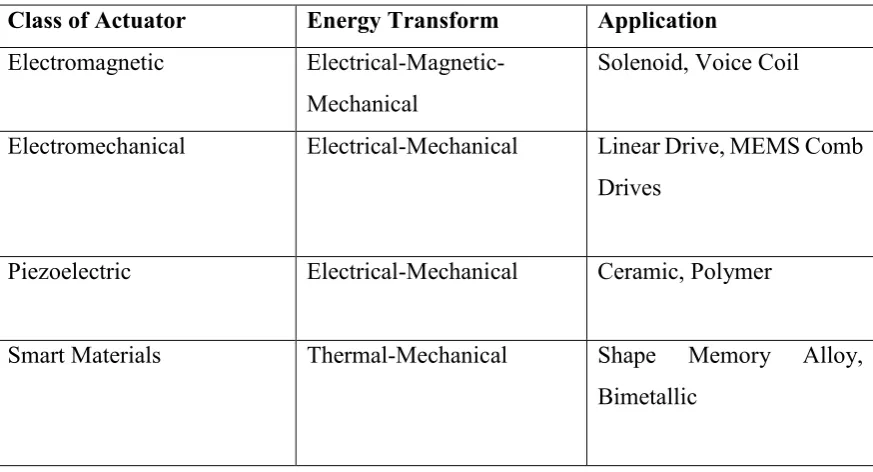
As actuators are energy converting devices, it convert an input from one or more sources to an output mechanical linear motion in a way which can be controlled using different methods. This energy conversion can be accomplished through different method depending on different operation principles and applications. According to different operation principles, linear actuators can be classified into four major and many minor types [1]. The four major types are presented in table (2.1) below.
Table 2-1 : Classes of actuators
Class of Actuator Energy Transform Application
Electromagnetic
Electrical-Magnetic-Mechanical
Solenoid, Voice Coil
Electromechanical Electrical-Mechanical Linear Drive, MEMS Comb
Drives
Piezoelectric Electrical-Mechanical Ceramic, Polymer
Smart Materials Thermal-Mechanical Shape Memory Alloy,
Bimetallic
8 applied mechanical stress. The mechanism of actuation or motion in the shape memory alloys is change in the induced temperature which produces a significant shear strain when the material temperature is above the transformation.
2.2.2 Characterization of Actuators
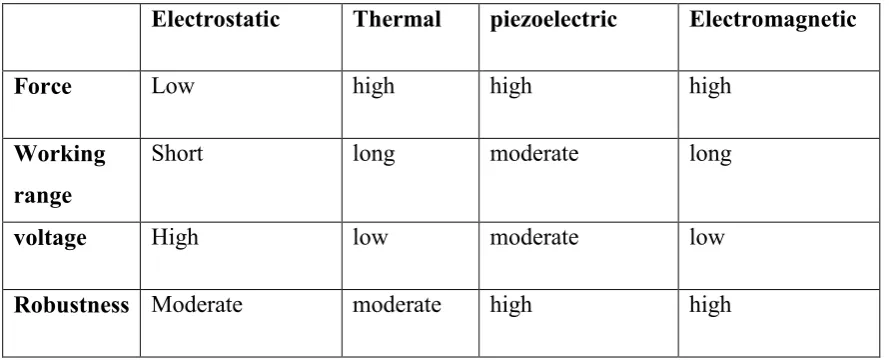
Different Linear actuator exhibit different performance in term of output force [2], working range, needed voltage and robustness. A brief characterization of these actuators are presented in table (2.2) below.
Table 2-2 : Characterization of linear actuators
Based on table (2.2), electromagnetic actuators provide high force and long working range with high robustness.
Electrostatic Thermal piezoelectric Electromagnetic
Force Low high high high
Working range
Short long moderate long
voltage High low moderate low
9 2.3 Electromagnetic Actuators
2.3.1 Magnetic Fields Interactions
Electromagnetic actuators in general employ magnetic field interactions to create magnetic forces and mechanical motions. The magnetic field is generated either by electric coil or the permanent magnet. Magnetic fields represent the fundamental mechanism by which the energy is converted from one form to another in the electromagnetic actuators.
Basic principles describe how magnetic fields employed in actuators [3]:
1. A current-carrying wire produces a magnetic field in the area around it.
2. A current-carrying wire in the presence of a magnetic field has a force induced on it (Motor principle).
3. A moving wire in the presence of a magnetic field has a voltage induced in it. (Generator principle).
2.3.2 Principles of Linear Electromagnetic Actuators
10
Figure 2.1: Basic principle of linear electromagnetic actuator [5]
As illustrated in figure 2.1 as the magnetic field of magnet traveling from north to south pole interact with the fields of the current currying conductor, force perpendicular to the fields is generated. The magnitude of the force depends in the density of the flux generated in the air gab.
� = (2.0)
Where F is the thrust output force, I is the current flowing in the conductor, L is the length of the coil and B is the flux density.
In order to determine the direction of the magnetic fields in a rounded set of coil (solenoid), the right hand rule is employed. The right hand figures are pointing with the direction of the current while the thumb is pointing to the North Pole where the field travels from S to N [6].An illustrative figure 2.2 is presented for clarity.
11
2.4 Electromagnetic Linear Actuators
2.4.1 Classification of Electromagnetic Linear Actuators
There are two main components of anyElectromagnetic linear actuator which are
stator (Stationary part of the actuator) and mover (Moving part of the actuator). According to different arrangement and fabrication of these two component, electromagnetic linear actuator can be classified to two main categories which are flat and tubular geometry, each with its own performance characteristics .The configurations of the two categories is shown in figure 2.3 below.
Figure 2.3: Two main categories of electromagnetic actuator [6]
A simple comparison of these two categories resulted in three conclusions:
Tubular type mechanically is more rugged, which is a result of having all components inside piston like structure.
Tubular type minimize if not eliminate stray magnetic field in the direction of travel. For the same sizes and weights of the actuators, the force density delivered by tubular
12
2.4.2 Classification of Tubular Electromagnetic Linear Actuators
Tubular Electromagnetic linear actuators can be classified according to coil and magnet utilization and arrangement to three different topologies as depicted in figure (2.4) bellow moving coil [7] , moving iron[8] and moving magnet [9].
Figure 2.4 : Three topologies of linear actuators [9]
The performance characteristics of the three topologies of linear actuators can be summarized as:
Moving coil type which uses coil in the mover and PM (permanent magnet) in the stator. This type has small mover mass and high dynamics, but relative poor thermal dissipation, low reliability and large size. Moving iron exhibit high thrust force. But its large inertia can cause low dynamic performance resulting in less stability in the actuator. Moving magnet type have low mass mover and with the new improvements such as Halbach PM array, teeth optimization and so on, moving magnet can achieve higher thrust force and higher stability and accuracy.
![Figure 2.1: Basic principle of linear electromagnetic actuator [5]](https://thumb-ap.123doks.com/thumbv2/123dok/478151.52364/22.595.158.457.612.740/figure-basic-principle-linear-electromagnetic-actuator.webp)
![Figure 2.3: Two main categories of electromagnetic actuator [6]](https://thumb-ap.123doks.com/thumbv2/123dok/478151.52364/23.595.86.516.364.524/figure-main-categories-electromagnetic-actuator.webp)
![Figure 2.4 : Three topologies of linear actuators [9]](https://thumb-ap.123doks.com/thumbv2/123dok/478151.52364/24.595.88.469.202.369/figure-topologies-linear-actuators.webp)
