O
*?:*ffi'""ffi:Hl":r"",if.T":I'"'
il'.o
S
HANDBOOK ON
FOREST
PLANTATION
SECTOR BUSINESS
IN
INDONESIA
Gooperation Project
between
Forestry
Research
and
Development
Agency
(FORDA),
Ministry
of
Forestry, lndonesia
Japan
lnternational Cooperation Agency
(JICA)
Collaboration
with
Faculty
of
Forestry,
Bogor
Agricultural
University
Demonstration Study on
Carbon
Fixing
Forest Management
in
lndonesia
HANDBOOK ON FOREST PLANTATION SECTOR
BUSINESS IN INDONESIA
Cooperation Project
between
Forestry
Research and Development
Agency
(FORDA),
Ministry of Forestry,
Indonesia
Japan International Cooperation Agency
(JICA)
Collaboration
with
Faculty
of
Forestry,
2005 by Carbon Fixing Forest Management Prcject
Cooperation Foject between Forestry Research and Development Agency (FORDA), Ministry of Forestry, Indonesia and Japan Intemational Cooperation Agency (JICA) All rights reserved. Published in 2005
Pdnted, Bogor
Published by
Carbon Fixing Forest Management Project
Jl. Gunllng Batu No.5, Pasidaya, Kota Bogor Barat,
Bogor 166l0,lndonesia
Tel. : +62 (25 1) 3 5083 2; F ax +62 (251) 622100
Organization
This report was surveyed
and
This report was planned, edited,written
by:
completed and published by:Faculty
of
Forestry
JICA
-
FORDA
Bogor
Agricultural
Demonstration Study
on
University
Garbon
Fixing Forest
Management
Project
Andi Sukendro I
Lilik Budi Prasetyo 1
All
rights reserved Miyakuni, Kiyoshi '?Hatori,Hiroki']
Taniguchi, Ichirc r N. M. Heriyanto a
Satoru, Shimaz aki 5
t Faculty of Forcstry,
Bo gor Agriculturai Univelsity '? JICA long+enr expert
3 JICA
Project coordinator
a FoRDA Researcher
s
TABLE
OF CONTENTS
I.
GOVERNMENT POLICY ON FORESTRY1.1.
Lawson Land
Tenureand Forestry
(a) The Basic Agrarian Law (Undang-undang Pokok AgrarialuUPA)
...
(b) Basic Forestry Law 1967 (Undang-undang Pokok Kehutananl LavtNo. 5
/
1967)(c) Forestry Law '1999 (Law No. 41l'1999)
'1.2.
Decentralization and lts impact on Forestry Sector
(a) Decentralization of Central Government authority
...
(b) lmplementation of Decentralization Law in Forestry
Sector
...
II,
FOREST PLANTATION SECTOR BUSINESS2.1.
Forest Plantation Development Trend (a) Forest Plantation Outside Java(b) Forest Plantation in Java
3
4
6
I
I
16
2.2.
Gonsiderations
for
lnvestment
2.2.'1. Positive Factor for lnvestment
in lndustrial Forest Plantation
(a) Deregulation of lnvestment Procedure (b) Shortage of Raw Material Supply
2.2.2. Negative Factor for lnvestment
(a) Unavailability of Reforestation Fund
lDana
Reboisasl(DR)
...
(b) Time Delayed during Application
(c) Land Availa
(d) Forest Fire
bility, Land dispute and Social Conflict
lll.
Foreign Direct lnvestment on forestry procedure
3.1. Brief History of Foreign Direct lnvestment (FDl)
Policy
...
233.2. Current Situation of Foreign
lnvestment
onForestry
2519
1S
20
20
21
3.3. Agency/lnstitution related to
FDI
...
263.4. Procedure and Manual of New FDI on lndustrial Forest Plantation
...
283.5. Cancellation of the
SP-PN4A
...
403.6. Specific Aspect
on
lndustrial Forest PlantationDevelopment
...
463.7. Related lnstitutional
Contact
...-...
49REFERENCE
53LIST
OF
TABLES
Table
'1.1.
Decentralizalion authority of forestsector
...
8Table
2.1.
Number Company and Area of Plantation Granted lndustrialforest plantation development permit by province in 2001
...
10Table
2.2.
lndustrial Forest Plantation Development !mplementation byProvince
during last fiveyears
...
12Table 2.3.
Total areaof
lndustrial Forest Plantation Managed byPT.
INHUTAN|I-V
...
15Table 2.4. Plan and
Realizationof
Forest
PlantationPlanting,
in
PT.INHUTANI based on Type of Forest
Plantation.
'16Table
2.5.
Area of Perhutani Plantation based on Tree Species...
t7
Tabel
3.1.
FDI of Forestry SectorApproved by thecovernment
(inmillion US
$)
...
25Tabel
3.2.
Flow of New lnvestment Procedure for lndustrial Forest Plantation : Joint Venture between Foreign CapitalLIST
OF
FIGURE
Fi1.2.1.
Acacia mangium onlmperata cylindrca
grassland in SouthSumatra, lndonesia
Fig.2.2.
HTI Trans ot Acaciamangium
in South Sumatra, lndonesiaFig.
2.3.
Distribution of lndustrial Forest Plantation in Kalimantan island (Greenareas)
...Fig.
2.4.
Distribution of Forest Plantation in Sumatra island (Greenareas)
...
Fig.2.5.
SpatialDistributionofForestPlantationinJava...
Fig.
2.6.
Flre on Acacia mangiumPlanlalion ...
....
Fig.
2.7.
Fire tor Land Clearing10
11
'13
't4
18
LIST
OF
ATTACHMENT
List of Accessible, non accessible sector for FDI
Attachment 1.
Attachment 2.
Attachment 3.
Attachment 4,
Attachment 5.
Attachment 6.
Model I/PMA form
RPTK Form
PPt 2 Form
Model lV
A
FormModel lV B Form
I,
GOVERNMENT
POLICY
ON FORESTRY
Land and natural resources
utilizationin
lndonesia has been directed
andinfluenced
by
Basic Agrarian Law, Basic Forestry Law
and
GovernmentRegulation
of Decentralization.
Chapters below will givea
brief explanation on the development of these lawsand
regulations,and its
impacton
Forest Management.1.1.
Basic
Lawson
LandTenure and Forestry
(a) The Basic
Agrarian Law (Undang-undang Pokok
AgrarialuuPAl
Before lndependence Day land tenure right
in
lndonesia
was
guided
byCustomary
Law (Hukum Adat) and
the
Netherlands lndies Agrarian
Lawpassed
in
1870by the
DutchGovernment.
HukumAdat is
customary lawthat
have been
utilized
by
indigenous community (masyarakat adat)
inmanaging their lives and utilization of their natural resources. The Customary
Law
is
not
alwaysin the form of written
regulationbut also
in the form of
norms.
The AgrarianLaw
1870was
applied untilthe
independence dayof
the Republic of lndonesia in 1945.
Directly
after
lndependenceuntil 1960,
processon
formulatinga
new
landlaw
began.As
a
resultof
longdebate,
on 24th
September 1960,the
newBasic Agrarian
Law
(BAL) (Law
No.
5 ot
19601 Undang-Undang PokokAgraria Nomor
5
Tahun
1960)was
enacted.
The
BAL replaced
the
oldNetherlands lndies Agrarian Legislation
of
1870,and
has been applied untilpresent. The
BAL is based on Article33
ofthe
1945 Constitution(Undang-undang
Dasar 1945/UUD 7945)of the
Republicof
lndonesia,and
Principle5h
of the state
philosophyot
Pancasila. Reform of the Agrarian Law,
as requested by Decision ofthe
People Assembly No. lXl2O01 (KetetapanMPR
No. 1)U2001) is still under formulation.
The foundation
of the
Law (BAL) is that the entire earth, water, air,
andweallh
of
the
nation.
However,
the
utilization
of
natural resources
tscontrolled by the state/Central Government.
The
BAL
confesses
the
existence
of
Customary
Law
(Hukum
Adat),however,
the
Customary
Law shall
not
be
conflicted
with
the
nationalinterest.
This condition made the traditional community with their CustomaryLaw
(Hukum adat\ was in a very weak position, since they cannot refuse theCentral Government
decision.
After giving compensation,usuallythe
CentralGovernment may acquire or redistribute the community land.
Under
the
BAL, the varioustypes of
rightson
land, water,and in air
spaceare
stipulated
such
as the
right
of
ownership
(Hak Milik\,
the
right
of
use/exploitation
(Hak
Guna
Usaha),
the
right
of
building
(Hak
GunaBangunan\,
the right
of
use (Hak
Pakai),and the right
of
collecting forestptoducts (Hak Memungut Hasil Hutan).
Hak
Milik
(the
right of
ownership)
isthe
strongest rightto
land.
lt is
notlimited
in
terms
of
time.
The
land
can be
sold, mortgaged
and can
beinherited
by the
legai heirs.
Hak Milik
is
subject
to
registration.
The landowner receivesa
legal
documentas
evidenceof his
rights (Seftitikat). Only lndonesian citizens are able to receive the right of ownershipHak Guna UsahalHGU
(the
right
of
business utilization)
is the right
to state land, andthe
rightto
usethe
land for agricultural (including cash cropsor forest
plantations),fishery and
breeding purposes.Hak Guna Usaha
islimited by
time. lt
can be granted lastfor
35 years andcan
be extended for another25
years. In total, Hak Guna Usahaon
state lands can be awardedHak Guna
BangunazHcB
(Theright of building)
gives the holder the rightto
buildon
landowned by
someoneelse. This right is
limitedby
periodof
time
and can be
obtainedfor state land (by
decree)as well as for
privateland (by
contract).The right is awarded
for
not
longerthan 30 years,
butthere is
a
possibilityof
extending for another 20 years. Hak Guna Bangunancan
be
bequeathed, sold, exchanged
or
presented
as
a
gifl. Hak
GunaBangunan can likewise be used as a credit security/guarantee.
Hak
Pakai
(Right to
Use) gives the holder the right to use a particular pieceof land. This can be belonged to state or private land.
Hak Pakaiis
validlot
acertain
time
petiod. Hak Pakai can in principle be transferredwhen
no otherregulations
apply.
Resident foreigners
and
foreign
corporations
withrepresentatives in lndonesia can be
awaded
Hak Pakai.Hak Memungut
Hasil
Hulan
is the
right
of
collecting
forest products
isawarded
to
lndonesian citizens bythe
Governmenton
land under customarylaw (Hukum,Adal)
in
order
to
be
able
to
use
wood and other
non-wood Products.(b)
Basic Forestry Law
1967(Law
No. 5 /'1967)The Basic Forestry Law (BFL\ (Undang-Undang Pokok Kehutanan, Nomor 5,
Tahun
1967 IUUPK)was
enactedin
1967.
Either stated withinthe
BAL orunder
the
BFL,
all
forests inside
the
lndonesian territory, including
their natural resources, are controlled by thestate.
This means that as long as the land is classified as state forest,there
is no individual/personal or communal rights can be registered under the National LandAgency.
The consequenceof the
statementis that
the
rightof
local
communityundet
HukumAdat
tomanage
their community forest
is
no
longer
exist.
Under
the
BFL,
the positionof
Hukum Adaf and/dat
community becameweaker.
This situationis sajd to be the
underlying causedof land
disputeand social
conflict that have been occurring in some places since the economical crisis took place inWhile
the
BAL give
a
general guidance
on
Forest Utilization,
the
BFLregulate
into
more detailand
applicable guidance. Forest underthe BFL
isdefined as any kind
of
land-cover area (with or without tress), which is statedby
the
governmentas
forest.
lt
maybe
inthe form of
forestarea or
areawithout trees which the government as forest has designated.
Based
on
BFL, functionof
forestarea
can dividedinto
Production Forests(Hutan Produksi),
ProtectionForest (Hutan Lindung), Nature
Reserve andRecreation Forests
(Huta,
SuakaAlam
danHutan
Wisata) and ConversionForcsl (Hutan Konversi)
Production Forest
(Hula,
Produksil
is,
according
to
the
Ministry
andFoeslry
(Departemen Kehutanan\, designated
for
exploitation
of
timber, rattan, saps. and other forest products.Protection Forest
(Huran
Lindungl is
forest areas which have
specificphysical characteristics
thai
should
be
protected
so
that
their
functions, particularly their hydrological function, can be maintained.Nature Reserve
and
Recreation
Forcst (Hutan
SuakaAlam
dan Hulan
Wisatal
arc for
the protection and
preservationof
genetic resources,
lifesupporting
system
and
for
the
development
of
science, education
and tourism.Conversion
Forest (Hutan
Konversll
is
forest
land
designated lor
conversion to other land uses such as agriculture and seitlement.c)
Forestry Law
1999(Law
No.4111999)Since
30
September 2001,the Basic
ForestryLaw
1967,was
replaced byForestry
Law 1999 (Law No. 4111999). There are some changes on
thecontent, especially
on
the forest classification andthe
appreciationof
forestUnder
the new
Law, function offorest
areas are classified into three, whichare
Conservation Forest
(Conservationarea, Protected forest
and
Gamereserve), Protection Forest
and
ProductionForest.
There is no Conversionforest anymore as was stated in the former forestry law.
The significant changes was made is the appreciation of forest under Hukum
Adal
stated in Chaptertwo,
Chapter three, Chapterfive
and Chapter twentyof the
ForestryLaw
1999. The traditional communitywhich
is still exist may utilized their own forest, such as; the community may take the forest productfor their daily
need, managethe forest
basedon their
customary Law, andhave a right
to
receive the support from the government for the improvementoftheir
live standardof living.
To judge whether the traditional communitiesare still
exist
or
not,
are
designated
by the
Regional
Governmentresponsible. This may
de
published under
the
Regional
GovernmentDecree/Regulation. lf the
communities under customary laware no
longerexist, the right of land should be transferred to the Government.
Forest and land
fire
preventions,and
illegal encroachment of the forest also aregiven a
special attention, aswell as the
punishmentfor
thosewho
are not obey the regulation.1.2.
Decentralization and its impact on Forestry sector
(a)
Decentralization of Central Government authority
ln
1999, there
two
Laws were issued concerning
to
regional
government(Law No.
2211999/UU
No. 22f1999 tentang PemerintahanDaerah\
andot
balance budget between
Central
and
Regional Government
(Law
No.2511999 tentang
pe
mbangan keuangan Pemerintah Pusat dan Daerah).Law No. 2211999 so called Decentralization Law gives authority, broadly and
clearly responsibility
to
RegionalGovernment. Underthe
Law, principally, allCentral Government authorities'
are
delegated
to
Regional
Governmentforeign affairs, fiscal and monetary, justice, religion, and other authorities that
are more
effectiveand efficient if
conductedwith:n
National level,such
asmacro economics planning, national public administration, human resources
development, conservation, management
of
natural resources utilization and national standardisation.Promulgation of Law No. 25l1999 aims is as follows:
to empower and
develop
regional economic capability,to
create proportional, rational, transparent, participative, responsibleand continue regional economic system,
The Law No.2511999, give guidance
on
how to divide the fund derived from property taxes and exploitation of natural resources, as follows :/
Tax on land and building/Pajak Bumi dan Bangunan : 90% for regional government and 10 % to Central Government./
Forest
exploitation,
mining,
and
fisheries
:
80%
for
RegionalGovernment and 20 ya'fot Centrcl Government;
/
Exploitationof
Gases: 30%
for
RegionalGovernment and
7oo/otot
central Government.
(b)
lmplementation
of Decentralization Law in Forestry Sector
By the promulgation of Law No.2211999 and Law No. 2511999, responsibility of forest management are decentralized
to
Regional Government, especiallyin
Regency level(Kabupaten\.
Almost allof
decisions relatedto
Productionforest
exploitationand
Protectedforest
are undet Kabupaten
Governmentauthority
which
is
supported
by
Provincial Government
in the
form
of
providing
guidance. The
Central
Government
decision
is
required if
coordination among Kabupaten
is
needed,
for
example
in the
case
of
business permit acquirement
on
productionforest
in
which
its
areas
arelocated
within
two or more Kabupaten. The
Central Governmentstill
holdarea
function
and its
statuschanges.
ln
most cases, Central Governmentonly
plays roleon
providing criteriaand
indicator forforest
management, to,9 G
o
o
o
o
q?o
gi;
.9o
Io
..=
tL>
EY
o_o
3;
tLi
.9<
6(J
oq
9>
oy
LLO
EO
6>
lL.tro
o
o
o
o
t
ll, Ng
o
o
o
(,,F
o)o
z
o
.c, o-Eo
o
o
o
o
o
o
o
o
o o
o o
o o
o
o
o
o
o
o
o
o
o
o
o
o
o
o
LL
(I
o
o
@o
o
o
o
o o
o o
o
o
o
0
o_
=
o
IL
(r
o o
o
o
o
o
o
o
LL
o
o o o
lJ-o_
o o o o
o o
o
e
g
a
t
o)t
L!E
(I
ILo
L!(I
,>c
q) E o)o
0)o
LL LI Er
I
E o ,EE
.s,o
'D'i
z. .E ILs
E .12E
g
L! LI _9 E E E .9E
uJ ,E -qI
I
IL E -9 Lrl E .s .9 .9 d ,9 -9I
E
.9o
z
,9E
I
.9c)
g>
EE
o!
6o
CP
=3
.9 E -q E96
o
iiiII.
INDUSTRIAL
FOREST
PLANTATION
SECTOR BUSINESS
2.1.
lndustrial Forest Plantation Development Trend
Forest plantation (lndustrial Forest Plantation)
in
lndonesia
have
beenstarted since
a
century ago,
by
developmentlarge area
ot
feak
(Tectonagrandis) plantation in
Java.
The oldest teak tree was plantedin 1883.
Other speciesof
treesfor
plantationis
pinetree (Pinus merkusii\. Even
though,foresutimber plantation have been started since
a
hundred ago in Java, largeforest plantation development in out site Java is still a new phenomenon.
(a)
lndustrial Forest Plantation in Outside Java
lndustrial Forest plantation (HTl) of fast growing species has been
a
policyof
the
forestry sector sincethe
beginningof the
Fourth Five-Year developmentPlan
(Pelita
/y) in 1984.
The
policywas
formulated bythe
anticipationof
raw material shortage by the year 2000, due to expanding domestic demandand export
markets(Anwar,
1993in
Potterand Lee,
1998)and
minimizingpressure
on
naturalforest.
Forest
plantation developmentalso aimed at
rehabilitation
of
degraded
land
by
planting fast growing species such
as;Acacia
mangium,
A.
crassicarya,
Eucalyptus deglupta,
Eucalyptus europhylla, Gmelina arboreaand
Paraserianthes falcataria.Until December 1999, there were 98 of timber plantation companies granted
license
for
plantation development
(Sural
keputusan
Hak
Pengusahaan Hutan,Hutan
Tanamanlndustti/
SKHPHHTI),with
designatedtotal area of
about 4,6 millionha.
While a year later, the granted companies reachto
100unit
which
cover about4.7
millionha
of land. ln
March 2001, total grantedFi1.2.1.
Acacia mangium onlmperata
cyl,ndrlca grassland in SouthSumatra, lndonesia
Table
2.1.
Number
company
and area
of
plantation
granted
forestplantation development permit by province in 200'1
No. Province Tolal
Unit Area IHal
I
DlAceh 6 233.8702 North Sumatera 6 318.705
3 West Sumatera 2 35.292
4 Riau 12 693.582
Jambi 10 20s 405
6 South Sumatera 3 380.100
7 Lamouno 4 149.067
8 West Kalimantan 11 580.086
c Cenlral Kalimantan 10 286.975
10 South Kalimantan 6 332.260
11 East Kalimantan 22 1.211.555
12 South Sulawesi 2 42.300
13 Central Sulawesi 2 23.441
14 South Eest Sulawesi 1 37.445
15 Maluku 4 64.568
16 Papua 1 206 800
TOTAL 102 4.801.851
Sour@ r O rectorate General of Forest Production Development
Some incentives had been offered to the companies willing
to
establish HTl, such as :(a)
free loans from the reforestation fund (Dana Reboisasi/ DR), [image:19.530.163.460.77.276.2]support
companies borrowing establishment
capital
from banks or other financial institution,low
taxes
and
right
to
clear
cut
and
sell
any
remnantvegetation on concession area.
Apart from this
incentives, companiesalso have been
supportin
providingemployment
through
introduction
of
HTI-Trans
scheme
(HTl
polatran sm ig ra s
i)
since I992.
Fig. 2.2. HTI Trans
ofAcacia mangium
in South Sumatra, lndonesiaRegardless
of
some incentives had been given bythe
government,the
HTIestablishment has been very slow (Potter
and
Lee,1998).
According to the plan(in
1984) targetof
HTI area establishment was about4.5
million ha bythe year
2000.
ln
realization of the plan, by 1989 only 67500 ha and by late1995
only 520 000 ha of
HTIwas
established.During
1996to
2000, there were '1,054,897 ha additional forest plantation (Table2.2).
ln total, estimatedHTI establishment area in 2000 was about 1.6 million ha, or only about 30%
from the target.
(b)
(c)
[image:20.506.116.418.250.478.2]fable
2.2.
lndustrial Forest Plantation Development lmplementation byProvince
during last five yearsNo. Province t996/1S97
(Ha) 1997/1998 t9s8/19s9(Hal 199S/2000 2000.)
1 DLAceh 15245 12.275 5.454 959 472
2 Norlh Sumalera 7 50t t-887 5.196 2.358 1_022 3 2.490 1.151 420 315
4 69216 52.613 34.199 51.014 29.429 5 21.017 19427 13160 23447
6 ,129A 6144 4994 4 085
7 Bengkuu ar5 300 13 0
8 Lanpung 7601 I 500 2144 92
SUMATERA 145191 100897 66 280 81 738 53 740
9 0 0 0
10 0 0 0
11 Norlh Java 0 0 0
0 0 0
12 38.2S1 31.089 14000 4.265 10791
13 Ceniral Kalimantan 21881 m_621 11 976 5.854 2351
14 South Kalimantan 44145 4.010 T-465 3.762 689 15 Norlh Kalmanlan 95 559 72.036 61.788 37.245 10.679 KALII,4ANTAN 2C6.512 127.756 95.229 51.126 24 514
16 Bal 0 0 0
17 NTB 695 11? 0
18 NTT 1.936 1 309 0 0
1S EastTimor 632 0 0
NUSATENGGARA 2346 112 0 0
20 2 253 1518 605 225 22
2l 5100 4 646 2121 12 335
22 Soulh Easl Sulaw6i 2235 2102 400 543 0
23 2 215 2199 758 0 0
SULAWESI 11.803 11.065 4.483 840 357
24 [4aluku 11.350 11.087 3.789 1140
25 12.460 12.638 6.866 0 0 NIALUKU & PAPUA 23810 24.545 14_441 3.789 1.144 TOTAL 390.542 266.609 180.506 137.493 19.747
Source : Direclorate General of Foresl Produclion Developmenl
Nore : *) Data
AIIil
D€cemb€.2000Spatial distribution of forest plantation in Kalimantan and Sumatra islands are presented in
Ftg.2.3
andFi1.2.4.
o
o
E
(,
!
_q
.q
o
E
Y
.=o
_q
o-o
lJ-.9
-o ,q
o
",
N
.si,
IL
4ts-\4
a
,il
i
,
a ..
\
t .
-."_
I'.
*j
' -rts
\*u
1E
9)
I
1.,\,
^({
lr&
\{B{
tg
)
5
) '\
l
,rf5
\H
/t,
tr\
,J
F.'.1
*6-
I
o
o
c
s
,9g
Ea
.E .s _qo-o
LLo
.q -o .9o
a
N
c;ii
I
T
L
A
*",
L
,
LS
A-q,
d,
,&*
,
t
tq
9s4
I
Ar,
\./--._\
{
'-4;
Almost of all forest plantation out site Java are managed
by
private companies,PT.
INHUTANI (State Enterpriseon
Forestry)or
Joint venture between
PT. INHUTANI and PrivateCompanies.
PT. INHUTANIl,ll
andlll
are operating in Kalimantan, while PT. INHUTANIlll
and lV in Sumatra.PT.
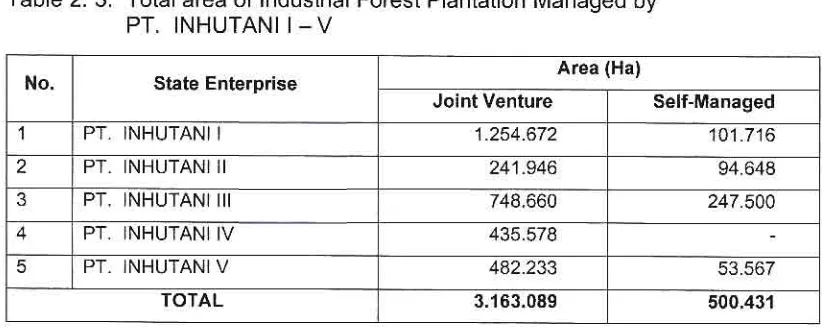
INHUTANI managed forestarea
(include forest plantation area)of
about [image:24.508.57.468.304.468.2]3.67 million
ha.
Amongof
the area, only 0.5 millionha
(14%) is managed by themselves and the rest (3.16 million ha or 860/0) is managed under joint venture scheme.Table 2.
3.
Total area of lndustrial Forest Plantation Managed byPT.
INHUTANII_V
No. State Enterprise Area (Ha)
Self-Managed
PT. INHUTANII '1.254_672 101.716
2
PT
INHI]TANIII 241_946 94.6483 PT. ]NHUTAN' III 748.660 247 _500
4 PT. ]NHUTANI IV 435.578
5 PT. ]NHUTANIV 442_233 53 567
TOTAL 3.163.049 500.431
Realization
of forest
plantation development inlow.
Until 1999, only about 33 % of planting area of forest plantation scheme (Table 2.4)PT.INHUTANI
area was
veryplan was realized, for all type
Table
2.4.
Plan and Realization of forest plantation planting, in PT. INHUTANI based on type of forest plantation.lndustrial lndustrial Forest
Plantation [Jnit (Ha)
Realization
until
1999i2000
2000
Target Realization lHa) PT,INHUTANII
Self -managed/Swake/o/a 101,716 42,736.14 42,736.14 4,901 Joint ven{ure Non Taans 1,055,317 336.414.04 46,110 22,O54 199,35s 73,342_90 12,426 3,673 PT.INHUTANI II
Self-managed/Swake/o/a 94,800 46,9'12 5,699 1,058
Jointventure Non Trans 126,041 31,276 1,650
106,905 9,349 2,800 1,476
PT,INHUTANI III
Self-managed/Swake/o/a 220,OO0 88,500.08 1,660 924_O2 Joint venture Trans 647,415 123,633.33 24,950 1,890.56 PT INHI]TANI IV
.loinl venture Non Trans 163,071 35,451 1,168 6,086 Joint venture Trans 116,197 53,951 4,777 2,721 PT, INHUTANIV
Self-manaqed/Swake/o/a 56,547 38,051.53 2,374 2,167 Joint venture Non Trans 449,523 240,729.16 25,464 14,479_00 Joint venlure Trans 35,730 13,987.63 5,889 2,401.18 3 372 617 1,134,334.41 171,703.14 64.590
(b)
Forest
Plantation inJava
Forest plantations in Java are managed by PT. PERHUTANI. Estimated working
areas
of
PT.Perhutaniis
a
bout
2.94 million
ha.
Of which
in
the form of
Production
Forest
(1.92 million
ha),
Protectedforest (0.61
millionha)
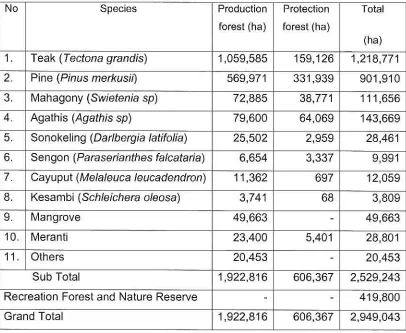
and Recreation foresvNature reserve (0.42 million ha).Main species
of the
plantations are teak, Pine, Mahogani andAgathis.
Detail plantation area based on species is presented in Table 2.5.Table
2.5.
Area of Perhutani Plantation based on Tree SpeciesSpatial Distribution of the species is presented in Fig. 2.5.
No Specie6 Production
forest (ha)
Protection
forest (ha)
Total
(ha)
1. Teak (Tectona grundis) 1,059,585 159,'126 1,218,771
2. Pine (Pinus merkusii\ 569,971 331,939 901,910
3. Mahagony (Swieferia sp) 72,445 38,771 't'l'1,656
4. Agathis (,Agarhis sp) 79,600 64,069 143,669
5. Sonokeling (Da rl be rg i a I atifolia) 25,502 2,959 28,461
6. Sengon (Palaseriarthes falcataria) 6,654 3,337 9,99'1
7. Cayuput (M elale uc a le ucade nd ro n) 11 ,362 6S7 12,059
Kesambi ( Sch/eichera o/eosa) 3,741 68 3,809
9. Mangrove 49,663 49,663
10. Meranti 23,400 5,401 28,801
11 Others 20,453 20,453
Sub Total 1,922,816 606,367 2,529,243
Recreation Forest and Nature Reserve 419,800
Grand Total 1,922,416 606,367 2,949,043
[image:26.502.55.461.231.564.2]!
s
E '1;;i ,ig hr:
; $Loi=
t-,rc',
n
o
.E
o-o
o
-o
,9
E
a
tti
N
2.2, Considerations for lnvestment in lndustrial
ForestPlantation
2.2.1.
Positivefactor for investment
a.
Deregulation of investment Procedure
Since the Law of Foreign direct lnvestment/
FDI
was enacted in 1967, there are3 times
remarkable changes, whichwas
happenedin
'1994, 1998and
1999. Startedin
1994, the foreign investor may have a 95% share without having anyduty
to
transfer sharesto the
lndonesian partner,or to
invest ina
fully-owned (100%).ln
'1998,the
Presidentof
Republic gavean
authorityto the
State Minister forlnvestments/Head
of the
National lnvestment Coordination Board (BKPM), to issue FDI approval up to US$100million.
Meanwhile, The National Commissionof
Environmentallmpact
Assessment
(Komisi Nasional
Analisis MengenaiDampak LingkunganiAl4DAL) also transferring authority
to
Regional Officesof
Environmental lmpact Assessment to verify AMDAL study.ln
'1999,the State
Ministerfor
lnvestments/Headof the
National lnvestmentCoordination Board (BKPM), delegated
to
Regional Offices
of
Investment Coordination Board (BKPMD) and some representative officesof the
Republic lndonesia an authority to give FDI approval.By authority delegation, the application
of
FDI became easier and faster. Detailexplanation
of
Reformation/Deregulationof
/
FDI
investmentis
presented in Chapter lll.b.
Shortageof
RawmaterialSupply
lndustrial forest plantation investment is still promising by
the
high demandof
raw
materialfor forest
industries.
Annualwood
productionto
meetthe
raw material demands of industry is projected to be about 37.67 million cubic meters.Another
2.71
million
cubic
meter
will be
supplied
from
industrial
forestplantations.
The production capacityof
natural forest has tendedto
decreaseover time due
to
variousdisturbances.
The forest product industry, however, especially the wood processing industry has been growing very fast since theexport
log bans
in
1984.
The
existenceof gaps
betweenthe
needof
rawmaterial
and
the
capacity
of
forest
to
supply
logs
is
therefore
a
serious challenge.2.2.2.
Negative Factorsfor lnvestment
a.
Unavailability
of
Reforestation Fund
lDana Reboisasi (DR)There are
two
kind funding schemesto
build lndustrial Forest Plantation:
(1)self
financing,and
(2)joint
venturewith
Government Estate Company. Under the joint venture, the company may borrow capital from reforestation fund (DanaRebolsasl/DR), maximum 32.5 %
of
the total asset (share) without any interest(0%). This mechanism had been last till 1999.
After
the
promulgationof Law
No. 4111999and
RegulationNo.
2511999, the policy on DR allocation waschanged.
Debate on how to divide the proportionof
DR
betlveenCentral
Governmentand
RegionalGovernment
(Log's/wood'sProducer
area)
has
been occurring. Since
there
is
no
any
Government Regulation (Peraturan Pemerintah) aboutthe
DR allocation,the
availabilityof
DRfor
Industrial Forest Plantation is uncertain (Letterof
secretary Generalof
Forestry and Estate crops, No. 549/ll-Keu/2000 dated on 20 april 2000 and No.'1 '133/ll-Keu/2000 dated on 6 July 2000)
b.
Time delayedduring application
Even though some deregulations of Law and regulation of FDI have taken place, some delayed during the administrative processes have been
reported.
As an extremely case, to get approval and rightto
developed HTl, may take of aboutmore than
2
years
(Sarijanto,2000).
The delayed may result
in
high-cost economy and increase the business uncertainty.c.
LandAvailability,
Landdispute
andsocial
conflict
Unproductive land or degraded land within production forest is estimated about
21
million hectares, however, it is often thatthe
lands are already occupied byshifting
cultivators/farmers (Sarijanto,2000).
This
facts made the
company difficult to find adequate sizedof
land parcel in accessible location without any additional cost during the establishment (Potter and Lee,1998).Land
availabilityalso
relatedwith
agrarian disputeand social
conflicts
thathave been occurring in some places
in lndonesia.
Kartodihardjo and Supriono(2000), reported
that social conflict
betweenHTI
companyand local
peopleoccurred
in
South
Sumatra,where
as 41,155
ha of
small holder
plantation owned by 4,101 families, have been taken over by 13companies.
ln the other partof
South Sumatra, 81oil
palm companies with total area of about 554,000ha, have
had
'l1%of its
land was dispute problem with localcommunities.
lntotal,
in
South Sumatra Provinces, thereare
103 land dispute cases resulting from oil palm and HTI establishment.Social conflict may
also
in
the
form
of
anti-HPH
and
anti-HTl
movement. Kartodihardjo and Supriono (2000), reported that since the economic crisis and instabilityof
the Government, there are anti-HPH, anti-HTl and anti-cash cropstree plantation
movement.
They reported that some places in South Lampungand
North Sumatra, farmers have occupied illegallythe
landof the
HPH, HTIand cash
cropstree
plantation.To
overcomethe
problemwith the
land and reduce social conflict some HTI company have begun implemented community 'fotestry (Hutan Rakyat)scheme.
The HTI company provide all input production and profit being shared to a group afarmer.
The scheme was already applied inJambi (Potter and lee.1998).
d.
Forest FireHTI is monoculture plantation and usually produce very huge quantity of litter/dry
biomass under the plantation
floor.
During dry season, especially under El-Ninoinfluenced, the dry biomass are very susceptible to
fire.
Fire may come from the surrounding field of shifting cultivators/farmers or HTI/ cash crops plantation,that usually use fire for land clearing, even though fire have been prohibited for
land clearing purposes.
Fig. 2.6. Fire on Acacia mangium planlalion (photo
by
Prasetyo)l,ig. 2.7. File for lafld clearing (photo hy Prasetyo)
[image:31.526.169.478.473.665.2]FOREIGN DIRECT INVESTMENT ON
INDUSTRIAL
FOREST
PLANTATION
3.'1.
Brief History of Foreign
Directlnvestment
(FDl)Policy
ln
'1967the
lndonesian Government introducedlhe
Foreign Direct lnvestmentLaw No. 1
in
1967(Undang-Undang Penanaman ModalAsing No. 1/196n
b
attract
foreign direct investment. Under
the
foreign investor received
very attractive incentivesuch
as tax
holidays,and some certain guarantees.
Toassure
of the Law
implementationthe
so-calledPanitia
Teknisor
TechnicalTeam
coordinatedwas
performed (later
in
1973,
the
Panitia Teknis
waschanged
into
Badan
Koordinasi Penanaman Modal,tsKpMor
The
National lnvestment Coordinating Board).ln
1974, after demonstration against the Japanese lnvestor happened (Malari-riot), foreign investment regulation became more restrictive. lnvestors were only allowedto
investin the form of a
joint-venturewith
a
local partner.The
new regulation wasalso
aimto
speedup the
processof
transferof
sharesto
the Indonesian partners.After the oil-boom had ended
in
1982, theoil
prices got extremely low and the income of devices from oil dropped.ln
responseto
this situation, the so-calledPakem
/
Pakmei(Paket
6
Meil
or
Packageof
6
May 1986
regulation was introduced, aimedat
improvementof
foreign investment environment and thecompetitiveness
of
non-oil sector
in
internationalmarket.
To
provide
more opportunities and attract more investment, simplification of procedure was taken,such
as
to
changeDaftar
Skala Prioritas/DsP(a
listof
sectors accessible to foreign investment) into Daftar Negatif lnyeslasi /DNl (a list of sectors closed toforeign investment, which was much shorter than the
DSP).
The DNI later was modified again to be more accommodative, by the promulgation of the Decreeof
the lndonesian President No. 96/2000.
ilt.
ln
1994,the Paket
DeregulasiJuni
1994 (Deregulationin
June
1994) wasintroduced.
This
deregulation
was
introduce
aimed
at
the
stability
andsustainability
of
foreign investment. Underthe
regulation,the
foreign investormay
choose between a joint-venture witha
lndonesian partner/
BUMN with ashare
of
95% without
havingany duty to
transfer sharesto
the
lndonesian partner, or to invest in a fully-owned(100%)
with one conditions, that is have to transfer at least 5% of shares to a lndonesian partner within 15 years.ln
1998,the
Presidentof
Republicof
lndonesia delegate authority to the State Ministerfor
lnvestments/Headof the
National lnvestment Coordination Board(BKP[/), to
issue FDI approval upto
tJS$100million.
Previously, FDIat
anyamountwas issued by the President. ln the same time, National Commission of
Environmental
lmpact
Assessment
(Komisi
Nasional Analisis
MengenaiDampak LingkunganlAMDAL) also transferring authority
to
Regional Officesof
Environmental lmpact Assessment to verify AMDAL study. Moreover, there arealso some deletion
of
letter recommendations from Technical Department andPrincipal Approval
Ujin
Prinsip)from
related
l\,'linistry,before
the
investor implement or construct the projectln
1999,the State
Ministerfor
lnvestments/Headof the
National lnvestment Coordination Board (BKPM), issued decree No.3B/Sl(/1999 regarding to manualand
procedureof
applyingfor
investmentin
the
frameworkof
domestic andforeign
investment.
Underthe
Decree, BKPM have delegated an authority toRegional
Ofllces
of
lnvestment Coordination Board (BKPMD)
and
some representative offices of the Republic lndonesia to give permitto
theFDl.
The Decreealso
have provided better guidanceto
the foreign investor tofullill
the application.3.2.
Currentsituation
offoreign
investment on Forestry
Allowable forestry sectors for FDI are governed by The Presidential Decree No. 96/2000, which
was
modified bythe
decreeNo.
118/2000 dated August 2000regarding accessible
and
inaccessible business
sector
on
some term
of
investment. Germ plasm nursery, natural forest exertion rightand
contractorsengaged
in the field
of
lumberingare
prohibited sectorfor
FDl.
Meanwhile, development of lndustrial Forest Plantation and pulp industry are not mentioned as closed sector (Daftar Negatif lnvestasilDNl)(Attachment'l
)Detail
data
of
FDI
on
Forestryis
difflcultto
be
collected,since very
limitedpublication published.
Since
the
economicalcrisis
in
1997followed
by
thepolitical instability
and public
unrest,almost
of
all
sector
of
FDI have
beendecreasing.
FDI approved
on
Forestry sector
tends
to
decrease,
except investmenton
paper industry, which showedan
remarkable increasein
1997, however, the figure shrinkto
very lowfigureintheyearof 2000(Table3.1)
Tabel 3.1.
FDI of forestry sector approved by the Government (inmi
ion US $)lndustrial Forest
Plantalion Wood lndustrv Paoar Industrv
1995 0 263 2540.5
1996 135.5 101 1 2907.3
1997 0 6S7 5353.3
1998 0 70.4 404
1999 8.8 't'13.2 14114
2000 10 208_2 141
I
Source : Bank of lndonesia, 2002
It
was
repofied
that
some
of
the
on
going FDI
on
forestry also
felt
into bankruptcy, due to long economical crisis. [image:34.500.83.427.462.590.2]3.3. Agency/lnstitution
relatedto
FDIa.
The Nationallnvestment Coordinating
Board (BKPM)The National lnvestment Coordinating Board (BKPM) is
a
Non Departmental Government agency serving under and responsible directly to the Presidentof the
Republic lndonesia. The Board led bya
Chairman who also acts asthe Minister of lnvestment. lt function is to assist the President in formulating
Government
policies
on
investment,
such
as
processing
investment approval, licenses and conducting supervision.b.
Regional
lnyestment Coordinating Boatd (Badan Penanaman Modal
Daerahl BKPMD)
Regional lnvestment Coordinating
Board
(BKPMD)
is
headed
by
aChairman,
who
is
a
subordinateof
and
responsibleto
the
ProvincialGovernor.
lt
hastask to assist
investorin
implementingtheir
investment project the BKPMD has the task to assist the investors in implementing the Foreign lnvestment Approval (SP-PMA), after the BKPM approval has beenissued. The BKPMD
will
issue regional permit for :- Locations permit.
- Building permit.
- Working permit for expatriate employees.
c.
Nalional LandAffai
(Badan Pertanahan /Vasionar/BPN)National Land
Aftai/-(Badan
PertanahanNaslonalBPN)
is
headed
by
a chairman, who is responsible to the Ministry of HomeAffair.
lt function is to issue permit on land, such as issuing Business Utilization Petmil (Hak GunaUsahalHGU ).
d.
Province Land
Affair
Offices (Badan Pertanahan
Nasional tingkat
PropinsD
Provincial office
of
Land
Affair
(
Badan
Peianahan
Nasional
tingkatProp,rsl) is the land affair agency
at
Provincial level, headed by a chairman, who is subordinate of and responsible to the head of the NationalAgency
forland
Aflai
(Badan Peftanahan Nasional).Regency Land
Affair Offices
Regency office
of
Land
Affair
(
Badan Peftanahan
Nasional
tingkatKabupaten\
is
the
land
affair agency
at
Regency
level, headed
by
a chairman, who is subordinate of and responsible to the head of the provincialoffice of Land
Affair.
lt has task to assist the investor in obtaining land for thelocation of the investment project.
Regency Public
Wotk
(Dinas Pekerjaan ahmumKabupatenl
Regency Public Work (Dinas Pekerjaan Umum Kabupaten)
is
headed by a Chairman, who is subordinate of and responsible tothe
Regent (BupatD. lthas task to lead the investor in implementing their construction works.
Regional
Office
of
Environmental
lmpact
Management
(BadanPengendalian
DampakLingkungan
Daeruh/Bapedalda)Bapedalda
is
headedby the
Chairmanwho is
directly responsibleto
theRegent.
lt
has task
to
verify
and
convincethat
environmental impactassessment
study (Arailsa
mengenai Dampak LmgkungarlAl\4DAl)of
iheinvestment project
plan.
Upon their approval the investment project can be continued.e.
t.
s.
3.4.
Procedure and manualof newFDl
Summarized
of
procedureand
manualof
new FDI application is presented inTable 3.1, while its explanations are follows:
Step
1
:Application
andapproval of
New FDIlnitial step that has to be taken by investor for new FDI is to get approval of FDl.
Applications
for
new capital
investmentsunder
FDI
arrangementscan
besubmitted
by:
a.
foreign citizens and/or foreign corporation and/or foreign investment companies;b.
foreign
citizensand/or foreign
corporationand/or foreign
investmentcompanies
along
with
lndonesian
citizens
and/or
lndonesian corporation.The applicalion forms shall be submitted
to:
a. The Staie Minister for lnvestments/Chairman ofBKPM; or
b. Heads of local representative offices of the Republic of lndonesia; or
c.
Heads of Regional lnvestment Coordinating Board (BKPMD)The applications should be submitted in duplicate (2 copies) by using the form of model I/PMA
(Aitachment 2)
and signedby
parties
(applicants)of the
Joint venture or their respective legal proxies.The Government Regulation no. 2011994 on investment guided type of general
FDl.
Based on the regulation the FDI may be established in the formof:
a. Joint
venture between foreign capitaland
domestic capital owned bylndonesia citizens
and/or lndonesian legal
entities.
Joint
venturecompany shall take
the
formof
Limited Liability lnveslment Companysubject
to
lndonesia Corporate Laws, denotedas
PerseroanTehatas
(PT).
The lndonesian parlners' share in joint venture company shall beat
least
5%
of
the total
paid-up c€pital
of
the
company upon
the establishmentb.
Straight investment meansthat
the entire capital is owned by foreign citizens, and/or ioreign legalentities.
For this type of investment, there is a requirement thatafte|l5
years from commencement of commercial operation,the
100% share holders must sellat
least 5% of the flrm toan lndonesian entity.
ln case
of
Forestry sector, from the time being FDI must be in the form of Joint venture as stated by[/inistry
Decree no.403/KPTs-ll/1992 about the Guidanceand Procedure the establishment of joint venture company for the development
of
Forest
plantation. Straight investment ('100 % owned by foreign company) on Forestry sector is still being in discussion. Further requirement is that the owners(Board
of
Directors)of
the
company haveclear
commitmenton
sustainableforest
managementas
requested
by
the
Decree
of
Forestry Ministry
No. 2'1lKpts-ll/2001, dated on 31 January 2001Based
on the
evaluationof
applicationsfor
investments (itwill
takesnot
laterthan
10 working days),the State
Ministerfor
lnvestments/Headof
BKPM orMinister
of
Foreign Affairs inthis
case Headsof
local representative offices ofthe Republic of lndonesia or covernors/Heads of Provincial Regions in this case Chairman of local BKPMD shall issue a letter of approval of foreign investments/ (Surat Persetujuan Penanaman Modal Asing/SP-PMA) and shall be conveyed to applicants with copies made available to :
a.
The Minister of lnternal Affairs:b.
Ministers fostering business fields of the relevant investments;c.
The Minister of Finance:d.
The State Minister for Agrarian Affairs/Chairman of the Agency forNational Land Affairs (Badan
Peianahan
Nasional);e.
The State l\,linister for Environment/Chairman of BAPEDAL (Board ofcontrol over lmpacts on the Environment);
f.
The ftIinister of Cooperatives, Small and Medium scaleBusinesses/Menteri Koperasi, Pengusaha Kecildan Menengah
(in
lhe
case of partnership with scale businesses);g.
Ambassador/Heads of representative offices of countries of origin oftoreign participants in lndonesia:
h.
Governor of Bank lndonesia;i.
Governors of the relevant provincial regions;j.
Directors general in charge of technical affairs of the relevant investments;k.
The Director Generalfor
Taxesll.
The DirectorGeneralfor
Customs;m. The Director General of Laws and Legislation;
n.
Chairman of the BKPMD concernedlo.
Heads
of
technical
service
institutions
of
regencies/municipalities concernedA
copy of the approval letter issued by Chairmen of localBKPI/D
shall also be made available to the State Minister for lnvestments/Head ofBKPM.
Meanwhile copies of the letter of approval issued by heads of local representative officesof
the Republic of lndonesia shall also be made available to the Minister of Foreign Affairs and the State Minister for lnvestments/Head of BKPM.
Step 2
:Application Lefter
ofdomicile
The FDI Company must obtained a Letter of Domicile issued by the Office of the Sub-District having jurisdiction over the domicile of the FDI Company. The Office
of
the
relevant District mustalso
acknowledgethe
aforementionedLetter of
Domicile.
Step
3
:Execution of
the deedof establishment
After
obtainingthe foreign
investment approvalfrom
BKPMor
the
Regional BKPM orthe
lndonesian Embassy/Consulate General/Consulate, the investors shall execute the final Joint Venture Agreement (signed by the parties), and theDeed
of
Establishment (established bythe
shareholders referredto in
foreign investment approval/SP-PMA) containing the Articlesof
Associationof the
FDI Company.The
executionof the
Deedof
Establishment mustbe
made beforea
NotaryPublic.
The person(s) appearing belore the Notary Public must also bring theirResident ldentification Cards
or
their
passports along
with
the
Resident ldentification Cards and/or passportsof
the members of the Boardof
Directorsand Board of Commissioners, and
a
power of attorney if the said person(s) areacting
as
legal
representatives/attorneys/proxies.The Deed
of
Establishmentmust then
be
submitted
to
the
Ministry
of
Justice
and
Human Rights
forratification.
Step
4:
Application for approval from the Minister of Justice and
Humanright
The application for approval of the Deed of Establishment of the PMA Company
by
the
l,'linistryof
Justiceand
Human Rights, isto
be submitted by the same Notary Public who made the notarial Deed of Establishment of the relevant PMACompany.
The
applicationwill
be
submittedtogether
with
the
evidenceof
payment
of
the initial
issuedand paid up
capital,and the PMA
Company's Taxpayer's Registration Number.Step
5
:Registration
and announcementof
the deed of theestablishment
The
Notary Publicwill then
registerthe
ratified Deedof
Establishmentin
the Registerof
Enterprise$ atthe
Regional Offlce ofthe
Departmentof
Trade and lndustry (acting as the Office for company registration within the said regency) atthe
latest30
(thirty)days as of the
issuanceof
the
Ministerof
Justice andHuman Rights approval, and the ratifled and registered Deed
of
Establishmentwill then be published in the State Gazette of the Republic of lndonesia, and its Supplement,
at the
latest30
(thirty) daysas of
registrationat the
Registerof
Companies.Step
6 :Application ofTax
Registeredcode
Number (NPwP)and
TaxableEnlrepreneur's
NumberAfter obtaining
the
Letterof
Domicile,the
PMA Company should immediatelyapply
for its
Taxpayer's Registration
Number (Nomor
Pokok
Wajib PajaklNPWP), by submitling the foilowing documents to the Taxoffice
for PMA Companies:r'
Application letter (form available at the Tax offlce);'/
Copy of the foreign investment approval (SP-PMA);r'
Copy of the Letter oI Domicile;"'
Copies
of
the
Resident
ldentiflcationCards and/or
passportsof
the Directors of the PMA Company;'/
Power of attorney if the person submitting the application letter i$ not the applicant; andr'
Copy of the PMA Company's deed of establishment (approved by public notary)This
Taxpayer's Registration
Number
is
required
to
be
attached
in
the application forthe
Minister of Jusiice and Human Rights approval referred to inthe below paragraph.
After
the
FDI Company has obtainedits
Taxpayer's Registration Number, therelevant
Tax
Officewill
conducton site
inspectionto
the office
of
the
FDI Company in order to issue the Taxable Entrepreneur's Number.Step
7
: Openingof
BankAccount
The PMA Company must open
a
bank account with a foreign exchange bank inlndonesia. The issued capital
of the
FDI Company must be transferredto
the said bank account by each of the shareholders, and copies of the relevant banktransfers must be attached
to
the application for approval fromthe
Minister ofJustice and Human Rights.
The following documents are to be submitted in opening a bank account:
/
Copy of the deed of establishment;,/
copy
of theTaxpayels
Registration Number;"
Copy of the Letter of Domicile;r'
Sample of signature of the President Director of the pMA Company;'/
Other requirements as stipulated by the relevant bank.Step
8
: Application of working permit
for
Expatriates
(tjin Kerja
TenagaAsrng/ IKTA)
PMA companies planning
to
employ expatriates
shall
have
the
plan
foremployment
of
foreign
personnel
(Re,cana
penggunaan
Tenaga
KeriaAsirglRPTKA).
Applications for approval of the plan for employment of foreign personnel (The Plan for Employment of Foreign Personnel/
RpfKA),
shall be submitted to:'/
the State Ministerfor
lnvestments/Headof
BKPM (for companies whose SP are issued by the State Minister for lnvestments/Head of BKpM)the Governor/Head of the Provincial Region in this case the Chairman
of
BKPlvlD
(for
companieswhose SP-PMA issued
by
the
Chairman ofBKPMD)
/
tothe
State Ministerfor
lnvestments/Headof
BKPM or the Chairman of BKPMD(for
companieswhose
SP-PMAare issued by
the
Headsof
Representative Offices of the Republic of lndonesia)The applications for approval shall be filed by using the Plan for Employment
of
Foreign Personnel/ RPTKA form (Attachment 3), with following attachments :/
The Article of Association of the joint venture company'/
A Description of the organizational structure of the joint venture companyr'
A copy of the company's labor reportv/
A
copyof
citizenship identification card forthe
lndonesian employee as 6n assistantThe Plan
for
Employmentof
Foreign
Personnel/ RPTKA approvalshall
beissued by
the
State Ministerfor
lnvestments headof
BKPMon
behalfof
theMinister
of
Manpower,
or
the
Chairman
of
BKPMD
on
behalf
of
the Governor/Headof
the provincialregion,
andthe
Ministerof
lvanpower for theState l\,Iinister
for
lnvestments/Headof
BKPM in the formof
RPTK decrees to applicantswith its
copies
addressedto
the
Ministryof
Manpower, relevant technical ministries and the local BKPMD.The
Plan for Employment of ForeignPersonnel/ RPTKA
is
usedas
a
basis considerationin
grantingthe
working permit for Expatriates/ IKTA.The approval
of
the Plan for Employment of Foreign Personnel/ shall be issuednot
later than4
(fou0
working days afterthe
receiptof
completeand
correct applications.Step
9
r
Application of Restricted
Stay PermiURSPAfter getting approval of the Plan for Employment of Foreign Personnel/ RPTKA,
the company shall apply Restricted Stay Perm|VRSP (y,'sa IerDatasAlITAS) for the Expatriates who are ready to come
to
lndonesia, from the Head of consular Representative OfJlcesof the
Republicof
lndonesia. To get
Restricted Stay Permit /RSP, the corporation require to fill and submit application formof
Ppt.2(Attachment
4), with following attachments :r'
A copy of the passport/
Curriculum Vitae (CV) signed by connected expatriate employee'/
Educational and experience of work certificates/diplomasr'
A
copyof
documentof
appointment (surat penunjukkan)or
minutesof
shareholder general meetings for the position of directorsAfter
the
Ppt.2 is evaluated, BKPM will issuea
letterof
recommendation in theform of TA.01 to
the
Director Generalof lmmigration.
Based onthis
Letter theDirector
General
of
lmmigration
will
issue
the
VITAS
for the
concerned expatriate employee.Step10
:
Application to lmport
Capitalcooda and
RadAuxiliary
Materials
The import
of
capital goods with facilities fora
PMA Company shall obtain theapproval
from BKPM
or the
Regional BKPM,by
submittingthe
Model
lV.A(Attachment 5
)/Master listof
Capital Goods in2
(two) sets to either BKPM or BKPMD, together with the following documents:/
Master list of Capital Goods;,/
lllustrationof
location for machines/equipment;"
Manuals/Brochures/Technical Literature:/
Description of the production process;/
Estimationn of the capacity for the machines;/
copy
ol
the
foreign
investment
approval
and
its
subsequent amendments;r'
Copy
of the
PMA
Company'sTaxpayer's Registration Number
and Taxable Entrepreneur's Number; and/
Copy of the latest lnvestment Progress Report.Step 11.
Theimport
of radauxiliary materials
The import of
radauxiliary
materials with facilities shall obtain the approval fromBKP[,
or
the
Regional BKPM,by
submittingthe
Model
lV.B
Masterlist of
RadAuxiliary
Materials(Attachment 6)
in2
(two) setsto
eitherBKPlil
or the BKPMD, along with the following documents:7
master list of RadAuxiliary Materials;r'
estimationofthe
requirement forra
auxiliary materials to be imported;/
list of installed machines/equipment, with technical specification and estimation capacityof
the machines;'/
copy of the foreign investment approval and its subsequent amendments;"
copy of the Taxpayer's Registration Number and Taxable Entrepreneur'sNumber;
,'
copy of the latest lnvestment Progress Report.Step
12
:Application for the Limited lmporter's ldentification
Numberln
order
to
obtain
the
Limited lmporter's ldentification Number,
the
PMACompany
shall submit
the
relevant applicationform
to
either
BKPMor
the Regional BKPlil in 2 (two) sets, together with the following documents:'/
Limited lmporter's ldentification Number card signed by those entitled tosign import documents and stamped with corporate seals;
/
Copy
ol
the
PMA Company's latest
deed
regarding
the
structure/ composition of the Board of Directors;/
Copy of the Taxpayer's Registration Number;/
Powerof
attorney fromthe
Boardof
Directors, duly stamped,for
import documents not signed by the Board of Directors;Step
13
:Applying
Site Permit(rln pencadangan Lokasil
After getiing SP-PMA and
its
related licensing document, the company should senda
letter to apply Site/Location Petmil (ljin Pencadanga,Lokas0.
lt should be submitted to :r'
The Ministryof
Forestry and Estate Crops (in case of the location of the project situated across two or more Provinces) ; or/
Governor ofthe
Province (in caseof the
location ofthe
project situated across two or more RegenuMajor) ; or/
Headof
Regency/Major(in
caseof the
locationof the
project situated within a RegenvMajor).Enclosed to the letter, some documents that have to submitted are as follows :
/
At least last 2 years Landsat Thematic Mapper (TMyEnhanced Thematic Mapper (ETM) image (s) photograph(s) band 5,4,2 and its interpretationof the proposed location
r'
Leter
of recommendation from Head of Regency, attached with mapof
the location at scale 1 : 100 000r'
Project Proposal/
Letter of company establishment approved by Indonesian notary office"/
Three years report of company cash flow, except the company is newly establishedr'
NPWP (Nomor Pokok Wajib PajaklTaxpayer's Registration Number) The judgment of Site Permit, will be made based on :r'
Whether
the
location proposed situated
in
accordancewith
Spatial Planning (Rercana Tata Ruang Wilayah Propinsa/Rf RWP)./
Whether condition of location proposed (bio-physical condition) meet with the requirement requested by Dept. of Forestry and Estate Crops.Step
'14
:
Obtaining Land Business Expolitation Right
(HGU:Hak
Guna Usaha) andBuilding
Right (HGB: Hak GunaBangunanl
After the issuing of Site/Location Petmil (ljin Pencadagan Lokasi), the company
can apply
Land-use
Right
(HGU)/BuildingRight (HGB)
to
the
Head
theProvincial
or
Regencyof
Land
OfficeAffair,
dependingon
the
project area location.Documents that should be enclosed to the letter of application are :
r'
The Site/Location Permit'/
The evidence of the applicants/
The letter showing that forest land has been released bythe
Minister ofForestry
'/
The situation sketch of map measured by the Land OfficeStep