THE BASIC GRAMMAR PROBLEMS FACED BY ARAB
(LIBYAN) STUDENTS IN ENGLISH COMPOSITION
a Thesis
in a Partial Fulfillment of the Requirements for
Master’s Degree in English
Hisham Mohammed Al-Naib Al-Shareef
POST GRADUATE PROGRAM
DIPONEGORO UNIVERSITY
SEMARANG CENTRAL JAVA
A Thesis
THE BASIC GRAMMAR PROBLEMS FACED BY ARAB
(LIBYAN) STUDENTS IN ENGLISH COMPOSITION
Submitted by:
Hisham Mohammed Al-Naib Al-Shareef
Approved by
Advisor,
Dra. Deli Nirmala, M.Hum
NIP.196111091987032001
Master’s Program in linguistics
Head,
ATHESIS
THE BASIC GRAMMAR PROBLEMS FACED BY ARAB
(LIBYAN) STUDENTS IN ENGLISH COMPOSITION
Submitted by:
Hisham Mohammed Al-Naib Al-Shareef
VALIDATION
Approved by
Thesis Proposal Examination committee
Master’s Degree in Linguistics
Postgraduate Program Diponegoro University
ON August 20th, 2011
Chairman
Dr. Deli Nirmala, M.Hum
CHAPTER I
INTRODUCTION
Recently, English has played an important role in our lives. Although
people have an increasing interest in learning English, many EFL students
struggle while learning it. Writing is the most challenging part for Arab learners. It
is a difficult skill even for native speakers, but it is even more difficult for
non-native speakers. This difficulty might be related to the interference between the
native language and the target language. In writing, many points must be
balanced, such as grammatical and non-grammatical aspects. therefore, teachers
concentrate only on teaching grammar and punctuation as they are the most basic
categories. What makes Arab students weak in writing is that the Arab world
suffers from being abstracted and product-oriented. Arab students always commit
mistakes in their writings, and these errors can cause serious difficulties.
1.1 Background of the Study
English language is being as the language of communication more and
more with the progress of time. Writing is an important skill among
communicative skills. As writing is becoming more important with the new
technology for its use in communicative purpose, it is important to give the
writing skill more attention for improving it among English language learners.
This study deals with writing among Libyan academic students in Diponegoro
University. How students learn it, what difficulties do they face in writing, and
In this study, the researcher is trying to find out the difficulties in order to
come out with some solutions and recommendations (in case, difficulties are
found), which may help in improving the writing skill in the academic level. As
English is used as a foreign language in the Arab world (Libya), therefore,
students may suffer from difficulties in using English in general and especially in
writing. As the formal English is the one taught in the institution in which there
must be no way to mistake, the students may suffer from the mother tongue
influence and the cultural differences which may be the main causes of these
difficulties encountered by the students.
The mother tongue infeluences such as the linguistic differences. i.e the
grammatical differences between the two languages. Under the heading
(grammatical differences ) one can talk about the sentence order differences, the
gender in language, the placement of the adjectives and adverbs, the prepositions
and the different usage, the subject verb agreement, etc.
On the other hand , there are some cultural differences between English
and Arabic which may cause a difficulty for the students in their writings. For
instance, in Arabic, it is concentrated on the form more than the content, whereas
in English the content is given the main focus. Therefore, the Arabic Libyan
students concentrate on the form more than the content.
In this research, the writing competence of the students will be tested in
order for finding out the difficulties faced by the Libyan students in the academic
Arab learners of English face many problems in the communicaticve skills
of English (writing and speaking). As writing is an important skill for language
production , it is very important for the students to be skillful in this competence.
Therefore, it is crusial to know what difficulty the students have in writing
English in order to come out with some solutions and recommendations to avoid
them.
Some other reasons that affect Arab’s writing in English are structure,
grammar, and spelling. Arabic structure is different from English. Most common
errors are in subject-verb agreement, verb tense and form, singular and plural,
word form and sentence structure. Arab students struggle with English because
their English foundation is fragile. Even after students gain high levels of
education, they struggle with writing. Although many teachers seek students who
are able to write English passages that are grammatically correct with accurate
punctuation and good organization; students fail to achieve these goals at times.
Moreover, EFL learners need more time than native speakers to finish in
class writing exams. It is naturally true that Arab students have difficulties
communicating their thoughts through writing easily. When they write, they think
in Arabic and use Arabic structure and grammar. Language transformation is
considered the most critical problem. When students are weak in English, they use
Arabic expressions to convey their ideas.
This study is aimed at investigating writing problems among EFL Arab
such problems. Such problems are very important to know for EFL teachers.
Teachers must know how their students perceive writing differences in both first
and second languages. The students will be tested by two ways. The first way is
through a writing test in which the writing competence of the students will be
examined. The second one is through a questionnaire in which the students write
about their areas of weaknesses. After that, the observer would make a distinction
between the two groups, and would find out in which areas they committed more
mistakes.
Recently, English has played an important role in our lives. Although
people have an increasing interest in learning English, many EFL students
struggle while learning it. Writing is the most challenging part for Arab learners. It
is a difficult skill even for native speakers, but it is even more difficult for
non-native speakers. This difficulty might be related to the interference between the
native language and the target language. In writing, many points must be
balanced, such as organization, writing purpose, audience, glossary, and
capitalization. However, teachers concentrate only on teaching grammar and
punctuation; they do not concentrate on how topics are developed or how to
organize ideas. What makes Arab students weak in writing is that the Arab world
suffers from being abstracted and product-oriented. Arab students always commit
mistakes in their writings, and these errors can cause serious difficulties. These
mistakes are classified into two parts, they are either:
Linguistic errors are those mistakes in the linguistic part of a language
such as syntactic aspects, semantic aspects. These errors are mostly caused
because of the simple knowledge of the foreign language and also because of the
diiferences between the two languages in the linguistic part. As the two languages
are completely different from each other, the EFL (Libyan Arab) students got
many difficulties in this part starting with the spelling of the words (in Arabic , the
words are written as they are pronounced, unlike English in which each word has
its own spelling which is different from the pronunciation of the word). Ending
with the complicated aspects of the English linguistic features.
The non-linguistic errors are caused because of the little knowledge of the
target language culture and the cltural differences between the two societies using
different language. For instance, in Arabic language, it is focusing on the form
more than the content, whereas in English the content is the most part
concenterated on. So when it comes to EFL students, they focus on the
grammatical part forgetting the meaning of their sentences. This is also one of the
major problems faced by Arab learners of English language.
Due to various reasons, EFL students, especially Arabs, encounter
difficulties in writing in English. For example, cultural difference is one of the
most critical problems that affect Arab students’ writing. Every culture and
language has unique rhetorical conventions to the other. For example, English
writing is direct while Arabic writing tends to be less direct. Arabic writers always
English language is being under focus in the Arab world in the last few
years and as it is being studied in the schools from the very beginner stages.
Writing is one of the most crusial skills in learning a language. In addition to this,
written English is the main language used in exchanging knowledge. Therefore, in
this study, the main focus is on the problems in writing English encountered by
the English as a foreign language students. By finding such problems and areas of
weaknesses, recommendations and solutions can be given in order to help the
students to come over these problems.
From another perspective, this study can help the teachers handle with the
problems of writing faced by their students. According to the areas of weaknesses,
they can have their teaching method accordingly.
In order to help the students to be proffesional in writing English, the
problems must be explored and checked. This research will find out these
problems in both linguistic and non-linguistic part, but the main focus will be
given to the linguistic part.
1.2 Problem Statement
This research aims at highlighting, investigating and finding out some
solution of the problems encountered by Arab Libyan students in writing English
Research Questions:
1. What are the grammar problems faced by the Arab Libyan academic students
2. What are the causes of the grammar problems in writing English among the
Arab Libyan students in Diponegoro University in academic level?
3. How to overcome the grammar problems in writing faced by Arab Libyan
students in Diponegoro University in academic level?
1.3 The Objectives of the Study
The main objectives of the current study are:
to highlight the writing problems of Libyan academic students in Diponegoro University.
to investigate the causes of the writing problems of Libyan academic students in Diponegoro Uuniversity
to suggest some solutions to solve the writing problems of Libyan academic students in Diponegoro University.
1.4
Scope of the Study
This study concentrates on the communicative competence (writing skill).
The research will measure the writing abilities of Libyan academic students in Diponegoro University in order to find out the difficulties that they encounter in
writing in the target language (English). Moreover, it investigates either these
difficulties are the result of the mother tongue influence or the cultural difference
or both.
According to the results, this research will bring out some solutions of the
This study will focus on the writing competence. It also focuses on the
enhancing of the writing skill among academic students. By exploring the
problems and the areas of weaknesses, the study will make some suggestions that
may help in developing the writing skill.
1.5 Significance of the Study
The study is hoped to be beneficial and effective to the readers and to be
useful for both students and teachers throughout the recommendation it may come
out with
For students:
It is hoped that this research will bring out the problems or difficulties of
the students in writing. According to these problems and difficulties, the research
will come out with the recommendation that may help the students in improving
the areas of weaknesses.
The students will pay more attention to these difficulties and the writing
skill will be improved accordingly as they follow the recommendations.
For teachers:
The teachers are the effective part of the teaching-learning process, so if
the teacher got aware of the areas of weaknesses where the students have
more to improve those areas which makes the exploration of those problems and
difficulties of the students in writing an important study which helps the teacher to
improve the level of his or her students.
The recommendation will have some solution which and instructions that
the teacher may follow to improve the level of his or her students.
For the schools:
This study may help the schools to find out some procedures and
instructions for the students to come up with their level in writing. For example,
the schools will provide the students with more work in this skill.
If this study found out that the students got many areas of weaknesses and
problems in this skill, therefore, the schools may focus on the writing skill more
and more.
Also the government :
According to this study , the government has to take some procedures for
developing the writing skill among the students from the very begnning stages. In
case that this study comes out with the result that the writing competence must be
given more attention, the government may ask the teachers to give more attention
1.6 Organization of the Study
This study deals with the grammar problems faced by Arab Libyan students in
English composition. It is divided into five chapters. Each part deals with some
aspects as follows:
Chapter I gives some information about English as an internatinal language all
over the world. Also, it highlights the writing skill and the difficulties that may
face the learners as foreign language learners by giving some information about
the differences between the mother tongue (Arabic) and the target language
(English).
Moreover, in this chapter, the problem statement is stated as research questions.
This study has three research questions. Also the objectives of this study is stated
in this chapter, the scope of the study and the significance of the study as well.
Chapter II deals with the literature review and the related studies. It gives a brief
idea about the previous studies on the same topic. And the sults they found out. In
addition to this, it talks about the underlying theories of the study.
Chapter III deals with the research method of the study. In this chapter, the
researcher tends to explain about the research design, sample of the study,
instrument, procedures, population of the study, and techniques of collecting data.
Chapter IV deals with the data analysis, findings and discussion. By analyzing the
data, the research can come out with the findings and by analyzing the findings,
research questions will be answered and the objectives of the study will be
achieved.
Chapter V is the conclusion of the research. It deals with the summary of the
whole research in which the researcher gives a breif summary about the results of
the study and the answers of the research questions. It also give some
recommendation and suggestion for the learners to improve their writing skill and
CHAPTER II
LITERATURE REVIEW
2.1 Previous Studies
Learning English is not easy for Arab learners. They always encounter
problems in writing. Many researchers state clearly this fact (Abdul Haq, 1982;
Harison, Prator & Tucker, 1975; Abbad, 1988; Wahba, 1998). All of these
researchers examined Arab students writing in English, and they found that Arab
students have problems in writing. Arab students learn English in their home
countries where the native language is Arabic. They learn English through formal
instruction. Most students do not have an opportunity to interact in English.
In Jordan, many studies have been conducted to investigate syntactical,
phonological, and lexical errors made by Jordanian school learners. Abdul Haq
(1982:1) mentioned that “One of the linguistic areas in which students in the
secondary cycle commit errors is in the writing skills.” He adds “there are general
outcries about the continuous deterioration of the standards of English proficiency
of students among school teachers, university instructors and all who are
concerned with English language teaching.” Zughoul (1984:4) supported Abdul
Haq’s view and finds that “Jordanian EFL students commit serious lexical errors
while communicating in English.” Lexical errors are considered a hard problem to
overcome for Arab learners.
Because of formal instruction by Arab language teachers, many Arab
due to limited natural exposure to English, Arab students face difficulties
acquiring English. On the other hand, Hisham (2008) mentioned that Arab
students face problems in grammar, referencing and glossary. Of course, these
problems affect students’ writing. Their writing seems weak and wordy.
Kambal (1980) studied a Sudanese group, and he analyzed the errors made
by them in their written compositions. His study was about the major syntactic
errors made by these students in the verb phrase and the noun phrase. Moreover,
he reported that the three errors made in the verb phrase are verb formation, tense,
and subject-verb agreement. Most Arab students make errors in tenses. Kambal
discussed these errors in tense. He categorized these errors into five categories:
tense sequence, tense substitution, deletion, tense marker, and confusion of perfect
tenses. The findings of his study revealed that students use incorrect forms of the
verb to be and randomly use the third personal singular. In addition, Zoughoul and
Husain (1985) claimed that the lack of lexical variety, subordination, and students’
heavy reliance on redundancy are the main problems learners’ have in their
writing.
In writing, Arab students suffer from word loss. It is a phenomenon most
international students have. It is defined as certain words that might have been
forgotten over time. Many words are very difficult to recognize, even if they are
in context. Weltens et al. claim that forgetting words is completely different from
weakness in getting the meaning as a whole when a context is given. Many
Furthermore, Chohen found that “the lexicon of his two trilingual children L2 or
L3 vocabulary became weak as a L1 word utterances interfered with L2 words.”
Chohen (1986) believes that if there is a large effort in learning and memorizing
vocabulary, it will not be very easy to forget it in the forgetting process. There was
a study made by Al-Hazemi on sixty Arabic officers in the Saudi armed forces
ranking from Lieutenants to Majors. They were taught both general and military
English words in their curriculum. In this study, the researcher used forty words as
material for this study. Twenty of the words are used in everyday situations and
the other twenty are taught only in academic fields. All of these words were taught
to those officers from 2-12 years ago. The test was multiple choice, and it did not
affect their careers. The purpose of this study was to show whether not using
vocabulary had caused a loss of English words. The results showed that each
group knew only 50% of the total words. Otherwise, they forgot the other twenty
words. The length of the period did not make any difference. Hence, we can say
that word loss is another problem that weakens Arabs’ writing. Their writing lacks
academic vocabulary.
Some researchers studied the problems that Arab students face in their
writing; Mukattash (1983) claims that these errors are divided into two types:
First, most university students make errors in pronunciation, spelling, morphology
and syntax. Second, they are unable to express themselves efficiently when
dealing either with academic topics, or every day topics. He also adds that
students’ main problems come from the truth that Arab students cannot use
Suleiman (1983:129) claims that the most obvious problems that affect
Arab students at the university level are related to the insufficient mastery of four
language skills: listening, speaking, reading, and writing. Many researchers
support Suleiman’s claim. Zughouls (1987) mentions that English institutes
should offer better language training. However, teaching English in the Arab
world lacks good foundations. Teachers use traditional methods, and their
teaching is abstracted. Halimah (1991) claims that teachers focus only on the final
result and its linguistic features. The major weakness in teaching writing is related
to the limited practice and use of the language (Kharma, 1985). He mentioned
that guided writing is practiced as a composition task, which contributes
negatively to students’ writing. He also adds that composition is not prepared
systematically or naturally. In addition to the focus on the level of sentence or
teaching EFL writing to the Arab world, obvious teacher-centeredness has a
negative impact on learners’ writing development (Liggett, 1983). Another study
has been conducted by Al-hazmi (1998; 2007) to find out if EFL learners have
problems in expressing their ideas appropriately and formulating important
thoughts. Al-sharah (1996) surveyed 210 Jordanian EFL students in writing; he
reported that students lack important strategies in their writing such as outlining
thoughts on paper or collaborating as a group.
However, recent research since 1980’s has shown that writing
methodology supported the writing process approach (Krapels, 1991). Moreover,
Asiri (2003:41) claims that modern methodologies in teaching writing in
assures that students should be given more opportunities to express themselves,
and think seriously. Leki (1994) mentioned in her discussion about writing in a
foreign language that “… now students are writing about what they are interested
in and know about, but most especially, what they really want to communicate to
someone else, what they really want a reader to know…. For the most part,
writing is easiest to do and is likely to have the highest quality when the writer is
committed intellectually to expressing something meaningful through writing.”
Moreover, Leki (1994) claims that “it is the one language skill where the language
students has… complete control over the ornery, slippery new linguistic code.
This finding of control can be very invigorating and satisfying.”
Now a day in Arab world, the aim of curriculum development in EFL
writing becomes more important than before. The main goals are to give students
the feeling of control; a self of personal achievement; an opportunity to think
critically. Not only this but also to initiate learning, and to help students express
themselves meaningful through writing (Al-hazmi, 2002). It has been known that
due to various serious teaching problems in the Arab world such as: traditional
teaching methodology, teacher centered approach, and text-book oriented,
students have difficulties express themselves appropriately and freely in writing.
Hanley (1995) argues that critical thinking derives from both cognitive and
metacognitive procedures. He mentioned that the cognitive skill goes in long
process. It deals with information and data, which are isolated, then programmed,
incorporated, organized, transformed, stored and retrieved. On the other hand,
various knowledge states (King 1995: 16). It involve conscious, designed,
informed, deliberate control of how to thinkand what to think in order to achieve
writing progress.
To help EFL learners overcome problems such as deep-level of thinking,
critical reflection and problem solving must take place in social vacuum. Bernstin
(1995: 23) claims that any theory of problem solving or critical thinking “must be
grounded in a more socially based view of knowledge and cognition.” Vygotsky
(1978:86) mentioned that true learning occurs between the actual development
level (determined by independent problem solving and thinking), and the level of
potential development (determined by cognitive functioning). Cognitive and
metacognitive skills take action in consort with the affective, emotional, and the
human dimensions (Al-Arishi, 1994 and Al-Arishi and Tarvin 1991). The
empathic understanding in classroom is very important. It is necessary that the
teacher has the ability to understand each student’s reaction, and has a sensitive
consciousness of how to process education. If the teachers do so then “the
likelihood that significant learning will take place is increased.” Wade (1995)
argues that writing is an essential factor in critical thinking instruction, because it
promotes self-reflection. Moreover, she thinks that writing is a natural process,
and it leads to active learning. Writing helps students reflect their understanding,
and communicate their ideas about what they know, what they are doing, what
struggles they encounter, and how they practice their learning (White and
In addition to all of the previous writing problems, Language interference
is one of the main problems that is committed by Arab students when they transfer
their native language to the target language. Due to the literal translation from
Arabic to English, Arab speakers mainly face problems in their writing. The
fundamental reason for that is Arab students find themselves unable to arrange
their ideas in English as they could in Arabic because of the different rules of the
two languages. Obviously, there are lexical differences between the two
languages, for example since many years ago would be better if it was written as
many years ago (Swan 2004) the first sentence would be more likely to use by
Arabic than the second. Such problems impact the writing style negatively.
However, the interference problem might have an important and positive role in
learning a new language. For example students sometimes find similarities
between Arabic and English in some respects; therefore, learners will not commit
mistakes while transferring from Arabic to English.
Corder and Newser point out to two kinds of errors that might be made by
L2 learners either intentionally or not. They found that it is easier to distinguish
errors of performance than errors of competence. They define errors of
performance as errors that occur because of inattention of not only the learners but
also the native speakers. Whereas errors of competence are concerning the rules of
the language and the “interlanguage” will be the normal result for it (to Huxley
68). Interlanguage might have a positive effect, for example learners of English
believe that the past tense of argue is argued because they have already learned
of verbs which have different rule for instance it is not correct to attach (–ed) past
tense to irregular verbs like go = goed (Huxley 68). The English grammatical
rules are absolutely different from Arabic’s one. Therefore, Arabic learners
naturally face interference problem at the beginning of their learning.
Many studies have been made on Arabic learners. Researchers study the
Alphabet and find out that Arabic alphabet writing system is completely different
from the English alphabet. Arabic letters are running from right to left, and there
are no upper case or lower case. These differences make the alphabet learning
process hard, and make them commit lots of spelling mistakes. Swan states that
the typical problems are related to misreading letters with “mirror” shapes, e.g. p
and q; d and b. Moreover, eye movement makes students misread letters within
words by right to left eye movements, e.g. form for from, ‘twon ‘for town. These
errors occur in the writing of Arab students. Also the most usually seen with
capital letters (often omitted), with the letters o, a, t, d, g, and the cursive linking
of almost any letters. Many adult Arab students tend to print in English rather than
attempt to write in cursive script.
Spelling from another hand is considered one of the factors that affect
Arab students’ writing. They always commit mistakes while spelling some
vocabulary. In spite of the fact that 85% of English words have a regular spelling,
there are complex exceptions (Thompson- Panos). Many Arabic speakers show
vowels in written English; for instance, some of them write M-U-H-A-M-A-D
obvious conclusion: the system for representing vowels in two languages lack
close corresponds.
Moreover, many other language aspects affect Arab learners. Sentence
structure of English language for instance is different from Arab language
structure. In Arabic sentence, the verb is placed first, followed by the subject.
Whereas English sentence structure places the noun first. Such sentence structures
can cause some challenges to Arab learners. Additionally, in Arabic language,
verb to be doesn’t exist in it; hence, Arab students automatically omit these copula
(am, is, are). They tend to use such sentences: *He teacher, *He going to school.
This of course makes their writing lacks grammatical foundations.
Arab learners also encounter problems in choosing the correct verb tense
form. For example, in reported speech, Arab students tend to use the original tense
form of speech, not the past tense. Such sentences are used by Arabs’ when they
report a speech: *She said told me I am (for she was) going to Mexico.
Additionally, present simple tense does exist in Arabic, but students have
problems in grasping and using the function and form of modal verbs. They add
regular verb endings to the modals and use the auxiliaries with them. In their
writing you will notice such sentences: *Does he can do that? Yes, he cans do
that. Also, Arab students overuse that clause. They tend to write such clause: *I
can that I help you.
There are other grammatical problems that Arab students struggle within
such reasons, Arab learners not only have problems in making accurate choice
between gerund and infinitive, but also essential problems of form and concept.
All of these grammatical affect Arab students writing. If they lack such
knowledge, their writing will be very weak.
This research is made to find out what problems do Arab learners face in
their writing. Many learners make trivial errors just because of their weak English
background, or because if the interference between Arabic and English. Teachers
from the other side must know Arab students’ flaws. This of course helps them
understand why students commit such mistakes. Moreover, when the teacher
knows the reason behind such error, s/he can treat these errors and help students
avoid future errors.
2.2 Underlying theory
2.2.1 General Perspective on the Importance of Writing Skill
interrelatedness or association between the errors of L1 (language one) and L2 (language two) with no restriction to Arabic, English or any other languages.
2.2.2 Writing Skill in EFL Arab Context
2.2.3 Difficulties Faced by Libyan Arab Students
The differences between Arabic and English languages and cultures affects
on the acquisition of English language by Libyan Arab students. As writing
considered the most complicated skill among the four skills, students face many
difficulties in writing English. The cultural differences and the linguistic
differences becomes a hurdle for students in their writing. The cultural differences
leads to the change in one’s writing in order to achieve the purpose of writing
which is conveying the ideas and meaning to the readers, Whereas the linguistic
differences are considered as the main obstacle encountered by Arab students
especially Libyans. These linguistic differences confuse the student in writing.
The linguistic variation of the two languages in syntax leads to problems
in writing. For instance, the variation of the sentence structure and order in Arabic
is ( V+S+O), where as in English is (S+V+O). Thus, it is noticed that the main
mistakes in the Arab Libyan students in the linguistic features.
In the field of writing it is important for the student to pay attention to the
variations between the two languages in order to avoid such problems.
2.2.4 About Writing
Writing is a creative process, where one discovers oneself. It is a process
of reaching out for one’s thoughts and discovering them. It is a communication
process that transmits ideas precisely and effectively. Linguists consider writing as
generation. Writing is not only linking letters to make words and words to make
sentences; it is a hard skill to be acquired as it needs a mastery of the language.
Of the four skills of English language (listening, speaking, reading and
writing), writing is considered as the most complicated and difficult skill that can
not be acquired instantly. It requires an active command of vocabulary, grammar
patterns and sentence structures. It demands the mastery of conventions of writing
like spelling and punctuation even more important is the high degree of
organization, which is essential to achieve coherence.
2.2.5 Teaching Writing
Most students think that writing is only making words to form sentences
and that is it. Writing is a difficult skill in which one needs to be resourceful of the
words of the language and the syntax (grammatical features) of the language and
the morphological features of the words. It is not only to take the pen and write
some sentences, but it is to be sure about the topic one is writing about and to
develop this topic into sentences, paragraphs. One must know the features of a
good writing and a student must be taught the skills of food writing (the linguistic
and non linguistic). The linguistic features containing spelling, grammar,
punctuation, while the non-linguistic features are the unity, coherence, the level
one is writing to, the cultural difference if writing in another language.
To write is to know about the topic one wants to write about, to develop
the ideas in smooth way, to convey the meaning properly as well as to construct
Most students do not know the purpose of their writing and also do not
differentiate between formal and informal writing. One must know exactly what
(s) he wants to write about, to have a clear cut idea about his\her topic. Moreover,
they can not build their sentences properly to serve the smooth construction of any
writing from the topic sentence till the conclusion. This is one of the main
problem that face Arab Libyan students in writing English.
There are some hints which every writer must keep in mind:
1- Think before you write.
Clear writing starts with and depends on clear thinking. The deep thinking
about one’s topic and his or her readers make clear writing. Thinking about the
message trying to convey and to whom it must be conveyed, what ideas must be
covered before engaging in writing leads to good writing.
The main points a writer have to think about before writing are:
a. What message to be conveyed ( the topic)
b. To whom one is writing ( who will read your writing )
c. How to convey your message easily and properly ( do not use complicated
way)
d. Why one is writing ( the objective of one’s writing) 2- Focus on the reader.
One has to consider his or her readers. (s) He must consider their level,
what they already know about the topic and what one has to explain.
One has to know how to construct his or her writing. Either he is writing a
paragraph or an essay or a book, etc...
4- The techniques of writing.
A writing piece is preferred to be as simple as possible as it is conducted to
ordinary people, unless it is conducted in literature. Unnecessary information must
be avoided.
5- The unity and coherence in ideas.
A writing piece must be coherent and the ideas are arranged in a specific
way to serve the unity of one’s ideas.
These points are considered by the writers in order to guarantee a
successful work.
2.2.6 Effective Writing
Effective Writing is writing which has a logical flow of ideas and is
cohesive. This means it holds together well because there are links between
sentences and paragraphs. Writing which is cohesive works as a unified whole and is
easy to follow because it uses language effectively to maintain a focus and to keep
the reader 'on track'
Effective writing “…requires a number of things: a high degree of
organization in the development of ideas and information; a high degree of
accuracy so that there is no ambiguity of meaning; the use of complex
vocabulary, grammatical patterns, and sentence structures” (Hedge 1988: 5).
Additionally, effective writing is also focused on the topic and does not
contain extraneous or loosely related information. The range of issues writers
2.2.7 Writing skill in EFL Arab Context
The faulty usage of the syntactic elements, e.g. verbs, prepositions, articles,
relative clauses, etc., affects negatively the whole theme and schema of the writing
process. Therefore, developing learners’ writing skills in L2 has been of concern for
some time in Arab tertiary education. Students studying in institutions of higher
learning in the medium of English, which is not their native language, have been
found to face serious problems mainly in writing, making them unable to cope with
the institution’s literacy expectations (Kharma and Hajjaj, 1997; Khalil, 2000; Bacha,
2002; Rababah, 2003). In Arab universities, English writing is significant in students’
academic course of study as research work depends on it. It is needed for taking
notes, describing objects or devices and writing essays, answering written questions,
writing their compositions, writing experimental reports, etc. Further, the process of
writing, specifically writing through a practical research task, also helps to develop
the students’ cognitive skills in acquiring the necessary strategies, such as analyzing
results of a research task, inferring from the significant differences observed in
comparing means, frequencies, etc., synthesizing different ideas or styles when
writing, and so forth, instrumental in the learning process (Bacha2002:164). For these
reasons, writing has always been an essential aspect of the curriculum of English as a
major, and for academic purposes. The English writing is also a fundamental aim of
teaching English in Arab institutions of higher education because English language is
2.2.8 Comparing English and Arabic Writing Systems
A brief comparison here of English and Arabic writing systems is included as this
may be relevant to understanding the difficulties Libyan Arab learners have in
written English.
a) Similarities
Both English and Arabic have letters not symbols or characters. In both
languages letters can be represented in different fonts (e.g. Times New Roman or
Arial for English, Kufi or Thuluth for Arabic). In addition, some common
punctuation marks are used in both languages (e.g. comma, colon, semi colon, full
stop, question mark).
b) Differences
There are a number of differences between English and Arabic writing:
The direction of the writing system: Arabic is right to left, while English is left
to right.
The sets of letters: there are many differences in the sets of letters which make
up the English and Arabic alphabet. For example, there are no capitals
in Arabic – as Sassoon (1995: 25) points out, “the concept of two sets of letters,
capitals and small, is by no means universal”.
Separate letters or joined letters: in Arabic, letters are almost always joined; in
English this is not the case.
which will influence Omani learners’ writing in English (e.g. the rules for
positioning adjectives are not the same).
Spelling is different from one language to the other e.g. in English each word has
its own written form however it is pronounced , whilst in Arabic each word is
written as it is pronounced.
2.2.9
CA (contrastive analysis)
This refers to the comparison of the linguistic systems of two languages, for
example the sound system or the grammatical system. It was developed and
practiced in the 1950s and 1960s, as an application of structural linguistics to
language teaching. It is based on the following assumptions:
a. The main difficulties in learning a new language are caused by interference from
the first language.
b. These difficulties can be predicted by CA.
c. Teaching materials can make use of CA to reduce the effect of interference
(Richards et al. 1992: 83).
2.2.10 Communicative Purpose
It is the result that the writer hopes to achieve in writing a text. This may be a
sure that X mount of money is transferred from my bank account to a service
provider’s bank account by a particular date (Trible, 1996: 158).
Communicative Failure
In this study, this term is used to mean that the writer has not been able to
convey his communicative purpose because in the process of writing s/he has made
(a) grammatical error(s) leading to the failure in communication.
Communicative Competence
It refers to the ability not only to apply the grammatical rules of a language in
order to form grammatically correct sentences but also to know when and where to
use these sentences and to whom. Communicative competence includes:
a. knowledge of the grammar and vocabulary of the language. b. knowledge of conversational rules.
c. knowing how to use and respond to different types of speech acts.
d. knowing how to use language appropriately (Richards et al. 1992: 65-6).
2.2.11 Categories of Grammatical Errors
They are features of grammar which are not used correctly from the view
point of standard usage and covering both syntax and morphology.
It refers to the knowledge of a finite system of rules that enables an ideal language
user in a homogenous speech community to generate and understand an infinite
variety of sentences. Chomsky sought to describe the underlying grammatical system
(competence), rather than what speakers say or understand someone else to say
(performance) (Chomsky, 1965). In this study this term refers to the grammatical
knowledge that learners show in the proficiency test.
Grammatical Errors
They include errors of morphology, handling word structure such as singular
–s, plural –s, -ed, and –ing, and errors of syntax, handling structures larger than the
word, namely hrase, clause, and sentence (James, 1998: 154-6).
2.2.12 Error
This term refers to the use of a linguistic item (a word, a grammatical item, a
speech act, etc.) in a way a native speaker regards as showing faulty or incomplete
learning. It happens due to the incomplete knowledge of the learner (Richards et al.
1992: 127). 24.
Error Analysis
The study and analysis of the ERRORS made by L2 learner is called EA,
which is carried out in order to:
b. try to identify the cause of learner errors.
c. obtain information on common difficulties in LL (Richards et al. 1992: 127).
2.2.13 Interlingual and Intralingual Errors
Interlingual/Transfer errors: those attributed to the native language (NL).
There are interlingual errors when the learner’s L1 habits (patterns, systems or rules)
interfere or prevent him/her, to some extent, from acquiring the patterns and rules of
the second language (Corder, 1971). Interference (negative transfer) is the negative
influence of the mother language (L1) on the performance of the target language
learner (L2) (Lado, 1964). It is 'those instances of deviation from the norms of either
language which occur in the speech of bilinguals as a result of their familiarity with
more than one language' (Weinreich, 1953, p.1).
Error analysis emphasizes “the significance of errors in learners’
interlanguage system” (Brown 1994, p. 204). The term interlanguage, introduced by
Selinker (1972), refers to the systematic knowledge of an L2 which is independent of
both the learner’s L1 and the target language. Nemser (1974, p. 55) referred to it as
the Approximate System, and Corder (1967) as the Idiosyncratic Dialect or
Transitional Competence.
Intralingual/Developmental errors: those due to the language being learned
(TL), independent of the native language. According to Richards (1970) they are
but generalizations based on partial exposure to the target language. The learner, in
this case, tries to “derive the rules behind the data to which he/she has been exposed,
and may develop hypotheses that correspond neither to the mother tongue nor to the
CHAPTER III
RESEARCH METHOD
3.1 Research Design
It is a descriptive research used to investigate about the grammatical problems faced
by Arab students in writing English. It makes use of mixed method (quantitative and
quaitative). In analyzing the data simple statistics will be used and the findings will
be descriped to come out with the proper solutions.
3.2 Subjects
They are Arab Libyan learners of English as a foreign language who are
intermediate level. I will focus my search on some of Arab Libyan academic students
in Diponegoro University level whose age is between 25-30 years. As they are being
taught English naturally in the university by teaching the main four skills which are
speaking and writing (productive skills) and reading and listening (receptive skills).
3.3 Instruments
The participants will be examined through a test in writing tasks and guided
writing. And also, the research will apply a questionnaire for the participants to get
The test will be applied in order to see the points of weaknesses and where
mainly the students make mistakes. The test will measure most of the linguistic
aspects especially the grammatical ones.
The questionnaire will provide the research with the attitudes of the students
towards learning English and their problems in writing. These attitudes show the
cause of the students problems in writing that they think of as a negative factor
affects their writings.
3.4 Procedure
Each participant should write a test and questionnaire individually. The test
and the questionnaire will test the the students competence in writing skill. This of
course could help the observer to notice which participant commits most writing
mistakes, and what kind of errors they commit.
3.5 Population of the Study
This study will apply a test and a questionnaire on the Libyan Arab students
studying in Diponegoro University in Semarang, Indonesia. The participants study in
different specialization, but all of them are studying in the master progrm. All of the
samples are academic student and they study using English language.
In indonesia, there are more than one hundred Libyan students, but only those
The samples are from different measures in the academic level (master
degree) of their study. Therefore, it is expected that they have the same level in
English language, althouhg, they study in different measures.
All of the participants are males. This is because that all the Libyan students
studying in Diponegoro University are of male gender.
The study programs of the sample:
Accounting : ten students
Public health : three students
Applied linguistics : four students
Engineering : ten students
Invironment : tow students
Pathology science : two students
Immunology science:one student
Thirty two students will be the samples of this study. All of them study in
3.6 Techniques of Collecting Data
This research will make use of two methods of collecting data which are a
questionnaire and a test. Throughout these two ways, it is expected to get the needed
data for this study,
By the questionnaire, the participants attitudes about their mistakes and what
kind of mistakes or problems in writing English they think that they have.
The test will provide the study with the real problems that the students suffer
from in writing English. It will examine their skills in writing. Also, it wil focus on
the linguistc aspects of English which are different from their mother tongue.
This research is a qualitative and quantitative study. It will focus on the types
of problems and the causes of them as well as the areas of weaknesses that students
suffer of. Also, it will focus on the errors in writing. How much errors a student
makes in his writing. As more mistakes a student makes as low level of writing skill
(s)he has got.
3.7Techniques of Analyzing Data
The data is collected through two instuments which are a questionnaire and a test.
This data will be described as the research is a descriptive one. It will be described
through contrastive analysis, error analysis and interlanguage and intralanguage
by the participants. Each category of the grammatical errors will be classified into
sub-categories and each one will be described as a problem which has a cause and
CHAPTER IV
DATA ANALYSIS, FINDINGS AND DISCUSSION
In this study, the instruments were applied are a questionnaire and a test as
well. These two instruments were applied to collect the data required in this study.
Each instrument was used for a specific purpose that may help the study to come out
with the results needed. The data collected will be analyzed contrastively i.e. the
students performance will be measured and the errors will be counted taking in
consideration the differences between the two languages. The answered papers will
be observed to highlight the problems that face the learners in writing English and
the caused behind them.
4.1. The first instrument
The questionnaire was applied to know the students attitude towards their
mastering of English language and to know the causes behind and problem they face
in their writings of English. It was distributed to the participants that were selected
randomly. The participants were some of the Libyan students studying in
Diponegoro University in Semarang, Indonesia. The population of the study is about
32 students who study in different master programs. All of them are academic
students engaging the postgraduate program for getting the master degree. The
study programs of the students were discussed before in chapter three under the
heading population of the study.
The questionnaire was distributed on 20 students out of 32 students studying
in Diponegoro students. The participants who were selected randomly were as
follows:
Accounting: six students Public health: two students Engineering: eight students
Pathology and immunology: two students Environment: two students
The first part of the questionnaire has the heading beliefs which investigate about the
participants beliefs about the learning of the foreign language (English). It provides
the study with some information about the participants’ beliefs about learning
English which may effect on their learning process. This part of the questionnaire
investigates about the beliefs of the students regarding the following:
the ability to learn independently
whether the participants thought they needed a teacher
how they rated English as a language to learn and their own ability as language
learners
whether English required a lot of effort to learn
country to know English.
Whether the practice with native speakers is the way to be professional.
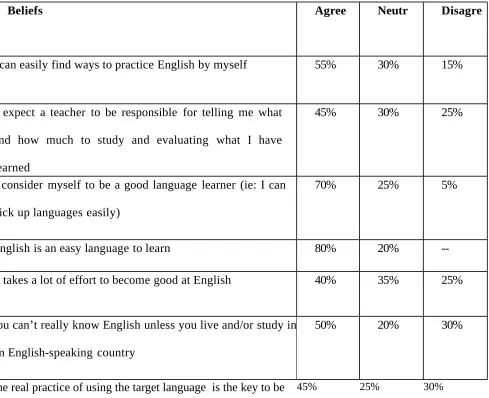
Table 1: Beliefs
Beliefs Agree Neutr Disagre
I can easily find ways to practice English by myself 55% 30% 15%
I expect a teacher to be responsible for telling me what
and how much to study and evaluating what I have
learned
45% 30% 25%
I consider myself to be a good language learner (ie: I can
pick up languages easily)
70% 25% 5%
English is an easy language to learn 80% 20%
It takes a lot of effort to become good at English 40% 35% 25%
You can’t really know English unless you live and/or study in
an English-speaking country
50% 20% 30%
The real practice of using the target language is the key to be
professional
Most respondents (80%) agreed that English was an easy language to learn, and
two -thirds considered themselves to be good language learners. Over half (55%)
stated they could easily find ways to practise English by themselves, while just
under half (45%) agreed they expected a teacher to be responsible for telling me
what and how much to study and evaluating how much I have learned. Fifty
percent agreed that you can’t really know English unless you live and/or study in
an English -speaking country, but 30% disagreed with this statement. Concerning
the effort required to learn English, 40% thought it took a lot of effort to become
good at English, while 35% were uncommitted and 25% disagreed. 45% agreed
that the key of mastering English is through practising it where as 30%disagrred. It is
impossible to make any generalizations about the beliefs, other than that, in this
group as a whole, there seems to be a general agreement that English is an easy
language to learn. However there is less agreement about the amount of effort
required to learn it, or the need to live in an English-speaking country to know
English.
The second part of the questionnaire investigates about the ways that
students do to improve their English when they finished the required courses. It
also inquires about some of the some aspects in English and Arabic if they think
that they effect on their learning of English.
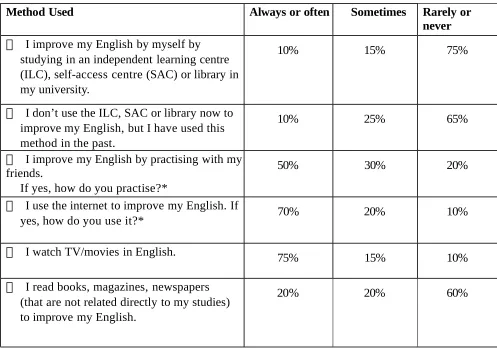
This part starts with the inquiry about the ways that the students used to
said that they do not use the self access center or library to improve their English
in the present whereas the rest said that they always and sometimes used them for
improving their English (10% always, 15% sometimes). In the second statement
of the inquiry about managing English was about the usage of ILC or SAC in the
past, the result more or tests the same. More than the half of the respondents
(65%) said that they never used it while the rest said that the used them to
improve their English.
The majority of the participants said that they use internet to improve their
English and watching Tv and movies in English as well. 50% used internet to
practise English with their friends also they said that they used English among
their friends in the classes of English. On the other hand, the majority of the
participants do not read magazines and newspaper in English, about 60% while
the 20% percent said that they sometimes read books to improve their English,
Table 2 : Method used to learn English
Method Used Always or often Sometimes Rarely or never I improve my English by myself by
studying in an independent learning centre (ILC), self-access centre (SAC) or library in my university.
10% 15% 75%
I don’t use the ILC, SAC or library now to improve my English, but I have used this method in the past. (that are not related directly to my studies) to improve my English.
20% 20% 60%
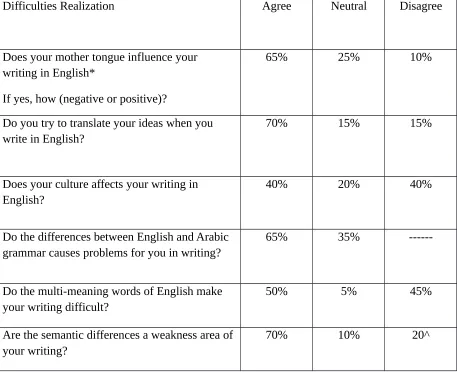
65% of the participants agreed that their mother tongue always influence
their writing especially the grammatical differences. Moreover, the majority of
them agreed that they always or sometimes translate their ideas from the mother
tongue into English. Just 15% who said that they don’t translate their ideas. The
participants added that the influence of the mother tongue is negative because of
because he said that it is easier to learn the language when you compare it to your
mother tongue.
70% of the respondents consider semantics is a weakness area of their
learning and about half said that they have a problem n dealing with the
multi-meaning words.
Table 3 : Difficulties Realization
Difficulties Realization Agree Neutral Disagree
Does your mother tongue influence your writing in English*
If yes, how (negative or positive)?
65% 25% 10%
Do you try to translate your ideas when you write in English?
70% 15% 15%
Does your culture affects your writing in English?
40% 20% 40%
Do the differences between English and Arabic grammar causes problems for you in writing?
65% 35%
---Do the multi-meaning words of English make your writing difficult?
50% 5% 45%
Are the semantic differences a weakness area of your writing?
The various usage of preposition is confusing me.
55% 10% 35%
In the next part of the realization of writing competence, the participants
were asked to answer wit yes or no , either they have some difficulties in writing
tasks or not. the first statement was inquiring about whether the participants have
problem in spelling or not. Most of the participants who said yes that they have
problem said that the reason behind that is the differences between the way a
word is pronounced and the way it is written. Unlike the Arabic system of writing
which is the same as a word is pronounced, it is written. They also gave the same
reason when they were asked about the subject and verb agreement and the
capitalization. The majority said that it is not found in Arabic, so they face
problem in understanding it.
More than half of the participants said that they can not use appropriate
words as well as they face a problem in the sentence order. The reasons behind
those two problems are:
The multi-meaning of the English words The lack of vocabulary
The mother tongue influence
The majority of the respondents have problem in the English tenses
their teachers did not give them more attention. Some others said that the perfect
tenses are not available in their mother tongue (Arabic), so they do not know the
usage of these tenses. Moreover, they said that the irregular verbs confuse them
as a verb is changed according to the tense it is used with.
4.2. The Second Instrument
To answer the research questions, a proficiency test composing of two
parts. The first part is made of multiple choice questions and tests six categories.
55 multiple choice questions and the capitalization question has been designed
and administered by the researcher to test the subjects’ ability to understand and
use the below mentioned categories correctly. In addition to this, the second part of
the test asks the respondents to write a paragraph about some topics. In this part the
respondents are asked for free writing and guided writing as well.
4.2.1 English Language Writing Test
The first part of the proficiency test includes the following items:
Spelling (10 questions)
Singular and plural (10 questions) Tenses (10 questions)
Prepositions (20 questions) Punctuation (5 questions)
Capitalization (applying on a paragraph)
addition to some other categories like the choosing of the appropriate words,
irrelevant information, subject verb agreement, etc.
4.2.2 Results and Discussion
20 students who learn English as a foreign language, who study in
Diponegoro University in different study programs were chosen as the subjects for
this study. They were asked to write about three different topics and answer a
writing test. The written data were analyzed by the researcher in terms of
identifying and classifying of the grammatical errors which were found in spelling,
singular and plural, tenses, prepositions, articles, active and passive voice, verbs,
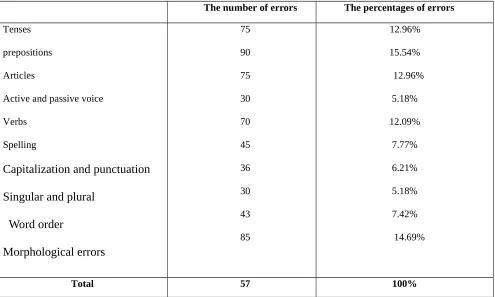
word order, capitalization and punctuation, and morphological errors. A total of 345
grammatical errors were found.
As stated above, they were classified into 10 major linguistic categories.
Table I is given in order to show the number and percentages of these errors as
Table 4 : The number and percentages of errors
4.2.3 A Detailed Classification of Errors
The errors, which are stated above into grammatical categories, were
classified in a more detailed way. The errors committed in the compositions of
the students will be presented as follows:
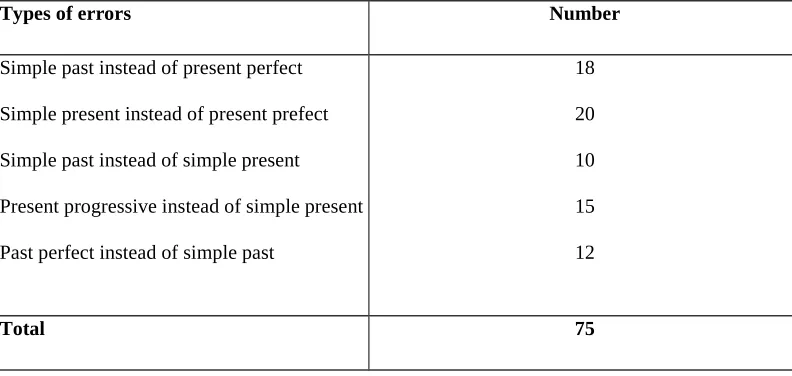
A. Tenses
The number of errors in tenses is 75 which comprises 7.2% of the total
errors. These errors are divided into sub-categories as stated in the table below:
Table 5 : Errors of tenses
categories employed in this study. This minority of the errors in this category is
due to the students who do not use various types of tenses in their writing.
Another reason for the minority of the errors in this category is the certain rules
about the usage of tenses and the subjects do not make so many errors because
they have learnt these rules. Some of these errors are below:
2. I never s e e like this kind of cigarette. (simple present instead of present
perfect)
A possible reason for such errors may be the lack of equivalent of present
perfect tense in Arabic. Accordingly, the subjects tend to translate literally from
Arabic and use simple past or simple present which are the nearest equivalent of
the present perfect. Unlike English, the particle /qad/ plus the perfect verb like
/gadara/" left" is used to render the perfect tense in Arabic as follows:
/Laqad gadara abi ila london/
This is equivalent to perfect tense in English: My father has left to London.
The subjects of the study also tend to substitute the simple past for the
simple present as follows:
3. I hoped that all of us give up smoking
Such errors may be due to interference because, unlike Arabic, English requires a sequence of tenses but Arabic is not as the following example: /qala 'inna-hu
sayu gadiru gaden
He said that he would leave the next day
It is noticed from the example stated above that the verb /qaala/ is in the
past tense but the main verb /sayu gadiru/ is in the future tense.
Another example is the use of present continuous instead of simple present as
follows:
4. I am und er s t a nd i n g why smoking is harmful.
Such example may be due to wrong overgeneralization. Some English
overgeneralize wrongly the progressive to all types of verbs.
In another sentence, the subject uses wrongly past perfect tense instead of the
simple past:
5. He h a d g i v e n up smoking last year.
B. Prepositions
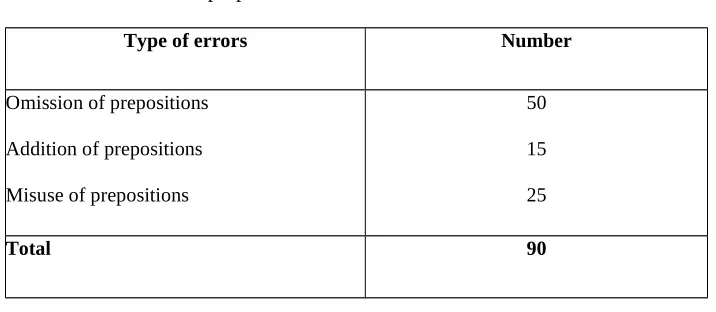
This category constitutes the most problematic area for the subjects.
Most of the subjects omitted or misused some prepositions. This category is the
one that includes number of errors which are 90 in total. They are summarized
as follows.
Table 6 : Errors of prepositions
Type of errors Number
Omission of prepositions
Addition of prepositions
Misuse of prepositions
50
15
25
Total 90
Prepositions express a relation between two entities. English prepositions
have different functions, so it is not easy for Arab learners to learn to use
prepositions correctly. As it is seen in table
3, the most common errors in this category is omission of prepositions. Some
examples of this category are as follows: