99 | Jurnal Integrasi | 2012 Vol. 4(1) 102-106 | ISSN: 2085-3858
HEDGING IN THE BOOK OF PROVERBS OF THE HOLY BIBLE
Erikson Togatorop Batam Polytechnics
Electrical Engineering study Program
Parkway Street, Batam Centre, Batam 29461, Indonesia
E-mail: [email protected]
ABSTRACT:
For some reasons and purpose, being realized or not, almost all writers use hedging in their writing. Hedging is widely used not only in secular
but also in spiritual writing. This study is intended to investigate the use of hedging in one of the Holy Bible books, that’s the Book of Proverbs, which
was believed written by King Solomon, the wisest king of Israel in about in about 970-930 BC. Using a qualitative method, the study found there are
eight types of hedges occurred in the Book. From the most to the least frequent, they are: modal auxiliary 85 times (62.50%), agentless passive 33 times
(24.26%), full verbs 7 times (5.15%), conditional sentences 3 times (2.21%), adjective twice (1.47%), noun and passive infinitives each once (0.74%).
Keywords: hedging, Book of Proverbs, Holy Bible 1 Introduction
The Book of Proverb seeks for the purpose of the human life.
The writer of the Books tried to use his wisdom to understand the riddle
and the uselessness of the life. He then shared his wisdom trough the
book and persuaded his reader to live in fear of God. Thus instead of
structuring information in straightforward manner, the writer of the
Book of Proverbs often engage in processes of negotiation and
persuasion. Hillyer mentioned that the Proverbs advises to live in fear
and respect of God and to realize that finally everybody should give the
responsibility unto Him [6].
In accordance with these processes (negotiation and persuasion),
in context where the writer of the Books of Proverbs tried to present
another view of the life which is difficult to be understood by the human
logic, King Salomon may wish to formulate his statement cautiously,
adhering to the central virtues of humility, and caution. For instance in
some verses of the Books, it seems that King Salomon did not want to
say that something is the case, but instead he said that something is possibly the case, or that it might be the case. In chapter 3 versus 18 (3:18)
of the Book, for example, instead of saying “that God manifest the sons
of men”, King Solomon wrote “that God mightmanifest them”
There have been many widely study on the use of hedging in
secular, but is very limited on the spiritual writing. The result of the
latest studies on hedging, for instance, have indicated that the student of
S1 and S2 program used a wide range of hedging in their thesis related to
their awareness of linguistic features that they used [1]. Considering the
magnitude of these findings, it is necessary to do a further research on
the other genre of religious writing, to find out what kinds of hedging
and how they are used in such kind of genre.
The logic of this study is based on functional approach to
language as proposed by Searle [2] and Levinson [7], that is, the choices
of the words, metaphors, and grammatical structures.
2 Formulation of the Problem
Based on what has been described above, the research questions
are formulated as follows:
1. Are there any hedges in the Books of Proverbs?
2. If any, what types of hedging are they?
3 Methodology
The study is descriptive and qualitative in nature since this
study does not use statistical calculation to measure the validity or
reliability. Qualitative study in nature is conducted inductively, meaning
that the study begins from data collected from the field and analyzed [3].
Descriptive method, because this method characterized by attempting to
describe characteristics and events that exist [5].
Since the purpose of the study is to find out the use of hedging
in a religious writing genre, then the object of the study investigation is
the Book of Proverbs of the Holy Bible. The reason for choosing the
Holy Bible because it is one of the popular religious writings which is
widely read by Christians. The Book of Proverbs was chosen because it
contain many wise advises from the King Salomon.
To analyze the hedging used in the Book of the Proverb of the
Holy Bible, I took the steps below:
1. I identified hedges words, phrases, and clauses based on indicators provided by Hyland [4].
Article History
Received 13 February 2012
Accepted 16 March 2012
Jurnal Integrasi
100 | Jurnal Integrasi | 2012 Vol. 4(1) 102-106 | ISSN: 2085-3858
2. I sought to classify the hedged words in terms of theirgrammatical forms given by Hyland [4].
3. Those hedges units were put into tables to show how they are
distributed in percentages. By calculating their frequency of
hedges, it would be easy to look at the tendencies of the
subjects in using hedging.
4. I interpreted the data in relation to the subjects’ proficiency in using hedging; there are certain types of hedging which are
more complex than others.
4 Related Literature Review
The words ‘hedge’ and ‘hedging’ can be broadly defined as
referring to a barrier, limit, defense or an act or means of protection of
defense. In a linguistic context, hedging may then be interpreted as a
feature that attempts to statements or linguistic feature that speakers or
writers use to protect their statement.
In the narrowest definition, ‘hedges’ is equated with ‘the expression of tentativeness and possibility’ [4]. Therefore, the most
commonly accepted, types of realization for ‘hedge’ are those that select an epistemic modality structure, e.g., ‘a possible interpretation of this finding may be that…’
The idea of hedged performatives, as it were, became one of
widening the concept of hedges. Levinson considered the effect that
modal and semi-modals have on the illocutionary acts of utterances
denoted by a performative verb in performative sentences such as I must
advise you to remain quiet. The modal must used in the sentence gets the
speaker off the hook, relieving him or her from some kind of
responsibility [7].
The concept of hedged performative has widened in another
way when hedges were taken to be modified of speaker’s commitment to
the truth-value of whole proposition, not just the category membership
of a part of it. Thus, for example, Searle in his categorization of
metadiscourse types considers the use of hedges as showing a lack of
full commitment to the propositional content of an utterance [2]. In other
words, hedges (e.g. perhaps, seem, might, to a certain extent) are seen as
modifying the truth-value of the whole proposition, making statement
less precise.
As motivation for using of hedges, much of the discussion
has concentrated on their use in spoken discourse, and the most
frequently mentioned motivating factor is politeness, as defined by
Levinson [7]. In their view, hedges are primarily used for negative
politeness in face-saving, in which they are put to elaborate use.
Types of Structure that Represent Hedging
Hedged
1. He may be ill
2. He must be a friend of hers 3. He will have finished by now Unhedged
1. He is ill
2. He is a friend of hers 3. He has finished by now
Types of Hedged Statements
1.Modal Auxiliaries (may or might, can or could, shall or
should, will or would, ought to, and must).
Example; Smoking may or might cause cancer.
2.Epistemic Nouns (possibility, probability, a supposition,
hypothesis, assumption, conjecture).
Example; There is a (strong or slight or
remote) possibility or probability that smoking causes
cancer.
3.Verbs
Epistemic Lexical Verbs (suggest, appear,
indicate, predict, believe, conclude, assume,
propose, seem)
Epistemic Judgment Verbs (feel, think, reckon,
guess, estimate, tend, speculate, suspect,
calculate, imply)
Epistemic Evidential Verbs (note, report,
deduce, show, attempt, seek)
Example; It seems unnecessary to discuss a new
model here.
4.Conditional Sentences (if Clause)
Example; Smoking leads to cancer, if certain other
variables are present.
5.Epistemic Adverbs
Adjunct/Downtoners: “lowing effect on the force of the modified verbs”
Disjuncts: “eventually the PS II pool would become
virtuallydepleted…”
6.Epistemic Adjectives [(un)likely, possible, apparent,
probable, approximate, consistent (with), similar,
significant].
7.Passive Infinitives
Example; it is to be hoped…
Summarizing these figures, It can be stated that…
101 | Jurnal Integrasi | 2012 Vol. 4(1) 102-106 | ISSN: 2085-3858
Example; Selection error must be regarded as a defect.An Overview of the Book of Proverbs
The Book of Proverbs is the twentieth book from the 39 books
on Old Testament (OT) in the Holy Bible. Christian theologians believe
it was written by Solomon, the third king and wisest of Israel kingdom,
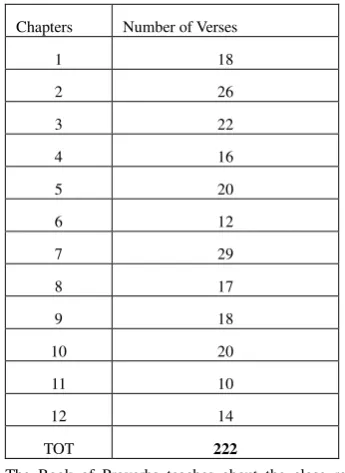
in about 970-930 BC. Proverbs consists of 12 chapters and 222 verses.
Each chapter has different number of verses. The table below shows
them:
Chapters Number of Verses
1 18
2 26
3 22
4 16
5 20
6 12
7 29
8 17
9 18
10 20
11 10
12 14
TOT 222
The Book of Proverbs teaches about the close relationship
between religion and everyday life. While the general tone of the book is
dominantly rational, the importance of reverencing and trusting the Lord
is stressed throughout the book. This “fear ofthe Lord” is one of the
main definitions of religion in the Old Testament. Far from there being
an unbridgeable gap between religion and the secular world, Proverbs
shows the result, in noble character and harmonious, happy homes,
when the whole of life is brought under God’s control. A danger exists
when the moral elements are taken in isolation from the religious
foundation which is assumed throughout. Then the pursuit for happiness
or success can become selfish, inward looking, and ultimately
self-defeating.
Proverbs belongs to a literature works. It contains sharp
practical application of wisdom covering many facets of life. At the time
the Proverbs was written, wisdom was originally connected with skills,
manual as well as intellectual, and it was considered to be the gift of the
God. There are about ten themes found in the Book of Proverbs, they
are: the reward to the righteous and the end of the ungodly (10:2,
11:3-9), the fool, the simple, the lazy which is often contrasted with the
industrious (10:4-5), wisdom (13:13-14), justice (17:8,23),
neighborliness (19:4,6,7), riches and poverty (21:6, 22:14), and family
life (12:4, 19:14).
The Book of Proverbs is composed of many distinct lessons on
wisdom, most of which are introduced by “my son” or something
similar. Some of the lessons are: Solomon’s invitation to avoid evil
companions in chapter 1: versus 8-33 (1:8-33), the rewards of wisdom
(2:1-22), the necessity for discipline (3:11-20, 5:1-23), the perils of
sexual prostitution and the wisdom of faithfulness within the marriage
relationship (5:1-23).
King Salomon used some epigrammatic expression of some
aspects of practical wisdom by examples, warnings or precepts, advices,
invitations [8]. In giving those (examples, warnings or precepts,
advices, invitations), King Solomon tried to teach wisely, humbly,
politely and cautiously. Then, he realized or not, he used hedges. To teach that “two are better than alone”, King Solomon wrote “If two lie
together, then they have heat: but how can one be warm alone?” (4:11).
To stress on the greatness of wisdom, he said “This wisdom have I seen
also under the sun, and it seemed great unto me” (9:13).
5 Finding and Discussion
The result of my study shows that there are eight types of
hedges were found in the Book of the Proverb of the Holy Bible. The
table below shows them:
Types of Hedges Example Chapt
er:Ver se 1 Modal
Auxiliary a.
All things are full of labour; man cannot utter it
b. It is that which shall
be… that which shall be
done
c. I will prove thee with mirth.
d. He may carry away in his hand
1:8
1:9
2:1
5:15
2 Full Verbs a. And I gave my heart to seek and search out by wisdom
b. Whoso keepeth the commandment shall feel no evil thing
c. it seemed great unto me 1:13
8:5
9:13 3 Adverbs a. turneth about unto the
north; it whirleth about continually
b. the mourners go about the streets
c. yet surely I know that it shall be well with them that fear God
1:6
12:5
8:12
4 Adjectives a. There is an evil which I have seen under the sun, and it is common among men.
b. There was a little city, and few men within it
6:1
9:14
5 Nous a. Who knoweth the interpretation of a thing?
102 | Jurnal Integrasi | 2012 Vol. 4(1) 102-106 | ISSN: 2085-3858
6 ConditionalSentences
a. For if they fall, the one will lift up his fellow b. if two lie together, then
they have heat: but how can one be warm alone? c. And if one prevail
against him, two shall withstand him shall be changed c. the doors shall be shut
Meanwhile, the most frequent types of hedges from the most
to the least frequent are shown in the following table:
Types of Hedges Number Percentage
1 Modal Auxiliary 85 62.50 %
From the table, it can be observed that the highest frequency
of hedging types in the Book of Proverb is modal auxiliary (62.50%),
followed by agentless passive (24.26%), while the lowest frequency are
noun and passive infinitives (each 0.74%).
Subtypes of Hedges in the Book of Proverb
Modal Auxiliaries Modal Auxiliaries
The Clauses Chapter:
Verse a. Will 1. I will prove thee with
mirth.
2. For if they fall, the one will lift up his fellow. 3. Better is a poor and a wise
child than an old and foolish king, who will no more be admonished. 4. but the abundance of the
rich will not suffer him to sleep.
5. for that is the end of all men; and the living will lay it to his heart. 6. I said, I will be wise 7. Surely the serpent will
bite without enchantment; and a babbler is no better.
8. The words of a wise man’s
mouth are gracious; but the lips of a fool will swallow up himself. 9. for all these things God
will bring thee into judgment. that which shall be done
1:9
2 neither shall there be any remembrance of things… that shall come after 3 the days to come shall all 6 therein shall he leave it 7 it shall be for ever 8 God shall judge the
righteous
9 who shall bring him to see what shall be after him? 10 who shall bring him to see
what shall be after him? 11 the second child that shall
stand up in his stead 12 they also that come after
shall not rejoice in him 13 He that loveth silver shall
not be satisfied with silver 14 naked shall he return to go as he came, and shall take nothing of his labour 15 so shall he go 16 For he shall not much
remember the days of his life
17 and his name shall be covered with darkness 18 man what shall be after
him under the sun? 19 God shall come forth of
them all
20 God shall escape from her; but the sinner shall be taken by her
21 Whoso keepeth the commandment shall feel no evil thing
22 For he knoweth not that which shall be: for who can tell him when it shall be?
23 neither shall wickedness deliver those
24 it shall be well with them that fear God
25 it shall not be well with the wicked, neither shall he prolong his days 26 that shall abide with him
of his labour
27 he shall not find it… God shall bring every work into judgment 28 For the living know that
they shall die
29 He that diggeth a pit shall fall into it; … a serpent shall bite him 30 Whoso removeth stones
shall be hurt therewith; and he that cleaveth wood shall be endangered thereby.
31 a man cannot tell what shall be; and what shall be after him
103 | Jurnal Integrasi | 2012 Vol. 4(1) 102-106 | ISSN: 2085-3858
33 thou knowest not whatevil shall be upon the earth 34 there it shall be
35 the clouds shall not reap 36 thou knowest not whether
shall prosper, … or whether they both shall be alike good
37 for they shall be many 38 the keepers of the house
shall tremble, and the strong men shall bow themselves
39 the doors shall be shut in the streets, … and he shall rise up at the voice of the bird, and all the daughters of music shall be brought low
40 Also when they shall be afraid of that which is high, and fears shall be in the way, and the almond tree shall flourish, and the grasshopper shall be a burden, and desire shall fail
41 Then shall the dust return to the earth as it was: and the spirit shall return unto God who gave it 42 God shall bring every
work into judgment
10:8
labour; man cannot utter it 2. That which is crooked
cannot be made straight: and that which is wanting cannot be numbered 3. for what can the man do
that cometh after the king? 4. For who can eat, or who
else can hasten hereunto, more than I?
5. so that no man can find out the work that God maketh from the beginning to the end. 6. nothing can be put to it shall be after him under the sun?
9. Consider the work of God: for who can make that straight
10. That which is far off, and exceeding deep, who can find it out?
11. for who can tell him when it shall be?
12. a man cannot find out the work that is done under the sun
13. A fool also is full of words: a man cannot tell what shall be; and what shall be after him, who can tell him? that is good before God. This also is vanity and vexation of spirit. 3. he may carry away in his
hand
4. neither may he contend with him that is mightier than he men, which they should do under the heaven all the days of their life 2. I should leave it unto the
man that shall be after me 3. There is nothing better for a man, than that he should eat and drink, and that he should make his soul enjoy good in his labour 4. And also that every man
should eat and drink 5. Wherefore I perceive that
there is nothing better, that a man should rejoice in his own works
6. Better is it that thou shouldest not vow, than that thou shouldest vow and not pay.
7. wherefore should God be angry at thy voice 8. to the end that man should
find nothing after him 9. why shouldest thou
destroy thyself? 10. why shouldest thou die
before thy time? 11. It is good that thou
shouldest take hold of this
104 | Jurnal Integrasi | 2012 Vol. 4(1) 102-106 | ISSN: 2085-3858
2. that God might manifest them and that they might see that they themselves are beasts.
3. neither may he contend with him that is mightier than he.
4. Whatsoever thy hand findeth to do, do it with
Having calculated the number of modal auxiliaries used as
hedging in the Book of Proverbs, I could present them in the table
below:
Modal Auxiliaries Percentage
1 Shall 49.41 %
Full Verbs Example Chapter:
Verse feel no evil thing 2. a wise man think to seek and search out by wisdom
2. I applied mine heart to know, and to search, and to seek out wisdom 3. Which yet my soul
seeketh, but I find not 4. a man labour to seek it
The percentage of those three kinds of full verbs can be seen
clearly in the table below:
Full Verbs Percentage
1 Epistemic Evidential Verbs 57.14 %
2 Epistemic Judgment Verbs 28.57 %
3 Epistemic Lexical Verbs 14.29 %
T O T A L 100%
Among the three kinds of the full verbs appeared in the Book
of Proverbs, the Epistemic Evidential Verbs (seek) got the highest
frequency (57.14%), Epistemic Judgment Verbs (fell and think) got
28.57%, while the Epistemic Lexical Verbs (seem) only 14.29 %.
Adverbs
Adverbs Example Chapter:
Verse unto the north; it whirleth about continually 2. the mourners go
about the streets 3. yet surely I
know that it shall be well with them that fear God heart knoweth that thou thyself likewise hast cursed others
7:22 25%
The writer of the Book of Proverbs, King Solomon, did not
use many adverbs to hedge. He only used four adverbs for hedging;
approximate adverb 3 times (75%), those are: about (twice) and surely.
The rest is adverb of indefinite frequency, that is oftentimes (25%).
Adjectives
Adjectives Example Chapter:
Verse
Book of Proverbs. That is Adjective of Indefinite Frequency, which uses
common, little and few. Each appears once (33.33%)
Noun
Noun Example Chapter:
105 | Jurnal Integrasi | 2012 Vol. 4(1) 102-106 | ISSN: 2085-3858
interpretation of a thing?
King Solomon only once used noun for hedging, that is
interpretation which belongs to epistemic nouns.
Conditional Sentences they have heat: but how can one
The conditional appeared three times in hedging in the Book
of Proverbs. Those three belong to open conditional which combine if….will…., if…can… and if…shall... Each appears once (33.33%).
Agentless Passive
Passives Example Chapter:
Verse done under the sun 3. crooked cannot be made
straight: and that which is wanting cannot be numbered
4. which hath been already done
5. in the days to come shall all be forgotten 6. A time to be born 7. nothing can be put to it,
nor any thing taken from it:
8. the oppressions that are done under the sun: and behold the tears of such as were oppressed 9. who will no more be covered with darkness 13. which is done is that
which shall be done 14. which hath been is
named already 15. the boldness of his face
shall be changed 16. all words that are spoken 17. neither shall wickedness deliver those that are
18. they were forgotten 19. the heart of the sons of
men is fully set in them to do evil
20. his days be prolonged 21. all things that are done snared in an evil time 23. and his words are not
heard
24. The words of wise men are heard
25. Whoso removeth stones shall be hurt therewith; and he that cleaveth wood shall be endangered thereby 26. If the iron be blunt 27. the stars, be not darkened 28. the windows be broken, or the pitcher be broken
31. which was written was upright
32. nails fastened by the masters of assemblies, which are given from
from the first until to the twelfth chapter.
Passive Infinitives
Passives Example Chapter:
Verse
The hedging using passive infinitives only happens once in
106 | Jurnal Integrasi | 2012 Vol. 4(1) 102-106 | ISSN: 2085-3858
6 ConclusionBased on the research findings, the study comes to conclude
that hedges occurred in the Book of Proverbs of the Holy Bible. From
the 222 verses of the book, there are 136 hedges which occurred in many
verses in the whole 12 chapters of the book.
The study also found that there are eight types of hedges were
found in the Book of the Proverb of the Holy Bible. From the most to the
least frequent, they are: modal auxiliary 85 times (62.50%), agentless
passive 33 times (24.26%), full verbs 7 times (5.15%), conditional
sentences 3 times (2.21%), adjective twice (1.47%), noun and passive
infinitives each once (0.74%).
References
[1]
Faridah Hidayati,. 2006. The Use of Hedging in Academic Writing. Bandung: UPI library (unpublished thesis)[2]
John R. Searle, 1984. Speech Acts: A Essay in the Philosophy of Language. New York: The Press Syndicate of the University of Cambridge.[3]
John W. Cresswell, Research Desining: Qualitative & Quantitative Approache,. SAGE Publications, London, 1984.[4]
K. Hyland 1996. Hedging in Scientific Research. Amsterdam: John Benjamins.[5]
Michael L Kamil,., et al. 1985. Understanding Research in Reading and Writing. Toronto: Allyn and Bacon Inc.[6]
N. Hillyer. 1996. The New Bible Dictionary. Leicester: Inter-Varsity Press.[7]
Stephen Levinson, C.1985. Pragmatics. Cambridge Textbooks in Linguistics.[8]
Walter Elwell, 1997. Encyclopedia of the Bible. Michigan: Baker Book House Company.Biographies