45
USING JEOPARDY STRATEGY TO I MPROVE THE FIRST SEMESTER
STUDENTS` VOCABULARY AT PIKI H PROGRAM OF UI N ALAUDDIN
MAKASSAR 2014/ 2015
Muhammad Yahr if, S.Pd.I.,M.Pd STKIP MEGA REZKY MAKASSAR
ABSTRACT
The obj ective of this r esear ch w as to find out whether or not the use of Jeopar dy Str ategy can i mpr ove the students` vocabulary at the fir st semester of PIKIH Pr ogr am of UIN Al auddin Makassar 2014/ 2015. This resear ch employed quasi exper i ment al method w ith tw o gr oups pr e-test and post-test desi gn. Ther e w er e t wo var iables; they w er e i ndependent var iable (the use of Jeopar dy Str at egy in teaching vocabular y) and dependent var iable (the students` vocabular y). The populati on of this r esear ch was the st udents of PIKIH Pr ogr am of UIN Alauddin Makassar 2014/ 2015 w hich consisted of 1670 students of 67 gr oups. The sample of the r esear ch consisted of two groups by using pur posive sampling technique. The r esear cher took the for ty-tw o gr oup as experi ment al class and the thir ty-nine gr oup as control class. The instr ument of thi s r esear ch w as a w r itten vocabular y test used in pr e-test and post-test. The r esul t of the data indicated that ther e w as a si gnificant differ ence bet ween students’ post-test in exper imental class and contr olled class. The mean score of post-test (74.29) in exper imental class w as gr eater than the mean scor e of post-test (59.96) in contr olled class. From t-test, the r esear cher found that the value of t-test (4.44) w as gr eat er than t-table (2.00) at the level of signifi cance 0.05 w ith degree of fr eedom (df) = 46. Based on the finding and discussion of the r esear ch, the r esear cher dr ew a conclusion that the use of Jeopar dy Str ategy can i mpr ove the students` vocabular y at the fir st semester of PIKIH Pr ogr am of UIN Alauddin Makassar 2014/ 2015.
Key Words: Jeopar dy Str ategy, Vocabular y Ski ll.
Intr oduction
46
w hen speaking, reading, w r iting, and listening so that vocabular y is one of the components of language that should be ow ned in the l anguage lear ni ng i ncludi ng in lear ni ng Engl ish.The students who have a lot of vocabular y w ill be easy in doing communication to expr ess ideas and feeli ng.
Ther efor e, vocabulary is ver y important i n effective communicati on.Ther e ar e a lot of vocabulary pr oblems in teaching and l earning pr ocess. The factor s can be caused by the i ndividualized teacher , by the method that is used, by the less motivation and inter est of the students in lear ning Engli sh, or per haps the students have difficulties in masteri ng vocabular y. The teachers need good mat eri als and w ell prepar ation to solve these problems. They should pr ovi de some new alter native w ays or str ategies to stimulate the students to impr ove their ow n vocabular y. One of the alter native teaching w ays to impr ove the students` vocabul ar y is fun str ategy. When lear ning i s fun, the students can r emember w hat they have learned. Based on this ar gument, the r esear cher conducted a resear ch under the title ”Using Jeopardy St r at egy t o Impr ove t he Fi rst Semest er St udent s` Vocabular y at PIKIH Pr ogram of UIN Alauddin Makassar 2014/ 2015”.
Liter atur e Review
The i mpor tance of vocabulary has made many language teacher s and r esear ch explorer s expose l anguage teaching and lear ning pr ocess by implementing var ious teachi ng techniques. Some of the r esear cher s r elated to the topic descri bed in this r esear ch: Aspi na (2009) stated that in teaching and lear ning vocabul ar y pr ocess by using Wor d Attacks Progr am, the teacher catches the pupils` attention and involves the students in lear ni ng process actively. Nevertheless, in this game there ar e too many words randomized w hich can make the students feel confused and bor ed quickly. Munawir (2010) conducted a r esear ch in impr oving students` vocabul ar y through whisperi ng game at the second year of SMP Neger i 3 Kahu. He found that whisper ing game make the students easy to memor i ze and underst and vocabular y, they can w r ite and pr onounce it w el l, and each of them par ticipates in teachi ng and l earning pr ocess. The w eakness of this game is the teacher gives a long sentence to the students w ith a complicated pr onunciation w hich can make the students ar e not focus to the meaning of the words. Ahmad i n Aspi na (2009) in his research The Teaching of Vocabular y Achievement of the SMA and non SMA of Tadri s Inggr is of Tar biyah of IAIN ALauddin Makassar poi nted out some factor s i nfluencing students` achievement i n mast eri ng vocabular y, they ar e the major ity of the students get less i nter ested in lear ning vocabulary, uninter esting str ategies of pr esent ation and ineffective w ay of teaching vocabul ar y. This resear ch only show s the factors but ther e is not a strategy proposed. Fuhuei Tseng (2008; Online) r epor ted that the r epetiti ons of the w or ds in the four textbook ser ies are found to be extr emely inadequate for effi cient vocabul ar y lear ning. Meanw hi le, over half of the w or ds occur r ed only once in the textbooks, w hich make it mor e difficult for beginning lear ner s to master . Bahar uddin (2009) said that the teachers catch the students’ attention and involve them in lear ning acti vely by cr eating good atmospher e var ieties of techniques in teaching English, par ticularl y in teaching vocabulary by usi ng Bookwor m Game. Nonetheless, the students should have backgr ound know ledge about the w or ds because this game is how to fi nd a w ord that is know n.
47 The Concepts of Vocabular y
Vocabulary is as fundamental requir ement that influences students` achievement in studying English. Without vocabular y ther e is not communication, reading, and w r iting can be conveyed. So that, it is impor tant to know w hat the vocabul ar y is. As follows the definitions or concepts of vocabular y by some exper ts: Accor ding to Read (2000: 1) the w or ds ar e basic building blocks of language, the units of meaning fr om w hi ch lar ger str uctur es such as sentences, paragr aphs and w hole text ar e for med. In Addition, Thomas Pyles and John Algeo (1970: 96) said that the vocabular y is the focus of language. It is in w or ds that sound and meaning inter lock to allow us to communi cate with one another , and i t is w or ds that w e ar r ange together to make sentences, conver sations, and discour se of all kinds. And Ur in Fari da (2004) stated that w ords must be shor ted into differ ent par ts of speech or some si milar gr oups w hich separ ate the type of w or d with lar ge r eserve vocabular y fr om those w ith small r eser ve. Ther efor e, vocabular y is a meaningful wor d of l anguage not only in speaki ng and w ri ting, but al so i n l isteni ng and r eading. Oxfor ddictionar ies.com (2010; online) defines vocabular y as: Vocabular y is a par t of such a body of w or ds used in a parti cular occasion or in a parti cular spher e. Vocabulary is the body of w or ds know n to an indivi dual per son. Vocabular y i s a li st of difficult or unfamiliar w or ds with an explanation of their meanings, accompanying a piece of speci alist or for ei gn-l anguage text. Gove in Munaw ir (2010) commented out that vocabugn-l ar y i s a gn-list of words and someti mes phr ases, usually ar r anged i n alphabetical or der and defined as a dicti onar y, glossar y or lexi con. All of the wor ds ar e used by a par ticul ar per son, class, pr ofessi on, etc. Someti mes all of the w ords r ecognized and under stood by a parti cular although not necessar il y used by him. Based on the definiti on above, the r esear cher concludes that vocabular y is a total number of words and phrases of language used in r eading, speaking, l istening, and wr iting by a per son or gr oup and it can make up a language.
Types of Vocabular y
Wor ds and phr ases ar e small element s but can make up a language and functi on to expr ess i deas. It is impor tant to know types of vocabulary. Har mer (1991:159) divided vocabular y into tw o types, active and passive vocabular y. Active vocabular y r efer s to vocabular y that students have lear ned, they ar e expected to be able to be used by the students and passive vocabulary r efer s to w or ds, w hi ch the students wi ll r ecogni ze when they meet them but they w ill probably not be able to pr oduce. Schail in Rosminar ty (2005) also classi fied vocabular y into three types as in follow ing:
1. Active vocabulary, the w or ds that w e use in speaking and w ri ting.
2. Reser ve vocabul ar y, the w or ds w e know but w e r ar ely used in ordinar y speech. We use them in w r iting a letter w hen w e have mor e ti me to consider or w e sear ching for a synonym.
3. Passive vocabular y, the words recogni ze vaguely, but ar e not sur e the meanings, never use them either speech or w ri ting, w e just know them because we have seen them befor e.
48
Mar ginal Vocabular y r efer s to the wor ds w hi ch could be interpreted from context and analysis of know ledge of w or d form (pr efix, suffixes, r oots) and other language. The mast ery of vocabulary is ver y impor tant. We use vocabular y in the for m of language to expr ess our feelings, i dea, etc. w hether is orally or in w r itten to other people. Talki ng about vocabular y, i t cannot be separ ated fr om four l anguage skill s: listeni ng, speaki ng, r eading, and w r iti ng. The pr oficiency of someone’s speaki ng is infl uenced by his/ her vocabular y. To clar ify that, l et us look at the impor tance of vocabular y r elating to the language ski lls. In l istening, vocabular y is used to understand someone’s speech or w hat someone says. It is ver y hard for us to catch w hat someone says if w e just know the constr uction of sent ence w ithout knowi ng the w or ds. In speaking, vocabular y is used to express our ideas or feelings to the other s or ally. The w or ds w e have influence how effective the communication r uns. In r eading, i t is used to compr ehend the r eadi ng mater ial . Reading w ithout vocabul ar y mast ery wil l cause di fficulties in compr ehending a t ext. The number of w or ds and the meaning of w or ds, which someone know s wil l affect hi s/ her r eading acti vity. It is i mpossible to understand passage unless he/ she knows the meaning of w or ds used in the passage. In w r iting, the w ri ter uses vocabular y (w or ds) to develop his/ her i dea. A w r iter should choose the w or ds clear ly and accur ately to express his/ her idea. Without knowi ng much vocabulary, w e cannot develop our w r it ing because w e ar e li mited on vocabul ar y mast eri ng. Gai rns and Redman in Baharuddi n (2009) concluded that by lear ni ng vocabular y the lear ner s can r ecogni ze and compr ehend the context of r eading and listeni ng mater ial , and later as pr oductively as the lear ner s can r ecall and use them appropr iately in speech and wr iting. In this case, the statement is noted by Legget in Bahar uddin (2009) that by vocabul ar y, the learner s can r ecogni ze all the w or ds in w r itten and oral context and fi nal ly they can use them daily in speaking and w r iting.
Techniques in Improving Vocabular y
49
below: The students look at sever al wor ds that ar e introduce i n the fir st year textbook, w or ds r epresenting nouns, verbs, and adjectives. Five and other kind of words such as preposi tion, conjunction, auxiliar y schools are emphasi zed i n si mpl e w or ds like name of animal s, fr uits, and act. In noun simple ver b that they ar e usually use in ever yday. Name of col or s, character i stic of persons, in adjectives and many other that ar e easy to be compr ehended by the students. Some classes for beginner , teacher use al l these ways to explain meaning of vocabular y w or ds. The ways her e ar e thr ough: pictur es, explai ning in the students’ ow n language, and descr ibing in simple English by using vocabulary that students alr eady know . This phase, si mpl e Engli sh is used to show the meaning of w or ds, mor e w or ds for ar ea of living w or ds r elated to food, clothi ng and so on. The val ue of seei ng a new word in a sent ence and the meaning in dictionar y i s also used to show the t eacher how to explai n `new ` w or ds by means of the English w or d the students ar e most likely to know .
Gai rns and Redman in Aspina (2009) suggested the foll ow ing types of vocabul ar y presentation techniques: Visual techni ques. These per tain to visual memor y w hich consi dered especi ally helpful wi th vocabular y retention. Lear ns r emember better the mater ial that has been pr esented by means of visual aids. Visual techniques lend themselves well to pr esenting well concr et e items of vocabular y nouns many ar e also helpful in conveying meaning of ver bs and adjectives. They hel p the students associate presented mat eri al of languages value. Verbal explanation. This per tai ns to the use of i llustr ative situation, synonym, opposites, scales, defi nition and categor i es, and use of dicti onar ies. Usi ng a dictionary is another technique of findi ng out meaning of unfamiliar w or ds and expr ession. Students can make use of a var iety of dictionar ies: monolingual, bilingual, pictor ial, thesauri, and the like. Basical ly, teaching and lear ning r elat ed to each other. Teaching involves teaching and lear ning in gener al, teaching and lear ning cannot be separ ated from w hat w e call inter section. Inter section can be achieved if the pr ocess of teachi ng and lear ning r un w ell. In teaching, teacher has a very impor tant r ole to cr eated good inter section. In thi s case the teacher wi ll have str ategy to motivate the lear ners to l earn. In lear ning, the lear ner is the main fact or to achieve the aim of teaching pr ocess. Ther e ar e nine pr inciples of teaching and lear ning vocabul ar y indicated by Wallace in Rosminar ty (2005), they are:
1. Aims, w e have to be clear about our ai ms in teaching vocabular y, how many of vocabular y l isted w e expect the lear ner s to be able to know? If it is not clear at this poi nt, it w ill be difficult to access how successful the vocabular y l earning has been attained.
2. Quantity, it is decided on the number of new w or ds that the students can lear n. The actual number wil l depend on a number of factors var ying fr om class and students. 3. Needs, to know or select the w ords that w ill be taught to the students, these based on
fr equency and usefulness on the var ious meaning of a word, students` backgr ound and language needs.
4. Fr equent expose and r epetition, ther e has to be a cer tain amount of r epetition until there i s evidence that the students lear n the t ar get wor ds.
5. Meaningful pr esentati on, w hen the teacher s int r oduce new w or d, they have to give cl ear explanation and deep under standing.
6. Si tuati on pr esentation, the teacher must know the students` situation or the student s r eady to accept the mat er i als.
50
8. Language vocabul ar y in mother tongue and tar get language, the teacher s can use words of mother tongue as a tool to compar e similar ities and di ffer ences of the w or d.
9. Infer ence (guessing) pr ocedur es in vocabulary lear ni ng, the students guess the meani ng of the wor ds that they hear then using it in a cer tai n situation or someti mes r eading in a context.
Dale and O’Rourke in Munaw ir (2010) pointed out thr ee case points i n teaching vocabul ar y as follow ing below : Vocabular y devel opment is concept development. Vocabular y and concept gr ow th occur s together . Ever y w or d is a concept but a concept must consistent of mor e than the meani ng of a single w or d. Vocabular y development is the result of planet progr am. A systematic pr ogr am pr ovides oppor tuni ties for students to build new concepts as w or d meaning. Vocabular y development involves w ithin the context of a communications compr ised speaking and listening. Vi suali zing and obser vi ng and w r iting.
Concept of Jeopar dy Str ategy
Jeopar dy is an Amer ican quiz show created by Merv Gr iffi n in 1964. It has a unique answ er -and-question for mat i n w hich contestants ar e pr esented wi th clues in the form of answ er s, and must phr ase their r esponses in question for m. In Additi on, June Pr ezsler , Bar b Rowenhor st, and Jo Har tmann (2006; Onl ine) stated that Jeopar dy i s developing a mat r ix w ith si x col umns and six r ow s. Titl e the mat ri x w ith the unit of study. The top r ow `s cells ar e label ed wi th cat egori es that r elat e to the unit of study. Related content ter ms ar e l isted below each categor y. Each cell contai ns a vocabular y w or d that cor r el ates w ith the col umn`s categor y. Although the ori ginal game is composed of only thr ee r ounds, six categor ies to choose, and the answer s must be gi ven in the for m of questions, the classr oom can be modi fied to fit the context of the l esson. The example of Jeopar dy matr ix show s bel ow :
51
20 20 20 20 20 20
30 30 30 30 30 30
40 40 40 40 40 40
50 50 50 50 50 50
Di vide students into some groups or teams. The fir st gr oup w ill choose and they wi ll get an oppor tunity to guess the w or d w hat their teacher means w ith a lowest avai lable scor e. The teacher cr eat es a defini ti on or a clue for the wor d. The definition or clue is stat ed as an answ er . For exampl es: Answ er or cl ue: A t hin cyli nder of finely cut t obacco r olled in paper for smoki ng. Question: What is cigar ette? Deci de whether a student’s question r epr esent s an adequate understanding of the ter m. If the member s of any gr oup gi ve an incorr ect answ er or do not answ er the questions, other groups w ill be given a chance to answer . The activity w ill continue until al l grids ar e exhaust ed or until time class r uns out. At the end of this game, the team w ith the most points w ins.
Method Participants
The Par ticipants of this r esear ch w ere the st udents of PIKIH Pr ogr am of UIN Alauddin Makassar 2014/ 2015 w hich consisted of 1670 students of 67 gr oups. The Par tici pants consi sted of several gr oups, Purposive sampl ing technique and took the for ty-tw o gr oup as exper i ment al class and the thir ty-nine group as controlled class.
Technique of Data Analysis
The statistic analysis to the data collected through vocabulary test. The steps employed to the following for mulas: Scor ing the students’ works on pr e-test and post-test by using thi s for mul a:
Students` cor r ect answ er scor e Score= x100
The total number of scor e
(Depdikbud in Busr an, 2009) Classifying the student`s scor e into the following cr it er i a:
Pus
(Depdikbud in Munaw ir, 2010) Computing the fr equency of the r ate per centage of the student`s scor e:
=
x
100
N
n
Notation:
= Per centage
n = Fr equency
N = The total r espondent
(Mason & Br amble in Munaw i r , 2010)
Scale Classification
91 – 100 Ver y Good
76 – 90 Good
61 – 75 Fair
51 – 60 Poor
52
Calcul ating the mean scor e of the students` answ er by using for mula: X = ∑
Notation:
X = Mean scor e
∑ = Sum of scor e in the gr oup N = Number of sampl e
(Gay, 2006: 320) Calcul ating the post-test result and consulting their differ ence for hypothesis testi ng, the for mula:
=
Notati on: t = Test of significance
X1 = Mean Scor e of contr ol class
X2 = Mean scor e of eksper imental cl ass
SS1 = the sum of squar e of contr ol class
SS2 = the sum of squar e of eksper i ment al class
1 = the subject of contr ol cl ass
2 = the subject of exper imental cl ass
(Gay, 2006: 349)
DISCUSSION
The findings of the r esearch which are present ed as data descr iption, and the discussion of the fi ndings r eveal ar gument and further inter pr etation of the findi ngs. Analyzes the dat a consisti ng of the r esult of pre-test and post-test either in exper i ment al class or contr ol led class.
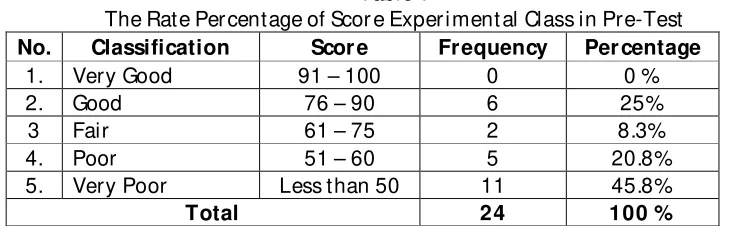
Table 1
The Rate Per centage of Scor e Exper i ment al Class in Pre-Test No. Classification Scor e Frequency Per centage
1. Very Good 91 – 100 0 0 %
2. Good 76 – 90 6 25%
3 Fair 61 – 75 2 8.3%
4. Poor 51 – 60 5 20.8%
5. Very Poor Less than 50 11 45.8%
Total 24 100 %
The table above show ed the students` scor e of pr e-test. The data indicated that the students` vocabular y w as poor w her e 45.8% students got scor e less than 50. It r epr esent ed us that al l the students had pr obl ems on lear ning vocabul ar y so that we needed good mater ials and w ell pr epar ati on to impr ove their vocabular y. Never theless, ther e w er e 6 of 24 students got good classificati on that meant pr oviding some new alternative w ays or str at egi es could stimulate them to impr ove their vocabular y.
Table 2
The Rate Per centage of Scor e Exper i ment al Class in Post-Test No. Classification Scor e Frequency Per centage
1. Very Good 91 – 100 1 4.1%
53
3 Fair 61 – 75 10 41.7%
4. Poor 51 – 60 4 16.7%
5. Ver y Poor Less than 50 0 0%
Total 24 100 %
The table above showed the rate per centage of experi ment al cl ass in post-test. Ther e w as a student got very good classi fication w hich indicated the students` scor e i ncr eased duri ng they got tr eatment from r esear cher . The data told us that 37.5% got good classification w hi ch r epresent ed ther e w as i mpr ovement of the students` achievement after ei ght meetings lear nt vocabul ar y by using Jeopar dy Strategy. How ever, still there w er e 4 students got poor classification of their post-test.
Based on the r esul t above, it can be concluded that the r ate percent age i n post-test w as gr eater than the r ate percent age in pr e-test w hich indicated students` enhancement in studying vocabul ar y after using Jeopar dy Strat egy.
Table 3
The Rate Per centage of Scor e Contr olled Cl ass i n Pr e-test No. Classification Scor e Fr equency Per centage
1. Ver y Good 91 – 100 0 0%
2. Good 76 – 90 2 8.3%
3 Fair 61 – 75 6 25%
4. Poor 51 – 60 6 25%
5. Ver y Poor Less than 50 10 41.7%
Total 24 1 00 %
Tabl e 3 show ed the students` scor e of controlled class in pr e-test. The data i ndicated us that the students` vocabular y w as poor w here 41.7% students got score less than 50 and 25% students got poor classi fication. It tol d us that the students had di fficulties in mast eri ng vocabular y and needed some alter native w ays to solve this pr oblem. The data also show ed us that the students got fair and good classifications w er e 25% and 8.3% r espectively or only 33.3 % students got scor e mor e than 60. In other w or ds, the students got scor e less than 60 w er e gr eat er than mor e than 60 (41.7% > 33.3 %). It meant the teacher should pay their attention and pr oviding some new str ategies to incr ease the students` vocabular y.
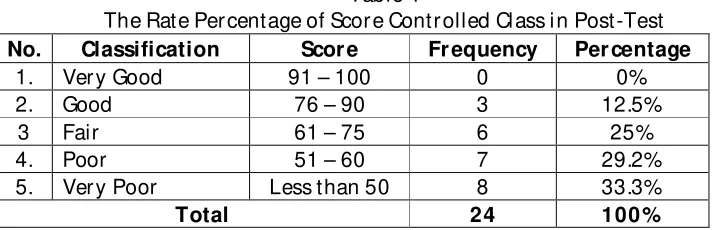
Table 4
The Rate Per centage of Scor e Contr olled Cl ass i n Post-Test No. Classification Scor e Fr equency Per centage
1. Ver y Good 91 – 100 0 0%
2. Good 76 – 90 3 12.5%
3 Fair 61 – 75 6 25%
4. Poor 51 – 60 7 29.2%
5. Ver y Poor Less than 50 8 33.3%
Total 24 100 %
54
per cent age in pr e-test w hi ch indi cated ther e was an incr ease in lear ning vocabular y, but the incr ement w as not si gnifi cant because ther e many students got low scor e.
The Mean Scor e and St andar d Deviati on of Exper imental Class and Controlled Class in Post-Test
Class Mean Scor e Standar d Deviation
Experi mental 74.29 11.40
Contr olled 59.96 11.57
The table above showed that the mean scor e of students` vocabul ar y incr eased in post-test. The students` mean scor e of exper i ment al class w as 74.29 w hich indicated ther e w as a good impr ovement of students` vocabulary after getting tr eat ment for ei ght meetings fr om r esear cher , w hil e the mean scor e of contr ol led class w as 59.96 w hich told us that students` vocabular y also got a little improvement. In summary, the mean scor e of contr ol led class w as low er than mean scor e of exper i mental class. The si gnificant scor e bet w een exper i ment al and contr olled class could be known by using t-test. The r esult of t-test could be seen in table 6 as follow s:
Table 6
Di str ibution the Value of t-Test and t-Table in Post-Test Var i able t-test val ue t-table value
Post-test 4.44 2.00
The table 6 showed the r esult of the post-test that indicated ther e w as significant difference betw een t-table and t-test, 2.00 < 4.44 or t-test w as higher than t-table w hich meant aft er t r eat ment the students` vocabular y incr eased. The r esult of the t-test statistical analysis showed that ther e w as si gnificant differ ence betw een the exper imental class w ho got treatment by using Jeopardy St r ategy w ith contr olled cl ass w ho got tr eatment by verbal explanati on, eventhough the di ffer ent both of them w as not enough hi gh. The statement w as pr oved by the t-test value (4.44) which higher than t-table value (2.00), at the lavel of signifi cance 0.05 and the degr ee of fr eedom ( N1 + N2) - 2 = (24 + 24) – 2 = 46. Thus, the
alternative hypothesis (H1) w as accepted and t he null hypothesis (H0) w as r ejected.
Based on the obser vation, it is found that the students are cur ious about the wor ds that they have to guess in Jeopar dy Str ategy, they ar e excited to find out the wor ds i n the dicti onar y and tr y to collect a lot of points as possible to become a w inner . This is consi stent with Aspina (2009) w ho stated that in teaching and lear ni ng vocabular y pr ocess, the teacher catches the pupils` attention and involves the students in learning process actively by creati ng the var iety and flexibility of techniques in teaching Engl ish, par ticular ly i n teaching vocabular y. Lear ning vocabulary thr ough Jeopar dy Str ategy is ver y i nter esti ng because the students can be motivated to lear n and make the students not bor ed and easy to know some new vocabular y. It is also suppor ted by the statement of Ruth A. Doucette (2005, Online) that Jeopardy is an excellent vehicle to pr actice vocabulary and w or d definitions. This game al so pr ovi des an opportunity for students to l earn how to develop potential test questions thr ough words categor y.
55
hand, the mean score of exper iment al class is gr eater than the mean scor e of contr oll ed class. Even though this research has proven that Jeopar dy Strat egy can motivate and i mpr ove the students’ achievement s in vocabular y but also the r esear cher find some w eaknesses of cooper ative lear ning. It i s difficult to activate all students because j ust the active students dominate the teachi ng and lear ning pr ocess. Some passive students w er e silent and w aited for her / his gr oup fr iends t o find the word i n dictionar y. Someti mes students ar e so excited w hich caused too much noise i n the class r oom w hen the fi ght r ound of this str at egy, this pr oblem can br eak students` concent r ation of the vocabul ar y w or ds. Even though ther e ar e some w eaknesses which have been found but at the end of this study all the weaknesses have been decr eased. Fr om the r eason above, Jeopar dy Str ategy can make the students enjoy i n learning and easy memor i zi ng vocabul ar y because they do their jobs together w ith all the member s of thei r gr oup. Therefore, they are feeli ng happy to do it and unintentional to memor ize some new vocabular y. In other w ords, r elax but seri ous.
CONCLUSION
Based on the r esult of the data analysis and the r esear ch findings and discussion in the pr evious chapter , the resear cher has come to the followi ng conclusi ons. Jeopar dy Str ategy is an affective w ay in i mproving English vocabulary master y at the fi r st semester of PIKIH Progr am of UIN Alauddin Makassar 2014/ 2015. It is pr oved by the t-test value that is 4.44 gr eater than the t-tabl e 2.00. In this case, Jeopardy Strat egy is an i nter esti ng w ay i n teaching vocabul ar y, beside that, i t is ver y helpful to activate the students’ backgr ound know ledge that is ver y i mpor tant to help students` compr ehension what w ill be lear n.
Consider ing the conclusion above, the r esear cher puts for war d some suggestions as follows:
1. The Engl ish teacher should be more cr eative in choosing the techniques that wi ll be used in teaching and lear ning process.
2. The English teacher should apply Jeopar dy Str ategy in teaching and lear ni ng process especial ly i n teachi ng vocabular y to engage the students to lear n English.
3. The students shoul d be more creative in choosing the techniques that w ill be used in lear ning vocabular y word.
4. The students should use Jeopar dy Str ategy to impr ove their vocabular y master y. Jeopar dy can be as an educated quiz for the students to make their learning fun.
5. The lectur er or teacher should conduct classr oom action r esear ch to identify and to solve students` pr oblem in teaching and lear ni ng pr ocess.
Refer ences
Ar ikunto, Suhar simi. 2006. Prosedur Penelit ian Suat u Pendekat an Prakt ik. Jakar ta: Ri neka Cipta.
Ar syad, Azhar. 1996. Dasar -Dasar Penguasaan Bahasa Inggri s Lewat Your Basic Vocabulary.
Ujung Pandang : Pustaka Pesantr en.
Aspina, Mar ma. 2009. Improving t he Vocabulary Mast ery of t he Fir st St udent s of SMA Neger i 1 Bulukumba t hrough Wor d At t acks Pr ogram. A Thesis of UNM.
Far ida, Dian. 2004. Incr easing St udent s` mast er y of English Vocabular y t hr ough Word Snake Game. A Thesi s of UNM.
56
KEED, Kaigan. 2010. The Ten Best Vocabular y Lear ning Tips. Retr ieved on September 4th,
2010 fr om http:/ / kaigenkeed.blogspot.com/
Munaw i r . 2010. Improving t he St udent s’ English Vocabular y at t he Second Year of SMP Neger i 3 Kahu by Using Whi sper ing Game. A Thesis of UIN.
Oxfor ddictionar ies. 2010. Retrieved on October 10t h, 2010 from
http:/ / oxfor ddictionaries.com/
Oxfor d Dictionar y. 1995. Oxfor d Dictionar y Pr ess.
Preszler , June, Row enhor st, Bar b, and Har t mann, Jo. 2006. St r at egies t o Bui ld St udent s` Vocabular ies. Ret r ieved on August 2nd, 2010 fr om
http:/ / w w w.sdesa6.or g/ content/ docs/ Str ategi esVocabular y-080808.pdf
Pyles, Thomas, and Algeo, John. 1970. English: An Int r oduct ion to Language. New Yor k: Har cour t, Br ace & Worl d.
Read, John. 2000. Assessing Vocabular y. London: Cambr idge Univer sity Pr ess.
Rosminar ty. 2005. Improving t he Vocabular y of t he Fi rst Year St udents of SMA Neger i 1 Mar e t hr ough English Magazines. A Thesi s of UNM.
Sur yabr ata, Sumar di. 2009. Met odologi Penelit i an. Jakarta: Rajaw ali Pr ess.
Tseng, Fuhuei. 2008. An Analysis of Vocabular y Select ion in El ement ar y School English Text books. Ret r ieved on September 3r d, 2010 fr om et hesys.lib.ccu.edu.t w/