Honor Killing in Legal, Cultural and Human Rights Perspective
Zenny Rezania DewantariPresident University Fulltime Lecturer [email protected]
Abstrak
This paper is talking about honor killing, a form of murder in which the act itself is considered as a necessity. This term is common used to picture a murder of a woman conducted by a man in a patriarchal community, as a retaliation of what she did that‟s brought shame to a family. In a broader term, honor killing means a necessary murder by a family member to a victim who is believed to have brought shame to a family.
Motives behind honor killing are what make this killing unique. The motives are commonly to restore the equilibrium after the damage brought by the victim to the family. There are no certain criteria of what damaging behavior is. Victims were usually women with some cases were involving men as a victim.
Right of life is stated in Universal Declaration of Human Rights. Many human rights conventions also state a protection of women‟s human rights. So in a human rights perspective, honor killing is against human rights especially right of life and specifically for women, it is against rights of a woman.
Naturally, human rights are universal. Problem occurs when this universality meets local cultures, beliefs, and traditions. Honor killing is sometimes allowed in those certain groups. So it is a challenge of human rights enforcement to get inside the cultures and beliefs of some state‟s ideology that might be different with UDHR statements, including honor killing phenomenon.
A. Honor Killing Phenomenon among Us
1. Honor Killing Cases Throughout the World
India, Jordan, Canada, Pakistan, Egypt, England are several countries mentioned in the news about honor-related crimes. Honor killing happened wide spread. From Asia, Middle East, America and Europe. Honor killings are a wide-spread problem, and despite common generalization, these senseless acts of violence are not exclusive to a single culture, ethnicity or religious group (Jonathan Leach, www.huffingtonpost.com).
Some of honor killings can be found in some sources as follow; Pakistani couple murdered in gruesome honor killing (Associated Press). This couple, a 17 year old girl Muafia Bibi and her 30 year old husband, Sajjad Ahmed was murdered by the girl‟s parents, grandfather, and two uncles. The motive behind this cruelty was a marriage without consent. The couple was married without the girl‟s family approval. Then it was reported that the victim was hacked by a butcher‟s knife and all five perpetrators had been apprehended.
In India, there was a case where a 14-year-old daughter was murdered by her parents. „Aarushi Talwar was found with her throat slit at the family home in Noida, an affluent town of new shopping malls and offices near Delhi, in 2008‟ (Shyamanta Asokan, Reuters). The parents, Rajesh and Nupur Talwar, were convicted and remain custody ahead of sentencing. Then, in the same article, Shyamanta Asokan also said „Early in the investigation, police alleged Rajesh had murdered his daughter and servant in a rage after finding them in a compromising situation – the kind of crime more often associated with rural,
conservative parts of India where “honour killings” are not uncommon‟.
Still in India, a man was beheaded and a woman was beaten to death after eloping. „The woman‟s mother, father and uncle were arrested after a gruesome murders carried out in a village in the state of Haryana‟ (Agence France Presse). The 22 year old boyfriend was attacked by sticks and while murdering the boy, they also beheaded him. Inspector-General Kumar told the AFP that “It is an honour killing but the murder was not approved by the society.” The article then also explain that „India has for centuries seen killings that often target young couples who have relationship of which their families, clans or communities, particularly in traditional rural areas, disapprove.‟ The killings were carried out in order restoring family‟s pride and reputation.
was all treated like servant to a preferred wife, Yahya. „The Crown alleged the family‟s patriarch was upset that his two eldest daughters wanted boyfriends, betraying his traditional Afghan values.‟ (Melinda Dalton, CBC News). The rage started when Zainab ran away to a women shelter, which raised the fathers‟ rage because she had made the family‟s problem became public. She was accused that she wanted to get married with boyfriend she secretly had before.
Another honor killing case, Morsal O, was stabbed 23 times in a parking lot in Germany by her brother Ahmad Sobair O in May 2008. This 16-year-old German-Afghan was murdered because of her alleged impure moral conduct (Phyllis Chesler, www.meforum.org). More on the article mentioned that honor killings, when prosecuted in the Muslim world, result in relatively light sentences. „When honor killings happened in the West, many people, including the police still shy away from calling it an honor killing‟ (Phyllis Chesler,
www.meforum.org). Islamist and feminist group in the west mostly insist that honor killings is western-style domestic violence or a femicide (a killing of women), which are not true.
Also from the article, it is known that honor killing phenomenon increased in 20 year period between 1989-2009. There are many reasons that cause the acceleration. It may be that honor killing become reported more accurately throughout the world and/or the increase of internet that makes many information spread out more easily.
Phyllis Chesler also said that the world average age for honor killings victim is 23. Then he mentioned that over half of the victims were daughters and sisters, about
quarters were wives and girlfriends, the remainder included mothers, aunts, nieces, cousins, uncles or non-relatives. The numbers can be seen on this table:
Table 1: Entire Population (N=230)
(source: www.meforum.com)
1
Significant according to a chi square test.
2
Family of origin includes fathers, mothers, brothers, grandfathers, uncles, and male cousins.
3“Other” includes mothers, aunts, cousins, and no familial relation. 4
Significant to a Pearson correlation test
This is the table describes the amount of honor killings occurred in North America and Europe:
Table 2: North American Honor Killings, Successful and Attempted
Victim Name (age) Year, Location Perpetrator‟s name, Origin
Motive Method
Palestina Isa (16) 1989 St. Louis, MO Maria & Zein Isa, parents, sisters also encouraged it / West Bank. (M)
“Too American”
refused to travel with her father, a member of the Abu Nidal Palestinian terrorist group, as
“cover”
Stabbed 13 times by father as mother held her down
Methal Dayem (22) 1999 Cleveland, OH
Yezen Dayem, Musa Saleh, cousins/ West Bank (M)
Refused to marry her cousin; attended college; sought independent career as elementary school teacher; drove her own car; too independent; turned back on her culture
Two cousins allegedly shot her, choked on own blood
Lubaina Bhatti Ahmed (39)
1999 St. Clairsville, OH
Nawaz Ahmed, estranged husband/ Pakistan (M)
Filed for divorced Throat cut; her father, sister and
sister‟s young child‟s throat also
cut
Farah Khan (5) 1999 Toronto, Muhammed Khan, father Suspected child was Father and step
AVERAGE AGE 23 25 22 23
BY PERCENTAGE
Killed by Family of Origin1,2 66 49 66 72
Family Position1
-- Daughter/Sister 53 50 49 56
-- Wife/Girlfriend 23 27 34 17
-- Other3 24 33 27 27
Paternal Participation4 37 53 39 31
Multiple Perpetrators 42 42 45 41
Multiple Victims1 17 30 7 21
Tortured1 53 39 67 49
Motive4
-- “too Western” 58 91 71 43
Canada and Kaneez Fatma, stepmother/unknown region (M)
not his biologically mother cut her throat,
dismembered her body
Jawinder “Jassi”
Kaur (25)
2000 Pakistan Gang of men hired by Malkiat Kaur, mother, and Surjit Sing Badesha, uncle/ Canada/Pakistan
2000 Chicago, IL Mohammad Harroon, husband / Pakistan (M)
Motive is unclear
Alim Hassan, husband / Guyana (Hindu Wife) (M)
His wife refused to convert from Hinduism to Islam
Husband, an auto mechanic, stabbed wife (and the twins in her womb), the
Hatice Peltek (39) 2004 Scottsville, NY
Ismail Peltek, husband / Turkey (M)
Aqsa Parvez (16) 2007, Toronto Canada
Muhammad Parvez, father, Waqas Parvez, brother (M) / unknown region
Refusing to wear hijab
Strangled
Amina Said (17) 2008 Irving, Texas Yaser Said, father; mother assisted / Egypt (M)
Upset by her
“Western” ways Shot
Sarah Said (18) 2008 Irving, Texas Yaser Said, father; mother assisted / Egypt (M)
2008 Henrietta, NY Goaded by mother, Waheed Allah
2008 Atlanta, GA Chaudry Rashid, father / Pakistan (M)
(source: Phyllis Chesler, Middle East Quarterly)
Victim Name Year, Location Perpetrato‟s Name, Origin
Motive Method
Surjit Athwal (27) 1998 lured to India from England
Bachan Athwal, grandmother-in-law, her son and another relative / India (S)
Having an affair, planning to divorce
Lured to India for
„family weding‟ and
strangled
Rukhsana Naz (19) 1999 England Brother and mother / Pakistan (M) while held down by mother
Fadime Sahindal (32)
2002 Sweden Father and brother / Kurds from Turkey
Heshu Yones (16) 2002 England Abdalla Yones, father / Iraq (M)
2002 France Jamal Derrar, ex-boyfriend and school mates / Algeria (M)
Too western Raped, tortured and burned alive
Anooshe Sediq Ghulam (22)
2002 Norway Nasruddin Shamsi, husband /
Afghanistan (M)
Failure to listen to her husband, divorce
Shot
Maja Bradaric (16) 2003 The Netherlands
Nephew and 3 others / Bosnia (M)
Using internet to find a boyfriend
Burned to death
Sahjda Bibi (21) 2003 England Rafaqat Hussain, cousin / Pakistan (M)
Refused arranged marriage
Stabbed 22 times
Anita Gindha (22) 2003 Scotland Relative suspected / Pakistan (S)
Married non-Sikh Strangled
Shafilea Ahmed (16) 2003 England Parents suspected / Pakistan (M)
Sought divorce Shot
Hatin Surucu (23) 2005 Germany Three brothers / Turkey (M)
Fled forced marriage; did not wear scarf
Shot
Rudina Qinami (16) 2005 Albania Father / Albania (M) Accepted ride by male, non-relative
Shot
Banaz Mahmod(20) 2006 England Mahmod Mahmod, father, her uncle Ari Mahmod / Kurds from Iraq (M)
Having an “affair” Raped, strangled
Samaira Nazir (25) 2006 England Azhar Nazir, brother and cousin / Pakistan (M)
2006 Germany Kazim Mahmud, husband / Iraq (M)
Acting in an
“immodest” way Stabbed, set on fire
Sabia Rani (19) 2006 England Shazad Khan, husband and in-laws / Pakistan (M)
Ghazala Khan (18) 2006 Denmark Brother, father and other family members / Pakistan (M)
Family did not approve of husband
Shot
Caneze Riaz (39), Sayrah Riaz (16), Sophia Riaz (15), Alicia Riaz (10), Hannah Riaz (3)
2006 England Mohammed Riaz, father / Pakistan (M)
Too westernized Immolated
Hina Saleem (21) 2006 Italy Father and brother in law / Pakistan (M)
Did not respect Pakistani culture, divorced, wore clothing that showed her midriff
Stabbed
Sana Ali (17) 2007 England Husband / Pakistan (M)
Not known, but detectives consider honor motive
Stabbed
Morsal Obeidi (16) 2008 Germany Ahmad Obeidi, brother, and cousin / Afghanistan (M)
Wanted too much freedom; did not appreciate Muslim values
Stabbed
Legend: M = Muslim; S = Sikh
(source: Phyllis Chesler, Middle East Quarterly)
The majority of victims were women. And honor killing mainly occurred in Muslim world, although Sikhs and Hindus sometimes also commit honor killings. In Phyllis Chesler‟s study, worldwide, 91 percent of perpetrators were Muslims. „In North America, most killers (84 percent) were Muslims, with only a few Sikhs and even fewer Hindus perpetrating honor killings; in Europe, Muslims comprised an even larger majority at 96 percent while Sikhs were a tiny percentage.‟ (Phyllis Chesler, www.meforum.org)
Even though Muslims mostly be brought up when it comes to honor killings, there is no evidence that show honor killing is from Islam. There are many violence oppressing women in the name of religion, including Islam but is not limited to Islam.
2. The Concept of Homicide and Honor Killing
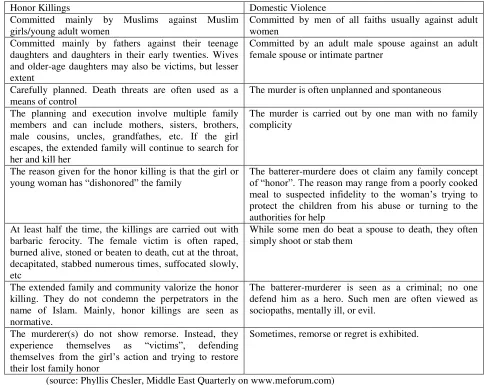
When we start talking about honor killing, we start with questioning what honor killing is. There must be a confusion to understand whether honor killing is similar with murder, or is it something very different. In general, it is a form of taking away one‟s life, so hypothetically it is a form of murder as well. But there must be a difference; otherwise honor killing wouldn‟t be seen as a deviant form of murder. „They differ from plain and psychopathic homicides, serial killings, crimes of passion, revenge killing, and domestic violence. Their motivation is different and based on codes of morality and behavior that typify some cultures, often reinforced by fundamentalist religious dictates‟ (Phyllis Chesler, www.meforum.org).
differentiate honor killings and domestic violence through this table
:
Table 4: Differing Characteristic of Honor Killings and Domestic Violence
Honor Killings Domestic Violence
Committed mainly by Muslims against Muslim girls/young adult women
Committed by men of all faiths usually against adult women
Committed mainly by fathers against their teenage daughters and daughters in their early twenties. Wives and older-age daughters may also be victims, but lesser extent
Committed by an adult male spouse against an adult female spouse or intimate partner
Carefully planned. Death threats are often used as a means of control
The murder is often unplanned and spontaneous
The planning and execution involve multiple family members and can include mothers, sisters, brothers, male cousins, uncles, grandfathes, etc. If the girl escapes, the extended family will continue to search for her and kill her
The murder is carried out by one man with no family complicity
The reason given for the honor killing is that the girl or
young woman has “dishonored” the family The batterer-murdere does ot claim any family concept of “honor”. The reason may range from a poorly cooked meal to suspected infidelity to the woman‟s trying to
protect the children from his abuse or turning to the authorities for help
At least half the time, the killings are carried out with barbaric ferocity. The female victim is often raped, burned alive, stoned or beaten to death, cut at the throat, decapitated, stabbed numerous times, suffocated slowly, etc
While some men do beat a spouse to death, they often simply shoot or stab them
The extended family and community valorize the honor killing. They do not condemn the perpetrators in the name of Islam. Mainly, honor killings are seen as normative.
The batterer-murderer is seen as a criminal; no one defend him as a hero. Such men are often viewed as sociopaths, mentally ill, or evil.
The murderer(s) do not show remorse. Instead, they
experience themselves as “victims”, defending
themselves from the girl‟s action and trying to restore their lost family honor
Sometimes, remorse or regret is exhibited.
(source: Phyllis Chesler, Middle East Quarterly on www.meforum.com)
To understand honor killing, we need to understand a murder first. Murder is also called as homicide. Webster‟s New World Dictionary of the American Language (in Eko Haryanto, 2014:1) explains that homicide comes from two words; homo which means a man (human) and caedere which means to cut or to kill. Another definition of homicide is „the killing of one person by another‟ (Bryan A. Garner et al, 2000:589). Furthermore Bryan A. Garner et al (2000:589) added that one form of homicide is criminal homicide which means
a homicide that is prohibited and punishable by law, such as murder or manslaughter. Murder itself then defined as „the killing of a human being with malice aforethought‟ (Bryan A. Garner et al, 2000:831).
said that a homicide can be in two form; criminal homicide and non-criminal homicide. A criminal homicide means the act of killing a human being is punishable by the law. That is also called as culpable homicide while a non-criminal (not punishable) homicide is known as innocent homicide (Gibbons and Kadish in Eko Haryanto, 2014:7). A criminal homicide is in the jurisdiction of state‟s criminal law and is clearly stated in the provisions that the act is against the law. Honor killing, on the other hand, is included in innocent homicide.
Honor killing is an act of killing people, just like homicide. So in general view, honor killing is homicide. The victims were burnt, beat, shot, stabbed, tortured to death but the intention was to kill. The focus must be pointed to the term „honor‟. Honor means „to recognize, salute, or praise‟.( Bryan A. Garner et al, 2000:590). So, honor killing means a homicide with praise, a homicide with a justification.
Referring to a definition of crime of honor, crime of honor is „tindak kejahatan – biasanya pembunuhan– terhadap anggota
keluarga –mayoritas adalah perempuan,
misalnya istri, ibu, anak, kakak atau adik
perempuan– demi membersihkan
kehormatan keluarga, karena mereka
dianggap telah mempermalukan kehormatan keluarga‟. (Febiana Malini, 2010:54) („A crime –usually a homicide– against family members –most commonly victims are women; wife, mother, daughter, sister– in order to cleanse the family honor, since they are deemed to have disgraced family honor‟).
„Honor killings are a wide-spread problem, and despite common generalizations, these senseless acts of violence are not exclusive to a single culture, ethnicity or religious group.‟
(www.huffingtonpost.com). Honor killing‟s
found in England, Jordan, Pakistan, and it is spread out through continents. The motive is what makes honor killing usually not punishable and this motive usually derived from beliefs and cultures. This lead to misunderstanding that honor killings only be found in a single region with strong culture or belief. Honor killings and attempted honor killings was happened in many regions.
This has become a problem mainly because its nature; it is a homicide but it isn‟t punishable since the act is considered as necessity in order to maintain family honor. While the act was often very brutal (stabbing, burning, mutilating, torturing) the perpetrator could walk away as a free man. They weren‟t liable to a committed murder according to State‟s law where the killing took place.
3. Honor Killing in Legal Perspective
Legal matters always work on legislations and any forms of written and positive law. Of course, a Law should represent the traditions and culture of the society, that what makes the Law is various between countries. „But human laws are not themselves statement of fact; they are rules or norms, which prescribe a course of conduct, and indicate what should happened in default‟. (M.D.A Freeman, 2008:11). Furthermore, Freeman also said that „the sanction, however, is not usually connected in an empirical sense with the ruler or its breach, but is merely indicative of what the rule itself prescribes, as the consequences of non-compliance‟. (M.D.A Freeman, 2008:11).
considered as crime (in criminal law) or a breach (in private law). For example, in Indonesian Penal Code (Kitab Undang-Undang Hukum Pidana Indonesia/KUHP) article 338 mentioned “Barangsiapa sengaja merampas nyawa orang lain, diancam, karena pembunuhan, dengan pidana penjara paling lama lima belas tahun” (Whoever intentionally take the life of another, subjected to an imprisonment for maximum 15 years). Article 340 is also about homicide with incriminating element (first degree murder). Both article 338 and article 340 are an intentional homicide, while article 359 is about homicide due to negligence (manslaughter). All three types of homicide are subjected to an imprisonment penalty various from maximum 5-20 years and for a first degree murder is subjected to a death penalty. Whoever commits the act as described on the provision is breaking the law and being subjected to a penalty. No empirical aspect matters. As long as the person commits the act, he is breaking the law.
The unwritten law is also a law that lives in certain time and place, obeyed by the citizens. This kind of law doesn‟t have a formal legal enforcement like written law does. Sometimes unwritten law may remove the enforcement of written law. Unwritten law may take the form as customs, habit, and tradition. So unwritten law is much related with traditional or local values. For instance, Indonesia is a very pluralistic society and in Indonesian Criminal Justice System, there is Indonesian Penal Code as a written law (state‟s law) and there are also various criminal customary laws. Many times, the definition of crime is different between such laws. Unwritten law (customary law) can be more specific in determining crime, for instance, cutting a branch of tree maybe considered as crime and punishable to certain penal while according to state‟s law cutting a branch of
tree is not a crime unless it takes form as illegal logging.
Sometimes, those unwritten laws are more obeyed than state‟s law. From several instances of honor killing, the perpetrator got away because honor killing isn‟t against the unwritten law. It is even commanded by the law. State‟s law couldn‟t jump to its jurisdiction, nor the state‟s law enforcers. Character differences between states law and certain beliefs and some unwritten laws have created a large gap.
The tendency in today‟s legal system through many countries is finding that honor killing is still a crime of life. Many cases showed that the perpetrators were apprehended and then sentenced for homicide. For instance, Hamed Shafia, his father, Mohammed, and his mother, Tooba Mohammed Yahya, were sentenced to life in prison for murder, with Judge Robert Maranger excoriating their "twisted notion of honor, a notion of honor that is founded upon the domination and control of women, a sick notion of honor that has absolutely no place in any civilized society." (http://religion.blogs.cnn.com/2012/01/30/isl am-doesnt-justify-honor-murders-experts-insist/) Their crime of killing three daughters and a first wife of polygamous marriage was found guilty by Canadian Law.
4. Honor Killing in Cultures and Beliefs
that among conservative Muslims in Pakistan that marrying for love is a taboo. In modern era and in the more opened culture society, marrying for love is natural. Nothing is wrong with it; on the contrary, the concept of an arranged marriage is more uncommon than marriage for love.
Different societies are resulting different perspective on moralities and values. Humans receive many standards of morality since birth until they die. Those standards of morality came from family, education, social, and environment. The underline is, humans values came from cultures and beliefs and, among all similarities, they are also different between each cultures and beliefs. In Indonesia, for instance, there is a tradition called Ngayau. This tradition is part of life for Dayak Tribe in Borneo, Indonesia. Ngayau is when the tribe men hunting for enemy‟s head during tribes war. The war was to expand the territory. After gathering the heads, there‟ll be held a ceremony to honor the spirit of the dead and to gather the power inside the heads. They also believe that heads they collected can bring the whole tribe a fortune, welfare, and dignity. The tribe only behead adult male while woman and children were taken as a slave. This tradition has ended through an agreement called Tumbang Anoi among whole Dayak Borneo tribe. That was happened on 22 May – 24 July 1894 (www.ceritadayak.com).
According to Indonesian criminal law, homicide is against the law and punishable for maximum 15 years of imprisonment and death penalty. Ngayau itself is part of tribe tradition so that it wasn‟t in State‟s law jurisdiction. Moreover, during the 1800, Indonesia was still under Dutch colonialism. But then, the practice of headhunting sporadically still happened many years later. The famous case of headhunting during war was the Sampit
tragedy (on 2001) in Kalimantan (Borneo). This time, the perpetrator and the provocateur was arrested.
As seen on those illustrations, the tradition of Ngayau was motivated by spiritual reason. The man who was successfully got the head of the enemy was gained an honor by the tribe. As for Sampit incident, the war was also to protect dignity between different ethnicity, Dayak and Madura. The headhunting was to prove the dignity. But then in the more modern society of Indonesia with its sovereign Government, that incident was considered as criminal law violation.
That shows how society takes part in the development of honor killing in cultures and beliefs. In the more complex and heterogenetic society honor killing is more likely to be seen as a deviant behavior. That senseless act is still a crime no matter what honorable reason behind it. The cumulative society perception interferes in determining what‟s right or wrong.
The honor killing among immigrant families in Europe and North America mostly driven by the reason that their family members has tainted family‟s native values or what they called as being „too western‟, for instance, having secret boyfriend, wearing a revealing clothes, or simply because they lived the western lifestyle. By that reason the victim deserved to die. The clash between the native culture and the new culture for immigrant families has created insecurities to the father so that he felt the needs to protect his family‟s dignity in a radical ways.
Humans are free to perceive their beliefs in their own way. For instance, Islam is a peaceful religion, just as peaceful as Christian, Hindu, Buddha and many other beliefs. Yet, some Muslims committed terrorism, torture and homicide in the name of God.
B. Honor Killings and Human Rights.
Honor killing is a form of murder, an act with intention to remove a life of someone. Human rights, is a right for humans simply because he/she is a human and is born as a human. Universal Declaration of Human Rights describes 30 provisions of what are classified as human right. The third article mentioned, „Everyone has the right to life, liberty and security of person‟ (Universal Declaration of Human Rights, 1948). In other words, everyone should respect and protect the right of life among all human being. Based on that, a homicide, for any reason, is violating human rights. Therefore, honor killings are also against human rights.
Human rights are very connected to justice. By protecting human rights, we also
fight for justice. Human rights has principles, there are:
Universal and inalienable Interdependent and indivisible Equal and non-discriminatory
Based on its concept, human rights are universal and ideal to restore peace and justice among human being. The problem lies on how human perceive human rights. What is considered as justice to one person may bring injustice to other person or groups. This diversity leads to a various criteria of justice. Suddenly, human rights aren‟t universal anymore.
The concept of human rights is absorbed into man‟s environment. Cultures and beliefs also determine one‟s perspective. For instance, person who lives in a fundamental religious family is more likely to have a perspective of justice based on his fundamental religion belief. Other illustration, person who live in a more heterogenetic society and is having a moderate family will have different justice criteria with the one who experience fundamental religion teaching.
recognized, the social significance of maternity and the role of both parents in the family and in the upbringing of children, and aware that the role of women in procreation should not be a basis for discrimination but that the upbringing of children requires a sharing of responsibility between men and women and society as a whole‟ (CEDAW, 1981). Moreover, CEDAW also explains that „Aware that a change in the traditional role of men as well as the role of women in society and in the family is needed to achieve full equality between men and women‟. This is not an era where women are restricted from any opportunity. Women are not to be an object but she is a subject that possesses rights for higher education, for instance.
Since the victim of honor killings are mostly women, then honor killing is certainly against women‟s right as codified in CEDAW. In general, honor killing is against human rights based on UDHR and other human rights conventions. Honor killings are mostly brutal and including torture. According to Convention against Torture and Other Cruel, Inhuman or Degrading Treatment or Punishment (Convention against Torture/CAT/The Torture Convention), article 1 mentioned „For the purposes of this Convention, the term "torture" means any act by which severe pain or suffering, whether physical or mental, is intentionally inflicted on a person for such purposes as obtaining from him or a third person information or a confession, punishing him for an act he or a third person has committed or is suspected of having committed, or intimidating or coercing him or a third person, or for any reason based on discrimination of any kind, when such pain or suffering is inflicted by or at the instigation of or with the consent or acquiescence of a public official or other person acting in an official capacity. It does
not include pain or suffering arising only from, inherent in or incidental to lawful sanctions.‟
In one way and another, honor killings are violating human rights. But honor killings are not a severe human rights violation, because there are criteria on what classified as severe human rights violation so that the case can be brought to the International Human Rights Courts. Those are:
- The case is continuous without a clear settlement
- It threaten international and national peace
- The national court can‟t afford to finish the case
Giving example on what type of crime that classified as severe human rights violations:
- Race discrimination - Apartheid
- Genocide
- Crime against humanity
However, honor killings are still a violation of human rights. That should be in states court jurisdiction and should be treated as homicide, despite the “honor” term in it. The term “honor” is put to justify the act itself. The reason that the killing is honor is the perpetrator‟s state of mind. It has nothing to do with culture and belief, especially religions. No religions teach violence but peace and good moral values. Human interpretation of belief is the only thing that evil on religion. So, the term “honor” is nonsense.
mutilating, drowning, and other brutalities ones can only imagine. In many honor killing cases, the perpetrators were already brought to the state‟s court. Honor killings that happened in the warzone were also investigated and were spread out by mass media.
In Indonesia, not much honor killing case found. The famous honor killing was The Head Hunter of Dayak Borneo Tribe that happened many years ago. Any forms of murder are taken as homicide and being investigated as so by the law enforcers. Good thing is in Indonesia there is a National Commission of Human Rights (Komisi Nasional Hak Asasi Manusia/KOMNASHAM) that working on any reports of suspected human rights violation.
1. Honor Killings, Human Rights Violation and Suggestion How to Stop it.
MeiMei Fox in
www.huffingtonpost.com told a story of her experience reading a book called The Seven Perfumes of Sacrifice by Amy Logan. She was shocked that from the book she learned that honor killings still exist in many parts of the world. „In fact, over 5000 such murders occur annually, according to the UN – and that number only includes the few honor killings that officials ever find out about. Eight hundred million women and girls live under the threat of honor killing, terrified that if they make one wrong move, or are unfortunate to be sexually abused, they will be murdered.‟ (MeiMei Fox, www.huffingtonpost.com)
MeiMei Fox then continue told the story of when she asked Amy what she found most surprising in Amy‟s research
into honor killings. „She said perhaps the single most shocking thing was how little research existed. Then, when she began calling NGOs, scholars and social workers in the honor-killing countries and asking about it, she repeatedly go shut down.‟ (MeiMei Fox, www.huffingtonpost.com)
Then MeiMei Fox and Amy offer some suggestions, those are:
a. Encourage all victims of violence and abuse to get to safety, then speak out and hold their abusers accountable. Silence protects the perpetrators and allows abuse to continue.
b. Support local shelters for victims of domestic abuse and immigrant women escaping honor violence. c. Enforcing the CEDAW. Almost
every nations has ratified it except for some nations such as; Sudan, Somalia, Iran and USA.
d. Support organizations that are doing the most to end honor killing and uplift women.
„Immigration, law enforcement, and religious authorities must all be included in education, prevention, and prosecution efforts in a matter of honor killings.‟ (Phyllis Chesler,
www.meforum.com)
C. Conclusion and Recommendation.
cold-blooded where the victim (mostly women) were shot, stabbed, raped, tortured, throat cut, burned and strangled by the perpetrator who are usually men. The victim were killed for some reasons like, they were too western, wanting a career or higher education, too independent, leaving an abusive husband, being raped, and rejecting an arranged marriage. Although the motive was honorable and religious, no religion ever teach its followers to be a sadist who able to kill other human. It is still violating human‟s rights and women‟s right and is a homicide no matter what.
So in that matter, honor killing must be seen as a homicide and is punishable by state‟s law. There has to be a cooperation between the government, law enforcers, human rights organizations, and people in general to watch, report, and prevent honor killing from developing especially in a state with high percentage of migrant citizens.
References:
Garner, Bryan A. (ed.) (2000) Black’s law Dictionary, MN: West Group
Haryanto, Eko (2014) Memahami Pembunuhan, Jakarta: Penerbit Buku Kompas
Journal:
Chesler, Phyllis and Bloom, Nathan (2012) Hindu vs. Muslim Honor Killings, Middle East Quarterly,[electronic] Summer, pp. 43-52 available at
http://www.meforum.org/3287/hindu-muslim-honor-killings
Chesler, Phyllis (2010) Worldwide Trends in Honor Killings, Middle East Quarterly, [electronic] Spring, pp. 3-11. Available at http://www.meforum.org/2646/worldwide-trends-in-honor-killings
Chesler, Phyllis (2009) Are Honor Killings Simply Domestic Violence? Middle East Quarterly, [electronic] Spring, pp. 61-69 available at
http://www.meforum.org/2067/are-honor-killings-simply-domestic-violence
Internet Sources:
AP (2014) Pakistani Couple Murdered In Gruesome Honor Killing, [online], available at
http://www.huffingtonpost.com/2014/06/29/ pakistan-honor-killing_n_5541100.html 7/1/2014
http://www.huffingtonpost.com/2013/11/25/ rajesh-nupur-talwar-guilty_n_4337091.html
AFP, (2013) India Honor Killing: Man Beheaded, Woman Beaten To Death After Eloping, [online], available at
http://www.huffingtonpost.com/2013/09/19/ india-honor-killing-man-beheaded-woman-beaten-to-death_n_3952927.html
Fox, MeiMei (2012) In Defense of the Goddess: Speaking Out Against Honor Killing, [online], available at
http://www.huffingtonpost.com/meimei-
fox/in-defense-of-the-goddess_b_2207715.html
Leach, Jonathan (2012) A Reporter's Journey: Revealing the Honor Violence Epidemic, [online], available at
http://www.huffingtonpost.com/jonathan-leach/honor-killings_b_1405348.html
CBC (2012) Shafia Father To Appeal Murder Convictions, [online], available at
http://www.huffingtonpost.ca/2012/02/03/sh afia-honour-killing-trial_n_1253888.html
Dalton, Melinda (2012) Shafia jury finds all guilty of 1st-degree murder, [online], available at
http://www.cbc.ca/news/canada/montreal/sh afia-jury-finds-all-guilty-of-1st-degree-murder-1.1150023
Basu, Nupur (2013) Honour killings: India's crying shame: Controversial conviction of dentist couple for double murder this week shines spotlight on scourge going
unchecked, [online], available at
http://www.aljazeera.com/indepth/opinion/2 013/11/honour-killings-india-crying-shame-20131127105910392176.html
Greene, Richard Allen (2012) Islam doesn't justify 'honor murders,' experts insist, [online], available at