Randy Ingermanson
Award-winning novelist
Peter Economy
Best-selling author of
Writing Children’s
Books For Dummies
Learn to:
• Find your target audience
• Choose your creative paradigm
• Invent compelling characters
• Create a multi-layered plot
Writing Fiction
Start with
FREE
Cheat Sheets
Cheat Sheets include
•
Checklists
•
Charts
• Common Instructions
• And Other Good Stuff!
Get Smart at Dummies.com
Dummies.com makes your life easier with 1,000s
of answers on everything from removing wallpaper
to using the latest version of Windows.
Check out our
•
Videos
• Illustrated Articles
• Step-by-Step Instructions
Plus, each month you can win valuable prizes by entering
our Dummies.com sweepstakes. *
Want a weekly dose of Dummies? Sign up for Newsletters on
• Digital Photography
• Microsoft Windows & Office
• Personal Finance & Investing
• Health & Wellness
• Computing, iPods & Cell Phones
•
eBay
•
Internet
• Food, Home & Garden
Find out “HOW” at Dummies.com
*Sweepstakes not currently available in all countries; visit Dummies.com for official rules.
To access the Cheat Sheet created specifically for this book, go to
by Randy Ingermanson
and
Peter Economy
FOR
111 River St.
Hoboken, NJ 07030-5774
www.wiley.com
Copyright © 2010 by Wiley Publishing, Inc., Indianapolis, Indiana
Published by Wiley Publishing, Inc., Indianapolis, Indiana Published simultaneously in Canada
No part of this publication may be reproduced, stored in a retrieval system or transmitted in any form or by any means, electronic, mechanical, photocopying, recording, scanning or otherwise, except as permit-ted under Sections 107 or 108 of the 1976 Unipermit-ted States Copyright Act, without either the prior written permission of the Publisher, or authorization through payment of the appropriate per-copy fee to the Copyright Clearance Center, 222 Rosewood Drive, Danvers, MA 01923, (978) 750-8400, fax (978) 646-8600. Requests to the Publisher for permission should be addressed to the Permissions Department, John Wiley & Sons, Inc., 111 River Street, Hoboken, NJ 07030, (201) 748-6011, fax (201) 748-6008, or online at http:// www.wiley.com/go/permissions.
Trademarks: Wiley, the Wiley Publishing logo, For Dummies, the Dummies Man logo, A Reference for the Rest of Us!, The Dummies Way, Dummies Daily, The Fun and Easy Way, Dummies.com, Making Everything Easier, and related trade dress are trademarks or registered trademarks of John Wiley & Sons, Inc. and/ or its affiliates in the United States and other countries, and may not be used without written permission. All other trademarks are the property of their respective owners. Wiley Publishing, Inc., is not associated with any product or vendor mentioned in this book.
LIMIT OF LIABILITY/DISCLAIMER OF WARRANTY: THE PUBLISHER AND THE AUTHOR MAKE NO REPRESENTATIONS OR WARRANTIES WITH RESPECT TO THE ACCURACY OR COMPLETENESS OF THE CONTENTS OF THIS WORK AND SPECIFICALLY DISCLAIM ALL WARRANTIES, INCLUDING WITH-OUT LIMITATION WARRANTIES OF FITNESS FOR A PARTICULAR PURPOSE. NO WARRANTY MAY BE CREATED OR EXTENDED BY SALES OR PROMOTIONAL MATERIALS. THE ADVICE AND STRATEGIES CONTAINED HEREIN MAY NOT BE SUITABLE FOR EVERY SITUATION. THIS WORK IS SOLD WITH THE UNDERSTANDING THAT THE PUBLISHER IS NOT ENGAGED IN RENDERING LEGAL, ACCOUNTING, OR OTHER PROFESSIONAL SERVICES. IF PROFESSIONAL ASSISTANCE IS REQUIRED, THE SERVICES OF A COMPETENT PROFESSIONAL PERSON SHOULD BE SOUGHT. NEITHER THE PUBLISHER NOR THE AUTHOR SHALL BE LIABLE FOR DAMAGES ARISING HEREFROM. THE FACT THAT AN ORGANIZATION OR WEBSITE IS REFERRED TO IN THIS WORK AS A CITATION AND/OR A POTENTIAL SOURCE OF FUR-THER INFORMATION DOES NOT MEAN THAT THE AUTHOR OR THE PUBLISHER ENDORSES THE INFOR-MATION THE ORGANIZATION OR WEBSITE MAY PROVIDE OR RECOMMENDATIONS IT MAY MAKE. FURTHER, READERS SHOULD BE AWARE THAT INTERNET WEBSITES LISTED IN THIS WORK MAY HAVE CHANGED OR DISAPPEARED BETWEEN WHEN THIS WORK WAS WRITTEN AND WHEN IT IS READ.
For general information on our other products and services, please contact our Customer Care Department within the U.S. at 877-762-2974, outside the U.S. at 317-572-3993, or fax 317-572-4002. For technical support, please visit www.wiley.com/techsupport.
Wiley also publishes its books in a variety of electronic formats. Some content that appears in print may not be available in electronic books.
Library of Congress Control Number: 2009939355 ISBN: 978-0-470-53070-2
Manufactured in the United States of America
Randy Ingermanson is the award-winning author of six novels. He is known around the world as “the Snowflake Guy,” thanks to his Web site article on the Snowflake method, which has been viewed more than a million times. Before venturing into fiction, Randy earned a Ph.D. in theoretical physics from the University of California at Berkeley and published a number of articles on superstring theory. He has spent a number of years working as a computational physicist developing scientific software for high-technology companies in San Diego, California.
Randy has taught fiction at numerous writing conferences across the country and sits on the advisory board of American Christian Fiction Writers. He also publishes The Advanced Fiction Writing E-zine, the world’s largest e-zine on how to write fiction. Randy’s first two novels won Christy Awards, and his second novel, Oxygen, coauthored with John B. Olson, earned a spot on the New York Public Library’s Books for the Teen Age list. Visit Randy’s personal Web site at www.ingermanson.com and his Web site for fiction writers at
www.AdvancedFictionWriting.com.
Peter Economy of La Jolla, California,is a best-selling author with 11
To my loyal blog readers on the Advanced Fiction Writing Blog. You’ve taught me more in your questions than I could possibly teach you in my answers.
— Randy Ingermanson
Authors’ Acknowledgments
We would like to thank the many people who took time to provide their advice and input to us as we created the book you now hold in your hands. Specifically, we would like to thank the folks at Wiley who cared enough to make this book the best it could be, including Tracy Boggier, Natalie Harris, Danielle Voirol, and Christy Pingleton. Thanks also to our talented technical editor David Hassler.
Randy would like to thank his coauthor Peter Economy for guidance in learn-ing the Dummies way and for many strategic and tactical conversations during the writing of this book. He also thanks his wife, Eunice, for being there always and his daughters, Carolyn, Gracie, and Amy, for many hun-dreds of hours of reading-out-loud time.
outside the U.S. at 317-572-3993, or fax 317-572-4002.
Some of the people who helped bring this book to market include the following:
Acquisitions, Editorial, and Media Development
Project Editor: Natalie Faye Harris Acquisitions Editor: Tracy Boggier Senior Copy Editor: Danielle Voirol Assistant Editor: Erin Calligan Mooney Editorial Program Coordinator: Joe Niesen General Reviewer: David Hassler
Editorial Manager: Christine Meloy Beck Editorial Assistants: Jennette ElNaggar,
David Lutton
Art Coordinator: Alicia B. South Cover Photos: © Gerard Fritz Cartoons: Rich Tennant
(www.the5thwave.com)
Composition Services
Project Coordinator: Sheree Montgomery Layout and Graphics: Carl Byers,
Joyce Haughey, Melissa K. Jester, Christine Williams
Proofreader: Shannon Ramsey
Indexer:ChristineKarpeles
Special Help: Christine Pingleton
Publishing and Editorial for Consumer Dummies
Diane Graves Steele, Vice President and Publisher, Consumer Dummies
Kristin Ferguson-Wagstaffe, Product Development Director, Consumer Dummies Ensley Eikenburg, Associate Publisher, Travel
Kelly Regan, Editorial Director, Travel Publishing for Technology Dummies
Andy Cummings, Vice President and Publisher, Dummies Technology/General User Composition Services
Introduction ... 1
Part I: Getting Ready to Write Fiction ... 7
Chapter 1: Fiction Writing Basics ... 9
Chapter 2: What Makes a Great Story?... 21
Chapter 3: Finding Your Audience and Category ... 37
Chapter 4: Four Ways to Write a Great Novel ... 59
Chapter 5: Managing Your Time . . . and Yourself ... 71
Part II: Creating Compelling Fiction ... 85
Chapter 6: Building Your Story World: The Setting for Your Story ... 87
Chapter 7: Creating Compelling Characters ... 107
Chapter 8: Storyline and Three-Act Structure: The Top Layers of Your Plot ... 135
Chapter 9: Synopsis, Scene List, and Scene: Your Middle Layers of Plot ... 157
Chapter 10: Action, Dialogue, and More: The Lowest Layer of Your Plot ... 177
Chapter 11: Thinking Through Your Theme ... 203
Part III: Editing and Polishing Your Story
and Characters ... 215
Chapter 12: Analyzing Your Characters ... 217
Chapter 13: Scrutinizing Your Story Structure ... 239
Chapter 14: Editing Your Scenes for Structure ... 259
Chapter 15: Editing Your Scenes for Content ... 273
Part IV: Getting Published ... 291
Chapter 16: Getting Ready to Sell Your Book: Polishing and Submitting ... 293
Chapter 17: Approaching Agents and Editors ... 315
Part V: The Part of Tens ... 327
Chapter 18: Ten Steps to Analyzing Your Story ... 329
Chapter 19: Ten Reasons Novels Are Rejected ... 337
Introduction ... 1
About This Book ... 1
Conventions Used In This Book ... 2
What You’re Not to Read ... 2
Foolish Assumptions ... 3
How This Book Is Organized ... 3
Part I: Getting Ready to Write Fiction... 4
Part II: Creating Compelling Fiction ... 4
Part III: Editing and Polishing Your Story and Characters ... 4
Part IV: Getting Published ... 4
Part V: The Part of Tens ... 5
Icons Used in This Book ... 5
Where to Go from Here ... 5
Part I: Getting Ready to Write Fiction ... 7
Chapter 1: Fiction Writing Basics . . . .9
Setting Your Ultimate Goal As a Writer ... 11
Pinpointing Where You Are As a Writer ... 13
Freshmen: Concentrating on craft ... 13
Sophomores: Tackling the proposal ... 14
Juniors: Perfecting their pitches ... 15
Seniors: Preparing to become authors ... 16
Getting Yourself Organized ... 17
Mastering Characterization, Plotting, and Other Skills ... 18
Editing Your Fiction ... 18
Chapter 2: What Makes a Great Story? . . . .21
Choosing What to Give Your Readers ... 22
Creating a powerful emotional experience: What your readers desperately want ... 22
Educating your reader... 23
Practicing the gentle art of persuasion ... 24
Making Life Hard on Your Characters: Conflict Plus Change Equals Story ... 25
The Five Pillars of Fiction ... 26
Setting the stage: Your story world ... 27
Creating characters ... 28
Constructing the plot ... 28
Formulating a theme... 30
Seven Ways to Deliver the Goods ... 31
The here and now: Action ... 32
Giving your characters a voice: Dialogue ... 33
Revealing thoughts: Interior monologue ... 33
Feeling with your character: Interior emotion ... 34
Seeing what your character sees: Description ... 34
Taking a trip to the past: Flashback ... 35
Supplying narrative summary ... 35
Chapter 3: Finding Your Audience and Category . . . .37
Identifying Your Ideal Novel ... 38
Looking at what you love to read ... 38
Thinking about what you love to write ... 39
Defining Your Ideal Reader ... 40
Considering worldview and interests ... 41
Looking at gender ... 42
Writing for readers of a certain age ... 43
Defining your niche ... 43
Understanding Your Category ... 43
Genres: Surveying categories based on content... 45
Understanding audience-based categories ... 50
Picking your category and subcategory ... 52
Finding Your Category’s Requirements ... 53
Targeting your word count ... 54
Accounting for major characters ... 54
Determining levels of action, romance, and all that ... 55
Identifying your story’s emotional driver ... 58
Chapter 4: Four Ways to Write a Great Novel . . . .59
Giving Yourself Permission to Write Badly ... 59
Creative Paradigms: Investigating Various Writing Methods ... 61
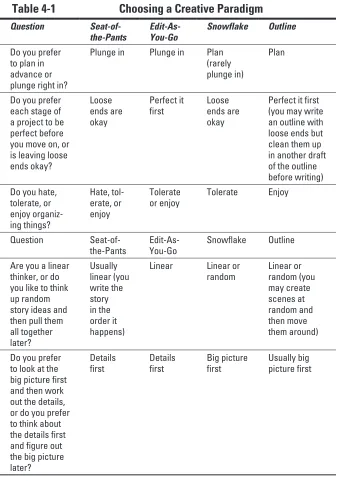
Writing without planning or editing ... 61
Editing as you go ... 62
Planning a little, writing a little ... 63
Outlining before you write ... 64
Finding a Creative Paradigm that Works for You ... 65
Understanding why method matters ... 66
Developing your creative paradigm ... 67
Using Your Creative Paradigm to Find Your Story Structure ... 69
Chapter 5: Managing Your Time . . . and Yourself . . . .71
Finding Time to Write ... 71
Establishing and sticking to a writing goal — for this week and this year ... 72
Setting Up Your Ideal Writing Space ... 75
Securing the best writing surface ... 76
Finding the right chair ... 76
Choosing a computer (if you want to use one) ... 77
Putting everything in place ... 78
Dealing with Distractions ... 79
Looking at Money Matters ... 80
Budgeting money for writing ... 81
Making your living as a writer: Don’t expect this to be your day job (yet) ... 82
Part II: Creating Compelling Fiction ... 85
Chapter 6: Building Your Story World: The Setting for Your Story. . .87
Identifying the Parts of a Story World ... 88
Creating a Sense of Place ... 89
Making description do double duty ... 90
Fitting description in the story ... 91
Weaving emotive force into your descriptions ... 92
Deciding What Drives Your Cultural Groups ... 93
Revealing cultural drivers with immediate scene ... 93
Exposition: Explaining cultural drivers through narrative summary ... 94
Combining various elements to show cultural drivers ... 95
Choosing the Backdrop for Conflict ... 95
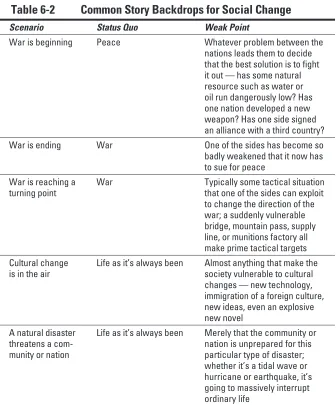
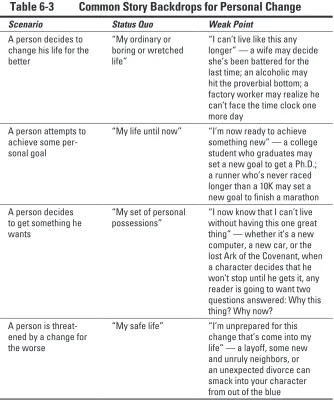
Defining your backdrop ... 95
Defining your story question ... 98
Story World Examples from Four Well-Known Novels ... 98
Pride and Prejudice ... 98
The Pillars of the Earth ... 99
Patriot Games ... 100
Ender’s Game... 101
Researching Your Story World ... 102
Identifying what you need to know about your story world ... 102
Knowing how much research is enough ... 104
Being Able to Explain Your Story World to Sell Your Book ... 106
Chapter 7: Creating Compelling Characters . . . .107
Defining Roles: Deciding Who Goes in Your Novel ... 107
Backstory: Giving Each Character a Past ... 109
Understanding why backstory matters... 109
Creating your character’s backstory... 110
Motivation: Looking to Your Character’s Future ... 112
Values: Core truths for your character ... 113
Ambitions: Getting abstract, or why Miss America wants “world peace” ... 115
Story goals: Your story’s ultimate driver ... 115
Establishing your character’s motivation ... 117
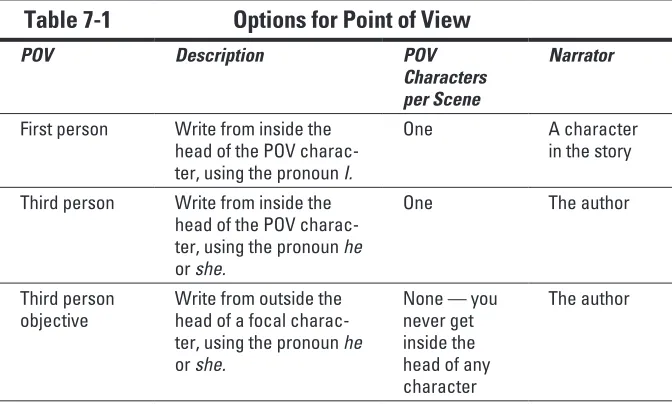
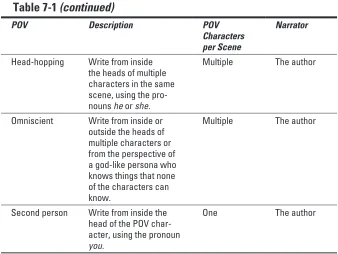
Point of View (POV): Getting Some Perspective on Character ... 121
First-person POV ... 122
Third-person POV ... 124
Objective third-person POV ... 125
Head-hopping POV... 126
Omniscient POV ... 127
Second-person POV ... 128
Choosing between Past and Present Tense ... 129
Revealing Your Characters to the Reader ... 131
Chapter 8: Storyline and Three-Act Structure:
The Top Layers of Your Plot . . . .135
Giving the Big Picture of Story Structure: Your Storyline ... 135
Understanding the value of a storyline ... 136
Writing a great storyline ... 137
Examples: Looking at storylines for 20 best-selling novels ... 140
Three-Act Structure: Setting Up Three Disasters ... 145
Looking at the value of a three-act structure ... 145
Timing the acts and disasters ... 147
Introducing a great beginning ... 148
The end of the beginning: Getting commitment with the first disaster ... 148
Supporting the middle with a second major disaster ... 149
Leading to the end: Tackling the third disaster ... 150
Wrapping up: Why endings work — or don’t ... 151
Summarizing Your Three-Act Structure for Interested Parties ... 153
Examples: Summarizing The Matarese Circle and Pride and Prejudice ... 153
Describing your own three-act structure ... 155
Chapter 9: Synopsis, Scene List, and Scene:
Your Middle Layers of Plot . . . .157
Deciding Which Order to Work In ... 157
Writing the Synopsis ... 158
Taking it from the top: Fleshing out your three-act structure ... 159
Bottoms up! Building around sequences of scenes ... 160
Knowing how much detail you need ... 161
Developing Your Scene List ... 163
Top-down: Fleshing out your synopsis ... 163
Bottom-up: Summarizing your manuscript ... 164
Example: A scene list of Ender’s Game ... 165
Extending your scene list ... 167
Setting Up the Structure of Individual Scenes ... 167
Setting the proactive scene ... 168
Following up with the reactive scene ... 170
Coming full circle with your scenes ... 173
Scene structure in Gone With the Wind ... 173
Scene structure in Patriot Games ... 174
Chapter 10: Action, Dialogue, and More:
The Lowest Layer of Your Plot . . . .177
Using Seven Core Tools for Showing and Telling ... 178
Action ... 179
Dialogue ... 180
Interior emotion ... 183
Interior monologue ... 184
Description ... 186
Flashback ... 189
Narrative summary and other forms of telling ... 192
The Secret of Showing ... 194
Sorting it all out ... 194
Understanding the two kinds of clips ... 196
Writing public clips ... 197
Writing private clips ... 197
Putting cause and effect together ... 199
Chapter 11: Thinking Through Your Theme . . . .203
Understanding Why Your Theme Matters ... 203
Looking at why writers include themes in their novels ... 204
Examining the features of a theme ... 205
Example themes for 20 novels ... 205
Deciding When to Identify Your Theme ... 209
Finding Your Theme ... 210
Faking it till you make it ... 210
Reading your own novel for the first time ... 211
Listening to your characters ... 212
Using test readers ... 212
Must you have a theme? ... 212
Part III: Editing and Polishing Your
Story and Characters ... 215
Chapter 12: Analyzing Your Characters . . . .217
The High-Level Read-Through: Preparing Yourself to Edit ... 218
Developing a Bible for Each Character ... 219
Physical traits ... 221
Emotional and family life ... 221
Intellectual and work life... 222
Backstory and motivation... 222
Psychoanalyzing Your Characters ... 223
Are values in conflict? ... 223
Do the values make sense from the backstory?... 224
Does ambition follow from values? ... 226
Will the story goal satisfy the ambition? ... 227
The Narrator: Fine-Tuning Point-of-View and Voice ... 228
Does your POV strategy work? ... 228
Have you chosen the right POV character? ... 232
Is your POV consistent? ... 233
Does your character have a unique voice? ... 233
Fixing Broken Characters ... 234
Boring characters ... 234
Shallow characters ... 234
Unbelievable characters ... 235
Unlikeable characters... 236
Chapter 13: Scrutinizing Your Story Structure . . . .239
Editing Your Storyline ... 240
Removing all unnecessary weight ... 240
Keeping your characters anonymous ... 241
Staying focused ... 241
Cutting down some example storylines ... 241
Testing Your Three-Act Structure ... 244
What are your three disasters? ... 246
Are your acts balanced in length? ... 247
The beginning: Does it accelerate the story? ... 248
The first disaster: Is the call to action clear? ... 249
The second disaster: Does it support the long middle? ... 250
The third disaster: Does it force the ending? ... 252
The ending: Does it leave your reader wanting to tell others? .... 253
Scene List: Analyzing the Flow of Scenes ... 255
Rearranging your scenes ... 255
Foreshadowing: Planting clues to prepare readers ... 256
Chapter 14: Editing Your Scenes for Structure . . . .259
Triage: Deciding Whether to Fix, Kill, or Leave a Scene Alone ... 260
Identifying ailing scenes ... 260
Evaluating a scene’s chances of recovery ... 261
Fixing Proactive Scenes ... 262
Imagining a proactive scene: The Day of the Jackal ... 262
Checking for change ... 263
Choosing a powerful goal ... 263
Stretching out the conflict ... 264
Desperately seeking setbacks ... 265
Examining the final result ... 266
Fixing Reactive Scenes ... 267
Imagining a reactive scene: Outlander ... 267
Checking for change (again) ... 268
Fitting the reaction to the setback ... 268
Working through the dilemma ... 269
Coming to a decision ... 270
Coming to the final result ... 270
Killing an Incurable Scene ... 271
Chapter 15: Editing Your Scenes for Content . . . .273
Deciding Whether to Show or Tell ... 274
Knowing when clips, flashbacks, or telling techniques are most appropriate ... 274
Following an example of decision-making ... 275
A Good Show: Editing Clips ... 277
Guidelines for editing clips ... 278
Fixing mixed clips ... 279
Fixing unintentional head-hopping ... 280
Fixing out-of-body experiences ... 282
Fixing cause-effect problems ... 283
Fixing time-scale problems ... 284
Getting In and Out of Flashbacks ... 286
Editing Telling ... 287
Tightening text and adding color... 288
Knowing when to kill a segment of telling ... 289
Part IV: Getting Published ... 291
Chapter 16: Getting Ready to Sell Your Book:
Polishing and Submitting . . . .293
Polishing Your Manuscript ... 294
Teaming with critique buddies ... 294
Working with freelance editors ... 296
Hiring freelance proofreaders ... 297
Looking at Three Common Legal Questions ... 298
Deciding between Traditional Publishing and Self-Publishing ... 299
Understanding how traditional publishers work ... 299
Understanding how self-publishing works ... 301
Beware the vanity publishers! ... 302
Our recommendation ... 303
First Contact: Writing a Query Letter ... 303
Piecing Together a Proposal ... 306
Deciding what to include ... 306
Your cover letter: Reminding the agent who you are ... 307
Your title page ... 307
The executive summary page ... 308
Market analysis: Analyzing your competition ... 309
Your author bio ... 309
Character sketches ... 310
The dreaded synopsis ... 311
Your marketing plan ... 311
Your writing, including sample chapters (or whole manuscripts!) ... 312
Chapter 17: Approaching Agents and Editors . . . .315
Defining the Roles of Agents and Editors ... 315
Finding the Best Agent for You ... 316
Deciding whether you need an agent ... 316
Doing your homework on agents first ... 317
Contacting agents to pitch your work ... 320
Editors, the Center of Your Writing Universe ... 322
Targeting a publishing house ... 323
Choosing which editor to contact ... 324
Contacting editors directly ... 324
Part V: The Part of Tens ... 327
Chapter 18: Ten Steps to Analyzing Your Story. . . .329
Step 1: Write Your Storyline ... 330
Step 2: Write Your Three-Act Structure ... 330
Step 3: Define Your Characters ... 331
Step 4: Write a Short Synopsis ... 332
Step 5: Write Character Sketches ... 332
Step 6: Write a Long Synopsis ... 332
Step 8: Make Your Scene List ... 333
Step 9: Analyze Your Scenes ... 334
Step 10: Write and Edit Your Story ... 335
Chapter 19: Ten Reasons Novels Are Rejected . . . .337
The Category Is Wrong ... 338
Bad Mechanics and Lackluster Writing ... 339
The Target Reader Isn’t Defined ... 339
The Story World Is Boring ... 340
The Storyline Is Weak ... 340
The Characters Aren’t Unique and Interesting ... 341
The Author Lacks a Strong Voice ... 341
The Plot Is Predictable ... 342
The Theme Is Overbearing ... 343
The Book Fails to Deliver a Powerful Emotional Experience ... 343
S
o, you want to write a novel? Great! Writing a novel is a worthwhile goal. It’ll challenge you, stretch you, and change you. Getting it published will gain you respect from your family and friends, and it may even earn you a bit of fame and money.But respect, fame, and money aren’t the only reasons for writing a novel. The only reason you need to give for writing a novel is that you want to write a novel. Don’t let anyone bully you by demanding some better reason; there isn’t one.
Whatever your reason, Writing Fiction For Dummies can help you make the leap from writer to author. You can write a powerful novel. You can get it published. And you can be the author you’ve always wanted to be.
About This Book
Writers like to think of themselves as artists, and rightly so; writing fiction is an art form. But artistic talent is not enough. Writing fiction is also a craft — a set of practical skills you can learn. This book is about teaching you the craft of writing fiction so that your art can shine through. So if you’re a budding novelist, then we wrote this book specifically for you. This book teaches you the craft you need, shows you how to edit yourself, and takes you through the process of getting published.
If you’re more advanced than a beginning writer, that’s great! You’ll find some parts of this book obvious. We hope to surprise you with some fresh insights, though, so stay alert. We’ve found that even published novelists are sometimes weak in certain areas. Our aim is to give you a solid foundation in every aspect of writing fiction.
As you build your craft, remember that every rule we mention in this book can be broken. Every rule. If we sometimes sound horribly dogmatic on some of the rules, it’s because they’re almost always true. When we sound less cer-tain with a rule, it’s because it’s true more often than not. The one unbreak-able rule of fiction writing is that no rule is unbreakunbreak-able — you should use whatever works.
Conventions Used In This Book
We use the following conventions throughout the text to make everything consistent and easy-to-understand:
✓ All Web addresses appear in monofont.
✓ New terms appear in italics and are closely followed by an easy-to-understand definition.
✓ Bold text indicates keywords in bulleted lists or highlights the action parts of numbered steps.
The English-speaking world is still trying to sort out how to deal with generic pronouns. In the bad old days, he was understood to refer to both men and women, which never made sense, but it was the standard. Now there is no standard. Replacing he with they is awkward, so in most cases, we try to use
he and she in roughly equal numbers.
Because more fiction readers are women than men, we often tilt toward using
she when referring to the reader. Because a great many editors are women, we often use she for editors and he for agents, but we’re not consistent. We try to mix up the he and she usage when referring to characters. Forgive us if we don’t get our pronouns quite even. We tried, and anyway we know you’re smart enough not to be confused.
What You’re Not to Read
Foolish Assumptions
Every author writes with an ideal reader in mind. Here are some things we assume about you:
✓ You want to get published. You’re a creative person, but you intend to act like a professional right from the start. You’re willing to do unglamorous tasks, like researching your category and target audience, because you know that fiction writing is a business, not just an art.
✓ You want to write a novel. This book focuses on writing novels, which typically run 60,000 words or more. If you prefer to write short fiction, the information on craft applies, but you’ll create a simpler plot and use fewer characters. If you want to write a screenplay, you’ll find all the informa-tion on story world, characters, structure, plot, and theme valuable, but we don’t discuss the formatting you need to know for screenwriting, and we don’t tell you how to sell your screenplay (you can find that kind of info in Screenwriting For Dummies, by Laura Schellhardt [Wiley]).
✓ You recognize that fiction is a big tent with many different opinions on what’s good and what isn’t. In this book, we give you broad guide-lines that apply to most kinds of fiction, but there are no rules that apply everywhere and always for all writers. You’ll strongly disagree with us sometimes, but you’re smart enough to take the advice that works for you and ignore the rest. You know that many other writers will find the advice you reject useful.
✓ You want to figure out how to tell a great story rather than how to fix grammar and punctuation. You already have a good handle on gram-mar, or you know where to find the help you need (perhaps you plan to enlist your grammar-guru friends, consult Geraldine Woods’s English Grammar For Dummies [Wiley],or hire a freelance proofreader). When you do break grammar rules, you claim artistic license and do it on purpose.
How This Book Is Organized
Part I: Getting Ready to Write Fiction
A little planning can go a long way. We believe strongly in strategic thinking — setting goals, defining story, choosing a category, developing a creative style, researching your novel, and getting the right tools. If you need help in strate-gic planning for your next novel, check out this part and see whether you can find some ideas you’ve never seen anywhere else.
Part II: Creating Compelling Fiction
Writing fiction is about giving your reader a powerful emotional experience. To do this, you need to master several main aspects of fiction, including cre-ating a great story world, constructing believable characters, building a well-structured plot, and overlaying it all with a theme. These are your core skills, and this part gives you step-by-step guides for developing them. After you’ve mastered this part, you’ll have all the tools you need to write the first draft of your novel.
Part III: Editing and Polishing Your
Story and Characters
After you have a first draft, you need to edit it to a high polish. Editing isn’t hard, but you need a strategic and tactical plan to help you analyze your characters and your plot. This part shows you how to ask the right questions of your manuscript and how to use your answers to rework your story. We give you many practical tips for editing your manuscript from top to bottom.
Part IV: Getting Published
With an excellent manuscript in hand, you’re ready to take it out to the world and knock ’em dead with your story. You’ll want to get a second opinion, of course, but after you’ve been through that, you’re ready to find out about editors and agents. Don’t be terrified of these folks — they’re looking for writ-ers (like you) with great stories. If you have what they need, they’ll become your instant lifelong friends.
Part V: The Part of Tens
This part contains some quick resources on two subjects of undying interest: Ten steps to designing your story and ten reasons people in the publishing business reject novels.
Icons Used in This Book
To make this book easier to read and simpler to use, we include some icons in the margins that can help you find and fathom key ideas and information.
Tips provide advice that’s short and easy to remember that you can use right away.
This icon marks a writing exercise that you should do to move forward on your novel.
Remember icons flag advice you’ll come back to again and again over the years.
This icon indicates a warning note about some special hazard that you should avoid.
The True Story icon marks anecdotes that illustrate what we’re talking about.
Where to Go from Here
Fiction Writing Basics
In This Chapter
▶ Setting your sights on publication
▶ Getting your head ready to write
▶ Writing great fiction and editing your story
S
o you want to write a novel? Great! But is that all you want to do? After all, anybody can type a bunch of words and call it a novel. The trick is writing one that’s good enough to get published. This book is for fiction writ-ers who want to write an excellent novel and get it published. That’s a tough, demanding goal, but it’s entirely doable if you tackle it intelligently.If you’re going to write a novel, you need to get your head fully into the game. That means making a game plan that’s a proven winner and then executing your game plan. After you have a plan, you need writing (and rewriting) skills — lots of them. Writing fiction means developing a raft of technical skills, both strategic and tactical. None of these steps are hard, but they’re a lot easier to pick up when you have some guidance.
After you’ve written a great novel, whether you choose to get an agent or make the deal yourself, selling a strong story is about making the right con-nections with the right people at the right time.
Five urban legends that can hurt you
As soon as you admit to your family and friends that you’re working on a novel, they’ll start feed-ing you all kinds of urban legends about writfeed-ing. These are things that “everybody knows,” and yet they’re dead wrong. Wrong or not, they can kill your career before it gets rolling. Here are some of the urban legends we’ve heard, along with answers you should have ready:
✓ Legend 1: You’re not smart enough to write a novel. How smart do you have to be to write a novel? How do you know? What does IQ have to do with writing fiction? The fact is that the main thing any novelist needs is the ability to tap into her own emo-tional wellsprings and create a story that can move her readers. We know plenty of novelists, and they run the gamut on intelli-gence from average to ultra-high. But every one of them is a person we’d be happy to be stranded with on a desert island for long periods of time. Fiction writers are excep-tionally honest people who don’t balk at telling their own inner truths. If you can do that, you can write fiction.
✓ Legend 2: You’re not talented enough to write a novel. What is talent? Does any-body know how to measure talent? What if talent is something you grow, not some-thing you inherit? The fact is that writing fic-tion requires quite a few skills. We’ve never met anyone who had all those skills when they started writing. Every single published novelist we know spent long hours learning the craft of fiction. They all had one thing in common: persistence. We have no idea what talent may be, but we do know sistence when we see it. If you have per-sistence, you have as good of a chance of getting published as anyone else.
✓ Legend 3: You have nothing to write about.
Is there only one kind of novel that you can write? Do all novelists have to come from New York City? Do they all have to be trendy and cool? Why? If you’ve lived long enough to be able to type, you have something to write about. If you’ve ever known fear, joy, rejection, love, rage, pleasure, pain, feast, or famine, then you have plenty to write about. If you’ve survived a miserable childhood or a wretched middle school or a toxic relation-ship — if you’ve been to hell and back — then you have enough material to write about for your whole career. If your life has been one long happy stream of nicey nirvana from beginning to end, then you’ll need to work a little harder, but you should still be able to scrape a story out of that.
✓ Legend 4: You have to know people to get a novel published. Who knew Stephen King before he got published? Who knew Tom Clancy? Who knew J. K. Rowling? If you have great writing in your pocket, you’ll get to know people quick enough. All you have to do is show around what you have, and the right people will find you. Yes, really. Great writing trumps great connections every time.
Setting Your Ultimate Goal As a Writer
If you’re writing a novel, don’t be modest about your goals. First of all, you want to write a really good novel, right? You aren’t in this game to write a piece of schlock. You have some talent, and you have a story, and you want to write it well.
Second, you want to get the darned thing published. Don’t hang your head and say, “I’ll be happy just to get it written.” Write to get published. Humility is a fine thing, but false humility can keep you from doing the one thing you really want to do.
Do this right now:
1. Take a piece of paper and write down these words:
“I’m going to write a novel and get it published. I’m going to do it because writing a novel is worthwhile and because I have the talent to do it. I’m going to do it because I have something impor-tant to say to the world. I refuse to let anything get in my way.”
2. Put today’s date at the top and your signature at the bottom.
Hang it where you can see it every day, and tell your family and friends about it.
As of this moment, you’re a writer. Don’t be ashamed to say so. On the happy day when you get your novel published, you’ll be an author.
It’s all too common for a writer to say (hanging head in shame), “I’m an unpub-lished writer.” Banish that word unpublished from your vocabulary. You are a writer. Call yourself a writer, whether you’ve been published or not.
Randy’s path to publication
Back in 1988, Randy decided that he was going to write a novel and get it published someday. Never mind why — just because. He started writing that novel, and about a year later, he’d
written enough that he felt ready to go to a writing conference. He met some other writers there, got some great training, and joined a cri-tique group.
(continued)
Another year passed, and Randy’s skills were developing. At a certain point, he realized that the novel he’d been working on for more than two years was fatally flawed. He put it in the drawer and never looked at it again, but he didn’t abandon the vision. The goal was not to get that novel published; the goal was to get some novel published. Randy kept writing, worked hard, and after a couple of more years, he finished a novel.
He then began looking for an agent. Meanwhile, he began writing the next book. Within a year or so, he met an agent at a writing conference and within a few months signed an agreement for literary representation with him. The agent submitted the manuscript to a number of likely publishers. Randy kept writing.
One by one, every publisher on the list rejected Randy’s manuscript. The agent submitted it to more publishers and resubmitted it to some publishers who’d rejected it but seemed inter-ested. One of the publishing houses eventually rejected it three times. Randy kept writing. The last publisher on the list saw some merit in Randy’s work. The publishing committee looked at the manuscript for several months — and then rejected it. However, they took the time to point out three major problems that prevented them from buying the work. Randy’s agent called him with the news that the novel was dead. He also explained to Randy the publisher’s three concerns.
That day, Randy began working on a new novel, one that didn’t have any of those problems. This time, he felt sure, he had a winner. This one
would be the novel that got published. His agent liked the idea and told him to pursue it. Randy kept writing.
Three months later, the agent died. Randy was devastated. He’d now been writing for eight years. He’d completed a novel, done his best to sell it, had it rejected everywhere, and then lost his champion. He kept writing.
Shortly thereafter, Randy went to a writing con-ference and made an appointment to talk with an editor he’d never met before. He stumbled through his pitch, making a perfect hash of it. Finally, the editor asked to see a writing sample. Randy pushed five pages across the table, and the editor skimmed over them. “You write pretty well,” he said. “Here’s my card. Send me a pro-posal and 100 pages.”
A year and a half later, without an agent, Randy sold that novel to that editor’s publishing house. The novel appeared in the spring of 2000, 12 years after he started writing. At last, he was an author. That novel, Transgression, went on to win a Christy Award, and Randy went on to write several more award-winning novels. He became well-known enough that conferences began asking him to teach.
Pinpointing Where You Are As a Writer
Now that you’ve set your goal — to write a novel good enough to get pub-lished — we can talk strategically about how to get there. It won’t be easy, but it will be straightforward, so long as you do things in the right order.
We’ve identified four stages in the life of most writers on the road to publica-tion. They’re analogous to the four years of college, so we like to call these stages freshman, sophomore, junior, and senior.
Please note that these stages may take more or less than a year to work through. We’ve seen a writer go from sophomore to senior in less than a year. Randy is pretty sure he was stuck as a junior for about eight years. If he’d had a coach, he could’ve zipped through that painful junior stage in about a year. That’s why he takes such joy in coaching writers.
This section looks at those four stages and explains how you can advance to the next level.
Freshmen: Concentrating on craft
Freshman writers are new to the game, and that’s okay. Every Ph.D. was a freshman in college at one time, and every author was a freshman writer at one time. It’s one step along the path. Typically, freshman writers have been reading fiction all their lives, and at last they’ve decided to start writing a novel. They write a few chapters and then discover an unpleasant truth: This fiction-writing game is harder than it looks.
Some freshmen give up at that point, but those who persist decide to get some training in the craft of writing fiction. They read books, take courses, join critique groups, and maybe go to a writing conference. Most importantly, they keep writing.
At first, freshmen writers feel like nothing is happening — those miserable critique partners never seem to be satisfied, and new flaws seem to pop up before they solve the old ones. But persistence pays off. Eventually, after months of hard work, freshmen writers wake up one day to a surprising truth: They’ve gotten better. They’ve gotten a whole lot better.
A freshman advances by writing and by getting it critiqued and by studying the craft of fiction and by writing some more.
Sophomores: Tackling the proposal
Sophomore writers have been writing for a good while, and they’re no longer rank newbies. The other writers in their critique group are telling them, “That’s pretty good. You’ve made a lot of progress.”
A sophomore has generally taken at least one course on writing or has read several books on writing. A sophomore has almost always gone to at least one writing conference. He or she is starting to feel pretty confident. This writing game no longer seems hopeless. The craft of fiction is no longer a mystery.
But one thing is still an enigma: By now, a sophomore has heard how hard it is to break into publishing. There’s a thing called a book proposal that needs to get written, but who knows what that’s supposed to look like? And it requires a dreaded synopsis, and that sounds too ghastly for words. And how are these things related to a query letter? Typically, a sophomore feels a mix of confidence and terror: A growing confidence in craft, a rising terror of marketing. (If you’re curious about query letters, synopses, and proposals, see Chapter 16.)
Retreating into defeatism here is easy, but that way lie dragons. The winning strategy is to keep writing — advancing in craft — but now to begin figur-ing out how to market yourself effectively. Writfigur-ing marketfigur-ing materials like a query, a synopsis, and a proposal is a skill that no novelist can afford to ignore.
Go home and rework that proposal. And then do it again. And again. Sooner or later, you’ll find that by some magic, you have a terrific proposal to go along with your excellent writing. You’ll be a junior.
A sophomore advances by writing, by studying how to write a proposal, by writing that first practice proposal, and then by testing the proposal at writing conferences.
Juniors: Perfecting their pitches
Juniors are excellent writers. They’ve mastered most of the skills they need to get published. Their critique partners are saying, “Why aren’t you pub-lished yet?”
A junior has typically taken a proposal or a sample chapter to a conference, showed it to an editor or an agent, and heard the magic words, “Send that to me.” The junior has also heard back a few months later with the news, “Your work isn’t right for me.”
Can’t wait! Practicing your proposal
Does a novel need a nice, long proposal to be sold to a publisher, or is a short synopsis good enough? Most writers Randy knows always prepare and submit full proposals, even to pub-lishers that they’ve worked with frequently. The agents Randy knows all insist on receiving a proposal before agreeing to represent an author, and most of them use proposals in submitting potential novels to publishers. One editor says that she loves proposals because they help her get ready to take a project to her committee. Randy insists that figuring out how to write a proposal is a highly valuable exercise for any writer. Many writers of commercial fiction need them, and this is becoming even more true as publishers find the economic screws
tightening — they need to know that the proj-ect has a good chance to sell well.
The junior year can be frustrating, humiliating, and depressing. It can be exhilarating beyond words at the same time. The junior period carries great highs and great lows, but you get through it if you persist.
If you’re a junior, then you need to be writing, writing, writing — perfecting your craft. You also need to be polishing proposals and pitching them, pref-erably in person at writing conferences.
It’s quite possible that you’ll find an agent late in your junior year. Or you may hear from an editor that your book is under review by the publishing committee. Or a published author may read some of your work and tell you that you’re almost there. If any of these things happen, you can be quite con-fident that you’ve become a senior.
A junior advances by striving for perfection in craft, by polishing proposals, and by pitching projects to live agents or editors.
Seniors: Preparing to become authors
Seniors are those chosen few who are destined to get published. This is clear to everyone — their critique buddies, their family, their friends, their agent. But it doesn’t always feel that way to the senior.
Your senior period can be supreme agony. You are that close to getting published. You know in your gut that you write better than many published authors. In a just universe, you ought to be published. So why aren’t you?
The answer is that you just haven’t found the right publisher with the right project at the right time. Making that connection takes time: the time you spend as a senior. Any senior could be published at any time.
Your action plan as a senior is simply to follow the process. By this time, you must have a very polished complete manuscript and a strong proposal. Get your work out to editors (or better yet, have your agent get your work out). Keep getting it out, ignoring the rejections. It only takes one yes to get pub-lished. Keep looking for that yes.
Someday — this usually happens on a miserable day when the car’s had a flat tire, or when the washing machine has leaked soapy water all over the floor, or your 3-year-old son has decided to iron the cat — on a day like that, the phone rings. It’s your agent, calling to tell you that a publisher has made an offer on your novel. On that day, you suddenly forget all those years of striv-ing, rejection, and heartache. On that day, you’re an author.
A senior advances by ignoring rejections and continuing to submit a polished project until a publisher buys it.
Getting Yourself Organized
Most writers hate organization. We do, too. We probably hate it twice as much as you do, because there are two of us. However, we’ve found that we’re a whale of a lot more productive when we do a bit of organization first. It isn’t fun, but it makes the fun stuff easier.
It helps to know exactly what that fun stuff is, so in this book we begin (in Chapter 2) with a high-level look at why fiction is fun and why your reader wants to read your novel. What keeps your reader turning pages at 3 a.m. when the alarm is set for 6? We show you that secret and what you need to do to keep that reader up all night.
In Chapter 3, we discuss your niche and your genre. You can’t appeal to every reader ever born. But the good news is this: Neither can any other author. Some readers walking this planet may find you the best author they’ve ever read. You need to figure out what those readers look like and how you can best meet their needs. When you know that, you’re ready to write the perfect book for them.
You’re unique. That means that you’ll probably use methods different from your friends’ for getting the first draft of your story down on the page. Some authors (Peter, for example) love outlines. Most authors hate them. Our job is not to tell you the one best process to write your novel. Our job is to show you (and we do so in Chapter 4) a variety of roads to completion and to let you choose one that works for you — or better yet, to find a unique road that fits you perfectly.
Mastering Characterization, Plotting,
and Other Skills
Novice writers have great ideas. Great writers have great ideas and great craft. Your first task is to understand the craft you need to turn your great ideas into great stories. Here’s what you need:
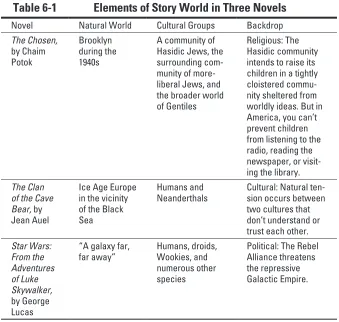
✓ Story world: Your novel doesn’t happen in a vacuum. It’s set some-where. That somewhere is usually called the setting or milieu, but we prefer the term story world because it’s the world in which your story takes place.
In Chapter 6, we show you what goes into constructing a great story world. It’s harder than it looks, but we give you a checklist of key con-cepts you need to nail down to have a fully defined story world. We also show you the most common backdrops that make a story world cry out for a story to fill it up with meaning.
✓ Characters: Your characters have a past, a present, and a future, and you need to know each of these. In Chapter 7, we show the ideas that go into building a believable backstory for each character. And we show why backstory is essential for knowing the possible futures of your char-acters. Finally, we show you how the past and the future intersect in the present — right now — to create a compelling story that moves (and moves your reader).
✓ Plot: The typical modern novel has a plot that contains six layers of structure, ranging from the 100,000-foot view all the way down to the up-close-and-personal view. As a novelist, you need to master each of these six layers and put them together into a harmonious story. In Chapters 8 through 10, we coach you through each level.
✓ Theme: Every novel has a core idea — a theme. The twin hazards of theme are to put in either too little or too much. Go to Chapter 11 to see how to find your theme by listening to your characters. We also show you what to do to fix the most common problems.
Editing Your Fiction
You can’t depend on your editor to fix your novel. Modern editors are vastly overworked and underpaid. When you hand them your masterpiece, it needs to be burnished to a brilliant shine already.
Editing your fiction is hard work, but it’s not a hard idea. It comes down to two primary tasks:
✓ Reworking your characters so that they come fully alive
✓ Revising your storyline at all six layers of plot
In Part III of this book, we tell you what you need to do and show you how to do it. In Chapter 12, you find out about character bibles, backstory, values, ambitions, story goals, and most importantly, the subtleties of point of view (POV). And in Chapter 13, we show you how to create a hook for your story that will be the number one sales tool at every link in the seven-point sales chain that comes between you and your masses of readers. We teach you Aristotle’s three-act structure, but we add to it a three-disaster structure that Aristotle never dreamed about.
What Makes a Great Story?
In This Chapter
▶ Satisfying your goals and those of your readers
▶ Writing about change
▶ Understanding the five pillars of fiction
▶ Using the seven core tools of the fiction writer
Y
our readers desperately want one thing from you when they pick up your novel: a powerful emotional experience. Readers want to feel something, and they want to feel it deeply and fully. If you fail to deliver that emotional punch, you lose, no matter how clever your story or charming your characters.But assuming you deliver what readers want, you also have the freedom to give them more — possibly much more. It’s up to you to decide what else you want to give, if anything.
Choosing What to Give Your Readers
Why do you write? We’ve asked many writers over the years what drives them to write fiction. We’ve heard zillions of different answers. Here are six of them:
✓ To see my name on a book cover
✓ To be a famous author
✓ To make lots of money
✓ To educate people
✓ To entertain my readers
✓ To persuade people to accept my views on politics or religion
These are all fine reasons to write a novel. Your reasons for writing are your reasons for writing. You don’t have to justify them to anybody. But it’s impor-tant to know what they are. Otherwise, how will you know whether you’re succeeding?
Take a few minutes right now and write down why you want to write fiction. What do you hope to get out of it? What do you want to do for your readers? On the same sheet of paper, write down the reasons you read. Circle the one that’s most important to you. If you’re like most readers, the main reason you read is to have fun — to be entertained.
In this section, we discuss how novels can educate, persuade, and, above all, entertain readers.
Creating a powerful emotional experience:
What your readers desperately want
What is entertainment? After writing and teaching fiction for many years, we’re convinced that entertainment can be boiled down to one thing: giving the reader a powerful emotional experience. Here we unpack this concept a little:
✓ Why emotions matter: Emotion is common to all fiction. Think about any of the major genres of fiction, and you see that each of them packs some sort of emotive punch:
• Romance novels and erotica deliver some combination of love and
• Suspense novels, thrillers, action-adventure novels, and horror
fiction all deliver various flavors of fear.
• Mysteries arouse a strong sense of curiosity and usually deliver a
healthy dose of fear.
• Historical novels, fantasy, and science fiction all give the reader an
experience of being “elsewhere.”
• General fiction and literary fiction can deliver any of the preceding
emotions, along with a strong sense of feeling understood.
✓ Why emotions must be powerful: Think about that for five seconds. Do you know anyone who ever bought a novel in the hopes that it would deliver an insipid emotional experience? Of course not! Powerful emo-tions make stories more enjoyable and memorable. Most people want excitement when they read a novel. They want a lot of excitement. Boatloads of it. If your readers want it, that’s all the reason you need for giving it.
✓ Why the experience is critical: Your readers don’t want to read about somebody else having powerful emotions. That’s actually rather dull. Imagine spending hours of your life watching somebody you don’t know crying or shivering in terror or kissing somebody you’ve never heard of. That’s boring.
Your readers want to become somebody else for a few hours, to live an exciting life, to find true love, to face down unimaginable terrors, to solve impossible puzzles, to feel a lightning jolt of adrenaline. Give them that, and you’ll earn fans for life. Give your readers anything else, and you’ll lose them forever.
The rest of this book has one goal only: to teach you — as simply and as quickly as possible — how to give your reader a powerful emotional experi-ence. Nothing matters more.
Educating your reader
Virtually all historical fiction has some educational value if the author has done his research well. James Michener is famous for fact-packed novels that let his readers painlessly discover vast amounts of historical information. Jean Auel’s Clan of the Cave Bear series comes loaded with lore about life in Ice Age Europe. Likewise, many science fiction novels teach all sorts of things about science and engineering. If you really want to know about Mars, one easy way to find out about it is to read Kim Stanley Robinson’s brilliant series
Red Mars, Green Mars, and Blue Mars.
Readers who love military suspense and technothrillers enjoy finding out about the latest military hardware and technology. Those who read Amish novels are intrigued by the Amish subculture. Fans of legal thrillers enjoy learning about the law. Police procedural buffs thrive on understanding how cops think. Educating your readers is perfectly fine, as long as you’re writing the kind of book where readers expect to learn something.
Don’t bore your reader. If you want to work in some information that you find fascinating, make sure it’s also fascinating to your reader. You do that by making it essential to the story. If your characters can’t survive unless they know the details of quark theory, then your reader will want all the quantum details. Remember, though, that you’re not writing a research paper.
Practicing the gentle art of persuasion
Many writers don’t merely want to teach their readers; they want to persuade them of something — often an economic or political or religious or ethical opinion. Many novels carry a strong message of some kind. For example
✓ Ayn Rand’s novels, such as Atlas Shrugged and The Fountainhead, make her case that a strong and unchecked capitalism is the finest economic system.
✓ Tom Clancy’s early military technothrillers show his conviction that the Soviet system was corrupt and would soon collapse under the weight of its own incompetence.
✓ The Left Behind series by Jerry Jenkins and Tim LaHaye presents a detailed and adrenaline-laced roadmap for the authors’ beliefs about Biblical end-times prophecy.
Each of these authors found many readers who agreed strongly with their messages. Each of them has been criticized for preaching their messages too fervently. Yet each of them succeeded in persuading numbers of “nonbeliev-ers” to change their minds.
A novel can persuade some readers if it’s also entertaining, but it’s most likely to find its main audience among those who already believe and who enjoy having their beliefs reinforced. Nobody ever bought a novel because they wanted to change their economic theories, switch political parties, or convert to a new religion. Nobody.
Respect your readers by first meeting their need for a powerful emotional experience. You can never persuade readers unless you first entertain them.
Decide what your goals are for your fiction. Besides entertaining your reader, what else do you want to achieve? Does your mission include educating readers? Persuading them? Something else? Will these goals undercut the reader’s powerful emotional experience?
Making Life Hard on Your Characters:
Conflict Plus Change Equals Story
A story consists of characters in conflict. Your characters want some sort of change in their lives, a change that (for most of the novel) they can’t have. The change may be
✓ A change in the relationships of the characters
✓ A change within a single character
✓ A change in the story world (setting)
Always, always, always make your characters want something to change in their lives. The desire for change is what makes your reader invest emotion-ally in your story. Readers would love to change their own lives, so they respect anyone willing to risk making a change. But you can’t make things easy on your characters. The minute they try to change things, conflict sets in. That’s bad for the characters, but it’s good for your story. The more conflict your characters face, the more emotion your reader invests into them. Your story is an account of how your characters deal with conflict in pursuing change.
If your lead characters get the change they want by the end of the story, that’s usually a happy ending. If they don’t get the change they want by the end of the story, that’s usually an unhappy ending. (We say usually because in either case, your characters may realize at the end of the story that they didn’t really want what they thought they wanted. But that, too, is a change — a change in mental attitude.)
What makes a great story great? That’s a complex question, but part of a story’s greatness comes from the depth of the change your character is pursu-ing. The power of Frodo’s story comes from the high stakes. If he wins, all the free races win; if he loses, so do they. The higher the stakes of the change, the more powerful your story.
The Five Pillars of Fiction
Fiction has five main elements, each of which helps you create a powerful emotional experience for your readers:
✓ Story world (often called setting or milieu)
✓ Characters
✓ Plot (which includes structure)
✓ Theme
✓ Style
Setting the stage: Your story world
We prefer the term story world to other common terms, such as setting or
milieu. These other words are excellent words, but we want a term that cap-tures the vastness of the stage for your novel. Your story world is all of the following and more:
✓ The universe or world where the story takes place
✓ The geography, including national boundaries
✓ The races of people, other intelligent beings, plants, and animals
✓ The historical context
✓ Political, economic, religious, and social structures
✓ Foods, drinks, and drugs
✓ Languages, entertainment methods, and sexual rules and roles
Some genres require enormously complex story worlds; others simply assume the story world of the reader. In either case, the author should know the story world inside out, because it determines what kind of story is possible. In this respect, story world sets constraints on what kind of powerful emotional expe-riences you can give your reader. A great story world greatly increases your chances of writing a great story.
Here are some examples of story worlds:
✓ The Lord of the Rings, by J. R. R. Tolkien, has Middle Earth as its story world. You could argue that Middle Earth is Tolkien’s finest creation.
✓ River God, by Wilbur Smith, takes place in 18th-century B.C.E. Egypt. Smith appears to have taken a lot of liberties with the actual history, but no matter. His story world is complete and dazzling.
✓ The Chosen, by Chaim Potok, is set in Brooklyn in the 1940s in a Hasidic Jewish neighborhood. Potok’s story world is close in space and time to modern America and yet worlds apart culturally.
✓ The Harry Potter series, by J. K. Rowling, is set in modern England but with one important change — some humans are genetically capable of magic. This single change enables Rowling to paint an epic battle between good and evil.
Creating characters
Characters are the players on the stage of your story. Each character comes into the story with a long and detailed past (known as a backstory). And each character is driven in some direction — he or she has abstract ambitions and concrete goals.
You can’t have conflict until you have characters. More importantly, your reader can’t have a powerful emotional experience without at least one char-acter. That powerful emotional experience comes when you weave such a convincing account of a character that your reader actually becomes that character. Your characters exist so that your reader can get inside the skin of one of them and do battle with the others.
Check out some examples of characters and their essential conflicts:
✓ Lizzie Bennet, in Jane Austen’s novel Pride and Prejudice, wants desper-ately to find a man of character with whom she can fall in love. But is that possible when her family seems determined to play the fool?
✓ Jack Ryan, the leading man in a number of Tom Clancy’s novels, is a CIA agent trying to do an excellent job in a world of bureaucrats. Can Jack win against foreign agents and terrorists, or will he be winged by his own side?
✓ Scarlett O’Hara, in Margaret Mitchell’s Gone With the Wind, wants to be the belle of the ball forever in a disappearing world of Southern gentility. Can Scarlett find her place when her world is changing in unspeakably horrible ways?
✓ Ender Wiggin is a young boy in Orson Scott Card’s novel, Ender’s Game. Ender hopes to be chosen as the military leader who will save humanity from the coming alien “buggers.” But can he survive the jealousy and hatred of his fellow students in Battle School?
Constructing the plot
Plot has several different layers, which we detail in Chapters 8 through 10. Each layer of plot is designed to elicit your reader’s emotions. Here, we give examples of four layers of plot and the emotions they evoke (two other layers are the synopsis and scene list):
✓ The highest layer of plot is a single-sentence summary of the story. In
The Hunt for Red October, by Tom Clancy, a Soviet sub captain tries to defect to the United States — bringing the latest low-noise submarine along with him. This one-sentence summary is designed to stir strong feelings of nationalistic pride in Americans.
✓ The next layer of plot is the famous three-act structure, which nor-mally contains a major disaster at the end of the first act, forcing the lead character to commit to the rest of the story. In Outlander, by Diana Gabaldon, a recently married English nurse accidentally time-travels from 1945 back to 1743 Scotland. Her goal to return to the future hits a huge roadblock when she’s forced to marry a charismatic and extremely attractive Scottish outlaw. This disaster commits the lead character into a stormy romance and is designed to make the reader feel maximum conflict between a woman’s love for her two very different husbands.
✓ One of the middle layers of plot is the scene, several pages of action that takes place at a single place and time. In a scene in The Pillars of the Earth, by Ken Follett, bandits steal a 12th-century English stonema-son’s pig. The mason, Tom, pursues and fights the bandits, but they get away with his pig — the winter’s food supply for his family. This disas-trous ending to the scene is designed to arouse in the reader a feeling of desperation in the face of starvation.
✓ The lowest layer of plot is the paragraph. In a fight sequence in Irwin Shaw’s novel Rich Man, Poor Man, a soldier punches a 16-year-old boy in a street brawl. The boy pretends pain from the ineffective blow and then responds with a devastating combination of jabs and punches. This action sequence covers just a few paragraphs and is designed to create in the reader a lurid fascination with a likeable young punk who loves to fight.
Formulating a theme
Every novel means something beyond the bare story that it tells. We call that deep meaning of your story the theme. Your theme does not have to be profound (by which we mean intellectually deep). It’s hard to pull pro-fundity out of your ear, so don’t make that your special burden in life. Your theme can be as simple as “everybody needs to be loved” or “life stinks” or “crime doesn’t pay.”
Your burden is to tell a great story, which means nothing more nor less than giving your reader a powerful emotional experience. You can and should try to make your theme emotionally deep. If it also happens to be intellectually deep, then that’s a plus.
Great novels typically probe emotionally deep themes. Consider two examples:
✓ In A Tale of Two Cities, Charles Dickens builds a powerful theme of redemption via self-sacrific