ABSTRACT
Purba, Hilarius Raditya Priambada. (2016). Sidang Akademi as a Strategy to Develop Speaking Confidence in Pangudi Luhur Van Lith Senior High School: A Case Study. Yogyakarta: Sanata Dharma University.
This research deals with the implementation of Sidang Akademi (Academic Preliminary Meeting) implemented in Pangudi Luhur Van Lith Senior High School. The aim of this study is to find out the implementation of Academic Preliminary Meeting as a strategy to develop speaking confidence.
The formulated problems of this study are: (1) How is Sidang Akademi (Academic Preliminary Meeting) implemented in Pangudi Luhur Van Lith Senior High School? and (2) How do the third-grade students in Pangudi Luhur Van Lith Senior High School develop their confidence in speaking English through the implementation of Sidang Akademi?
This research employed qualitative research design. The type of the research is specifically a case study. The researcher decided to have intrinsic case study as the focus was on the case. The participants of this study were eleven (11) students. In order to enhance the reliability, validity and trustworthiness, the researcher conducted research triangulation. In obtaining the research triangulation the researcher conducted observation and group interview as well as analysed the documents of the implementation. The processes of data gathering were accompanied by at least one co-facilitator to prevent the research bias. The researcher employed coding strategy and presented the data in a form of narrative description.
The result of the study presented that the implementation of Academic Preliminary Meeting as a strategy to develop speaking confidence worked well as the students improved their confidence through some strategies in presenting their materials. Moreover, the students realised that the speaking skill which was maintained through the implementation of Sidang Akademi could be beneficial to them in their future lives. Nonetheless, the students generated suggestions for the betterment of the implementation of Sidang Akademi. The elements of activity should be developed well so that the activity can be one of the best strategies in developing students’ speaking confidence.
ABSTRAK
Purba, Hilarius Raditya Priambada. (2016). Sidang Akademi as a Strategy to Develop Speaking Confidence in Pangudi Luhur Van Lith Senior High School: A Case Study. Yogyakarta:Sanata Dharma University.
Penelitian ini berisikan mengenai pelaksanaan Sidang Akademi (Academic Preliminary Meeting) yang dilaksanakan di SMA Pangudi Luhur Van Lith. Tujuan dari penelitian ini adalah untuk mengetahui pelaksanaan kegiatan Sidang Akademi sebagai strategi untuk mengembangkan kepercayaan diri dalam berbicara dan pengembangan kepercayaan diri siswa dalam berbicara melalui pelaksanaan kegiatan tersebut.
Masalah yang dirumuskan dari penelitian ini adalah: (1) Bagaimana Sidang Akademi (Academic Preliminary Meeting) dilaksanakan di Pangudi Luhur Van Lith SMA? dan (2) Bagaimana siswa kelas tiga di Pangudi Luhur Van Lith SMA mengembangkan kepercayaan diri mereka dalam berbicara bahasa Inggris melalui pelaksanaan kegiatan?
Penelitian ini adalah sebuah penelitian kualitatif. Jenis penelitian secara khusus adalah penelitian studi kasus. Fokus dalam penelitian ini adalah pada kasus. Maka, peneliti memutuskan untuk melakukan studi kasus intrinsik. Subject dalam penelitian ini sejumlah sebelas (11) siswa. Dalam rangka meningkatkan reliabilitas, validitas dan akuntabilitas, peneliti melakukan triangulasi data. Dalam memperoleh triangulasi penelitian peneliti melakukan observasi, wawancara kelompok dan menganalisis dokumen-dokumen kegiatan. Proses pengumpulan data disertai dengan setidaknya satu ko-fasilitator untuk mencegah bias penelitian. Peneliti memanfaatkan coding strategi dan menyajikan data dalam bentuk deskripsi narasi.
SIDANG AKADEMI AS A STRATEGY TO DEVELOP
SPEAKING CONFIDENCE IN PANGUDI LUHUR VAN LITH
SENIOR HIGH SCHOOL: A CASE STUDY
A SARJANA PENDIDIKAN THESIS
Presented as Partial Fulfilment of the Requirements to Obtain the Sarjana Pendidikan Degree in English
Language Education
By:
Hilarius Raditya Priambada Purba Student Number: 121214067
ENGLISH LANGUAGE EDUCATION STUDY PROGRAM DEPARTMENT OF LANGUAGE AND ARTS EDUCATION FACULTY OF TEACHERS TRAINING AND EDUCATION
SANATA DHARMA UNIVERSITY YOGYAKARTA
i
SIDANG AKADEMI AS A STRATEGY TO DEVELOP
SPEAKING CONFIDENCE IN PANGUDI LUHUR VAN LITH
SENIOR HIGH SCHOOL: A CASE STUDY
A SARJANA PENDIDIKAN THESIS
Presented as Partial Fulfilment of the Requirements to Obtain the Sarjana Pendidikan Degree in English
Language Education
By:
Hilarius Raditya Priambada Purba Student Number: 121214067
ENGLISH LANGUAGE EDUCATION STUDY PROGRAM DEPARTMENT OF LANGUAGE AND ARTS EDUCATION FACULTY OF TEACHERS TRAINING AND EDUCATION
SANATA DHARMA UNIVERSITY YOGYAKARTA
iv
Your worst enemy
cannot harm you
as much as your
own unguarded
thought
–
Buddha
vii ABSTRACT
Purba, Hilarius Raditya Priambada. (2016). Sidang Akademi as a Strategy to Develop Speaking Confidence in Pangudi Luhur Van Lith Senior High School: A Case Study. Yogyakarta: Sanata Dharma University.
This research deals with the implementation of Sidang Akademi (Academic Preliminary Meeting) implemented in Pangudi Luhur Van Lith Senior High School. The aim of this study is to find out the implementation of Academic Preliminary Meeting as a strategy to develop speaking confidence.
The formulated problems of this study are: (1) How is Sidang Akademi (Academic Preliminary Meeting) implemented in Pangudi Luhur Van Lith Senior High School? and (2) How do the third-grade students in Pangudi Luhur Van Lith Senior High School develop their confidence in speaking English through the implementation of Sidang Akademi?
This research employed qualitative research design. The type of the research is specifically a case study. The researcher decided to have intrinsic case study as the focus was on the case. The participants of this study were eleven (11) students. In order to enhance the reliability, validity and trustworthiness, the researcher conducted research triangulation. In obtaining the research triangulation the researcher conducted observation and group interview as well as analysed the documents of the implementation. The processes of data gathering were accompanied by at least one co-facilitator to prevent the research bias. The researcher employed coding strategy and presented the data in a form of narrative description.
The result of the study presented that the implementation of Academic Preliminary Meeting as a strategy to develop speaking confidence worked well as the students improved their confidence through some strategies in presenting their materials. Moreover, the students realised that the speaking skill which was maintained through the implementation of Sidang Akademi could be beneficial to them in their future lives. Nonetheless, the students generated suggestions for the betterment of the implementation of Sidang Akademi. The elements of activity should be developed well so that the activity can be one of the best strategies in developing students‟ speaking confidence.
viii ABSTRAK
Purba, Hilarius Raditya Priambada. (2016). Sidang Akademi as a Strategy to Develop Speaking Confidence in Pangudi Luhur Van Lith Senior High School: A Case Study. Yogyakarta:Sanata Dharma University.
Penelitian ini berisikan mengenai pelaksanaan Sidang Akademi (Academic Preliminary Meeting) yang dilaksanakan di SMA Pangudi Luhur Van Lith. Tujuan dari penelitian ini adalah untuk mengetahui pelaksanaan kegiatan Sidang Akademi sebagai strategi untuk mengembangkan kepercayaan diri dalam berbicara dan pengembangan kepercayaan diri siswa dalam berbicara melalui pelaksanaan kegiatan tersebut.
Masalah yang dirumuskan dari penelitian ini adalah: (1) Bagaimana Sidang Akademi (Academic Preliminary Meeting) dilaksanakan di Pangudi Luhur Van Lith SMA? dan (2) Bagaimana siswa kelas tiga di Pangudi Luhur Van Lith SMA mengembangkan kepercayaan diri mereka dalam berbicara bahasa Inggris melalui pelaksanaan kegiatan?
Penelitian ini adalah sebuah penelitian kualitatif. Jenis penelitian secara khusus adalah penelitian studi kasus. Fokus dalam penelitian ini adalah pada kasus. Maka, peneliti memutuskan untuk melakukan studi kasus intrinsik. Subject dalam penelitian ini sejumlah sebelas (11) siswa. Dalam rangka meningkatkan reliabilitas, validitas dan akuntabilitas, peneliti melakukan triangulasi data. Dalam memperoleh triangulasi penelitian peneliti melakukan observasi, wawancara kelompok dan menganalisis dokumen-dokumen kegiatan. Proses pengumpulan data disertai dengan setidaknya satu ko-fasilitator untuk mencegah bias penelitian. Peneliti memanfaatkan coding strategi dan menyajikan data dalam bentuk deskripsi narasi.
ix
ACKNOWLEDGEMENTS
First of all, I gratefully thank Lord Jesus. His unconditional love and strength can perfectly pour into my life make me able to finish the responsibility. He makes all things possible.
I am wholeheartedly thankful to my advisor, Bapak Drs Pius Nurwidasa Prihatin, M.Ed., Ed.D., for his limitless patience, support and guidance during the seemingly never-ending thesis writing process. I learned many precious life lessons from him.
I would like to express my great thanks to my parents, Bapak Drs. Valentinus Yudanto Priambudi Purba and Ibu Yustina Rika Andri Yani for their guidance, prayers, motivation, and support to me every single day. I would also present this work to my brothers, Leo Andrean Priambada Purba and Albertus Raynaldi Priyambada Purba and send my gratitude to them for their support and motivation.
I am indebted to the third-grade students of Pangudi Luhur Van Lith Senior High School, the participants of Focus Group Discussion, Ibu Theresia Eka Oktaviani, S.Pd and Brother Wenseslaus Parut, FIC., S.S., who have made the completion of this thesis possible. I would like to make special reference to Fransiscus Ian Soerja and Leocadia Prima Puspitasari who helped me in the data gathering process.
x
never forget. I will not forget to express my gratitude to all staff and students in Master of Management Sanata Dharma University who support me and share the experience in the working world.
I also send my sincere gratitude to Bapak Krisna Septa Bernanda S.Pd. for his willingness to be my thesis proofreader. I would like to express my thanks to my best friends Vinsensius Satwika, Gerardo Bramastya, Birgita Finalita, Gregorius Chandra, Andreas Danu, Rodericko Reinaldo, Agatangelus Dwi, Natal Nino, Yudha Pranggodo, Maximilianus Angga, Yohanes Veryndra, Puguh Kristanto, Magistra Dewa, Dwitya Wirattama, Bryan Anugerah, Robert Septian, Gregorius Hapsoro, Siti Basitha, Maria Elga, Damiana Resya, Gheza Damara, Adreana Pritha, and Ganesh Group for their encouragement and motivation. My gratitude goes to all my PBI and Van Lith friends I have not mentioned for the love and care to me as well.
Last but not least, I would like to extend my heartfelt gratitude to any other individuals who in one way or another have contributed their valuable assistance in the preparation and completion of this thesis. I also apologize those whose names cannot be mentioned one by one in helping me finish this thesis.
xi
CHAPTER II: REVIEW OF RELATED LITERATURE ... 13
A. Theoretical Description ... 13
1. Basic Overview of Public Speaking ... 13
2.The Message Model of Linguistic Communication ... 14
3.Overview of Giving Presentations ... 16
4.Speech as a Liberal Study ... 17
xii
6.The Significance of Speaking for the Personal Success ... 19
7.Speaking Problems Encountered by EFL Students ... 20
8.Proposition ... 22
B. Theoretical Framework... 22
CHAPTER III: METHODOLOGY ... 26
A. Research Method ... 26
B. Research Participant ... 28
C. Research Setting ... 29
D. Research Instruments and Data Gathering Technique ... 30
1.Focus Group Discussion (FGD) ... 31
2.Observation ... 33
3.Document Analysis ... 35
E. Data Analysis Technique ... 36
F. Research Trustworthiness ... 40
G. Research Procedure ... 41
CHAPTER IV: RESEARCH FINDINGS AND DISCUSSION ... 44
A. Study Site ... 44
B. Data Reduction ... 46
1.Coding Category ... 47
2.Themes Development ... 50
C. Data Display ... 52
1.The Implementation of Sidang Akademi... 53
2.The Development of the Third-grade Students‟ Speaking Confidence ... 65
xiii
CHAPTER V: CONCLUSIONS AND RECOMMENDATIONS ... 85
A. Conclusions ... 85
B. Recommendations ... 88
REFERENCES ... 90
xiv
LIST OF TABLES
Tables: Page
xv
LIST OF FIGURES
Figures: Page
xvi
LIST OF APPENDICES
Appendix A: The Schedule of the Activity………... 94
Appendix B: Power Point Document...……….. 98
Appendix C: Interview Protocol………... 101
Appendix D: Observation Sheet………... 103
Appendix E: Photos Taken during the Research……… 105
1 CHAPTER I INTRODUCTION
This chapter provides an introduction to what the research will discuss in this research paper. The introductory part contains six subheadings. They are: research background, research questions, problem limitation, research objectives, research benefits, definition of terms and research significance.
A. Research Background
Learning English is beneficial to the sake of interaction and communication to the other people all over the world. According to Bright and Mc Gregor (1970), speaking skill take the highest place as the most important skill to be mastered. Speaking skill which is classified as productive skill typically results in more and stronger knowledge than receptive skills since individual‟s knowledge gained from receptive skills can be measured through the performance in the productive learning (Griffin &Harley, 1996 as cited in Nation, 2007). Thus, developing this skill is beneficial to the sake of personal success.
this skill helps the transfer of knowledge and information (Goh & Burns, 2012). Furthermore, as speaking is accepted as an essential language-communication skill, the learner must be able to go beyond just a day-to-day communication. Therefore, it is prominent for the teacher to develop such activity in the learning process to encourage their students to master this skill since speaking is one of the keys of the language acquisition. In line with the significance of speaking skill as the communicative skill, Swales (1985) states that in the process of teaching English, the process has been called upon in order to provide students with the basic ability to use the language to receive and to convey information associated with their specialist study. Therefore, it is clear that the process inside the classroom has been designed to prepare the students to use the language directly.
3 do a lot of talking in class activity might be often insufficient teaching of speaking as a language communication skill (Goh & Burns, 2012).
The researcher chose Pangudi Luhur Van Lith Senior High School, one of Catholic educational institutions established since 1991 at Muntilan, Central Java as the research setting. Pangudi Luhur Van Lith is a boarding school where every student is required to live in the boarding house. Both educational system and curriculum of this school are quite different compared to other ordinary schools. There are some typical activities in this school that differentiate this school from others. They are catechism, Wawasan Kebangsaan, Sidang Akademi (Academic Preliminary Meeting), Live-in, Home Stay, Rekoleksi Kesadaran Keterlibatan Sosial (RKKS), Orientasi Panggilan Profesi (OPP) and other activities. The school supports all of the activities with many facilities in order to fulfil the goal of education and instill the vision and mission of this school.
been the focus of the school so that the activities established in the school are designed to develop these points. Therefore, the maintenance of the activity that deals with public speaking and English acquisition established by the school is really matter for the development of the students‟ knowledge and the English mastery as well.
One of the unique and typical activities in Pangudi Luhur Van Lith Senior High School is Sidang Akademi (Academic Preliminary Meeting) or simply SA. The school designs the activity in order to make the students get used to speaking in front of public and at the same time the third-grade students are to develop their English ability. Through the implementation of this activity, the school encourages the students to develop their ideas related to the topic presented at the meeting and be confident whenever they are to deliver presentation or to speak by themselves in front of public. This activity might be in line with the purpose of the public speaking which allows students to be confident and be able to handle such discussion (Hendrikus, 1991). Through the implementation of Sidang Akademi the development of the students‟ self-confidence is possible to be maintained well so that the students can raise self-esteem which is beneficial when they interact with other people. This activity is classified as a muatan lokal or local content in the school so that all students have to deal with such activity.
5 during the process of Sidang Akademi (Academic Preliminary Meeting). All process is conducted using English so that the students are able to learn how to speak in front of public as well as develop their English mastery through the process.
In line with the activity of Sidang Akademi that encourages students to maintain the development of language, the students are also able to develop the interaction using the communication ability that they master during the implementation of this activity. According to Richard and Rogers (1989), language is a system used for conveying the expression of meaning, the primary function of which is for interaction and communication. In other word, it is clear that language is necessary for the purpose of communication and interaction with other people so that people can reveal their thought and express themselves clearly.
B. Problem Formulation
Based on the background of the research, the researcher generated two research questions in this study. The research questions are presented as follows. 1. How is Sidang Akademi (Academic Preliminary Meeting) implemented in
Pangudi Luhur Van Lith Senior High School?
2. How do the third grade students in Pangudi Luhur Van Lith Senior High School develop their confidence in speaking English through the implementation of Sidang Akademi?
C. Problem Limitation
In order to limit the scope and focus of the study, the researcher focuses this study on its discussion of Sidang Akademi as a strategy to develop students‟ speaking confidence in Pangudi Luhur Van Lith Senior High School in Muntilan. The researcher chooses the Sidang Akademi implemented in the third grade because the activity is done using English. The type of this research is case study, for it is commonly used in explanation of how and/or why a specific event takes place.
D. Research Objectives
7 Luhur Van Lith Senior High School develop their confidence in speaking English through the implementation of Sidang Akademi. Since this activity is a compulsory activity, the effect of the implementation can be reflected through students‟ performance in speaking English.
E. Research Benefits
This research provides some valuable and beneficial contributions for whoever concerns with the improvement of Indonesia‟s educational quality. It is also contributed to the teaching of English as a foreign language in Indonesia. The expected benefits are as follows.
1. The researcher
The researcher is expected to be able to answer the research problem of the study. The researcher hopes that the finding in the field of education will be able to be the positive contribution to ESL students.
2. For schools in Indonesia
After knowing the significance of Sidang Akademi strategy to develop student‟s speaking confidence development, schools or any
educational institutions will be able to prepare their students for surviving in the global era.
3. For further studies
This study is expected to be able to support other related studies in revealing the current trends in education. It is supposed that some studies done in this field will be able to bring the positive contribution for the development of education in Indonesia. Furthermore, the future researcher can have experimental research on the same topics. In addition, the future researchers who are interested in the similar topic can develop a modul for research and development.
4. For English Language Education Study Program
The English Language Education Study Program is to produce a qualified English teachers in the future. Through the study, the researcher aims to enlighten the teacher candidates to facilitate their students in developing the skills for developing English proficiency in this case speaking skill.
F. Definition of Terms
9 1. Case Study
This study is categorized as a case study because it focuses on a specific event. The researcher focused on the strategy implemented in one school that is designed to develop students‟ speaking confidence. Based on three main types of case study identified by Stake (1995), this case study is included to an intrinsic case study since it is carried on in order to understand a particular case in question. In addition, according to Stake (1995), an intrinsic case study is a case study which focuses in the case itself for its own sake and thus the case is where the interest lies. In this study, a case study is aimed to explain the aspect of “how” from the use of public
speaking strategy to develop students‟ speaking confidence development.
2. Sidang Akademi (Academic Preliminary Meeting)
Sidang Akademi is a compulsory activity in Pangudi Luhur Van Lith Senior High School. The purpose of the implementation of Sidang Akademi itself is to introduce the students to public speaking and later they are expected to be able to deliver and develop their thought related to the theme given in the meeting. The performance of each week is scheduled and so is the theme.
Indonesia; until in the second grade the process will be all conducted using Bahasa Indonesia. The third-grade students have the same activity but the process of the implementation of Sidang Akademi will all be conducted by using English. The purpose of the activity which is conducted in English is still the same with the previous Sidang Akademi but the-third grade students are expected to be able to convey their thought using English. In addition, the development of their English skills will be maintained during the implementation of the activity.
3. Sidang Akademi for the Third-grade Students
The knowledge of speaking in public which is developed by a person leads to increasing skill in social decision-making. Pangudi Luhur Van Lith Senior High School implements a public speaking activity, namely Sidang Akademi for developing students‟ skills and encourage their students to manage the performance in front of public. Sidang Akademi is an obligatory activity that every student has to deal with; grade one, two and three.
11 the public speaking skill, the school also encourages the students to develop their English proficiency through the implementation of Sidang Akademi. Speeches course is expected to be able to facilitate the students to be better organized, guide the students to learn more about preparing a speech and help the students to think more clearly and critically (Zarefsky, 1996).
Sidang Akademi which allows the students to develop such skills and competence is a good strategy for the sake of the development of students‟ speaking confidence. The activity is
beneficial to the students because Sidang Akademi is designed and organized well. Zarefsky (1996) proposes that by improving presentation skills, students may become more self-confident and more willing to engage in serious dialogue with others.
4. Speaking Confidence
G. Research Significance
13 CHAPTER II
REVIEW OF RELATED LITERATURE
This chapter presents the review of theoretical descriptions and theoretical framework. The first part discusses the related theories to limit the scope of the research. Thereafter, the second part presents the several theories as the framework to answer the research questions.
A. Theoretical Description
This theoretical description is concerned with theories that are related to the key words used in this research. This part shows the discussions of the basic overview of public speaking, the message model of linguistic communication, overview of giving presentation, speech as a liberal study, the role of self-confidence for developing speaking self-confidence, the significance of speaking for personal success, speaking problem encountered by EFL student and the proposition of the study.
1. Basic Overview of Public Speaking
well-organized idea and the validity so that the speech can be attractive to the audience. It is clearly stated by the Greek philosopher Aristotle in his theory of Rhetoric (Hendrikus, 1991). He divides his theory into three main categories simply called as Ethos, Pathos and Logos. The Ethos or credibility means that the speaker might be heard if he can convince the audience through the idea that he presents and the credibility of the speaker so that the audience could consider the speaker as a worth listening speaker to the listeners. Pathos or emotional development is the ability of the person to persuade by appealing to the audience‟s emotion. In addition, the
language choices are matter to give a good persuasion so that the listener might be convinced. Logos or Logical development means that the speaker has to possess the good reasoning technique. This technique reflects the knowledge of the speaker as the reason is the heart of the argumentation. Thus, if in the process of public speaking the speaker has these kinds of abilities, the point of the argument will seem convincing and therefore the audience might be really attracted to the speaker by the speech that they convey.
2. The Message Model of Linguistic Communication
15
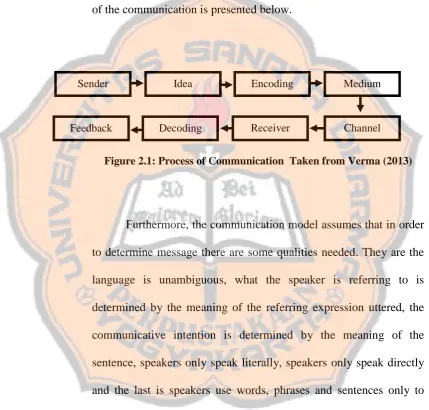
one plays the role of speaker, while the other plays as the listener. People establish the idea to be communicated in the mind and then there is an encoding system which is mostly in a form of language. Furthermore, the idea is transmitted through a channel. The process of the communication is presented below.
Figure 2.1: Process of Communication Taken from Verma (2013)
Furthermore, the communication model assumes that in order to determine message there are some qualities needed. They are the language is unambiguous, what the speaker is referring to is determined by the meaning of the referring expression uttered, the communicative intention is determined by the meaning of the sentence, speakers only speak literally, speakers only speak directly and the last is speakers use words, phrases and sentences only to communicate.
On the other hand, there are problems with the message model. First, the language is not always unambiguous. Meanwhile, expression can be ambiguous too. When these problems arise, the
Sender Idea Encoding Medium
Channel Receiver
hearer may face difficulties in assessing which possible meaning is intended. Second, under determination of reference by meaning is another problem with the Message Model. The next problem is the speaker‟s communicative intention is not clearly expressed by the
Message Model. Last, the Message Model cannot facilitate the fact that human speak non-literally as for example we may not mean what our word means.
In addition, there are also other factors that make the communication go wrong. One of the factors is known as “noise”.
Noise is not the disturbance caused by the sound. It is a technical term meaning any disturbance occurring in the process of communication (Verma, 2013).
3. Overview of Giving Presentations
Giving a presentation requires the speaker to develop such skills that will help them in the process of performing their presentation. In addition, the speaker has to consider such problem that they may have during the presentation. These considerations will result in a good presentation. One of the elements in giving presentation is “limiting condition” (Argyle, 1988 as cited in Molen
17
information, look for the accommodation, order and write out material, and make supporting media.
Giving presentation also requires the presenter to have “Expressive Skills”. This skill will help the presenter to make use of
their body and voice to support their presentation. Body language includes movement of the body and the use of the voice. Argyle (1988) as cited in Molen and Hoogland (2005) states that use of body language includes following skills: eye contact, facial expression, movement and posture. Nevertheless, the use of the voice includes speed of speech, timing, volume, rhythm and articulation.
4. Speech as a Liberal Study
There are so many aspects of maintaining an effective speech. According to Wilson, Arnold and Wertheimer (1990), the effective speaking requires more than mechanical application of techniques. The purpose of speaking has to be maintained with regard to the combination of meanings, surroundings, and human relationships. It is better to know what is being revealed in the presentation and the audience to whom the presentation is delivered to.
social decision making. While people are developing their speaking skills in front of public, they are also maintaining their relationships with others. Next, the knowledge of speaking in front of public develops skills in promoting and defending ideas. The acceptance of the audience becomes the essential matter for the speaker when they are to present their thought in front of public. The speaker cannot neglect their audience‟s presence by not making the reasonable judgment and decisions obvious to listener who might not be familiar with what are being presented. Both the listener and speaker are supposed to have the same concept of what are being presented so that the presentation might produce the beneficial result for both of them.
5. The Role of Self-Confidence for Developing Speaking Skills The development of speaking confidence is necessary for the improvement of speaking skills (Goel, 2012). Self-confidence is as positive attitude towards one‟s self-concept (Goel, 2012). Therefore,
the attitude is an important thing that might allow people to have positive perception toward themselves and the ability that people have.
19
confidence in speaking English if only they maintain the learning strategies that work effectively for their learning so that the significant progress of an improvement can be achieved as their learning goals (Nunan, 1999).
The learners might feel unconfident when they are to present their thought or idea in front of public. This problem of nervousness might be the problem faced by the learners particularly when they have to practice speaking in English. Thus, the development of self-confidence is needed in order to improve their speaking ability. More practices of speaking English in front of the public will arise learners‟ self-confidence as according to Goel (2012), confidence is learned through process. In addition, the process that encourages the students to speak in front of people will maximize the student‟s speaking skill and their self-confidence as well.
6. The Significance of Speaking for the Personal Success
The effective speaking will result in the achievements in ceremonial speaking activities, job training activities, job interviews and the other business matters that require good speaking skill (Osborn, Osborn, & Osborn, 2008). The fact that the students have limited chances to develop the speaking skills and limited exposure to English speakers that can arise the development of speaking development are also presented by Zhang (2009) as cited in Procedia Social and Behavioural Science (2010). Thus, the teacher or even the educational institution, in this case, is required to prepare the activity in order to strengthen students‟ speaking competence because if
there is only limited practice, they will not develop the competence as well.
7. Speaking Problems Encountered by EFL Students
EFL students possibly find problems wherever they are to develop the speaking skills. Tuan and Mai (2015) present the speaking problems faced by EFL students in their speaking class. They propose inhibition, lack of topical knowledge, low or uneven participation and mother tongue use as the factors affecting one‟s
21
foreign language possibly create inhibitions and anxiety. The next problem is that the student cannot think of anything to say and they have no motivation to do so. River (1968) states that learners have nothing to express maybe because the teacher had chosen a topic which is not suitable for him or about which he knows very little (Tuan & Mai, 2015). Another problem is due to low and uneven participation. There is a problem when one student has very little talking time while the other tends to dominate the process. The last problem is because of mother tongue, when all learners share the same mother-tongue, they tend to use it as it is easier for them.
In addition, EFL students might find difficulties in presenting using foreign language confidently. EFL students possibly encounter a source of anxiety that affects students‟ performance. A study
conducted in Indonesia by a group of researchers discover the factors that affect the learners‟ performance in speaking English. According
8. Proposition
After presenting the theories and the phenomena of the implementation of public speaking activity as a strategy to develop the students‟ speaking confidence, the researcher established a
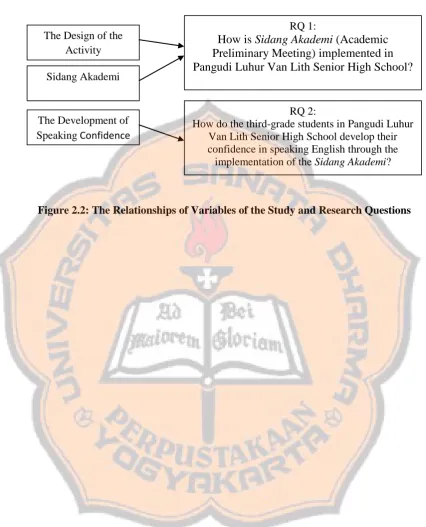
proposition of the study. Yin (2009) proposes that there are five prominent components of a research design for a case study. One of the elements is research proposition. This element plays a prominent role as it directs something that should be examined in a study (Yin, 2009). The researcher believes that Sidang Akademi is a strategy implemented in Pangudi Luhur Van Lith Senior High School which is deliberately designed to improve the development of speaking confidence. Therefore, the design of the activity, Sidang Akademi, and the development of speaking confidence are the variables of this study.
B. Theoretical Framework
In this thesis, the researcher answers two formulated research questions. The answers to two research questions are based on several related theories described in the theoretical description part.
23
The first research question deals with the implementation of Sidang Akademi as a strategy to develop students‟ speaking confidence. In order to answer the problem formulation number one, the researcher discusses the rationale of the activity. The rationale of the implementation of Sidang Akademi is deliberately designed in order to fulfil the vision and mission of the school and facilitate the students to possess such quality. In addition, there is a step-by-step process from the beginning until the end of the process. The theory of public speaking established by Aristotle as cited in Hendrikus (1991) assists the researcher in the descripting of an ideal public speaking. The researcher makes use the theory of giving the presentation composed by Molen and Hoogland (2005) in order to give a clear awareness about the elements of giving presentations. Furthermore, the connection of the answer to the theory of speech proposed by Wilson, Arnold and Wertheimer (1990) and the theory of speaking in public established by Zarefsky (1996) will be elaborated to present the importance of speaking in front of public. The researcher refers the answer to the variables in the proposition which is the design of the activity and Sidang Akademi which is designed as a strategy to develop students‟ speaking confidence.
25
Figure 2.2: The Relationships of Variables of the Study and Research Questions
The Design of the Activity
Sidang Akademi
The Development of Speaking Confidence
RQ 1:
How is Sidang Akademi (Academic Preliminary Meeting) implemented in Pangudi Luhur Van Lith Senior High School?
RQ 2:
How do the third-grade students in Pangudi Luhur Van Lith Senior High School develop their confidence in speaking English through the
26 CHAPTER III METHODOLOGY
In this chapter, the researcher provides the discussion of the research methods and analysis. This section is presented in several subdivisions. They are research method, research participant, research setting, research instruments, data gathering technique, data analysis technique, research trustworthiness and research procedure.
A. Research Method
27
by choosing the public speaking activity for the third-grade students as this activity was implemented in English.
Generally, this research is a qualitative study as it enables rich description and analysis of the phenomena. The type of the research is specifically a case study. Case study research is a qualitative approach in which the researcher focuses on a bounded system over a period of time, through detailed, in-depth data collection and reports a case description as well as case-based themes (Creswell, 2007). In addition, case study is a suitable format for investigating or exploring the studies of language learning (McDonough & McDonough, 1997). According to Creswell (2007), the involvement of multiple sources of information is suggested in order to grab the complete illustration of the phenomenon being investigated and thus, triangulation takes its role as an important aspect in the qualitative study. The sources of data are in a form of observation, documents and reports, interview, and audio-visual material.
The study was mainly to explore the development of students‟ speaking
confidence through the implementation of the activity. According to Yin (2003), the focus of the study conducted using case study approach is generally to answer the “how” and “why” aspect of the phenomenon being investigated. The
needed for the study. The story revealed by the participant during the process of investigation was considered important as those factors might reflect the relevant data. Through the stories, the participants are able to describe their views related to the topic which can reflect to the reality or the situation and it allows the researcher to really understand about the participant‟s action (Lather, 1992;
Robottom & Hart, 1993 as cited in Baxter & Jack, 2008).
B. Research Participant
In this case study, the research participants were the third-year students of Pangudi Luhur Van Lith Senior School Muntilan. Sidang Akademi has been an obligatory activity for all students in Van Lith. However, for the third-grade students the activity is conducted using English so that the developments of English skills are really maintained in the implementation of the activity especially the English speaking skill. Thus, the use of English for third grade students of Van Lith Senior High School is demanded in order to be able to present their materials in Sidang Akademi.
According to Creswell (2007), a case study may involve an individual, several individuals, a program, an event, or an activity. The researcher observed the Saint Ignatius de Loyola Sidang Akademi group in which the researcher was able to observe students‟ behaviour in the implementation of Sidang Akademi as
29
The researcher conducted Focus Group Discussion (FGD as the data from the observation process could not cover all information that the researcher needed in the study. Every member of the group was chosen by the teacher based on criteria. The researcher and one teacher in charge of the implementation determined criteria in order to choose the suitable participants for obtaining the natural data of the implementation. There were three criteria in being a participant of the group discussion. They were: (1) student who was seen as the one who was capable to reveal the development of speaking confidence through the implementation of the activity so that the student must be a proactive person. (2) The students who improved their speaking confidence through the implementation of the activity. And the last was (3) they who maintained their presentation well during the implementation. These criteria were necessary as the study demanded the information of the development of speaking confidence as its main focus. Furthermore, the FGD also allowed the researcher to collect as many points of views from the participants as the representative of the third grade students so that the data is optimally obtained.
C. Research Setting
academic of the year in the school in order to gain the complete data before the students graduate from the school.
D. Research Instruments and Data Gathering Technique
The number of instruments are important as the instruments allow the collection of many source of data or triangulation. In order to gather the data, the researcher used a number of instruments namely interview protocol, documents and observational protocol. Moreover, many sources of data were beneficial to a study than a single source because multiple sources lead to a fuller understanding of the phenomena which the researcher was studying (Bogdan & Biklen, 2003).
In order to gather the data needed, the researcher conducted some approaches in collecting the data such as observation, documents, and interview in a form of focus group interview or Focused Group Discussion. The data were expected to complete the information about the behaviour of the students during the implementation of the activity, how the activity was done and implemented and the development of students‟ speaking confidence through the development of
Sidang Akademi.
31
the researcher to obtain the complete information related to the development of student‟s speaking confidence and the implementation of Sidang Akademi.
Besides, the researcher also used the interview, which was done at March 31th 2016, as the instrument to collect the data needed for the study. The researcher conducted the interview in Indonesian language in order to obtain complete explanation from the students as the participants. Creswell (2003), states that the process of interview can be done by engaging the participant in focus group interview by having six to eight interviewees in each group. In addition, according to Seliger and Shohamy (1989), an interview is conducted to obtain information from the subject by talking to them. Thus, the interview, which was in the form of focus group interview, was done to the focus group discussion in order to obtained detailed data along with some important information that researcher might not consider previously. The interview involved unstructured and generally open-ended questions which are intended to elicit views and opinions from the participant of the study (Creswell, 2003). In addition, Focus Group Discussion (FGD) was chosen as an attempt to gain the personal opinion or point of view related to the implementation of Sidang Akademi and its influence to the students‟ speaking confidence. The multiply data collections done by the researcher are proposed to make sure the reliability of the research result.
1. Focus Group Discussion (FGD)
question was beneficial to the sake of sharpening the information so that the data and information gathered were enough for answering the questions of the implementation of Sidang Akademi and its impact to the development of students‟ speaking confidence.
According to Irwanto (2006), Focus Group Discussion is one of research methodologies so that the use of FGD is mainly as a systematically method of information and data gathering. The general ideas of FGD are Discussion, Group and Focused so that the form of the process will not be an interview or conversation; the process will be done in a form of group rather than individual and the material of the discussion will be maintained well as it try to focus on the issue being discussed in the process. Besides, Bader and Rossi (1998), state that the use of Focus Group Discussion is a powerful data-collection tool which is able to give extra information gathered by human resources, production, or service departments. Thus, it can be concluded that FGD is a type of group interview that is structured in order to obtain the detailed information, opinion and knowledge about a particular topic from selected participants needed to enrich the study being conducted.
33
obtain the detail of the implementation of the Sidang Akademi and the benefits of it with regard to the development of the speaking English confidence. The group discussion reported how such activity influenced the development of speaking confidence.
In order to obtain research validity, the transcript summarizing the result of the FGD and interview were given to the participants so that they were able to know the result and whether the result was accountable. The participants were able to ask for the revision of the transcript in case they found missing or inappropriate information. Furthermore, in conducting the FGD, the researcher involved two co-facilitators as to prevent the research bias and to obtain trustworthiness. The interview protocol is in Appendix C.
2. Observation
The observation of the implementation of Sidang Akademi as a strategy to develop students‟ speaking confidence used an observational protocol in
order to collect the observational data from the observed activity. The observational protocol was in the form of descriptive notes about portraits of the participants, a description of the setting, the events and the activity. In addition, there were reflective notes which were about researcher‟s personal thought such as speculation, feeling, problems, ideas, impression and prejudices (Creswell, 2003).
observation, there was training for conducting the observation in order to have the same concept of what were to be observed between the researcher and the peer observer. After the process of the observation, the researcher and peer observer discussed about the result of the observation to make sure that there were no big differences in the implementation of observation and it allowed the researcher and the peer observer to have the same concept and then complete the information obtained through the process of the observation.
35
process of observation, the next process was summarizing the result of observation. The observation sheet is in Appendix D.
3. Document Analysis
The researcher also used the document as data for answering the research questions of the study. The document refers to material such as photographs, videos, films, memos, letters, diaries, clinical case records, and memorabilia of all sorts that can be used as supplemental information as part of case study whose main data source is a participant observation or interviewing (Bogdan & Biklen, 2003).The documents collected by the researcher were some documents related to the process of the implementation of Sidang Akademi.
implementation of Sidang Akademi. The document of the weekly minutes would likely tell about student‟s maintenance of their performance. The minutes were the summary of the complete implementation. There were also the comment of appointed critics, the comment of the facilitator of the activity, the questions proposed by the audience and the answer given by the presenter as the response of the question. These documents played the significant role in revealing the background of the activity establishment and how the activity was implemented as well.
All the documents collected by the researcher above were classified as official documents. Bogdan and Biklen (2003) define official documents as the document produced by schools and other organizations for record-keeping and dissemination purposes as memos, minutes from meetings newsletters, policy documents, the student‟s record yearbooks and so on. This kind of data is seen as an exclusive of data for some.
E. Data Analysis Technique
37
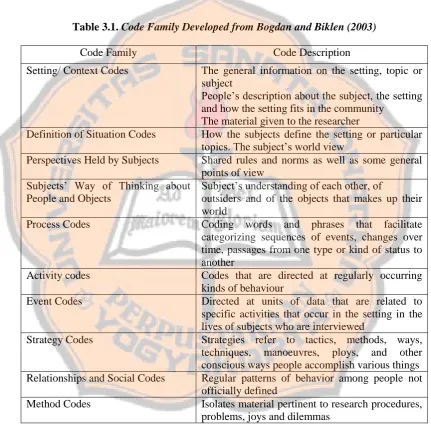
summarizing segment of data. In this study, the researcher used the code family generated by Bogdan and Biklen (2003). The table of the code family is presented on the following page.
Table 3.1. Code Family Developed from Bogdan and Biklen (2003)
Code Family Code Description
Setting/ Context Codes The general information on the setting, topic or subject
People‟s description about the subject, the setting and how the setting fits in the community
The material given to the researcher
Definition of Situation Codes How the subjects define the setting or particular topics. The subject‟s world view
Process Codes Coding words and phrases that facilitate
categorizing sequences of events, changes over time, passages from one type or kind of status to another
Activity codes Codes that are directed at regularly occurring kinds of behaviour
Event Codes Directed at units of data that are related to specific activities that occur in the setting in the lives of subjects who are interviewed
Strategy Codes Strategies refer to tactics, methods, ways, techniques, manoeuvres, ploys, and other conscious ways people accomplish various things Relationships and Social Codes Regular patterns of behavior among people not
officially defined
Method Codes Isolates material pertinent to research procedures, problems, joys and dilemmas
Sidang Akademi. How is the implementation of Sidang Akademi and the way students maintain their performances each week.
Miles and Huberman (1994) also reveal the importance of the use of pattern coding for helping the process of analysing the data. Thus, the researcher used pattern coding in order to make group of classification of the data that have been summarized into smaller number of sets, themes and construct. Pattern coding took an important account in the process of analysing the data. It was used to reduce the large amount of data so that the researcher was able to get into analysis during the data collection for focusing more on the field work. The use of pattern coding, in fact, was not only for reducing the amount of data, but also helping the researcher in elaborating a cognitive map and integrated schema in order to have deeper understanding about such interaction.
The researcher considered the selection of the themes after conducting the process of data collection. Here, the researcher adopted the way phenomenology research in selecting the themes. According to Waters (2012), the researcher is not supposed to be directive in the question. Thus, the participants were expected to give full description of their experience including their personal thought, feeling and the situation of the phenomena. The process of the selection of the data needed was done after the process of collecting the data. The researcher, indeed, considered the data which were needed in the fulfilment of the study.
co-39
facilitator so that the information gathered from the process of data collection really processed well and to prevent the bias of analysis the data. Creswell (2003), proposes that the validity in the qualitative study is obtained through the process of checking the pattern consistency of the theme development. Validity takes an important account of the qualitative study (Creswell & Miller, 2000, as cited in Creswell, 2003). In order to obtain this criterion, the researcher assured whether the findings in the study are accurate from the standpoint of researcher, participants and the reader as well.
The data were displayed in a form of narrative text. It had something to do with an organized assembly of information where the conclusion will be drawn. According to Miles and Huberman (1994) all display are designed to assemble and organize information in an immediately accessible, compact form so that the researcher will be able to see what is happening.
F. Research Trustworthiness
41
G. Research Procedure
There are several procedures in conducting case study research (Creswell, 2007). In addition, Stake (1995) proposes some approaches in conducting the case study research. Below are the stages which are done by researcher from the initial until the final process of the study:
1. Determining whether or not the case study is appropriate for the problems formulated in the study
After conducting the process of selecting the topic and the problem that was being explored and studied, the researcher chose the most appropriate approach in order to have the best study. Case study, according to Stake (1995), is a suitable approach for the study proposed to provide in-depth explanation and understanding of the case. In addition, the case being explored has specialized cases with its limitation. Choosing the type of the case study is also important. In this study, the researcher decided to have intrinsic case study as the focus was on the cases so that the researcher tried to provide a deep and complete explanation about the description of the topic. This study, generally, was about to seek the development of students‟ speaking confidence through the implementation of the activity. Thus, a case study is the best approach for conducting the study.
2. Identifying a case or cases
whether a theory‟s propositions are correct (Yin, 2009). The lesson learned
from this case was assumed to be informative about the experience of the average person or institution.
3. Collecting the data
The are many sources of information such as observation, Focus Group Discussion or focus group interview, documents and audio-visual material as what case study typically has in its data collection (Stake, 1995). In conducting the study, the researcher collected the data by making observations in the group of Sidang Akademi, forming a group to obtain the information through the implementation of Focus Group Discussion.
The researcher first made a number of observations on the implementation of the activity on how this activity was implemented and how the students developed their speaking confidence through the implementation of the activity. The investigation was then continued by doing a focus group interview to gather in-depth information related to the implementation of the activity with regard to its impacts on the development of students‟ speaking confidence development. The data saturation was also taken into account in this stage in order to avoid having the data which were not needed for the study being investigated.
4. Analysing the data
43
or Focus Group Discussion, the researcher analysed and classified the data through the use of coding. The information collected through the process of data collection was classified to some themes and classification and the use of coding took account in order to ease the process of the data analysis. The result of the discussion, observation, document analysis of the implementation and FGD were elaborated in details and presented in a form of the sequences of the stories or narrations.
5. Reporting the meaning of the case
44 CHAPTER IV
RESEARCH FINDINGS AND DISCUSSION
In this chapter, the researcher first gathers the research findings. The findings are presented in accordance with the research questions proposed in Chapter I; the implementation of Sidang Akademi and the third-grade students of Pangudi Luhur Van Lith Senior High School development in speaking confidence through the implementation of Sidang Akademi. Each problem is discussed and analysed using theories that were stated in the review of related literature.
In this section, there are description and discussions of the study site and of the implementation of Sidang Akademi in Pangudi Luhur Van Lith Senior High School which includes the brief description of the school mission influencing the establishment of Sidang Akademi in this school. The description gives a clear illustration to the reader about the fundamental reason why the school implemented Sidang Akademi as a strategy to develop students‟ speaking confidence. In addition, the research setting and the implementation mechanism of Sidang Akademi are discussed in this section as well.
A. Study Site
45
Java. In this study, the researcher focused on the implementation of Sidang Akademi as a strategy to develop students‟ speaking confidence. The school establishes some points to be mastered by their students in the process of their educational processes. One of the points to develop is the point of skills development. In the point of skills development, it states clearly that the students are demanded to have the public speaking skill, English skills, operating computer-based technology to obtain information, organizational skills, leadership, and multi-level communication skills. Two of which are the fundamental reason for the activity establishment. They are public speaking skill and English skills. The establishment of Sidang Akademi, therefore, plays the important role in fulfilling schools mission.
In the research conducted in Pangudi Luhur Van lith Senior High School, the researcher decided to choose the third-grade students as the research participant since Sidang Akademi for the third-grade students is conducted in English. Therefore, the research was suitably conducted in this grade in order to reveal the development of students‟ speaking confidence. There were three data
sources of the study which were the data from FGD process which was conducted by the researcher and two co-facilitators, the class observation which was conducted by the researcher and one peer observer and the supportive document regarding to the process of Sidang Akademi implementation.
number of the students as the FGD participant was 11 students. The students were chosen based on the criteria established by the researcher and the teacher in charge. The students came from different Sidang Akademi groups so that the data collected from the process could be varied and rich. The researcher observed the implementation of Sidang Akademi from August 18th – September 8th, 2015 at 3.30 P.M. until 5.00 P.M. The process of the observation was done in Thomas Aquinas class together with a peer-observer. The FGD was conducted on March 31th, 2016 at 6.00 P.M in Physic Class. There were two co-facilitator and 11 participants in the process of FGD. The process had done for an hour and 25 minutes.
B. Data Reduction
In chapter III, the study was already classified as a qualitative study as it enables description and analysis of the phenomena. The type of the research is specifically a case study. Case study research is a qualitative approach in which the researcher focuses on a bounded system over a period of time, through detailed, in-depth data collection and reports a case description as well as case-based themes (Creswell, 2007). The study dealt with multiple sources of data in order to enable rich and in-depth explanation. The sources of data are in a form of observation, documents and reports, interview, and audio-visual material.
47
was done by reading the transcript of data over and over to grab the clear insight of the data. The data were in the form of narration of observation result, which was done by the researcher and peer observer, documents of the implementation of Sidang Akademi, and the transcript of Focus Group Discussion process. After reading the data for many times, the researcher then generated the main point of the data obtained from the process of data gathering. After conducting data summarization, the next process was choosing the supportive data only related to the focuses of the study which were the process of implementation and the process of developing speaking confidence.
Finally, after doing the data gathering process, the researcher focused in making the categorization of the data through coding before finally decided the themes which contained the fundamental data of the study.
1. Coding Category
categories were used by the researcher to reduce the data which were obtained in the approaches of the data collection; they were observation, document of the implementation of Sidang Akademi and Focus Group Discussion.
After the process of elaborating the narration of observation result and the documents of Academic Preliminary Meeting as well as making the transcription of interview, the researcher read the data for several times in order to get the general information from it. As stated by Bogdan and Biklen (2003), the researcher has to read the transcripts over and over again several times in order to get ideas for a coding scheme.
In this study, the researcher chose three code categories in order to organize the data collected from the process of data gathering. The chosen code categories played significant role in the process of coding scheme. The code categories were chosen as these categories appeared the most in all the collected data. Thus, organizing the data using these categories was significant.
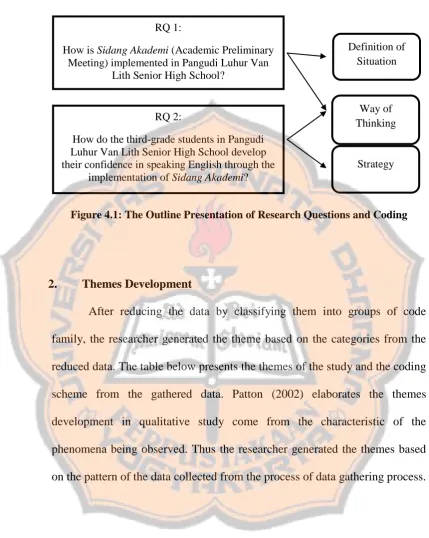
The coding strategy helped the researcher to answer the generated research questions in this study. Three of which were: (1) definitions of situation codes. This code presented how the subjects define the setting or particular topics. In the process of data gathering, the researcher obtained the data of subjects‟ opinion about the implementation and the experience they
49
Figure 4.1: The Outline Presentation of Research Questions and Coding
2. Themes Development
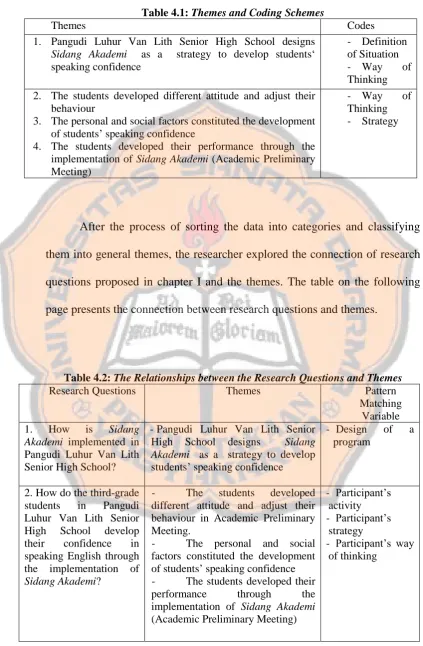
After reducing the data by classifying them into groups of code family, the researcher generated the theme based on the categories from the reduced data. The table below presents the themes of the study and the coding scheme from the gathered data. Patton (2002) elaborates the themes development in qualitative study come from the characteristic of the phenomena being observed. Thus the researcher generated the themes based on the pattern of the data collected from the process of data gathering process.
RQ 1:
How is Sidang Akademi (Academic Preliminary Meeting) implemented in Pangudi Luhur Van
Lith Senior High School?
RQ 2:
How do the third-grade students in Pangudi Luhur Van Lith Senior High School develop their confidence in speaking English through the
implementation of Sidang Akademi?
Definition of Situation
Way of Thinking