AFLATOXIN PROBLEMS IN POULTRY FEED AND ITS RAW MATERIALS IN INDONESIA
IMASALAH AFLATOKSIN PADA PAKAN DAN BAHAN PAKAN UNGGAS DI INDONESIA
SjamsuI Bahri
Balai Penelitian Vderiner (BALITVET) Departemen Pertanian RI, JI. R.E. Martadina No. 30, Bogor INDONESIA
ABSTRACT
Media Veteriner. 1998. 5(2): 7-13
Contamination of atlatoxins in animal feeds is one of a major problem in the development of poultry industry in Indonesia. Atlatoxins may lead to losses in animal productivity, atlatoxicosis and residue in animal products. A series of investigation on atlatoxin contamination in animal feed in poultry had been carried out at Research Institute for Veterinary Science (Balitvet) between 1984 to 1995. It showed that more than 80 % of commercial chicken feeds were contaminated by atlatoxin B I (AFB I) within a wide range of concentration. Besides AFBI, other atlatoxins such as AFB2, AFG I and AFG2 were also found. The level of AFBI more than 200 ppb was found in 13.5 % out of 193 feed samples, whilst 23.3 % and 63.2 % of samples showed concentration 100-200 ppb and <100 ppb respectively. It had approved from the investigation that com was the most frequent foodstuff contaminated by atlatoxins compared.to other animal foodstuff. Most of com used for chicken feeds appeared to be the major source of atlatoxin contamination, where it could be indicated visually in bad or good kernel appearance. The levels of AFB 1 contamination seemed to be higher in the wet season (39.5 ppb) than in the dry season (19.5 ppb) as well as at the lower altitude (39.8 ppb) was higher than at the higher altitude (24.13 ppb). Based on this view, further studies are required to control of the atlatoxins problems in poultry feed in Indonesia.
Key words: atlatoxins, animal feeds, pOUltry
ABSTRAK
Media Veteriner. 1998. 5(2): 7~J3.
Cemaran Atlatoksin pada' pakan unggas merupakan salah satu masalah utama yang dapat menghambat
perkembangan industri perunggasan di Indonesia. Hal ini dikarenakan atlatoksin dapat menghambat produktifitas ternak, kesehatan dan meninggalkan residu pada produk-produknya. Serangkaian penelitian terhadap pencemaran atlatoksin pada pakan unggas telah dilakukan di Balai Penelitian Veteriner (Balitvet) Bogor an tara tahun 1984 sampai 1995. Hasi!-hasil yang diperoleh menunjukkan bahwa lebih dari 80 % pakan unggas komersial terkontaminasi oleh atlatoksin B I (AFB I) pada berbagai kadar. Selain AFB I, atlatoksin lainnya seperti AFB2, AFG I dan AFG2 juga diketemukan. Kadar AFB I lebih dari 200 ppb dijumpai sebanyak 13,5 % dari 193 contoh pakan unggas yang diperiksa, sedangkan 23,3 % dengan kadar 100-200 ppb dan 63,2 % dengan kadar <100 ppb. Pada pengamatan iersebut juga dapat dibuktikan bahwa jagung merupakan bahan pakan yang dominan tercemari atlatoksin daripada bah an pakan lainnya. Jagung-jagung yang tercemar atlatoksin terse but secara kasat mata dapat dibedakan dari kondisi/keadaan fisik biji jagung terse but. Kadar pencemaran AFB I tampaknya lebih tinggi pada keadaan musim hujan (39,5 ppb) dibandingkan pada keadaan musim kering (19,5 ppb). Demikian juga ketinggian tempat yang lebih rendah kadar AFB 1 (39,8 ppb) lebih tinggi daripada dataran tinggi (24,13 ppb). Berdasarkan tinjauan ini, penelitian-penelitian lebih lanjut masih diperlukan untuk mengatasi masalah-masalah atlatoksin pada pakan unggas di Indonesia.
Kata~kata kuncl; aflatoksin, pakan, unggas
INTRODUCTION
Poultry industry in Indonesia has been developed rapidly in the last decade. The poUltry number has been increased year by year. In the year 1993, the poUltry population was 17.6 million animal unit, where 65.9 % were
commercial chicken, 29.8 % were indigenous chicken, and 4.7 % were duck (Soehadji, 1994).
The development of the poultry industry in Indonesia is followed by the development of the animal feed industry. It is understood, since 60 % of the poultry production cost is depending on the feed. The most dominant animal feed industry is the poultry feed (layer and broiler).
Animal feedstuff becomes one of the most important factors for increasing animal production. The quality of animal product is not only depending on the feedstuff quantity, but also on its quality. Generally, feedstuff compose by various agriculture-commodities (materials). The feedstuff quality of course depend on the quality of the materials. If the materials have bad quality, it will also produce bad feedstuff. Even the materials are good, but the storage and the production technique are not good, it will produce the feedstuff quality less.
One of the natural factor which affecting the quality of agriculture commodity is the fungal growing on the stuff. This situation is supported by the Indonesian Tropical Climate, where temperature, humidity and the high rainfall are . very conducive for fungal growth (Aspergillus, Penicillium; Eurotium) on stuffs such as com, soybean, peanut etc.
Feedstuff or materials which contaminated by fungi, especially Aspergillus jlavus and A. parasitic us will degrade the quality and become hazard for animal health (Diener and Davies, 1969; Domer et al., 1984), since the fungi produce toxin such as aflatoxin (B 1, B2, Gland G2).
The 'negative effects of aflatoxin in animal can be acute if the feedstuff highly contaminated by aflatoxin, such as turkey X disease in the UK in 1960 (Blount, 1961). The chronic effects of aflatoxin are more frequent in case of aflatoxin contamination in feedstuff or in lower level of contaminated materials. This situation has not been reported yet, since the chronicle effect could not be observed directly. In Indonesia those problems might be occurred since Ginting (1988) and Widiastuti et al., (1988) reported the aflatoxin contamination cases in chicken feedstuff. In this paper, a review on the aflatoxin situation and its problem in poultry feedstuff industry in Indonesia, and the alternative to control it, is presented.
-
,.;;; I8
AFLATOXIN IN POULTRY FEEDSTUFF
Aflatoxin level in Poultry Feedstuff collected from market and farms
Various research results written by Ginting (1984a, 1984b, 1985) and Widiastuti et al., (1988) show that 61.3 % to 95 .% of commercial chicken feedstuff from several places in Indonesia have been contaminated by AFB 1, the level content is shown in Table 1. The range is between 10.1 ppb and 54.4 ppb.
As shown in Table 1, the lowest contents of AFBI level in feedstuff was 61.3 % from broiler starter feedstuff samples from Bogor area collected during dry season. Whereas sample which were taken and analysed in the wet season, the positive samples to AFB 1 increased to 92.8 % (Ginting, 1984a). Widiastuti et al. (1988) observed the AFB 1 level contents in the commercial feedstuff produced by a feed factory for one-year period and showed that 95 % of the feedstuff examined were contaminated by AFB 1 (the average level was 52 ppb). This observation showed that most of the Indonesian commercial chicken feedstuff, especially from Jakarta and Bogor had been contaminated by AFB1.
Table 1. AFBI Contamination in Broiler's Feedstuff in Some Areas in Indonesia
Sample Samples Source Number Bogor(S) 28 Bogor(S) 31 Jakarta" 87 Pontianak"' 31 Jakarta' 121 Bogor 53 Bandung' 92 Bogor 290
..
adapted from Gmtmg (1984a) 2adapted from Ginting (1984b) ladapted from Ginting (1985)
Sampling seasons Wet Dry Wet Wet Wet Wet Wet All through the year
~adapted from Widiastuti et al., (1988) S) Broiler's starter feedstuff.
(%) Average Positive Levels ppb 92.8 51 61.3 10.1 85 53 64.5 26.4 83.5 54.4 81.1 50.8 "83.7 38.8 95 52
There is a trend that the case of aflatoxin contamination mostly higher in the wet season rather than in the dry season. This trend is supported by Ginting (1988) observation (Table 2). Table 2 shows that the average of AFBI contents iIl:/the wet season (39.5 ppb) is higher than during the dry season (19.5 ppb). It is highly connected to
the increasingly humidity in the wet seasons. This situation is similar to the study done by Haryadi and Setiastuty (1994) which revealed that the prevalence of aflatoxin contamination was more evident during rainy season when the humidity was quite high. From their data on moisture content of groundnut samples, it was clear that the prevalence of aflatoxins was positively correlated with the moisture content of the sample. The increase of humidity factor will accelerate the A. jlavus and A. parasitic us growth, which at last increasing aflatoxin production. According to Thakur and Mandokhot (1976), Blaney et ai., (1984) and Bean and Fernando (1986), the rainfall is an important factor for fungal growth to produce aflatoxin in the feedstuff.
Table 2. The Average of AFBI Level in Broiler Feedstuff Collected form Jakarta, Bogor and Bandung'
The average level
Areas altitude (ppb) of AFB 1 in Average seasons Wet Dry Jakarta ( ±7m) 45.43 31.93 39.18c Bogor (200-400m) 41.40 8.87 25.13u Bandung (600-1250m) 30.77 17.70 24.23° Average 39.5" 19S
..
Adared from Gmtmg, 1988a,b,c, avaerage within row and column with no common superscipts differ significantly (P<O.05)
Besides the rainfall factor, the altitude of an area is become another important factor for AFB 1 contamination level in the foodstuffs. The average of AFB 1 level contents
in the broiler feedstuff from Jakarta (± 7m above sea level) is 39.18 ppb, compared to 25.13 ppb AFBI in the feedstuff from Bogor (± 400 m) and 24.23 ppb AFB 1 in the feedstuff from Bandung (± 600-1,250 m). Blaney et al., (1984) stated that higher humidity and higher temperature would support fungal growth (A. jlavus and A. parasiticus).
Ginting (1985) reported that during the wet season the AFBI contents in broiler feedstuff from Jakarta (54.4 ppb) was higher than that from Bandung (38.8 ppb).
Aflatoxin concentrations on BALITVET routine examination (1988-1994)
From Balitvet experienced (1988-1994), samples containing of aflatoxins (B I, B2, Gland G2) from chicken feedstuff were sent to Balitvet for examination. The most frequent finding was AFBI (98.29 %), followed by AFB2 (78.1 %), AFG 1 (47.04 %) and AFG2 (35.59 %). The highest level content of AFG 1 was 732 ppb (Table 3 and 4).
From the observation, AFB 1 was also the most dominant aflatoxin, compared to the others. This finding was supported by Bainton et al., (1980), that stated from four aflatoxins, AFB I was the most common aflatoxin found in nature, it was also the most toxic aflatoxin.
Since AFB 1 is the most frequent aflatoxin found in the observation, from this point forward we
will
consider to AFB 1 to discuss. One hundred and twenty tWo out of 193 samples (63.21 %) contained AFBI level less than 100 ppb, 45 samples (23.32 %) between 100-iWO ppb and 26 samples (13.47 %) more than 200 ppb (Table 4).Table 3. Percentage of Aflatoxin, Which Detected from Poultry Feedstuff Examined in Balitvet
Year of Number of % of Aflatoxin Variation Detected
Samples examined Samples (N) BI B2 Gl G2
1988 14 100 (14/14) 70 (10/14) 21(3/14) 7(1/14) 1989 32 100 (32/32) 65 (21132) 50 (16/32} 15(5/32) 1990 15 100 (15/15) 93 (14115) 27 (4115) 27(4/15) 1991 25 88 (22/25) 68 (17/25) 64 (16/25) 48(12/25) 1992 13 100 (13/13) 85 (11113) 62 (8113) 46(6/13) 1993 48 100 (48/48) 85 (41148) 69 (33/48) 62(30/48) 1994 46 100 (46/46) 83 (38/46) 37 (17/46) 43(20/46) Total Average 193 98.4 (190/193) 78.7 (152/193) 50.3 (971193) 40.4(781193)
Table 4. Level o.f AFBI (ppb) in Po.ultry Feedstuff Examined at Balitvet (1988-1994)
Year o.f Number o.f Range
Samples examined Samples (N) (ppb)
1988 14 8-120 1989 32 16-720 1990 15 4-240 1991 25 0-732 1992 13 24-326 1993 48 5.3-640 1994 46 1.7-560 To.taVAverage 193 1.7-732
Source: Bahri e I al. , ( 996) I
Acco.rding to. Giambro.ne et al. (1985): the AFB I level around 100 ppb or mo.re is able to. pro.duce sub-clinical into.xicatio.n in bro.iler. Fro.m Table 4, we eQuid o.bserve that 71 (45+26) samples (36.79 %) 'were co.ntaminated by AFBI mo.re than 100 ppb. It also. sho.wed thatpo.ultry feedstuff samples sent to' Balitvet, was mo.stly heavily co.ntaminated by aflato.xin, co.mpared to' the direct samples col1ected fro.m field. It can be understo.o.d, since mo.st o.f the samples sent to. Balitvet has already been suspected with aflato.xin co.ntaminatio.n because o.f the expensive Co.st fo.r aflato.xin analysis.
Aflatoxin in Duck Feedstuff
Aflato.xin co.ntaminatio.n in Alabio. duck feedstuff fro.m So.uth Kalimantan are presented in Table 5 (Zahari and Tarmudji, 1995). Table 5 sho.ws that 19 samples o.f duck feedstuff co.l1ected from So.uth Kalimantan farmers are po.sitive to. AFB I, with range between 4 and 160 ppb, the average level is 60.21
±
43.35 ppb. The 73.7 % o.f 19 samples have level abo.ve 30 ppb. Acco.rding to. Culveno.r (1974), the AFBI level in duck feedstuff sho.uld have co.ncentratio.n less than 30 ppb. Study o.n the histo.patho.lo.gy o.f duck livers sho.wed aflato.xico.sis alteratio.n that might have co.rrelatio.n with the aflato.xin presence in the feedstuff. Aflato.xin co.ntaminatio.n was also. fo.und in the fine rice bran and o.ther materials, even in level between 8-20 ppb.Number and % sample at Level
<100 ppb 100-200 ppb >200 ppb 12 (86 %) 2 (14 %) 0(0%) 16 (50 %) 10 (31 %) 6 (19 %) 12 (80 %) 2 (13 %) 1(7 %) 10 (40 %) 7 (28 %) 8 (32 %) 7 (54 %) 5 (38 %) 1(8 %) 27 (56 %) 15(31%) 6 (13 %) 38 (82 %) 4 (9 %) 4 (9 %) 122 (63.2 %) 45 (23.3 %) 26 (13.5 %)
Table 5. AFBI Level in Alabio. Duck Feedstuff Co.l1ected from So.uth Kalimantan I
Samples Samples Range Number and Percentage Samples Number (ppb) <30 ppb 30-100 ppb >100 ppb Feedstuff 19 4-160 5 II 3 (26.3 %) (57.9 %) (15.8 %) Fine Rice 8 0-20 6 0 0 bran (75 %) Mixed 8 0-8 I 0 0 materials (12.5 %) ..
Adapted from Zahan and TarmudJI (1995) .
AFLATOXIN IN RAW MATERIALS
Aflatoxin in Agriculture Products and By-product of Agroindustries
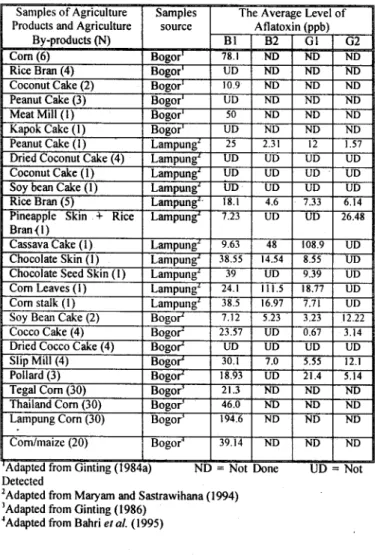
Aflato.xin co.ntaminatio.n (Bl, B2, GI and G2) in the feed raw materials and the waste products which co.mpo.sed the animal feedstuff are sho.wn in Table 6. From vario.us materials, it seems that co.rn is the mo.st co.mmo.n material co.ntaminated by aflato.xin. Besides co.rn, the o.ther raw materials whichco.ntaminated such as po.llard, slip mill, so.y bean cake, while the waste pro.ducts which were co.ntaminated such as cho.co.late seed skin and rice bran. The co.ncentratio.n o.f aflato.xin were varied. Dharmaputra et al. (1997) also. repo.rted their study, that five o.ut o.f 14 samples (so.ybean cake from feedmills) were co.ntaminated by aflato.xin between 7.9-34 ppb. The highest aflato.xin co.ncentratio.n was 34 ppb. (samples taken fro.m Surabaya feed mill). Since the aflato.xin co.ncentratio.n in the agriculture and by-pro.ducts are Io.w, it sho.ws that feedstuff seems suspicio.usly to. be co.ntaminated by aflato.xin.
Table 6. Level of Aflatoxin In Various Agriculture Products and By-products
Samples of Agriculture Samples The Average Level of Products and Agriculture source Aflatoxin (ppb)
By-products (N) BI B2 GI G2
Com (6) Bogor 78.1 NO ND ND
Rice Bran (4) Bogor UO NO NO ND Coconut Cake (2) Bogor 10.9 NO NO ND Peanut Cake (3) Bogor UO NO NO NO Meat Mill (I) Bogor 50 ND NO NO Kapok Cake (I) Bogor UD ND NO NO Peanut Cake (I) Lampung' 25 2.31 12 1.57
Dried Coconut Cake (4) Lampung' UD UO UO UO Coconut Cake (I) Lampung' UD UO UO UD Soy bean Cake (I) Lampung' UD UO UO UO Rice Bran (5) Lampung" 18.1 4.6 7.33 6.14
Pineapple Skin
+
Rice Lampung' 7.23 UO UD 26.48Bran{l)
Cassava Cake (I) Lampung' 9.63 48 108.9 UO Chocolate Skin (I) Lampung' 38.55 14.54 8.55 UD Chocolate Seed Skin (I) Lampung' 39 UD 9.39 UD Com Leaves (I ) Lampung 24.1 111.5 18.77 UO Com stalk (I) Lampung' 38.5 16.97 7.71 UD Soy Bean Cake (2) Bogor' 7.12 5.23 3.23 12.22
Cocco Cake (4) Bogor' 23.57 UD 0.67 3.14
Dried Cocco Cake (4) Bogor' UD UD UO UD Slip Mill (4) Bogor' 30.1 7.0 5.55 12.1
Pollard (3) Bogor' 18.93 UD 21.4 5.14
Tegal Com (30) Bogor 21.3 NO ND NO Thailand Com (30) Bogor 46.0 NO NO ND Lampung Com (30) Bogor 194.6 NO NO NO Com/maize (20) Bogor 39.14 ND ND ND Adapted from Gmtmg (1984a) ND - Not Done UD - Not Detected
2Adapted from Maryam and Sastrawihana (1994) JAdapted from Ginting (1986)
4Adapted from Bahri et al. (1995)
The role of Corn as the main source of Aflatoxin contamination in Animal Feedstuff
Buckle (1983) and Dutton and Westlake (1985) revealed that poultry feedstuffs were very common contaminated by aflatoxin or the other mycotoxins. Ginting (1984a, 1984b, 1985 and 1988) reported the aflatoxin contamination in commercial poultry feedstuff in Indonesia. Whilst Widiastuti et al. (1988), have proofed, that the AFB I cOllcentration in com and commercial poultry feedstuff in a feed factory showed high correlation. In this case, if the AFB 1 level was high, the AFB 1 level of the feedstuff was also high (Table 7). In contrast, if the AFBI level in com was low, the AFBI level in the feedstuff was also relatively low. Since com is the main material in the feedstuff, Widiastuti et al. (1988) took an inference that com was as a fuajor source of aflatoxin contamination in the commercial poultry feedstuff.
Table 7. The Average Level of AFBI in Com Kernel and Chicken Feedstuff Taken from A Feed Factory from August 1985 to August 19861
Month of Sampling Level of AFBI (ppm) in
Com Kernel' Chicken Feedstuff
August 1985 0.056 No sample September 1985 0.008 0.005 October 1985 0.007 0.005 November 1985 0.010 0.002 December 1985 0.130 0.054 January 1986 0.053 0.040 February 1986 0.064 0.052 March 1986 0.369 0.095 April 1986 0.243 0.220 May 1986 0.105 0.080 June 1986 0.152 0.035 July 1986 0.095 0.030 August 1986 0.013
O.otl
..
Adapted from Wldlastutl-et al. (1988)
2Corn kernel is the main material for Chicken Feedstuff from the same Feed Factory.
A further direct observation to com, done by Widiastuti et al. (1988), showed that the visual examination method was able to distinguish which com was relatively low conta!11inated by AFBI and which one was heavily contaminated by AFB 1 (Table 8). From five groups of com, visually could be distinguished that com which color was yellow fluorescent to bright green, had highest AFB I level contents, that was 1.93 ppm, followed by fungal com (0.742 ppm) etc. as shown in Table 8.
Table 8. The AFB 1 level in various quality of com observed visually·
Com quality Observed Visually AFBI (ppm) Levels Range Average
Purple 0.001-2.0 0.213
Insects Damage 0.001-1.5 0.221
Yellowish fluorescence - 0.010- 1.193 Bright Green (365 run/uV) 20.0
Moldy 0.016-5.0 0.742
Good 0.001-1.0 0.061
..
CONCLUSION
The frequency of aflatoxin contamination in the raw materials as wen as in the feedstuff in Indonesia are very high (more than 80 %) and also happening an through the year. AFB 1 is the most common toxin found than the other three (AFB2, AFG 1 and AFG2). As the main source of contaminated material compared to the other materials, com is the most common raw material contaminated by aflatoxin.
REFERENCES
Bahri, S., Yuningsih, R. Maryam dan P.Zahari. 1994. Cemaran Aflatoksin pada Pakan Ayam yang Diperiksa di Laboratorium Toksikologi Balitvet tahun 1988-1991. Penyakit Hewan., (47): 39-42.
Bahri, S., P. Zahari, and R. Maryam. 1995. Aflatoxin Contents in Feedstuffs: A Preliminary Study. Paper was presented in the World Veterinary Congress XXV in Yokohama, Japan, 3-9 September 1995. Bahri, S., R. Maryam, R. Widiastuti, dan P. Zahari. 1996.
Aflatoksikosis dan Cemaran Aflatoksin pada Pakan serta Produk Ternak. Prosiding seminar nasional peternakan dan veteriner, Bogor 7-8. November 1995, p: 95-107.
Bainton, S.1., R.D. Coler., B.D.1ones., E.M.Morley., M.1. Nagler and R.L. Turner. 1980. Mycotoxin Training Manual. Tropical Products Institute, London. p: 20-65.
Bean, G. and T. Fernando. 1986. Winged Bean (Psophocarpus tetragonolobus (L). DC) as a
Substrate for Growth and Aflatoxin Production by Aflatoxigenic Strains of Aspergillus spp. Mycopath.,
93: 3-7. .
Blaney, B.1., C.1. Moore and A.L. Tyler. 1984. Mycotoxins and Fungal Damage in Maized Harvested during 1982 in Far North Queensland. Aust.J. Agric. Res., 35: 463-471.
Blount, W.P. 1961. Turkey "X" Disease. J. Brit. Turkey Fed., 9: 52-77.
Buckle, A.E. 1983. The Occurrence of Mycotoxins in' Cereals and Animal Feedstuff. Vet. Res. Commun., 7: 171-186.
Culvenor, C.C.1. 1974. The Hazard from Toxic Fungi in Australia. Aust. Vet. J., 50: 69-78.,
i
Dharmaputra, O.S., H. Susilo, and M. Sidik. 1997. Populasi Cendawan Pascapanen dan Kandungan
Aflatoksin pada Bungkil Kedelai. Prosiding Kongres Nasional XIV dan Seminar Ilmiah Perhimpunan Fitopato[ogi Indonesia. Palembang, 27-29 Oktober
1997. Vol. II: 240-249.
Diener, U.L. and N. Davis. 1969. Aflatoxin Formation by Aspergillus flavus. In Goldblatt L.A. (ed). Aflatoxins. Academic Press, New York. USA, p:77-105.
Domer, J.W., R.1. Cole and U.L. Diener. 1984. The Relationship of Aspergillus jlavus and Aspegillus parasiticus with Reference to Production of Aflatoxins and Cylopiazonic acid. Mycopatho[ogia., 87: 13-15.
Dutton, M.F. and K. Westlake. 1985. Occurrence of Mycotoxins in Cereals and Animal Feedstuff in Natal, South Africa. 1. Assoc off Anal., Chern. 68: 839-842. Giambrone, U., U.L. Diener, N.D. Davis, V.S. Panangala,
and FJ. Hoerr. 1985. Effects of Aflatoxin on Young Turkeys and Broiler Chikens. Poultry Sci., 64: 1678-1684.
Ginting, Ng. 1984a. Aflatoksin di
Dala~
Bahan 'Baku Pakan dan Pakan Ayam Pedaging: I. di daerah Bogor. Penyakit Hewan., 27: 152-155.--- 1984b. Aflatoksin pada Pakan Ayam Pedaging di Daerah Khusus Ibukota Jakarta Raya dan Kotamadya Pontianak. Penyakit Hewan., 28: 212-214.
---.--- 1985. Aflatoxin in Broiler Diets in Indonesia. Proceedings 3rd AAAP Animal Science Congress. May 6-10. 1985. Seoul. Korea. p: 528-530.
---. 1986. Variasi Kejadian dan Kandungan Afla-toksin pada Jagung yang Bersumber dari Tegal, Thailand dan Lampung pada SuatU Pabrik Makanan Ternak di Bogor. Penyakit Hewan., 31: 79-81. ---. 1988. Sumber dan Pengaruh Aflatoksin
Ter-hadap Pertumbuhan dan Performa Lain Broiler. Disertasi. Universitas Padjadjaran Bandung.
Haryadi, Y. and E. Setiastuty. 1994. Characterization of Aflatoxins B 1, B2, G I and G2 in Groundnuts and Groundnut Products. Proceedings of the 6th International Working Conference on Stored-product Protection. 2: 996-998.
Maryam, R, dan T.B. Sastrawihana. 1994. Laporan Hasil Penelitian Mikotoksin pada Pakan Temak Asal Limbah Pertanian dan Agroindustri. Laporan Intern, Balitvet.
Soehadji. 1994. Membangun Peternakan Tangguh. Orasi Ilmiah Penganugerahan Gelar Doctor Honoris Causa Bidang IImu Peternakan. Universitas Padjadjaran. 15 September 1994.
Thakur, R.S. and V.M. Mandokhot. 1976. More about Aflatoxin in Poultry Feeds. Poult. Advis., p: 31-32.
Widiastuti, R., R. Maryam, BJ. Blaney, Salfina and D.R. Stoltz 1988. Corn as a Source of Mycotoxins in Indonesian Poultry Feeds and the Effectiveness of Visual Examination Methol:is for Detecting Contamination. Mycopath., 102: 45-49.
Zahari, P. dan Tarrnudji. 1995. Aflatoksikosis Pada Ternak Itik Alabio di Kalimantan Selatan. Prosiding Seminar Nasional Teknologi Veteriner untuk Meningkatkan Kesehaian Hewan dan Pengamanan Bahan Pangan Asal ternak. Cisarua, Bogor, 22-24 Maret 1994. Balai Penelitian Veteriner. p: 408.-441.