Gadjah Mada International Journal of Business
Vol. 18, No. 2 (May-August, 2016): 111-130
The Behavioral Intention of Micro Enterprises to Use the
Integrated Cash Waqf Micro Enterprise Investment
(ICWME-I) Model as a Source of Financing
Mohamed Asmy Bin Mohd Thas Thaker, Mustafa Omar Mohammed, Jarita Duasa, and
Moha Asri Abdullah
International Islamic University Malaysia
Abstract: This study is designed to examine the behavioural intention of micro enterprises to use the Integrated Cash Waqf Micro Enterprise Investment (ICWME-I) model as a source of financing in Ma-laysia. The primary data are collected from the survey administered to micro entrepreneurs in the Klang Valley and the analysis is conducted using Structural Equation Modeling (SEM). Furthermore, the model has validated its acceptance in the field by adopting the Theory of Reasoned Action (TRA). This study has revealed that both the attitude and subjective norms are found to have a positive impact on the intention of micro entrepreneurs to use the ICWME-I Model in the context of Malaysia.
Abstrak: Penelitian ini dirancang untuk menguji niat perilaku usaha mikro menggunakan model investasi usaha mikro wakaf tunai integrasian (ICWME-I) sebagai sumber pembiayaan di Malaysia. Data primer dikumpulkan dari survei yang dibagikan kepada pengusaha mikro di Klang Valley dan analisis dilakukan dengan menggunakan structural equation modeling (SEM). Selanjutnya, model telah divalidasi dengan mengadopsi theory of reasoned action (TRA). Penelitian ini telah menunjukkan bahwa sikap dan norma subjektif memiliki dampak positif pada niat pengusaha mikro untuk menggunakan model ICWME-I di Malaysia.
Keywords:cash waqf; micro enterprises; structural equation modeling (SEM); theory of reasoned action
Introduction
Micro Enterprises (MEs) have played an essential role in contributing to economic growth, employment generation and indus-trialization through entrepreneurship devel-opment. The contributions of these MEs to the national economy can be determined in terms of some inter-related issues: economic (income generation), social (poverty reduc-tion) and political (wealth redistribureduc-tion) (Nasrullah 2012). In terms of their economic contributions, this includes employment cre-ation, wealth crecre-ation, the expansion of out-put, the utilization of local resources and the adaptation of indigenous technologies. Mean-while, the social benefits include other dimen-sions such as a reduction of poverty, balanced development, the provision of goods and ser-vices appropriate to local needs, a seed bed for new initiatives, and redistribution of both income and opportunity in the community. On the other hand, the role of the MEs in politics can be realized from the redistribu-tion of wealth, opportunities and therefore power within the community (Nasrullah 2012). Furthermore, it is noted that the MEs’ contributions also cover a wide range of ar-eas and sectors with a disproportionate num-ber of total establishments in many countries. Some statistics indicate that they ac-count for more than 70 percent of all regional enterprises and up to 50 percent of paid em-ployment, including in Malaysia. In Malay-sia, MEs form the largest composition of enterprises, along with small and medium enterprises with 77 percent, 20 percent and 3 percent respectively (Economic Census: Profile of SMEs 2011). MEs in Malaysia are defined as establishments with less than 5 employees, or less than RM 250,000 in sales turnover for all sectors, namely for agricul-ture, mining and quarrying, construction,
ser-vices and manufacturing. In terms of their contribution to the national gross output and value added, Malaysian MEs contributed RM93.6 billion and RM54.53 billion, respec-tively (Economic Census: Profile of SMEs 2011). Meanwhile, for the total employment figures by the MEs in Malaysia, they em-ployed 1.3 million workers or 36.5 percent, with an average of 3 workers per establish-ment.
Despite being recognized for their im-portance and contribution towards the Ma-laysian economy, many constraints to the MEs development exist, and the most formi-dable constraint is the lack of access to ex-ternal finance. To grow and prosper, busi-nesses of all sizes including the MEs, need access to financial services. However, the studies by Hashim (1999), Ting (2004), Saleh and Ndubisi (2006), Abdullah and Mannan (2010), SME Annual Report (2011/2012), SME Masterplan (2012-2020), and Aris (2006) pointed out that the lack of access to external financing from financial institutions and government agencies were cited as ma-jor hindrances to the MEs development. Among the factors that hindered their access to external finance are (i) inadequate collat-eral, (ii) insufficient legal status, (iii) high transaction costs, (iv) insufficient informa-tion and documentainforma-tion, (v) no financial track record, (vi) the nature and quality of their business, (vii) rigidity in the financing proce-dures and (viii) a lack of awareness about the financial facilities. Furthermore, most of the financial institutions do not serve MEs, be-cause MEs are perceived as having a high risk of defaulting on loans, and also because of the high costs involved in small transactions and perceived low relative profitability.
financial assistance programs and allocations over the years to enhance financial accessi-bility. For example, in 2013, the Government implemented a total of 139 programs with a financial commitment of RM9.9 billion for the SMEs. In addition, the Government is also working together with the private sector in undertaking another 15 programs which amount to RM8.5 billion of funding. Alto-gether, there are 154 programs amounting to RM18.4 billion. From these allocations, ac-cess to financing accounts for 38 percent of the total number of programs and 93 percent (RM9.2 million) of the total funds commit-ted by the Government during the year (SME Annual Report 2012/2013).
Although the government has allocated a huge amount for financial assistance and provided various programs for the SMEs, the effort is seen as being less effective when the impact from the business activities receiving this funding is found to be insignificant (Abdullah et.al, 2001). Such a situation oc-curs when the assistance program is offered through many government or private agen-cies without appropriate oversight. Accord-ing to Abdullah et.al (2001), the ineffective-ness of these assistance programs is due to: (i) the limited number of SMEs which receive the full range of assistance, (ii) inefficient allocation of the resources, and (iii) the pro-grams only focus on developing new enter-prises. Therefore, in spite of the Govern-ment’s efforts to promote financial accessi-bility through various measures, the micro enterprises are still facing the problem of ac-cessing external financing.
To meet the need for financial services by micro enterprises, alternative approaches have been introduced and applied in many developing countries by utilizing microfinance institutions (Suryana and Komaladewi 2012; Akorsu 2012; Ngehnevu and Nembo 2010;
Husain et al. 2005; Nawaii and Shariff 2011; Mondal 2012; Ventkatasubramanyan 2001) and Islamic microfinance institutions (Muhammad 2012). However, the suggested former model of using microfinance institu-tions was of no avail in solving those prob-lems, particularly when related to high inter-est rates (Anyanwu 2004; Parveen 2009; Weiss and Montgomery 2004). Also, Islamic microfinance institutions face their own is-sues when the existing practices of the Is-lamic microfinance institutions tend to con-verge with the conventional practices (Muhammad 2012). For example, the financ-ing modes befinanc-ing used by the Islamic microfinance institutions are mostly debt-based, which has a similarity to the interest-based conventional modes (Muhammad 2012). In some Muslim countries, the Islamic microfinance institutions’ operations tend to be costly due to the dominance of Murabahah
practices, or administrative charges that are tantamount to riba (Hassan 2010; Muhammad 2012). Furthermore, most of the suggested models focus on the SMEs in general, rather than on the component-based SMEs, particu-larly the micro enterprises. There is a lack of a well developed and tested model specifi-cally for these micro enterprises.
There is therefore an urgent need for an alternative model that could improve the fi-nancial accessibility of the micro enterprises. This paper proposes an Integrated Cash Waqf
has been little research into cash waqf and micro enterprises using TRA. The present research was designed to test empirically the behavioral intention of micro entrepreneurs in using the ICWME-I model.
Literature Review
Empirical Studies on the Problem
of Accessing Finance
Several empirical studies had indicated that the micro enterprises in Malaysia suffered from the problem of accessing external financ-ing. The lack of collateral, insufficient docu-ments to support a loan application, no fi-nancial track record, the nature of the busi-ness and a long loan processing time are some of the factors that prevented them from ac-cessing external financing (Aris 2006).
For example, in 2010, Hassan et al. ex-amined the financial constraints faced by the micro enterprise entrepreneurs in Malaysia. Based on their observations, they found that in general, micro entrepreneurs faced finan-cial difficulties particularly during the start-up stage. They also found that the rigidity of the procedures to access financial programs hampered the smooth success of the pro-grams. Their general observations were also supported by the studies by Selamat et al. (2011) and Kasim et al. (2010).
Selamat et al. (2011) examined the chal-lenges to the performance of micro enter-prises in a particular place in Malaysia, namely Balik Pulau, which is in Penang. By using in-depth interviews with 21 respondents, they found that limited access to finance was a significant challenge that affected the micro entrepreneurs in that area. Due to the lack of access to external financing, many of them were using their own savings to start their
businesses. These findings were also consis-tent with Subramaniam (2010), who exam-ined the challenges faced by youths in micro enterprises in Malaysia. Based on her personal interviews with several of them, she pointed out that the lack of access to external financ-ing became a major factor that led them to rely more on internal financing.
These two studies’ findings are also rel-evant to the micro enterprises in other states in Malaysia, such as in Perak, Selangor and Melaka. For instance, Salleh and Sidek in 2011 studied the issues that were faced by the rural micro enterprises in Perak. For this study, they interviewed 30 entrepreneurs in-volved in rural micro enterprises. Their re-sults revealed that most of the entrepreneurs faced the problem of access to financing. In the state of Selangor, Ali et al. (2010) exam-ined the problems facing by Malay micro en-trepreneurs. Based on the feedback received from 65 respondents, the authors revealed that most of the Malay micro entrepreneurs faced similar problem of access to financing. Furthermore, for the case of Melaka, Kasim et al. (2010) examined the challenges that hindered the development of Malay female micro entrepreneurs. Their result also pro-vided similar results, in that most of the fe-male micro entrepreneurs claimed that the lack of access to finance hampered their busi-nesses’ development.
to the financial sources, most poor and low-income micro entrepreneurs continued to rely on self-financing or informal sources of fi-nancing.
The challenges facing the Malaysian SMEs are apparently shared by SMEs in other countries. For example Stephanou and Rodriguez (2008) examined the financing challenges faced by SMEs in Colombia. Based on the data collected and interviews with the authorities of the SMEs, the lack of access to finance has been cited as an impor-tant problem for the SMEs, and was ranked among the most important constraints, par-ticularly for smaller and newer firms. Accord-ing to the authors, the most important fac-tors limiting access to finance were related primarily to interest rates, the maturity of the businesses, collateral requirements and lend-ing procedures.
Ganbold (2008) found that in Mongolia, access to finance, especially external finance, for SMEs remained a major obstacle. Accord-ing to his findAccord-ings, he found that the large firms could gain easy access to finance for their capital requirements, compared to the micro enterprises. The main reasons that hin-dered them from access to finance were the high interest rates, limited access to long term loans, collateral requirements and a weak capacity to produce a proper business plan.
Meanwhile, in the case of Thailand, Punyasvatsut (2011) found that 40 percent of Thai firms, most of them small, could gain access to credit. The remaining 60 percent faced difficulties in getting access to financ-ing. Based on the feedback received from the SMEs, inadequate collateral, a lack of busi-ness experience, the lack of a sound busibusi-ness plan, a non-performing loan history, and high transaction costs prevented them from ac-cessing finance.
Ung and Hay (2011) studied the finan-cial constraints faced by SMEs in Cambodia. Based on their findings using 180 randomly selected firms, they discovered that the firms with high sales volumes and high profit mar-gins easily gained access to financing. Mean-while, the small businesses were blocked from accessing finance due to the high col-lateral requirement, restrictions on the size of loans, high interest rates and short repay-ment periods.
Machmud and Huda (2011) examined the financial constraints faced by Indonesian SMEs. Based on their findings, about 44 per-cent of their SME respondents relied on in-ternal financial sources, particularly personal savings and retained earnings. The respon-dents indicated that the two most important reasons for a loan application to be turned down were: (i) a poor credit history and (ii) a poor business plan.
Tadesse (2011) investigated the failure of Micro and Small Enterprises (MSEs) in the sub-city of Addis Ababa Arada, Ethio-pia. He used a survey covering 49 randomly selected MSEs to examine whether firms had problems accessing finance or not. Based on his findings, the lack of access to finance was caused by such factors as the inappropriate delivery of the loans, high collateral require-ments, high interest rates, the small size of the available loans and the limited availabil-ity of financial instruments.
Theory of Reasoned Action
behavior. Meanwhile, the subjective norm refers to the perception of a person to the social pressure put on him/her to perform, or not to perform, the behavior (Lada et al. 2009).
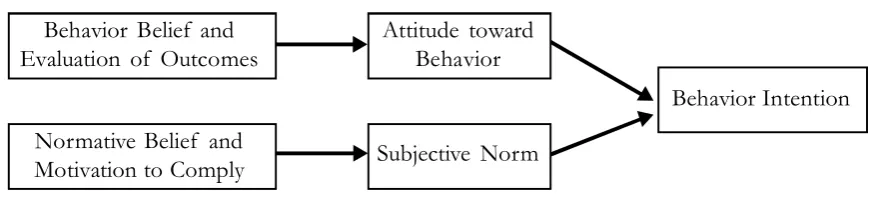
According to the theory, attitudes are derived from beliefs. Usually, a person will hold a favorable attitude toward performing the behavior if it leads to mostly positive outcomes, while a person who believes that performing the behavior will lead to mainly negative outcomes will hold an unfavorable attitude to it (Lada et al. 2009). The subjec-tive norm is also a function of the beliefs that reflect the influence of individuals or groups to think whether he/she should or should not perform the behavior. These beliefs are termed normative beliefs. A person who be-lieves that most referents with whom he is motivated to comply think he should perform the behavior will receive social pressure to do so (Lada et al. 2009). Figure 1 represents the TRA model in a structural form.
The TRA has received great popularity in many disciplines, due its flexibility and ease of application to different situations (Ramayah et al. 2003). This theory has been applied in different contexts such as in busi-nesses, information technology (IT), health, banking, Islamic banking and many others.
For example, Fauziah et al. (2008) ex-amined the intentions of consumers in Ma-laysia to engage in a diminishing partnership
contract from an Islamic bank for their home financing. By utilizing 300 samples, the re-sult indicated that both the attitude and sub-jective norms were able to explain the be-havioral intention, with the subjective norms giving more influence.
Meanwhile, Abiden et al. (2001) and Sapingi et al. (2011) studied zakat payment behavior among Muslim employees and aca-demics in Malaysia. Based on the feedback received from 231 respondents, they found that the attitude towards the behavior and subjective norm significantly influenced the intention to pay the zakat.
Alternatively, Lada et al. (2009) exam-ined which factors led to a consumer choos-ing halal products in Labuan, Malaysia. The findings indicated that the TRA was able to predict the intention to choose halal prod-ucts. The attitude and subjective norms were found to be positively related to the inten-tion, with the subjective norm being the more influential predictor.
Realizing the application of the TRA in various fields, this study aimed for the ad-ditional contribution from the TRA in the area of the Islamic voluntary sector, specifically the waqf. To the best knowledge of the re-searcher, there has been little research into cash waqf and micro enterprises using the TRA. The present research was designed to test empirically the behavioral intention of micro entrepreneurs to using the ICWME-I
Figure 1. Model of Theory of Reasoned Action Behavior Belief and
Evaluation of Outcomes
Normative Belief and Motivation to Comply
Behavior Intention
Subjective Norm Attitude toward
Behavior
model. Thus the present study is intended to examine the following Research Questions (RQ) after developing the ICWME-I model: 1) To what extent can attitude influence the intention of micro entrepreneurs to use the Integrated Cash Waqf Micro Enter-prise Investment (ICWME-I) model? 2) To what extent can the subjective norms
influence the intention of micro entrepre-neurs to use the Integrated Cash Waqf Micro Enterprise Investment (ICWME-I) model?
Hypotheses Development
Based on the TRA, the research hypoth-eses are posited to identify the effect of both attitude and the subjective norm on the be-havioral intention of micro enterprises to use the ICWME-I Model. The hypotheses are as follows:
Ha1: The attitude of micro entrepreneurs is signifi-cantly (positively) affecting their intention to use the Integrated Cash Waqf Micro Enter-prise Investment (ICWME-I) model. Ha2: The subjective norm of micro entrepreneurs is
significantly (positively) affecting their inten-tion to use the Integrated Cash Waqf Micro Enterprise Investment (ICWME-I) model.
The Need For an Alternative
Model
The problem in accessing external fi-nance by the MEs in Malaysia, as discussed by Hashim, (1999), Hassan et al. (2010), Kasim et al. (2010), Selamat et al. (2011), Salleh and Sidek (2011), Ali et al. (2010) and Meza (2012) is due basically to the following reasons: (i) inadequate collateral, (ii) insuffi-cient legal status, (iii) high transaction costs, (iv) insufficient information and
documen-tation, (v) no financial track record, (vi) the nature and quality of their business, (vii) ri-gidity in the financing procedures and (viii) a lack of awareness about the financial facili-ties.
Proposed Model
Overview of Waqf, Cash Waqf
and Its Characteristics
Waqf literally means to stay in perpetu-ity (Ahmed 2004). Technically, it is holding a
maal (an asset) and repeatedly extracting its usufruct for the benefit of an objective rep-resenting righteousness and/or philanthropy for as long as its principal is preserved by its own nature - as in land - or from arrangements and conditions prescribed by the waqf founder (Kahf 2003).
The waqf needs to fulfil three main important characteristics, namely (i) irrevo-cability (ii) perpetuity, and (iii) inalienability. The donor cannot revoke his donation once the property is declared as waqf, and this is known as irrevocability. The perpetuity of the waqf property occurs where the declaration by the donor is binding and perpetual in na-ture, hence fixed asset properties. It is known as the perpetuity of the waqf property. This perpetuity brings benefits for both the donor and the beneficiaries. Meanwhile, the waqf property is not subject to sale, disposition, mortgage, gift, inheritance, attachment, or any alienation whatsoever and this is known as the inalienability of the waqf property.
During Islamic history and civilization, waqf has played a significant role in the pro-vision of social benefits, such as education and health, public facilities (roads, bridges and national security), commercial business, utili-ties (water and sanitation), religious services (the building and maintenance of mosques and graveyards), helping the poor, orphans and the needy, creating employment, support-ing the agricultural and industrial sectors, all without imposing any cost on the government (Mohsin 2008).
A cash waqf means the devotion of an amount of money by a founder and the dedi-cation of its usufruct in perpetuity to a pre-scribed purpose (Mohsin 2008). In this case, the donor endows a cash waqf instead of real estate or a fixed asset. The use of cash waqf came into prominence in the 8th century after
Imam Zufar approved their use (Cizakza 2004). Based on his view, a cash waqf can be invested through Mudarabah and the profits generated would be spent for the charity’s purposes.
Later, in early 15th century these
endow-ments (cash waqf) had been approved by the Ottoman courts and they had become the dominant form of waqf donations and were extremely popular until the end of the 16th
century (Cizakza 2004). During the Ottoman period, education, public works, health and religious services were financed by cash waqf (Toroman et al. 2007). Due to the historical and golden role of cash waqf in the past, nowadays in the 21st century, there is grow-ing evidence of the revitalization of interest, promotion and rethinking into the role of the cash waqf for community development.
One of the suggestions that arose is to integrate a waqf into enterprises. Several con-temporary Muslim scholars have attempted to integrate waqf for small and medium en-terprises, particularly to support their finan-cial needs. In the next section, this study will unveil a number of earlier studies that inte-grated waqf with human capital develop-ment.
Waqf and Financing
proper utilization of the waqf mechanism, as a source of financing, can play a role in providing sufficient funding for the micro entrepreneurs.
For example, in 2004, Elgari came out with the idea to integrate waqf into the con-cept of interest free loans or Qard Hassan. The aim was to provide a source of financ-ing for the poor and those restricted from accessing regular financial institutions. In or-der to perform this operation, Elgari recom-mended establishing a nonprofit financial in-termediary, called the Qard Hassan bank. The capital for the bank would come from the monetary (cash) waqf donated by Muslims.
Cizakza (2004) also suggested a model where the cash waqf can be used to meet the social objectives of the society by providing financing assistance to the entrepreneurs through the concept of partnership (Mudharabah). He also suggested that cash waqf can be used as microfinance tools for the poor or for entrepreneurs.
Meanwhile, Lahsasna (2010) suggested the cash waqf model to enhance the finan-cial services for SMEs in Malaysia. This sug-gested model is expected to improve domes-tic economic growth and play a vital role in the socioeconomic development by allowing the SMEs access to financial services. The investment of these cash waqf will be made with debt financing and equity financing con-tracts such as Murabahah, Ijarah, Istisna and
Bai Bithamil Ajil, Mudharabah and Musharakah
for the SMEs in Malaysia.
Also in 2010, Tohirin found that the cash waqf system was a solution to the lack of access to formal banking institutions in Indonesia. Through proper utilization and investment of these cash waqf assets, SMEs would be able to expand their business
ven-tures through partnerships with the cash waqf institutions.
From these models, as proposed by the various authors, it has been shown that the integration of waqf and micro enterprises is a possibility, to effectively address the issue of financing for micro entrepreneurs. Al-though the model proposed by various stud-ies has a similarity with the present study, there are also major differences as mentioned earlier. Furthermore, most of the proposed models by (Elgari 2004; Cizakza 2004; Ahmed 2007; Hassan 2010) are not validated empirically to gauge the entrepreneurs’ inten-tion to use them.
Furthermore, most of the studies dis-cussed the conceptual and theoretical aspects of waqf and enterprise models, without any hypotheses formulated to measure the entre-preneurs’ intentions to use those models. This study fills this gap by proposing an Integrated Cash Waqf Micro Enterprise Investment (ICWME-I) model which is a participatory form of contract between the waqf institu-tions and the micro enterprises. This model incorporates Musharakah Mutanaqisah (dimin-ishing partnership) financing arrangements between the waqf institutions and the micro enterprises.
Proposed Integrated Cash Waqf
Micro Enterprise Investment
(ICWME-I) Model
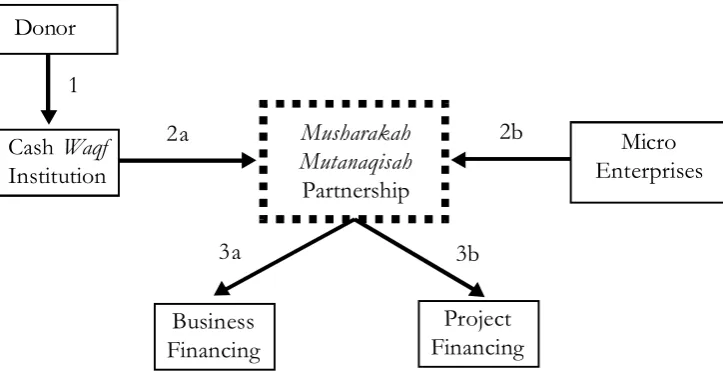
schemes for financing in Malaysia as shown in Figure 1.
Below are the detailed explanations of the above model:
Arrow [1] indicates the flow of fund from the donors (both in the public and corpo-rate sectors) that will contribute cash waqf to the CWI with the intention of creating perpetual waqf. The public will contrib-ute cash waqf by voluntarily donating or purchasing waqf shares or certificates of-fered by the CWI. The corporate sector can contribute cash waqf as a part of their Corporate Social Responsibility (CSR) programs. The CWI becomes the mutawali
(manager) of the fund. The manager would be responsible for making the nec-essary investment decisions for the fund. The CWI can be treated as a separate en-tity under the State Islamic Religious Councils (SIRCs) or the corporate sector. Arrow [2a] and [2b] show that the CWI will provide a financing facility by involv-ing a Musharakah Mutanaqisah (diminish-ing partnership) arrangement with the
mi-cro enterprises. A Musharakah Mutanaqisah
(diminishing partnership) arrangement is where both the CWI and the micro enter-prises jointly engage in business activities or purchase property or commercial en-terprises. Later, the assets owned by the financier are divided into parts, with the understanding that the customer will gradually purchase those parts via peri-odic payments. The objective is for the customer to eventually become the sole owner of the property or enterprise. This arrangement is suitable for business fi-nancing [3a] and project fifi-nancing [3b]. For the business financing, it can include the financing of machinery, land, electric installations, equipment, and other fixed assets. Meanwhile, the project financing involves financing of construction of shop lots and business premises.
Under this model, the CWI requires no collateral, or needs to apply an interest rate or ask for strict documentation. How-ever, in order to ensure this model is ef-fectively operated, the CWI is required to conduct prior and post screening of the Donor
Cash Waqf
Institution
Musharakah Mutanaqisah
Partnership
Micro Enterprises
Business Financing
Project Financing
1
2a
3a
2b
potential micro enterprises, to ensure that they are able to generate revenue, and to monitor their businesses.
After this model was developed, this study undertook an empirical survey to gauge the intentions of micro enterprises to use this model. Hence, in this study, the researcher applied the Theory of Reasoned Action (TRA) as discussed in an earlier section. This theory is basically a method to empirically test the intentions of micro entrepreneurs to use the ICWME-I model developed by the study.
Methods
Data Collection
The study focuses on micro enterprises in the Klang Valley (Selangor and Kuala Lumpur). This area was chosen, as the data-base for SMEs which also includes micro enterprises, showed it had the highest num-ber. A random sampling was drawn for the survey. Sampling was conducted by distrib-uting questionnaires to the owners of micro enterprises. The sample size was four hun-dred and twenty (n=420) individuals. 19 (4.52 percent) of the 420 respondents were ex-cluded due to their incomplete survey re-sponses. This resulted in a total of 401 effec-tive responses which were used in the data analysis procedures. Therefore, the effective return rate was 95.5 percent
Sample Size
The selection of an appropriate sample size is an important issue in Structural Equa-tion Modeling (SEM). According to Hair et al. (2006), a sample size ranging between 200 and 400 is sufficient for SEM to give precise results. This is also supported by Kline (2011) who suggested that the sample size for SEM
should be large enough (n>200). Thus, by taking the suggestions of Hair et al. (2006) and Kline (2011), the present study has sur-veyed a total sample of 420 micro enterprises. However, only 401 effective responses were used in the data analysis procedures.
Research Instruments
This study adopted a self-administered questionnaire design. The questionnaires were adopted and adapted based on the Theory of Reasoned Action (TRA). For these TRA questionnaires, this study developed the items in the questionnaires by adapting measures which were developed by previous studies that used TRA (Ajzen & Fishbein, 1980; Abduh, 2011; Muhammad, 2012). It was aimed at finding the acceptance and inten-tion of micro entrepreneurs in Malaysia to use the ICWME-I model.
opinion I value would approve my action in using this ICWME-I model for financing pur-poses” coded as 34.
Data Analysis
The collected data were analyzed using SPSS Statistics 20 and AMOS 20. Following the procedure suggested by Anderson and Gerbing (1988), a measurement model was estimated before the structural model. A Confirmatory Factor Analysis (CFA) was employed to assess the measurement model and to test the data’s quality, including its reliability and construct validity checks. Structural Equation Modelling (SEM) was conducted to assess the overall fit of the pro-posed model and to test the hypotheses.
Results and Discussions
Descriptive Analysis
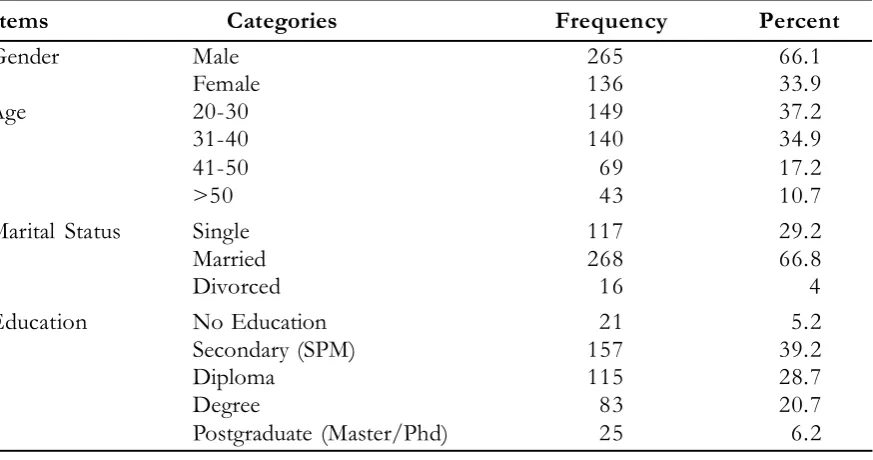
As shown in Table 1, a total of 265 (66.1 percent) of the respondents were male,
while 136 (33.9 percent) were female. The respondents were classified into four age cat-egories. The age range of the respondents consisted of 149 (37.2 percent) who were 20-30 years old, 140 (34.9 percent) were 31-40 years old, 69 (17.2 percent) were 41-50 years old and 43 (10.7 percent) were over 50 years old. The respondents were also classified into three marital categories. Among the choices given were married, single and divorced. Most of the subjects, 268 (66.8 percent) were mar-ried. The survey also indicated that 117 (29.2 percent) of the respondents were single and 16 (4 percent) were divorced.
In terms of their education level, the respondents were classified into five catego-ries. For this purpose, the respondents were asked to identify the highest level of educa-tion that they completed. The choices given were no education, secondary (SPM), Di-ploma, Bachelor degree and Master/PhD. The distribution consisted of 21 (5.2 percent) with no education, 157 (39.2 percent) had a secondary education (SPM), 115 (28.7
per-Table 1. Descriptive Statistics for Demographic Variables of the Sample by Gender, Age, Marital Status and Education
Items Categories Frequency Percent
Gender Male 265 66.1
Female 136 33.9
Age 20-30 149 37.2
31-40 140 34.9
41-50 69 17.2
>50 43 10.7
Marital Status Single 117 29.2
Married 268 66.8
Divorced 16 4
Education No Education 21 5.2
Secondary (SPM) 157 39.2
Diploma 115 28.7
Degree 83 20.7
cent) possessed a Diploma, 83 (20.7 percent) had completed a Bachelor degree, and 25 (6.2 percent) held a postgraduate degree (Master/ PhD).
Meanwhile, in Table 2, it shows that the respondents were categorized into 3 catego-ries based on the number of years they were in business. 254 (63.3 percent) of the respon-dents had operated their business for between 0-5 years, with 101 (25.2 percent) for 6-10 years. Only 46 (11.5 percent) had more than 10 years. In terms of the category of their businesses, 387 (96.5 percent) of the respon-dents were in service oriented businesses, followed by 8 (2 percent) in agricultural ones. The remaining 4 (1 percent) and 2 (0.5 per-cent) were involved in manufacturing and construction, respectively.
The respondents were also classified into five groups by their annual sales turn-over. The respondents were asked to pinpoint
their annual sales turnover. The distribution consisted of 226 (56.4 percent) between RM10,000-RM50,000, 113 (28.2 percent) RM50,001-RM100,000, 31 (7.7 percent) RM100,001-RM150,000, 25 (6.2 percent) RM150,001-RM200,000 and 6 (1.5 percent) RM200,001-RM300,000.
Furthermore, as depicted in Table 3 below, 123 (30.7 percent) of the respondents indicated that they had applied for an exter-nal loan in the last 6 months to 1 year. Hence, it is appropriate to investigate the reasons behind their application for a loan. Table 6.4 indicates the most commonly cited reason for applying for external finance: (78) 19.5 per-cent of the respondents said it was for ex-pansion, (56) 14 percent said it was for capi-tal purchases and (41) 10.2 percent stated it was for working capital. Another reason given by (10) 2.5 percent of the respondents was that they needed the loan to finance their plans for relocating their businesses.
Table 2. Descriptive Statistics for the Demographic Variables of the Sample by the Number of Years in Business, the Category of Business and the Annual Sales Turnover
Items Categories Frequency Percent
Number of Years in Business 0-5 Years 254 63.3
6-10 Years 101 25.2
>10 Years 46 11.5
Category of Business Services 387 96.5
Agriculture 8 2
Manufacturing 4 1
Construction 2 0.5
Annual Turnover RM10,000-RM50,000 226 56.4
RM50,001-RM100,000 113 28.2
RM100,001-150,000 31 7.7
RM150,001-RM200,000 25 6.2
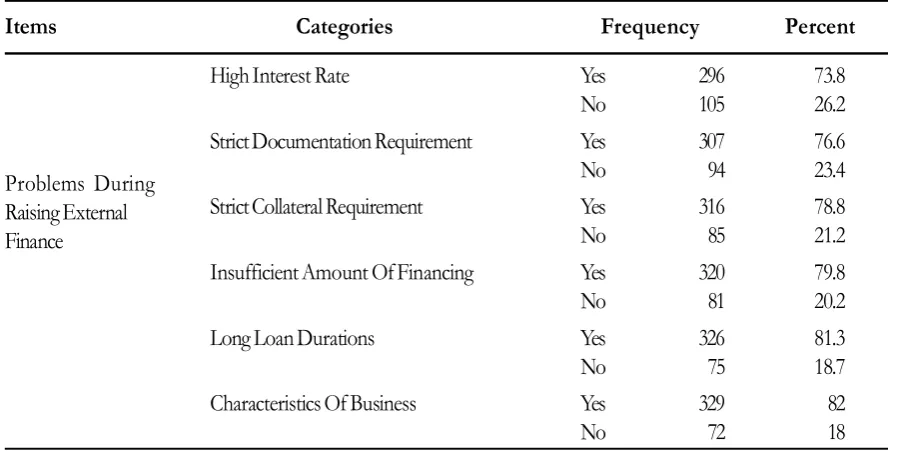
Although Table 3 shows that micro en-terprises may eventually succeed in raising external financing, they encounter problems in the process of obtaining their loans. Hence, the respondents were asked about the diffi-culties they experienced in the process of applying for and obtaining external financing during the last six months to one year.
As shown in Table 4, 73.8 percent of the respondents stated that a higher interest rate was one of the difficulties they faced in obtaining external financing. They also agreed
that the strict documentation requirements and collateral requirements affected them. These two factors received 76.6 percent and 78.8 percent, respectively. A further 79.8 percent also disclosed that they were faced with the problem of insufficient amounts of financing from the financial institutions. The other obstacles, such as the long duration of their loans (81.3 percent) and the character-istics of their businesses (28 percent) were also seen to place undue pressure on the mi-cro enterprises to obtain finance.
Table 3. Cross-Tabulation of Applying for a Loan and the Objectives for the Loan
Expansion Capital Working
Purchase Capital Relocation
Frequency No Yes No Yes No Yes No Yes
No 278 0 278 0 278 0 278 0
Yes 45 78 67 56 82 41 113 10
Applying for a Loan During the Last 6 Months- 1 Year
Table 4. Type of Problems during Loan Application
Items Categories Frequency Percent
High Interest Rate Yes 296 73.8
No 105 26.2
Strict Documentation Requirement Yes 307 76.6
No 94 23.4
Strict Collateral Requirement Yes 316 78.8
No 85 21.2
Insufficient Amount Of Financing Yes 320 79.8
No 81 20.2
Long Loan Durations Yes 326 81.3
No 75 18.7
Characteristics Of Business Yes 329 82
No 72 18
Structural Equation Modeling
Measurement Model
A measurement model was estimated using the maximum likelihood estimation method. The initial 25 items developed for measurement were subjected to a CFA. Later, after running the new measurement models, the results of the CFA on these 23 items showed a moderate fit to the data as shown in Table 5. The chi-square value (2) of the
measurement model was 967.783 (df = 216, p = 0.000). The Normed 2 value of 4.480
falls within the range of below 5, as suggested by Marsh and Hocevar (1988). Other practi-cal fit indices demonstrated that the measure-ment model fitted the data well (RMSEA 0.098; CFI 0.927). Consequently, this mea-surement model was used for all further ana-lyzes.
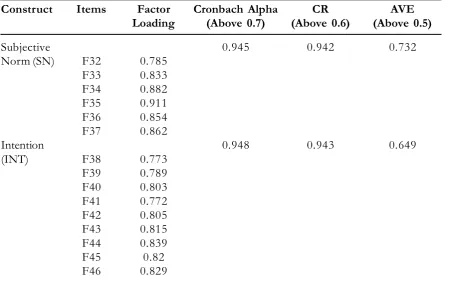
Meanwhile, as shown in Table 6, the construct reliability values were well above the 0.70 level suggested by Nunnally (1978).
All standardized factor loadings emerged fairly high and significant, ranging from 0.622 to 0.94. This suggested convergence of the indicators with the appropriate underlying factors (Anderson and Gerbing, 1988). The Average Variance Extracted (AVE) values for each construct were all above 0.50 (Fornell and Larcker 1981). Overall, these results showed strong evidence of the unidimension-ality, reliability, and validity of the measures. The discriminant validity of the con-structs is shown in Table 7. Smith et al. (1996) proposed that each construct’s AVE is com-pared to its Squared Correlation (SC) with other constructs. In this regard, if the aver-age variance extracted of a factor is greater than the squared correlation between that and every other factor, the factor exhibits discrimi-nant validity. The result shows that the square root of the AVE between each pair of fac-tors was higher than the correlation estimated between factors, thus ratifying its discrimi-nant validity (Hair et al. 2006).
Table 5. Fit Indices for Final MM3
Model 2 Df Normed 2 RMSEA CFI Comment
Final MM3 967.783 216 4.480 0.093 0.927 The required level is achieved
Table 6. The CFA Results for the Measurement Model
Construct Items Factor Cronbach Alpha CR AVE
Loading (Above 0.7) (Above 0.6) (Above 0.5)
Attitude 0.945 0.937 0.657
(AT) F15 0.899
F16 0.93
F17 0.941
F18 0.891
F19 0.866
F22 0.622
F23 0.659
Structural Model
A structural model was estimated to test the hypotheses Ha1 and Ha2. The good-ness-of-fit statistics of the proposed model showed that the model reasonably fits the current data. Chi-square values of the model (2 = 205.109, df = 98, p = 0.000) and other
goodness of fit indices (Normed 2 = 4.480;
RMSEA = 0.093; CFI = 0.927) revealed that the model fitted the data reasonably well. The
structural results of the proposed model are depicted in Figure 3.
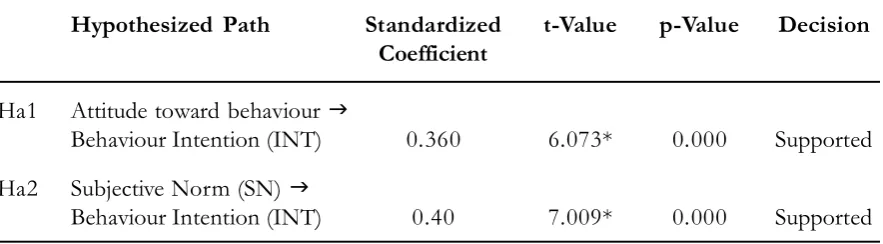
The hypothesized relationship in which micro entrepreneurs’ attitudes toward their intention to use the Integrated Cash Waqf Micro Enterprise Investment (ICWME-I) model was statistically significant (â1 = 0.360, t-value = 6.073, p < 0.01), thus Ha1 was supported. The results indicated that when the micro entrepreneurs had a more Table 7. Inter-construct Correlation and Squared Correlation (SC)
Average Variance Extracted (AVE) INT AT SN
(0.649) (0.657) (0.732)
INT 1
ATSC 0.585(0.342) 1
SNSC 0.6(0.36) 0.569(0.323) 1
Table 6. Continued
Construct Items Factor Cronbach Alpha CR AVE
Loading (Above 0.7) (Above 0.6) (Above 0.5)
Subjective 0.945 0.942 0.732
Norm (SN) F32 0.785
F33 0.833
F34 0.882
F35 0.911
F36 0.854
F37 0.862
Intention 0.948 0.943 0.649
(INT) F38 0.773
F39 0.789
F40 0.803
F41 0.772
F42 0.805
F43 0.815
F44 0.839
F45 0.82
positive view about the outcome of their in-volvement with the ICWME-I model, the more favorable their attitude was toward their behavior and subsequently, the stronger their intention was to take the initiative to use the ICWME-I Model to finance their businesses and also for human capital development.
Meanwhile, the second hypothesis (Ha2) also found that the subjective norms had a significant influence on the micro
en-trepreneurs’ intention to use the ICWME-I model. Therefore, research hypothesis two was supported (2 = 0.40, t-value = 7.009, p < 0.01) as shown in Table 8. It is believed that the social pressure groups that assert the subjective norms, including family members, relatives, friends, neighbors and co-workers, influenced the decision making process of the survey’s respondents who are interested in using the ICWME-I model in the future. Figure 3. Structural Model
Conclusion
This study has examined the problems of accessing external financing faced by mi-cro enterprises in Malaysia. The study identi-fied financial problems as the main obstacle, due to (i) inadequate collateral, (ii) insuffi-cient legal status, (iii) high transaction costs, (iv) insufficient information and documen-tation, (v) no financial track record, (vi) the nature and quality of the business, (vii) the rigidity of the financing procedure and (viii) a lack of awareness of the financial facili-ties.
Therefore, there is a crucial need for an alternative model of financing that should be based on being interest–free and collateral– free. In addition, this model should also be
able to help micro enterprises financially. The Integrated Cash Waqf Micro Enterprises In-vestment (ICWME-I) model proposed inte-grates all these identified aspects.
This model has been tested using the Theory of Reasoned Action (TRA) in order to identify which factors are influencing the intention of the micro enterprises to use the ICWME-I model. This study has proven that both the attitude toward behavior and the subjective norms are directly significant in influencing the micro entrepreneurs’ intention to use the ICWME-I model. The findings of this study can be used to develop a specific framework in which to examine other com-ponents of using the ICWME-I model’s be-havior and to plan appropriate intervention strategies to increase access to finance. Table 8. Hypotheses Testing: The Effect of Attitude Toward Behaviour and the
Subjec-tive Norm on the Behavioral Intention of Micro Enterprises
Hypothesized Path Standardized t-Value p-Value Decision Coefficient
Ha1 Attitude toward behaviour
Behaviour Intention (INT) 0.360 6.073* 0.000 Supported
Ha2 Subjective Norm (SN)
Behaviour Intention (INT) 0.40 7.009* 0.000 Supported
*p-value < 0.01
References
Abdullah, M. A. 2002. Industri Kecil Di Malaysia: Pembangunan Dan Masa Depan. Kuala Lumpur, Malaysia: Dewan Bahasa dan Pustaka.
Abdullah, M. A. 1999. Small And Medium Enterprises In Malaysia: Policy Issues And Challenges. Ashgate, En-gland.
Abduh, M., J. Duasa, and M. Omar. 2011. Factors influence depositors’ withdrawal behavior in Islamic banks: A theory of reasoned action. World Academy of Science, Engineering and Technology 60: 2074-2079.
Abidin, Z., K. M. Idris and F. M. Shamsudin. 2009. Predicting compliance intention on zakah on employ-ment income in Malaysia: An application of reasoned action theory. Jurnal Pengurusan 28: 85-102 Aris N. M. 2006. SMEs: Building blocks for economic growth. Paper Presented at National Statistics
Confer-ence. Department of Statistics, Malaysia, 4-5 September.
Ajzen, I. 1991. The theory of planned behavior, organizational behavior and human. Decision Processes 50: 199-211
Cizakca, M. 2004. Cash waqf as alternative to NBFIs Bank. Paper Presented in the International Seminar On Nonbank Financial Institutions: Islamic Alternatives. Kuala Lumpur., Malaysia, March 1-3.
El-Gari, M. A. 2004. The qard Hassan Bank. Paper Presented in The International Seminar On Nonbank Finan-cial Institutions: Islamic Alternatives. Kuala Lumpur, Malaysia, March 1-3.
Fishbein, M., and Ajzen, I. 1975. Belief, Attitude, Intention, and Behavior: An Introduction to Theory and Research. Reading, MA: Addison-Wesley
Hair, J. F., W. C. Black, B. J. Babin, R. E. Anderson, and R. L. Tatham. 2006. Multivariate Data Analysis 6. Upper Saddle River, NJ: Pearson Prentice Hall.
Hair, J. F., W. C. Black, and B. J. Babin. 2010. RE Anderson Multivariate Data Analysis: A Global Perspective. New Jersey: Pearson Education.
Hassan, N., S. T. S. Chin, J. A. Yeow, and N. A. Mohd Rom. 2010. Financial constraints and opportunities of micro enterprise entrepreneur: A theoretical framework. Paper Presented at International Conference On Business And Economics Research. Kuala Lumpur, Malaysia.
Hashim, M. K., S. A. Ahmad, and L. L. Ooi. 2008. Leadership styles and job satisfaction among employ-ees in SMEs. In Hashim, M. K. (Ed.), Emerging Issues in Small and Medium-sized Enterprises. Sintok: Universiti Utara Malaysia Press.
Idris, F., A. A. Ab-Latif, and S. Haron. 2002. Entrepreneurs’ Awareness of Bank Borrowing Offered by Government Agencies and Commercial Banks in Malaysia. ICSB
Jamak A., A. B. S. Salleh, R. S. Sivapalan, and A. Abdullah. 2011. Entrepreneurial challenges confronting micro-enterprise of Malaysian Malays. World Academy of Science, Engineering and Technology 59: 862-867.
Kahf, M. 2007. The role of waqf in improving the Ummah welfare. Paper Presented at The Singapore International Waqf Conference. Singapore, March 6-7.
Kahf, M. 2003. The role of waqf in improving the Ummah welfare. Paper Presented to the International Seminar on Waqf as a Private Legal Body. Universitas Islam Sumatera Utara, Medan, Indonesia. Lahsasna A. 2010. The role of cash-waqf in financing micro and medium-sized enterprises. Paper Presented
at 7th International Conference - The Tawhidi Epistemology: Zakat and Waqf Economy. Bangi, Selangor.
Lada, S., G. H. Tanakinjal, and H. Amin. 2009. Predicting intention to choose halal products using theory of reasoned action. International Journal of Islamic and Middle Eastern Finance and Management 2 (1): 66-76.
Mohsin M. I. A.2008.Cash waqf a new financial product model aspects of shariah principles on ITS commercialization. Paper is presented at Islamic Banking, Accounting and Finance Conference (iBAF 2008), Faculty of Economics and Muamalat, Universiti Sains Islam Malaysia, 28-29 July 2008 at The Legend Hotel, Kuala Lumpur 2008
Ramayah T., M. N. Aizzat, M. N. Mohd Naser, and H. Hajemi. 2003. Students’ choice intention of a higher learning institution: An application of the theory of reasoned action (TRA). Malaysian Man-agement Journal 7 (1): 47-62 (2003).
Razak D. A., and M. Abduh. 2012. Customers’ attitude towards diminishing partnership home financing in islamic banking. American Journal of Applied Sciences 9 (4): 593-599.
Saleh, A. S., and N. O. Ndubisi. 2006. An evaluation of SME development in Malaysia. International Review of Business Research Papers (2) (1).
Selamat, N. H., R. R. Abdul-Razak, S. A. Gapor, and Z. A. Sanusi. 2011. Survival through entrepreneur-ship: Determinants of successful micro-enterprises in Balik Pulau, Penang Island, Malaysia. British Journal of Arts and Social Sciences 3 (1): 23-37.
Salleh, M. M., and N. Z. M. Sidek. 2011. Rural entrepreneurship: A challenges and opportunities of rural micro enterprise (RME) in Malaysia. Interdisciplinary Journal Of Contemporary Research In Business 2 (11) (March).
Saleh, A.S., P. Caputi, and C. Harvey. 2008. Perceptions of business challenges facing Malaysian SMES: Some preliminary results. Paper presented at 5th SMEs in a Global Economy Conference, August 2nd-3rd, Senshu University, Kandajimbocho, Tokyo, Japan.
SME Masterplan (2012 – 2020). Catalysing Growth and Income. National SME Development Council. SME Annual Report (2010/2011). Leveraging Opportunities Realizing Growth. Kuala Lumpur, Malaysia SME Annual Report (2012/2013). Embracing Changes. Kuala Lumpur, Malaysia
Tohirin A. 2010. The Cash Waqf For Empowering The Small Businesses. Paper presented At 7th
Interna-tional Conference- The Tawhidi Epistemology: Zakat And Waqf Economy, Bangi, Selangor. Toraman C., B. Tuncsiper and S. Yilmaz. 2004. Cash Waqf in the Ottomans as Philanthropic Foundations and their