http://www.arjournals.org/index.php/ijdd/index
Original Research Article
Honey gel and film for burn wound
Febriyenti
1,2*, Najmiatul Fitria
1, Noratiqah Mohtar
2, Salman Umar
1, Deni Noviza
1, Shintia Rineldi
1, Yunirwanti
1and Saringat bin Bai
2*
Corresponding author:
Febriyenti
1Faculty of Pharmacy, Universitas
Andalas, Padang-Indonesia; 2School of
Pharmaceutical Sciences, Universiti Sains Malaysia
A b s t r a c t
Honey has been used to treat infected wounds since ancient times. Antibacterial properties of honey are derived from the high sugar content which inhibits bacteria. The natural acidity of honey will inhibit many pathogens. Honey also containing glucose oxidase enzyme that produced hydrogen peroxide when diluted. But honey is still used directly to treat the wound. In this study, we try to formulate the honey to form gel and film. Polymers used are natrium carboxymethyl cellulose (Na-CMC), Aqupec 505 HV, hydroxylpropyl methylcellulose (HPMC), gelatine and polyvinyl alcohol (PVA). Selected polymer was formulated into honey film. Polymers should be combined with plasticizer to improve their properties. Plasticizers studied are polyethylene glycol 400, glycerin and propylene glycol. Evaluations for gel including general appearance, homogeneity, pH and spreadability test, washed test and skin irritation test. Film evaluations are thickness, tensile strength, elongation at break, YoungÊs modulus and water vapour permeability. Based on general appearance and physical properties of gel and film, formula that used PVA as polymer and glycerin as plasticizer is the best formula in this study.
Keywords: Honey, gel, film, PVA and glycerin
Introduction
Honey is a natural fluid generally has a sweet taste produced by insect called a bee. Honey had been used in earlier times for its medicinal properties in many cultures throughout the world. Several studies have reported that honey is effective as a topical therapy on wound [1, 2]. Honey is antibacterial, antioxidant and has a high nutrient content which good for wound healing process [3, 4, 5]. In a study in India, honey can be used in healing burns. This is mainly because honey has a high osmolarity and content of some organic components. In addition, the content of honey also has a composition that suitable with human body, so honey is not considered as a foreign compound [6, 7].
One way of burn wound treatment is using topical antibiotic because there are many protein in the surface of burn wound that could facilitate the growth of bacteria. Honey can act as antimicrobial agents because honey contained hydrogen peroxide. Hydrogen peroxide is known as a major source of honey antibacterial capabilities. Hydrogen peroxide produced by enzyme glucose oxidase (glucosidase) reaction in honey, especially glucose. With the presence of that enzyme, glucose in honey will be converted into glucoronic acid and hydrogen peroxide. Mechanism of hydrogen peroxide as antibacterial is by ruin the outer membrane that protects the bacteria so that the bacteria will be die instantly [5, 8]. Honey has antimicrobial properties because honey has high osmolarity, acidic pH and relatively low water activity [9, 10].
Gel is defined as a semi-solid system consisting of a good dispersion composed of small inorganic particles or large organic molecules, penetrated by a fluid, can be either transparent or opaque mass is used topically [11]. Gel dosage forms have several types of advantages such as simple manufacturing; gives a sense of cold, easily leached after basting and the thin layer formed can provide protection [12]. Gel dosage form is preferred over cream which gel has a high water content so as to reduce pain at the time of application, especially to mucous membranes and in the injured tissue or burned [13]. This study used several gel-forming polymers i.e. Na-CMC, Aqupec 505 HV, HPMC, Gelatine and PVA.
In ancient time, the treatment of wounds is done by allowing the wound to dry and form a hard cover wound like a scab. Since about 30 years ago, the treatment of wound has undergone a change where it is known that the wound will heal faster when covered with a moist cover. Traditionally, gauze made of cotton was used as dressing the wound. But now we can used gels and films to cover the wound and accelerate wound healing [14]. Therefore we conducted this study to find a formula honey gel and film that can be used as wound dressing and accelerate healing of burns.
Materials and Methods
Materials
Honey was acquired from Talu, West Sumatera, Indonesia, Na-CMC, Aqupec 505 HV and Gelatine. Polyvinyl alcohol (PVA) were
ISSN: 0975-0215
Febriyenti
et al
. International Journal of Drug Delivery 6 (1) 01-06
[2014]
PAGE | 2 |
bought from VWR International, Belgium. Hydroxypropyl methylcellulose (HPMC) was supplied by Sigma Chemical Co., USA. Polyethylene glycol (PEG) 400 was purchased from Fisher Scientific, U.K. Propylene glycol, glycerin, triethanolamine and methyl paraben, were acquired from R&M Chemicals,U.K.. All chemicals were used without further purification.
Methods
Preparation of Gels
Gels using Aqupec 505 HV and HPMC were prepared by cold mechanical method while gels using Na-CMC, Gelatine and PVA were prepared by hot mechanical method [12, 13, 15, 16]. The prepared gels were packed in wide mouth glass jar covered with screw capped plastic lid.
Table 1. Honey Gels Formula
Ingredients Formula 1 (%) Formula 2 (%) Formula 3 (%) Formula 4 (%) Formula 5 (%)
1a 1b 1c 2a 2b 2c 3a 3b 3c 4a 4b 4c 5a 5b 5c
Honey 10 10 10 10 10 10 10 10 10 10 10 10 10 10 10
Na-CMC 4 5 6 - - - - - -
-Aqupec 505 HV - - - 0,5 0,75 1 - - - - -
-HPMC - - - - - - 4 4,5 5 - - -
Gelatine - - - - - - - 2 2,5 3
PVA - - - - - - - 8 10 12
Propilen glikol 10 10 10 10 10 10 10 10 10 10 10 10 10 10 10 Methyl paraben 0,1 0,1 0,1 0,1 0,1 0,1 0,1 0,1 0,1 0,1 0,1 0,1 0,1 0,1 0,1
TEA - - - qs qs qs - - - - -
-Distilled water (up
to) 100 100 100 100 100 100 100 100 100 100 100 100 100 100 100
pH Measurements [17, 18]
The pH of all gels formula was determined by using digital pH meter.
General Appearance [11, 19]
Consistency, texture and transparency of the prepared gels were done visually.
Homogeneity [11, 17, 19]
All gels formula was tested for homogeneity by visual inspection after the gels have been set in the container. They were tested for their appearance and presence of any aggregates.
Spreadability Test [17, 19]
0.5 g of each gel formulas was placed on a transparent glass repose graph paper, samples was let dilated at a certain diameter. Then covered with transparent plastic and given a certain load (1, 3, 5 and 7 g) for 15 seconds. Increasing of diameter measured after being given the load.
Washed Test [20]
Test was done by applied 1 g gel to the hand and then washed with a certain amount of water. Accounted for much of the water volume was used.
Skin Irritation Test [11, 17]
Test for irritation was performed on human volunteers. For each formula, five volunteers were selected and 0.1 g of formulated gel was applied on an area of 2 square inch to the back of upper hand. The volunteers were observed for lesions or irritation after 24 hours.
Preparation of Honey Film
Honey film was prepared by using selected gel formula. Honey film was prepared by drying a certain amount of honey gel in Petri dish to form a thin layer. Evaluation of film including thickness [21], tensile strength, elongation at break [22] and water vapour permeability [23].
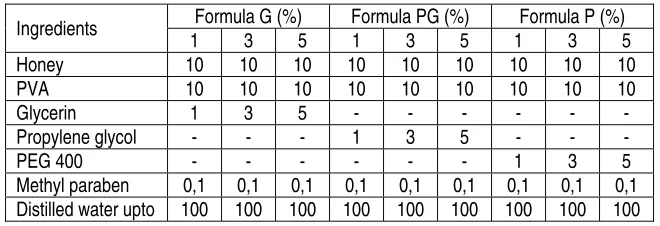
Table 2. Honey Film Formulas
Ingredients Formula G (%) Formula PG (%) Formula P (%)
1 3 5 1 3 5 1 3 5
Honey 10 10 10 10 10 10 10 10 10
PVA 10 10 10 10 10 10 10 10 10
Glycerin 1 3 5 - - -
Propylene glycol - - - 1 3 5 - - -
PEG 400 - - - - 1 3 5
PAGE | 3 |
Film Thickness
The film thicknesses were measured using a micrometer (Digimatic micrometer, Mitutoyo, Tokyo, Japan) by the method of Yoo et al. [24] and Cao et al. [16]. Sample with air bubbles, nicks or tears and having mean thickness variations of greater than 10 % were excluded from analysis [21].
Mechanical Properties Measurements
The mechanical properties of aerosol concentrate films were evaluated using a texture analyzer (TA.XT2, Stable Micro System, Haslemere, Surrey, UK) by the method of Khan et al. [25] and Febriyenti et al. [22]. YoungÊs modulus (E), a measure of intrinsic film stiffness (Garcia et al., 2009), can be calculated by using the equation in Martin et al. [18].
Water Vapour Permeability of Films
The rates of water vapour permeability of films were determined using the method described in USP XXIV [26] for the evaluation of moisture permeability of containers and packaging materials. Films were tied onto the mouth of small glass bottles of the same size and type (diameter = 1.6 cm) with an average volume of 25 ml μ 0.5 ml. The average area available for vapour permeation was
2.0096 cm2. The rate of moisture permeability was calculated by using the equation:
1000
Rate of Moisture Permeability (mg/day/litre) = --- x [(Tf Ti) (Cf Ci)] 14 V
Which V is volume (ml) of the container, (Tf Ti) is the difference (mg) between the final and initial weights of each test container, (Cf Ci) is the average of the difference (mg) between final and initial weights of two containers (control).
And other equation by Fetisova and Tsetlin [23]:
1000
Water vapour permeability (mg/cm2/day) = --- x [(Tf Ti) (Cf Ci)] 14 A
A is the area of the film available for vapour permeability (cm2).
Results and Discussion
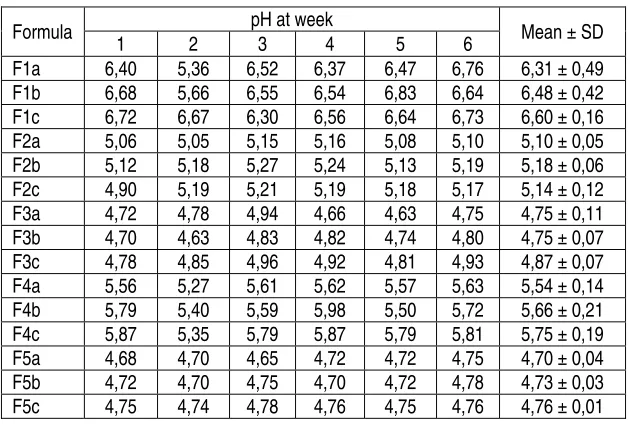
pH evaluation was done every week for 6 weeks of storage. pH value changed every week. Nevertheless the results are still within the normal skin pH range i.e. 4,2-6,5 [27] or 5-6,5 [28].
Table 3. pH of Honey Gels
Formula pH at week Mean μ SD
1 2 3 4 5 6
F1a 6,40 5,36 6,52 6,37 6,47 6,76 6,31 μ 0,49 F1b 6,68 5,66 6,55 6,54 6,83 6,64 6,48 μ 0,42 F1c 6,72 6,67 6,30 6,56 6,64 6,73 6,60 μ 0,16 F2a 5,06 5,05 5,15 5,16 5,08 5,10 5,10 μ 0,05 F2b 5,12 5,18 5,27 5,24 5,13 5,19 5,18 μ 0,06 F2c 4,90 5,19 5,21 5,19 5,18 5,17 5,14 μ 0,12 F3a 4,72 4,78 4,94 4,66 4,63 4,75 4,75 μ 0,11 F3b 4,70 4,63 4,83 4,82 4,74 4,80 4,75 μ 0,07 F3c 4,78 4,85 4,96 4,92 4,81 4,93 4,87 μ 0,07 F4a 5,56 5,27 5,61 5,62 5,57 5,63 5,54 μ 0,14 F4b 5,79 5,40 5,59 5,98 5,50 5,72 5,66 μ 0,21 F4c 5,87 5,35 5,79 5,87 5,79 5,81 5,75 μ 0,19 F5a 4,68 4,70 4,65 4,72 4,72 4,75 4,70 μ 0,04 F5b 4,72 4,70 4,75 4,70 4,72 4,78 4,73 μ 0,03 F5c 4,75 4,74 4,78 4,76 4,75 4,76 4,76 μ 0,01
Table 4 shows the results of the evaluation of general appearances, homogeneity, washed test and irritation test. Gel using Aqupec HV505 and PVA produce clear or transparent gel while the other polymer produced slightly cloudy gel. Good gel for wound dressing is transparent so it is easy to observe the condition of the wound underneath. All of the Honey gel formulas produce homogeny gel. Means that all the ingredients could be mixed with either and gel preparation method used was appropriate.
Washed test was conducted in order to measure the amount of water needed to wash up the gel smeared on the skin. Factor
affecting the amount of water that is needed is the type of polymer and the viscosity of the gels. Usually, the dilute gels required less water to wash it up.
Febriyenti
et al
. International Journal of Drug Delivery 6 (1) 01-06
[2014]
PAGE | 4 |
Table 4. Honey Gel Evaluations
Gelling Agent Conc.
(%w/w) General appearances Homogeneity
Washed test (ml)
Irritation test Na-CMC 4 slightly cloudy gel Good 44.4 Nil
5 slightly cloudy gel Good 48.0 Nil 6 slightly cloudy gel Good 57.6 Nil Aqupec 505 HV 0.5 clear gel Good 25.9 Nil
0.75 clear gel Good 30.7 Nil
1 clear gel Good 45.0 Nil
HPMC 4 slightly cloudy gel Good 34.3 Nil 4.5 slightly cloudy gel Good 36.6 Nil 5 slightly cloudy gel Good 43.7 Nil
Gelatine 2 slightly cloudy gel Good 5.0 Nil
2.5 slightly cloudy gel Good 7.0 Nil
3 slightly cloudy gel Good 9.0 Nil
PVA 8 clear gel Good 23.7 Nil
10 clear gel Good 24.3 Nil
12 clear gel Good 25.4 Nil
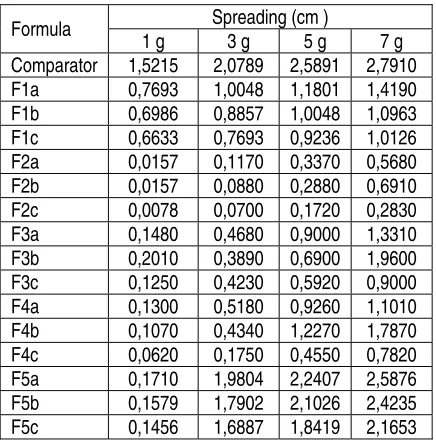
Spreading test aims to determine the ability of the gels to spread over the surface of the skin upon application. Spreading test was done manually by using extensometer. The principle of this test is to determine the increasing of the area that could cover by gel at a particular time after given a certain load [17]. All formula has a smaller spread than comparator.
Table 5. Spreading Test of Honey Gel
Formula Spreading (cm )
1 g 3 g 5 g 7 g Comparator 1,5215 2,0789 2,5891 2,7910 F1a 0,7693 1,0048 1,1801 1,4190 F1b 0,6986 0,8857 1,0048 1,0963 F1c 0,6633 0,7693 0,9236 1,0126 F2a 0,0157 0,1170 0,3370 0,5680 F2b 0,0157 0,0880 0,2880 0,6910 F2c 0,0078 0,0700 0,1720 0,2830 F3a 0,1480 0,4680 0,9000 1,3310 F3b 0,2010 0,3890 0,6900 1,9600 F3c 0,1250 0,4230 0,5920 0,9000 F4a 0,1300 0,5180 0,9260 1,1010 F4b 0,1070 0,4340 1,2270 1,7870 F4c 0,0620 0,1750 0,4550 0,7820 F5a 0,1710 1,9804 2,2407 2,5876 F5b 0,1579 1,7902 2,1026 2,4235 F5c 0,1456 1,6887 1,8419 2,1653
After conducting the whole test and based on the general appearance and spreading test, can be observed that the best honey gel formula was the use PVA as polymer.
PAGE | 5 |
Table 6. Honey Film Evaluations
Formula Thickness Tensile Strength Elongation at break Young's
(mm) (N/mm2) (%) modulus
FG 1 0.165 μ 0.01 9.05 μ 1.28 282.70 μ 50.49 3.24 μ 0.38 FG 3 0.225 μ 0.01 8.94 μ 1.19 339.78 μ 24.43 2.64 μ 0.35 FG 5 0.161 μ 0.02 3.09 μ 0.48 376.50 μ 52.78 0.82 μ 0.09 FPG 1 0.140 μ 0.02 7.62 μ 1.18 353.99 μ 37.57 2.19 μ 0.50 FPG 3 0.205 μ 0.01 4.49 μ 0.73 321.35 μ 65.28 1.42 μ 0.16 FPG 5 0.247 μ 0.08 5.48 μ 1.33 484.93 μ 103.95 1.14 μ 0.23 FP 1 0.157 μ 0.02 11.59 μ 2.92 288.48 μ 41.00 3.98 μ 0.64 FP 3 0.173 μ 0.02 7.30 μ 1.52 282.58 μ 31.83 2.58 μ 0.40 FP 5 0.181 μ 0.04 4.82 μ 1.51 405.04 μ 85.80 1.20 μ 0.29
permeable to water vapour to decrease the possibility of anaerobic bacterium growth in the wound vicinity. Components added to film-forming agents as a part of the formulation may affect the rate of water vapour transmission. They include the type of the film-forming polymer and plasticizer, their concentrations and the thickness of the film formed [35]. In USP XXIV [26], the materials were permeable if they have water vapour permeability more than
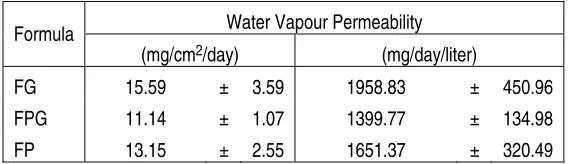
2000 mg/day/litre. According to Fetisova and Tsetlin [23], for the films that have water vapour permeability between 19 26 mg/cm2/day or more ensure the natural aeration of the skin. The water vapour permeability test showed that films that used glycerine as plasticizer produced the best permeability when compared to films that used propylene glycol and PEG 400.
Table 7. Water vapours Permeability of Honey Film
Formula Water Vapour Permeability
(mg/cm2/day) (mg/day/liter)
FG 15.59 μ 3.59 1958.83 μ 450.96 FPG 11.14 μ 1.07 1399.77 μ 134.98
FP 13.15 μ 2.55 1651.37 μ 320.49
Conclusion
Based on the results of physical evaluation that include general appearance, spreading test and wash test, honey gel that used PVA was better than used Na-CMC, Aqupec 505 HV, HPMC and gelatine.
Plasticizer with 10% concentration of the amount of polymer is sufficient to produce films with good elasticity. Honey films that
using glycerine as plasticizer is better than that using propylene glycol and polyethylene glycol.
Acknowledgement
This study was supported by Hibah Bersaing Grant No. 08/UN.16/PL-HB/2013 Universitas Andalas (UNAND), Padang-Indonesia.
.
References
[1]. Suguna L, Chandrakasan G, Ramamorrthy U, and Joseph KT. Influence of honey on collagen metabolism during wound healing in rats. J. Clin. Biochem. Nutr., 1993. 14: p. 91 - 99.
[2]. Molan P. Why honey is effective as a medicine. Bee World, 2001. 82(1): p. 22 - 40.
[3]. Martos MV, Navajas YR, Lopez JF, and Alvarez JAP. Functional properties of honey, propolis and royal jelly. J. Food Sci., 2008. 73(9): p. 117 - 124.
[4]. Cooper RA, Molan PC, and Harding KG. Antibacterial activity of honey against strains of Staphylococcus aureus from infected wounds. Journal of the Royal Society of Medicine, 1999. 92: p. 283 - 285.
[5]. Molan PC. The role of honey in the management of wounds. Journal of Wound Care, 1999. 8(8): p. 415 - 418.
[6]. Subrahmanyam M. Topical application of honey treatment of burns. Br. J. Surg., 1991. 78(4): p. 497 - 498.
Febriyenti
et al
. International Journal of Drug Delivery 6 (1) 01-06
[2014]
PAGE | 6 |
Potential of Manuka Honey and Platelet-Rich Plasma in Wound Healing. International Journal of Biomaterials, 2012. 2012: p. 1 - 14.
[8]. Al-Naama RT. Evaluation of in-vitro inhibitory effect of honey on some microbial isolate. J. Bacteriol. Res, 2009. 1(6): p. 64 - 67.
[9]. National-Honey-Board, pH and Acid in Honey. 1997, Longmont: Colorado.
[10].Schneider M, Coyle S, Warnock M, Gow I, and Fyfe L. Anti-Microbial Activity and Composition of Manuka and Portobello Honey. Phytotherapy Research, 2013. 27(8): p. 1162 - 1168.
[11].USP, The United States Pharmacopeia XXX - The National Formulary XXV. 2007, United States Pharmacopeial Convention, Inc.: Rockville.
[12].Carter SS. Dispensing Pharmaceutical Student. 12th ed. 1975, London: Pittman Medical.
[13].Swarbrick J, and Boylan JC, Encyclopedia of Pharmaceutical Technology. 1992, Marcel Dekker, Inc.: New York.
[14].Santos KSCR, Coelho JFJ, Ferreira P, Pinto I, Lorenzetti SG, Ferreira EI, Higa OZ, and Gil MH. Synthesis and characterization of membranes obtained by graft copolymerization of 2-hydroxyethyl methacrylate and acrylic acid onto chitosan. Int. J. Pharm., 2006. 310(1-2): p. 37-45.
[15].Kumar L, and Verma R. In vitro evaluation of topical gel prepared using natural polymer. International Journal of Drug Delivery, 2010. 2: p. 58 - 63.
[16].Cao N, Yang X, and Fu Y. Effects of various plasticizers on mechanical and water vapor barrier properties of gelatin films. Food Hydrocolloid, 2009. 23(3): p. 729-735.
[17].Shivhare UD, Jain KB, Mathur VB, Bhusari KP, and Roy AA. Formulation development and evaluation of
diclofenac sodium gel using water soluble polyacrylamide polymer. Digest Journal of Nanomaterials and Biostructures, 2009. 4(2): p. 285 - 290.
[18].Martin A, Bustamante P, and Chun AHC. eds. Physical Pharmacy. Fourth ed. 2001, Lippincott Williams & Wilkins: Baltimore.
[19].Misal G, Dixit G. and Gulkari V., Formulation and evaluation of herbal gel. Indian journal of Natural Products and Resources, 2012. 3(4): p. 501 - 505.
[20].Jellineck JS. Formulation and Function of Cosmetics. 1970, New York: Willey Interscience.
[21].Macleod GS, Fell JT, and Collett JH. Studies on the physical properties of mixed pectin/ethylcellulose films intended for colonic drug delivery. Int. J. Pharm., 1997. 157(1): p. 53-60.
[22].Febriyenti M, Azmin N, and. Baie SbB. Mechanical Properties and Water Vapour Permeability of Film from Haruan (Channa striatus) and Fusidic Acid Spray for Wound Dressing and Wound Healing. Pak. J. Pharm. Sci., 2010. 23(2): p. 155-159.
[23].Fetisova NI, and. Tsetlin VM. Main Group of Parameters for Evaluating FilmForming Properties in Aerosol Packages for the Treatment of an Operation Field and for the Sealing of Wounds. Khim. Farm. Zh+, 1976. 10(8): p. 86 - 91.
[24].Yoo J-W, Dharmala K, and Lee CH. The physicodynamic properties of mucoadhesive polymeric films developed as female controlled drug delivery system. Int. J. Pharm., 2006. 309(1-2): p. 139-145.
[25].Khan TA, Peh KK, and Ch'ng HS. Mechanical, Bioadhesive Strength and Biological Evaluations of Chitosan Films for Wound Dressing. J. Pharm. Pharmaceut. Sci., 2000. 3(3): p. 303 - 311.
[26].USP, The United States Pharmacopeia XXIV - The National
Formulary XIX. 2000, United States Pharmacopeial Convention, Inc.: Rockville.
[27].Gennaro AR. Remington's Pharmaceutical Sciences. 18th ed. 1990, Pensylvania: Mack Publishing Company.
[28].Balsam MS, and Sagarin E. Cosmetic Science and Technology. 2nd ed. Vol. 1. 1992, New York: A. Willey Interscience.
[29].Nagarsenker MS, and Hegde DD. Optimization of The Mechanical Properties and Water-Vapor Transmission Properties of Free Films of Hydroxypropylmethylcellulose. Drug Dev. Ind. Pharm., 1999. 25(1): p. 95 - 98.
[30].Sezer AD, Hatipoglu F, Cevher E, Ogurtan Z, Bas AL, and Akbuga J. Chitosan Film Containing Fucoidan as a Wound Dressing for Dermal Burn Healing: Preparation and In Vitro/In Vivo Evaluation. AAPS Pharm. Sci.Tech., 2007. 8(2): p. E1 - E8.
[31].Cockbill SME. Dressings in Wound Management, in Encyclopedia of Pharmaceutical Technology, J. Swarbrick, Editor. 2007, Informa Healthcare: New York. p. 1023 - 1037.
[32].Balakrishnan B, Mohanty M, Umashankar PR, and Jayakrishnan A. Evaluation of an in situ forming hydrogel wound dressing based on oxidized alginate and gelatin. Biomaterials, 2005. 26(32): p. 6335-6342.
[33].Watson NFS, and Hodgkin W. Wound dressings. Surgery (Oxford), 2005. 23(2): p. 52-55.
[34].Weiss J, Herman O, Wertheym E, and Shafir R. Synthetic Skin Substitute for Superficial Paediatric Burns. 1993;
Available from: http://www.medbc.com/annals/review/
vol_6/num_2/text/vol6n2p105.htm.