CHAPTER II
THEORETICAL REVIEW
A. Verb
Verb Definition
There are many different ways of analyzing a language. Such as analysis words can be given various names, depending on the function with their performing. One thing of the words that we know is a verb. Verb is the words which perform the function of expressing states or actions (Ansell, 2000 : 25).
Then from Oxford Advanced Learner‟s Dictionary of Current English
sixth edition verb is a word or group of words that expresses an action, an event or a state (Hornby, 2000 : 1498). So that verb uses for an action words or predicate in the sentences.
In brief verb is the words that is performing actions as predicate in the sentences or the words that states action that is done by the subject.
B. Word Formation
formation of verb is influenced by the suffixes. In general there are two word formations of verb as inflectional suffixes and derivational suffixes.
1. Inflectional Suffixes
The first word formation can be seen from the form of inflectional.
Inflectional comes from the word “inflection”, which means that inflection is
to change in the form of a word, especially the ending. According to grammatical function in a sentence (Hornby, 2000 : 696). Inflectional suffixes are morphemes which serve a purely grammatical function, such as referring to and giving extra linguistic information about the already existing meaning of a word, expressing syntactic relation between words, among others (Zapata, 2007 : 3). For example “walk – walked”, in this case the basic meaning of the word does not change.
1. Suffix “-s/ -es “
In the affirmative form that is the subject from the third person singular ( he, she, and it ) in present tense, so the verb I or infinitive will change in the form ending by adding “-s/-es”.
a. Infinitive (V1) in general will be adding with “-s”.
Verb 1 -s buy
lay obey play say
buys lays obeys plays says
e. When infinitive is beginning by auxiliary, in the interrogative and
negative form, so does not get additional “-s/ -es”
can read can open must close must work does not make does he come here?
(Lado, 2008 : 9 – 11) 2. Suffix “ –ed”
These suffixes are used in the regular past tense marker or verb II. The infinitives or Verb I will be ending by “ –d/ed “ or change into simple past. It is the rule for changing into past form.
a. After “-y” preceded by a consonant, the “-y” is changed to “-i”
and “-ed” is added (except played).
Verb 1 -ed
accompany bury carry clarify identify
accompanied buried
carried clarified identified
b. After a single consonant preceded by a single vowel, the final
Verb 1 -ed we often face on the verb III (past participle) of irregular verb. It is used
There are some rules that should be understood when we are formed present participle (infinitive + ing).
a. All of infinitives in general just add with “ing”.
Verb 1 -ing
c. When infinitive has one syllable and ending by consonant that is previously by vowel, so the last consonant will be double and add with “ing”. which is ending by consonant and beginning by vowel, so the last
Verb 1 -ing allot
begin occur submit
allotting beginning occurring submitting
e. When infinitive has two syllables and ending by consonant “-i” that is previously by one vowel, so the last vowel is double, than
add with “-ing”.
Verb 1 -ing
cancel control expel propel
cancelling controlling expelling propelling
f. When the verb base has one or two syllables that ending by
consonant “-i” that is previously by two vowels, so the last
consonant does not double, only adding with “-ing”.
Verb 1 -ing
sail seal wait
sailing sealing waiting
g. When verb base ending by vowel “-ie”, so those vowel change to
“-y”, then add with “-ing”.
Verb 1 -ing
die lie tie
dying lying tying
2. Derivational Suffixes
The second category from the word formation in lexical verb is
derivational. Derivational comes from “derived” as the origin word.
Derivational Suffixes are morphemes that create (derive) new words, usually by either changing the meaning and/or the part of speech or both (Zapata, 2007: 2).
The other expert states derivational is suffix which is added to a steam, the resultant from is not closed, but open, because it can take another suffix ; e.g the verb agree, after taking the suffix -ment, can still have another suffix like -s, this the form „agreement‟ is a possible construction in English (Ramelan in Desi, 2010 : 7)
Derivational suffixes also affect the core meaning of the stem they attach to. This is often, but not always, reflected by a category change in the stem after the affix has attached to it. The suffixes for the derivational such as “–age ,-al,-ence, -ion, -able, -ate, and etc” . There are some suffixes that
give an effect or changing the form of verbs includes noun and adjective.
Suffix “ –er”
Verb Noun
bake complain manage receive
baker complainer manager receiver Suffix “ –ant/-ent”
Verb Noun
attend contest depend inhabit
attendant contestant dependent inhabitant
Suffix “ -or “
Verb Noun
act conduct corrupt direct
actor conductor corruptor director Suffix “ –ity “
Verb Noun
activate clear create
activity clarity creativity
(englishwilleasy.com : 2014)
Suffix “-less”
Verb Adjective help
use fear
helpless useless fearless
(grammar-quizzes.com : 2014)
C. The Differences between Inflectional and Derivational
It can be concluded that there are some differences between inflectional and derivational suffixes in verbs such as:
Inflectional Suffixes
1. Inflectional suffixes do not change the part meaning of the words. 2. Inflectional suffixes are productive, it means inflectional suffixes
typically combine freely with all members of a certain class of stems. 3. The meanings of the resulting words are entirely compositional and
predictable.
4. Sometimes depends on tenses/time. Derivational Suffixes
1. Derivational suffix can change part of speech meaning of the word, especially in verb.
2. Change the meaning into noun or adjective.
D. Error Analysis
Error and Mistake
Human being is fundamentaly a process that involves making of mistakes, miscalculation and errorneous assumptions form an important aspect of learning virtually any skill or acquiring information. Most of person has made mistakes in the process of constructing a new system of language need to be analyzed carefully.
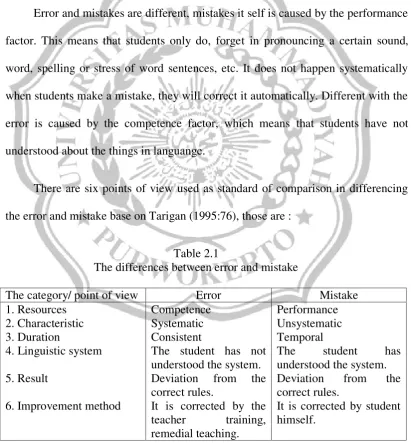
Error and mistakes are different, mistakes it self is caused by the performance factor. This means that students only do, forget in pronouncing a certain sound, word, spelling or stress of word sentences, etc. It does not happen systematically when students make a mistake, they will correct it automatically. Different with the error is caused by the competence factor, which means that students have not understood about the things in languange.
There are six points of view used as standard of comparison in differencing the error and mistake base on Tarigan (1995:76), those are :
Table 2.1
The differences between error and mistake
The category/ point of view Error Mistake
1. Resources 2. Characteristic 3. Duration
4. Linguistic system 5. Result
Competence Systematic Consistent
The student has not understood the system. Deviation from the correct rules.
Performance Unsystematic Temporal