See discussions, stats, and author profiles for this publication at: https://www.researchgate.net/publication/310595271
Predicting Innovative Behavior Among
Employees in a Manufacturing Company: The
Role of Psychological Capital
Article · January 2016
CITATIONS
0
READS
42
3 authors:
Ika Zenita Ratnaningsih
Universitas Diponegoro
4PUBLICATIONS 1CITATION
SEE PROFILE
Anggun Resdasari Prasetyo
Universitas Diponegoro
1PUBLICATION 0CITATIONS
SEE PROFILE
Unika Prihatsanti
Universitas Diponegoro
7PUBLICATIONS 0CITATIONS
SEE PROFILE
All content following this page was uploaded by Ika Zenita Ratnaningsih on 21 November 2016.
84
Correspondence concerning this article should be addressed to Ika Zenita Ratnaningsih, Faculty of Psychology Universitas Diponegoro, Jalan Prof. Sudharto, S.H. Tembalang, Semarang. E-mail: ikazenita@ yahoo.com
Predicting Innovative Behavior Among Employees in a
Manufacturing Company: The Role of Psychological Capital
Ika Zenita Ratnaningsih, Anggun Resdasari Prasetyo, and Unika Prihatsanti
Faculty of Psychology Universitas Diponegoro
The aim of this study is to investigate the relationship between psychological capital and workplace innovative behavior. The importance of innovative behavior in the competitive business world has been widely recognized. Previous studies have examined variables related to innovative behavior both at personal and organizational levels; however, there is a paucity of research looking at psychological capital as the predictor of workplace innovative behavior. In this study psychological capital and innovative behavior of 149 non-managerial employees in an apparel manufacture company were measured using Psychological Capital Scale (20 items, α = .872) and Innovative Behavior Scale (nine items, α = .874). The regression analysis shows a significant positive correlation between these two variables (r = .519, p < .01) and 27% of variance in innovative behavior can be explained from psychological capital. The results are discussed in relation to its theoretical contribution and practical implications in organizational contexts.
Keywords: innovative behavior, psychological capital, manufacture
Penelitian ini bertujuan untuk mengetahui hubungan antara psychological capital dan perilaku inovatif di tempat kerja. Perilaku inovatif berperan penting dalam dunia bisnis yang semakin kompetitif. Penelitian sebelumnya telah meneliti variabel-variabel yang berhubungan dengan perilaku inovatif, baik pada tingkat individual maupun organisasional, namun belum ada penelitian yang menguji hubungan antara psychological capital dan perilaku inovatif. Subjek penelitian berjumlah 149 karyawan non-manajerial setingkat group leader di perusahaan yang bergerak di bidang manufaktur garmen. Alat ukur yang digunakan terdiri atas dua buah skala psikologi, yaitu Skala Perilaku Inovatif (sembilan butir, α = .874) dan Skala Psychological Capital (20 butir, α = .872). Hasil pengujian hipotesis dengan analisis regresi sederhana menunjukkan bahwa terdapat korelasi yang positif dan signifikan antara psychological capital dan perilaku inovatif (r = .519, p < .01). Psychological capital memiliki sumbangan efektif 27% terhadap variabel perilaku inovatif di tempat kerja. Temuan tersebut didiskusikan di artikel ini dalam kaitannya dengan kontribusi teoretis dan implikasi praktis untuk organisasi.
Kata kunci: perilaku inovatif, psychological capital, manufaktur
The business world is a competitive world. Global flow of products, services, and labour in the free market has increased the pressure for businesses to be more competitive. This situation drives companies to develop their own unique competitive advantages. To this end, innovations in both product and service are crucial (Ancok, 2012). As also noted by Pundt, Martins, and Nerdinger (2010), innovation is impera-tive for companies to survive in this ever-changing world.
A rapid change in an organization’s strategic envi -ronment may cause major problems which can de-crease performance if there is no innovative capabi-lity within the organization (De Jong & Hartog, 2007). Organizations that identify themselves with innova-tion and innovative culture tend to encourage and provide information about innovation to their em-ployees (Poulton, 2005). Innovative organizations ma-nage environmental challenges quicker and more easily (Damanpour & Gopalakrishnan, 1998).
ROLE OF PSYCHOLOGICAL CAPITAL 85
neighbouring countries such as Malaysia and Singapore. Considering its potential as a major consumer in South East Asia, Indonesia should be able to innovate more creatively as compared to the current condition.
Many organizations still use outdated and ineffective ways in conducting their business, simply following what they have done in the past. Efforts are usually focused on improving these outdated ways, and not on attempting to see problems from a different angle. Currently, many organizations have started to include innovation in their vision and mission statement. One of the key innovations crucial in this competitive business world is the innovation in human resource management. The condition and management of
hu-man resources determine the company’s competitive advantages (Simamora, 2004). As also argued by Hasibuan (2000), human resource is an invaluable asset for a company to achieve its goals.
Innovation adds values to product, service, work process, marketing, distribution, and policy, not only for the company but also for stakeholders and the society. The scope of innovation in an organization ranges from the development and implementation of new ideas which affect the theory, practice, and product to improvements of everyday work design and process in a smaller scale (Axtell et al., as cited in Janssen, 2004). Research on organizational innovation can be conducted on three different levels, namely, individual, group, and organizational level. Innovation on indi-vidual level is called innovative behavior (Helmi, 2011).
According to West and Farr (cited in Janssen, 2004), innovative behavior is the intention to create, introduce, and apply new ideas aimed at optimizing group and organizational performance. Scott and Bruce (1994) described workplace innovative behavior as a complex behavior consisted of different behavioral tasks, namely, idea generation, idea promotion, and idea realization. Moreover, Scott and Bruce
explain-ed that innovative behavior is an individual’s intent
-ion expressed in their work, group, and organizat-ion.
Innovative behavior is defined as an individual’s
action directed at the emergence, introduction, and application of new ideas which benefited the organi-zation at all levels (Kleysen & Street, 2001). Innovation includes new ideas which aimed at improving work relations or the application of new ideas or new technologies which significantly improve work effi-ciency and effectiveness. Innovative behavior is
em-ployees’ intention to create, introduce, and apply new ideas in groups or organisations, which intended to
optimize group’s and organisation’s performance
(Yuan & Woodman, 2010).
Often conflated with creativity, innovation involves a more complex process because it also focuses on the application of ideas generated. Innovative behavior is a tendency to create new ideas, a tolerance towards ambiguity, which is marked by the willingness to be effective, and oriented to achievement. Kleysen and Street (2001) stated that innovative behavior involves five components, namely, exploration of opportuni-ties, generativitity, formative investigation, efforts to be the best, and application. Aspects of innovative behavior are idea generation, idea promotion, and idea realization.
Innovative behavior is not an inherited condition, rather, all humans have the potential to innovate par-ticularly within a supportive climate. Research has
shown that individual’s innovative capability at work
-place is important to nurture the organisation’s
in-novation (De Jong & Hartog, 2007). Riyanti’s (cited
in Hutahaean, 2005) study indicated a direct effect of
organization innovation on the business’ success.
Accordingly, Dörner (2012) also explained that inno-vative behavior at workplace can predict work per-formance.
Previous studies have identified several factors affecting innovative behavior, namely, personal fac-tors and organizational facfac-tors. Personal facfac-tors in-clude intrinsic motivation (Helmi, 2011), openness to experience (Yesil & Sozbilir, 2013), and educational level (Etikariena & Muluk, 2014; Baumann, 2011). Organizational factors include trust, transformational leadership (Reuvers, Van Engen, Vinkenburg, & Wilson-Evered, 2008), access to information technology, know-ledge sharing (Helmi, 2011), organizational climate (Scott & Bruce, 1994), organizational support (Cingöz
& Akdoğan, 2011), supervisor’s gender (Reuvers et al), flexible job design (Dorenbosch, Van Engen, & Verhagen, 2005), and organizational memory (Etikariena & Muluk, 2014).
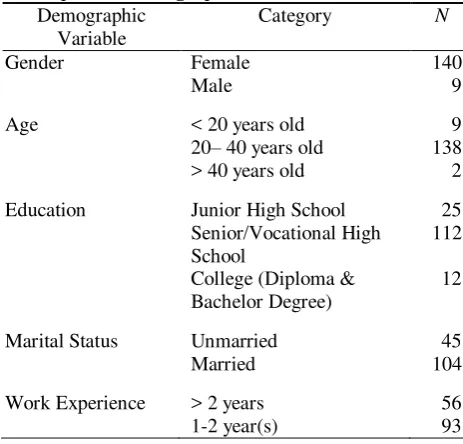
Table 1
Education Junior High School 25
Senior/Vocational High
Marital Status Unmarried 45
Married 104 the organization. These components would produce
optimal contributions when accompanied by leader-ship and organizational structure capital which pro-vide supportive working environments. These seven components are creative, intellectual, emotional, so-cial, adversity, moral, and health capital (Ancok, 2012). Another capital which is not less important is
psychological capital.
Psychological capital is defined as an individual’s
psychological capacity characterized by confidence in taking and overcoming challenging tasks (self-efficacy), positive attribution of the current and future success (optimism), aspiration of achieving
goals—and if needed finding alternative ways—to
achieve goals (hope), and ability to recover quickly when facing difficult challenges or problems (resi-liency) (Luthans, Youssef, & Avolio, 2007).
Psychological capital is relatively new in psycho-logical research and is useful for improving human resource management in order to increase organi-zational performance and competitiveness (Luthans, Youssef & Avolio, 2007). Psychological capital may
enhance competition in achieving organisation’s pro -fit by identifying full potentials of the human resour-ces within the organisation. Cetin (2011) stated that
psychological capitalcan predict organizational
com-mitment and job satisfaction. T. D. Nguyen and T. T.
Nguyen’s (2012) study indicated positive correlation
between psychological capital, work performance, and work-life quality.
Based on the argument that innovative behavior can be developed, this study seeks to investigate the correlation between psychological capital and work-place innovative behavior.
Method
Participants in this study were 149 employees in an export-oriented clothing manufacturing company in Semarang, Indonesia. The demography of the participants is presented in Table 1. Participants were
recruited through a non-probability sampling –
tech-nique, namely, purposive sampling (Sugiyono, 2005). Recruitment criterium was a minimum of one year work experience in this company, so that the par-ticipants had reasonable knowledge about the con-ditions within the company. Allen & Meyer (cited in Noordin, Rahim, Ibrahim, & Omar, 2011) noted that at this stage an employee has been through the introductory phase of their work in a certain com-pany. Participants were non-managerial employees and
at least at the group leader level.
Data in this study were collected using inventory
methods to generate participants’ responses. The instruments were Innovative Behavior Scale and
Psychological Capital Scale. The Innovative Behavior
Scale (nine items, α = .874) was based on Scott and
Bruce’s (1994) and Janssen’s (2000) studies that
have been adapted by Etikariena and Muluk’s (2014)
study. This scale consists of three dimensions of innovative behavior, which are idea generation, idea
promotion, and idea realization. Participants’ were
asked to respond from 1 (never) to 4 (always).
The Psychological Capital Scale (20 items, α =
resi-ROLE OF PSYCHOLOGICAL CAPITAL 87
Table 3
Correlations Between and Contributions of Each Dimension of Psychological Capital to Innovative Behavior
Variable Correlation (r) Contribution Interpretation Psychological capital & Innovative Behavior .519** 27% Average
Self-Efficacy & Innovative Behavior .570** 32.5% Average
Hope & Innovative Behavior .336** 11.3% Average
Resilience & Innovative Behavior .390** 15.2% Average
Optimism & Innovative Behavior .211* 4.5% Low
Note. **) Correlation is significant at p = .000 (p < .001) *) Correlation is significant at p = .005 (p < .05) lience. The response ranged from 1 (not relevant) to 6 (very relevant).
Data were analyzed using simple regression ana-lysis to examine the correlations between variables and the proportion of variance in innovative behavior predictable from psychological capital. According to Sugiyono (2005), regression analysis is one of the statistical techniques to measure correlation between two or more variables both causal and functional relationships.
Results
Descriptive Statistics
The descriptive statistics of the data in this study is presented in Table 2. Table 2 reveals the empirical mean of both variables are higher than their
hypo-thetical mean. This shows that participants’ inno -vative behavior and psychological capital are rela-tively high. Categorisations were created based on the general description of these scores. It is concluded that in general employees in this company have a high score of innovative behavior and psychological capital.
Hypothesis Testing
The analysis shows a significant positive corre-lation between psychological capital and workplace
innovative behavior (r = .519, p < .001). This finding
supports the research hypothesis that there is a
correlation between psychological capital and
em-ployees’ innovative behavior. Positive direction of the correlation indicates that the higher the
psycho-logical capital, the higher the employees’ innovative
behavior. The coefficient of determination .270 shows that psychological capital contributes 27% to innovative behavior. It is concluded that psycho-logical capital is a predictor of workplace innovative behavior.
Discussion
The finding shows a significant correlation be-tween psychological capital and workplace
innova-tive behavior (r = .519, p < .01). Twenty seven
percent of variance in innovative behavior can be predicted by psychological capital. This result indi-cates that one of the individual factors contributing to workplace innovative behavior is psychological capital. Psychological capital is defined as an
indivi-dual’s psychological capacity which is characterized by confidence in taking and overcoming challenging tasks (self-efficacy), positive attribution of the current and future success (optimism), aspiration of
achieving goals – and if needed finding alternative
ways to achieve goals (hope), and ability to recover quickly when facing difficult challenges or problems (resiliency) (Luthans, Youssef, & Avolio, 2007).
A meta-analysis by Avey, Reichard, Luthans, and Mhatre (2011) identified that psychological capital
affects employees’ positive work attitudes (job satis-faction, organizational commitment, psychological
wellbeing), employees’ positive work behavior
(or-ganizational citizenship behaviour), and work per-formance. In accordance with this and the finding of the current study, psychological capital has also been identified as one of the predictors of workplace innovative behavior (Wojtczuk-Turek & Turek, 2015; Jafri, 2012). Individuals who have positive attitude and confidence of their capability will be able to contribute thoughts and ideas to achieve goals. This is also supported by positive attitude and hope to achieve a better future, so that individuals will keep trying to introduce and implement new ideas.
This study is also in accordance with Pryce-Jones’
(2010) argument that psychological capital can help
increasing employees’ motivation, persistence, and
creative thinking in stressful situations. This is pos-sible because employees with high psychological
ca-pitaladapt better, are more resilient, and have hope;
Table 3 presents the recapitulation of correlations between each dimension of psychological capital and innovative behavior. In general psychological capital shows correlation with innovative behavior on an average level. In analyzing each dimension of psycho-logical capital, the largest contribution is from
self-efficacy. This means that individuals’ confidence in their own ability is important for enabling individuals to think and produce new ideas (idea generation). Such individuals are also confident in expressing their ideas (idea promotion), and courageous in im-plementing their ideas (idea realization).
In general participants in this study are individuals with positive characteristics such as confident, opti-mistic, hopeful, and are able to recover quickly from difficult situations. These characteristics show that participants are resilient and reliable individuals par-ticularly in the face of problems. They will strive, and not give up.
Further analyses on participants’ demographic data
reveal that age, education, and gender do not corre-late with workplace innovative behavior. This result
supports Hilmi, Pawanchik, Mustapha, and Mahmud’s
(2012) study which found that there is no significant difference in innovative behavior based on gender. Moreover, a study by Reuvers et al. (2008) also found
that manager’s gender does not affect workplace in -novative behavior.
Different from the current finding which indicates no correlation between educational level and work-place innovative behavior, Scott and Bruce (1994) Employees with Junior High School qualification generally have worked longer. Only a small minority of participants have a college degree.
Regarding organizational characteristics, this cloth-ing company is relatively new but growcloth-ing rapidly. At this stage, the company develops and expands so
that employees’ organizational commitment is of paramount importance (Jones, 1994). To this end, the company has conducted different levels of training and development programmes.
Limitations
There are some limitations of this study, particu-larly in relation to participants. The small sample size
from only one company might not enable a gene-ralization on a larger population or different types of company. Future research is needed to explore other contexts and scopes.
Conclusion and Recommendation
This study contributes to the knowledge on per-sonal factors that influence workplace innovative behavior, namely, psychological capital. Regression analysis indicates a significant correlation between psychological capital and workplace innovative behavior (r = .519, p < .01) and 27% of variance in workplace innovative behavior is predictable from psychological capital. Demographic variables such as age, gender, and education do not correlate with workplace innovative behavior. Additionally, the findings of this study also show that workplace inno-vative behavior is relatively high among employees in this clothing manufacturing company. Theore-tically, this research support the notion that inno-vative behavior in an organization can be improved particularly at individual level, and identified a factor at play, that is, psychological capital.
Considering the significant contribution of psy-chological capital for innovative behavior, it is re-commended for companies to take into account
em-ployee’s level of psychological capital during re-cruitment. Training and development programmes for employees may also be directed to enhance their psychological capital. Future research can extend this study on other industries, and may investigate pos-sibilities of mediating variables or other variables which can predict workplace innovative behavior.
References
Ancok, D. (2012). Psikologi kepemimpinan dan
inovasi (Leadership psychology and innovation). Jakarta: Erlangga.
Avey, J. B., Reichard, R. J., Luthans, F., Mhatre, K. H. (2011). Meta-analysis of the impact of positive psychological capital on employee attitudes,
beha-viors and performance. Human Resource
Develop-ment Quarterly,22(2), 127-152.
Basrawy, I. F., Susanto, F. (2012). Pengaruh
kecer-dasan emosional dan motivasi intrinsik terhadap
perilaku inovatif guru SD (The effects of emotional intelligence and intrinsic motivation on
ROLE OF PSYCHOLOGICAL CAPITAL 89
men, Universitas Gadjah Mada.
Baumann, P. K. (2011). The relationship between
in-dividual and organizational characteristics and nurse innovation behavior (Unpublished dissertation). School of Nursing Indiana University.
Cetin, F. (2011). The effects of the organizational psychological capital on the attitudes of commit-ment and satisfaction: A public sample in Turkey. European Journal of Social Science, 21(3), 373-384.
Chrisbiyanto, A., Ancok, D. (2014). Pengaruh
per-sepsi gaya kepemimpinan transformasional, buda-ya inovasi perusahaan, dan tipe kepribadian open-ness to experience terhadap perilaku inovatif kar-yawan studi empirik pada PT. Garuda Indonesia (Persero) Tbk (The effects of the perception of transformational leadership style, organizational innovative culture, and openness to experience
per-sonality type on employees’ innovative behavior: An
empirical study on Garuda Indonesia, Ltd.) (Abs-tract of an unpublished thesis). Magister Manajemen, Universitas Gadjah Mada.
Cingöz, A., & Akdoğan, A. A. (2011). An empirical examination of performance and image outcome expectation as determinants of innovative behavior
in the workplace. Procedia Social & Behavioral
Sciences,24, 847-853. doi: 10.1016/j.sbspro.2011.09.099 Damanpour, F., & Gopalakrishnan, S. (1998).
Theo-ries of organizational structure and innovation
adop-tion: The role of environmental change. Journal of
Engineering and Technology Management, 15, 1-24.
De Jong, J. P. J., & Den Hartog, D. N. (2007). How leaders influence employees' innovative behaviour. European Journal of Innovation Management, 10
(1), 41–64. doi: 10.1108/ 14601060710720546
Dorenbosch, L., Van Engen, L., & Verhagen, M. (2005). On-the-job innovation: The impact of job design and human resource management through
pro-duction ownership. Creativity and Innovation
Ma-nagement,14(2), 129-141.
Dörner, N. (2012). Innovative work behavior: The
roles of employee expectations and effects on job performance (Unpublished dissertation). School of Management, Economics, Law, Social Sciences and International Affair. University of St.Gallen. Etikariena, A., & Muluk, H. (2014). Hubungan
an-tara memori organisasi dan perilaku inovatif kar-yawan (Relationship between organizational memory
and employees’ innovative behavior). Makara Hubs-Asia,18(2), 77-88, doi: 10.7454/mssh.v18i2.xxxx
Hasibuan, M. S. P. (2000). Manajemen sumber daya
manusia (Human resources management). Jakarta: Bumi Aksara.
Helmi, A. F. (2011). Model determinan perilaku ino-vatif pada mahasiswa yang berwirausaha (Deter-mination model of innovative behavior among
entrepreneur college students). Jurnal Psikologi,
38(2), 134-146.
Hilmi, M. F., Pawanchik, S., Mustapha, Y., & Mahmud,
N. (2012). Innovative behavior of Malaysian
em-ployees: An exploratory study. Proceeding of Inter-national Conference on Innovation, Management and Technology Research (ICIMTR2012), Malacca, Malaysia 21-22 May.
Hutahaean, E. S. (2005). Kontribusi pribadi kreatif
dan iklim organisasi terhadap perilaku inovatif (Contribution of creative personality and organi-zational climate for innovative behavior).Proceeding Seminar Nasional PESAT, Universitas Gunadarma, Jakarta.
Jafri, H. (2012). Psychological capital and innovative behaviour: An empirical study on apparel fashion
industry. The Journal Contemporary Management
Research,6(1), 42-52.
Janssen, O. (2000). Job demands, perceptions of effort-reward, fairness and innovative work behavior. Journal of Occupational and Organizational Psy-chology,73, 287-302.
Janssen, O. (2004). How fairness perceptions make
innovative behavior more or less stressful. Journal
of Organizational Behavior,25, 201–215. doi: 10. 1002/job.238
Jones, G. R. (1994). Organization theory, test and
cases (2nd ed.).Boston: Addison Wesley: Longman Publishing Company, Inc.
Kleysen, R. F., & Street, C. T. (2001). Toward a multi-dimensional measure of individual innovative
behaviour. Journal of Intellectual Capital, 2(3),
1469-1930.
Kresnandito, A. P., & Fajrianthi. (2012). Pengaruh persepsi kepemimpinan transformasional terhadap perilaku inovatif penyiar radio (The effects of the perception of transformational leadership on
broad-casters’ innovative behavior). Jurnal Psikologi Industri dan Organisasi,1(2), 78-85.
Luthans, F., Youssef, C. M., & Avolio, B. J. (2007). Psychological capital: Developing the human com-petitive edge. New York: Oxford University Press
Maryen, A. S., Ancok, D. (2012). Pengaruh iklim
Ltd.). (Abstract of an unpublished thesis). Magister Manajemen Universitas Gadjah Mada.
Nguyen, T. D., & Nguyen, T. T. (2012). Psychological capital, quality of work life and quality of life
marketers: Evidence from Vietnam. Journal of
Macromarketing, 32(1), 87-95.
Noordin, F., Rahim, A. R., Ibrahim, A. H., & Omar, M. S. (2011). An analysis of career stages on organizational commitment of Australian managers. International Journal of Business and Social Sci-ences,2(17), 117-126.
Poulton, M. S. (2005). Organizational story telling, ethics and morality: How stories frame limits of
behavior in organizations. Electronic Journal of
Bu-siness Ethics and Organizational Studies, 10(2), 500-509.
Pryce-Jones, J. (2010). Happines at work: Maximizing
your psychological capital for success. Chichester: John Wiley & Sons Ltd.
Pundt, A., Martins, E., & Nerdinger, F. W. (2010). Innovative behavior and reciprocal exchange
be-tween employees and organization. Zeitschift fur
Personalforschung, 24(2), 173-193.
Reuvers, M., Van Engen, M. L., Vinkenburg, C. J., & Wilson-Evered, E. (2008). Transformational lea-dership and innovative work behavior: Exploring
the relevance of gender differences. Creativity and
Innovation Management,17(3), 227-244. doi.10.1 11/ j.1467-8691.2008.00487
Scott, S. G., & Bruce, R. A. (1994). Determinants of innovative behavior: A path model of individual
innovation in the workplace. The Academy of
Ma-nagement Journal,37(3), 580-607.
Simamora, H. (2004). Manajemen sumber daya
manusia (Human resources management) (3rd ed.). Yogyakarta: Bagian Penerbitan STIE YKPN.
Sugiyono (2005). Statistika untuk penelitian
(Statis-tics for research). Bandung. Alfabeta.
Yesil, S., Sozbilir, F. (2013). An empirical investi-gation into the impact of personality on individual
innovation behaviour in the workplace. Procedia
Social & BehavioralSciences, 81, 540-551.
Yuan, F., & Woodman, R. W. (2010). Innovative be-havior in the workplace: The role performance and
image outcomes expectation. Academy of
Mana-gement Journal,53(2), 323 – 343
Wojtczuk-Turek, A., & Turek, D. (2015). Innovative behaviour in the workplace: The role of HR flexibility, individual flexibility and psychological capital. In the case of Poland. European Journal of Innovation Management, 18(3). 397-419. Doi: http://dx.doi.org/10.1108/EJIM-03-2014-0027