* Corresponding author.
CRYSTALLIZATION AND CHARACTERIZATION OF
CHROMIUM-CONTAINING SILICALITE-1
Hari Sutrisno
*, Endang Dwi Siswani, Susila Kristianingrum and Suharto
Department of Chemical Education, Faculty of Mathematics and Natural Sciences Yogyakarta State University (UNY), Yogyakarta 55281
Received 18 July 2005; Accepted 16 August 2005
ABSTRACT
Chromium-containing silicalite-1, designed CrS-1, was synthesized by the hydrothermal method and characterized by XRD and FTIR techniques. The objectives of the research are to study the synthesis of CrS-1 and investigate the effect of crystallization temperatures and times toward its character. All samples of CrS-1 crystallized in orthorhombic structure and Pnma space group. The phase observed in the XRD patterns of CrS-1 synthesized from 150 to 190 oC for 11 days showed only MFI-type phase. The CrS-1 prepared under static condition for 1 day at 150 oC indicated -SiO2 phase, on the contrary, the samples
conditioned for 2 to 8 days at 150oC are only MFI phase.
Keywords:Crystallization, synthesis, chromium silicate CrS-1, incorporation.
INTRODUCTION
Silicalite, synthesized first by Union Carbide group [1], is an aluminium-free zeolites, belonging to the structure type MFI (Mobile Five) in the IUPAC nomenclature. It shows a three dimensional pore system consisting of two intersecting sets of tubular channels: a linear one parallel to the [010] direction having openings of 5.4 x 5.6 Å, and sinusoidal one parallel to the [100] direction with openings of 5.1 x 5.5 Å. Ten-membered rings of SiO4 tetrahedra defined both channels [2-3]. From the crystallographic point of view all synthetic MFI zeolites show a polymorphic orthorhombic to monoclinic phase transition. The transition temperature and mechanism are closely related to the composition and defect density of the tetrahedral framework, besides of course the nature and amount of the molecules absorbed in the zeolitic channels. At room temperature the as-synthesized samples of hydrogen free ZSM-5 and TS-1 (MFI-type titanosilicate) are orthorhombic and
Pnma space group, whereas hydrogen-containing ZSM-5 and TS-1 with very low titanium are monoclinic andP21/nspace group [4-7].
The isomorphous substitution of Al(III) and/or Si(IV) by other di- tri-, tetra- penta-, and hexavalen metal ions is generally considered as a tool for modifying the acidic and catalytic properties of zeolites. Some authors have claimed the possibility of incorporating a large number of elements in framework positions, but only a few (V, Cu, Cr, Fe, B, and Ti) have been proved, leading to the
information of microporous materials with catalytic properties different from those of the parent aluminosilicates. Among the large number of synthetic zeolite structures, MFI proves to be the most versatile towards isomorphous substitution: literally some papers have been published on the synthesis, physico-chemical characterization and catalytic properties of V- [8-9], Cu- [10-11], Cr- [12], Fe- [13], B- [14-15], and Ti-MFI [6,9,14,16]. In these cases, the incorporation of the heteroatom has been unambiguously assessed by structural and spectroscopic evidence. The unit cell parameters and volume have a linear dependence on the degree of substitution.
The objectives of the present work are to study the synthesis of Cr-containing MFI-type structure (CrS-1), investigate the effect of crystallization temperatures and times toward character of CrS-1 obtained. CrS-1 has shown a remarkably high efficiency and molecular selectivity in oxidation reactions under mild conditions, such as the oxidative of olefinic double bonds, for example methyl acrylate and methyl methacrylate afforded methyl glyoxylate and methyl pyruvate respectively, the oxidation of aromatic side chains with tertbutylhydroperoxide (THBP) or O2as oxidant to give the corresponding ketones in high selectivities [2].
EXPERIMENTAL SECTION
Material
synthesized hydrothermally using tetraethyl-orthosilicate (TEOS, Merck, 98%) as the Si source, while potassium dichromate (K2Cr2O7, Merck) was the main chromium source. Tetrapropylammonium bromide (TPABr, Aldrich), NaOH (Merck) and H2O were used as a template, the mineralizer (mobilizing) and a solvent respectively.
Procedure
Preparation of CrS-1
In a typical preparation, 0.612 g of TPABr was mixed in Teflon jar with 0.090 g of NaOH and 3 mL of H2O thoroughly. This mixture was stirred for 1 hour before adding to it a solution of 0.013 g of K2Cr2O7in 3 mL of distilled water under stirring. The mixture obtained was stirred for 1 hour. Finally the remaining 1.936 mL of TEOS was slowly added and stirred for 4 hours to obtain a clearly transparent colloid. Then the clear gel, whose composition was: SiO2: Cr2O3: NaOH : TPABr : H2O =
0.95 : 0.005 : 0.25 : 0.25 : 37.00
then transferred into a Teflon-lined autoclave and was heated at 150 °C under autogenous pressure for 11 days. After the crystallization was over, the autoclave was quenched in cold water. The solid was taken out from the Teflon, filtered and washed thoroughly with distilled water, and dried at 60oC in an oven for 12 hours. Occluded TPA+cations were removed from the zeolite channels by heating as-synthesized samples in an air atmosphere with a heating rate of 5oC min-1 to a final temperature of 600oC and then maintained at this temperature for about 4 hours. The same procedure was repeated for various temperatures i.e. 160, 170, 180 and 190 o
C respectively. All of the obtained crystals were symbolized as (a), (b), (c), (d) and (e). Based on the crystallization temperature (150oC) that obtained the samples posses highly crystalline, the same procedure was repeated for various times: 1, 2, 5, and 8 days to obtain the symbolized crystal(f),(g),
(h)and(i).
Characterization
All products have been characterized using conventional techniques. X-ray diffraction patterns were obtained using a powder diffractometer (Shimadzu XRD-6000) operating in the reflection mode with Cu-K radiation. The diagrams were recorded from 2 = 5o to 35o in 0.03 steps. The X-ray diffraction patterns were analyzed to determine the hkl plans by using Samson [17] and U-fit programs [18]. The unit cell dimensions were refined by a least-squares method. FTIR spectra were obtained using a Shimadzu 8201PC spectrometer with KBr wafers. Spectra were recorded from 400 to 4000 cm-1.
RESULT AND DISCUSSION
Synthesis
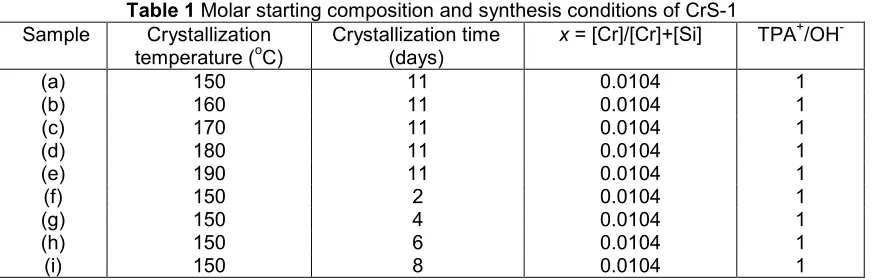
Table 1 summarizes the molar compositions of the starting mixtures and the synthesis conditions of CrS-1 by hydrothermal method. The gel transparent obtained was transferred to Teflon-lined autoclaves and crystallized under autogenous pressure and static conditions at 150oC for 11 days. After cooling of autoclaves the white solid product was recovered, filtered washed and dried at 60oC in an oven for 12 hours. The (a) white solid sample was obtained by calcination in an air atmosphere at 600 o
C for 4 hours. The same procedure was repeated at various temperatures (160, 170, 180 and 190oC) to obtain the (b) to (e) samples. The (f) to (i) samples were crystallized under autogenous pressure and static conditions at 150oC for various times: 1, 2, 5 and 8 days respectively.
Powder XRD Patterns
The X-ray powder diffraction patterns of pure CrS-1 phases obtained at different temperature are depicted in Fig 1. The high intensity of the peaks and the absence of any baseline drift indicated that the samples were highly crystalline without any impurities phase, i.e. CrO3 or Cr2O3.
Table 1Molar starting composition and synthesis conditions of CrS-1 Sample Crystallization
temperature (oC)
Table 2Crystallographic data of the calcined samples recovered at different crystallization temperature
Temperature (oC) a (Å) b (Å) c (Å) V (Å3)
150 19.90 19.31 13.42 5156.19
160 20.25 19.89 13.31 5357.82
170 20.01 19.29 13.55 5227.60
180 19.98 19.83 13.42 5313.59
190 19.88 19.36 13.41 5162.24
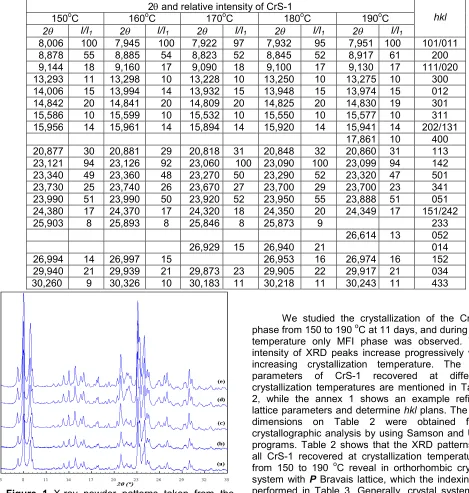
Tabel 3 2, the relative intensity and hkl of CrS-1 calcined samples recovered at different crystallization temperature
2and relative intensity of CrS-1
150oC 160oC 170oC 180oC 190oC
2 I/I1 2 I/I1 2 I/I1 2 I/I1 2 I/I1
hkl
8,006 100 7,945 100 7,922 97 7,932 95 7,951 100 101/011
8,878 55 8,885 54 8,823 52 8,845 52 8,917 61 200
9,144 18 9,160 17 9,090 18 9,100 17 9,130 17 111/020
13,293 11 13,298 10 13,228 10 13,250 10 13,275 10 300
14,006 15 13,994 14 13,932 15 13,948 15 13,974 15 012
14,842 20 14,841 20 14,809 20 14,825 20 14,830 19 301
15,586 10 15,599 10 15,532 10 15,550 10 15,577 10 311
15,956 14 15,961 14 15,894 14 15,920 14 15,941 14 202/131
17,861 10 400
20,877 30 20,881 29 20,818 31 20,848 32 20,860 31 113
23,121 94 23,126 92 23,060 100 23,090 100 23,099 94 142
23,340 49 23,360 48 23,270 50 23,290 52 23,320 47 501
23,730 25 23,740 26 23,670 27 23,700 29 23,700 23 341
23,990 51 23,990 50 23,920 52 23,950 55 23,888 51 051
24,380 17 24,370 17 24,320 18 24,350 20 24,349 17 151/242
25,903 8 25,893 8 25,846 8 25,873 9 233
26,614 13 052
26,929 15 26,940 21 014
26,994 14 26,997 15 26,953 16 26,974 16 152
29,940 21 29,939 21 29,873 23 29,905 22 29,917 21 034
30,260 9 30,326 10 30,183 11 30,218 11 30,243 11 433
Figure 1 X-ray powder patterns taken from the CrS-1 calcined samples experiencing crystallization in different temperature: (a). 150, (b). 160, (c). 170, (d). 180 and (e). 190oC
We studied the crystallization of the CrS-1 phase from 150 to 190oC at 11 days, and during this temperature only MFI phase was observed. The intensity of XRD peaks increase progressively with increasing crystallization temperature. The cell parameters of CrS-1 recovered at different crystallization temperatures are mentioned in Table 2, while the annex 1 shows an example refines lattice parameters and determine hklplans. The cell dimensions on Table 2 were obtained from crystallographic analysis by using Samson and U-fit programs. Table 2 shows that the XRD patterns of all CrS-1 recovered at crystallization temperatures from 150 to 190 oC reveal in orthorhombic crystal system with P Bravais lattice, which the indexing is performed in Table 3. Generally, crystal system of MFI-type zeolite can be met in orthorhombic with
Pnma space group or monoclinic with P21/n space group [5], therefore, all CrS-1 at crystallization
In
te
n
si
ty
(a.u
temperatures from 150 to 190oC crystallized in the
Pnma-orthorhombic structure.
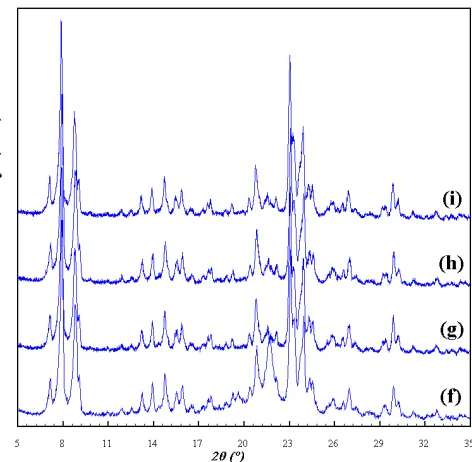
The X-ray powder diffraction patterns of the Cr-containing molecular sieves with MFI structure crystallized at different times are shown in Fig 2. For the (f) white solid sample, the XRD pattern exhibits an extra-peak around 2 = 21.67o, characteristic of crystalline -SiO2 [19]. The (g) to (i) white solid samples have a high crystallinity and purity. The intensity of XRD peaks of the samples increase with increasing crystallization times. All CrS-1 recovered at different crystallization times, have an orthorhombic structure and Pnma space group (Table 4), while the indexing of hkl plans is performed properly complete in Table 5. The cell parameters on Table 4 were calculated by Samson program and refined by U-fit program.
Table 4 Crystallographic data of the calcined samples recovered at different crystallization time
time (days)
a (Å) b (Å) c (Å) V (Å3)
1 20.15 19.39 13.38 5228.06
2 20.14 19.55 13.47 5302.79
5 20.10 19.43 13.43 5245.53
8 20.18 19.98 13.46 5428.73
Figure 2X-ray powder patterns taken from the CrS-1 calcined samples experiencing crystallization in different times: (f).1, (g). 2, (h). 5, and (i). 8
Tabel 52, the relative intensity andhklof CrS-1 calcined samples recovered at different crystallization time 2and relative intensity of CrS-1
1 day 2 days 5 days 8 days
2 I/I1 2 I/I1 2 I/I1 2 I/I1
hkl
7,895 100 7,880 100 7,908 100 7,859 100 101/011
8,793 57 8,776 55 8,804 58 8,757 52 200
9,100 16 9,040 18 9,070 18 9,020 17 111/020
13,213 10 13,203 10 13,215 10 13,164 9 300
13,912 14 13,893 14 13,918 14 13,871 13 012
14,753 19 14,721 20 14,755 19 14,699 19 301
15,511 10 15,489 9 15,521 10 15,468 8 311
15,874 14 15,852 13 15,885 13 15,830 13 131/202
17,780 7 17,770 8 17,820 7 17,741 8 400
20,817 28 20,785 28 20,821 26 20,766 25 113
21,665 34 -SiO2
22,100 12 22,108 8 22,137 7 22,084 7 023
23,062 83 23,024 92 23,061 84 22,999 86 142
23,280 46 23,260 45 23,270 42 23,220 39 501
23,680 26 23,640 24 23,680 23 23,670 24 341
23,920 46 23,822 51 23,930 46 23,950 55 051
24,320 16 24,258 18 24,320 15 24,231 15 151/242
24,520 15 24,506 15 24,550 14 24,489 15 133
25,820 8 25,780 8 25,820 7 25,720 6 233
26,919 13 26,908 14 26,944 12 26,882 13 104
29,871 17 29,847 21 29,883 18 29,825 20 261
30,180 8 30,161 9 30,197 8 30,141 9 314
In
te
n
si
ty
(a.u
Figure 3 FTIR spectra of the CrS-1 calcined samples at different crystallization temperatures : (a). 150, (b). 160, (c). 170, (d). 180 and (e). 190oC
The results of the analysis show that all CrS-1 recovered at different crystallization times from 1 to 8 days crystallized in the orthorhombic structure and P Bravais lattice, therefore all CrS-1 have an orthorhombic structure andPnmaspace group.
FTIR Spectra
FTIR spectra of the Cr-containing molecular sieves with MFI structure obtained at different temperature and time of crystallization are depicted in Fig 3 and 4 respectively. Pure silicalite-1 has FTIR bands at 1230, 1100, 800, 550 and 450 cm-1, which assigned to different vibrations of tetrahedral and framework atoms of MFI zeolite [20]. The band at 550 cm-1 confirms the presence of double five rings and is generally regarded as a characteristic probe for the existence of the MFI structure, while at 450, 800, 1100 and 1230 cm-1 are mainly assigned to the asymmetric bend stretch, the symmetric stretch, the symmetric stretch and the symmetric bend stretch respectively [21]. On the contrary, two peaks are present at 585 and 630 cm -1
which are assigned to vibration of the Cr=O and Cr-O bonds [22]. Fig 3 and 4 show that the broadening ratios of the band at 800 cm-1to that at 450 cm-1 (I800/I450) decrease with increasing crystallization temperatures or crystallization times. These cases prove that the crystallinity of CrS-1 increase with increasing crystallization temperatures or crystallization times.
Model of the Chromium Incorporation on the Framework Silicalites-1
From Pauling’s theory of the chemical bond [23], framework substitution, in which the metals are coordinated tetrahedrally by four oxygen ions, should be possible if the ratio of the radii of the cation and the oxygen atom is between 0.225 and 0.414. In contrary, Arendset al. [2] reported that
Figure 4 FTIR spectra of the CrS-1 calcined samples at different crystallization times: (f). 1, (g). 2, (h). 5, and (i). 8 days
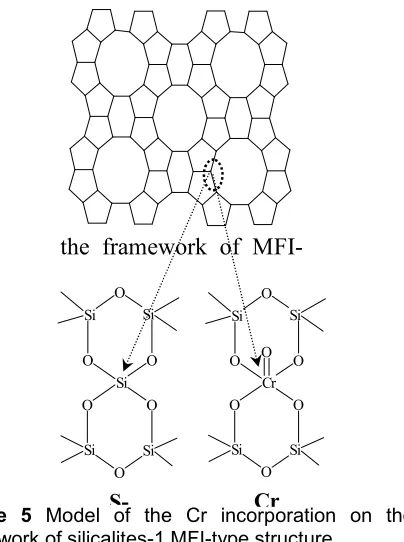
Figure 5 Model of the Cr incorporation on the framework of silicalites-1 MFI-type structure
framework incorporation is also possible for metal cations for which r(Mn+)/r(O2-) is slightly higher than 0.414. The oxidation state of the metal ion and hence, the structure may be substantially different in the calcined material from that in the as-synthesized redox molecular sieves. The valence state of the metal cations is that of original material incorporated in the synthesic gel, e.g. V(IV), Cr(III), Mn(II) and Co(II), when calcined, the valence state in the final material can change to: V(V), Cr(VI), Mn(III) and Co(III). Chromium-substituted molecular sieves generally contain chromium(III) in the as-synthesized material, but this is converted to chromium(VI) upon calcination. Since chromium(VI) always contains two extra framework Cr=O bonds it can only be
%
T
r
MFI-anchored to the surface and cannot be isomorphously substituted. Model of the Cr incorporation on the framework of MFI-type structure silicalites-1 can be predicted as in Fig 5.
CONCLUSION
In this paper, we have shown that it is possible to synthesis chromium-containing silicates MFI-type structure using K2Cr2O7 as the chromium source, TEOS as the silicon source, TPABr as template, NaOH as the mineralizer and H2O as solvent. The phase observed in the XRD patterns of the CrS-1 calcined samples synthesized from the crystallization 150 to 190oC for 11 days is only MFI-type phase. The crystallinity of CrS-1 calcined samples increase progressively with increasing crystallization temperature. The CrS-1 sample prepared under static condition for 1 day at 150oC indicated -SiO2 phase. On the contrary, the samples conditioned for 2, 5, and 8 days at 150oC were only MFI phase. All of the CrS-1 calcined samples recovered at different crystallization temperatures and times, crystallized in the orthorhombic structure andPnmaspace group.
ACKNOWLEDGEMENT
The authors would like to acknowledge the financial support of DUE-Like program.
REFFERENCES
1. Flaningen, R.M., Bennet, J.M., Grose, R.W., Cohen, J.P., Patton, R.L., Kirchner, R., and Smith, J.V., 1978,Nature, 271, 512
2. Arends, I.W.C.E., Sheldon, R.A., Wallau, M., and Schuchardt, U., 1997, Angew. Chem. Int. Ed. Engl.,36, 1144
3. Olson, G.T., Kokotailo, G.T., Lawton, S.L., and Meier, W.M., 1981,J. Phys. Chem., 85, 2238 4. Van Koningsveld, H., Jansen, J.C., and Van
Bekkum, H., 1990,Zeolites, 10, 235
5. Artioli, G., Lamberti, C., and Marra, G.L., 2000, Acta Cryst., B56, 2
6. Marra, G.L., Artioli, G., Fitch, A.N., Milanesio, M., and Lamberti, C., 2000, Micropor. Mesopor. Mat.,40, 85
7. Millini, R., Massara, E.P., Perego, G., and Bellussi, G., 1992,J. Catal., 137, 497
8. Yin Au, T.L., Hang Chau, J.L., Ariso, C.T., and Yeung, K.L., 2001,J. Memb. Sci., 183, 269 9. Kishor Mal, N., and Ramaswamy, A.V., 1996,
Appl. Catal. A : General, 143, 75
10. Valange, S., Gabelica, Z., Abdellaoui, M., Clacens, J.M., and Barrault, J., 1999, Micropor. Mesopor. Mat.,30, 177
11. Shevade, S.S., Raja, R., and Kotasthane, C., 1999, Appl. Catal. A: General, 178, 243
12. Sasidharan, M., Suresh, S., and Sudalai, A., 1995,Tetrahed. Lett., 36, 9071
13. Xiongfu, Z., Yongsheng, L., Jinqu, W., Huairong, T., and Changhou, L., 2001, Separ. Purific. Tech., 25, 269
14. Millini, R., Perego, G., Berti, D., Parker Jr, W.O., Carati, A., and Bellussi, G., 2000, Micropor. Mesopor. Mat.,35, 387
15. Bandyopadhyay, R., Kubota, Y., Sugimoto, N., Fukushima, Y., and Sugi, Y., 1999, Micropor. Mesopor. Mat., 32, 81
16. Taramasso, M., Perego, G., and Notari, B.,1983, U.S. Patent No. 4410501
17. Evain, M., and Barbet, J.M., 1992,Samson vers. 2.0, Institute des Materiaux de Nantes- Nantes, France
18. Evain, M., 1992, U-fit vers. 1.2, IMN-Université de Nantes, France
19. Bosman, H.J.M., 1995, Characterization of the Acidity of SiO2-ZrO2 Mixed Oxides, Disertation.
Technische Universiteit Eindhoven, Netherlands 20. Shibata, M., and Gabelica, Z., 1997, Zeolites,
19, 246
21. Zhao, Q., Bao, X.H., Han, X.W., Liu, X.M., Tan, D.L., Lin, L.W., Guo, X.W., Li., G., and Wang, X.S., 2000,Mater. Chem. Phys. 66, 41
22. Fosse, N., 1998, “Synthèse, Caracterisation Structurale de Chromates Micro et Mésostructurés, A2CrmO3m+1 (m=2,3) et Transitions de Phase”, These de Doctorat, Universite de Nantes, France
Annex 1 : an example for parameters calculation of CrS-1
The unit cell dimensions were refined by a least-squares method
Title: CrS-1 calcined sample recovered at crystallization temperature 150oC
Parameters:
a = 19.902895 (0.047470) (*) b = 19.309593 (0.031154) (*) c = 13.416503 (0.025153) (*) Volume = 5156.1875 (30.2835) Special parameters:
z = 0.010492 (0.033027) (*) Zero shift Largest correlation coefficients:
(a) - (b) : 0.60464579 (a) - (c) : 0.58850000 (b) - (c) : 0.43950637 (a) - (z) : 0.00734595 (c) - (z) : 0.00691493 Crystal system: orthorhombic
Bravais lattice: Primitive Wave length: 1.54059810 Weighting scheme: unit weight # of cycles: 1 (max:10) # of hkl : 18
Cycle 1 "Chi**2" = 1.934E-0006
h k l 2obs 2cor 2calc d(2) int
1 0 1 8.006 7.996 7.941 -0.055 100 2 0 0 8.878 8.868 8.879 0.011 55 1 1 1 9.144 9.134 9.167 0.033 18 3 0 0 13.293 13.283 13.335 0.053 11 0 1 2 14.006 13.996 13.964 -0.031 15 3 0 1 14.842 14.832 14.885 0.053 20 3 1 1 15.586 15.576 15.579 0.003 10 2 0 2 15.956 15.946 15.920 -0.025 14 1 1 3 20.877 20.867 20.855 -0.012 30 1 4 2 23.121 23.111 23.116 0.006 94 5 0 1 23.340 23.330 23.291 -0.039 49 3 4 1 23.730 23.720 23.720 0.001 25 0 5 1 23.990 23.980 23.959 -0.021 51 1 5 1 24.380 24.370 24.378 0.008 17 2 3 3 25.903 25.893 25.837 -0.055 8 1 5 2 26.994 26.984 26.993 0.009 14 0 3 4 29.940 29.930 30.018 0.088 21 4 3 3 30.260 30.250 30.221 -0.028 9
D = (((2))/nhkl = 0.029600