Providing User Quality of Service Specification
for Communities with Low Connectivity
Ratna Wardani
1), F. Soesianto
2), Lukito Edi Nugroho
2), Ahmad Ashari
3) 1)Department of Electronic Engineering, Yogyakarta State University Kompleks Karangmalang, Yogyakarta, Indonesia 55281
[email protected]
2)
Department of Electrical Engineering, Gadjah Mada University
Jl. Grafika No. 2, Bulaksumur Yogyakarta, Indonesia 55281
[email protected]
,
[email protected]
3)
Department of Mathematics and Natural Science, Gadjah Mada University Bulaksumur Yogyakarta, Indonesia 55281
[email protected]
Abstract— The Internet has the potential to provide universal and easy access to the various types of information services on a single multi-service, but unreliable quality connection can sometime prevent access to the Internet altogether.
There are many efforts have been started to resolve the Internet access problem. The main idea behind them is to provide a set of objective parameters that can be used to compare and negotiate in a network. Relatively little emphasis has been put on issues concerning end users, especially on the relationship of user perception and subjective Quality of Service parameters. In order to implement Quality of Service schemes successfully, users must be taken into account to establish users' subjective perceptions of Quality of Service.
This paper is concerned to the study of mechanism of providing Quality of Service specification for Internet access in low-quality connection. We propose the conceptual model for the specification of user access and allow the users to specify their subjective preferences through the Quality of Service parameters. This model provides the alternative option for user access if resource availability in the system is limited. The user is given opportunity to define their access and determine the parameter for each application which they are chosen. The system will check the resource availability and then compare to the user preferences. In the case resource availability is lower than user preferences, the system can exchange to another option as determined by user requirements.
Keywords-low-quality connection; users’ subjective perception; QoS parameter; QoS specification; resource availability;
I. INTRODUCTION
Information services on the Internet come in varying forms, such as web browsing, e-mail, and multimedia on demand. The main motivation behind the design of next-generation computer and communications networks is providing universal and easy access to these various types of information services on a single multi-service Internet. This means that all forms of communications (video, voice, data and signaling), along with all types of services (from plain text web pages to multimedia applications), are bonded in a single-service platform through Internet technology.
The Internet has the potential to provide access to a large amount of information electronically. However, there are obstacles. In many of the world‟s community there is still limited access to the Internet. Bandwidth so is narrow that it can take the user hours to access Internet to find some information. Time spent online often translates to higher telephone and ISP charges. Unreliable network infrastructure can sometime prevent access to the Internet altogether.
Indonesia is the one of many countries in the world that has poor communication infrastructure. In September 2009, the Indonesian Association of Internet Service
Providers [12] estimated that there were approximately
The majority found a problem at least once out of four times of access and around 7-10% found a problem every time they used the Internet. Fortunately, most users would wait if they found difficulty in accessing or when browsing is too long. And interestingly, for these two problems less than 11% would report to the provider. When they found frequent disconnection, the action that a user would take was evenly divided between waiting, switching to other address, report to provider, try another time and last, turn off the computer - especially when the computer "hangs"[7].
This is an example of a set of problems that exists in the low-quality connection environment. There are many efforts have been started to resolve the Internet access problem. While cost-effective network infrastructure solutions have been available, most software tools (e.g., browsers, file transfer tools, and email clients) do not suit the situation. They assume all users have high-speed connection in accessing the Internet. The problem is that when the connection is bad, they decide to fail the operation without leaving the user with any option. As a result, it is extremely difficult to execute a complete access operation in a low-quality Internet connection. This situation discourages people from harnessing the potential of Internet as a communication medium or a giant information repository. Therefore, we need an access model that allows a user to keep accessing the Internet even in very low speed and with temporary disconnection.
Our research is concerned with the study of mechanism for the provision of quality of service guarantees for Internet access in low-quality connection. However, in this paper we focus on the user Quality of Service specification. The objectives of the first stage of this research were as follows. of Service specification accessible to the user
The rest of the paper is organized as follows. The next section contains a discussion about work related to Quality of Service in other domains like networking, application, and in domain of user perception. In section 3, the model design is described, along with a brief description of Quality of Service specification. In section 4, we present our conclusion and the future work.
II. RELATED WORK factors such as accessibility and availability. The success of any scheme that attempts to deliver desirable levels of Quality of Service for the Internet must be based, not only on technology improvements, but on users‟ requirements.
Quality of Service is very popular and overloaded term that is very often looked at from different perspectives by the networking and the application-development communities. Quality of Service was primarily used by the communications and networking areas to describe the ability to measure and guarantee
transmission rates over networks [5]. In more broadly
vision, Quality of Service can be defined as a relation
between server and client [7]. The server provides
services with a specific quality level whereas the client requests a service with a desired quality.
The concept of Quality of Service arises due to the fact that Internet requires guarantees for transmission of information. The service traditionally offered by the Internet is called Best Effort, meaning it is going to supply the best possible service without distinction between different communications, or data flow. In this model, when congestions occurs in the path (when the amount of received data is higher than a transmission capacity in the network node) packets are arbitrarily dropped. Using protocol such as TCP, the only guarantee provided is fairly share bandwidth and reliable data delivery. If this Best Effort is sufficient for traditional application like Telnet, e-mail or FTP, it is not the case for application with time constrains like multimedia or interactive applications. For these applications, the Quality of Service delivered is useful.
User
Application
Transport Network
System
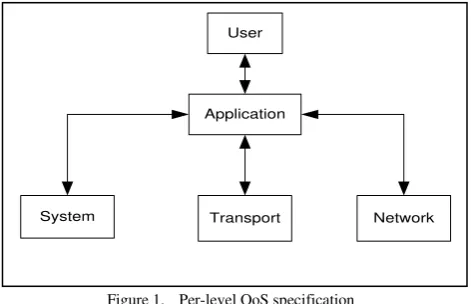
Figure 1. Per-level QoS specification
From Fig. 1, we can see at the end of chain, the user
Quality of Service can also be defined as “the set of
qualitative and quantitative characteristics of a
telecommunication system that are necessary to achieve the required functionality of applications and furthermore
to satisfy the user” [3]. The user‟s perceptions define the
acceptable parameter values and the acceptable Quality of Service [5], [13]. The definition states that the telecommunication system supports a Quality of Service level to make sure that application and the user‟s requirements are met.
While there are many approaches tackling the challenge from a technical point of view by providing mechanisms and protocols to implement Quality of Service, relatively little emphasis is put on the end user. The main idea behind them is to provide a set of objective parameters that can be used to compare and negotiate in a network. However, in today's world, a substantial part of communication over networks still involves humans. Users do not talk bandwidth and jitter, they think on a much higher level in terms of good quality and bad quality. Traditional Quality of Service metrics at the network level such as delay, jitter, bandwidth, buffer size, and response time cannot sufficiently describe the quality of service as perceived by users. Therefore our research puts emphasis on the specification of Quality of Service requirements from user perspective.
B. Quality of Service Specifications
Specification of Quality of Service is vital to realizing quality guarantees. The specification can be done at various levels of system (i. e. network, application and user). Network-layer Quality of Service specification states the degree of resource commitment required to maintain performance guarantees. In this layer, the specification of the Quality of Service is made in quantitative aspects (i.e. delay, jitter, throughput, and bandwidth). Application-layer Quality of Service
specification describes the application-specific Quality of Service requirements. Since different applications have different Quality of Service requirement, each application should specify its requirements to a network in order to achieve the desired Quality of Service. If there are no requirements given, the network will take for granted that any level of service is acceptable, and therefore can provide any level of networks support. User-layer Quality of Service specification reflects the user-perceptive quality of the application quality in the subjective criteria.
Most researchers in the field of user-layer Quality of Service agree that user Quality of Service specification must not include technical details in describing Quality of Service as perceived by the user. They also agree that
There are two approaches to develop specification of Quality of Service, namely Application Programming Interface (API) approach and Language-based approach. The former is the common approach in operating system and computer network practice. This approach provides a set of Quality of Service Programming Interface for each Quality of Service domain. The later is a common Quality of Service language is used to describe Quality of Service characteristic and their combination. It is believed the API approach is useful but not adequate, and a language-based approach is preferred because of its adaptability and portability.
C. Performance Requirements
There are several classes of performance
requirements. Most traditional are response time (how fast the system will respond the user request) and measure the performance requirements of a process:
timeliness, precision and accuracy [13]. Timeliness
measures the time taken to produce the output of the process. Precision measures the amount or quantity of the produced output. Accuracy measures the correctness of the produced output, usually relating to the content of the output. Specific measures of the three Quality of Service attributes depend on the process of interest. Existing work on Quality of Service of computer networks has used the following Quality of Service measures.
Response Time Expected by Users: The users‟ expected response time is the time elapsed between sending a request and the reception of the first response by the user.
data block by the transmitting end-system, and its reception by the receiving end-system.
Jitter: In transmission technology, jitter refers to the variation of delay generated by the transmission equipment.
Data Rate: Data rate refers to the raw data rate of encoded multimedia data before transmission, that is, the rate in which data are encoded.
Required Bandwidth: The required bandwidth is defined by the required data transfer rate, measured in bits per second, of each specific application in telecommunication. This metric includes raw data and overhead.
Loss Rate: The bit loss rate is the number of bits lost between two points in telecommunications after transmission.
Error Rate: The bit error rate is the frequency of
erroneous bits between two points in
telecommunication after transmission.
III. MODEL REPRESENTATION
Given the low-bandwidth and high cost of using the Internet in low-connectivity settings, we realized that the access model for Internet access that exists today is not compatible with the infrastructure that exists elsewhere. In this situation we therefore need a model that provides a kind of flexible access and gives the opportunities to
the users to specify other access arrangement.
A. User Quality of Service Description
Users need to have access and capability to specify the quality of their application. One common way is to provide users with a specification that is simple, because users are not expected to give sophisticated description about Quality of Service requirements. Therefore, giving a specification with limited number of option that focus on subjective user Quality of Service is desirable.
There are two main features that user Quality of Service specification should satisfy: (1) provision of parameter of user Quality of Service that can be measured easily from user perspective; (2) provision of alternative actions if the access cannot be executed.
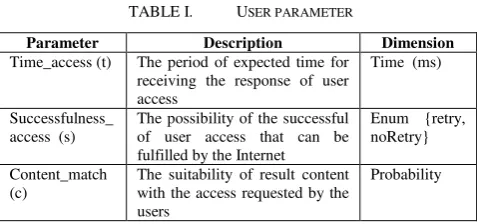
In our research, we design a specification that provides the user with the choice to specify the quality she/he expects to receive. The objective of the designed specification is to satisfy the user perceived requirements with conveniently choosing appropriated Quality of Service parameters based on the application. To specify Quality of Service, we need a way to formally quantify jitter and error [13]. In addition, the users basically have
time expectation to get response, the level of performance and the perception about the quality they received.
TABLE I. USER PARAMETER service without exposing details of the internal design and implementation. Such dimensions enable Quality of
Service specifications that are relevant and
understandable to any application without depending on the implementation technology. It means that the same parameter can be realized by multiple implementation depend on the application media.
B. The Conceptual Model for User Specification
This section explains the conceptual model for user specification in accessing Internet. We are using statechart diagram to describe the model.
The statechart diagram describes a set of transition and state. A transition is defined as a transformation of a state to another state in the statechart diagram. A state is a condition during the life of an object or an interaction during which it satisfies some condition, performs some action, or waits for some event.
A state can only be “executed” when the guards in the
transition satisfies the pre-condition predicate. The transition changes the state in any way so that the new state satisfies the post-condition predicate.
We propose a scheme for modeling the specification
pre: a predicate, which defines a pre-condition
post: a predicate, which defines a post-condition Action: an ongoing activity (“do activity”) that is performed as long as the model element is in the state or until the computation specified by the action expression is completed.
Whereas a transition contains three elements and is expressed by the following form:
S0
guard : a Boolean expression written in terms of parameters of the triggering state
act : an action expression which is executed if and when the condition satisfied
The state (Si) is triggered by the transition (ei-1). The
guards in the transition ei-1 indicate the conditions that
determine which state will be executed, meaning if the condition is true then the specified state will be executed and contrary if the condition is false then the process will go to another state. The execution of the next state is asserted by an action expression (act) in the transition ei-1.
In the state Si, pre-condition (Spre, ei-1) is a requirement
for the action (ai,[qexp]) andpost-condition ((True) Si+1
(False) Si+2) showed the next state that will be occur
after the action is completed. The parameter in the pre-condition predicate contains the evaluation value of the
condition (guard) in the transition ei-1. This value
determines what action will be processed in the state Si.
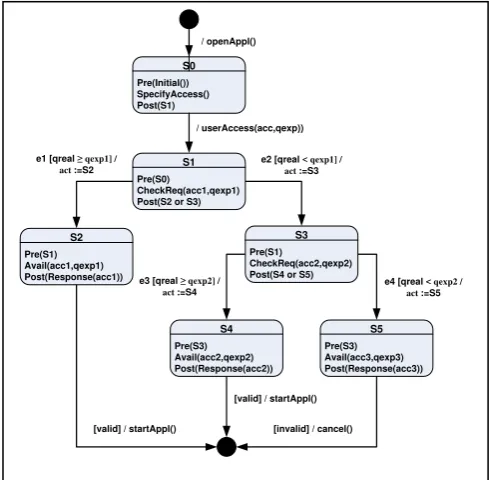
Statechart diagram in Fig. 2 depicts the scenario of conceptual model of user‟s access specification. The user is given opportunity to define their access and determine the parameter for each application which they are chosen. The system will check the resource availability and then compare to the user preferences. In the case resource availability is lower than user preferences, the system can exchange to another option as determined by user requirements.
Figure 2. Statechart diagram for the conceptual model
Based on the scheme and statechart diagram, the
perform specifications when a specified _event occurs
provided that certain specified conditions are satisfied. In
this scenario, the event ei+n (n = 0,1) occurs whenever the
action on the state Si performs CheckReq() activity. For
example, the event e1[qreal ≥ qexp1] / act:= S2 occurs after
the activity CheckReq(acc1), qexp1) in the state S1 is
activated. The process then go to the state S2, because the
evaluated of guard-condition shows that the current
Quality of Service is available for the user‟s Quality of
Service requirements.
The guard-condition is evaluated whenever its event actives. The guard-condition (i.e. [qreal ≥ qexp1]) shows the
comparation result between the parameter qreal (the
current Quality of Service) and the parameter qexp (the Quality of Service requested by user). The evaluation process provides two possible results, True or False. The designated guard-condition becoming True if user‟s Quality of Service requirements can be satisfied by the system. In contrary, the guard-condition becoming False if user‟s Quality of Service cannot be satisfied by the
C. The Functionality Model and Interaction
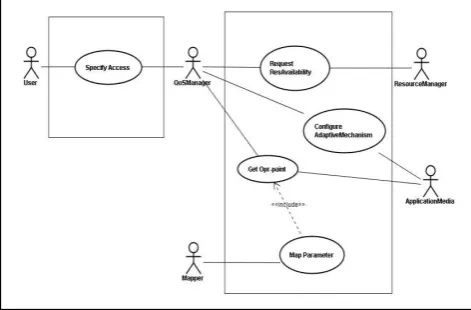
The functionality model describes the proposed functionality of the new model. Each component has a description which describes the functionality that will be built in the new model. Fig. 3 depicts five main components which are involved in the new model.
User is used to specify the user‟s Quality of Service
requrements and preferences. The user‟s requirement may be specified for one or more Quality of Service
parameters. QoSManager coordinates and performs the
mechanism on behalf of the interacting components. In order to decide on the solution (i.e. selection of
appropriate service based on user‟s preferences), the
QoSManager has to make a reference to: (i) user‟s
Quality of Service requirements and preferences, (ii) available resource conditions, and (iii) the operational
point of application media. ResourceManager stores
:User :QoSManager :Mapper :RescManager :ApplMedia
1:access_pref()
1.1:req_resource()
1.2:get_opr-point()
1.3:map_parameter()
1.4:configure_adaptive-mechanism()
1.5:response()
[res_availability]
[result]
[mapping_result]
QoSManager regarding the state of the resources.
ApplicationMedia performs the media type and the parameters related to the application that requested by
users. Finally, Mapper would convert high-level user
QoS specifications to a set of resource requirements. QoS parameters have to be translated between different levels of abstraction to be meaningful for the mechanism present at a particular level.
Figure 3. Use case diagram for the conceptual model
The interaction of a functionality component is described in Fig. 4. The sequence diagram describes the general view of the specification process. Users specify their access preferences (1). This would influence the QoSManager to set an adaptive mechanism. Based on the user preferences, the QoSManager determines required resources for this access. Based on these requirements it request a resource allocation from ResourceManager (1.1). The ResourceManager responds with the available resource that may be less than the amount requested. The QoSManager sends a message to media application to get an operational point of media application (1.2). The mapping process translates between the user‟s QoS parameter, application‟s QoS parameter and system‟s QoS parameter (1.3). After mapping parameter process, the QoSManager now configures the adaptive mechanism to activate the appropriate application (1.4) as determined by user preferences and the resource availability. At the end of process, the QoSManager sends a response to the user‟s specification access (1.5).
Figure 4. Sequence diagram for the interaction model
IV. CONCLUSION AND FUTURE WORK
A. Conclusion
In our first stage of the study, we describe the conceptual model for specification of user Quality of Service that deals with limited access in low-quality connection. The conceptual model is designed to provide
mechanism for user access specification. The
specification is used to state the user‟s Quality of Service requirements and preferences.
The next stage of this study is to develop a framework that enable the application of Quality of Service specification, Quality of Service mapping and Quality of Service decision in order to provide internet access in low quality connection.
B. Future Work
There is still much work to be done in this study. For example, we need to fix the weak points and transform the concept into a solution. More specifically, work has to be performed in the following tasks:
Implementation. The specification model has to be implemented in order to examine the suitability of presented model.
Feasibility of specification model. The
specification has to be validated using the prototype.
Usability of model. The usability of the model has to be tested in a formal setting. For that, a working prototype of the model is required.
ACKNOWLEDGMENT
The work reported in this paper has been funded by the Directorate General of Higher Education of Indonesia through the Sandwich Program 2009.
REFERENCES
[1] A. Bouch, A. Kuchinsky and N. Bhatti, “Quality is in The Eye of
Beholder : Meeting user‟s requirements for Internet Quality of
Service”, HPL-2000-4, January 2000.
[2] A. Podelko, “Multiple Dimensions of Performance
Requirements”, Proceeding of the Computer Measurement Group‟s International Conference, 2007.
[3] A. Tsalianis and A.A Economides, “QoS Standards for Distributed Multimedia Application”, Proceeding IEEE Communications Quality & Reliability, International Workshop,2000, pp. 13-17. [4] A.Vogel, B. Kerhevre, G.V. Bochmann, J. Gecsei, “Distributed
Multimedia Applications and Quality of Service : A Survey” Proceedings of the 1994 Centre for Advanced Studies Conference, Torornto, Canada, November 1994.
[5] E. Babulak, “The IT Network Quality of Service Provision
Analysis in Light of The User‟s perception and Expectation”,
http://www.soc.staffs.ac.uk
[6] G. Oberholzer, “QoS for End-Users : Briging the Gap from
Network to User”, Thesis Report, Computer Engineering and Networks Laboratory, July 2001.
[8] Internet2 QoS Working Group, “Network QoS Needs of
Advanced Internet Application : A Survey”, 2002.
[9] J.F. Huard and A.A. Lazar, “On QoS Mapping in Multimedia Networks, 21st IEEE Annual International Computer Software
and Application Conference (COMPSAC‟97), August 13 – 15, 1997.
[10] R. A. Carimo, “Evaluation of UML Profile for Quality of Service from The User Perspective”, Thesis no: MSE-2007-03, School of Engineering Blekinge Institute of Technology, Sweden, August 2006.
[11] S. Chakrabarti, “Low-bandwidth Web Access with Tandem Proxies”, Master Thesis, Department of Electrical Engineeing and Computer Science, MIT, September 2002.
[12] www.apjii.or.id , accessed on November 2009
[13] Y. Chen, T. Farley, and N. Ye, “QoS Requirements of Network Applications on the Internet”, Department of Industrial Engineering, Arizona State University, Tempe, AZ, USA, 2003.