Interactions Between Environmental Factors and Zinc Concentrations in Porewater and Roots of Rhizophora sp. in Ampallas, Mamuju, West Sulawesi, Indonesia
Rantih Isyrini1*, Shinta Werorilangi 1, Supriadi Mashoreng1, Ahmad Faizal1, Rastina Rachim1, and Akbar Tahir1
1Department of Marine Science. Faculty of Marine Science and Fisheries, Hasanuddin University,
Makassar, Indonesia.
*email: [email protected]
Received September 11, 2017; Accepted April 16, 2018; Available online May 31, 2018
ABSTRACT
The study was to determine the concentrations of Zn in porewater and fine rootsof Rhizophora sp., and to examine their interactions with mangrove densities and physico-chemical. Porewater samples, fine roots, and sediments were collected in a 100 m2 plot at each site with different mangrove densities. The average Zn concentrations in mangrove roots in the study area were 0 – 58.21 mg/kg, suggested the capability of mangrove roots in retaining Zn. The average dissolved Zn concentrations in porewater were 0.63 mg/L – 3.50 mg/L, illustrated the amount of Zn bioavailable form and its potential release to the adjacent environment. The Zn concentrations in porewater did not correlate significantly with the densities of mangroves. The concentrations of Zn in roots increased as the densities were higher, which is possibly caused by the absence of mangrove at Site 1. The study discovered the important roles of organic content and silt/clay in Zn sorption thus affect Zn levels in porewater. The concentrations of Zn in mangrove roots increased as the pH of sediment and porewater decreased.
Keywords : Zinc, porewater, mangrove roots, environmental variables.
INTRODUCTION
The mangrove ecosystem has numerous ecological and economic important functions (Alongi, 2002; Aksornkoae, 2004; Walters et al. 2008; Hogarth, 2015), including their capability in retaining pollutants, such as metals, to adjacent marine environment (MacFarlane, Pulkownik, & Burchett, 2003; Silva, Da Silva, & De Oliveira, 2006; Chaudhuri, Nath, & Birch, 2014). Zinc is an essential element for plant growth (Broadley, White, Hammond, Zelko, & Lux, 2007), including mangroves (Marchand, Fernandez, & Moreton, 2016), which becomes
one of the important topics studied in mangrove ecosystems. Zinc is involved in various enzymes in higher plants, however, in excessive concentration (i.e. at leaf Zn concentration > 100 mg/kg), it can cause toxicity to plants (Bradl, Kim, Kramar, & Stüben, 2005; Broadley et al. 2007).
The main natural source of Zn to sediments is from the chemical and physical weathering of parent rocks. The average Zn
concentration of rocks in the earth’s crust is
approximately 78 mg/kg (Alloway, 2008).
processes, such as: decomposition,
leaching/wash-off from leaf surfaces can raise Zn concentrations in sediments (Friedland, 1990; Broadley et al., 2007). Anthropogenic inputs from mining, manure (Broadley et al. 2007; Chaney, 2008), fuel combustion, and sewage sludge can also increase Zn concentrations in sediments (Broadley et al. 2007). Zn rise can also come from agriculture, such as: fertilizer (Bradl et al., 2005; Chaney, 2008), a wood preservative, and an insecticide (Bradl et al., 2005). Besides natural and anthropogenic aspects, several factors, such as: pH (Du Laing, Rinklebe, Vandecasteele, Meers, & Tack, 2009), soil texture and organic matter can influence Zn concentrations in sediments (Broadley et al., 2007; Du Laing et al., 2009).
8.33 – 16.16 mg/kg, while the Zn concentrations in seawater at the area were 0.13 – 0.14 mg/L (Analuddin et al., 2017). There are few published data on the Zn concentrations in porewater over the world. The Zn concentrations in porewater of mangrove ecosystem in Sarawak, Malaysia were 0.00042–0.0013 mg/L (Billah, Abu Hena, Idris, Ismail, Bhuiyan, 2014).
The mangrove ecosystem in Ampallas, District of Mamuju, Province of West Sulawesi, Indonesia, is located near fish ponds and agricultural areas, which can affect the natural levels of Zn in the area. Furthermore, fishermen’s boat activities and urban effluent can also increase the concentrations of Zn in the area. Free inundation from seawater as well as river located at the left side of the study area can control the geochemical processes occurred thus affect the levels of Zn in the mangrove ecosystem. Changes of the solid phase in the environment can affect the composition of the interstitial water, thus influence the solubility and bioavailability of heavy metals (Otero and Macı́as, 2002). The later form could also reflect the potential amount of Zn released into adjacent environments.
This study was to examine the Zn concentrations in porewater and roots of Rhizophora sp. in order to evaluate the capability
of the mangrove ecosystem in retaining Zn as well as its potential to release the bioavailable Zn to adjacent environment. Furthermore, this study was to evaluate their interactions with mangrove densities and physico-chemical variables.
EXPERIMENTAL SECTION
Study sites
The study was conducted from May to August 2016 at a mangrove ecosystem in Ampallas, District of Mamuju, Province of West Sulawesi, Indonesia (Figure 1). The study was conducted at four sites that have different mangrove density levels based on criterion stated by Environment Ministry, Republic of Indonesia (KepMenLH, 2004) (Table 1).
Each site was located at a 10 x 10 m2 plot. The amount of mangrove density was determined by converting the number of mangrove trees in a plot to a hectare (ha) unit. Site 1 that had no mangrove was served as the control site. Site 2 had lesser mangrove density (583 mangroves/ha) and was dominated by R. apiculata approximately 300 mangroves/ha. Site 3 was occupied by medium level of mangrove density (1100 mangroves/ha) and dominated by R. mucronata as much as 967 mangroves/ha.
Table 1. The density of mangroves at each research sites and the criterion level based on Environment Ministry, Republic of Indonesia (KepMenLH, 2004).
Site Density
(trees/ha)
KepMenLH (2004)
Criteria Density (trees/ha)
1 0 - -
2 583 Less dense <1000
3 1100 Medium density >1000 - <1500
4 1750 Densest >1500
Figure 2. Peeping bottle designed to collect porewater sulfide. The upper side of the bottle had holes around it, covered with a soft net, and was connected to a PVC pipe Site 4 had densest mangroves (1750
mangroves/ha) and was dominated by R. mucronata as much as 1417 mangroves/ha (Table 1). At each site, six mature trees of Rhizophora sp. were chosen as study objects and served as replications. The trees had similar heights, diameters, and visual health.
Sample collections and measurements
Fine roots that were considered as nutritive roots, up to 5 cm surface sediments (MacFarlane et al. 2003), as well as porewater samples, were collected at least one meter from each of mangrove trees. Porewater samples were collected using peeping bottles built from a 250 ml bottle connected to a PVC pipe at the bottom. This pipe served to hold the bottle firmly upright inside the soil. The upper side of the bottle had holes around it and was covered with a soft net to minimize the amount of the soil getting inside (Figure 2). The bottles were put inside the holes
overnight to ensure the bottles were filled with porewater. After removal, the porewater was transferred into sample bottles.
The pH of porewater and sediment samples were measured using pH probe meter, while the redox potential (Eh) of sediment samples were measured using Eh probe meter. The concentration of organic content was determined using the Loss on Ignition (LOI) method (Heiri, Lotter, & Lemcke, 2001). The analysis of grain size of the soil was determined using wet sieve analysis by employing a stainless
steel 63 μm sieving net (Percival and Lindsay, 1997).
All samples were kept in a cool box before transported to the laboratory. Porewater samples were filtered using membrane filter 0.45 m and preserved with 1.5 ml HNO3 every 1 L water sample for dissolved metal analysis.
Guzman, 2005). As much as 0.5 g root tissues were digested with concentrated HNO3 and H2O2 (Khrisnamurty, Shprirt, & Reddy, 1976). 100 ml porewater samples were digested with HNO3 and H2SO4 (APHA, 1999). The concentrations of total Zn accumulated on root tissues samples as well as dissolved Zn on porewater samples were determined using ICP-OES.
Statistical analysis
This study applied several statistical analyses, using Excel and SPSS 21 to assess the variability of geochemical interactions and their correlations. A normality test was performed, and data transformation was employed for non-normal variables. The transformation types depended on the type of skewness. Spearman correlation was employed to identify the correlation between the Zn concentrations in porewater, roots and physico-chemical variables as well as mangrove densities.
RESULTS AND DISCUSSION
Physico-chemical measurements
The conditions of redox potential in study location were varied from reductive to oxidative, with average values from -73.2 to 113.6 mV (Table 2). The range of average sediment pHs was from 6.83 at Site 2 to 7.14 at Site 1. The organic contents were relatively low (1.41%) at Site 1 that had no mangrove and high (12.9%) at Site 4 that had the densest mangroves. The study sites were dominated by sand (above 95%) and a small portion of silt and clay (0. 64 - 2.78%) (Table 2).
The average concentrations of dissolved oxygen in porewater were between 4.3 – 7.1
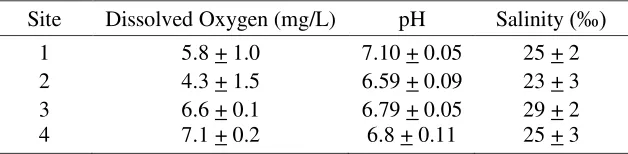
mg/L, where the highest concentration was at Site 4 that had the densest mangroves. The average pHs of porewater were between 6.59 – 7.10, where the highest average pH was located at the Site 1 that had no mangrove. The average salinities of porewater in the study area were between 25 –29‰ (Table 3).
The concentration of metals in porewater and mangrove roots
The average concentrations of Zn in porewater in the study area were between 0.63 – 3.50 mg/L (Table 4). The lowest average Zn concentration in porewater was at the Site 1 that had no mangrove, whilst the highest concentration was at the Site 2 that had less dense mangroves. The average concentrations of Zn in mangrove roots in the study area were similar (53.73 – 58.21 mg/kg). The average concentrations of Fe in roots in the study area were between 2282.60 – 6693.52 mg/kg. The average concentrations of Mn in mangrove roots in the study area were in the range of 43.91 – 129.22 mg/kg (Table 4).
Correlations of Zn concentrations in porewater and mangrove roots to measured physico- chemical variables
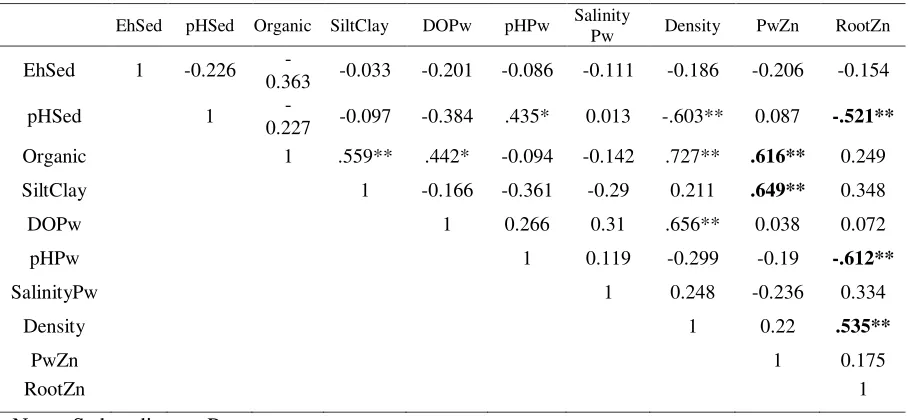
Table 5 shows the concentration of dissolved Zn in porewater increased as the percentage of organic content and silt clay increased (p < 0.01). The concentration of Zn in mangrove roots increased as the pH of sediment and porewater decreased (p < 0.01). The range of dissolved porewater Zn concentrations found in study sites was 0.63 mg/L – 3.50 mg/L.
Table 2. The physico-chemical condition of sediments in the study area (n=24). Data are presented as mean +/- standard deviation
Site Eh pH Organic (%) Sand (%) Silt Clay (%)
Table 3. The physico-chemical condition of porewater in the study area (n=24). Data are presented as mean +/- standard deviation
Site Dissolved Oxygen (mg/L) pH Salinity (‰)
1 5.8 + 1.0 7.10 + 0.05 25 + 2
2 4.3 + 1.5 6.59 + 0.09 23 + 3
3 6.6 + 0.1 6.79 + 0.05 29 + 2
4 7.1 + 0.2 6.8 + 0.11 25 + 3
As mention before, there are limited published data on the Zn concentrations in porewater of mangrove ecosystems over the world. The concentrations found in the study sites were higher than that found in New Caledonia where the average concentration was lower than 10
μmol·l−1 (0.6538 mg/L) (Marchand, Fernandez, & Moreton, 2016), or in Sarawak, Malaysia 0.00042–0.0013 mg/L (Billah et al., 2014). In comparison, the concentration of Zn in porewater of Jeneberang estuary, Makassar, Indonesia in West monsoon and East monsoon were 0.051-0.278 mg/L and 0.220-3.526 mg/L, respectively (Najamuddin, 2017). The values found in the study area illustrated the amounts of Zn bioavailable form that were readily taken up by mangroves, as well as indicated the amounts of dissolved Zn form that are potentially released to the adjacent marine environment.
However, the study showed that the concentrations of dissolved Zn in porewater did not correspond significantly to Zn concentrations in mangrove roots. In fact, the porewater Zn associated with organic content and silt/clay percentage, where the concentrations of dissolved Zn in porewater increased as the percentages of organic content and silt clay increased. Soil organic matter, soil type, and clay mineral content can influence Zn sorption in soil (Bradl et al. 2005; Zhou, Zhao, Peng, & Chen, 2010; Kabata-Pendias, 2011), and become some of the primary Zn fractions found in the environment (Broadley et al. 2007). In study location, organic matters were higher in
sediments that contain higher silt/clay percentages because silt/clay textures were more capable in trapping organic matter as well as binding with metals compared to sand, which due to their high specific surface area (Marchand et al., 2006). Therefore, higher concentrations of metals, including Zn were found in fine-grained soils than in sandy soils (Abraham, 2007), including in mangrove areas (Tam and Wong, 2000; Zhou et al., 2010).
Table 5. Spearman correlation analysis of measured variables
EhSed pHSed Organic SiltClay DOPw pHPw Salinity
Pw Density PwZn RootZn
EhSed 1 -0.226
-0.363 -0.033 -0.201 -0.086 -0.111 -0.186 -0.206 -0.154
pHSed 1
-0.227 -0.097 -0.384 .435* 0.013 -.603** 0.087 -.521**
Organic 1 .559** .442* -0.094 -0.142 .727** .616** 0.249
SiltClay 1 -0.166 -0.361 -0.29 0.211 .649** 0.348
DOPw 1 0.266 0.31 .656** 0.038 0.072
pHPw 1 0.119 -0.299 -0.19 -.612**
SalinityPw 1 0.248 -0.236 0.334
Density 1 0.22 .535**
PwZn 1 0.175
RootZn 1
Note: Sed: sediment, Pw : porewater
The average concentrations of Zn in mangrove roots in the study area were categorized as normal in plants (0 – 58.21 mg/kg). Levels of 10 – 150 mg/kg are normal in plants, while 400 mg/kg is toxic (Mulligan, Yong & Gibbs, 2001). The concentrations of Zn in mangrove roots increased as the pH of sediment decreased. Similar conditions were found elsewhere, where metal accumulations in mangrove roots were higher under lower sediment pHs due to the mobilization of metals as exchangeable species (Harbison, 1986; Clark, McConchie, Saenger, & Pillsworth, 1997; MacFarlane et al. 2003). Lower pH in sediments resulted in lower pH in porewater thus affected the concentrations of Zn in mangrove roots due to the mobilization of Zn as indicated by strong association between pH of sediments and pH of porewater, as well as strong correlations between these two variables and Zn concentrations in roots (Table 4).
CONCLUSIONS
The average Zn concentrations in mangrove roots in the study area were 0 – 58.21 mg/kg. The range of average dissolved Zn concentrations in porewater was 0.63 mg/L – 3.50 mg/L. The Zn concentrations in porewater did not correlate significantly with the densities of mangroves. The concentrations of Zn in roots increased as the densities were higher, which is
possibly caused by the absence of root sample at Site 1 that had no mangrove. The concentrations of dissolved Zn in porewater increased as the percentages of organic content and silt clay increased, indicated the important roles of organic content and silt/clay in Zn sorption thus affect Zn levels in porewater. The concentrations of Zn in mangrove roots increased as the pH of sediment and porewater decreased.
REFERENCES
Abrahim, G. M. S., Parker, R. J., & Nichol, S. L. (2007). Distribution and assessment of sediment toxicity in Tamaki Estuary, Auckland, New Zealand. Environmental Geology, 52, 1315-1323. doi: 10.1007/s00254-006-0570-0
Aksornkoae, S. (2004). Sustainable use and conservation of mangrove forest resources with emphasis on policy and management practices in Thailand. In M. Vanucci (Ed.), Mangrove management and conservation : present and future (pp. 149-160). New York, NY: United Nation University.
Alongi, D. M. (2002). Present state and future of
the world’s mangrove forests.
Alloway, B.J. (2008). Zinc in Soils and Crop Nutrition (2nd ed.). Brussels, Belgium and Paris, France: IZA and IFA.
Amin, B., Ismail, A., Arshad, A., Yap, C.K., Kamarudin, M. S. (2009). Gastropod assemblages as indicators of sediment metal contamination in mangroves of Dumai, Sumatra, Indonesia. Water, Air, and Soil Pollution, 201(1-4), 9-18.
Analuddina, K., Sahadev, S., Jamilia, Septiana, Andi., Sahidin, I., Rianse, U., Nadaoka, K. (2017).
Heavy metal bioaccumulation in mangrove ecosystem at the coral triangle ecoregion, Southeast Sulawesi, Indonesia. Marine Pollution
Bulletin, 125(1-2), 472-480. doi: https:// doi.org/10.1016/j.marpolbul.2017.07.065 APHA. (1999. Standard method for the
examination of water and wastewater (20th ed). Washington, DC: American Public Health Association.
Billah, M. M, Abu Hena, M. K, Idris, M. H, Ismail, J. B, Bhuiyan, M. K. A. (2014). Cu, Zn, Fe, and Mn in mangrove ecosystems (sediment, water, oyster, and macroalgae) of Sarawak, Malaysia. Zoology and Ecology, 24(4), 380–88. mangrove Avicennia marina fine nutritive roots: The role of rhizosphere processes. Marine Pollution Bulletin, 79(102),
284-292. doi:
http://dx.doi.org/10.1016/j.marpolbul.201 3.11.024
Chaney, R. L. (2010). 17. Cadmium and Zinc. In P. S. Hooda (Ed.), Trace elements in soils (pp. 409-440). West Sussex, United Kingdom: John Wiley & Sons Ltd.
Clark, M. W., McConchie, D., Saenger, P. & Pillsworth, M. (1997). Hydrological
zinc concentrations in an anthropogenically polluted mangrove ecosystem, Wynnum, Brisbane, Australia. Journal of Coastal Research, 13(4),
1150-1158. Retrieved from
http://www.jstor.org/stable/4298723 Defew, L. H., Mair, J. M. & Guzman, H. M.
(2005). An assessment of metal contamination in mangrove sediments and leaves from Punta Mala Bay, Pacific metal behaviour in estuarine and riverine floodplain soils and sediments: A review. Metals Through Soil An Ecosystem. In A. J. Shaw (Ed.) Heavy metal tolerance in plants: Evolutionary aspects (pp. 7-19). Boca Raton, Florida: CRC Press.
Harbison, P. (1986). Mangrove muds--A sink estimating organic and carbonate content in sediments: reproducibility and comparability of results. Journal of Paleolimnology, 25(1), 101-110.
Hogarth, P. J. (2015). The biology of mangroves and seagrasses. Oxford University Press. Kabata-Pendias, A. (2011). Trace elements in
soils and plants (4th ed.). Boca Raton, Florida: CRC Press.
Khrisnamurty, K. V., Shprirt, E. & Reddy, M. M. (1976). Trace metal extraction of soils and sediments by nitric acid-hydrogen peroxide. Atomic Absorption Newsletter, 15, 68-70.
(Forsk.) Vierh. Marine Pollution Bulletin, (Forsk.)Vierh.: biological indication potential. Environmental Pollution, 123, 139-151.
Marchand, C., Lallier-Verges, E., Baltzer, F., Albéric, P., Cossa, D., & Baillif, P. (2006). Heavy metals distribution in mangrove sediments along the mobile coastline of French Guiana. Marine mangrove plants (New Caledonia). Science of The Total Environment, 562,
216-227. doi:
http://dx.doi.org/10.1016/j.scitotenv.2016. 03.206
MENKLHRI (2004). Keputusan Menteri Lingkungan Hidup Nomor 51 Tahun 2004 tentang Penetapan baku mutu air laut. Kementerian Lingkungan Hidup Republik Indonesia.
Mulligan, C. N., Yong, R. N. & Gibbs, B. F. (2001). Remediation technologies for metal-contaminated soils and groundwater: an evaluation. Engineering Geology, 60(1-4), 193-207. doi: Pasca Sarjana. Bogor: Institut Pertanian Bogor. two. Measurement of physical properties of sediments. In A. Mudroch, J. M. Azcue, & P. Mudroch (Eds.) Manual of physico-chemical analysis of aquatic sediments (pp 7-38). Florida: CRC Press, Inc.
Rapin, F., Nembrini, G. P., Förstner, U. & Garcia, J. I. (1983). Heavy metals in marine sediment phases determined by sequential chemical extraction and their interaction with interstitial water. Environmental Technology Letters, 4(8-9),
387-396. doi: 10.1080/
09593338309384222
Silva, C. A. R., Da Silva, A. P. & De Oliveira, S. R. (2006). Concentration, stock and transport rate of heavy metals in a tropical red mangrove, Natal, Brazil. Marine Chemistry, 99(1-4), 2-11. doi: 10.1016/j.marchem.2005.09.010
Sullivan, P. & Taylor, K. G. (2003). Sediment and porewater geochemistry in a metal contaminated estuary, Dulas Bay, Anglesey. Environmental Geochemistry and Health, 25(1): 115–122.
Syakti, A. D., Demelas, C., Hidayati, N. V., Rakasiwi, G., Vassalo, L., Kumar, N., Prudent, P. & Doumenq, P. (2015). Heavy metal concentrations in natural and human-impacted sediments of Segara Anakan Lagoon, Indonesia. Environmental Monitoring and Assessment, (187):4079. doi: swamps. Environmental Pollution, 110(2),
195-205. doi:
https://doi.org/10.1016/S0269-7491(99)00310-3
Tomasick, T., Mah, J. M., Nontji, A. & Moosa, M. K. (1997). Chapters 19. Mangroves. In T.Tomasick, J. M. Mah, A. Nontji & M. K. Moosa (Eds.), The Ecology of the Indonesian seas. Part II (pp. 907–999). Singapore: Periplus Editions (HK) Ltd. Walters, B. B., Rönnbäck, P., Kovacs, J. M.,
Dahdouh-Guebas, F. (2008). Ethnobiology, socio-economics and management of mangrove forests: A review. Aquatic Botany, 89(2),
220-236. doi:
http://dx.doi.org/10.1016/j.aquabot.2008.0 2.009
Zhou, Y. W., Zhao, B., Peng, Y. S., & Chen, G. Z. (2010). Influence of mangrove reforestation on heavy metal accumulation and speciation in intertidal sediments. Marine Pollution Bulletin, 60(8), 1319-1324. doi: https://doi.org/10.1016 /j.marpolbul.2010.03.010.