HOLISTICS JOURNAL
A publication on hospitality and linguistics of English
Holistics Journal is published twice a year in the month of June and December (ISSN 2085-4021); it presents articles on hospitality, linguistics, and literature. The contents include analyses, studies, application of theories, research reports, materials development, and reviews.
Chief Editor: Welly Ardiansyah Managing Editor: M. Nadjmuddin
Associate Editors: Nurul Aryanti Iskandar Rosyidin Evi Agustina Sari
Zakaria Koryati
Reviewers
Prof. Sofendi, Ph,D., Universitas Negeri Sriwijaya, Palembang Dr. Rita Inderawati, M.Pd., Universitas Negeri Sriwijaya, Palembang Prof. Dr. Indawan Syahri, M.Pd., Universitas Muhammadiyah, Palembang
Dr. Sunda Ariana, M.Pd., M.M., Universitas Bina Darma, Palembang Dr. Dian Ekawati, M.Pd., Lembaga Penjamin Mutu Pendidikan, Palembang
Dr. A. Gumawang Jati, M.A., Institut Teknologi Bandung, Bandung Dr. Yuli Utanto, M.Si., Universitas Negeri Semarang, Semarang
Dr. Een Y. Haenilah, Universitas Negeri Lampung, Lampung Dr. Nurlaelah, M.Hum., Universitas Muslim Indonesia, Makassar Drs. Deddy Suryana, M.A., Universitas Pendidikan Indonesia, Bandung
Dr. Alimin Laundung, M.Pd., Politeknik Negeri Makassar, Makassar Drs. Zubaidi, Dipl. TESL, M.Pd., Politeknik Negeri Malang, Malang I Nyoman Rajin Aryana, S.Pd., M.Hum., Politeknik Negeri Bali, Bali
Drs. Mulyadi, M.A., Universitas PGRI, Palembang Drs. Iman Suroso, M.Pd., Politeknik Negeri Semarang, Semarang
Editor and Administration Address : HOLISTICS Publication Division c.o. English Department, Sriwijaya State Polytechnic, Jalan Srijaya Negara-Bukit Besar, Palembang 30139. Telephone: (0711) 353414. E-mail: [email protected].
Volume 7, Number 13 June 2015 ISSN 2085-4021
Analysis of Legislation onSecurity and SafetyVisitor Attractions
Fransisca Ully Marshinta. ... 1-7 Approaches to Teaching Literature in the EFL Classroom
Welly Ardiansyah.. ... 8-17
Attitude and Motivation and Its Impact on English Achievement
Harpiansi. ...18-24
The Importance of Possessing Grammar Skills As a Basic Foundation of Developing English Competence
Moehamad Ridhwan and Eriza ...25-33 The Influence of Reader-Generated Questions And Reading Attitude toward Students’ Reading Comprehension Achievement of The Eleventh Graders of SMA PGRI 2 of Palembang
ANALYSIS OF LEGISLATION ON SECURITY AND SAFETY VISITOR ATTRACTIONS
Fransisca Ully Marshinta
Teaching Staff UP.MPK State Polytechnic of Sriwijaya [email protected]
ABSTRACT:Tourism is identical with pleasure but these activities have a risk to the safety and security of visitors. Based on the analysis or assessment of the law on tourism it was found that the legislation on tourism only set the assurance of safety for tourist visitors with high-risk activities. All tourism business activities have the potential risks of low, medium, high, or extreme level in which each requires different type of follow-up activities once risk occurs and it needs parameters of safety and security of visitors of attractions in order to minimize and follow-up the potential risks. It is hoped that the result of this research can be applied especially in government regulation at national and local level.
Keywords:Safety of visitors, tourism law
on literature and description of problems above, the problem of this research is how the analysis of the legislation on the safety and security of visitors attractions.
METHODOLOGY
This research employed normative research method. The related tourism laws were analyzed. Sources of Data of this research were primary law materials (constitution 1945 and Peoples' Consultative Assembly decree), secondary law materials ( act/regulation in lieu of act, government regulation, president regulation, provincial regulations, district/city regulation) and tertiary legal materials (books, journals, articles, scientific papers and so on)
Legal Material Collection Techniques
Legal materials were collected by means of tracing and analyzing legal materials and documents
Legal Material Analysis Techniques
Analyzing technique used for analyzing the collected legal materials was content analysis-the legal materials of tourism were analyzed after eliciting a conclusion. The result of legal material analysis was expected to answer research problem.
FINDINGS
Legislation on tourism
Ministry of Tourism in http://www.parekraf.go.id describes that Indonesian tourism is the motor of national economy which has great potential to grow higher in the future. In Year 2008 Indonesian tourism contribute 153, 25 trillion rupiahs or 3.09% of the total Indonesian Gross Domestic Product (GDP).In Year 2009, the contribution increases to 3.25%. The growth of GDP has always been higher since 2001 compared to the growth of national GDP. Even though still temporary, in 2009 the GDP growth of tourism reached 8.18% of the national GDP, while only 4.37%.In the same year, foreign exchange from tourism was the third biggest national foreign exchange contributor right behind oil and gas, and palm oil. This has been indicating an increasing trend since 2006 when it was the 6th rank of 11 commodities of national foreign exchange source. In managing this fast growing, government has issued several regulations concerning tourism. Based on Act No. 2 Year 2011 about government regulation, the followings are regulations concerning tourism:
1. Constitution 1945
Article 32 and 33 subsection 3 of Constitution 1945 are the main constitutional bases for tourism development which is an effort to develop and exploit tourism objects.
2. People’s Consultative Assembly Decree
The regulation concerning tourism in People’s Consultative Assembly Decree is in
Decree about GBHN subsection culture, art and tourism. The same as People’s
Consultative Assembly Decree, the Decree about GBHN is just visional foundation for tourism development.
3. Act/Regulation in Lieu of Act
a. Act No 9 Year 1990 about Tourism
In general this regulation regulates the principles, functions, objectives, principles of implementation, development, strategic area establishment, tourism business, rights, obligations, prohibitions, government authorities, certification and standardization of labors and organizations. All are associated with the development of tourism in Indonesia.
In general this regulation regulates the principles, functions, objectives, principles of implementation, development, strategic area establishment, tourism business, rights, obligations, prohibitions, government authorities, certification and standardization of labors and organizations. All are associated with the development of tourism in Indonesia.
4. Government regulations
Tourism regulations issued as government regulation are as follows:
a. Government Regulation No. 67 Year 1996 about Tourism. This regulation regulates that all tourism businesses must ensure the security and safety of tourism object visitors.
b. Government Regulation No. 36 Year 2010 about obligations of tourism management in Wildlife, National Parks, and Conservations to provide security for the visitors and the surrounding areas.
c. Government regulation No. 50 Year 2011 about National Tourism Development Master Plan.
d. Government regulation No. 52 Year 2012 about skill certification and tourism business certification.
5. Presidential Regulation
Presidential Regulation No. 64 Year 2014 about Tourism Strategic Cross-cutting Coordination
6. Provincial Regulation
Some examples of provincial regulations that regulates tourism are as follows: a. Bali Provincial Regulation No.2 Year 2012 about Cultural Tourism in Bali b. West Java Provincial Regulation No. 8 Year 2008 about Tourism
7. County/City Regulations
Some examples of county/city regulations that regulate tourism are as follows: a. Yogyakarta City Regulation No. 4 Year 2010 about tourism
b. Batu City Regulation No.1 Year 2013 about tourism. c. Malang City Regulation No.11 Year 2013 about tourism. d. Bandung City Regulation No. 1 Year 2013 about tourism.
We can see that in chapter of right, obligation and prohibition of the above mentioned regulations assure the security and safety of tourism object visitors.
Tourism regulations concerned about security and safety of tourism object visitors Based on the above explanation about tourism regulations, author found that regulations concerning security and safety of tourism object visitors are as follows:
1. Act/ Regulation in Lieu of Act
a. Act No. 9 Year 1990 about tourism
Article 21 of this Act states that activities in tourism objects that need to keep the safety of visitors, sustainabilityandenvironmental quality, the order and peace of people surround are managed based on the government regulation.
b. Act no. 10 Year 2009 about Tourism
Article 23 of this Act explains that government and local government must provide tourism information, legal protection and security and safety of tourists. Article 26 explains that high risk tourism activities must be insured.
2. Government Regulations
a. Government Regulation No. 67 Year 1996 about Tourism Management
• Article 10 : Travel agent is responsible for the safety of the tourists of their tour packages.
• Article 44 : The management of natural resort and tourist attraction is responsible for the safety of its visitors.
• Article 56 : The management of special tourist attraction shall preserve the environment, employ tourist guide and/or skilled labors, and provide For high risk tourist activities, management shall provide insurance protection. facilities and responsible for the security and safety of tourists.
b. Government Regulation No.36 Year 2010 about management of natural resort in Wildlife, National Park, Forest Park and Natural Park.
Article 21 states that management of the fore mentioned natural tourist attractions shall secure both the area and the tourist.
3. Provincial Regulations and County/City Regulations
a. Bali Provincial Regulation No. 2 Year 2012 about Bali cultural tourism b. West Java Provincial Regulation No. 8 Year 2008 about tourism management c. West Java Provincial Regulation No. 8 Year 2008 about tourism management d. Batu City Regulation No. 1 Year 2013 about tourism management
e. Malang City Regulation No.11 Year 2013 about tourism management f. Bandung City Regulation No.1 Year 2013 about tourism management
From the above examples, we can see regulations about security and safety of tourism object visitors are regulated in chapter about rights, obligations and prohibitions. Furthermore, researcher found that all tourism regulations assure security and safety of tourism object visitors. Nevertheless, it was in general without clear parameter of security and safety and only assured tourism object visitor of high risk activities.
Level of Risk and Parameter of Security and Safety of Tourism Object Visitors
It was found that security, safety and Hygiene of visitors were important aspects. Paramitha (2012, p.2) stated that security, safety and hygiene of visitors were full protection for visitors from any danger, risks, accidents and losses on rival, during and departure from tourism objects.
Based security theory by Suardi (2005, pp.83-85) and APEC level of risk (2006, p.30), the potential risks in tourism objects are categorized as follows:
Level of risk Description Follow-up
Low risk 20-70
1. Minimum damage on destinations and visitors
1. the short-term damage on destinations and visitors
3. Raises anger and frustration among
4. Critical media reports and criticism of
Yudistira (2012, p.22) states that follow-up activities for minimizing potential risk in order to create security and safety of tourism object visitors can be analyzed by using the following parameters:
The availability of a special room or other means of related treatment
7 The Transparency of Security Assurance
REFERENCES
Gromang,Frans. (2003). Tuntunan keselamatan dan keamanan wisatawan. PT. Pradnya Paramita. Jakarta.
Robertson,Doone,dkk. (2006). Manajemen resiko pariwisata-pedoman resmi menanggulangi krisis pariwisata. APEC. Singapore.
Suardi,R. (2007). Manajemen risiko : Konsep, kasus dan implementasi. ElekMedia Komputindo. Jakarta.
Yudistira, I.G.A Anom & Susanto, Nur Agus. “Rancangan Sistem Penilaian Keselamatan
Pengunjung Tempat Wisata. (Online), (http://download.portalgaruda.org/ article.php ?article=250245&val=6691&title=RANCANGAN%20SISTEM%20PENILAIAN%20 KESELAMATAN%20PENGUNJUNG%20TEMPAT%20WISATA). Diakses 4 April 2014.
Undang-Undang Dasar 1945 amandemen, (Online), (http://www.carsis.ubb.ac.id/files/UUD _TH_1945_Amandemen.pdf.). Diakses 5 Februari 2015.
Undang-Undang No. 9 Tahun 1990 Tentang Kepariwisataan, (Online), (http://www.wisata kandi.com/2011/06/undang-undang-ri-no-9-tahun-1990.html.) Diakses 5 Januari 2014. Undang-Undang No. 10 Tahun 2009 Tentang Kepariwisataan, (Online), (http://www.parekraf
.go.id/asp/detil.asp?c=33&id=676). Di akses 4 Januari 2014.
Undang-Undang No. 12 Tahun 2011 Tentang Tata Urutan Perundang-undangan, (online), (http://id.wikipedia.org/wiki/Peraturan_perundang-undangan_Indonesia). Diakses 23 November 2014.
Peraturan Pemerintah No. 67 Tahun 1996 Tentang Penyelenggaraan Kepariwisataan, (online), (http://www.bpkp.go.id/uu/filedownload/4/70/1445.bpkp.) Diakses 5 Januari 2014.
Peraturan Pemerintah No. 36 Tahun 2010 Tentang Pengusahaan Pariwisata Alam Di Suaka Margasatwa, Taman Nasional, Taman Hutan Raya Dan Taman Wisata Alam, (online), (http://www.dephut.go.id/uploads/files/PP%20no%2036%20tahun%202010_0.pdf.) Diakses 5 Februari 20015.
Peraturan Pemerintah No.50 Tahun 2011 tentang Rencana Induk Pembangunan Kepariwisataan Nasional, (online), (http://www.parekraf.go.id/asp/detil.asp?c=34&id = 1112). Diakses tanggal 7 Februari 2015.
Peraturan Pemerintah No. 52 Tahun 2012 tentang Sertifikasi Kompetensi dan Sertifikasi Usaha di Bidang Parwisata, (online), (http://www.parekraf.go.id /asp/detil.asp?c=34& id=2631). Diakses 7 Februari 2015
Peraturan Presiden Republik Indonesia Nomor 63 Tahun 2014 Tentang Pengawasan dan Pengendalian Kepariwisataan, (online), (http://www.parekraf.go.id/asp/ringkasan .asp?c=35). Diakses 7 Februari 2015.
Peraturan Presiden Republik Indonesia Nomor 85 Tahun 2013 Tentang Tunjangan Kinerja Pegawai Di Lingkungan Kementerian Pariwisata Dan Ekonomi Kreatif, (online), (http://www.parekraf.go.id/asp/ringkasan.asp?c=35). Diakses 7 Februari 2015.
Peraturan Daerah Provinsi Bali No. 2 Tahun 2012 Tentang Kepariwisataan Budaya Bali, (online), (http://simkum.baliprov.go.id/uploads/Perda_2012_2.doc). Diakses 7 Februari 2015.
Peraturan Daerah Provinsi Jawa Barat No. 8 Tahun 2008 Tentang Penyelenggaraan Kepariwisataan, (online), (http://www.bphn.go.id/data/documents/08pdprovjabar008. pdf.) Diakses 7 Februari 2015.
Peraturan Daerah Kota Yogyakarta No. 4 Tahun 2010 Tentang Penyelenggaraan Kepariwisataan, (online), (http://www.bphn.go.id/data/documents/10pdyogya004.pdf.) Diakses 7 Februari 2015
Peraturan Daerah Kota Batu No.1 Tahun 2013 Tentang Penyelenggaraan Kepariwisataan, (online),(http://jdih.jatimprov.go.id/download/PERDA%20KabupatenKota/Kota%20Ba tu/perda_2013/KOTA_BATU_1_2013.pdf.) Diakses 7 Februari 2015.
Peraturan Daerah Kota Malang No.11 Tahun 2013 Tentang Penyelenggaraan Kepariwisataan, (online),(http://kotamalang.jdih.jatimprov.go.id/download/Peraturan%20Daerah%20Ko ta%20Malang/PERDA%20Tahun%202013/SALINAN%20PERDA%20NOMOR%201 1%20TAHUN%202013%20TENTANG%20PENYELENGGARAN%20KEPARIWIS ATAAN.pdf.) Diakses 7 Februari 2015.
APPROACHES TO TEACHING LITERATURE IN THE EFL CLASSROOM Welly Ardiansyah
Department of English Sriwijaya State Polytechnic-Indonesia
E-mail: [email protected] Tel: 0812-74822878/0815-32669933
ABSTRACT:This paper aims at emphasizing the approaches used to teach literature in EFL classroom, how to integrate literature into the language classroom, and how to select suitable literary texts. Reasons for the use of literature in language classrooms and major factors for choosing appropriate kinds of literary texts in such classes should be highlighted in order to make students aware of the primary reasons that why English lecturers are suggested to use literary texts. Furthermore, the lecturer has an important role in teaching English through literature. He should determine the aim of language teaching in relation to the needs and expectations of the students, select the appropriate language teaching method, teaching techniques, and classroom activities, and then select the literary texts relevant to the aim and the objectives of his teaching.
Key Words:Literature, EFL classroom, literary texts
Today, the role of literature as a major component and source of authentic texts of the language program instead of an ultimate goal of English instruction has been acquiring a strength and motivation. Among language instructors, there has been an argument as how, when, where and why literature should be included in EFL program. Various discussions of how literature and EFL instruction can work together and interact for the advantage of students and teachers has led to the development of interesting ideas, and placed learning as an interesting and worthy concern (Sage 1987, cited in Alhemiary, 2011).
The use of literature as a method for teaching basic language skills (i.e. reading, writing, listening and speaking) and other language areas (i.e. vocabulary, grammar and pronunciation) is quite common within the domain of foreign language learning and teaching nowadays. Moreover, in translation courses, many language teachers appoint literary translation pieces like drama, poetry and short stories to the students to be translated into the
mother tongue (Hişmanoğlu, 2005).
Langer (1997) points out that literature can open “horizons of possibility, allowing students to question, interpret, connect, and explore”. (Langer, 1997, p.607). It is assumed among researchers (Lazar, 1993), that using literature in the classroom strengthens and promotes motivation. In this way literature aids students to expand “their linguistic and cognitive skills, cultural knowledge and sensitivity.” (Shanahan, 1997, p.165). Nonetheless, integrating literature in the curricula adds a new dimension to the teaching of EFL. It mainly: “expose students to a wide variety of styles and genres.”(Fitzgerald, 1993, p.643).
The writing investigates what approaches are used to teach literature in EFL classroom, how English lecturers are able to integrate literature into the language classroom, and how English lecturers select suitable literary texts.
LITERATURE REVIEW
To facilitate the teaching task of the EFL teacher, there have been different models suggested on the teaching of literature to ESL/EFL students (Carter & Long 1991, and Lazar 1993). These models are: the cultural model, the language model and the personal growth model (Clandfield, 2004). What is needed according to Savvidou (1996) is an approach to teaching literature in the EFL classroom which attempts to integrate these elements in a way that makes literature accessible to learners and beneficial for their linguistic development. Approaches to Teaching Literature
A work of literature can be approached in a number of ways. An understanding of these approaches is essential if teachers, learners and other stakeholders in the learning process are to determine how best to employ the resources it provides with the purpose of improving language learning programs. A general categorization of approaches to teaching literature is
provided by Maley (1989) who distinguishes ‘the study of literature’ as a cultural artifact
from ‘the use of literature as a resource for language learning’. He further asserts that the former can be either critical or stylistic:
1. The critical literary approach
This approach mainly focuses on what Maley calls “the literariness of the texts we study”
(p.10), i.e. motivation, characterization, background, etc. He believes this approach assumes a reasonable level of language proficiency and familiarity with literary terms and conventions. 2. The stylistic approach
This approach is aimed at making textual discoveries and interpretations by describing and analyzing the language of a literary text. Maley goes on to state that to be used in the EFL classroom, the critical literary approach demands a great amount of linguistic preparation, and that the stylistic approach might better serve language learning and teaching purposes, but it, too, is largely contingent on linguistic competence in the target language and cannot deservedly further language learning. The approach he favors is one which posits no dichotomy between language and literature and which uses literature as one among the many resources for language learning. This approach, he maintains, will generate greater motivation and an awareness of language functions in learners in the course of their interaction and engagement with the text.
A more comprehensive classification of approaches to literary analysis is offered by Van (2009):
1. New criticism
Within this approach, literature is conceived of as a self-contained whole, independent of the
author’s intention, the reader’s response, and the social, political andhistorical background of
the text. Activities mainly involve the study of literary devices and formal elements of the piece with no regard for its beauty and value. Moreover, the literary texts to work on are generally selected from among thetraditional canon,which are too long, difficult, unfamiliar
and irrelevant to students’ lives. As such, they might border on the banal for learners and
create a negative attitude toward literature. 2. Structuralism
Leavingno room for subjective meaning and the reader’s response, this model approaches a
3. Stylistics
This model approaches literature by analyzing the features of literary language, for example its unconventionality and non-grammaticality, to develop students’ sensitivity to literature,
and to have them make aesthetic judgments and interpretations of the text based upon their linguistic knowledge. An example of such an approach is the comparative technique in which learners compare literary and non-literary registers to work out the various ways language is used to accomplish things. However, though aesthetically relevant, the stylistics approach poses challenges to the learners’ communicative competence and teachers’ knowledge of
literary language. 4. Reader-Response
This model predicates on a commitment to the transactional relationship between the reader’s
personal experiences, opinions and feelings on the one hand and the text on the other. As such, it goes hand-in-hand with theories of top-down reading and readers’ schemata. In the
EFL classroom, this approach has much to offer as it:
• makes literature more accessible by activating students’ background knowledge; • harnesses emotional reactions for classroom instruction;
• increases students’ individual and group participation and motivation since it
personalizes the learning experience;
• provides for a student-centered and process-oriented classroom; However, there are some problems, too, as:
• students’ responses may deviate from the work;
• considering the learners’ language proficiency and culture, selecting appropriate
materials may be problematic; 5. Language-based
On top of emphasis on literary language, this approach facilitates student responses and experience with literature, through a variety of activities as cloze procedures, brainstorming, summarizing, jigsaw reading, etc. which enhance collaboration, independence, interaction, peerteaching, and motivation. Accordingly, it meets the students’
needs in both reading literature, and learning a language as it results in four-skill English
language development. The teacher’s role is not to impose interpretation, but to clarify
technical terms, offer appropriate classroom procedures and intervene to provide stimuli and prompts.
6. Critical Literacy
Stemming from such theories as critical language studies, feminism and educational sociology, this model focuses on the relationship between language use and social power. It is
aimed at facilitating students’ critical awareness about the role of language in establishing
social relations, and encouraging learners to explore how social and political factors shape the language they are learning. These are the tenets of ‘Transformative Pedagogy’. To employ such an approach, teachers must consider the degree of openness of their students’ society
and culture so as to create a safe atmosphere.
It is evident that this classification is an improvement over Maley’s, and formalizes
As another framework, Savvidou (2004) cites Carter and Long (1991) as describing three main models of teaching literature likely to fit in an EFL/ESL program.
1. The Cultural Model
Within this model, the focus is on language as a cultural artefact, requiring learners to investigate a literary text from social, political, literary and historical perspectives.
2. The Language Model
This model has a lot in common with the ‘language-based’ model of Van mentioned earlier.
It is based on the idea that literature provides a rich repertoire of contextualized linguistic features which can be systematically practiced through a wide range of activities with no regard for the literary quality of the text or reader-text interaction.
3. The Personal Growth Model
This model has the potential to meet the aims of the first two models, i.e. furthering language learning and cultural awareness, and to bring about personal development through placing a
premium on the learner’s own response to and interaction with the text, feelings, ideas and
opinions.
Savvidou asserts that because of its being teacher-centered, the cultural model has fallen out of favour. So has the linguistic model due to its hindrance of experiencing literature as literature and not as language. She further argues for an integrated model comprising elements of all the three approaches which would pay off linguistically, methodologically and motivationally. The common thread running through the related research indicates a shift of concern from the solely linguistic analysis of literary texts in the language classroom to a concern with enhancing inter-cultural awareness, appreciating learners’ interpretations of and
responses to such texts, and developing the ability to see “with different eyes” (Oster, 1989,
p.85).
Integrating Literature into the Language Classroom
Arthur (1968, p.199) states “second language teachers interested in using literature in their classes must be aware of how literature can teach second language skills while, at the same
time, retaining its literary value for second language learners.” In the first place, this goal can
be achieved by selecting the right kind of text. Three suggestions have been put forth to get around the problem of linguistic and cultural complexity (McKay, 1982):
Using simplified texts: The use of simplified texts is generally frowned upon on the grounds that simplification reduces the information density, cohesion and, in consequence, readability of a text. However, upon browsing the literature, examples of the successful use of simplified texts in the language classroom can be found. Zoreda and Vivaldo-Lima (2008, pp. 22-23) state “there is a renewed interest in integrating graded literary materials such as simplified novels that are written specially for beginning and
intermediate level students”. They report their success with the use of simplified novels along with the novels’ audio and film versions to offer scaffolded instruction on linguistic and intercultural skills.
Using easy texts: The question with using easy texts is what ‘easy’ means. According to
characterization, plot and its other literary qualities. The selection of easy texts is, therefore, mostly based on intuition.
Using young adult texts: These texts can benefit a wide range of learners because of their inherent simplicity, both linguistic and literary. Such texts, according to McKay (1982), are characterized by brevity, a small cast of characters, stylistic simplicity and such relevant themes as personal growth. However, the problem with the use of such texts for adult classes is that adult learners might not identify with themes of interest to young adults, and their motivation and willingness to interact with the text may suffer.
It follows that there is no clear-cut rule as to the selection of literary texts for the EFL/ESL classroom. Appropriacy seems to be a function of several classroom and course variables which teachers need to analyze before deciding what kind of literary text to use. However, it needs to be mentioned that although the selection of texts is of utmost significance, the way the text is approached by both teachers and learners and the nature of tasks and activities that learners engage in have a more decided influence on the success with which literature is employed in the language classroom.
Some of the tips and frameworks put forward are generally applicable to poetry, short story and drama, while some have been specifically devised for one of these categories. Vera (1991) distinguishes between intensive and extensive literature reading programs; the extensive program which draws on novels and short stories has two versions:
1. interventionist, in which the teacher assigns the students with a pre-determined list of books which they will read and be tested on;
2.non-interventionist, in which the students themselves choose the books and then write a standard reading questionnaire on them.
On the other hand, the intensive reading program draws on classroom student-centred activities and tasks to improve the linguistic competence of learners. The remaining of this section focuses on the intensive use of literature in the classroom. Maley (1989) believes any literary text can best be approached through a three-step procedure:
1. Framing or preparing learners to deal with the text.
This stage can involve thematic preparation activities, for example asking learners to brain storm on the general topic of the piece or engaging them in a passage on a related topic and eliciting their ideas. Teacher can also introduce activities to sensitize learners to differences between poetry and prose. Such activities can include presenting learners with extracts from poetry and prose and having them recognize which category they belong to.
2. Focusing or leading learners to engage in and understand the text.
At t his stage, instead of asking learners to read the text and answer comprehension questions, teachers can juxtapose the text with another text on a related topic and have learners compare and contrast the two texts through guiding questions. It is also a good idea to extract key
phrases and utterances from the text and have learners match them with ‘effect words’, i.e.
wordswhich can best express learners’ feelings toward those excerpts.
3. Diverging or leading learners to engage in parallel activities which extend the theme and allow learners to voice their own opinions, feelings and thoughts.
Upon contemplating Maley’s framework, one comes to the conclusion that his
approach aims at creating and sustaining literary experience in learners, with little, if any, focus on the language of the piece. As he himself states, the framework ensures constant reference to the text and interaction between the reader and the text on the one hand, and between the teacher and the learneron the other. Gajdusek (1988) offers a four-level sequence of activities for in-class work. He exemplifies his approach with a story, though he claims that it is equally applicable to all kinds of literary texts. Following is a rough sketch of the four levels of the model along with his suggested activities for each stage.
I. Pre-reading work
• Pre-reading vocabulary work
1. Cloze exercises for words whose meaning can be derived from the context;
2. Providing information on words that bear clues to the cultural and emotional meaning of the text;
3. Training learners in identifying the category of and dismissing words that proficient readers merely categorize;
1. Identifying the point of view and discussing its implications; 2. Rewriting the story from different points of view;
• Character
1. Listing the main characters;
2. Analyzing the main characters, their relationships, motivations and conflicts;
• Setting
1. Providing background information about the author in the pre-reading work; 2. Assigning students to groups to report on the general and specific time and place;
• Action:
1. Asking questions and checking for comprehension; 2. Having learners work out the time line of the story; III. Analysis
• Structure-Plot, conflict, climax
1. Investigating the plot in terms of conflict, climax, denouement; 2. Having learners identify the climax line and then compare their ideas;
• Theme
1. Eliciting several topics and having learners articulate the theme using those topics; 2. Having learners articulate the theme by analyzing paragraph foci;
• Style
1. Pursuing patterns and figurative language;
2. Having learners divide the text into significant sections and name them with a word or
phrase that reveals the author’s purpose;
2. Assigning writing tasks from journals to critical essays;
In his illuminating study, Davies (1990) includes ‘exploiting scripted play’ as one of the
several options for the use of drama in the language classroom. Recognizing the vitality of linguistic accessibility and topic relevance in the selection of plays, he posits a procedure
which can, in his own words, “extract the most out of a play” on behalf of language learners
(p. 93). The procedure is as follows:
1. The students read the text before listening to a recording of it. 2. The teacher and students discuss the text.
3. The teacher reads the text and/or plays the recording a second time, pausing to draw attention to or elicit ideas on particular utterances, attitudes and emotions.
4. The teacher assigns the students into groups to discuss and fully grasp the setting and characterization of the play.
5. The students choose their roles and rehearse the play. 6. The students perform the play, or a scene/scenes from it. 7. Class discussion follows each performance.
Davies’ approach, as he himself admits, is one among numerous possibilities regarding
the exploitation of plays for language learning depending on the language proficiency of learners and the objectives of the course. The literature also abounds with ideas concerning the use of poetry in EFL classrooms. Akyel (1995) reports the results of her study in which TEFL student teachers were guided tostylistically analyze poems prior to designing tasks and activities, i.e. to detect and interpret the distinctive grammatical, lexico-semantic, and discoursal features of the language of the poem:
The student teachers stated that stylistic analysis was an effective tool for preparing their own language awareness activities. Moreover, they reported that they could use these language activities successfully in EFL classrooms for practice teaching (p.63). Activities developed on the basis of student teacher stylistic analyses of poems aimed at:
• relating the title and theme of the poem to the students’ personal experience by having them brainstorm about the topic or answer particular topic-related questions;
• focusing on the referential meaning of the lexical items used in the poem by having learners match such items with their definitions prior to reading the poem;
• raising learners’ awareness of the poet’s unique choice of words to effect special
meanings by juxtaposing their usual and unusual use in sentences;
• focusing on collocations and word associations by having them groups words and phrases together;
• improving inference-making and interpretive skills through, for example, providing a number of interpretation sentences and asking learners to mark them true or false providing evidence from the text; etc.
• combining interpretation with learners’ personal evaluation by having them interpret excerpts of the poems and express their own ideas on them.
Selecting Suitable Literary Texts
In order to select the literary texts to be used in language classes, the language teacher should take into account the needs, motivation, interests, cultural background and language level of the students. By the way, one major factor to take into account is to ask oneself whether a
particular work is able to display personal involvement by stimulating the learners’ interest
and eliciting strong, positive reactions from them. Reading a literary text will probably have a long-term and valuable effect upon the learners’ linguistic and extra-linguistic knowledge when it is meaningful and amusing. It is important to choose books that are relevant to the real-life experiences, emotions, or dreams of the learner. The level of language difficulty has to be taken into account as well. When the language of the literary work is simple, it may facilitate the comprehensibility of the literary text, but this is not by itself the most crucial criterion. Interest, plea, and relevance are also important. Enjoyment and pleasure showed clearly in a work of art; and equal pleasure of noticing those same thoughts, feelings, emotions, or situations presented by a completely new perspective are all motives that help learners to cope with the linguistic obstacles that might be considered too great in less involving material (Collie and Slater 1990, cited in Hişmanoğlu, 2005).
As mentioned earlier, one of the main ideas of using literary texts in the classroom is to “expose”the learner to as much real language as possible. By the way, learning of English as a foreign language by young learners has become quite popular nowadays. Starting at a younger age may not bring automatic improvement to language standards unless teacher education and language teaching both are in accordance with the new situation.
Language teachers of young children have a much broader responsibility than mere teaching of a language system; they need to take into account the education of the whole child when planning their teaching program. At the heart of this responsibility is that classroom activities should be selected according to systematic criteria. According to Phillips (1993) some of the points which should be kept in mind while designing the activities for children (aged 5-12 years) in the language classroom using literary texts as the material, are as follows:
1. The activities should not be complex. They should easily understand what is expected of them.
2. The task should not be outside their abilities: it needs to be attainable but at the same time sufficiently stimulating for them to feel satisfied with their work.
3. The activities should be mostly oral based (reading aloud, recitation so on). Indeed, with young children activities regarding listening skill will take up a large part of class time. 4. Written activities should be used at a minimum amount with younger children.
Activities such as games and songs with actions, total physical response activities, tasks that involve coloring, cutting and pasting, simple, repetitive stories, and simple, repetitive speaking activities that have an obvious communicative value are among the most useful activities used for children at this age (Tasneen, 2010).
CONCLUSION
clear-cut objectives defining the role of literature in EFL. Many English lecturers try to include literature in their classroom, but lack the background and training in that field.
Literature is not only a tool for developing the written and oral skills of the students in the target language but also is a window opening into the culture of the target language, building up a cultural competence in students.
REFERENCES
Akyel, A. (1995). Stylistic analysis of poetry: A perspective from an initial training course in TEFL.TESL Canada journal, 13 (1): 63-73.
Alhemiary, A .(2011). The use of literature in teaching English as a foreign language. Retrieved on August 16, 2012 from http://www.oppapers.com/essays/The-Use-Of-Literature-In-Teaching/654266
Arthur, B. (1968). Reading literature and learning a second language. Language learning, XVIII: 199-210.
Carter, R.& Long, M.N. (1991).Teaching literature. Harlow: Longman.
Clandfield, L. (2004). Teaching materials: Using literature in the EFL/ ESL classroom. The Internet TESL Journal,Vol. X, No. 12, December 2004.
Davies, P. (1990). The use of drama in English language teaching. TESL Canada Journal, 8 (1): 87-99.
Fitzgerald, J. (1993). Literacy and students who are learning English as a second language. TheReading Teacher, 46(8), 638-647.
Frisby,A.W. (1957).Teaching English: Notes and comments on teaching English overseas. Longman group limited. London.
Gajdusek, L. (1988). Toward wider use of literature in ESL: Why and how. TESOL Quarterly, 22(2): 227-257.
Hişmanoğlu, M. (2005). Teaching English through literature. Journal of Language and
Linguistic Studies,1(1), 53-66.
Langer, J. (1997). Literacy acquisition through literature. Journal of Adolescent and Adult Literacy, 40, 602-614.
Lazar, G. (1993). Literature and language teaching: A guide for teachers and trainers. Cambridge: Cambridge University Press.
Maley, A. (1989). Down from the pedestal: Literature as resource. Modern English publications.
Oster, J. (1989). Seeing with different eyes: Another view of literature in the ESL class. TESOL Quarterly23.1, 85-103.
Philips, S. (1993).Young learners. Oxford: Oxford University Press.
Rashid, R. Ab., Vethamani, M.E., Basree Abdul Rahman S. (2010). Approaches employed by teachers in teaching literature to less proficient students in form 1 and form 2. English Language Teaching, 3(4), 87-99.
Savvidou, C. (2004). An integrated approach to the teaching of literature in the EFL classroom. The Internet TESL Journal, X, 12. Retrieved March, 2010 from: http://iteslj.org/
Shanahan, D. (1997). Articulating the relationship between language, literature, and culture: Toward a new agenda for foreign language teaching and research. The Modern Language Journal,81,164-174.
Tasneen, W. (2010). Literary texts in the language classroom: A study of teachers' and students' views at international schools in Bangkok. Asian EFL Journal, 12(4), 173-187.
Van, T.T.M. (2009). The relevance of literary analysis to teaching literature in the EFL classroom.English Teaching Forum, 3: 2-9.
Vera, J.J.Z. (1991). Literature as study and resource: The purposes of English literature teaching at University Level.Revista Alicantina de Estudios Ingleses, 4: 163-175. Zoreda, L.M. & Vivaldo-Lima, J. (2008). Scaffolding linguistic and intercultural goals in
ATTITUDE AND MOTIVATION AND ITS IMPACT ON ENGLISH ACHIEVEMENT
Harpiansi, M.Pd
English lecturer at ABA Bina Insani Indonesia Palembang [email protected]
ABSTRACT: This research was aims at getting an overview of students’ attitudes and motivation toward English achievement using descriptive qualitative method. The population of this research was the 79 respondents taken from second semester students of AMIK Bina Sriwijaya Palembang in the academic year of 2014-2015. The data were the collected through language attitude and language learning motivation questionnaire and were analyzed through correlation product moment to and simple regression. Correlation product moment was used to see the correlation between language attitude and language learning motivation towards English achievement. Meanwhile, simple regression was used to get the influence between those variables. The result shows that, there was correlation and influences between language attitude and learning motivation towards English achievement.
Key words:Attitude, motivation, and English achievement
The development and the changing of the world grow rapidly especially in pacing the ASEAN Economic Community (AEC) requires Indonesian to have the ability in communication to the world through various languages which is accepted and understood as the international language, one of the languages is English. The ability to use English is a very fundamental aspect especially for the educated people. The use and the need of English which is related to the ability in communication either in oral or written form in the case of comprehending the written text in English about various aspects of science is a main priority in the implementation of the developing Indonesia. However English language skill is not instant to master, it needs to be learnt which needs time allocated through formal or informal school.
In Indonesia, English is function as the first most important foreign language that must be understood by the students in communicating, reading and understanding literature written in English. However, the teaching of English in university today is still unsatisfied even though most of them had learned English in formal school started from elementary to university. Students have their only real contact with English in class and, as a result, English is more likely to be an academic exercise conducted in response to external pressure than a normal and accustomed extension of the need to communicate.
AMIK Bina Sriwijaya is actually the academy which concentrates on computer science and technology where English is studied started from first to third semester and is also treated as a requirement before finishing their study by TPEFL Prediction competence.. However,
19
Considering the attitudes and motivation of these learners are essential, students’
motivation and language attitude are believed as learning unsure which determines the
success of students’ English learning. Burns et all, (2001, p.183) stated that attitude is fundamental since it has vital objective when considering language restoration,. Survey on language attitude can also give valued information to language planner when they make policy about language and language variety which make it possible to make the language is used in formal and education language. Attitude can conclude and explain and even predicts behavior, hence this is the reason why this research becomes important. Achievement and success in learning language will occur if it is followed positive attitude towards language and language learning.
According to Tileston (2004) motivation correlates with the desire to do something, to learn something new and stimulates someone to try again when he/she gets failure. In relating to the learning, motivation is meant as energy instudent’spersonality that simulates desire to study and gives learning activity destination. According to Saridman (1996) in the world of education, a student of university who has high intelligence may fall because of having less motivation in addition, according to Gardner (1985, p.10). “Motivation refers to the
combination of effort plus desire to acheive the goal of learning the language plus favourable
atitudes towards learning language”. By taking place the attitude and motivation to the achievement simultaneously, Gardner wants to show that describing motivation only with the effort is not enough but also it should be followed by the desire to achieve the goal and positive attitude. The point of view of Gardner above describes the importance of attitude and motivation in learning
The condition of students’ low score in English subject in AMIK Bina Sriwijaya above is an indicator and a problem phenomenon. Accordingly, this research focuses on language attitude and learning motivation on English for students of AMIK Bina Sriwijaya who are still in semester two. Therefore, this study refers to the three components: cognitive, affective and cognitive, so that this research includes these three components. This study sees how student assessment towards English language, whether they consider it as an essential that language in their communication or otherwise. While from the affective component, this research sees how they feel about the languages, whether they feel like it or vice versa. Based on cognitive component tendency seen how they act on the language, whether they have tendency to accept or reject the language.
Meanwhile, on motivational aspects, this research will be discussed the students' motivation to learn English. This study refers to Gardner and Lambert (1972), which distinguishes the two elements of motivation, namely intrinsic, and extrinsic motivation, Furthermore Garder and Lambert (1985) saw the motivation to learn a language based on objectives by distinguishing two main parts, namely motivation (1) integrative motivation, have social and cultural objectives; and (2) instrumental motivation to have a practical purpose such as academic and economic objectives. With reference to the opinion of the experts, this study saw their efforts and desire to learn the language. Language Attitudes and language learning motivation on English language are then compared. Furthermore, these two aspects will be found the influence on achievement in the subject of English. Beside those two variables, another variable in this research is students’ gender and study program. However, these variables will be treated as a control variable. The research control is done towards external variables which is assumed can influence the research result.
the language by looking at the intrinsic and extrinsic motivation as well as integrative and
instrumental. Thus, students’ attitude towards the language and motivation to learn the language is known. in addition, this study also aims to describe the influence of language attitudes and language learning motivation towards the achievement of learning English, then formulated as follows: 1) How is students’ language attitude towards English? 2) How is students’ learning language motivation towards English? 3) How is the influence of students’
language attitude towards English achievement? 4) How is the influence of students’
language learning motivation towards English achievement?
The benefits of this research include theoretical and practical aspects. In terms of the theoretical aspects, the results can provide a snapshot of students' language attitudes and motivation to learn English as well as the influence of both variables to subjects of English achievement. In terms of the practical benefits, the results of this research can contribute to the method of learning English.
Language attitude and language learning motivation have been the defined by some researchers. According to Fasld (1984) attitude is a state of readiness or a variable Interrupters ( intervening variable) between stimuli that affect a person and the person's response to stimuli. William (1974, p.21) then added that the attitude of an internal state that is stimulated by stimuli on some things that mediate the organism's response further. In addition, Hornby (1995, p.20) says that attitude is way of feeling, thinking or behaving. In other words we can say that people who have good feeling, thinking or behaving to something means they have positive attitude to it whereas people who have bad feeling, thinking or behaving means they have negative to it. Attitude can be measured through words and actions. For example, we can say that people who spend a lot of time in the libraries to read show that they have a positive attitude toward reading.
In addition, Anderson (1974) reveals the attitude of the language is a belief system that is associated with language that is relatively long, about an object language that gives the tendency to someone (who has the attitude that language) to act in a certain way she likes. From some views, attitudes can be used as a tool to predict future attitudes and is one factor that distinguishes it from the view of behavior
Motivation has also been defined by some experts. Stephen (1991, p.168) defines motivation as a willingness inside and effort to achieve higher goals . These conditions encourage the person's ability to satisfy their needs . In general, motivation is defined as an attempt to acquire an organized destination . The element of motivation include businesses , organizes goals and needs .in addition, Tileston 2004) says that motivations related to the desire to do something, learn new things and encouraged us to do it again if it failed. Similarly, Clinder et al (1983, p.187) defines motivation as the, needs, and interests that stimulate or activate and direct organism to achieve specific goals. From the description above can be concluded that motivation is the energy that drives a learner to determines the learning objectives, efforts to achieve it and do not give up when faced obstacles even failures
21 RESEARCH METHODOLOGY
This research was descriptive qualitative method. The population of this research was the second semester students of AMIK Bina Sriwijaya Palembang in the academic year of 2014-2015. From the population, the writer took 79 respondents as the sample chosen using simple random technique. Those 79 students contain 60 students (75.94 %) who come from information management department and 19 students (24.05%) who come from computer technique department. In addition, from 79 respondents there are 51 (64.55%) female students and 28 (35.44%) male students.
The data which the writer collected through questionnaire consist of two categories;
they are students’ language attitude and students’ language learning motivation. While the
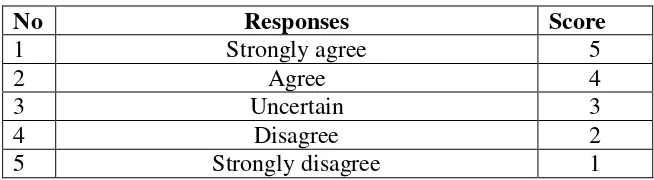
other variable are study program and gender. The Instruments used in this research were language attitude questionnaire which contains 25 items and 23 items for students learning motivation questionnaire in the form of Likert Scale which include the statement of very agree, agree, disagree and very disagree. These data were analyzed through Simple Linier
Regression using the formula Y = α + b X by the assistance of SPSS Computer Software Release 11.5
RESULT AND DISCUSSION
Related to the design and research questions that have been posed, the data processing and analysis carried out by several phases. For the attitude ‘like’ towards English the mean score was 65.80. Based on this mean, the score, which was categorized into ‘very fond’ of the English language was the score that more than (> 65.80). Meanwhile, it is categorized into ‘Dislike’ towards English is that if the score is less than (<65.80. Of the total number of subjects, there are 47 students who like English and 32 students who did not. From these results, it can be seen the number of subjects who likes English was more than the students who did not.
For motivation to learn English, the mean score was 68.38. Based on this mean, the score, it was categorized into ‘high motivation’ towards English if the score was more than 68.38. Meanwhile, it was categorized into ‘low motivation towards English if the score was less than 68.38. Of the total number of subjects, there are 42 students who are interested in learning English and 37 students have are uninterested in learning English. From these results, it can be seen that the number of subjects who have high language learning motivation more than the students who have low language learning motivation. The description of the students’ language attitude and language learning motivation can be seen in the following table of statistics.
Statistics
Language Attitude
Languagen Learning Motivation
N Valid 79 79
Missing 0 0
Mean 65.80 68.38
Median 67.00 67.00
Std. Deviation 6.568 9.905
Minimum 25 23
The table above shows the average value of the students’ language attitudes and
students' language learning motivation. The average value of students' language attitudes towards English was 65.80 80, which is less than mean value (67.00). Thus, the students' attitude towards English language is low. The average value of students' language learning motivation towards English was 68.38, which is upper than the middle value (67.00). Thus, the students' language learning motivation towards English language is also high.
The following table is the result of analyzing correlation coefficient using regression Model Summary
Model R R Square
Adjusted R Square
Std. Error of the Estimate
1 .639a .409 .401 6.539
a. Predictors: (Constant), Language attitude
From table above it can be seen that the value of R (correlation coefficient) between the language attitude variable (Y) is 0.639 at a significant level (sig) of 0.05 (5%). In other word, the correlation between language attitude and English is 63.9 %. This result shows a good correlation or relationship between Language attitude and English learning achievement. While the value of R2 (coefficient determinated) of dependent variable (English achievement) in predicting the amount of dependent variable is 0.409 or 40:9%.
The table bellow is the result of analyzing the value of constant regression equation. This output was used to test the meaningfulness of constant and independent variable coefficient with the testing criteria. If the value of p-output (Sig) < alpha (0.05), the coefficient constant can be used in regression equation. However, if the value of p-output (Sig) > alpha (0.05), the coefficient constant cannot be used in regression equation.
Coefficientsa
Model
Unstandardized Coefficients
Standardized Coefficients
T Sig.
B Std. Error Beta
1 (Constant) 89.641 2.425 36.968 .000
Language attitude 14.474 1.984 -.639 7.295 .000
a. Dependent Variable: English achievement
The table above shows the value of constant of regression equation (B) was 89.641 with the t value 36.968, the value of independent variable (language attitude constant (B) 14.474 with the t value 7.295 and the value of Sig 0.00. From these findings, it can be seen that the value of Sig was (<) less 0.05. it means that the coefficient constant can be used in regression
equation. These equations can be described that the students’ attitude towards English affects
English achievement significantly. Every increment 1 score of attitudes variable toward the English language (X) can improve English achievement 14.474 scores. In other word, the students language attitude influences English achievement.
23 language attitude variable (Y) is 0.789 at a significant level (sig) of 0.05 (5%). In other word, the correlation between language learning motivation and English achievement is 78.9 %. This result shows a good correlation between language learning motivation and English achievement. While the value of R2 (coefficient determinated) of dependent variable (English achievement) in predicting the amount of dependent variable is 0.623 or 62.3 %.
The table bellow is the result of analyzing the value of constant regression equation. This output was used to test the meaningfulness of constant and independent variable coefficient with the testing criteria. If the value of p-output (Sig) < alpha (0.05), the coefficient constant can be used in regression equation. However, if the value of p-output (Sig) > alpha (0.05), the coefficient constant cannot be used in regression equation.
Coefficientsa
The table above shows the value of constant of regression equation (B) was 93.335 with the t value 48.784. The value of independent variable (language attitude constant (B) 13.307 with the t value -11.286 and the value of Sig 0.00. From these findings, it can be seen that the value of Sig was (<) less 0.05. t means that the coefficient constant can be used in regression equation. Therefore, these equationscan be described that the students’ language
learning motivation affects English achievement significantly. Every increment 1 score of attitudes variable toward the English language (X) can improve English achievement 13.307 scores. In other word, the students language learning motivation influence English achievement.
CONCLUSION AND SUGGESTION
In this research, attitude influence on English learning achievement. With reference to the results of research (Brudner and White 1979) who revealed that the role of attitude is very important in learning a second language, because of the speakers attitude towards a language can describe how it behaves, thinks and feels about the language.
the continuation of learning a foreign language. The importance role of motivation in learning a second language can be seen as follows. First, a very high motivation can be directed learners undertake more vigorous efforts to learn a second language (Secondly, with a highly motivated, learners will find and determine learning strategies in accordance with the conditions and intake or linguistic abilities Third, with motivation, learners will undertake efforts to overcome obstacles to learn and work towards easiness which support the learning process.
Based on the research that has been done, the writer suggests that for forther study, this research can be can be done with the experiment so it will be more controlled.
REFERENCES
Anderson, Edmund A. (1974). Language attitude, belief and values: A study in linguistics cognitive framework.Disertasi. Georgetown University.
Burns, Sarah., Patrick Mathew, and Evelyn Nolan-Conroy (2001). “Language attitude”, in Cell Locus (ed). The Sociolinguistics of Sign Language Cambridge: Cambridge University Press. Page 181-215
Fasld, Ralph.(1984).The sociolinguistics of society: Oxford. Basil. Blackwell
Gardner, R.C. (1985). Social psychology and second language learning: The role of attitudes and motivation. London: Edward Arnold.
Hornby, A. S. (1995). Oxford advanced learners’ dictionary of current English. Oxford: University Press.
Saridman, AM. (1996). Interaksi dan motivasi belajar mengajar: Pedoman bagi guru dan calon guru. Jakarta: Rajawali Press.
Stephen, R. Socializing student motivation to learn (Institute for Research on Teaching Research Series no. 169. East Lansing. Michigan University Press.
Tileston, D.W. (2004). What every teacher should know about student motivation. California: Corwin
25
THE IMPORTANCE OF POSSESSING GRAMMAR SKILLS AS A BASIC FOUNDATION OF DEVELOPING ENGLISH COMPETENCE
Moehamad Ridhwan Eriza
Department of English Sriwijaya State Polytechnic-Indonesia
ABSTRACT: The current conditions which put the stress on improving communicative skills in studying a foreign language have almost shifted away the significance of mastering grammar skills. This, if not properly dealt with, will lead to the omission of studying English grammar altogether which would be such a shame. The fact that English grammar is very essential to the improvement of English proficiency would gradually shrink to the point that people no longer care to attend to it owing to the assumption that grammar is just a set of binding rules strictly made to tell people what to do with their words This negative stigma should be prevented from expanding from now on. People need to be informed that Grammar is a guide to constructing English sentences which are communicative and free from misunderstanding or confusion. People may not keep on thinking that grammar has nothing to do with developing English competence because it actually does. Linguists have said so and a research has been conducted to prove it.
Key words: Grammar Skill, omission, stigma, English Competence, significance, rule, communicative,
It is an accepted belief that English has succeeded in establishing a claim to the title as the international language. Since technology is communicated, transferred, and recorded in English, people find it compulsory to have a good command of English. This will smooth their path to mastering the technology itself eventually. Even though English is only a foreign language in this country, its effects on our livesare enormous. Quite a few Indonesian words are adopted from English and used a lot in naming things around us. In line with that, English courses and formal institutions are established, promising people that they will be able to communicate in English only within a short period of time. Facilities are provided. People want to learn English in the nicest, most comfortable, and if possible, fastest way. That is good. However, the facts are sometimes disappointing. Some people keep asking about how to be good at speaking English while ignoring the fact that English has a skeleton called grammar. These people are inclined to be rather allergic to grammar. They seem to have entertained an idea that somehow, somewhere, someday, English can be learned with almost the absolute absence of grammar. These people dream all their lives through until they finally realize that they are already too old to do just about anything to improve their English. All this is due to their unreasonably incessant fright towards having to work on one of the most important elements of English called grammar.
This paper is aimed at convincing people of the necessity to possess grammar skills in order to better gain English competence as a means of communication.
it is the possession of this grammar which makes it possible for us to produce and understand an infinite number of sentences, the vast majority of which are completely novel to us.
Everyone who speaks English, and also writes in English, must have known grammar consciously or intuitively. Without all this, one can only construct a group of scattered words enough to confuse his readers. Along with this, Crystal (1987, p.9) insists that we encounter ambiguity, imprecision, unintelligible speech or writing. To deal with these problems, we need to put grammar under the microscope and work out what went wrong.
In other words, English competence benefits from good grammar mastery. Alexander (1990, p.1) adds that there is no point in learning grammar for the sake of learning grammar. Grammar is the support system of communication and we learn it to communicate better.
Another writer named Butler (1987, p.1) also participates in supporting the idea. She states that precise grammatical usage promotes clear thinking and encourages logical and systematic transmission of ideas.
With quite a similar idea, Mackay (1987, p.263) affirms that comprehension is also affected by the grammar people use when they are talking. The order in which words appear in a sentence can make them easier or more difficult to understand.
GRAMMAR AS A WELL-PLANNED MANAGEMENT OF WORDS
English grammar comprises a lot of rules that organize the whole sentences. It is like a big company with a well-planned management that authorizes each member of its staff with certain job to do. If this share of job overlapped with one another, the company would suffer from inefficiency which might lead to bankruptcy. The same case happens to sentences. Misplacing words or using words with wrong forms will end up with confusing statements and misunderstanding.
To be more specific, English grammar tells how subject and predicate are connected together, how an adjective runs a position as a noun modifier, and how to construct a proper exclamatory or imperative statement. Above all, it changes the verb forms to indicate the time. This can be an obstacle to EFL students whose language does not demand the change of verbs to show the time. Furthermore,Kapili (1985, p. 79) says that verb forms signal not only the past or non-past but also distinct sentence meaning in relation to the nature of the activity or situation expressed in the sentence. Native speakers of English seldom have trouble differentiating among these possible meanings. But learners of English as a second language usually find these distinctions difficult.
It seems to the writer that it is not enough for the students only to know the functions of the verb forms as the time indicators. They still have to learn what kind of situation the verb forms present. The students will have to be able to apply which verb forms correspond to what they mean. This, according to Kapili (1985, p. 82), is a skill the students must master. He confirms that pinpointing the time or the time sequence of ideas and choosing the proper verb forms to express not only the time element but also the time of situation described are skills we must master. To express exactly what we mean, we must develop the ability to determine precisely the time element of the ideas, the nature of the events, and the proper verb forms.
GRAMMAR IN RELATION TO THE OTHER ENGLISH ASPECTS