
TRANSPORT USING RENEWAL REWARD THEORY
CHRISTOPHER E. MILES†, SEAN D. LAWLEY‡, AND JAMES P. KEENER§
Abstract. We propose and analyze a mathematical model of cargo transport by non-processive molecular motors. In our model, the motors change states by random discrete events (corresponding to stepping and binding/unbinding), while the cargo position follows a stochastic differential equation (SDE) that depends on the discrete states of the motors. The resulting system for the cargo position is consequently an SDE that randomly switches according to a Markov jump process governing motor dynamics. To study this system we (1) cast the cargo position in a renewal theory framework and generalize the renewal reward theorem and (2) decompose the continuous and discrete sources of stochasticity and exploit a resulting pair of disparate timescales. With these mathematical tools, we obtain explicit formulas for experimentally measurable quantities, such as cargo velocity and run length. Analyzing these formulas then yields some predictions regarding so-called non-processive clustering, the phenomenon that a single motor cannot transport cargo, but that two or more motors can. We find that having motor stepping, binding, and unbinding rates depend on the number of bound motors, due to geometric effects, is necessary and sufficient to explain recent experimental data on non-processive motors.
Key words. molecular motors, intracellular transport, reward renewal theory, stochastic hybrid systems, switching SDEs
AMS subject classifications. 92C05, 60K20, 60J28, 34F05, 60H10
1. Introduction. Active intracellular transport of cargo (such as organelles) is critical to cellular function. The primary type of active transport involves molecular motors, which alternate between epochs of active transport (discrete stepping) along a microtubule and epochs of passive diffusion when the motors are unbound from the microtubule. Stochastic modeling of this fundamental process has a rich and fruitful history (see the review [4]).
In both experimental and modeling studies,processivemotors have received con-siderable attention. Processive motors are characterized by taking hundreds of steps along a microtubule before unbinding. In contrast, non-processive motors (such as most members of the kinesin-14 family) take very few (1 to 5) steps before unbind-ing from a microtubule [5, 10]. Non-processive motors are crucial to a number of cellular processes, including directing cytoskeletal filaments [41], driving microtubule-microtubule sliding during mitosis [13], and retrograde transport along microtubules in plants [47]. Here, we focus on motor behavior during transport.
Some curious properties of non-processive motor transport were found in [15].
Onenon-processive (Ncd) motor has extremely limited transport ability, measured by both velocity and run length (distance traveled before detaching from a microtubule). However, two non-processive motors somehow act in unison to produce significant directed motion, a phenomenon termed “clustering.” This observation is supported by the subsequent studies [25,37], where similar experiments were performed
creat-∗Submitted to the editors November 15, 2017.
Funding: This work was supported by NSF grant DMS-RTG 1148230. CEM and JPK were also supported by NSF grant DMS 1515130.
†Department of Mathematics, University of Utah, Salt Lake City, UT 84112 USA
‡Department of Mathematics, University of Utah, Salt Lake City, UT 84112 USA ( [email protected]).
§Departments of Mathematics and Bioengineering, University of Utah, Salt Lake City, UT 84112
USA ([email protected]).
1
ing a mutant of attached non-processive kinesin-14 motors, and processivity emerges. Moreover, the authors of [15] note that adding more Ncd motors beyond two further increases transport ability. In contrast, one processive motor (kinesin-1) is sufficient to produce transport, and additional motors do not significantly increase transport ability [15, 44]. Other interesting facets of transport by non-processive motors in-clude the emergence of processive transport in the presence of higher microtubule concentration [16] or opposing motors [21].
In this work, we formulate and analyze a mathematical model to investigate the natural question: how do non-processive motors cooperate to transport cargo? Our model predicts that non-processive motor stepping, binding, and unbinding rates must depend on the number of bound motors, and that this dependence is a key mechanism driving the collective transport of non-processive motors. We note that such dependence has been observed in experiments [12, 19] and in simulations of detailed computational models [29,11,34,16], all stemming from geometric effects of cargo/motor configuration.
Non-processive motors are notoriously difficult to study experimentally, because they take only a few steps before detaching. For this same reason, it is not clear how to best model non-processive motors, or known if existing modeling frameworks, such as mean-field methods [26,8] or averaging the stepping dynamics into an effective ve-locity [35], are appropriate. Hence, our model explicitly includes the discrete binding, unbinding, and stepping dynamics of each motor, as well as the continuous tethered motion of the cargo.
Mathematically, our model takes the form of a randomly switching stochastic dif-ferential equation (SDE), and thus merges continuous dynamics with discrete events. The continuous SDE dynamics track the cargo position, while the discrete events cor-respond to motor binding, unbinding, and stepping. Our model is thus a stochastic hybrid system [3], which are often two-component processes, (J(t), X(t))t≥0∈ I ×Rd, whereJ is a Markov jump process on a finite setI, and X evolves continuously by
dX(t) =FJ(t)(X(t)) dt+σdW(t), (1)
where{Fj(x)}j∈I is a given finite family of vector fields,σ≥0, andW is a Brownian motion. That is,X follows an SDE whose righthand side switches according to the processJ.
However, our model differs from most previous hybrid systems in some key ways. First, the set of possible continuous dynamics (e.g. possible righthand sides of (1)) for our model is infinite. Second, the new righthand side of (1) that is chosen when J jumps depends on the value of X at that jump time, although the rates dictatingJ are taken to be independent ofX.
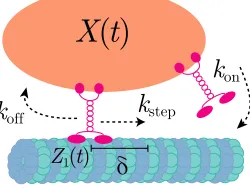
δ
k
offk
stepk
onX
(
t
)
Z
1(
t
)
Fig. 1. Schematic describing the binding, unbinding, and stepping of motors. The positions of
cargo and bound motors areX(t)andZi(t), respectively, both measured with respect to the principal
axis of the microtubule. The state of the motor can switch between bound or unbound, and while
bound, the motor can step, incrementingZi(t)by displacementδ.
The rest of the paper is organized as follows. We formulate the mathematical model in section 2. In section3, we generalize the renewal reward theorem to apply to our model. In section4, we derive explicit formulas to evaluate motor transport. In section 5, we use the model to make biological predictions. We conclude with a brief discussion and an Appendix that collects several proofs.
2. Mathematical model. We model the motion of a single cargo driven by M ≥1 motors along a single microtubule. These motors are permanently attached to the cargo, but they can bind to and unbind from the microtubule. At any time t≥0, the state of our model is specified by
X(t),Z(t),J(t)∈R×RM× {u, b}M,
where X(t)∈ R is the location of the center of the cargo, Z(t) = (Zi(t))Mi=1 ∈RM gives the locations of the centers ofM motors, andJ(t) = (Ji(t))Mi=1 specifies if each motor is unbound or bound. Spatial locations are measured along the principal axis of the microtubule, which we identify with the real line.
The cargo position evolves continuously in time, while the positions and states of motors change by discrete events, which correspond to binding to the microtubule, stepping along the microtubule, or unbinding from the microtubule. Specifically, in between these discrete motor events, X(t) follows an Ornstein-Uhlenbeck (OU) process centered at the average bound motor position,
dX(t) = k γ
X
i∈I(t)
Zi(t)−X(t)dt+
p
2kBT /γdW(t).
(2)
Here, I(t) ={i:Ji(t) =b} ⊆ {1, . . . , M} gives the indices of motors that are bound
at time t ≥0, and {W(t)}t≥0 is a standard Brownian motion. The SDE (2) stems from assuming a viscous (low Reynolds number) regime with drag coefficientγ >0, and that each bound motor exerts a Hookean force on the cargo with stiffnessk >0. The Stokes-Einstein relation specifies the diffusion coefficient kBT /γ, where kB is
Boltzmann’s constant andT is the absolute temperature.
the number of bound motors at timet≥0,
m(t) =
M
X
i=1
1{Ji(t)6=u}∈ {0,1, . . . , M},
where 1{A} denotes the indicator function on an eventA. Each unbound motor binds to the microtubule at ratekon(m(t))>0. Since unbound motors are tethered to the cargo, if an unbound motor binds at time t ≥ 0, then we assume that it binds to the track atX(t) (motors can bind anywhere along the microtubule, not only binding sites). We could allow it to bind to a random position, but if the mean binding position is X(t), then our results are unchanged. The position of each bound motor is fixed until it either steps or unbinds. Each bound motor unbinds at rate koff(m(t))> 0 and steps at ratekstep(m(t))>0. When a motor steps, we add δ >0 to its position, which is then fixed until it steps again or unbinds. This discrete motor behavior is summarized in Fig.1. We emphasize that the motor binding, unbinding, and stepping rates are allowed to depend on the number of bound motors,m(t), but are otherwise independent ofX(t).
2.1. Nondimensionalization and assumptions. We now give a dimension-less and more precise formulation of the model described above. First, we nondimen-sionalize the model by rescaling time by the ratekoff(1) and space by the inverse length δ−1. Next, we note that unbound motors do not affect the cargo position. Hence, for convenience we can takeZi(t) =X(t) if thei-th motor is unbound, meaning that we
can include unbound motors in the sum in (2) with zero contribution, and make the sum overall motors. This yields the simplified dimensionless form
dX(t) =ε−1
M
X
i=1
Zi(t)−X(t)
dt+σdW(t), (3)
where
ε:=koff(1)γ/k, σ:=
p
2kBT /(δ2koff(1)γ),
and motors bind, unbind, and step at dimensionless rates
λon(m) := kon(m) koff(1)
, λoff(m) :=koff(m) koff(1)
, λstep(m) := kstep(m) koff(1)
. (4)
We find it convenient for our analysis to track the number of steps taken by each motor before unbinding, so let us expand the state space ofJ(t) so that its components (Ji(t))Mi=1 each take values in{u,0,1,2, . . .}with transition rates
uλon(→m(t))0, j λstep→(m(t))j+ 1, jλoff→(m(t))u, j6=u. (5)
The components of J(t) are conditionally independent given m(t). At time t ≥ 0, the i-th motor is unbound if Ji(t) = u, bound if Ji(t) ≥ 0, and steps when Ji(t)
transitions fromjtoj+ 1 forj≥0. Under these assumptions,m(t) is itself a Markov process on{0,1, . . . , M} with transition rates
(6) 0M λ⇋on(0)
1 1
(M−1)λon(1) ⇋ 2λoff(2)
2⇋· · ·⇋M−2
2λon(M−2) ⇋ (M−1)λoff(M−1)
M−1λon(⇋M−1)
M λoff(M)
For simplicity, we assume that the motors are initially unbound and that the cargo and motors start at the origin,
Ji(0) =u, X(0) =Zi(0) = 0, i∈ {1, . . . , M}.
The position of thei-th motor is then
Zi(t) = X(τi(t)) +Ji(t)1{Ji(t)6=u}+X(t)1{Ji(t)=u}, i∈ {1, . . . , M},
(7)
whereτi(t) is the most recent binding time of thei-th motor,
τi(t) = sup{s < t:Ji(s) =u}, i∈ {1, . . . , M}.
We assume the Brownian motionW ={W(t)}t≥0and the jump processJ={J(t)}t≥0 are independent.
3. Cargo position as a renewal reward process. In order to analyze our model, we first show thatX(t) is a renewal reward process with partial rewards [46] and extend the classical renewal reward theorem to our case of partial rewards. This framework has an intuitive interpretation: the net displacement of cargo is determined by the displacement accrued at each epoch of being bound or unbound. However, there is a technical challenge. In the most classical setting, the reward-renewal theorem accrues rewards at the end of each epoch and boundedness of expectation of the rewards is sufficient to apply the reward-renewal theorem. In the case of partial rewards (which we have in our model), where rewards are accrued during an epoch, stronger conditions are required, which we prove are satisfied.
First, define the sequence of times in which the cargo completely detaches from the microtubule (off) and subsequently reattaches to the microtubule (on),
0 =τ0
on=τoff0 < τon1 < τoff1 < τon2 < τoff2 < . . .
by
τoffk := inf{t > τonk :m(t) = 0}, k≥1,
τonk := inf{t > τoffk−1:m(t)≥1}, k≥1. (8)
Next, define the sequence of cargo displacements when the cargo is attached to the microtubule (on) and detached from the microtubule (off),
Rk
on:=X(τoffk )−X(τonk ), Rkoff:=X(τonk )−X(τoffk−1), k≥1, (9)
and the corresponding times spent attached or detached,
Tonk :=τoffk −τonk , Toffk :=τonk −τoffk−1, k≥1. (10)
It follows directly from the strong Markov property that{(Tk
off+Tonk , Rkoff+Rkon)}k≥1 is an independent and identically distributed (iid) sequence of random variables.
In the language of renewal theory, {Toffk +Tonk}k≥1 are the interarrival times and {Rk
off+Rkon}k≥1are the corresponding rewards. LetN(t) be the renewal process that counts the number of arrivals before timet≥0,
Define the reward function,R(t), and the partial reward function,Y(t), by
In words,R(t) describes rewards accrued during past epochs, andY(t) is the partial reward accrued during the current epoch. We show below that E[|Ron+Roff|]<∞ andE[Ton+Toff]<∞, and therefore the classical renewal reward theorem [46] ensures that
The following theorem verifies that this convergence actually holds forX(t).
Theorem 1. The following limit holds,
lim
To prove this theorem, we need several lemmas. We collect the proofs of these lemmas in AppendixA. The first lemma bounds the probability that the partial reward functionY(t) in (12) is large when the cargo is detached from the microtubule.
Lemma 2. Define the sequence of iid random variables{Yk
off}k≥1 by
Similarly, the next lemma bounds the probability that the partial reward function is large when the cargo is attached to the microtubule.
Lemma 3. Define the sequence of iid random variables{Yk
on}k≥1 by
whereΓ(c˙)is the Gamma function.
Lemma 4. Define the sequence of iid random variables{Yk}k≥1 by
Yk:= sup t∈[τk−1
off ,τ
k
off]
X(t)−X(τoffk )
, k≥1.
(16)
Then
P lim
K→∞ ∞
[
k=K
Yk >
√
k = 0.
The last lemma checks that the mean ofYk in (16) is finite.
Lemma 5. Define{Yk}k≥1 as in (16). ThenE[Yk]<∞ for allk≥1.
With these lemmas in place, we are ready to prove Theorem1.
Proof of Theorem 1. It follows immediately from Lemma5thatE[|Rk
on+Rkoff|]< ∞. Furthermore,Tk
offis exponentially distributed with rateM λon(0), and the proof of Lemma3 shows thatE[Tk
on]<E[S] for an exponentially distributed random variable S with some rateλ > 0. Hence, E[Tk
on+Toffk ]<∞, and thus (13) holds by a direct application of the classical renewal reward theorem [46].
Therefore, it remains to check that
lim
t→∞
EX(t)−X(τoffN(t))
t = 0 = limt→∞
X(t)−X(τoffN(t))
t , almost surely. (17)
The first equality in (17) follows immediately from Lemma5.
To verify the second equality in (17), we note that Lemma4 ensures that
lim sup
k→∞ Yk
√
k ≤1, almost surely.
Therefore,
lim
t→∞
|X(t)−X(τoffN(t))| t ≤tlim→∞
|YN(t)| t ≤tlim→∞
p N(t)
t = 0, almost surely,
since
lim
t→∞ N(t)
t = 1 E[Ton+Toff]
, almost surely,
by the strong law of large numbers for renewal processes [46].
Consequently, the position of the cargo does indeed satisfy a classical reward-renewal structure with two different types of epochs: bound and unbound, each of which accrue some net displacement.
4. Mathematical analysis of transport ability. With the framework of re-newal theory constructed in section3, we are ready to analyze the transport ability of the model introduced in section2. To assess the transport ability of the motor cargo ensemble, we analyze the expected run length, expected run time, and asymptotic
Ron. The run time is the corresponding time spent attached to a microtubule, which was defined precisely in (10) and denoted byTon. The asymptotic velocity is
(18) V := lim
t→∞ X(t)
t .
The velocityV includes both the time the cargo is being transported along the mi-crotubule and diffusing while unattached.
Applying Theorem1, we have that
V =E[Ron] +E[Roff] E[Ton] +E[Toff]
almost surely. (19)
Now,
E[Roff] = 0, (20)
since the cargo is freely diffusing when no motors are bound, and since motor binding and unbinding is independent of Brownian motion{W(t)}t≥0. Furthermore, when all of theM motors are unbound, each motor binds at rateλon(0). Hence,
E[Toff] = (M λon(0))−1. (21)
It therefore remains to calculate two of the three quantities,V, E[Ron], and E[Ton], since the third is given by (19). We calculateE[Ton] first since it is the simplest, as it is a mean first passage time of a continuous-time Markov chain.
4.1. Expected run time. As we noted in section 2.1, the number of motors boundm(t) is itself the Markov process (6). To compute the expected run time, we compute the mean time form(t) to reach state m= 0 starting fromm(0) = 1.
LetQe ∈R(M+1)×(M+1)be the generator of the Markov chain m(t) in (6). That is, the (i, j)-entry of Qe gives the rate that m(t) jumps from state i to state j 6=i, and the diagonal entries are chosen so thatQe has zero row sums. LetQ∈RM×M be the matrix obtained from deleting the first row and column of Q. The matrixe Qis tridiagonal, with them-th row containing subdiagonal, diagonal, and superdiagonal entriesmλoff(m),−(mλoff(m) + (M−m)λon(m)), (M−m)λon(m), respectively. The expected run timeE[Ton] is (by Theorem 3.3.3 in [39]),
(22) E[Ton] =1Tt, where QTt=−e1,
where1∈RM is the vector of all 1’s ande1∈RM is the standard basis vector.
4.2. Decomposing stochasticity. Having calculated E[Ton] in (22), we can determineV by determiningE[Ron] (or vice versa). Two key steps allow us to analyze V and E[Ron]: (i) we average over the diffusive dynamics while conditioning on a realization of the jump dynamics, and (ii) we take advantage of a timescale separation between the relaxation rate of the cargo dynamics and the jump rate of the motor dynamics.
state is described by the Markov jump processJ. We first average over the diffusion by defining the conditional expectations
x(t) :=E[X(t)|J], zi(t) :=E[Zi(t)|J], t≥0, i∈ {1, . . . , M}.
(23)
We emphasize that (23) are averages over paths of W given a realization J. Thus, {x(t)}t≥0 and {{zi(t)}t≥0}Mi=1 are functions of the realization J. This definition is convenient, because whileX(t) follows the randomly switching SDE (3), the process x(t) follows a randomly switching ODE, whose solution is known explicitly.
Proposition 6. For each t >0, the expected cargo position x(t)conditioned on a realization of the jump process satisfies
d
dtx(t) =ε −1
M
X
i=1
zi(t)−x(t), almost surely.
(24)
Proof. Using the explicit solution of an OU process, we have that
X(t) =X(τ)e−θ(t−τ)+µ(1−e−θ(t−τ)) +M, (25)
whereτ is the most recent jump time ofJ,
τ= sup{0} ∪ {s < t:J(s−)6=J(s+)} , θ=m(τ)ε−1,µ= 1
m(τ)
P
i∈I(τ)Zi(τ), andMsatisfiesE[M|J] = 0. We have used the notation f(t±) := lims→t±f(s). Hence, taking the expectation of (25) conditioned onJyields
x(t) =E[X(τ)e−θ(t−τ)|J] +E[µ(1−e−θ(t−τ))|J] =e−θ(t−τ)E[X(τ)|J] + (1−e−θ(t−τ)) 1
m(τ) X
i∈I(τ)
E[Zi(τ)|J],
sinceτ are{m(s)}s≥0 measurable with respect to the σ-algebra generated byJ.
4.2.2. Separation of timescales. We next make an observation of disparate timescales. After averaging over the diffusive noiseW, the model effectively depends on two timescales: the relaxation time of the continuous dynamics (24) (characterized by the dimensionless rateε−1) and the switching times of the discrete motor dynamics (5) (characterized by the dimensionless rates λon, λstep, λoff). Even for conservative parameter estimates, the continuous timescale is much faster than the discrete switch-ing timescale. For instance, suppose a motor exerts a Hookean force with stiffness k= 0.5 pN/nm [15] on a spherical cargo with radiusr= 1µm in cytosol with viscos-ity η equal to that of water. It follows thatk/(6πηr)≈3×104 s−1, whereas k
off(1) is on the order of 10−1 to 101 s−1[15]. Hence,
ε:=koff(1)γ/k≈3<10−4≪1. (26)
Further, λon, λstep, λoff are roughly order one since kon, kstep, koff have similar orders of magnitude [15].
Hence, we approximate x(t) by a jump process x(t) obtained from assuming x(t) immediately relaxes to its equilibrium after each motor switch.
More precisely, let (x(t), z1(t), . . . , zM(t)) ∈ RM+1 be a J-measurable,
right-continuous process,
x(t) =x(t+), zi(t) =zi(t+), t≥0, i∈ {1, . . . , M},
with x(0) = x(0) and zi(0) = zi(0), i ∈ {1, . . . , M}, that evolves in the following
way. In light of (7), we define the effective motor positions by how they are modified through the jump process, binding at τi and then incrementing from stepping, or
staying unbound at the cargo positionx(t),
zi(t) = x(τi(t)) +Ji(t)1{Ji(t)=6 u}+x(t)1{Ji(t)=u}, i∈ {1, . . . , M}.
(27)
Due to the assumed fast relaxation, x(t) only changes when a motor steps or unbinds, as newly bound motors exert no force. That is, if Ji(t+) = Ji(t−) for
all i ∈ {1, . . . , M} satisfying Ji(t−) ≥ 0, then x(t−) = x(t+). Otherwise, x(t)
evolves according to the following two rules, which describe how the cargo position x(t) changes when a motor steps or unbinds.
1. If the i-th motor steps (Ji(t−) =j ≥0 and Ji(t+) =j+ 1), thenx(t+) =
x(t−) + 1/m(t).
2. If the i-th motor unbinds (Ji(t−) = j ≥0 and Ji(t+) = u), then x(t+) =
x(t−) + ∆i,(z1,...,zm(t−)), where (z1, . . . , zm(t−)) gives the positions of the
m(t−) bound motors just before timet, and
∆i,(z1,...,zm(t−))=
1 m(t−)−1
m(t−)
X
i′=1,i′6=i
zi′(t−)− 1 m(t−)
m(t−)
X
i′=1
zi′(t−). (28)
In words, if either of these events occurs, the cargo positionx(t) relaxes to the mean position of the motors. These two rules describe how the mean motor position changes in the two scenarios. If a single motor steps, incrementing its position by 1, the mean motor position increases by 1/m(t). If a motor unbinds, (28) is the change in the mean motor position from removing that motor.
It follows from these two evolution rules forx(t) that
x(t) =
M
X
m=1 1
mSm(t) +χ(t), (29)
where Sm(t) is the number of steps taken when m motors are bound before time t
(each of which modifies the position by 1/m), and χ(t) accounts for changes in the cargo position that result from a motor unbinding,
χ(t) =
NXoff(t)
k=1
∆jk,(z1(soffk −),...,zm(skoff−)(s k off−),
(30)
where 0 =s0off< s1off< . . . is the sequence of times in which a motor unbinds,
skoff:= inf
t > skoff−1:Ji(t−)≥0 andJi(t) =ufor somei∈ {1, . . . , M} k≥1,
and Noff(t) := sup{k≥0 :skoff ≤t} is the number of unbindings before timet ≥0, andjk ∈ {1, . . . , M}gives the (almost surely unique) index of the motor that unbinds
at timesk
off. That is,jk satisfiesJjk(s
k
off−)6=Jjk(s
k
off) =u.
Proposition 7. If T ≥0 is an almost surely finite stopping time with respect to
{J(t)}t≥0, then
lim
ε→0x(T) =x(T), almost surely.
From this proposition, we conclude that studying the mean behavior of the cargo positionX(t) can ultimately be reduced to studying the jump processx(t), where the jumps correspond to motor stepping and unbinding events.
4.3. Run length and velocity. Sinceε≪1 for biologically relevant parame-ters, we investigate the run length and velocity ofX(t) by investigating the analogous quantities forx(t),
R:=x(τoff1 )−x(τon1 ), V := limt →∞
x(t) t . (31)
4.3.1. Run length. The following proposition checks that the mean run length of the full processX(t) converges to the mean run length of the jump processx(t) as ε→0.
Proposition 8. E[Ron]→E[R]asε→0.
Proof. By the tower property of conditional expectation (Theorem 5.1.6 in [9]), we have that
E[Ron] =E[E[Ron|J]] =E[E[X(τoff1 )−X(τon1 )|J]] =E[x(τoff1 )−x(τon1 )]. Now, Proposition7ensures that
x(τoff1 )−x(τon1 )→R, almost surely as ε→0. (32)
LetN ≥0 be the number of steps taken between timeτ1
onand timeτoff1 . Since motors take steps of distance one, we have the almost sure bound,x(τ1
off)−x(τon1 )≤N. Steps are taken at Poisson ratem(t)λstep(m(t))≤MΛ, and thusE[N]≤ΛME[τoff1 −τon1 ]< ∞. Thus, (32) and the bounded convergence theorem complete the proof.
4.3.2. Velocity. Let us now investigateV in (31), observing that this quantity can be approached in two ways. The first exploits the observation that non-zero mean displacements only occur from motor stepping, so the velocity can be interpreted as the product of how often a step occurs withmmotors and the size of the displacement. The second approach is again a reward-renewal argument, noting that the only non-zero displacements occur during epochs of bound cargo. The connection between these two approaches provides explicit relationships between the velocity, run lengths, and run times.
Recalling the decomposition of the jump process xin (29), we seek to compute the expected value
E[x(t)] =
m
X
m=1 1
mE[Sm(t)] +E[χ(t)].
Using the definition of χ(t) in (30), we compute its expectation by summing over all possible displacements from one of m motors unbinding ∆j,(z1(t−),...,zm(sk
off−)
(t−), which yields
m
X
j=1
∆j,(z1,...,zm)=
1 m−1
m
X
j=1
−zj+
m
X
i=1 zj
−
m
X
Since each of the bound motors is equally likely to unbind, it follows thatE[χ(t)] = 0. This can be interpreted as the observation that the arithmetic mean does not change in expectation when removing a randomly (uniformly) chosen element. In other words, the effects of motors unbinding ahead of the cargo are completely offset in the mean by motors unbinding behind the cargo. Therefore, the only long-term influence onx is stepping events.
Given a realization{m(s)}s≥0, the number of steps taken withmmotors bound before timet≥0 is Poisson distributed with meanmλstep(m)R
t
Now, {m(s)}s≥0 is an ergodic Markov process, so the occupation measure converges almost surely to the stationary measure (see Theorem 3.8.1 in [39])
1 We note that pm is the (m+ 1)-st component of the unique probability vector,p∈
R1×(M+1) satisfying (see Theorem 3.5.2 in [39])
pQe= 0, (33)
where Qe ∈ R(M+1)×(M+1) is the generator matrix defined in section 4.1. Since the occupation measure is bounded above by one, the bounded convergence theorem gives
lim
It is easy to see that the classical renewal reward theorem applies tox(t) so that
M
10−1 100 101 102
Fig. 2.Expected run lengthsE[R]and asymptotic velocitiesV as a function of the parameters
kon, koff, kstep forM = 1,2,3 total motors. The curves are the analytical formulas (34)-(35) for
theε→0 limit, and the dots are estimates from statistically exact realizations of the full process,
{(X(s),Z(s),J(s))}t formulas forE[R] andV with estimates ofE[Ron] andV from simulations of the full process (X(t),Z(t),J(t)) (for details on our statistically exact simulation method, see section4.5).
Furthermore, some experimental works [15,25] measure the average run velocity, E[R/Ton]. Now, ifσ(m) denotes theσ-algebra generated by{m(t)}t≥0, then recalling (8) and (10) and using the tower property of conditional expectation yields
Eh R
Hence, it follows from (34) that
V:=E[R/Ton] =V /pon, (36)
wherepon=PMm=1pm is the stationary probability thatm(t)≥1.
4.4. Cases M = 1, M = 2, and M = 3. In this subsection, we collect explicit formulas for the run lengthE[R] and run velocityV when the total number of motors is M = 1,2,3. The run time E[Ton] and net velocity V can be easily deduced from these quantities using (34)-(35) but are omitted for brevity.
ForM = 1 total motors, the quantities are simply
ForM = 2 total motors, we find
E[R] =λstep(1) +
λon(1)λstep(2) 2λoff(2)
, V= 2λoff(2)λstep(1) +λon(1)λstep(2) 2λoff(2) +λon(1)
. (38)
ForM = 3 total motors, we find
E[R] =λstep(1) +
λon(1)(3λoff(3)λstep(2) +λon(2)λstep(3)) 3λoff(2)λoff(3)
,
V =3λoff(3) [λoff(2)λstep(1) +λon(1)λstep(2)] +λon(1)λon(2)λstep(3) 3λoff(3) [λoff(2) +λon(1)] +λon(1)λon(2) . (39)
To put these quantities in dimensional units, recall the jump rates (4) and multiply E[R] by the dimensional step distanceδ >0 and multiply V byδkoff(1)>0.
4.5. Numerical simulations. To verify our predictions for the expected run lengths and velocities, we compare to statistically exact numerical simulations of the full process (X(t),Z(t),J(t)). In a given state, we use the classical Gillespie stochastic simulation algorithm to generate the time of the next transition for the Markov chain
J(t) and to choose which transition occurs. For m(t) ≥ 1, X(t) is an OU process, generically described by
dX(t) =α[µ−X(t)] dt+βdW(t).
To updateX(t) to the next timet+τ, we use the statistically exact method described in [17], summarized by
X(t+τ) =e−ατX(t) + (1−e−ατ)µ+β r
(1−e−2ατ)
2α n
where n is a standard normal random variable. When m(t) = 0, X(t) is a pure diffusion process with α = 0, so (4.5) becomes an Euler-Maruyama update. This procedure generates statistically exact sample paths ofX(t), sampled at the transition times ofJ(t). We use this scheme to generate a long realization of (X(t),Z(t),J(t)), thereby providing Monte Carlo estimates forE[Ron] andV for a given parameter set.
5. Biological application. We now use the formulas (37)-(39) for run velocity, V, and run length, E[R], to explore the behavior of non-processive motors. The behavior of individual non-processive motors is characterized by two observations: i) short attachment times, ii) the time it takes to hydrolyze ATP (and consequently, to step) coincides with this attachment time [5, 14,38]. Concretely, Ncd motors in the kinesin-14 family take 1 to 5 steps before unbinding [1, 10]. In our model, λstep(1) gives the expected number of steps before unbinding, so we characterize non-processive motors as those withλstep(1)∈[1,5].
Using this characterization, we explore the observation made in [15, 25,47] that non-processive motors in the kinesin-14 family cooperate to produce long-range trans-port. This behavior is reported in [15, 25] in terms of a velocity that is analogous to the run velocity V in our model. Specifically, the primary manifestation of coop-erativity is thatV increases substantially when the total number of motors increases fromM = 1 toM = 2. ForM ≥2, the velocity remains relatively constant.
follows immediately from (34) and (36) thatV is independent ofM. In particular, if the dimensional step rate iskstep(m)≡k0for allm∈ {1, . . . , M}, then in dimensional units,V is simplyδk0, regardless of any other parameter values.
Therefore, our model predicts that the stepping rate must depend on the number of bound motors in order to produce the cooperative behavior seen in run velocities in [15, 25]. This prediction is bolstered by the simulation results of [15]. There, the authors constructed a detailed computational model of motor transport, and they had to improve motor stepping ability when two or more motors are bound in order for simulations of their computational model to match experimental run velocities.
The authors of [15] also describe motor cooperativity in terms of the average distance traveled by a cargo before all of its motors detach from a microtubule, which is analogous to E[R] in our model. Namely, they find that the run length E[R] dramatically increases whenM increases from 1 to 2. Our model can replicate this cooperativity if and only if we allow the binding rate,kon, and/or the unbinding rate, koff, to depend on the number of bound motors,m.
To illustrate, we find the parameter values needed for our model to match the measurements from [15]. However, we emphasize the qualitative results rather than the precise quantitative values of our parameters. Indeed, there are issues preventing an exact comparison of our model with the data in [15]. For example, as the au-thors point out, the length of the microtubules sometimes caused run lengths to be significantly altered (see Figures 1 and S6 in [15]). Furthermore, for a single motor (M = 1), the authors report average run lengths of approximately 300 [nm], and they note that this value is necessarily an overestimate since they were unable to measure very short runs. Furthermore, this value must also be an overestimate since a single non-processive motor takes only a few steps per run (by definition of non-processive), and each step is approximately 7 [nm] [10].
We thus assume that λstep(1) = 4, based on [1, 10] and δ = 7 [nm]. This gives
E[R] = 28 [nm] forM = 1, which we use instead of the reported value in [15]. We then match the respective approximate run lengths of 1300 [nm] and 3300 [nm] for M = 1,2 and the respective approximate run velocities of 100, 150, and 150 [nm/s] for M = 1,2,3 reported in [15]. Using the formulas in (37)-(39), this uniquely determines the stepping rates, kstep(1) ≈ 14 [s−1] and kstep(2) ≈ kstep(3) ≈ 21 [s−1], and the unbinding ratekoff(1)≈3.5 [s−1], which are all within the range of previously reported rates. The other binding/unbinding rates are not uniquely specified, but rather must satisfy the relations koff(2) ≈0.02kon(1) andkoff(3)≈1.1kon(2). Hence, ifkoff were constant inm, thenkon(1)≈200 [s−1] andkon(2)≈3 [s−1].
We make two observations about this result: i) the binding ratekon(1) is an order of magnitude larger than reported values [1,15] and ii) the binding rate decreases as the number of bound motors increases from 1 to 2. Both of these points can be explained by geometry. First, the value of kon(1) is enhanced because the single bound motor tethers the unbound motors close to the microtubule, and thus allows those motors to bind more easily. This binding enhancement due to geometry has precedent in motor studies. Indeed, in a different family of kinesins, it was shown to be critical for determining run lengths [12]. Further, it was shown to play a critical role in enabling dynein processivity [19], and it was posited as an explanation for why myosin motors can become processive when processive kinesin motors are present [21]. The authors in [2] report largekonvalues in a model of microtubule sliding driven by kinesin-14 motors and also speculate that this is due to tethering effects.
near the microtubule. Such rebinding was the mechanism posited in [16] to explain the processive behavior of non-processive motors along microtubule bundles. Further, rebinding is very important in enzymatic reactions [45,18,32,33]. In that context, one incorporates rebinding by using an “effective” unbinding rate, which is the intrinsic unbinding rate multiplied by the probability that the particle does not rapidly rebind [31]. Hence, this effect could be included in our model by reducingkoff(2) rather than (or in addition to) increasingkon(1). Importantly, this is exactly what is implied by the relation,koff(2)≈0.02kon(1), derived above.
Second, geometric exclusion effects can explain a decrease in binding rates as the number of bound motors increases from 1 to 2. When more motors are bound, it is more difficult for additional motors to bind because the range of diffusive search is reduced for unbound motors. In numerical investigations of motor transport systems, this exact effect is observed [29, 34]. Furthermore this decrease in binding rate can arise due to motors competing for binding sites, a point posited in [28]. Interestingly, these authors find that negative cooperativity has little impact on transport velocity. The same is true in our model, as the value of V changes by less than 1 [nm/s] as kon(2) ranges from 0 to∞while keeping the other parameters fixed. However, we note that the run length for M = 3 is greatly affected bykon(2), and thus this highlights the importance of using both run velocity and run length to study motor transport.
6. Discussion. In this work, we formulated and analyzed a mathematical model of transport by non-processive molecular motors. We deliberately made our model simple enough to enable us to extract explicit formulas for experimentally relevant quantities, yet maintain agreement with detailed computational studies. One such simplification is to assume the motor stepping and unbinding rates are independent of force. The justification for this assumption is that since non-processive motors take only a few steps before unbinding (compared to hundreds of steps by processive motors), these motors are unlikely to be stretched long distances and therefore are unlikely to generate large forces. This assumption on the stepping rate has been made in other models involving non-processive motors [38] and did not appear to be a necessary feature in that context. Furthermore, how force affects stepping is not completely clear [40].
These limitations notwithstanding, our model makes some concrete predictions about motor number-dependent stepping, binding, and unbinding behavior and how these quantities contribute to transport by non-processive motors. Specifically, we observe that a complex cooperativity mechanism appears to be a necessary ingre-dient for non-processive motor transport, and these predictions align with several recent experimental and computational works. Furthermore, these predictions can be investigated experimentally. Indeed, we hope that the work here will spur further in-vestigation into how geometry affects non-processive motor transport, especially given that kinesin-14 motors are known to transport a wide variety of cargo, including long, cylindrical microtubules [20,13] and large, spherical vesicles in plants [47].
Appendix A. Proofs of Lemmas 2-5. Proof of Lemma 2. Between time τoffk−1 and τk
on, the cargo is freely diffusing. Therefore, to control Yk
(Theorem 3.8(i) in [27]) and symmetry of Brownian motion that
Note that (40) is an average over realizations of the diffusionW for fixed realizations of the timeTk
off. That is, the inequality holds for almost all realizations of Toffk. Now,Tk
off is exponentially distributed with rateM λon(0). Hence, the tower prop-erty of conditional expectation (see Theorem 5.1.6 in [9]) yields
P(Yoffk ≥C) =E[P(Yoffk ≥C|Toffk )]≤2M λon(0)
where K1(x) denotes the modified Bessel function of the second kind. Hence, the proof is complete after combining (41) and (42) and the following bound,
K1(x)≤
p
π/x(1 + 1/(2x))e−x, x >0, which was proven in [48].
Proof of Lemma 3. To controlYk
on, we note that each bound motor takes steps of unit length at a Poisson rate that is bounded above by Λ := maxm∈{1,...,M}λstep(m). Since the number of bound motors is bounded above byM, and since the cargo is an OU process centered at the average bound motor position, it follows that
P(Yonk ≥C|Tonk)≤P
We thus need to control the distribution of Tk
on. Now, Tonk is the first passage time of the Markov chain (6) to statem= 0 starting from statem= 1. This Markov chain is a finite state space birth-death process, and thus there exists [6] a unique quasi-stationary distributionν ∈RM, which is a probability measure on {1, . . . , M} so that ifP(m(0) =m) =νmform∈ {1, . . . , M}, then
P m(t) =mm(s)6= 0 for alls∈[0, t]=νm, m∈ {1, . . . , M}.
Furthermore, it is known that the first passage time ofm(t) to state 0 is exponentially distributed with some rateλ >0 if P(m(0) =m) =νmform∈ {1, . . . , M}[36]. IfS
is this first passage time, then
sinceS is the first passage time assumingm(0)≥1 andTonis this first passage time assumingm(0) = 1. Thus, since both terms in the upper bound in (43) are increasing functions of the realizationTk
on>0, the tower property yields
P(Yonk ≥C) =E
Next, ifP is Poisson distributed with meanµ, then Corollary 6 from [42] yields
P(P ≥C)≤eC−µµ
C C
, ifC≥µ.
Hence, we have the following almost sure inequality,
P(P(S)≥C/2|S)≤eC2−MΛS
SinceS∼Exponential(λ), we have that
EheC2−MΛS
where Γ(·) denotes the Gamma function. Further,
P(C/2< MΛS) =e−λC/(2MΛ).
Hence, using the upper bounds established in Lemmas2 and3, we have
∞
To check the convergence of the last series in (49), we recall Stirling’s formula,
lim
z→∞
Γ(z+ 1) √
2πz zez = 1,
and thus the limit comparison test implies that the last series converges if and only if
∞
X
k=1 k1/4
MΛ MΛ +λ
√k
4
<∞. (50)
The integral test confirms that (50) holds. Therefore, (49) converges, and thus the Borel-Cantelli lemma (Theorem 2.3.1 in [9]) completes the proof.
Proof of Lemma 5. SinceYk≥0 almost surely, we have thatE[Yk] =R0∞P(Yk >
C) dC. Using the bounds in Lemmas2and3 as in the proof of Lemma4shows that this integral is finite.
Appendix B. Proof of Proposition 7.
Proof. Fix a realizationJ. LetK ≥0 denote the almost surely finite number of jump times of Jbefore time T, wheret is said to be a jump time if J(t+)6=J(t−). Denote theseKjump times by 0< τ1<· · ·< τK < T and letτ0= 0 and τK+1=T.
For ease of notation, define the sequences
xk:=x(τk), xk:=x(τk), zik:=zi(τk), zik:=zi(τk), mk:=m(τk),
for k∈ {0,1, . . . , K}. Further, define the time between jumps, sk :=τk−τk−1, for k∈ {1, . . . , K}. It follows immediately from Proposition6that
xk+1=xke−sk+1/ε+µk+1(1−e−sk+1/ε), k∈ {0,1, . . . , K}, (51)
where fork∈ {0,1, . . . , K+ 1} we define
µk+1:=
( 1
mk P
i∈I(τk)z
i
k ifmk >0,
xk ifmk = 0.
(52)
Furthermore, it follows from the definition ofx(t) that fork∈ {0,1, . . . , K},
xk+1:=
( 1
mk P
i∈I(τk)z
i
k ifmk >0,
xk ifmk = 0.
(53)
Now, since motors take steps of size one, it follows that if k ∈ {0, . . . , K} and i∈ {1, . . . , M}, then 0≤zi
k ≤K+ 1 and 0≤xk ≤K+ 1. Hence, ifk∈ {0, . . . , K},
then (52) implies
|xk−µk+1|< K+ 1. (54)
Next, we claim that ifk∈ {0, . . . , K}and
max
j∈{0,...,k}
n
|xj−xj|, max i∈{1,...,M}|z
i j−zij|
o < η, (55)
then
maxn|xk+1−xk+1|, max
i∈{1,...,M}|z
i
k+1−zik+1|
o
<(K+ 1)e−sk+1/ε+η.
To see this, we use (51) and (54) to obtain
|xk+1−xk+1|=|xke−sk+1/ε+µk+1(1−e−sk+1/ε)−xk+1| ≤(K+ 1)e−sk+1/ε+|µ
k+1−xk+1|.
Using (52) and (53), we have that
|µk+1−xk+1| ≤
( 1
mk P
i∈I(τk)|z
i
k−zik| ifmk>0,
|xk−xk| ifmk= 0.
Furthermore, it follows from (7) and (27) that |zi
k+1−zik+1| ≤ max
j∈{0,...,K+1}|xj−xj|, i∈ {1, . . . , M}. Hence, the claim (56) is verified.
Define the largest time between jumps, s:= maxk∈{1,...,K}sk. Sincex0 =x0 = zi
0=zi0 fori∈ {1, . . . , M}, we apply (55) and (56) iteratively to obtain |xK+1−xK+1| ≤(K+ 1)2e−s/ε.
Takingε→0 completes the proof.
REFERENCES
[1] R. D. Astumian and I. Der´enyi,A chemically reversible Brownian motor: application to
kinesin and Ncd., Biophys. J., 77 (1999), pp. 993–1002.
[2] M. Braun, Z. Lansky, A. Szuba, F. W. Schwarz, A. Mitra, M. Gao, A. L¨udecke, P. R. ten Wolde, and S. Diez, Changes in microtubule overlap length regulate
kinesin-14-driven microtubule sliding, Nat. Chem. Biol., (2017).
[3] P. C. Bressloff, Stochastic Processes in Cell Biology, vol. 41 of Interdisciplinary Applied Mathematics, Springer International Publishing, 2014.
[4] P. C. Bressloff and J. M. Newby,Stochastic models of intracellular transport, Rev. Mod. Phys., 85 (2013), pp. 135–196.
[5] R. B. Case, D. W. Pierce, N. Hom-Booher, C. L. Hart, and R. D. Vale,The directional preference of kinesin motors is specified by an element outside of the motor catalytic
domain, Cell, 90 (1997), pp. 959–966.
[6] J. A. Cavender,Quasi-stationary distributions of birth-and-death processes, Advances in Ap-plied Probability, 10 (1978), pp. 570–586.
[7] M. H. A. Davis,Piecewise-deterministic markov processes: A general class of non-diffusion
stochastic models, J R Stat Soc Series B Stat Methodol., (1984), pp. 353–388.
[8] T. Duke, Cooperativity of myosin molecules through strain-dependent chemistry., Philos. Trans. R. Soc. Lond. B. Biol. Sci., 355 (2000), pp. 529–38.
[9] R. Durrett,Probability: theory and examples, Cambridge university press, 2010.
[10] S. A. Endow and H. Higuchi,A mutant of the motor protein kinesin that moves in both
directions on microtubules., Nature, 406 (2000), pp. 913–6.
[11] R. P. Erickson, Z. Jia, S. P. Gross, and C. C. Yu,How molecular motors are arranged on
a cargo is important for vesicular transport, PLoS Comput. Biol., 7 (2011).
[12] Q. Feng, K. J. Mickolajczyk, G.-Y. Chen, and W. O. Hancock, Motor reattachment
kinetics play a dominant role in multimotor-driven cargo transport, bioRxiv, (2017), pp. 1–
12.
[13] G. Fink, L. Hajdo, K. J. Skowronek, C. Reuther, A. A. Kasprzak, and S. Diez,The
mitotic kinesin-14 Ncd drives directional microtubule-microtubule sliding., Nat. Cell Biol.,
11 (2009), pp. 717–23.
[14] K. A. Foster, A. T. Mackey, and S. P. Gilbert,A Mechanistic Model for Ncd Directionality, J. Biol. Chem., 276 (2001), pp. 19259–19266.
[15] K. Furuta, A. Furuta, Y. Y. Toyoshima, M. Amino, K. Oiwa, and H. Kojima,Measuring
collective transport by defined numbers of processive and nonprocessive kinesin motors,
[16] K. Furuta and Y. Y. Toyoshima,Minus-End-Directed Motor Ncd Exhibits Processive
Move-ment that Is Enhanced by Microtubule Bundling In Vitro, Curr. Biol., 18 (2008), pp. 152–
157.
[17] D. T. Gillespie,Exact numerical simulation of the Ornstein-Uhlenbeck process and its integral, Phys. Rev. E, 54 (1996), pp. 2084–2091.
[18] I. V. Gopich and A. Szabo,Diffusion modifies the connectivity of kinetic schemes for multisite
binding and catalysis, Proc. Natl. Acad. Sci. USA, 110 (2013), pp. 19784–19789.
[19] D. A. Grotjahn, S. Chowdhury, Y. Xu, R. J. McKenney, T. A. Schroer, and G. C. Lander,Cryo-electron tomography reveals that dynactin recruits a team of dyneins for
processive motility, bioRxiv, (2017), pp. 1–35.
[20] M. A. Hallen, Z.-Y. Liang, and S. A. Endow, Ncd motor binding and transport in the
spindle., J. Cell Sci., 121 (2008), pp. 3834–41.
[21] A. R. Hodges, C. S. Bookwalter, E. B. Krementsova, and K. M. Trybus,A Nonpro-cessive Class V Myosin Drives Cargo ProNonpro-cessively When a Kinesin- Related Protein Is a
Passenger, Curr. Biol., 19 (2009), pp. 2121–2125.
[22] J. Hughes, W. O. Hancock, and J. Fricks, A matrix computational approach to kinesin
neck linker extension, J. Theor. Biol., 269 (2011), pp. 181–194.
[23] ,Kinesins with Extended Neck Linkers: A Chemomechanical Model for Variable-Length
Stepping, Bull. Math. Biol., 74 (2012), pp. 1066–1097.
[24] J. Hughes, S. Shastry, W. O. Hancock, and J. Fricks,Estimating Velocity for
Proces-sive Motor Proteins with Random Detachment, J. Agric. Biol. Environ. Stat., 18 (2013),
pp. 204–217.
[25] E. Jonsson, M. Yamada, R. D. Vale, and G. Goshima,Clustering of a kinesin-14 motor
enables processive retrograde microtubule-based transport in plants, Nat. Plants, 1 (2015),
p. 15087.
[26] F. J¨ulicher and J. Prost, Cooperative molecular motors, Phys. Rev. Lett., 75 (1995), pp. 2618–2621.
[27] I. Karatzas and S. Shreve, Brownian motion and stochastic calculus, vol. 113, Springer Science & Business Media, 2012.
[28] S. Klumpp and R. Lipowsky,Cooperative cargo transport by several molecular motors, Proc. Natl. Acad. Sci., 102 (2005), pp. 17284–17289.
[29] C. B. Korn, S. Klumpp, R. Lipowsky, and U. S. Schwarz,Stochastic simulations of cargo
transport by processive molecular motors, J. Chem. Phys., 131 (2009).
[30] A. Krishnan and B. I. Epureanu,Renewal-Reward Process Formulation of Motor Protein
Dynamics, Bull. Math. Biol., 73 (2011), pp. 2452–2482.
[31] D. A. Lauffenburger and J. Linderman, Receptors: models for binding, trafficking, and
signaling, Oxford University Press, 1993.
[32] S. D. Lawley and J. P. Keener,Including Rebinding Reactions in Well-Mixed Models of
Distributive Biochemical Reactions, Biophys. J., 111 (2016), pp. 2317–2326.
[33] ,Rebinding in biochemical reactions on membranes, Phys. Biol., (2017).
[34] A. T. Lombardo, S. R. Nelson, M. Y. Ali, G. G. Kennedy, K. M. Trybus, S. Walcott, and D. M. Warshaw,Myosin Va molecular motors manoeuvre liposome cargo through
suspended actin filament intersections in vitro., Nat. Commun., 8 (2017), p. 15692.
[35] S. A. McKinley, A. Athreya, J. Fricks, and P. R. Kramer, Asymptotic analysis of
microtubule-based transport by multiple identical molecular motors, J. Theor. Biol., 305
(2012), pp. 54–69.
[36] S. M´el´eard, D. Villemonais, et al.,Quasi-stationary distributions and population processes, Probability Surveys, 9 (2012), pp. 340–410.
[37] C. Mieck, M. I. Molodtsov, K. Drzewicka, B. van der Vaart, G. Litos, G. Schmauss, A. Vaziri, and S. Westermann,Non-catalytic motor domains enable processive
move-ment and functional diversification of the kinesin-14 Kar3, Elife, 4 (2015), pp. 1–23.
[38] B. Nitzsche, E. Dudek, L. Hajdo, A. A. Kasprzak, A. Vilfan, and S. Diez,Working stroke
of the kinesin-14, ncd, comprises two substeps of different direction, Proc. Natl. Acad. Sci.,
113 (2016), pp. E6582–E6589.
[39] J. Norris, Markov Chains, Statistical & Probabilistic Mathematics, Cambridge University Press, 1998.
[40] E. Pechatnikova and E. W. Taylor,Kinetics processivity and the direction of motion of Ncd., Biophys. J., 77 (1999), pp. 1003–1016.
[41] P. M. Shaklee, T. Idema, G. Koster, C. Storm, T. Schmidt, and M. Dogterom,
Bidirec-tional membrane tube dynamics driven by nonprocessive motors, Proc. Natl. Acad. Sci.,
105 (2008), pp. 7993–7997.
quan-tile functions, ISRN Probability and Statistics, 2013 (2013).
[43] B. Shtylla and J. P. Keener,Mathematical modeling of bacterial track-altering motors :
Track cleaving through burnt-bridge ratchets, Phys. Rev. E, 91 (2015), p. 042711.
[44] G. T. Shubeita, S. L. Tran, J. Xu, M. Vershinin, S. Cermelli, S. L. Cotton, M. A. Welte, and S. P. Gross,Consequences of Motor Copy Number on the Intracellular Transport of
Kinesin-1-Driven Lipid Droplets, Cell, 135 (2008), pp. 1098–1107.
[45] K. Takahashi, S. Tanase-Nicola, and P. Rein Ten Wolde,Spatio-temporal correlations
can drastically change the response of a MAPK pathway, Proc. Natl. Acad. Sci. USA, 107
(2010), pp. 2473–2478.
[46] M. Vlasiou,Regenerative processes, Wiley Encyclopedia of Operations Research and Manage-ment Science, (2011).
[47] M. Yamada, Y. Tanaka-Takiguchi, M. Hayashi, M. Nishina, and G. Goshima,Multiple
kinesin-14 family members drive microtubule minus end-directed transport in plant cells,
J. Cell Biol., 216 (2017), pp. 1705–1714.
![Fig. 2.({themk11(on. Further,X ε). Unless noted otherwise,, k( Expected run lengths E[R] and asymptotic velocities V as a function of the parametersoff, kstep for M = 1, 2, 3 total motors](https://thumb-ap.123doks.com/thumbv2/123dok/2113754.1609136/13.612.72.444.81.280/unless-expected-lengths-asymptotic-velocities-function-parameterso-motors.webp)
