Chapter 4. Chemical Structure
and Polymer Properties
Chemical Structure
Morphology
Intermolecular and
Intramolecular forces
Amorphous
Crystalline
(Semicrystalline)
Chemical composition
Stereochemistry
Structure
Arrangement
Physical form
4.2. Fabrication Methods
Molding, extrusion, casting: Three basic techniques A) Compression molding (Fig 4.1)
1) Thermosetting polymers
2) In situ crosslinking in the mold cavity
3) Partially cured (B-stage) Fully cured (C-stage)
Flow under pressure
∆
FRP (Fiber-Reinforced Plastic)
Polymeric binder + Reinforcing material (glass fiber)
4) Preform = Prepreg
+
Fig 4.1
Compression molding
Heating
and
B) Injection molding (Fig 4.2) 1) Thermoplastics
2) Screw is used to feed the polymer to the mold
3) Injection molding is faster than compression molding
C) Reaction injection molding (RIM) (Fig 4.3) 1) Themosetting polymers
2) Monomer or low-M.-W. polymeric precursor are mixed and injected into the mold
3) Reaction rates must be synchronized with the molding process 4) Advantages : Polymerization prior to molding eliminated.
Energy requirements for handling of the monomers are much lower than those for viscous polymers.
Fig 4.2
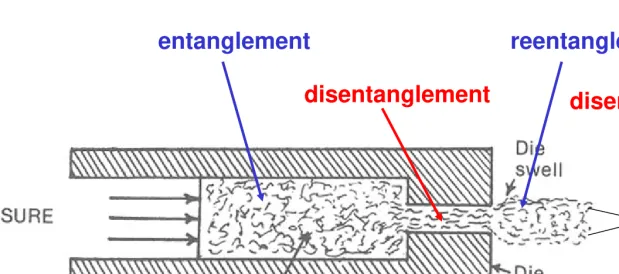
Fig 3.2 Polymer flow through a die orifice
elastic
entanglement reentanglement
Fig 4.3
Reaction injection molding
(
RIM
E) Blow molding (Fig 4.4) Manufacturing bottles
Polymer tubing (parison) is blown by compressed air or drawn by vacuum into the shape of the mold.
F) Casting
Pouring molten polymer into a mold and allowing the product to cool
G) Extrusion
Forcing compacted, molted polymer through a die shaped to give the desired object
Fig 4.4
H) Polymer Films
By casting from solution
By extrusion through a slit die or through a ring-shaped die
By passing polymer under high pressure between hot rollers (calendering)
I) Fibers by spinning
Polymer is forced under pressure through a perforated plate
(spinneret) (Fig 4.5)
Melt spinning: polymer melt
Dry spinning: polymer solution
The solvent is removed by evaporation with heat
Wet spinning : polymer solution The melt is cooled by cold air
Four-roll calender
Wad of plastic
Blown film molding process
Polymer melt extruded through an annular slit die
Forms tubular shaped bubble
Air at the center of die used for inflation of bubble and for cooling
Fig 4.5 Fibers by spinning
Polymer is forced under
J) Polymeric foams : by incorporation a blowing agent into the polymer Physical blowing agents :
Gases (air, nitrogen, carbon dioxide) dissolved in the molted polymer under pressure
Low-boiling liquids (pentane) that vaporize on heating or under reduced pressure.
Chlorofluorocarbon, once the blowing agents of choice, were discontinued after being linked to stratospheric ozone depletion
Chemical blowing agents :
4.3. Mechanical Properties
Fig 4.6. Dependence of properties on M.W.
η ∝ M 3.4
MW > 105 PE Level off:
MW = 20,000 – 50,000 polyamide
Tensile strength : Resistance to stretching
Compressive strength : Resistance to compression
Resistance to bending (flexing) Flexural strength :
Impact strength : Resistance to sudden stress, like a hammer blow
Resistance to repeated applications of tensile, flexural, or compressive stress
Tensile stress ( σ )
A
F
=
σ
F = force applied
A = cross-sectional area where
lo ∆l
A F
Tensile strain ( ε )
where
lo = original length
∆l = change in sample length
o
l
l
∆
=
ε
Tensile modulus (E) : resistance to tensile stress
Hooke's
L
aw
ε
=
σ
E
E
=
Elastic Properties of Materials
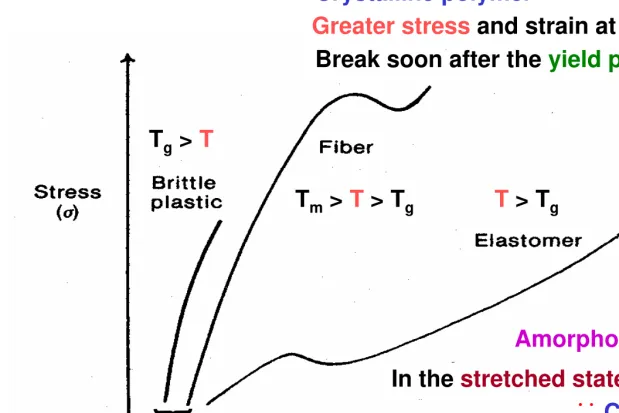
Fig 4.7. Tensile stress-strain behavior
High E Low E Tg > T
T > Tg Tm > T > Tg
Crystalline polymer
Greater stress and strain at break Break soon after the yield point
Amorphous polymer
In the stretched state, E ↑ sharply
Elastic
and
Plastic
Deformation
REAL MATERIALS
Some brittle* materials,
like ceramics, at first glance appear to be almost ideal in their behavior.
But, these materials are
usually nowhere near as strong as they should be.
Even more drastic deviations from ideal behavior are observed in
Stress/Strain of Polymers
For glassy and semi-crystalline polymers we see this type of brittle and ductile behavior.
For elastomers, however, elastic but non-linear behavior is often observed up to strains of 500%!
Furthermore, even in the initial apparently Hookean regions of the stress/strain behavior of polymers an elastic (time dependent)
Stiffness
Material E (lbs/sq. inch) E (MPa)
Rubber 0.001 x 10⁶ 7
Polyethylene 0.2 x 10⁶ 150
Wood 2.0 x 10⁶ 14,000
Concrete 2.5 x 10⁶ 17,000
Glass 10.0 x 10⁶ 70,000
Steel 30.0 x 10⁶ 210,000
Diamond 170.0 x 10⁶ 1,200,000
Stiffness of Polymers
Polymer E (MPa)
Rubber 7
Polyethylene
High Density 830
Low Density 170
Poly(styrene) 3100 Poly(methyl methacrylate) 4650
(Plexiglas)
Phenolic Resins 6900
(Bakelite) FACTORS:
• Crystallinity
• Cross-Linking
Tensile Strength
Material TS (psi) TS (MPa)
Steel piano wire 450,000 3,000
High - tensile steel 225,000 1,500
Aluminium alloys 20,000 - 80,000 140 - 550
Titanium alloys 100,000 - 200,000 700 - 1,400
Wood (spruce),along grain 15,000 100
Wood (spruce),across grain 500 7
Ordinary glass 5,000 - 25,000 30 - 170
Ordinary brick 800 5
Ordinary cement 600 4
Nylon fiber 140,000 950
Brittle vs
Ductile Materials
Strength and Toughness
• In window glass the molecular
structure is perturbed to a relatively shallow depth during fracture and
W is about 6G.
• Under any significant load the critical crack length is very short. The tensile strength of glass might be appreciable under a static load, but under stress the glass is in a fragile state, the critical
crack length is small and slight perturbations can lead to crack propagation and failure.
Strength and Toughness
• Mild steel and other ductile metals
have an enormous work of fracture;
W is of the order of 104 - 106 G and the critical crack length is very long.
• The structure of these materials is perturbed to a significant depth
below the fracture surface, hence the high work of fracture.
• The stress strain plots of such a
material display a yield point, where a
Yielding in Flexible Semi-Crystalline Polymers
Flexible semi-crystalline polymers such as
polyethylene
(where the Tg of the
amorphous domains is
below room temperature) usually display a
considerable amount of
yielding or “cold-drawing”, as long as they are
Rubber Elasticity
Rubbers also have strong stiff (covalent) bonds, but they are capable of stretching more than
500% elastically.
Instead of just minor deviations from Hooke’s law we see
behavior that is markedly nonlinear.
The bonds in these materials cannot be stretching this much, so what’s going on.
Molecular Analogies of Viscoelasticity in Plastic Materials
A) Elasticity B) Viscous flow C) Chain uncoiling
Spring T < Tg
Low ε
Deformation of bond angle and bond length
Dashpot
T > Tg T
≈
TgHigh ε
Irreversible Sliding motion
Energy of deformation
is dissipated as heat Bond rotationsegmental motionand Contributes to creep
and stress relaxation Reversible (delayed)
Spring and dashpot
Low E High E
Fig 4.8. General Tensile Stress-Strain Curve for a Typical Thermoplastic
reversible irreversible
Initial E: high Molecules one anotheruntangle and flow over
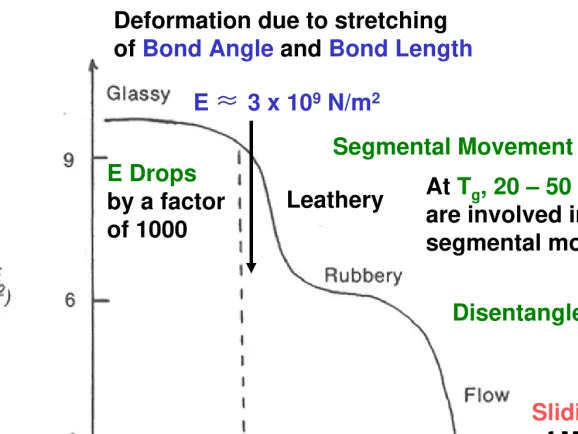
Fig 4.9. Effect of T on E of an Amorphous Thermoplastic
E Drops by a factor of 1000
E
≈
3 x 10⁹ N/m2Deformation due to stretching of Bond Angle and Bond Length
Leathery
Segmental Movement
Sliding Motions of Molecules
At Tg, 20 – 50 Chain Atoms are involved in the
segmental movement.
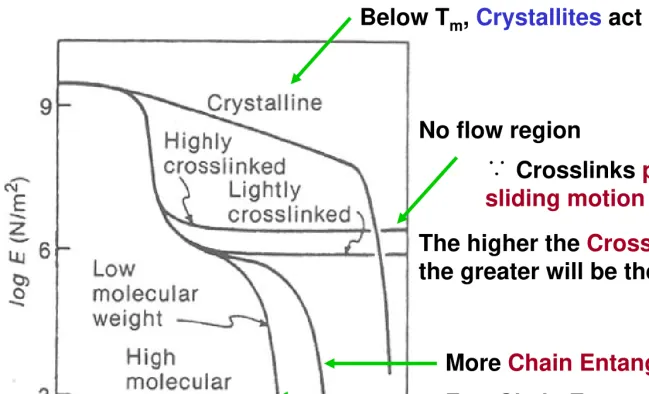
Fig 4.10. Effects of T on E of various polymers
Few Chain Entanglements More Chain Entanglements No flow region
∵ Crosslinks prevent sliding motion
Below Tm, Crystallites act as Crosslinks
The higher the Crosslink Density, the greater will be the Modulus.
MECHANICAL
PROPERTIES OF
SOLIDS
RHEOLOGICAL
PROPERTIES OF
FLUIDS
Strength Stiffness Toughness
Viscosity of polymer melts
Elastic properties of polymer melts
Creep
Stress Relaxation
POLYMERS TREATED AS SOLIDS
POLYMERS TREATED AS FLUIDS
Creep (Cold Flow), Stress Relaxation
Characteristic of Viscoelastic materials
Arise from the Slippage of polymer molecules
Time Dependent Properties:
Creep: Increase in strain when a polymer sample is subjected to a
constant stress
Stress Relaxation:
Chain Stiffening
(Bulky Side Groups, Cyclic Units, Crosslinking, Crystallinity) Tensile Strength
Flexural Strength
Compressive Strength
Tensile Elongation
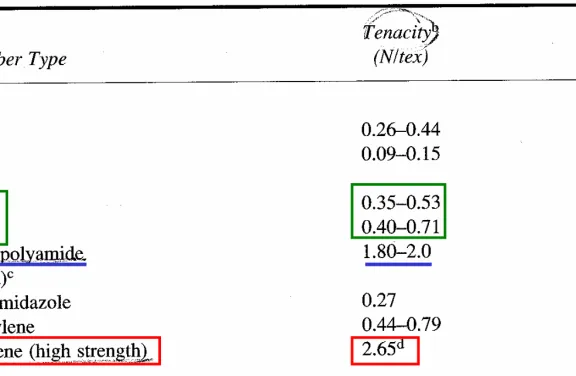
Table 4.2. Fiber Properties
Gel-Spinning
Convert ultra-high-M.W. (106) linear PE to a Gel with Solvent
Spinning and Drawing
Water
Solvent acts as a plasticizer
Gelly filament (containing a large amount of Solvent) 1-2 % UHMW-PE in a hot solvent (xylene)
Crystallization
Evaporation of solvent
Applications for High-Strength PE Fibers
- Cut-resistant industrial gloves
- Protective glove liners for health care workers
- Bulletproof vests
Viscoelasticity
If we stretch a crystalline solid, the energy is stored in the
chemical bonds
If we apply a shear stress to a fluid, energy is dissipated
in flow
VISCOELASTIC
Experimental Observations
•
Creep
•
Creep
and
Stress Relaxation
Creep
- deformation
under a
constant load
as a function of time
Stress Relaxation
-constant deformation
Creep
and
Strain
vs.
Time Plots
Stress Relaxation
The data are not usually reported as a
stress/time plot, but as a
modulus/time plot. This time dependent modulus,
called the relaxation modulus, is simply the time dependent stress divided by the
Viscoelastic
Properties
of Amorphous Polymers
Measured over
some arbitrary
time period
-s
ay
Viscoelastic Properties of Amorphous Polymers
Stretch sample an arbitrary amount, measure the stress required to maintain
this strain.
Time
Temperature
Equivalence
Increasing temperature
speeds up
the molecular disentanglement
Relaxation in Polymers
First consider a hypothetical
isolated chain in space, then imagine stretching this chain instantaneously so that there is a new end - to - end distance. The distribution of bond angles
(trans, gauche, etc) changes to accommodate the conformations that are allowed by the new
constraints on the ends.
Because it takes time for bond rotations to occur, particularly when we also add in the viscous forces due to neighbors, we say the chain RELAXES to the new
state and the relaxation is described by a characteristic time τ.
Strain vs. Time
for
Maxwell Model
Maxwell was interested in creep and stress relaxation and developed a differential equation to describe these properties
Maxwell started with Hooke’s law
Then allowed σ to vary with time
Writing for a Newtonian fluid
Then assuming that the rate of is simply a sum of these two contributions
ε
=
σ
E
dt
d
E
dt
d
ε
=
σ
dt
d
ε
η
=
σ
dt
d
E
1
dt
d
+
σ
MAXWELL MODEL –
Creep
and Recovery
A picture
representation of Maxwell’s equation
Recall that real viscoelastic
behavior looks something like this
Creep and recovery
Maxwell Model –
Stress Relaxation
In a stress relaxation experiment Hence
E
-Where
Maxwell Model –
Voigt Model
Maxwell model essentially assumes a uniform distribution of stress. Now assume uniform distribution of strain
- VOIGT MODEL
Equation
(Strain in both elements of the model is the same and the total
Voigt Model –
Creep
and
Stress Relaxation
Gives a retarded elastic response but does not allow for “ideal” stress relaxation, in that the model cannot be “instantaneously” deformed to a given strain.
But in CREEP σ = constant, σ0
τt = retardation time
( )
( )
( )
dt
t
d
t
E
t
=
σ
o=
ε
+
η
ε
Creep
Constant Stress, σo( )
( )
( )
dt
t
d
t
E
t
=
σ
o=
ε
+
η
ε
σ
( )
( )
dt
t
d
t
E
oε
η
=
ε
−
σ
( )
t 0dt
t
E
d
τ
=
ε
−
σ
ε
( )
( )
dt
t
d
E
t
E
o
−
ε
=
η
ε
σ
( )
⎟⎟
⎠
⎞
⎜⎜
⎝
⎛
τ
−
=
σ
ε
−
t ot
exp
E
t
1
( )
t o 0t
E
ln
t
E
ln
τ
=
σ
+
⎟
⎠
⎞
⎜
⎝
⎛
σ
−
ε
−
( )
⎟
⎟
⎠
⎞
⎜
⎜
⎝
⎛
⎟⎟
⎠
⎞
⎜⎜
⎝
⎛
τ
−
−
σ
=
ε
to
1
exp
t
Recovery
σ= 0
( )
( )
( )
0
dt
t
d
t
E
t
=
ε
+
η
ε
=
σ
( )
( )
dt
t
d
t
=
−
τ
tε
ε
( )
( )
t
dt
tt
d
τ
−
=
ε
ε
( )
( )
0
t
tt
ln
τ
−
=
ε
ε
( ) ( )
⎟⎟
⎠
⎞
⎜⎜
⎝
⎛
τ
−
ε
=
ε
tt
exp
0
t
( )
⎟
⎟
⎠
⎞
⎜
⎜
⎝
⎛
⎟⎟
⎠
⎞
⎜⎜
⎝
⎛
τ
−
−
σ
=
ε
t 1 o 1t
exp
1
E
t
( ) ( )
⎟⎟
⎠
⎞
⎜⎜
⎝
⎛
τ
−
−
⎟
⎟
⎠
⎞
⎜
⎜
⎝
⎛
⎟⎟
⎠
⎞
⎜⎜
⎝
⎛
τ
−
−
σ
=
⎟⎟
⎠
⎞
⎜⎜
⎝
⎛
τ
−
−
ε
=
ε
t 1 2 t 1 o t 1 2 1 2t
t
exp
t
exp
1
E
t
t
exp
t
t
t = 0 t1 t2
Creep
Problems with
Simple Models
• The Maxwell model cannot
account for a retarded elastic
response
• The Voigt model does not
describe stress relaxation
• Both models are characterized by single relaxation times - a spectrum of relaxation times would provide a better
description
Four – Parameter
Model
Elastic + viscous flow + retarded elastic
(e.g. CREEP)
( )
⎟
⎟
⎠
⎞
⎜
⎜
⎝
⎛
⎟⎟
⎠
⎞
⎜⎜
⎝
⎛
τ
−
−
σ
+
η
σ
+
σ
=
ε
t V o M o Mo
1
exp
t
E
t
0 t1 t2 M o
E
σ
1 2 3 4 1 = 2 = 3 = 4 = M 1 ot
η
σ
⎟⎟
⎠
⎞
⎜⎜
⎝
⎛
τ
−
−
⎟
⎟
⎠
⎞
⎜
⎜
⎝
⎛
⎟⎟
⎠
⎞
⎜⎜
⎝
⎛
τ
−
−
σ
+
η
σ
t 1 2 t 1 V o M 1o
1
exp
t
exp
t
t
E
t
( )
⎟
⎟
⎠
⎞
⎜
⎜
⎝
⎛
⎟⎟
⎠
⎞
⎜⎜
⎝
⎛
τ
−
−
σ
+
η
σ
+
σ
=
ε
t V o M o M ot
exp
1
E
t
E
t
( )
⎟
⎟
⎠
⎞
⎜
⎜
⎝
⎛
⎟⎟
⎠
⎞
⎜⎜
⎝
⎛
τ
−
−
σ
+
η
σ
+
σ
=
ε
t 1 V o M 1 o M o 1t
exp
1
E
t
E
t
⎟
⎟
⎠
⎞
⎜
⎜
⎝
⎛
⎟⎟
⎠
⎞
⎜⎜
⎝
⎛
τ
−
−
σ
+
η
σ
t 1 V o M 1o
1
exp
t
4.4 Thermal Stability
A) Origins of Decomposition
1) Bond breakage
Decreased materials properties
Depolymerization with many polymers
This is especially true with vinyl polymers 2) Aromatization upon heating
B) Thermally Stable Polymers
1) Primarily a function of Bond Energy
a) T↑ ⇒ Bond vibration ↑ ⇒ Bond rupture b) Cyclic repeating units:
Breaking of one bond in a ring does not lead to a decrease in M.W. and the probability of two bonds breaking within one ring is low
c) Ladder or semiladder polymers : Higher thermal stability than open-chain polymers
2) Thermooxidative Stability Values
a) Initial onset may be lower than those in inert atmospheres b) Initial decomposition is still via bond rupture
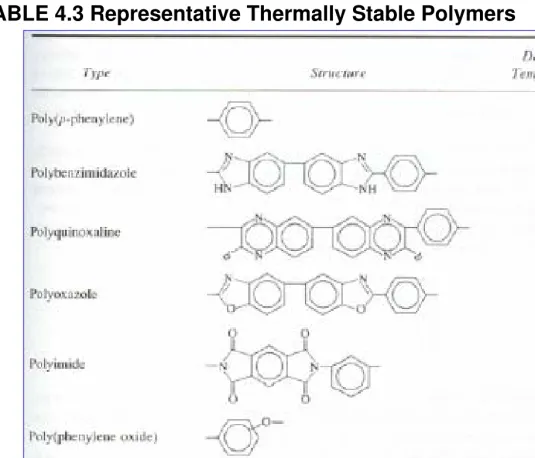
Polybenzimidazole (Hoechst Celanese, trade name PBI)
•
Rigid aromatic polymers :High Tg, High melt viscosity, Low solubility ∴ Intractable
Incorporation of “Flexibilizing groups”
such as ether or sulfone into the backbone
Greater solubility and lower viscosity but thermal stability suffers <Solution 1>
Introduction of cyclic aromatic groups that lie perpendicular to the planar aromatic backbone
Cardo polymers (from Lartin cardo : loop) <Solution 2>
Improved solubility
<Solution 3>
Incorporation of reactive groups into the polymer backbone
that undergo intramolecular cycloaddition on heating
Improved processability
∵ Longer flow times are possible because
little or no crosslinking takes place.
(Scheme 4.1)
Scheme 4.1 Increasing Tg of a polyquinoxaline by intramolecular cycloaddition
C
C
C
C
C
CH C
Aromatic oligomers or prepolymers capped with reactive end groups <Solution 4>
End-capped oligomers melt at relatively low temp. and are soluble in a variety of solvents.
On heating, they are converted to
thermally stable network polymers
Table 4.4 Reactive End Groups
for converting oligomers to network polymers
Phenylethynyl-terminated oligomers for aerospace applications
Cycloaddition or addition polymerization reactions of the end groups
Table 4.4 Reactive End Groups
for Converting Oligomers to Network Polymers
Type Structure
O C N
C CH N O O N O O C C Cyanate Ethynyl Maleimide Nadimide Phenylethynyl
Cure Temp (oC)
170 200 350
200
300
4.5. Flammability and Flame Resistance
Because synthetic polymers are used increasingly in construction and
transportation, considerable efforts has been expended to develop nonflammable polymers.
Most polymers
Inherently nonflammable : Poly(vinyl chloride) Polymers having a high halogen contents Self-extinguishing : Polycarbonate
● Burning Steps
1. An external heat source increases the polymer temp to a point where it begins to decompose and release combustible gases.
2. Once the gases ignite, the temp increases until the
Pyrolysis
zone
Diffusion
zone
Flame
front
1. Heat flux
3. Gas diffusion
5. Combustion 4. O2 2. Pyrolysis
(Endothermic)
○ Flame Chemistry
Flame contain atoms, free radicals, and ions
Dominant free radicals: H•, HO•, and •O•, and hydrocarbon species
● Branching reactions
•O• + H2 → HO• + H•
● Chain or propagation reactions HO• + H2 → H2O + H•
● Recombination reactions
* Hydrogen combustion
H• + H• → H2
H• + O2 → HO• + •O•
* Methane combustion
H•, HO•, •O•
CH4 CH3•
- H•
+ •O•
CH2O CH3•
- H•
CH2O
H•, HO•, •O• - H•
CHO•
CHO•
H•, HO•, •O• - H•
CO
+ HO•
CO2 CO
Monomer breaks down further to lower M.W. combustible
products, including hydrogen, as it diffuses toward the flame. Polystyrene, poly(methyl methacrylate) :
∵ Thermally induced depolymerization Combustible gases
High in monomer
Where depolymerization dose not occur, surface oxidation plays a role in generation of combustible gases.
Approaches to flame resistance
1. Retarding the combustion process in the vapor phase 2. Causing “char formation” in the pyrolysis zone
3. Adding materials that decompose either to give
1. Combustion occurs by a series of free radical propagation and radical transfer reactions
Reduce the concentration of radicals in the vapor by incorporating
radical traps into the polymer
e.g. Halogenated compounds
Hydrogen halide that is released reacts with free radicals to form
Polyesters prepared with 5 decompose on heating by the retrograde Diels-Alder reaction, and the resultant
hexachlorocyclopentadiene, 6, suppresses radical formation in the vapor phase and inhibits free radical depolymerization in the pyrolysis zone.
O O O Cl Cl Cl Cl Cl Cl 5 CO2 CO2 Cl Cl Cl Cl Cl
Cl Cl Cl
Cl Cl Cl Cl
CO2
CO2
6
Antimony oxides are often used in combination with halogen compounds
∵ Synergistic effects arising from formation of antimony halides
Disadvantage of halogen compounds : Toxicity of
Halogen in Sb-X FR system interrupts the high-energy hydrogen-oxygen branching and chain reactions by competing for
hydrogen atoms and hydroxyl radicals H• + HBr → H2 + Br•
HO• + HBr → H2O + Br• Br• + H • → HBr
Sb2O3 + Chlorinated organic compounds Sb2O3 + 2 HCl → 2 SbOCl + H2O
5 SbOCl → SbCl3 + Sb4O5Cl2 (170 – 280 oC)
3 Sb4O5Cl2 → 2 SbCl3 + 5 Sb2O3 (320 – 700 oC)
2. Char formation at the surface of polymer
Acts as a barrier to inhibit gaseous products from
diffusing to the flame, and to shield the polymer surface from the heat flux.
Aromatic polymers have a natural tendency toward char formation, which accounts for their generally low flammability.
∵ Crosslinking during pyrolysis Crosslinking increases char formation
Introduction of chloromethyl groups onto polystyrene
Phosphorus-containing compounds: Effective in reducing the flammablility of cellulose by promoting dehydration to yield unsaturated compounds that subsequently polymerize to a crosslinked char.
3. Hydrated alumina, Al2O3•3H2O
Evolve water endothermically to cool the pyrolysis zone
Toxic decomposition products and smoke
HCN ← N-containing polymers such as polyamides and polyurethanes
HCl ← Poly(vinyl chloride) CO ← Almost all polymers
Smoke arises from formation of acetylene and benzene, which condense to form soot particles.
4.6 Chemical Resistance
One of the problems that oil companies face with their huge
petroleum storage tanks: rusting away of the metal bottom from underneath.
<Remedy>
Spray-coating the inside floor of the tanks with glass fiber-reinforced unsaturated polyester
→ Lengthens the tank’s lifetime significantly
→ Avoids the expense of having to replace the tank bottom with steel
Two general approaches to increase chemical resistance
2. To reduce the # of ester groups per unit chain length Both increase the hydrophobic nature of the polyesters 1. To increase the steric hindrance about the ester groups
OCH2CHOH CH3 HOHCH2CO
H3C HO
H3C CH3
OH
Another approach:
To reduce the hydrophilic nature of the end groups
OH
OCNH
φ
O
+
φ
NCO
Phenyl isocyanate converts hydroxyl groups of polyesters to urethanes,
and carboxyl to amide
CO2H + φNCO CNHφ
O
Fluorine:
Element that imparts both water and solvent resistance to a variety of polymers
N P Cl
Cl
Polyphosphazene:
Very unstable in the presence of moisture
N P
OCH2CF3
OCH2CF3
Highly moisture resistant
CF2CF2
Ethylene-chlorotrifluoroethylene copolymer:
CH2CF2 CF2 CF
CF3
CH2CF2
A chemically resistant coating for underground cables.
For gaskets, sealants, valves, and so on, where resistance to lubricating fluids is necessary
Ozone:
Formed by the action of ultraviolet light or electrical discharge on oxygen
Degrades polymers containing double bonds in backbone by ozonolysis followed by hydrolysis
C C
O3
C O C
O O
H2O
C O + O C
<Solution>
Crystalline polymers:
Crosslinking increase solvent resistance
Particularly important in the microelctronics industry
Coating a substance with a polymer that crosslinks under the influence of light or ionizing radiation.
More resistant than amorphous counterparts ∵Close chain packing reduces permeability
A mask carrying the pattern to the transferred to the substrate is placed over the coated surface is irradiated.
The pattern allows radiation through, and those portions of the polymer thus exposed undergo crosslinking.
When the mask is removed, the unexposed parts of the polymer are dissloved with solvents, leaving behind the desired pattern.
Negative resist: the exposed portions of the surface becomes
Negative resists Positive resists
Fig. 4.12 Lithographic procedure in manufacture of integrated circuits
Crosslinking Polarity Change
Sunlight brings about polymer degradation
Monomer containing ultraviolet-absorbing chromophores such as 2,4-dihydroxy-4’-vinylbenzophenone have been incorporated into vinyl polymers to improve light stability.
O OH
4.7 Degradability
Most polymers: very durable Polymer waste products Degradable by sunlight and soil microorganisms
Photodegradable Biodegradable
New markets in agriculture, medicine, and microelectronics for polymers that degrade at a predictable rate.
A) Photochemically degradable = Photodegradable Incorporation of carbonyl groups
Absorb UV radiation to form excited states
Norrish type II reaction C O R H UV H O UV OH C OH R O C O R + + α β γ α β γ
Norrish type I reation C O C CH3 CH3 H3C
hν C O C CH3 CH3 H3C
C O
C CH3
CH3 H3C
+
1,2-biradical
Norrish type II reation
C O C H2 CH2 C H R1
R2 hν C O C H2 CH2 C
H R1
R2
C O
CH2 CH2 C H
R1 R2
+ C O CH3 C O C H2 CH2 C
B) Biodegradable polymers
Microorganisms degrade polymers by catalyzing hydrolysis and oxidation.
The lower the M.W., the more rapidly the polymer degrades.
C) Resist technology and controlled release applications.
Degradable polymers are used for positive resists
Herbicide 2,4-dichlorophenoxyacetic acid (2,4-D) has been
incorporated into polymers either as a chelate with iron (16) or as a hydrolyzable pendant ester group on a vinyl polymer (17).
C O Fe O R O O C R
O C O
-R
CH2 C CH3
CO2CH2CH2OCR O
(17) (16)
where
CH2O Cl
Cl
Controlled release based on polymer permeability to encapsulate the active reagent within a polymeric membrane or a strip.
Fig 4.13 Membrane-controlled release devices
Transdermal patches: release drugs through the skin
Degradable polyesters: used as disappearing surgical sutures.
Smart polymers: polymers that respond in a predictable way to change in temperature or polarity
CH2 CH
C
O
NHCH(CH3)2
e.g. Poly(N-isopropylacrylamide),
4.8 Electrical conductivity
CH2 CH
N
A) Poly(N-vinylcarbazole)
Photoconducting, conduct electricity a small degree under the influence of light
Used in the electrophotography (phtocopying) industry.
B) Poly(sulfur nitride) and polyacetylene:
C) Structural features for conduction
1. Delocalization: an extended conjugated system is usually necessary for backbone conductivity
Electron acceptors: e.g. AsF5 or halogen Electron donors: e.g. alkali metals
2. Doping Dopants:
Conductivity varies with dopant concentration 3. Morphology:
Conduction is influenced by configurational and conformational factors, as well as crystallinity.
Insulators: σ < 10-8 S/cm
Semiconductors: 10-7 < σ < 10-1 S/cm Conductors: σ > 102 S/cm
Polyacetylene
Trans σ = 4.4 ×10⁻⁵ S/cm
Doping apparently converts the red metallic-colored cis isomer to blue metallic trans.
Dopant forms a charge transfer complex with the polymer that give rise to highly delocalized cation radicals or anion radicals depending on whether the dopant is electron accepting or
donating, respectively
Poly(sulfur nitride): σ = 100 S/cm Superconductivity at T< 0.3 K
Cis σ = 1.7 ×10⁻⁹ S/cm
CH CH 3I2
CH CH Na
CH CH
CH CH
2I3
-Na+ +
2 +
The delocalized regions, called solitons, extend about 15 bond lengths, at which point the energy gain arising from lengthening of double bonds and shortening of single bonds apparently
outweighs stabilization arising from delocalization.
Soliton: neutral (radical), positive (carbocation), or negative(carboanion).
Change of bond lengths
Delocalization
Net energy gain
Conduction: movement of electrons intramolecularly and intermolecularly via the positive or negative solitons.
Intermolecular conduction is highly dependent on crystallinity, which accounts for the increase in polyacetylene’s conductivity (to as much as 1.5 ×10⁵ S/cm) when films of the polymer are
properly oriented.
Polyacetylene: Instability to air and moisture
More stable conducting polymers: polyaniline, polypyrrole, polythiophene, poly(p-phenylene), poly(p-phenylenevinylene)
reduced to
Typical dopants: AsF5, I2 AsF6- and I 3
Conjugated Organics
Polyaniline
Polypyrrole
Polythiophene
Poly(para-phenylene)
Poly(para-phenylenevinylene)
NH
N H
S
D) Typical applications:
a) Light-weight batteries b) Thin-film transistors c) Light-emitting diodes d) Antistatic materials e) Molecular electronics
E) Ionic conductors / Polyelectrolytes:
Solid electrolytes, polyelectrolytes for solid battery applications generally consist of polymers such as poly(ethylene oxide) or polyphosphazene in combination with metal salts.
4:1 ratio of poly(ethylene oxide) to NaBF4 is typical.
To function as an effective polyelectrolyte, the polymer should be highly amorphous and a low Tg to allow the freedom of molecular movement necessary for ion transport.
Poly(ethylene oxide)
P
(OCH2CH2)2OCH3
(OCH2CH2)2OCH3 N Polyphosphazene O O O O Na
4.9 Nonlinear Optical Properties
Conjugated polymers: a key role in photonics
Photonics = the use of photons instead of electrons for information and image processing.
Nonlinear Optical ( NLO) property :
Reflective index change in response to a light – induced electric field
NLO Chromophores :
Dipole moieties containing electron–donating groups at one end and electron–attracting groups at the other
∴ A large change in dipole moment is induced upon excitation For the polymer to exhibit NLO properties, the dipole moments must be aligned ⇒ Poled polymer
Heating above Tg, applying a strong electric field to bring about alignment , then cooling
No electric field
Electric field
Chromophores are incorporated into the polymer
Low – mol – wt compound dissolved (host – guest systems) Polymer backbone
Polymer side chain
CH2CH2N
H C C CN C O O CH2CH3
e- donor e- acceptor
POLYESTER BACKBONE N N N NO2 N O O CF3 F3C
N
O O
4. 10 Additives
Purpose
(1) To alter the properties of the polymer (2) To enhance processability