AN ANALYSIS OF THE TRANSLATION OF
SWEARING WORDS IN THE FILM ENTITLED
“BAD SANTA”
THESIS
Submitted as a Partial Fulfillment for Requirements for the Sarjana Sastra Degree in English Department
Faculty of Letters and Fine Arts Sebelas Maret University
By
ARUM KUSUMAYANI C0305017
ENGLISH DEPARTMENT
FACULTY OF LETTERS AND FINE ARTS
SEBELAS MARET UNIVERSITY
ii
AN ANALYSIS OF THE TRANSLATION OF
SWEARING WORDS IN THE FILM ENTITLED
“BAD SANTA”
Done by: Arum Kusumayani
C0305017
Thesis Consultant:
Dyah Ayu Nila Khrisna, SS, M.Hum NIP. 198302112006042001
Head of English Department
iii
AN ANALYSIS OF THE TRANSLATION OF
SWEARING WORDS IN THE FILM ENTITLED
“BAD SANTA”
Done by: Arum Kusumayani
C0305017
Accepted and approved by the board of examiners Faculty of Letters and Fine Arts of Sebelas Maret University on December 2010
1. Chairman:
Drs. S Budi Waskito, M.Pd ( )
NIP. 195211081983031001
2. Secretary:
Ardianna Nuraeni, SS, M.Hum ( )
NIP. 198209272008122001
3. First Examiner:
Dyah Ayu Nila Khrisna, S.S, M.Hum ( ) NIP. 198302112006042001
4. Second Examiner:
Ida Kusuma Dewi, S.S., M.A. ( )
NIP. 197105251998022001
The Dean of Faculty of Letters and Fine Arts Sebelas Maret University
iv
PRONOUNCEMENT
Name : Arum Kusumayani NIM : C 0305017
Stated whole-heartedly that this thesis entitled An Analysis of the Translation of Swearing Words in the Film entitled “Bad Santa” is originally made by the researcher. It is neither a plagiarism, nor made by others. Things relating to other people’s work are written in quotations and included in bibliography.
If it is then proved that the researcher cheats, the researcher is ready to take the responsibility.
Surakarta,
The Researcher
v MOTTO
“And when you want something, all the universe conspires in helping you to achieve it”
(The Alchemist)
“Anyone who has never made a mistake has never tried anything new”
vi
DEDICATION
vii
ACKNOWLEDGEMENT
All praise just for the Almighty God, Allah SWT, for the leading, blessing, love and guidance so that the researcher can complete this thesis. This thesis will not be complete without support and encourage from many people. Therefore, the writer would like to present her gratitude to those who have given important contribution to this thesis. I would like to express my gratitude to:
1. The Dean of Faculty of Letters and Fine Arts, Drs. Sudarno, M. A. for approving this thesis.
2. The Head of English Department, DR. Djatmiko, M. A, for giving permission to write this thesis.
3. Dyah Ayu Nila Khrisna, SS, M.Hum as my thesis supervisor, thank you for her patience, guidance, and advice in completing this thesis.
4.
Prof. Drs. MR. Nababan, M.Ed., M.A., Ph.D., the lecturer of the translation studies who has given so many great lessons dealing with translation.5. Ida Kusuma Dewi, S.S., M.A., as the lecturer of the translation studies. Thank you for precious knowledge given to me.
6. Herianto Nababan, S.S., Sumardiono, S.S., and Ardianna Nuraeni, SS, M.Hum as my raters. Thank them for the ideas and suggestions.
7. All of the lecturers in English Department whom I can not mention one by one. I thank them very much for every lesson, knowledge given to me.
8. My beloved mother and father who always give their love, care, pray, patience and support to finish this thesis. I love them so much.
viii
10.M. Siko Ardiansyah. I am so thankful for cheer me up and share his love, care, and support.
11.My lovely friends, Dini (thank her for accompanying and helping me through this happiness and sadness), Mew2 (thank her for this friendship and support), Mas Dion (thank him for lending me many books, wish God will recompense his kindness), Elis, Ismi, Ima, and Rupet (thank them for the advice and support. Glad to have you all as my partners), and for all my friends in ED 2005 whom I can not mention one by one (thank them for this friendship). 12.The member of Ajeng boarding house, imung and intan (thank them for the
ideas, suggestion, big support, and sisterhood), randut (thank her for this friendship and support), and the upper stair girls (thank them for everything).
The Researcher
ix
TABLE OF CONTENTS
THE APPROVAL OF THE CONSULTANT ... i
THE APPROVAL OF THE BOARD OF EXAMINERS ... ii
PRONOUNCEMENT ... iii
MOTTO ... iv
DEDICATION ... v
ACKNOWLEDGEMENT ... vi
TABLE OF CONTENTS ... vii
ABSTRACT ... xi
CHAPTER I: INTRODUCTION A. Research background……… 1
B. Problem Statements……….. 5
C. Research Objectives……… 5
D. Research Limitation……….. 4
E. Research Benefit……….. 4
F. Thesis Organization……….. 5
CHAPTER II: LITERATURE REVIEW A. Definition of Translation………... 8
B. Meaning in Translation……….. 10
C. Translation Technique………. 15
D. Translation Difficulty………. 22
E. Translation Quality Assessment………. 24
F. Definition of Swearing……….. 26
G. Swearing Word………. 29
x
I. Grammatical Pattern of Swearing Word……… 34
J. Degree of Offensiveness of Swearing Word………. 36
K. Synopsis……… 34
L. Review of Related Current Studies……….. 36
CHAPTER III: RESEARCH METHODOLOGY A. Type of Research ……….. 42
B. Source of the Data……….. 43
C. Data……….………... 40
D. Sample and Technique of Sampling……….. 43
E. Method of Data Collection………. 45
F. Technique of Data Analysis………... 45
G. Research Procedure………. 50
CHAPER IV: DATA ANALYSIS A. Introduction……… 53
B. Data Analysis………. 53
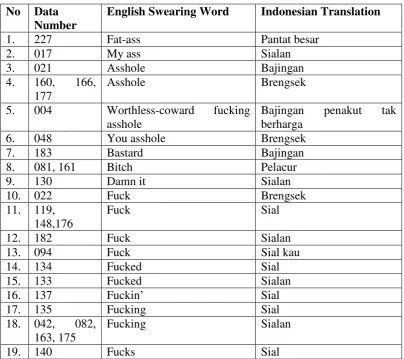
1. Analysis of the Technique in Translating Swearing Words…. 54 1.1.Similar Expressive Meaning……….. 54
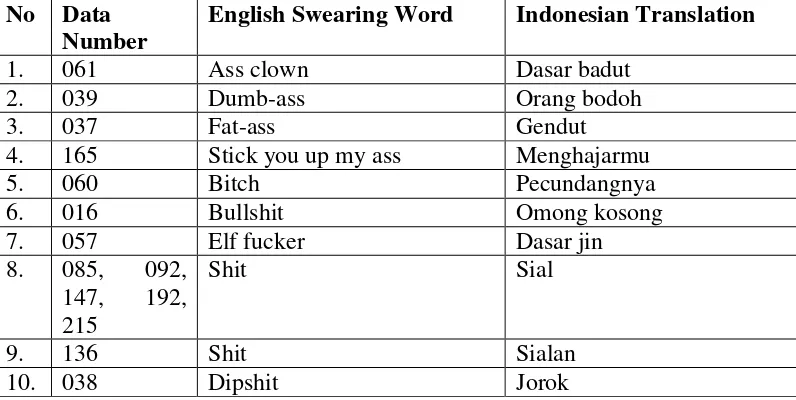
1.2.Less Expressive Meaning………. 60
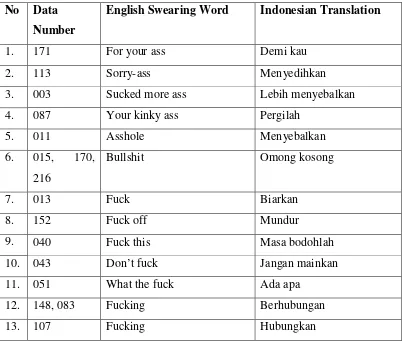
1.3.Neutral Word……… 64
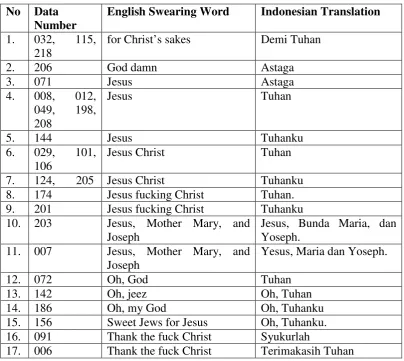
1.4.Interjection……….... 67
xi
2. The Accuracy and Acceptability Level of Translation……… 78
2.1.Accuracy……… 80
2.2.Acceptability……….. 91 3. The Influence of the Translation Technique Used by
the Translator toward the Accuracy and Acceptability
Level of Translation ……… ……….. 98
CHAPTER V: CONCLUSION AND RECOMMENDATION
A. Conclusion………. 103
B. Recommendation……… 105
xii swearing words in the film entitled “Bad Santa” and how the techniques are used by the translator in translating swearing words influence the accuracy and acceptability levels of the translation.
The research employed qualitative descriptive method with total sampling technique. This research used two kinds of data. The primary data of this research are all of swearing words and their translation taken from the movie entitled “Bad Santa”. While the secondary data are in form of questionnaire result given by the raters.
There are 227 data containing swearing words in this film. From the analysis, the researcher found five techniques applied by the translator in translating swearing words: translation using swearing word having similar expressive meaning covers 55 data, translation using swearing word having less expressive meaning covers 14 data, translation using neutral words covers 32 data, translation using interjection covers 26 data, and translation by omission covers 100 data.
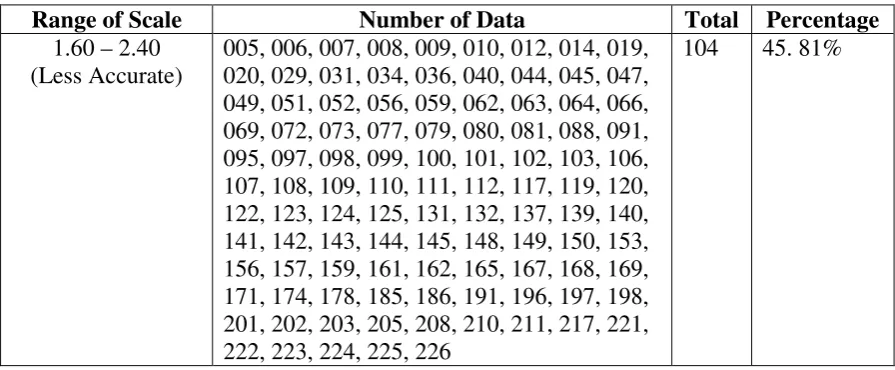
In accordance with the accuracy, the translation of swearing words in this film is less accurate. From 227 data, 87 data (38. 33%) were accurate, 104 data (45. 81%) were less accurate, and 36 data (15. 86%) were inaccurate. Dealing with the acceptability, the translation of swearing words in this film is acceptable. From 227 data, 204 data (89. 87%) were acceptable, 23 data (10.13%) were less acceptable, and no one of the data was unacceptable.
xiii CHAPTER I INTRODUCTION
A. Research Background
Edward Sapir in Bassnett and McGuire claims that “Language is a guide to social reality.” (1991: 13). Swearing is considered as a part of the language. It represents the culture where the society lives and is used as a means of communication in their daily life. For instance American black community uses swearing words to complete the sentences they uttered, as they are normal words. Swearing words are expressed by different community in different socio-cultural background. People assume swearing is a kind of response to something unexpected, upsetting or painful. It is considered being rude, blasphemous, insulting, and offensive. The concept of swearing word is considered indecent and inappropriate in polite context; however it exists in most languages and cultures.
According to Anderson and Trudgill (1992: 55) the form of swearing involves blasphemy and obscenity. Blasphemy refers to words which refer to Christian religion in a disrespectful way. It consists of heaven, hell, and their inhabitants. For instance: Jesus, Christ, God damn you, Hell, Go to hell, etc. Whereas, obscenity refers to words that refer to sexual organs and acts and also various body elimination processes and excretory substances. For instance: fuck, shit, fart, asshole etc.
xiv
intimacy or even is used as a ‘style giver’. For example the phrase: “You bloody old bastard” which is used as a greeting to a friend. Hence, it does not mean that it is socially acceptable because society in general makes a negative judgment for those who are swearing and using improper English. However, the society has ways of obliquely expressing the meaning of swearing word using synonyms, euphemism, and code words.
There is a great change of the use of swearing in different period of time. Several years ago some words are unusual and taboo to say, but nowadays it is already changed. The severity of blasphemous words has been in decline throughout the past century, in conjunction with a decline in strict Christian beliefs. Bloody, hell, burp and fart are now considered mild or very common. As a result, blasphemous words are replaced by some words which are consistently judged to be more offensive (abrasive, aggressive, impolite, profane, upsetting, etc.) than others. Sexual terms generally rated the most offensive. It is followed by excretory terms which, in turn, are typically judged more offensive than sacred terms. Specifically, fuck, shit, cunt, and motherfucker (in varying orders) have been rated as the most offensive words (http://scidok.sulb.uni-saarland.de/volltexte/2007/1173). Beside that, gender and social class also
xv
Globally, this is the age of mass communications, of multimedia experiences and a world where audiences demand the right to share the latest text, such as film, song, or book simultaneously across cultures. Therefore, there is a huge demand for (mainly) American productions and, in response to it, markets are flooded with them (http://accurapid.com/journal/32film.htm). Swearing words can be found easily especially through television as the communication media. It can not be denied that television presents many programs containing swearing words, for instance broadcasting movie which most of them are made by American. American films are regarded offensive and they consist of many swearing words. Therefore, they shock for some particular society. However, it should be translated well in the appropriate level so that it will be acceptable to the target audience.
There are some difficulties in translating swearing words from the source language (English) into the target language (Indonesia). They are the difficulties to translate the concept dealing with ecological problem, social culture, material culture, religious culture, and linguistic culture.
Therefore, the translator should transfer the message from the source language (SL) into the target language (TL) properly and accurately using some techniques to find the equivalent words which are acceptable to certain culture. For example:
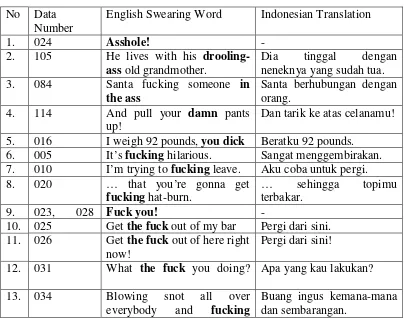
1. ST : Santa fucking someone in the ass TT : Santa berhubungan dengan orang.
xvi
Context of situation: Gin gives his comment of Chipeska’s complaint about Willie’s behavior in the dressing room.
The translator uses ‘translation using neutral word’ techniques in this dialogue. According to Encarta dictionary, the word ‘fuck’ or ‘fucking’ means to have sexual intercourse with someone. The translator makes the dialogue more polite by using ‘berhubungan’ instead of ‘bercinta’ to make it more acceptable in Indonesian culture where the society is avoid using offensive words.
2. ST : Who’s the bitch now, Santy Clause? Huh? TT : Siapa pecundangnya sekarang, Santa Clause?
(060/HT/1.2/A 23:23) Context of situation: The trouble maker in the bar insults Willy because Willie thinks that the trouble maker is a gay. The troublemaker surprises Willie with a flurry of effective punches. In moments, Willie is on the losing end of homosexual panic. The troublemaker swears at Willie.
The translator uses ‘translation using swearing word of less expressive meaning’ technique in this dialogue. ‘Bitch’ refers to female dog. In An English-Indonesian Dictionary ‘bitch’ mean ‘anjing betina/ perempuan jalang’. It can be seen that the translator translated the word ‘bitch’ is not as offensive as the real meaning in the source language (SL).
xvii
the movie entitled “Bad Santa” as the source of data because this film contains many swearing words. Besides, the story is interesting.
B. Problem Statements
Consider to the research background, the problems proposed in the present research are:
1. What are techniques used in translating swearing words in the film entitled “Bad Santa”?
2. How do the techniques influence the translator in translating swearing words in the case of the accuracy and acceptability levels of the translation?
C. Research Objectives The goals of this research are:
1. To find out what techniques used by the translator in translating the swearing words.
2. To reveal how the techniques used by the translator in translating the swearing words influence the accuracy and acceptability level of the translation.
D. Research Limitation
xviii
E. Research Benefits
The researcher hopes this research will be useful and beneficial for: 1. Subtitler/ Film Translator
This research expects to give benefit for translator in translating swearing word in the film.
2. Students
This research is expected to be useful for the student to give more knowledge about the technique in translating swearing words.
3. Other Researcher
xix
F. Thesis Organization
This research is arranged and divided into five chapters as follows:
Chapter I: Introduction. It consists of Research Background, Problem Statements, Research Objectives, Research Limitation, Research Benefit, Thesis Organization
Chapter II: Literature Review. It consists of Definition of Translation, Meaning in Translation, Translation Technique, Translation Difficulty, Translation Quality Assessment, Definition of Swearing, Swearing Word, Function of Swearing Word, Grammatical Pattern of Swearing Word, Degree of Offensiveness of Swearing Word, Synopsis, Review of Related Current Studies.
Chapter III: Research Methodology. It consists of Types of Research, Source of the Data, Data, Sample and Technique of Sampling, Method of Data Collection, Technique of Data Analysis, Research Procedure.
Chapter IV: Data Analysis. It consists of a process series of analyzing the data and classifying them in purpose to get the answers from the raised problems.
xx CHAPTER II LITERATURE REVIEW
A. Definition of Translation
There are various definition of translation proposed by experts. Brislin states “Translation is the general term referring to the transfer of thoughts and ideas from one language (source) to another (target), whether the languages are in written or oral form” (1976: 1).
In addition, Bassnett and McGuire define translation as follows:
What is generally understood as translation involves the rendering of a source language (SL) text into the target language (TL) so as to ensure that (1) the surface meaning of the two will be approximately similar and (2) the structures of the SL will be preserved as closely as possible but not so closely that the TL structures will be seriously distorted (1991: 2).
From this definition, it can be seen that Bassnett and McGuire emphasize that the process of translation produce the similarity in the surface meaning and the proper translation for the structures.
According to Nida “Translating consists of reproducing in the receptor language the closest natural equivalent of the source language message, first in term of meaning and secondly in terms of style” (1974: 14). This definition emphasizes that a translation product covers the closest natural equivalent of the source language message, in term of meaning and style.
xxi
B. Meaning in Translation
The meaning of a given word or set of words is best understood as the contribution that word or phrase can make to the meaning or function of the whole sentence or linguistic utterance where that word or phrase occurs. The meaning of a given word is governed not only by the external object or idea that particular word is supposed to refer to, but also by the use of that particular word or phrase in a particular way, in a particular context, and to a particular effect (http://accurapid.com/journal/14theory.htm). Cruse (in Baker, 1991: 13-16) distinguishes four main types of meaning in words and utterances as follows: 1. Propositional Meaning
The prepositional meaning of a word or an utterance arises from the relation between it and what it refers to or describes in a real or imaginary world, as conceived by the speakers of the particular language to which the word or utterance belongs. It is the type of meaning which provides the basis on which we can judge an utterance as true or false (ibid: 13).
In short, the statement above express that propositional meaning is a type of meaning which describes the real meaning of a word. For example, according to Encarta dictionary, the word ‘asshole’ (or ‘arsehole’ in British English) is a highly offensive term for the anus. It should not used to refer to the buttocks. 2. Expressive Meaning
“Expressive meaning cannot be judged as true or false. This is because it relates to the speaker’s feelings or attitude rather than to what words and utterances refer to” (ibid: 13).
xxii
female reproductive organ. The differences among them actually lie in the expressive meaning which is related to the context of situation in which the word is used. Vagina known as the most general word used to mention female genitalia while pussy and ‘cunt’ are considered vulgar and obscene. ‘Cunt’ is one of the most taboo words in the English language, and one of the few remaining words with a genuine power to shock. In a paper called "Delete Expletives" published in December 2000 stated that about 83% of respondents regarded ‘cunt’ as very severe.
3. Presupposed Meaning
“Presupposed meaning arises from co-occurrence restrictions, i.e. restrictions on what other words or expression we expect to see before or after a particular lexical unit” (ibid.:14).There are two types of these restrictions:
a) Selectional restriction
“These are a function of the propositional meaning of a word. Selectional restrictions are deliberately violated in the case of figurative language but are otherwise strictly observes” (ibid.). According to http://www.ctu.edu.vn/coursewares/supham/itdich/ch3.htm figurative or
xxiii
‘ass’ which can be meant animal resembling horse with long ears or as an offensive term.
b) Collocational restriction
“Collocational restrictions are semantically arbitrary restrictions which do not follow logically from the propositional meaning of a word” (ibid.). For example, Andersson and Trudgill (in Sri Haryati, 2006), in English, ‘Who the hell has been here?’ Is grammatically correct, but in Swedish is ‘Who in hell has been here?’
4. Evoked Meaning
“Evoke meaning arises from dialect and register variation. A dialect is a variety of language which has currency within a specific community or group of speakers” (ibid.: 15). It may be classified into:
a) Geographical, for example is the less offensive term for ‘posterior’ in the UK is ‘bum’ which in America might referred to as ‘butt’. However, in America the word as a noun means tramp or hobo, while as a verb means scrounge or borrow (http://www.bbc.co.uk/dna/h2g2/A753527).
b) Temporal (e.g. words and structure used by members of different groups within a community, or words used at different period in the history of a language) (1991: 15). For example, Hughes (in Sri Haryati, 2006: 13) states the variants of god, agad for example, was used at 1728, golly at 1742, gracious at 1760s, etc.
xxiv
distancing themselves from mainstream society and affirming their position as a member of particular social group. Other speakers are not only come from such backgrounds, but also from lower income and education.
“Register is a variety of language that a language user considers appropriate to a specific situation” (1991: 15). Register variation arises from variations in the following:
a) Field of discourse:
This is an abstract term for ‘what is going on’ that is relevant to the speaker’s choice of linguistic items. Different linguistic choices are made by different speakers depending on what kind of action other than the immediate action of speaking they see themselves as participating in (ibid.: 16).
For instance swearing word is used as a way of speaking that some people use to express their feelings of anger, annoyance, and frustration or when they want to hurt someone else's feelings. However, sometimes people swear because they think it is smart or funny.
b) Tenor of discourse: “An abstract term for the relationships between the people taking part in the discourse” (ibid.). According to Andersson and Trudgill (1992: 65-66) swearing is very typical of pheripheral groups (young people, the unemployed, alcoholics, and criminals).
xxv
translating is very needed to transfer the source language into written language in order to make the message acceptable for television audience. Those all are parts of lexical meaning. According to Baker “The lexical meaning of a word or lexical unit may be thought of as the specific value it has in a particular linguistic system and the ‘personality’ it acquires through usage within that system” (ibid: 12). In order to find the proper meaning in translating of swearing word, it is important to consider the contextual meaning in which swearing is said. Nababan (2008: 58) states “The meaning(s) that a word refers to are culturally bound, and in most cases the meaning(s) of a word can only be understood through its context of use”. According to http://www.ctu.edu.vn (in Adinugroho, 2008: 16) both lexical and contextual/situational meaning are parts of referential meaning since referential meaning refers to things in reality; dictionary meaning; also contextual meaning; talks about something out of the language extralinguistic; and culturally determined.
C. Translation Technique
Nababan defines translation technique as “Prosedur untuk menganalisa dan mengklasifikasikan bagaimana kesepadanan terjemahan berlangsung dan dapat diterapkan pada berbagai satuan lingual”. While according to Molina and Albir “We needed the category of translation technique that allowed us to describe the actual steps taken by the translator in each textual micro-unit and obtain clear data about the general methodological option chosen” (2001: 499).
xxvi
terminological but also conceptual. There is even a lack of consensus to what name to give to call the categories, different labels are used (procedures, techniques, strategies) and sometimes they are confused with the concepts. Furthermore, different classifications have been proposed and the terms often overlap (ibid).
Baker (1992: 26) labels the category (which is used to analyze translation) as strategies. She proposed several strategies of translation as follows:
1. Translation by a more general word
“This strategies dealing with the use of a general word (superordinate) to overcome a relative lack of specificity in the target language compared to the source language” (ibid.: 26-28).
The translator applies this technique by translating the source language word using a more general word in which covers the propositional meaning. The aim of this technique is to avoid the missing of hyponym in the target language beside what have been mentioned in the statement above.
For example:
English : She uses vacuum cleaner to clean the carpets
Indonesia : Dia menggunakan alat penghisap debu untuk membersihkan karpet 2. Translation by a more neutral/ less expression word
xxvii
through euphemism, synonyms, or code words. Moreover, Baker states “…and the expressive meaning of the word is therefore lost in translation” (1992: 30). For example:
English : Let me tell you something, motherfucker.
Indonesia : Biar kuberitahu kau, sialan.
3. Translation by cultural substitution
This strategy involves replacing a culture-specific item or expression with a target language item which does not have the same propositional meaning but is likely to have a similar impact on the target reader. The main advantage of using this strategy is that it gives the reader a concept with which s/he can identify something familiar and appealing (ibid: 31).
From the statement above, it can be concluded that the aim of this technique is to give a familiar concept without neglecting the norms which exist in the reader’s or audience’s community in order to make it accessible to people from other culture. It can be done by translating the source language word using a familiar and interesting word in which the reader or audience may identify.
For example:
English : He rudely ordered Karjo about, using language that one might use with a servant. (Mangunwijaya, 1993: 136)
Indonesia: Langsung ia berbahasa ngoko kepadanya, seperti kepada jongos (Mangunwijaya, 1989: 106-107)
( http://www.translationdirectory.com/article634.htm) 4. Translation using a loan word or loan word plus explanation
xxviii
The translator using loan word not because there is no equivalent word in the target language. It is used because there is an opinion that loan word represents the image of modern, smart, and high class. However, the use of loan word is considering the norms of translation which exist in the communities. Baker adds “The emphasis here is on evoked rather than propositional meaning” (ibid: 36).
For example:
English : The new walkman phone Sonny Ericsson W595 is completed with
share jack.
Indonesia : Walkman phone baru dari Sonny Ericsson W595 dilengkapi dengan
share jack.
5. Translation by paraphrase using related words
“This strategy tends to be used when the concept expressed by the source item is lexicalized in the target language but in a different form, and when the frequency with which a certain form is used in the source text is significantly higher than would be natural in the target language” (ibid: 34).
According to the statement above, this technique can be used if the concept of the original word is lexicalized to the target language word. The aim of technique is to avoid the repetition of word.
For example:
English : They offer 2 chicken thighs
Indonesia : Mereka menawarkan 2 daging paha ayam
xxix
6. Translation by paraphrase using unrelated words
If the concept by the source item is not lexicalized at all in the target language, the paraphrase strategy can still be used in some contexts. Instead of a related word, the paraphrase may be based on modifying a superordinate or simply on unpacking the meaning of the source item, particularly if the item in question is semantically complex (1992: 38). The paraphrase technique still can be applied even though the concept of the source language word is not lexicalized to the target language text. It can be done by modifying a word which meaning encompasses the meaning of another more specific word.
For example:
English : That painting really caught my eye
Indonesia : Lukisan itu sangat menarik perhatianku.
Back translated: That painting really attracted my attention
Sardjana (2005: 18) 7. Translation by omission
In fact it does no harm to omit translating a word or expression in some contexts. If the meaning conveyed by a particular items or expression is not vital enough to the development of the text to justify distracting the reader with lengthy explanation, translator can and often do simply omit translating the word or expression in question (ibid: 40).
xxx For example:
English : What the fuck are you doing here? Indonesia : Apa yang kau lakukan di sini? 8. Translation by illustration
“This is a useful option in the word which lacks an equivalent in the target language refers to physical entity which can be illustrated, particularly if there are restrictions on space and if the text has to remain short, concise, and to the point” (ibid: 42).
This technique shows the meaning of a word (which has a physical entity) by giving an illustration. The aim of this technique is to make the target reader easier in conceiving the representation of something which is intended.
For example:
English : Coca-Cola Zero or Coke Zero is the latest in a whole range of drinks from Coca-Cola Company
xxxi
9. Translation using an idiom/ expression of similar meaning and form
“This strategy involves using an idiom in the target language which conveys roughly the same meaning as that of the source-language idiom and, in addition, consists of equivalent lexical items” (ibid: 72).
From the statement above, it can be seen that in this technique the translator tries to find out the translation of the original word or expression in the target language which has the same meaning and same lexical item.
Example
SL : Where there’s a will, there’s a way. TL : Bila ada kemauan, pasti ada jalan.
Adinugroho (2008: 21) 10. Translation using an idiom/ expression of similar meaning but dissimilar
form
“It is often possible to find an idiom or fixed expression in the target language which has a meaning similar to that of the source idiom or expression, but which consist of different lexical item” (ibid: 74).
In short, idiom or expression of the source language text which has similar meaning but has different lexical item in the target language text may be translated using dissimilar form but must express the same meaning.
Example:
SL : It is raining cats and dogs TL : Hujannya lebat sekali
xxxii
D. Translation Difficulty
Every language has its own system which is different from one to another. That is the reason why translating is not an easy thing to do. Baker (1992: 21) states “The source-language word may express a concept which totally unknown in the target culture. The concept in question may be abstract or concrete; it may relate to a religious belief, a social custom, or even a type of food.” Moreover, Nababan states “Perbedaan budaya antara teks bahasa sumber dan bahasa sasaran menimbulkan ketakterjemahan budaya (cultural untranslatability)”
(2008: 54). According to Newmark (in Nababan, 2008: 54) cultural untranslatability relates to ecological problem, social culture, material culture, religious culture, and linguistic culture
1. Ecological problem
“Ecological problem occurs when translating a name of creature or phenomenon which exists in one place (in the source language) but not in the other place (in the target language)” Nida (1988: 95).
The difficulty in translating something dealing with the ecological problem is often faced by the translator. In this case, the difficulty to find the equivalent term is caused by the lack or even no similar concept of the source language into the target language.
2. Social culture
xxxiii
and finding the most appropriate technique of successfully conveying these aspects in the target language (TL)” (1975: 130).
“As language is one of the elements of culture, consequently, different cultural background is reflected in the usage of language in every society” (ibid.). Therefore, in translating the source language text the translator has to consider the acceptability of the equivalent term in the target language culture.
3. Material culture
The material culture of one place is often different from the others. As stated by Nida “material culture has something to do with different materials of each place” (ibid). This could be a difficulty for the translator in translating material culture since each place has their own material culture which dissimilar one another, for example things or tools which are produced by human.
4. Religious culture
xxxiv 5. Linguistic culture
Each language has their own linguistic system which is not always similar each other. Therefore, there is a difficulty in finding the equivalent term or structure in the target language. As stated by Nida “The fact that each language has its own characteristics either in grammar, vocabulary, or pronunciation makes the translator often experiences problems in choosing appropriate words in translating a text” (ibid.). As a matter of fact, there is a problem in translating English swearing word into Indonesian as a result of the complexity of English swearing word itself dealing with the difficulty to find the similar expressive or propositional meaning in Indonesia.
E. Translation Quality Assessment
Newmark defines “Translation quality assessment is a very important in the process of translation and it becomes a significant link between translation theory and its practice” (1988: 184). Dealing with Translation Quality Assessment there are three types of measurement of the translation quality: accuracy, acceptability, and readability.
1. Accuracy
xxxv
Accuracy is a term used in translation evaluation to refer to the extent to which a translation matches its original. While it is usually refers to preservation of the information content of ST in TT, with an accurate translation being generally literal rather than free, its actual meaning in the content of a given translation must depend on the type of equivalence (1997: 3)
While Baker states “Accuracy is no doubt an important aim in translation, but it is also important to bear in mind that the use of common target-language patterns which are familiar to the target reader plays an important role in keeping the communication channels open” (1992: 57). The capability of the translator to choose the correct words is needed to build an accurate translation.
2. Acceptability
Translation product should be natural in order to make it acceptable in target language system. Shuttleworth and Cowie (2007: 17) state “Translation which lean towards acceptability can thus be thought of as fulfilling the requirement of ‘reading as an original’ written in the target language rather than that of ‘reading as the original’, and consequently generally have a more natural ‘feel’”.
According to the statement above, it can be concluded that the level of acceptability of translation product can be determined if it fulfills the requirement of ‘reading as an original’.
3. Readability
xxxvi
cacat tetapi busuk dan berulat di bagian dalamnya”. It means that an easy-read translation may, after being compared to its original, betray the source message.
Based on the statement above, we can conclude that level of readability of a translation can be seen through the comprehension level of target text when it is read by the readers.
F. Definition of Swearing
The Oxford English Dictionary defines swearing as follows: “To utter a form of oath lightly or irreverently, as mere intensive, or an expression of anger, vexation or other strong feeling…to utter a profane oath, or use profane language habitually; more widely, to use bad language” (OED XVII:367). According to Eckert and McConnel “Swearing is widely considered an expression of very strong emotion: anger at specific others or simply deep frustration, often manifest as anger directed at the closest available target. It is viewed as potent language and can indeed sometimes achieve impressive effect” (2003: 181). While Anderson and Trudgill states “Swearing can be defined as a type of language use in which the expression (a) refers to something that is taboo and/or stigmatized in the culture; (b) should not be interpreted literally; (c) can be used to express strong emotions and attitudes” (1990: 53).
xxxvii (1) swearing
(a) I'm thinking about X
(b) I feel something bad because of that
(c) I want to say something bad because of that
(d) I want to say some words because of that that people think one should not say (e) I say: [#@!?*!]
(f) I imagine that by saying these words I could cause something bad to happen to something
(g) I imagine that by saying these words I could cause myself to feel better (h) I say this because I want to show what I feel
(Wierzbicka 1987:252-253)
The statements above show that swearing is a deliberately “bad” act designed for emotional expression. It explicitly acknowledges the importance of the speaker’s attitude and the fact that particular words will be used in such context.
Based on Echols and Shadily, the word ‘swearing’ or ‘cursing’ means
mengutuk or memaki (1988: 160). According KBBI (2007: 620) kutuk means n 1
xxxviii
kurang adat untuk menyatakan kemaran atau kejengkelan (ibid: 702). This word is similar to mengumpat which based on KBBI has several meanings as follows:
1. mengeluarkan umpat(an); memburuk-burukan orang; mengeluarkan kata-kata keji (kotor) karena marah (jengkel, kecewa, dsb); 2. mencerca; mencela keras; 3. memaki-maki; mengutuk orang karena merasa diperlakukan kurang baik. (2002: 1244).
Wijana and Rohmadi (2006: 125) state as follows:
Guna menjalankan fungsinya sebagai wahana pengungkap perasaan, bahasa memerlukan berbagai sarana. Bentuk- bentuk makian adalah sarana kebahasaan yang dibutuhkan oleh para penutur untuk mengekspresikan ketidaksenangan dan mereaksi berbagai fenomena yang menimbulkan perasaan seperti tiu. Dalam hal ini sekurang-kurangnya ada lima buah substansi yang sering dijadikan sasaran makian, yakni kebodohan (1), keabnormalan (2), sesuatu yang terkutuk atau dilarang agama (3), ketidakberuntungan (4), sesuatu yang menjijikkan (5), dan sesuatu yang menganggu hidup manusia dalam arti yang seluas-luasnya (6).
While according to http://edukasi.kompasiana.com/2010/01/23/umpatan-kompasioner-yang-marah/ swearing words are the evidence of language
universality
Umpatan barangkali juga merupakan bukti universalitas bahasa. Semua bahasa pasti mengandung kata umpatan apapun bentuknya. Dalam bahasa Indonesia umpatan yang kita jumpai biasanya berupa nama binatang, bagian tubuh manusia, atau sesuatu yang dianggap kotor atau menjijikan.
xxxix
G. Swearing Word
Swearing words regarded as bad words. There is an opinion that these words are not appropriate to use in front of the public. However, in a certain community, swearing words are used in social interactions.
As the definition given by Anderson and Trudgill, it can be seen that swearing word has a relation with taboo word because swearing word relate to something taboo to be said since it is considered vulgar. Taboo according Anderson and Trudgill is something relating to sex, religion, bodily functions, ethnic groups, food, dirt, and death (1990: 55). Asher (2003: 4512) adds “object, actions, and phenomena which are considered taboo in many societies are words that refer to processes and states of human biological existence; birth; death; pregnancy; various illnesses and diseases, menstruation, sexual and excretory activities, feces, urine, blood and semen; deceased person; animals considered to have special powers, ancestors, and benevolent and malevolent supernatural, being and their activities”. While “Swearing words are considered to be offensive, rude, insulting, and inappropriate or even ‘bad language’. The reason is that these words refer to things that are not to be delivered in public (usually unmentionable
bodily functions and sex); they are taboo.”
(http://accurapid.com/journal/37swear.htm). From the statement above, it can be seen that taboo word have broader meaning because it does not always carry a strong emotion as swearing word does.
xl
heaven and hell and their inhabitants. Another swearing word, such as piss off, cunt, and sod, come from two other areas from which many swearing words in many languages are taken- bodily functions and sex.
The meaning in swearing words sometimes can be translated literally or non-literally. There just a little number of swearing words used literally. Most of these were relatively mild word such as ‘damn’, ‘hell’ and ‘ass’. Non-literal use of swearing word mostly used as a way to express anger or annoyance, either in the form of a general interjection or a personal insult. For instance, the word ‘shit’. According Andersson and Trudgill (1990: 53) ‘shit’ literally refers to a taboo item, namely excrement. However, when it is used for swearing, it is not meant to the literal sense, but instead in an emotive sense. From its referential duties, we can use swearing words to express emotions and attitudes. Another example of terms rarely taken literally are ‘wanker’ (masturbation), ‘motherfucker’ (incest), ‘bastard’ (illegitimate family background), or ‘bugger’ (sexual deviance). These terms are used to show the emotion of the speaker.
xli
of euphemism is to protect the readers or audience from possible offence (Linfoot-ham, 2005). For example, the words ‘husky’ or ‘full-figured’ are euphemisms for the words ‘overweight’ or ‘fat’. Synonym refers to “a word that means the same, or almost the same, as another word in the same language, either in all of its specific uses or in a specific context” (Microsoft Encarta: 2008). For example many speakers will use the words ‘urine’ or ‘faces’ rather than ‘piss’ and ‘shit’. The use of code words is quite common. Some are phonetically similar to the taboo words, e.g., ‘shoot’ for ‘shit’ or ‘fudge’ for ‘fuck’ or they are phonetically similar nonsense syllables, e.g., ‘frig’ for ‘fuck’, ‘heck’ for ‘hell’.
As stated in the chapter one, swearing is a part of language which represents the culture where the society lives and is used as a communication device in their daily life. It means that swearing word exist in every community in different socio-cultural background, including Indonesia. However there are some differences when we compare the swearing word used in English and Indonesia. In fact, not every swearing word in English considered taboo in Indonesia, for instance the word referring to bodily functions and sex, and blasphemy. The word ‘cunt’ refers to women’s genitalia included as one of the most taboo words which is used in swearing in English. This word is similar to ‘vagina’ in Indonesian language. However, it can not be used as swearing word.
H. Function of Swearing Words
xlii
in the last minute of the game, there is no limit to strength, volume, and intensity of their ‘Damn it!’ or whatever alternative expression they use. The speaker of these words uses them to express strong feelings and to shock the listener which potentially arouses strong reactions. The use of swearing words gives the speaker a feeling such as a freedom from social conventions and constraints. It is used as a protest against what the speaker consider antiquated values regarding speech because using these words will make the listener uncomfortable. Swearing word is considered as a verbal aggression because it will force those who avoid these words. Andersson and Trudgill add “However, swearing does not have to be ‘emotional’. When swearing occurs with this kind of frequency, it is used as a ‘style-giver’” (1990: 53-54). They give an example as follows; there are nine uses of the word ‘bloody’. If these were pronounced with the same force as ‘Damn it!’ above, it would be difficult to deliver the lines or to listen to them. In some contexts the use of swearing words may show affection, admiration, enthusiasm, endearment, and so on. For example, close friend usually use swearing words when they are joking to show endearment. For instance the phrase: You bloody old bastard which is used as a greeting a friend.
However, Andersson and Trudgill (1990: 61) in further add that the use of swearing in relation to its function can be categorized into four types: two major types as expletive and abusive, and two secondary types of swearing that are humorous and auxiliary
1. Expletive
xliii 2. Abusive
It is directed towards others; derogatory; includes name-calling and different types of curses.
Examples: You bitch! , Fuck you! , You bastard! , Motherfucker! , Go to hell!
3. Humorous
It is said directly towards others but it is not derogatory. It often takes the form of abusive swearing but it has opposite function; it is playful instead of offensive.
Examples: Get your ass in gear!
4. Auxiliary
Here, swearing is as a way of speaking (“lazy swearing”); it is not said directly towards a person or situation. It is often or always non-emphatic.
Examples: The fucking x, motherfucking y, bloody z.
Based on the theory above, it can be concluded that swearing words is not only used to show strong emotion or to express strong feelings which potentially arouse strong reactions to shock their listener, but also to show affection, admiration, enthusiasm, endearment, and so on.
xliv
According to Andersson and Trudgill (1990: 58) there are only few taboo concepts or words used, but these can combine to other words and be used in fixed expressions to make up a fairly elaborate system of swearing. They also states about vocabulary of swearing which include not only simple swear-words (hell, fuck, etc.), but also compound words (skitbra), formulas (Go to hell), and frames (Who gives a---?) (ibid: 59).
Andersson and Trudgill (ibid: 61) state “The ordinary rules of the grammar taken together with the vocabulary of swearing give us grammatical swearing in that language”. The ordinary rule that applies specifically to swearing involves additions of swearing words or euphemism to question-words. Swearing word may intrude into several grammatical patterns:
1. As separate utterances (expletive and abusive):
“Shit! Jesus Christ! You bastard! God damn you!”
2. As ‘adsentences’ (loosely tied to a sentence, before or after):
“Shit, I forgot all about it.”
“You have to tell me, for God sake!”
3. As major constituents of a sentence (subject, verb, adverb, etc.):
“That stupid bastard came to see me” “He fucks up everything”
“He managed – God damn it – to get his degree”
4. As part of constituents of a sentence(adjective, adverb)
“This fucking train” “A bloody big house”
xlv
“Skitbra (shit good)” “Bilbelvet (car hell)” “Tenne – goddam – see” “Abso – bloody – lutely”
Andersson and Trudgill (1990: 62-63)
Hughes (1998: 31) divide swearing into eight categories based on the flexibilities as follows:
1. Personal : “You ----!”
2. Personal by reference : “The ----!”
3. Destinational : “---- off!”
4. Cursing : “---- you!”
5. General expletive of anger, annoyance, frustration : “----!” 6. Explicit expletive of anger, annoyance, frustration : “---- it!”
7. Capacity of adjective extension : “----ing” or “----y”
8. Verbal usage : “to ---- about”
xlvi
grammatical patterns can be used to set the formulas and to show many kinds of intentions and situations faced by the speaker as well.
J. Degree of Offensiveness of Swearing Word
According to
http://scidok.sulb.uni-saarland.de/volltexte/2007/17773/pdf/Beers Faegersten.pdf offensiveness is
traditionally determined by evaluative and semantic differentiation rating techniques. Research has revealed unequivocal evidence that swear words are highly offensive.
A paper called "Delete Expletives" published in December 2000 by British Broadcasting Standards Commission, Independent Television Commission, BBC
and Advertising Standards Authority; listed the profanities in order to decrease severity, the top ten being cunt, motherfucker, fuck, wanker, nigger, bastard, prick, bollocks, arsehole, and paki in that order. While Hargrave (in Sri Haryati,
2006: 24) states that the severity of the various English profanities/ swearing, as perceived by the public, can be ranked in an order as follows: cunt, motherfucker, fuck, wanker, nigger, bastard, prick, bollocks, arsehole, paki, shag, whore, twat,
piss off, spastic, slag, shit, dickhead, pissed off, arse, bugger, balls, Jew, sodding, Jesus Christ, crap, bloody, and God.
K. Synopsis
xlvii
holiday seasons as a mall Santa along with his dwarf friend, Marcus (Tony Cox), who works as Santa's elf. Every Christmas Eve, two of them disable the security alarm after the mall closes and rob the mall safe; afterwards, Marcus returns to living with his wife, Lois (Lauren Tom), while Willie goes to Miami and spends all his money on booze.
At the new mall they plan to steal from, Willie's alcoholic rants arouse the suspicion of mall manager Bob Chipeska (John Ritter), who asks security chief Gin (Bernie Mac) to investigate. Meanwhile, Willie meets bartender Sue (Lauren Graham), and they begin a relationship. He also meets a pudgy, preteen boy,
whom he nicknames the Kid (Brett Kelly), during their visit in the mall. When he leaves the bar and is confronted by a hostile man (Ajay Naidu), the Kid stops the man from beating up (and possibly raping) Willie after the guy falsely accuses Willie of being gay. A lonely, unpopular boy, the Kid lives with his senile grandmother (Cloris Leachman); his mother is dead and his father is in prison for embezzlement. After taking the Kid home to the Kid's father's mansion, Willie
breaks into the house safe, takes all the money, "borrows" his father's BMW, and winds up spending the money on more booze.
xlviii
which proves to be quite a convenience. During his time spent with the Kid, Willie starts to show small signs of kindness, offering advice when the Kid is beaten by bullies and playing checkers with the Kid.
Willie has a series of incidents in the mall in between his time spent with the Kid and Sue. During one of his lunch breaks, he yells at a mother and son after Marcus insults him. Marcus is continually disgusted by how unreliable Willie has become. Gin, meanwhile, discovers the history of Marcus and Willie and he demands half of the money and merchandise they plan to steal, creating further
friction between Willie and Marcus. Willie goes to the mall drunk the next day and destroys a reindeer display in a drunken rage, shocking the customers. Marcus and Gin try to cover it up, but get into an argument. The next day, Willie tries to commit suicide, giving the Kid a letter to give to the police when they would come to collect his corpse, explaining the mall robbery. He is motivated to live when he sees how the bullies have blackened the Kid's eye. He beats up the lead bully (Max Van Ville) as his friends run away and then gives the Kid a very
unsuccessful boxing lesson.
The Kid gives Willie a Christmas present in advance: a wooden pickle he bloodied when he cut himself carving it. He then gets a low-grade report card (all Cs, with the exception of one B), hoping to make Willie happy (from this, Willie learns the Kid's name: Thurman Merman). Thurman asks for a pink stuffed elephant this year, since he hadn't received any presents for the past two years.
xlix
After cracking the safe, Willie takes a stuffed elephant for Thurman. However, Marcus produces a gun and reveals that he is going to kill Willie because he finally has become too unreliable for the job. Willie, in tears, asks Marcus and Lois if they really need everything they steal. Fortunately for Willie, the police arrive, having been tipped off by Willie's letter that Thurman gave them. Willie flees and speeds to Thurman's house in order to give him his present; he arrives at the house and is shot eight times by the police in front of the whole neighborhood. Afterwards, Thurman gets his present and it is revealed that Willie has survived and will avoid prison time because of the letter he gave the police, and because "Everyone agrees that the Phoenix police department shooting an unarmed Santa Claus in front of children is more fucked up than Rodney King." Marcus and Lois are both arrested and are in prison. Willie, Sue, and Thurman will form a kind of family upon Willie's release from the hospital as Sue is legally given guardianship of Thurman. Furthermore, in an ironic twist of events, Willie is to be made a sensitivity trainer for the police department, so that "incidences such as [Willie's getting shot] will never again embarrass the whole fucking department”.
l
L. Review of Related Study
In the previous research, Annys Octaviana Sardjana, C0300015, English Department, Faculty of Letters and Arts, Sebelas Maret University, Surakarta, in her thesis entitled A Translation of Swearing Words in the Movie “8 Mile”, analyzed the strategies in translating swearing words and the accuracy of the translation. In her research, Sardjana applied purposive sampling technique. This technique takes all the data focusing on sentences having containing swearing word in order to make the sample can be analyzed selectively.
Another research entitled Analysis on the Translation of English Swearing Utterances in the Film entitled Sideways into Indonesia is done by Sri Haryati (2006), English Department, Faculty of Letters and Arts, Sebelas Maret University, Surakarta. Similar to Sardjana, she analyzed the strategies in translating swearing words and the accuracy of the translation. In her research, Sri Haryati applied a total sampling technique that is, if there are two or more the same swearing words or phrases with the same translation, the researcher took only one as datum. Sample of this research cover all of the collected data
li
lii CHAPTER III
RESEARCH METHODOLOGY
A. Type of Research
This research employs qualitative descriptive method in analyzing the way in which swearing is translated and to know the accuracy and acceptability of the translation in the movie “Bad Santa”. According to Sutopo, the data identified as qualitative since the data are in the form of words, sentences, or pictures rather than numbers” (2002: 35). (Wolcott (in Cresswell, 1994: 182) determined qualitative research as follows:
Qualitative research is fundamentally interpretive. This means that the researcher make an interpretation of the data. This includes developing a description of an individual or setting, analyzing data for themes or categories, and finally making an interpretation or drawing conclusions about its meaning personally and theoretically, starting the lessons learned, and offering further questions to be asked.
In addition, Cresswell (ibid: 185) states “The idea behind qualitative research is to purposefully select participants or sites (or documents or visual material) that will help the researcher understand the problem and the research question”. According to Moleong, qualitative research is a type of research which does not include any calculation and enumeration (2001: 2).
liii
Fraenkel & Wallen, 1990; Locke et al., 1987; Marshall & Rossman, 1989; and Merriam, 1988 (in Cresswell, 1994: 199) conclude that “The data that emerge from a qualitative study are descriptive. That is, data are reported in words (primarily the participant’s words) or pictures, rather than in numbers”.
It can be concluded that qualitative descriptive method which is used in this research conducted by interpreted the data including select the document , finding the data, collecting the data, classifying the data, analyzing data for categories, and interpreting the result or drawing the conclusion.
B. Source of Data
Sutopo (2002: 58) defines “Sumber data dalam penelitian kualitatif terdiri dari beragam jenis, bisa berupa orang, peristiwa dan tempat atau lokasi, benda, serta dokumen atau arsip”. In short, source of data refers to the subject where the data are derived from. There are two source of data used in this research.
The first was taken from the film entitled “Bad Santa”, completed with the Indonesian subtitle. This film is produced by Miramax International. The reason for choosing this film as the source of data was that the film contains a large number of swearing words beside the story are interesting.
The second one are the informants who are called raters. There are several criteria for the ratters:
liv
4. Having willingness to participate in this research by providing the information needed.
C. Data Sutopo defines data as follows:
Data dalam penelitian kualitatif biasanya (sebagian besar) berupa deskripsi dalam bentuk kalimat, dan catatan data tersebut disebut fieldnote atau catatan lapangan. Data pada dasarnya merupakan bahan mentah yang berhasil dikumpulkan oleh peneliti dari dunia yang dipelajarinya. Sebagian besar data merupakan catatan hasil wawancara dan observasi atau isi dokumen (2002: 73).
From the statement above it can be concluded that data refer to the objects of the research.
The primary data of this research are all of swearing words and their translation taken from the film entitled “Bad Santa”. While the secondary data are in form of questionnaire result given by the raters. It provided data in relation to the accuracy and acceptability of swearing words translation found in the movie.
The data were analyzed to find out the techniques used by the translator in translating the movie, and to reveal how the techniques used by the translator in translating the swearing words influence the accuracy and acceptability level of the translation.
D. Sample and Technique of Sampling
lv
information as many as possible from various constructions”. The samples used in this research are all the sentences which contain swearing words in the film entitled “Bad Santa”. If there are two or more the same swearing words or phrases with the same translation, the researcher took only one as datum. Sample of this research cover all of the collected data. Therefore, the researcher used a total sampling technique. According to Surakhmad total sampling is a technique in which the whole data becomes the sample. He states “Adalakanya masalah penarikan sample ditiadakan sama sekali dengan memasukkan seluruh populasi sebagai sample yakni selama jumlah populasi itu diketahui terbatas. Sample yang jumlahnya sebesar populasi seringkali disebut sampel total” (1994: 100)
E. Method of Data Collection
lvi
This scale was reformulated from the basic theory from Nagao, Tsujii, Nakamura (in Nababan 2004: 61). The scale is as follows:
Scale Description 3 = Accurate.
The translation of swearing words can deliver the same information; strong emotion or the language style of the speaker consist in the swearing words can be transferred by the translation.
2 = Less accurate.
The translation of swearing words does not deliver the same information and emotion; strong emotion or the language style of the speaker consists in the swearing words can not transferred by the translation.
Skala Keterangan
3 = Akurat.
Pesan yang terkandung dalam bahasa sumber tersampaikan dalam bahasa sasaran; emosi kuat atau gaya bahasa penutur yang terkandung dalam kata umpatan tersampaikan oleh terjemahan.
2 = Kurang akurat.
Pesan yang terkandung dalam bahasa sumber kurang dapat tersampaikan dalam bahasa sasaran; emosi kuat atau gaya bahasa penutur yang terkandung dalam kata umpatan tersampaikan kurang akurat oleh terjemahan.
1 = Tidak akurat.
lvii
Meanwhile, the scale for the acceptability assessment adapted from Machali (2000: 119-120) and Adinugroho (2008: 42) is as follows:
Scale Description 3= Acceptable
The translation of swearing words is accepted as linguistic and culture; the terms or the language style which are used are common in the target language. It also might be omitted or deleted because of the subjective consideration on the existence of the grammar and social norms in the target language society.
2= Less Acceptable
The translation of swearing words is not really accepted as linguistic and culture; the term or the language style used is not really common in the target language.
1= Unacceptable
The translation of swearing words is not accepted as linguistic and culture; the term or the language style used is not common in the target language.
Skala Keterangan
3= Berterima
Terjemahan kata umpatan berterima secara linguistik dan budaya; istilah-istilah/ ungkapan/ gaya bahasa yang digunakan lazim dalam bahasa sasaran atau dihilangkan (omitted/ deleted) oleh karena pertimbangan subyektifitas terhadap tata bahasa dan norma sosial yang terdapat dalam bahasa sasaran.
2= Kurang berterima
Terjemahan kata umpatan kurang berterima secara linguistik dan budaya; istilah-istilah/ ungkapan/ gaya bahasa yang digunakan kurang lazim dalam bahasa sasaran.
1= Tidak berterima
lviii
F. Technique of Data Analysis
The technique of analyzing data was carried out as follows: 1) Reading the data
The researcher read the English and Indonesian versions of each data and identified them.
2) Comparing the data
The researcher tried to compare the swearing words in the English version to their equivalence in Indonesia
3) Analyzing the technique used of the data
The researcher analyzed each category of data to find out the kinds of translation technique occurs in the data. Dealing with this, the researcher observed the translation technique used by the subtitler based on the fact of the data. Although Baker (1992) proposing ten translation techniques as a reference, the researcher only described the fact dealing with the translation technique applied on each data.
4) Analyzing the result of the questionnaire
lix
5) Analyzing the technique applied on the data are accurate and acceptable Based on the results of the analysis of the translation technique applied on each data and the analysis of the questionnaires, the researcher then observed whether the technique of the translation are accurate and acceptable.
6) Determining How do the techniques influence the translator in translating swearing words in the case of the accuracy and acceptability levels of the translation
Dealing with this, the researcher then determined how do the techniques used in translating swearing words influence the accuracy and acceptability level of the translation based on the result of the questionnaire.
7) Drawing conclusion
Based on the data analysis and research findings, the researcher made a conclusion and raised a suggestion.
G. Research Procedure
In conducting this research, the researcher took some steps as follows: 1) Collecting the data.
The researcher took the data which consist of all the swearing words and the translation found in the film entitled “Bad Santa”.
2) Sorting out the data