SOCIAL SCIENCES & HUMANITIES
Journal homepage: http://www.pertanika.upm.edu.my/
E-mail address:
[email protected] (Karomani)
Article history:
Received: 01 March 2016 Accepted: 08 September 2017 ARTICLE INFO
Intercultural Communication among the Local Elites in
Indonesia (A Study in Banten Province)
Karomani
Department of Communication, Faculty of Social Science and Politics, Lampung University, Jl. Soemantri Brodjonegoro, Bandar Lampung-Lampung Province, Indonesia
ABSTRACT
Research on intercultural communication with respect to cultural differences in an ethnic group has rarely been undertaken. Thus, this study is proposes a communication model among elites (namely ulamaks) in Menes district, Banten province, Indonesia using Goffman’s (1974) dramaturgy theory. Data was obtained from 24 informants from the district of Menes-Banten based on interviews, observation and documents. Findings show that Goffman’s impression management theory cannot be fully accepted, particularly ulama’s impression management model.
Keywords: Intercultural communication, local elites, impression management, Indonesia
INTRODUCTION
Background
Intercultural communication includes interracial, interethnic, and international communication (Rich, 1974; Samovar, Porter, & Jain, 1981). Numerous studies have explored patterns of interracial, interethnic, and international communication (Lu
However, very few studies focused on intercultural communication between different cultures within the same ethnic groups. Saied, Reza, Ameli, and Hamideh Molaei (2010) studied intra ethnic communication between Syiah and Sunnis in Iran. Ma (1999) examined intra-ethnic verbal communication and found that non-verbal communication plays an important role in intra-ethnic communication. This study was therefore, intended to examine intra-ethnic or intra-cultural communication among the Sundanese in South Banten, Indonesia with particular attention on verbal and non-verbal communication among jawara (powerful free men), ulama (Moslem clerics) and umaro (government officers). The study was based on impression management theory of Erving Goffman.
Jawara, ulama, and umaro in Banten (Indonesia) are local elites who have significant influence in the society. Ulama refers to an individual with adequate Islamic knowledge and is regarded as the primary source of society regarding various social
problems. Jawara is acknowledged as
having knowledge in community martial arts (silat). His role is to prevent chaos and disharmony among the Banten ethnic group
while Umaro is a government officer whose
major role is to oversee the community in the region of Banten. The ulama, jawara and umaro are mutually dependent on each other namely having a symbiotic relationship in the social construct and culture of Bantenese ethnic groups (Dewi, 2003: 243).
Although ulama, jawara, and umaro support each other, they often live in less harmonious situation mainly due to their different roles and interests. Ulamas are very strict in their religious tradition Jawara (who is not jawara-ulama type) has long been much influenced by a feudal system of indigenous leadership. This often leads to a serious conflict of interests among the jawara and ulama. On one hand, jawara is concerned with customs or feudal traditions which are influenced by Hindu culture. On the other hand, ulama, tries to erode the influence of Hindu teaching (Sunatra, 1997: 125). According to Nugraha (2006):
In the next development, especially ulamas, they became separate groups, and as if it has different schools. As the time goes by further change the image of jawara who used called as patriot to be people who simply sell muscle. Crime and hugger even attached. Even at local politics as direct elections of regional heads are rampant, jawara are mobilized by certain candidate as pollsters.
The Umaro is often viewed by other elites, ulama and jawara, as a source of potential conflict in society as their mission or message are sometimes considered as not in line with the expectations of society.
Sunatra (1997: 124) states that ulama,
jawara, and umaro in Menes-Banten
complementary leadership, but, they also lead to potential conflicts. The conflict is also due to communication problem between them, such as perceptions, prejudices, and so forth. In addition, the differences in cultural backgrounds, values, norms, attitudes, and ways of life among them can lead to potential conflicts.
Menes was chosen as the study area of the current research because it is known for its Islamic education as well as being the home town for famous. Menes, since the
turn of the 19th century, has become one
of the centres of Islamic education and for protesting against colonialism.
Research Framework
T h e c o m m u n i c a t i o n p a t t e r n o r t h e impression management between ulama, jawara, and umaro in Menes, Banten, the focus of this study, was explored on the basis of Goffman’s theory of Dramaturgis. The impression management, the process by which people control communications with others, plays an important role in interpersonal behaviour (Leary & Kowalski, 1990:34). Goffman (1974:32) believes that human social life can be divided into “front area” and the “back area”. The front area refers to social events that allow individuals play a formal role as an actor, in front of an audience. The front area is described by Goffman as the following:
that part of individual’s performance which regularly functions in a
general and fixed fashion to define
the situation for those who observe
the performance. Front, then, is the expressive equipment of a standard kind intentionally or unwittingly employed by the individual during his performance (Goffman, 1974: 32).
doctors). The style on the other hand relates to what kind role the actors are expected to play in certain situations such as using physical force and having a certain attitude., Goffman explain:
Appearance may be taken to refer to those stimuli which function at the time to tell us of the performer’s social statuses. These stimuli also tell us of the individual’s temporary ritual state: that is, whether he is engaging in formal social activity, work, or informal recreation; whether or not he is celebrating a new phase in the season cycle or in his life-cycle. Manner may be taken to refer to those stimuli which functions at the time to warn us of the interactions role the performer will expect to play in the oncoming situation (Goffman, 1974: 34-35).
Communication behaviour or impression management is coloured by perceptions and prejudices of local ulama elites, jawara and umaro based on Goffman’s theory. The theory describes how they interact, view, manage prejudices and communicate with each other.
METHODS
Approaches and Methods
The research approach of the current study is interpretive, phenomenological and naturalistic. It focuses on the meaning,
motives, background, rationality, and interrelationships(Creswell, 2002:136; 1997; 14) and its meaning is based on a social phenomenon (Verstehen).
Data Collection Procedures
The subjects were determined using purposive sampling. There were 24 informants, comprising three ethnic groups: Ulama, Jawara, and Umaro, each represented by 8 informants. Data was collected through interviews, observation and literature review related to the research problem. Triangulation technique was used to examine data based on the inter-subjective interpretation among jawara, ulama, and umaro.
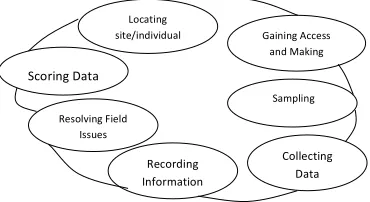
Creswell’s “a data collection circle” (Creswell, 1988:110) was adopted; the Creswell Model is outlined below:
Figure 1. A data collection circle Source. Creswell, 1988:110
9
Figure 1
Locating
site/individual Gaining Access and Making
Rapport
Sampling
Collecting Data Recording
Information Resolving Field
Issues
Scoring Data
Method of Data Analysis
The qualitative data in this study are statements, symptoms and non-verbal actions. Data analysis is performed simultaneously, namely data reduction, data display, and drawing conclusion or verification.
The researcher used a matrix of texts, graphs, and charts on the network side of the narrative text. Conclusions made in this study are verified during the research process. Verification in the form of a review or re-think of the field notes was done carefully and it took a long time to develop inter-subjective agreement. Validity test confirmed the reliability of data (Alwasilah, 2003:169).
To test the validity (credibility or validity of data), this research followed procedures as suggested by Alwasilah (2003:175-190)
To maintain reliability or trustworthiness, an audit trail was also done so the results of the study are valid.
RESULTS AND DISCUSSION
In this section Impression Management among the elites, ulama, jawara, and umaro in Menes, is discussed.
Impression Management Model
The communication of jawara with their community members and outsiders as well as with other elites such as ulama and umaro can be viewed as two different communication events. The first is back stage, while the second is front stage. When jawara communicates both with ulama
and umaro it is classified as the front
stage because of what they display when communicating with others is different compared with members of their own which can be seen as back stage. Based on participants’ observation and references to Gofman’s theory, the communication management model of communication
of jawara with ulama and umaro can be
described as below:
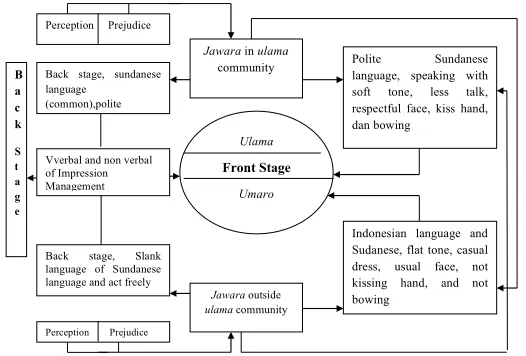
Figure 2. Impression Management Model of Jawara’s Communication with Ulama and Umaro
11
Vverbal and non verbal of Impression Management Back stage, sundanese language
(common),polite
Back stage, Slank language of Sundanese language and act freely
Jawara outside ulama community
Jawara in ulama
community Polite Sundanese
language, speaking with soft tone, less talk, respectful face, kiss hand, dan bowing
T h e m o d e l i l l u s t r a t e s j a w a r a’s communication with the ulama community, and outside both verbally and nonverbally. They speak the dialect of Sundanese Banten relatively “smooth with soft tones and a little talk with facial expression indicating respect (bending the face and body), and kiss the hands of ulama. However, they communicate with umaro in the Indonesian language, which is occasionally mixed with Sundanese language especially in official places such as village offices or district offices. They speak in a flat tone, and a facial expression indicating less respect. They neither kiss the hand nor bow. Interview with three jawara informants showed that the Jawara tended to speak more politely with ulama than they did with umaro. They regard the ulama as a role model in terms of attitude. This is an excerpt of their interview.
Jawara say to ulama: “Kumaha damang
abah?”
Jawara say to umaro: “Apa kabar pak?
The dialogue above indicates that the first greeting (in Sudanese) by jawara to ulama is more polite rather than second greeting (in Indonesian). (Interview 2015).
Impression management by jawara and
ulama differ significantly from that initiated
by jawara with a village head or a district head. This is due mainly to the jawara’s different perceptions and prejudice of the two groups of elites, ulama and umaro. Ulama were perceived by jawara as higher than both jawara and umaro as having higher social status, roles, and position in the
society.(Goffman, 1951: 294). The jawara regard ulama as a community builder and being a honourable person, while they perceive umaro as being venal. As a result,
jawara generally speak politely using
Sudanese language and sometimes switch to the Indonesian language with an ordinary tone of voice, not flat intonation, and speak slowly when they talk to the ulama. Unlike when speaking with ulama, jawara tended to speak with a patronizing tone, and with a lot of interruptions when talking with umaro, i.e., a village leader. However, they speak with more respect to umaro, particularly with those high ranking officers with a higher level of education such as when speaking with district heads compared with a village head. Fisher (1994: 57-60) suggests that experience, and socio-cultural factors, such as, educational level, occupation, social status and even psychological factors such as motivation, expectation, emotion affect social perceptions and behaviours are at play in this kind of situations. Even the nostalgia factor, a social emotion, has relevance to intergroup perception, in particular to prejudicial reactions (Cheung, Sedikides, Wildschut, 2017:96). This has coloured the communication behaviour of jawara both verbally and nonverbally. According to Moss and Tubb (2001: 56) and Rich (1974: 34), perception colours the behaviour of one’s communication. Kartika (2016) explains that perception greatly influences personal or community behaviour in Indonesian society.
ways communication between the different elite groups. They communicate using harsh language that is abusive (impolite Sudanese language), with a high intonation of voice or in a high pitch, interrupting each other, pointing their fists, hands on their hips, and sometimes even talking indecently. They also often a gossip about each other, irrespective of their social status or position in the society.
Although the jawara is perceived as not having good manners, the senior jawara is always respected by the junior. This is seen in the way they speak with each other. Juniors tend not to speak too roughly, loudly, or in a high pitch voice, and do not interject each other during a conversation. They avoid sitting before their senior jawara, particularly those with higher position in society, such as the head of the association of swordsman or another chairman of Jawara. They kiss the hand of the senior jawara as they do with the
ulama. Jawara who are subordinates tend to perform Impression Management when communicating with their seniors.
Model of Impression Management in
Communications of Umaro Against
Jawara and Ulama
The communication between umaro and outsiders and communication with other elites, both ulama and jawara, has two different components, namely back stage and front stage.
When the umaro is communicating
with ulama and Jawara it considered as the second stage, because of what is shown (the performance) them when communicating with other parties. This is in contrast with the umaro communicating among themselves, which in this study, is considered as back stage. Thus, the impression management model of communication of umaro vis a vis the jawara and ulama can be described below:
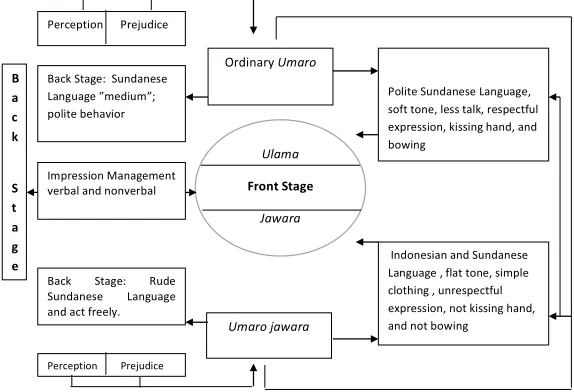
Figure 3. Impression Management Model of Communication of Umaro against Jawara and Ulama
14
Ulama
Front Stage
Jawara
Perception Prejudice Perception Prejudice
Ordinary Umaro
Impression Management verbal and nonverbal Back Stage: Sundanese Language ”medium”; polite behavior
Back Stage: Rude Sundanese Language and act freely.
Umaro jawara
Polite Sundanese Language, soft tone, less talk, respectful expression, kissing hand, and bowing
Indonesian and Sundanese Language , flat tone, simple clothing , unrespectful expression, not kissing hand, and not bowing
B a c k
Among the ulama, umaro as well as jawara - as depicted in the model, they speak politely in informal situations. In their homes, ulama, umaro and jawara generally use Sundanese Banten dialect and with respectful expression, bowed action, and kissing the hand of the ulama, especially a senior ulama. While in formal situations, such as meetings at the village or the district, the umaro generally speak in Indonesian, although sometimes he occasionally mixes it with Sundanese language. Like the jawara, the umaro speaks in Sundanese language instead of Indonesian when communicating
with ulama. This is a reflection of their
closeness and respect.
The reason for different communication style with regards to the ulama is that in the perception of umaro, they are more respectable than jawara. Ulama, especially senior or elderly ulama, must be respected. Their homage to ulama is coloured by their beliefs and worldview of umaro. The Ulama is considered as Warosatul Anbiya (heir to the prophet). This is the reason that is why they must be respected. When meeting with ulama such as, a in religious
ceremony, umaro generally wearing black
kopiah or a pilgrimage kopiah, in order to be presentable.
Umaro has different communication
behaviour or impression management when they meet the jawara and ulama. They wear plain Indonesian clothes and speak in Sudanese in a monotone, and use expressions of disrespect, without kissing hand, and bowing when meeting
with jawara. On the other, umaro do not
use Indonesian but rather Sundanese as mother tongue. It is supported by data from interview with two informants (umaro). Using Sundanese as mother tongue to ulama is intended to be more polite and presentable (interview 2015). This points to the distinction of treatment between ulama and jawara by umaro, that is, the
jawara is viewed by umaro as someone
who is potentially violent and commits petty crimes.
Impression Management Model in the
Communication of Ulama With Umaro
and Jawara
As with the other elites, the communication
between ulama and their fellows, and
communication with outsiders and
other elites, both umaro and jawara, are
considered different. Communication in the first event is classified as a back stage, while the second communication event is called
front stage. When the ulama communicate
with both umaro and jawara, it is considered
as the second stage because of what is shown (the performance).When a ulama communicates with others, it is characterised by unobtrusive communication. The Impression Management model in the communication of ulama with umaro and jawara can be described as below:
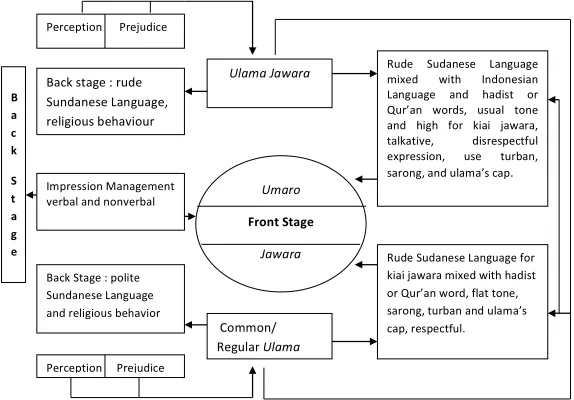
Figure 4. Impression Management Model of Communication of Ulama against Jawara and Umaro
17
Impression Management verbal and nonverbal Back stage : rude Sundanese Language, religious behaviour
Back Stage : polite Sundanese Language and religious behavior
Common/ Regular Ulama
Ulama Jawara Rude Sudanese Language mixed with Indonesian Language and hadist or Qur’an words, usual tone and high for kiai jawara, talkative, disrespectful expression, use turban, sarong, and ulama’s cap.
Rude Sudanese Language for kiai jawara mixed with hadist or Qur’an word, flat tone, sarong, turban and ulama’s cap, respectful. Umaro
Front Stage
Jawara Perception Prejudice
Perception Prejudice B
a c k
S t a g e
With the umaro, as well as with other guests, generally in informal settings, such as at home, ulama tend to speak using the dialect of Sudanese Banten relatively “smooth”, but ulama jawara still use Sudanese language which is regarded as being rude. In formal situations at work, such as in an official ceremony in village or in district or other events, such as religious holidays commemoration, take
place formally where ulama generally communicate with umaro using Indonesian language, although sometimes remain intermingled with Sundanese language. When an ulama talk to umaro, he frequently cites or intersperses his speech with Qoranic
verses or Alhadist for the purpose of
preaching and advising umaro.
The Ulama when communicating
management of communications. Based on the interview with three ulama, it was found they use Sundanese to both of two groups, umaro and jawara, in formal settings (Interview 2015). In certain circumstances, there is a different treatment of Impression Management between umaro and jawara. When an ulama meets either umaro or jawara, they are accustomed to wearing koko (moslem dress) or a long-sleeved shirt, with a kopiah (cap) or a pilgrim cap, and a turban. The turban is not viewed as the symbol of an ulama or a Hajj, rather, it is regarded as Sunnah. When the ulama communicate with both umaro and even jawara, they do not show respect to other groups of elites as they are used to doing that to the ulama. This indicates that men though regarded as equals, the treatment also varies based on their religious status .
Communication by ulama with other groups of elites as previously described is slightly different from that with others in their community. On the back of stage, ulama communicates differently with the jawara who has “bad” manners within their
community. Ulama in their community
appear to have better etiquette and conduct than the jawara. When ulama talk to each other, their communication is warm and pleasant and they often joke among themselves, with occasional arguments on matters related to religion. However, the jokes and debate are done respectfully, using “polite” language, This is different from the communication among the jawara characterised by harsh language. Under certain circumstances, on the back stage,
when students meet with their ulama, they use Impression Management such as, bowing and kissing their hand.
A s d i s c u s s e d , t h e I m p r e s s i o n Management of ulama vis a vis the umaro
and jawara is similar. The difference is
simply a matter of verbal Impression
Management. The Ulama is often called
jawara baragajul, that is, an individual with bad manners. They refer to the
umaro as educated people. The nonverbal
communication between ulama and jawara is characterised by the use of a personal
space. For example, ulama is always
seated in the front row along with umaro in every single social or religious event. This allows ulama to get closer to umaro. This form of familiarity suggests differences in Impression Management both verbally and nonverbally by ulama with regards to umaro and jawara. The differences are coloured by perceptions and prejudices of ulama against umaro and jawara. The Ulama generally has a more negative perception and prejudice
against jawara in contrast with umaro.
Jawara, in the eyes of ulama, is identical with those who commit violence and often breach religious rules or teachings.
CONCLUSION
Similarly, impression management by umaro to ulama and jawara is different. On one hand, the umaro gives more respect to the ulama than to jawara. They perceive ulamas as leaders who are a role model for society and therefore, they need to be respected by the members of the ethnic group. On the other hand, jawara is often regarded as one who is willing to commit violence.
Impression management by ulama is not special in the sense that the ulama does not show respect to both elites of ethnic
groups, umaro and jawara. In addition,
quoting Qur’an verses and Alhadist is not intended to build an image that they need to be respected as ulama; rather, it is for the sake of missionary endeavour in order to seek blessings from God. This suggests that Goffman’s theory cannot be accepted fully, as this study has proven communication is loaded with pragmatism and idealism.
REFERENCES
Alwasilah, A. C. (2003). Pokoknya Kualitatif. Dasar-dasar Merancang dan Melakukan Penelitian Kualitatif. Jakarta: Pustaka Jaya.
Ameli, S. R., & Molaei, H. (2012). Religious affiliation and intercultural sensitivity: Interculturality between Shia and Sunni Muslims in Iran. International Journal of Intercultural Relations, 36(2012), 31– 40. doi:10.1016/j. ijintrel.2010.11.007
Cheung, W. Y., Sedikides, C., & Wildschut, T. (2017). Nostalgia proneness and reduced prejudice. Personality and Individual Differences, 109(2017), 89–97. Retrieved May 5, 2017, from http://dx.doi.org/10.1016/j.paid.2016.12.045 Chitty, N. (2010). Mapping Asian international
communication. Asian Journal of Communication, 20(2), 181-196. Retrieved July 31, 2017, from http://dx.doi.org/10.1080/01292981003693377 Creswell, J. W. (1988). Qualitative Inquiry and
Research Design Choosing Among Five Traditions. India: Sage Publication Inc.
Dewi, K. H. (2003). Kepemimpinan Kiai dan Jawara di Banten Pengaruhnya terhadap Good Governance. Banten: LSPB.
Durant, A., & Shepherd, I. (2009). ‘Culture’ and ‘Communication’ in Intercultural Communication. European Journal of English Studies, 13(2), 147-162. Retrieved July 31, 2014, from http://dx.doi. org/10.1080/13825570902907185
Fisher, B. A., & Adams, K. L. (1994). Interpersonal C o m m u n i c a t i o n P r a g m a t i c s o f H u m a n Relationship. New York, NY: McGraw Hill. Inc.
Goffman, E. (1974). The Presentation of Self in Everyday Life. USA: Penguin Books.
Kartika, T. (2016). Media, Cosmetic Dengarous, NA-DFC (The National OF Drug and Food Agency) Badan Pom Republik Indonesia. The Social Sciences, 11(7), 1350-1354.
Lu, Y., & Hsu, C. F. (2008). Willingness to Communicate in Intercultural Interactions between Chinese and Americans. Journal of Intercultural Communication Research, 37(2), 75-88. Retrieved July 31, 2014, from http:// dx.doi.org/ 10.1080/ 17475750802533356 Ma, R. (1999). The relationship between intercultural
and nonverbal communication revisited: From facial expression to discrimination. New Jersey Journal of Communication, 7(2), 180-189. Retrieved July 31, 2014, from http://dx.doi. org/10.1080/15456879909367366
Mark, R. L., & Robin, M. K. (1990). Impression Management: A Literature Reviews and Two-Component Model. Psihological Bulletin, 107(1), 34-47.
McQuail, D., & Windahl, S. (1984). Communication Models for Study of Mass Communications. New York, NY: Longman., Inc.
Mulyana, D. (2001). Metodologi Penelitian Kualitatif. Bandung: PT Remaja Rosda Karya.
Nugraha, P. (2006). Jawara sebagai Kenyataan Sosial. Retrieved from http://www.kompas.com Panggabean, H., Juliana, M., & Hora, T. (2013).
Profiling intercultural competence of Indonesians
in Asian Workgroups. International Journal of Intercultural Relations, 37(2013), 86–98. Retrieved July 31, 2014, from http://dx.doi. org/10.1016/j.ijintrel.2012.04.002
Rich, A. L. (1974). Interracial Communication. New York: Harper & Row Publishers.
Samovar, L. A., Porter, R. E., & Jain, N. C. (1981). Understanding Intercultural Communication. California: Wadsworth Publishing Company. Sharifian, F. (2010). Cultural conceptualisations
in intercultural communication: A study of Aboriginal and non-Aboriginal Australians. Journal of Pragmatics, 42(2010), 3367–3376. doi:10.1016/j.pragma.2010.05.006.
Silva, L. C., Campbell, K., & Wright, D. W. (2012). Intercultural Relationships: Entry, Adjustment, and Cultural Negotiations. Journal of Comparative Family Studies, 43(6), 857-870. Retrieved July 31, 2014, from http:// www.jstor. org/ stable/41756274
Sunatra. (1997). Integrasi dan Konflik Kedudukan Politik Jawara dan Ulama dalam Budaya Lokal. Studi Kasus Kepemimpinan di Banten. Bandung: PPs Unpad.